Post Syndicated from John Walker original https://aws.amazon.com/blogs/architecture/align-your-architecture-backlog-with-tech-roadmap-prioritization-trp/
What do the organizations that succeed at digital transformation have in common? They align business and technical stakeholders around a shared plan before writing a single line of code. Yet research from McKinsey shows that 70 percent of transformations fail. Stakeholder misalignment and the inability to scale initiatives beyond initial pilots are patterns we see repeatedly across these failures. Before you architect your workloads, your team must agree on which ones deserve focus first.
In this post, we show you how to run a one-hour prioritization session with your stakeholders, plot competing initiatives on a shared matrix by cost and impact and turn the result into an actionable architecture backlog – using a framework called Tech Roadmap Prioritization (TRP).
The architect’s challenge
You’re facilitating alignment between five competing initiatives, but your organization only has capacity to execute two. Who decides? Without structure, decisions default to political influence or recency bias. High-value work stalls while low-impact projects consume resources.
Consider this scenario: your organization has competing initiatives such as a new product launch, application modernization, sales expansion, and security upgrades. Business and technical leaders each hold different priorities, share no view of tradeoffs, and have no shared way to decide what gets done first.
Developers work story backlogs. Support teams work ticket queues. As an architect, your backlog is the set of prioritized initiatives your organization needs to execute, and TRP is how you build it with your stakeholders.
The TRP framework
In approximately one hour, you bring business and technical owners into the same room and build a shared roadmap together. At every stage of your cloud journey, you face competing workloads that require your team’s attention. TRP gives you a repeatable way to decide which ones come first. You produce a single visual artifact: a modified prioritization matrix adapted for architecture roadmapping that plots your initiatives by cost and complexity against business impact.
The initiatives that you surface in TRP feed directly into the AWS Cloud Adoption Framework (AWS CAF) Envision phase, where you can connect business goals to enabling technologies and evaluate initiatives across the CAF’s six perspectives. TRP gives you the starting artifact and AWS CAF gives you the structured analysis that follows.
Why a visual roadmap?
You track your technology initiatives across spreadsheets, slide decks, and hallway conversations. Your business leaders frame urgency in revenue terms. Your technical leaders frame it in risk terms. No single artifact exists where both can view every initiative, its relative priority, and the reasoning behind it. TRP produces that artifact. One hour, one room, one artifact. You plot each initiative on a matrix where position alone communicates priority, and the conversation shifts from “my initiative matters more” to “where does this land relative to everything else?”
The TRP matrix
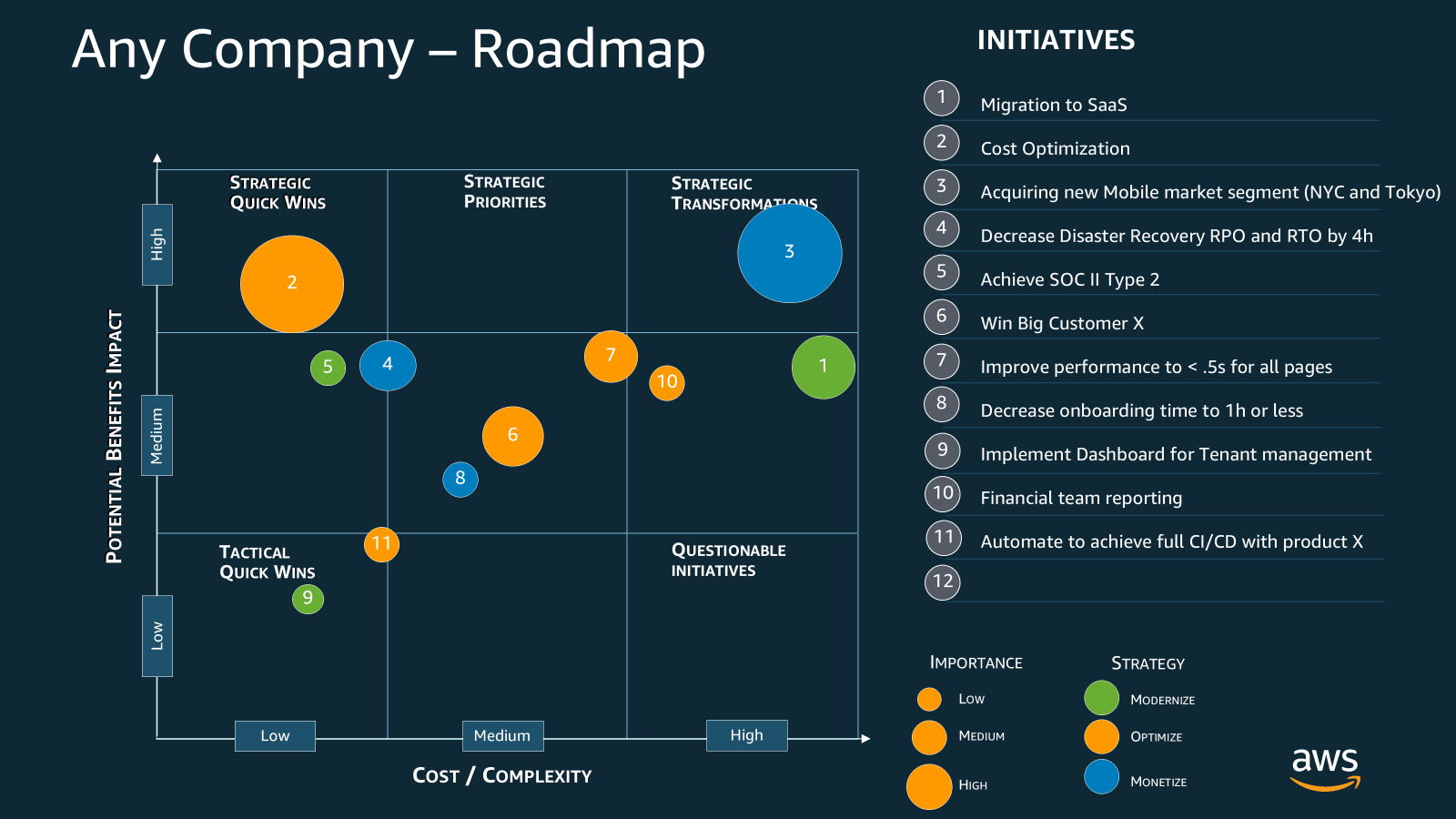
You represent each initiative as a numbered bubble. The numbers are identifiers, not a priority ranking. Priority is determined by position on the matrix, which you read using five visual cues:
- X-axis position: Cost and complexity of the initiative (low to high).
- Y-axis position: Potential benefits and business impact (low to high).
- Bubble size: Strategic importance to the organization (small = low, large = high).
- Bubble color: Strategy type based on the Modernize, Optimize, Monetize (MOM) framework. Healthy cloud architectures balance all three: yellow = Modernize (improve what exists), blue = Optimize (reduce cost or increase efficiency), green = Monetize (generate new revenue).
- Position on the matrix: Where a bubble lands reveals its priority. Upper-left = strategic quick wins (high impact, low cost). Upper-right = strategic transformations (high impact, high cost). Lower-left = tactical quick wins. Lower-right = questionable initiatives that should wait.
What each position tells you to do
After you plot your initiatives, position on the matrix tells you more than priority. It tells you what kind of work comes next.
Upper-left: Strategic quick wins. High impact, low cost. You execute these now. Assign an owner, set a delivery date, and get moving. These build momentum and demonstrate early value to your stakeholders.
Upper-right: Strategic transformations. High impact, high cost. Look at a large blue bubble here, like initiative 1 (Migration to SaaS) in the sample. This delivers high value but carries significant risk. You don’t commit resources to this on day one. You de-risk it first. Run a proof of concept. Schedule workshops to close skill gaps. Identify the complexity drivers and investment requirements, then remove them before you scale. Your job as the facilitator is to define the path from “we want this” to “we’re ready to build this.” For initiatives requiring skills your organization lacks, engage AWS Partners to de-risk and accelerate the work.
Lower-left: Tactical quick wins. Low impact, low cost. Delegate or batch these small wins together. They won’t move the needle on their own, but they clear the backlog and free up attention for the strategic work above.
Lower-right: Questionable initiatives. Low impact, high cost. You park these. They stay visible on the matrix so stakeholders know they haven’t been forgotten, but you don’t invest in them until the business case changes. If someone pushes for one of these, you point to the matrix and ask what moves off the board to make room.
Your architecture decisions start here. Each quadrant demands a different response, and the matrix gives you the shared language to explain why.
Look at initiative 2 in the sample, Cost Optimization. It sits in the upper-left as a large yellow bubble: high impact, low cost, high strategic importance, optimization strategy. That is your first move. Initiative 1 (Migration to SaaS) ranks second: high impact but high cost, meaning you de-risk it before committing. You read every initiative the same way, and the full priority order emerges from the diagram itself.
Now that you know how to read the matrix, here’s how to run the session that creates it.
How to run a one-hour roadmap session
You are the facilitator, not a participant, not a decision-maker. The decisions belong to the business and technical owners in the room. Your role is to keep the group moving, protect the scope, and ensure every voice is heard. TRP isn’t a substitute for capacity planning, project sequencing, or backlog management – those follow TRP and are handled by project management, product owners, and technical owners. What TRP produces is the shared prioritization artifact that informs all of those downstream functions.
You’re answering four questions per initiative, relative to one another. That is the entire scope. Keep the group focused on relative positioning, not detailed analysis. Target 60 minutes. For larger groups, budget 90. The hour works when you protect the scope.
1. Get the right people in the room
Invite people who can make decisions and commit resources. Bring your CTO, VP of Engineering, product leaders, and line-of-business owners. If you don’t have access to those people, find the person who does. That’s your sponsor up your chain of command. Seat business owners and technical owners at the same table. Whether your organization has dedicated roles for each or one person wears multiple hats, the key is getting the people who understand the business priorities and the people who understand the technical complexity into the same conversation.
2. Bring the set of initiatives
Gather your list of competing initiatives before the session. Aim for 5–15. Too few and the exercise feels trivial, too many and you won’t finish in an hour. Pull from your existing project proposals, strategic plans, customer requests, and technical debt backlog. Write a name and a one-sentence description for each one that everyone in the room can understand.
3. Ask the four questions
Walk through each initiative and ask four questions:
- How big is it? Skip detailed estimates. Size it relative to the others. Is this a quarter-long effort or a multi-year program? Is it cost, complexity, or something your team has never attempted? Plot it on the x-axis accordingly.
- How important is it? Determine where it sits in your organization’s strategic priorities. Does it directly impact initiatives from the board or company owners? Does it enable new technical capabilities? Identify who sponsors it and why. Set the bubble size based on the answer.
- How much impact will it have? Name the business outcome it drives: revenue growth, cost reduction, risk mitigation, or customer retention. Place it on the y-axis based on the group’s assessment.
- Does it modernize, optimize, or monetize? Assign the bubble color and check your portfolio balance. If every initiative targets optimization, you may be missing growth opportunities. If everything targets monetization, technical debt may be piling up.
Keep these questions high-level on purpose. TRP is qualitative by design. You’re calibrating relative priority, not producing detailed estimates. Focus on alignment, not solutioning. Save the how for after the group agrees on the what and the why.
4. Dos and don’ts
The following patterns are drawn from facilitation observations across TRP sessions run with AWS customers since its creation. They’re specific to what goes wrong (and right) in this particular conversation.
Do:
- Establish your role at the start. Open with: “I’m here as a facilitator. My job is to help you reach a shared view – the decisions are yours.” This prevents the group from deferring to you and keeps accountability where it belongs.
- Surface the “someone else’s problem” initiatives. Each team knows what matters to them but assumes another team owns the overlap. TRP puts both sides in the same room and forces them to name where their work ends and the other’s begins.
- Break the “everything is number one” cluster. Teams that struggle to prioritize will plot every initiative in the same spot. When you see clustering, force relative comparison: no two initiatives can occupy the same position on the matrix.
- Watch for portfolio imbalance. If every initiative maps to a single color, name it. An all-blue portfolio means no one is investing in growth. A healthy roadmap balances modernization, optimization, and monetization.
- Redirect from “what it is” to “what it does.” Teams describe initiatives as technologies: “migrate our database,” “upgrade our instances.” Redirect to the business outcome. You can’t plot an initiative on the matrix until the group agrees on what it accomplishes.
Don’t:
- Let the group solution. The most common failure mode in TRP is the group diving into architecture details mid-session. The moment someone says “well, for initiative 3 we’d need to refactor the data layer,” pull them back: “We’re deciding what matters, not how to build it. Let’s place it on the matrix first.”
- Skip preparation. The second most common failure: walking in without a pre-populated list of initiatives. You will spend the hour defining them instead of prioritizing them. Even a rough list of five initiatives with one-sentence descriptions is enough to start.
- Ignore missing data. If nobody can estimate cost or impact for an initiative, flag it. That gap tells you something: you can’t prioritize what you can’t size. These are the initiatives that need a discovery conversation before they can be placed.
5. Close with next steps
Assign the number one priority a point person and set specific dates for next steps. Repeat for each initiative in priority order. Every initiative on the matrix should leave the session with an owner and a next action, even if that action is “revisit in Q3.”
After the session
Treat the matrix as a living document, not an annual artifact. A formal review cadence of at least once per year is a floor, not a target. The real question is: what triggers an out-of-cycle review? Based on patterns across TRP engagements, the answer is any of the following:
- A major strategic shift – new leadership, a market pivot, an acquisition.
- A failed or stalled initiative that changes the cost or complexity picture.
- A significant budget change that reorders what’s feasible.
- A new initiative that clearly belongs in the upper-left quadrant and displaces existing priorities.
- A completed initiative that frees capacity and opens room to pull forward work from the upper-right.
When any of these occur, call a TRP session. The matrix is the mechanism for keeping your architecture decisions aligned with a business that doesn’t stand still.
As your prioritized initiatives break down into epics and themes, use the matrix to drive your architecture decision-making throughout the year. Share it with executives, delivery teams, and partners. Before TRP, you justified priorities in meetings and emails that nobody could find later. After TRP, you have a single artifact that documents what was decided, why, and in what order.
Conclusion
Since its creation, TRP has been run with AWS customers of all sizes across industries. That volume is the source of the practitioner patterns in this post, not just a credibility number. Customers consistently surface 4–7 initiatives they hadn’t previously articulated or prioritized as a group. That finding alone is worth one hour of your time.
For example, Zinnia, a leading insurance technology company that processes over 55 percent of digital annuity sales in the U.S., used TRP to prioritize the most critical workloads in their migration to AWS. By identifying their core order entry platform, AnnuityNet, as the highest-impact initiative, they focused resources there first before tackling their data warehouse and commission systems. Within 16 months, Zinnia completed the migration and now processes over 55 percent of digital annuity sales in the U.S. on AWS infrastructure.
The biggest risk in architecture isn’t the technology. It’s that your team isn’t on the same page. TRP gives you a repeatable way to fix that in one hour. Gather your stakeholders, bring your initiatives, ask the four questions, and walk out with a shared roadmap. If you want facilitation support, reach out to your AWS account team. For deeper guidance on the workloads you prioritize, explore the AWS Architecture Center.