I know this decision is tough, as all the candidates in the list deserve
an award. However, I hope that you’ll chose to vote for my friend and
colleague, Karen Sandler, for
the 2015 Red
Hat Women in Open Source Community Award. Admittedly, most of Karen’s
work has been for software freedom, not Open Source (i.e., her work has
been community and charity-oriented, not for-profit oriented). However,
giving her an “Open Source” award is a great way to spread the
message of software freedom to the for-profit corporate Open Source
world.
I realize that there are some amazingly good candidates, and I admit I’d
be posting a blog post to endorse someone else (No, I won’t say who 🙂 if
Karen wasn’t on the ballot for the Community Award. So, I wouldn’t say you
backed the wrong candidate you if you vote for someone else. And, I’m
imminently biased since Karen and I have worked together
on Conservancy since its
inception. But, if you can see your way through to it, I hope you’ll give
Karen your vote.
(BTW, I’m not endorsing a candidate in the Academic Award race. I am just
not familiar enough with the work of the candidates involved to make an
endorsement. I even abstained from voting in that race myself because I
didn’t want to make an uninformed vote.)
Preface: There is a tonne of drama about systemd on the internets; it won’t take you long to find it, if you’re curious. Despite that, I’m largely a fan and focusing on all the cool stuff I can finally do as an ops person without basically re-writing crappy bash scripts for a living (cough sys-v init)
Process Supervision
Without going into the basics about systemd too much (I quite enjoy this post as an intro), you tell systemd to run your executable using the “ExecStart” part of the config, and it will go and run that command and make sure it keeps running. Wonderful! In this case, we wanted to keep HHVM running all the time, so we told systemd to do it, in 3 lines. Waaaay easier than sys-v init.
ExecStop
By default when you tell systemd to stop a process, and you haven’t told it how to stop the process, it’s just going to gracefully kill the process and any other processes it spawned.
However, there is also the ExecStop configuration option that will be executed before systemd kills your processes, adding a new “deactivating” step to the process. It takes any executable name (or many) as an argument, so you can abuse this to do literally anything as cleanup before your processes get killed.
Systemd will also continue to do it’s regular killing of processes if by the end of running your ExecStop script the processes are not all dead.
Load balancer health checks
We have a load balancer that uses a bunch of health checks to ensure that the node that it’s asking to do work can actually still do work before it sends it there.
One of these is hitting an HTTP endpoint we set up, let’s call it “status.php” which just contains the text “Status:OK”. This way, if the server dies, or PHP breaks, or Apache breaks, that node will be automatically depooled and we don’t serve garbage to the user. Yay!
Example: automatic depooling using ExecStop
Armed with my new ExecStop super power, I realised we were able to let the load balancer know this node was no longer available before killing the process.
I wrote a simple bash script that:
Moves the status.php file to status.php.disabled
Starts pinging the built in HHVM “load” endpoint (which tells you how many requests are in flight in HHVM) to see if the load has hit 0
if the curl to the “load” endpoint fails, we try again after 1 second
If we hit 30 seconds and the load isn’t 0 or we still can’t reach the endpoint, we just carry on anyway; something is wrong.
Once the load is “0”, we can continue
use `pidof` to kill the HHVM process
Move status.php.disabled back to status.php
And now, i can reference this in our HHVM systemd unit file:
Now when I call service hhvm stop, it takes 6-10 seconds for the stop to complete, because the traffic is gracefully removed.
Logging
Another thing I personally love about systemd, is the increase visibility the operator gets about what’s going on. In sys-v, if you’re lucky, someone put a “status” action in their bash script and it might tell you if the pid exists.
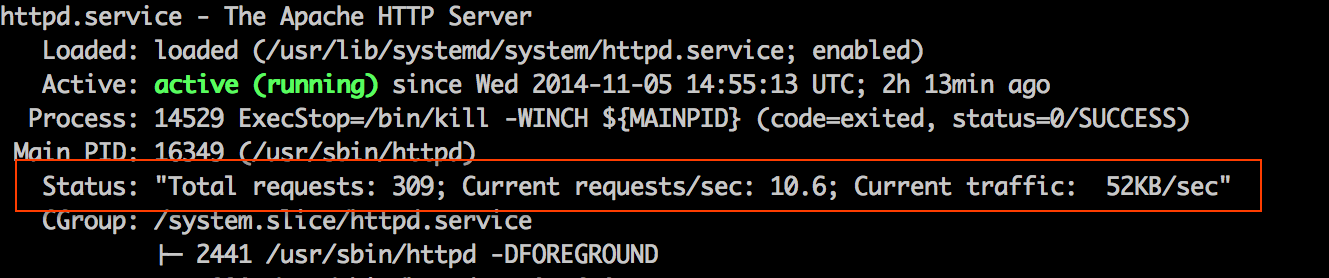
In systemd, you get a tonne of information about what’s going on; the processes that have been launched (including child processes), the PIDs, logs associated with that process, and in the case of something like Apache, the process can report information back:
Apache systemd status output showing requests per second
In this case, our ExecStop script output gets shown when you look at the status output of systemd:
[root@hhvm01 ~]# systemctl status hhvm -l
hhvm.service - HHVM HipHop Virtual Machine (FCGI)
   Loaded: loaded (/usr/lib/systemd/system/hhvm.service; enabled)
   Active: inactive (dead) since Tue 2015-02-17 22:00:52 UTC; 48s ago
  Process: 23889 ExecStop=/usr/local/bin/hhvm_stop.sh (code=exited, status=0/SUCCESS)
  Process: 37601 ExecStart=/usr/bin/hhvm <snip> (code=killed, signal=TERM)
  Main PID: 37601 (code=killed, signal=TERM)

Feb 17 22:00:45 hhvm01 hhvm_stop.sh[23889]: Moving status.php to status.php.disabled
Feb 17 22:00:47 hhvm01 hvm_stop.sh[23889]: Waiting another second (currently up to 8) because the load is still 16
Feb 17 22:00:48 hhvm01 hhvm_stop.sh[23889]: Waiting another second (currently up to 9) because the load is still 10
Feb 17 22:00:49 hhvm01 hhvm_stop.sh[23889]: Waiting another second (currently up to 10) because the load is still 10
Feb 17 22:00:50 hhvm01 hhvm_stop.sh[23889]: Load was 0 after 11 seconds, now we can kill HHVM.
Feb 17 22:00:50 hhvm01 hhvm_stop.sh[23889]: Killing HHVM
Feb 17 22:00:52 hhvm01 hhvm_stop.sh[23889]: Flipping status.php.disabled to status.php
Feb 17 22:00:52 hhvm01 systemd[1]: Stopped HHVM HipHop Virtual Machine (FCGI).
Now all the information about what happened during the ExecStop process is captured for debugging later! No more having no idea what happened during the shut down.
When the script is in the process of running, the systemd status output will show as “deactivating” so you know it’s still ongoing.
Summary
This is just one example of how you might use/abuse the ExecStop to do work before killing processes. Whilst this was technically possible before, IMO the ease of use and the added introspection means this is actually feasible for production systems.
I’ve gisted a copy of the script here, if you want to steal it and modify it for your own use.
Update 2015-10-12: These documents are now out of date. Please visit our Policy and Legal Repository for
up-to-date documents.
Today we’re publishing a draft of our Certificate Policy (CP). This is an important document for any Certificate Authority (CA), and we want to give people a chance to review it before we start issuing certificates. Please let us know if you have any questions or comments.
We’re also working on our Certification Practice Statement (CPS), which describes how we’re going to issue certificates under the policies outlined in our CP, but it isn’t quite ready for public review yet. We’re hoping to publish a draft within the next month.
Today’s release of MS15-016 (CVE-2015-0061) fixes another of the series of browser memory disclosure bugs found with afl-fuzz – this time, related to the handling of bi-level (1-bpp) TIFFs in Internet Explorer (yup, MSIE displays TIFFs!). You can check out a simple proof-of-concept here, or simply enjoy this screenshot of eight subsequent renderings of the same TIFF file:
The vulnerability is conceptually similar to other previously-identified problems with GIF and JPEG handling in popular browsers (example 1, example 2), with the SOS handling bug in libjpeg, or the DHT bug in libjpeg-turbo (details here) – so I will try not to repeat the same points in this post.
Instead, I wanted to take note of what really sets this bug apart: Microsoft has addressed it in precisely 60 days, counting form my initial e-mail to the availability of a patch! This struck me as a big deal: although vulnerability research is not my full-time job, I do have a decent sample size – and I don’t think I have seen this happen for any of the few dozen MSIE bugs that I reported to MSRC over the past few years. The average patch time always seemed to be closer to 6+ months – coupled with what the somewhat odd practice of withholding attribution in security bulletins and engaging in seemingly punitive PR outreach if the reporter ever went public before that.
I am very excited and hopeful that rapid patching is the new norm – and huge thanks to MSRC folks if so 🙂
It’s amazing what we let for-profit companies and their trade associations get away with.
Today, Joyent
announced the Node.js Foundation, in conjunction with various
for-profit corporate partners and Linux Foundation (which is a 501(c)(6)
trade association under the full control of for-profit companies).
Joyent and their corporate partners claim that the Node.js Foundation will
be neutral and provide open governance. Yet, they don’t
even say what corporate form the new organization will take, nor present
its by-laws. There’s no way that anyone can know if the organization will
be neutral and provide open governance without at least that information.
Meanwhile, I’ve spent years pointing out that what corporate form you
chose matters. In the USA, if you pick a 501(c)(6) trade association (like
Linux Foundation), the result is not a neutral non-profit
home. Rather, a trade association simply promotes the interest of the
for-profit businesses that control it. Such organizations don’t have
the community interests at heart, but rather the interests of the
for-profit corporate masters who control the Board of Directors. Sadly,
most people tend to think that if you put the word “Foundation”
in the name0, you magically get a neutral home
and open governance.
Fortunately for these trade associations, they hide behind the
far-too-general term non-profit, and act as if all non-profits are equal. Why
do trade association representatives and companies ignore the differences
between charities and trade associations? Because they don’t want you to
know the real story.
Ultimately, charities serve the public good. They can do nothing else,
lest they run afoul of IRS rules. Trade associations serve the business
interests of the companies that join them. They can do nothing else, lest they run afoul of IRS rules. I would certainly argue the Linux
Foundation has done an excellent job serving the interests of the
businesses that control it. They can be commended for meeting their
mission, but that mission is not one to serve the individual users and
developers of Linux and other Free Software. What will the mission of the
Node.js Foundation be? We really don’t know, but given who’s starting it,
I’m sure it will be to promote the businesses around Node.js, not its
users and developers.
0Richard Fontana recently
pointed out to me that it is extremely rare for trade associations
to call themselves foundations outside of the Open Source and Free
Software community. He found very few examples of it in the wider
world. He speculated that this may be an attempt to capitalize on
the credibility of the Free Software Foundation, which is older
than all other non-profits in this community by at least two
decades. Of course, FSF is a 501(c)(3) charity, and since there
is no IRS rule about calling a 501(c)(6) trade association by the
name “Foundation”, this is a further opportunity to
spread confusion about who these organization serve: business
interests or the general public.
The collective thoughts of the interwebz
Manage Consent
To provide the best experiences, we use technologies like cookies to store and/or access device information. Consenting to these technologies will allow us to process data such as browsing behavior or unique IDs on this site. Not consenting or withdrawing consent, may adversely affect certain features and functions.
Functional
Always active
The technical storage or access is strictly necessary for the legitimate purpose of enabling the use of a specific service explicitly requested by the subscriber or user, or for the sole purpose of carrying out the transmission of a communication over an electronic communications network.
Preferences
The technical storage or access is necessary for the legitimate purpose of storing preferences that are not requested by the subscriber or user.
Statistics
The technical storage or access that is used exclusively for statistical purposes.The technical storage or access that is used exclusively for anonymous statistical purposes. Without a subpoena, voluntary compliance on the part of your Internet Service Provider, or additional records from a third party, information stored or retrieved for this purpose alone cannot usually be used to identify you.
Marketing
The technical storage or access is required to create user profiles to send advertising, or to track the user on a website or across several websites for similar marketing purposes.