SCALE 8x Highlights

Post Syndicated from Bradley M. Kuhn original http://ebb.org/bkuhn/blog/2010/02/22/scale-8x.html

I just returned today (unfortunately on an overnight flight, which
always causes me to mostly lose the next day to sleep problems) from
SCALE 8x.
I spoke
about GPL enforcement efforts
, and also was glad to spend all day
Saturday and Sunday at the event.

These are my highlights of SCALE 8x:

  • Karsten
    Wade’s keynote
    was particularly good. It’s true that some of his
    talk was the typical messaging we hear from Corporate Open Source PR
    people (which are usually called “Community Managers”,
    although Karsten calls himself a “Senior Community
    Gardener” instead). Nevertheless, I was persuaded that Karsten
    does seek to educate Red Hat internally to have the right attitude
    about FLOSS contribution. In particular, he opened
    with a
    an illuminating literary analogy (from Chris Grams) about Tom Sawyer
    manipulating his acquaintances into paying him to do his
    work
    . I hadn’t seen Chris’ article when it was published back in
    September, and found this (“new to me”) analogy quite
    compelling. This is precisely the kind of activity that I see
    happening
    with problematic
    copyright assignments
    . I think the Tom Sawyer analogy fits aptly
    to that situation, because a contributor first does some work without
    compensation (the original patch), and then is manipulated even
    further into giving up something of value (signing away copyrights for
    nothing in return) for the mere honor of being able to do someone
    else’s work. It was no surprised that after Karsten’s keynote, jokes
    abounded in the SCALE 8x hallways all weekend that we should nickname
    Canonical’s new COO, Matt Asay, the “Tom Sawyer of Open
    Source”. I am sure Red Hat will be happy that their keynote
    inspired some anti-Canonical jokes.
  • Another Red Hat employee (who is also my good friend and former
    cow-orker), Richard Fontana, also
    gave an
    excellent talk
    that many missed, as it was scheduled in the very
    final session slot. Fontana put forward more details about his theory
    of the “Lex Mercatoria” of FLOSS and how it works in
    resolving licensing conflicts and incompatibility inside the community.
    He contrasted it specifically against the kinds
    of disputes
    that happen in normal GPL violations, which are primarily perpetrated by
    those outside the FLOSS world
    ). I agreed with Fontana’s
    conclusions, but his argument seemed to assume that these in-community
    licensing issues were destabilizing. I asked him about
    this, pointing out that the
    community is really good at solving these issues before they destabilize
    anything
    . Fontana agreed that they do get easily resolved, and
    revised his point to say that the main problem is that distribution
    projects (like Debian and Fedora) hold the majority of responsibility
    for resolving these issues, and
    that upstreams need to take
    more responsibility on this
    . (BTW, Karsten was also in the audience
    for Fontana’s talk,
    has written
    a more detailed blog post about it
    .) Fontana noted to me after his
    talk that he thought I wasn’t paying attention, as I was using my
    Android phone a lot during the talk. I was
    actually dent’ing various
    points from his
    talk. I realized when Fontana expressed this concern that perhaps we as
    speakers have to change our views about what it means when people seem
    focused on computing devices during a talk. (I probably would have
    thought the same as Fontana in the situation.) The online conversation
    during a talk is a useful part of the
    interaction. Stormy Peters
    even once suggested before a talk at Linux World that we should have a
    way to put dents up on the screen as people comment during a talk. I
    may actually try to find a way to do this next time I give a talk.
  • I also
    saw Brian
    Aker
    ‘s presentation about
    Drizzle, which is
    a fork of the MySQL codebase
    that he began inside Sun and now
    maintains further (having left Sun before the Oracle merger
    completed). I was impressed to see how much Drizzle has grown in just
    a few years, and how big its user base is. (Being a database
    developer, Brian thinks user numbers in the tens of thousands
    is just a start, but there are many FLOSS projects that would
    be elated even to max out at tens of thousands users. While I admire
    his goals of larger user bases, I think they’ve already accomplished a
    lot.) I talked with Brian for an hour after his talk all about the
    GPL and the danger of single-copyright-held business models. He’s
    avoided this for Drizzle, and it sounds like none of the consulting
    companies spouting up around the user community has too much power
    over the project. (Brian also
    blogged a summary of
    some of the points in the discussion we had
    .)
  • Because it directly time-conflicted Brian’s talk, I missed my friend
    and
    colleague’s Karen
    Sandler’s talk about trademarks
    , but I hear it went well. Karen
    told me not to attend anyway since she said I already knew everything it
    contained, and that she would have went to Brian’s talk too if my talk
    was against it. She did however make a brief appearance at my talk, so
    I feel bad my post-talk chat with Brian made it impossible for me to do
    the same for her talk.
  • I spoke extensively with Matt Kraai
    in the Debian booth. It
    was great to meet Matt for the first time, as he had previously
    volunteered on the
    Free Software Directory project
    when I was at FSF, and he’s also contributed a lot of development effort to
    BusyBox. It’s always strange but great
    to finally meet someone in person you’ve occasionally been in touch with
    for nearly a decade online.
  • Don Armstrong was also in
    the Debian booth. I got to know Don when we served
    on one of the GPLv3
    discussion committees
    together, and I hadn’t been in touch with him
    regularly since the GPLv3 process ended. He’s continuing to do massive
    amounts of volunteer work for Debian, including being in charge of the bug
    tracking system! I asked him for some ideas in how to help Debian more,
    and he immediately mentioned
    the Debian/GNOME Bug
    Weekend
    coming up this weekend. I’m planning to get involved this
    weekend, and I hope others will too.
  • Finally, I had a number of important meetings with lots of people in
    the FLOSS world, such as Tarus
    Balog
    , Michael
    Dexter
    , Bob
    Gobeille
    , Deb Nicholson,
    Rob Savoye
    and Randal Schwartz.
    Ok, enough name-dropping. (BTW, Tarus
    has written about his
    trip as well, and mentioned our ongoing copyright assignment debate
    .
    Tarus argues that he can do non-promise copyright assignment in OpenNMS
    and still avoid
    the normal
    Open Core shareware-like outcomes
    , which he dubs
    “fauxpen source” for “fake open source”. Time will
    tell.)

SCALE is really the gold standard of community-run, local FLOSS
conferences. It is the inspiration for many of the other regional
events such as OLF, SELF, and the like. A major benefit of these
regional events is that while they draw speakers from all over the
country, the average attendee is a local who usually cannot travel to
the better-known events like OSCON.

SCALE 8x Highlights

Post Syndicated from Bradley M. Kuhn original http://ebb.org/bkuhn/blog/2010/02/22/scale-8x.html

I just returned today (unfortunately on an overnight flight, which
always causes me to mostly lose the next day to sleep problems) from
SCALE 8x.
I spoke
about GPL enforcement efforts
, and also was glad to spend all day
Saturday and Sunday at the event.

These are my highlights of SCALE 8x:

  • Karsten
    Wade’s keynote
    was particularly good. It’s true that some of his
    talk was the typical messaging we hear from Corporate Open Source PR
    people (which are usually called “Community Managers”,
    although Karsten calls himself a “Senior Community
    Gardener” instead). Nevertheless, I was persuaded that Karsten
    does seek to educate Red Hat internally to have the right attitude
    about FLOSS contribution. In particular, he opened
    with a
    an illuminating literary analogy (from Chris Grams) about Tom Sawyer
    manipulating his acquaintances into paying him to do his
    work
    . I hadn’t seen Chris’ article when it was published back in
    September, and found this (“new to me”) analogy quite
    compelling. This is precisely the kind of activity that I see
    happening
    with problematic
    copyright assignments
    . I think the Tom Sawyer analogy fits aptly
    to that situation, because a contributor first does some work without
    compensation (the original patch), and then is manipulated even
    further into giving up something of value (signing away copyrights for
    nothing in return) for the mere honor of being able to do someone
    else’s work. It was no surprised that after Karsten’s keynote, jokes
    abounded in the SCALE 8x hallways all weekend that we should nickname
    Canonical’s new COO, Matt Asay, the “Tom Sawyer of Open
    Source”. I am sure Red Hat will be happy that their keynote
    inspired some anti-Canonical jokes.
  • Another Red Hat employee (who is also my good friend and former
    cow-orker), Richard Fontana, also
    gave an
    excellent talk
    that many missed, as it was scheduled in the very
    final session slot. Fontana put forward more details about his theory
    of the “Lex Mercatoria” of FLOSS and how it works in
    resolving licensing conflicts and incompatibility inside the community.
    He contrasted it specifically against the kinds
    of disputes
    that happen in normal GPL violations, which are primarily perpetrated by
    those outside the FLOSS world
    ). I agreed with Fontana’s
    conclusions, but his argument seemed to assume that these in-community
    licensing issues were destabilizing. I asked him about
    this, pointing out that the
    community is really good at solving these issues before they destabilize
    anything
    . Fontana agreed that they do get easily resolved, and
    revised his point to say that the main problem is that distribution
    projects (like Debian and Fedora) hold the majority of responsibility
    for resolving these issues, and
    that upstreams need to take
    more responsibility on this
    . (BTW, Karsten was also in the audience
    for Fontana’s talk,
    has written
    a more detailed blog post about it
    .) Fontana noted to me after his
    talk that he thought I wasn’t paying attention, as I was using my
    Android phone a lot during the talk. I was
    actually dent’ing various
    points from his
    talk. I realized when Fontana expressed this concern that perhaps we as
    speakers have to change our views about what it means when people seem
    focused on computing devices during a talk. (I probably would have
    thought the same as Fontana in the situation.) The online conversation
    during a talk is a useful part of the
    interaction. Stormy Peters
    even once suggested before a talk at Linux World that we should have a
    way to put dents up on the screen as people comment during a talk. I
    may actually try to find a way to do this next time I give a talk.
  • I also
    saw Brian
    Aker
    ‘s presentation about
    Drizzle, which is
    a fork of the MySQL codebase
    that he began inside Sun and now
    maintains further (having left Sun before the Oracle merger
    completed). I was impressed to see how much Drizzle has grown in just
    a few years, and how big its user base is. (Being a database
    developer, Brian thinks user numbers in the tens of thousands
    is just a start, but there are many FLOSS projects that would
    be elated even to max out at tens of thousands users. While I admire
    his goals of larger user bases, I think they’ve already accomplished a
    lot.) I talked with Brian for an hour after his talk all about the
    GPL and the danger of single-copyright-held business models. He’s
    avoided this for Drizzle, and it sounds like none of the consulting
    companies spouting up around the user community has too much power
    over the project. (Brian also
    blogged a summary of
    some of the points in the discussion we had
    .)
  • Because it directly time-conflicted Brian’s talk, I missed my friend
    and
    colleague’s Karen
    Sandler’s talk about trademarks
    , but I hear it went well. Karen
    told me not to attend anyway since she said I already knew everything it
    contained, and that she would have went to Brian’s talk too if my talk
    was against it. She did however make a brief appearance at my talk, so
    I feel bad my post-talk chat with Brian made it impossible for me to do
    the same for her talk.
  • I spoke extensively with Matt Kraai
    in the Debian booth. It
    was great to meet Matt for the first time, as he had previously
    volunteered on the
    Free Software Directory project
    when I was at FSF, and he’s also contributed a lot of development effort to
    BusyBox. It’s always strange but great
    to finally meet someone in person you’ve occasionally been in touch with
    for nearly a decade online.
  • Don Armstrong was also in
    the Debian booth. I got to know Don when we served
    on one of the GPLv3
    discussion committees
    together, and I hadn’t been in touch with him
    regularly since the GPLv3 process ended. He’s continuing to do massive
    amounts of volunteer work for Debian, including being in charge of the bug
    tracking system! I asked him for some ideas in how to help Debian more,
    and he immediately mentioned
    the Debian/GNOME Bug
    Weekend
    coming up this weekend. I’m planning to get involved this
    weekend, and I hope others will too.
  • Finally, I had a number of important meetings with lots of people in
    the FLOSS world, such as Tarus
    Balog
    , Michael
    Dexter
    , Bob
    Gobeille
    , Deb Nicholson,
    Rob Savoye
    and Randal Schwartz.
    Ok, enough name-dropping. (BTW, Tarus
    has written about his
    trip as well, and mentioned our ongoing copyright assignment debate
    .
    Tarus argues that he can do non-promise copyright assignment in OpenNMS
    and still avoid
    the normal
    Open Core shareware-like outcomes
    , which he dubs
    “fauxpen source” for “fake open source”. Time will
    tell.)

SCALE is really the gold standard of community-run, local FLOSS
conferences. It is the inspiration for many of the other regional
events such as OLF, SELF, and the like. A major benefit of these
regional events is that while they draw speakers from all over the
country, the average attendee is a local who usually cannot travel to
the better-known events like OSCON.
Speaker Setup

Post Syndicated from Lennart Poettering original https://0pointer.net/blog/projects/speaker-setup.html

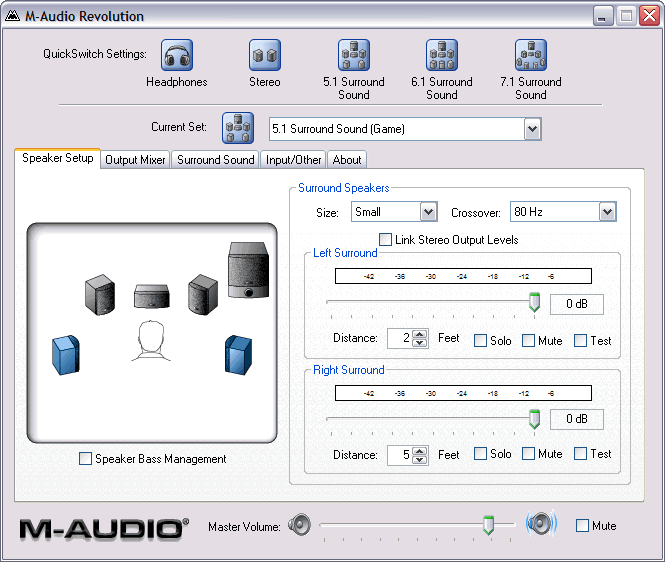
While tracking down some surround sound related bugs I was missing a speaker
setup and testing utility. So I decided to do something about it and I present you gnome-speaker-setup:

gnome-speaker-setup

The tool should be very robust and even deal with the weirdest channel
mappings. OTOH the artwork is not really good and appropriate. But I hope it still shows some resemblance to other
UIs
of this type. If you are an artist wand want to contribute better artwork make
sure to go through the Gnome Art Requests page,
and more specifically this particular
request
.

This (or something like it) will hopefully and eventually end up in some way
or another in gnome-media. Until that day comes I’ll maintain this tool independently.

To compile this you need a recent Vala and libcanberra
0.23
.

Computer Science Education Benefits from FLOSS

Post Syndicated from Bradley M. Kuhn original http://ebb.org/bkuhn/blog/2010/02/17/education-floss.html

I read with interest today
when Linux Weekly
News
linked

to
Greg DeKoenigsberg’s response
to
Mark
Guzdial’s ACM Blog post, The Impact of Open Source on Computing
Education
(which is mostly a summary
of his
primary argument on his personal blog)
. I must sadly admit that I
was not terribly surprised to read such a post from an ACM-affiliated
academic that speaks so negatively of
FLOSS‘s
contribution to Computer Science education.

I mostly agree with (and won’t repeat) DeKoenigsberg’s arguments, but I
do have some additional points and anecdotal examples that may add
usefully to the debate. I have been both a student (high school,
graduate and undergraduate) and teacher (high school and TA) of Computer
Science. In both cases, software freedom was fundamental and frankly
downright essential to my education and to that of my students.

Before I outline my copious disagreements, though, I want to make
abundantly clear that I agree with one of Guzdial’s primary three
points: there is too much unfriendly and outright sexist (although
Guzdial does not use that word directly) behavior in the
FLOSS
community. This should not be ignored, and needs active attention.
Guzdial, however, is clearly underinformed about the extensive work that
many of us are doing to raise awareness and address that issue. In
software development terms: it’s a known bug, it’s been triaged, and
development on a fix is in progress. And, in true FLOSS fashion,
patches are welcome, too (i.e., get involved in a FLOSS community and
help address the problem).

However, the place where my disagreement with Guzdial begins is that
this sexism problem is unique to FLOSS. As an undergraduate Computer
Science major, it was quite clear to me that a sexist culture was
prevalent in my Computer Science department and in CS in general. This
had nothing to do with FLOSS culture, since there was no FLOSS in my
undergraduate department until I installed a few GNU/Linux
machines. (See below for details.)

Computer Science as a whole unfortunately remains heavily
male-dominated with problematic sexist overtones. It was common when I
was an undergraduate (in the early 1990s) that some of my fellow male
students would display pornography on the workstation screens without a
care about who felt unwelcome because of it. Many women complained that
they didn’t feel comfortable in the computer lab, and the issue became a
complicated and ongoing debate in our department. (We all frankly could
have used remedial sensitivity training!) In graduate school, a CS
professor said to me (completely straight-faced) that women didn’t major
in Computer Science because most women’s long term goals are to have
babies and keep house. Thus, I simply reject the notion that this
sexism and lack of acceptance of diversity is a problem unique to FLOSS
culture: it’s a CS-wide problem, AFAICT. Indeed,
the CRA’s
Taulbee Survey shows (see PDF page 10)
that only 22% of the tenure
track CS faculty in the USA and Canada are women, and only 12% of the
full professors are. In short, Guzdial’s corner of the computing world
shares this problem with mine.

Guzdial’s second point is the most offensive to the FLOSS community.
He argues that volunteerism in FLOSS sends a message that no good jobs
are available in computing. I admit that I have only anecdotal evidence
to go on (of course, Guzdial quotes no statistical data, either), but in
my experience, I know that I and many others in FLOSS have been
successfully and gainfully employed precisely because of past
volunteer work we’ve done. Ted
T’so
is fond of saying: Thanks to Linux, my hobby became my job
and my job became my hobby
. My experience, while neither as
profound nor as important as Ted’s, is somewhat similar.

I downloaded a copy of GNU/Linux for the first time in 1992. I showed
it to my undergraduate faculty, and they were impressed that I had a
Unix-like system running on PC hardware, and they encouraged me to build
a computer lab with old PC’s. I spent the next three and half years as
the department’s volunteer0 sysadmin and
occasional developer, gaining essential skills that later led me to a
lucrative career as a professional sysadmin and software developer. If
the lure of software freedom advocacy’s relative poverty hadn’t
sidetracked me, I’d surely still be on that same career path.

But that wasn’t even the first time I developed software and got
computers working as a volunteer. Indeed, every computer geek I know
was compelled to write code and do interesting things with computers
from the earliest of ages. We didn’t enter Computer Science because we
wanted to make money from it; we make a living in computing because we
love it and are driven to do it, regardless of how much we get paid for
it. I’ve observed that dedicated, smart people who are really serious
about something end up making a full-time living at that something, one
way or the other.

Frankly, there’s an undertone in Guzdial’s comments on this point that
I find disturbing. The idea of luring people to Computer Science
through job availability is insidious. I was an undergraduate student
right before the upward curve in CS majors, and a graduate student
during the plateau
(See PDF
page 4 of the Taulbee Survey for graphs
). As an undergraduate, I
saw the very beginnings of people majoring in Computer Science
“for the money”, and as a graduate student, I was surrounded
by these sorts of undergraduates. Ultimately, I don’t think our field
is better off for having such people in it. Software is best when it’s
designed and written by people who live to make it better
— people who really hate to go to bed with a bug still open. I
must constantly resist the urge to fix any given broken piece of
software in front of me lest I lose focus on my primary task of the
moment. Every good developer I’ve met has the same urge. In my
experience, when you see software developed by someone who doesn’t have
this drive, you see clearly that it’s (at best) substandard, and
(usually) pure junk. That’s what we’re headed for if we encourage
students to major in Computer Science “for the money”. If
students’ passion is making money for its own sake, we should encourage
them to be investment bankers, not software developers, sysadmins, and
Computer Scientists.

Guzdial’s final point is that our community is telling newcomers
that programming is all that matters
. The only evidence Guzdial
gives for this assertion is a pithy quote from Linus Torvalds. If
Guzdial actually listened
to interviews
that Torvalds has given
, Guzdial would hear that Torvalds cares
about a lot more than just code, and spends most of his time in
natural language discussions with developers. The Linux community
doesn’t just require code; it requires code plus a well-argued
position of why the code is right for the users.

Guzdial’s primary point here, though, is that FLOSS ignores usability.
Using Torvalds and the Linux community as the example here makes little
sense, since “usability” of a kernel is about APIs for
fellow programmers. Linus’ kernel is the pinnacle of usability measured
against the userbase who interacts with it directly. If a kernel is
something non-technical users are aware of “using”, then
it’s probably not a very usable kernel.

But Guzdial’s comment isn’t really about the kernel; instead, he subtly
insults the GNOME community (and other GUI-oriented FLOSS projects).
Usability work is quite expensive, but nevertheless the GNOME community
(and others) desperately want it done and try constantly to fund it. In
fact, very recently, there has
been great
worry in the GNOME community
that Oracle’s purchase of Sun means
that various usability-related projects are losing funding. I encourage
Guzdial to get in touch with projects like the GNOME accessibility and
usability projects before he assumes that one offhand quote from Linus
defines the entire FLOSS community’s position on end-user usability.

As a final anecdote, I will briefly tell the story of my year teaching
high school. I was actively recruited (again, yet another a job I got
because of my involvement in FLOSS!)
to teach a high
school AP Computer Science class
while I was still in graduate
school in Cincinnati. The
students built
the computer lab themselves from scratch
, which one student still
claims
is one
of his proudest accomplishments
. I had planned to teach only
‘A’ topics, but the students were so excited to learn, we
ended up doing the whole ‘AB’ course. All but two of the
approximately twenty students took the AP exam. All who took it at
least passed, while most excelled. Many of them now have fruitful
careers in computing and other sciences.

I realize this is one class of students in one high school. But that’s
somewhat the point here. The excitement and the “do it
yourself” inspiration of the FLOSS world pushed a random group of
high school students into action to build their own lab and get the
administration to recruit a teacher for them. I got the job as their
teacher precisely because of my involvement in FLOSS. There is no
reason to believe this success story of FLOSS in education is an
aberration. More likely, Guzdial is making oversimplifications about
something he hasn’t bothered to examine fully.

Finally, I should note that Guzdial
used Michael
Terry
‘s work as a jumping off point for his comments. I’ve met,
seen talks by, and exchanged email with Terry and his graduate students.
I admit that I haven’t read Terry’s most recent papers, but I have read
some of the older ones and am familiar generally with his work. I was
thus not surprised to find
that Terry
clarified that his position differs from Guzdial’s
, in particular
noting that we found that open source developers most
certainly do care about the usability of their
software
, but that those developers make an error by focusing too
much on a small subset of their userbase (i.e., the loudest). I can
certainly verify that fact from the anecdotal side. Generally speaking,
I know that Terry is very concerned about FLOSS usability, and I think
that our community should work with him to see what we can learn from
his research. I have never known Terry to be dismissive of the
incredible value of FLOSS and its potential for improvement,
particularly in the area of usability. Terry’s goal, it seems to me, is
to convince and assist FLOSS developers to improve the usability of our
software, and that’s certainly a constructive goal I do support.

(BTW, I mostly used last names through out this post because Mark,
Michael, and Greg are relatively common names and I can think of a dozen
FLOSS celebrities who have one of those first names. 🙂


0Technically,
I was “paid” in that I was given my own office in
the department because I was willing to do the sysadmin duties.
It was nice to be the only undergraduate on campus (outside of
student government) with my own office.

The collective thoughts of the interwebz