India, 360 Degrees at a Time, Part Six

Post Syndicated from Lennart Poettering original https://0pointer.net/blog/photos/india-360-at-a-time-6.html

Here’s the sixth part of my ongoing series.

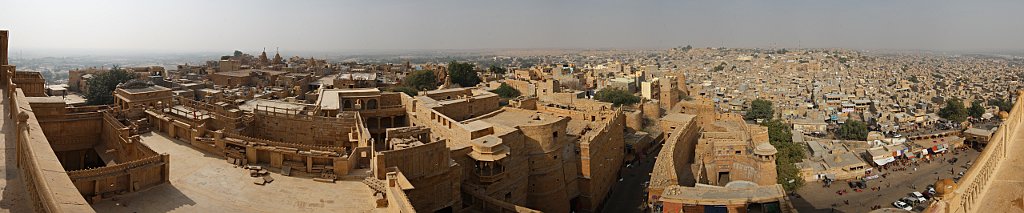
Leaving Jodhpur we continued our journey to Jaisalmer, a sand castle of a town in the Thar desert:

Jaisalmer

In the vicinity of Jaisalmer you’ll find cliche sand dunes like you’d expect from a grown-up desert:

Jaisalmer

Our next station after a long, cold and dusty train ride was Delhi. The principal mosque of Old Delhi is the Jama Masjid:

Jama Masjid

That’s all for now, tomorrow I’ll post the rest of my panoramas from this trip, all from Delhi.

India, 360 Degrees at a Time, Part Five

Post Syndicated from Lennart Poettering original https://0pointer.net/blog/photos/india-360-at-a-time-5.html

Here’s the fourth part of my ongoing series.

After Udaipur the next stop on our trip was Jodhpur, the blue city. Which is called that way due of the blue colour of many of its houses:

Jodhpur

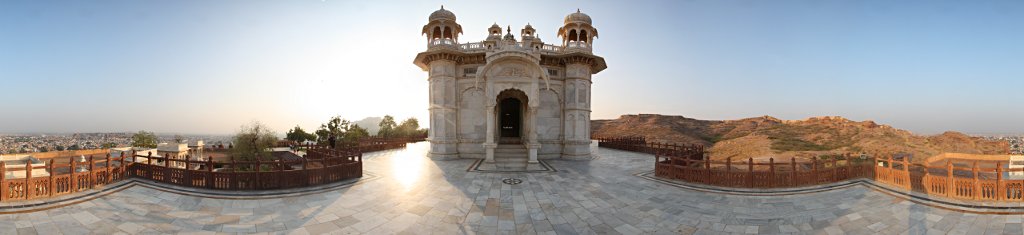
On a hill next to Mehrangarh Fort, one of the biggest Forts in India (the big sand castle on the hill in the panorama above), you find the Jaswant Thada, a memorial of the Maharajas of Jodhpur:

Jodhpur

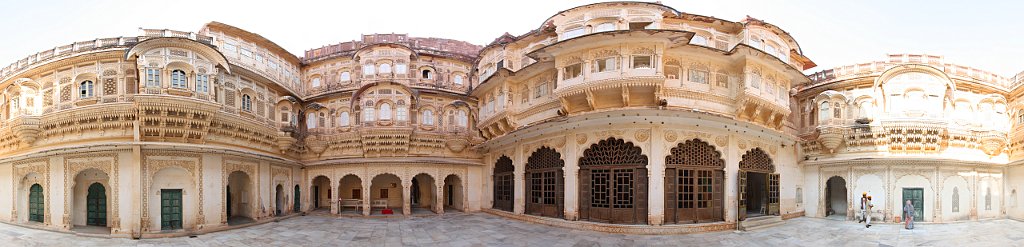
Inside the fort you’ll find highly decorated courtyards:

Jodhpur

That’s all for Jodhpur, tomorrow I’ll post more panoramas, from other stops of our trip.

India, 360 Degrees at a Time, Part Four

Post Syndicated from Lennart Poettering original https://0pointer.net/blog/photos/india-360-at-a-time-4.html

Here’s the fourth part of my ongoing series.

After Hampi we went to Bangalore to attend foss.in. (Fantastic conference, btw. The concerts at
the venue are unparalleled.) From there we flew up to Udaipur, in Rajasthan. Udaipur
is (among other things) famous for being the place where the central scenes of Octopussy were filmed.
Octopussy’s famous white palace is on Jagniwas Island in Lake Pichola:

Udaipur

This panorama was taken from another island in the lake, Jagmandir Island, which is visible in the following shot on the left:

Udaipur

Udaipur’s scenery, seen from the Maharaja’s City Palace down onto Pichola Lake:

Udaipur

That’s all for Udaipur, tomorrow I’ll post more panoramas, from other stops of our trip.

Announcing udev-browse

Post Syndicated from Lennart Poettering original https://0pointer.net/blog/projects/udev-browse.html

It’s easy to get lost in /sys and not much fun typing long
udevadm info command lines all the time. Today, when I had enough of
that I sat down and spent an hour to write a little UI for exploring the
udev/sysfs tree: udev-browse. I wrote it for my own use, but I am quite sure I am not the only
one who wants a little bit simpler access to the device tree. So here you go.

And since everybody loves screenshots here you go:

udev-browse

Two usability hints: if you run udev-browse from a directory in
/sys udev-browse will automatically present the device of
that path on startup. And if you know the name of a device you can just type it
into the device listbox (which is focussed by default). The usual Gtk+ live
search will then find you the right entry right-away. It’s pretty nifty.

It’s written in Vala with minimal dependencies.

I want to keep the maintainership burden for this minimal. So no tarballs, no releases, and I won’t reply to your emails regarding this tool, unless they include a good, clean, git formatted patch. Thank you for your understanding.

Anyone wants to package this for Fedora? I’d be very thankful if someone would pick it up.

Have fun.

India, 360 Degrees at a Time, Part Three

Post Syndicated from Lennart Poettering original https://0pointer.net/blog/photos/india-360-at-a-time-3.html

Here’s the third part of my ongoing series.

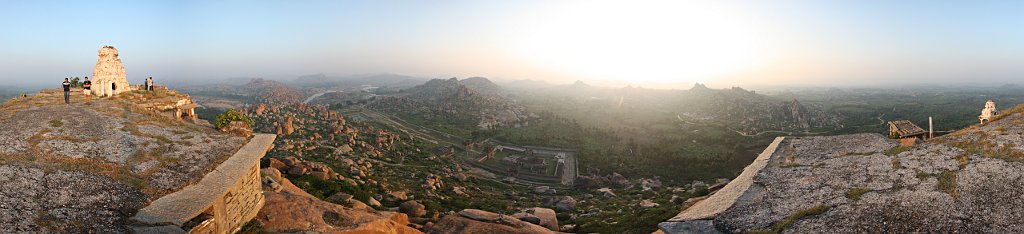
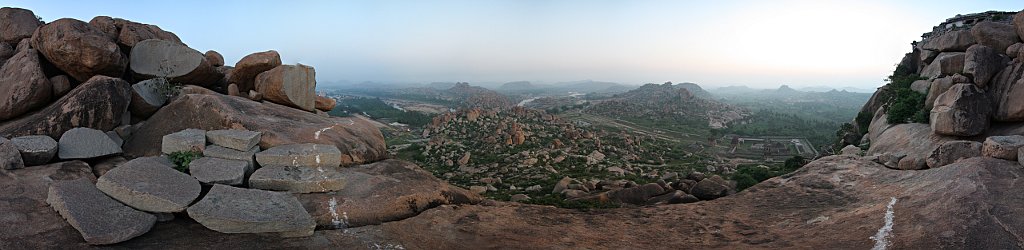
Still in Hampi here’s another 360 from the Hills in Hampi down to the Achyutaraya Temple:

Matanga Hill

A little further down, before dawn, here’s a shot from the rocky path leading up the hill:

Matanga Hill

Our last picture for today is a view down from Hemakuta Hill which is
covered with old temples and other structures. In the middle you’ll see the
large Virupaksha
Temple
which is still in full use. In that temple you’ll find an amazing camera obscura, a
physics teacher’s dream that projects the temple tower onto a wall (projection,
subject, more interesting in reality. Really.)

Hemakuta Hill

That’s all for Hampi, tomorrow I’ll post more panoramas, from other stops of our trip.

Back Home, with Debian!

Post Syndicated from Bradley M. Kuhn original http://ebb.org/bkuhn/blog/2010/01/14/ubuntu-debian.html

By the end of 2004, I’d been running Debian ‘testing’ on my
laptop since around early 2003. For almost two years, I’d lived with
periodic instability — including a week in the spring of 2003 when
I couldn’t even get X11 started — for the sake of using a
distribution that maximally respected software freedom.

I’d had no trouble with ‘potato’ for its two year lifespan,
but after 6-8 months of woody, I was backporting far too much and I
couldn’t spare the time for upkeep. Running ‘testing’ was
the next best option, as I could pin myself for 3-6 months at a time on
a particularly stable day and have a de-facto “release”.
But, I slowly was unable to spare the time for even that work, and I was
ready to throw up my hands in surrender.

At just about that time,
a thing called
‘warty’ was released
. I’d already heard about this
company, Canonical, as they’d tried earlier that year to buy a domain
name I technically own (canonical.org), but had long since given over to
a group of old friends. (They of course had no interest in selling such
a “hot property”). This new distribution, Ubuntu, was
Debian-based, and when installed, it “felt” like Debian.
Canonical was committed to a six-month release schedule, so I said to
myself: well, if I have to ‘go corporate’ again, I might
as well go to something that works like the distribution I prefer
.
And so, my five year stint as an Ubuntu user began.

Of course, I hadn’t always been a Debian user. I started in 1992 with
SLS
and quickly moved to Slackware. When the pain of that got too great, I
went “corporate” for a while back then, too. I
used Red Hat
Linux
from early 1996 until 1998. I ultimately gave up Red Hat
because the distribution eventually became focused around the
advancement of the company. They were happy to include lots of
proprietary software — indeed, in the later 1990s, Red Hat CDs
typically came with as many as two extra CDs filled with proprietary
software. Red Hat (the company) had earlier made some efforts to
appease us harder-core software-freedom folks. But, by the late 1990s,
their briefly-lived RMS (aka Red Hat Means Source) distribution had
withered completely. By then, I truly regretted my 1996 decision to go
corporate, and fell in love quickly with Debian and its community-led,
software-freedom-driven community. I remained a Debian user from 1998
until 2004.

But, by the end of 2004, the pain of waiting for ‘sarge’
was great. So, for technical reasons only, “going
corporate” again seemed like a reasonable trade-off. Ubuntu
initially looked basically like Debian: ‘main’ and
‘universe’ were FaiF, ‘restricted’ was like
‘non-free’.

Sadly, though, a for-profit, corporate-controlled distribution can
never remain community-oriented. A for-profit company is eventually
always going to put the acquisition of wealth above any community
principle. So it has become with Ubuntu, in my view. The time has come
(for me, at least) to go back to a truly community-oriented,
software-freedom-respecting distribution. (Hopefully, I’ll also never
be tempted to leave again.)

I didn’t take this decision lightly, and didn’t take it for only one
reason. I’ve gone back to Debian for three
(now) seven specific reasons:

(Updated on 2010-02-17: As can be seen above, my mere list of three
reasons posted just one month ago has now more than doubled! It’s as if
Canonical made a 2010 plan to “do less software freedom”,
and is executing it with amazing corporate efficiency.
As Queen
Gertrude says in Hamlet
, One woe doth tread upon
another’s heel, so fast they follow
.)

When considering all this and taking a step back and look at the status
of major distributions, my honest assessment is this: among the two
primary corporate-controlled-but-dabbling-in-community-orientation
distributions (aka Fedora and Ubuntu), Fedora is clearly much more
software-freedom-friendly. Nevertheless, since I’ve twice gone
corporate and ultimately regretted it, I decided it was time to go back
home — back to Debian.

So, during the last week of 2009, I took nearly two full days off to
reinstall and configure my laptop from scratch with lenny. I’ve thus
been back on Debian since 2010-01-01. Twelve days in, I am very
impressed. Really, all the things I liked about Ubuntu are now
available upstream as well. This isn’t the distribution I left in 2004;
it’s much better, all while being truly community-oriented and
software-freedom-respecting. It’s good to be home. Thank you, Debian
developers.


0 For more information on the
danger that proprietary network services pose to software freedom, please
see
the Franklin
Street Statement
.

The collective thoughts of the interwebz