Post Syndicated from Harith Gaddamanugu original https://aws.amazon.com/blogs/security/authenticate-legitimate-ai-agent-traffic-with-aws-waf-bot-control/
As AI agents and automated tools increasingly access web applications, distinguishing legitimate bot traffic from malicious attempts has become a critical security challenge. Traditional approaches such as IP-based filtering and reverse DNS lookups fail in multi-tenant systems (such as Amazon Bedrock AgentCore) where thousands of distinct workloads share the same IP space. Attackers can easily spoof user agents, and manual allowlists don’t scale with growing demand.
Web Bot Authentication (WBA), available in AWS WAF Bot Control since November 2025, solves this challenge by implementing cryptographic signatures that provide tamper-proof verification of bot identities. WBA uses asymmetric cryptography to verify that a request comes from an authorized automated agent, relying on two active Internet Engineering Task Force (IETF) drafts: a directory draft for sharing public keys, and a protocol draft defining how keys attach crawler identity to HTTP requests.
With WBA, you can confidently identify trusted automated access while maintaining granular control through WAF labels, creating a more secure and manageable ecosystem for both bot operators and website owners. AWS WAF Bot Control respects WBA verification status by default, automatically allowing verified AI agent traffic.
This post provides a deeper technical guide to implementing WBA with AWS WAF. You learn how WBA works, explore the new labels and capabilities it introduces, and walk through a step-by-step implementation—including signing code—to authenticate bot traffic using cryptographic signatures.
How Web Bot Authentication works with AWS WAF
WBA uses asymmetric cryptography to verify bot identities through HTTP message signatures. The process works as follows:
- Bot registration – Bot operators publish their public keys in a signature directory. AWS WAF regularly polls these directories and maintains a valid key registry.
- Request signing – Each bot operator’s request is signed using their private key following the IETF standard HTTP Message Signatures (RFC 9421).
- Verification – AWS WAF verifies signatures against known public keys associated with the bot operator and appends labels related to verification status.
A typical WBA-signed request includes headers like the following:
The following sequence diagram shows how AWS WAF verifies bot signatures and applies labels for allow or block decisions.
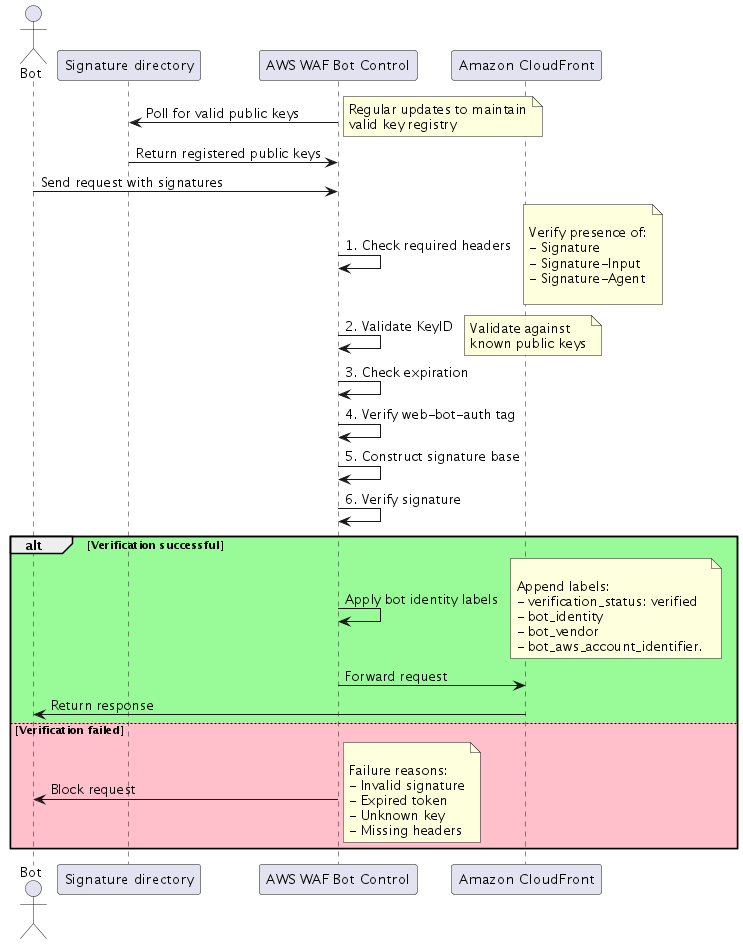
Figure 1 – AWS WAF Web Bot Authentication verification flow
The workflow shown in figure 1 includes the following steps:
- A bot sends a signed request to Amazon CloudFront and is inspected by AWS WAF Bot Control
- AWS WAF Bot Control retrieves the bot operator’s public key from the signature directory
- AWS WAF Bot Control verifies the ed25519 signature
- AWS WAF Bot Control appends a verification label (
verified,invalid,expired, orunknown_bot)
AWS WAF Bot Control evaluates rules using the label to allow or block the request.
New capabilities added to AWS WAF
With the addition of WBA, the following capabilities were added to AWS WAF.
Cryptographic bot verification
When a bot sends a request, it includes HTTP message signatures that AWS WAF validates at the edge using the AWS WAF Bot Control rule group (version 4.0 and later). This validation process adds minimal latency to requests while providing cryptographic certainty about the bot’s identity. HTTP Message Signatures is an open IETF standard (RFC 9421) that defines a mechanism for signing and verifying HTTP messages using asymmetric keys—in practice, this means a bot cryptographically signs specific headers and metadata of each request, and the receiver can verify the signature using the bot’s published public key.
New labels within AWS WAF for granular control
AWS WAF automatically validates signatures, and successfully validated traffic is immediately marked as verified. This verification status can be used in WAF rules and bot management policies, giving you the ability to write your own rules based on the new functionality.
The following table describes the new labels.
| Label | Meaning | Suggested action |
| awswaf:managed:aws:bot-control:bot:web_bot_auth:verified | Successful cryptographic verification | Allow |
| awswaf:managed:aws:bot-control:bot:web_bot_auth:invalid | Failed verification attempt | Block or rate-limit |
| awswaf:managed:aws:bot-control:bot:web_bot_auth:expired | Expired key used | Block and alert |
| awswaf:managed:aws:bot-control:bot:web_bot_auth:unknown_bot | Unrecognized key | Monitor or block |
| awswaf:managed:aws:bot-control:bot:vendor:<vendor_name> | Bot vendor or operator | Use for vendor-specific rules |
| awswaf:managed:aws:bot-control:bot:name:<rfc_name> | Bot name (RFC token from WBA) | Use for bot-specific rules |
| awswaf:managed:aws:bot-control:bot:account:<hash> | AWS account identifier (Amazon Bedrock AgentCore agents only) | Use for account-level controls |
AWS WAF now automatically allows verified AI agent traffic
AWS WAF Bot Control now respects WBA verification status by default, automatically allowing verified AI agent traffic. This includes two specific behavior changes:
- Category:AI rule update – Previously, the
Category:AIrule under common Bot Control blocked unverified bots. Bot Control now checks WBA verification status before applying this rule. - TGT_TokenAbsent rule update – The
TGT_TokenAbsentrule, which detects requests without a WAF token, no longer matches requests that carry theweb_bot_auth:verifiedlabel.
Key benefits for AWS WAF customers
WBA with AWS WAF delivers several advantages for organizations managing automated traffic at scale.
- Enhanced bot visibility – Clear identification of distinct bots operating from multi-tenant platforms like Amazon Bedrock AgentCore, providing transparency into automated traffic sources. The AWS WAF console includes a new AI activity dashboard that provides a centralized view of AI bot and agent traffic across your protected resources.
- Enhanced security – Cryptographic verification of bot identities using industry-standard signing mechanisms.
- Reduced false positives – Accurate distinction between legitimate and malicious automated traffic, particularly in shared IP environments.
- Industry alignment – Alignment with industry standards and major content delivery network (CDN) providers for consistent bot authentication across platforms.
Customer use cases for WBA with AWS WAF
Across industries, organizations use WBA to grant automated agents secure, controlled access to their web applications. The following scenarios highlight where this capability delivers real-world value:
- Verified customer support agents – Authenticate AI-powered chat and support bots so websites can recognize them as approved, registered agents. This enables seamless customer service automation while maintaining security controls and audit trails.
- Automated crawling and indexing – Allow search engine crawlers and content indexers to fetch pages with clear identity and scoped permissions. This reduces false-positive blocks, improves crawl efficiency, and helps legitimate bots access your content without triggering security controls.
- Partner integrations – Third-party agents can access customer portals and APIs with explicit consent and granular, scoped access controls. This facilitates secure business-to-business (B2B) integrations while maintaining visibility into partner bot activity.
- Enterprise automations and agents – Internal automation tools—including monitoring systems, QA bots, continuous integration and delivery (CI/CD) pipelines, and robotic process automation (RPA) solutions—get authenticated access to web applications with least-privilege access principles and full auditability.
Availability
WBA was introduced in Bot Control rule group Version_4.0 (November 2025) for Amazon CloudFront distributions, with continued support in later versions. With Version_6.0, WBA is available for resource types supported by AWS WAF across standard commercial AWS Regions.
Getting started: Developers or agents quick start
Whether you’re implementing WBA yourself or working with an AI coding assistant, the following steps walk you through deploying WBA, signing requests, and writing custom rules.
Step 1: Deploy the WBA-enabled Bot Control
Add the AWS WAF Bot Control rule group to your CloudFront-associated web ACL using static Version_4.0 or Version_5.0—both include WBA support for cryptographic bot verification. Version_5.0 (released February 2026) covers more than 650 unique bots and agents spanning categories including AI search engine crawlers, AI data collectors, AI assistants, and large language model (LLM) training crawlers.
Important: You must explicitly select one of these static versions.
The following example CloudFormation YAML snippet shows a bot control rule set configuration:
Step 2: Sign requests from your bot
If your agent runs on Amazon Bedrock AgentCore Browser, request signing is handled automatically—no additional configuration is required.
For agents running outside of AgentCore, registration APIs are on the roadmap that you can use to sign requests independently by:
- Generating an ed25519 key pair
- Hosting your public key in a signature directory
- Signing outbound HTTP requests using the Signature-Input and Signature headers with the
web-bot-authtag. For language-specific signing implementations, see the HTTP Message Signatures RFC (RFC 9421) and the AWS WAF Bot Control documentation.
Step 3: Write custom rules using WBA labels
Use the verification labels in custom WAF rules for granular traffic control, for example:
- Allow –
awswaf:managed:aws:bot-control:bot:web_bot_auth:verified - Rate-limit –
awswaf:managed:aws:bot-control:bot:web_bot_auth:invalid - Alert on –
awswaf:managed:aws:bot-control:bot:web_bot_auth:expired
Step 4: Monitor WBA traffic
Use AWS WAF metrics and logs to monitor authenticated bot traffic:
- Review Amazon CloudWatch metrics for Bot Control rule group matches and set up alarms for anomalous or unexpected spikes in invalid or expired verification attempts.
- Analyze AWS WAF logs to identify patterns in bot authentication attempts and filter on
web_bot_authlabels. - Use the AI Activity Dashboard in the AWS WAF console for a centralized view of AI bot traffic. Visualize traffic trends, identify top bots and frequently targeted paths, and filter by verification status to decide which bots to allow, rate-limit, or block.
Conclusion
WBA with AWS WAF provides a cryptographically secure, standards-based approach to authenticating legitimate AI agent traffic. By moving from IP-based allowlisting to signature-based verification, you gain accurate bot identification that works across multi-tenant environments.
Looking ahead, our focus is to simplify bot authentication and make it safer by default. Registration APIs that agent owners can use to cryptographically verify bot identity and intent are on the roadmap, helping website owners quickly distinguish trusted automation from unknown traffic.
If you own an agent, adopt WBA and register your agent to receive verified status. In parallel, AWS continues to actively participate in the IETF web-bot-auth working group, advocating for complementary approaches—using both identifying and anonymous verification protocols—and will incorporate these standards into products as they mature to help your deployments stay aligned with the broader ecosystem.
To get started, see the AWS WAF Bot Control documentation and the HTTP Message Signatures RFC (RFC 9421).
If you have feedback about this post, submit comments in the Comments section below.