Post Syndicated from Kirill Tishenkov original https://aws.amazon.com/blogs/big-data/how-delivery-hero-rebuilt-real-time-ad-measurement-with-apache-flink/
This post is co-written with Kirill Tishenkov, Alexandru Pisarenco, Upendra Kambhampati, and Sabariesh Ganesan from Delivery Hero.
Real-time ad measurement is one of the harder streaming problems in advertising. Every impression and click has to be accurate enough to bill a vendor for, and fresh enough for the ad server to act on. In this post, we describe how Delivery Hero moved its ad measurement pipeline from hourly batch processing to real time on Amazon Managed Service for Apache Flink. Delivery Hero, based in Berlin, Germany, is one of the world’s leading local delivery platforms, operating across Asia, Europe, Latin America, the Middle East, and North Africa. Working with more than 1.5 million restaurant partners and local vendors in around 65 countries, Delivery Hero handles millions of orders for food, groceries, and everyday essentials daily.
At the center of Delivery Hero’s business sits an advertising platform that connects vendors and brands with millions of active consumers. The platform handles tens of thousands of messages per second and processes billions of ad events per day, supporting an advertising revenue stream that reached almost EUR 1.5 billion in 2025. Every impression served and every click recorded must satisfy two requirements at once. The data must be accurate enough to bill vendors fairly, and fresh enough for the ad server to act on in real time. Delivery Hero replaced its batch-oriented measurement system with a fully real-time pipeline built on Amazon Managed Service for Apache Flink. The new pipeline cut infrastructure costs by more than half and reached a level of data quality the previous system could not.
Challenges with the legacy system
The legacy ads measurement system consumed impression, click, and order events from message queues. It enriched them through synchronous API calls for campaign metadata and product lookups, then wrote hourly aggregated metrics to a reporting database. This design worked at a modest scale, but five structural problems emerged as traffic grew.
No event-time semantics, and slow processing. The pipeline bucketed events by the time it processed them rather than the time they occurred, because most events arrived without a usable event timestamp. Results were internally consistent, but they skewed whenever ingestion lagged or events arrived out of order. That widened the error bar on every time-sensitive metric, including return on ad spend (ROAS). The bigger cost was speed. Metrics were assembled in hourly batches, so the average gap between when an event occurred and when it was recorded was 61 minutes. The platform was reacting to clicks and impressions up to an hour after the fact, far too late for budget pacing or ad serving.
Synchronous enrichment capped how far the system could scale. Enrichment is the step that attaches business context to a raw ad event: which campaign it belongs to, which vendor owns it, and which product was advertised. In the legacy system, every event triggered a chain of blocking external API calls to fetch that context. During traffic spikes, such as a flash sale or a back-to-school surge, exhausted connection pools cascaded into billing, ad serving, and reporting simultaneously. There was no back-pressure mechanism and no way to scale enrichment independently of event ingestion.
The database behind the pipeline was built for a very different access pattern. The pipeline kept its working data in a NoSQL document database: deduplication keys, attribution history, and running totals. The platform inherited that database from its pre-streaming era, when ad measurement looked like document storage and retrieval. The workload then evolved into continuous deduplication, multi-day attribution lookups, and rolling aggregation. Every event ended up triggering a full document read and write against a database designed for occasional access, not per-event mutation. Read/write amplification stored far more data than the logic needed, every write triggered index updates and collection scans, and storage costs grew in lockstep with query latency. At peak load, this often tipped into production outages.
Reprocessing was a project, not a capability. Recovery from a bug, a traffic spike, or a corrupted upstream batch required different tooling for every consuming system. Billing replay was a hand-rolled combination of Google Cloud BigQuery tables, Pub/Sub topics, and custom CLI scripts. Reporting replay ran as a separate daily Airflow job with a one-hour-per-day cost and a six-month horizon. Campaigns and credits events had no replay path at all. Every recovery was a coordination exercise across teams. Every event type that could not be replayed was a class of problems that could only be patched manually after the fact.
Incomplete event context corrupted downstream data quality. Enrichment was synchronous and best-effort, so the pipeline still wrote through events that failed a lookup or arrived malformed, leaving their fields blank. The pipeline had no mechanism to recover the missing context later. Three gaps mattered most:
- Missing session rate: the share of events that landed without a usable session ID, leaving the interaction unattached to the user browsing session it belonged to. At 30–40 percent, roughly a third of all events could not be tied back to a session, breaking any session-scoped analysis or feature.
- Missing customer identifiers (IDs): the share of events with no customer ID, severing the link between an ad interaction and the customer who generated it and weakening attribution and personalization.
- Missing impression timestamps: the share of impression events lacking a reliable event-time timestamp (the same root cause as the processing-time fallback described earlier). At 91 percent, most impressions had no trustworthy event time, forcing the processing-time approximation and widening the error bar on every time-based metric.
These omissions propagated silently into the reporting metrics and into the session-scoped features consumed by machine learning (ML) models for campaign ranking, conversion-rate estimation, and anomaly detection.
Why Amazon Managed Service for Apache Flink
The team set three non-negotiable requirements. First, fault-tolerant data processing, to eliminate data loss. Second, stateful stream processing that could hold multiple days of interaction history in low-cost, low-latency storage. Third, fully managed infrastructure, so engineers could focus on application logic rather than cluster operations.
The team selected Apache Flink because it satisfies all three requirements natively, without bolting on external systems. Its event-time watermark model helps place out-of-order events in the correct time window even when they arrive late. Its RocksDB state backend holds large keyed state on disk without Java Virtual Machine (JVM) heap pressure.
The team chose Amazon Managed Service for Apache Flink over self-hosted Flink on Amazon Elastic Kubernetes Service (Amazon EKS) to eliminate the operational burden of managing JobManagers, TaskManagers, and checkpoint storage. Amazon Kinesis Data Streams serves as the upstream event bus, with two streams: one for user event actions (impressions and clicks) and one for orders. The team chose Kinesis Data Streams over Amazon Managed Streaming for Apache Kafka (Amazon MSK) for cost efficiency at this topology.
Amazon DynamoDB holds campaign and product reference data, queried through Flink’s Async I/O API to enrich events without blocking the processing pipeline. AWS Secrets Manager stores ad event decryption keys, retrieved once at job startup. Amazon Simple Storage Service (Amazon S3) stores granular event logs in Avro format and serves as the incremental checkpoint store for Flink state. Amazon EventBridge Pipes bridged Amazon Simple Queue Service (Amazon SQS) to Kinesis in the minimum viable product (MVP) phase without any custom code, cutting time-to-production by two weeks.
Solution architecture
The following diagram shows the end-to-end pipeline.
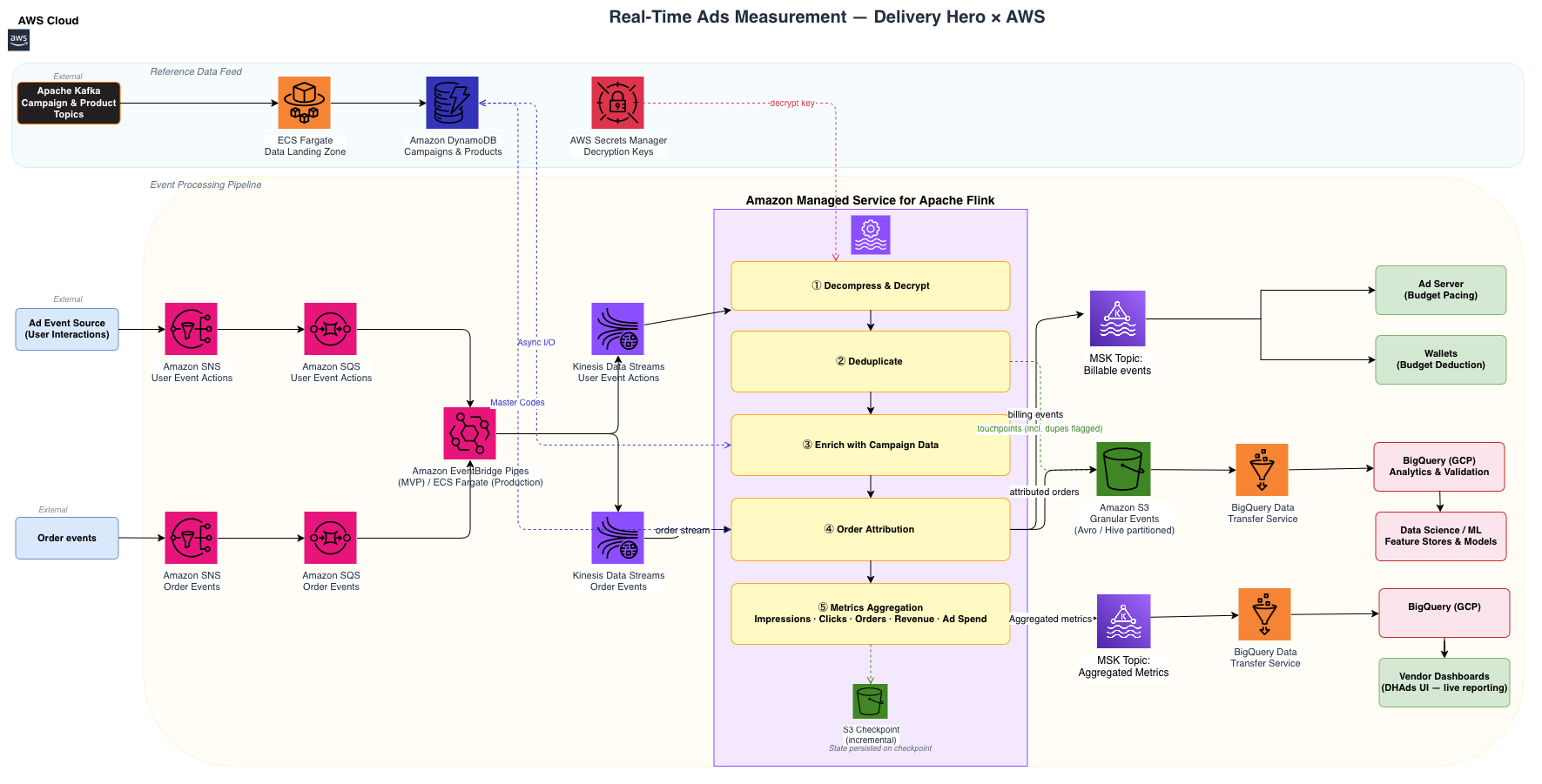
Figure 1: End-to-end architecture of the real-time ad measurement pipeline
Two Amazon Simple Notification Service (Amazon SNS) topics ingest events: one receives user event actions (compressed, encrypted ad tokens containing campaign, vendor, and placement metadata), the other receives order events. Amazon SQS buffers both before Amazon EventBridge Pipes (MVP) or an AWS Fargate service (production) forwards them into Kinesis.
Amazon Managed Service for Apache Flink runs a five-stage Java pipeline:
- Decompress and decrypt. The pipeline decrypts the ad event token using keys from AWS Secrets Manager.
- Deduplicate. The pipeline keys events on a composite of entity, ad, event, and customer identifiers. Flink’s RocksDB state tracks seen events over a 30-hour window (approximately 20 GB of state), filtering duplicates while preserving them in Amazon S3 for audit.
- Enrich. Flink’s Async I/O API queries Amazon DynamoDB concurrently for campaign metadata and product master codes, populated continuously from upstream Kafka topics by an AWS Fargate consumer.
- Attribute. A multi-day keyed interval join matches user event actions to subsequent orders on entity, customer, vendor, and campaign dimensions (approximately 100 GB of state). This stage emits attributed orders to Amazon S3.
- Aggregate. The pipeline accumulates impression, click, order, revenue, and ad spend metrics in RocksDB state, then batch-upserts them to the reporting database every 5 minutes.
The pipeline emits billing events (cost per mille (CPM) impressions and valid cost per click (CPC) clicks) to Apache Kafka topics. The ad server and budget service consume those topics in real time. Flink checkpoints all state incrementally to Amazon S3, so the job restores from the last checkpoint after a failure. Kinesis Data Streams and the upstream sources deliver at-least-once, and the deduplication stage in step 2 drops any event replayed during recovery. Billing is therefore effectively exactly-once, even though the transport underneath it is at-least-once.
Results and impact
The redesigned architecture achieved quantifiable performance gains across data fidelity, processing throughput, and operational expenditure, while introducing capabilities that were not feasible under the legacy model.
Processing latency: From hourly windows to real time
The average gap between when an event was published and when it was recorded dropped from 61 minutes to 1.2 seconds. Budget pacing and aggregated metrics now reflect activity within seconds rather than the following hour. Downstream ad serving and budget pacing systems act on real-time signals instead of reconciling after the fact.
Cost efficiency
The migration reduced monthly operational costs by approximately 57 percent, which more than halves the annual run rate for the pipeline. The saving came alongside stronger reliability, not at its expense.
System reliability
Durable attribution window. The multi-day attribution window lives in RocksDB-backed keyed state, roughly 100 GB on local TaskManager disks, checkpointed incrementally to Amazon S3. Per-key lookups stay in the low-millisecond range regardless of state size, and a crash or shard rebalance restores state from the last checkpoint rather than triggering a reconciliation job.
Elasticity replacing fragility. Async I/O against DynamoDB removed the synchronous enrichment chain that previously gated every event. The pipeline sustains 20,000 messages per second at peak without back-pressure leaking into ad serving or billing, and enrichment scales independently of ingestion. Flash sales and seasonal surges no longer threaten upstream systems.
Replayable history. The pipeline persists every raw event to Amazon S3 in Avro format the moment it lands, and Kinesis Data Streams retains the source stream for up to 7 days. When a logic bug surfaces or a downstream contract changes, the team reprocesses the affected time range deterministically against the original inputs. There is no bespoke backfill job and no reconciliation against external systems. Past data is a first-class input, not a frozen artifact.
Data quality at the source
The following table compares the three data quality gaps before and after the migration.
| Metric | Before | After |
| Missing session rate | 30–40% | 0% |
| Missing customer IDs | 5% | 0.8% |
| Missing impression timestamps | 91% | 0.2% |
Downstream applications now receive fully enriched transactional and session context. Machine learning models use session-scoped features for campaign ranking, conversion-rate estimation, and anomaly detection. The pipeline now computes those features from a complete event stream, rather than one in which roughly a third of events were missing session context and 91 percent of impressions were missing a reliable timestamp.
What’s next
The pipeline described here is the first of several planned migrations to Amazon Managed Service for Apache Flink. The team is extending the same architecture to additional ad formats, and connecting real-time Flink aggregations directly to the ad serving layer for sub-second budget pacing. The real-time data layer built for measurement also serves as the foundation for AI-driven use cases. The team plans to explore live user interaction streams feeding personalization ranking models and grounded large language model (LLM) recommendations, which were impractical with batch-oriented infrastructure.
Conclusion
Delivery Hero’s migration to Amazon Managed Service for Apache Flink shows that effectively exactly-once billing, multi-day stateful attribution, and manageable operational complexity are not competing goals. The combination that made it work: Kinesis Data Streams for ingestion, DynamoDB for low-latency enrichment, Amazon S3 for event storage and checkpointing, and Amazon EventBridge Pipes for rapid MVP delivery. Together they produced a system that is more accurate, more resilient, and less expensive than the one it replaced. For advertising platforms where billing accuracy and attribution correctness are commercial imperatives, this architecture offers a replicable path from batch approximation to real-time measurement.
To get started with Apache Flink on AWS, see the Amazon Managed Service for Apache Flink Developer Guide.
Additional resources
- Amazon Managed Service for Apache Flink
- Amazon Kinesis Data Streams
- Amazon DynamoDB
- Amazon EventBridge Pipes
- Apache Flink Exactly-Once Processing