Post Syndicated from Grab Tech original https://engineering.grab.com/grabmart-data-for-faster-disease-outbreak-detection
Abstract
Retail purchases can supplement clinical surveillance because changes in demand for some over-the-counter (OTC) products may appear before confirmed case reports. This article describes an early-stage concept for analysing aggregated GrabMart transaction data to identify unusual changes in product demand. The concept is not a deployed system, and it would require validation by public health experts, privacy review, and regulatory approval before any implementation.
Introduction
Public health agencies use sources such as clinical case reports, laboratory results, and hospital records to monitor disease activity. Retail data may offer an additional signal when demand changes across groups of symptom-related products. It cannot establish a diagnosis or replace clinical evidence.
When using indirect signals, we should assess whether they remain relevant to the outcome we want to measure. This includes considering how changes in user behaviour could affect their interpretation. A retail-based signal can experience similar drift, selection bias, and false alarms. Any useful design must therefore combine statistical validation with careful privacy and governance controls.
Background
Syndromic surveillance tracks patterns that may indicate emerging illness before diagnoses are confirmed. Retail surveillance applies this idea to changes in demand for products associated with symptoms, such as fever remedies or cough medicines.
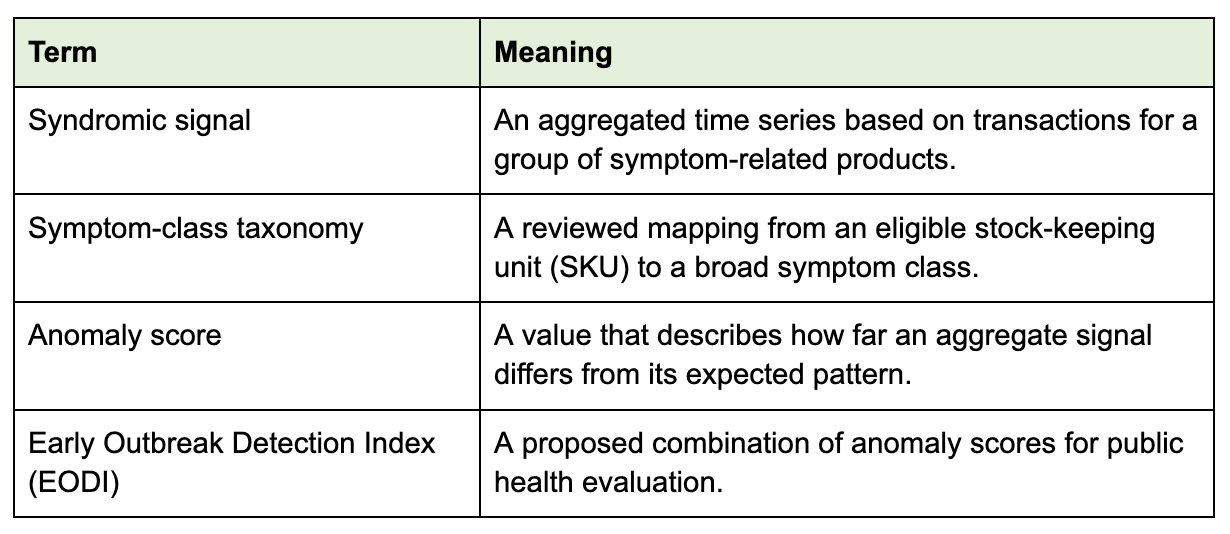
The proposed method groups eligible products into broad symptom classes and measures changes in aggregate demand over time. An anomaly score can indicate that observed demand differs from an expected seasonal pattern. The score is a statistical signal, not an estimate of how many people have a disease.
The design uses the following terms:
Proposed solution
The proposed pipeline would process only transactions that meet documented eligibility rules. It would map eligible SKUs to symptom classes, aggregate counts across approved time periods and geographic areas, and compare each series with an appropriate baseline. Public health experts would review the resulting Early Outbreak Detection Index alongside independent evidence.
The method deliberately excludes identity linkage and individual-level health inference. It also avoids using a single purchase to classify a customer, target an advertisement, adjust an insurance decision, or change access to a product.
Conceptual data flow
Eligible transactions
        |
        v
Reviewed SKU-to-symptom mapping
        |
        v
Aggregate by approved time period and geographic area
        |
        v
Compare with seasonal and historical baselines
        |
        v
Privacy and quality checks
        |
        v
Aggregate signal for authorised public health evaluation
Analysis and validation
Several statistical methods could model expected demand, including seasonal time-series models and spatial scan statistics. Model selection should follow retrospective evaluation against approved public health data. Evaluation should measure sensitivity, false-alert rate, calibration, geographic stability, and performance during seasonal changes.
The system would also need ongoing monitoring. Product catalogues change, purchasing behaviour shifts, promotions affect demand, and access to GrabMart varies across populations and locations. These factors can produce anomalies unrelated to disease activity.
Privacy and governance
Privacy protection starts with data minimisation. The analysis should use only eligible product categories, coarse geographic areas, and aggregate time windows approved for the stated public health purpose. It should not expose raw transactions or personally identifiable information (PII).
The release process could apply minimum-count thresholds and differential privacy (DP), subject to a documented privacy analysis. Privacy specialists would need to set and review any privacy budget. Access controls, retention limits, audit logs, and contractual restrictions would govern any approved data exchange.
An independent review should cover privacy law, health-related inference, fairness, scientific validity, and the risk of harm from false alerts. An authorised public health body, rather than an automated model, should decide whether and how to communicate a possible outbreak.
Potential applications
If research validates the signal and the required approvals are in place, aggregate trends could support:
- public health research alongside established surveillance sources;
- operational planning for broad categories of health supplies; and
- evaluation of whether retail demand contributes useful evidence during an emerging event.
These applications should use aggregate trends only. The signal should not drive personalised medical advice, individual targeting, insurance decisions, or automatic changes to medicine search rankings.
Limitations
Retail demand is an indirect and incomplete measure of illness. Purchases may reflect promotions, weather, media coverage, household stocking, or changes in product availability. GrabMart customers are not representative of the full population, and the available product mix differs by market.
Mapping a product to a symptom class is also uncertain because many products have several uses. Aggregation and privacy controls reduce disclosure risk but can weaken statistical utility. These limitations require local validation and documented thresholds before anyone interprets the index.
Conclusion
Aggregated retail transactions may add a timely signal to public health research, but they cannot replace clinical surveillance. A responsible design must minimise data, prohibit individual health inference, test the model against independent evidence, and place public health experts in control of interpretation and communication.
This concept remains in the early planning phase. No production deployment, measured performance result, or public health integration is claimed.
Join us
Grab is a leading superapp in Southeast Asia, operating across the deliveries, mobility, and digital financial services sectors. Serving over 900 cities in eight Southeast Asian countries: Cambodia, Indonesia, Malaysia, Myanmar, the Philippines, Singapore, Thailand, and Vietnam. Grab enables millions of people every day to order food or groceries, send packages, hail a ride or taxi, pay for online purchases or access services such as lending and insurance, all through a single app. We operate supermarkets in Malaysia under Jaya Grocer and Everrise, which enables us to bring the convenience of on-demand grocery delivery to more consumers in the country. As part of our financial services offerings, we also provide digital banking services through GXS Bank in Singapore and GXBank in Malaysia. Grab was founded in 2012 with the mission to drive Southeast Asia forward by creating economic empowerment for everyone. Grab strives to serve a triple bottom line. We aim to simultaneously deliver financial performance for our shareholders and have a positive social impact, which includes economic empowerment for millions of people in the region, while mitigating our environmental footprint.
Powered by technology and driven by heart, our mission is to drive Southeast Asia forward by creating economic empowerment for everyone. If this mission speaks to you, join our team today!