All posts by Muhammad Musab Iqbal

How AgentFlo built AI sales agents with Amazon Bedrock AgentCore – Part 2

Post Syndicated from Muhammad Musab Iqbal original https://aws.amazon.com/blogs/architecture/how-agentflo-built-ai-sales-agents-with-amazon-bedrock-agentcore-part-2/

If you’re building AI agents for commerce at scale, you face two critical challenges: handling unpredictable traffic spikes and ensuring your agents can be trusted with real customer transactions.

This post shows how AgentFlo solved these challenges using Amazon Bedrock AgentCore and AWS serverless architecture. You learn the architectural patterns behind their reliability and trust frameworks, see the measurable business results (including +12% net revenue uplift based on early deployment data), and explore their roadmap for voice agents and server-side tool execution.

This is Part 2 of a two-part series. Part 1 covers velocity, standardization, and scalability.

Pillar 4: Trust: guardrails for autonomous commercial action and real-time visibility into agent operations

AgentFlo enforces trust at every layer of the stack, from pre-request filtering to post-response privacy controls, so merchants can deploy autonomous agents with confidence.

The challenge

Enterprise customers won’t deploy autonomous agents unless they can trust them. An agent in production can’t expose sensitive data, offer unauthorized discounts, or access another customer’s information. The system also prevents price hallucination, unauthorized tool calls, opt-out violations, and credential exposure.

Merchants also need fine-grained control over who can interact with their AI agents and what data each segment can access. Enterprise customers require restricted access; B2C businesses need open access for broader reach. Without identity-based controls, deploying customer-facing AI is a non-starter.

Defense in depth

In AgentFlo, trust isn’t only about safe responses. It’s about safe action. Agents can create carts, place orders, apply discounts, access customer data, and interact with backend systems, so policy enforcement must sit outside the model’s reasoning loop. The model proposes. Deterministic policy decides.

AgentFlo applies trust controls across the full agent lifecycle: before the model sees the request, during tool execution, and after the model generates a response.

Three-layer guardrails

When users deploy an agent from the AgentFlo Portal, security enforcement happens at three stages.

First, the AWS Fargate layer detects prompt injection and handles opt-outs before requests reach the agent. WhatsApp messages are authenticated using phone numbers as unique identifiers. Enterprise customers like EBM restrict access to authorized users, while restaurant deployments stay open for broader reach.

Next, the AgentCore layer verifies identity and enforces order locks during tool execution. AgentCore Gateway, a capability of Amazon Bedrock AgentCore, enforces policies that prevent sales agents from accessing customer support tools. Cedar policies enforce business rules like maximum discount percentages independently of the model’s reasoning. Cedar is an open-source policy language developed by AWS for fine-grained, verifiable authorization decisions. Additionally, Policy in Amazon Bedrock AgentCore integrates with Amazon Bedrock Guardrails, so Cedar policies can invoke configurable safeguards for prompt attack detection, content filtering, and sensitive information blocking directly at the gateway boundary.

Finally, post-turn privacy filters screen outputs to block inadvertent token disclosure and unverified price claims before customers see responses. Secrets are managed through AWS Secrets Manager with OIDC (OpenID Connect)-authenticated continuous integration and continuous delivery (CI/CD) pipelines. No credentials are stored in agent code.

Infrastructure security

Trust at the application layer requires sound underlying infrastructure. AgentFlo combines the built-in isolation of AgentCore with application-level controls:

  • Session isolation: Session isolation through AgentCore runtime, a capability of Amazon Bedrock AgentCore, which provides complete separation between merchants’ agent sessions through dedicated microVMs.
  • AgentCore Gateway policies: Fine-grained Cedar policies control which agents can access which tools and data, enforced deterministically regardless of model reasoning.
  • AWS Identity and Access Management (IAM)-based access control: Fine-grained permissions for agent-to-service communication.
  • Amazon Virtual Private Cloud (Amazon VPC) integration: Agent sessions operate within AgentFlo’s VPC with domain-level network restrictions, so agents only communicate with approved endpoints.
  • Compliance: Data residency controls and audit trails for regulatory requirements across multiple jurisdictions.

Observability

Trust requires visibility. Merchants need to see what their agents are doing in real time, not only after something goes wrong. AgentFlo uses AgentCore Observability, a capability of Amazon Bedrock AgentCore, to provide end-to-end tracing of every agent interaction, from initial request through tool execution to final response.

AgentCore Observability captures structured traces for each agent turn, including model latency, tool invocation sequences, token usage, and error rates. These traces flow into Amazon CloudWatch, where AgentFlo builds dashboards showing active sessions, response times, and tool call patterns. Full request-to-response traces enable trace-level debugging. The system tracks P50/P95 latencies and throughput across agent types, alerting merchants when behavior deviates from baselines. Cost attribution provides per-merchant, per-agent breakdowns tied to specific conversations.

Results

Together, observability and trust give enterprises confidence to deploy autonomous agents at scale. Merchants benefit from safer execution, stronger compliance across jurisdictions, and controlled access to tools and data at the session level.

Pillar 5: Reliability: a data foundation that keeps agents grounded in reliable data

Reliable agents need reliable data. AgentFlo grounds every agent action in verified, current information through stateful sessions, merchant knowledge bases, and semantic product discovery.

The challenge

Enterprise customers won’t trust AI agents that forget context, hallucinate product details, or operate on stale data. An agent that quotes the wrong price, forgets a customer’s earlier request, or recommends discontinued products destroys confidence instantly. The system must make sure every agent action is grounded in verified, current information, from product catalogs and pricing to conversation history and business rules.

Merchants also need their agents to maintain continuity across long customer journeys, access up-to-date business-specific knowledge, and surface products through natural language, all without manual intervention or prompt engineering.

Data architecture overview

In AgentFlo, reliability isn’t only about accurate responses. It’s about accurate action grounded in verified data. Agents retrieve product information, manage carts, and complete transactions, so every data source must be authoritative and current. The model reasons. Structured data decides.

AgentFlo applies data reliability controls across three layers: stateful conversation management through Amazon DynamoDB, merchant-specific knowledge through Amazon Bedrock Knowledge Bases, and semantic product discovery through vector embeddings in Amazon S3 Vector.

State management architecture

A real sales journey can span 8 hours or 3 days. A customer might ask about a product in the morning, compare options at lunch, and complete the purchase that evening. The agent must remember context across all turns and maintain state, so customers don’t need to start over.

AgentCore runtime and Amazon DynamoDB manage this context storage. The agent replays relevant history, loads context based on intent, and continues transactions safely.

Each agent needs to be stateful (remembering earlier interactions), autonomous (deciding next steps without human intervention), and safe (operating within business rules without exposing sensitive data).

The two-table DynamoDB design covers all three requirements: session continuity through conversation replay, autonomous context loading based on detected intent, and data integrity through structured ground-truth storage that the model can’t hallucinate over.
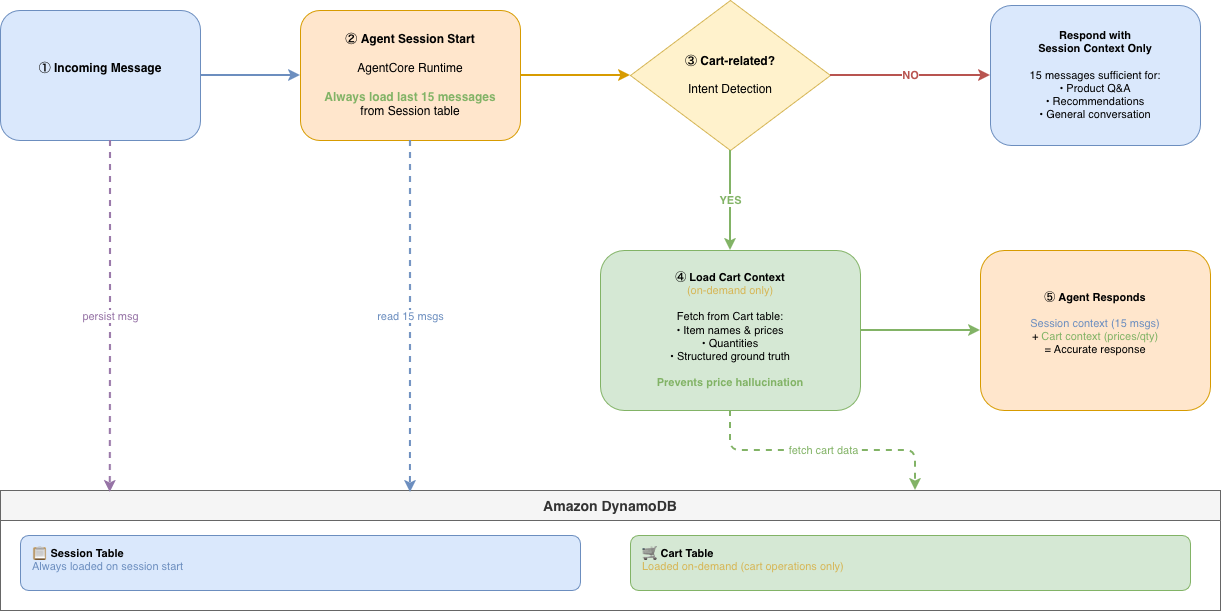
Diagram of the per-message conversation flow between AgentCore runtime and the DynamoDB session and cart tables

Figure 1: Per-message conversation flow. AgentCore runtime loads the last 15 messages from the DynamoDB Session Table at the start of each turn. The Cart Table is loaded on demand only when intent detection flags the request as cart-related, preventing the model from generating incorrect prices and quantities.

Knowledge base system

Merchants upload business-specific data (restaurant menus, clinic policies, product specifications, promotion calendars) into Amazon Bedrock Knowledge Bases backed by Amazon Simple Storage Service (Amazon S3). Agents automatically retrieve and reason over this merchant-specific content. Responses stay grounded in accurate, up-to-date business information without merchants writing a single prompt.

Semantic search and vector retrieval

AgentFlo improves product discovery by giving every product in its Amazon Aurora database a lightweight vector embedding. Customers can find products by name or description.

AgentFlo also generates extra searchable tags for each product automatically, and merchants can add their own. The result: phrases like “the pink one,” “the smallest one,” “the new one,” or “the chocolate with the golden wrapper” all map to the right product. Customers ask for things naturally, and the platform finds what they’re looking for.

Observability and billing

The system captures all message interactions through Amazon Data Firehose to Amazon S3, so merchants can track cost per conversation and compare those costs against sales revenue. This pipeline shows merchants the return on investment (ROI) of their agent deployments and provides the data foundation for continuous agent improvement.

Results

The data architecture helps minimize context loss in conversations across multi-day customer journeys, with grounded responses that eliminate price and product hallucination. Merchants benefit from natural language product discovery without keyword dependency and merchant-specific knowledge retrieval without prompt engineering. Full cost visibility and ROI attribution per agent deployment give merchants clear measurement of platform value.

Business impact: measurable results across the customer lifecycle

Salesflo’s solution, powered by Strands Agents SDK and Amazon Bedrock AgentCore, delivered measurable improvements across the customer lifecycle:

Metric Improvement
Net revenue uplift +12%
Customer engagement +40%
Conversion rate +15%
Average order value +8%
Customer reactivation +20%

AgentFlo generated these results by comparing agent-assisted customer journeys against a control group over a 90-day early deployment period.

Note: The foundation models referenced in this post are available in select AWS Regions. For the latest information on model availability, see Supported Regions and models for Amazon Bedrock.

The compounding effect at scale

At AgentFlo’s scale, the impact is significant. With $300 billion in annual transacted value flowing through the Salesflo solution (based on platform transaction data), even single-digit percentage improvements translate to billions in incremental revenue for merchants.

Operational improvements

Beyond the metrics, merchants see operational improvements:

  • 24/7 coverage — AI agents engage customers at any hour, in any time zone, across any channel.
  • Consistent quality — Every customer interaction follows best-practice selling methodologies without the variability of human agents.
  • Scalable personalization — Thousands of concurrent agent sessions, each maintaining unique context per customer.
  • Rapid merchant onboarding — New merchants go live with customized AI agents in days, not months, through the self-service configuration platform.

What’s next: voice, server-side execution, and integration expansion

AgentFlo is actively extending the platform along three directions, each at a different stage of maturity.

Real-time voice agents (in pilot)

AgentFlo already supports voice within WhatsApp. Incoming voice notes go through a two-pass transcription process: a raw initial pass, followed by domain-aware correction that fuzzy-matches text against the live product catalog. The second pass catches brand names and SKUs even when partially misheard, across more than 90 supported languages. For outbound audio, merchants pick from multiple Text-to-Speech (TTS) providers per deployment.

Because Speech-to-Text (STT), reasoning on AgentCore runtime, and TTS are fully independent components, any one can be swapped without disrupting the rest of the pipeline.

The next step: BidiAgent. The next evolution is real-time voice agents built on the Strands SDK BidiAgent and Amazon Bedrock AgentCore WebRTC support. BidiAgent supports bidirectional audio streaming, natural interruptions, and concurrent tool execution. The agent can check inventory or apply a discount while continuing to listen and respond to the customer in the same call.

The AgentCore WebRTC protocol and Amazon Kinesis Video Streams handle peer-to-peer transport for mobile and browser interactions without requiring relay infrastructure. This pushes AgentFlo beyond text messaging into proactive outbound calls and high-value B2B sales, where real-time conversation is essential for building trust.

Server-side tool execution (under development)

AgentFlo is experimenting with server-side tool execution in Amazon Bedrock, which removes client-side orchestration entirely.

Traditional orchestration loops between model and tools repeatedly (model → execute → send result → repeat). With server-side execution, the agent makes a single API call to the Amazon Bedrock Responses API with an AgentCore Gateway Amazon Resource Name (ARN). The model then autonomously discovers, invokes, and processes tools through the Gateway Model Context Protocol (MCP) interface, all inside AWS infrastructure with no roundtrips back to the client.

Here’s what that one API call looks like:

from openai import OpenAI

# OPENAI_BASE_URL = https://bedrock-mantle.us-west-2.api.aws/v1
# OPENAI_API_KEY = <Amazon Bedrock API key>
client = OpenAI()

response = client.responses.create(
    model="openai.gpt-oss-120b",
    stream=True,
    background=False,
    store=False,
    input=[
        {
            "type": "message",
            "role": "user",
            "content": [{"type": "input_text", "text": user_message}],
        }
    ],
    tools=[
        {
            "type": "mcp",
            "server_label": "agentflo_gateway",
            "connector_id": GATEWAY_ARN,  # arn:aws:bedrock-agentcore:...:gateway/...
            "server_description": "AgentFlo commerce tools (cart, catalog, knowledge base)",
            "require_approval": "never",
        },
    ],
)

Note: Model availability varies by AWS Region. The model and endpoint shown in this example may not be available in all Regions. See Supported Regions and models for Amazon Bedrock for current availability.

One request handles the whole loop. The Gateway ARN goes in as an MCP connector, and Bedrock takes it from there; pulling the tool list, picking the right one, invoking it, and feeding the result back to the model without anything leaving AWS. The client never sees credentials, tool schemas, or the intermediate turns. See ShopAssist: E-Commerce Agent Demo for more details.

Early results: For specialist agents with short, focused tool loops, early measurements show approximately 30% lower latency. A sales agent calling three tools in sequence (check inventory, apply discount, update cart) collapses 50+ lines of orchestration into a single API call. All credentials stay server-side, and the simplified architecture makes onboarding new agent developers faster.

Integration ecosystem expansion (ongoing)

AgentFlo adds integrations based on merchant demand. Each new platform (payment processors, shipping providers, loyalty systems, or vertical-specific ERPs) becomes another MCP server connector in AgentCore Gateway. This pattern keeps expansion modular and quick.

Key takeaways

  1. Pick your pillars first. The right AWS stack follows. AgentFlo first defined what velocity, standardization, scalability, and trust meant for the production system. With clear requirements, the AWS stack choices became obvious: Strands for the agent layer, AgentCore runtime for stateful sessions, AgentCore Gateway for tool routing and policy, and AWS Fargate for message ingestion.
  2. Specialized agent recipes beat multi-agent complexity. Deploying a single, well-configured agent with domain-specific tools and knowledge outperforms multi-agent orchestration for most customer interactions. Multi-agent handoffs are reserved for cross-domain transitions where context boundaries are clearly defined.
  3. Commerce is stateful. Plan for that on day one. A real sales journey can span 8 hours or 3 days. Stateless chatbots can’t maintain context that long. AgentCore runtime stateful sessions and DynamoDB-backed context were chosen on day one for exactly this reason. Retrofitting state onto a stateless agent later is much more painful than designing for it up front.
  4. Three-layer security builds trust. Pre-turn guards on Fargate, per-tool guards through AgentCore Gateway policies with Cedar, and post-turn output filters work together to support safe deployment of autonomous agents handling commercial transactions.
  5. System design supports scale. By building agent customization as a software as a service (SaaS) layer on top of AgentCore infrastructure, AgentFlo serves hundreds of merchants on shared infrastructure while still delivering personalized agent behavior for each one.
  6. Serverless + AgentCore = elastic commerce. The combination of Fargate for message handling and AgentCore for agent execution means AgentFlo scales from normal traffic to 50x flash-sale spikes without pre-provisioning or capacity planning.
  7. The feedback loop is the product. Real customer conversations teach the agents how to close. Where customers hesitate, what language converts, when they want a human handoff — all of it feeds back into recipes, prompts, and tool definitions. A new merchant deployment benefits from every conversation that ran on the platform before it. That compounding loop is harder to copy than any single piece of the architecture.

Conclusion

Building production-scale AI agents for commerce requires scalability and trust from day one. By combining Amazon Bedrock AgentCore stateful sessions and microVM isolation with AWS serverless infrastructure, AgentFlo delivers autonomous agents that handle unpredictable traffic while maintaining the security controls enterprises require.

Next steps

For questions about implementing similar architectures, visit the AWS Architecture Center or contact your AWS account team. To start building, open the Amazon Bedrock console or explore the Amazon Bedrock service detail page.

We’d love to hear how you’re building agentic AI systems. Share your experiences in the comments.
About the authors

How AgentFlo built AI sales agents with Amazon Bedrock AgentCore – Part 1

Post Syndicated from Muhammad Musab Iqbal original https://aws.amazon.com/blogs/architecture/how-agentflo-built-ai-sales-agents-with-amazon-bedrock-agentcore-part-1/

In this post, you learn how AgentFlo built intelligent sales agents that convert conversations into completed purchases. We show you how AgentFlo improved revenue performance in early deployments using Amazon Bedrock AgentCore and the Strands Agents SDK.

AgentFlo, the agentic commerce service by Salesflo, helps merchants deploy always-on AI sales, support, and ordering agents across channels like WhatsApp. These agents understand intent, connect to commerce systems, recommend products, create carts, and convert conversations into completed transactions. Today, AgentFlo serves eCommerce merchants managing over $300 billion in annual transacted value, according to Salesflo, across services including Shopify, WooCommerce, Magento, and SAP.

This is Part 1 of a two-part series covering the five pillars of production-grade AI agents. Part 1 covers Velocity, Standardization, and Scalability. Part 2 covers Trust, Reliability, and Business results.

The challenge: customer intent without assistance

Cart abandonment hovers around 70% industry-wide, representing trillions in unrealized revenue annually. For merchants operating on messaging platforms like WhatsApp, the gap widens further:

  • Cart abandonment: Customers abandon carts because a single question goes unanswered.
  • Generic product discovery: Ranked listings replace recommendations tailored to each customer.
  • Missed messaging conversations: Inbound chat volume exceeds staffing capacity across time zones and languages.
  • No personalized guidance: Most merchants can’t afford 1:1 assistance for every interaction.
  • Limited outbound engagement: Teams lack bandwidth for proactive sales motions.
  • Peak traffic spikes: Flash sales and seasonal campaigns can spike traffic 10–50x beyond normal capacity.

Rule-based chatbots can’t handle nuanced sales conversations. Human agents can’t scale across geographies, languages, and time zones. Merchants need specialized AI sales agents that understand customer context, run complex workflows, and operate autonomously 24/7.

What makes an agent?

At its simplest, an agent combines a model, instructions, tools, context, and memory. The model reasons over a user’s request. The instructions define the agent’s role and the limits of what it should do. Tools let the agent take action in the real world. Context grounds it in business-specific data. Memory keeps the conversation coherent across turns.

In AgentFlo, those abstract components map to concrete pieces of the platform:

Component What it does in AgentFlo
Model Understands user intent and decides what to do next
System prompt / persona Defines whether the agent behaves like a sales agent, restaurant agent, support agent, or receptionist
Tools Allow the agent to search products, check inventory, create carts, place orders, raise tickets, or trigger follow-ups
Knowledge Grounds responses in merchant-specific data such as product catalogs, menus, policies, promotions, and FAQs
Memory / state Maintains conversation history, cart state, customer preferences, and previous actions
Channels Connects the agent to WhatsApp, SMS, RCS, web chat, and voice
Guardrails / Policy Prevents unsafe, unauthorized, or incorrect actions
Observability Tracks cost, performance, conversions, and conversation quality

Building a demo agent is straightforward. Building one that runs a business safely, repeatably, and at scale requires a different approach. AgentFlo organizes this approach around five pillars.

Five pillars of production-grade AI agents

AgentFlo’s architecture centers on five pillars: Velocity, Standardization, Scalability, Trust, and Reliable. Each addresses a specific production challenge. These challenges influenced how the team chose AWS services, including Strands Agents SDK, Amazon Bedrock AgentCore, Amazon Bedrock, AWS Fargate, Amazon DynamoDB, Amazon Aurora, Amazon Kinesis, and Amazon Simple Storage Service (Amazon S3).

Architecture overview

AgentFlo production architecture on AWS spanning the messaging, agent runtime, tool gateway, data, and observability layers

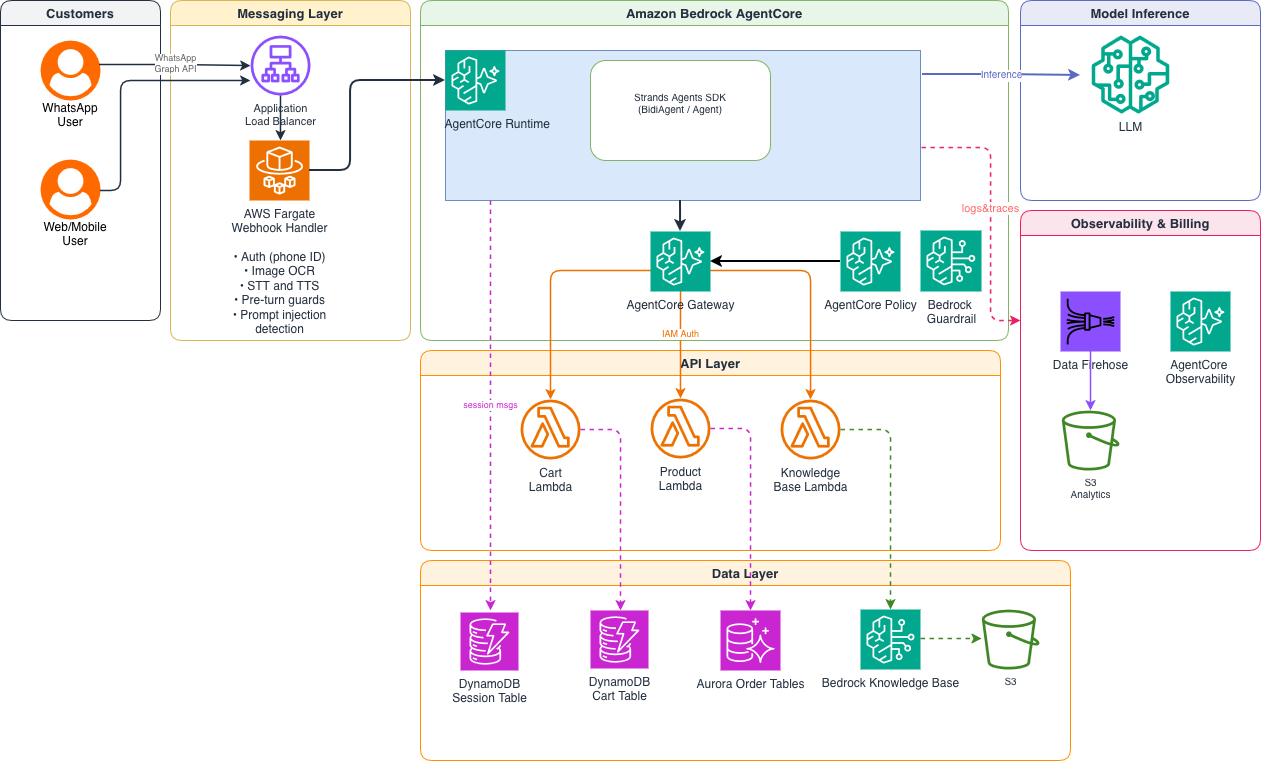
Figure 1: AgentFlo’s production architecture on AWS.

Customer messages arrive through WhatsApp Graph API or web/mobile channels and pass through an Application Load Balancer into the AWS Fargate messaging layer. It handles authentication, image optical character recognition (OCR), speech-to-text/text-to-speech, pre-turn guardrails, and prompt injection detection. Validated requests flow into AgentCore runtime, a capability of Amazon Bedrock AgentCore, where the Strands Agents SDK orchestrates an agent that streams model inference to an external large language model (LLM). AgentCore Gateway, a capability of Amazon Bedrock AgentCore, brokers tool calls, with IAM-based authorization, to an API layer of AWS Lambda functions (Cart, Product, and Knowledge Base). It persists state across a data layer comprising Amazon DynamoDB session and cart tables, Amazon Aurora order tables, and an Amazon Bedrock Knowledge Base backed by Amazon S3. Policy in Amazon Bedrock AgentCore enforces deterministic access control independently of model reasoning. Amazon Bedrock Guardrails can also be embedded in Policy to filter prompt attacks, harmful content, and sensitive information on both requests and responses. On the observability side, logs and traces feed into AgentCore Observability, a capability of Amazon Bedrock AgentCore, while Amazon Data Firehose captures every interaction into Amazon S3 for cost and revenue analytics.

AgentFlo evaluated several hosting options before selecting Amazon Bedrock AgentCore. Three capabilities made the difference:

  • Stateful sessions for long-running commerce conversations.
  • Agent runtime: each agent session runs in its own lightweight virtual machine, providing hardware-level security boundaries between tenants.
  • Native MCP integration: Model Context Protocol (MCP) is an open standard that allows AI agents to connect securely to external data sources and tools through a unified interface. AgentCore Gateway supports MCP natively for standardized tool connectivity.

Pillar 1: Velocity: from merchant idea to live agent in minutes

Speed to market determines whether merchants can capture emerging opportunities. AgentFlo addresses this with a streamlined deployment model.

The challenge

Merchants want to launch agents quickly, but each has unique workflows, tone, tools, languages, products, and business rules. Generic chatbot templates are too shallow. Custom-building each agent doesn’t scale.

Recipe-based deployment

AgentFlo uses a recipe-based agent deployment model. Merchants select from pre-configured recipes, each shipping with persona, language, tone, tool sets, prompt templates, knowledge sources, response packs, and business rules. Available recipes include:

  • Sales agent.
  • Restaurant ordering agent.
  • Clinic receptionist.
  • Support agent.
  • B2B reorder agent.
  • Cart recovery agent.

Merchants fine-tune a few choices in the AgentFlo Portal. The rest is automated.

How it works

AgentFlo chose Strands Agents SDK as its agent framework. Strands Agents SDK uses a model-driven architecture: you define tools as Python functions, write a system prompt, and let the model handle orchestration. No rigid workflow graphs or hand-coded state machines.

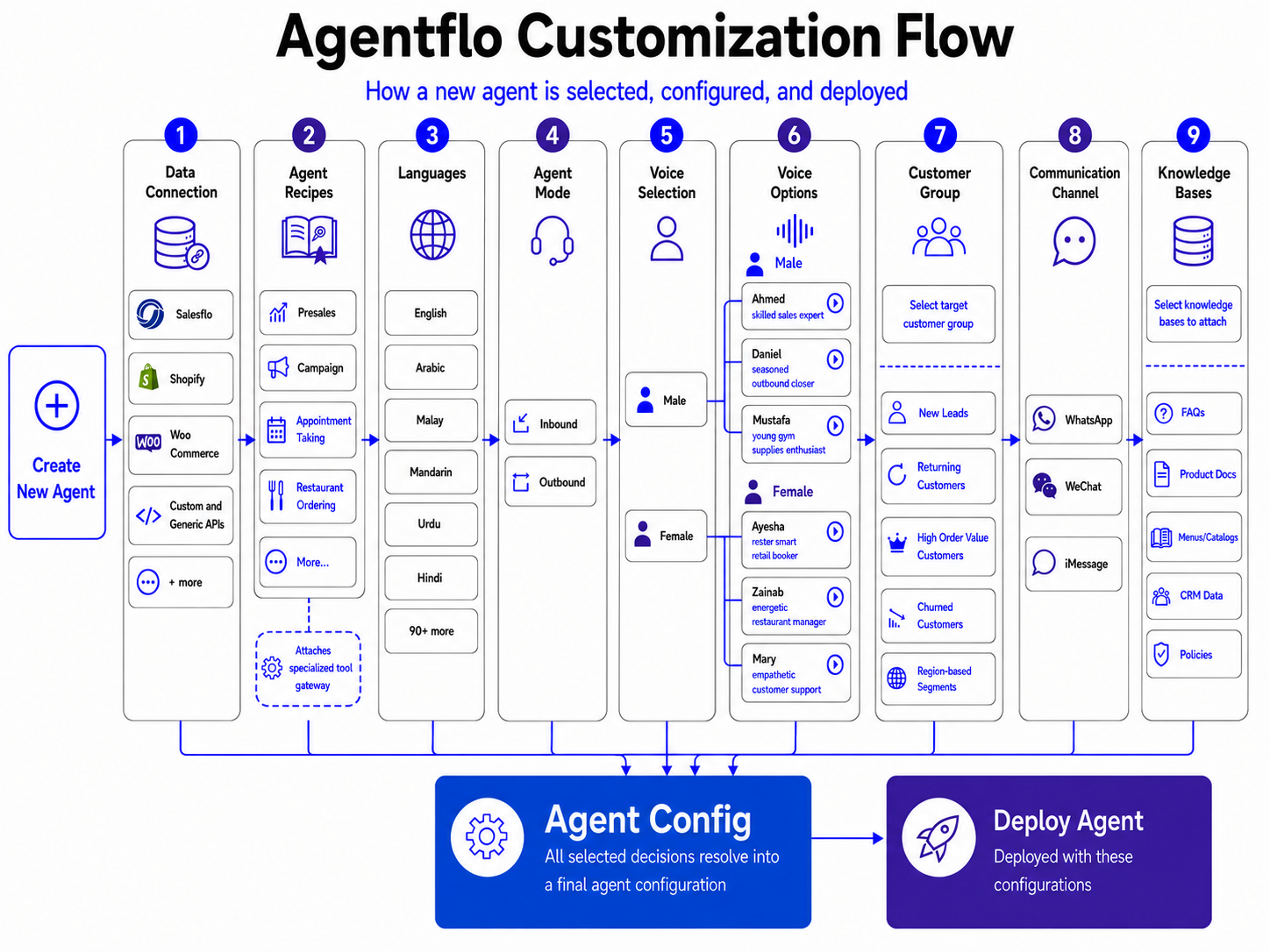
From the merchant’s perspective, agent creation is entirely no-code. Here’s an example of the agent customization flow:

AgentFlo Portal agent customization workflow

Figure 2: Agent customization workflow

This approach makes the recipe model work. Adding a new capability (like loyalty program enrollment) means writing a new tool function and updating the system prompt. No orchestration layer rewiring is needed.

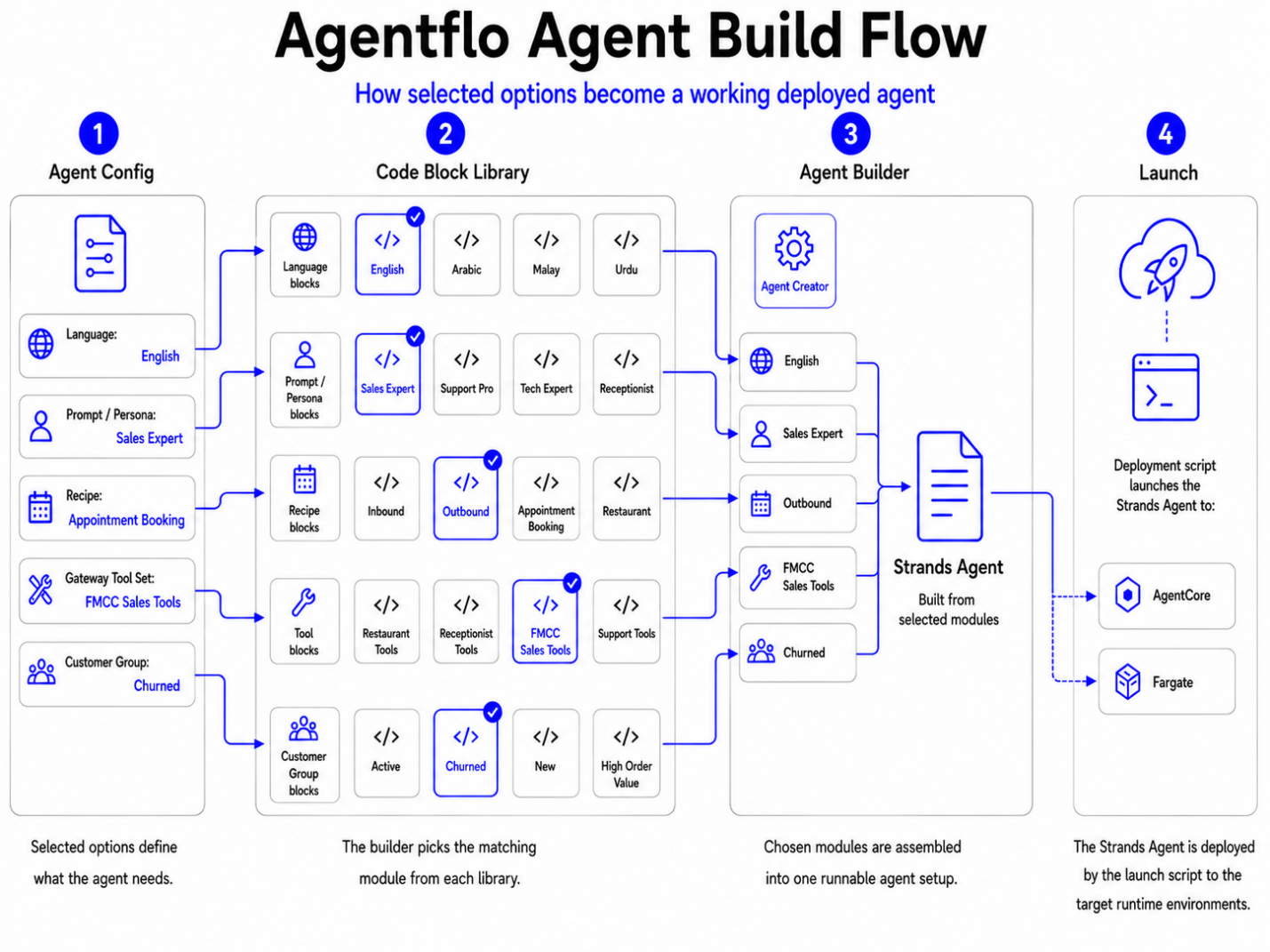
Behind the scenes, one selection triggers an automated pipeline:

  1. The portal generates a Strands agent configuration from the recipe template.
  2. GitHub Actions packages the agent (tools, prompts, context) into a container.
  3. The container deploys to AgentCore runtime with appropriate Gateway policies.
  4. The agent goes live on WhatsApp within minutes.
Automated pipeline that builds and deploys a customized agent

Figure 3: How to build a customized agent under hook workflow

Each agent is a Strands Agent instance with tool definitions mapped to AgentCore Gateway endpoints. Extending an agent’s capabilities is a code change, not an architectural one.

Results

This recipe-based approach delivers faster merchant onboarding, rapid experimentation with new agent behaviors, and quick addition of new capabilities platform-wide. It also means lower engineering effort per deployment and a tighter feedback loop between customer conversations and product iteration.

Pillar 2: Standardization: reusable recipes, tools, and commerce workflows

Consistency across deployments speeds iteration and reduces maintenance burden. AgentFlo achieves this through shared building blocks.

The challenge

As AgentFlo expanded across industries, fragmentation threatened to slow the team down. Every merchant has unique catalog structures, ERP setups, system configurations (Shopify, WooCommerce, Magento), pricing rules, languages, promotions, and support processes. Without standardization, every deployment becomes a custom project, and custom projects don’t scale to hundreds of merchants.

Repeatable building blocks

AgentFlo standardizes around several core components: agent recipes (domain-specific templates), a tool marketplace (reusable capabilities), MCP-based connectors (standardized integrations), integration contracts (consistent interfaces). Additional components include prompt and context packs (reusable templates), conversation review loops (continuous improvement), and a shared semantic layer (unified product understanding). Merchant-specific complexity is pushed to the system edges. The core remains consistent.

Single-agent architecture with domain expertise

We learned early on that a single agent with domain-specific knowledge and a curated tool set outperforms multi-agent architectures for most customer interactions. Each AgentFlo deployment configures a distinct persona, voice, language, and specialized tool set tailored to the business domain (sales agent, restaurant agent, clinic receptionist). It ships with curated contexts, prompt templates, and response packs. Merchants deploy these domain-specific agents through the self-service portal.

A single focused agent maintaining unified context converts better than multiple generalists coordinating with each other. Multi-agent capabilities remain available where valuable. For example, when conversations transition from sales to support, context hands off cleanly to the specialist agent.

Tool routing through AgentCore Gateway

Centralized tool management routes agent requests to dedicated AWS Lambda functions. When a customer asks about product availability, the agent queries the product catalog. When they’re ready to buy, it handles cart operations. For personalized recommendations, it retrieves data from Amazon Bedrock Knowledge Bases, the fully managed Retrieval Augmented Generation (RAG) capability, backed by merchant data stored in Amazon S3. Sales intelligence APIs provide additional context for each interaction.

OAuth tokens and platform credentials live in the Gateway, not in agent sessions. Policy in AgentCore sits alongside the Gateway, enforcing fine-grained, Cedar-based access control rules that operate independently of model reasoning. Cedar is an open-source policy language developed by AWS that allows fine-grained, verifiable authorization decisions.

Policies define which agent sessions can invoke which tools. For example, a sales agent can’t call customer-support-only APIs.

For standardization, this means every new tool added to the platform (payment integration, shipping provider, loyalty system) becomes available to every applicable recipe through the same mechanism. Tools aren’t re-implemented per merchant.

AgentCore Gateway as the integration backbone

AgentFlo integrates with dozens of eCommerce services: Shopify, WooCommerce, Magento, SAP, payment processors, shipping providers, and loyalty systems. Each integration is defined as an MCP server connector, with Gateway handling discovery, authentication, and routing. Furthermore, AgentFlo has many different agent recipes, each with their own specialized tool packs to provide that functionality. To make these connections modular and efficient, AgentFlo uses AgentCore Gateway.

From the agent’s perspective, the full Gateway tool surface is reachable in a few lines:

from strands import Agent
from strands.models import BedrockModel
from strands.tools.mcp.mcp_client import MCPClient
from mcp.client.streamable_http import streamablehttp_client

def create_transport():
    return streamablehttp_client(
        GATEWAY_URL,
        headers={"Authorization": f"Bearer {access_token}"},
    )

mcp_client = MCPClient(create_transport)

with mcp_client:
    # Discover every tool registered on the Gateway in one call.
    # cart, product catalog, knowledge base, shipping, loyalty, etc.
    tools = mcp_client.list_tools_sync()

    agent = Agent(
        model=BedrockModel(model_id="us.anthropic.claude-sonnet-5-20260630"),
        tools=tools,
        system_prompt=SALES_AGENT_PROMPT,
    )

    response = agent("Do you have the red leather wallet in stock?")

Connecting a Strands agent to AgentCore Gateway. A single list_tools_sync() call gives the agent every integration registered on the Gateway: cart, product catalog, knowledge base, shipping, loyalty. Onboarding a new service for a merchant is a Gateway change, not an agent change.

Key capabilities:

MCP-native tool connectivity: Each platform or tool set integration is a standard MCP server connector.

OAuth and credential management: Platform API keys and OAuth tokens are managed centrally in Gateway, never exposed to individual agent sessions.

Code simplicity: The code is cleaner, shorter, and more modular, which simplifies configuration for scale. The alternative is extensive local code for each connection or tool set.

Because each new service integration and recipe-specific tool set is defined as an MCP server connector in AgentCore Gateway, expansion is modular and quick. Adding a new service or tool set requires a connector definition, not a re-architecture.

Conversation reviews as a standardization loop

Standardization also comes from learning. AgentFlo continuously reviews real conversations to understand how customers ask for products, where they drop off, which recommendations convert, when handoff is needed, and how local language affects buying behavior.

These reviews feed back into recipes, prompts, and tool definitions. Standardization is something the platform earns over time, not something declared at launch.

Results

Every deployment improves future deployments, and new integrations become reusable across the merchant base. Agent behavior stays consistent across recipes and merchants, and workflows become repeatable across industries. The service becomes harder to replicate because it learns from real commerce behavior, not generic templates.

Pillar 3: Scalability: elastic, stateful commerce conversations

Commerce conversations are unpredictable in volume and duration. AgentFlo’s architecture handles both dimensions without manual intervention.

The challenge

During flash sales, product launches, or restaurant rush hours, customer conversations can spike 10–50x. Human teams can’t scale that fast. AgentFlo must also support many merchants and concurrent customer sessions simultaneously. One merchant’s surge can’t affect another’s experience.

AgentFlo’s serverless architecture

AgentFlo uses a serverless architecture. Message ingestion, agent execution, tool execution, state, analytics, and billing each scale independently. Each layer absorbs its own spikes without requiring the rest of the system to over-provision.

AgentCore runtime properties for scale

Several AgentCore runtime properties specifically support scale:

Isolated microVM execution: Each agent session runs in its own environment with dedicated CPU, memory, and filesystem. The environment is sanitized on termination. One merchant’s sessions never interfere with another’s.

Stateful sessions up to eight hours: Long-running conversations don’t lose context. A customer browsing in the morning can continue the same assisted session that evening.

Framework-agnostic: AgentCore runs Strands Agents natively but also supports any containerized agent framework, giving AgentFlo flexibility to evolve the agent architecture over time.

How it works

The architecture is built end-to-end on AWS:

Messaging layer (AWS Fargate): An Application Load Balancer routes incoming WhatsApp messages to a Fargate application that handles authentication, voice message conversion (Opus OGG to MP3 transcription with fuzzy matching for product name recognition). The application also runs pre-turn security guards. AWS End User Messaging provides an alternative channel option for broader reach.

Agent orchestration (Amazon Bedrock AgentCore runtime): Each customer session spawns an isolated agent instance running the Strands Agents SDK. Sessions are stateful for up to eight hours and isolated through microVM architecture, where each session runs in its own lightweight virtual machine. They are persistent, with filesystem access for intermediate results and cached product catalogs. microVM isolation keeps merchants completely separated.

This is the entire bridge between Strands SDK agent code and a production-ready endpoint on AWS:

from strands import Agent
from bedrock_agentcore.runtime import BedrockAgentCoreApp

app = BedrockAgentCoreApp()

agent = Agent(
    tools=tools,  # from the Gateway, per snippet above
    system_prompt=SALES_AGENT_PROMPT,
)

@app.entrypoint
def invoke(payload, context):
    """One AgentCore session per customer conversation."""
    user_message = payload.get("prompt")
    session_id = getattr(context, "session_id", None)  # stable for up to 8 hours
    result = agent(user_message)
    return {"result": result.message}

if __name__ == "__main__":
    app.run()

This is all the glue between a Strands agent and AgentCore Runtime. BedrockAgentCoreApp wraps the agent in the standard /invocations contract, and AgentCore handles microVM provisioning, session isolation, scaling, and stateful sessions up to eight hours. Two CLI commands take it from a local file to a live endpoint on AWS. No Dockerfile, no API routing, no web framework to maintain.

agentcore configure --entrypoint agent.py
agentcore launch

Tool execution (Amazon Bedrock AgentCore Gateway): Tool calls scale separately from agent reasoning, so a sudden burst of cart operations doesn’t slow down the agent loop itself.

Results

The architecture handles peak traffic without pre-provisioning capacity and supports long-running conversations that survive across visits. It provides strong multi-merchant isolation with lower operational overhead than traditional always-on infrastructure, resulting in a better customer experience during high-intent moments like product launches or flash sales.

What’s next

In Part 2 of this series, we explore:

Pillar 4: Trust. Guardrails for autonomous commercial action and real-time visibility into agent operations.

Pillar 5: Reliable. Data foundation that ensures agents act on reliable, up-to-date information to complete tasks with precision.

Business results: Measurable impact across the customer lifecycle.

Future roadmap: Voice agents, server-side tool execution, and integration expansion.

Summary

In this post, we explored three of the five pillars for building production-grade AI agents:

Velocity: How recipe-based deployment allows merchants to launch AI sales agents in minutes using the model-driven architecture of the Strands Agents SDK.

Standardization: How reusable building blocks and centralized tool management through Amazon Bedrock AgentCore create consistency across hundreds of deployments.

Scalability: How AgentFlo handles elastic, stateful commerce conversations at scale through Amazon Bedrock AgentCore and AWS Fargate.

Next steps

We’d love to hear how you’re building agentic AI systems. Share your experiences in the comments.


About the authors