All posts by sabeen malik

Modernizing Global Vulnerability Standards For The Age Of AI

Post Syndicated from sabeen malik original https://www.rapid7.com/blog/post/ai-modernizing-global-vulnerability-standards

As AI-driven vulnerability discovery accelerates, the cybersecurity ecosystem is being forced to examine whether the standards, disclosure processes, and prioritization frameworks defenders rely on can still keep pace. Many of those systems were built around human-speed discovery, manageable vulnerability volumes, and exploitability confirmed after the fact, which leaves them under increasing strain as frontier AI capabilities mature.

During a private sector consultation with the White House in June, Corey Thomas and I presented Rapid7’s new policy paper, Modernizing Global Vulnerability Standards, which lays out where today’s vulnerability management infrastructure is breaking under AI-era conditions and what governments, security companies, and frontier AI providers need to do next.

In recent guidance, the Five Eyes cyber security agencies warned that AI is rapidly transforming cyber risk by increasing the speed, scale, and sophistication of threats, lowering barriers for malicious actors, and requiring leaders to reassess long-standing assumptions about resilience and accountability.

AI vulnerability discovery is changing the rules

In April 2026, Anthropic, OpenAI, and Google DeepMind each announced production-grade AI systems capable of discovering, chaining, and, in some cases, remediating software vulnerabilities at machine speed. In the same period, the Stanford HAI AI Index 2026 Cybench benchmark showed unguided AI agent solve rates on cybersecurity tasks rising from 15% to 93% in a single year.

These are deployed capabilities on a steep improvement curve. Faster discovery can help security teams identify weaknesses earlier, validate risk more effectively, and improve remediation workflows. It also increases the pressure on every system that decides how vulnerabilities are verified, scored, disclosed, prioritized, and fixed.

Vulnerability management standards were built for human speed

For decades, the security community has depended on shared infrastructure to make vulnerability management work. CVE identifiers, CVSS scoring, the National Vulnerability Database, the CISA Known Exploited Vulnerabilities catalog, and the Exploit Prediction Scoring System all help organizations understand what a vulnerability is, how severe it may be, whether it is being exploited, and how urgently it should be addressed.

Those systems were built around several assumptions: vulnerability discovery would be human-led, volume would remain manageable, exploitability would usually be confirmed after the fact, and organizations would have time to assess and respond. As AI-driven discovery challenges each of those assumptions, existing strain across the vulnerability ecosystem becomes much harder to absorb.

CVE submissions already grew 263% between 2020 and 2025 from human-speed growth alone. NIST acknowledged in April 2026 that the National Vulnerability Database can no longer keep pace and is shifting to risk-based triage. If AI-driven discovery dramatically increases volume, the prioritization problem becomes even more acute.

The issue for defenders is whether organizations can understand which vulnerabilities are actually exploitable, which are reachable in their environments, which can be chained together, and which require immediate action.

AI-era vulnerability prioritization needs reform

The paper argues that the prioritization gap is the most urgent and least addressed part of the problem. Traditional severity scores can miss the way attackers chain multiple lower-severity issues into a serious compromise. KEV remains one of the strongest signals available to defenders, but it is retrospective by design because it depends on confirmed exploitation in the wild. EPSS is trained on historical attacker behavior, which may not reflect what AI-assisted attackers can now do.

To close that gap, we propose reforms that would help move vulnerability prioritization closer to real-world risk. These include recognizing verified AI-demonstrated exploitability, adding chaining-risk metadata to vulnerability records, and requiring reachability guidance alongside AI-discovered findings.

The goal is to help organizations understand how dangerous a vulnerability is in practice, in their environment, rather than relying only on abstract severity.

AI vulnerability policy needs verification, access, and accountability

The paper also outlines a broader policy agenda – we call for updates to the Vulnerabilities Equities Process, investment in CVE and NVD infrastructure, standardized capability disclosure from AI labs, stronger international coordination, and clear CISA leadership.

We also propose three access and verification standards for the security community:  

  • Independent verification before access expansion

  • Broad but curated access through transparent processes

  • Rigorous data standards for published capability claims

The frontier model providers building these capabilities deserve credit for acting responsibly as they develop programs in real time. But individual access programs cannot carry the weight of ecosystem governance on their own. The security community needs shared standards backed by independent verification and institutional accountability.

The next phase of cybersecurity resilience

This paper is part of a wider conversation we recently explored on Rapid7’s Experts on Experts: Commanding Perspectives, where Corey and I discussed AI, compliance, industry accountability, and the shift toward more resilient security operations.

AI-driven vulnerability discovery has crossed a threshold. The question now is whether the policy, standards, and operational systems around it can adapt quickly enough to help defenders use these capabilities safely and effectively.

Read the full paper, Modernizing Global Vulnerability Standards, to explore Rapid7’s recommendations for verification, access, disclosure, prioritization, and institutional accountability in the age of AI-driven vulnerability discovery.

NIS2 is raising the bar. Here’s how to turn readiness into resilience.

Post Syndicated from sabeen malik original https://www.rapid7.com/blog/post/so-nis2-compliance-turn-readiness-into-resilience

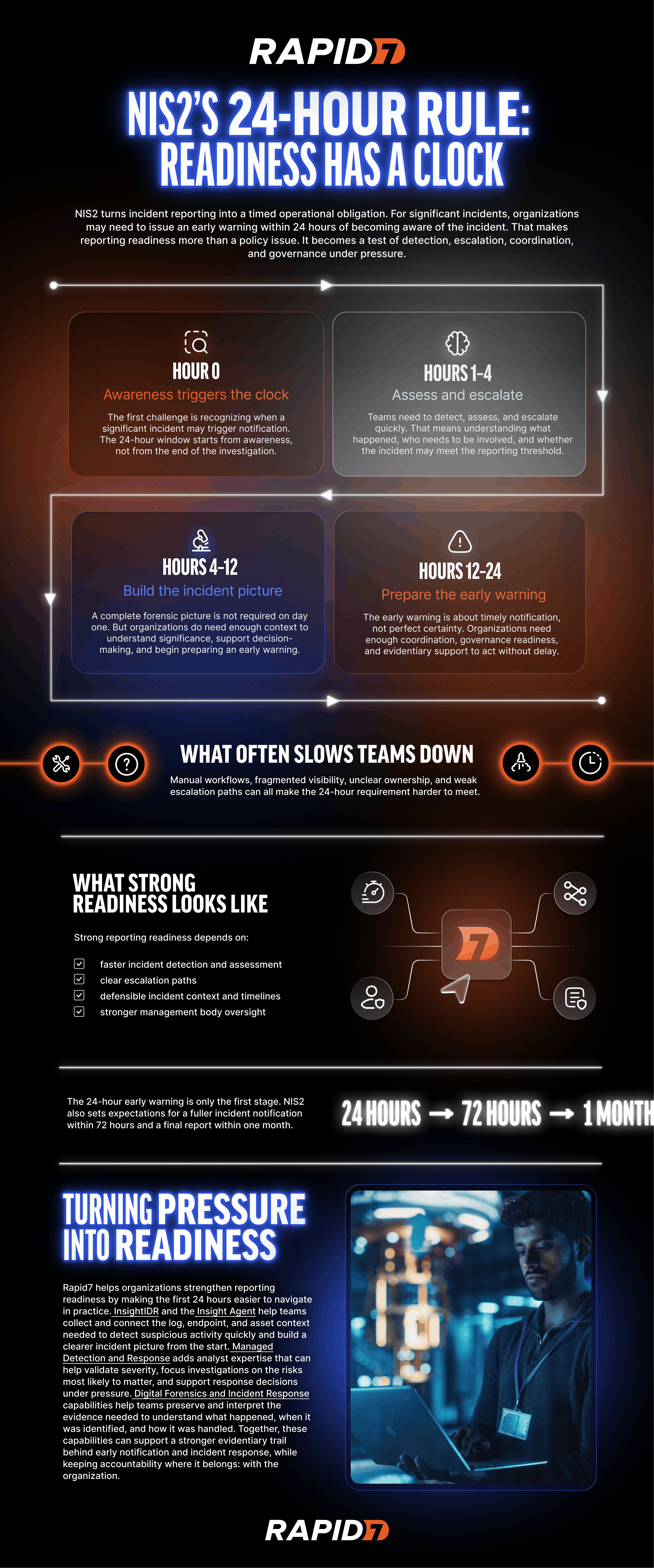
The NIS2 directive asks covered organizations to take a more structured approach to risk management, governance, supply chain security, and incident reporting. It expands the scope of who may be covered, raises expectations around management body accountability, introduces clearer and more enforceable requirements, and increases pressure on organizations to show that security is being managed in a consistent, defensible way. Reporting timelines are one of the most visible parts of that shift, with early warning required within 24 hours of awareness for significant incidents, incident notification within 72 hours, and a final report within one month. It also arrived in a landscape that is still uneven, with member states continuing to implement the directive in different ways across the EU.

That combination has created a familiar challenge for CISOs and security teams, as the questions coming from boards and leadership are no longer just about whether the organization understands the regulation, but whether it can meet the requirements in practice. NIS2 reaches into risk management, reporting, governance, and supply chain oversight, which means readiness depends on how well security works across the business, not just on how well a policy is written.

That is why the most useful way to think about NIS2 is as an operational resilience exercise. Compliance still matters, of course, and teams need to know what the directive requires. What tends to make the difference over time is whether security leaders can connect those requirements to the real conditions of the environment: what is exposed, where ownership sits, how incident response works in practice, how supply chain risk is monitored, and how quickly the organization can move when something material happens.

Regulations are easier to absorb than operating model changes. A team may understand that NIS2 raises expectations around governance and incident handling, while still finding it difficult to answer basic questions quickly when pressure rises. Which business services are most critical? Which third parties matter most? Who owns the decision when a serious issue lands? How prepared are we to investigate, communicate, and report inside the timelines the directive expects? Those are the questions that separate a compliance project from a resilience program.

That is also why we have been building practical content to help teams move from interpretation to action.

Our ebook is the best place to start if you want the wider context. It is designed to help security leaders understand what NIS2 means in practical terms, how to think about the directive beyond a narrow checklist, and how to connect compliance obligations to a broader resilience strategy. If your team needs a stronger narrative for internal stakeholders, or a clearer way to explain why NIS2 should influence operational priorities, the ebook is the most useful first read.

Next, our NIS2 Readiness Toolkit is built for teams that want to assess where they are and what to do next. iIt is as a way to bridge the gap between NIS2 requirements and operational reality, with a focus on risk, reporting, and governance. It is designed to help teams spot gaps, focus effort, and simplify the path from regulatory complexity to a more defensible security strategy. In other words, it gives you a practical framework for understanding where readiness is strong, where it is uneven, and what deserves attention first.

Our infographic, seen below, is the quickest asset to use when you need to communicate one of the most tangible parts of NIS2: the 24-hour reporting requirement. Some stakeholders need the long-form explanation. Others need a practical view of what has to happen between incident awareness and early notification. The infographic helps teams bring that operational pressure into planning conversations, leadership updates, and internal alignment without requiring everyone to start with a longer asset first.

REQ-18355_-_Infographic_The_24-Hour_Rule-1.png

Taken together, these assets are useful because they serve different parts of the same problem. The ebook gives you a strategic view, the toolkit helps you assess readiness and prioritize action, and the infographic helps communicate the big picture quickly and clearly.

Enforcement expectations, reporting maturity, and national interpretation continue to evolve, and security teams are working through those changes at the same time as the wider threat landscape becomes more complex. A stronger response starts with clarity, but it needs to move quickly into coordination, ownership, and repeatable process if it is going to hold up under pressure.

If your organization is still treating NIS2 as a point-in-time compliance exercise, now is a good moment to widen the lens. The directive is pushing security leaders beyond a comply-once approach and toward a model of being continuously secure. Teams that build better visibility, stronger governance, and clearer response processes for NIS2 will be better prepared not only for regulatory scrutiny, but for the wider operational demands that are already shaping the market.

Does Your Security Programme Align With NIS2 Requirements?

Post Syndicated from sabeen malik original https://www.rapid7.com/blog/post/so-aligning-security-programmes-with-nis2-requirements

If your organization operates in the EU, or works with organizations that do, NIS2 is no longer something on the horizon. It is here and it applies to a far wider range of sectors than its predecessor, the original NIS Directive (Directive (EU) 2016/1148), and it comes with real consequences for organizations that cannot demonstrate they are meeting its requirements. The good news? You do not have to figure out how to approach it alone.

Rapid7 has developed a dedicated NIS2 resource page that shows how the Command Platform can support key technical and operational aspects of NIS2 readiness, highlights common security program gaps, and explains where our solutions can help strengthen visibility, prioritization, detection, and reporting readiness. It is not a substitute for the broader organizational, legal, and governance measures the directive also requires, but it can be a useful starting point if you are evaluating your security capabilities and want a clearer picture of where tooling can support your approach. If you are in the early stages of assessing readiness, or further along and looking for a clearer view of the technical side, it is worth 10 minutes of your time.

What are the NIS2 requirements organizations need to meet?

NIS2, formally Directive (EU) 2022/2555, expands the scope of EU cybersecurity regulation significantly. More sectors are covered,the requirements are more demanding, and, crucially, the expectations have shifted from “do you have policies in place?” to “can you demonstrate that your controls actually work, continuously?”.

Article 21 mandates specific risk-management measures, including risk analysis, incident handling, business continuity, supply chain security, vulnerability handling, access control, and policies regarding the use of cryptography and encryption.. Article 23 introduces strict incident reporting timelines: an early warning within 24 hours, a full notification within 72 hours, and a detailed report within one month of a significant incident.

For many security teams, these timelines necessitate a shift in operational readiness. Timely and accurate incident reporting requires pre-established detection workflows, investigation processes, and contemporaneous documentation practices to be in place prior to an incident..

NIS2 also raises the stakes at a leadership level. Executive accountability for cybersecurity is now formalised. This is not just a technical team problem. It is a governance issue that touches CISOs, boards, and senior leadership across every in-scope organization.

Why traditional compliance approaches fall short of NIS2

Many security programs were designed around a different set of expectations. Periodic vulnerability scans.,annual audits, and compliance reports that reflected a moment in time rather than ongoing operational health.

NIS2 necessitates a move toward continuous, defensible risk management. This involves maintaining comprehensive asset visibility, identifying threat-aware exposures with high likelihood of exploitability, and validating the effectiveness of detection capabilities to support regulatory reporting requirements..

It is a meaningful operational shift, and it is exactly the kind of shift where having the right platform and the right partner matters.

How does Rapid7 support NIS2 compliance?

Rapid7 views NIS2 as an operational readiness challenge. The objective is to assist organizations in transitioning from periodic compliance assessments to continuous resilience: a sustained, measurable security posture designed to support regulatory alignment and strengthen defense-in-depth against emerging threats. The platform integrates exposure management, vulnerability management, cloud security, SIEM, and managed detection and response to provide broad support for the core requirements of Article 21 within a unified, connected view of risk..

That means organizations can move from scattered, point-in-time security activity to continuous visibility, threat-informed prioritization, faster incident workflows, and the kind of evidence and reporting that NIS2 and regulators actually demand.

A few areas where this makes a real difference:

Knowing what you are actually exposed to

Rapid7 is positioned as a Leader in the 2025 Gartner® Magic Quadrant™ for Exposure Assessment Platforms, a technology category fundamental to the Continuous Threat Exposure Management (CTEM) framework, which supports the proactive risk-management objectives of NIS2. Surface Command provides centralized visibility across internal and external environments, supporting the identification of unmanaged assets, shadow IT, and security control gaps that may otherwise remain undetected. Exposure Command utilizes active risk scoring and attack path analysis to identify and prioritize exposures based on reachability and threat context, helping teams focus remediation efforts on high-impact risks.

Responding and reporting faster

Rapid7’s SIEM and MDR capabilities are designed to support the detection, investigation, and reporting speed necessitated by NIS2. 24/7 monitoring and managed response facilitate the capture of essential telemetry and investigation trails within the SIEM, streamlining the evidence collection process for regulatory reporting.

Demonstrating that controls work

NIS2 is not satisfied by a list of tools you have purchased. It wants evidence that your controls are effective. Rapid7 provides continuous risk scoring, detection metrics, and audit-ready reporting that translates security activity into governance-ready language for leadership and regulators.

Where to go next for NIS2 readiness

This post covers the highlights, but Rapid7’s NIS2 resource page goes much deeper.

It walks through each of Article 21’s requirements in plain language, maps them to specific Rapid7 capabilities, and shows how the platform supports risk analysis… MFA monitoring, and technical assessment of cryptographic configurations. Whether you are a CISO seeking a strategic overview, a security manager evaluating technical controls, or a compliance lead mapping regulatory requirements to platform capabilities, our guidance is designed to support your objectives. NIS2 is operational; your approach to resilience should be as well. NIS2 is operational and your readiness should be too.

See how Rapid7 supports NIS2 compliance here

How Rapid7 is bringing Cyber GRC closer to security operations

Post Syndicated from sabeen malik original https://www.rapid7.com/blog/post/cds-rapid7-cyber-grc-secops-compliance

Sabeen Malik is VP, Global Government Affairs and Public Policy at Rapid7.

Security teams need a better way to connect what they detect, what they fix, and what they can prove.

The pace of modern security operations no longer works in defenders’ favor. IBM’s Cost of a Data Breach Report 2025 found that the mean time to identify and contain a breach is now 241 days, even as AI and automation help defenders move faster. At the same time, Rapid7’s 2026 Global Threat Landscape Report shows how quickly attacker behavior is compressing the response window: exploited high and critical severity vulnerabilities more than doubled year over year, increasing 105% from 71 in 2024 to 146 in 2025, while the median time from publication to CISA KEV inclusion fell from 8.5 days to 5.0 days. This is not a future risk. It is today’s operational reality.

It also exposes a governance problem most security programs were not built to solve. Security teams are expected to demonstrate, continuously, that controls are working, that risk is being reduced, and that security investments are delivering measurable outcomes. Point-in-time audit evidence, assembled quarterly, is structurally incompatible with an environment where the threat picture changes in minutes.

The underlying issue is not a lack of effort, but a disconnect. Security data lives in one place, remediation happens in another, and evidence for auditors is assembled somewhere else. When leadership asks what changed, what was fixed, and what risk remains, teams are left stitching the story together manually producing reports that reflect where the organization was, not where it is.

Cyber GRC closes that gap by bringing governance, risk management, and compliance closer to the security data and workflows teams already rely on.

Why security operations and compliance need connected data

For years, security operations and GRC have run in parallel. One team manages threats, exposures, and remediation. Another manages policies, controls, audits, and evidence. Both aim to reduce risk, but typically without shared context or shared data.

That separation is no longer sustainable. Vulnerability exploitation rose 34% year-over-year and now accounts for 20% of all breaches, with a median of zero days between critical vulnerability publication and mass exploitation (Verizon DBIR 2025). Supply chain breaches doubled, now representing 30% of all incidents. Ransomware appeared in 44% of breaches – up 37% from the prior year.

Security leaders operating in this environment face an expectation that compliance teams were not designed to meet alone: continuous proof that controls are effective against adversaries who operate at machine speed. When AI agents can autonomously chain every phase of an attack with minimal human oversight, a quarterly audit cycle is not an assurance, but a historical record.

Why Cyber GRC matters now

Boards are no longer satisfied with compliance status reports. They want dollarized risk scenarios and evidence that remediation is actually reducing exposure — not just that it was attempted.

Two pressures are converging. First, environmental complexity: modern infrastructure spans cloud, SaaS, remote endpoints, OT systems, and third-party providers. The perimeter is everywhere, and so is the attack surface. Second, regulatory expectation: SEC, NIS2, DORA, and CMMC now require demonstrable control effectiveness, not just documented policies. Both pressures demand a model that brings security activity, compliance readiness, and accountability into the same view.

What Cyber GRC changes for security and compliance teams

Cyber GRC changes how organizations use security data. Instead of disconnected, point-in-time artifacts, it enables teams to build governance and compliance workflows directly on top of real security telemetry – so evidence reflects the current state of the environment, not a snapshot assembled weeks before an audit.

In practice, this means connecting findings, controls, remediation activity, and evidence so teams can see what issues exist, who owns the response, how remediation is progressing, and what that means for overall readiness. This also helps address the compliance-theater problem directly: many programs are designed to pass audits rather than reduce actual exposure, creating false confidence and misallocated resources. Grounding compliance evidence in live security telemetry — rather than manual documentation — means teams can tell the difference between controls that are configured and controls that are working.

How connected security data strengthens compliance

Compliance has historically been treated as a separate process that happens alongside security operations. In practice, it depends on the same data. The telemetry that surfaces a critical finding also determines whether a control is operating effectively.

When evidence is generated directly from operational systems, teams spend less time assembling reports and more time improving controls. Continuous monitoring for control drift allows organizations to move from reactive audit preparation toward a consistent assurance model. Third-party risk — now a source of 30% of all breaches — benefits particularly, since continuous TPRM monitoring surfaces supply chain exposure in real time rather than at the next assessment cycle.

How Rapid7 Cyber GRC builds on existing security workflows

This shift does not require rebuilding security programs from the ground up. With the launch of Rapid7 Cyber GRC, customers can use the security data and workflows already connected through the Command Platform to support audits, assessments, and ongoing control validation. Capabilities such as HITRUST E1 control coverage provide continuous monitoring and automated evidence collection, while features like audit-ready user access exports and unified policy data reduce manual effort across SOC 2, NIST CSF, PAI, and other common frameworks.

When NIST CSF 2.0, MITRE ATT&CK, and FAIR-based risk quantification inform the evidence model rather than just the policy library, compliance becomes a byproduct of strong security operations — not a parallel burden.

Rapid7 is launching Cyber GRC to connect security operations, risk, and compliance

Organizations do not need more disconnected processes for managing risk. They need a way to connect what they detect, what they fix, and what they can prove in a way that stands up to regulatory scrutiny, board-level oversight — and keeps pace with adversaries who operate at AI speed.

That is why Rapid7 is launching Cyber GRC: to help customers bring security operations, governance, and compliance into a single, continuous view so teams can reduce risk, improve readiness, and demonstrate progress with confidence.

For current clients, reach out to your account team to get early access to Rapid7’s Cyber GRC solution and help shape what comes next.

Sources: IBM Cost of a Data Breach Report 2025 | Rapid7’s 2026 Global Threat Landscape Report | Verizon DBIR 2025

What is Cyber GRC? How Rapid7 is bringing compliance closer to security operations

Post Syndicated from sabeen malik original https://www.rapid7.com/blog/post/so-cyber-grc-how-rapid7-brings-compliance-to-security-operations

Sabeen Malik is VP, Global Government Affairs and Public Policy at Rapid7.

Security teams need a better way to connect what they detect, what they fix, and what they can prove.

The pace of modern security operations no longer works in defenders’ favor. IBM’s Cost of a Data Breach Report 2025 found that the mean time to identify and contain a breach is now 241 days, even as AI and automation help defenders move faster. At the same time, Rapid7’s 2026 Global Threat Landscape Report shows how quickly attacker behavior is compressing the response window: exploited high and critical severity vulnerabilities more than doubled year over year, increasing 105% from 71 in 2024 to 146 in 2025, while the median time from publication to CISA KEV inclusion fell from 8.5 days to 5.0 days. This is not a future risk. It is today’s operational reality.

It also exposes a governance problem most security programs were not built to solve. Security teams are expected to demonstrate, continuously, that controls are working, that risk is being reduced, and that security investments are delivering measurable outcomes. Point-in-time audit evidence, assembled quarterly, is structurally incompatible with an environment where the threat picture changes in minutes.

The underlying issue is not a lack of effort, but a disconnect. Security data lives in one place, remediation happens in another, and evidence for auditors is assembled somewhere else. When leadership asks what changed, what was fixed, and what risk remains, teams are left stitching the story together manually producing reports that reflect where the organization was, not where it is.

Cyber GRC closes that gap by bringing governance, risk management, and compliance closer to the security data and workflows teams already rely on.

Why security operations and compliance need connected data

For years, security operations and GRC have run in parallel. One team manages threats, exposures, and remediation. Another manages policies, controls, audits, and evidence. Both aim to reduce risk, but typically without shared context or shared data.

That separation is no longer sustainable. Vulnerability exploitation rose 34% year-over-year and now accounts for 20% of all breaches, with a median of zero days between critical vulnerability publication and mass exploitation (Verizon DBIR 2025). Supply chain breaches doubled, now representing 30% of all incidents. Ransomware appeared in 44% of breaches – up 37% from the prior year.

Security leaders operating in this environment face an expectation that compliance teams were not designed to meet alone: continuous proof that controls are effective against adversaries who operate at machine speed. When AI agents can autonomously chain every phase of an attack with minimal human oversight, a quarterly audit cycle is not an assurance, but a historical record.

Why Cyber GRC matters now

Boards are no longer satisfied with compliance status reports. They want dollarized risk scenarios and evidence that remediation is actually reducing exposure — not just that it was attempted.

Two pressures are converging. First, environmental complexity: modern infrastructure spans cloud, SaaS, remote endpoints, OT systems, and third-party providers. The perimeter is everywhere, and so is the attack surface. Second, regulatory expectation: SEC, NIS2, DORA, and CMMC now require demonstrable control effectiveness, not just documented policies. Both pressures demand a model that brings security activity, compliance readiness, and accountability into the same view.

What Cyber GRC changes for security and compliance teams

Cyber GRC changes how organizations use security data. Instead of disconnected, point-in-time artifacts, it enables teams to build governance and compliance workflows directly on top of real security telemetry – so evidence reflects the current state of the environment, not a snapshot assembled weeks before an audit.

In practice, this means connecting findings, controls, remediation activity, and evidence so teams can see what issues exist, who owns the response, how remediation is progressing, and what that means for overall readiness. This also helps address the compliance-theater problem directly: many programs are designed to pass audits rather than reduce actual exposure, creating false confidence and misallocated resources. Grounding compliance evidence in live security telemetry — rather than manual documentation — means teams can tell the difference between controls that are configured and controls that are working.

How connected security data strengthens compliance

Compliance has historically been treated as a separate process that happens alongside security operations. In practice, it depends on the same data. The telemetry that surfaces a critical finding also determines whether a control is operating effectively.

When evidence is generated directly from operational systems, teams spend less time assembling reports and more time improving controls. Continuous monitoring for control drift allows organizations to move from reactive audit preparation toward a consistent assurance model. Third-party risk — now a source of 30% of all breaches — benefits particularly, since continuous TPRM monitoring surfaces supply chain exposure in real time rather than at the next assessment cycle.

How Rapid7 Cyber GRC builds on existing security workflows

This shift does not require rebuilding security programs from the ground up. With the launch of Rapid7 Cyber GRC, customers can use the security data and workflows already connected through the Command Platform to support audits, assessments, and ongoing control validation. Capabilities such as HITRUST E1 control coverage provide continuous monitoring and automated evidence collection, while features like audit-ready user access exports and unified policy data reduce manual effort across SOC 2, NIST CSF, PAI, and other common frameworks.

When NIST CSF 2.0, MITRE ATT&CK, and FAIR-based risk quantification inform the evidence model rather than just the policy library, compliance becomes a byproduct of strong security operations — not a parallel burden.

Rapid7 is launching Cyber GRC to connect security operations, risk, and compliance

Organizations do not need more disconnected processes for managing risk. They need a way to connect what they detect, what they fix, and what they can prove in a way that stands up to regulatory scrutiny, board-level oversight — and keeps pace with adversaries who operate at AI speed.

That is why Rapid7 is launching Cyber GRC: to help customers bring security operations, governance, and compliance into a single, continuous view so teams can reduce risk, improve readiness, and demonstrate progress with confidence.

For current clients, reach out to your account team to get early access to Rapid7’s Cyber GRC solution and help shape what comes next.

Sources: IBM Cost of a Data Breach Report 2025 | Rapid7’s 2026 Global Threat Landscape Report | Verizon DBIR 2025

Peeking into the crystal ball: What 2023 cyber threats told us about 2024

Post Syndicated from sabeen malik original https://blog.rapid7.com/2023/12/12/peeking-into-the-crystal-ball-what-2023-cyber-threats-told-us-about-2024/

Peeking into the crystal ball: What 2023 cyber threats told us about 2024

Stepping into 2024 feels like opening the latest best-selling mystery novel – you know there’s adventure ahead, but the plot is still up in the air.

In the twist-riddled world of cybersecurity, we can’t help but ask, What’s next on the digital horizon? Sure, every business would like 2024 to be “less surprising” in terms of cyber threats, but let’s be honest, that’s not going to happen.

Even though we’re surely in for more than a few surprises in the coming year, there are ways we can be better prepared. So sit back and relax as we venture through some insights we’ve gained in 2023 and offer ways you can put them into practice in the coming year.

Prediction 1: Ransomware actors burning through zero-days

RDP (remote desktop protocol) has long been the initial entry vector of choice for ransomware groups, closely followed by the less-so sophisticated email. However the MOVEit and SysAid campaigns show change is brewing.

Rapid7 has observed an increasing number of zero-day vulnerabilities being exploited by ransomware groups, and it’s unlikely this trend will abate. Forget the mindset that ransomware actors just go after “the low hanging fruit”; they are now exploiting zero-day vulnerabilities at mass scale.

This trend is seeing criminal groups that to date have not demonstrated any real capable skills in gaining access to previously unidentified vulnerabilities, exploit them and gain a foothold into victim networks. This demonstrates that potentially something is afoot in the ransomware ecosystem. For organizations, the message is simple: get your vulnerability management and patching procedures in place and do it now. Being proactive when it comes to dealing with vulnerabilities that are being exploited in the wild is imperative.

Prediction 2:  Cyber Risk and Vulnerability disclosures will lead to consolidation around better risk management practices.

With the growing number of regulatory disclosures for cyber risk management practices and incidents, the emergence of GenAI as a potent tool for cyber attacks, more ransomware hijacks, and the lack of common lexicon around cyber risk, businesses are truly going to have to spend more time than ever determining their risk profile, and subsequently thinking about the tools and services that they will need to address the risks.

This means that more leaders will be deciding between whether to deal with compliance risk mitigation and/or creating agile cyber risk management strategies. The leaders that understand this moment as a rallying call to uplevel the conversation about systemic risks will set their business up for success by not getting sidetracked by playing compliance whack-a-mole, but by investing in a strategic vision for dealing with cyber business risks. Those businesses will also be able to withstand the scrutiny related to more global requirements for disclosure of both cyber risk management and cyber incident response and procedures.  More disclosure may not necessarily lead to clarity in the short term on what are best practices, but over the long term we will see more consolidation on best practices on cyber disclosures and risk management practices.

At the same time, governments will also be struggling to find the right balance on how to incentivize risk management rather than compliance risk mitigation whack-a-mole if they continue to introduce regulations that are not driven by harmonization around best practices and product security instead of first to market on regulations.

Here’s the catch: as regulations become more comprehensive, they may inadvertently nudge the industry towards a more consolidated structure – a double edged sword.

Prediction 3: Growth of real-time information sharing within global public-private cyber partnerships

The regulatory dance floor will definitely become more crowded in 2024, especially with AI cutting in.

This new dance partner will be adding to the complexity of tools needed to deal with cyber risk mitigation and will lead to more robust and global public-private partnerships. We might see something like a global cybersecurity flash mob in 2024. Instead of just sharing the usual threat intelligence of cyber threats and cyber risks, governments and businesses will join hands to share threat intel, resources and bolster defenses in concentrated ways to deal with specific threats. Ultimately, moving beyond the historical PPP’s of quarterly meetings, to a more real-time sharing approach in order to deal with the diminishing timelines between initial entry vectors to final stage payloads.

It will be interesting to see if more action oriented partnerships bolster capacity and cyber defenses. In order for such an approach to be successful, a mentality of “information sharing” and an open door of communication must be developed.

Prediction 4: Cloudy with a chance of threats

The cloud will continue to be a critical cyber battleground. And in the coming year, an emerging concern will likely be the misuse of commercial cloud service providers (CSPs). That’s because cybercriminals are no longer relying on known command-and-control servers; instead, they’re turning to commercial CSPs for cover to host malicious content.

It’s a clever trend, and it comes back to the game of hide-and-seek, with attackers exploiting the cloud’s anonymity and legitimacy, and blending their activities with legitimate services. Combatting this threat requires more innovative solutions, such as those leveraging AI and advanced automation techniques — as well as heightened vigilance — in the cloud. Organizations need advanced risk scoring across cloud environments, so security teams get complete visibility that eliminates blind spots and enables them to effectively prioritize remediation actions.

Prediction 5: AI and automation will be table stakes

As mentioned in prediction 4, innovations in AI and automation promise to effectively address an ever-increasing volume of attacks. Seeing threat intelligence is one thing, but it’s a completely different ball game to be doing something about it. This is where more automated responses come into play. With AI coming and more advanced automation techniques, the majority of detection and remediation or prevention work will occur automatically.

But, let’s not get ahead of ourselves. The inevitable rush to market for some solutions means that some AI capabilities will miss the mark. Therefore, organizations that adopt AI solutions must ensure that they truly improve cyber resilience without presenting new cyber risks.

Over the next year, a growing AI use case will be the use of AI synthetic media (i.e., deep fakes) and identity management. Governments will have the challenge of navigating the tricky space between the problematic use case of biometric technology and synthetic media, while businesses will have to understand how to manage the risks with identity and access management.

Be ready for 2024

So, there’s our bird’s eye view of what the cyber landscape could look like in 2024. But as always, there will be many shifts, evolutions, and transformations in the new year, some unprecedented and some expected. Regardless, practitioners must stay on their toes, remain vigilant, and aim for resilience. Here’s to a more prepared, secure — and less stressful — 2024.

For more thoughts from our team on what 2024 could bring, watch the Top Cybersecurity Predictions webinar on-demand.