The second Patch Tuesday of 2021 is relatively light on the vulnerability count, with 64 CVEs being addressed across the majority of Microsoft’s product families. Despite that, there’s still plenty to discuss this month.
Vulnerability Breakdown by Software Family
Family
Vulnerability Count
Windows
28
ESU
14
Microsoft Office
11
Browser
9
Developer Tools
8
Microsoft Dynamics
2
Exchange Server
2
Azure
2
System Center
2
Exploited and Publicly Disclosed Vulnerabilities
One zero-day was announced: CVE-2021-1732 is a privilege elevation vulnerability affecting the Win32k component of Windows 10 and Windows Server 2019, reported to be exploited in the wild. Four vulnerabilities have been previously disclosed: CVE-2021-1727, a privilege elevation vulnerability in Windows Installer, affecting all supported versions of Windows; CVE-2021-24098, which is a denial of service (DoS) affecting Windows 10 and Server 2019; CVE-2021-24106, an information disclosure vulnerability affecting DirectX in Windows 10 and Server 2019; and CVE-2021-26701, an RCE in .NET Core.
Vulnerabilities in Windows TCP/IP
Microsoft also disclosed a set of three serious vulnerabilities affecting the TCP/IP networking stack in all supported versions of Windows. Two of these (CVE-2021-24074 and CVE-2021-24094) carry a base CVSSv3 score of 9.8 and could allow Remote Code Execution (RCE). CVE-2021-24094 is specific to IPv6 link-local addresses, meaning it isn’t exploitable over the public internet. CVE-2021-24074, however, does not have this limitation. The third, CVE-2021-24086, is a DoS vulnerability that could allow an attacker to trigger a “blue screen of death” on any Windows system that is directly exposed to the internet, using only a small amount of network traffic. The RCE exploits are probably not a threat in the short term, due to the complexity of the vulnerabilities, but DoS attacks are expected to be seen much more quickly. Windows systems should be patched as soon as possible to protect against these.
In the event a patch cannot be applied immediately, such as on systems that cannot be rebooted, Microsoft has published mitigation guidance that will protect against exploitation of the TCP/IP vulnerabilities. Depending on the exposure of an asset, IPv4 Source Routing should be disabled via a Group Policy or a Netsh command, and IPv6 packet reassembly should be disabled via a separate Netsh command. IPv4 Source Routing requests and IPv6 fragments can also be blocked load balancers, firewalls, or other edge devices to mitigate these issues.
Zerologon Update
Back in August, 2020, Microsoft addressed a critical remote code vulnerability (CVE-2020-1472) affecting the Netlogon protocol (MS-NRPC), a.k.a. “Zerologon”. In October, Microsoft noted that attacks which exploit this weakness have been seen in the wild. On January 14, 2021, they reminded organizations that the February 2021 security update bundle will also be enabling “Domain Controller enforcement mode” by default to fully address this weakness. Any system that tries to make an insecure Netlogon connection will be denied access. Any business-critical process that relies on these insecure connections will cease to function. Rapid7 encourages all organizations to heed the detailed guidance before applying the latest updates to ensure continued business process continuity.
Adobe
Most important amongst the six security advisories published by Adobe today is APSB21-09, detailing 23 CVEs affecting Adobe Acrobat and Reader. Six of these are rated Critical and allow Arbitrary Code Execution, and one of which (CVE-2021-21017), has been seen exploited in the wild in attacks targeting Adobe Reader users on Windows.
We arrive at the first Patch Tuesday of 2021 (2021-Jan) with 83 vulnerabilities across our standard spread of products. Windows Operating System vulnerabilities dominated this month’s advisories, followed by Microsoft Office (which includes the SharePoint family of products), and lastly some from less frequent products such as Microsoft System Center and Microsoft SQL Server.
CVE-2021-1647 is marked as a CVSS 7.8, actively exploited, remote code execution vulnerability through the Microsoft Malware Protection Engine (mpengine.dll) between version 1.1.17600.5 up to 1.1.17700.4.
As a default, Microsoft’s affected antimalware software will automatically keep the Microsoft Malware Protection Engine up to date. What this means, however, is that no further action is needed to resolve this vulnerability unless non-standard configurations are used.
This vulnerability affects Windows Defender or the supported Endpoint Protection pieces of the System Center family of products (2012, 2012 R2, and namesake version: Microsoft System Center Endpoint Protection).
Patching Windows Operating Systems Next
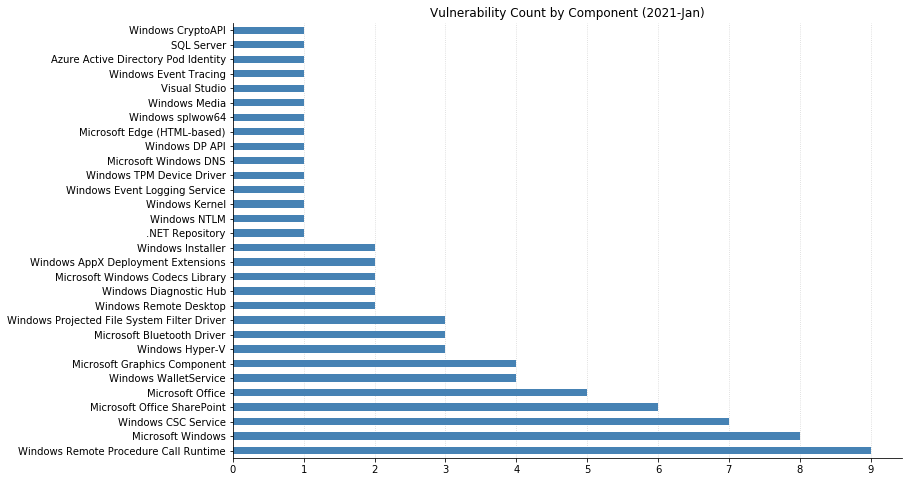
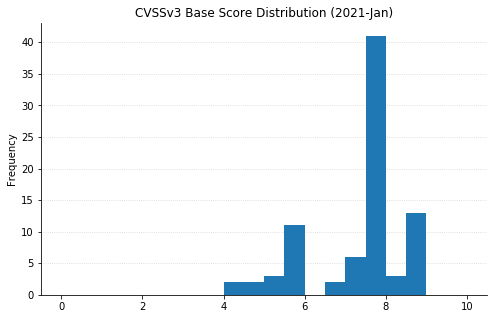
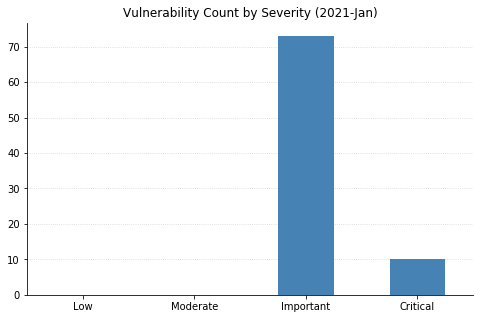
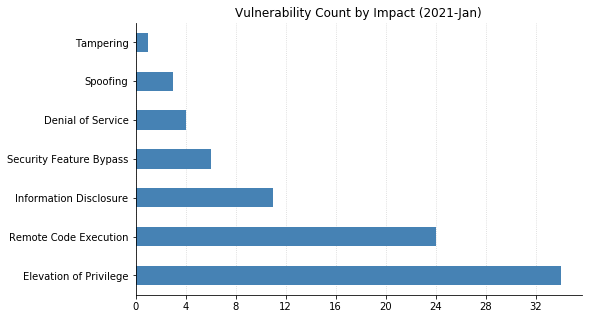
Another confirmation of the standard advice of prioritizing Operating System patches whenever possible is that 11 of the 13 top CVSS-scoring (CVSSv3 8.8) vulnerabilities addressed in this month’s Patch Tuesday would be immediately covered through these means. As an interesting observation, the Windows Remote Procedure Call Runtime component appears to have been given extra scrutiny this month. This RPC Runtime component accounts for the 9 of the 13 top CVSS scoring vulnerabilities along with half of all the 10 Critical Remote Code Execution vulnerabilities being addressed.
More Work to be Done
Lastly, some minor calls to note that this Patch Tuesday includes SQL Server as that is an atypical family covered during Patch Tuesdays and, arguably more notable, is a reminder that Adobe Flash has officially reached end-of-life and would’ve been actively removed from all browsers via Windows Update (already).
Summary Tables
Here are this month’s patched vulnerabilities split by the product family.
Active Template Library Elevation of Privilege Vulnerability
No
No
7.8
No
Summary Graphs
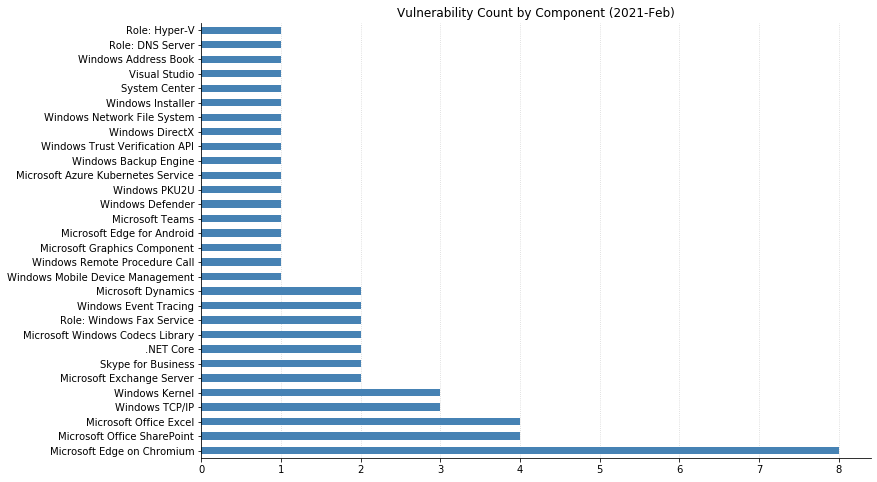
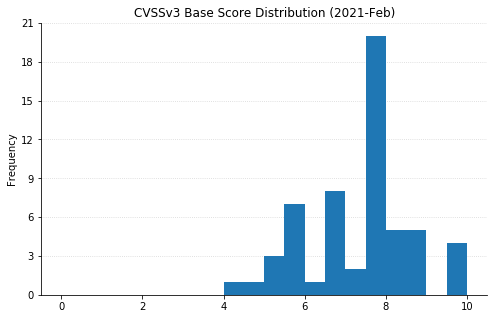
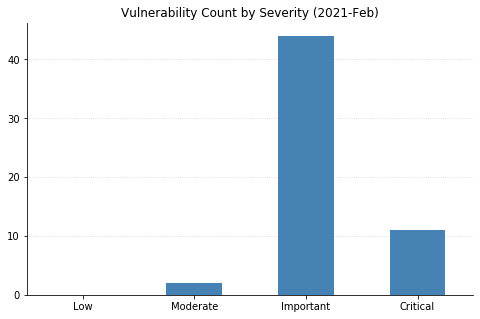
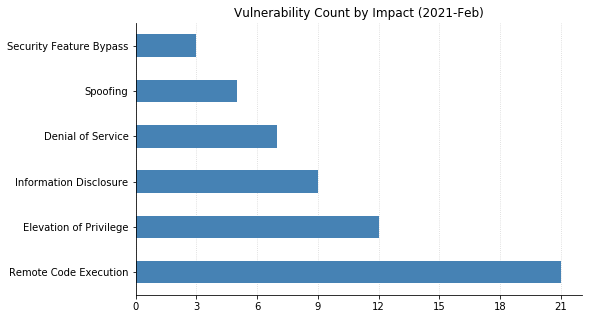
Note: Graph data is reflective of data presented by Microsoft’s CVRF at the time of writing.
The collective thoughts of the interwebz
Manage Consent
To provide the best experiences, we use technologies like cookies to store and/or access device information. Consenting to these technologies will allow us to process data such as browsing behavior or unique IDs on this site. Not consenting or withdrawing consent, may adversely affect certain features and functions.
Functional
Always active
The technical storage or access is strictly necessary for the legitimate purpose of enabling the use of a specific service explicitly requested by the subscriber or user, or for the sole purpose of carrying out the transmission of a communication over an electronic communications network.
Preferences
The technical storage or access is necessary for the legitimate purpose of storing preferences that are not requested by the subscriber or user.
Statistics
The technical storage or access that is used exclusively for statistical purposes.The technical storage or access that is used exclusively for anonymous statistical purposes. Without a subpoena, voluntary compliance on the part of your Internet Service Provider, or additional records from a third party, information stored or retrieved for this purpose alone cannot usually be used to identify you.
Marketing
The technical storage or access is required to create user profiles to send advertising, or to track the user on a website or across several websites for similar marketing purposes.