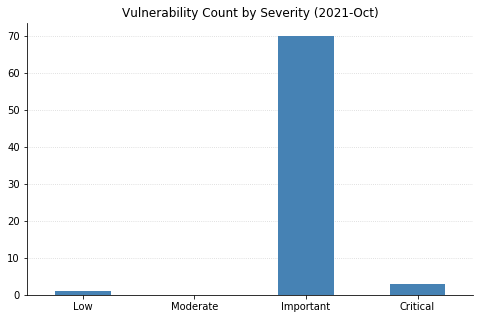
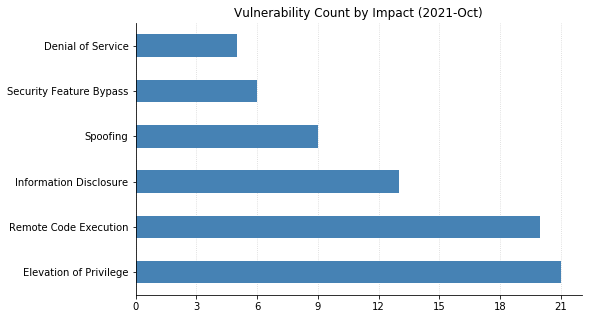
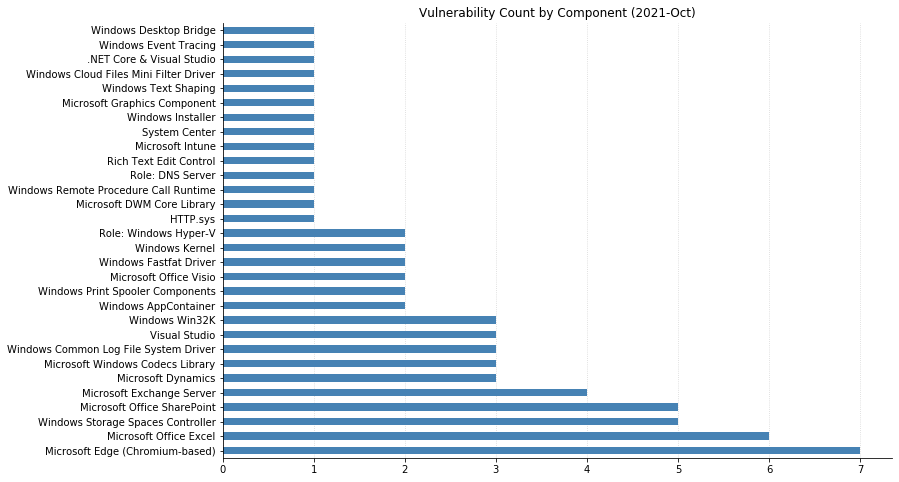
Today’s Patch Tuesday sees Microsoft issuing fixes for over 70 CVEs, affecting the usual mix of their product lines. From Windows, Edge, and Office, to Exchange, SharePoint, and Dynamics, there is plenty of patching to do for workstation and server administrators alike.
One vulnerability has already been seen exploited in the wild: CVE-2021-40449 is an elevation of privilege vulnerability in all supported versions of Windows, including the newly released Windows 11. Rated as Important, this is likely being used alongside Remote Code Execution (RCE) and/or social engineering attacks to gain more complete control of targeted systems.
Three CVEs were publicly disclosed before today, though haven’t yet been observed in active exploitation. CVE-2021-40469 is an RCE vulnerability affecting Microsoft DNS servers, CVE-2021-41335 is another privilege escalation vulnerability in the Windows Kernel, and CVE-2021-41338 is a flaw in Windows AppContainer allowing attackers to bypass firewall rules.
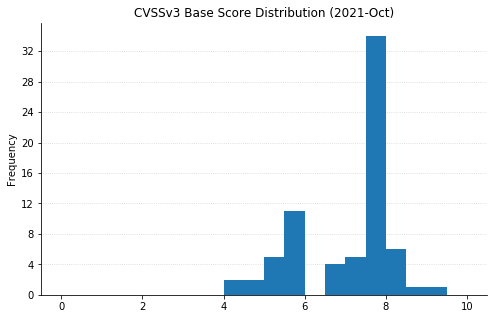
Attackers will likely be paying attention to the latest Windows Print Spooler vulnerability – CVE-2021-36970 is a Spoofing vulnerability with a CVSSv3 score of 8.8 that we don’t yet have much more information about. Also worth noting is CVE-2021-40486, an RCE affecting Microsoft Word, OWA, as well as SharePoint Server, which can be exploited via the Preview Pane. CVE-2021-40487 is another RCE affecting SharePoint Server that Microsoft expects to be exploited before too long.
Another notable vulnerability is CVE-2021-26427, the latest in Exchange Server RCEs. The severity is mitigated by the fact that attacks are limited to a “logically adjacent topology,” meaning that it cannot be exploited directly over the public Internet. Three other vulnerabilities related to Exchange Server were also patched: CVE-2021-41350, a Spoofing vulnerability; CVE-2021-41348, allowing elevation of privilege; and CVE-2021-34453, which is a Denial of Service vulnerability.
Finally, virtualization administrators should be aware of two RCEs affecting Windows Hyper-V: CVE-2021-40461 and CVE-2021-38672. Both affect relatively new versions of Windows and are considered Critical, allowing a VM to escape from guest to host by triggering a memory allocation error, allowing it to read kernel memory in the host.
Active Directory Federation Server Spoofing Vulnerability
No
No
5.4
Yes
The collective thoughts of the interwebz
Manage Consent
To provide the best experiences, we use technologies like cookies to store and/or access device information. Consenting to these technologies will allow us to process data such as browsing behavior or unique IDs on this site. Not consenting or withdrawing consent, may adversely affect certain features and functions.
Functional
Always active
The technical storage or access is strictly necessary for the legitimate purpose of enabling the use of a specific service explicitly requested by the subscriber or user, or for the sole purpose of carrying out the transmission of a communication over an electronic communications network.
Preferences
The technical storage or access is necessary for the legitimate purpose of storing preferences that are not requested by the subscriber or user.
Statistics
The technical storage or access that is used exclusively for statistical purposes.The technical storage or access that is used exclusively for anonymous statistical purposes. Without a subpoena, voluntary compliance on the part of your Internet Service Provider, or additional records from a third party, information stored or retrieved for this purpose alone cannot usually be used to identify you.
Marketing
The technical storage or access is required to create user profiles to send advertising, or to track the user on a website or across several websites for similar marketing purposes.