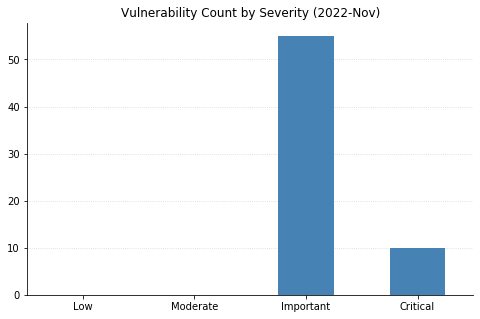
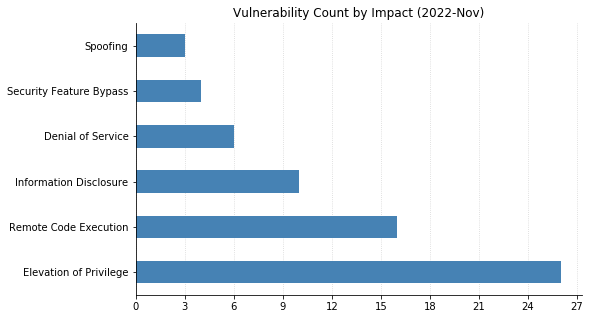
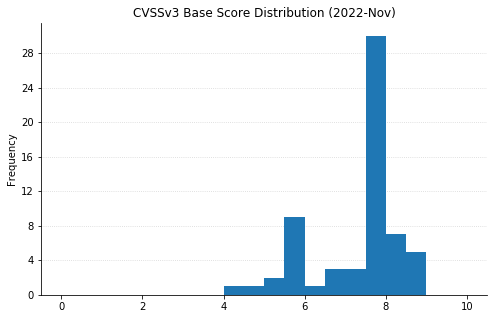
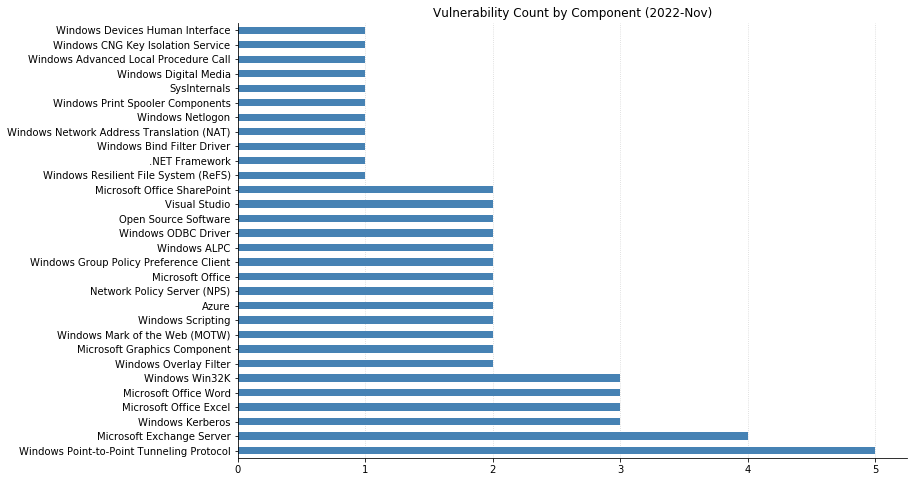
It’s a relatively light Patch Tuesday this month by the numbers – Microsoft has only published 67 new CVEs, most of which affect their flagship Windows operating system. However, four of these are zero-days, having been observed as exploited in the wild.
The big news is that two older zero-day CVEs affecting Exchange Server, made public at the end of September, have finally been fixed. CVE-2022-41040 is a “Critical” elevation of privilege vulnerability, and CVE-2022-41082 is considered Important, allowing Remote Code Execution (RCE) when PowerShell is accessible to the attacker. Both vulnerabilities have been exploited in the wild. Four other CVEs affecting Exchange Server have also been addressed this month. Three are rated as Important, and CVE-2022-41080 is another privilege escalation vulnerability considered Critical. Customers are advised to update their Exchange Server systems immediately, regardless of whether any previously recommended mitigation steps have been applied. The mitigation rules are no longer recommended once systems have been patched.
Three of the new zero-day vulnerabilities are:
CVE-2022-41128, a Critical RCE affecting the JScript9 scripting language (Microsoft’s legacy JavaScript dialect, used by their Internet Explorer browser).
CVE-2022-41073 is the latest in a storied history of vulnerabilities affecting the Windows Print Spooler, allowing privilege escalation and considered Important.
CVE-2022-41125 is also an Important privilege escalation vulnerability, affecting the Windows Next-generation Cryptography (CNG) Key Isolation service.
The fourth zero-day, CVE-2022-41091, was previously disclosed and widely reported on in October. It is a Security Feature Bypass of “Windows Mark of the Web” – a mechanism meant to flag files that have come from an untrusted source.
Exchange Server admins are not the only ones on the hook this month: SharePoint Server is affected by CVE-2022-41062, an Important RCE that could allow an attacker who has Site Member privileges to execute code remotely on the server. CVE-2022-41122, a Spoofing vulnerability that Microsoft rates as “Exploitation more likely” than not, was actually addressed in September’s SharePoint patches but not included in their Security Update Guide at the time.
This month also sees Microsoft’s third non-CVE security advisory of the year, ADV220003, which is a “defense-in-depth” update for older versions of Microsoft Office (2013 and 2016) that improves validation of documents protected via Microsoft’s Information Rights Management (IRM) technology – a feature of somewhat dubious value, meant to help prevent sensitive information from being printed, forwarded, or copied without authorization.
To provide the best experiences, we use technologies like cookies to store and/or access device information. Consenting to these technologies will allow us to process data such as browsing behavior or unique IDs on this site. Not consenting or withdrawing consent, may adversely affect certain features and functions.
Functional
Always active
The technical storage or access is strictly necessary for the legitimate purpose of enabling the use of a specific service explicitly requested by the subscriber or user, or for the sole purpose of carrying out the transmission of a communication over an electronic communications network.
Preferences
The technical storage or access is necessary for the legitimate purpose of storing preferences that are not requested by the subscriber or user.
Statistics
The technical storage or access that is used exclusively for statistical purposes.The technical storage or access that is used exclusively for anonymous statistical purposes. Without a subpoena, voluntary compliance on the part of your Internet Service Provider, or additional records from a third party, information stored or retrieved for this purpose alone cannot usually be used to identify you.
Marketing
The technical storage or access is required to create user profiles to send advertising, or to track the user on a website or across several websites for similar marketing purposes.