Post Syndicated from Esra Kayabali original https://aws.amazon.com/blogs/aws/amazon-aurora-postgresql-now-supports-direct-querying-of-apache-iceberg-and-parquet-data-in-your-data-lake/
Today, we’re announcing a new capability for Amazon Aurora PostgreSQL that you can use to directly query operational data together with data stored in your data lake in Apache Iceberg and Apache Parquet formats, using your existing PostgreSQL applications and tools. By eliminating the need to extract, transform, and load (ETL) structured data from data lakes into your operational database, you can reduce operational complexity and simplify application development. You can also use Aurora PostgreSQL to query data from data lakes managed in Iceberg REST Catalog (IRC)-compatible catalogs, giving you access to data across a breadth of analytics systems without moving or duplicating it. Whether you’re powering real-time dashboards, enriching transactions with historical context, or building AI agents that reason over both live and archived data, you can now do it all through a single, familiar interface.
Previously, if your application needed to combine recent transactional data in Aurora with historical records stored in Amazon S3, a common approach was to build reverse ETL pipelines that duplicated data, increased infrastructure costs, and required ongoing engineering effort to keep everything synchronized. This challenge only grows as you increasingly embed AI agents into your applications, where it is impractical to predict and pre-replicate every dataset an agent might need.
DuckLabs, the team that maintains the DuckDB project, recently joined Amazon, and this capability is an example of how the efficiency of DuckDB is being integrated into our services. DuckDB is now embedded directly within Aurora PostgreSQL, so you can query live operational data (including uncommitted writes) alongside your data lake in a single query. Query processing stays within Aurora, with no additional network hops and no ETL pipelines that duplicate data. You can query Apache Iceberg tables managed through the AWS Glue Data Catalog, as well as Parquet and Iceberg data stored in Amazon S3 and S3 Tables. You do all of this using familiar PostgreSQL syntax and your existing applications and tools.
We’re excited to bring the speed and simplicity of DuckDB directly into Aurora PostgreSQL, so you and your agents can query and combine operational and Iceberg data using the familiar PostgreSQL applications, tools, and endpoints already in use. By building this capability around DuckDB, future improvements to the open source engine can continue to bring performance and functionality gains to Aurora and other AWS services.
What is new
This capability is supported on two Aurora PostgreSQL major versions: 17 (starting with 17.11) and 18 (starting with 18.6). To use it, you create an Aurora PostgreSQL cluster, attach an IAM role with the AuroraAnalytics feature, and enable the aurora_analytics extension. The IAM role is what gives Aurora access to your data in Amazon S3 and the AWS Glue Data Catalog. You then create foreign tables that point to your Iceberg or Parquet data in the data lake, and query them using familiar PostgreSQL syntax. You can complete this setup through the Amazon RDS console, or with any PostgreSQL client such as psql. The process is well documented in the Aurora PostgreSQL documentation.
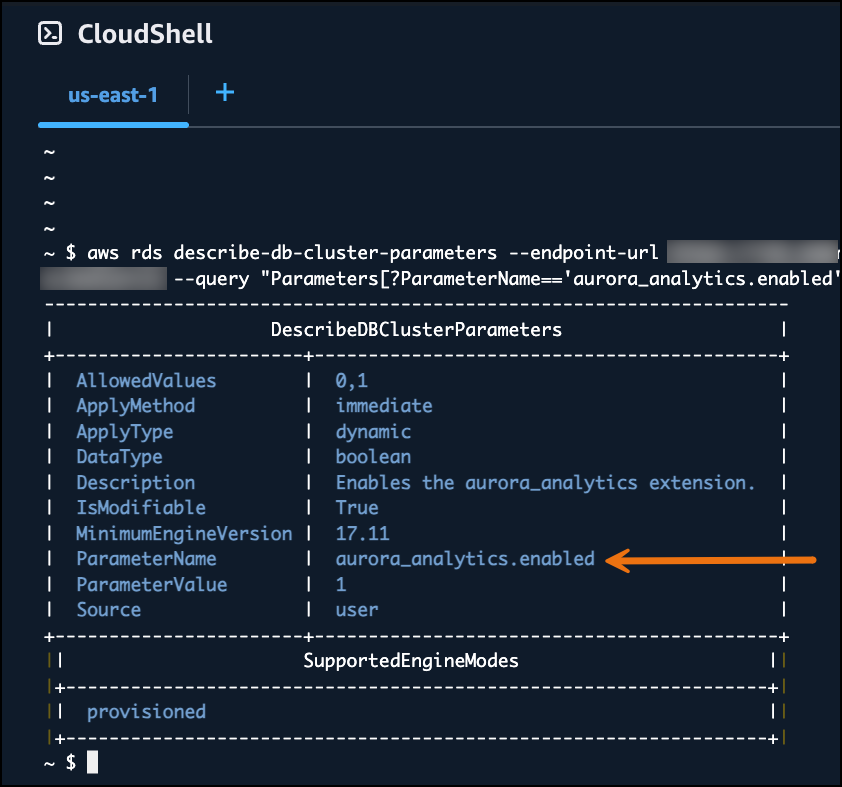
You can query data across external IRC-compatible catalogs through AWS Glue Data Catalog federation. You register the external catalog once with Glue, and then create foreign tables for the tables you want to query, the same way you would for any Glue-native table. A single query can then join data stored in Aurora with Iceberg tables registered across multiple catalogs, so applications get a unified view without moving data or replacing your existing catalog investments.
Aurora also applies optimizations such as predicate pushdown and column pruning so that only the relevant data is read. This keeps queries efficient even as the underlying data grows. Frequently accessed data is also cached in your Aurora instance, so subsequent queries against the same data return faster. You can inspect this behavior per query using aurora_analytics_stat_statements(), which reports metrics such as rows scanned, bytes read from Amazon S3, and cache hits.
To see how direct querying works, I connected to my Aurora PostgreSQL database using psql and created the extension:
CREATE EXTENSION aurora_analytics;For my walkthrough, I set up a simple financial scenario. I have a recent_transactions table in Aurora with the last 7 days of customer transactions, and a Parquet file in Amazon S3 containing 5 years of historical transaction data. To make Aurora aware of the historical data, I created a foreign table pointing at the Parquet file in S3:
CREATE FOREIGN TABLE transaction_history ()
SERVER aurora_analytics_server
OPTIONS (
    location 's3://<my-bucket>/finance/transaction_history.parquet',
    format 'parquet'
);
Notice the empty parentheses in the CREATE FOREIGN TABLE statement. Aurora automatically reads the schema from the Parquet file metadata, so you do not need to define columns manually. For workloads with many tables, you can skip creating them one at a time: a single IMPORT FOREIGN SCHEMA statement bulk-creates foreign tables for every Iceberg or Parquet table in an AWS Glue Data Catalog database, inferring schemas automatically.
With both tables in place, I ran a single query that combines the recent operational data in Aurora with the historical data in S3:
SELECT merchant, category, amount, transaction_date, 'recent' AS source
FROM recent_transactions
WHERE customer_id = 'C-1001'
UNION ALL
SELECT merchant, category, amount, transaction_date, 'historical' AS source
FROM transaction_history
WHERE customer_id = 'C-1001'
  AND transaction_date >= CURRENT_DATE - INTERVAL '5 years'
ORDER BY transaction_date DESC
LIMIT 15;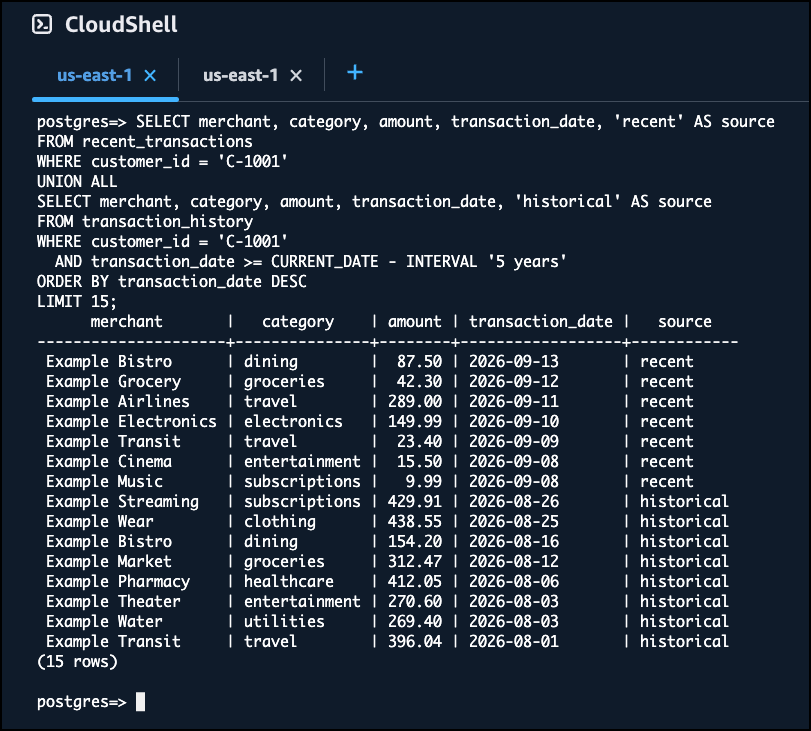
The result shows both recent and historical transactions in a single result set. The 7 most recent rows come from Aurora, and the rest come directly from the Parquet file in S3. DuckDB handles the analytical scan of the Parquet data under the hood, while Aurora handles the operational data. That single query would have previously required a pipeline to move the historical data into the database first.
If a query pattern needs single-digit-millisecond latency, you can materialize data from the data lake into a native Aurora PostgreSQL table using familiar commands such as CREATE TABLE AS SELECT, INSERT INTO ... SELECT, or MERGE INTO. The materialized table lives in Aurora and is queried like any other PostgreSQL table, giving you a low-latency path for hot data without operating a separate ingestion pipeline. The read queries can run on any Aurora PostgreSQL instance in your cluster, whether the writer or a read replica, so you can offload analytical scans from your operational workload. The materialization commands write data into Aurora, so they run on the writer instance.
Get started today
Direct querying of Apache Iceberg and Parquet data from Amazon Aurora PostgreSQL is available today in all commercial AWS Regions and AWS GovCloud (US) Regions, at no additional charge. You pay only for the incremental Aurora compute the queries consume and Amazon S3 request costs for reading data lake files.
To learn more, visit the Amazon Aurora features page, read the Aurora PostgreSQL documentation, or try it in the Amazon RDS console. We welcome your feedback through AWS re:Post or through your usual AWS Support contacts.