All posts by Juan Pablo Melgarejo Zamora

Streamlining Cloud Compliance at GoDaddy Using CDK Aspects

Post Syndicated from Juan Pablo Melgarejo Zamora original https://aws.amazon.com/blogs/devops/streamlining-cloud-compliance-at-godaddy-using-cdk-aspects/

This is a guest post written by Jasdeep Singh Bhalla from GoDaddy.

AWS Cloud Development Kit (CDK) Aspects are a powerful mechanism that allows you to apply organization-wide policies, like security rules, tagging standards, and compliance requirements across your entire infrastructure as code. By implementing the Visitor pattern, Aspects can inspect and modify every construct in your CDK application before it’s synthesized into AWS CloudFormation templates, enabling you to enforce organizational standards automatically at build time.

At GoDaddy, we’ve used CDK Aspects to transform how we enforce compliance across our massive AWS footprint. Our Cloud Governance team is responsible for ensuring every AWS resource deployed across thousands of accounts adheres to strict security, compliance, and operational standards.

We have a simple goal:

Make it easy for developers to do the right thing without slowing them down.

Traditionally, we relied on documentation, Slack threads, and peer reviews to flag misconfigurations. But as our cloud footprint grew, this approach quickly hit its limits. It simply didn’t scale.

We needed something proactive.

From reactive to proactive: CloudFormation Hooks

Our first major leap forward came through CloudFormation Hooks. These allow us to validate every resource in a CloudFormation template against our compliance rules at deployment time. If a resource passes, it gets deployed. If not, the deployment is blocked, and we provide developers with clear, actionable error messages to help them fix the template.

This worked well, but it wasn’t perfect. Developers would often only discover issues after writing their entire templates using manual values to make the template compliant, and attempting deployment. This was a time-consuming process, and it was not a good developer experience.

We needed an automated way to make CloudFormation templates compliant with our compliance rules without manual effort.

This is where CDK Aspects come in.

CDK Aspects: compliance while you code

CDK Aspects are our answer to proactive, early-stage compliance enforcement — catching and resolving issues at the code level, before deployment.

In AWS CDK, an Aspect is a lightweight Visitor that can inspect and act on every construct in your infrastructure code before it’s synthesized into a CloudFormation template. This means you can apply organization-wide rules as developers write CDK code, not after.

Think of it as linting for your infrastructure.

Want to ensure all Amazon Simple Storage Service (Amazon S3) buckets have encryption enabled? Require specific tags on resources? Block public access on security groups? With CDK Aspects, all of that becomes not only possible, but automatic.

Under the hood: how CDK Aspects work

CDK Aspects are a powerful mechanism for inspecting and modifying your infrastructure as code. At their core, they use the Visitor Pattern, which allows you to traverse a tree of objects (constructs) and perform operations on each node without modifying the constructs themselves directly.

Interface IAspect

An Aspect is a class that implements the IAspect interface:

interface IAspect {
    visit(node: IConstruct): void;
}

The single visit() method is called for every construct in the scope where the Aspect is applied. Inside visit(), you can inspect, modify, or enforce rules on the construct.

Adding Aspects

To attach an Aspect to a construct (or a tree of constructs), use the following method:

Aspects.of(myConstruct).add(new SomeAspect());

This adds the Aspect to the construct’s internal list.

When cdk deploy is run, a CDK app goes through several phases:

A horizontal flow diagram illustrating the CDK App Lifecycle consisting of six sequential stages connected by arrows from left to right. The stages are: 1) CDK app source code, 2) Construct, 3) Prepare, 4) Validate, 5) Synthesize, and 6) Deploy. Each stage is represented by a light blue rectangular box with centered text. The entire lifecycle flow is contained within a gray bordered frame with the title 'CDK App Lifecycle' at the top. This diagram shows the progression of AWS Cloud Development Kit (CDK) applications from initial source code through deployment.

Figure 1: CDK app lifecycle from source code to deployment

  • Construction – Constructs are instantiated.
  • Preparation – Final modifications and Aspects are applied.
  • Validation – Checks for invalid configurations.
  • Synthesis – CloudFormation templates are generated.
  • Deployment – Resources are provisioned in AWS.

Aspects are executed during the Preparation phase, which happens automatically. This ensures all rules, validations, or mutations are applied before synthesis, so your generated CloudFormation templates are compliant and valid before deployment.

During the Preparation phase of the CDK lifecycle, CDK traverses the construct tree and calls visit() on each node in top-down order (parent → children). Inside visit(), you can inspect, modify, or enforce rules on the construct.

visit(node: IConstruct) {
    if (node instanceof s3.Bucket) {
        node.encryption = s3.BucketEncryption.KMS; // Mutates the resource
    }
}

Example: CDK Aspects to automatically add S3 Encryption to all S3 buckets in a stack by mutating the resource.

class EnforceBucketEncryption implements IAspect {
    visit(node: IConstruct) {
        if (node instanceof s3.Bucket) {
            node.encryption = s3.BucketEncryption.KMS; // Mutates the resource
        }
    }
}

This aspect can be registered on the stack by calling the following method:

Aspects.of(this).add(new EnforceBucketEncryption());

The template generated by CDK will look something like this:

Resources:
    MyBucket:
        Type: AWS::S3::Bucket
        Properties:
            BucketEncryption:
                ServerSideEncryptionConfiguration:
                    - ServerSideEncryptionByDefault:
                          SSEAlgorithm: aws:kms

From the example above, you can see that the BucketEncryption property is added to the MyBucket resource by the Aspect.

During the prepare phase, CDK traverses the construct tree from top to bottom – starting at the App, then each Stack, and down to resources like S3 buckets. At each node, Aspects are applied by invoking aspect.visit(node), allowing inspection and modification of resources. By the time CDK reaches the synth step, the CloudFormation template already includes these Aspect-driven changes, ensuring compliance and best practices are consistently enforced before deployment.

Types of CDK Aspects

AWS CDK distinguishes between two types of Aspects based on how they interact with your infrastructure: those that modify resources (mutating) and those that only inspect them (read-only).

Mutating Aspects

Mutating Aspects modify resources automatically (like adding encryption or logging). These change the properties of resources as they traverse your constructs. They are ideal for enforcing compliance and best practices like:

Mutating Aspects are powerful, but overusing them can introduce unintended changes, because they modify resources without explicit developer action.Always make sure you are aware of the changes, and avoid applying them to production resources without caution. Use logging or annotations to help you understand and debug the changes.

For example, the following aspect sets the default timeout on all Lambda functions to 300 seconds:

class SetDefaultTimeouts implements IAspect {
    visit(node: IConstruct) {
        if (node instanceof lambda.Function) {
            node.timeout = 300; // mutates the resource
        }
    }
}

Read-only Aspects

Read-only Aspects only inspect resources and report findings without modifying them. They’re ideal for compliance checks, tagging audits, and policy validation.

class RequireTags implements IAspect {
    visit(node: IConstruct) {
        const tags = Tags.of(node);
        if (!tags.hasTag("project_budget_number")) {
            Annotations.of(node).addWarning(
                "Missing required tag: project_budget_number",
            );
        }
    }
}

At GoDaddy, we use mutating Aspects to enforce compliance automatically, reducing manual work and ensuring stacks are compliant with our standards by default. We add read-only Aspects for stricter audits where mutation isn’t appropriate.

Common use cases for CDK Aspects

When building cloud infrastructure at scale, enforcing consistency across stacks can be an ongoing challenge. AWS CDK Aspects let you automatically enforce security, compliance, and operational standards across your entire infrastructure.

Below are some of the most impactful use cases where Aspects can save you time, reduce risk, and improve governance.

  • Security & compliance: Security and compliance go hand in hand, and Aspects are a powerful way to enforce both before resources ever reach AWS. With Aspects, you can:
  • IAM policies: Aspects make it trivial and consistent across all stacks to apply the same permissions boundary to every IAM role.
  • Tagging enforcement: Tags are the backbone of cost allocation, compliance, and automation. Yet, they’re easy to forget. With Aspects, you can enforce required tags across every resource.
  • Operational best practices: Use Aspects to enforce sensible defaults and operational hygiene:
  • Testing made easier: You can use Aspects to override the default RemovalPolicy for test stacks to DESTROY, ensuring everything is cleaned up automatically.
  • Working around 3rd-party constructs: Sometimes external constructs create resources you can’t fully configure, like an S3 bucket without encryption or logging options. Instead of waiting on maintainers or forking the library, you can apply an Aspect to modify those resources directly.
  • Network policies: Networking issues often lead to security incidents. With Aspects, you can:
  • Cost control: Budgets matter. Aspects can help by:
    • Flagging high-cost instance types before deployment
    • Limiting use of expensive storage classes
    • Warning when provisioned throughput exceeds thresholds

You can combine these use cases into reusable, testable policies that run consistently across all CDK stacks.

CDK Aspects in action at GoDaddy

At GoDaddy, we define CDK Aspects and distribute them through a wrapper Stack that development teams use when building infrastructure with CDK. Every template a team creates is automatically made compliant with GoDaddy’s cloud compliance rules, without requiring manual updates or fixes.

As an example, some of the Aspects are:

  • S3BucketAspect – Enforces encryption, logging, and public access block on S3 buckets.
  • IAMRoleAspect – Flags wildcard permissions and enforces naming conventions.
  • LambdaFunctionAspect – Validates timeouts, memory limits, and Amazon VPC configurations.

These Aspects enforce security, operational, and tagging standards at the code level. When you use the wrapper stack, the relevant Aspects are applied automatically, injecting the necessary properties into the CloudFormation template before deployment. This is intended to support compliance without slowing down development.

Each of these aspects implements the IAspect interface and is applied to stacks directly:

Aspects.of(myStack).add(new S3BucketAspect());
Aspects.of(myStack).add(new IAMRoleAspect());
Aspects.of(myStack).add(new LambdaFunctionAspect());

This approach means that when a developer defines a new resource, like an S3 bucket or IAM role, all relevant compliance rules are automatically applied:

const bucket = new s3.Bucket(myStack, "MyBucket", {
    // developer doesn't need to manually configure encryption or logging
});

During the CDK preparation phase, the aspect injects the required properties into the CloudFormation template, which is done before the template is synthesized and deployed. This ensures that the resources are deployed with the required properties at GoDaddy’s standards.

# s3-bucket.yaml - generated by `cdk synth`
Resources:
    MyBucket:
        Type: AWS::S3::Bucket
        Properties:
            BucketEncryption:
                ServerSideEncryptionConfiguration:
                    - ServerSideEncryptionByDefault:
                          SSEAlgorithm: AES256
            PublicAccessBlockConfiguration:
                BlockPublicAcls: true
                BlockPublicPolicy: true
                IgnorePublicAcls: true
                RestrictPublicBuckets: true
            LoggingConfiguration:
                DestinationBucketName: logging-bucket
                LogFilePrefix: logs/

Consider a team that deploys hundreds of S3 buckets per month, where each bucket requires encryption, logging, versioning, and public access block. With CDK Aspects, you don’t have to manually update the CloudFormation template to add the required properties.

This saves a lot of engineering effort and time, and ensures that the resources are deployed with the required properties that meet GoDaddy’s standards.

Conclusion

At GoDaddy, CDK Aspects have significantly transformed our approach to cloud infrastructure compliance.

Because Aspects run during the CDK preparation phase, before synthesis and deployment, they inject required properties like encryption, logging, and access controls into CloudFormation templates automatically. Developers write their CDK code as usual, and compliance happens behind the scenes. This eliminates the manual effort of configuring each resource to meet security and compliance standards.

This proactive approach has also improved developer productivity. Instead of discovering compliance failures after attempting deployment (as was the case with CloudFormation Hooks alone), developers now get compliant templates on the first synthesis. Fewer failed deployments mean faster iteration cycles and less time spent debugging configuration issues.

Policy enforcement is consistent because every team uses the same wrapper Stack with the same Aspects applied. Whether a team deploys an S3 bucket, an IAM role, or a Lambda function, the same tagging, encryption, network isolation, and cost control rules are applied uniformly.

Finally, this model scales. Adding a new compliance rule means updating a single Aspect in the shared library, and every stack that uses the wrapper inherits the change automatically. This lets our Cloud Governance team enforce standards across thousands of accounts with minimal operational overhead.

If you’re working with AWS CDK at scale, adopting CDK Aspects isn’t just a nice-to-have, it’s essential. Your future self and your security team will thank you.

To get started, pick one compliance rule, like S3 encryption, and implement it as a mutating Aspect. Once you see how it works, expand to cover tagging and IAM policies. From there, package your Aspects into a shared library that teams across your organization can adopt.

References

The content and opinions in this blog are those of the third-party author and AWS is not responsible for the content or accuracy of this blog.
Jasdeep Singh Bhalla

is a Senior Software Engineer at GoDaddy, focused on scaling Cloud Infrastructure governance and automation across thousands of AWS accounts. He builds frameworks, APIs, and tools that make it easy for developers to follow best practices in AWS, while ensuring every resource is secure, compliant, and production-ready by default.

Juan Pablo Melgarejo Zamora

is a Sr. Solutions Architect at Amazon Web Services, where he helps customers architect and optimize their cloud solutions. Throughout his career, he has built expertise across Data Engineering, High Performance Computing (HPC), and DevOps practices. He leverages this diverse technical background to provide comprehensive solutions for AWS customers. Outside of work, he enjoys cooking and traveling.

Beyond Bootstrap: Bootstrapless CDK Deployments at GoDaddy

Post Syndicated from Juan Pablo Melgarejo Zamora original https://aws.amazon.com/blogs/devops/beyond-bootstrap-bootstrapless-cdk-deployments-at-godaddy/

This is a guest post written by Ramanathan Nachiappan from GoDaddy.

In the world of infrastructure as code, the AWS Cloud Development Kit (AWS CDK) has revolutionized how teams define and provision cloud resources. Central to its operation is the bootstrapping process, which ensures all required resources and permissions are in place to enable secure and scalable deployments.

At GoDaddy, our cloud journey has always prioritized governance, compliance, and a great developer experience. As our AWS footprint expanded across hundreds of teams and thousands of deployments, we faced a classic engineering dilemma: how do we uphold rigorous governance standards without compromising developer velocity?

AWS CDK’s default bootstrapping process—while essential—often clashed with our governance model, creating friction, workarounds, and wasted cycles. This post details how we evolved beyond that friction, eliminating the explicit bootstrap step entirely and replacing it with a seamless, zero-touch experience. The result: a “bootstrapless” CDK deployment flow that enforces governance invisibly and empowers developers to deploy with a single command.

The Governance Imperative: Security by Design

GoDaddy’s governance model isn’t just a checkbox for compliance; it’s the foundation of our cloud security posture. Our approach requires all AWS resource modifications to flow through AWS CloudFormation, with each deployment evaluated against our rule sets covering:

  • Security configurations: Encryption requirements, network controls, access management
  • Compliance standards: Data protection, regulatory requirements, audit capabilities
  • Operational practices: Resource tagging, backup strategies, monitoring configurations
  • Cost optimization: Resource sizing, lifecycle management, utilization thresholds

Our CloudFormation hooks evaluate every resource against these rules pre-deployment, helping to reduce the likelihood of non-compliant resources being created. This proactive approach is designed to support governance from day one, rather than retroactively detecting violations.

The CDK Bootstrap Challenge

AWS CDK V1 vs AWS CDK V2:

  • AWS CDK v1: Used the active AWS CLI credentials for all deployments.
  • AWS CDK v2: Introduced a new bootstrap template with five new AWS Identity and Access Management (IAM) roles, designed primarily for CDK Pipelines. These roles must be assumed or passed by the AWS CLI. It’s worth noting that AWS CDK v2 still fully supports the legacy synthesizer, allowing users to maintain their existing v1-style workflows.

When AWS CDK v2 arrived, its bootstrap process introduced crucial changes designed to standardize authentication across multiple deployment tools and scenarios (CLI, cross-account deployments, pipelines, etc.). The standard cdk bootstrap command creates several essential components:

# Creates the default bootstrap stack with resources
cdk bootstrap

This command provisions:

Here’s where things got interesting for GoDaddy. While the default AWS CDK setup includes security measures (like encrypted Amazon S3 buckets), our enterprise governance requirements had additional specifications that created some difficulty with the default bootstrap resources:

  • Amazon S3 buckets needed additional encryption, logging, and compliance settings beyond the defaults
  • IAM roles required alignment with our specific permission boundaries and organizational policies
  • Amazon ECR repositories needed mandatory GoDaddy tags and access configurations
  • Additional compliance requirements around resource naming, backup policies, and monitoring

These GoDaddy-specific governance requirements meant the default bootstrap resources do not pass our validation checks, creating deployment slowdown for developers and increasing support overhead for GoDaddy’s governance platform as teams worked around the governance failures.

Phase 1: Custom Bootstrap Templates

Our first step toward enhancing the developer experience was creating a customized bootstrap approach using two key components:

1. The GDStack and Conformers

We developed a specialized CDK construct called GDStack extending the native CDK Stack. This custom stack framework used CDK Aspects to automatically ensure governance compliance:

  • Automatic Resource Conformers: We built a system of “conformers” that apply company-wide governance standards to every resource automatically. For example, our S3Conformer ensures all buckets have required encryption, logging, and access settings.
  • CDK Aspects Under the Hood: These conformers use AWS CDK’s powerful Aspects system—a visitor pattern that traverses all constructs in a stack and applies transformations. This allowed us to inspect and modify any non-compliant resources during synthesis without requiring developers to learn complicated rules.
  • Seamless Governance: When developers added resources to a GDStack, these aspects would automatically transform the resources to align with our governance rules before deployment—all invisible to the developer.

This approach dramatically reduced turnaround time for developers, who previously had to manually correct violations in their application specific CloudFormation stacks after failed deployments. Instead, the system intelligently fixed issues before they became deployment failures.

2. CliCredentialsStackSynthesizer

Instead of using AWS CDK’s default deployment roles, we used the CliCredentialsStackSynthesizer to:

  • Use the developer’s CLI credentials directly for deployments
  • Eliminate the need for complex cross-account role assumptions
  • Respect our existing IAM permission boundaries
  • Simplify the authentication flow

Our solution required a custom bootstrap command:

# Custom bootstrap with governance-compliant template
npx cdk bootstrap --template node_modules/internal-constructs/bootstrap-template.yaml --tags governance=safeguard

This approach worked well, but still required teams to run a bootstrap step with precise GoDaddy-specific parameters. Although our platform documentation was extensive, some users still encountered issues as they continued to use the native cdk bootstrap command instead of the custom command. This behavior likely stemmed from the habit of running cdk bootstrap first, as trained by the native AWS CDK workflow. As a result, this approach still maintained some support troubleshooting workload for teams. We needed a more elegant solution for our needs!

Phase 2: The Revolutionary Bootstrapless Approach

As AWS CDK evolved, so did our thinking. The introduction of the AppStagingSynthesizer opened new possibilities, leading us to develop a completely bootstrapless solution.

The Factory Pattern Solution

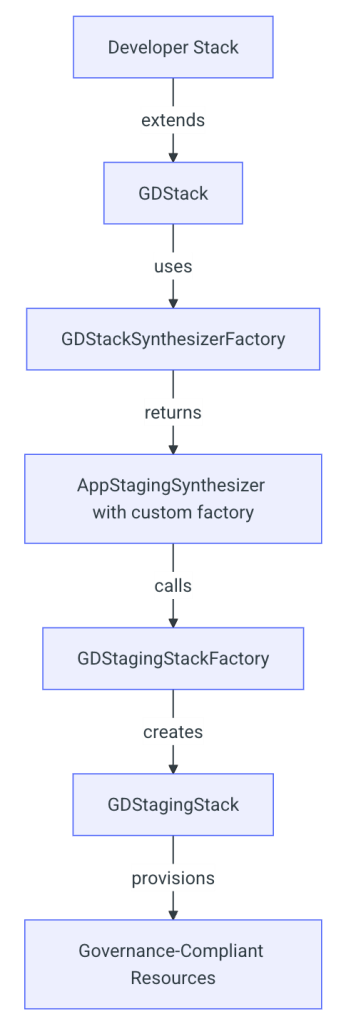
We engineered an elegant chain of specialized components:

A flowchart diagram showing the relationship between different components in a software development stack. The chart flows from top to bottom, starting with "Developer Stack" which extends to "GDStack". GDStack uses "GDStackSynthesizerFactory" which returns "AppStagingSynthesizer with custom factory". This then calls "GDStagingStackFactory" which creates "GDStagingStack". Finally, GDStagingStack provisions "Governance-Compliant Resources". Each component is represented by a rectangle, with arrows and labels indicating the relationships between them.

Bootstrapless CDK Factory Pattern Design

Each component plays a crucial role:

1. GDStack: The Developer Interface

This is the only component developers interact with directly:

// Developer simply extends GDStack instead of Stack
export class MyApplicationStack extends GDStack {
  constructor(scope: Construct, id: string, props: GDStackProps) {
    super(scope, id, props);

    // Normal CDK resource definitions
    new s3.Bucket(this, 'MyBucket', { ... });
  }
}

2. GDStackSynthesizerFactory: The Orchestrator

This factory connects our custom components with CDK’s synthesis system:

export const GDStackSynthesizerFactory = () => {
    return AppStagingSynthesizer.customFactory({
        factory: new GDStagingStackFactory(),
        deploymentIdentities: DeploymentIdentities.cliCredentials(),
    });
};

3. GDStagingStackFactory: The Resource Producer Factory

This implements the IStagingResourcesFactory interface to dynamically create staging resources:

export class GDStagingStackFactory implements IStagingResourcesFactory {
    public obtainStagingResources(
        stack: cdk.Stack,
        context: ObtainStagingResourcesContext,
    ): IStagingResources {
        const app = cdk.App.of(stack)!;
        const appId = getAppIdFromContext(app.node);

        const stagingStack = new GDStagingStack(
            app!,
            `StagingStack-${appId}-${context.environmentString}`,
            {
                env: { region: stack.region, account: stack.account },
                appId: appId,
            },
        );

        return stagingStack;
    }
}

4. GDStagingStack: The Resource Producer for App-Level bootstrapping

This stack implements IStagingResources and creates rule-compliant assets on demand:

export class GDStagingStack extends cdk.Stack implements IStagingResources {
    constructor(scope: Construct, id: string, props: GDStagingStackProps) {
        super(scope, id, {
            ...props,
            // The magic ingredient - BootstraplessCliSynthesizer
            synthesizer: new BootstraplessCliSynthesizer(),
            description: `This stack includes resources needed to deploy the AWS CDK app ${props.appId} into this environment`,
        });

        // Apply governance conformers to everything
        this.applyGovernanceConformers();

        // Create compliant resources
        const bucket = new s3.Bucket(this, "CdkStagingBucket", {
            bucketName: `cdk-${this.appId}-staging-${this.account}-${this.region}`,
            // Conformers ensure encryption, logging, and other requirements
        });

        // Additional resource creation...
    }
}

The Secret Sauce: BootstraplessCliSynthesizer

The cornerstone of our solution is a custom synthesizer BootstraplessCliSynthesizer that combines the best aspects of AWS CDK’s built-in synthesizers BootstraplessSynthesizer and CliCredentialsStackSynthesizer.

It brings together key features from both AWS CDK synthesizers while adding our own innovations:

  • From CliCredentialsStackSynthesizer: Uses the CLI credentials directly for all operations
  • From BootstraplessSynthesizer: Eliminates the need for bootstrap resources
  • Our custom approach: Purpose-built specifically for the GDStagingStack with explicit asset rejection where GDStagingStack itself essentially creates the required asset resources on demand for the CDK Application.

This synthesizer:

  • Requires no bootstrapping in any region
  • Uses AWS CLI credentials directly for all operations
  • Maintains a minimal implementation focused solely on template generation
export class BootstraplessCliSynthesizer extends cdk.StackSynthesizer {
    constructor() {
        super();
    }

    // Prevent asset uploads to enforce governance compliance
    public addFileAsset(_asset: cdk.FileAssetSource): cdk.FileAssetLocation {
        throw new Error(
            "Cannot add assets to a Stack that uses the BootstraplessCliSynthesizer",
        );
    }

    public addDockerImageAsset(
        _asset: cdk.DockerImageAssetSource,
    ): cdk.DockerImageAssetLocation {
        throw new Error(
            "Cannot add assets to a Stack that uses the BootstraplessCliSynthesizer",
        );
    }

    // Minimal synthesis - just template generation and artifact emission
    public synthesize(session: cdk.ISynthesisSession): void {
        // Same as LegacySynthesizer
        this.synthesizeTemplate(session);
        this.emitArtifact(session);
    }
}

Our innovation was creating a synthesizer used only for the GDStagingStack that works in concert with our factory pattern. Rather than assuming pre-existing bootstrap resources, it enables the staging stack itself to create the required asset resources on demand, achieving enhanced bootstrapless deployments while maintaining governance compliance.

The Elegant Workflow: Dynamic Asset Management

Our solution transformed the developer experience through intelligent, on-demand resource provisioning:

Our Previous Custom Approach:

# Pre-provision compliant bootstrap resources
npx cdk bootstrap --template node_modules/internal-constructs/bootstrap-template.yaml --tags governance=safeguard

# Deploy applications
npx cdk deploy

Our New Enhanced Bootstrapless Approach:

# Deploy directly - compliant staging resources created automatically when needed
npx cdk deploy

The key advantage is our intelligent asset management:

  1. On-Demand Resource Creation: Staging resources (Amazon S3 buckets, Amazon ECR repositories) are created automatically when needed, rather than requiring pre-provisioning
  2. Governance Integration: All staging resources are created with full compliance built-in from the start
  3. Simplified Credential Flow: Uses existing CLI credentials without complex role assumption chains
  4. Multi-Account Scalability: Works seamlessly across any number of AWS accounts and regions

Behind the scenes, our architecture:

  • Creates governance-compliant staging resources dynamically as applications require them
  • Uses the developer’s existing CLI credentials for all operations
  • Applies security and compliance requirements transparently
  • Eliminates the need to manage bootstrap stacks across environments

Evolution of Approaches

Approach Bootstrap Required Security Model Asset Management GoDaddy Governance Developer Workflow
AWS CDK v2 Default Yes (one-time) 5 deployment roles Pre-provisioned bootstrap stack  Failed validation checks Standard setup + deploy
Custom Template + CliCredentialsStackSynthesizer Yes (one-time) CLI credentials Compliant bootstrap stack via custom template Passes all checks Setup + deploy
GDStagingStack + BootstraplessCliSynthesizer No CLI credentials Compliant staging resources created dynamically on-demand Passes all checks Deploy only

Business Impact: GoDaddy’s Transformation

The business value of our bootstrapless approach has been significant for GoDaddy’s infrastructure teams:

  • Streamlined developer focus: Our teams now focus entirely on writing infrastructure implementation logic, with AWS CDK bootstrapping fully abstracted and automated. Developers no longer need to work with bootstrap configurations, even though it was a one-time setup per environment previously.
  • Automated compliance: Deployments automatically meet GoDaddy’s governance requirements without developer intervention, addressing the validation failures we experienced with default bootstrap resources.
  • Simplified support model: Our platform support team handles fewer bootstrap-related configuration requests, allowing them to focus on broader platform improvements.
  • Broader CDK adoption: The streamlined workflow has encouraged more teams at GoDaddy to adopt AWS CDK from native CloudFormation YAML code for their infrastructure management.

This bootstrapless approach has worked well for GoDaddy’s specific governance requirements and development workflow preferences, demonstrating one way to integrate enterprise compliance seamlessly into AWS CDK deployments.

Conclusion: The Invisible Framework

The evolution from bootstrap – dependent to bootstrapless CDK deployments represents more than a technical improvement—it demonstrates a pathway to eliminate friction while strengthening organization specific governance. Our implementation at GoDaddy validates that enterprise compliance and developer productivity can be achieved simultaneously.

  1. Organizations seeking to implement similar solutions should begin by evaluating the AppStagingSynthesizer capabilities within their current AWS CDK deployment patterns. This assessment will reveal opportunities to reduce bootstrap dependencies while maintaining security and compliance standards. For comparison, teams can also examine the BootstraplessSynthesizer to understand alternative approaches to eliminating traditional bootstrap resources.
  2. The implementation approach we’ve outlined leverages established AWS CDK patterns, including the CliCredentialsStackSynthesizer for credential management and dynamic resource provisioning interfaces. These core AWS CDK interfaces — IStagingResourcesFactory and IStagingResources — form the foundation for creating governance-compliant, bootstrapless deployment workflows that scale across enterprise environments.

The future of infrastructure as code lies in systems that enforce governance invisibly while empowering developers to focus on business logic. As AWS CDK continues to evolve, the patterns we’ve demonstrated at GoDaddy provide a foundation for organizations to build their own invisible frameworks—where compliance becomes a catalyst for velocity rather than an obstacle to innovation.

The content and opinions in this blog are those of the third-party author and AWS is not responsible for the content or accuracy of this blog.

Ramanathan Nachiappan

is a Senior Software Engineer at GoDaddy, specializing in cloud infrastructure automation, governance frameworks, and AI-driven solutions. He designs and implements tools, platforms, and policies to enhance developer productivity while ensuring compliance with security standards. His current focus includes developing agentic workflows and AI-powered automation systems that streamline enterprise infrastructure operations.