Tag Archives: Attacks

Beat – An Acoustics Inspired DDoS Attack

Post Syndicated from Omer Yoachimik original https://blog.cloudflare.com/beat-an-acoustics-inspired-ddos-attack/
Beat - An Acoustics Inspired DDoS Attack

Beat - An Acoustics Inspired DDoS Attack

On the week of Black Friday, Cloudflare automatically detected and mitigated a unique ACK DDoS attack, which we’ve codenamed “Beat”, that targeted a Magic Transit customer. Usually, when attacks make headlines, it’s because of their size. However, in this case, it’s not the size that is unique but the method that appears to have been borrowed from the world of acoustics.

Acoustic inspired attack

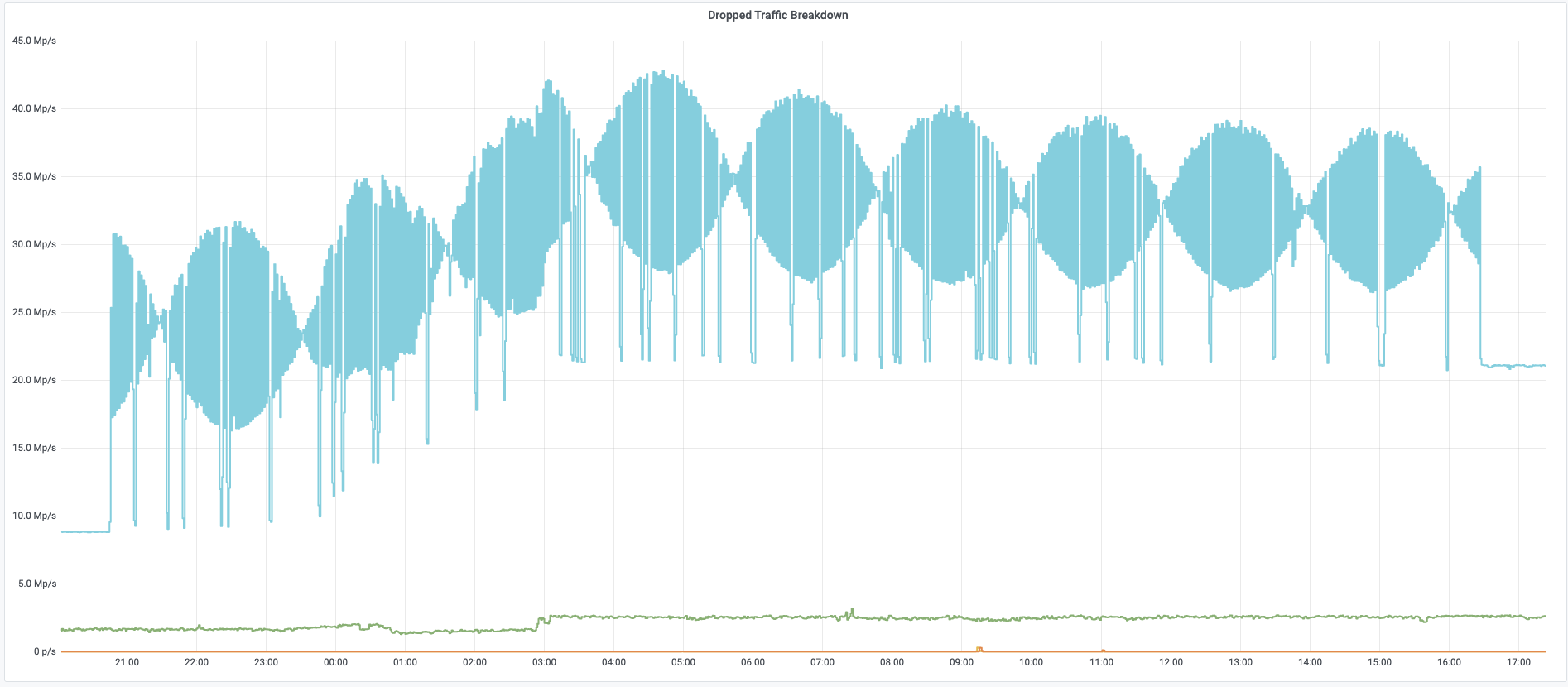
As can be seen in the graph below, the attack’s packet rate follows a wave-shaped pattern for over 8 hours. It seems as though the attacker was inspired by an acoustics concept called beat. In acoustics, a beat is a term that is used to describe an interference of two different wave frequencies. It is the superposition of the two waves. When the two waves are nearly 180 degrees out of phase, they create the beating phenomenon. When the two waves merge they amplify the sound and when they are out of sync they cancel one another, creating the beating effect.
Beat - An Acoustics Inspired DDoS Attack
Beat DDoS Attack

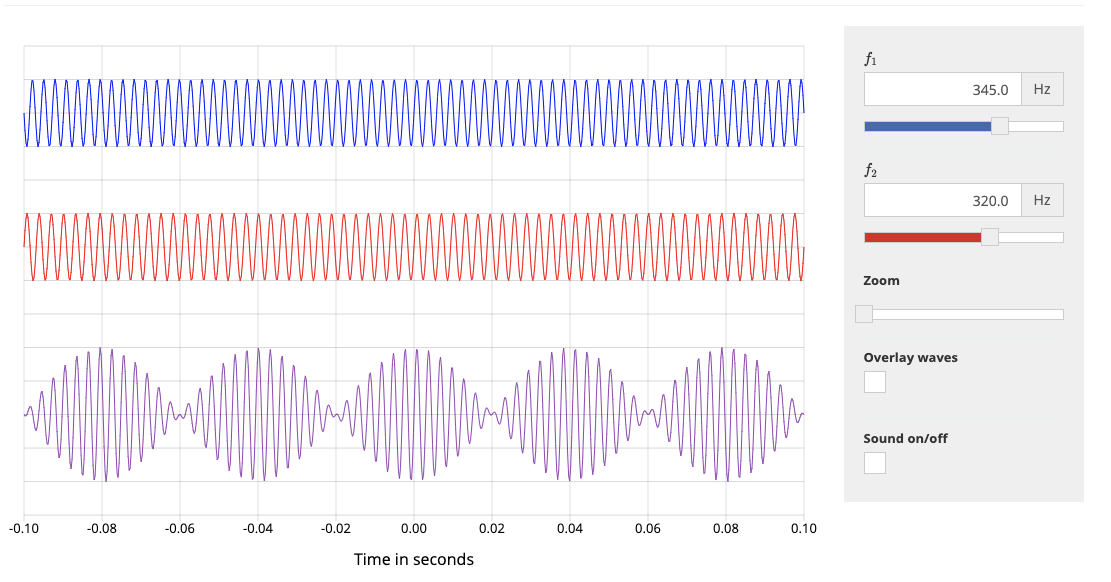
Acedemo.org has a nice tool where you can create your own beat wave. As you can see in the screenshot below, the two waves in blue and red are out of phase and the purple wave is their superposition, the beat wave.
Beat - An Acoustics Inspired DDoS Attack
Source: https://academo.org/demos/wave-interference-beat-frequency/ 

Reverse engineering the attack

It looks like the attacker launched a flood of packets where the rate of the packets is determined by the equation of the beat wave: y‘beat=y1+y2. The two equations y1 and y2 represent the two waves.

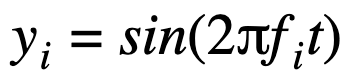
Each equation is expressed as
Beat - An Acoustics Inspired DDoS Attack

where fi is the frequency of each wave and t is time.

Therefore, the packet rate of the attack is determined by manipulation of the equation

Beat - An Acoustics Inspired DDoS Attack

to achieve a packet rate that ranges from ~18M to ~42M pps.

To get to the scale of this attack we will need to multiply y‘beat by a certain variable a and also add a constant c, giving us ybeat=ay‘beat+c. Now, it’s been a while since I played around with equations, so I’m only going to try and get an approximation of the equation.

By observing the attack graph, we can guesstimate that

Beat - An Acoustics Inspired DDoS Attack

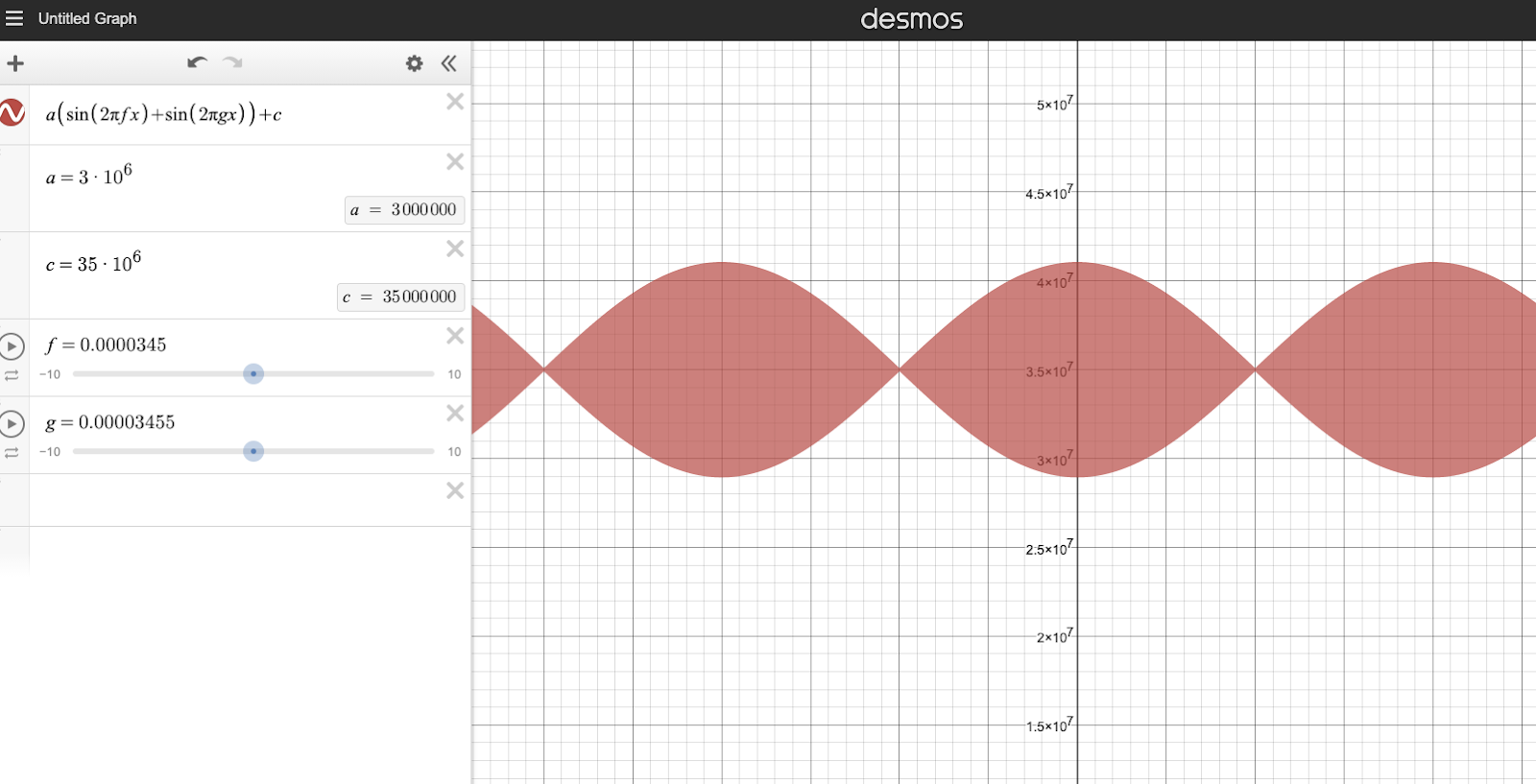
by playing around with desmos’s cool graph visualizer tool, if we set f1=0.0000345 and f2=0.00003455 we can generate a graph that resembles the attack graph. Plotting in those variables, we get:

Beat - An Acoustics Inspired DDoS Attack

Now this formula assumes just one node firing the packets. However, this specific attack was globally distributed, and if we assume that each node, or bot in this botnet, was firing an equal amount of packets at an equal rate, then we can divide the equation by the size of the botnet; the number of bots b. Then the final equation is something in the form of:

Beat - An Acoustics Inspired DDoS Attack

In the screenshot below, g = f 1. You can view this graph here.
Beat - An Acoustics Inspired DDoS Attack

Beating the drum

The attacker may have utilized this method in order to try and overcome our DDoS protection systems (perhaps thinking that the rhythmic rise and fall of the attack would fool our systems). However, flowtrackd, our unidirectional TCP state tracking machine, detected it as being a flood of ACK packets that do not belong to any existing TCP connection. Therefore, flowtrackd automatically dropped the attack packets at Cloudflare’s edge.

The attacker was beating the drum for over 19 hours with an amplitude of ~7 Mpps, a wavelength of ~4 hours, and peaking at ~42 Mpps. During the two days in which the attack took place, Cloudflare systems automatically detected and mitigated over 700 DDoS attacks that targeted this customer. The attack traffic accumulated at almost 500 Terabytes out of a total of 3.6 Petabytes of attack traffic that targeted this single customer in November alone. During those two days, the attackers utilized mainly ACK floods, UDP floods, SYN floods, Christmas floods (where all of the TCP flags are ‘lit’), ICMP floods, and RST floods.

The challenge of TCP based attacks

TCP is a stateful protocol, which means that in some cases, you’d need to keep track of a TCP connection’s state in order to know if a packet is legitimate or part of an attack, i.e. out of state. We were able to provide protection against out-of-state TCP packet attacks for our “classic” WAF/CDN service and Spectrum service because in both cases Cloudflare serves as a reverse-proxy seeing both ingress and egress traffic.
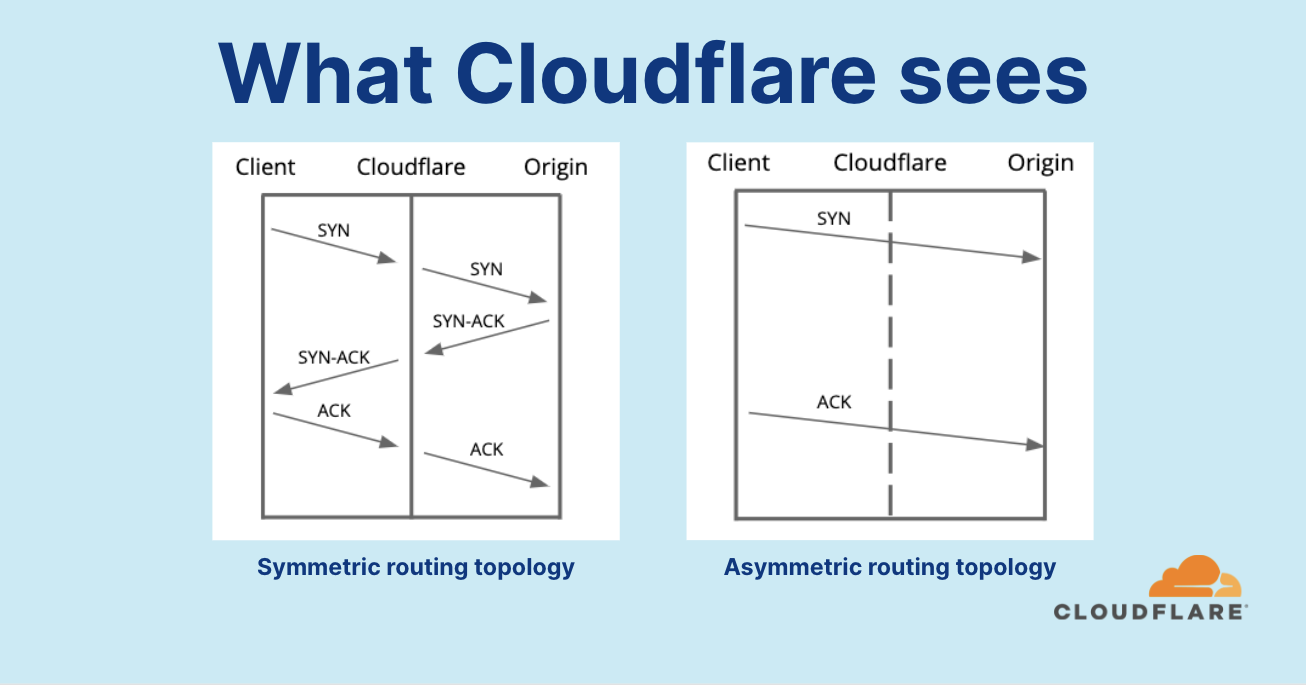
Beat - An Acoustics Inspired DDoS Attack

However, when we launched Magic Transit, which relies on an asymmetric routing topology with a direct server return (DSR), we couldn’t utilize our existing TCP connection tracking systems.
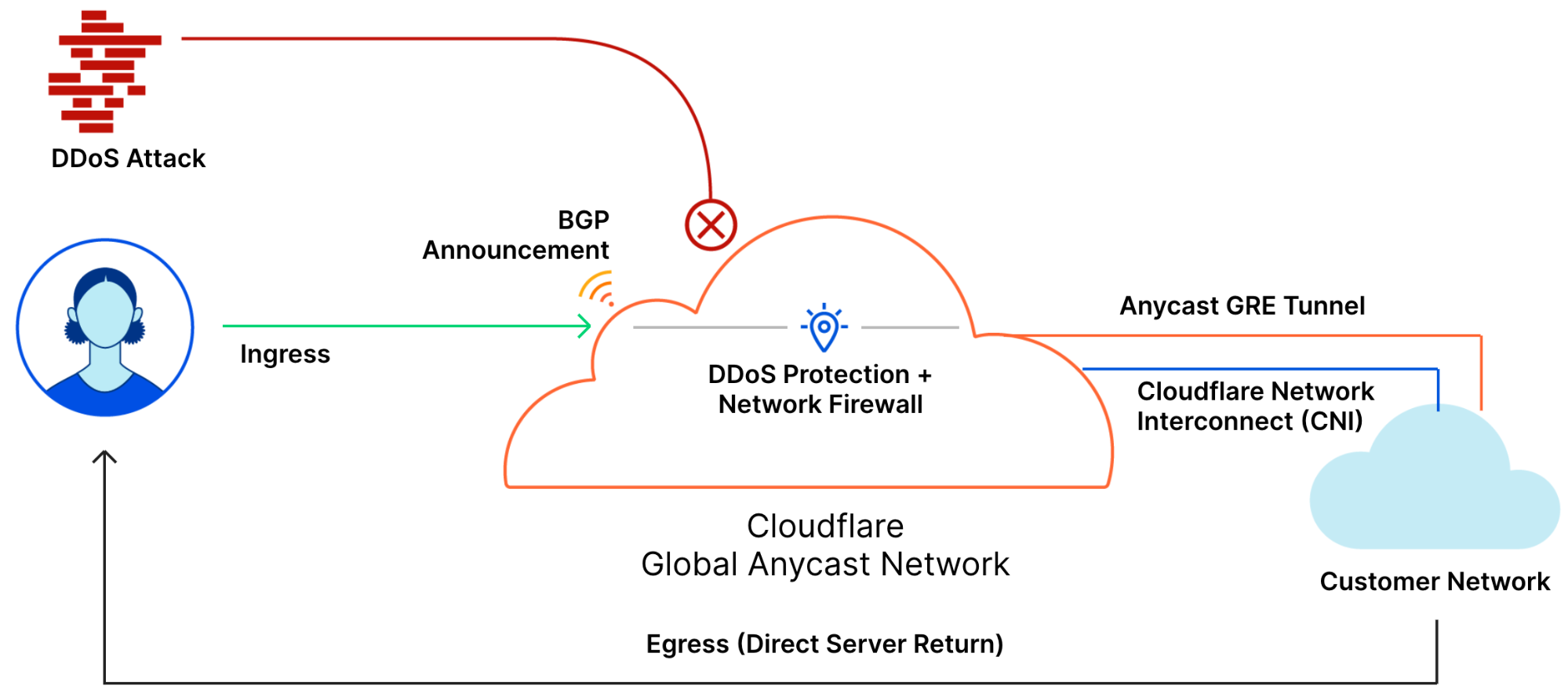
Beat - An Acoustics Inspired DDoS Attack

And so, being a software-defined company, we’re able to write code and spin up software when and where needed — as opposed to vendors that utilize dedicated DDoS protection hardware appliances. And that is what we did. We built flowtrackd, which runs autonomously on each server at our network’s edge. flowtrackd is able to classify the state of TCP flows by analyzing only the ingress traffic, and then drops, challenges, or rate-limits attack packets that do not correspond to an existing flow.
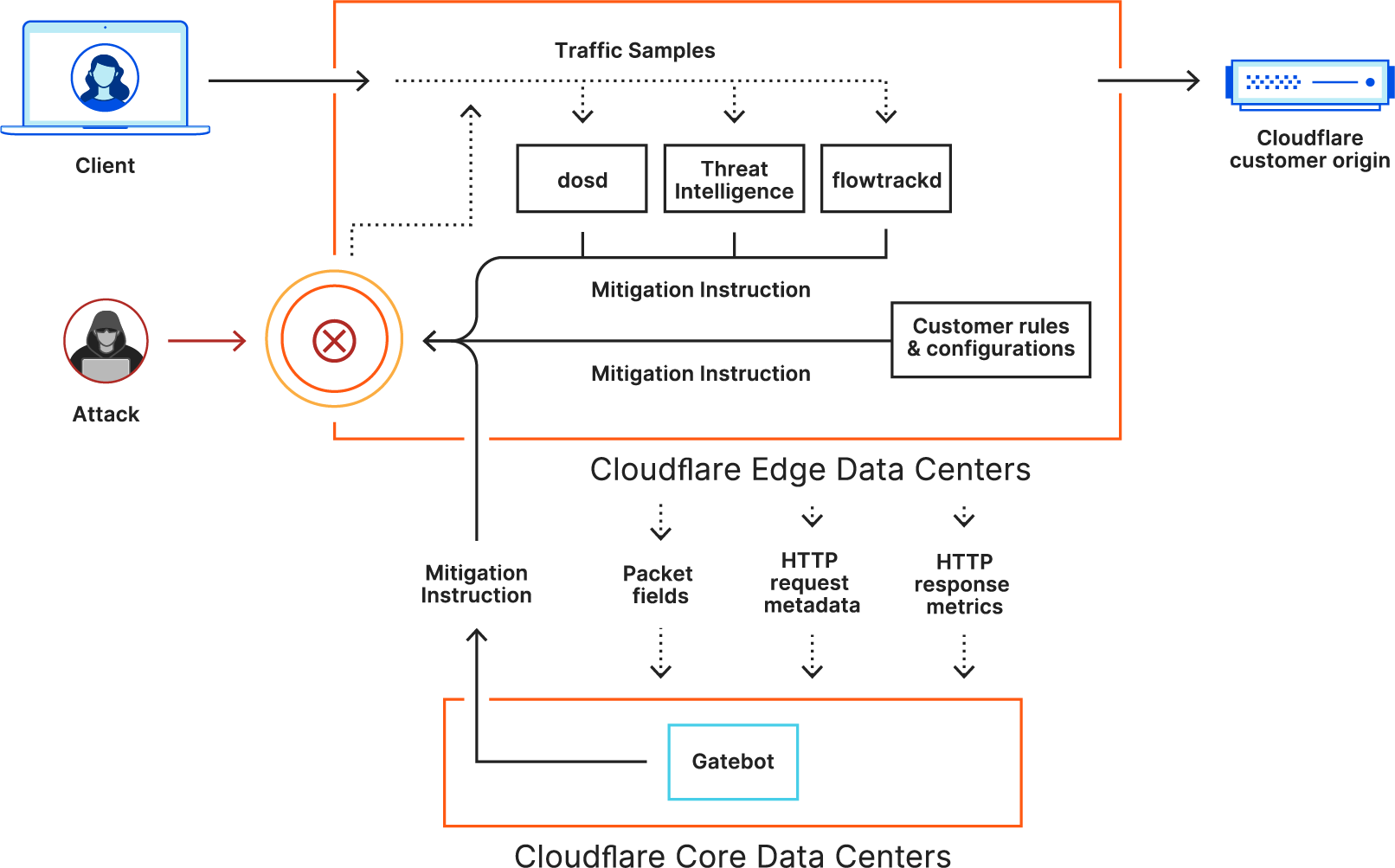
Beat - An Acoustics Inspired DDoS Attack

flowtrackd works together with our two additional DDoS protection systems, dosd and Gatebot, to assure our customers are protected against DDoS attacks, regardless of their size or sophistication — in this case, serving as a noise-canceling system to the Beat attack; reducing the headaches for our customers.

Read more about how our DDoS protection systems work here.

Know When You’ve Been DDoS’d

Post Syndicated from Omer Yoachimik original https://blog.cloudflare.com/announcing-ddos-alerts/

Know When You’ve Been DDoS’d

Know When You’ve Been DDoS’d

Today we’re announcing the availability of DDoS attack alerts. The alerts are available for free for all Cloudflare’s customers on paid plans.

Unmetered DDoS protection

Last week we celebrated Cloudflare’s 10th birthday in what we call Birthday Week. Every year, on each day of Birthday Week, we announce a new product with the goal of helping make the Internet a better place — one that is safer and faster. To do that, over the years we’ve democratized many products that were previously only available to large enterprises by making them available for free (or at very low cost) to all. For example, on Cloudflare’s 7th birthday in 2017, we announced free unmetered DDoS protection as part of every Cloudflare product and every plan, including the free plan.

DDoS attacks aim to take down websites or online services and make them unavailable to the public. We wanted to make sure that every organization and every website is available and accessible, regardless if they can or can’t afford enterprise-grade DDoS protection. This has been a core part of our mission. We’ve been heavily investing in our DDoS protection capabilities over the last 10 years, and we will continue to do so in the future.

Real-time DDoS attack alerts

I’ve recently published a few blogs that provide a look under the hood of our DDoS protection systems. These systems run autonomously, they detect and mitigate attacks without any human intervention. As was the case with the 654 Gbps attack in July, and the 754 Mpps attack in June. We’ve been successful at blocking DDoS attacks and also providing our users with important analytics and insights about the attacks, but our customers also want to be notified in real-time when they are targeted by DDoS attacks.

So today, we’re excited to announce the availability of DDoS alerts. The current delivery methods by Cloudflare plan type are listed in the table below. Additional delivery methods will be made available in the future.

Delivery methods by plan

Delivery method Plan
Free Pro Business Enterprise
Email ❌ ✅ ✅ ✅
PagerDuty ❌ ❌ ✅ ✅

There are two types of DDoS alerts: HTTP DDoS alerts and L3/4 DDoS alerts. Whether you are eligible to one or both depends on the Cloudflare services that you are subscribed to. The table below lists the alert types by the Cloudflare service.

Alert types by service

Alert type Service
WAF/CDN Spectrum Spectrum BYOIP Magic Transit
HTTP DDoS alerts ✅ ❌ ❌ ❌
L3/4 DDoS alerts Coming soon Coming soon ✅ ✅

Creating a DDoS alert policy

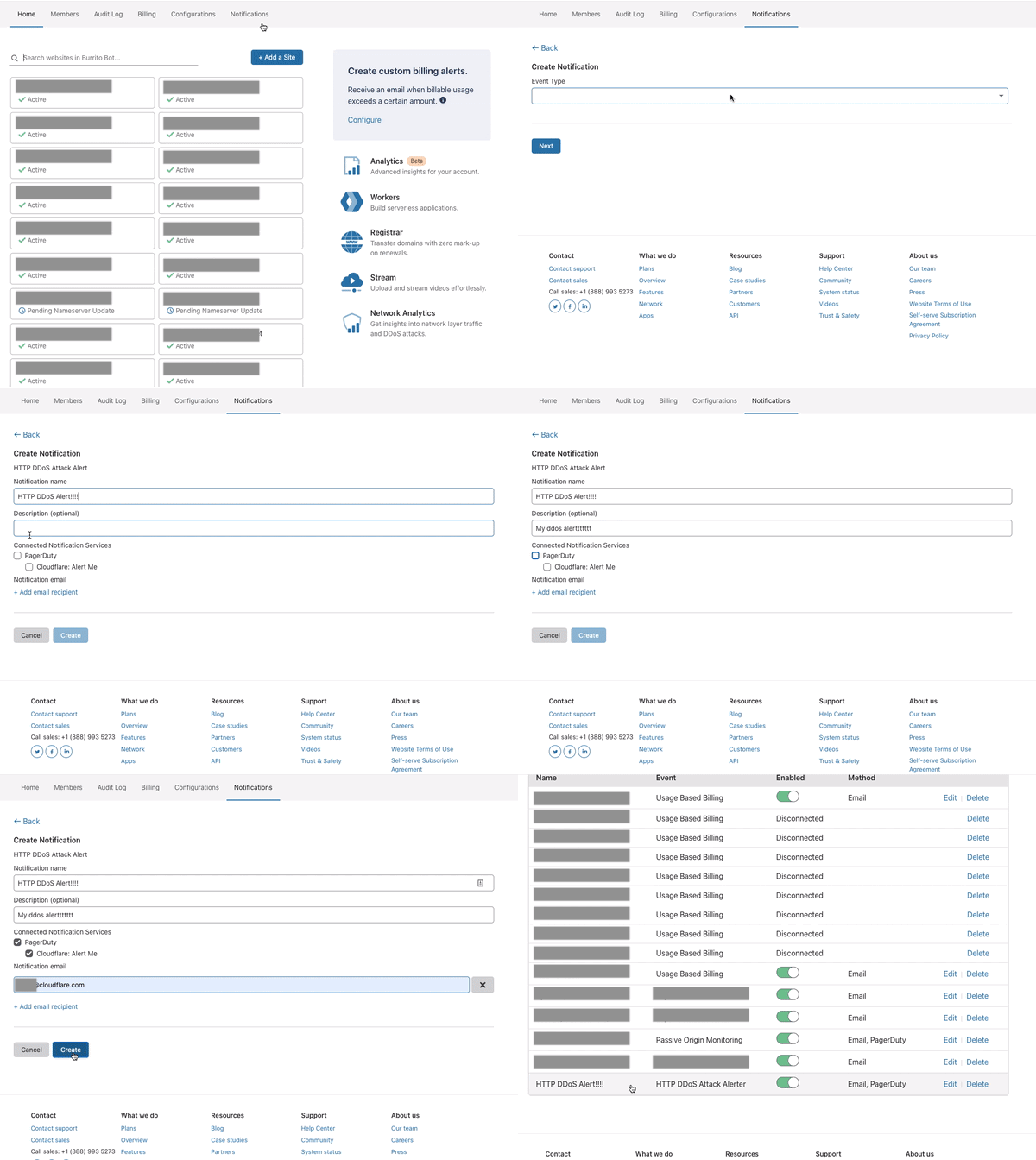
In order to receive alerts on DDoS attacks that target your Cloudflare-protected Internet property, you must first create a notification policy. That’s fast and easy:

  1. Log in to your Cloudflare account dashboard: https://dash.cloudflare.com
  2. In the Account Home page, navigate to the Notifications tab
  3. In the Notifications card, click Create
  4. Give your notification a name, add an optional description, and the email addresses of the recipients.
Know When You’ve Been DDoS’d

If you are on the Business plan or higher, you’ll need to connect to PagerDuty before creating the alert policy. Once you’ve done so, you’ll have the option to send the alert to your PagerDuty service.

Receive the alert, view the attack, and give feedback

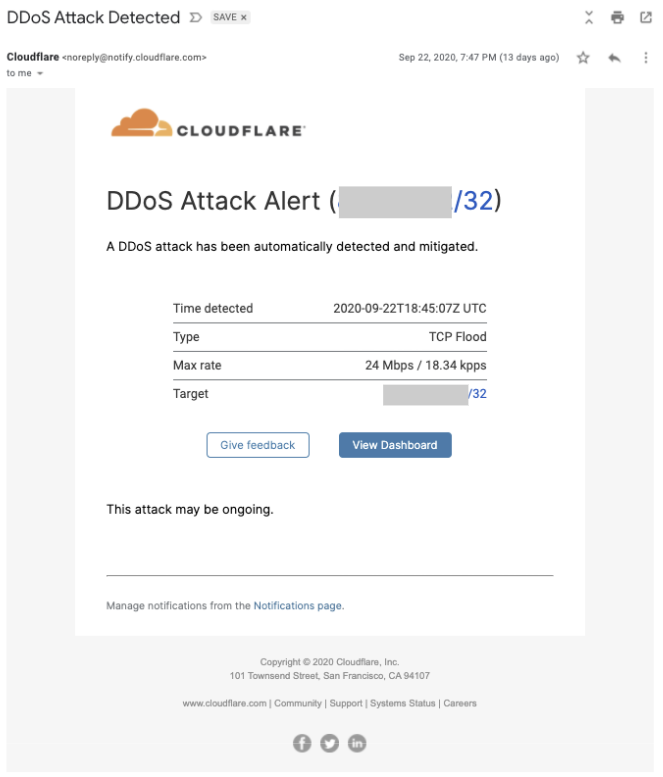
When developing and designing the alert template, we interviewed many of our customers to understand what information is important to them, what would make the alert useful and easy to understand. We’ve intentionally made the alert short. The email subject is also straightforward: DDoS Attack Detected, and it will only be sent from our official email address: [email protected][dot]com. Add this email to your list of trusted email addresses to assure you don’t miss the alerts.

The alert includes the following information:

  1. A short description of what happened
  2. The date and time the attack was initially detected and mitigated by our systems
  3. The attack type
  4. The max rate of the attack when the alert was triggered
  5. The attack target

The attack may be ongoing when you receive the alert and so we also include a link to view the attack in the Cloudflare dashboard and also a link to provide feedback on the protection and visibility.

Know When You’ve Been DDoS’d

We’d love to get your feedback!

We’d love your feedback on our DDoS protection solution. When you receive a DDoS alert, you’ll be provided with a link to submit your feedback. Measuring user satisfaction helps us build better products. Your feedback helps us measure user satisfaction for Cloudflare’s DDoS protection and the attack analytics that we provide in the dashboard. User satisfaction rates are one of the main Key Performance Indicators (KPIs) for our DDoS protection service that we monitor closely. So give your feedback, and help us make DDoS protection better for everyone.

Not a Cloudflare customer yet? Sign up to get started.