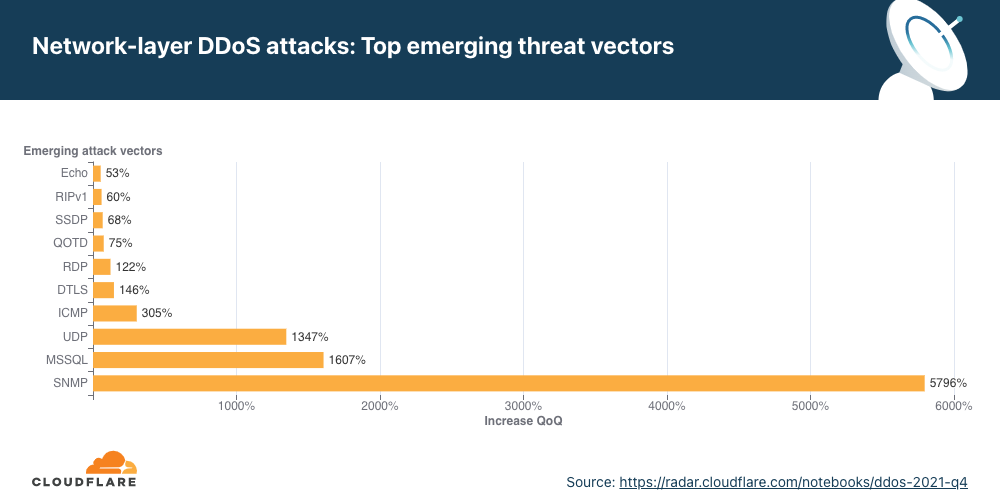
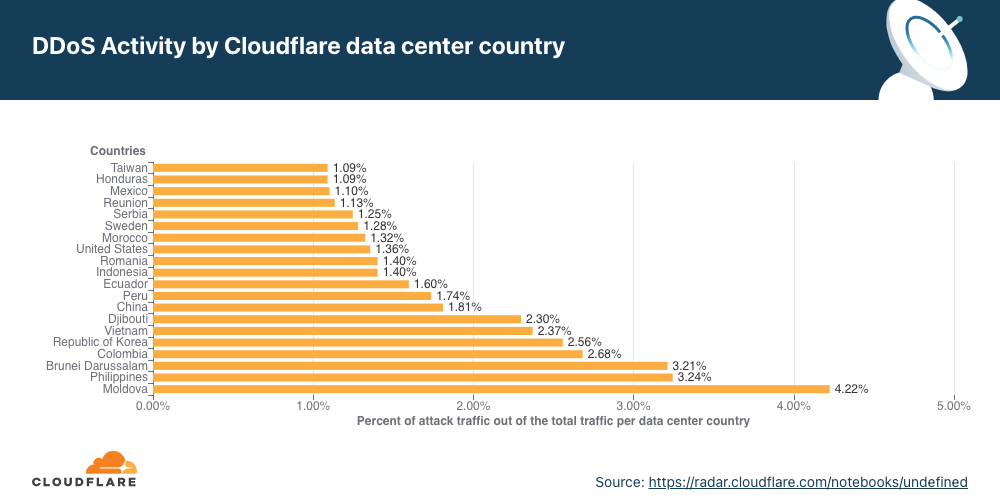
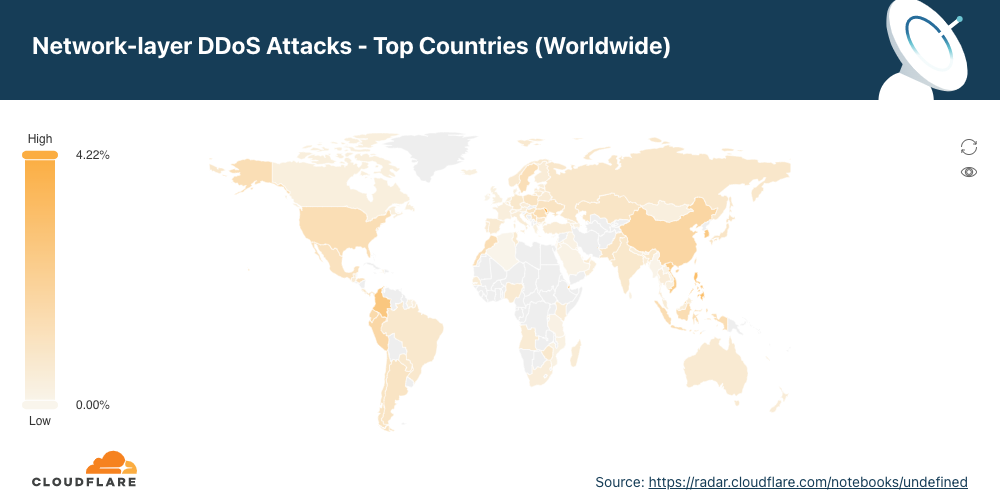
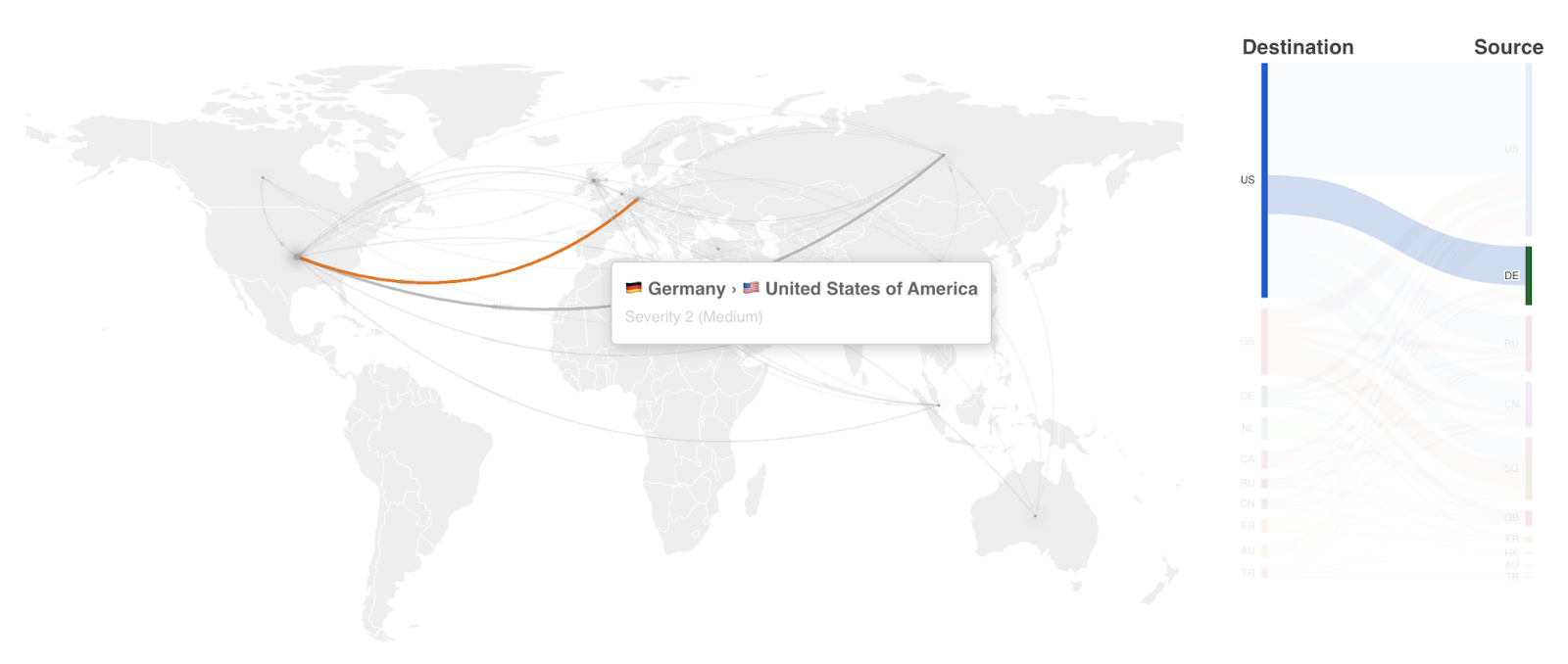
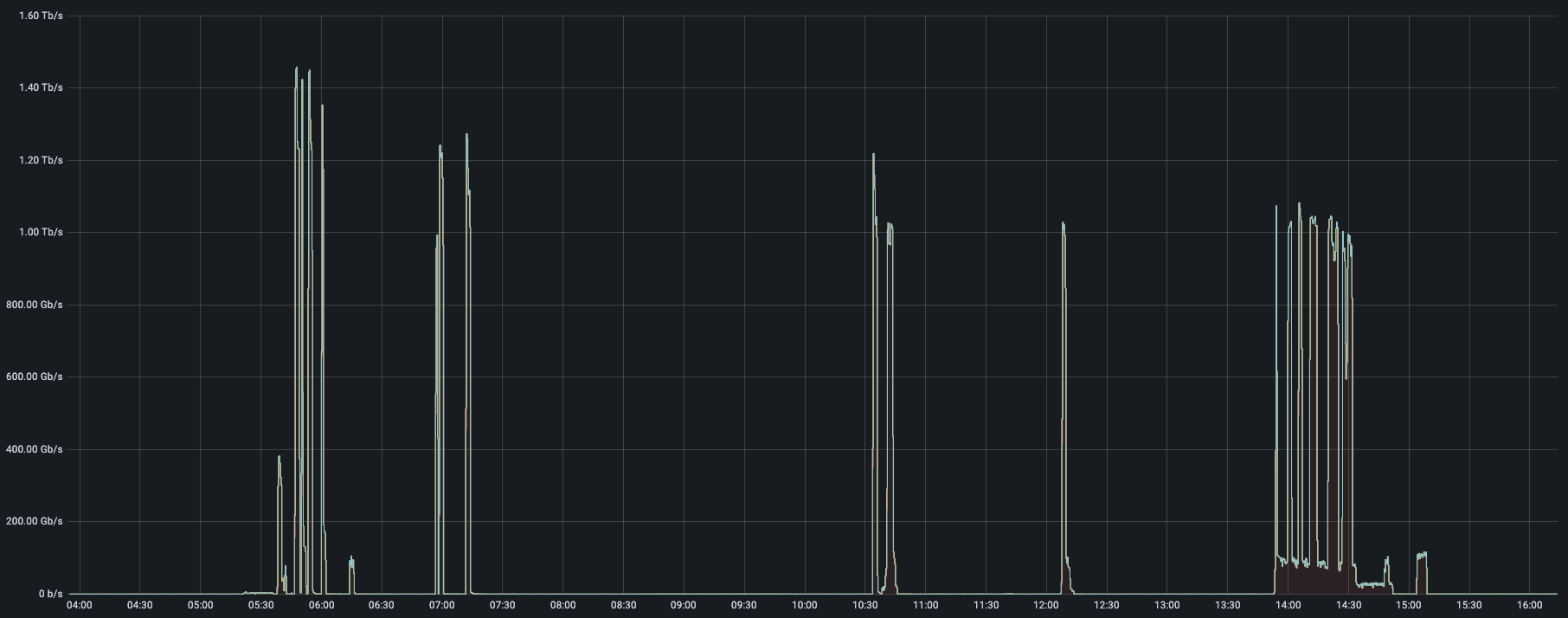
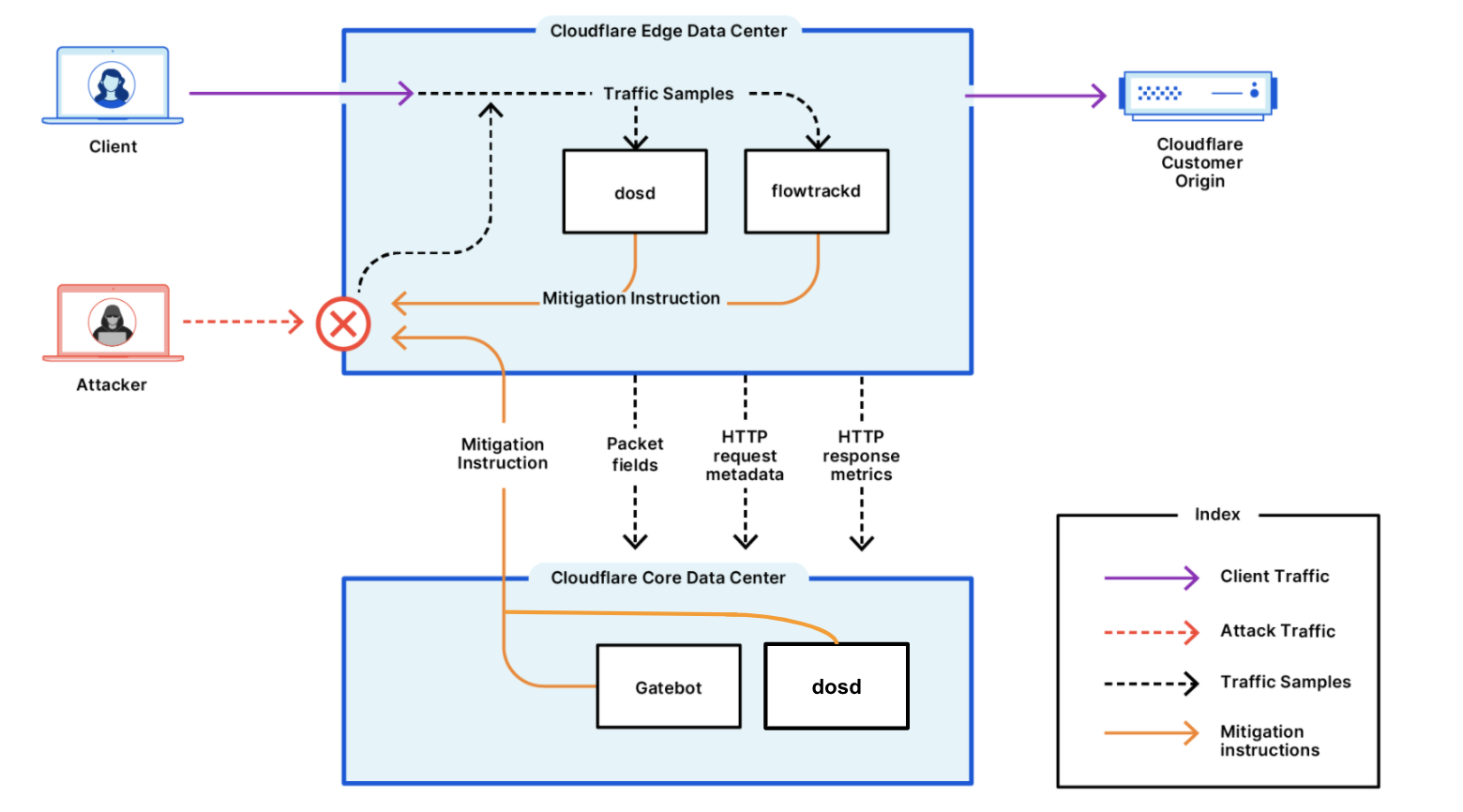
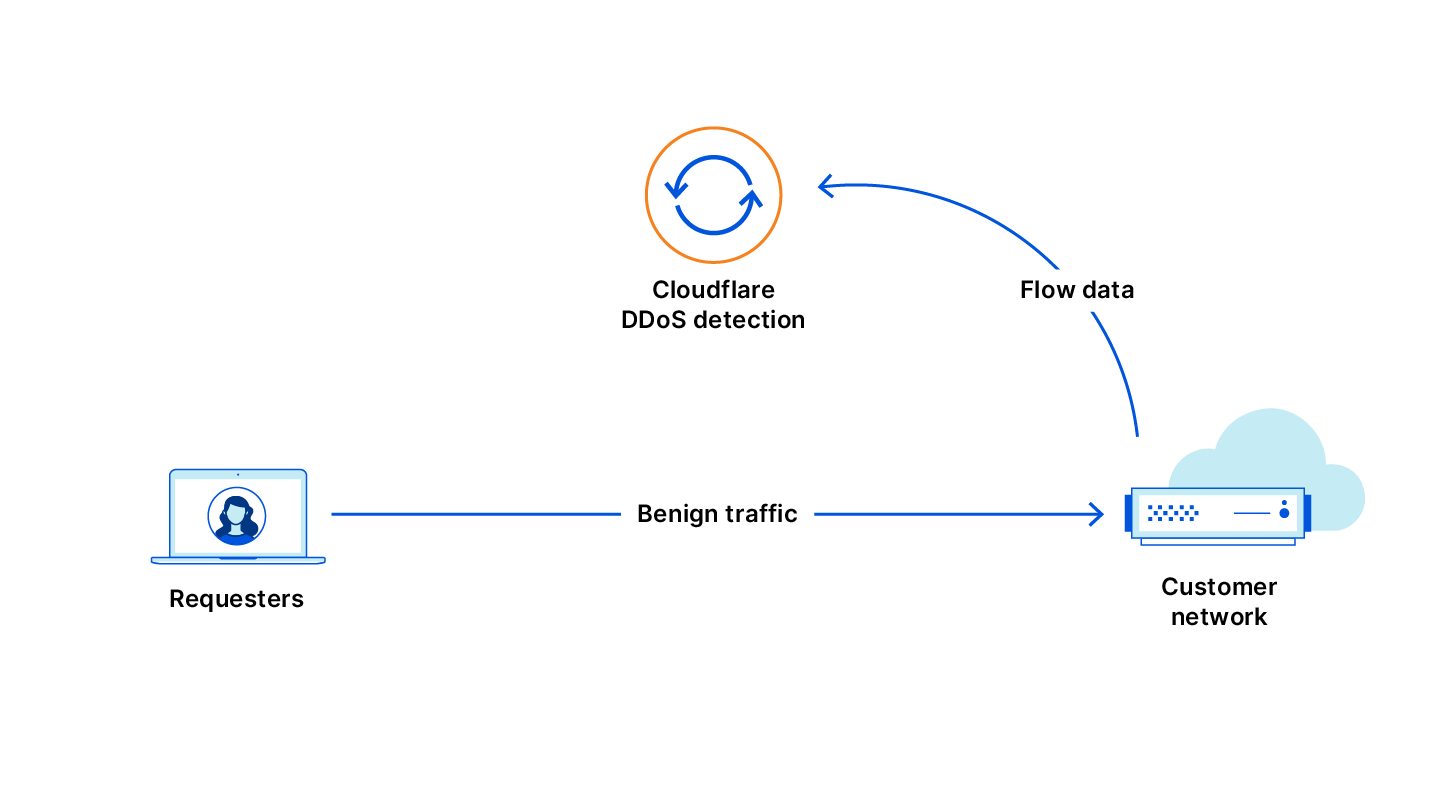
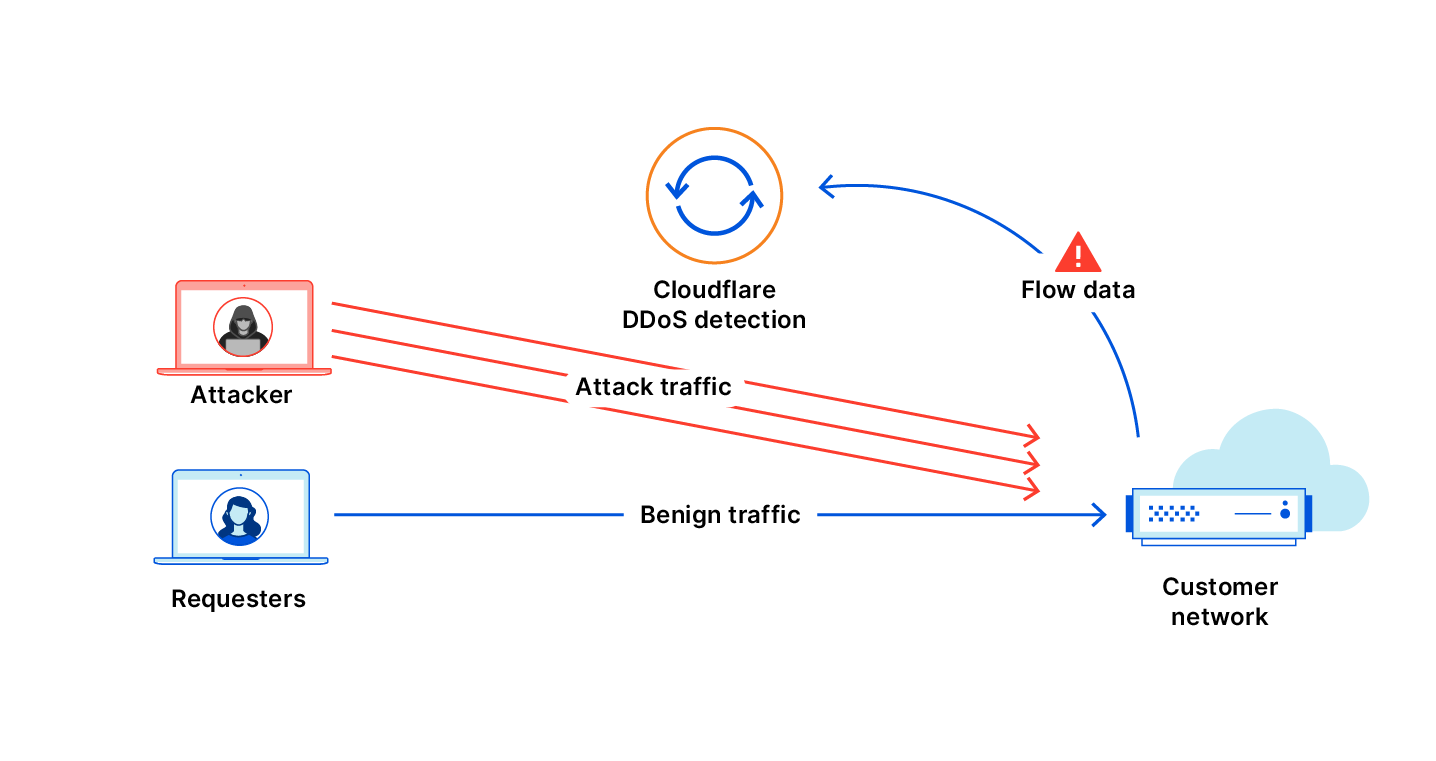
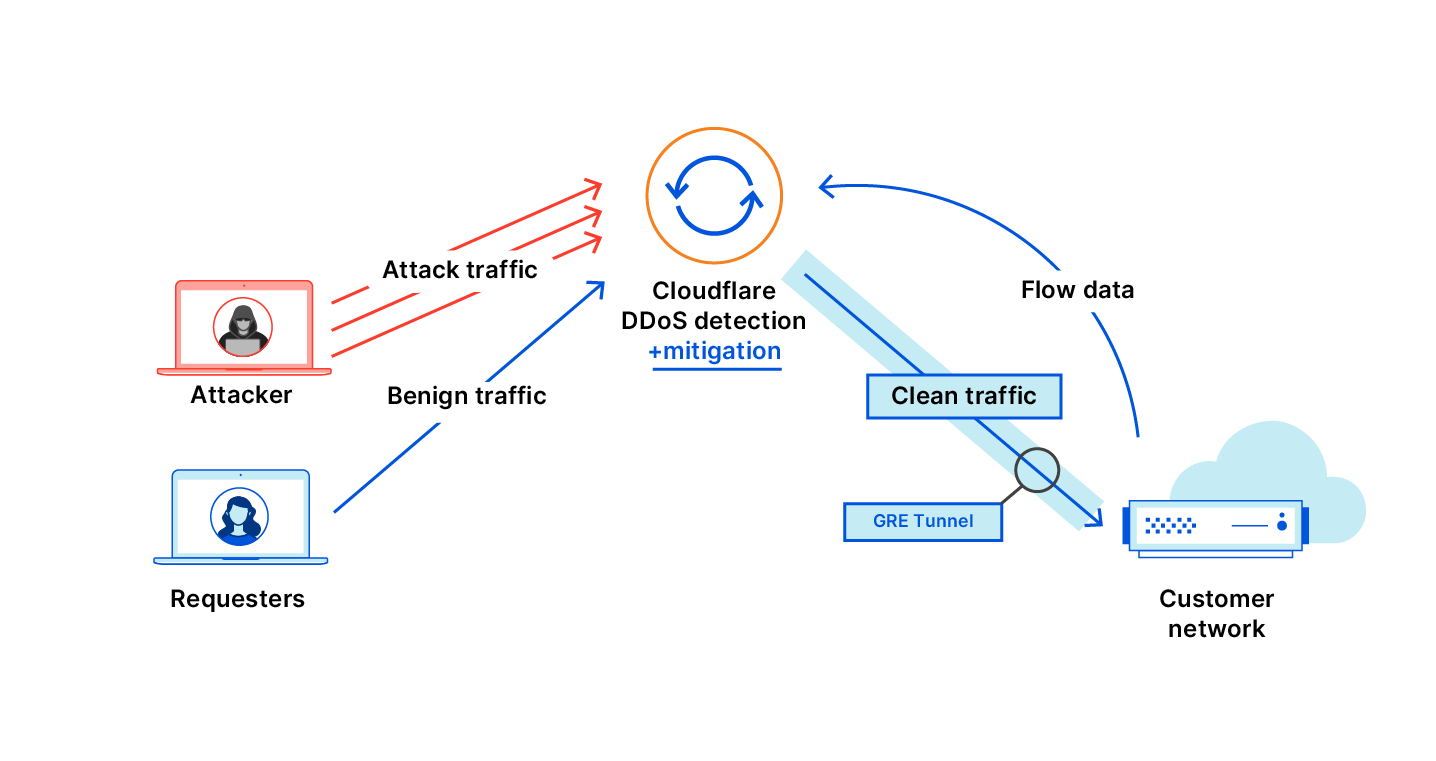
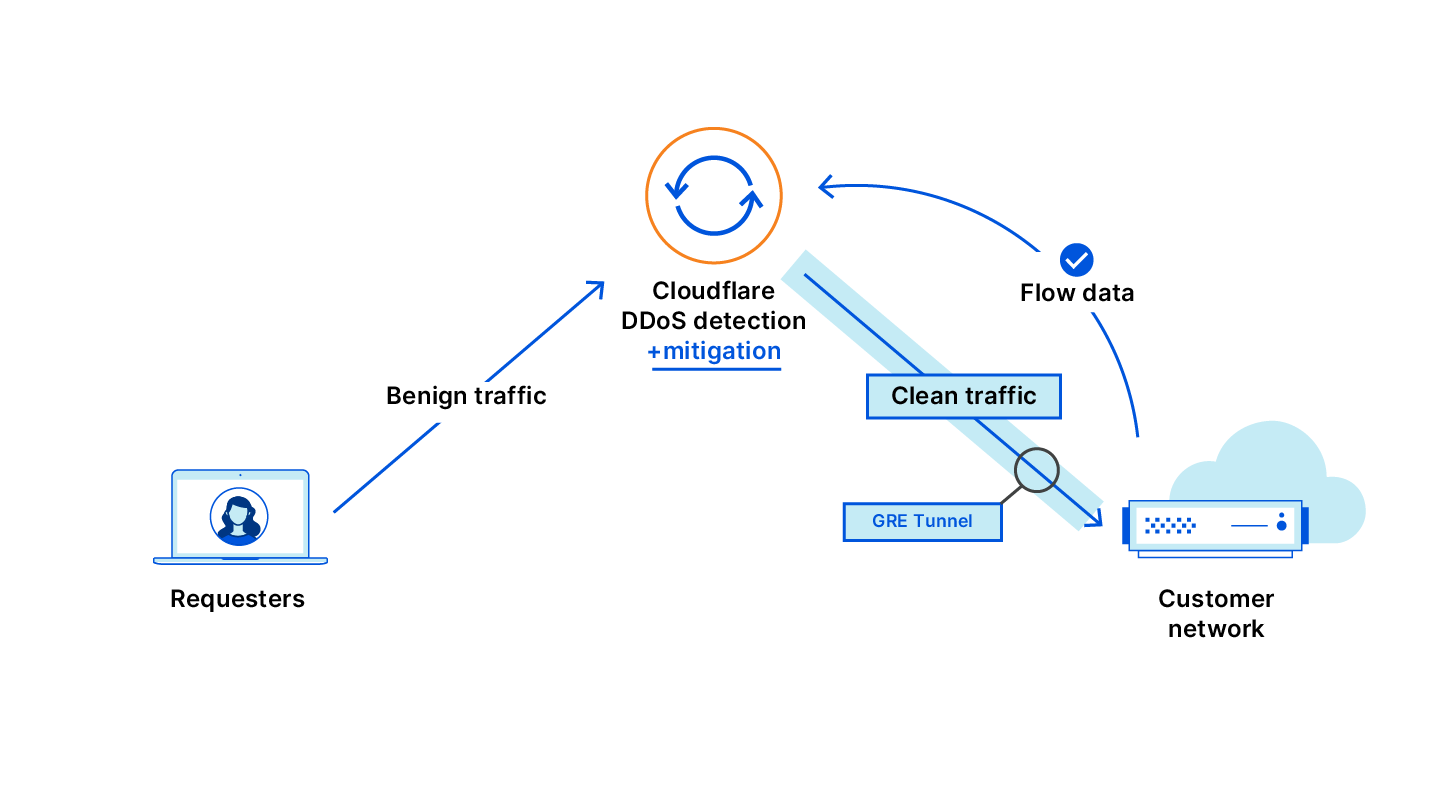
Earlier today, April 25, 2023, researchers Pedro Umbelino at Bitsight and Marco Lux at Curesec published their discovery of CVE-2023-29552, a new DDoS reflection/amplification attack vector leveraging the SLP protocol. If you are a Cloudflare customer, your services are already protected from this new attack vector.
Service Location Protocol (SLP) is a “service discovery” protocol invented by Sun Microsystems in 1997. Like other service discovery protocols, it was designed to allow devices in a local area network to interact without prior knowledge of each other. SLP is a relatively obsolete protocol and has mostly been supplanted by more modern alternatives like UPnP, mDNS/Zeroconf, and WS-Discovery. Nevertheless, many commercial products still offer support for SLP.
Since SLP has no method for authentication, it should never be exposed to the public Internet. However, Umbelino and Lux have discovered that upwards of 35,000 Internet endpoints have their devices’ SLP service exposed and accessible to anyone. Additionally, they have discovered that the UDP version of this protocol has an amplification factor of up to 2,200x, which is the third largest discovered to-date.
Cloudflare expects the prevalence of SLP-based DDoS attacks to rise significantly in the coming weeks as malicious actors learn how to exploit this newly discovered attack vector.
Cloudflare customers are protected
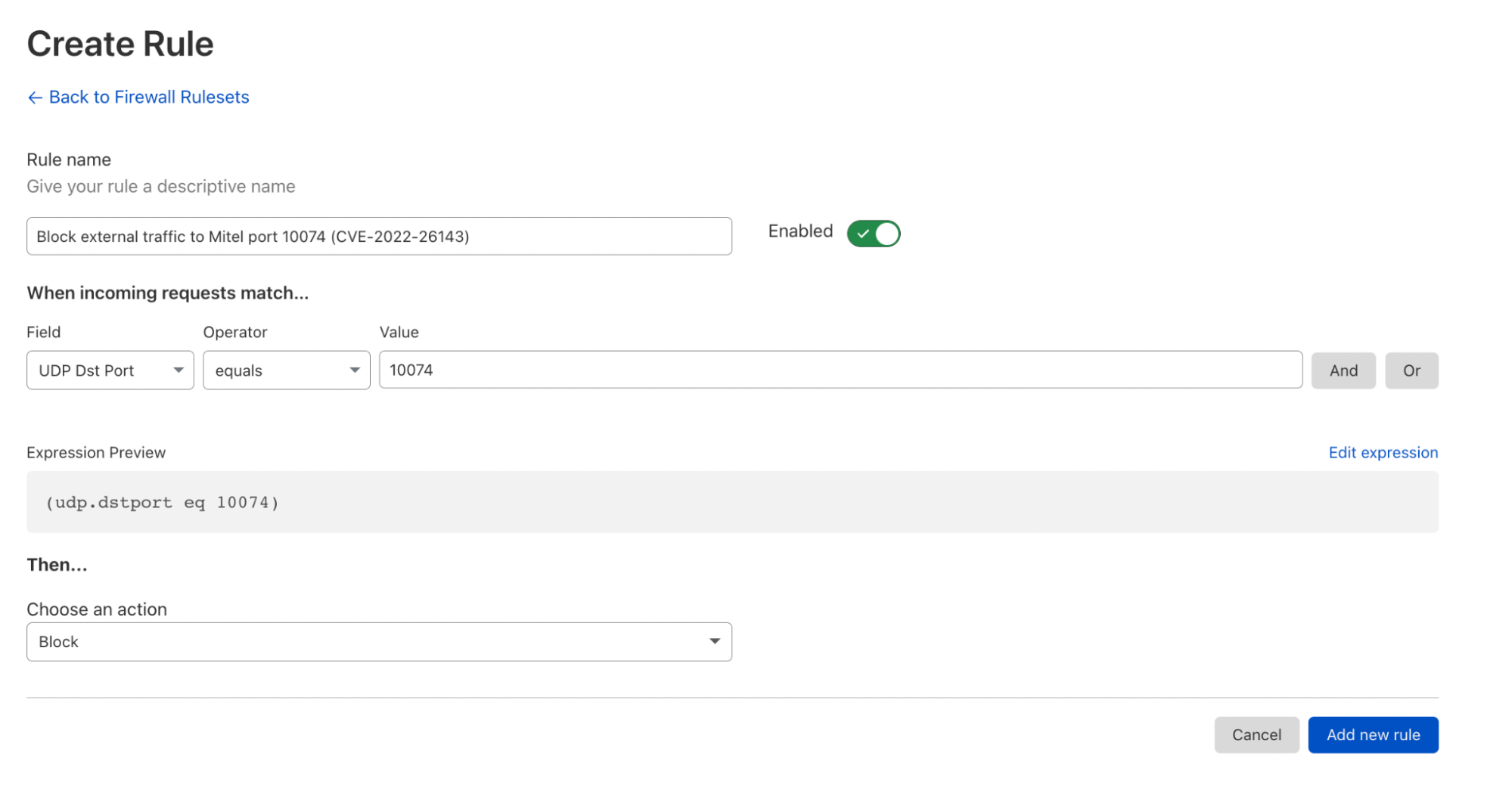
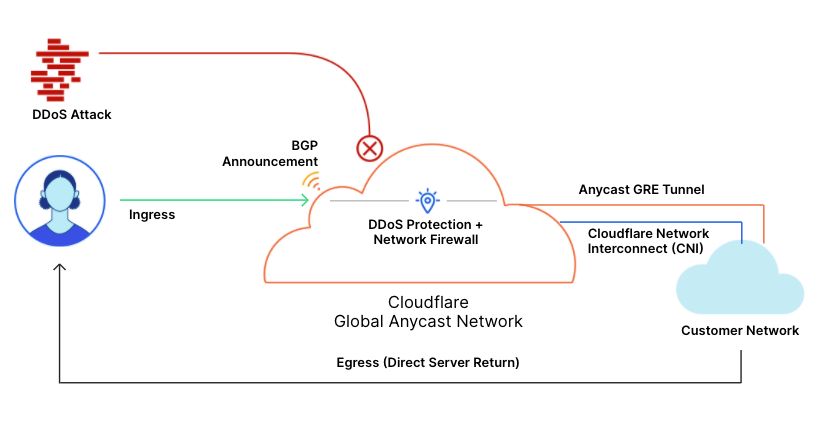
If you are a Cloudflare customer, our automated DDoS protection system already protects your services from these SLP amplification attacks. To avoid being exploited to launch the attacks, if you are a network operator, you should ensure that you are not exposing the SLP protocol directly to the public Internet. You should consider blocking UDP port 427 via access control lists or other means. This port is rarely used on the public Internet, meaning it is relatively safe to block without impacting legitimate traffic. Cloudflare Magic Transit customers can use the Magic Firewall to craft and deploy such rules.
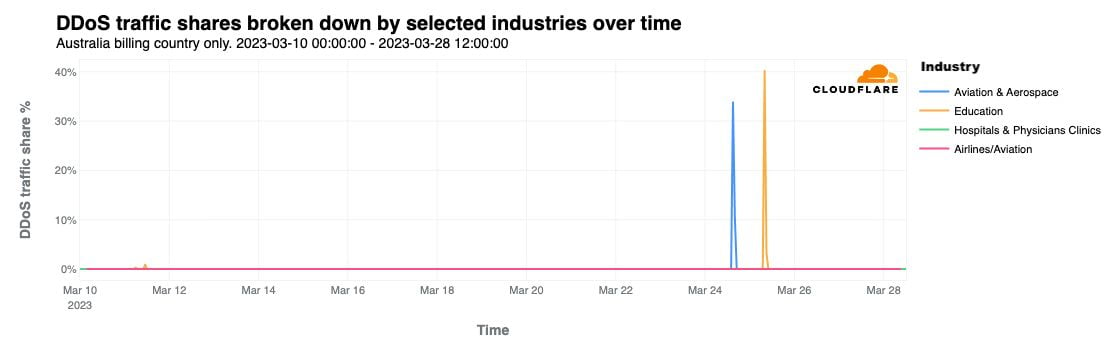
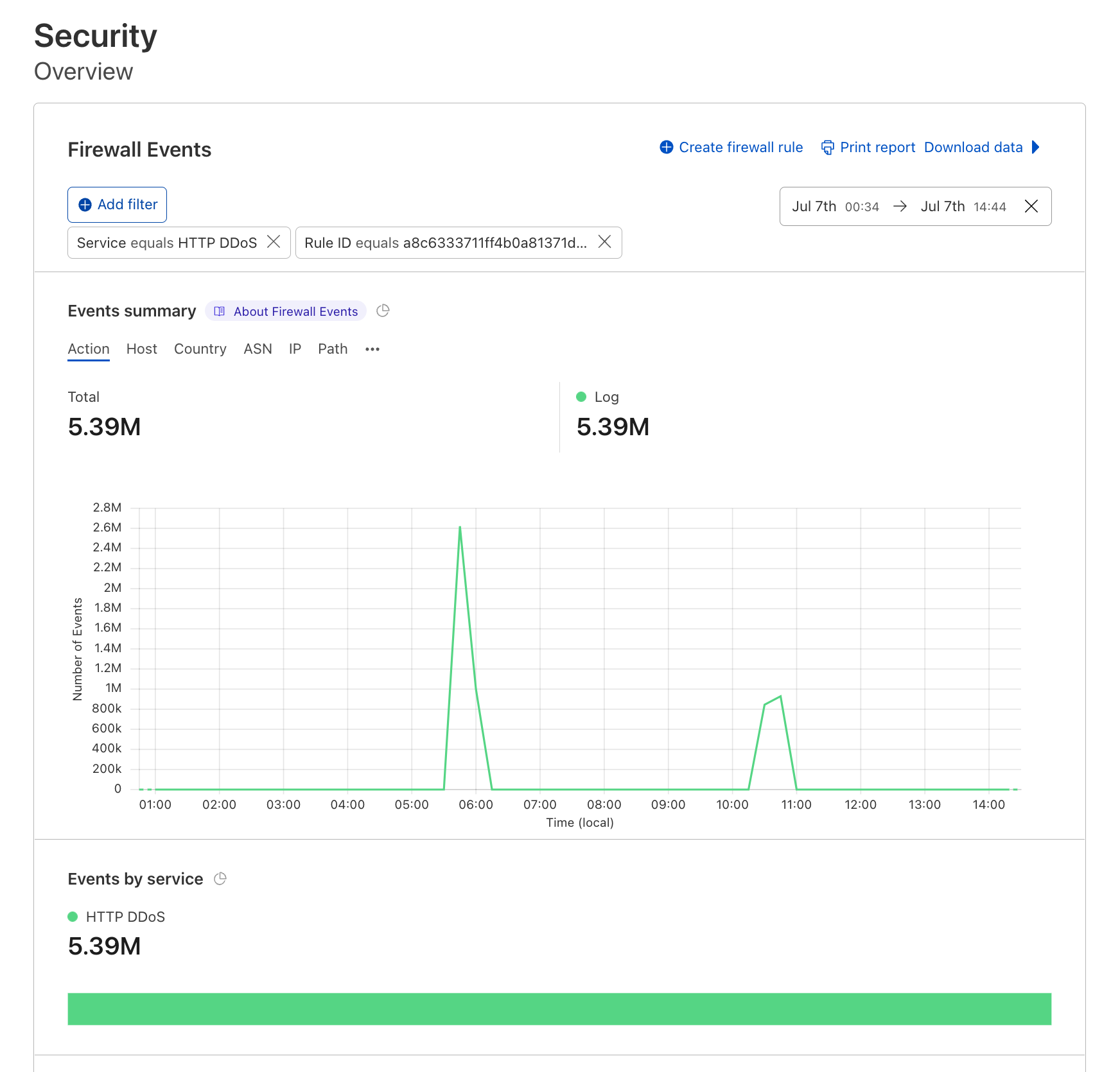
Over the past 24 hours, Cloudflare has observed HTTP DDoS attacks targeting university websites in Australia. Universities were the first of several groups publicly targeted by the pro-Russian hacker group Killnet and their affiliate AnonymousSudan, as revealed in a recent Telegram post. The threat actors called for additional attacks against 8 universities, 10 airports, and 8 hospital websites in Australia beginning on Tuesday, March 28.
Killnet is a loosely formed group of individuals who collaborate via Telegram. Their Telegram channels provide a space for pro-Russian sympathizers to volunteer their expertise by participating in cyberattacks against western interests.
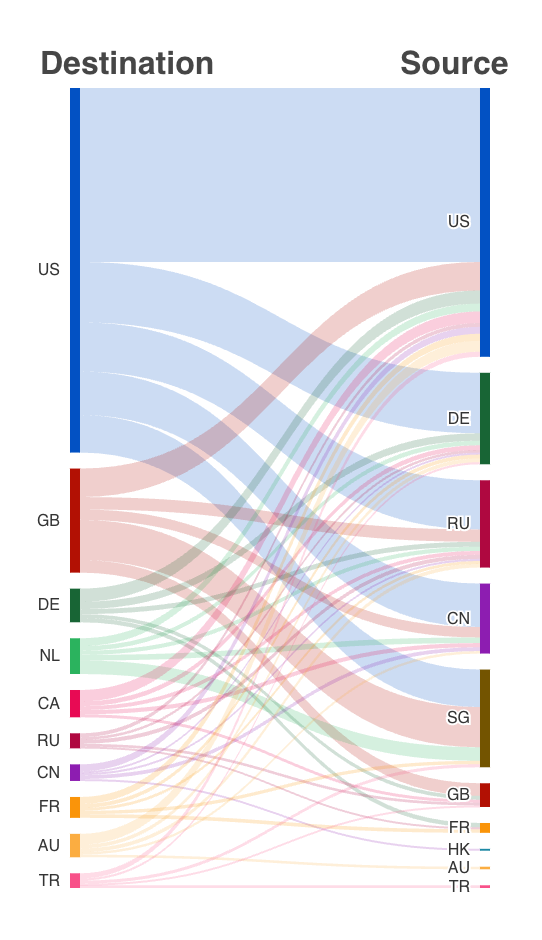
Figure: % of traffic constituting DDoS attacks for organizations in Australia
This is not the first time Cloudflare has reported on Killnet activity. On February 2, 2023 we noted in a blog that a pro-Russian hacktivist group — claiming to be part of Killnet — was targeting multiple healthcare organizations in the US. In October 2022, Killnet called to attack US airport websites, and attacked the US Treasury the following month.
As seen with past attacks from this group, these most recent attacks do not seem to be originating from a single botnet, and the attack methods and sources seem to vary, suggesting the involvement of multiple individual threat actors with varying degrees of skill.
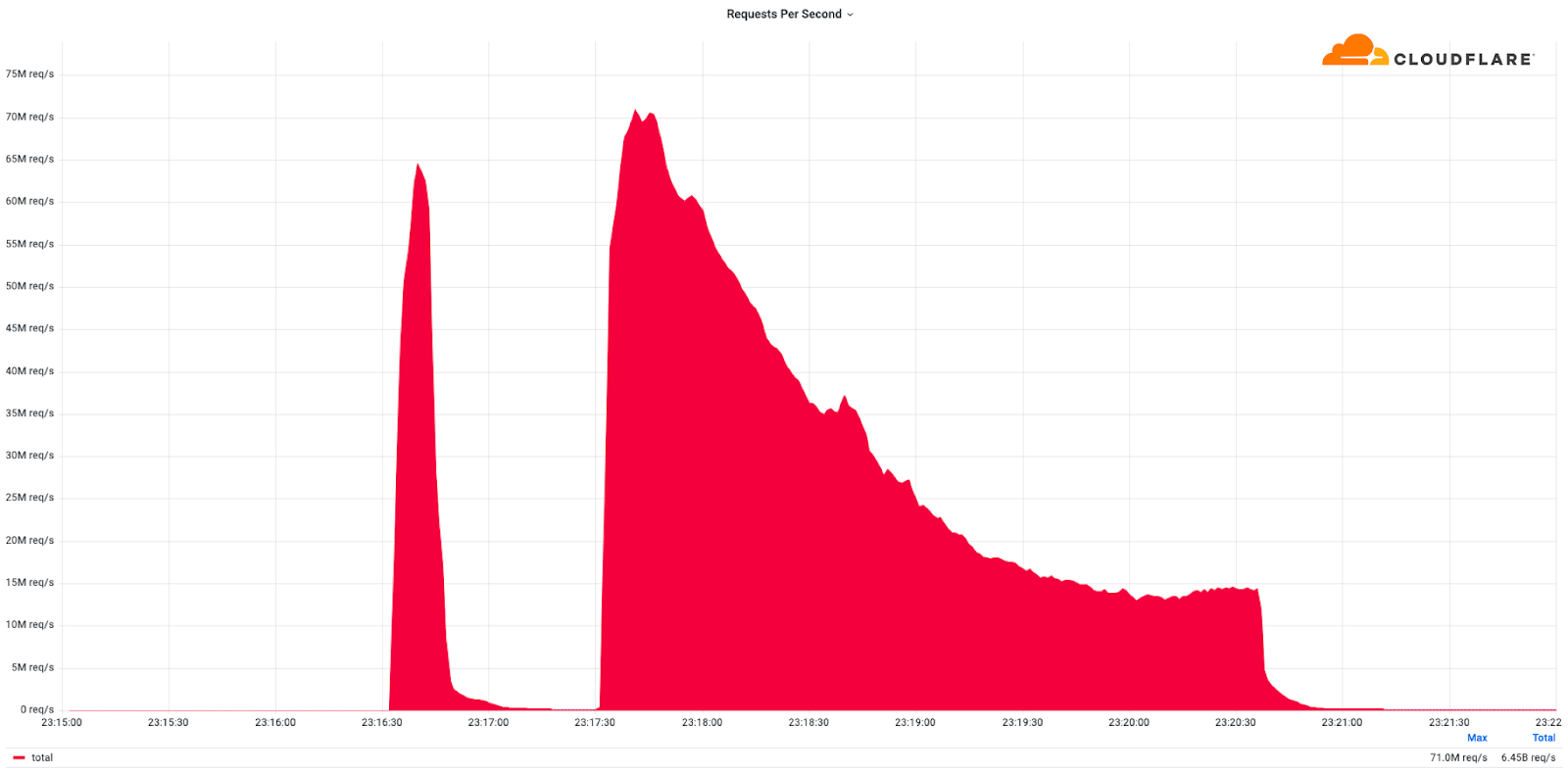
DDoS (Distributed Denial of Service) attacks often make headlines due to their ability to disrupt critical services. Cloudflare recently announced that it had blocked the largest attack to date, which peaked at 71 million requests per second (rps) and was 54% higher than the previous record attack from June 2022.
DDoS attacks are designed to overwhelm networks with massive amounts of malicious traffic, and when executed correctly, can disrupt service or take networks offline. The size, sophistication, and frequency of attacks have been increasing over the past months.
What is Killnet and AnonymousSudan?
Killnet is not a traditional hacking group: it does not have membership, it does not have tools or infrastructure, and it does not operate for financial gain. Instead, Killnet is a space for pro-Russian “hacktivist” sympathizers to volunteer their expertise by participating in cyberattacks against western interests. This collaboration happens entirely in the open via Telegram, where anyone is welcome to join.
Killnet was formed shortly after (and likely in response to) the IT Army of Ukraine, and it emulates their tactics. Most days, administrators of the Killnet telegram channel will put out a call for volunteers to attack some particular target. Participants share many different tools and techniques for launching successful attacks, and inexperienced individuals are often coached on how to launch cyber attacks by those who are more experienced.
AnonymousSudan is another nontraditional hacking group similar to Killnet who is ostensibly composed of Sudanese “hacktivists”. The two groups have recently begun collaborating to attack various western interests.
Attackers, including from these groups, are becoming more audacious in the size and scale of the organizations they are targeting. What this means for businesses, especially those with limited cyber resources, is an increasing threat level against vulnerable networks.
Organizations of all sizes need to be prepared for the eventuality of a significant DDoS attack against their networks. Detection and mitigation of attacks should ideally be automated as much as possible, because relying solely on humans to mitigate in real time puts attackers in the driver’s seat.
How should I protect my organization against DDoS?
Cloudflare customers are protected against DDoS attacks; our systems have been automatically detecting and mitigating the attack. Our team continues to monitor the situation and will deploy countermeasures as needed.
As an additional step of precaution, customers in the Education, Travel, and Healthcare industries are advised to follow the below recommendations.
Ensure all other DDoS Managed Rules are set to default settings (High sensitivity level and mitigation actions).
Deploy firewall rules and rate-limiting rules to enforce a combined positive and negative security model. Reduce the traffic allowed to your website based on your known usage.
Turn on Bot Fight Mode or the equivalent level (SBFM, Enterprise Bot Management) available to you.
Ensure your origin is not exposed to the public Internet, i.e., only enable access to Cloudflare IP addresses.
Enable caching as much as possible to reduce the strain on your origin servers, and when using Workers, avoid overwhelming your origin server with more subrequests than necessary
As easy as it has become for the attackers to launch DDoS attacks, we want to make sure that it is even easier – and free – for defenders of organizations of all sizes to protect themselves against DDoS attacks of all types. We’ve been providing unmetered and unlimited DDoS protection for free to all of our customers since 2017. Cloudflare’s mission is to help build a better Internet. A better Internet is one that is more secure, faster, and reliable for everyone – even in the face of DDoS attacks.
If you’d like to learn more about key DDoS trends, download the Cloudflare DDoS Threat Report for quarterly insights.
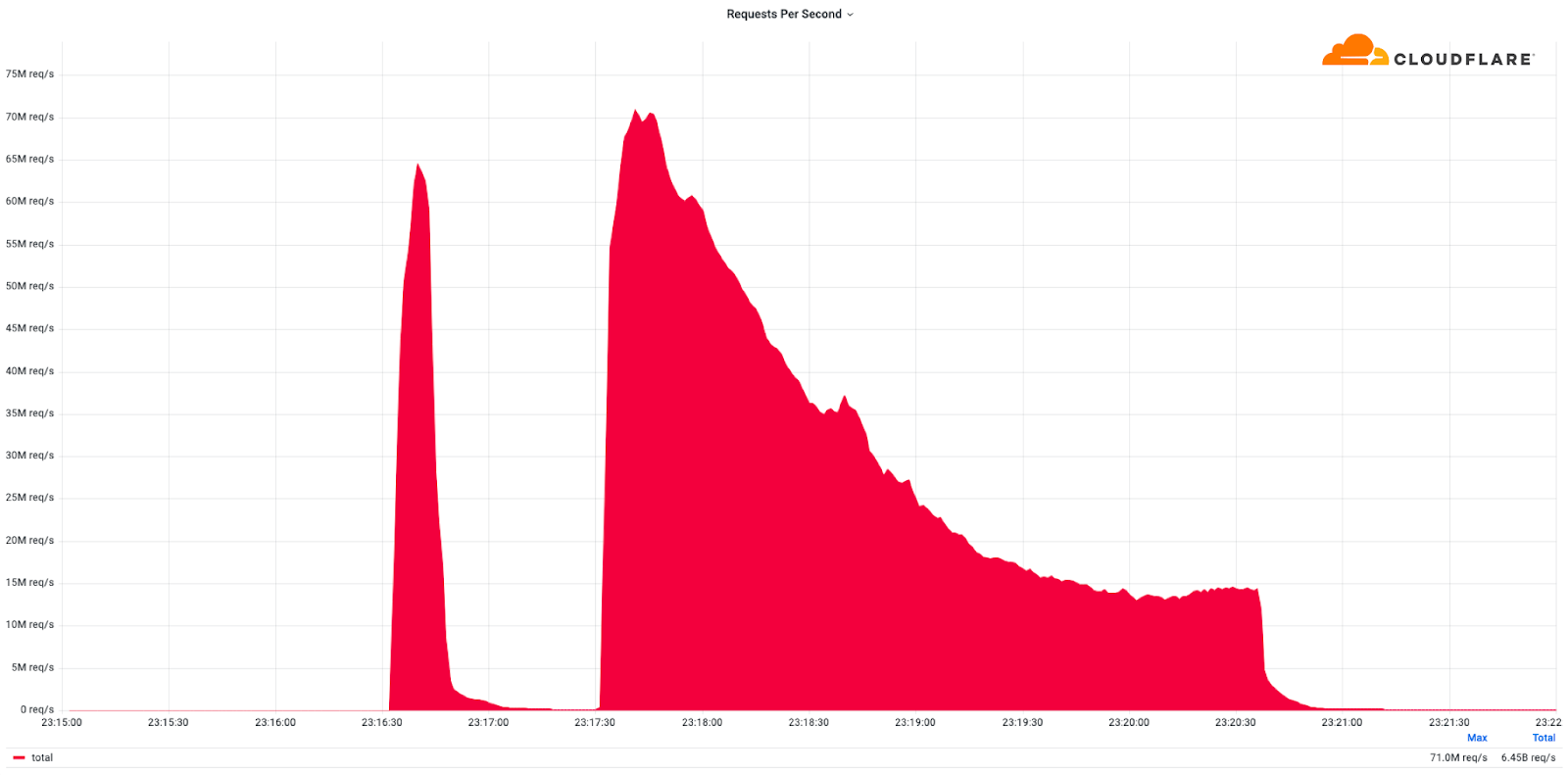
This was a weekend of record-breaking DDoS attacks. Over the weekend, Cloudflare detected and mitigated dozens of hyper-volumetric DDoS attacks. The majority of attacks peaked in the ballpark of 50-70 million requests per second (rps) with the largest exceeding 71 million rps. This is the largest reported HTTP DDoS attack on record, more than 35% higher than the previous reported record of 46M rps in June 2022.
The attacks were HTTP/2-based and targeted websites protected by Cloudflare. They originated from over 30,000 IP addresses. Some of the attacked websites included a popular gaming provider, cryptocurrency companies, hosting providers, and cloud computing platforms. The attacks originated from numerous cloud providers, and we have been working with them to crack down on the botnet.
Record breaking attack: DDoS attack exceeding 71 million requests per second
Over the past year, we’ve seen more attacks originate from cloud computing providers. For this reason, we will be providing service providers that own their own autonomous system a free Botnet threat feed. The feed will provide service providers threat intelligence about their own IP space; attacks originating from within their autonomous system. Service providers that operate their own IP space can now sign up to the early access waiting list.
Is this related to the Super Bowl or Killnet?
No. This campaign of attacks arrives less than two weeks after the Killnet DDoS campaign that targeted healthcare websites. Based on the methods and targets, we do not believe that these recent attacks are related to the healthcare campaign. Furthermore, yesterday was the US Super Bowl, and we also do not believe that this attack campaign is related to the game event.
What are DDoS attacks?
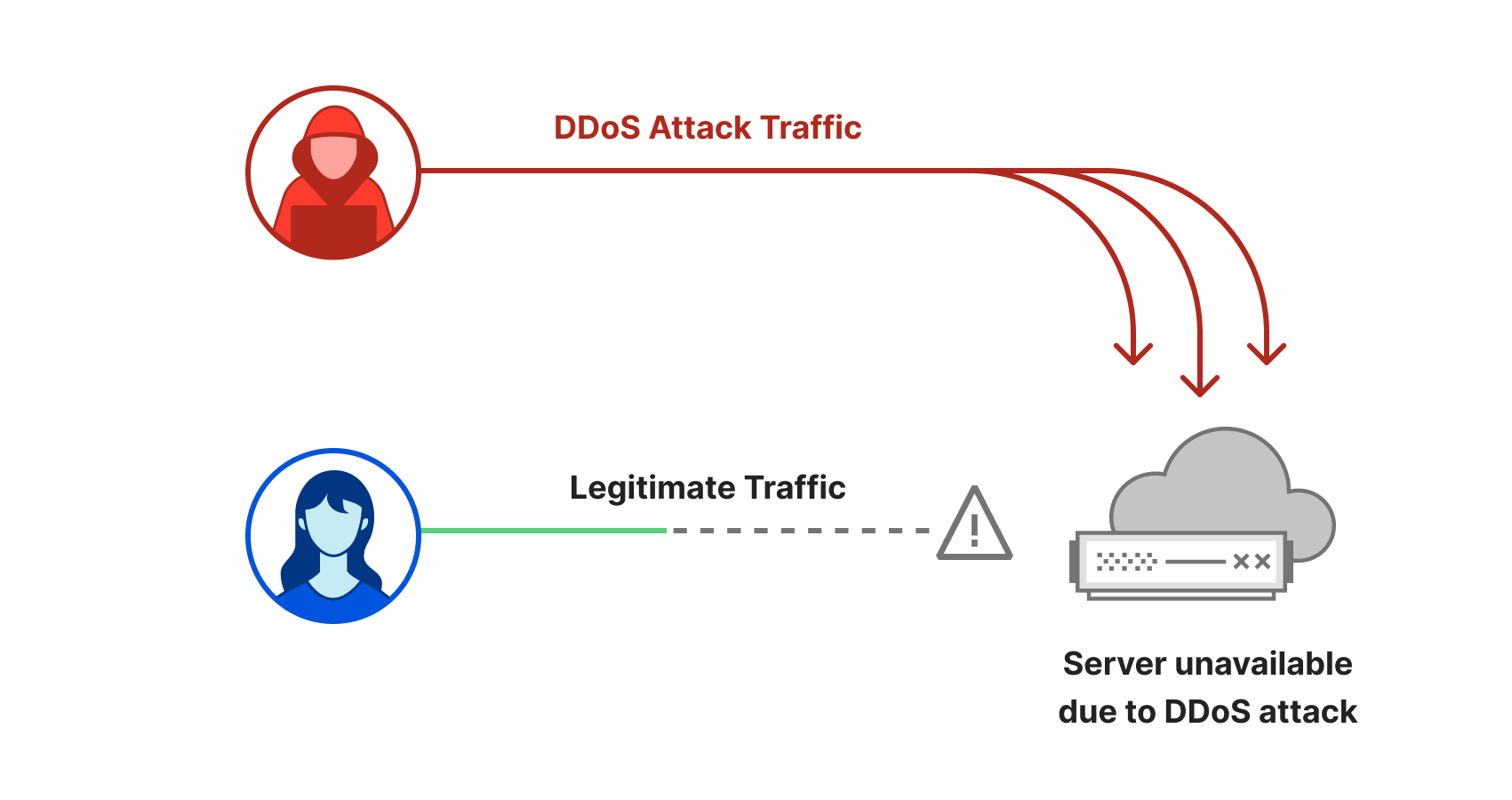
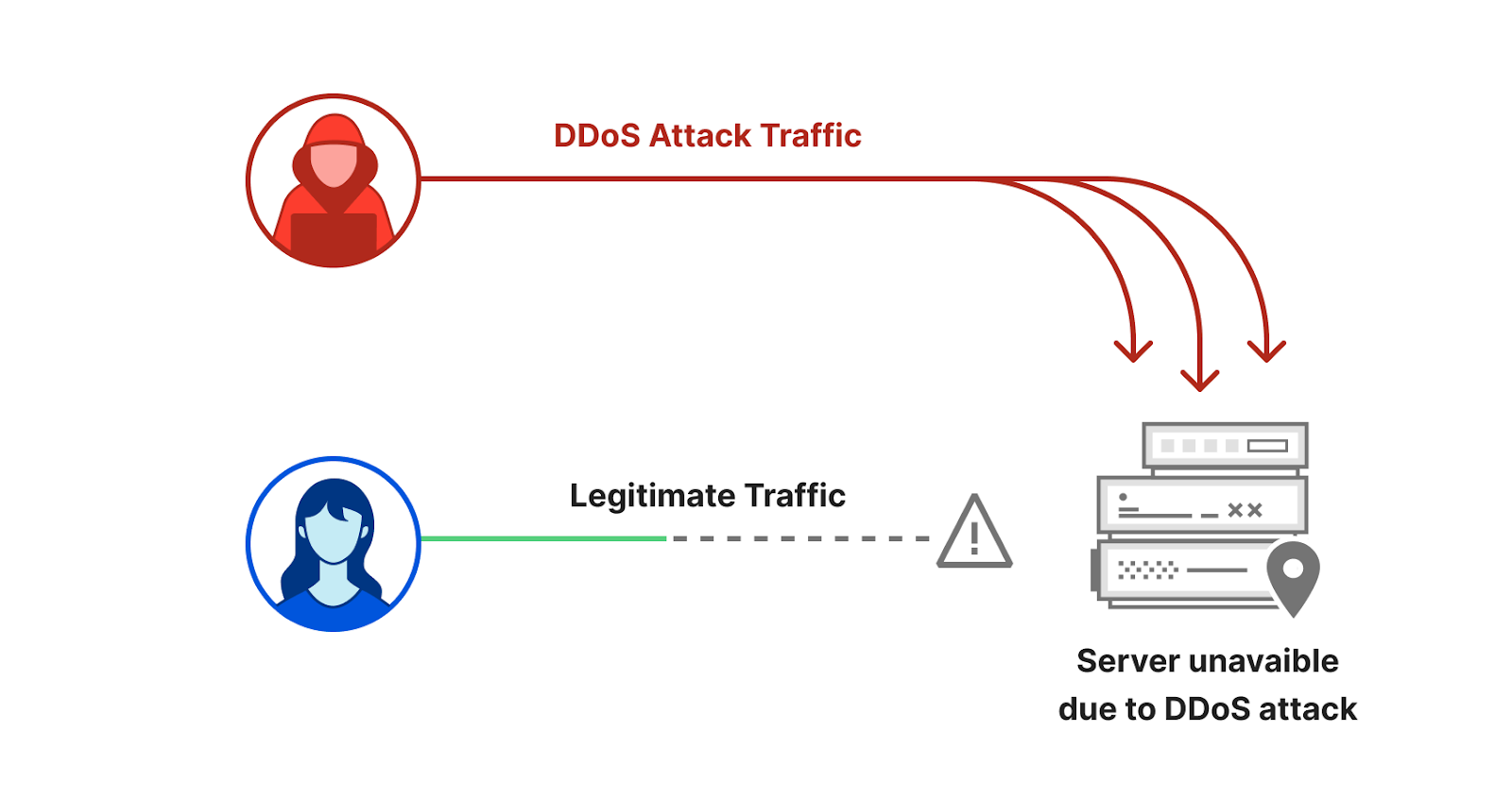
Distributed Denial of Service attacks are cyber attacks that aim to take down Internet properties and make them unavailable for users. These types of cyberattacks can be very efficient against unprotected websites and they can be very inexpensive for the attackers to execute.
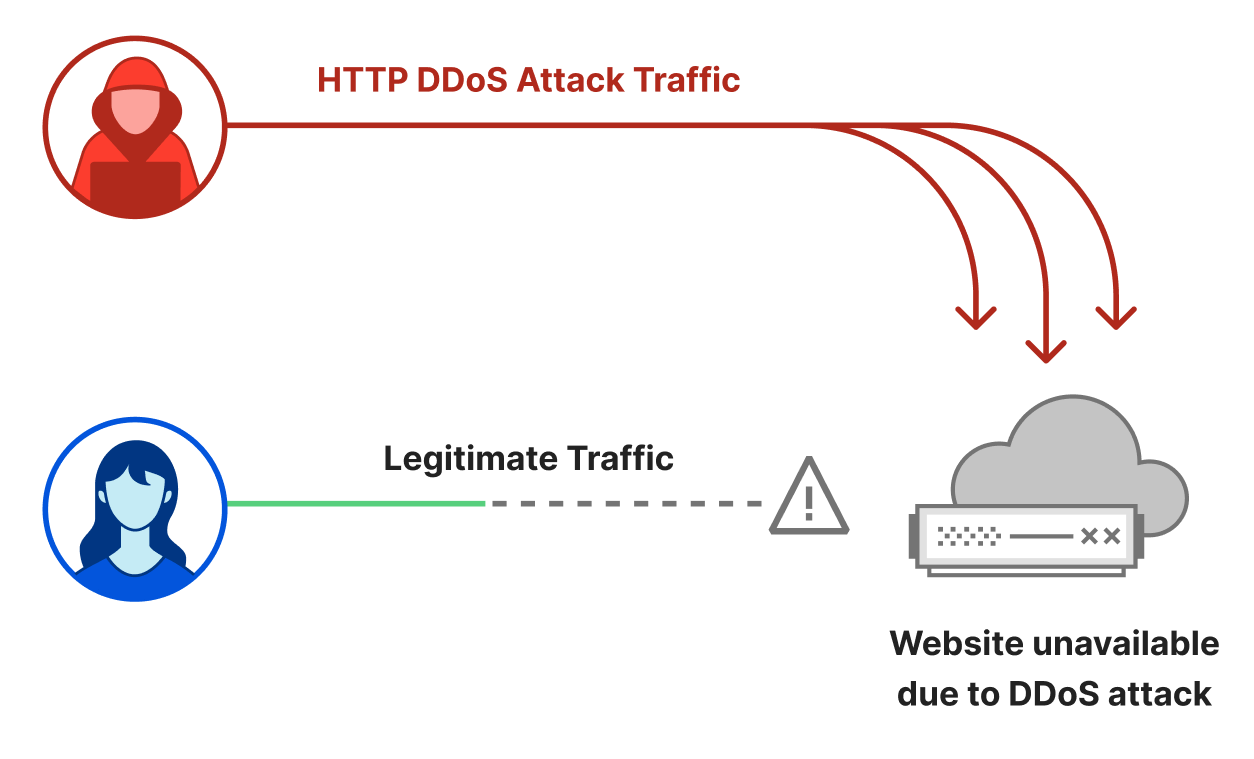
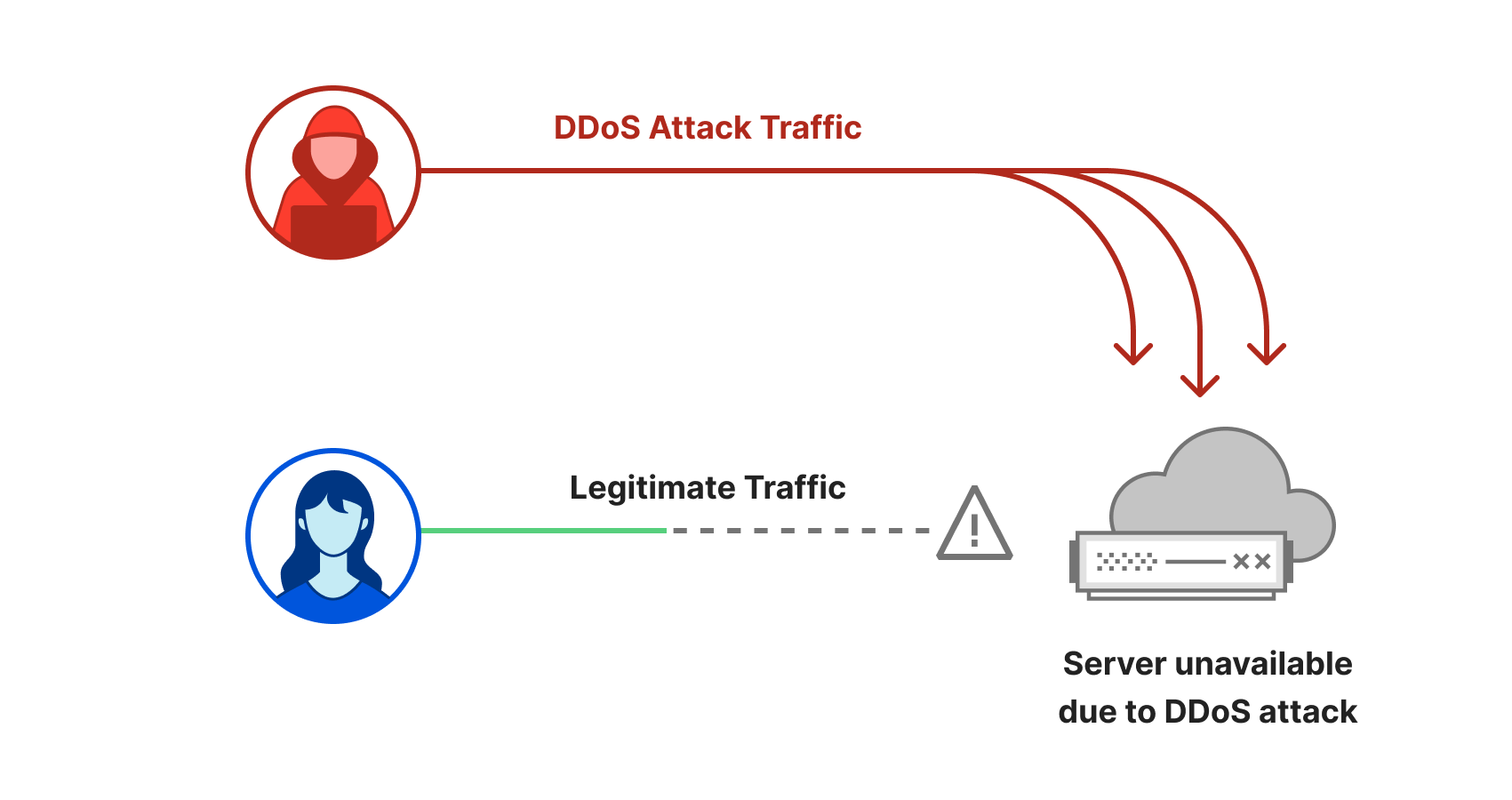
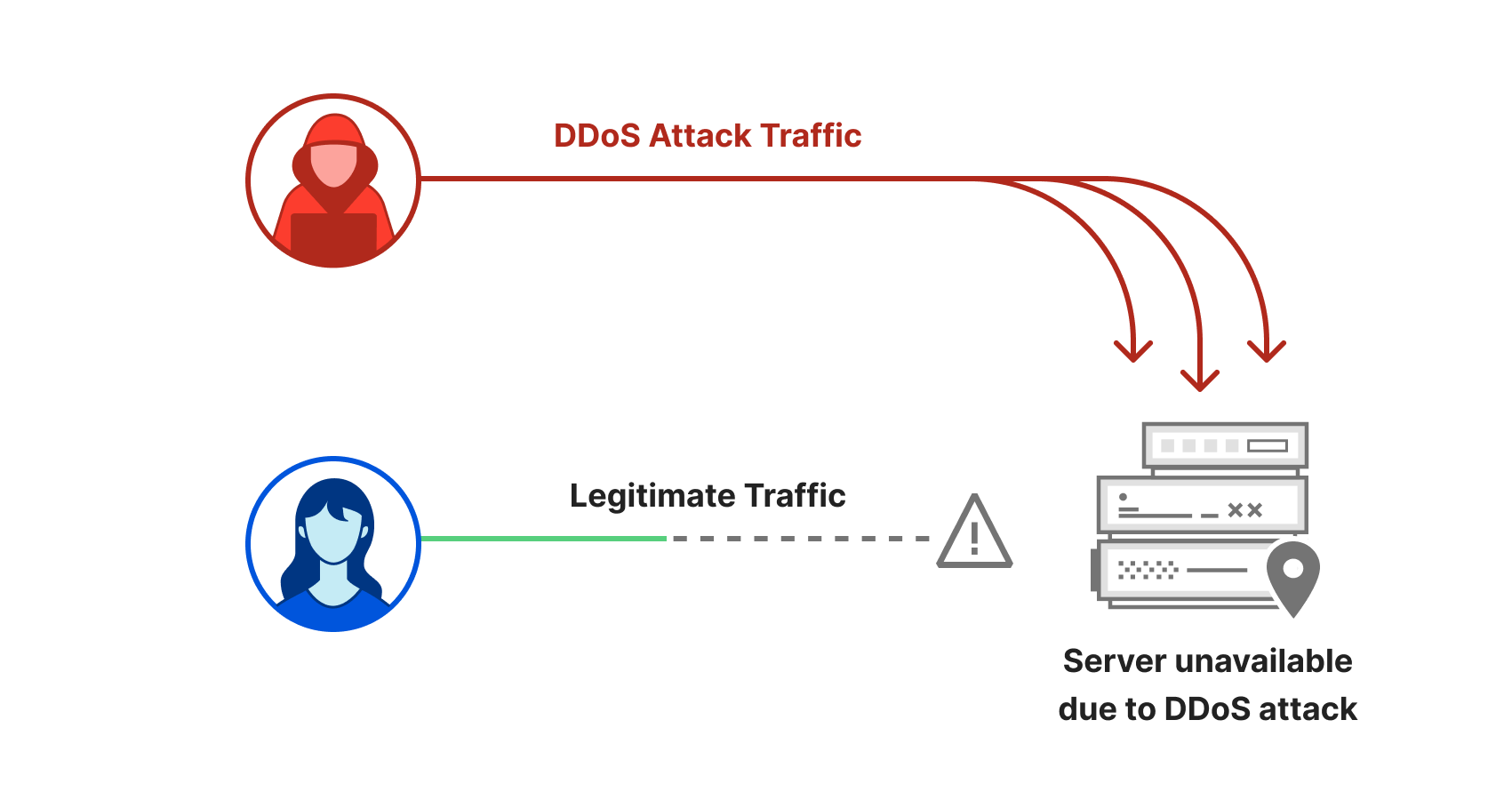
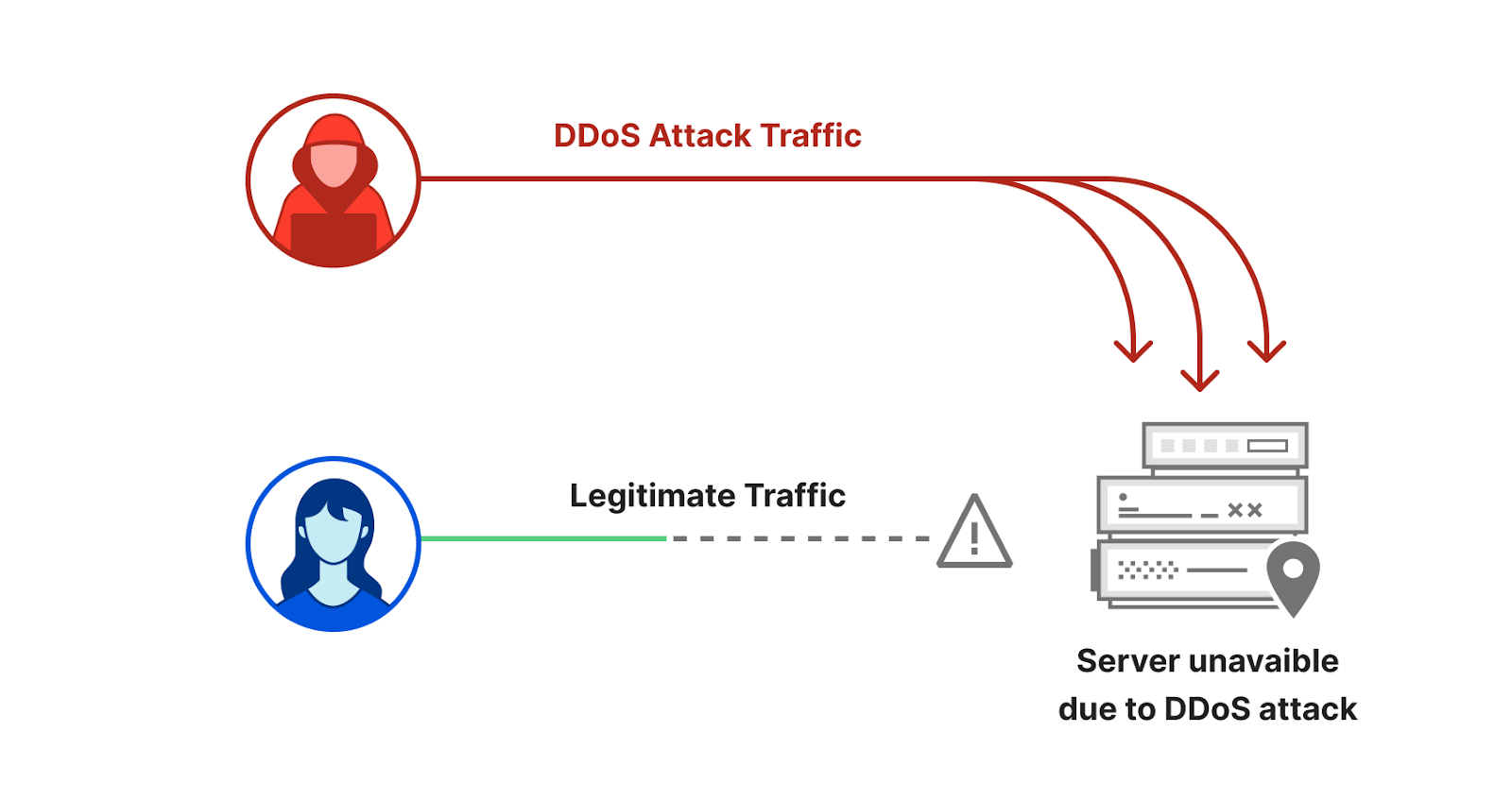
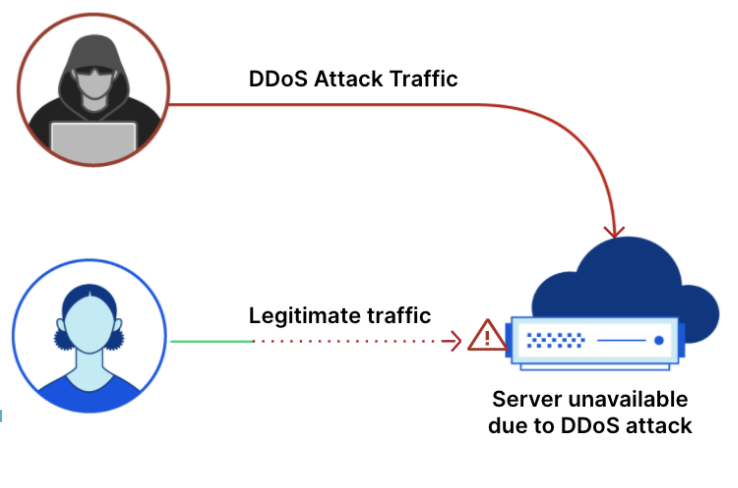
An HTTP DDoS attack usually involves a flood of HTTP requests towards the target website. The attacker’s objective is to bombard the website with more requests than it can handle. Given a sufficiently high amount of requests, the website’s server will not be able to process all of the attack requests along with the legitimate user requests. Users will experience this as website-load delays, timeouts, and eventually not being able to connect to their desired websites at all.
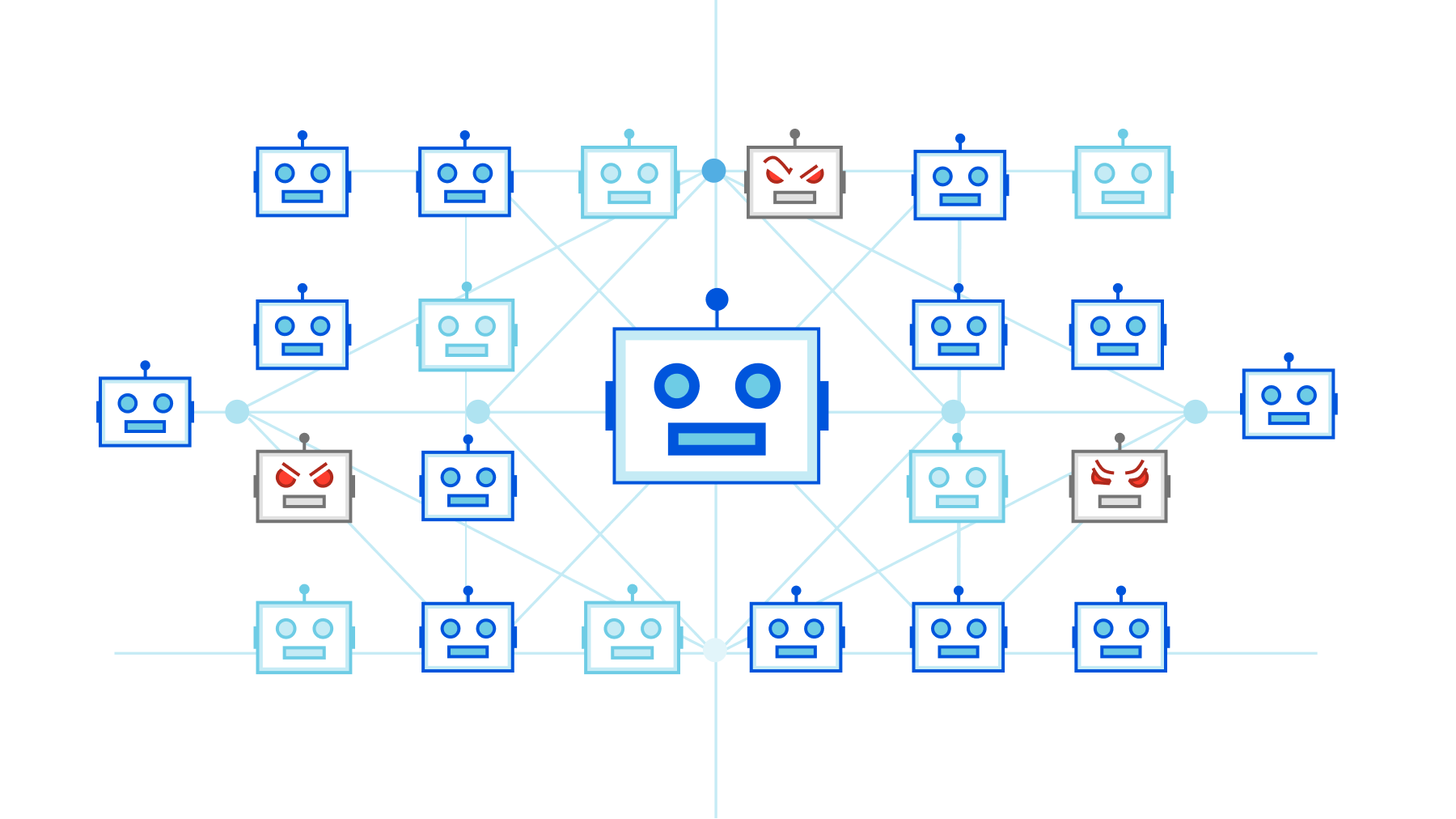
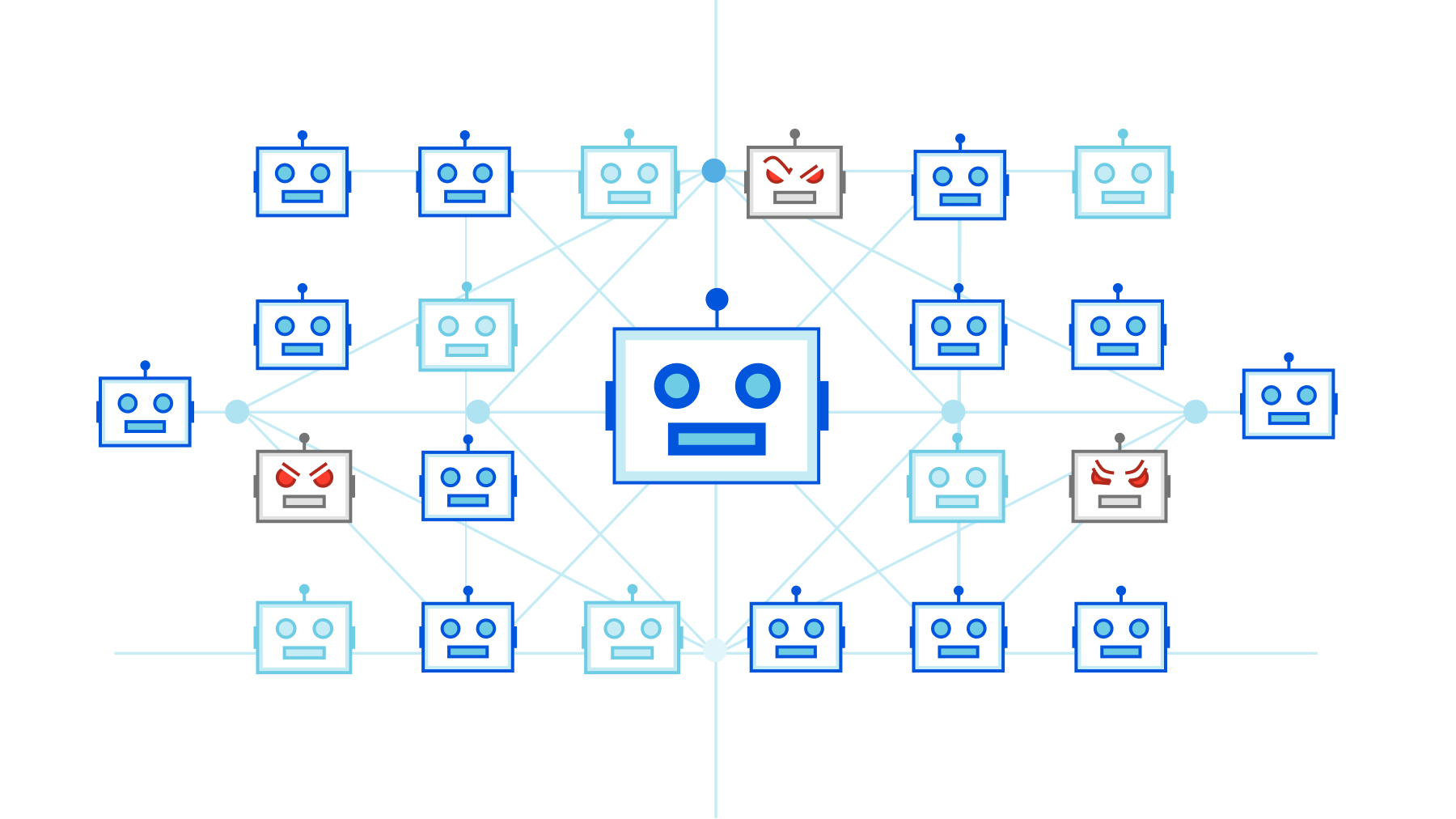
Illustration of a DDoS attack
To make attacks larger and more complicated, attackers usually leverage a network of bots — a botnet. The attacker will orchestrate the botnet to bombard the victim’s websites with HTTP requests. A sufficiently large and powerful botnet can generate very large attacks as we’ve seen in this case.
However, building and operating botnets requires a lot of investment and expertise. What is the average Joe to do? Well, an average Joe that wants to launch a DDoS attack against a website doesn’t need to start from scratch. They can hire one of numerous DDoS-as-a-Service platforms for as little as $30 per month. The more you pay, the larger and longer of an attack you’re going to get.
Why DDoS attacks?
Over the years, it has become easier, cheaper, and more accessible for attackers and attackers-for-hire to launch DDoS attacks. But as easy as it has become for the attackers, we want to make sure that it is even easier – and free – for defenders of organizations of all sizes to protect themselves against DDoS attacks of all types.
Unlike Ransomware attacks, Ransom DDoS attacks don’t require an actual system intrusion or a foothold within the targeted network. Usually Ransomware attacks start once an employee naively clicks an email link that installs and propagates the malware. There’s no need for that with DDoS attacks. They are more like a hit-and-run attack. All a DDoS attacker needs to know is the website’s address and/or IP address.
Is there an increase in DDoS attacks?
Yes. The size, sophistication, and frequency of attacks has been increasing over the past months. In our latest DDoS threat report, we saw that the amount of HTTP DDoS attacks increased by 79% year-over-year. Furthermore, the amount of volumetric attacks exceeding 100 Gbps grew by 67% quarter-over-quarter (QoQ), and the number of attacks lasting more than three hours increased by 87% QoQ.
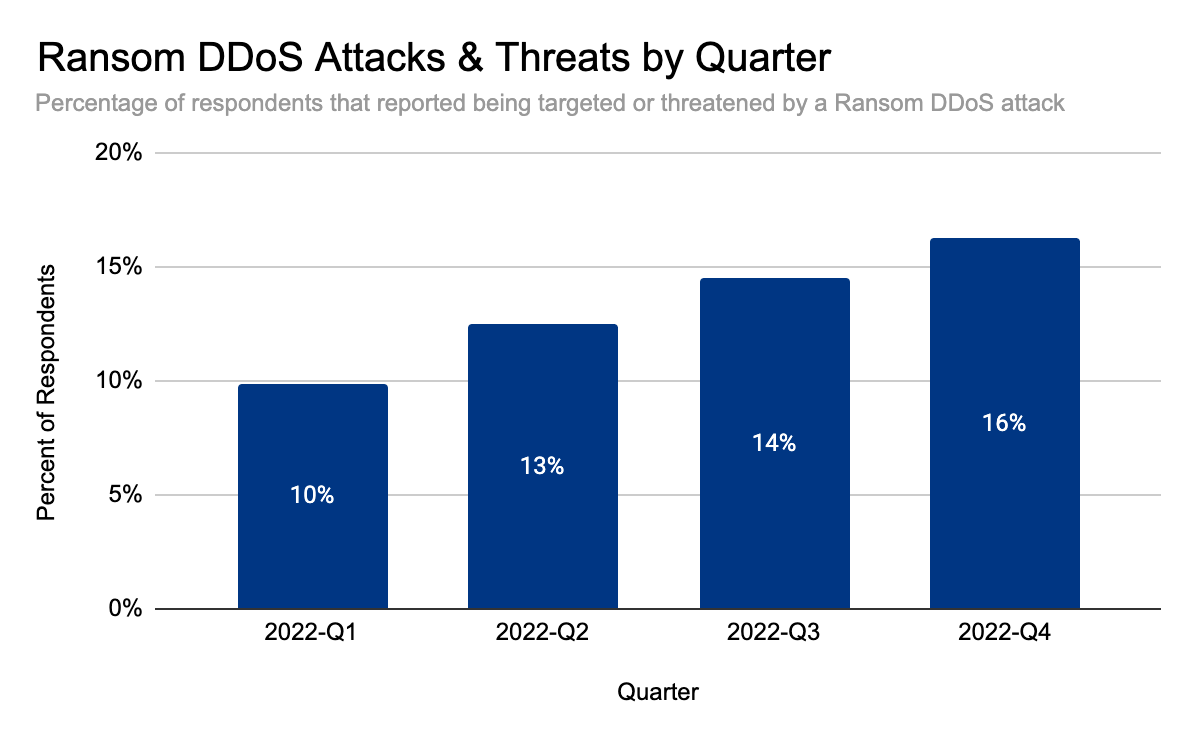
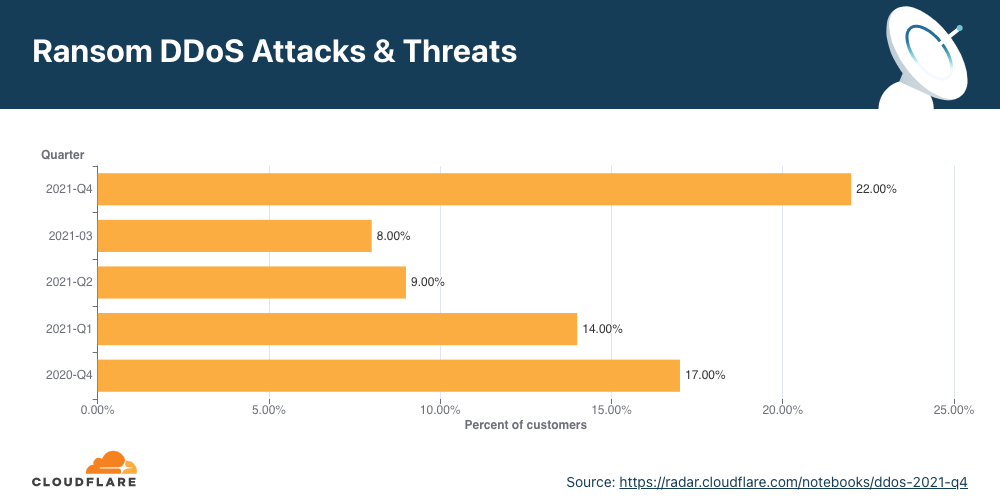
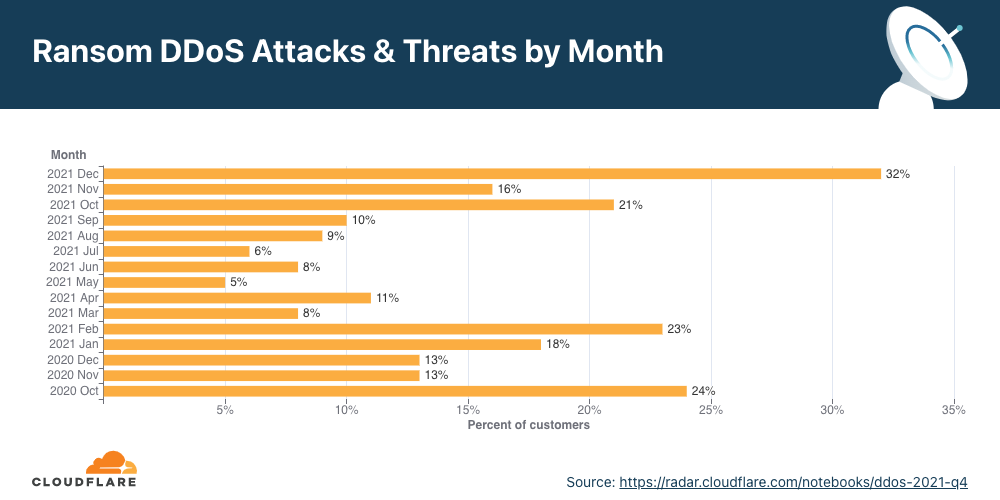
But it doesn’t end there. The audacity of attackers has been increasing as well. In our latest DDoS threat report, we saw that Ransom DDoS attacks steadily increased throughout the year. They peaked in November 2022 where one out of every four surveyed customers reported being subject to Ransom DDoS attacks or threats.
Distribution of Ransom DDoS attacks by month
Should I be worried about DDoS attacks?
Yes. If your website, server, or networks are not protected against volumetric DDoS attacks using a cloud service that provides automatic detection and mitigation, we really recommend that you consider it.
Cloudflare customers shouldn’t be worried, but should be aware and prepared. Below is a list of recommended steps to ensure your security posture is optimized.
What steps should I take to defend against DDoS attacks?
Cloudflare’s systems have been automatically detecting and mitigating these DDoS attacks.
Cloudflare offers many features and capabilities that you may already have access to but may not be using. So as extra precaution, we recommend taking advantage of these capabilities to improve and optimize your security posture:
Ensure all DDoS Managed Rules are set to default settings (High sensitivity level and mitigation actions) for optimal DDoS activation.
Cloudflare Enterprise customers that are subscribed to the Advanced DDoS Protection service should consider enabling Adaptive DDoS Protection, which mitigates attacks more intelligently based on your unique traffic patterns.
Deploy firewall rules and rate limiting rules to enforce a combined positive and negative security model. Reduce the traffic allowed to your website based on your known usage.
Ensure your origin is not exposed to the public Internet (i.e., only enable access to Cloudflare IP addresses). As an extra security precaution, we recommend contacting your hosting provider and requesting new origin server IPs if they have been targeted directly in the past.
Customers with access to Managed IP Lists should consider leveraging those lists in firewall rules. Customers with Bot Management should consider leveraging the threat scores within the firewall rules.
Enable caching as much as possible to reduce the strain on your origin servers, and when using Workers, avoid overwhelming your origin server with more subrequests than necessary.
Defending against DDoS attacks is critical for organizations of all sizes. While attacks may be initiated by humans, they are executed by bots — and to play to win, you must fight bots with bots. Detection and mitigation must be automated as much as possible, because relying solely on humans to mitigate in real time puts defenders at a disadvantage. Cloudflare’s automated systems constantly detect and mitigate DDoS attacks for our customers, so they don’t have to. This automated approach, combined with our wide breadth of security capabilities, lets customers tailor the protection to their needs.
We’ve been providing unmetered and unlimited DDoS protection for free to all of our customers since 2017, when we pioneered the concept. Cloudflare’s mission is to help build a better Internet. A better Internet is one that is more secure, faster, and reliable for everyone – even in the face of DDoS attacks.
Today we mark the International Holocaust Remembrance Day. We commemorate the victims that were robbed of their possessions, stripped of their rights, deported, starved, dehumanized and murdered by the Nazis and their accomplices. During the Holocaust and in the events that led to it, the Nazis exterminated one third of the European Jewish population. Six million Jews, along with countless other members of minority and disability groups, were murdered because the Nazis believed they were inferior.
Seventy eight years later, after the liberation of the infamous Auschwitz death camp, antisemitism still burns with hatred. According to a study performed by the Campaign Against Antisemitism organization on data provided by the UK Home Office, Jews are 500% more likely to be targeted by hate crime than any other faith group per capita.
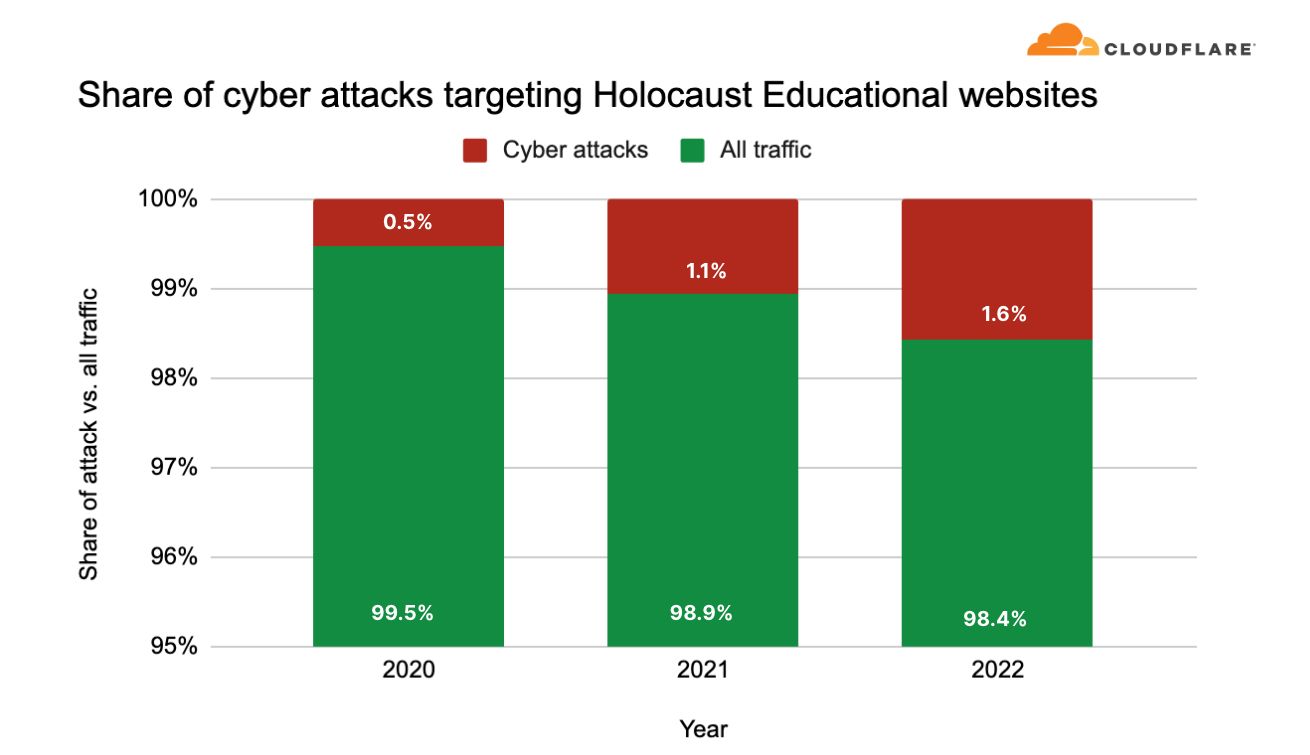
From Cloudflare’s vantage point we can point to distressing findings as well. In 2021, cyberattacks on Holocaust educational websites doubled year over year. In 2021, one out of every 100 HTTP requests sent to Holocaust educational websites behind Cloudflare was part of an attack. In 2022, the share of those cyber attacks grew again by 49% YoY. Cyberattacks represented 1.6% of all traffic to Holocaust educational websites (almost 1 out of every 50 HTTP requests), as can be seen in the chart below in 2022.
We’re representing cyberattacks as a percentage to normalize natural growth of traffic to websites, mitigation methods and other potential data biases. But even if we look at the raw numbers, between 2021 and 2022, the absolute cyberattack traffic (in HTTP requests) that targeted Holocaust education websites behind Cloudflare grew by 640% in contrast to the total growth of 397% in the number of all requests (attack and non-attack HTTP requests).
Share of cyberattack targeting Holocaust education websites
(Please note that the graph starts in 95% in order to provide better visibility into the share of attacks)
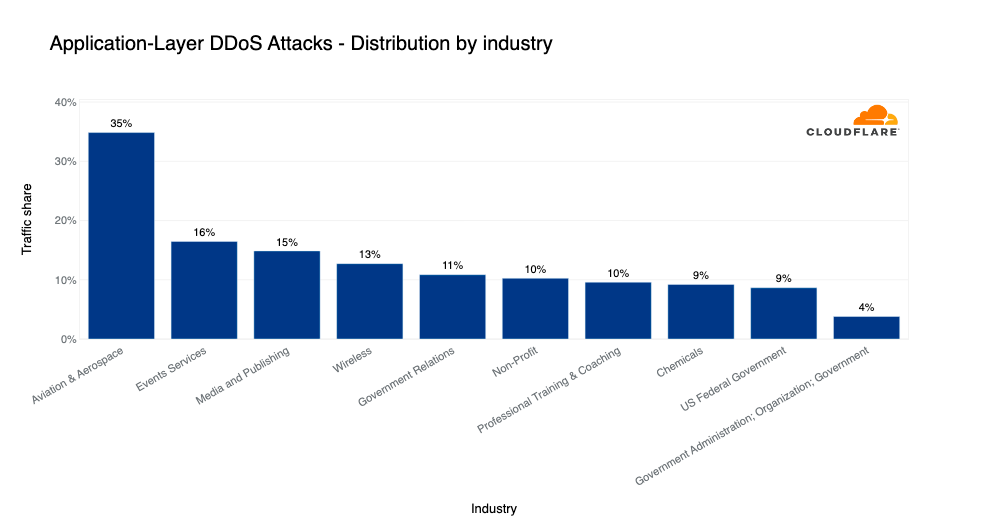
The threat that Holocaust educational websites face is one that many other non-profit organizations face. In fact, in our most recent DDoS Trends report, non-profit organizations were the sixth most targeted industry. Ten percent of all traffic to non-profit websites behind Cloudflare was DDoS attack traffic.
Top industries targeted by HTTP DDoS attacks in 2022 Q4
However, nonprofits such as Holocaust educational organizations might not always have the resources to fend off attacks. For this reason, we provide free protection to at-risk groups across the world. We do this through Project Galileo. It helps keep vulnerable websites online. It provides free cyber security services for groups working in the arts, human rights, civil society, journalism, or democracy. As detailed in our recent Impact Report, in 2022, through Project Galileo, we protected vulnerable websites from an average of 59M cyber threats every day.
If you’re representing a vulnerable public interest group and want to protect your website with Project Galileo, please follow the steps and apply here. While you wait to hear back, you can also get started with our Free plan.
At Cloudflare, we remember and never forget.
Here at Cloudflare, some of us are descendants of Holocaust survivors. My grandparents escaped Nazi-occupied Poland after the German invasion. Sadly, my grandparents — as other elderly survivors, have already passed. I grew up hearing about their stories of bravery — and of deep torment. It’s not always easy to hear these stories, but we must — especially in times like these when war in Europe has been ongoing for almost a year now. We have the responsibility to ensure the world remembers and never forgets the atrocities of the Holocaust and what antisemitism, racism and hatred in general can lead to.
To this extent, a few months ago, here at the Cloudflare London office, we had the honor of hosting Janine Webber, recipient of the British Empire Medal (BEM) in an event hosted by Judeoflare, Cloudflare’s Jewish employee resource group. The event was made possible due to our partnership with the Holocaust Education Trust. And so in a fully packed auditorium and an oversubscribed Zoom call, we listen to Janine’s story of survival and bravery first hand. We asked questions and we learned.
We’re privileged to be able to share her story here with all of you via Cloudflare TV.
In 2022, cybersecurity is a must-have for those who don’t want to take chances on getting caught in a cyberattack with difficult to deal consequences. And with a war in Europe (Ukraine) still going on, cyberwar also doesn’t show signs of stopping in a time when there never were so many people online, 4.95 billion in early 2022, 62.5% of the world’s total population (estimates say it grew around 4% during 2021 and 7.3% in 2020).
Throughout the year we, at Cloudflare, have been making new announcements of products, solutions and initiatives that highlight the way we have been preventing, mitigating and constantly learning, over the years, with several thousands of small and big cyberattacks. Right now, we block an average of 124 billion cyber threats per day. The more we deal with attacks, the more we know how to stop them, and the easier it gets to find and deal with new threats — and for customers to forget we’re there, protecting them.
In 2022, we have been onboarding many customers while they’re being attacked, something we know well from the past (Wikimedia/Wikipedia or Eurovision are just two case-studies of many, and last year there was a Fortune Global 500 company example we wrote about). Recently, we dealt and did a rundown about an SMS phishing attack.
Providing services for almost 20% of websites online and to millions of Internet properties and customers using our global network in more than 270 cities (recently we arrived to Guam) also plays a big role. For example, in Q1’22 Cloudflare blocked an average of 117 billion cyber threats each day (much more than in previous quarters).
Now that August is here, and many in the Northern Hemisphere are enjoying the summer and vacations, let’s do a reading list that is also a sum up focused on cyberattacks that also gives, by itself, some 2022 guide on this more than ever relevant area.
War & Cyberwar: Attacks increasing
But first, some context. There are all sorts of attacks, but they have been generally speaking increasing and just to give some of our data regarding DDoS attacks in 2022 Q2: application-layer attacks increased by 72% YoY (Year over Year) and network-layer DDoS attacks increased by 109% YoY.
The US government gave “warnings” back in March, after the war in Ukraine started, to all in the country but also allies and partners to be aware of the need to “enhance cybersecurity”. The US Cybersecurity and Infrastructure Security Agency (CISA) created the Shields Up initiative, given how the “Russia’s invasion of Ukraine could impact organizations both within and beyond the region”. The UK and Japan, among others, also issued warnings.
That said, here are the two first and more general about attacks reading list suggestions:
Shields up: free Cloudflare services to improve your cyber readiness (✍️) After the war started and governments released warnings, we did this free Cloudflare services cyber readiness sum up blog post. If you’re a seasoned IT professional or a novice website operator, you can see a variety of services for websites, apps, or APIs, including DDoS mitigation and protection of teams or even personal devices (from phones to routers). If this resonates with you, this announcement of collaboration to simplify the adoption of Zero Trust for IT and security teams could also be useful: CrowdStrike’s endpoint security meets Cloudflare’s Zero Trust Services.
In Ukraine and beyond, what it takes to keep vulnerable groups online (✍️) This blog post is focused on the eighth anniversary of our Project Galileo, that has been helping human-rights, journalism and non-profits public interest organizations or groups. We highlight the trends of the past year, including the dozens of organizations related to Ukraine that were onboarded (many while being attacked) since the war started. Between July 2021 and May 2022, we’ve blocked an average of nearly 57.9 million cyberattacks per day, an increase of nearly 10% over last year in a total of 18 billion attacks.
In terms of attack methods to Galileo protected organizations, the largest fraction (28%) of mitigated requests were classified as “HTTP Anomaly”, with 20% of mitigated requests tagged as SQL injection or SQLi attempts (to target databases) and nearly 13% as attempts to exploit specific CVEs (publicly disclosed cybersecurity vulnerabilities) — you can find more insights about those here, including the Spring4Shell vulnerability, the Log4j or the Atlassian one.
And now, without further ado, here’s the full reading list/attacks guide where we highlight some blog posts around four main topics:
Cloudflare mitigates 26 million request per second DDoS attack (✍️) Distributed Denial of Service (DDoS) are the bread and butter of state-based attacks, and we’ve been automatically detecting and mitigating them. Regardless of which country initiates them, bots are all around the world and in this blog post you can see a specific example on how big those attacks can be (in this case the attack targeted a customer website using Cloudflare’s Free plan). We’ve named this most powerful botnet to date, Mantis.
That said, we also explain that although most of the attacks are small, e.g. cyber vandalism, even small attacks can severely impact unprotected Internet properties.
DDoS attack trends for 2022 Q2 (✍️) We already mentioned how application (72%) and network-layer (109%) attacks have been growing year over year — in the latter, attacks of 100 Gbps and larger increased by 8% QoQ, and attacks lasting more than 3 hours increased by 12% QoQ. Here you can also find interesting trends, like how Broadcast Media companies in Ukraine were the most targeted in Q2 2022 by DDoS attacks. In fact, all the top five most attacked industries are all in online/Internet media, publishing, and broadcasting.
Cloudflare customers on Free plans can now also get real-time DDoS alerts(✍️) A DDoS is cyber-attack that attempts to disrupt your online business and can be used in any type of Internet property, server, or network (whether it relies on VoIP servers, UDP-based gaming servers, or HTTP servers). That said, our Free plan can now get real-time alerts about HTTP DDoS attacks that were automatically detected and mitigated by us.
One of the benefits of Cloudflare is that all of our services and features can work together to protect your website and also improve its performance. Here’s our specialist, Omer Yoachimik, top 3 tips to leverage a Cloudflare free account (and put your settings more efficient to deal with DDoS attacks):
DDoS Protection: it’s enabled by default, and if needed you can also override the action to Block for rules that have a different default value.
Security Level: this feature will automatically issue challenges to requests that originate from IP addresses with low IP reputation. Ensure it’s set to Medium at least.
Block bad bots – Cloudflare’s free tier of bot protection can help ward off simple bots (from cloud ASNs) and headless browsers by issuing a computationally expensive challenge.
Firewall rules: you can create up to five free custom firewall rules to block or challenge traffic that you never want to receive.
Managed Ruleset: in addition to your custom rule, enable Cloudflare’s Free Managed Ruleset to protect against high and wide impacting vulnerabilities
Move your content to the cloud
Cache as much of your content as possible on the Cloudflare network. The fewer requests that hit your origin, the better — including unwanted traffic.
2. Application level attacks & WAF
Application security: Cloudflare’s view (✍️) Did you know that around 8% of all Cloudflare HTTP traffic is mitigated? That is something we explain in this application’s general trends March 2022 blog post. That means that overall, ~2.5 million requests per second are mitigated by our global network and never reach our caches or the origin servers, ensuring our customers’ bandwidth and compute power is only used for clean traffic.
You can also have a sense here of what the top mitigated traffic sources are — Layer 7 DDoS and Custom WAF (Web Application Firewall) rules are at the top — and what are the most common attacks. Other highlights include that at that time 38% of HTTP traffic we see is automated (right the number is actually lower, 31% — current trends can be seen on Radar), and the already mentioned (about Galileo) SQLi is the most common attack vector on API endpoints.
WAF for everyone: protecting the web from high severity vulnerabilities (✍️) This blog post shares a relevant announcement that goes hand in hand with Cloudflare mission of “help build a better Internet” and that also includes giving some level of protection even without costs (something that also help us be better in preventing and mitigating attacks). So, since March we are providing a Cloudflare WAF Managed Ruleset that is running by default on all FREE zones, free of charge.
On this topic, there has also been a growing client side security number of threats that concerns CIOs and security professionals that we mention when we gave, in December, all paid plans access to Page Shield features (last month we made Page Shield malicious code alerts more actionable. Another example is how we detect Magecart-Style attacks that have impacted large organizations like British Airways and Ticketmaster, resulting in substantial GDPR fines in both cases.
3. Phishing (Area 1)
Why we are acquiring Area 1 (✍️) Phishing remains the primary way to breach organizations. According to CISA, 90% of cyber attacks begin with it. And, in a recent report, the FBI referred to Business Email Compromise as the $43 Billion problem facing organizations.
It was in late February that it was announced that Cloudflare had agreed to acquire Area 1 Security to help organizations combat advanced email attacks and phishing campaigns. Our blog postexplains that “Area 1’s team has built exceptional cloud-native technology to protect businesses from email-based security threats”. So, all that technology and expertise has been integrated since then with our global network to give customers the most complete Zero Trust security platform available.
The mechanics of a sophisticated phishing scam and how we stopped it (✍️) What’s in a message? Possibly a sophisticated attack targeting employees and systems. On August 8, 2022, Twilio shared that they’d been compromised by a targeted SMS phishing attack. We saw an attack with very similar characteristics also targeting Cloudflare’s employees. Here, we do a rundown on how we were able to thwart the attack that could have breached most organizations, by using our Cloudflare One products, and physical security keys. And how others can do the same. No Cloudflare systems were compromised.
Our Cloudforce One threat intelligence team dissected the attack and assisted in tracking down the attacker.
Introducing browser isolation for email links to stop modern phishing threats (✍️) Why do humans still click on malicious links? It seems that it’s easier to do it than most people think (“human error is human”). Here we explain how an organization nowadays can’t truly have a Zero Trust security posture without securing email; an application that end users implicitly trust and threat actors take advantage of that inherent trust.
As part of our journey to integrate Area 1 into our broader Zero Trust suite, Cloudflare Gateway customers can enable Remote Browser Isolation for email links. With that, we now give unmatched level of protection from modern multi-channel email-based attacks. While we’re at it, you can also learn how to replace your email gateway with Cloudflare Area 1.
About account takeovers, we explained back in March 2021 how we prevent account takeovers on our own applications (on the phishing side we were already using, as a customer, at the time, Area 1).
Also from last year, here’s our research in password security (and the problem of password reuse) — it gets technical. There’s a new password related protocol called OPAQUE (we added a new demo about it on January 2022) that could help better store secrets that our research team is excited about.
4. Malware/Ransomware & other risks
How Cloudflare Security does Zero Trust (✍️) Security is more than ever part of an ecosystem that the more robust, the more efficient in avoiding or mitigating attacks. In this blog post written for our Cloudflare One week, we explain how that ecosystem, in this case inside our Zero Trust services, can give protection from malware, ransomware, phishing, command & control, shadow IT, and other Internet risks over all ports and protocols.
Since 2020, we launched Cloudflare Gateway focused on malware detection and prevention directly from the Cloudflare edge. Recently, we also include our new CASB product (to secure workplace tools, personalize access, secure sensitive data).
Anatomy of a Targeted Ransomware Attack (✍️) What a ransomware attack looks like for the victim:
“Imagine your most critical systems suddenly stop operating. And then someone demands a ransom to get your systems working again. Or someone launches a DDoS against you and demands a ransom to make it stop. That’s the world of ransomware and ransom DDoS.”
Ransomware attacks continue to be on the rise and there’s no sign of them slowing down in the near future. That was true more than a year ago, when this blog post was written and is still ongoing, up 105% YoY according to a Senate Committee March 2022 report. And the nature of ransomware attacks is changing. Here, we highlight how Ransom DDoS (RDDoS) attacks work, how Cloudflare onboarded and protected a Fortune 500 customer from a targeted one, and how that Gateway with antivirus we mentioned before helps with just that.
We also show that with ransomware as a service (RaaS) models, it’s even easier for inexperienced threat actors to get their hands on them today (“RaaS is essentially a franchise that allows criminals to rent ransomware from malware authors”). We also include some general recommendations to help you and your organization stay secure. Don’t want to click the link? Here they are:
Use 2FA everywhere, especially on your remote access entry points. This is where Cloudflare Access really helps.
Maintain multiple redundant backups of critical systems and data, both onsite and offsite
Monitor and block malicious domains using Cloudflare Gateway + AV
Sandbox web browsing activity using Cloudflare RBI to isolate threats at the browser
Investigating threats using the Cloudflare Security Center (✍️) Here, first we announce our new threat investigations portal, Investigate, right in the Cloudflare Security Center, that allows all customers to query directly our intelligence to streamline security workflows and tighten feedback loops.
That’s only possible because we have a global and in-depth view, given that we protect millions of Internet properties from attacks (the free plans help us to have that insight). And the data we glean from these attacks trains our machine learning models and improves the efficacy of our network and application security products.
Steps we’ve taken around Cloudflare’s services in Ukraine, Belarus, and Russia (✍️) There’s an emergence of the known as wiper malware attacks (intended to erase the computer it infects) and in this blog post, among other things, we explain how when a wiper malware was identified in Ukraine (it took offline government agencies and a major bank), we successfully adapted our Zero Trust products to make sure our customers were protected. Those protections include many Ukrainian organizations, under our Project Galileo that is having a busy year, and they were automatically put available to all our customers. More recently, the satellite provider Viasat was affected.
Zaraz use Workers to make third-party tools secure and fast (✍️) Cloudflare announced it acquired Zaraz in December 2021 to help us enable cloud loading of third-party tools. Seems unrelated to attacks? Think again (this takes us back to the secure ecosystem I already mentioned). Among other things, here you can learn how Zaraz can make your website more secure (and faster) by offloading third-party scripts.
That allows to avoid problems and attacks. Which? From code tampering to lose control over the data sent to third-parties. My colleague Yo’av Moshe elaborates on what this solution prevents: “the third-party script can intentionally or unintentionally (due to being hacked) collect information it shouldn’t collect, like credit card numbers, Personal Identifiers Information (PIIs), etc.”. You should definitely avoid those.
Introducing Cloudforce One: our new threat operations and research team (✍️) Meet our new threat operations and research team: Cloudforce One. While this team will publish research, that’s not its reason for being. Its primary objective: track and disrupt threat actors. It’s all about being protected against a great flow of threats with minimal to no involvement.
Wrap up
The expression “if it ain’t broke, don’t fix it” doesn’t seem to apply to the fast pacing Internet industry, where attacks are also in the fast track. If you or your company and services aren’t properly protected, attackers (human or bots) will probably find you sooner than later (maybe they already did).
To end on a popular quote used in books, movies and in life: “You keep knocking on the devil’s door long enough and sooner or later someone’s going to answer you”. Although we have been onboarding many organizations while attacks are happening, that’s not the less hurtful solution — preventing and mitigating effectively and forget the protection is even there.
If you want to try some security features mentioned, the Cloudflare Security Center is a good place to start (free plans included). The same with our Zero Trust ecosystem (or Cloudflare One as our SASE, Secure Access Service Edge) that is available as self-serve, and also includes a free plan (this vendor-agnostic roadmap shows the general advantages of the Zero Trust architecture).
We’re thrilled to introduce Cloudflare’s Location-Aware DDoS Protection.
Distributed Denial of Service (DDoS) attacks are cyber attacks that aim to make your Internet property unavailable by flooding it with more traffic than it can handle. For this reason, attackers usually aim to generate as much attack traffic as they can — from as many locations as they can. With Location-Aware DDoS Protection, we take this distributed characteristic of the attack, that is thought of being advantageous for the attacker, and turn it on its back — making it into a disadvantage.
Location-Aware DDoS Protection is now available in beta for Cloudflare Enterprise customers that are subscribed to the Advanced DDoS service.
Distributed attacks lose their edge
Cloudflare’s Location-Aware DDoS Protection takes the attacker’s advantage and uses it against them. By learning where your traffic comes from, the system becomes location-aware and constantly asks “Does it make sense for your website?” when seeing new traffic.
For example, if you operate an e-commerce website that mostly serves the German consumer, then most of your traffic would most likely originate from within Germany, some from neighboring European countries, and a decreasing amount as we expand globally to other countries and geographies. If sudden spikes of traffic arrive from unexpected locations outside your main geographies, the system will flag and mitigate the unwanted traffic.
Location-Aware DDoS Protection also leverages Cloudflare’s Machine Learning models to identify traffic that is likely automated. This is used as an additional signal to provide more accurate protection.
Enabling Location-Aware Protection
Enterprise customers subscribed to the Advanced DDoS service can customize and enable the Location-Aware DDoS Protection system. By default, the system will only show what it thinks is suspicious traffic based on your last 7-day P95 rates, bucketed by client country and region (recalculated every 24 hours).
Customers can view what the system flagged in the Security Overview dashboard.
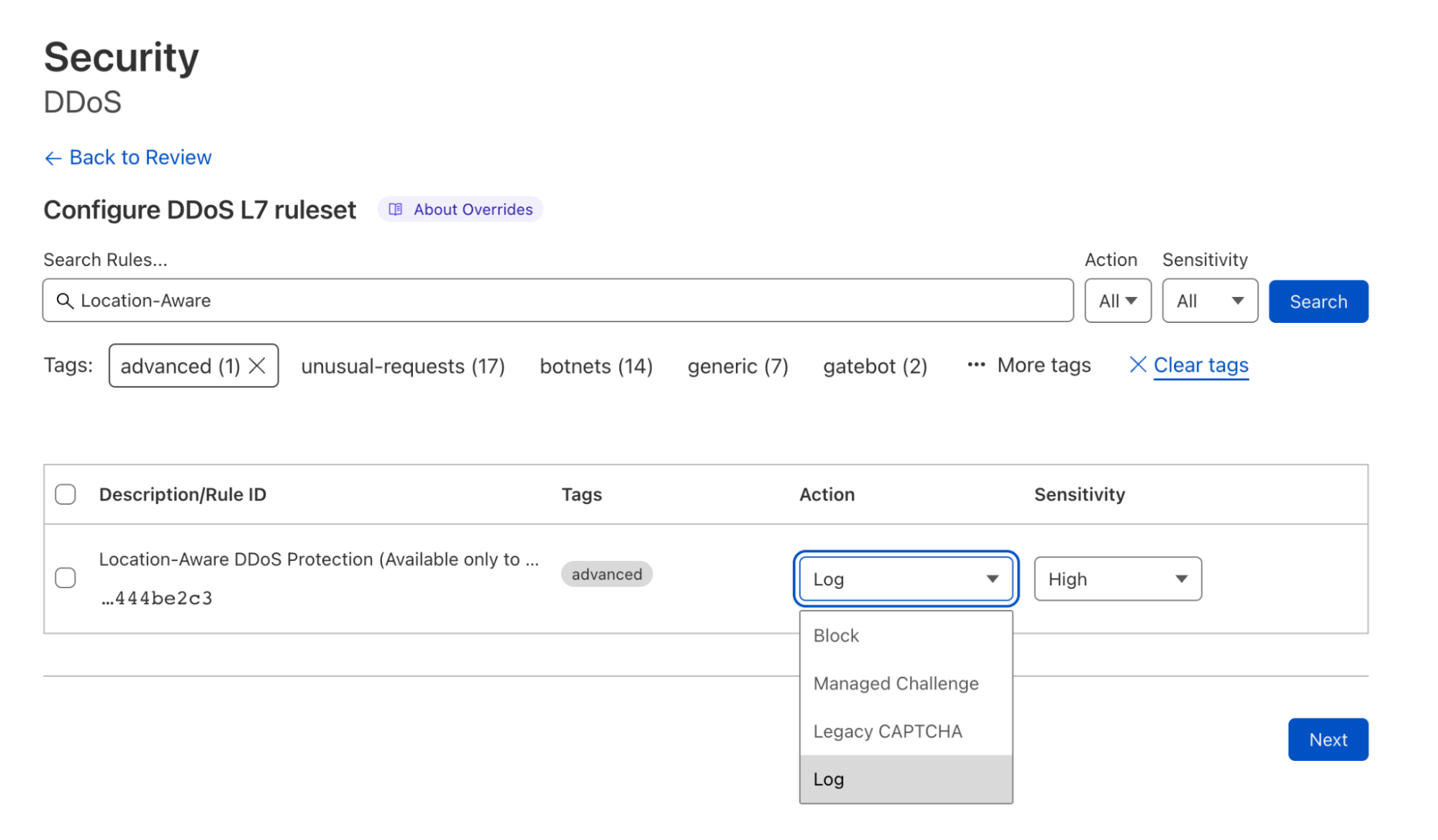
Location-Aware DDoS Protection is exposed to customers as a new HTTP DDoS Managed rule within the existing ruleset. To enable it, change the action to Managed Challenge or Block. Customers can adjust its sensitivity level to define how much tolerance you permit for traffic that deviates from your observed geographies. The lower the sensitivity, the higher the tolerance.
To learn how to view flagged traffic and how to configure the Location-Aware DDoS Protection, visit our developer docs site.
Making the impact of DDoS attacks a thing of the past
Our mission at Cloudflare is to help build a better Internet. The DDoS Protection team’s vision is derived from this mission: our goal is to make the impact of DDoS attacks a thing of the past. Location-aware protection is only the first step to making Cloudflare’s DDoS protection even more intelligent, sophisticated, and tailored to individual needs.
Not using Cloudflare yet? Start now with our Free and Pro plans to protect your websites, or contact us to learn more about the Enterprise Advanced DDoS Protection package.
Welcome to our 2022 Q2 DDoS report. This report includes insights and trends about the DDoS threat landscape — as observed across the global Cloudflare network. An interactive version of this report is also available on Radar.
In Q2, we’ve seen some of the largest attacks the world has ever seen including a 26 million request per second HTTPS DDoS attacks that Cloudflare automatically detected and mitigated. Furthermore, attacks against Ukraine and Russia continue, whilst a new Ransom DDoS attack campaign emerged.
The Highlights
Ukrainian and Russian Internet
The war on the ground is accompanied by attacks targeting the spread of information.
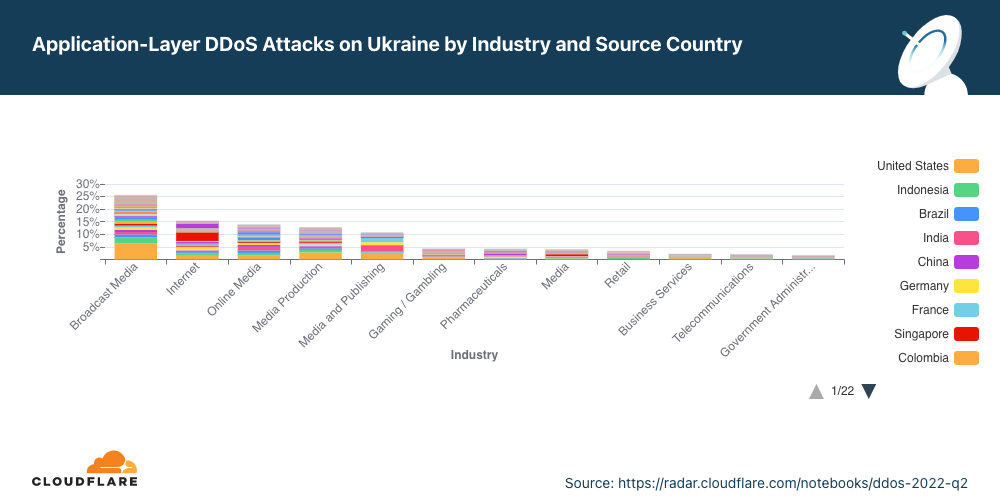
Broadcast Media companies in the Ukraine were the most targeted in Q2 by DDoS attacks. In fact, all the top five most attacked industries are all in online/Internet media, publishing, and broadcasting.
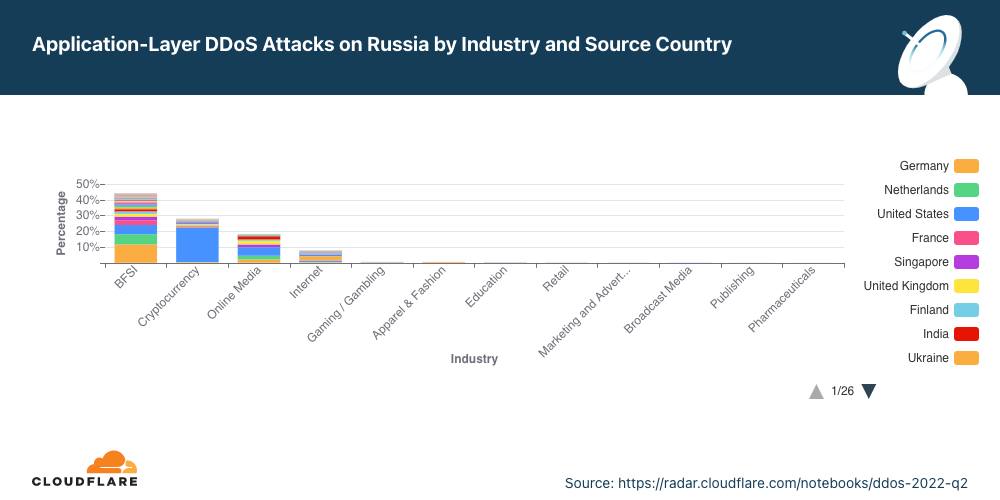
In Russia on the other hand, Online Media drops as the most attacked industry to the third place. Making their way to the top, Banking, Financial Services and Insurance (BFSI) companies in Russia were the most targeted in Q2; almost 45% of all application-layer DDoS attacks targeted the BFSI sector. Cryptocurrency companies in Russia were the second most attacked.
We’ve seen a new wave of Ransom DDoS attacks by entities claiming to be the Fancy Lazarus.
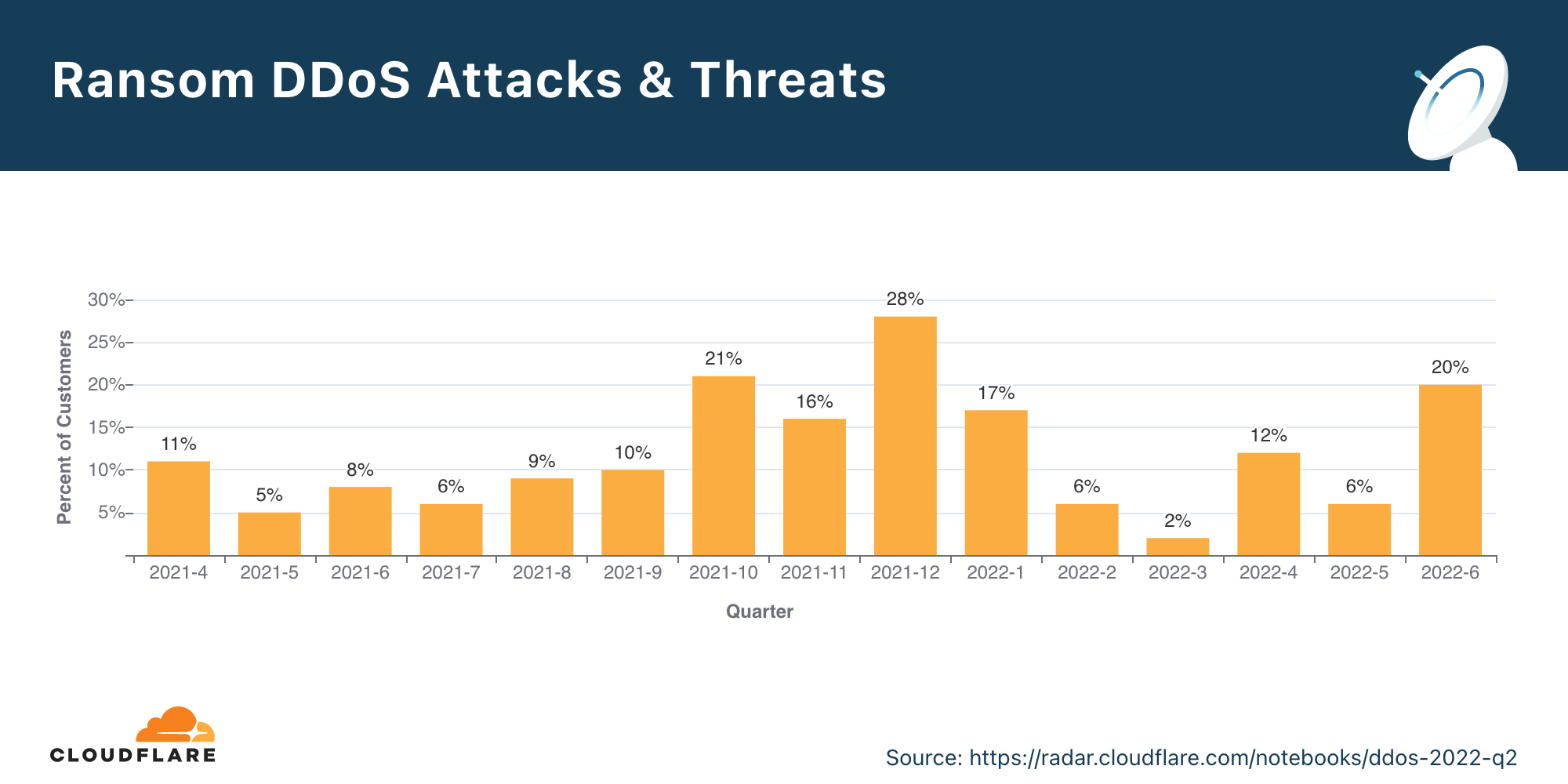
In June 2022, ransom attacks peaked to the highest of the year so far: one out of every five survey respondents who experienced a DDoS attack reported being subject to a Ransom DDoS attack or other threats.
Overall in Q2, the percent of Ransom DDoS attacks increased by 11% QoQ.
Application-layer DDoS attacks
In 2022 Q2, application-layer DDoS attacks increased by 72% YoY.
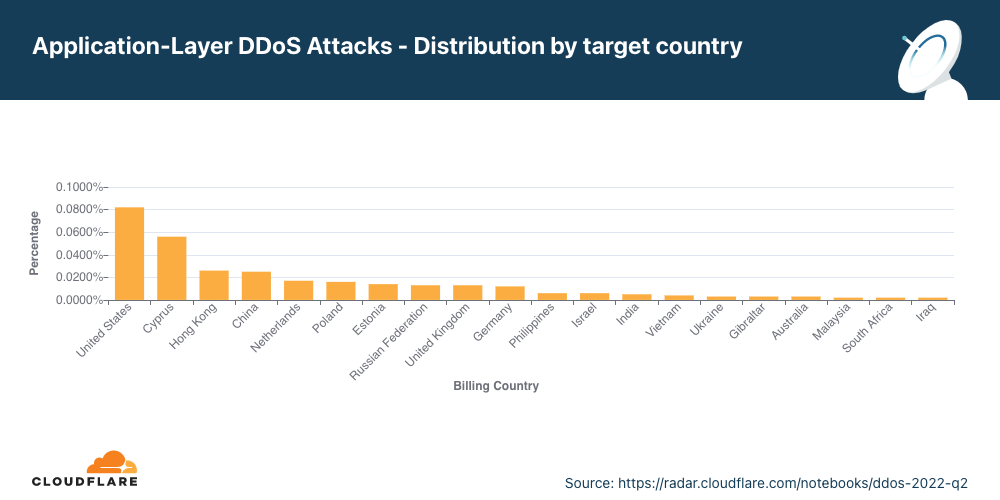
Organizations in the US were the most targeted, followed by Cyprus, Hong Kong, and China. Attacks on organizations in Cyprus increased by 166% QoQ.
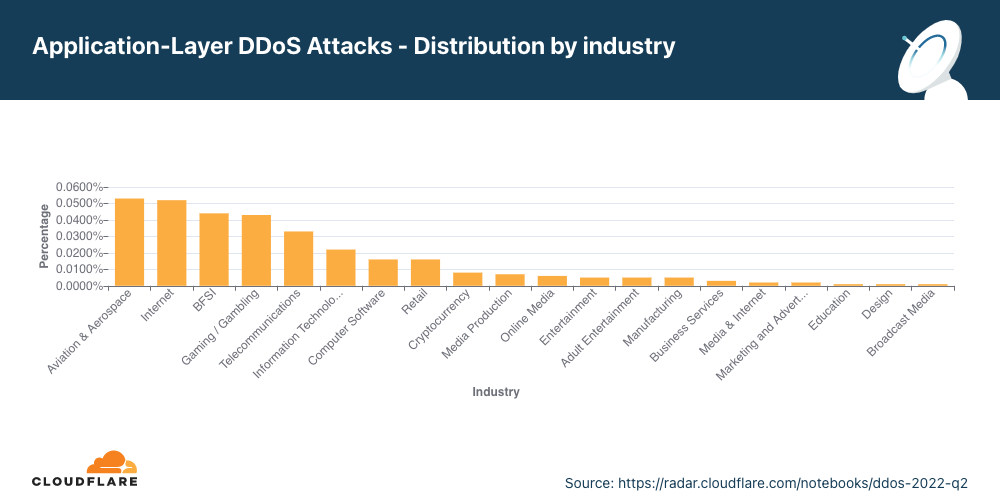
The Aviation & Aerospace industry was the most targeted in Q2, followed by the Internet industry, Banking, Financial Services and Insurance, and Gaming / Gambling in fourth place.
Network-layer DDoS attacks
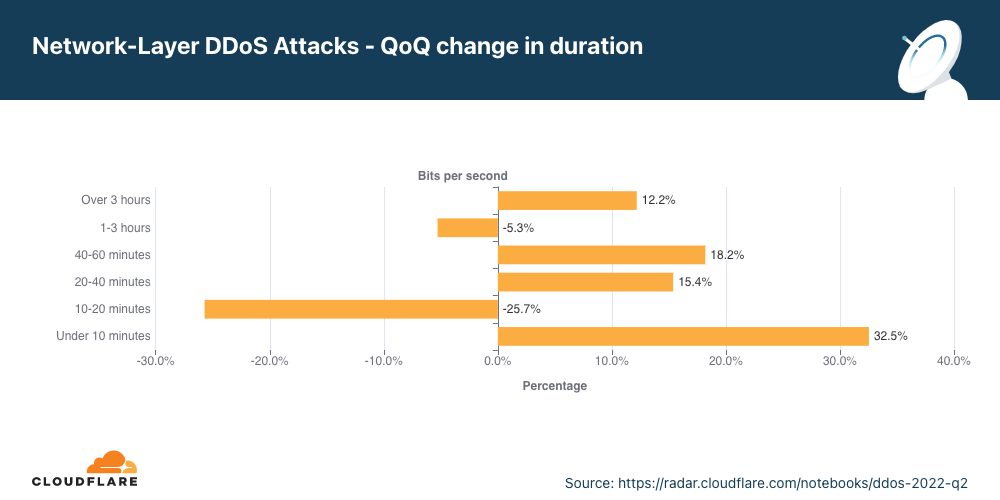
In 2022 Q2, network-layer DDoS attacks increased by 109% YoY. Attacks of 100 Gbps and larger increased by 8% QoQ, and attacks lasting more than 3 hours increased by 12% QoQ.
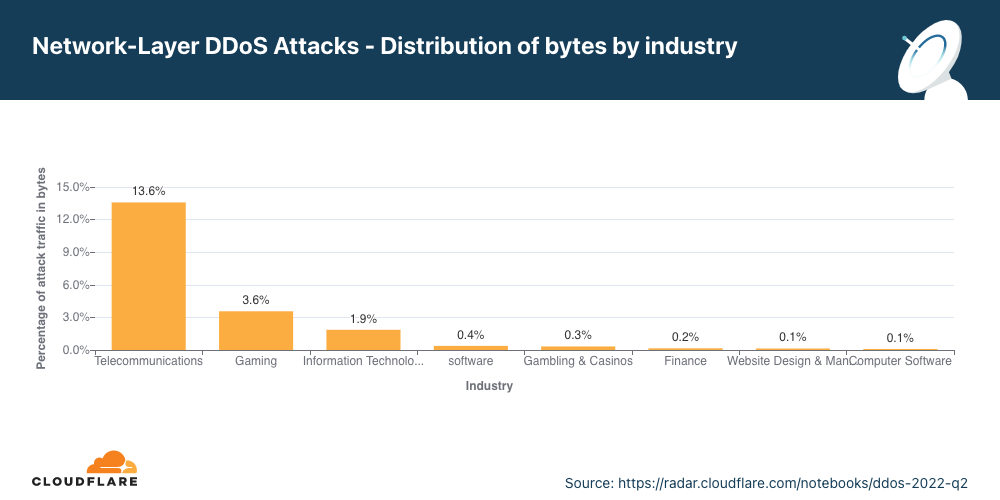
The top attacked industries were Telecommunications, Gaming / Gambling and the Information Technology and Services industry.
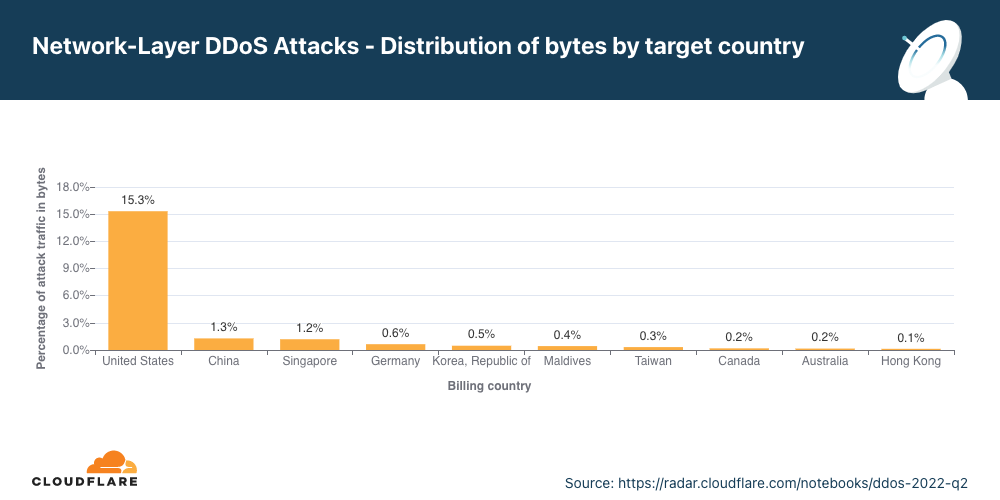
Organizations in the US were the most targeted, followed by China, Singapore, and Germany.
This report is based on DDoS attacks that were automatically detected and mitigated by Cloudflare’s DDoS Protection systems. To learn more about how it works, check out this deep-dive blog post.
A note on how we measure DDoS attacks observed over our network
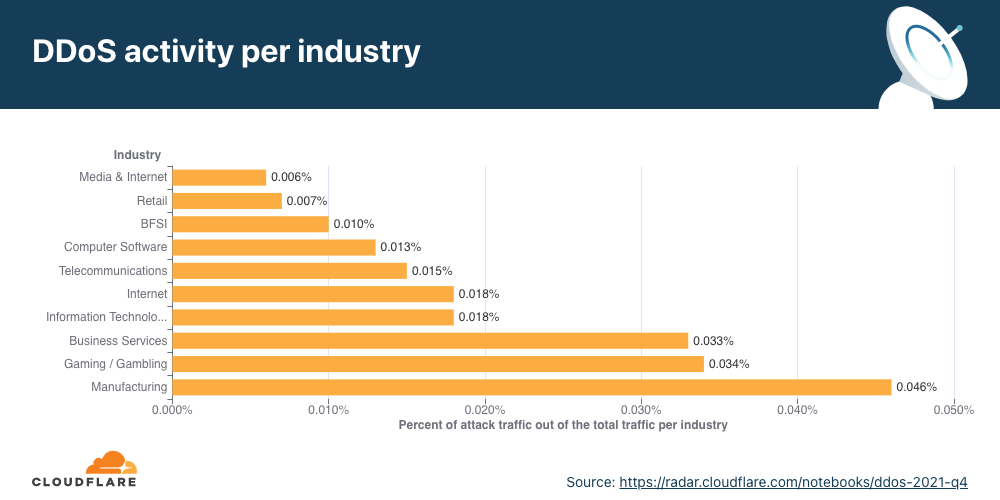
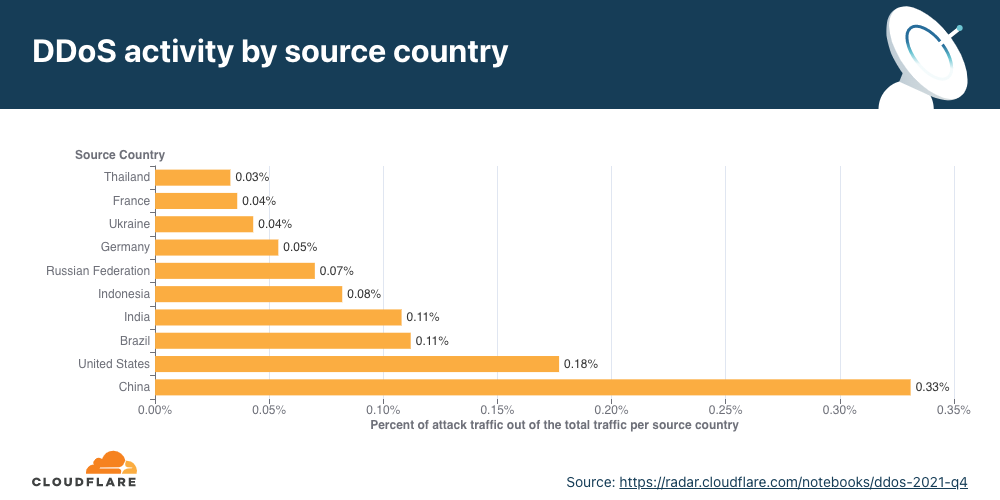
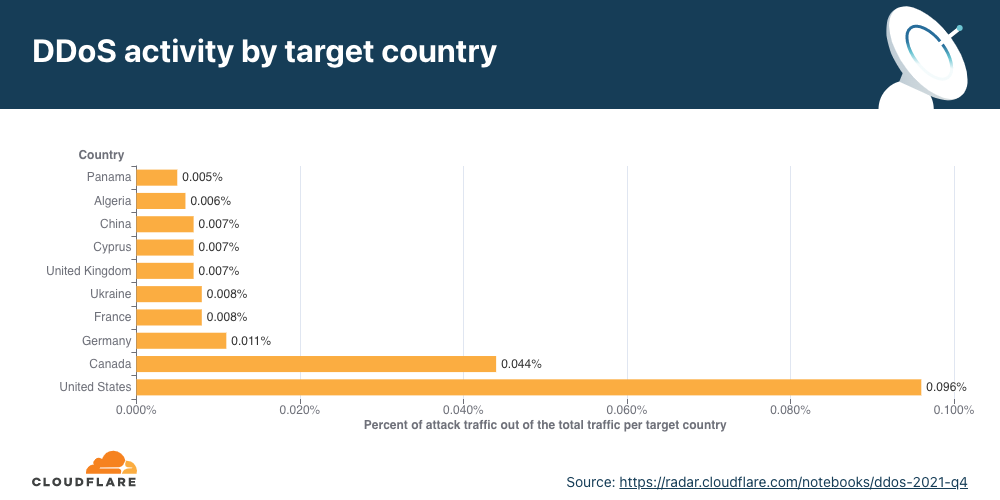
To analyze attack trends, we calculate the “DDoS activity” rate, which is either the percentage of attack traffic out of the total traffic (attack + clean) observed over our global network, or in a specific location, or in a specific category (e.g., industry or billing country). Measuring the percentages allows us to normalize data points and avoid biases reflected in absolute numbers towards, for example, a Cloudflare data center that receives more total traffic and likely, also more attacks.
Ransom Attacks
Our systems constantly analyze traffic and automatically apply mitigation when DDoS attacks are detected. Each DDoS’d customer is prompted with an automated survey to help us better understand the nature of the attack and the success of the mitigation.
For over two years now, Cloudflare has been surveying attacked customers — one question on the survey being if they received a threat or a ransom note demanding payment in exchange to stop the DDoS attack.
The number of respondents reporting threats or ransom notes in Q2 increased by 11% QoQ and YoY. During this quarter, we’ve been mitigating Ransom DDoS attacks that have been launched by entities claiming to be the Advanced Persistent Threat (APT) group “Fancy Lazarus”. The campaign has been focusing on financial institutions and cryptocurrency companies.
The percentage of respondents reported being targeted by a ransom DDoS attack or that have received threats in advance of the attack.
Drilling down into Q2, we can see that in June one out of every five respondents reported receiving a ransom DDoS attack or threat — the highest month in 2022, and the highest since December 2021.
Application-layer DDoS attacks
Application-layer DDoS attacks, specifically HTTP DDoS attacks, are attacks that usually aim to disrupt a web server by making it unable to process legitimate user requests. If a server is bombarded with more requests than it can process, the server will drop legitimate requests and — in some cases — crash, resulting in degraded performance or an outage for legitimate users.
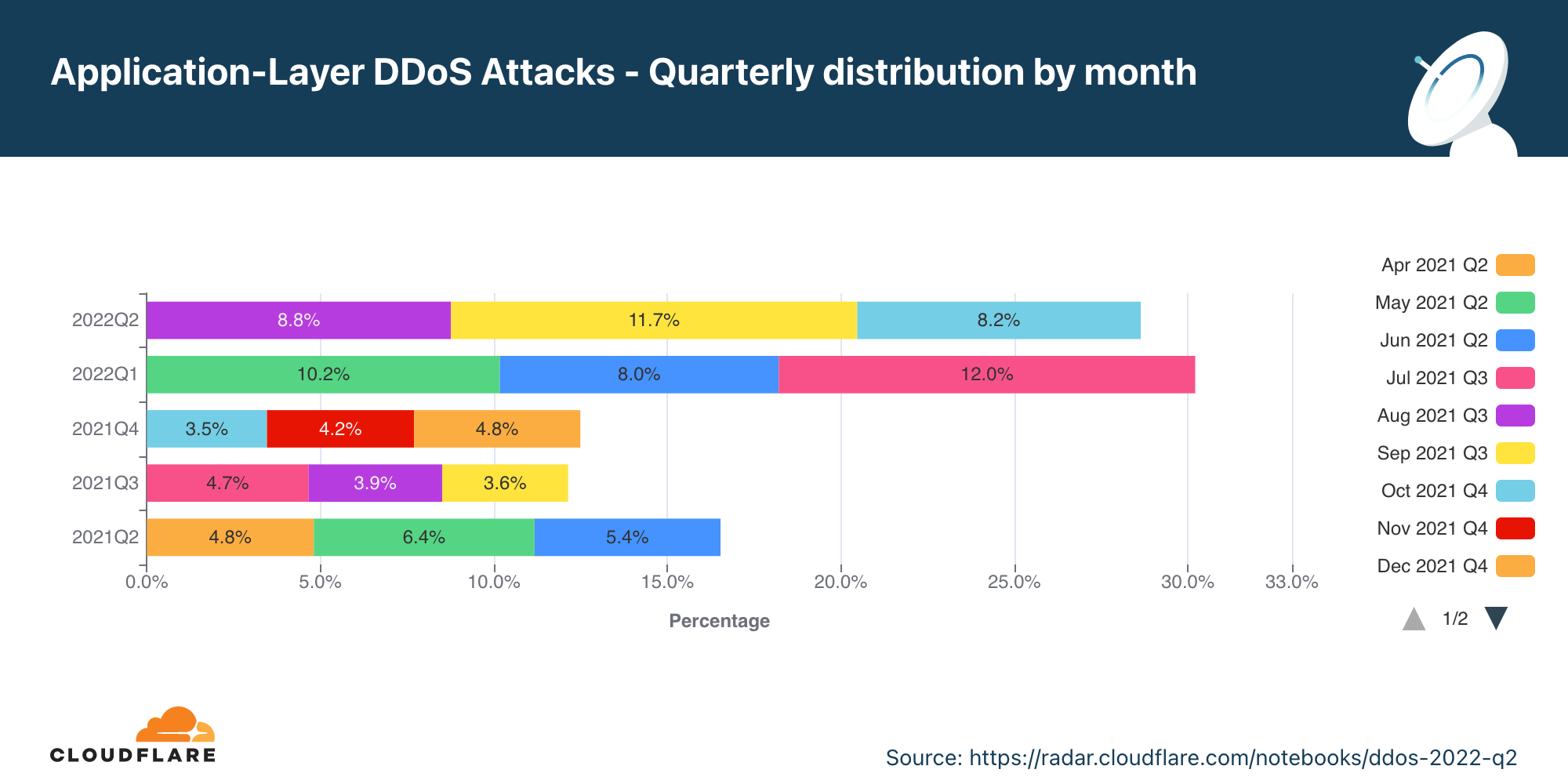
Application-layer DDoS attacks by month
In Q2, application-layer DDoS attacks increased by 72% YoY.
Overall, in Q2, the volume of application-layer DDoS attacks increased by 72% YoY, but decreased 5% QoQ. May was the busiest month in the quarter. Almost 41% of all application-layer DDoS attacks took place in May, whereas the least number of attacks took place in June (28%).
Application-layer DDoS attacks by industry
Attacks on the Aviation and Aerospace industry increased by 493% QoQ.
In Q2, Aviation and Aerospace was the most targeted industry by application-layer DDoS attacks. After it, was the Internet industry, Banking, Financial Institutions and Insurance (BFSI) industry, and in fourth place the Gaming / Gambling industry.
Ukraine and Russia cyberspace
Media and publishing companies are the most targeted in Ukraine.
As the war in Ukraine continues on the ground, in the air and on the water, so does it continue in cyberspace. Entities targeting Ukrainian companies appear to be trying to silence information. The top five most attacked industries in the Ukraine are all in broadcasting, Internet, online media, and publishing — that’s almost 80% of all DDoS Attacks targeting Ukraine.
On the other side of the war, the Russian Banks, Financial Institutions and Insurance (BFSI) companies came under the most attacks. Almost 45% of all DDoS attacks targeted the BFSI sector. The second most targeted was the Cryptocurrency industry, followed by Online media.
In both sides of the war, we can see that the attacks are highly distributed, indicating the use of globally distributed botnets.
Application-layer DDoS attacks by source country
In Q2, attacks from China shrank by 78%, and attacks from the US shrank by 43%.
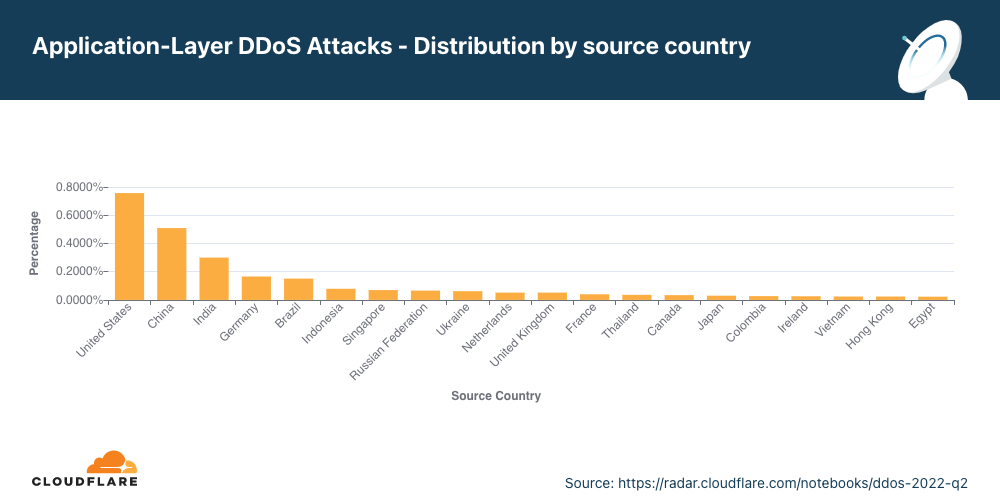
To understand the origin of the HTTP attacks, we look at the geolocation of the source IP address belonging to the client that generated the attack HTTP requests. Unlike network-layer attacks, source IP addresses cannot be spoofed in HTTP attacks. A high percentage of DDoS activity in a given country doesn’t mean that that specific country is launching the attacks but rather indicates the presence of botnets operating from within the country’s borders.
For the second quarter in a row, the United States tops the charts as the main source of HTTP DDoS attacks. Following the US is China in second place, and India and Germany in the third and fourth. Even though the US remained in the first place, attacks originating from the US shrank by 48% QoQ while attacks from other regions grew; attacks from India grew by 87%, from Germany by 33%, and attacks from Brazil grew by 67%.
Application-layer DDoS attacks by target country
In order to identify which countries are targeted by the most HTTP DDoS attacks, we bucket the DDoS attacks by our customers’ billing countries and represent it as a percentage out of all DDoS attacks.
HTTP DDoS attacks on US-based countries increased by 67% QoQ pushing the US back to the first place as the main target of application-layer DDoS attacks. Attacks on Chinese companies plunged by 80% QoQ dropping it from the first place to the fourth. Attacks on Cyprus increase by 167% making it the second most attacked country in Q2. Following Cyprus is Hong Kong, China, and the Netherlands.
Network-layer DDoS attacks
While application-layer attacks target the application (Layer 7 of the OSI model) running the service that end users are trying to access (HTTP/S in our case), network-layer attacks aim to overwhelm network infrastructure (such as in-line routers and servers) and the Internet link itself.
Network-layer DDoS attacks by month
In Q2, network-layer DDoS attacks increased by 109% YoY, and volumetric attacks of 100 Gbps and larger increased by 8% QoQ.
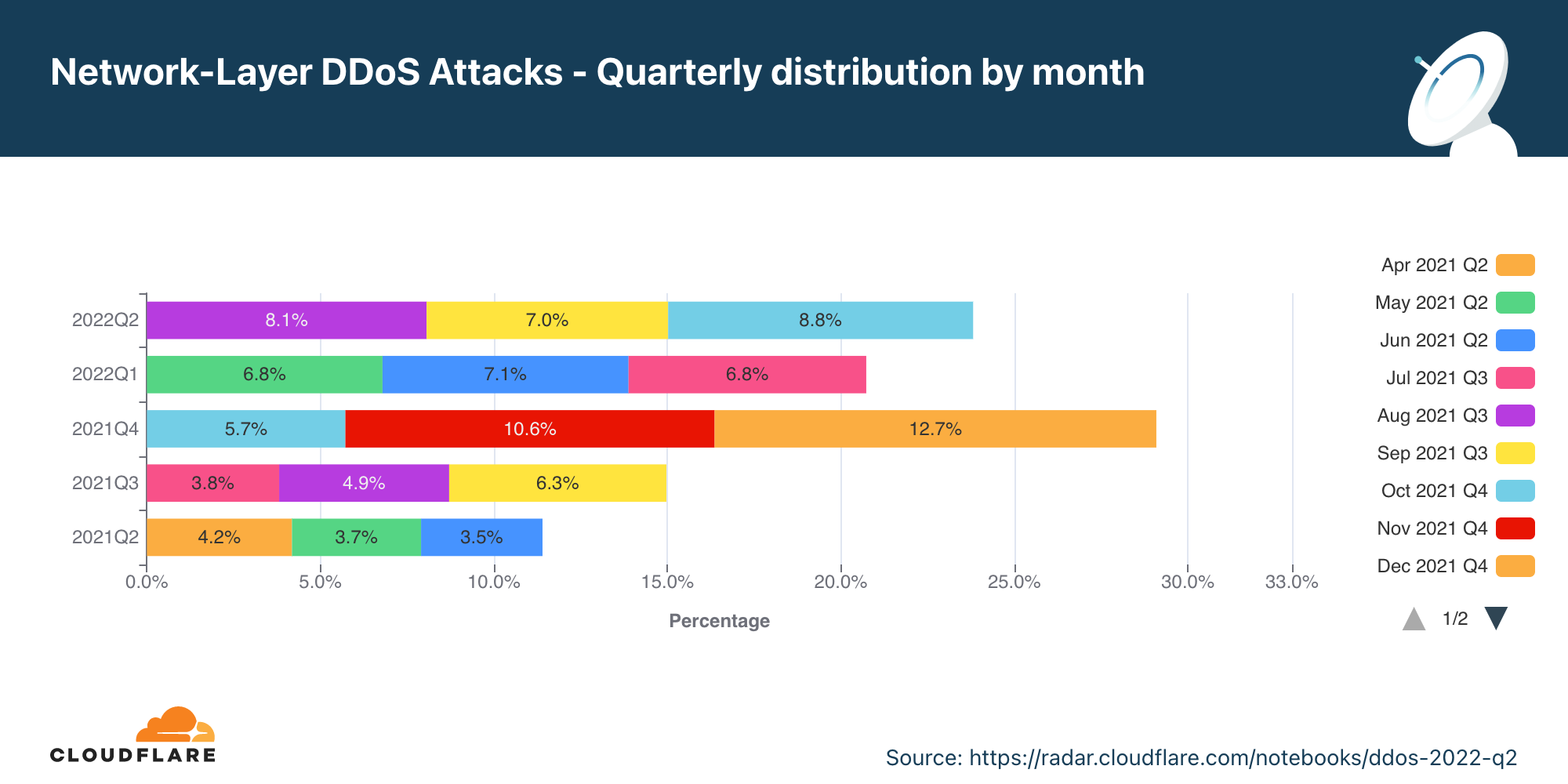
In Q2, the total amount of network-layer DDoS attacks increased by 109% YoY and 15% QoQ. June was the busiest month of the quarter with almost 36% of the attacks occurring in June.
Network-layer DDoS attacks by industry
In Q2, attacks on Telecommunication companies grew by 66% QoQ.
For the second consecutive quarter, the Telecommunications industry was the most targeted by network-layer DDoS attacks. Even more so, attacks on Telecommunication companies grew by 66% QoQ. The Gaming industry came in second place, followed by Information Technology and Services companies.
Network-layer DDoS attacks by target country
Attacks on US networks grew by 95% QoQ.
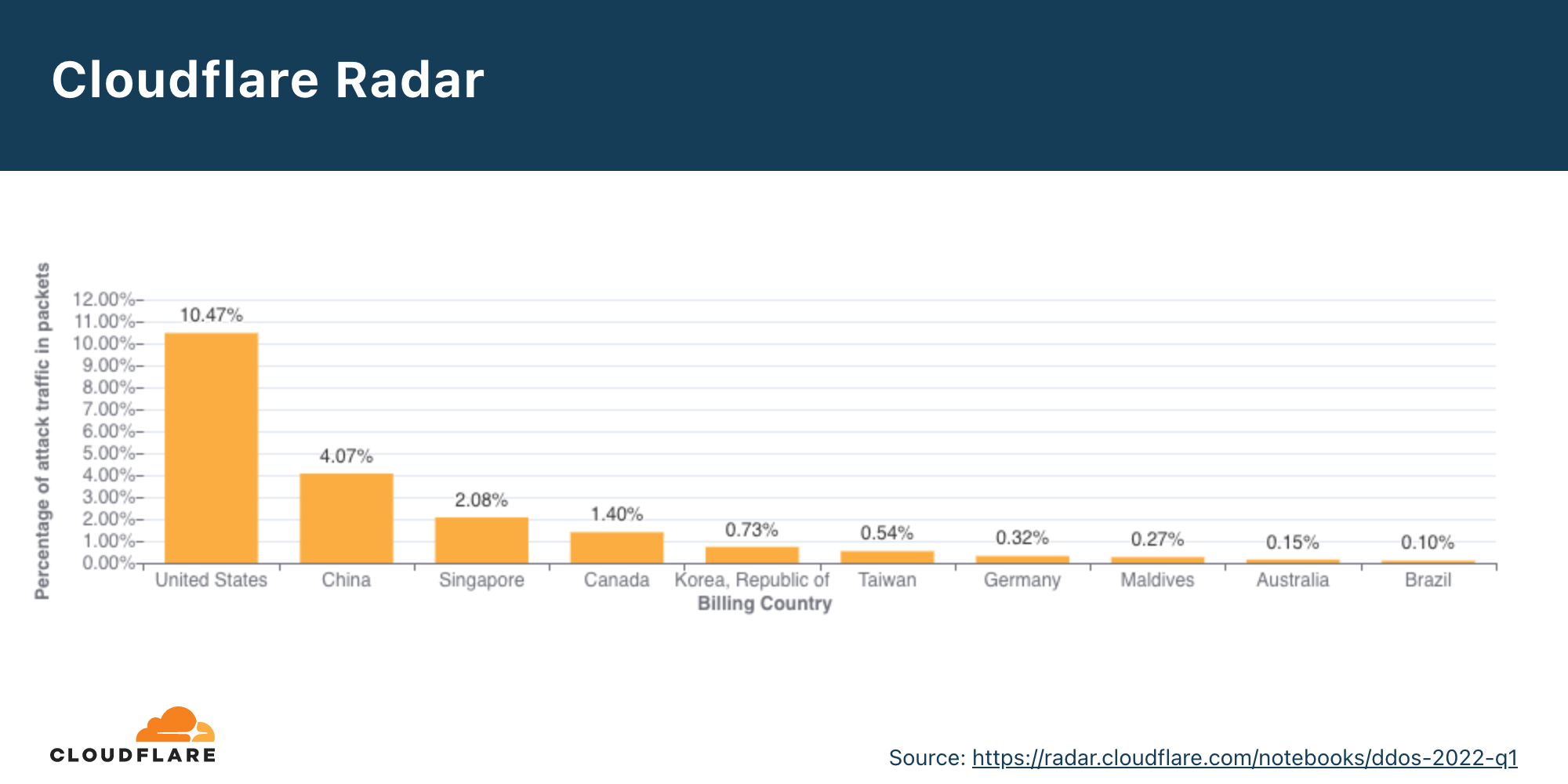
In Q2, the US remains the most attacked country. After the US came China, Singapore and Germany.
Network-layer DDoS attacks by ingress country
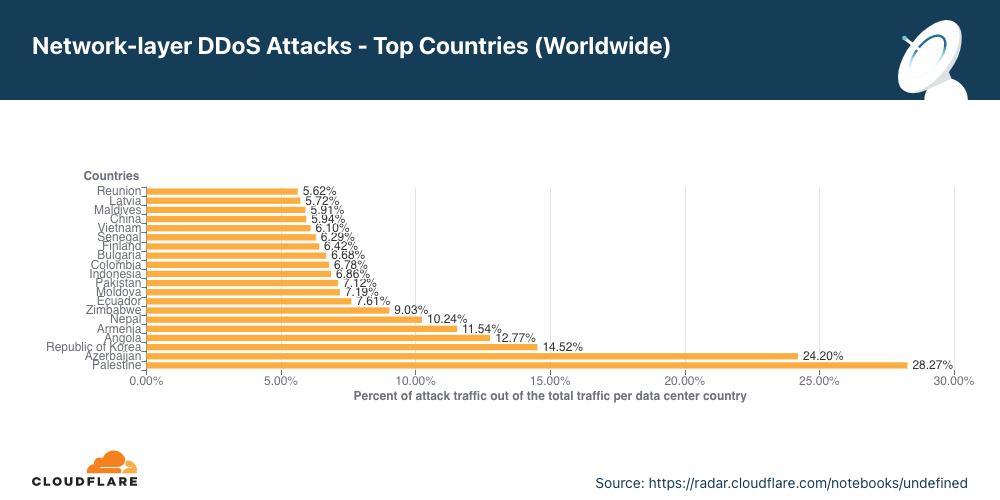
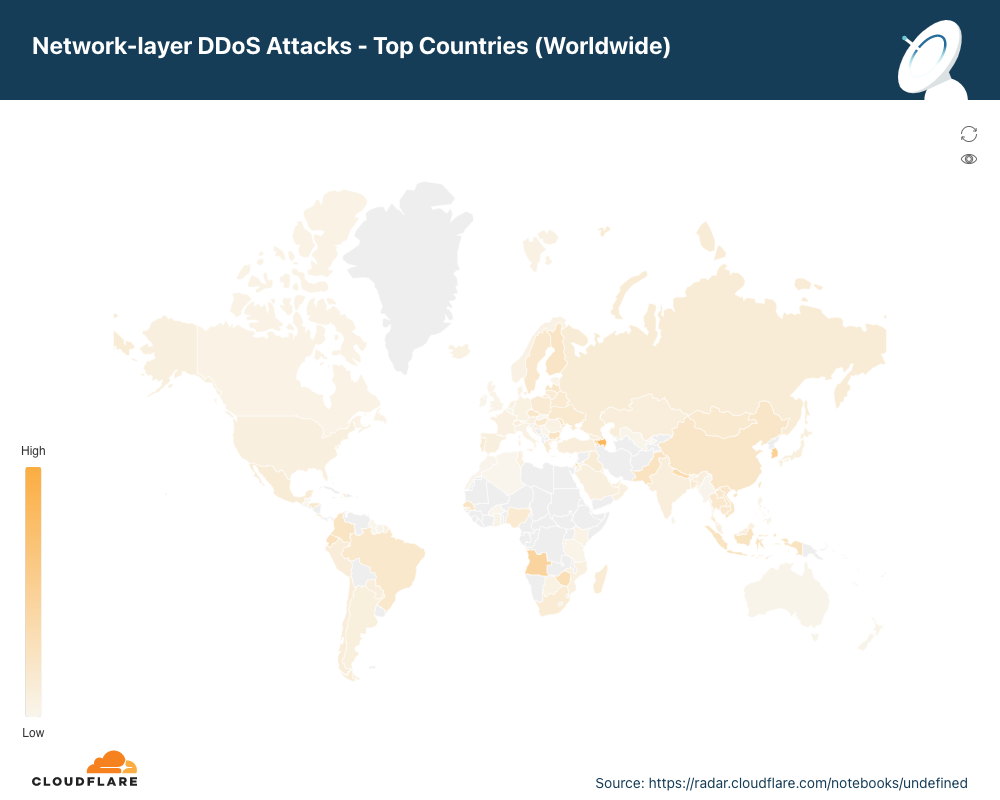
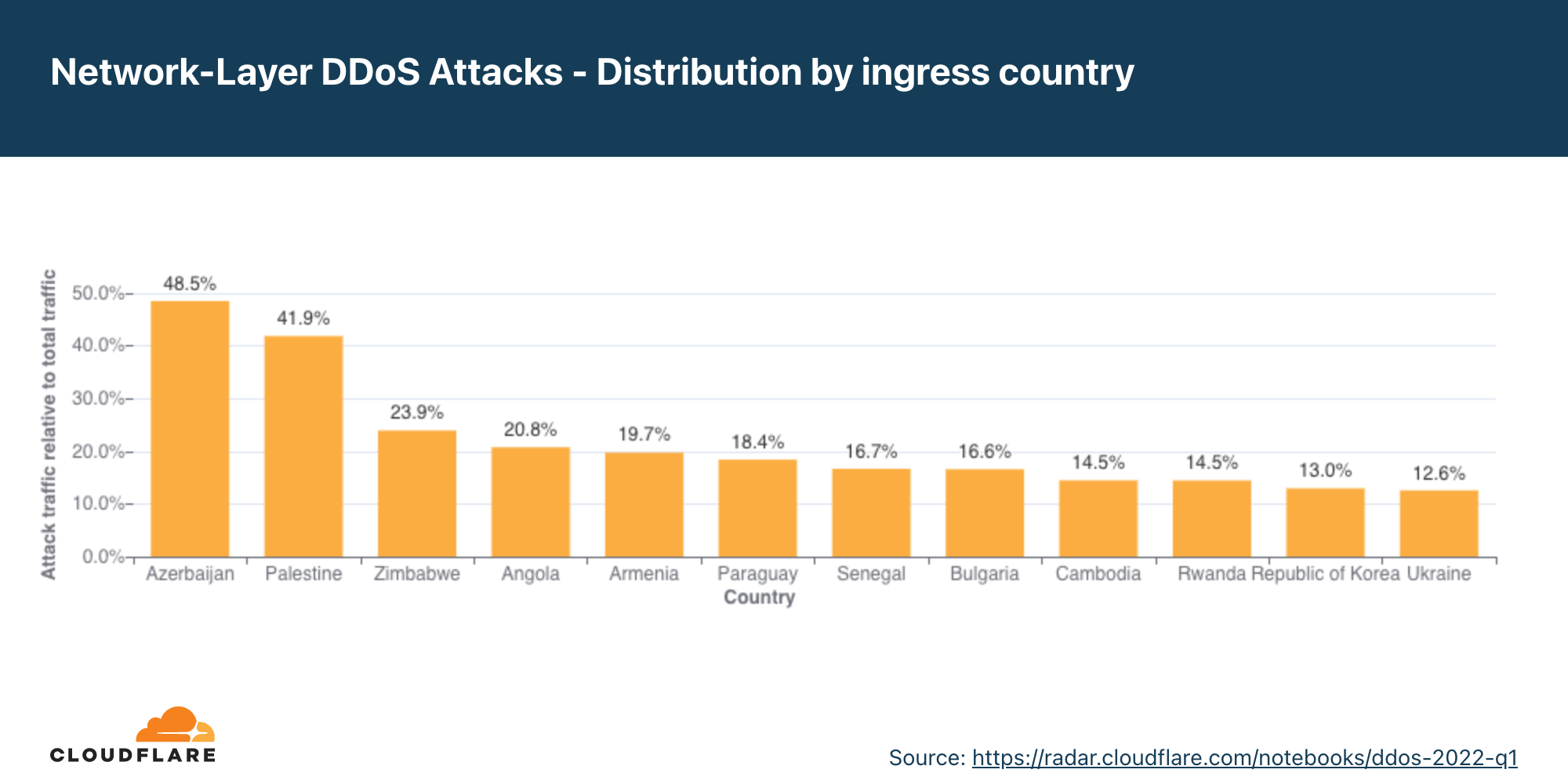
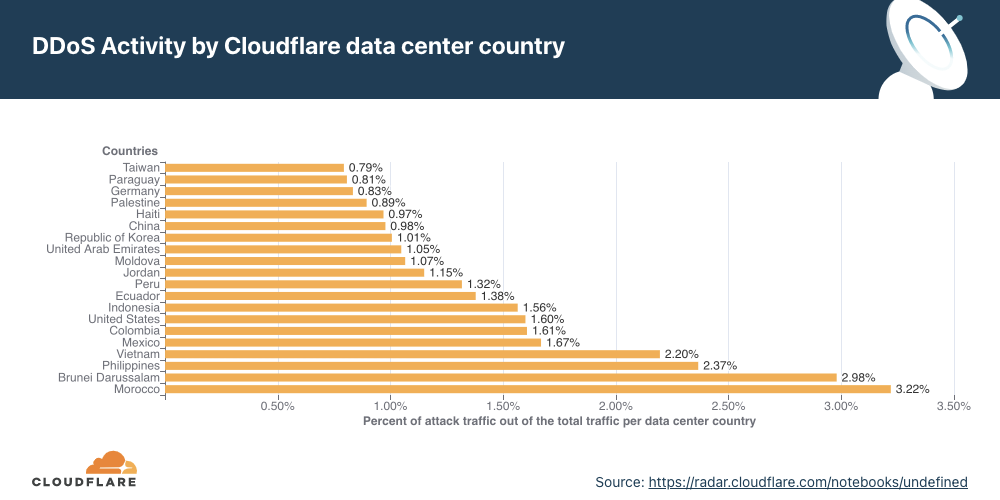
In Q2, almost a third of the traffic Cloudflare observed in Palestine and a fourth in Azerbaijan was part of a network-layer DDoS attack.
When trying to understand where network-layer DDoS attacks originate, we cannot use the same method as we use for the application-layer attack analysis. To launch an application-layer DDoS attack, successful handshakes must occur between the client and the server in order to establish an HTTP/S connection. For a successful handshake to occur, the attacks cannot spoof their source IP address. While the attacker may use botnets, proxies, and other methods to obfuscate their identity, the attacking client’s source IP location does sufficiently represent the attack source of application-layer DDoS attacks.
On the other hand, to launch network-layer DDoS attacks, in most cases, no handshake is needed. Attackers can spoof the source IP address in order to obfuscate the attack source and introduce randomness into the attack properties, which can make it harder for simple DDoS protection systems to block the attack. So if we were to derive the source country based on a spoofed source IP, we would get a ‘spoofed country’.
For this reason, when analyzing network-layer DDoS attack sources, we bucket the traffic by the Cloudflare data center locations where the traffic was ingested, and not by the (potentially) spoofed source IP to get an understanding of where the attacks originate from. We are able to achieve geographical accuracy in our report because we have data centers in over 270 cities around the world. However, even this method is not 100% accurate, as traffic may be back hauled and routed via various Internet Service Providers and countries for reasons that vary from cost reduction to congestion and failure management.
Palestine jumps from the second to the first place as the Cloudflare location with the highest percentage of network-layer DDoS attacks. Following Palestine is Azerbaijan, South Korea, and Angola.
To view all regions and countries, check out the interactive map.
Attack vectors
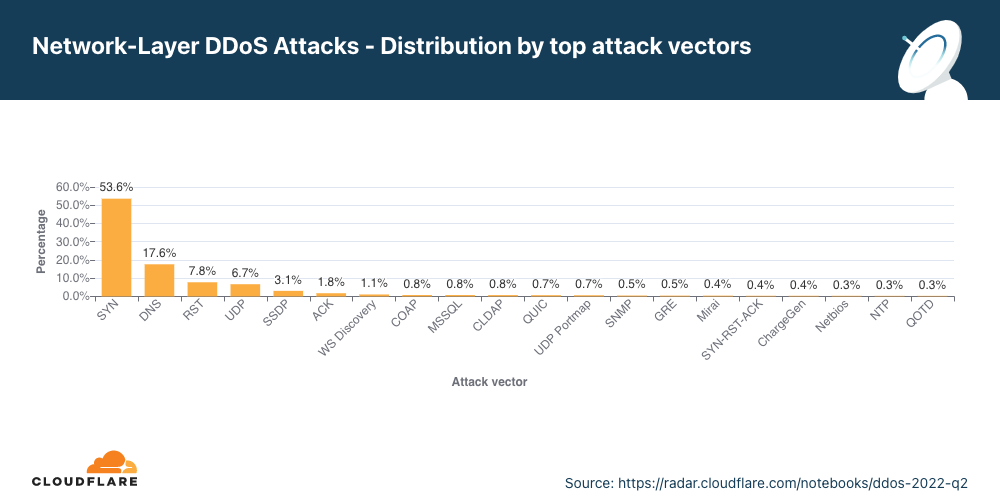
In Q2, DNS attacks increased making it the second most frequent attack vector.
An attack vector is a term used to describe the method that the attacker uses to launch their DDoS attack, i.e., the IP protocol, packet attributes such as TCP flags, flooding method, and other criteria.
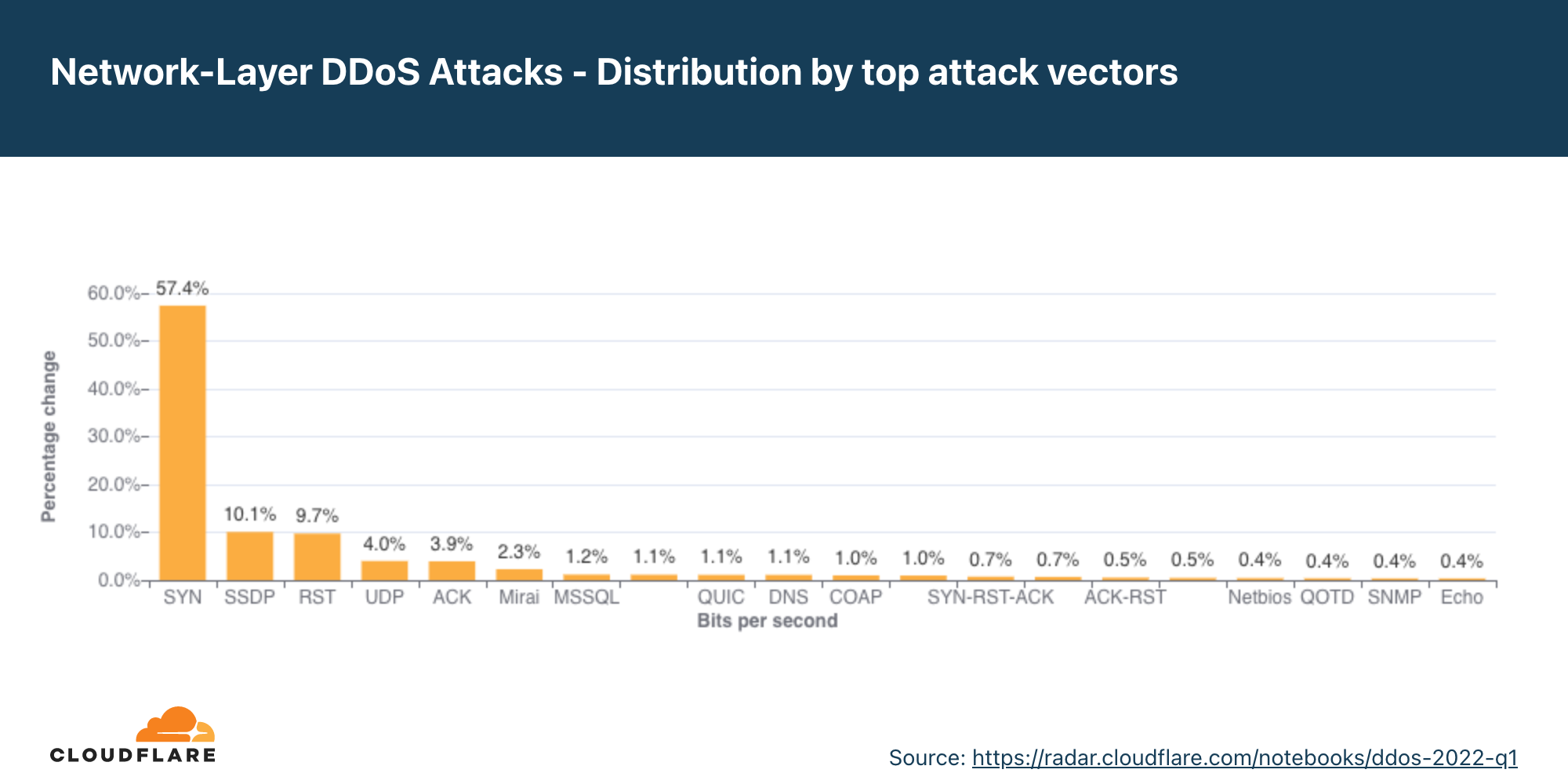
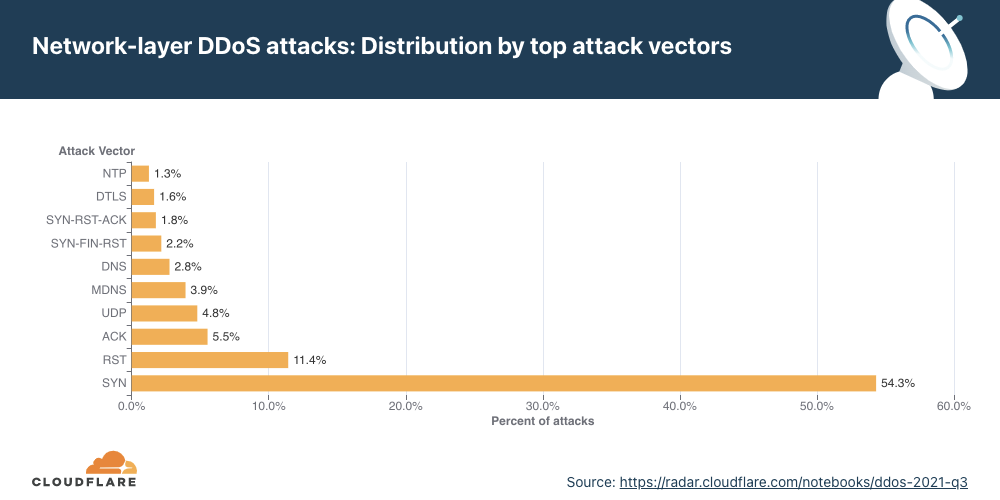
In Q2, 53% of all network-layer attacks were SYN floods. SYN floods remain the most popular attack vector. They abuse the initial connection request of the stateful TCP handshake. During this initial connection request, servers don’t have any context about the TCP connection as it is new and without the proper protection may find it hard to mitigate a flood of initial connection requests. This makes it easier for the attacker to consume an unprotected server’s resources.
After the SYN floods are attacks targeting DNS infrastructure, RST floods again abusing TCP connection flow, and generic attacks over UDP.
Emerging threats
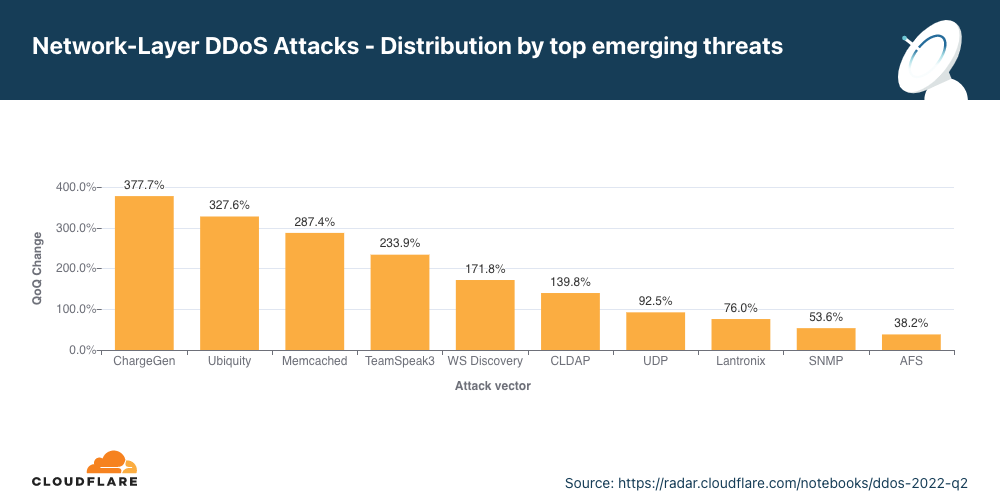
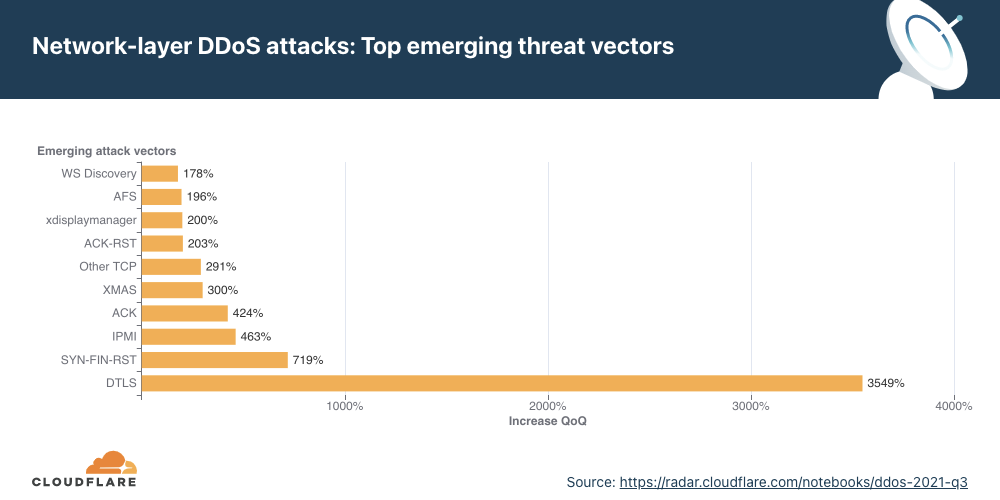
In Q2, the top emerging threats included attacks over CHARGEN, Ubiquiti and Memcached.
Identifying the top attack vectors helps organizations understand the threat landscape. In turn, this may help them improve their security posture to protect against those threats. Similarly, learning about new emerging threats that may not yet account for a significant portion of attacks, can help mitigate them before they become a significant force.
In Q2, the top emerging threats were amplification attacks abusing the Character Generator Protocol (CHARGEN), amplification attacks reflecting traffic off of exposed Ubiquiti devices, and the notorious Memcached attack.
Abusing the CHARGEN protocol to launch amplification attacks
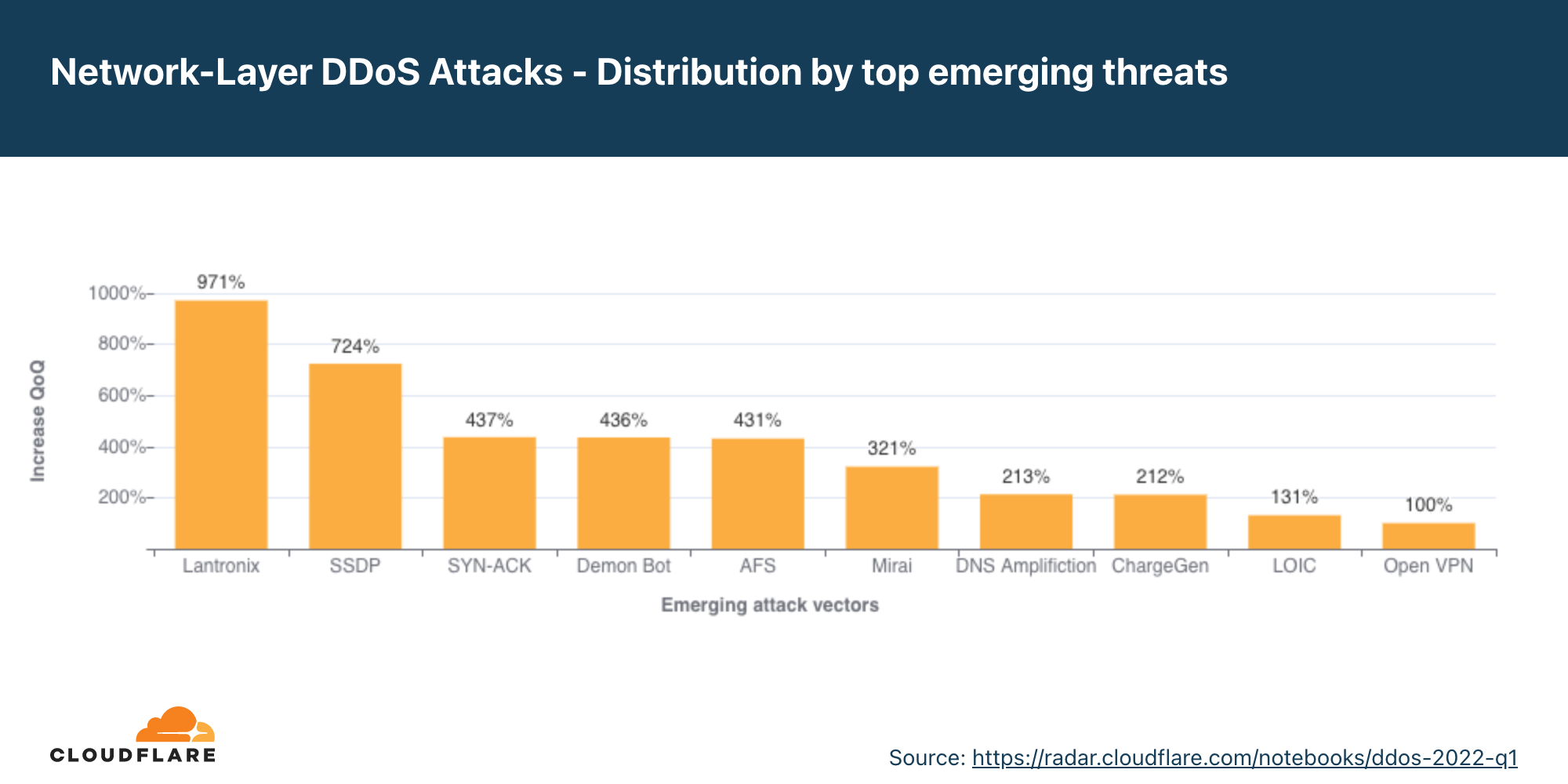
In Q2, attacks abusing the CHARGEN protocol increased by 378% QoQ.
Initially defined in RFC 864 (1983), the Character Generator (CHARGEN) protocol is a service of the Internet Protocol Suite that does exactly what it says it does – it generates characters arbitrarily, and it doesn’t stop sending them to the client until the client closes the connection. Its original intent was for testing and debugging. However, it’s rarely used because it can so easily be abused to generate amplification/reflection attacks.
An attacker can spoof the source IP of their victim and fool supporting servers around the world to direct a stream of arbitrary characters “back” to the victim’s servers. This type of attack is amplification/reflection. Given enough simultaneous CHARGEN streams, the victim’s servers, if unprotected, would be flooded and unable to cope with legitimate traffic — resulting in a denial of service event.
Amplification attacks exploiting the Ubiquiti Discovery Protocol
In Q2, attacks over Ubiquity increased by 327% QoQ.
Ubiquiti is a US-based company that provides networking and Internet of Things (IoT) devices for consumers and businesses. Ubiquiti devices can be discovered on a network using the Ubiquiti Discovery protocol over UDP/TCP port 10001.
Similarly to the CHARGEN attack vector, here too, attackers can spoof the source IP to be the victim’s IP address and spray IP addresses that have port 10001 open. Those would then respond to the victim and essentially flood it if the volume is sufficient.
Memcached DDoS attacks
In Q2, Memcached DDoS attacks increased by 287% QoQ.
Memcached is a database caching system for speeding up websites and networks. Similarly to CHARGEN and Ubiquiti, Memcached servers that support UDP can be abused to launch amplification/reflection DDoS attacks. In this case, the attacker would request content from the caching system and spoof the victim’s IP address as the source IP in the UDP packets. The victim will be flooded with the Memcache responses which can be amplified by a factor of up to 51,200x.
Network-layer DDoS attacks by attack rate
Volumetric attacks of over 100 Gbps increase by 8% QoQ.
There are different ways of measuring the size of an L3/4 DDoS attack. One is the volume of traffic it delivers, measured as the bit rate (specifically, terabits per second or gigabits per second). Another is the number of packets it delivers, measured as the packet rate (specifically, millions of packets per second).
Attacks with high bit rates attempt to cause a denial-of-service event by clogging the Internet link, while attacks with high packet rates attempt to overwhelm the servers, routers, or other in-line hardware appliances. These devices dedicate a certain amount of memory and computation power to process each packet. Therefore, by bombarding it with many packets, the appliance can be left with no further processing resources. In such a case, packets are “dropped,” i.e., the appliance is unable to process them. For users, this results in service disruptions and denial of service.
Distribution by packet rate
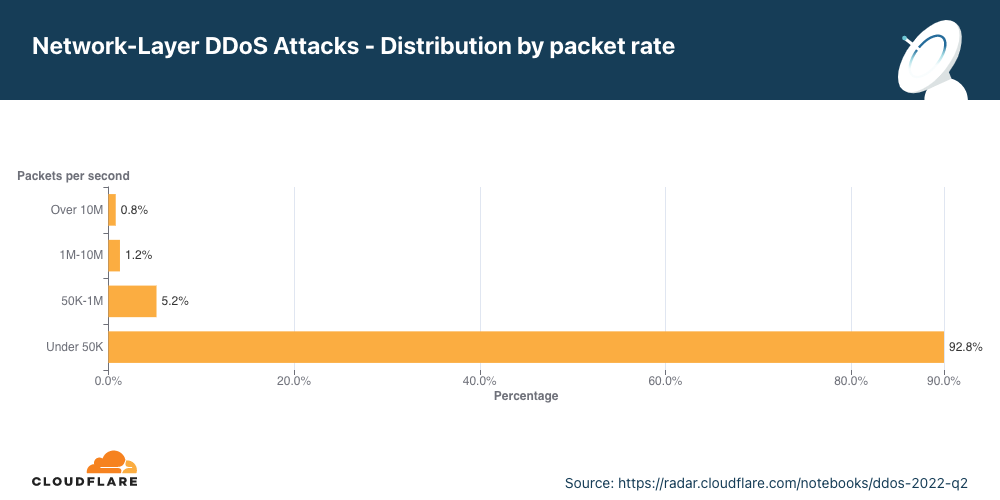
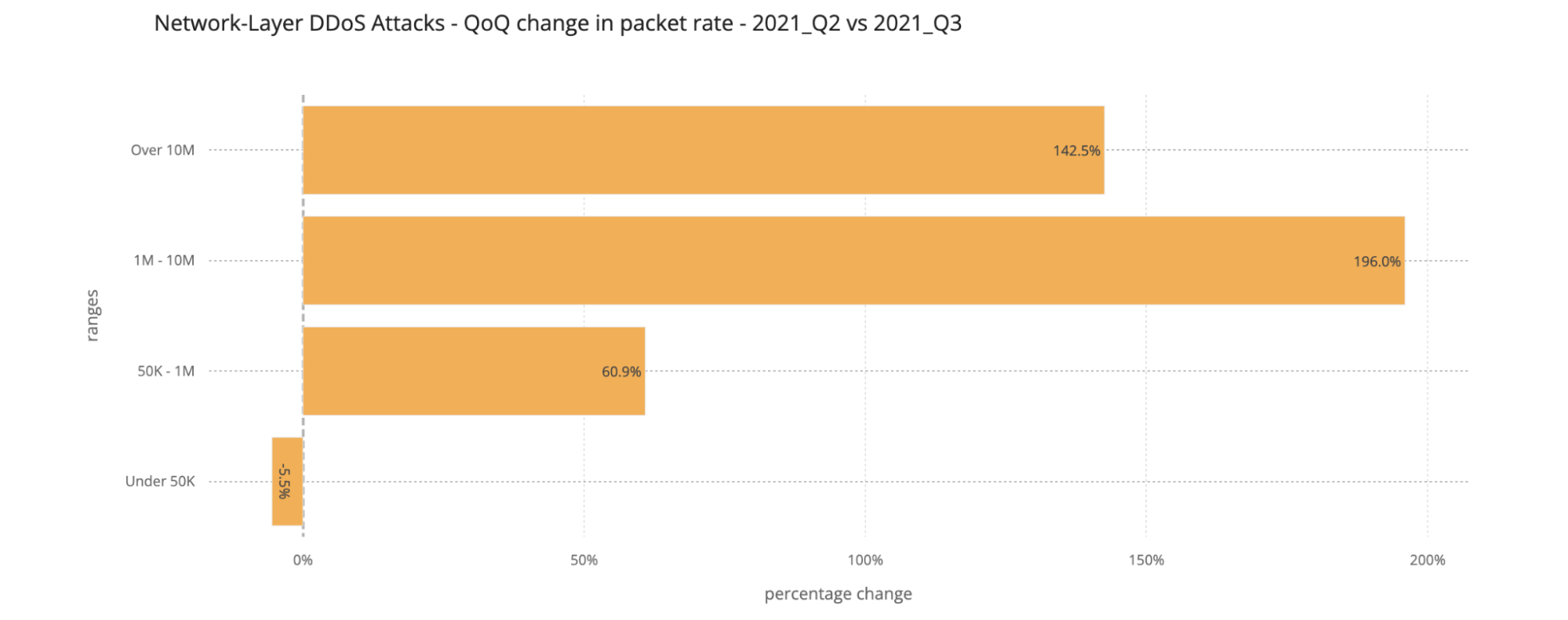
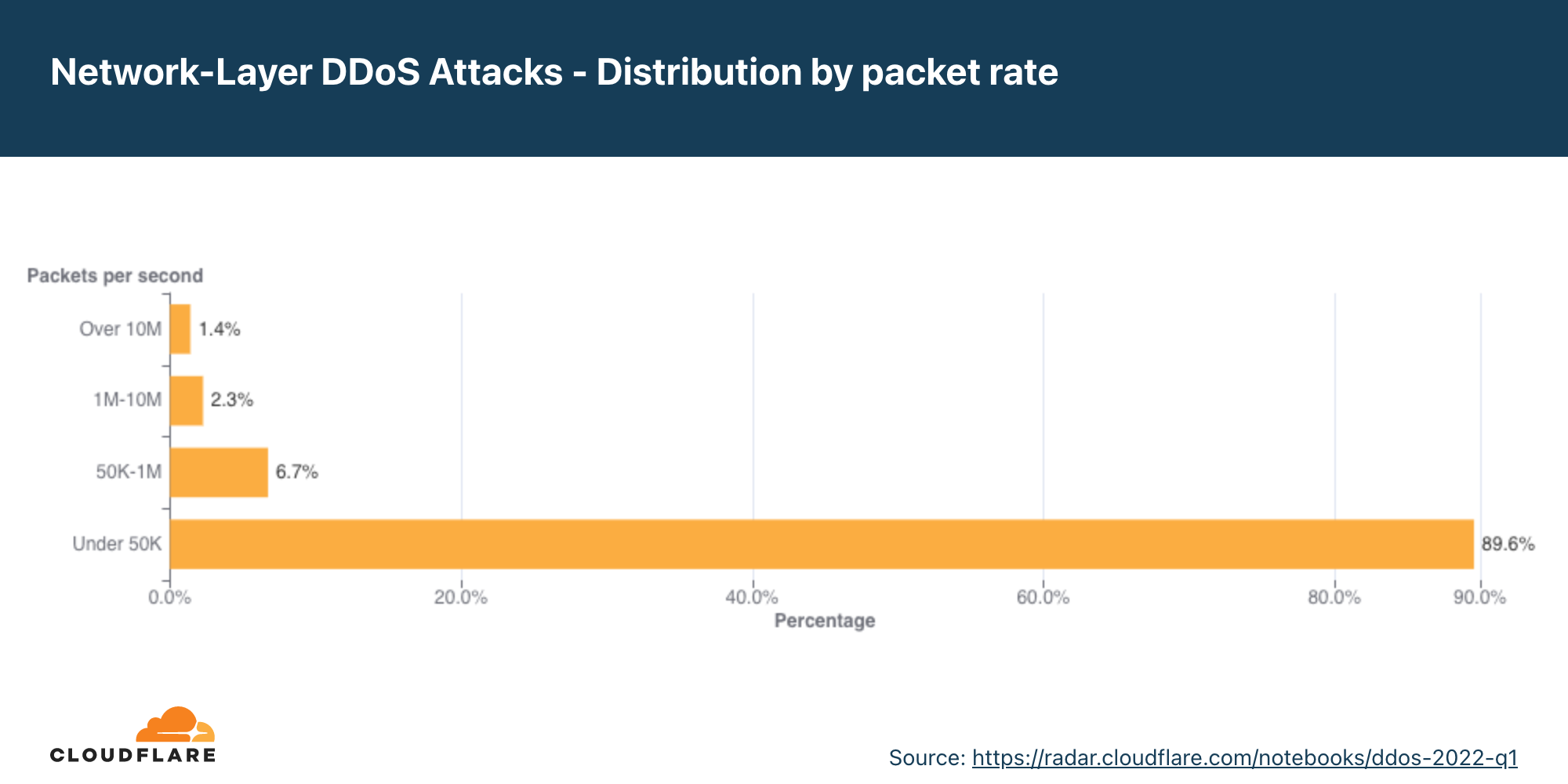
The majority of network-layer DDoS attacks remain below 50,000 packets per second. While 50 kpps is on the lower side of the spectrum at Cloudflare scale, it can still easily take down unprotected Internet properties and congest even a standard Gigabit Ethernet connection.
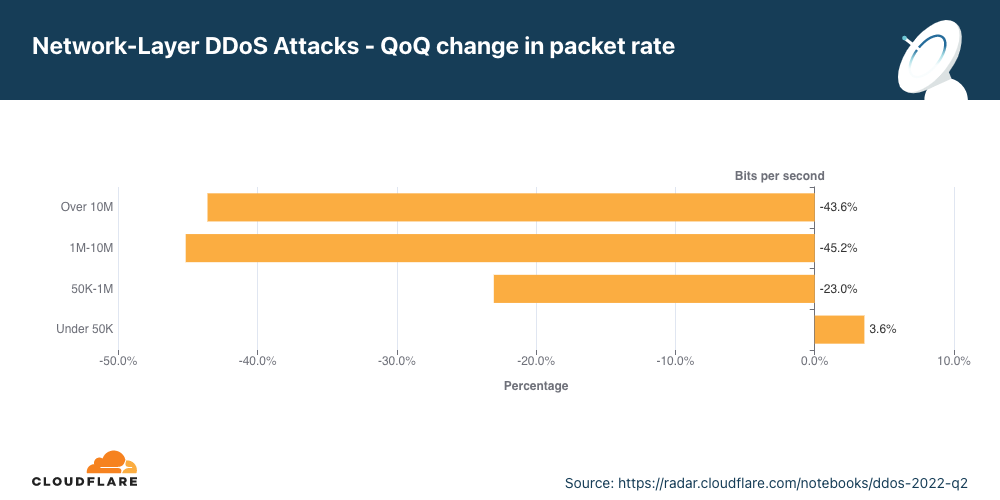
When we look at the changes in the attack sizes, we can see that packet-intensive attacks above 50 kpps decreased in Q2, resulting in an increase of 4% in small attacks.
Distribution by bitrate
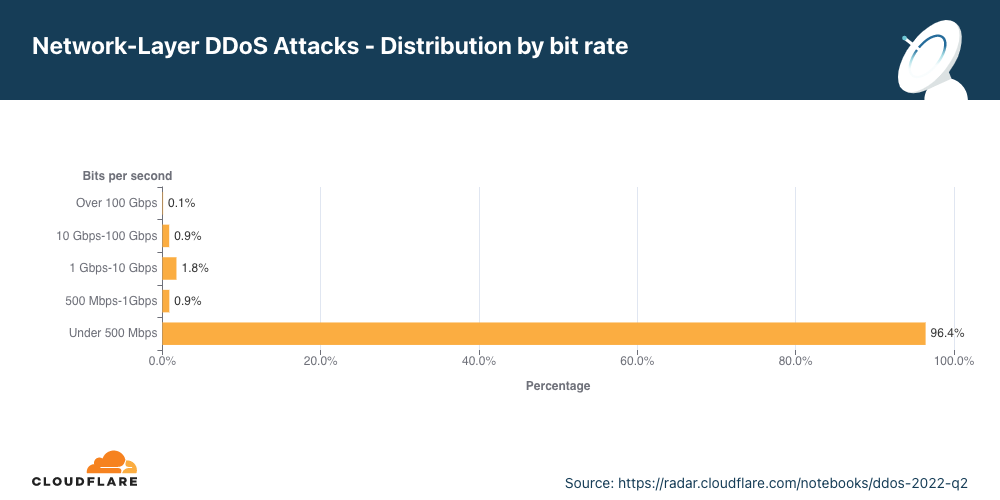
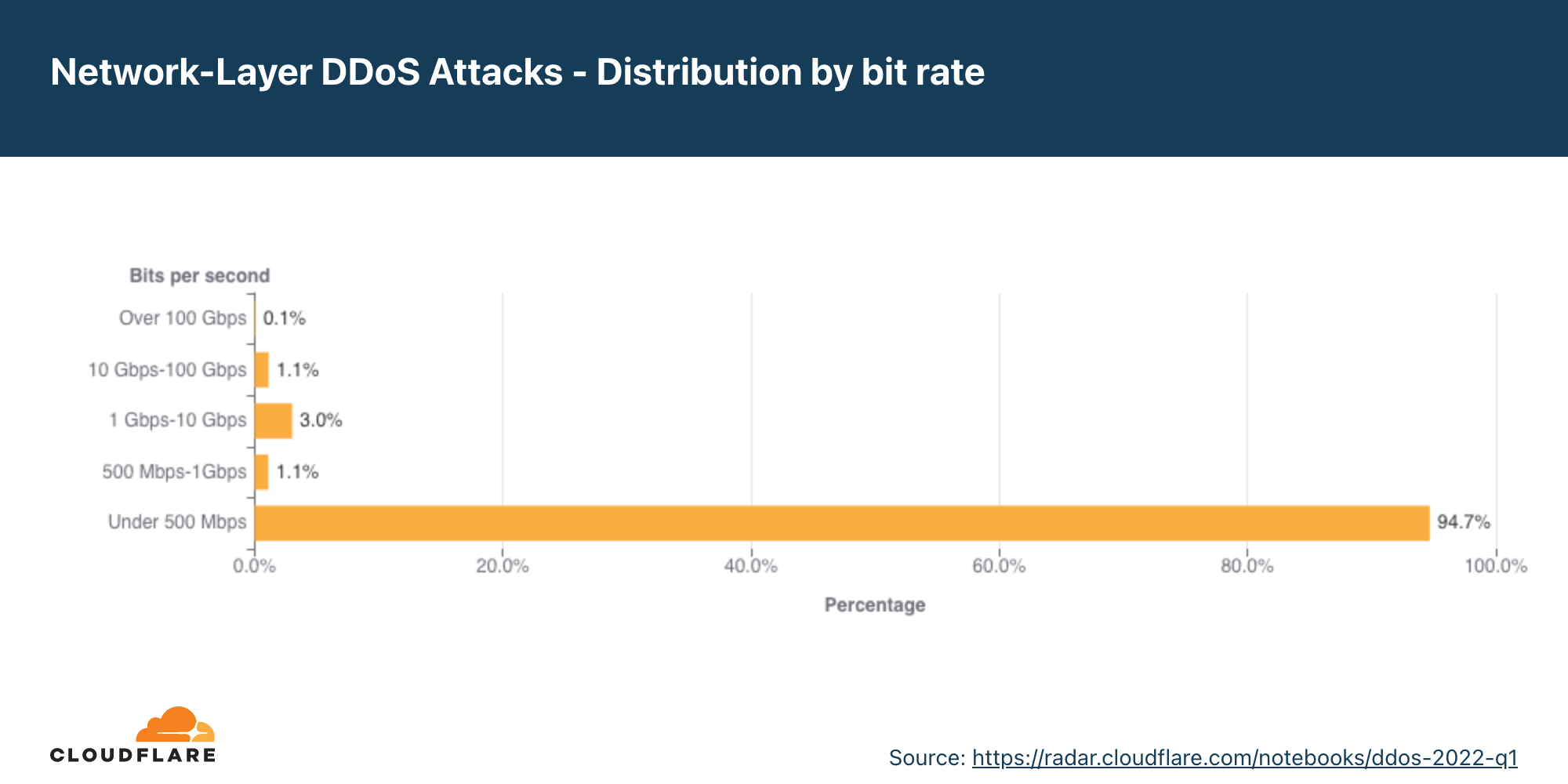
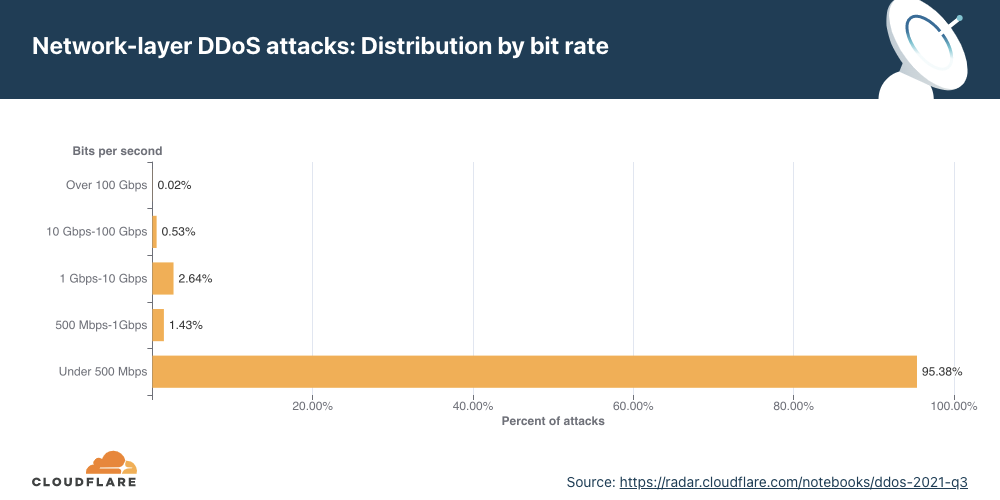
In Q2, most of the network-layer DDoS attacks remain below 500 Mbps. This too is a tiny drop in the water at Cloudflare scale, but can very quickly shut down unprotected Internet properties with less capacity or at the very least cause congestion for even a standard Gigabit Ethernet connection.
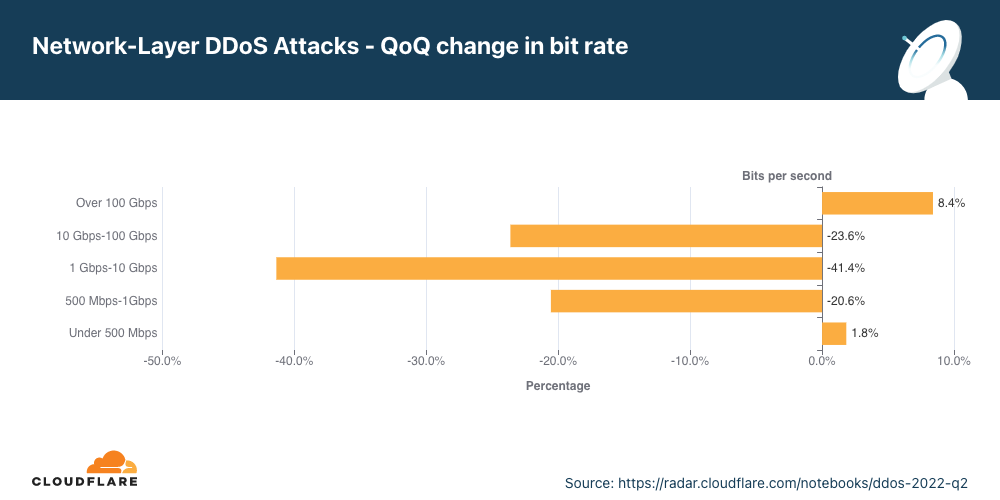
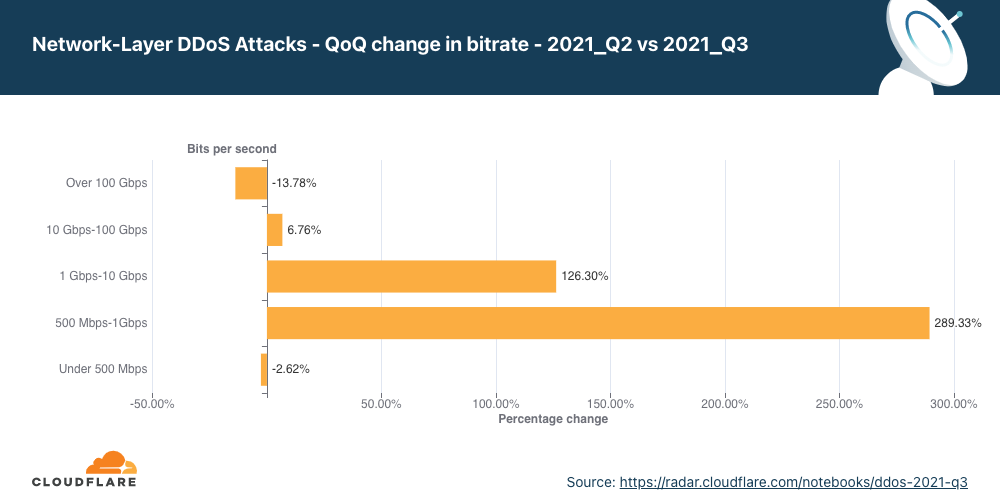
Interestingly enough, large attacks between 500 Mbps and 100 Gbps decreased by 20-40% QoQ, but volumetric attacks above 100 Gbps increased by 8%.
Network-layer DDoS attacks by duration
In Q2, attacks lasting over three hours increased by 9%.
We measure the duration of an attack by recording the difference between when it is first detected by our systems as an attack and the last packet we see with that attack signature towards that specific target.
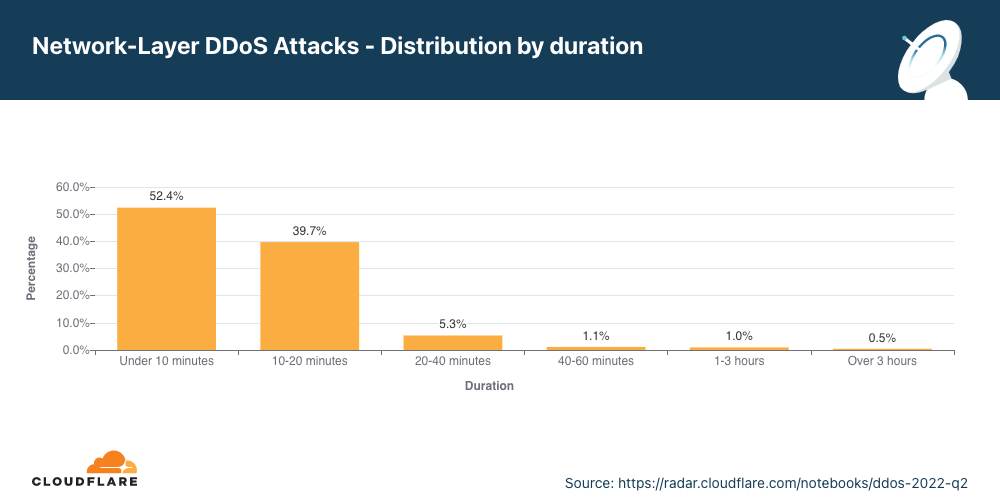
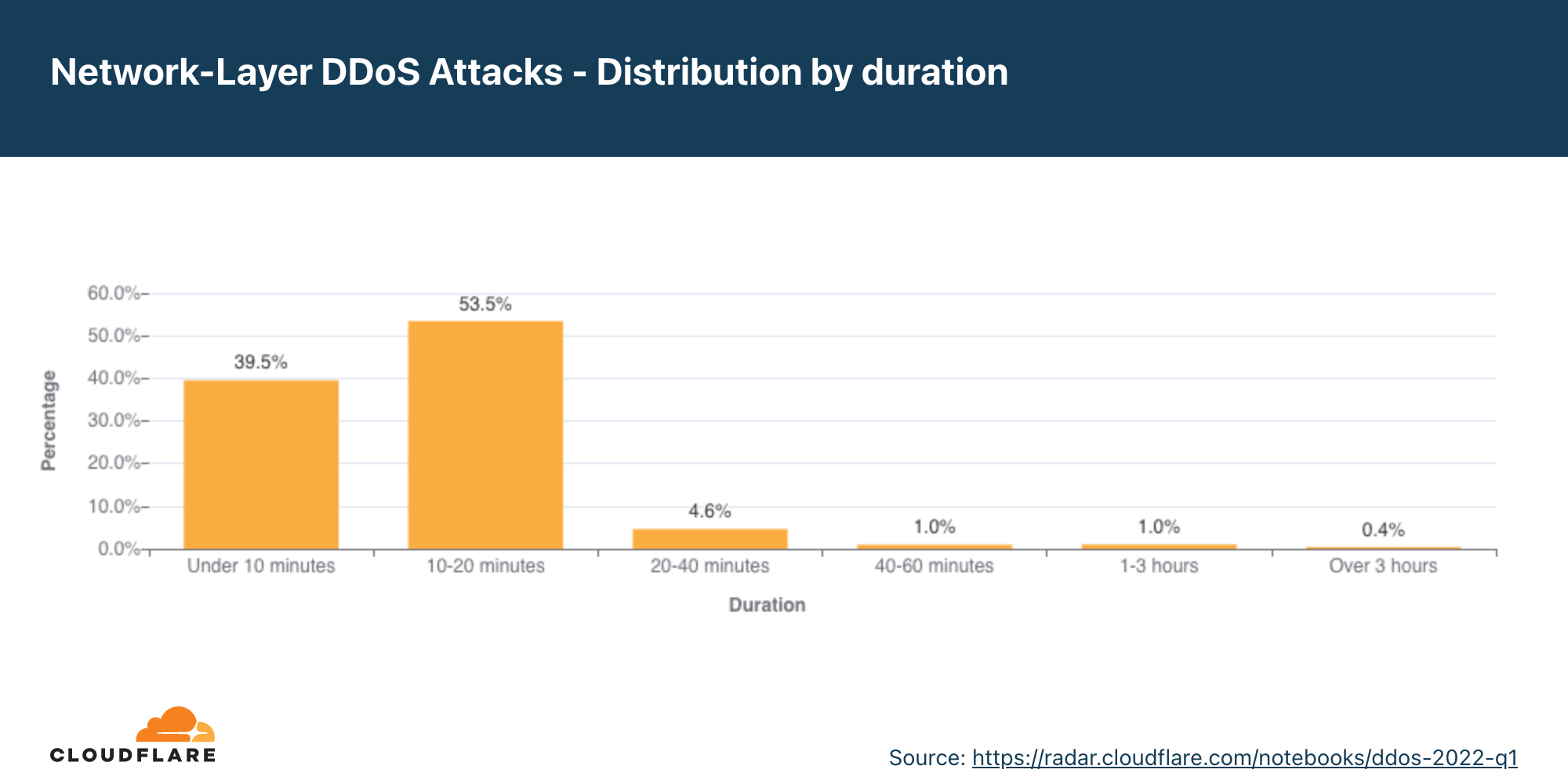
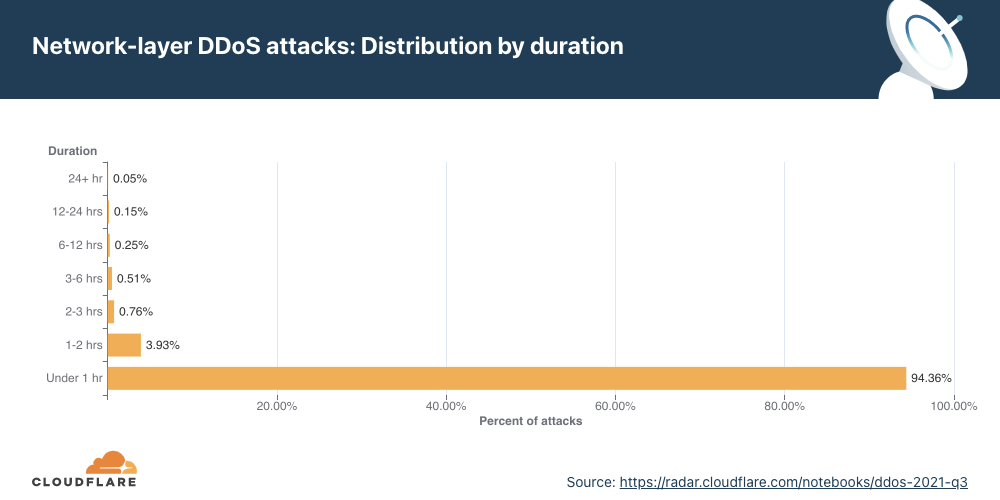
In Q2, 52% of network-layer DDoS attacks lasted less than 10 minutes. Another 40% lasted 10-20 minutes. The remaining 8% include attacks ranging from 20 minutes to over three hours.
One important thing to keep in mind is that even if an attack lasts only a few minutes, if it is successful, the repercussions could last well beyond the initial attack duration. IT personnel responding to a successful attack may spend hours and even days restoring their services.
While most of the attacks are indeed short, we can see an increase of over 15% in attacks ranging between 20-60 minutes, and a 12% increase of attacks lasting more than three hours.
Short attacks can easily go undetected, especially burst attacks that, within seconds, bombard a target with a significant number of packets, bytes, or requests. In this case, DDoS protection services that rely on manual mitigation by security analysis have no chance in mitigating the attack in time. They can only learn from it in their post-attack analysis, then deploy a new rule that filters the attack fingerprint and hope to catch it next time. Similarly, using an “on-demand” service, where the security team will redirect traffic to a DDoS provider during the attack, is also inefficient because the attack will already be over before the traffic routes to the on-demand DDoS provider.
It’s recommended that companies use automated, always-on DDoS protection services that analyze traffic and apply real-time fingerprinting fast enough to block short-lived attacks.
Summary
Cloudflare’s mission is to help build a better Internet. A better Internet is one that is more secure, faster, and reliable for everyone — even in the face of DDoS attacks. As part of our mission, since 2017, we’ve been providing unmetered and unlimited DDoS protection for free to all of our customers. Over the years, it has become increasingly easier for attackers to launch DDoS attacks. But as easy as it has become, we want to make sure that it is even easier — and free — for organizations of all sizes to protect themselves against DDoS attacks of all types.
Not using Cloudflare yet? Start now with our Free and Pro plans to protect your websites, or contact us for comprehensive DDoS protection for your entire network using Magic Transit.
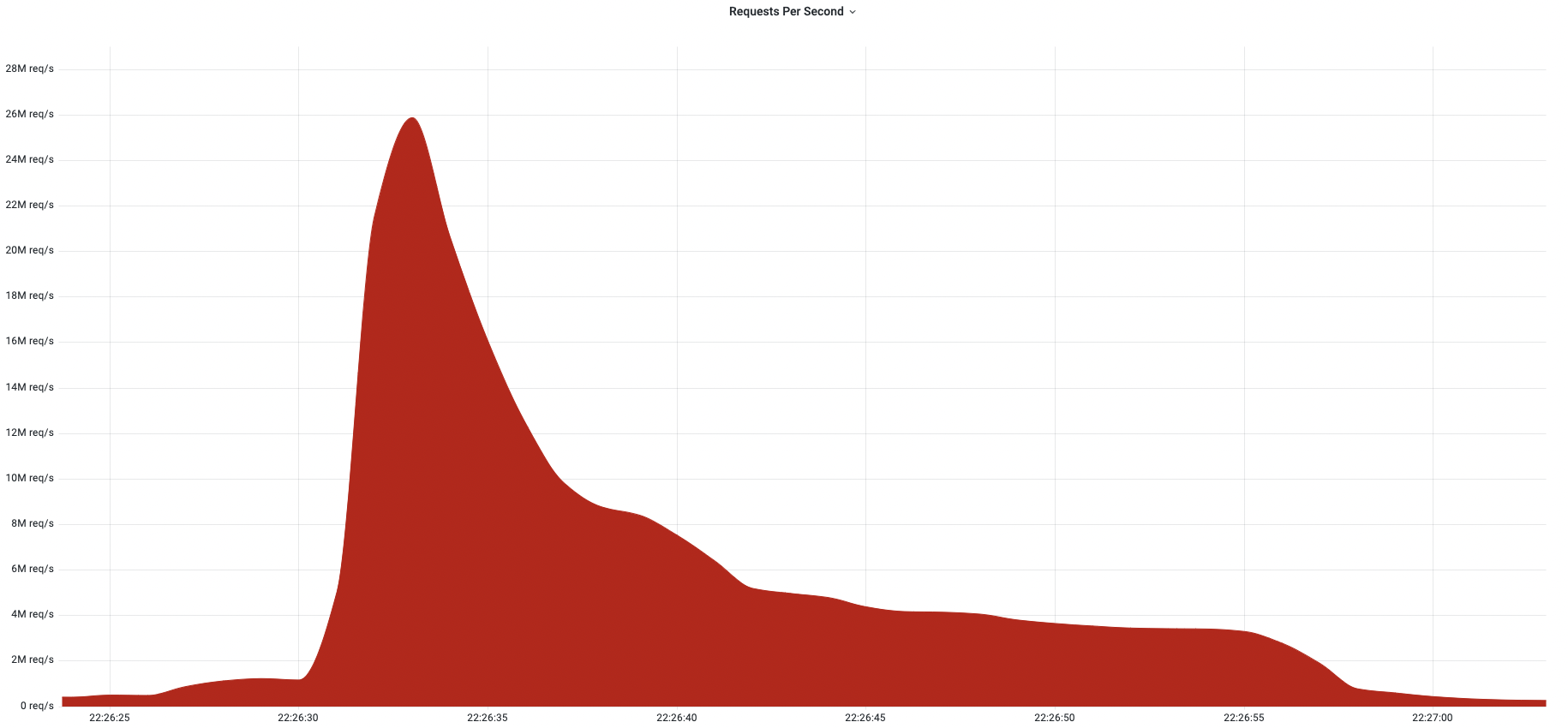
Last week, Cloudflare automatically detected and mitigated a 26 million request per second DDoS attack — the largest HTTPS DDoS attack on record.
The attack targeted a customer website using Cloudflare’s Free plan. Similar to the previous 15M rps attack, this attack also originated mostly from Cloud Service Providers as opposed to Residential Internet Service Providers, indicating the use of hijacked virtual machines and powerful servers to generate the attack — as opposed to much weaker Internet of Things (IoT) devices.
The 26M rps DDoS attack originated from a small but powerful botnet of 5,067 devices. On average, each node generated approximately 5,200 rps at peak. To contrast the size of this botnet, we’ve been tracking another much larger but less powerful botnet of over 730,000 devices. The latter, larger botnet wasn’t able to generate more than one million requests per second, i.e. roughly 1.3 requests per second on average per device. Putting it plainly, this botnet was, on average, 4,000 times stronger due to its use of virtual machines and servers.
Also, worth noting that this attack was over HTTPS. HTTPS DDoS attacks are more expensive in terms of required computational resources because of the higher cost of establishing a secure TLS encrypted connection. Therefore, it costs the attacker more to launch the attack, and for the victim to mitigate it. We’ve seen very large attacks in the past over (unencrypted) HTTP, but this attack stands out because of the resources it required at its scale.
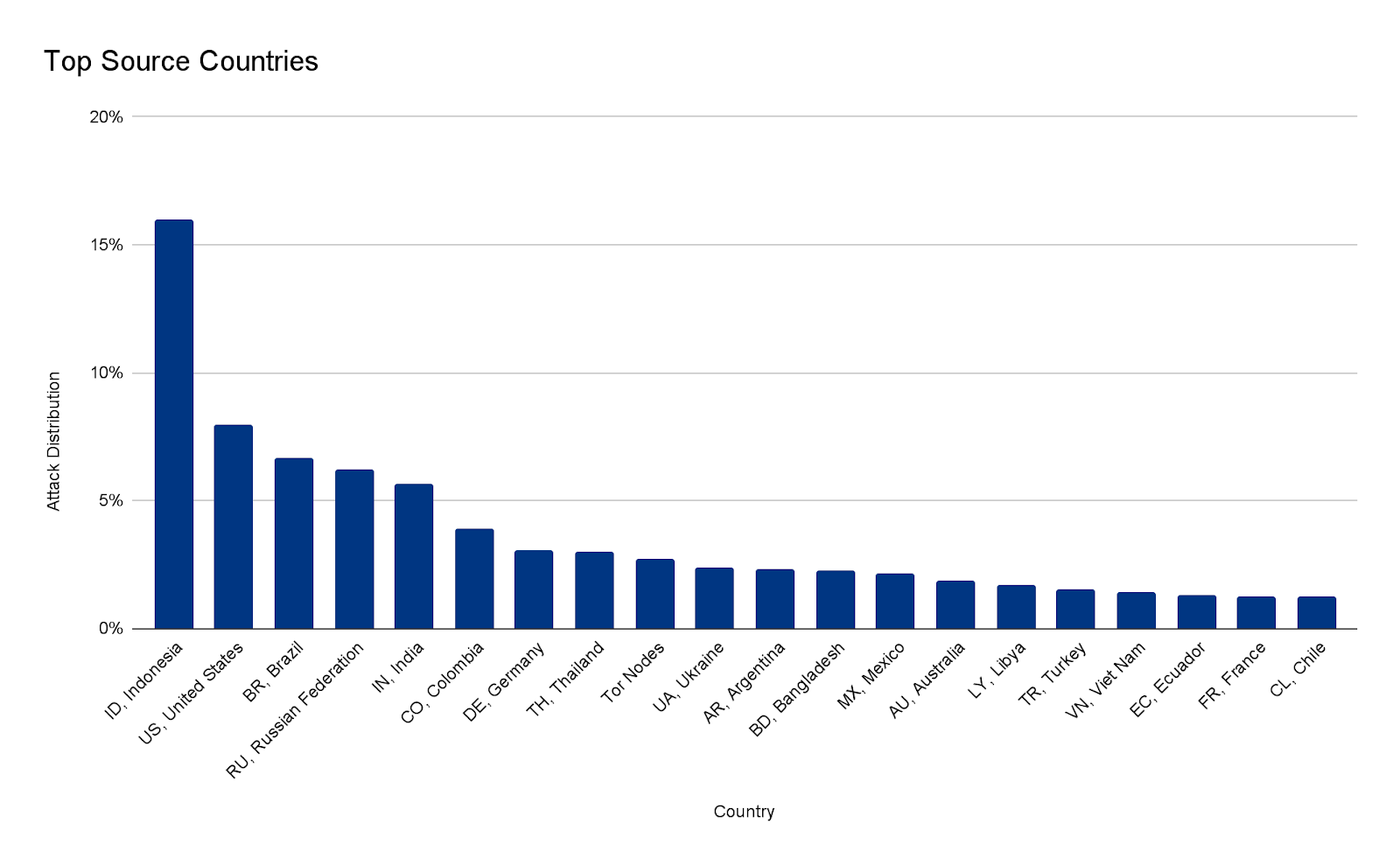
Within less than 30 seconds, this botnet generated more than 212 million HTTPS requests from over 1,500 networks in 121 countries. The top countries were Indonesia, the United States, Brazil and Russia. About 3% of the attack came through Tor nodes.
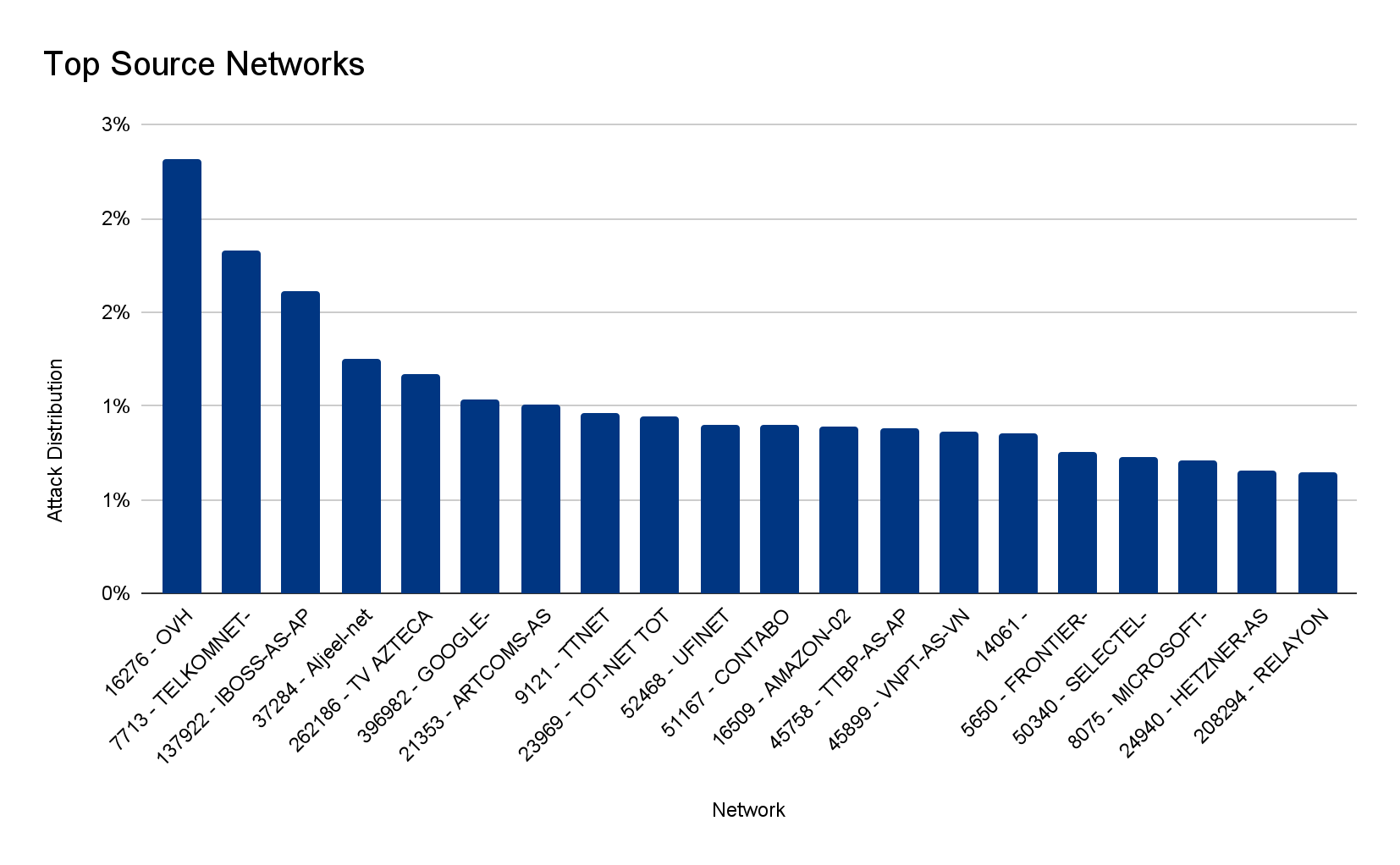
The top source networks were the French-based OVH (Autonomous System Number 16276), the Indonesian Telkomnet (ASN 7713), the US-based iboss (ASN 137922) and the Libyan Ajeel (ASN 37284).
The DDoS threat landscape
It’s important to understand the attack landscape when thinking about DDoS protection. When looking at our recent DDoS Trends report, we can see that most of the attacks are small, e.g. cyber vandalism. However, even small attacks can severely impact unprotected Internet properties. On the other hand, large attacks are growing in size and frequency — but remain short and rapid. Attackers concentrate their botnet’s power to try and wreak havoc with a single quick knockout blow — trying to avoid detection.
DDoS attacks might be initiated by humans, but they are generated by machines. By the time humans can respond to the attack, it may be over. And even if the attack was quick, the network and application failure events can extend long after the attack is over — costing you revenue and reputation. For this reason, it is recommended to protect your Internet properties with an automated always-on protection service that does not rely on humans to detect and mitigate attacks.
Helping build a better Internet
At Cloudflare, everything we do is guided by our mission to help build a better Internet. The DDoS team’s vision is derived from this mission: our goal is to make the impact of DDoS attacks a thing of the past. The level of protection that we offer is unmetered and unlimited — It is not bounded by the size of the attack, the number of the attacks, or the duration of the attacks. This is especially important these days because as we’ve recently seen, attacks are getting larger and more frequent.
Not using Cloudflare yet? Start now with our Free and Pro plans to protect your websites, or contact us for comprehensive DDoS protection for your entire network using Magic Transit.
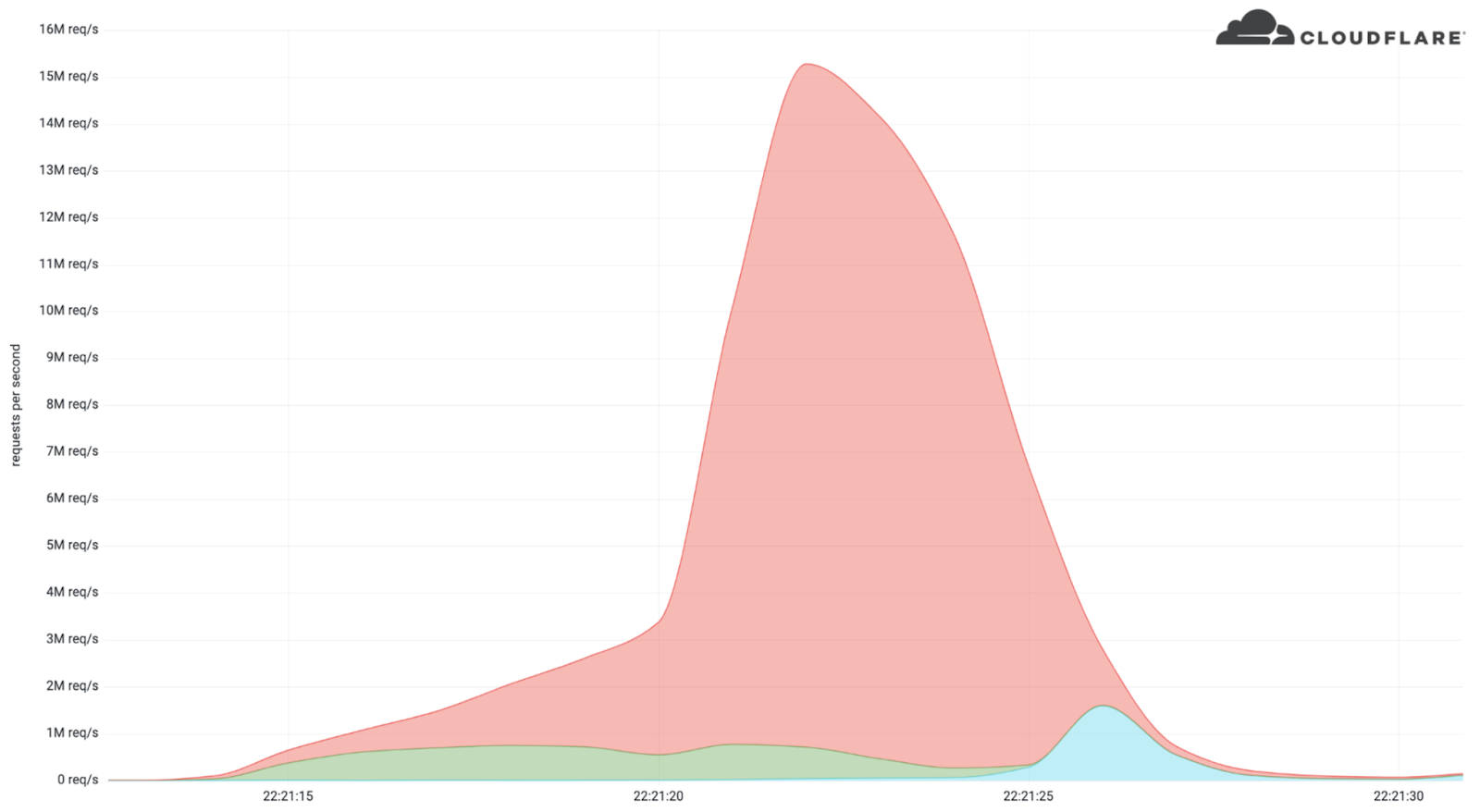
Earlier this month, Cloudflare’s systems automatically detected and mitigated a 15.3 million request-per-second (rps) DDoS attack — one of the largest HTTPS DDoS attacks on record.
While this isn’t the largest application-layer attack we’ve seen, it is the largest we’ve seen over HTTPS. HTTPS DDoS attacks are more expensive in terms of required computational resources because of the higher cost of establishing a secure TLS encrypted connection. Therefore it costs the attacker more to launch the attack, and for the victim to mitigate it. We’ve seen very large attacks in the past over (unencrypted) HTTP, but this attack stands out because of the resources it required at its scale.
The attack, lasting less than 15 seconds, targeted a Cloudflare customer on the Professional (Pro) plan operating a crypto launchpad. Crypto launchpads are used to surface Decentralized Finance projects to potential investors. The attack was launched by a botnet that we’ve been observing — we’ve already seen large attacks as high as 10M rps matching the same attack fingerprint.
Cloudflare customers are protected against this botnet and do not need to take any action.
The attack
What’s interesting is that the attack mostly came from data centers. We’re seeing a big move from residential network Internet Service Providers (ISPs) to cloud compute ISPs.
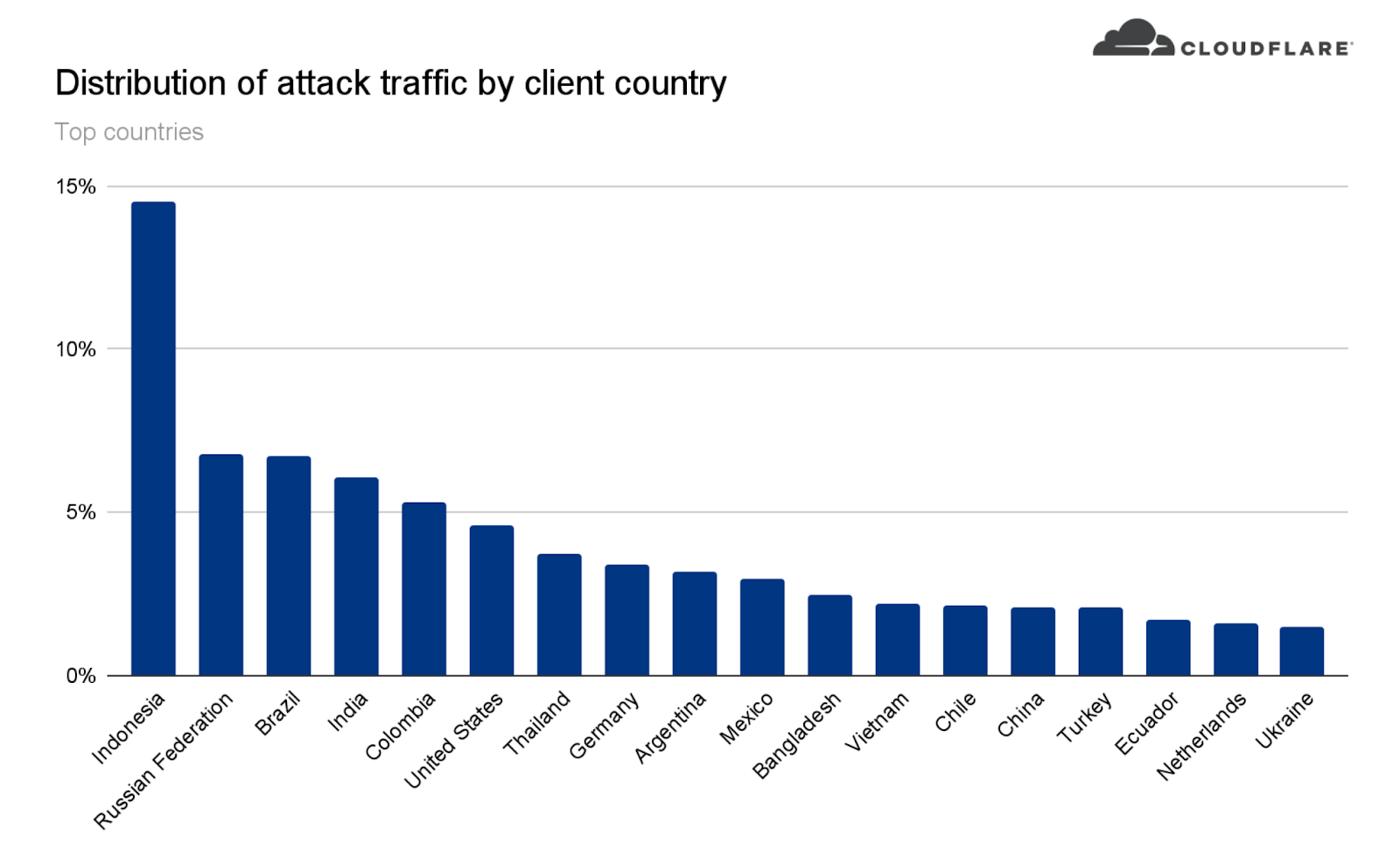
This attack was launched from a botnet of approximately 6,000 unique bots. It originated from 112 countries around the world. Almost 15% of the attack traffic originated from Indonesia, followed by Russia, Brazil, India, Colombia, and the United States.
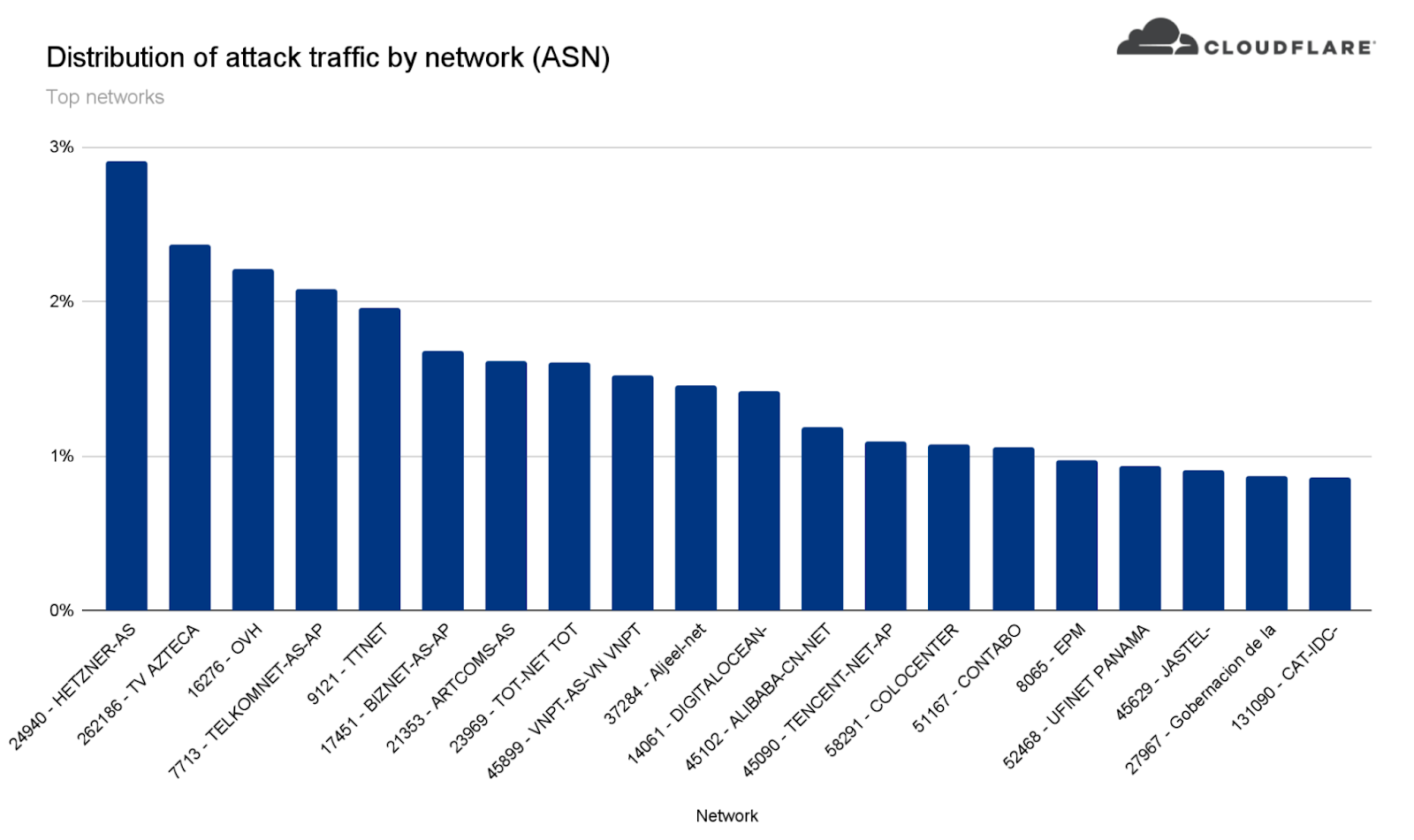
Within those countries, the attack originated from over 1,300 different networks. The top networks included the German provider Hetzner Online GmbH (Autonomous System Number 24940), Azteca Comunicaciones Colombia (ASN 262186), OVH in France (ASN 16276), as well as other cloud providers.
How this attack was automatically detected and mitigated
To defend organizations against DDoS attacks, we built and operate software-defined systems that run autonomously. They automatically detect and mitigate DDoS attacks across our entire network — and just as in this case, the attack was automatically detected and mitigated without any human intervention.
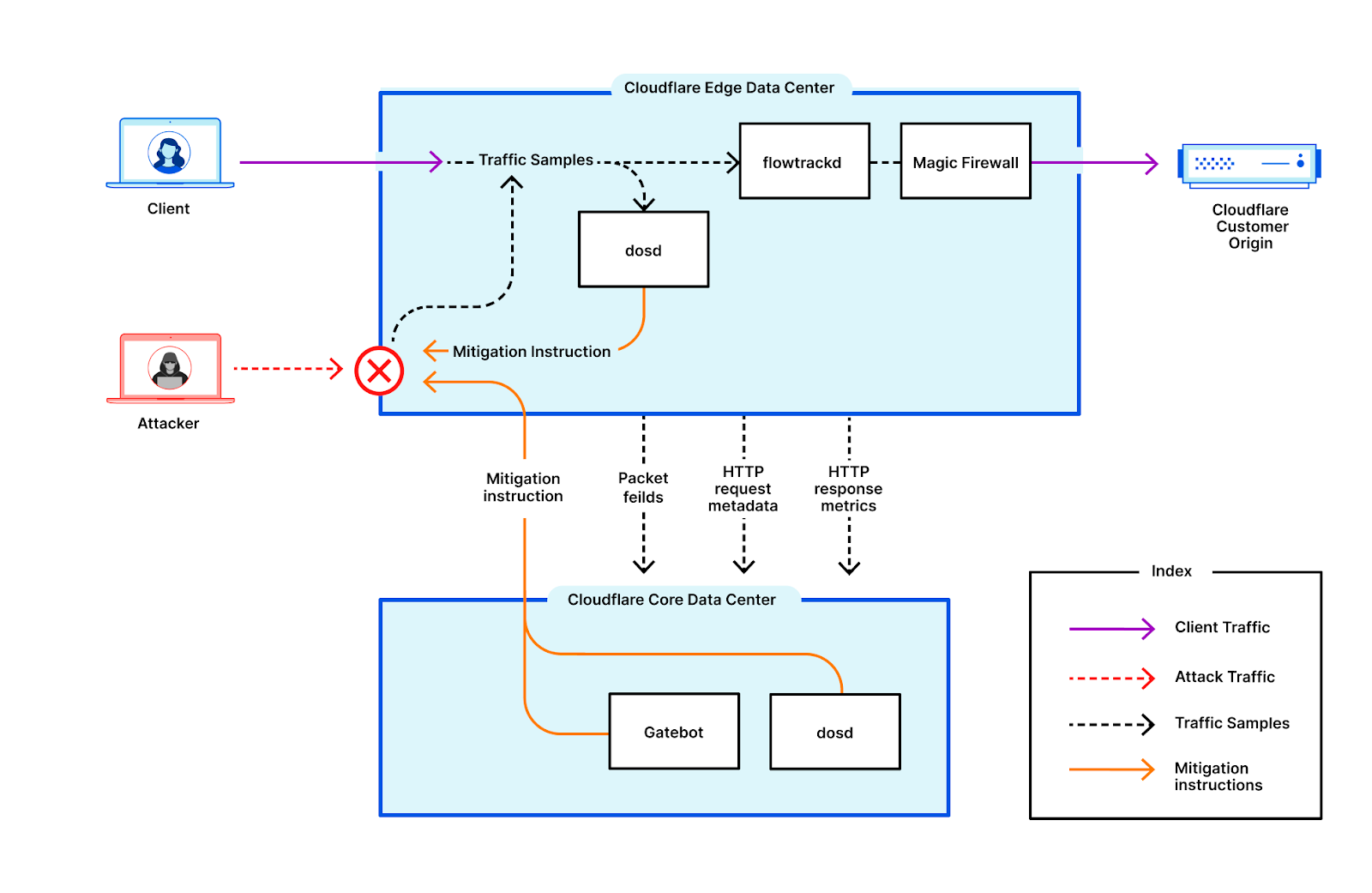
Our system starts by sampling traffic asynchronously; it then analyzes the samples and applies mitigations when needed.
Sampling
Initially, traffic is routed through the Internet via BGP Anycast to the nearest Cloudflare data centers that are located in over 250 cities around the world. Once the traffic reaches our data center, our DDoS systems sample it asynchronously allowing for out-of-path analysis of traffic without introducing latency penalties.
Analysis and mitigation
The analysis is done using data streaming algorithms. HTTP request samples are compared to conditional fingerprints, and multiple real-time signatures are created based on dynamic masking of various request fields and metadata. Each time another request matches one of the signatures, a counter is increased. When the activation threshold is reached for a given signature, a mitigation rule is compiled and pushed inline. The mitigation rule includes the real-time signature and the mitigation action, e.g. block.
Cloudflare customers can also customize the settings of the DDoS protection systems by tweaking the HTTP DDoS Managed Rules.
You can read more about our autonomous DDoS protection systems and how they work in our deep-dive technical blog post.
Helping build a better Internet
At Cloudflare, everything we do is guided by our mission to help build a better Internet. The DDoS team’s vision is derived from this mission: our goal is to make the impact of DDoS attacks a thing of the past. The level of protection that we offer is unmetered and unlimited — It is not bounded by the size of the attack, the number of the attacks, or the duration of the attacks. This is especially important these days because as we’ve recently seen, attacks are getting larger and more frequent.
Not using Cloudflare yet? Start now with our Free and Pro plans to protect your websites, or contact us for comprehensive DDoS protection for your entire network using Magic Transit.
Welcome to our first DDoS report of 2022, and the ninth in total so far. This report includes new data points and insights both in the application-layer and network-layer sections — as observed across the global Cloudflare network between January and March 2022.
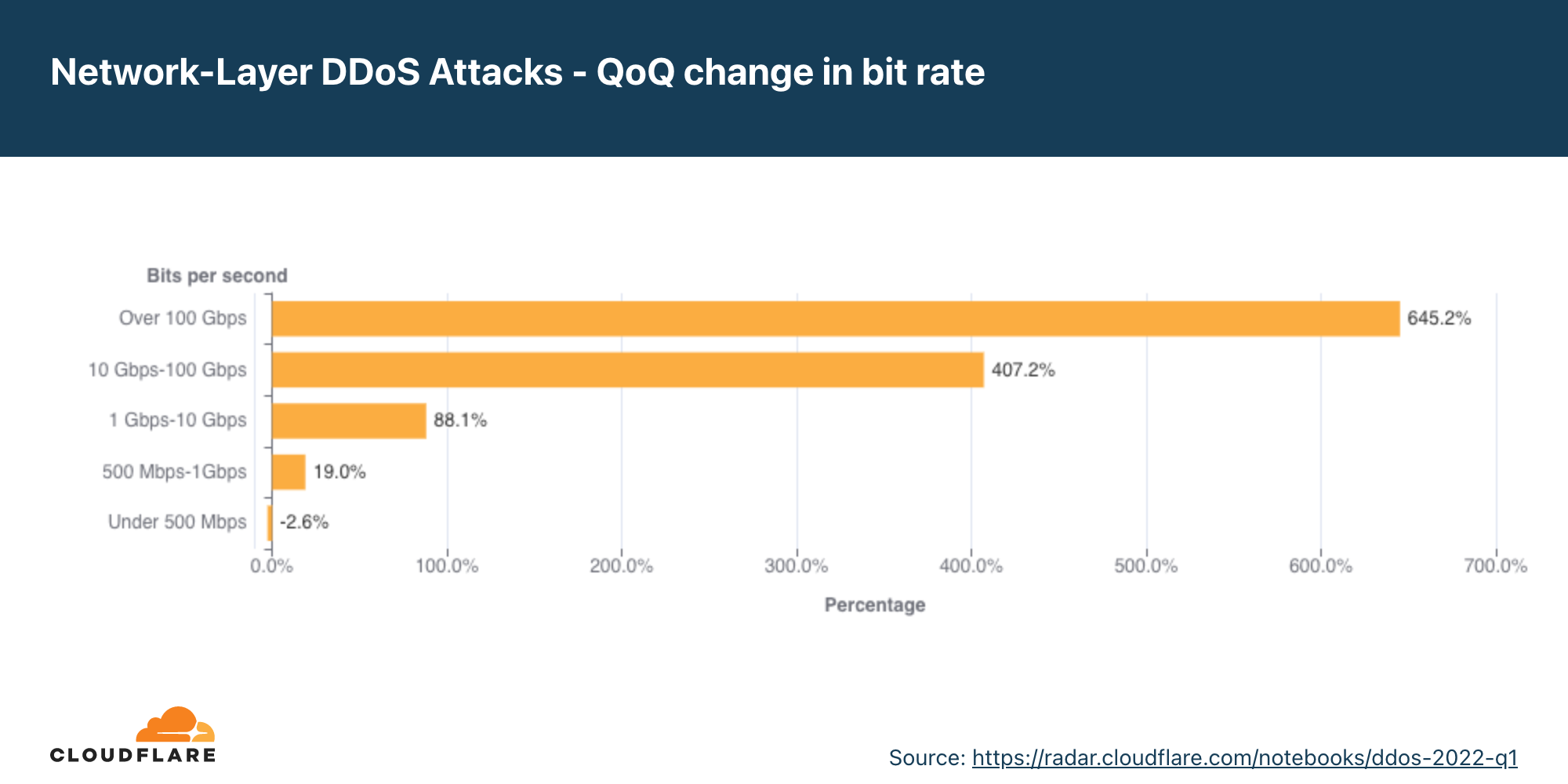
The first quarter of 2022 saw a massive spike in application-layer DDoS attacks, but a decrease in the total number of network-layer DDoS attacks. Despite the decrease, we’ve seen volumetric DDoS attacks surge by up to 645% QoQ, and we mitigated a new zero-day reflection attack with an amplification factor of 220 billion percent.
In the Russian and Ukrainian cyberspace, the most targeted industries were Online Media and Broadcast Media. In our Azerbaijan and Palestinian Cloudflare data centers, we’ve seen enormous spikes in DDoS activity — indicating the presence of botnets operating from within.
The Highlights
The Russian and Ukrainian cyberspace
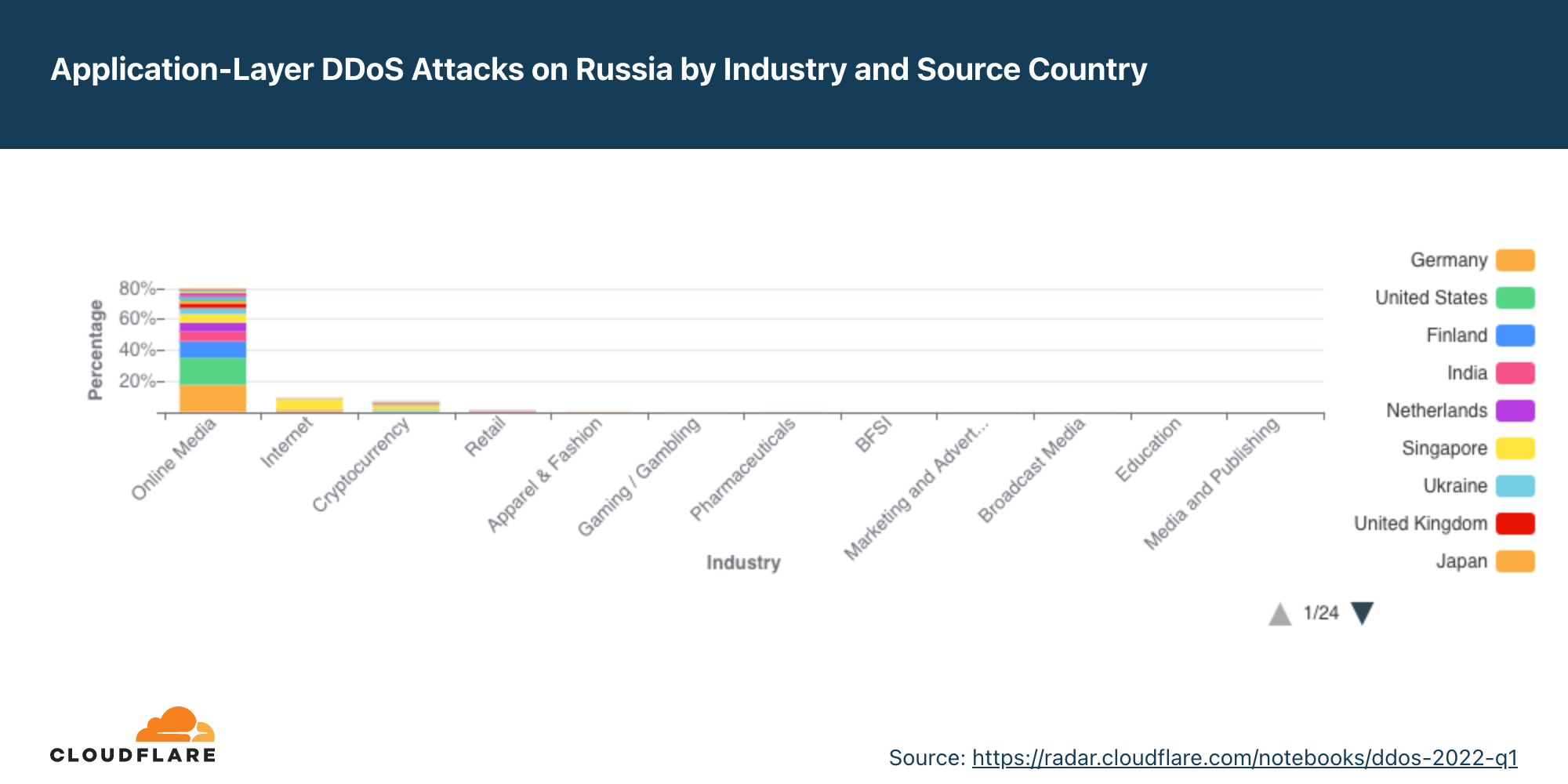
Russian Online Media companies were the most targeted industries within Russia in Q1. The next most targeted was the Internet industry, then Cryptocurrency, and then Retail. While many attacks that targeted Russian Cryptocurrency companies originated in Ukraine or the US, another major source of attacks was from within Russia itself.
The majority of HTTP DDoS attacks that targeted Russian companies originated from Germany, the US, Singapore, Finland, India, the Netherlands, and Ukraine. It’s important to note that being able to identify where cyber attack traffic originates is not the same as being able to attribute where the attacker is located.
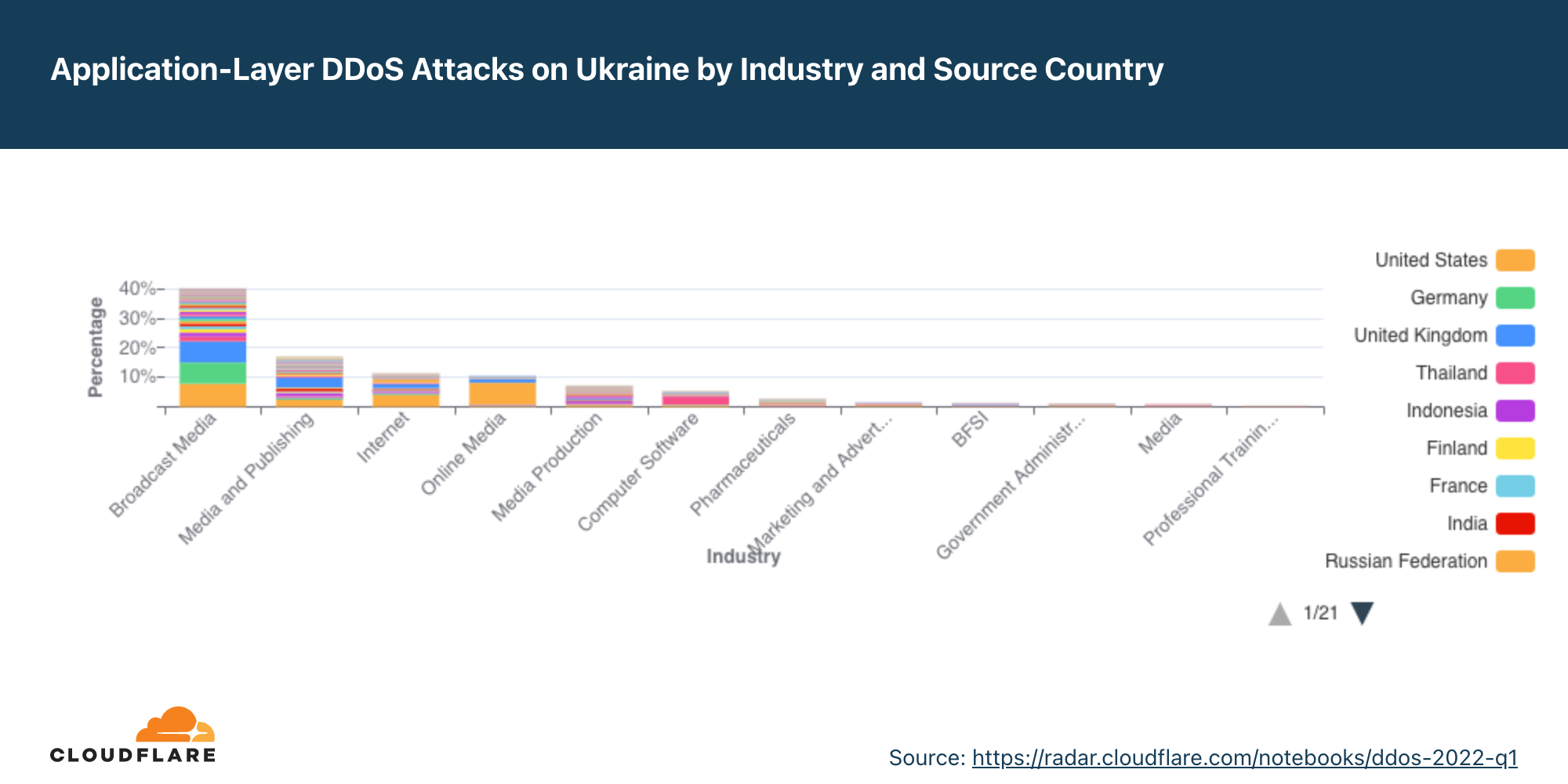
Attacks on Ukraine targeted Broadcast Media and Publishing websites and seem to have been more distributed, originating from more countries — which may indicate the use of global botnets. Still, most of the attack traffic originated from the US, Russia, Germany, China, the UK, and Thailand.
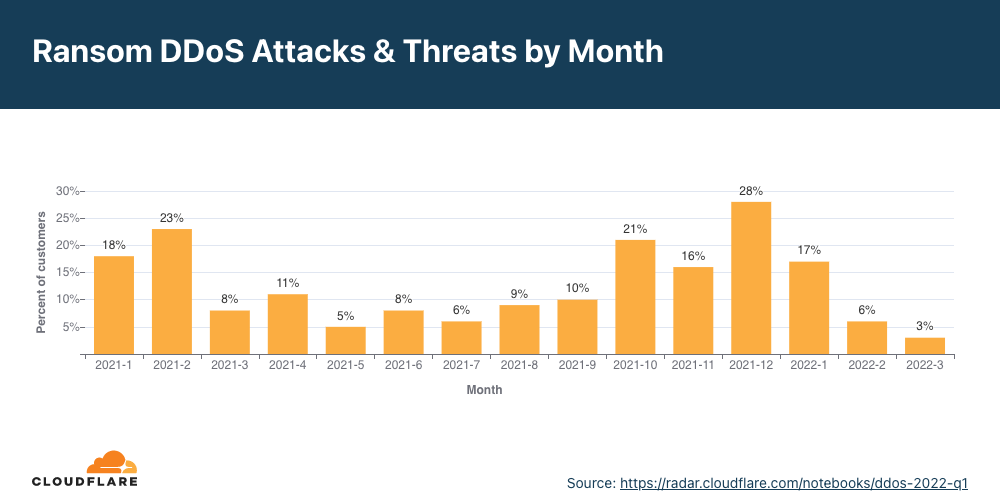
In January 2022, over 17% of under-attack respondents reported being targeted by ransom DDoS attacks or receiving a threat in advance.
That figure drastically dropped to 6% in February, and then to 3% in March.
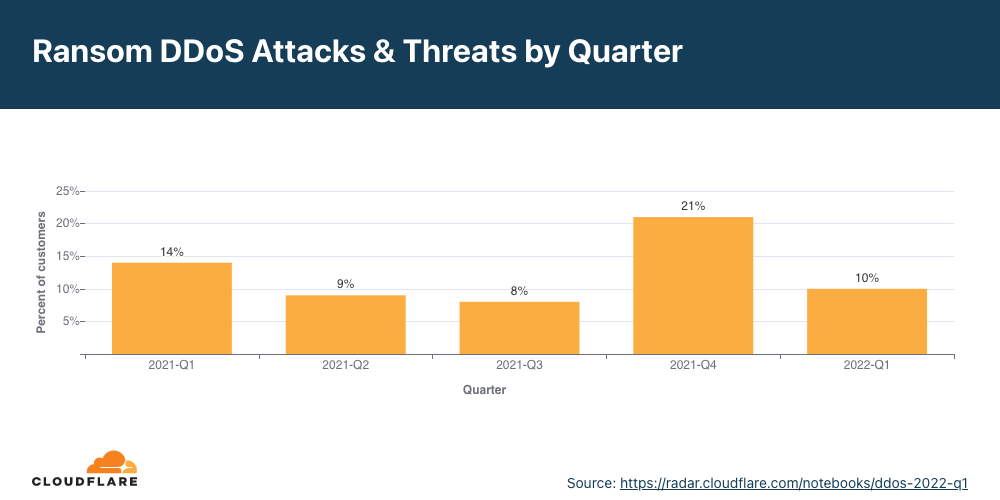
When compared to previous quarters, we can see that in total, in Q1, only 10% of respondents reported a ransom DDoS attack; a 28% decrease YoY and 52% decrease QoQ.
Application-layer DDoS attacks
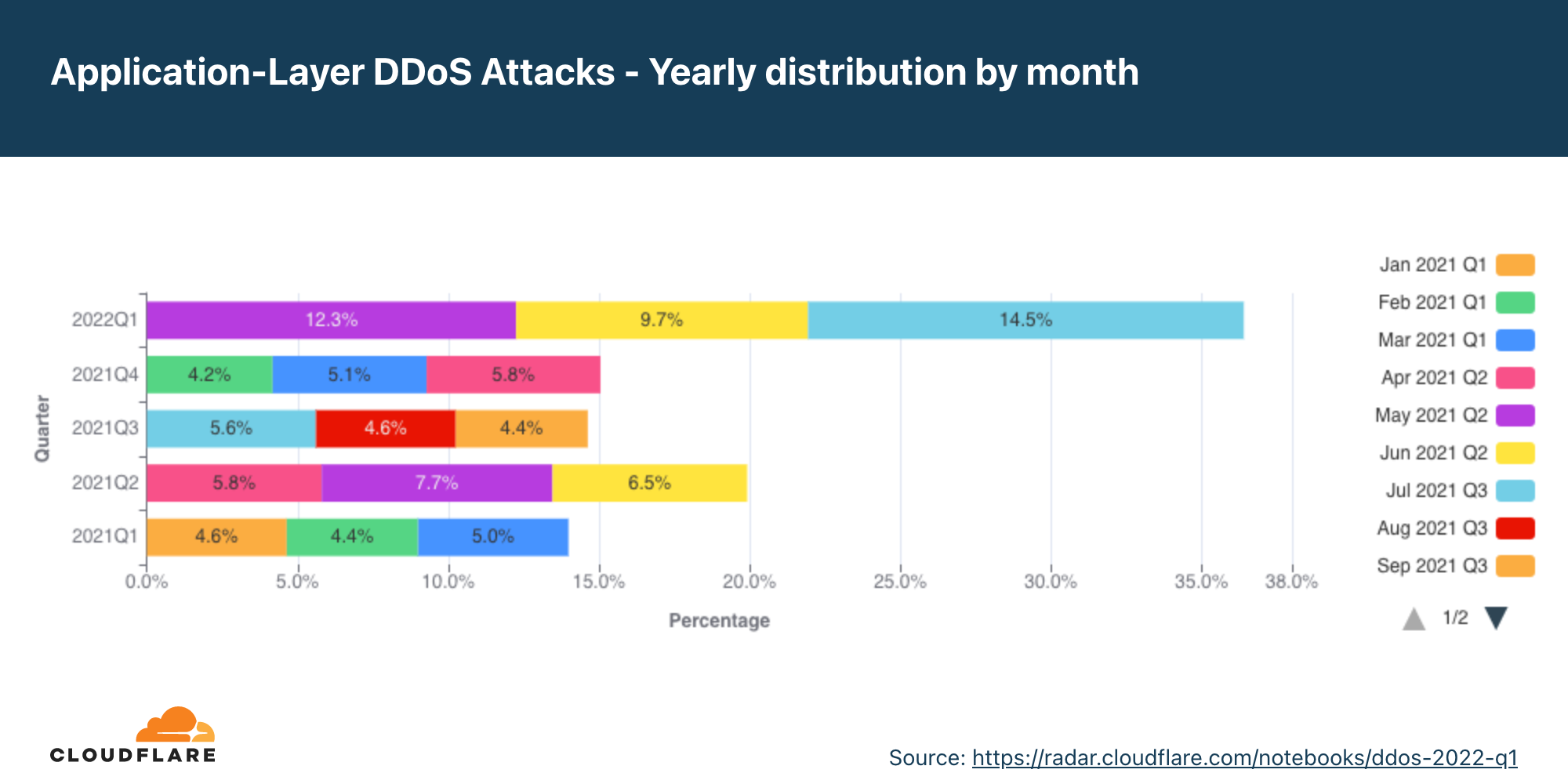
2022 Q1 was the busiest quarter in the past 12 months for application-layer attacks. HTTP-layer DDoS attacks increased by 164% YoY and 135% QoQ.
Diving deeper into the quarter, in March 2022 there were more HTTP DDoS attacks than in all of Q4 combined (and Q3, and Q1).
After four consecutive quarters in a row with China as the top source of HTTP DDoS attacks, the US stepped into the lead this quarter. HTTP DDoS attacks originating from the US increased by a staggering 6,777% QoQ and 2,225% YoY.
Network-layer DDoS attacks
Network-layer attacks in Q1 increased by 71% YoY but decreased 58% QoQ.
The Telecommunications industry was the most targeted by network-layer DDoS attacks, followed by Gaming and Gambling companies, and the Information Technology and Services industry.
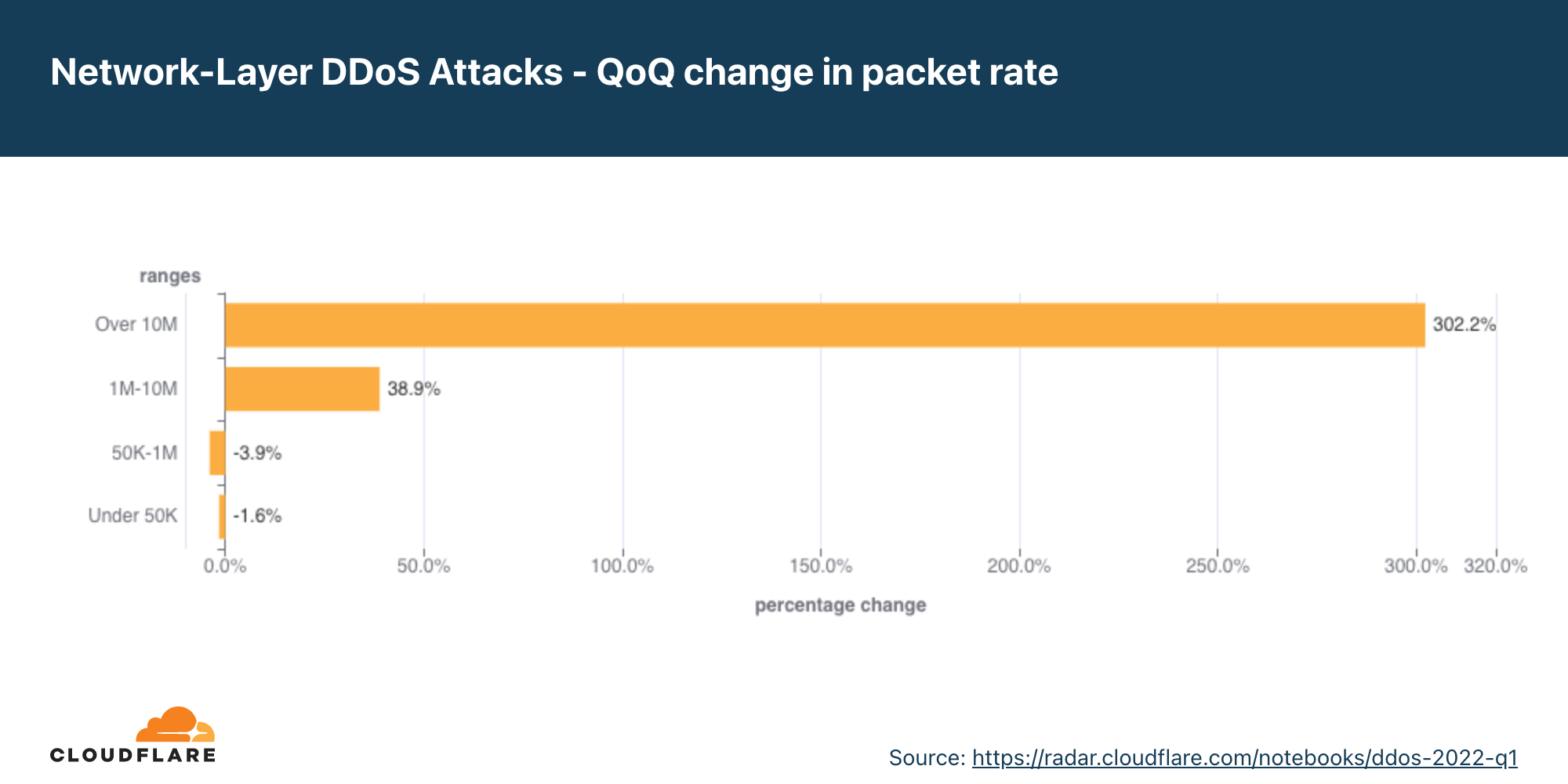
Volumetric attacks increased in Q1. Attacks above 10 Mpps (million packets per second) grew by over 300% QoQ, and attacks over 100 Gbps grew by 645% QoQ.
This report is based on DDoS attacks that were automatically detected and mitigated by Cloudflare’s DDoS Protection systems. To learn more about how it works, check out this deep-dive blog post.
A note on how we measure DDoS attacks observed over our network To analyze attack trends, we calculate the “DDoS activity” rate, which is either the percentage of attack traffic out of the total traffic (attack + clean) observed over our global network, or in a specific location, or in a specific category (e.g., industry or billing country). Measuring the percentages allows us to normalize data points and avoid biases reflected in absolute numbers towards, for example, a Cloudflare data center that receives more total traffic and likely, also more attacks.
To view an interactive version of this report view it on Cloudflare Radar.
Ransom Attacks
Our systems constantly analyze traffic and automatically apply mitigation when DDoS attacks are detected. Each DDoS’d customer is prompted with an automated survey to help us better understand the nature of the attack and the success of the mitigation.
For over two years now, Cloudflare has been surveying attacked customers — one question on the survey being if they received a threat or a ransom note demanding payment in exchange to stop the DDoS attack. In the last quarter, 2021 Q4, we observed a record-breaking level of reported ransom DDoS attacks (one out of every five customers). This quarter, we’ve witnessed a drop in ransom DDoS attacks with only one out of 10 respondents reporting a ransom DDoS attack; a 28% decrease YoY and 52% decrease QoQ.
When we break it down by month, we can see that January 2022 saw the largest number of respondents reporting receiving a ransom letter in Q1. Almost one out of every five customers (17%).
Application-layer DDoS attacks
Application-layer DDoS attacks, specifically HTTP DDoS attacks, are attacks that usually aim to disrupt a web server by making it unable to process legitimate user requests. If a server is bombarded with more requests than it can process, the server will drop legitimate requests and — in some cases — crash, resulting in degraded performance or an outage for legitimate users.
Application-layer DDoS attacks by month
In Q1, application-layer DDoS attacks soared by 164% YoY and 135% QoQ – the busiest quarter within the past year.
Application-layer DDoS attacks increased to new heights in the first quarter of 2022. In March alone, there were more HTTP DDoS attacks than in all of 2021 Q4 combined (and Q3, and Q1).
Application-layer DDoS attacks by industry
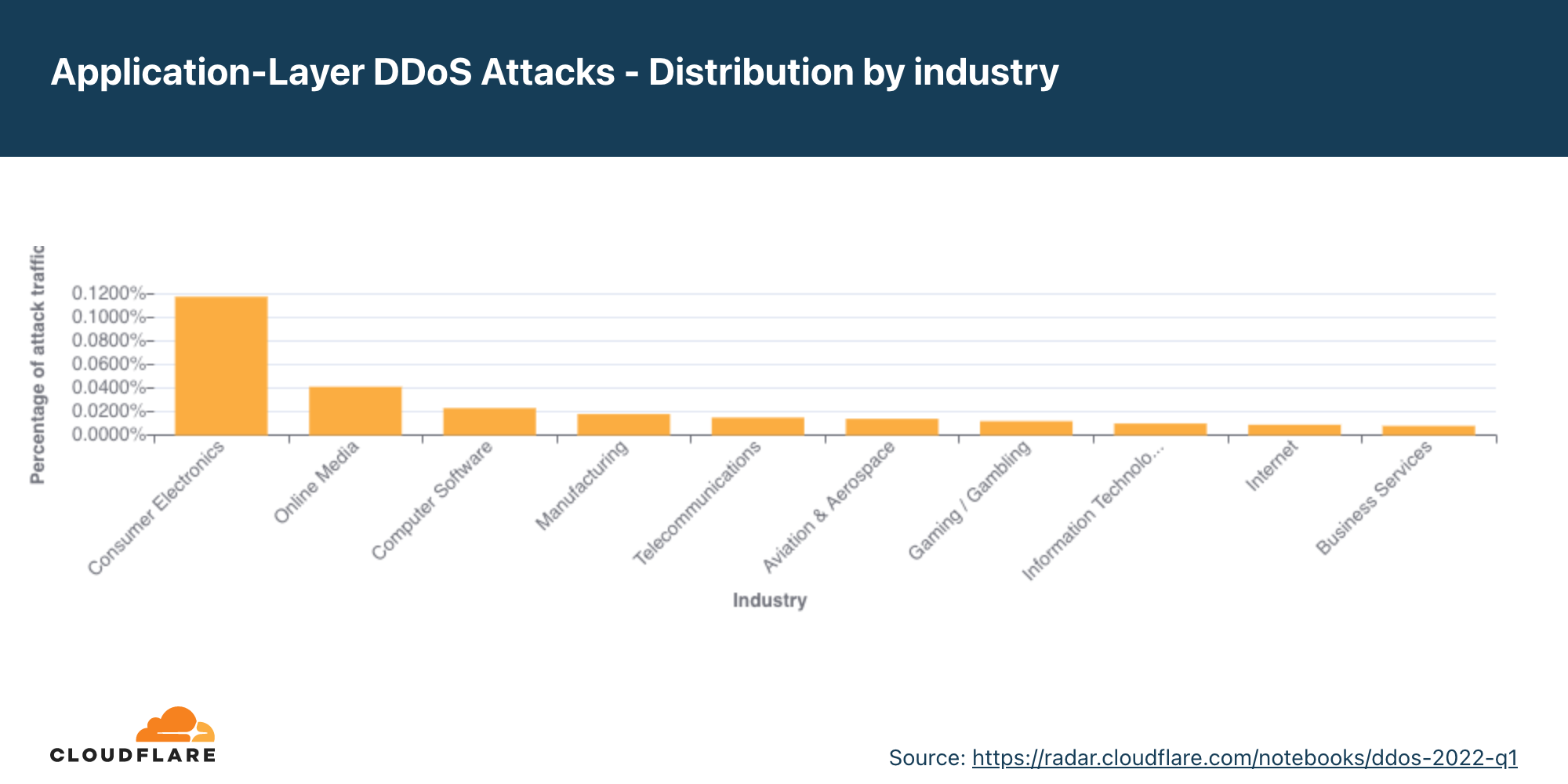
Consumer Electronics was the most targeted industry in Q1.
Globally, the Consumer Electronics industry was the most attacked with an increase of 5,086% QoQ. Second was the Online Media industry with a 2,131% increase in attacks QoQ. Third were Computer Software companies, with an increase of 76% QoQ and 1,472 YoY.
To understand the origin of the HTTP attacks, we look at the geolocation of the source IP address belonging to the client that generated the attack HTTP requests. Unlike network-layer attacks, source IP addresses cannot be spoofed in HTTP attacks. A high percentage of DDoS activity in a given country usually indicates the presence of botnets operating from within the country’s borders.
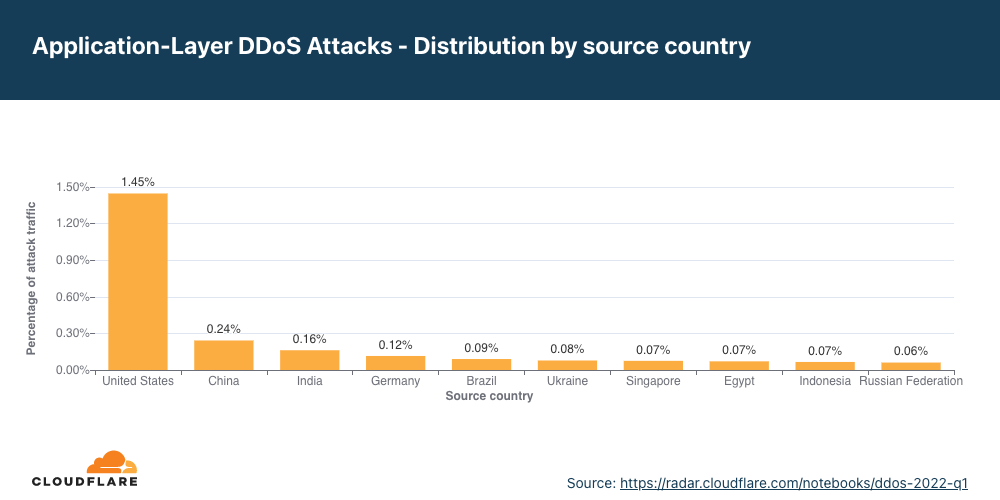
After four consecutive quarters in a row with China as the top source of HTTP DDoS attacks, the US stepped into the lead this quarter. HTTP DDoS attacks originating from the US increased by a staggering 6,777% QoQ and 2,225% YoY. Following China in second place are India, Germany, Brazil, and Ukraine.
Application-layer DDoS attacks by target country
In order to identify which countries are targeted by the most HTTP DDoS attacks, we bucket the DDoS attacks by our customers’ billing countries and represent it as a percentage out of all DDoS attacks.
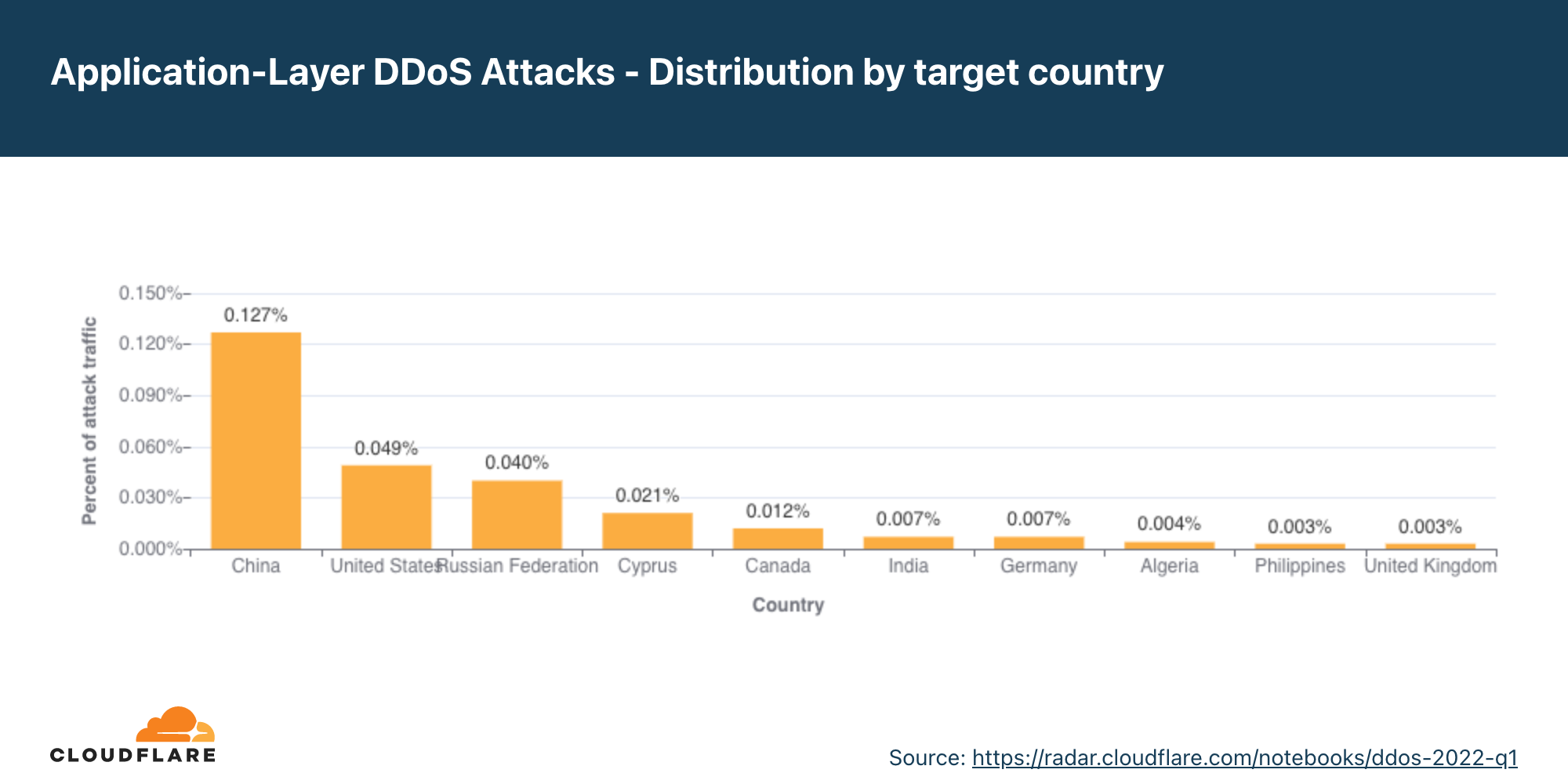
The US drops to second place, after being first for three consecutive quarters. Organizations in China were targeted the most by HTTP DDoS attacks, followed by the US, Russia, and Cyprus.
Network-layer DDoS attacks
While application-layer attacks target the application (Layer 7 of the OSI model) running the service that end users are trying to access (HTTP/S in our case), network-layer attacks aim to overwhelm network infrastructure (such as in-line routers and servers) and the Internet link itself.
Network-layer DDoS attacks by month
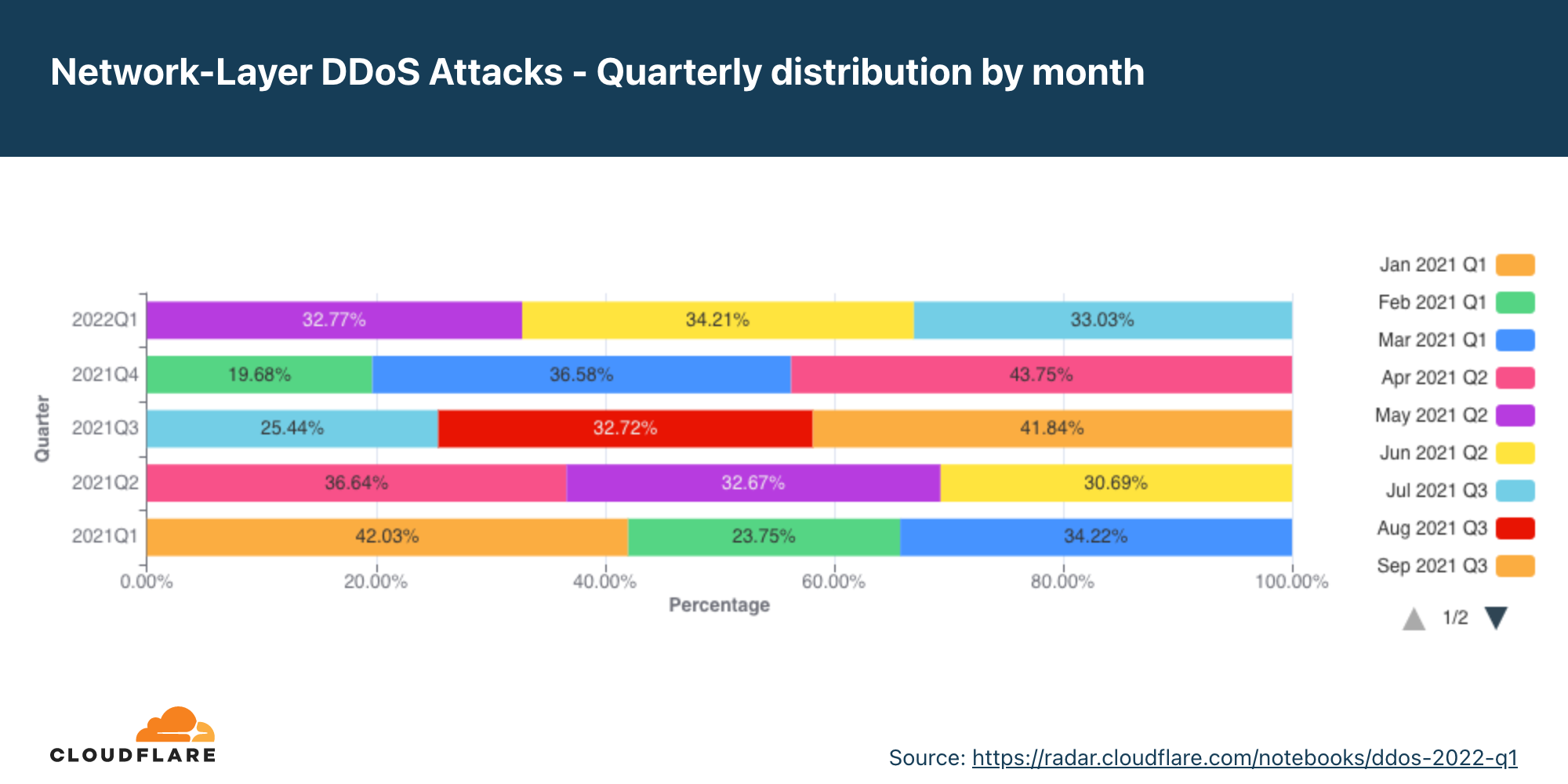
While HTTP DDoS attacks soared in Q1, network-layer DDoS attacks actually decreased by 58% QoQ, but still increased by 71% YoY.
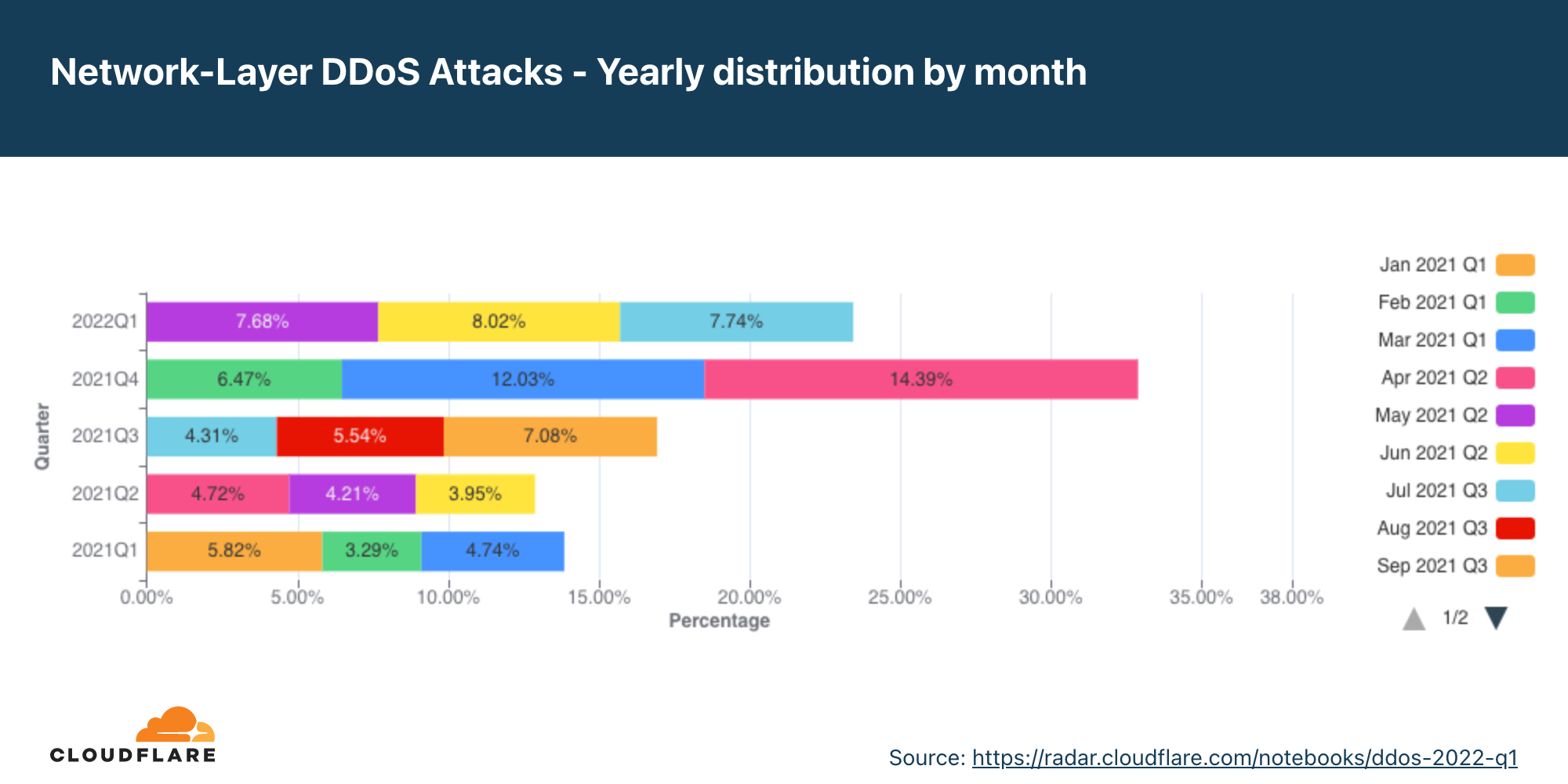
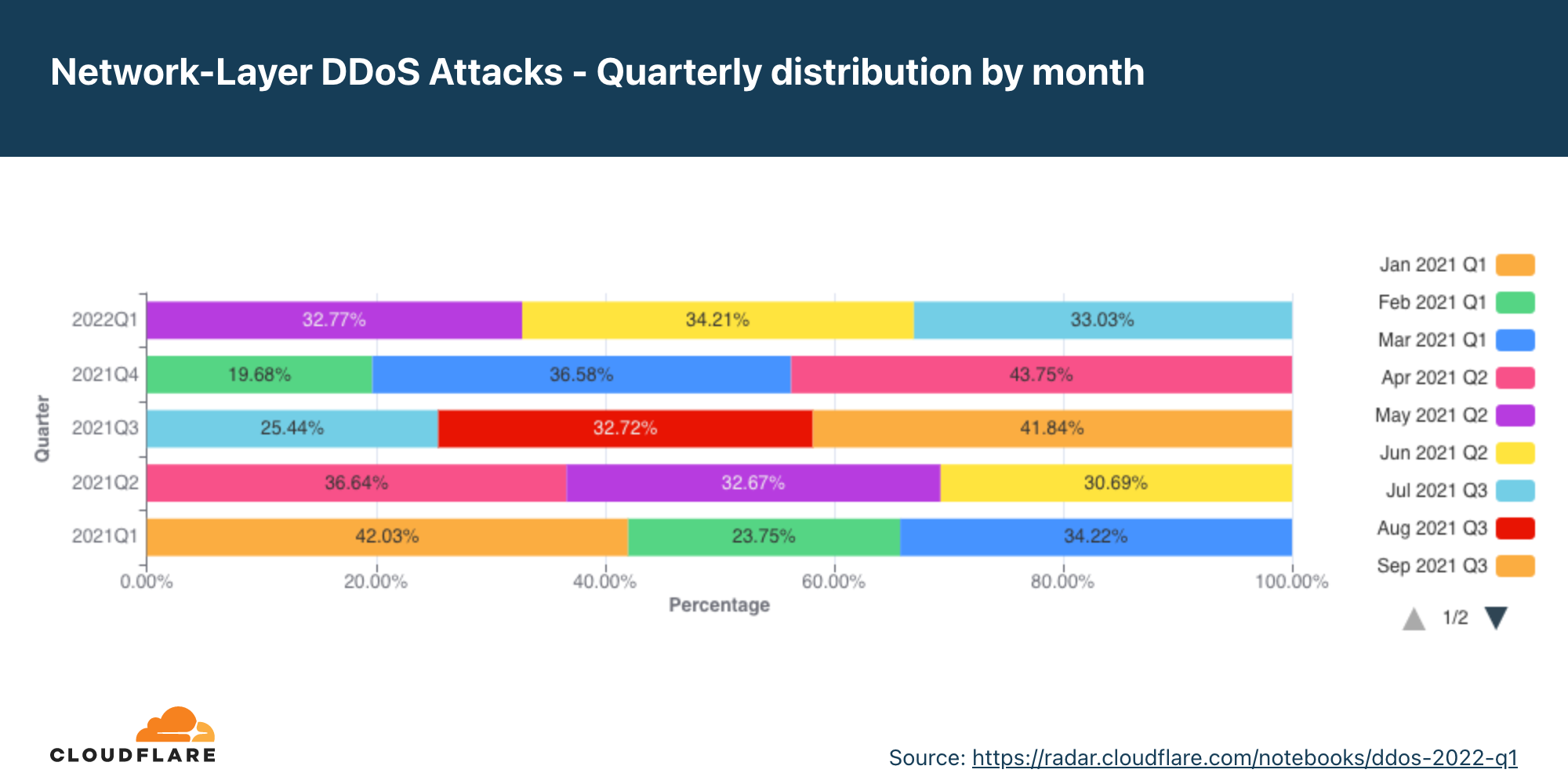
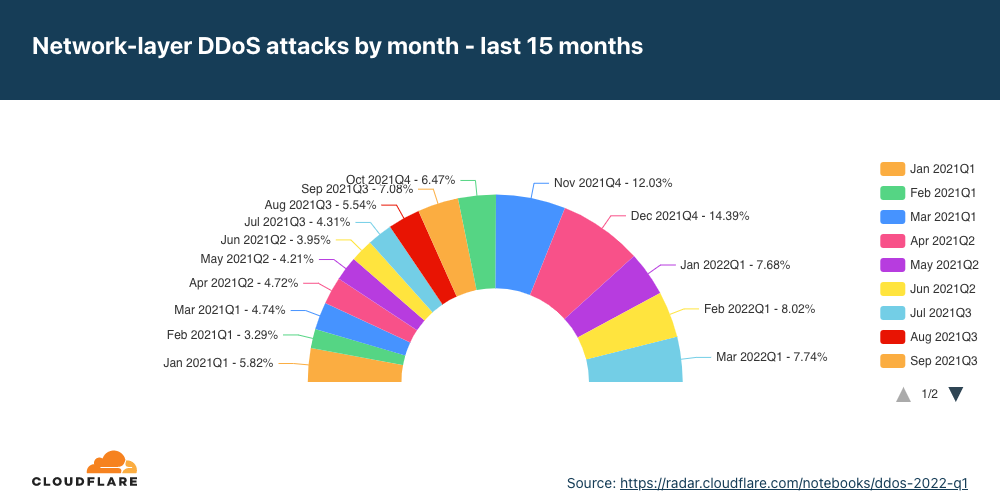
Diving deeper into Q1, we can see that the amount of network-layer DDoS attacks remained mostly consistent throughout the quarter with about a third of attacks occurring every month.
Amongst these network-layer DDoS attacks are also zero-day DDoS attacks that Cloudflare automatically detected and mitigated.
In the beginning of March, Cloudflare researchers helped investigate and expose a zero-day vulnerability in Mitel business phone systems that amongst other possible exploitations, also enables attackers to launch an amplification DDoS attack. This type of attack reflects traffic off vulnerable Mitel servers to victims, amplifying the amount of traffic sent in the process by an amplification factor of 220 billion percent in this specific case. You can read more about it in our recent blog post.
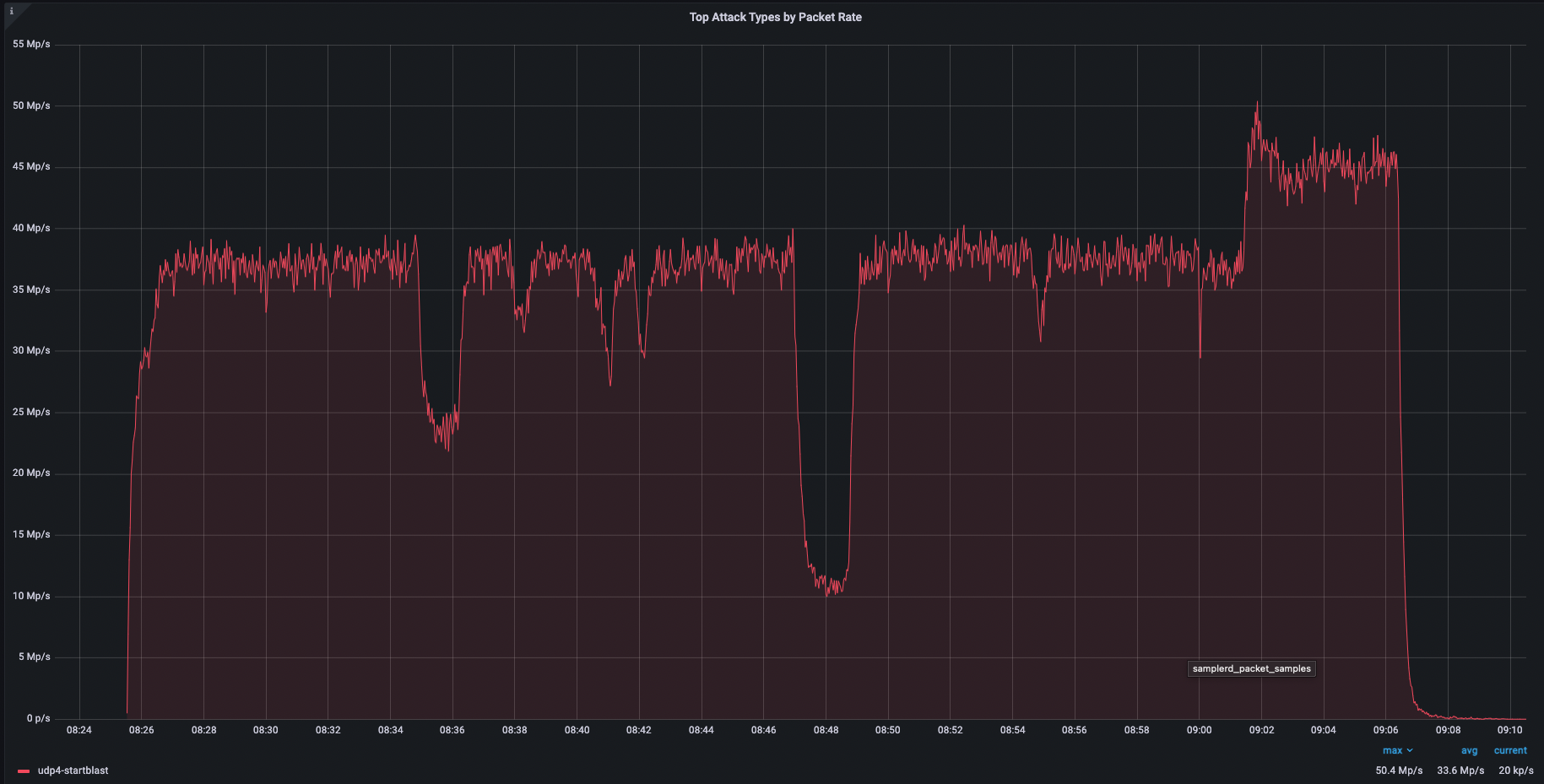
We observed several of these attacks across our network. One of them targeted a North American cloud provider using the Cloudflare Magic Transit service. The attack originated from 100 source IPs mainly from the US, UK, Canada, Netherlands, Australia, and approximately 20 other countries. It peaked above 50 Mpps (~22 Gbps) and was automatically detected and mitigated by Cloudflare systems.
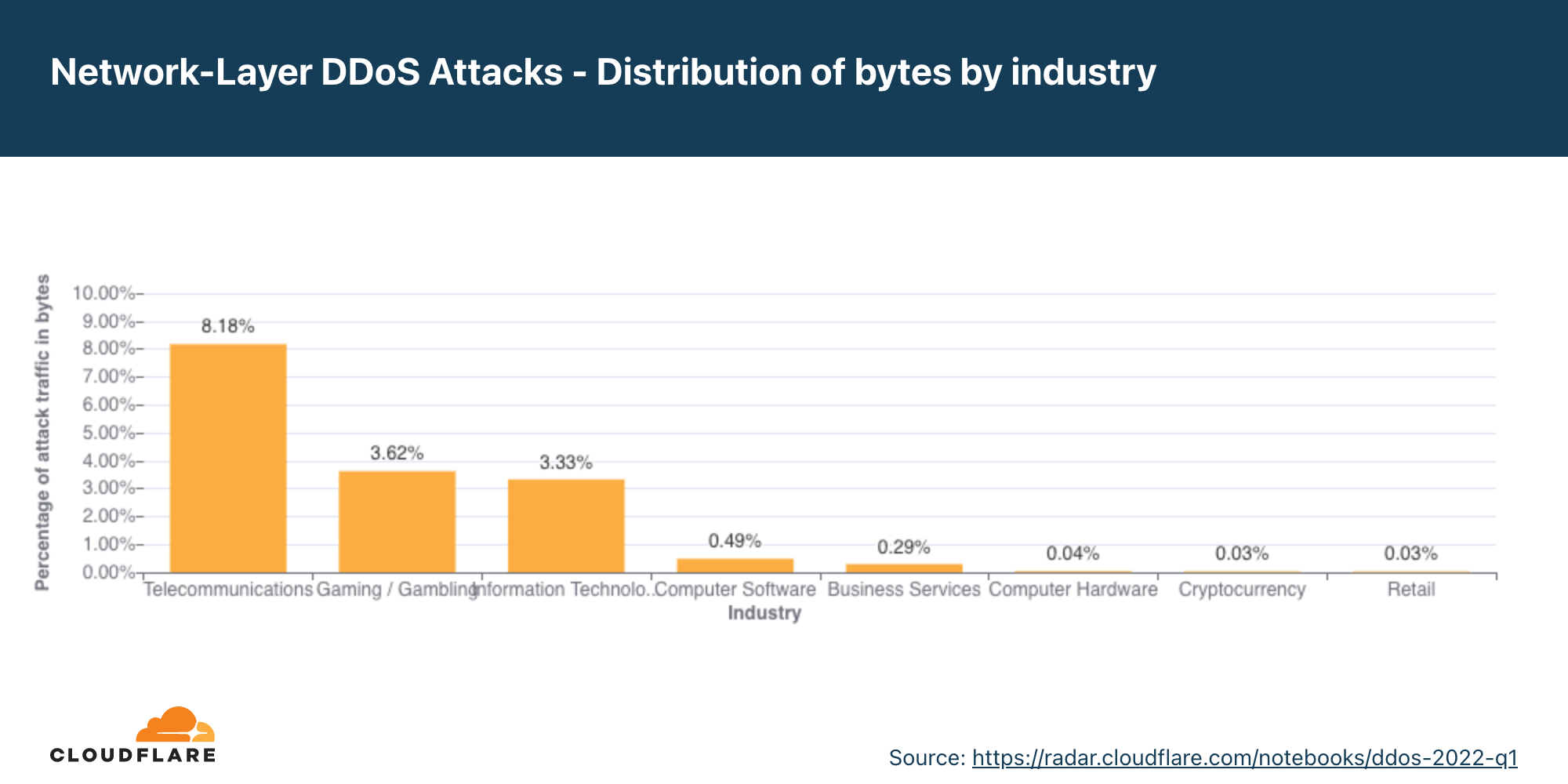
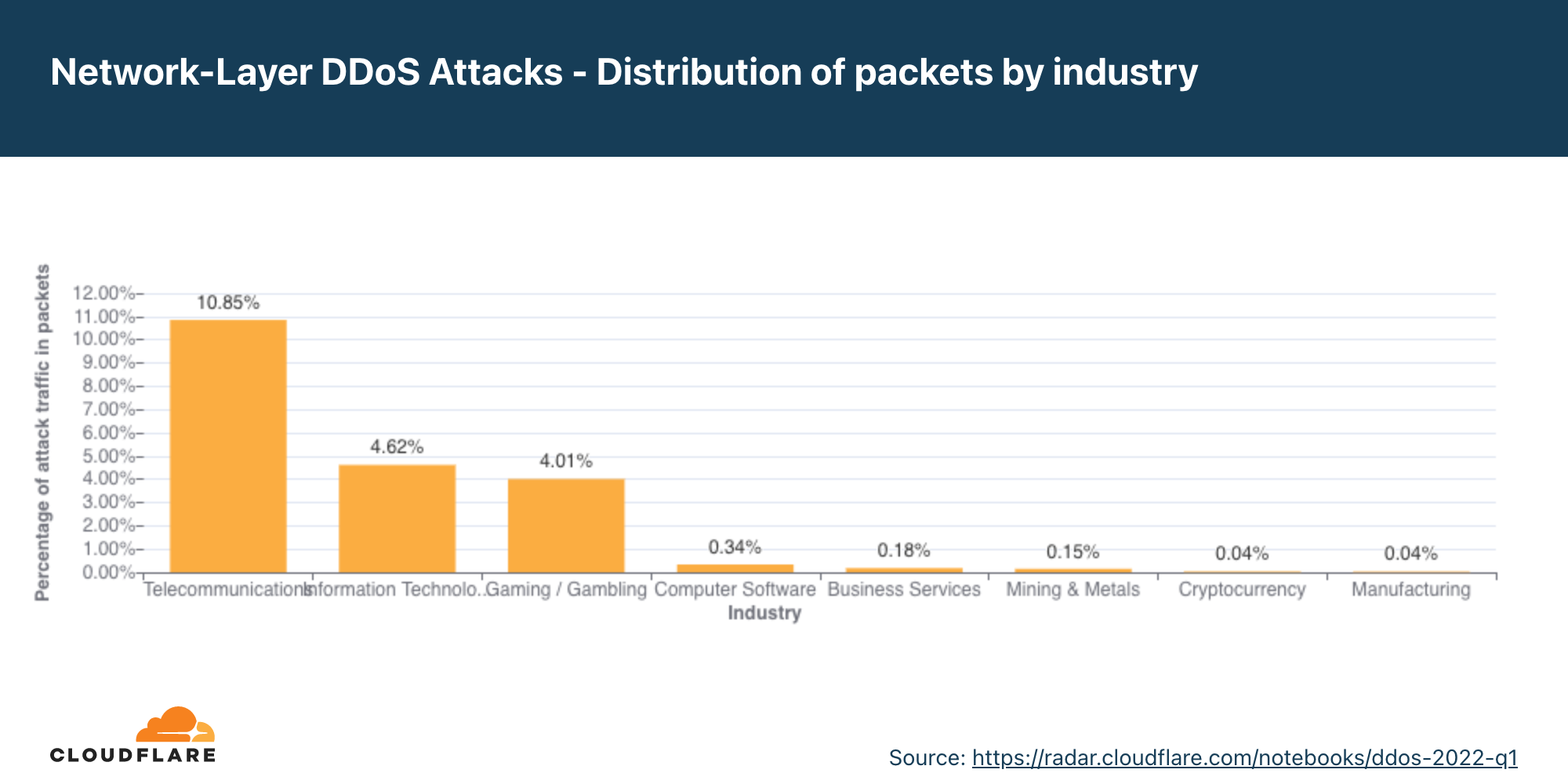
In this report, for the first time, we’ve begun classifying network-layer DDoS attacks according to the industries of our customers using the Spectrum and Magic products. This classification allows us to understand which industries are targeted the most by network-layer DDoS attacks.
When we look at Q1 statistics, we can see that in terms of attack packets and attack bytes launched towards Cloudflare customers, the Telecommunications industry was targeted the most. More than 8% of all attack bytes and 10% of all attack packets that Cloudflare mitigated targeted Telecommunications companies.
Following not too far behind, in second and third place were the Gaming / Gambling and Information Technology and Services industries.
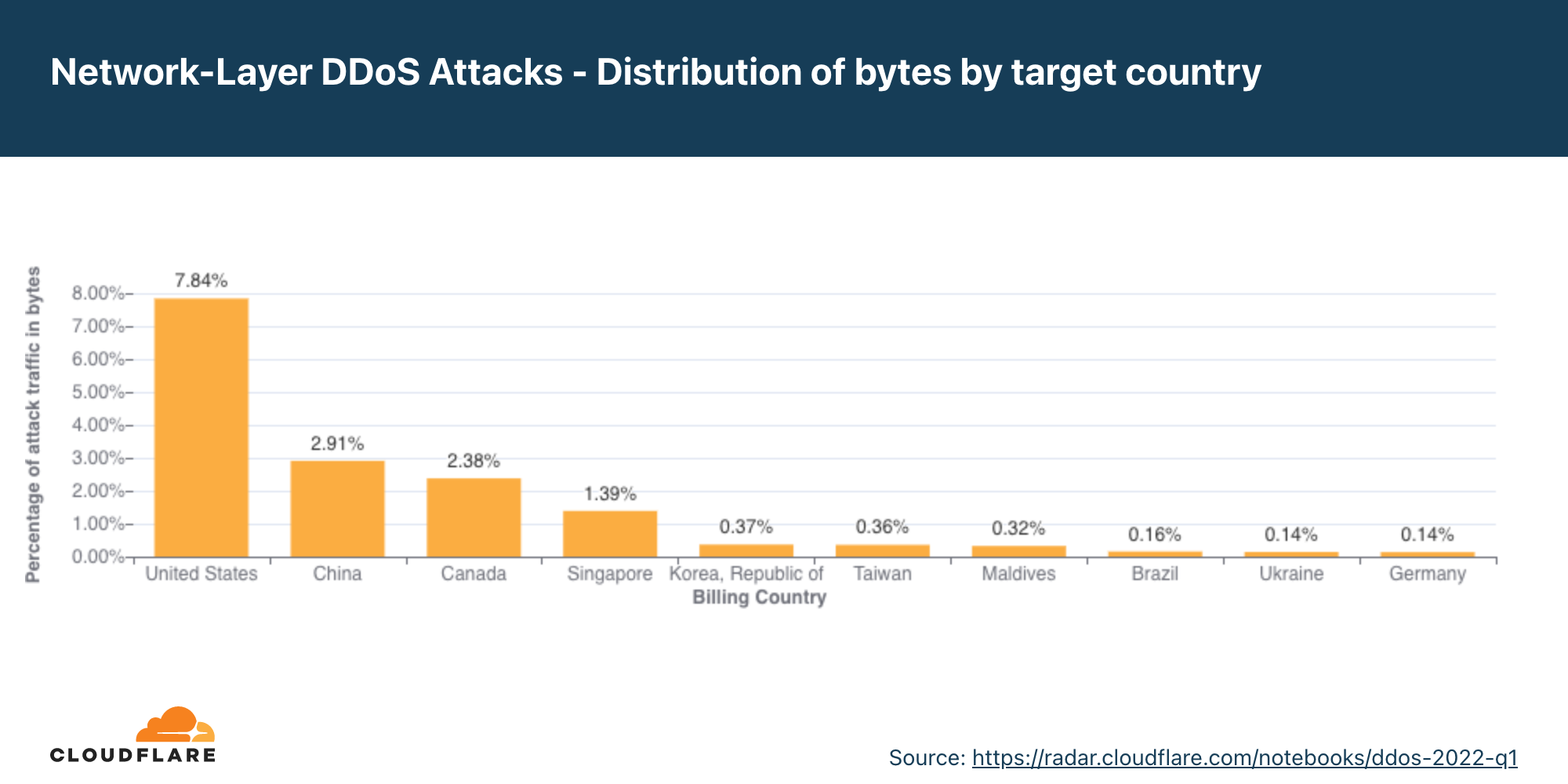
Network-layer DDoS attacks by target country
Similarly to the classification by our customers’ industry, we can also bucket attacks by our customers’ billing country as we do for application-layer DDoS attacks, to identify the top attacked countries.
Looking at Q1 numbers, we can see that the US was targeted by the highest percentage of DDoS attacks traffic — over 10% of all attack packets and almost 8% of all attack bytes. Following the US is China, Canada, and Singapore.
Network-layer DDoS attacks by ingress country
When trying to understand where network-layer DDoS attacks originate, we cannot use the same method as we use for the application-layer attack analysis. To launch an application-layer DDoS attack, successful handshakes must occur between the client and the server in order to establish an HTTP/S connection. For a successful handshake to occur, the attacker cannot spoof their source IP address. While the attacker may use botnets, proxies, and other methods to obfuscate their identity, the attacking client’s source IP location does sufficiently represent the attack source of application-layer DDoS attacks.
On the other hand, to launch network-layer DDoS attacks, in most cases, no handshake is needed. Attackers can spoof the source IP address in order to obfuscate the attack source and introduce randomness into the attack properties, which can make it harder for simple DDoS protection systems to block the attack. So if we were to derive the source country based on a spoofed source IP, we would get a ‘spoofed country’.
For this reason, when analyzing network-layer DDoS attack sources, we bucket the traffic by the Cloudflare edge data center locations where the traffic was ingested, and not by the (potentially) spoofed source IP to get an understanding of where the attacks originate from. We are able to achieve geographical accuracy in our report because we have data centers in over 270 cities around the world. However, even this method is not 100% accurate, as traffic may be back hauled and routed via various Internet Service Providers and countries for reasons that vary from cost reduction to congestion and failure management.
In Q1, the percentage of attacks detected in Cloudflare’s data centers in Azerbaijan increased by 16,624% QoQ and 96,900% YoY, making it the country with the highest percentage of network-layer DDoS activity (48.5%).
Following our Azerbaijanian data center is our Palestinian data center where a staggering 41.9% of all traffic was DDoS traffic. This represents a 10,120% increase QoQ and 46,456% YoY.
To view all regions and countries, check out the interactive map.
Attack vectors
SYN Floods remain the most popular DDoS attack vector, while use of generic UDP floods drops significantly in Q1.
An attack vector is a term used to describe the method that the attacker uses to launch their DDoS attack, i.e., the IP protocol, packet attributes such as TCP flags, flooding method, and other criteria.
In Q1, SYN floods accounted for 57% of all network-layer DDoS attacks, representing a 69% increase QoQ and a 13% increase YoY. In second place, attacks over SSDP surged by over 1,100% QoQ. Following were RST floods and attacks over UDP. Last quarter, generic UDP floods took the second place, but this time, generic UDP DDoS attacks plummeted by 87% QoQ from 32% to a mere 3.9%.
Emerging threats
Identifying the top attack vectors helps organizations understand the threat landscape. In turn, this may help them improve their security posture to protect against those threats. Similarly, learning about new emerging threats that may not yet account for a significant portion of attacks, can help mitigate them before they become a significant force.
When we look at new emerging attack vectors in Q1, we can see increases in DDoS attacks reflecting off of Lantronix services (+971% QoQ) and SSDP reflection attacks (+724% QoQ). Additionally, SYN-ACK attacks increased by 437% and attacks by Mirai botnets by 321% QoQ.
Attacker reflecting traffic off of Lantronix Discovery Service
Lantronix is a US-based software and hardware company that provides solutions for Internet of Things (IoT) management amongst their vast offering. One of the tools that they provide to manage their IoT components is the Lantronix Discovery Protocol. It is a command-line tool that helps to search and find Lantronix devices. The discovery tool is UDP-based, meaning that no handshake is required. The source IP can be spoofed. So an attacker can use the tool to search for publicly exposed Lantronix devices using a 4 byte request, which will then in turn respond with a 30 byte response from port 30718. By spoofing the source IP of the victim, all Lantronix devices will target their responses to the victim — resulting in a reflection/amplification attack.
Simple Service Discovery Protocol used for reflection DDoS attacks
The Simple Service Discovery Protocol (SSDP) protocol works similarly to the Lantronix Discovery protocol, but for Universal Plug and Play (UPnP) devices such as network-connected printers. By abusing the SSDP protocol, attackers can generate a reflection-based DDoS attack overwhelming the target’s infrastructure and taking their Internet properties offline. You can read more about SSDP-based DDoS attacks here.
Network-layer DDoS attacks by attack rate
In Q1, we observed a massive uptick in volumetric DDoS attacks — both from the packet rate and bitrate perspective. Attacks over 10 Mpps grew by over 300% QoQ, and attacks over 100 Gbps grew by 645% QoQ.
There are different ways of measuring the size of an L3/4 DDoS attack. One is the volume of traffic it delivers, measured as the bit rate (specifically, terabits per second or gigabits per second). Another is the number of packets it delivers, measured as the packet rate (specifically, millions of packets per second).
Attacks with high bit rates attempt to cause a denial-of-service event by clogging the Internet link, while attacks with high packet rates attempt to overwhelm the servers, routers, or other in-line hardware appliances. These devices dedicate a certain amount of memory and computation power to process each packet. Therefore, by bombarding it with many packets, the appliance can be left with no further processing resources. In such a case, packets are “dropped,” i.e., the appliance is unable to process them. For users, this results in service disruptions and denial of service.
Distribution by packet rate
The majority of network-layer DDoS attacks remain below 50,000 packets per second. While 50 kpps is on the lower side of the spectrum at Cloudflare scale, it can still easily take down unprotected Internet properties and congest even a standard Gigabit Ethernet connection.
When we look at the changes in the attack sizes, we can see that attacks of over 10 Mpps grew by over 300% QoQ. Similarly, attacks of 1-10 Mpps grew by almost 40% QoQ.
Distribution by bitrate
In Q1, most of the network-layer DDoS attacks remain below 500 Mbps. This too is a tiny drop in the water at Cloudflare scale, but can very quickly shut down unprotected Internet properties with less capacity or at the very least congest, even a standard Gigabit Ethernet connection.
Graph of the distribution of network-layer DDoS attacks by bit rate in 2022 Q1
Similarly to the trends observed in the packet-per-second realm, here we can also see large increases. The amount of DDoS attacks that peaked over 100 Gbps increased by 645% QoQ; attacks peaking between 10 Gbps to 100 Gbps increased by 407%; attacks peaking between 1 Gbps to 10 Gbps increased by 88%; and even attacks peaking between 500 Mbps to 1 Gbps increased by almost 20% QoQ.
Network-layer DDoS attacks by duration
Most attacks remain under one hour in duration, reiterating the need for automated always-on DDoS mitigation solutions.
We measure the duration of an attack by recording the difference between when it is first detected by our systems as an attack and the last packet we see with that attack signature towards that specific target.
In previous reports, we provided a breakdown of ‘attacks under an hour’, and larger time ranges. However, in most cases over 90 percent of attacks last less than an hour. So starting from this report, we broke down the short attacks and grouped them by shorter time ranges to provide better granularity.
One important thing to keep in mind is that even if an attack lasts only a few minutes, if it is successful, the repercussions could last well beyond the initial attack duration. IT personnel responding to a successful attack may spend hours and even days restoring their services.
In the first quarter of 2022, more than half of the attacks lasted 10-20 minutes, approximately 40% ended within 10 minutes, another ~5% lasted 20-40 minutes, and the remaining lasted longer than 40 minutes.
Short attacks can easily go undetected, especially burst attacks that, within seconds, bombard a target with a significant number of packets, bytes, or requests. In this case, DDoS protection services that rely on manual mitigation by security analysis have no chance in mitigating the attack in time. They can only learn from it in their post-attack analysis, then deploy a new rule that filters the attack fingerprint and hope to catch it next time. Similarly, using an “on-demand” service, where the security team will redirect traffic to a DDoS provider during the attack, is also inefficient because the attack will already be over before the traffic routes to the on-demand DDoS provider.
It’s recommended that companies use automated, always-on DDoS protection services that analyze traffic and apply real-time fingerprinting fast enough to block short-lived attacks.
Summary
Cloudflare’s mission is to help build a better Internet. A better Internet is one that is more secure, faster, and reliable for everyone — even in the face of DDoS attacks. As part of our mission, since 2017, we’ve been providing unmetered and unlimited DDoS protection for free to all of our customers. Over the years, it has become increasingly easier for attackers to launch DDoS attacks. But as easy as it has become, we want to make sure that it is even easier — and free — for organizations of all sizes to protect themselves against DDoS attacks of all types.
Not using Cloudflare yet? Start now with our Free and Pro plans to protect your websites, or contact us for comprehensive DDoS protection for your entire network using Magic Transit.
A zero-day vulnerability in the Mitel MiCollab business phone system has recently been discovered (CVE-2022-26143). This vulnerability, called TP240PhoneHome, which Cloudflare customers are already protected against, can be used to launch UDP amplification attacks. This type of attack reflects traffic off vulnerable servers to victims, amplifying the amount of traffic sent in the process by an amplification factor of 220 billion percent in this specific case.
Cloudflare has been actively involved in investigating the TP240PhoneHome exploit, along with other members of the InfoSec community. Read our joint disclosure here for more details. As far as we can tell, the vulnerability has been exploited as early as February 18, 2022. We have deployed emergency mitigation rules to protect Cloudflare customers against the amplification DDoS attacks.
Mitel has been informed of the vulnerability. As of February 22, they have issued a high severity security advisory advising their customers to block exploitation attempts using a firewall, until a software patch is made available. Cloudflare Magic Transit customers can use the Magic Firewall to block external traffic to the exposed Mitel UDP port 10074 by following the example in the screenshot below, or by pasting the following expression into their Magic Firewall rule editor and selecting the Block action:
(udp.dstport eq 10074).
Creating a Magic Firewall rule to block traffic to port 10074
To learn more, register for our webinar on March 23rd, 2022.
Exploiting the vulnerability to launch DDoS attacks
Mitel Networks is based in Canada and provides business communications and collaboration products to over 70 million business users around the world. Amongst their enterprise collaboration products is the aforementioned Mitel MiCollab platform, known to be used in critical infrastructure such as municipal governments, schools, and emergency services. The vulnerability was discovered in the Mitel MiCollab platform.
The vulnerability manifests as an unauthenticated UDP port that is incorrectly exposed to the public Internet. The call control protocol running on this port can be used to, amongst other things, issue the debugging command startblast. This command does not place real telephone calls; rather, it simulates a “blast” of calls in order to test the system. For each test call that is made, two UDP packets are emitted in response to the issuer of the command.
According to the security advisory, the exploit can “allow a malicious actor to gain unauthorized access to sensitive information and services, cause performance degradations or a denial of service condition on the affected system. If exploited with a denial of service attack, the impacted system may cause significant outbound traffic impacting availability of other services.”
Since this is an unauthenticated and connectionless UDP-based protocol, you can use spoofing to direct the response traffic toward any IP and port number — and by doing so, reflect and amplify a DDoS attack to the victim.
We’ve mainly focused on the amplification vector because it can be used to hurt the whole Internet, but the phone systems themselves can likely be hurt in other ways with this vulnerability. This UDP call control port offers many other commands. With some work, it’s likely that you could use this UDP port to commit toll fraud, or to simply render the phone system inoperable. We haven’t assessed these other possibilities, because we do not have access to a device that we can safely test with.
The good news
Fortunately, only a few thousand of these devices are improperly exposed to the public Internet, meaning that this vector can “only” achieve several hundred million packets per second total. This volume of traffic can cause major outages if you’re not protected by an always-on automated DDoS protection service, but it’s nothing to be concerned with if you are.
Furthermore, an attacker can’t run multiple commands at the same time. Instead, the server queues up commands and executes them serially. The fact that you can only launch one attack at a time from these devices, mixed with the fact that you can make that attack for many hours, has fascinating implications. If an attacker chooses to start an attack by specifying a very large number of packets, then that box is “burned” – it can’t be used to attack anyone else until the attack completes.
How Cloudflare detects and mitigates DDoS attacks
To defend organizations against DDoS attacks, we built and operate software-defined systems that run autonomously. They automatically detect and mitigate DDoS attacks across our entire network.
Initially, traffic is routed through the Internet via BGP Anycast to the nearest Cloudflare edge data center. Once the traffic reaches our data center, our DDoS systems sample it asynchronously allowing for out-of-path analysis of traffic without introducing latency penalties.
The analysis is done using data streaming algorithms. Packet samples are compared to the fingerprints and multiple real-time signatures are created based on the dynamic masking of various fingerprint attributes. Each time another packet matches one of the signatures, a counter is increased. When the system qualifies an attack, i.e., the activation threshold is reached for a given signature, a mitigation rule is compiled and pushed inline. The mitigation rule includes the real-time signature and the mitigation action, e.g., drop.
Cloudflare’s mission is to help build a better Internet. A better Internet is one that is more secure, faster, and reliable for everyone — even in the face of DDoS attacks and emerging zero-day threats. As part of our mission, since 2017, we’ve been providing unmetered and unlimited DDoS protection for free to all of our customers. Over the years, it has become increasingly easier for attackers to launch DDoS attacks. To counter the attacker’s advantage, we want to make sure that it is also easy and free for organizations of all sizes to protect themselves against DDoS attacks of all types.
The first half of 2021 witnessed massive ransomware and ransom DDoS attack campaigns that interrupted aspects of critical infrastructure around the world (including one of the largest petroleum pipeline system operators in the US) and a vulnerability in IT management software that targeted schools, public sector, travel organizations, and credit unions, to name a few.
The second half of the year recorded a growing swarm of one of the most powerful botnets deployed (Meris) and record-breaking HTTP DDoS attacks and network-layer attacks observed over the Cloudflare network. This besides the Log4j2 vulnerability (CVE-2021-44228) discovered in December that allows an attacker to execute code on a remote server — arguably one of the most severe vulnerabilities on the Internet since both Heartbleed and Shellshock.
Prominent attacks such as the ones listed above are but a few examples that demonstrate a trend of intensifying cyber-insecurity that affected everyone, from tech firms and government organizations to wineries and meat processing plants.
Here are some DDoS attack trends and highlights from 2021 and Q4 ‘21 specifically:
In December alone, one out of every three survey respondents reported being targeted by a ransom DDoS attack or threatened by the attacker.
Application-layer DDoS attacks
The Manufacturing industry was the most attacked in Q4 ’21, recording a whopping 641% increase QoQ in the number of attacks. The Business Services and Gaming/Gambling industries were the second and third most targeted industries by application-layer DDoS attacks.
For the fourth time in a row this year, China topped the charts with the highest percentage of attack traffic originating from its networks.
Q4 ’21 was the busiest quarter for attackers in 2021. In December 2021 alone, there were more than all the attacks observed in Q1 and Q2 ’21 separately.
While the majority of attacks were small, terabit-strong attacks became the new norm in the second half of 2021. Cloudflare automatically mitigated dozens of attacks peaking over 1 Tbps, with the largest one peaking just under 2 Tbps — the largest we’ve ever seen.
Attacks originating from Moldova quadrupled in Q4 ’21 QoQ, making it the country with the highest percentage of network-layer DDoS activity.
SYN floods and UDP floods were the most frequent attack vectors while emerging threats such as SNMP attacks increased by nearly 5,800% QoQ.
This report is based on DDoS attacks that were automatically detected and mitigated by Cloudflare’s DDoS Protection systems. To learn more about how it works, check out this deep-dive blog post.
A note on how we measure DDoS attacks observed over our network
To analyze attack trends, we calculate the “DDoS activity” rate, which is the percentage of attack traffic out of the total traffic (attack + clean) observed over our global network. Measuring attack numbers as a percentage of the total traffic observed allows us to normalize data points and avoid biases reflected in absolute numbers towards, for example, a Cloudflare data center that receives more total traffic and likely, also more attacks.
An interactive version of this report is available on Cloudflare Radar.
Ransom Attacks
Our systems constantly analyze traffic and automatically apply mitigation when DDoS attacks are detected. Each DDoS’d customer is prompted with an automated survey to help us better understand the nature of the attack and the success of the mitigation.
For over two years now, Cloudflare has been surveying attacked customers — one question on the survey being if they received a ransom note demanding payment in exchange to stop the DDoS attack. Q4 ’21 recorded the highest survey responses ever that indicated ransom threats — ransom attacks increased by 29% YoY and 175% QoQ. More specifically, one out of every 4.5 respondents (22%) reported receiving a ransom letter demanding payment by the attacker.
The percentage of respondents reported being targeted by a ransom DDoS attack or that have received threats in advance of the attack.
When we break it down by month, we can see that December 2021 topped the charts with 32% of respondents reporting receiving a ransom letter — that’s nearly one out of every three surveyed respondents.
Application-layer DDoS attacks
Application-layer DDoS attacks, specifically HTTP DDoS attacks, are attacks that usually aim to disrupt a web server by making it unable to process legitimate user requests. If a server is bombarded with more requests than it can process, the server will drop legitimate requests and — in some cases — crash, resulting in degraded performance or an outage for legitimate users.
Application-layer DDoS attacks by industry
In Q4, DDoS attacks on Manufacturing companies increased by 641% QoQ, and DDoS attacks on the Business Services industry increased by 97%.
When we break down the application-layer attacks targeted by industry, the Manufacturing, Business Services, and Gaming/Gambling industries were the most targeted industries in Q4 ’21.
Application-layer DDoS attacks by source country
To understand the origin of the HTTP attacks, we look at the geolocation of the source IP address belonging to the client that generated the attack HTTP requests. Unlike network-layer attacks, source IP addresses cannot be spoofed in HTTP attacks. A high percentage of DDoS activity in a given country usually indicates the presence of botnets operating from within the country’s borders.
For the fourth quarter in a row, China remains the country with the highest percentage of DDoS attacks originating from within its borders. More than three out of every thousand HTTP requests that originated from Chinese IP addresses were part of an HTTP DDoS attack. The US remained in second place, followed by Brazil and India.
Application-layer DDoS attacks by target country
In order to identify which countries are targeted by the most HTTP DDoS attacks, we bucket the DDoS attacks by our customers’ billing countries and represent it as a percentage out of all DDoS attacks.
For the third consecutive time this year, organizations in the United States were targeted by the most HTTP DDoS attacks, followed by Canada and Germany.
Network-layer DDoS attacks
While application-layer attacks target the application (Layer 7 of the OSI model) running the service that end users are trying to access, network-layer attacks aim to overwhelm network infrastructure (such as in-line routers and servers) and the Internet link itself.
Cloudflare thwarts an almost 2 Tbps attack
In November, our systems automatically detected and mitigated an almost 2 Tbps DDoS attack. This was a multi-vector attack combining DNS amplification attacks and UDP floods. The entire attack lasted just one minute. The attack was launched from approximately 15,000 bots running a variant of the original Mirai code on IoT devices and unpatched GitLab instances.
Network-layer DDoS attacks by month
December was the busiest month for attackers in 2021.
Q4 ‘21 was the busiest quarter in 2021 for attackers. Over 43% of all network-layer DDoS attacks took place in the fourth quarter of 2021. While October was a relatively calmer month, in November, the month of the Chinese Singles’ Day, the American Thanksgiving holiday, Black Friday, and Cyber Monday, the number of network-layer DDoS attacks nearly doubled. The number of observed attacks increased towards the final days of December ’21 as the world prepared to close out the year. In fact, the total number of attacks in December alone was higher than all the attacks in Q2 ’21 and almost equivalent to all attacks in Q1 ’21.
Network-layer DDoS attacks by attack rate
While most attacks are still relatively ‘small’ in size, terabit-strong attacks are becoming the norm.
There are different ways of measuring the size of an L3/4 DDoS attack. One is the volume of traffic it delivers, measured as the bit rate (specifically, terabits per second or gigabits per second). Another is the number of packets it delivers, measured as the packet rate (specifically, millions of packets per second).
Attacks with high bit rates attempt to cause a denial-of-service event by clogging the Internet link, while attacks with high packet rates attempt to overwhelm the servers, routers, or other in-line hardware appliances. These devices dedicate a certain amount of memory and computation power to process each packet. Therefore, by bombarding it with many packets, the appliance can be left with no further processing resources. In such a case, packets are “dropped,” i.e., the appliance is unable to process them. For users, this results in service disruptions and denial of service.
The distribution of attacks by their size (in bit rate) and month is shown below. As seen in the graph above, the majority of attacks took place in December. However, the graph below illustrates that larger attacks, over 300 Gbps in size, took place in November. Most of the attacks between 5-20 Gbps took place in December.
Distribution by packet rate
An interesting correlation Cloudflare has observed is that when the number of attacks increases, their size and duration decrease. In the first two-thirds of 2021, the number of attacks was relatively small, and correspondingly, their rates increased, e.g., in Q3 ’21, attacks ranging from 1-10 million packets per second (mpps) increased by 196%. In Q4 ’21, the number of attacks increased and Cloudflare observed a decrease in the size of attacks. 91% of all attacks peaked below 50,000 packets per second (pps) — easily sufficient to take down unprotected Internet properties.
Larger attacks of over 1 mpps decreased by 48% to 28% QoQ, while attacks peaking below 50K pps increased by 2.36% QoQ.
Distribution by bit rate
Similar to the trend observed in packet-intensive attacks, the amount of bit-intensive attacks shrunk as well. While attacks over 1 Tbps are becoming the norm, with the largest one we’ve ever seen peak just below 2 Tbps, the majority of attacks are still small and peaked below 500 Mbps (97.2%).
In Q4 ’21, larger attacks of all ranges above 500 Mbps saw massive decreases ranging from 35% to 57% for the larger 100+ Gbps attacks.
Network-layer DDoS attacks by duration
Most attacks remain under one hour in duration, reiterating the need for automated always-on DDoS mitigation solutions.
We measure the duration of an attack by recording the difference between when it is first detected by our systems as an attack and the last packet we see with that attack signature towards that specific target. In the last quarter of 2021, 98% of all network-layer attacks lasted less than one hour. This is very common as most of the attacks are short-lived. Even more so, a trend we’ve seen is that when the number of attacks increases, as in this quarter, their rate and duration decreases.
Short attacks can easily go undetected, especially burst attacks that, within seconds, bombard a target with a significant number of packets, bytes, or requests. In this case, DDoS protection services that rely on manual mitigation by security analysis have no chance in mitigating the attack in time. They can only learn from it in their post-attack analysis, then deploy a new rule that filters the attack fingerprint and hope to catch it next time. Similarly, using an “on-demand” service, where the security team will redirect traffic to a DDoS provider during the attack, is also inefficient because the attack will already be over before the traffic routes to the on-demand DDoS provider.
It’s recommended that companies use automated, always-on DDoS protection services that analyze traffic and apply real-time fingerprinting fast enough to block short-lived attacks.
Attack vectors
SYN floods remain attackers’ favorite method of attack, while attacks over SNMP saw a massive surge of almost 5,800% QoQ.
An attack vector is a term used to describe the method that the attacker uses to launch their DDoS attack, i.e., the IP protocol, packet attributes such as TCP flags, flooding method, and other criteria.
For the first time in 2021, the percentage of SYN flood attacks significantly decreased. Throughout 2021, SYN floods accounted for 54% of all network-layer attacks on average. While still grabbing first place as the most frequent vector, its share dropped by 38% QoQ to 34%.
However, it was a close-run for SYN attacks and UDP attacks. A UDP flood is a type of denial-of-service attack in which a large number of User Datagram Protocol (UDP) packets are sent to a targeted server with the aim of overwhelming that device’s ability to process and respond. Oftentimes, the firewall protecting the targeted server can also become exhausted as a result of UDP flooding, resulting in a denial-of-service to legitimate traffic. Attacks over UDP jumped from fourth place in Q3 ’21 to second place in Q4 ’21, with a share of 32% of all network-layer attacks — a 1,198% increase in QoQ.
In third place came the SNMP underdog that made a massive leap with its first time 2021 appearance in the top attack vectors.
Emerging threats
When we look at emerging attack vectors — which helps us understand what new vectors attackers are deploying to launch attacks — we observe a massive spike in SNMP, MSSQL, and generic UDP-based DDoS attacks.
Both SNMP and MSSQL attacks are used to reflect and amplify traffic on the target by spoofing the target’s IP address as the source IP in the packets used to trigger the attack.
Simple Network Management Protocol (SNMP) is a UDP-based protocol that is often used to discover and manage network devices such as printers, switches, routers, and firewalls of a home or enterprise network on UDP well-known port 161. In an SNMP reflection attack, the attacker sends out a large number of SNMP queries while spoofing the source IP address in the packet as the targets to devices on the network that, in turn, reply to that target’s address. Numerous responses from the devices on the network results in the target network being DDoSed.
Similar to the SNMP amplification attack, the Microsoft SQL (MSSQL) attack is based on a technique that abuses the Microsoft SQL Server Resolution Protocol for the purpose of launching a reflection-based DDoS attack. The attack occurs when a Microsoft SQL Server responds to a client query or request, attempting to exploit the Microsoft SQL Server Resolution Protocol (MC-SQLR), listening on UDP port 1434.
Network-layer DDoS attacks by country
Attacks originating from Moldova quadrupled, making it the country with the highest percentage of network-layer DDoS activity.
When analyzing network-layer DDoS attacks, we bucket the traffic by the Cloudflare edge data center locations where the traffic was ingested, and not by the source IP. The reason for this is that, when attackers launch network-layer attacks, they can spoof the source IP address in order to obfuscate the attack source and introduce randomness into the attack properties, which can make it harder for simple DDoS protection systems to block the attack. Hence, if we were to derive the source country based on a spoofed source IP, we would get a spoofed country.
Cloudflare is able to overcome the challenges of spoofed IPs by displaying the attack data by the location of the Cloudflare data center in which the attack was observed. We are able to achieve geographical accuracy in our report because we have data centers in over 250 cities around the world.
To view all regions and countries, check out the interactive map.
Summary
Cloudflare’s mission is to help build a better Internet. A better Internet is one that is more secure, faster, and reliable for everyone — even in the face of DDoS attacks. As part of our mission, since 2017, we’ve been providing unmetered and unlimited DDoS protection for free to all of our customers. Over the years, it has become increasingly easier for attackers to launch DDoS attacks. To counter the attacker’s advantage, we want to make sure that it is also easy and free for organizations of all sizes to protect themselves against DDoS attacks of all types.
Cloudflare Radar launched as part of last year’s Birthday Week. We described it as a“newspaper for the Internet”, that gives“any digital citizen the chance to see what’s happening online [which] is part of our pursuit to help build a better, more informed, Internet”.
Since then, we have made considerable strides, including adding dedicated pages to cover how key events such as the UEFA Euro 2020 Championship and the Tokyo Olympics shaped Internet usage in participating countries, and added a Radar section for interactive deep-dive reports on topics such as DDoS.
Today, Radar has four main sections:
Main page with near real-time information about global Internet usage.
Internet usage details by country (see, for example, Portugal).
Domain insights, where searching for a domain returns traffic, registration and certificate information about it.
Deep-dive reports on complex and often underreported topics.
Cloudflare’s global network spans more than 250 cities in over 100 countries. Because of this, we have the unique ability to see both macro and micro trends happening online, including insights on how traffic is flowing around the world or what type of attacks are prevalent in a certain country.
Radar Maps will make this information even richer and easier to consume.
Introducing Radar Maps
Starting today, Radar has two new data visualizations to help us share more insights from our data and represent what’s happening on the Internet.
Geographical distribution of application-level attacks
Note: The identified location of the devices involved in the attack may not be the actual location of the people performing the attack.
Geographical distribution of application-level attacks, in both directions
Cyber threats are more common than ever. In the third quarter of 2021 Cloudflare blocked an average of 76 billion cyber threats each day and had visibility over many more. Helping build a better Internet also means giving people more visibility over our data. That’s why we’ve made a near real-time view of the types of attacks, protocol distribution, and attack volume over time available on Radar from day one.
Now we’re adding a geographical representation of origin and target of such attacks using two new visualizations.
First, we have a global map drawing near real-time directional lines of the attacks, also known as a “pew pew” map — thank you, 1983 and WarGames.
Second, we have Sankey diagrams that are great for representing how strongly the attacks are flowing from one country to the other.
We hope you like what we’ve built with our new Radar Maps. Radar, unlike any other insights platform out there, is totally built on Cloudflare components and our edge computing platform — Workers and Workers KV. This gives us new and unique ways of representing data at scale. So do keep checking back radar.cloudflare.com to see the Internet evolving in (near) real-time.
Earlier this week, Cloudflare automatically detected and mitigated a DDoS attack that peaked just below 2 Tbps — the largest we’ve seen to date. This was a multi-vector attack combining DNS amplification attacks and UDP floods. The entire attack lasted just one minute. The attack was launched from approximately 15,000 bots running a variant of the original Mirai code on IoT devices and unpatched GitLab instances.
DDoS attack peaking just below 2 Tbps
Network-layer DDoS attacks increased by 44%
Last quarter, we saw multiple terabit-strong DDoS attacks and this attack continues this trend of increased attack intensity. Another key finding from our Q3 DDoS Trends report was that network-layer DDoS attacks actually increased by 44% quarter-over-quarter. While the fourth quarter is not over yet, we have, again, seen multiple terabit-strong attacks that targeted Cloudflare customers.
DDoS attacks peaking at 1-1.4 Tbps
How did Cloudflare mitigate this attack?
To begin with, our systems constantly analyze traffic samples “out-of-path” which allows us to asynchronously detect DDoS attacks without causing latency or impacting performance. Once the attack traffic was detected (within sub-seconds), our systems generated a real-time signature that surgically matched against the attack patterns to mitigate the attack without impacting legitimate traffic.
Once generated, the fingerprint is propagated as an ephemeral mitigation rule to the most optimal location in the Cloudflare edge for cost-efficient mitigation. In this specific case, as with most L3/4 DDoS attacks, the rule was pushed in-line into the Linux kernel eXpress Data Path (XDP) to drop the attack packet at wirespeed.
A conceptual diagram of Cloudflare’s DDoS protection systems
Cloudflare’s mission is to help build a better Internet — one that is secure, faster, and more reliable for everyone. The DDoS team’s vision is derived from this mission: our goal is to make the impact of DDoS attacks a thing of the past. Whether it’s the Meris botnet that launched some of the largest HTTP DDoS attacks on record, the recent attacks on VoIP providers or this Mirai-variant that’s DDoSing Internet properties, Cloudflare’s network automatically detects and mitigates DDoS attacks. Cloudflare provides a secure, reliable, performant, and customizable platform for Internet properties of all types.
For more information about Cloudflare’s DDoS protection, reach out to us or have a go with a hands-on evaluation of Cloudflare’s Free plan here.
Meris first got our attention due to an exceptionally large 17.2 million requests per second (rps) DDoS attack that it launched against one of our customers. This attack, along with subsequent attacks originated by the Meris botnet, was automatically detected and mitigated by our DDoS protection systems. Cloudflare customers, even ones on the free plan, are protected against Meris attacks.
Over the past months, we’ve been tracking and analyzing the activity of the Meris botnet. Some main highlights include:
Meris targets approximately 50 different websites every single day with a daily average of 104 unique DDoS attacks.
More than 33% of all Meris DDoS attack traffic targeted China-based websites.
More than 12% of all websites that were attacked by Meris are operated by US-based companies.
View more Meris attack insights and trends in the interactive Radar dashboard.
So what is Meris?
Meris (Latvian for plague) is the name of an active botnet behind a series of recent DDoS attacks that have targeted thousands of websites around the world. It was originally detected in late June 2021 by QRator in joint research they conducted with Yandex. Their initial research identified 30,000 to 56,000 bots, but they estimated that the numbers are actually much higher, in the ballpark of 250,000 bots.
The Meris botnet is formed of infected routers and networking hardware manufactured by the Latvian company MikroTik. According to MikroTik’s blog, the attackers exploited a vulnerability in the router’s operating system (RouterOS) which enabled attackers to gain unauthenticated remote access to read and write arbitrary files (CVE-2018-14847).
RouterOS is the router operating system that’s used by MikroTik’s routers and the RouterBOARD hardware product family, which can also be used to turn any PC into a router. Administration of RouterOS can be done either via direct SSH connection or by using a configuration utility called WinBox. The vulnerability itself was possible due to a directory traversal vulnerability in the WinBox interface with RouterOS.
Directory traversal is a type of exploit that allows attackers to travel to the parent directories to gain access to the operating system’s file system, a method and structure of how data is stored and retrieved in the operating system. Once they gain access to the file system, attackers can then read the existing files that administer the router and write files directly into the file system to administer the routers to their botnet needs.
While the vulnerability was patched after its detection back in 2018, it’s still being exploited in compromised devices that do not use the patched RouterOS versions, or that use the default usernames and passwords. MicroTik has advised its customers to upgrade their devices’ OS version, to only allow access to the devices via secure IPsec, and to inspect for any abnormalities such as unknown SOCKS proxy settings and scripts.
To launch volumetric attacks, the botnet uses HTTP pipelining which allows it to send multiple requests over a single connection, thus increasing its total attack throughput. Furthermore, in an attempt to obfuscate the attack source, the botnet uses open SOCKS proxies to proxy their attack traffic to the target.
Cloudflare’s DDoS protection systems automatically detect and mitigate Meris attacks. One of the mitigation actions that the system can choose to use is the ‘Connection Close’ action which eliminates the risk of HTTP pipelining and helps slow down attackers. Additionally, as part of Cloudflare’s threat intelligence suite, we provide a Managed IP List of Open SOCKS Proxies that customers can use as part of their firewall rules — to block, challenge or rate-limit traffic that arrives via SOCKS proxies.
How does Meris compare to Mirai?
About five years ago, Mirai (Japanese for future) — the infamous botnet that infected hundreds of thousands of IoT devices — launched record-breaking DDoS attacks against websites.
There have been many variants of the Mirai botnet since its source code was leaked. One version of Mirai, called Moobot, was detected last year when it attacked a Cloudflare customer with a 654 Gbps DDoS attack. Another variant recently made a resurgence when it targeted Cloudflare customers with over a dozen UDP and TCP based DDoS attacks that peaked multiple times above 1 Tbps, with a max peak of approximately 1.2 Tbps.
While Mirai infected IoT devices with low computational power, Meris is a swarm of routers that have significantly higher processing power and data transfer capabilities than IoT devices, making them much more potent in causing harm at a larger scale to web properties that are not protected by sophisticated cloud-based DDoS mitigation.
Tracking the Meris botnet attacks
Since the appearance of Meris, Cloudflare’s systems automatically detected and mitigated Meris attacks using the existing mitigation rules. During our analysis of the Meris botnet attacks, our security experts noticed the attack vectors adapt to try and bypass Cloudflare’s defenses. Needless to say, they were not successful. But we wanted to stay many steps ahead of attackers — and so our engineers deployed additional rules that mitigate Meris attacks even more comprehensively. A side effect of these mitigation rules is that it also provides us with more granular threat intelligence on the Meris attacks.
Since we deployed the new rules in early August, we’ve seen Meris launch an average of 104 DDoS attacks on Cloudflare customers every day. The highest figure we’ve seen was on September 6, when Meris was used to launch 261 unique attacks against Cloudflare customers.
Overall, Meris targets about 50 different websites and applications every single day. Although the average attack peaked at 106K rps, the median attack size was actually smaller at 17.6K rps. The largest attack we’ve seen was 17.2M rps and that occurred in July. In the graph below, you can see the daily highest requests per second rate after we deployed the new rules. Since then, the largest attack we’ve seen was 16.7M rps, which took place on August 19.
Meris used to target Banks, Financial Services, and Insurance companies
Over the past few months, the industry that received the most attack traffic from the Meris botnet was the Banking, Financial Services, and Insurance (BFSI) industry
Following the BFSI industry, the most attacked industries were the Publishing, Gaming/Gambling, and IT Services industries. And while BFSI was the number one most attacked industry when considering the Meris DDoS activity rate, it only came in fourth place when considering the percentage of targeted websites.
In terms of the percentage of targeted websites, the Computer Software industry came in first place. Almost 4% of all impacted websites were of Computer Software companies protected by Cloudflare, followed by Gaming/Gambling and IT Services with 3% and 2%, respectively.
Besides the total breakdowns shown above, we can also view the top industries the botnet attacked over time to understand the changing trends. These trends may be tied to political events, new video game releases, sporting events, or any other global or local public interest events.
Off the top, we can already see the two largest peaks on August 9 and August 29 — mainly on the Computer Software, Gaming/Gambling, and IT industries. Another interesting peak occurred on August 14 against Cryptocurrency providers.
In late August, the botnet was pointed against gambling and casino websites, generating attacks at rates of hundreds of thousands to millions of requests per second. A second significant wave against the same industry was launched in early September.
Meris targets websites in China, Australia, and US
Similarly to the analysis of the top industries, we can calculate the Meris DDoS activity rate per target country to identify which countries came under the most attacks. In total, China-based companies saw the largest amount of DDoS attacks. More than 33% of all requests generated by Meris were destined for China-based companies that are protected by Cloudflare. Australia came in second place, and the US in third.
On the other hand, when we look at the number of websites that were targeted by Meris, the US came in first place. More than 12% of all websites that were targeted by Meris are operated by US-based companies. China came in second place with 5.6% and Russia in third with 4.4%.
Over time, we can see how the attacks on the top countries change. Similarly to the per-industry breakdown, we can also see two large peaks. The first one occurred on the same spike as the per-industry breakdown on August 9. However, the second one here occurred on September 1.
Although only tens of thousands of bots have been detected per attack, it is estimated that there are roughly 250,000 bots worldwide. As indicated above, the botnet is formed of MikroTik routers. Using the source IP address of the routers, we’re able to identify the origin country of the bots to paint a geographical representation of the bots’ presence and growth over time.
The change in the location of the bots doesn’t necessarily indicate that the botnet is growing or shrinking. It could also be that different bot groups are activated from time to time to spread the load of the attacks while attempting not to get caught.
At the beginning of August, the majority of the bots were located in Brazil. But by the end of August, that number plummeted to a single digit percentage close to zero. Meanwhile, the number of infected devices grew in the United States. From the beginning of September, the number of bots was significantly higher in the US, Russia, India, Indonesia, and China.
Cloudflare operates autonomous DDoS protection systems that automatically detect and mitigate DDoS attacks of all types, including attacks launched by Meris and Mirai. These systems are also customizable, and Cloudflare customers can tweak and tune their DDoS protection settings as needed with the HTTP DDoS Managed Rulesetand the L3/4 DDoS Managed Ruleset.
Here’s a summary of the trends observed in Q3 ‘21:
Application-layer (L7) DDoS attack trends:
For the second consecutive quarter in 2021, US-based companies were the most targeted in the world.
For the first time in 2021, attacks on UK-based and Canada-based companies skyrocketed, making them the second and third most targeted countries, respectively.
Attacks on Computer Software, Gaming/ Gambling, IT, and Internet companies increased by an average of 573% compared to the previous quarter.
Meris, one of the most powerful botnets in history, aided in launching DDoS campaigns across various industries and countries. You can read more on that here.
Network-layer (L3/4) DDoS attack trends:
DDoS attacks increased by 44% worldwide compared to the previous quarter.
The Middle East and Africa recorded the largest average attack increase of approximately 80%.
Morocco recorded the highest DDoS activity in the third quarter globally — three out of every 100 packets were part of a DDoS attack.
While SYN and RST attacks remain the dominant attack method used by attackers, Cloudflare observed a surge in DTLS amplification attacks — recording a 3,549% increase QoQ.
Attackers targeted (and continue to target going into the fourth quarter this year) VoIP service providers with massive DDoS attack campaigns in attempts to bring SIP infrastructure down.
Note on avoiding data biases: When we analyze attack trends, we calculate the “DDoS activity” rate, which is the percentage of attack traffic of the total traffic (attack + clean). When reporting application- and network-layer DDoS attack trends, we use this metric, which allows us to normalize the data points and avoid biases toward, for example, a larger Cloudflare data center that naturally handles more traffic and therefore also, possibly, more attacks compared to a smaller Cloudflare data center located elsewhere.
Application-layer DDoS attacks
Application-layer DDoS attacks, specifically HTTP DDoS attacks, are attacks that usually aim to disrupt a web server by making it unable to process legitimate user requests. If a server is bombarded with more requests than it can process, the server will drop legitimate requests and — in some cases — crash, resulting in degraded performance or an outage for legitimate users.
Q3 ‘21 was the quarter of Meris — one of the most powerful botnets deployed to launch some of the largest HTTP DDoS attacks in history.
This past quarter, we observed one of the largest recorded HTTP attacks — 17.2M rps (requests per second) — targeting a customer in the financial services industry. One of the most powerful botnets ever observed, called Meris, is known to be deployed in launching these attacks.
Meris (Latvian for plague) is a botnet behind recent DDoS attacks that have targeted networks or organizations around the world. The Meris botnet infected routers and other networking equipment manufactured by the Latvian company MikroTik. According to MikroTik’s blog, a vulnerability in the MikroTik RouterOS (that was patched after its detection back in 2018) was exploited in still unpatched devices to build a botnet and launch coordinated DDoS attacks by bad actors.
Similar to the Mirai botnet of 2016, Meris is one of the most powerful botnets recorded. While Mirai infected IoT devices with low computational power such as smart cameras, Meris is a growing swarm of networking infrastructure (such as routers and switches) with significantly higher processing power and data transfer capabilities than IoT devices — making them much more potent in causing harm at a larger scale. Be that as it may, Meris is an example of how the attack volume doesn’t necessarily guarantee damage to the target. As far as we know, Meris, despite its strength, was not able to cause significant impact or Internet outages. On the other hand, by tactically targeting the DYN DNS service in 2016, Mirai succeeded in causing significant Internet disruptions.
Application-layer DDoS attacks by industry
The tech and gaming industries were the most targeted industries in Q3 ‘21.
When we break down the application-layer attacks targeted by industry, Computer Software companies topped the charts. The Gaming/Gambling industry, also known to be regular targets of online attacks, was a close second, followed by the Internet and IT industries.
Application-layer DDoS attacks by source country
To understand the origin of the HTTP attacks, we look at the geolocation of the source IP address belonging to the client that generated the attack HTTP requests. Unlike network-layer attacks, source IPs cannot be spoofed in HTTP attacks. A high DDoS activity rate in a given country usually indicates the presence of botnets operating from within.
In the third quarter of 2021, most attacks originated from devices/servers in China, the United States, and India. While China remains in first place, the number of attacks originating from Chinese IPs actually decreased by 30% compared to the previous quarter. Almost one out of every 200 HTTP requests that originated from China was part of an HTTP DDoS attack.
Additionally, attacks from Brazil and Germany shrank by 38% compared to the previous quarter. Attacks originating from the US and Malaysia reduced by 40% and 45%, respectively.
Application-layer DDoS attacks by target country
In order to identify which countries are targeted the most by L7 attacks, we break down the DDoS activity by our customers’ billing countries.
For the second consecutive time this year, organizations in the United States were targeted the most by L7 DDoS attacks in the world, followed by those in the UK and Canada.
Network-layer DDoS attacks
While application-layer attacks target the application (Layer 7 of the OSI model) running the service that end users are trying to access, network-layer attacks aim to overwhelm network infrastructure (such as in-line routers and servers) and the Internet link itself.
Mirai-variant botnet strikes with a force of 1.2 Tbps.
Q3 ‘21 was also the quarter when the infamous Mirai made a resurgence. A Mirai-variant botnet launched over a dozen UDP- and TCP-based DDoS attacks that peaked multiple times above 1 Tbps, with a max peak of approximately 1.2 Tbps. These network-layer attacks targeted Cloudflare customers on the Magic Transit and Spectrum services. One of these targets was a major APAC-based Internet services, telecommunications, and hosting provider and the other was a gaming company. In all cases, the attacks were automatically detected and mitigated without human intervention.
Network-layer DDoS attacks by month
September was, by far, the busiest month for attackers this year.
Q3 ‘21 accounted for more than 38% of all attacks this year. September was the busiest month for attackers so far in 2021 — accounting for over 16% of all attacks this year.
Network-layer DDoS attacks by attack rate
Most attacks are ‘small’ in size, but the number of larger attacks continues to rise.
There are different ways of measuring the size of a L3/4 DDoS attack. One is the volume of traffic it delivers, measured as the bit rate (specifically, terabits per second or gigabits per second). Another is the number of packets it delivers, measured as the packet rate (specifically, millions of packets per second).
Attacks with high bit rates attempt to cause a denial-of-service event by clogging the Internet link, while attacks with high packet rates attempt to overwhelm the servers, routers, or other in-line hardware appliances. Appliances dedicate a certain amount of memory and computation power to process each packet. Therefore, by bombarding it with many packets, the appliance can be left with no further processing resources. In such a case, packets are “dropped,” i.e., the appliance is unable to process them. For users, this results in service disruptions and denial of service.
The distribution of attacks by their size (in bit rate) and month is shown below. Interestingly enough, all attacks over 400 Gbps took place in August, including some of the largest attacks we have seen; multiple attacks peaked above 1 Tbps and reached as high as 1.2 Tbps.
Packet rate As seen in previous quarters, the majority of attacks observed in Q3 ‘21 were relatively small in size — nearly 89% of all attacks peaked below 50K packets per second (pps). While a majority of attacks are smaller in size, we observed that the number of larger attacks is increasing QoQ — attacks that peaked above 10M pps increased by 142% QoQ.
Attacks of packet rates ranging from 1-10 million packets per second increased by 196% compared to the previous quarter. This trend is similar to what we observed the last quarter as well, suggesting that larger attacks are increasing.
Bit rate From the bit rate perspective, a similar trend was observed — a total of 95.4% of all attacks peaked below 500 Mbps.
QoQ data shows that the number of attacks of sizes ranging from 500 Mbps to 10 Gbps saw massive increases of 126% to 289% compared to the previous quarter. Attacks over 100 Gbps decreased by nearly 14%.
The number of larger bitrate attacks increased QoQ (with the one exception being attacks over 100 Gbps, which decreased by nearly 14% QoQ). In particular, attacks ranging from 500 Mbps to 1 Gbps saw a surge of 289% QoQ and those ranging from 1 Gbps to 100 Gbps surged by 126%.
This trend once again illustrates that, while (in general) a majority of the attacks are indeed smaller, the number of “larger” attacks is increasing. This suggests that more attackers are garnering more resources to launch larger attacks.
Network-layer DDoS attacks by duration
Most attacks remain under one hour in duration, reiterating the need for automated always-on DDoS mitigation solutions.
We measure the duration of an attack by recording the difference between when it is first detected by our systems as an attack and the last packet we see with that attack signature. As in previous quarters, most of the attacks are short-lived. To be specific, 94.4% of all DDoS attacks lasted less than an hour. On the other end of the axis, attacks over 6 hours accounted for less than 0.4% in Q3 ‘21, and we did see a QoQ increase of 165% in attacks ranging 1-2 hours. Be that as it may, a longer attack does not necessarily mean a more dangerous one.
Short attacks can easily go undetected, especially burst attacks that, within seconds, bombard a target with a significant number of packets, bytes, or requests. In this case, DDoS protection services that rely on manual mitigation by security analysis have no chance in mitigating the attack in time. They can only learn from it in their post-attack analysis, then deploy a new rule that filters the attack fingerprint and hope to catch it next time. Similarly, using an “on-demand” service, where the security team will redirect traffic to a DDoS provider during the attack, is also inefficient because the attack will already be over before the traffic routes to the on-demand DDoS provider.
Cloudflare recommends that companies use automated, always-on DDoS protection services that analyze traffic and apply real-time fingerprinting fast enough to block the short-lived attacks. Cloudflare analyzes traffic out-of-path, ensuring that DDoS mitigation does not add any latency to legitimate traffic, even in always-on deployments. Once an attack is identified, our autonomous edge DDoS protection system (dosd) generates and applies a dynamically crafted rule with a real-time signature. Pre-configured firewall rules comprising allow/deny lists for known traffic patterns take effect immediately.
Attack vectors
SYN floods remain attackers’ favorite method of attack, while attacks over DTLS saw a massive surge — 3,549% QoQ.
An attack vector is the term used to describe the method that the attacker utilizes in their attempt to cause a denial-of-service event.
As observed in previous quarters, attacks utilizing SYN floods remain the most popular method used by attackers.
A SYN flood attack is a DDoS attack that works by exploiting the very foundation of the TCP protocol — the stateful TCP connection between a client and a server as a part of the 3-way TCP handshake. As a part of the TCP handshake, the client sends an initial connection request packet with a synchronize flag (SYN). The server responds with a packet that contains a synchronized acknowledgment flag (SYN-ACK). Finally, the client responds with an acknowledgment (ACK) packet. At this point, a connection is established and data can be exchanged until the connection is closed. This stateful process can be abused by attackers to cause denial-of-service events.
By repeatedly sending SYN packets, the attacker attempts to overwhelm a server or the router’s connection table that tracks the state of TCP connections. The server replies with a SYN-ACK packet, allocates a certain amount of memory for each given connection, and falsely waits for the client to respond with the final ACK. Given a sufficient number of connections occupying the server’s memory, the server is unable to allocate further memory for legitimate clients, causing the server to crash or preventing it from handling legitimate client connections, i.e., a denial-of-service event.
More than half of all attacks observed over our network were SYN floods. This was followed by RST, ACK, and UDP floods.
Emerging threats
While SYN and RST floods remain popular overall, when we look at emerging attack vectors — which helps us understand what new vectors attackers are deploying to launch attacks — we observed a massive spike in DTLS amplification attacks. DTLS floods increased by 3,549% QoQ.
Datagram Transport Layer Security (DTLS) is a protocol similar to Transport Layer Security (TLS) designed to provide similar security guarantees to connectionless datagram-based applications to prevent message forgery, eavesdropping, or tampering. DTLS, being connectionless, is specifically useful for establishing VPN connections, without the TCP meltdown problem. The application is responsible for reordering and other connection properties.
Just as with most UDP-based protocols, DTLS is spoofable and being used by attackers to generate reflection amplification attacks to overwhelm network gateways.
Network-layer DDoS attacks by country
While Morocco topped the charts in terms of the highest network attack rate observed, Asian countries closely followed.
When analyzing network-layer DDoS attacks, we bucket the traffic by the Cloudflare edge data center locations where the traffic was ingested, and not by the source IP. The reason for this is that, when attackers launch network-layer attacks, they can spoof the source IP address in order to obfuscate the attack source and introduce randomness into the attack properties, which may make it harder for simple DDoS protection systems to block the attack. Hence, if we were to derive the source country based on a spoofed source IP, we would get a spoofed country.
Cloudflare is able to overcome the challenges of spoofed IPs by displaying the attack data by the location of the Cloudflare data center in which the attack was observed. We are able to achieve geographical accuracy in our report because we have data centers in over 250 cities around the world.
A note on recent attacks on voice over-IP service providers — and ransom DDoS attacks
We recently reported and provided an update on the surge in DDoS attacks on VoIP service providers — some of who have also received ransom threats. As of early Q4 ‘21, this attack campaign is still ongoing and current. At Cloudflare, we continue to onboard VoIP service providers and shield their applications and networks against attacks.
HTTP attacks against API gateways and the corporate websites of the providers have been combined with network-layer and transport-layer attacks against VoIP infrastructures.
Examples include:
TCP floods targeting stateful firewalls: These are being used in “trial-and-error” type attacks. They are not very effective against telephony infrastructure specifically (because it is mostly UDP) but very effective at overwhelming stateful firewalls.
UDP floods targeting SIP infrastructure: Floods of UDP traffic that have no well-known fingerprint, aimed at critical VoIP services. Generic floods like this may look like legitimate traffic to unsophisticated filtering systems.
UDP reflection targeting SIP infrastructure: These methods, when targeted at SIP or RTP services, can easily overwhelm Session Border Controllers (SBCs) and other telephony infrastructure. The attacker seems to learn enough about the target’s infrastructure to target such services with high precision.
SIP protocol-specific attacks: Attacks at the application layer are of particular concern because of the higher resource cost of generating application errors versus filtering on network devices.
Organizations also continue to receive ransom notes that threaten attacks in exchange for bitcoin. Ransomware and ransom DDoS attacks, for the fourth consecutive quarter, continue to be a germane threat to organizations all over the world.
Cloudflare products close off several threat vectors that can lead to a ransomware infection and ransom DDoS attacks:
Cloudflare Browser Isolation prevents drive-by downloads and other browser-based attacks.
A Zero Trust architecture can help prevent ransomware from spreading within a network.
Magic Transit protects organizations’ networks against DDoS attacks using BGP route redistribution — without impacting latency.
Helping build a better Internet
Cloudflare was founded on the mission to help build a better Internet. And part of that mission is to build an Internet where the impact of DDoS attacks is a thing of the past. Over the last 10 years, we have been unwavering in our efforts to protect our customers’ Internet properties from DDoS attacks of any size or kind. In 2017, we announced unmetered DDoS protection for free — as part of every Cloudflare service and plan, including the Free plan — to make sure every organization can stay protected and available. Organizations big and small have joined Cloudflare over the past several years to ensure their websites, applications, and networks are secure from DDoS attacks, and remain fast and reliable.
But cyberattacks come in various forms, not just DDoS attacks. Malicious bots, ransomware attacks, email phishing, and VPN / remote access hacks are some many attacks that continue to plague organizations of all sizes globally. These attacks target websites, APIs, applications, and entire networks — which form the lifeblood of any online business. That is why the Cloudflare security portfolio accounts for everything and everyone connected to the Internet.
Network-layer DDoS attacks are on the rise, prompting security teams to rethink their L3 DDoS mitigation strategies to prevent business impact. Magic Transit protects customers’ entire networks from DDoS attacks by placing our network in front of theirs, either always on or on demand. Today, we’re announcing new functionality to improve the experience for on-demand Magic Transit customers: flow-based monitoring. Flow-based monitoring allows us to detect threats and notify customers when they’re under attack so they can activate Magic Transit for protection.
Magic Transit is Cloudflare’s solution to secure and accelerate your network at the IP layer. With Magic Transit, you get DDoS protection, traffic acceleration, and other network functions delivered as a service from every Cloudflare data center. With Cloudflare’s global network (59 Tbps capacity across 200+ cities) and <3sec time to mitigate at the edge, you’re covered from even the largest and most sophisticated attacks without compromising performance. Learn more about Magic Transit here.
Using Magic Transit on demand
With Magic Transit, Cloudflare advertises customers’ IP prefixes to the Internet with BGP in order to attract traffic to our network for DDoS protection. Customers can choose to use Magic Transit always on or on demand. With always on, we advertise their IPs and mitigate attacks all the time; for on demand, customers activate advertisement only when their networks are under active attack. But there’s a problem with on demand: if your traffic isn’t routed through Cloudflare’s network, by the time you notice you’re being targeted by an attack and activate Magic Transit to mitigate it, the attack may have already caused impact to your business.
On demand with flow-based monitoring
Flow-based monitoring solves the problem with on-demand by enabling Cloudflare to detect and notify you about attacks based on traffic flows from your data centers. You can configure your routers to continuously send NetFlow or sFlow (coming soon) to Cloudflare. We’ll ingest your flow data and analyze it for volumetric DDoS attacks.
Send flow data from your network to Cloudflare for analysis
When an attack is detected, we’ll notify you automatically (by email, webhook, and/or PagerDuty) with information about the attack.
Cloudflare detects attacks based on your flow data
You can choose whether you’d like to activate IP advertisement with Magic Transit manually – we support activation via the Cloudflare dashboard or API – or automatically, to minimize the time to mitigation. Once Magic Transit is activated and your traffic is flowing through Cloudflare, you’ll receive only the clean traffic back to your network over your GRE tunnels.
Activate Magic Transit for DDoS protection
Using flow-based monitoring with Magic Transit on demand will provide your team peace of mind. Rather than acting in response to an attack after it impacts your business, you can complete a simple one-time setup and rest assured that Cloudflare will notify you (and/or start protecting your network automatically) when you’re under attack. And once Magic Transit is activated, Cloudflare’s global network and industry-leading DDoS mitigation has you covered: your users can continue business as usual with no impact to performance.
Example flow-based monitoring workflow: faster time to mitigate for Acme Corp
Let’s walk through an example customer deployment and workflow with Magic Transit on demand and flow-based monitoring. Acme Corp’s network was hit by a large ransom DDoS attack recently, which caused downtime for both external-facing and internal applications. To make sure they’re not impacted again, the Acme network team chose to set up on-demand Magic Transit. They authorize Cloudflare to advertise their IP space to the Internet in case of an attack, and set up Anycast GRE tunnels to receive clean traffic from Cloudflare back to their network. Finally, they configure their routers at each data center to send NetFlow data to a Cloudflare Anycast IP.
Cloudflare receives Acme’s NetFlow data at a location close to the data center sending it (thanks, Anycast!) and analyzes it for DDoS attacks. When traffic exceeds attack thresholds, Cloudflare triggers an automatic PagerDuty incident for Acme’s NOC team and starts advertising Acme’s IP prefixes to the Internet with BGP. Acme’s traffic, including the attack, starts flowing through Cloudflare within minutes, and the attack is blocked at the edge. Clean traffic is routed back to Acme through their GRE tunnels, causing no disruption to end users – they’ll never even know Acme was attacked. When the attack has subsided, Acme’s team can withdraw their prefixes from Cloudflare with one click, returning their traffic to its normal path.
When the attack subsides, withdraw your prefixes from Cloudflare to return to normal
Get started
To learn more about Magic Transit and flow-based monitoring, contact us today.
On the week of Black Friday, Cloudflare automatically detected and mitigated a unique ACK DDoS attack, which we’ve codenamed “Beat”, that targeted a Magic Transit customer. Usually, when attacks make headlines, it’s because of their size. However, in this case, it’s not the size that is unique but the method that appears to have been borrowed from the world of acoustics.
Acoustic inspired attack
As can be seen in the graph below, the attack’s packet rate follows a wave-shaped pattern for over 8 hours. It seems as though the attacker was inspired by an acoustics concept called beat. In acoustics, a beat is a term that is used to describe an interference of two different wave frequencies. It is the superposition of the two waves. When the two waves are nearly 180 degrees out of phase, they create the beating phenomenon. When the two waves merge they amplify the sound and when they are out of sync they cancel one another, creating the beating effect.
Beat DDoS Attack
Acedemo.org has a nice tool where you can create your own beat wave. As you can see in the screenshot below, the two waves in blue and red are out of phase and the purple wave is their superposition, the beat wave.
It looks like the attacker launched a flood of packets where the rate of the packets is determined by the equation of the beat wave: y‘beat=y1+y2. The two equations y1 and y2 represent the two waves.
Each equation is expressed as
where fi is the frequency of each wave and t is time.
Therefore, the packet rate of the attack is determined by manipulation of the equation
to achieve a packet rate that ranges from ~18M to ~42M pps.
To get to the scale of this attack we will need to multiply y‘beat by a certain variable a and also add a constant c, giving us ybeat=ay‘beat+c. Now, it’s been a while since I played around with equations, so I’m only going to try and get an approximation of the equation.
By observing the attack graph, we can guesstimate that
by playing around with desmos’s cool graph visualizer tool, if we set f1=0.0000345 and f2=0.00003455 we can generate a graph that resembles the attack graph. Plotting in those variables, we get:
Now this formula assumes just one node firing the packets. However, this specific attack was globally distributed, and if we assume that each node, or bot in this botnet, was firing an equal amount of packets at an equal rate, then we can divide the equation by the size of the botnet; the number of bots b. Then the final equation is something in the form of:
In the screenshot below, g = f 1. You can view this graph here.
Beating the drum
The attacker may have utilized this method in order to try and overcome our DDoS protection systems (perhaps thinking that the rhythmic rise and fall of the attack would fool our systems). However, flowtrackd, our unidirectional TCP state tracking machine, detected it as being a flood of ACK packets that do not belong to any existing TCP connection. Therefore, flowtrackd automatically dropped the attack packets at Cloudflare’s edge.
The attacker was beating the drum for over 19 hours with an amplitude of ~7 Mpps, a wavelength of ~4 hours, and peaking at ~42 Mpps. During the two days in which the attack took place, Cloudflare systems automatically detected and mitigated over 700 DDoS attacks that targeted this customer. The attack traffic accumulated at almost 500 Terabytes out of a total of 3.6 Petabytes of attack traffic that targeted this single customer in November alone. During those two days, the attackers utilized mainly ACK floods, UDP floods, SYN floods, Christmas floods (where all of the TCP flags are ‘lit’), ICMP floods, and RST floods.
The challenge of TCP based attacks
TCP is a stateful protocol, which means that in some cases, you’d need to keep track of a TCP connection’s state in order to know if a packet is legitimate or part of an attack, i.e. out of state. We were able to provide protection against out-of-state TCP packet attacks for our “classic” WAF/CDN service and Spectrum service because in both cases Cloudflare serves as a reverse-proxy seeing both ingress and egress traffic.
However, when we launched Magic Transit, which relies on an asymmetric routing topology with a direct server return (DSR), we couldn’t utilize our existing TCP connection tracking systems.
And so, being a software-defined company, we’re able to write code and spin up software when and where needed — as opposed to vendors that utilize dedicated DDoS protection hardware appliances. And that is what we did. We built flowtrackd, which runs autonomously on each server at our network’s edge. flowtrackd is able to classify the state of TCP flows by analyzing only the ingress traffic, and then drops, challenges, or rate-limits attack packets that do not correspond to an existing flow.
flowtrackd works together with our two additional DDoS protection systems, dosd and Gatebot, to assure our customers are protected against DDoS attacks, regardless of their size or sophistication — in this case, serving as a noise-canceling system to the Beat attack; reducing the headaches for our customers.
Read more about how our DDoS protection systems work here.
Today we’re announcing the availability of DDoS attack alerts. The alerts are available for free for all Cloudflare’s customers on paid plans.
Unmetered DDoS protection
Last week we celebrated Cloudflare’s 10th birthday in what we call Birthday Week. Every year, on each day of Birthday Week, we announce a new product with the goal of helping make the Internet a better place — one that is safer and faster. To do that, over the years we’ve democratized many products that were previously only available to large enterprises by making them available for free (or at very low cost) to all. For example, on Cloudflare’s 7th birthday in 2017, we announced free unmetered DDoS protection as part of every Cloudflare product and every plan, including the free plan.
DDoS attacks aim to take down websites or online services and make them unavailable to the public. We wanted to make sure that every organization and every website is available and accessible, regardless if they can or can’t afford enterprise-grade DDoS protection. This has been a core part of our mission. We’ve been heavily investing in our DDoS protection capabilities over the last 10 years, and we will continue to do so in the future.
Real-time DDoS attack alerts
I’ve recently published a few blogs that provide a look under the hood of our DDoS protection systems. These systems run autonomously, they detect and mitigate attacks without any human intervention. As was the case with the 654 Gbps attack in July, and the 754 Mpps attack in June. We’ve been successful at blocking DDoS attacks and also providing our users with important analytics and insights about the attacks, but our customers also want to be notified in real-time when they are targeted by DDoS attacks.
So today, we’re excited to announce the availability of DDoS alerts. The current delivery methods by Cloudflare plan type are listed in the table below. Additional delivery methods will be made available in the future.
Delivery methods by plan
Delivery method
Plan
Free
Pro
Business
Enterprise
Email
❌
✅
✅
✅
PagerDuty
❌
❌
✅
✅
There are two types of DDoS alerts: HTTP DDoS alerts and L3/4 DDoS alerts. Whether you are eligible to one or both depends on the Cloudflare services that you are subscribed to. The table below lists the alert types by the Cloudflare service.
Alert types by service
Alert type
Service
WAF/CDN
Spectrum
Spectrum BYOIP
Magic Transit
HTTP DDoS alerts
✅
❌
❌
❌
L3/4 DDoS alerts
Coming soon
Coming soon
✅
✅
Creating a DDoS alert policy
In order to receive alerts on DDoS attacks that target your Cloudflare-protected Internet property, you must first create a notification policy. That’s fast and easy:
In the Account Home page, navigate to the Notifications tab
In the Notifications card, click Create
Give your notification a name, add an optional description, and the email addresses of the recipients.
If you are on the Business plan or higher, you’ll need to connect to PagerDuty before creating the alert policy. Once you’ve done so, you’ll have the option to send the alert to your PagerDuty service.
Receive the alert, view the attack, and give feedback
When developing and designing the alert template, we interviewed many of our customers to understand what information is important to them, what would make the alert useful and easy to understand. We’ve intentionally made the alert short. The email subject is also straightforward: DDoS Attack Detected, and it will only be sent from our official email address: [email protected][dot]com. Add this email to your list of trusted email addresses to assure you don’t miss the alerts.
The alert includes the following information:
A short description of what happened
The date and time the attack was initially detected and mitigated by our systems
The attack type
The max rate of the attack when the alert was triggered
The attack target
The attack may be ongoing when you receive the alert and so we also include a link to view the attack in the Cloudflare dashboard and also a link to provide feedback on the protection and visibility.
We’d love to get your feedback!
We’d love your feedback on our DDoS protection solution. When you receive a DDoS alert, you’ll be provided with a link to submit your feedback. Measuring user satisfaction helps us build better products. Your feedback helps us measure user satisfaction for Cloudflare’s DDoS protection and the attack analytics that we provide in the dashboard. User satisfaction rates are one of the main Key Performance Indicators (KPIs) for our DDoS protection service that we monitor closely. So give your feedback, and help us make DDoS protection better for everyone.
Not a Cloudflare customer yet? Sign up to get started.
The collective thoughts of the interwebz
Manage Consent
To provide the best experiences, we use technologies like cookies to store and/or access device information. Consenting to these technologies will allow us to process data such as browsing behavior or unique IDs on this site. Not consenting or withdrawing consent, may adversely affect certain features and functions.
Functional
Always active
The technical storage or access is strictly necessary for the legitimate purpose of enabling the use of a specific service explicitly requested by the subscriber or user, or for the sole purpose of carrying out the transmission of a communication over an electronic communications network.
Preferences
The technical storage or access is necessary for the legitimate purpose of storing preferences that are not requested by the subscriber or user.
Statistics
The technical storage or access that is used exclusively for statistical purposes.The technical storage or access that is used exclusively for anonymous statistical purposes. Without a subpoena, voluntary compliance on the part of your Internet Service Provider, or additional records from a third party, information stored or retrieved for this purpose alone cannot usually be used to identify you.
Marketing
The technical storage or access is required to create user profiles to send advertising, or to track the user on a website or across several websites for similar marketing purposes.