Tag Archives: safe and responsible design

Keep coding when your internet drops: Offline support in the Code Editor

Post Syndicated from Greg Annandale original https://www.raspberrypi.org/blog/offline-support-in-the-code-editor/

Our free, browser-based Code Editor now keeps working when your internet connection doesn’t. If your connection breaks in the middle of a lesson or a project, you can carry on writing and running your code without disruption, even if the page is reloaded.
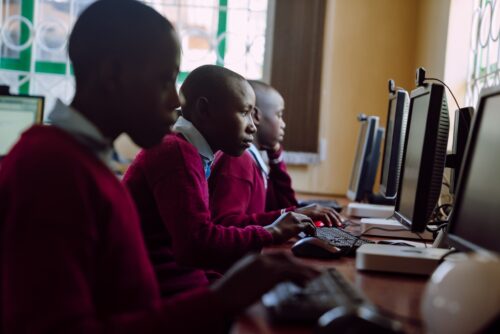
Learners in a classroom in Kenya.

Why we built this

An unstable internet connection is a minor annoyance when you’re reading a web page, but it’s a much bigger problem when you’re 20 minutes into creating a program.

Until now, losing your connection while using the Code Editor could mean losing your work: if you refreshed the page at the wrong moment, you might have seen a blank screen or a browser error instead of your program.
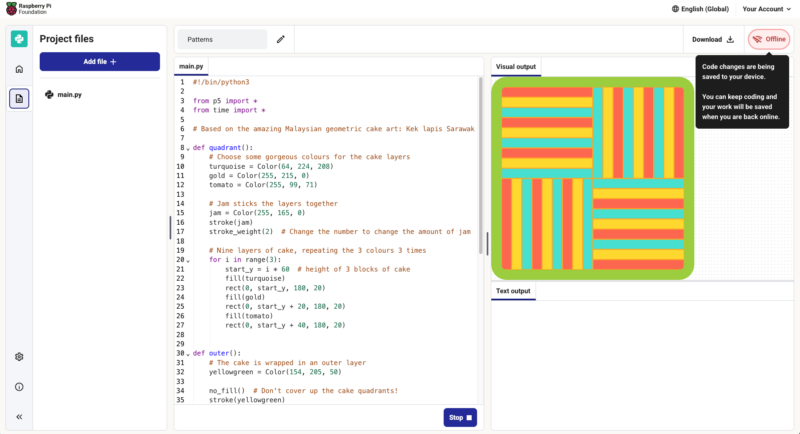
A screenshot of the Code Editor being used without internet connection.
Better offline support means the Code Editor can be more useful for learning and teaching.

When we wanted to understand better what learners and educators around the world need from the Code Editor, we carried out research in countries including India, Kenya, and South Africa. One topic we explored was the availability and reliability of internet connections in metropolitan and rural areas. While it was no surprise that internet access is often slow, unreliable, or expensive in rural areas, we learned that issues related to electricity supply, such as load-shedding and brownouts, are also prevalent in metropolitan areas. All this shapes what is realistically possible in a programming activity using an online editor.

And connectivity issues can occur in any school computing lab where 30 learners are all accessing the same WiFi at once, or for a Code Club running off a mobile hotspot in a community centre, or for someone finishing their homework on patchy mobile data.

That’s why it became a priority for us to improve the Code Editor’s offline support by making it resilient to disconnection.

As we describe in our recently shared draft principles for safe and responsible education technology, one of our commitments is to design for diverse needs, abilities, and contexts — including not to assume constant internet connectivity. This Code Editor update is a small, practical piece of that commitment.

What this means for learners and teachers

The Code Editor was built with resilience in mind from the start, for example running code in your browser rather than on a server, and saving your project locally on your device as you go.

Our recent additions ensure that once you’ve opened the Code Editor while online, your browser holds on to even more of the parts you need to keep coding without a connection. Now if you go offline midway through using the Editor:

  • You’ll see a clear message in the Editor flagging that you’re offline
  • A full page refresh won’t result in a connection error or blank screen
  • If you’re logged in, everything you do in the Editor while offline is saved to your account automatically once you’re back online
  • You can still download your code using the ‘download’ button, in case you know you’re going to be offline for a while and need to save your program file on your computer or a storage device
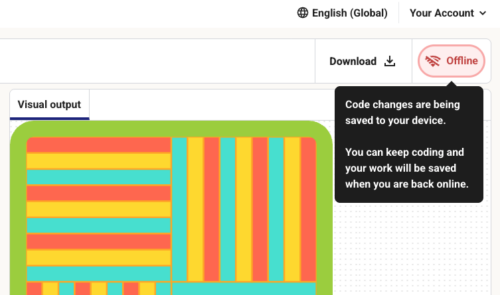
A screenshot of the message the Code Editor shows when it is being used offline.
A message shows in the Editor when the internet connection is down.

How it works, in brief

This update is built on a service worker, a script your internet browser runs in the background. When you first load the Code Editor, the service worker stores the files the Editor needs in your browser’s cache. If the network connection then breaks, the service worker serves those stored files instead of trying and failing to fetch them. When you come back online, it automatically refreshes the cache so you’re not left running old files.

What is not possible at the moment

The Code Editor isn’t a full offline app that you install. It’s a browser-based app that we have now upgraded to better cope with losing its internet connection, which means:

  • You need to have loaded the Code Editor at least once while online, in the browser and on the device you’re going to use
  • When you go offline, you can’t open projects you haven’t already loaded
  • If you clear your browser data while offline, any changes you’ve made to projects will disappear
  • You can’t log into or out of your account while offline, and saving to your account pauses until you’re back online
  • Any feature that needs the network, such as sharing projects with students in Code Classroom, won’t be available until you reconnect

We’ll keep working to extend what parts of the Editor work offline.

Try it and tell us how you get on

The Code Editor works in your browser with no setup and will always be free for educators and learners. We hope this update makes it more useful for people in lots of different settings.

The update is one of those features some people will never notice, which is rather the point: it should feel like nothing went wrong. If your connection is unreliable and you try out the updated Code Editor, we’d love you to tell us whether or not it works well for you.

We would like to thank Cisco for the generous funding that made this work possible.

The post Keep coding when your internet drops: Offline support in the Code Editor appeared first on Raspberry Pi Foundation.
Building education technology that children can trust

Post Syndicated from Laura Kirsop original https://www.raspberrypi.org/blog/draft-principles-for-safe-responsible-edtech/

Millions of young people and educators around the world use our technology to teach, learn, and create with code. Building it safely and responsibly is intrinsic to who we are and what we stand for.

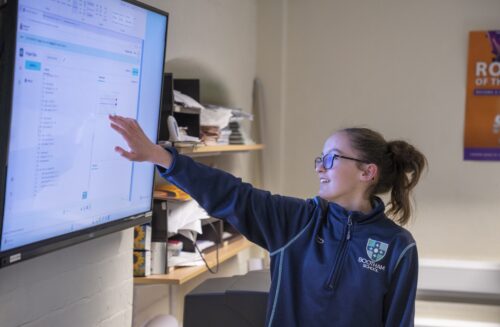
A young person presents her code on a large screen.
A young person presents code she has written in our Code Editor.

A growing body of research and public commentary links the use of social media, smartphones, and algorithmic platforms to declining mental health and attention in young people. Public attitudes are shifting in response, and parents, teachers, and governments are increasingly demanding action. Phone bans in schools and restrictions on social media are spreading across many countries. The technology sector can no longer take public trust for granted.

None of this is new territory for researchers, who have argued for decades that technology is not neutral, and that the choices made in designing it can either embed harm or help prevent it (1). We think this moment calls for a calm, evidence-led response, and we want to be open about how we are approaching it and to do this work alongside others rather than on our own.

Standing on existing research

We have always been a research-led organisation. When we face a difficult question, we look at the evidence and learn from the people who have studied it.

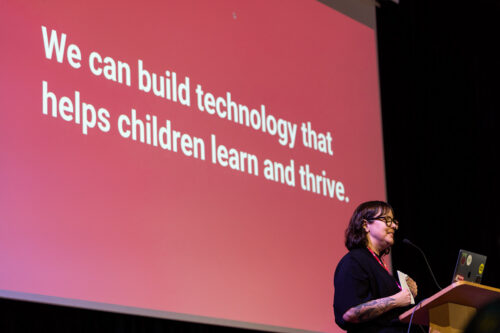
A person on stage stands before a slide with the sentence "We can build technology that helps children learn and thrive".
Laura Kirsop presented the draft principles at the Raspberry Fields summit in July.

Children’s digital rights is a rich and well-established field. Researchers and experts have spent years thinking carefully about what children need from the technology they use, and how their rights apply in a digital world. The United Nations set out a clear framework in 2021 with General Comment No. 25, which describes how children’s rights apply to the digital environment. Organisations like UNICEF and the 5Rights Foundation have built on this with practical guidance for the people who design and build products.

This body of work gives us firm ground to stand on. Rather than starting from scratch, we have used it to shape our own approach. We have drawn in particular on UNICEF’s Responsible Innovation in Technology for Children framework, UNICEF’s EdTech for Good Framework 1.0, the UN’s General Comment No. 25, and the Digital Futures Commission’s Child Rights by Design principles.

Eight principles to guide our work on edtech

We have begun by writing eight principles, designed to guide the decisions we make as we build and run our products.

Our principles:

1. The best interests of the child come first. We design for children’s wellbeing, which means more than safety and privacy. It includes their agency, their emotional health, their relationships, and the space to create. Sometimes putting that first means choosing against growth, engagement, or speed.

2. Our technology supports human relationships. It does not replace them. Any personalised or AI-supported features we build are there to strengthen the relationships between young people, educators, and caregivers. People stay in control, and we do not hand decisions about a child’s learning or wellbeing to a machine.

3. We only collect the data we need. By the time a child turns 13, more than 72 million pieces of personal data will have been collected about them. We collect the minimum we need to help children learn and to measure our impact. We do not sell data, and we never will.

4. We design for learning, and we prove its impact. Our products are grounded in evidence about how children learn, and we evaluate whether they actually work. We avoid designs that keep learners hooked rather than helping them learn.

5. We design with children and educators, not for them. The people who use our products are the experts on their own needs. We involve them in research, testing, and feedback, and we make sure what they tell us shapes the product, not just a report at the end.

6. We design for diverse needs, abilities, and contexts. Our technology adapts to people, not the other way around. We do not assume constant connectivity, confidence with digital technologies, or a classroom that looks like anyone else’s.

7. We are transparent and accountable. We use plain language to explain how our products work, how data is used, and what rights people have. And we give people clear ways to question or challenge the decisions our systems make.

8. We apply the highest standards of children’s rights everywhere we work. Where local rules fall short of international best practice, we choose the higher standard. A child’s rights should not depend on where they happen to live.

You can read the full set of draft principles, and the research behind each one, in this PDF:

Committed, not perfect

Publishing these principles is a statement of intent, not a claim that we have got everything right. This is a fast-moving area. Regulation is changing quickly, the research keeps developing, and we grow and change our own products. There are areas where we know we have work to do, and almost certainly areas we have not yet spotted.

These principles are how we hold ourselves to account, and they are only a start. Alongside them, we are mapping the regulatory landscape across the countries where we work, developing ways to assess our products against these principles, and building these commitments into how we make decisions. We will keep listening to the people who use our products, and making sure children themselves have a voice in shaping the technology built for them.

We also know we cannot do this alone, so we have two asks for you:

If you have a view on these principles, tell us. Whether you are a researcher, educator, parent, young person, or policymaker, we want to hear where you think we have got it right, where we have not, and what we have missed. Honest challenge is genuinely useful to us. Give your feedback and sign up to be involved in shaping them.

If you are part of a non-profit or organisation working on similar questions, get in touch. We would like to build a coalition of like-minded organisations to share what we are learning and raise standards across the sector.


(1) See for example:

  • Friedman, B., & Nissenbaum, H. (1996). Bias in computer systems. ACM Transactions on Information Systems, 14(3), 330–347. https://doi.org/10.1145/230538.230561
  • Noble, S. U. (2018). Algorithms of Oppression: How Search Engines Reinforce Racism. NYU Press.
  • O’Neil, C. (2016). Weapons of Math Destruction: How Big Data Increases Inequality and Threatens Democracy. Crown.

The post Building education technology that children can trust appeared first on Raspberry Pi Foundation.