Microsoft is addressing 34 vulnerabilities this December Patch Tuesday, including a single zero-day vulnerability and three critical remote code execution (RCE) vulnerabilities. December Patch Tuesday has historically seen fewer patches than a typical month, and this trend continues in 2023. This total does not include eight browser vulnerabilities published earlier this month. At time of writing, none of the vulnerabilities patched today are yet added to the CISA KEV list.
Certain AMD processors: zero-day information disclosure
This month’s lone zero-day vulnerability is CVE-2023-20588, which describes a potential information disclosure due to a flaw in certain AMD processor models as listed on the AMD advisory. AMD states that a divide-by-zero on these processor models could potentially return speculative data. AMD believes the potential impact of the vulnerability is low since local access is required; however, Microsoft ranks severity as important under its own proprietary severity scale. The vulnerability is patched at the OS level in all supported versions of Windows, even as far back as Windows Server 2008 for Azure-hosted assets participating in the Extended Security Update (ESU) program.
Outlook: no-interaction critical RCE
CVE-2023-35628 describes a critical RCE vulnerability in the MSHTML proprietary browser engine still used by Outlook, among others, to render HTML content. Of particular note: the most concerning exploitation scenario leads to exploitation as soon as Outlook retrieves and processes the specially crafted malicious email. This means that exploitation could occur before the user interacts with the email in any way; not even the Preview Pane is required in this scenario. Other attack vectors exist: the user could also click a malicious link received via email, instant message, or other medium. Assets where Internet Explorer 11 has been fully disabled are still vulnerable until patched; the MSHTML engine remains installed within Windows regardless of the status of IE11.
Internet Connection Sharing: critical RCE
This month also brings patches for a pair of critical RCE vulnerabilities in Internet Connection Sharing. CVE-2023-35630 and CVE-2023-35641 share a number of similarities: a base CVSS v3.1 score of 8.8, Microsoft critical severity ranking, low attack complexity, and presumably execution in SYSTEM context on the target machine, although the advisories do not specify execution context. Description of the exploitation method does differ between the two, however. CVE-2023-35630 requires the attacker to modify an option->length field in a DHCPv6 DHCPV6_MESSAGE_INFORMATION_REQUEST input message. Exploitation of CVE-2023-35641 is also via a maliciously crafted DHCP message to an ICS server, but the advisory gives no further clues. A broadly similar ICS vulnerability in September 2023 led to RCE in a SYSTEM context on the ICS server. In all three cases, a mitigating factor is the requirement for the attack to be launched from the same network segment as the ICS server. It seems improbable that either of this month’s ICS vulnerabilities are exploitable against a target on which ICS is not running, although Microsoft does not explicitly deny the possibility.
Holiday season update
Notable by their absence this month: no security patches for Exchange, SharePoint, Visual Studio/.NET, or SQL Server. There are also no lifecycle transitions for Microsoft products this month, although a number of Windows Server 2019 editions and Office components will transition out of mainstream support and into extended support from January 2024.
Summary Charts
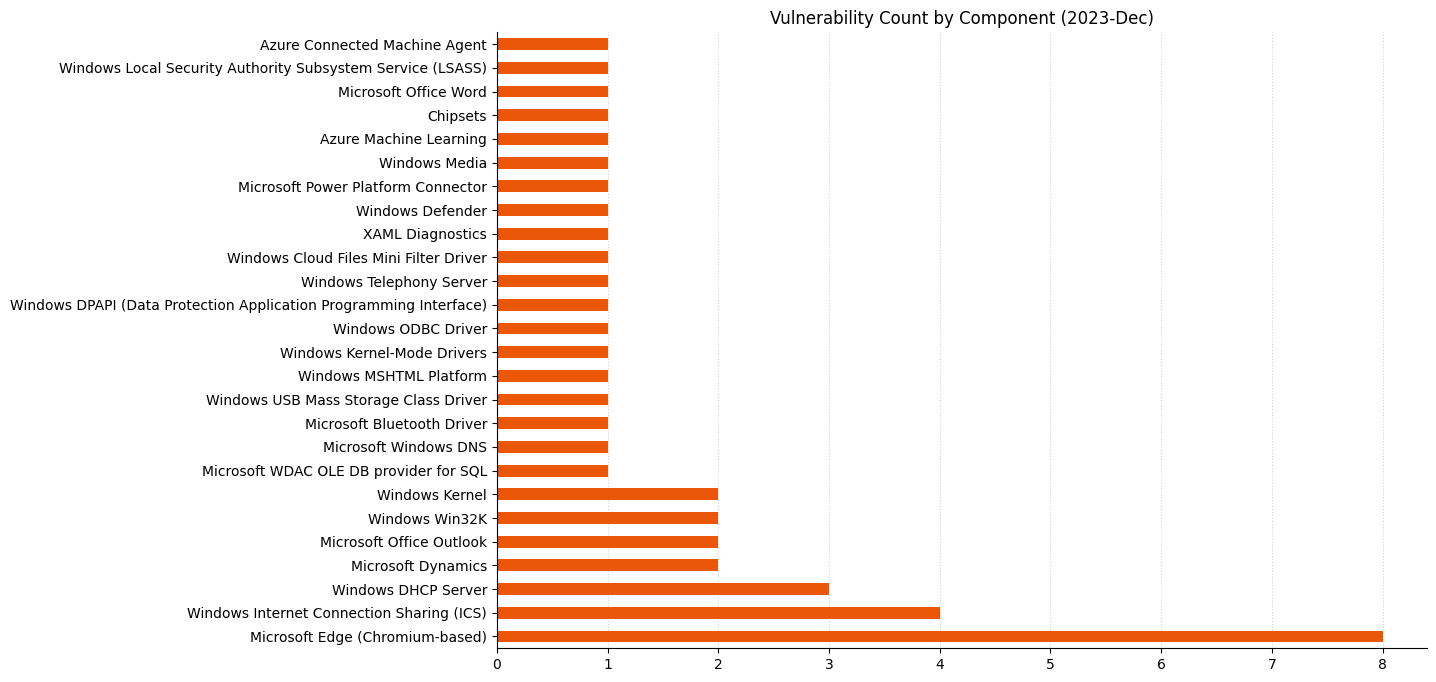
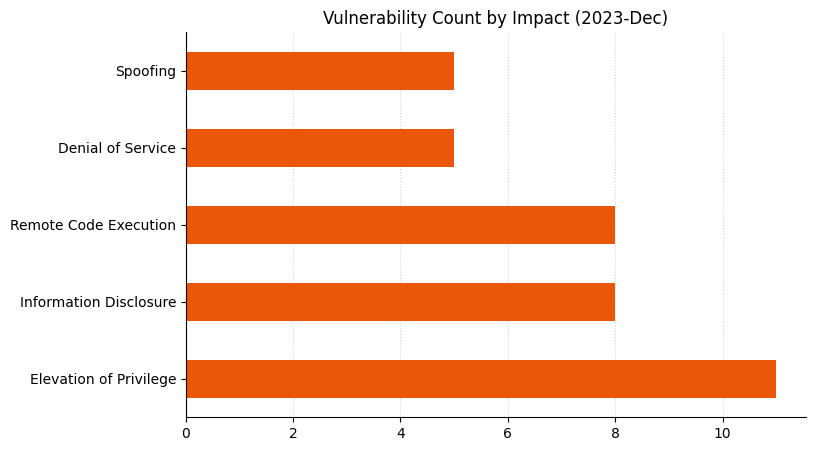
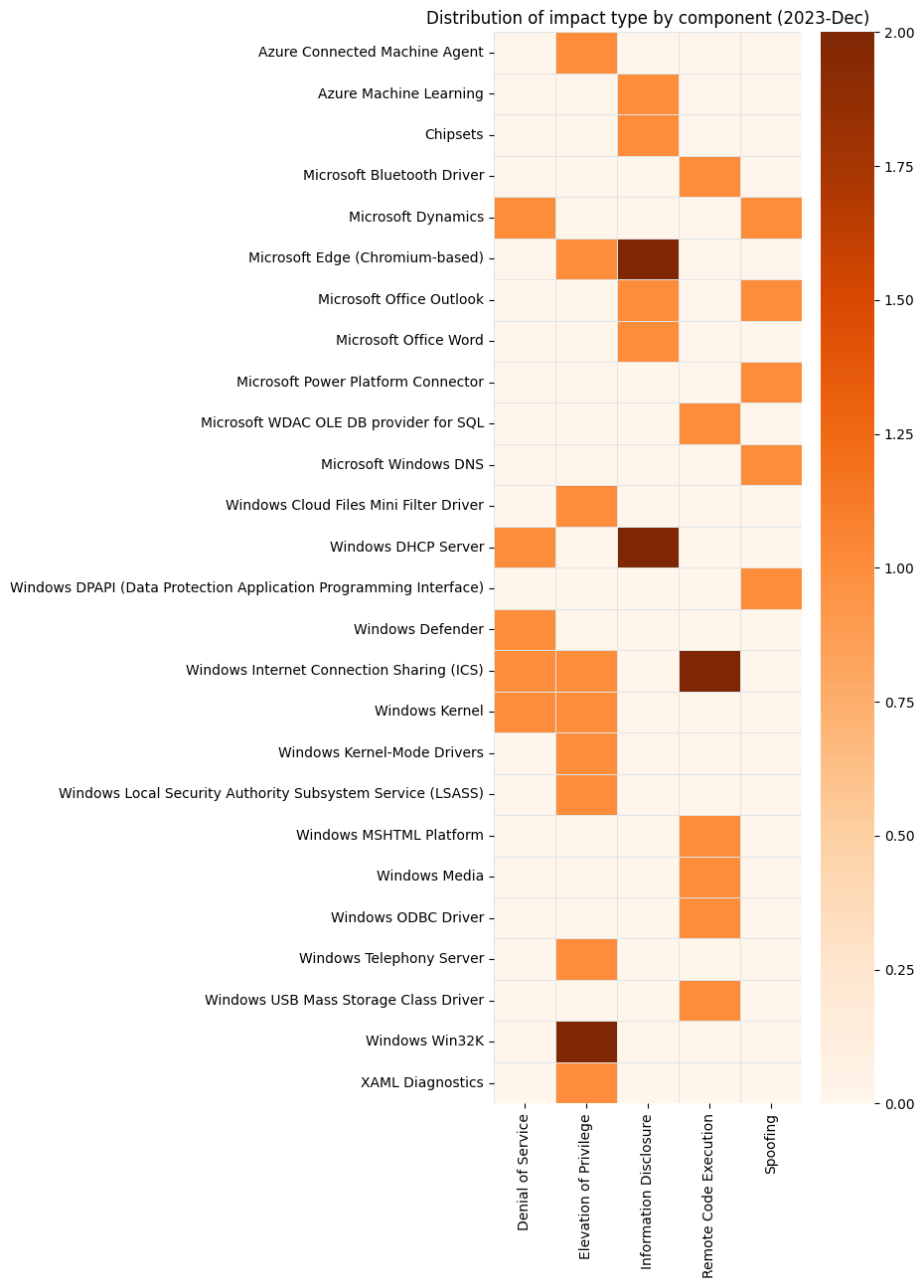
Sharing is caring, unless it’s exploitative.A rare occurence: Remote Code Execution not in the top spot.Fewer vulns this month overall means less variation in the heatmap.
To provide the best experiences, we use technologies like cookies to store and/or access device information. Consenting to these technologies will allow us to process data such as browsing behavior or unique IDs on this site. Not consenting or withdrawing consent, may adversely affect certain features and functions.
Functional
Always active
The technical storage or access is strictly necessary for the legitimate purpose of enabling the use of a specific service explicitly requested by the subscriber or user, or for the sole purpose of carrying out the transmission of a communication over an electronic communications network.
Preferences
The technical storage or access is necessary for the legitimate purpose of storing preferences that are not requested by the subscriber or user.
Statistics
The technical storage or access that is used exclusively for statistical purposes.The technical storage or access that is used exclusively for anonymous statistical purposes. Without a subpoena, voluntary compliance on the part of your Internet Service Provider, or additional records from a third party, information stored or retrieved for this purpose alone cannot usually be used to identify you.
Marketing
The technical storage or access is required to create user profiles to send advertising, or to track the user on a website or across several websites for similar marketing purposes.