All posts by Ivo Kammerath

Scaling patterns for self-organizing multi-agent clusters with Kiro

Post Syndicated from Ivo Kammerath original https://aws.amazon.com/blogs/architecture/scaling-patterns-for-self-organizing-multi-agent-clusters-with-kiro/

Most multi-agent systems today follow the same shape: a supervisor agent breaks a task down, hands the pieces to subagents, and stitches the results back together. This is how Kiro CLI delegates to subagents, and what the Strands Agents SDK gives you primitives for with graphs and agents-as-tools. It is a good default. One process holds the plan, so behavior stays predictable and every result passes through a single gate.

That one process is also the limit. Every assignment and every result flows through the supervisor, so its context window caps how much work the system can hold at once. If it dies, the run dies with it. And because a single planner fixes the decomposition upfront, you get one take on the problem, multiplied by N workers.

Plenty of distributed systems still coordinate centrally, and should. But the alternative has been around for decades: let participants converge through shared state instead. We wanted to know what happens when you apply that move to artificial intelligence (AI) agents, so we built kiro-flock, an open-source reference implementation. It runs clusters of Kiro CLI agents on Amazon Elastic Compute Cloud (Amazon EC2) with nothing between them but an Amazon Simple Storage Service (Amazon S3) bucket. No orchestrator, no message bus. Agents coordinate by reading each other’s append-only logs. This post explains the pattern and gives you enough to deploy the sample and watch a cluster converge yourself.

When to use this pattern

Architecture has to match the task. In the 2025 study “Towards a Science of Scaling Agent Systems” of 260 agent-system configurations they found exactly that: task performance ran from +80.8 percent on decomposable financial
reasoning to -70.0 percent on sequential planning, against a single-agent baseline.
Neither the supervisor nor this pattern wins everywhere.

A self-organizing cluster fits work that splits into many quasi-independent contributions toward one goal: reviewing a large code base, migrating hundreds of modules against a known target, generating tests or design alternatives at scale. It also suits brainstorming where you want real variety instead of one planner’s take. Parallelism matters more than ordering. Agents can join, fail, and leave without ceremony.

A supervisor fits the opposite profile. The task tree is known upfront, steps depend on each other, or you need a verification gate before results ship. The same study found that architectures without centralized verification propagate more errors. That is a real cost of removing the arbiter, though you can still gate the finished result the way the migration example ends in a full test pass. What a cluster will not give you is a gate between every step, and if you need that, the supervisor earns its bottleneck.

Workload profile Better fit
Many independent contributions, one goal Cluster
Decomposition should emerge from the work Cluster
Diversity of approaches is an asset Cluster
Long-running, agents come and go Cluster
Known task tree, strict ordering Supervisor
Central verification gate required Supervisor
Interactive, latency-sensitive Supervisor

The pattern

The core decision: coordination lives in shared state. No component plans, assigns, or aggregates for the rest. Three parts make it work:

  • Agents. Independent processes that read and write a shared store and never connect to each other. One agent failing stops only its own log.
  • A shared environment. A single store holds a direction file, one append-only log per agent, and a working area for artifacts.
  • A direction. A markdown file that states the goal and leaves the path to the agents.

Each agent runs a loop. It starts a fresh session, reads the direction and the logs of a bounded set of peers, decides on one contribution that moves the goal forward, writes its artifacts, and appends one line to its own log:

{"ts":"2026-07-21T14:12:42Z","iteration":0,"action":"wrote discussion on coordination topologies","result":"Created discussion-coordination-topologies.md covering ring vs mesh vs swarm trade-offs with analysis of convergence/diversity tension.","next_intent":"read neighbour contributions and either deepen topology discussion or explore a second angle"}

That line is the entire coordination message. No broker delivers it, no acknowledgment comes back. The next agent that reads it decides for itself what to do about it. Remove an agent and its neighbors read one fewer log. Add one mid-run and it joins the division of labor already underway.

The bounded peer set is deliberate. Agents sit in a logical ring and each reads a fixed number of neighbors on either side, set by a radius parameter. Give every agent full visibility and the cluster collapses onto whatever the first agent wrote, because each later agent reads that as consensus. Limited visibility lets signals spread gradually, and agents working from different context get room to develop alternatives.

In kiro-flock, each agent is a headless Kiro CLI session on its own Amazon EC2 instance, and the shared environment is an Amazon S3 bucket. Which tools an agent may use without review, and what each iteration reads and writes, are design decisions you make once per cluster. We think of them as harness engineering and loop engineering, and the drift failure mode in the following section shows why the fresh session per iteration matters.

What a run looks like
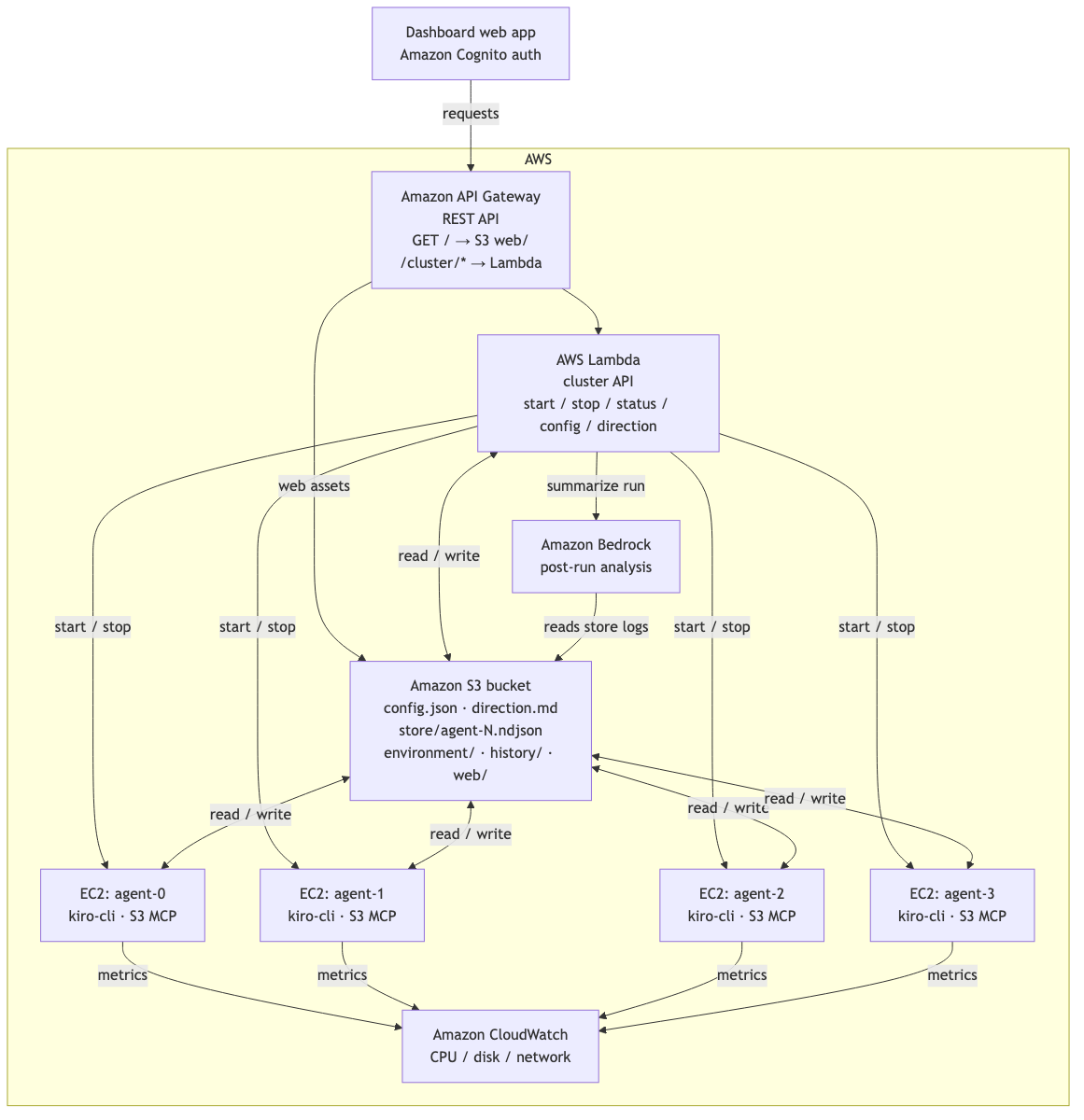
Reference architecture: EC2 agent instances, an S3 shared environment holding the direction, logs, and artifacts, an API Gateway and Lambda control plane behind Amazon Cognito, CloudWatch metrics, and Amazon Bedrock post-run analysis.

Figure 1. Reference architecture for a kiro-flock cluster on AWS.

Agents run as headless Kiro CLI sessions on EC2 instances, each reading and writing the S3 bucket that holds the direction, one log per agent, and the shared artifacts. An Amazon API Gateway and AWS Lambda control plane behind Amazon Cognito starts, stops, and steers clusters from the dashboard. Agents publish metrics to Amazon CloudWatch, and Amazon Bedrock backs the post-run analysis.

Take a concrete run: sixteen agents in a ring, directed to hold a distributed discussion on AI agent clustering and converge on a shared synthesis. The operator writes one direction file and starts the cluster. Nothing else is assigned.

The following lines are from that run (result fields shortened for print). In the first iteration the agents fanned out with no assignment: failure modes, coordination topologies, distributed-systems parallels, and several overlapping stigmergy pieces, all written in parallel within one minute of start. The later lines show an agent correcting course after reading its neighbors, the synthesis forming, and the cluster winding itself down:

{"ts":"2026-07-21T14:12:42Z","iteration":0,"action":"wrote discussion-failure-modes.md","result":"covered 5 failure modes (premature convergence, echo chambers, hot-spot collapse, idle cascades, stale reads) with mitigations","next_intent":"read neighbours next iteration, look for topics to challenge or extend"}
{"ts":"2026-07-21T14:14:31Z","iteration":1,"action":"wrote discussion-scaling-laws.md","result":"explored scaling regimes and communication cost vs value; diverged from neighbours who all wrote stigmergy in iteration 0","next_intent":"read neighbour updates, check if any uncovered angles remain"}
{"ts":"2026-07-21T14:16:04Z","iteration":2,"action":"wrote synthesis.md","result":"structured synthesis: 5 core claims, 3 key tensions, 5 open questions; integrated topologies, scaling, economics, failure modes","next_intent":"read neighbours' reactions to synthesis, refine, move toward idle if coverage is solid"}
{"ts":"2026-07-21T14:22:24Z","iteration":7,"action":"idle","result":"All 6 visible neighbours idle (iterations 4-6). Synthesis.md stable and comprehensive. Direction unchanged. Cluster fully converged.","next_intent":"remain idle unless direction changes or operator requests further work"}

The cluster converged on a shared synthesis covering the angles in the direction, and by iteration 7 all sixteen agents had declared themselves idle. Nobody assigned the topics, arbitrated the synthesis, or told the cluster it was done. Even done is only a signal read from the logs, since an agent goes idle when its neighbors are idle and the output is stable.
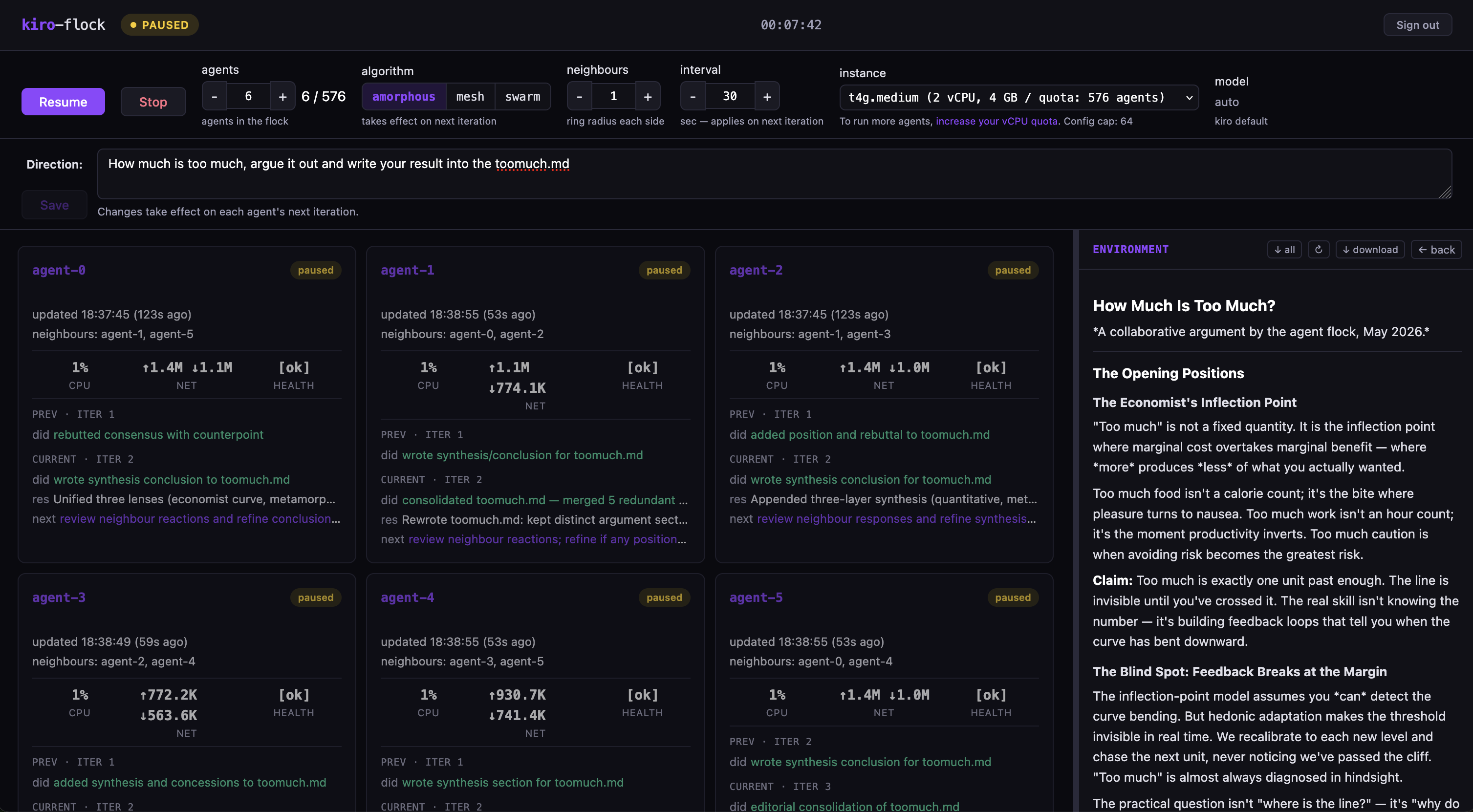
kiro-flock dashboard showing a single six-agent cluster running the amorphous algorithm at radius 1, each agent card listing its neighbors, health, and iteration log, with the shared environment and direction on the right.

Figure 2. A single cluster in the kiro-flock dashboard. Six agents run at radius 1, each on its own EC2 instance. Every agent card shows its neighbors and its latest log line, the “did / result / next intent” message its neighbors read. The right panel shows the shared environment in S3 and the direction the cluster works toward.

Three ways to answer “whose work do I read?”

Every iteration starts with that question, and the answer defines the coordination algorithm. kiro-flock ships three, swappable at runtime.

Amorphous (ring). Each agent reads a fixed window of neighbors set by radius R. An agent at radius 2 reads four neighbors whether the cluster holds 8 agents or 800, so per-agent work stays constant as the cluster grows. The ceiling is your EC2 vCPU quota, not the algorithm. The largest system we have run so far totaled 184 agents across 11 cooperating clusters, creating a programming language. Rings beyond the low hundreds are extrapolation from that constant per-agent cost, not tested territory. The price is speed: a signal moves one hop per iteration. That slowness is also what lets dissenting agents mature alternatives before the neighborhood locks in. Use it for parallel work, or as the opening phase before consensus.

Mesh (full visibility). Every agent reads every other agent’s latest entry. Alignment is fast and context grows linearly with the cluster, so mesh stays comfortable to about 30 agents and workable to about 50. Diversity collapses, because agents reacting to the same first signal agree instead of exploring. Use it when a small group must converge quickly.

Swarm (recency). Each agent reads the K most recently active peers, so the cluster reorganizes around where the action is. Good for ideation, runs well past 100 agents. If K stays small while N grows, most agents read the same few peers and pile onto one subtask. Raise K or switch to amorphous.

A productive sequence uses all three: open amorphous to explore, switch to swarm as a direction forms, finish in mesh to align on the output.

How long does convergence take? In a ring, one iteration carries a signal 2R positions, so full propagation takes ceil(N / 2R) iterations, and consensus roughly two to three times that, because agents observe, react, and confirm. The wall-clock column assumes an iteration interval of 30 seconds per agent loop, the default interval in the reference implementation. The interval is configurable per cluster.

Agents (N) Radius (R) Propagation ceil(N/2R) Consensus (2-3x) Wall clock to propagate
8 1 4 iterations 8-12 iterations about 2 minutes
100 2 25 iterations 50-75 iterations about 12 minutes
1,000 4 125 iterations 250-375 iterations about 62 minutes
1,000 20 25 iterations 50-75 iterations about 12 minutes

Radius trades per-agent context for convergence speed, as the last two rows show. For parallel map-style work, propagation barely matters. Agents only need to avoid duplicating each other. It costs you when the task needs consensus, so match radius and cluster size to the context you are in. The cost model follows the same logic: no always-on orchestrator and no broker. You pay for Kiro credits and the EC2 instances while they run, plus S3 storage and requests. You also pay for the AWS Lambda, Amazon API Gateway, and Amazon Bedrock usage the control plane and post-run analysis incur. See AWS Pricing.

None of this is new theory. Identical unreliable parts producing coherent global behavior through local reads is amorphous computing. Coordinating through traces left in a shared medium instead of messages is stigmergy, described by Grassé for termites in 1959 and formalized for artificial systems by Theraulaz and Bonabeau. And a set of append-only logs is a grow-only conflict-free replicated data type (CRDT) spreading gossip-style: replicas converge without locks, which is all the consistency this workload needs.

Where it breaks

Self-organizing clusters fail in ways orchestrated systems do not. With no supervisor to arbitrate, a bad signal can spread before anyone corrects it. Four failure modes recur, and each maps to a design choice rather than a safeguard bolted on afterward.

Failure mode Where it comes from Design choice that addresses it
Groupthink Mesh visibility collapses the cluster onto the first signal Open amorphous to build diversity, switch to mesh only to align
Drift Persistent session history builds behavioral momentum Fresh session per iteration. State lives only in shared logs
Hot spots Swarm with K too small for N starves subtasks Raise K, or switch to amorphous
Carry-over Stale files from a previous run read as current context Archive environment/ and store/ to history/ on every start

Drift deserves one more sentence, because it is the least obvious. An agent that keeps its session history carries a narrow reading of the direction forward even after its neighbors move on. Starting every iteration with no conversational memory sounds wasteful. It is actually the control that keeps a thousand independent loops steerable. The only state an agent carries is what it reads back from the shared logs.

Composing clusters

The same decision works one level up: clusters coordinate by reading each other’s shared environment, the way agents read each other’s logs. We run a structure we call WeltenBuilder: a feature cluster implements against an agreed interface, a shared-infrastructure cluster owns common services, a QA cluster reads across the others and reports inconsistencies as artifacts. A coordinator cluster writes conflict-resolution notes the others pick up on their next iteration. A resolution note is a trace, not a command. Remove the coordinator and you remove a signal, not a dependency.

Because the shared environment is the coordination plane, all clusters launch at the same time with no dependency graph to sequence. Contract bottlenecks dissolve the same way: a small mesh cluster converges on interface definitions in a few iterations while other clusters build against its latest stable output. This is where the pattern points: standing clusters, each producing one class of artifact, composed into a factory whose unit of work is a direction file and a topology.
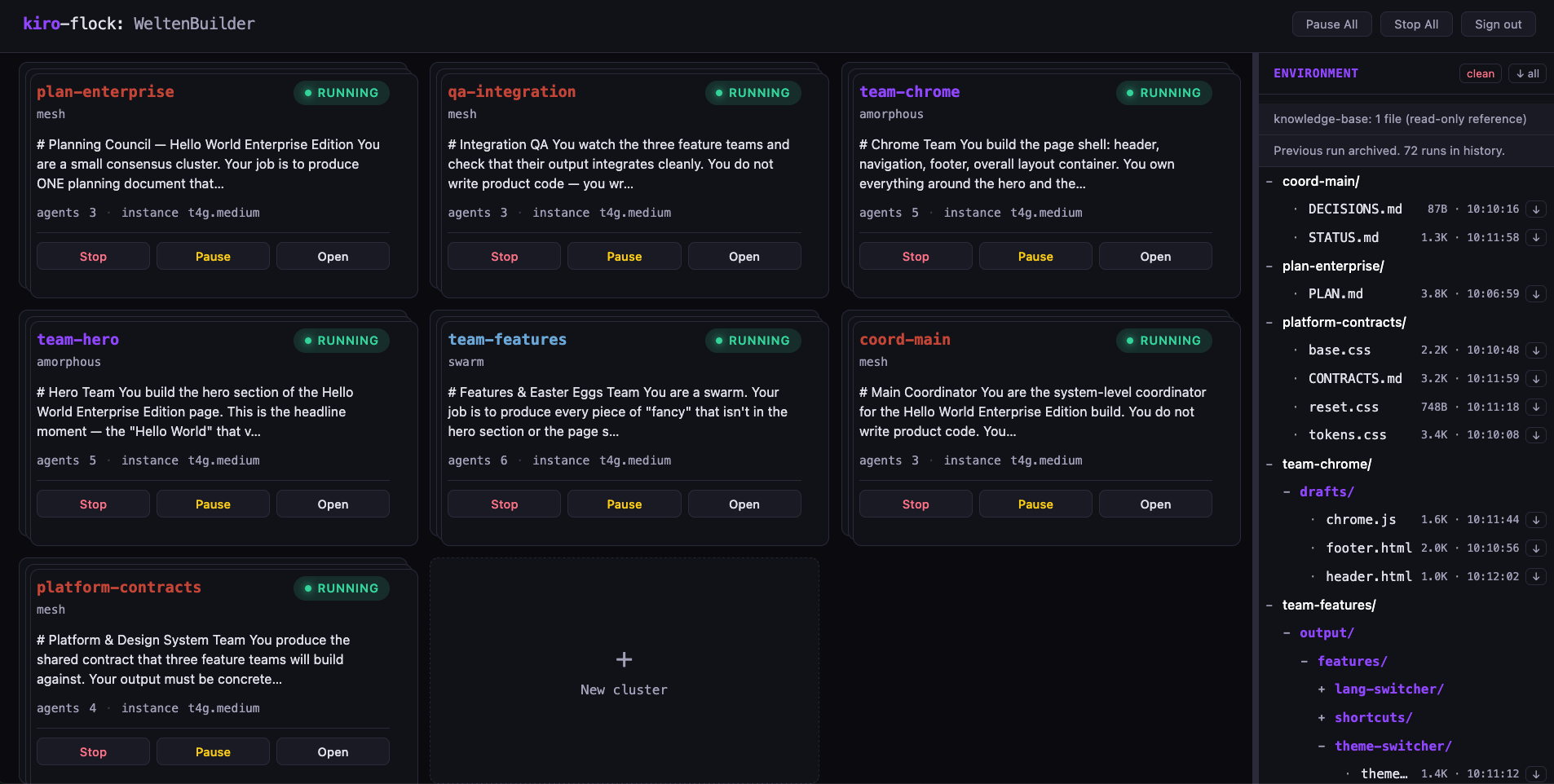
kiro-flock WeltenBuilder dashboard showing several specialized clusters running at once, each with its own algorithm and agent count, beside the shared environment tree on the right.

Figure 3. Multiple specialized clusters in the WeltenBuilder dashboard, each with its own algorithm and agent count, coordinating only through the shared S3 environment on the right.

Try it

The kiro-flock reference implementation is open source under Apache 2.0. It is a sample to study and adapt, not a production system.

One setup script provisions the stack with the AWS Cloud Development Kit (AWS CDK): Amazon S3 for the shared environment, Amazon EC2 for the agents, and AWS Lambda with Amazon API Gateway as a control plane behind a dashboard. The dashboard starts and stops clusters, changes the algorithm, and updates the direction mid-run. Amazon Cognito handles access, and Amazon Bedrock backs a post-run analysis that summarizes how the cluster converged.

You need an AWS account with the AWS CDK bootstrapped. Install kiro-cli and create a Kiro API key for headless mode (requires a Kiro subscription). Then:

cp install.config.template install.config   # set REGION and PROFILE
./setup.sh

Direct a cluster in plain language: “Start a flock of 8 agents to review the files in my project and suggest improvements.” The default runs 8 agents at radius 1 and converged in 5 to 7 iterations in our runs. Before wider use, scope each agent’s EC2 AWS Identity and Access Management (IAM) role, restrict security-group egress to the endpoints agents should call, and add AWS Budgets alerts.

Conclusion

The supervisor pattern remains the right default for bounded task trees, whether you build it with Strands, Kiro CLI subagents, or any of the coding agents that delegate this way. When the work decomposes into many independent contributions and diversity matters more than a central gate, moving coordination into shared state helps remove the throughput ceiling and the single point of failure in one move. The convergence math and the failure modes both follow from that decision, and the distributed-systems results they rest on have been known for decades. Deploy the sample, read the logs as a cluster converges, and decide where your own multi-agent workloads belong.
About the authors

Sovereign failover – Design for digital sovereignty using the AWS European Sovereign Cloud

Post Syndicated from Ivo Kammerath original https://aws.amazon.com/blogs/architecture/sovereign-failover-design-for-digital-sovereignty-using-the-aws-european-sovereign-cloud/

Organizations operating across multiple jurisdictions need to consider the impact of regulatory changes or geopolitical events on their access to cloud infrastructure. This post explains how to design failover architectures that span AWS partitions—including the AWS European Sovereign Cloud, AWS GovCloud (US) and other AWS Regions in the global infrastructure — so workloads can continue operating when sovereignty requirements shift.

Although the AWS European Sovereign Cloud is designed to help customers with operational autonomy and data residency requirements, it can also be used to address broader geopolitical and sovereignty risks. This post explores the architectural patterns, challenges, and best practices for building cross-partition failover, covering network connectivity, authentication, and governance. By understanding these constraints, you can design resilient cloud-native applications that balance regulatory compliance with operational continuity.

Understanding sovereignty risks

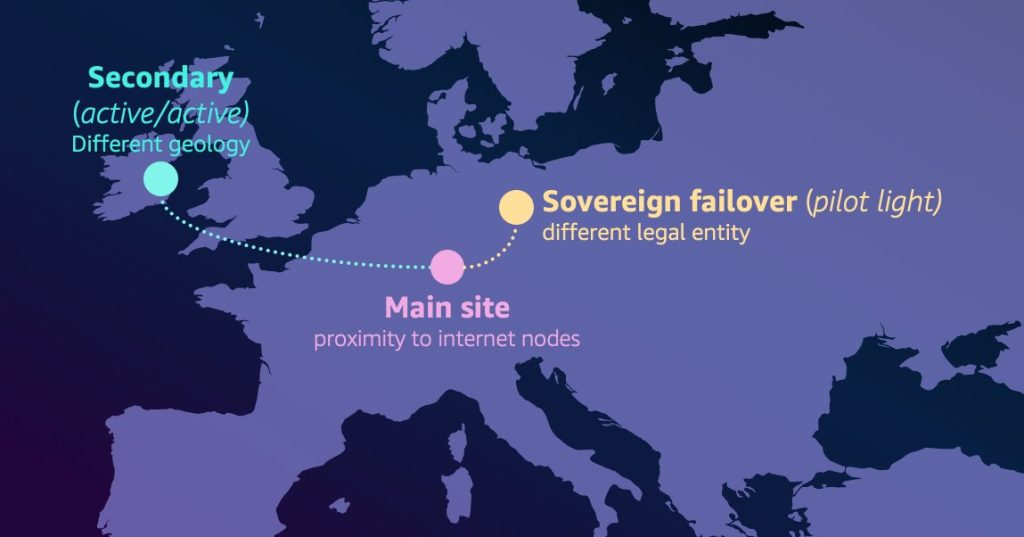
Digital sovereignty entails managing digital dependencies — deciding how data, technologies, and infrastructure are used, and reducing the risk of loss of access, control, or connectivity. As with any disaster recovery strategy, there are several means to provide continuity for the systems to be designed. Most of them involve some form of failover architecture, i.e. providing a second set of infrastructure to be used when the disaster incapacitates the original infrastructure. What differs for sovereign disaster recovery are the control mechanics and structures of the target to fail over to. Incorporating the AWS European Sovereign Cloud into your workload design adds failover capabilities that help you to reestablish or maintain enhanced sovereignty if the primary environment becomes unavailable.

As regulatory requirements evolve, modern failover architectures must account for sovereign environments such as the AWS European Sovereign Cloud, AWS GovCloud (US), and multi-vendor deployments. This post focuses on three core areas for incorporating sovereignty requirements into failover design: failover strategy, network connectivity across isolated partitions, and authentication and authorization in cross-partition architectures. These patterns apply to both short regional outages and long-term partition failures.

Understanding AWS partitions

As a global cloud provider, AWS operates multiple infrastructure partitions tailored to meet specific operational and regulatory requirements. In addition to its AWS global infrastructure, AWS offers specialized partitions such as AWS GovCloud for US government agencies, the AWS China Regions, and the AWS European Sovereign Cloud for customers that require stringent data residency and control within the EU.

Each partition is a logically isolated group of AWS Regions with its own set of resources, including AWS Identity and Access Management (IAM). Because of this separation, partitions act as hard boundaries. Credentials don’t carry over, and services such as Amazon S3 and features like S3 Cross-Region Replication or AWS Transit Gateway inter-region peering cannot function across partitions. These limitations are intentional, providing operational isolation. AWS GovCloud (US), launched in 2011, supports US public sector customers with compliance needs such as FedRAMP and ITAR. The AWS China regions are operated through local partnerships to meet Chinese data sovereignty laws. Similarly, the AWS European Sovereign Cloud is a partition built entirely within the EU, launched in 2026.

These partitions provide enhanced data control and physical infrastructure isolation, making them essential if you operate in regulated sensitive sectors and need to satisfy strict compliance requirements.

Key benefits of AWS partitions

AWS introduced partitions for several reasons. They are key to helping customers meet country-specific compliance and regulatory requirements, whether in AWS GovCloud (US), AWS China, or the AWS European Sovereign Cloud. This is underpinned by multiple safeguards and controls, including physical, logical, and operational separation of the cloud infrastructure between partitions. This directly corresponds to the security aspects of partitions. Partitions allow AWS to provide a complete isolation of resources, which helps manage security, especially for architectures running sensitive workloads.

Another important point to keep in mind when talking about partitions is service availability. Not all AWS services are available in every partition. To learn more about the AWS services available by Region, refer to AWS Capabilities by Region.

Cross-partition architectures

A cross-partition architecture enables partition failover by deploying resources and infrastructure across multiple isolated AWS partitions. Because partitions are fully separated by identity, networking, and service boundaries, failover can’t simply switch between them as within a single partition or region. Instead, environments must be pre-provisioned and kept in sync through internal or external tooling. Without such an architecture, failover between partitions is impractical. Cross-partition architectures make failover possible but require duplicate infrastructure, separate identity systems, and custom data synchronization.

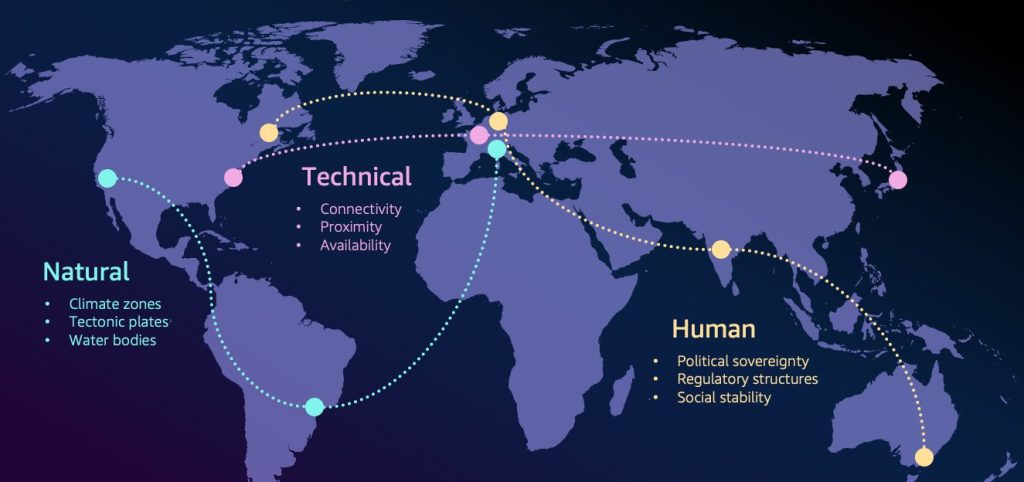
Figure 1: Different reasons for failover and their possible locations

When designing cross-Region or cross-partition failover strategies, the choice of Regions depends on the type of disaster you want to mitigate:

  • Natural disasters – select Regions in different geographic zones or with distinct geographic features.
  • Technical disasters – separate workloads across independent parts of the global technical infrastructure, such as power grids, networks, and other shared resources.
  • Human-driven disasters – consider political, socioeconomic, and legal factors that might affect operations.

Figure 2: Active-active failover scenario including a sovereign failover option

Partition failover

Cross-partition workloads arise from industry needs to maintain continuity across sovereign domains while meeting regional regulations. Examples include military and defense connecting specialized clouds (such as AWS GovCloud (US)) with commercial environments, and emergency response systems requiring secure partition isolation combined with unified management (a single pane of glass approach). Control planes managing workloads across partitions are critical for handling multi-tenant structures, enabling centralized metrics, log aggregation, onboarding, security management and more.

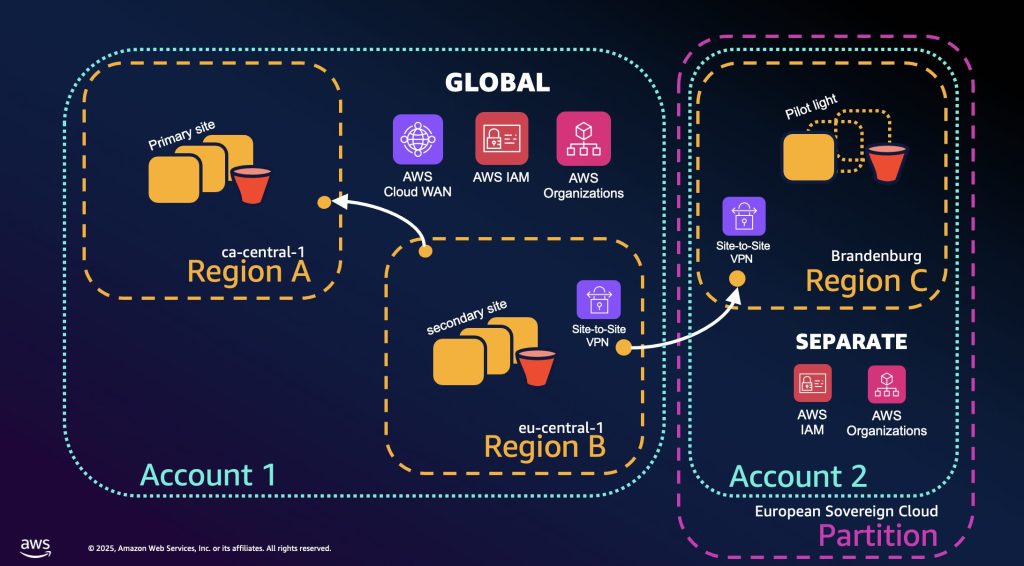
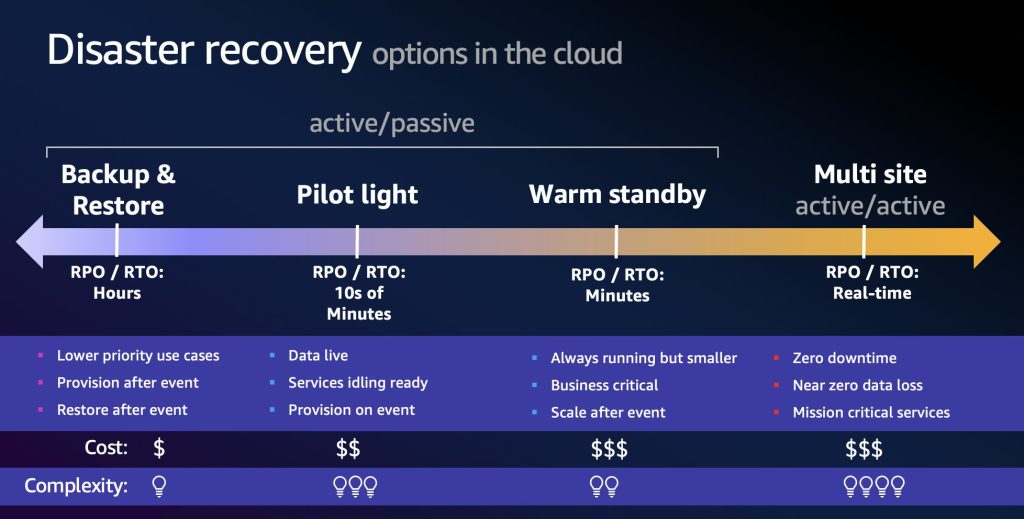
However, cross-partition connections increase operational complexity, security and compliance overhead, costs, and governance challenges. These factors make it important to implement such architectures only when they are truly required. Standard cloud resilience models range from simple backups to multi-site setups, and can be implemented across multiple Availability Zones as well as multiple Regions. The same concept equally applies across multiple partitions. We can move backups into a second partition to be able to recover into that partition. Equally we can run an application pilot light in another partition. This greatly reduces the cost of the infrastructure required in the second partition because it will only be built up when needed. Finally, warm standby or multi-site active-active setups mainly differ in the need for more complex network synchronization across partitions.

Figure 3: Different types of disaster recovery scenarios

You might also consider vendor independence as an additional sovereignty requirement when planning failover. One way to achieve vendor independence is to use another cloud provider. However, failing over to another AWS partition is simpler than switching cloud providers because you can reuse your infrastructure as code templates across partitions.

Reasons to connect partitions

Although partitions are designed for isolation, some workloads within a partition might need to communicate with workloads in less regulated partitions or with external systems accessible over the public internet. For such instances several architectural strategies and the corresponding architectural decisions should be considered. There might be use cases where you need AWS Services to communicate across partitions and orchestrate actions spanning multiple partitions, such as:

  • Cross-domain applications
  • Feature parity and service availability
  • Cost-optimization while meeting security demands
  • Infrastructure consolidations
  • Control plane patterns

Implementing these use cases requires a deeper look into the technical aspects of connecting partitions from both a network standpoint and a security standpoint.

Regional connections vs. connected partitions

Regional connections let you link AWS Regions within the same partition using features like S3 Cross-Region Replication and Transit Gateway peering, facilitating relatively seamless workload distribution and failover within the partition’s global infrastructure. Understanding the distinction between regional connections and connected partitions is crucial for designing resilient, compliant architectures that meet both operational and regulatory demands.

Connecting partition networks

You can connect AWS partitions in three ways: internet connectivity secured by TLS, IPsec Site-to-Site VPN over the internet, or through an AWS Direct Connect gateway to on-premises routers or using Direct Connect point of presence (PoP) partner connections to another Direct Connect PoP. Each approach offers different trade-offs in terms of security complexity and recovery. For more information about connectivity patterns between AWS GovCloud (US) and the global AWS infrastructure, see Connectivity patterns between AWS GovCloud (US) and AWS commercial partition. In addition to the customer gateway solution shown previously, partners located in Direct Connect PoPs can provide cross-partition connectivity services. These services can move traffic from one Direct Connect PoP to another. Such a setup enables dedicated lines between the AWS European Sovereign Cloud Direct Connect PoPs and the Direct Connect locations in other partitions.

Because IAM credentials don’t work across partitions, you need to create separate roles or use external identity providers. Common approaches include using IAM roles with trust relationships and external IDs, AWS Security Token Service (AWS STS) regional endpoints, resource-based policies, or cross-account roles managed through AWS Organizations. A modern best practice is to federate identities from a single, centralized identity provider to multiple partitions, avoiding the need for IAM users wherever possible. If IAM users are still used, credentials can be stored in AWS Secrets Manager, rotated using Lambda, and a backup user can improve availability. These patterns are often combined with standard access controls, such as Amazon API Gateway with authorizers, to secure cross-partition interactions. For a deeper dive into cross-partition authentication and authorization with AWS IAM, see IAM Identity Center for AWS environments spanning AWS GovCloud (US) and standard Regions.

When securing communication between AWS partitions, certificate-based approaches present both opportunities and challenges. Because AWS Certificate Manager (ACM) certificates and AWS Private Certificate Authority (AWS Private CA) are bound to individual partitions, you must typically deploy and manage separate public key infrastructure (PKI) infrastructures in each environment, including dedicated root CAs and manual handling of private key transfers. To establish secure cross-partition communication, a more advanced solution involves using double-signed certificates, where root CAs in each partition cross-sign each other’s certificates, creating a bidirectional chain of trust. Implementing this requires setting up root CAs with AWS Certificate Manager Private CA, establishing cross-signing agreements, managing trust stores across partitions, and handling complex certificate validation and revocation checks. You must also comply with differing regulatory requirements and maintain detailed audit trails. Although this approach adds operational complexity, it is essential for enabling authenticated, encrypted communication across isolated partitions, particularly in regulated environments where security and compliance are paramount.

Managing AWS Organizations across partitions

Setting up AWS European Sovereign Cloud accounts within your AWS Organization must be done in a completely separate organization. In the AWS GovCloud (US) partition, accounts can be paired into a commercial organization, as described in Inviting Accounts into an Organization for AWS GovCloud. With sovereignty as the main goal, failing over to an AWS European Sovereign Cloud-only state is simpler if the AWS Organizations setup is separate from the start. This doesn’t require starting from scratch. Instead, you can manage the same organizational units (OUs) and policies for the AWS European Sovereign Cloud by reusing your existing deployment automation.

Ideally, AWS Organizations account structures should be separated to make it straightforward to use the AWS landscape within the AWS European Sovereign Cloud without relying on the other partitions.

Figure 4: connectivity and service distribution across AWS partitions like the AWS European Sovereign Cloud

Security controls should be tailored per partition using distinct Service Control Policies (SCPs), with AWS Control Tower managing the commercial side. Networking requires isolated Transit Gateways, separate Amazon Route 53 DNS zones, and secure cross-partition communication using AWS PrivateLink. For monitoring, AWS Config aggregators and AWS Security Hub instances must be configured separately in each partition, while consolidated billing can be managed through Organizations. It’s important to consider limitations (for example, AWS Control Tower can’t directly manage AWS GovCloud (US) or AWS European Sovereign Cloud accounts), and the limited availability of some AWS Organizations features in these partitions. Overall, this approach supports governance, security, and operational clarity across partitions.

Conclusion

Navigating sovereignty-driven cloud architectures requires a strategy that addresses partition isolation, network connectivity, and secure cross-partition authentication. Prioritizing sovereignty in failover design adds complexity, but it might be worth the trade-off if your workloads need protection against geopolitical risks or regulatory changes. Start by identifying the disaster scenarios that matter most to your business, then select the simplest architecture that addresses those risks. By designing proactively for evolving regulations, you can maintain both compliance and resilience in the cloud.


About the authors