All posts by Rehana Al-Soltane

Encouraging learners to think first, prompt second: Using large language models to learn

Post Syndicated from Rehana Al-Soltane original https://www.raspberrypi.org/blog/encouraging-learners-to-think-first-prompt-second-using-large-language-models-to-learn/

Imagine this scenario:

Alex, a teenaged learner, reads a homework assignment, ponders a little, and then opens an AI chatbot. A quick prompt produces a structured, well-written answer within seconds. Alex pastes the text into a document, tweaks a few words, and submits the work.

For many young people, this is becoming the norm.

Recent reports show that, in countries including the US and UK, over half of all teens use AI tools for homework, and 1 in 10 says they do most or all of their homework with chatbots. “I use it every day,” stated one 17-year-old student in a recent study (Pew Research, 2026), and went on to say how she relies on chatbots for everything from homework to life decisions. In another study, a teenager openly admitted to using AI to cheat on assignments, essays, and book reports (Harvard GSE, 2024).

This raises an important question: when AI technology does the work, what happens to the learning?

Researchers are increasingly concerned that such uncritical use of AI tools may lead to cognitive offloading, where learners outsource their thinking, and the weakening of higher-order thinking skills in young people, such as problem-solving, critical thinking and creativity.

To address these concerns, the Raspberry Pi Foundation and Google DeepMind have teamed up to create a new unit of research-informed lessons on large language models (LLMs) as part of Experience AI. Rather than focusing simply on how to use AI tools, the new unit helps learners understand how LLMs work, evaluate their outputs, and use them strategically to support their own learning.

The unit, designed for 13- to 16-year-old learners, supports a learning-focused approach, drawing on metacognition, critical thinking, feedback literacy, and learning-centered prompt engineering. The five lessons in it support young people’s cognitive development, strengthen their metacognitive skills, and bolster their ability to strategically use LLMs for their learning. They draw on extensive research within Google DeepMind’s Learning team on how to scaffold around AI use to preserve ‘productive struggle’ and learner agency.

Research-informed pedagogies

Feedback literacy: Developing learners’ judgement of AI-generated outputs

The new ‘Large language models (LLMs): Using LLMs strategically for learning’ unit is grounded in learning science research, including feedback literacy. Feedback literacy refers to the skill of actively interpreting, judging and using information when learning, instead of passively receiving information. 

In the unit, learners explore three types of information, also called ‘feedback types’:

  • Telling: When someone is given the answer straight away
  • Guiding: When someone is guided with hints
  • Challenging: When someone is asked questions that make them think harder

Learners discover that deep learning requires a blend of all three feedback types. They also analyse LLM outputs and discover that LLMs default to providing the answer, usually in a ‘tell’ format. 
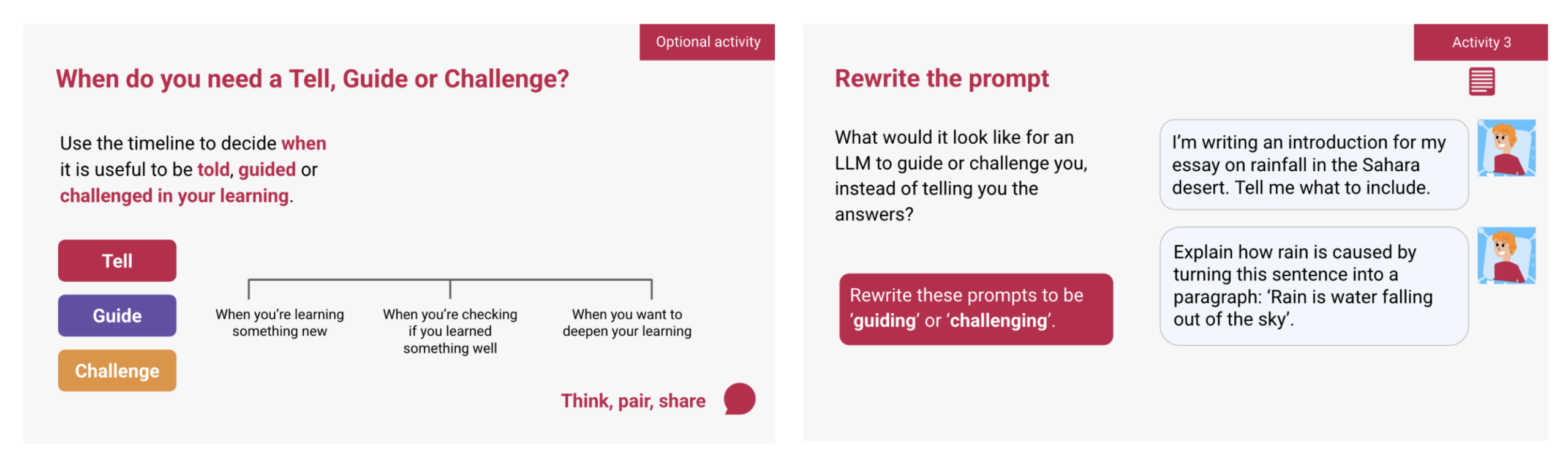
To help learners strategically use LLMs for their learning, they are provided with prompting strategies that elicit LLM outputs in ‘guide’ and ‘challenge’ formats. This helps learners engage more deeply with their own learning and develop higher-order thinking skills.

Prompting techniques for learning, not just answers

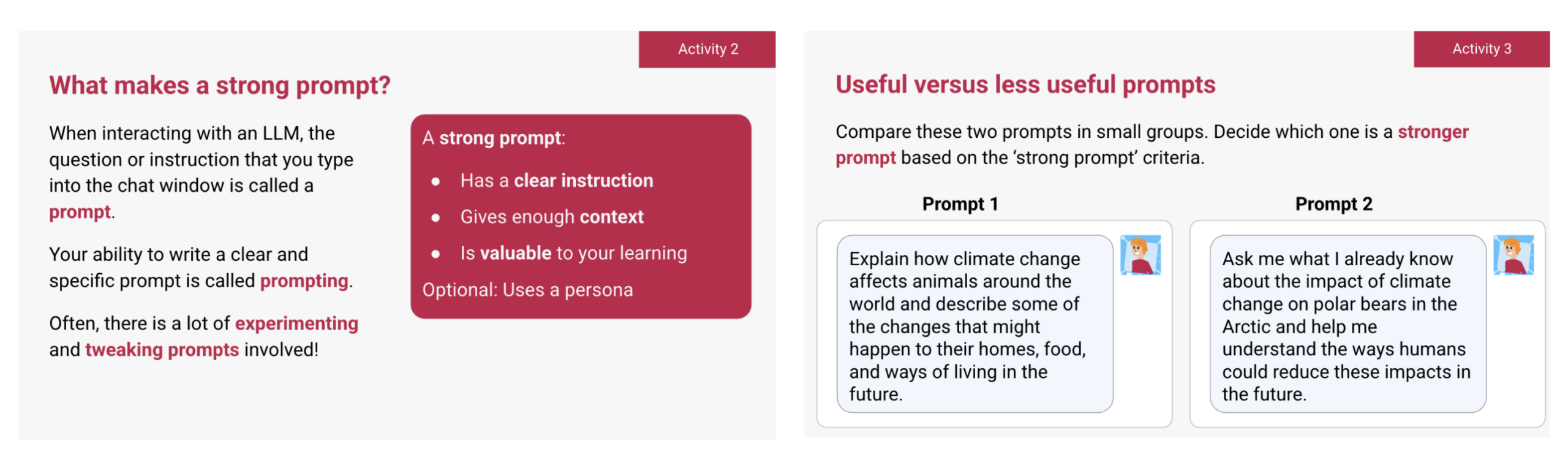
To help young people strategically use LLMs for their learning, the lessons include learning-centred, platform-agnostic prompting techniques. These include strategies borrowed from research papers on the most effective prompting frameworks. To make sure that the prompting strategies in the lessons remain effective over time and can be translated into different languages when we expand the resources, we did not use acronyms, unlike most popular prompting frameworks.
Building metacognition and future-ready skills

There are several industry reports highlighting the future-proof skills in the age of AI, such as problem solving, communication, critical thinking, collaboration and creativity skills. In the ‘Large language models’ unit, learners reflect on which skills they want to build and consider how their use of LLMs can support or hinder their development, helping them make responsible and intentional choices about using LLMs in ways that build their long-term capabilities rather than replace them.
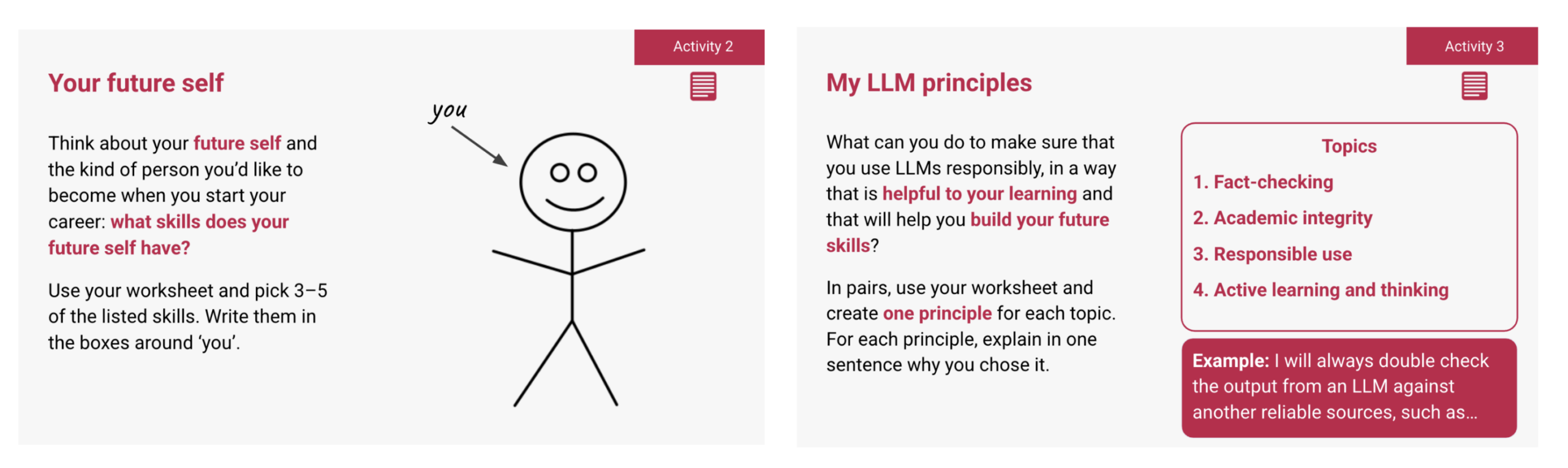
There are also activities in the lesson resources that help learners understand the long-term impacts of cognitive offloading and uncritical LLM use on the development of their future skills. The resources encourage learners to stay actively engaged in their learning and be reflective of their LLM use when learning.

Uncovering LLM training data

Many young people (Pew Research, 2026) use LLMs as search engines, believing that LLMs produce outputs that are always accurate. To address that misconception, the lessons include activities that question where the training data comes from, and how accurate those sources of data are. 
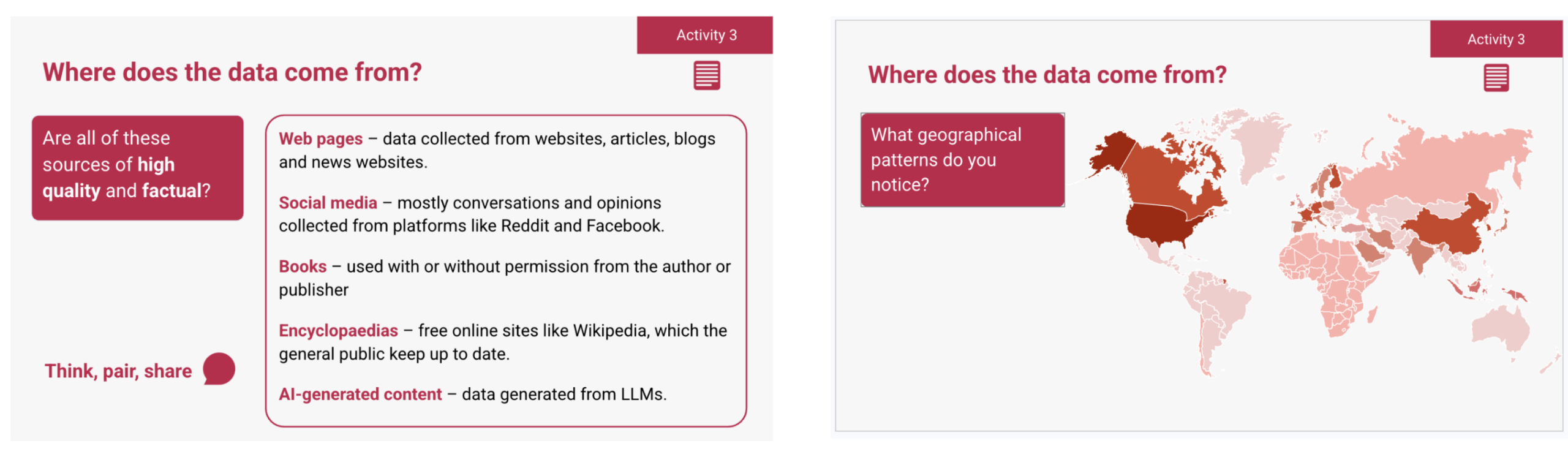
For example, when young people discover that a portion of data that LLMs are trained on come from social media platforms like Reddit and Facebook, they are encouraged to question the quality and factuality of these sources through classroom-wide discussions. Through discussions and thinking exercises, learners are also encouraged to question whose voices, languages, cultures and perspectives are (and are not) represented in these AI models.

Looking ahead

As AI tools become more integrated in young people’s lives, many learners, like Alex, are tempted to turn to AI tools for quick answers, convenience, and support. 

The ‘Large language models (LLMs): Using LLMs strategically for learning’ unit equips young people with the skills to use LLMs effectively, critically and strategically, in ways that are most helpful to their learning. Through research-informed lessons, they explore how LLMs are created, why their outputs are not always accurate and how to evaluate AI-generated responses. 

Just as importantly, learners are encouraged to reflect on their own use of AI: when using an LLM supports their learning, when it does not, and how they can remain in control of their thinking, learning and skills development.

With these resources, young people like Alex are not discouraged from using LLMs, but encouraged to pause, rewrite their prompts in ways that are more helpful to their learning, evaluate the outputs they receive, and stay actively involved in their own thinking. 

As we prepare young people for a future we do not yet know, the most important skill we can teach them is how to keep thinking. Who does the thinking, gets the learning.

The unit is available on the Experience AI website.

Acknowledgements

We would like to thank all the educators across South Africa, Nigeria, Kenya, the United Kingdom, India and beyond who piloted these resources and shared their thoughtful feedback. Their contributions helped shape and strengthen the unit. We are also grateful to Google DeepMind for their continued support in the development of this unit.

The post Encouraging learners to think first, prompt second: Using large language models to learn appeared first on Raspberry Pi Foundation.
Why localisation matters for AI literacy: Lessons from Uzbekistan

Post Syndicated from Rehana Al-Soltane original https://www.raspberrypi.org/blog/why-localisation-matters-for-ai-literacy-lessons-from-uzbekistan/

Experience AI has grown into a global effort to build AI literacy in schools, supporting educators and young people around the world to better understand and critically engage with AI technologies. We recently brought Experience AI to Uzbekistan through a new collaboration with UNICEF.

Together, we are integrating Experience AI into the Tinkering with Tech programme, which supports Uzbekistani educators and learners to develop 21st-century skills, including computational thinking, and digital and AI literacy skills.

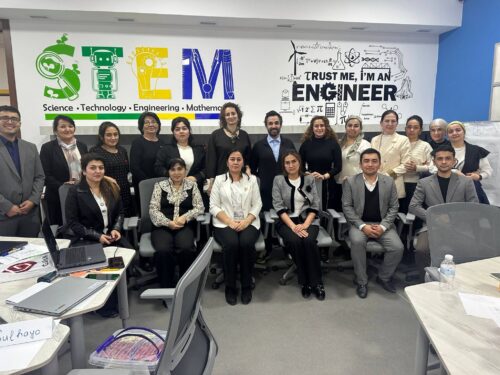
As one of the Learning Managers on the Foundation’s AI literacy team, I travelled to Uzbekistan to lead the AI literacy part of the programme, working closely with local trainers and educators and introducing them to Experience AI.

Experience AI training in action

On the plane to Tashkent, Uzbekistan, I found myself wondering about the level of engagement with AI tools among teachers and educators in Uzbekistan: how interested are teachers and students in AI technologies? Are they more excited or hesitant about AI technologies?

My questions were answered within minutes of the start of the training session in Tashkent. The teachers and trainers, who had travelled from cities and rural areas across the country, were enthusiastic, inquisitive, and already experimenting with AI technologies in their daily lives.

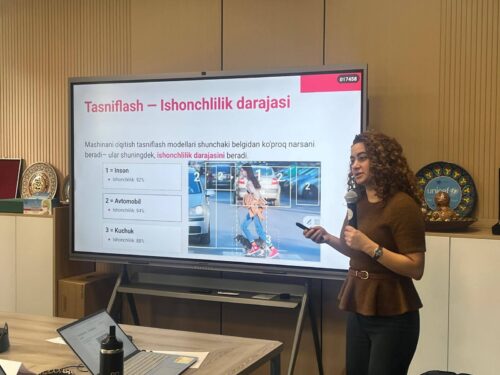
The training session created space for educators to deepen their understanding of both technical concepts like classification and accuracy, but also ethical considerations, including data representation, bias, and the implications of inaccurate AI tools.

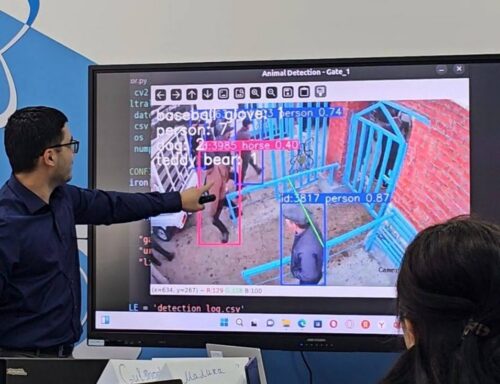
One particularly powerful example of how AI systems can be inaccurate came from a trainer who shared video footage from a local cattle market, where an AI tool classifies animals and monitors traffic. In the video, a human was misclassified as a horse, and a goat misclassified as a human.

While the example was funny and showed a harmless error, it quickly became a meaningful learning opportunity. Together, we used it to have a wider discussion around the implications of these errors. For example, what happens when AI tools fail in higher stakes situations? Would we trust a self-driving car that might misclassify a person in a long, dark coat as a lamp post, or a child in an orange-and-white coat as a traffic cone?

Localisation and representation

Working closely with the partners and trainers, we used localised examples in the training to explore other AI literacy concepts, particularly representation and bias.

In one activity, we used an AI tool to generate an image of Gulistan, a beautiful city in eastern Uzbekistan. The result sparked a range of reactions — while Gulistan is known for its flat landscape and mosques, the AI-generated image showed mountains and churches.

This led to a rich discussion about how AI systems represent places and cultures, and what it means when those representations are inaccurate. I asked them: why did the tool produce this image? What data might the underlying model have been trained on? And how do these inaccuracies shape perceptions, especially for those unfamiliar with the place being represented?

This example resonated strongly with the trainers, particularly because it reflected their own context. After a short break, I returned to find everyone still engrossed in a deep discussion around the lack of neutrality of AI tools, and what that meant for them, their students and communities. As one trainer reflected, “I have changed my mind about AI and now I have a better understanding of it.”

Adapting to global classrooms

Spending time with educators in Uzbekistan was also a reminder that classrooms are far from uniform. In some Uzbekistani settings, learners have access to laptops and interactive whiteboards; in others, teaching happens with limited electricity, lower levels of digital literacy, or shared devices among many students.

As we continue to expand Experience AI globally, localisation remains crucial. From South Africa to Saudi Arabia, and from Ukraine to Uzbekistan, flexible, context-aware resources are key to ensuring that all learners have the opportunity to develop a meaningful and critical understanding of AI.

In our ongoing collaboration on the Tinkering with Tech programme with UNICEF, the Micro:bit Educational Foundation, and Arm, we’re supporting teachers to develop the confidence and skills they need to teach AI in ways that are engaging, relevant and grounded in real-world contexts for their students. Together, we aim to equip young people with the knowledge and confidence to shape how these technologies affect their lives and communities.

For more information about Experience AI, visit our website, experience-ai.org.


About Tinkering with Tech and AI: UNICEF is co-developing new learning materials, enhancing AI literacy, and scaling the Tinkering with Tech and AI initiative to reach more learners and education systems worldwide. The initiative benefits from the continued strategic support from Arm and the Government of Finland, along with technical partners the Raspberry Pi Foundation and Micro:bit Educational Foundation. Learn more here.

The post Why localisation matters for AI literacy: Lessons from Uzbekistan appeared first on Raspberry Pi Foundation.
Helping young people stay safe online in the age of AI

Post Syndicated from Rehana Al-Soltane original https://www.raspberrypi.org/blog/helping-young-people-stay-safe-online-in-the-age-of-ai/

The online world that young people navigate today is different from the one we encountered just a few years ago: the search engines, social media platforms and digital tools they use to find information, interact with friends and complete schoolwork are now deeply embedded with AI technologies. 

Experience AI Safety Image

While the core aims of online safety education remain the same, the scope must now expand to include AI literacy: the ability to use, question and navigate AI tools so young people can make responsible choices online.

This is a shared challenge for anyone who supports young people as they navigate the online world: parents and carers, youth leaders and volunteers, and educators across all subjects. Many young people use these AI tools independently, often without guidance, so having open and useful conversations about trust, risk and responsibility matter just as much in the classroom as they do at dinner tables and Code Clubs.

Why AI literacy is essential for staying safe online

At the Raspberry Pi Foundation, we have developed various AI literacy resources for educators, club leaders and parents to address this challenge in age-appropriate and practical ways. Our ‘AI safety’ resources, part of our Experience AI programme, are a set of free comprehensive teaching activities to support you in educating young people aged 11–14 in navigating key safety issues linked to AI, including privacy, misinformation, trust and responsibility. Delivered through videos, unplugged activities and discussions, the activities are adaptable to a range of learning settings, and reflect the real decisions young people are already making online.

Experience AI safety image

For example, in the ‘Trusted Sources’ activity from the ‘Media literacy in the age of AI’ lesson, young people reflect on the ways they look for information related to schoolwork, news and in their free time. They consider which sources are likely to allow the use of generative AI and how that affects their trustworthiness. Rather than labelling sources as ‘good’ or ‘bad’, learners explore questions around responsibility, credibility and oversight, and build practical skills for fact-checking and staying safe online.

Supporting responsible use of generative AI through Experience AI

Alongside the ‘AI safety’ resources, we have also developed a new ‘Large Language Models (LLMs)’ unit for learners aged 11–13 and 14–17, currently being tested in classrooms. The unit focuses on another important aspect of online safety: how young people interact responsibly with AI tools that generate content. While helpful, learners’ uncritical use of these tools could lead to cognitive offloading and limit the development of their higher-order thinking skills. The confident, persuasive tone of LLMs can also make it harder for young people to judge accuracy, recognise bias or notice missing information in outputs. 

Experience AI safety image

To support the critical thinking skills that are essential for staying safe online, the new LLM unit includes research-informed lessons that explore how LLMs are created, why their outputs are not always accurate and how to evaluate AI-generated responses. The unit also encourages learners to reflect on when using an LLM is helpful to their learning, when it is not, and how they can remain in control of their own thinking, learning and skills development.

Starting the conversation this Safer Internet Day

Helping young people stay safe online in the age of AI doesn’t require having all the answers. Instead, it’s about creating the space to pause, question, and think critically about what they are encountering online. Through carefully designed, research-informed and pedagogically aligned AI literacy resources, we aim to help you start the conversations that empower young people to think critically, stay curious and remain in control of their learning and online lives. 

Experience AI safety image

This Safer Internet Day, we invite educators, parents and anyone who supports young people to explore our AI literacy resources and start the conversation. Visit the Experience AI website for more information.

The post Helping young people stay safe online in the age of AI appeared first on Raspberry Pi Foundation.