Tag Archives: Security Operations

How AI is Rewriting the Zero-Day Playbook for Preemptive Security

Post Syndicated from Joel Alcon original https://www.rapid7.com/blog/post/ai-rewriting-zero-day-playbook-for-preemptive-security

The scenario is all too familiar for any cybersecurity professional: It’s late in the day, and a critical zero-day vulnerability is disclosed. When this happens, CISOs from every industry immediately turn to their Security Operations Centers (SOC) with the single most important, and often most difficult, question: “Are we exposed?”

Answering questions like these when zero-days drop tends to trigger a frantic, high-stress fire drill. Analysts scramble to cross-reference outdated Configuration Management Databases (CMDBs), query disparate endpoint detection tools, and ping IT administrators. The data is siloed, context is missing, and time rapidly slips away. 

Today, the window between a vulnerability’s disclosure and its active exploitation in the wild has essentially collapsed, making predictive lead time a thing of the past. As adversaries integrate AI into their playbooks to automate attacks, defending against them requires us to operate at machine speed.

We believe preemptive security is the most effective way to close this window. You cannot wait for every alert to fire to understand your environment. You need an architecture that constantly tracks emerging risks and threats, coupled with AI-accelerated discovery that brings your attack surface into sharp focus before the adversary does. Rapid7 is previewing a series of new features at Black Hat USA 2026 designed to transform the way security teams navigate the chaos of a zero-day threat to identify and close attack paths before they are exploited.  

The foundation: Continuous Software Visibility

You cannot secure what you cannot see, and in highly distributed, AI-enabled environments, absolute visibility has traditionally been a gap. To achieve true preemptive security, you need a complete, continuous view of emerging risks. When a zero-day drops, your platform should already be tracking it via an Emerging Threat Response (ETR) process. But knowing the threat exists is only step one; you must correlate that threat with your specific environment. This is where Rapid7 Software Visibility (in-preview) becomes important.
Software-Visibility.png
Software Visibility: Depicts details of installed vulnerable software across the technology stack.

Instead of initiating massive, disruptive network scans, security teams can drill directly into the ETR to view key details of the vulnerability, pinpointing relevant assets and software versions in real-time. For example, if a new zero-day dictates that versions of Safari earlier than 18 are vulnerable, Software Visibility allows you to instantly map that criteria against your entire technology stack. That expansive view into your attack surface allows you to uncover whether this newly discovered exposure exists within your environment, shifting your posture from reactive investigation to proactive defense.

Calculating the blast radius: Decoding toxic combinations

Once you know that you have vulnerable instances of Safari running in your environment, the CISO’s initial question evolves. It is no longer just “Are we exposed?” but rather, “How exposed are we?”

Answering this requires breaking down the traditional silos of security data. A vulnerable service running on an isolated sandbox is a minor blip. That same vulnerable service hosted on a production machine where a highly privileged service account recently left a cached credential in memory is a direct path to domain compromise.

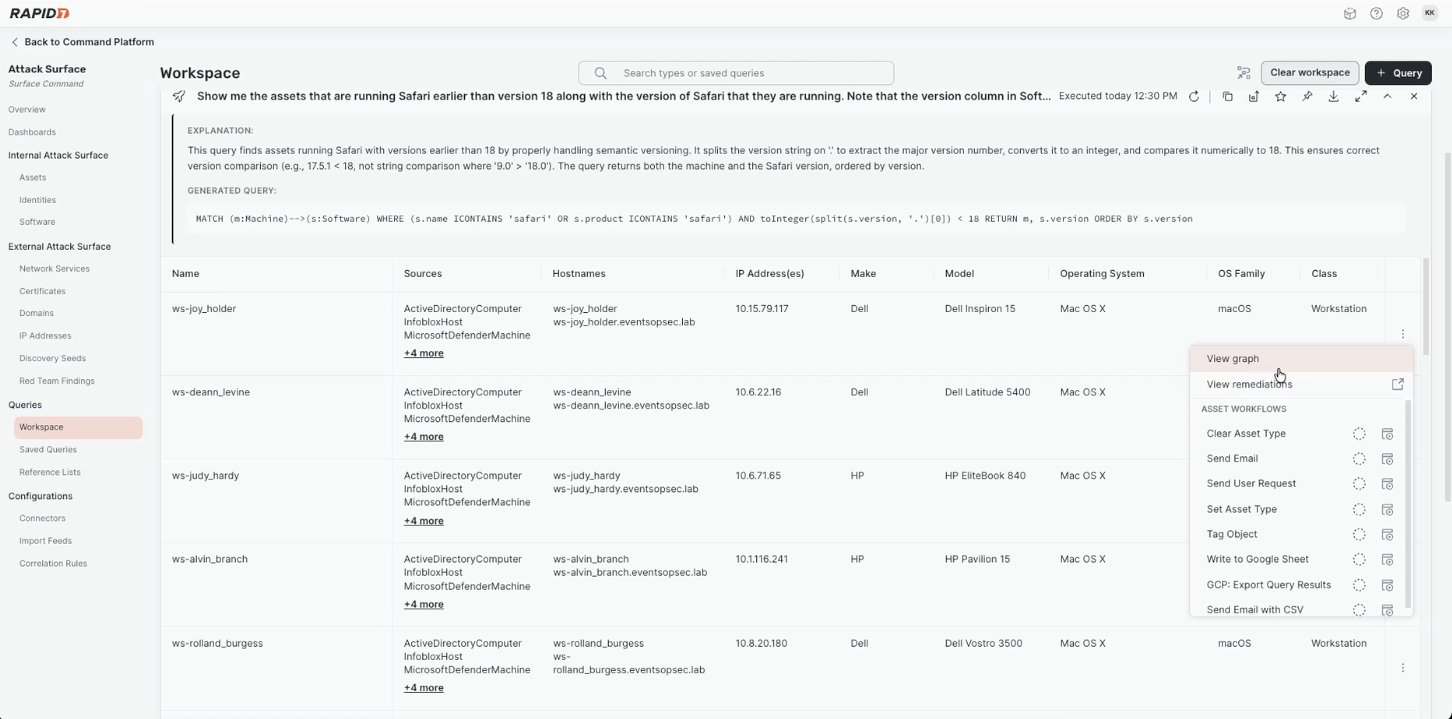
To accurately gauge risk, you need a unified view of your attack surface that pulls together both internal and external telemetry, and lets teams find the information easily. Rapid7’s Exposure Command accelerates this level of exposure discovery with natural language queries (in preview), so that instead of writing complex syntax, plain-English questions will uncover shadow AI models, pinpoint insecure assets, or identify overprivileged users. A SOC analyst can simply ask the platform in plain English: “Show me all assets running Safari earlier than version 18.”
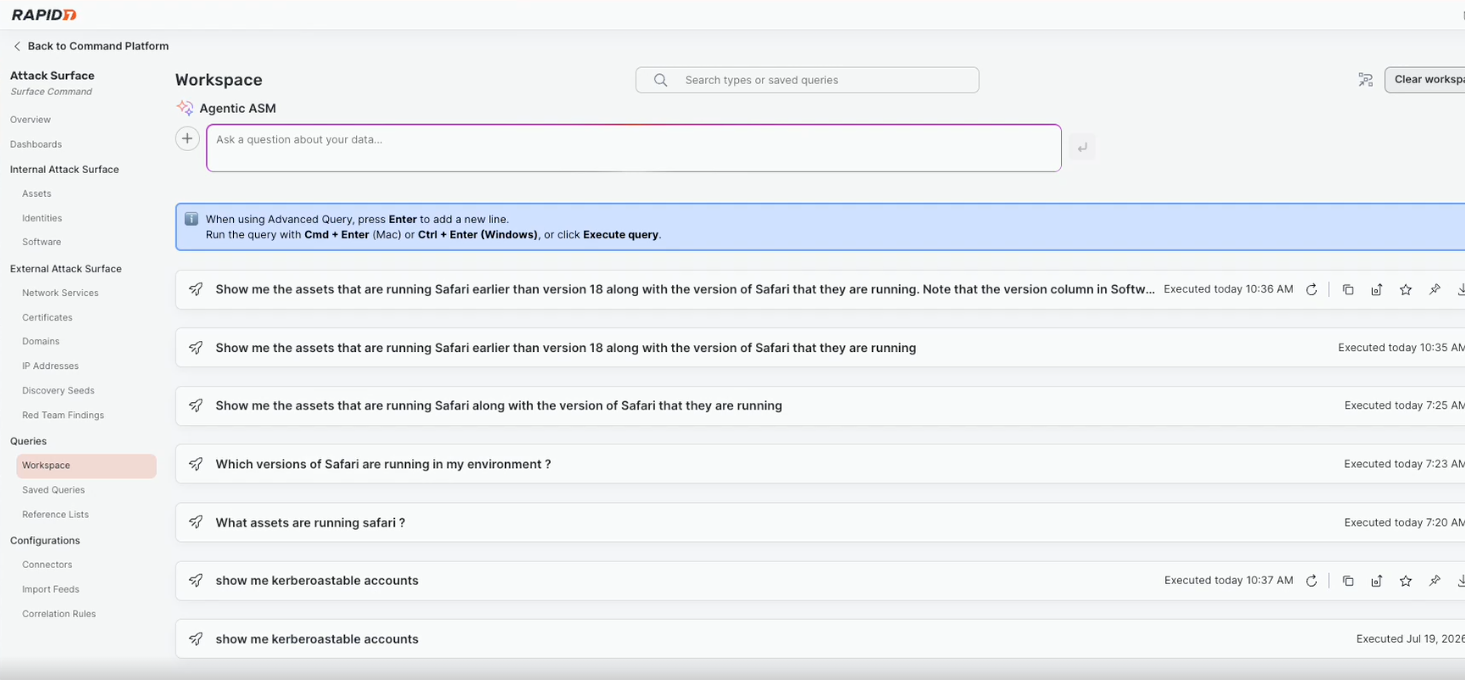
Natural-language-queries.png
Natural language queries: Displays a quick, intuitive way to reveal valuable information about the attack surface.

The platform reveals the total footprint, but more importantly, it also uncovers toxic combinations. It highlights not just the vulnerable assets and software, but can also highlight the specific users associated with those systems. By illuminating these connections, security teams can prioritize their response based on actual business risk rather than generic CVSS scores.

Bridging the SecOps / ITOps divide: Actionable remediation

Identifying the risk is a security function, but fixing it almost always falls to IT Operations. The friction between these two departments usually goes something like this: the SOC demands immediate patching to stop a breach; ITOps demands testing to ensure the patch does not break critical business services.

To achieve preemptive security, we help streamline this important handoff between teams. For instance, when a critical zero-day hits, a patch is often unavailable for days. In the interim, Rapid7 Exposure Command can provide mitigation guidance to help organizations minimize their risk using existing security controls, even when a formal patch does not exist.

Once a patch is released or a formal CVE number is assigned, the challenge shifts to rapid, safe deployment. To accelerate this, Rapid7 leverages AI-Generated Remediation Summaries (available now). Rather than tossing a massive spreadsheet of vulnerable IP addresses over to IT, these AI summaries provide highly tailored, environment-specific guidance.
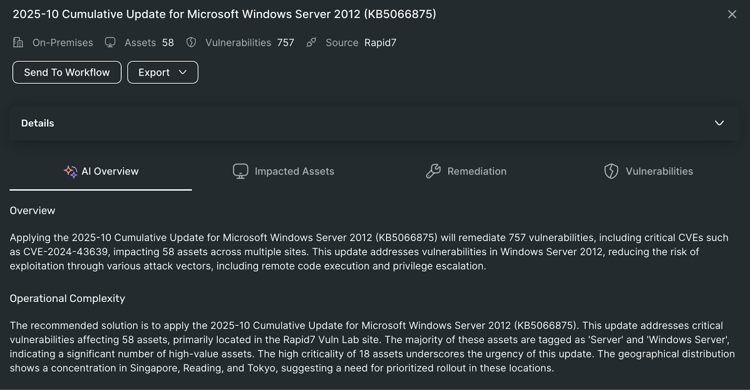
Remediation-summaries.png
Remediation summaries: AI-powered summary of remediation guidance.

The AI contextualizes the vulnerability findings based on your existing security controls, established asset ownership, and the unique makeup of your attack surface. It translates raw vulnerability data into clear, actionable narratives, empowering ITOps to quickly understand not just what needs to be patched, but how to securely and efficiently deploy those patches with minimal disruption to the business.

Communicating up: Translating data into cross-functional narratives

While the SOC and IT are working to remediate the threat, the business demands constant updates. The CISO, the executive team, and the board of directors need to know the organization’s real-time risk posture.

Historically, translating deeply technical security metrics into executive-ready reports meant a security analyst would spend hours manually interpreting data, formatting charts, and building slide decks. These are valuable hours that should have been spent actively hunting threats.

To address this, Rapid7 is introducing AI Dashboard Summaries (in preview). This capability automatically transforms dense, data-heavy dashboards into plain-text, actionable narratives. The platform generates a powerful, easy-to-digest summary of the active risk posture, allowing security leaders to give leadership and cross-functional partners exactly what they need: clear, confident answers, delivered immediately.

We also recognize that security telemetry doesn’t exist in a vacuum. Organizations need complete control over their data. If you want to integrate this vulnerability intelligence with broader enterprise risk models, you can seamlessly export this data to your AI analytics engine of choice via a Model Context Protocol (MCP) server. This flexibility ensures you can add context or perform secondary risk analysis exactly as your business requires.

The preemptive future

The scenario described above is just a snapshot of how AI-enabled capabilities are fundamentally changing the defensive landscape. By leveraging continuous software visibility, AI-accelerated discovery, and automated remediation guidance, we can stay ahead of the ever-narrowing window between vulnerability disclosures and active exploits.

Preemptive security is about building an environment so visible, so well-understood, and so seamlessly integrated that when the inevitable zero-day drops, panic is replaced by precision. Whether it is navigating complex toxic combinations, securing ephemeral cloud workloads, or implementing robust mitigations when no patch is available, these Rapid7 AI-enabled capabilities lay the groundwork for teams to outpace the adversary.

Visit us at BlackHat to see these capabilities in action!

Why Security Teams Need To Start Earlier

Post Syndicated from Tom Caiazza original https://www.rapid7.com/blog/post/it-why-security-teams-need-to-start-earlier

Security leaders are facing an unusual set of circumstances. The drumbeat for better security prioritization has been rising for years in boardrooms around the world. The desire is there, but the processes of the past aren’t meeting the needs of the new moment we find ourselves in. 

That gap is not a technology problem. It’s an operating model problem.

At the opening keynote of Rapid7’s 2026 Global Cybersecurity Summit, Craig Adams, Chief Product Officer, Rapid7, Brian Castagna, CSO, Rapid7 and IDC’s Research VP, Craig Robinson framed a simple idea: cyber defense needs to start earlier.

For more on this, download our new ebook, Preemptive Security: From Resilience to Action.

Complexity is outpacing control

Security environments have never been more connected or more difficult to manage. Cloud adoption, SaaS sprawl, third-party dependencies, and identity growth have expanded the attack surface in ways most programs were not designed to handle. Many teams have responded by adding more tools and more telemetry. This has resulted in more fragmentation, more dashboards, and more opportunities for important information to slip through the cracks. 

Teams are spending more time stitching context together than they are effectively reducing risk. This shows up in daily operations with analysts moving between multiple systems to validate alerts, and leaders lacking the clear picture to explain risk to the business. In a time when exposure management and detection & response can live on one platform, that level of fragmentation makes no sense.

Reactive security creates operational drag

The traditional model still dominates most security programs. It goes like this (stop us if you’ve heard this before): 1) Detect an alert. 2) Investigate. 3) Contain. 4) Recover. 5) Repeat, forever. 

Sounds simple, right? And it worked great when environments were simpler and attackers moved slower. That is no longer the case.

Today, initial access often happens quietly through identity abuse or misconfiguration. Attack paths form before an alert even fires. By the time a signal reaches the security team, attackers may already be moving laterally or accessing sensitive systems. This creates a cycle of constant response without consistent risk reduction. Teams get better at handling incidents but struggle to remove the conditions that enable them.

Security operations centers can receive thousands of alerts per day, many of which are low value or false positives. This leaves analysts spending hours triaging signals instead of focusing on the exposures most likely to lead to impact.

More alerts do not make you safer. They create drag. Better context creates better outcomes. 

The issue is prioritization, not visibility

Most organizations are not lacking data. They are lacking the clarity needed to understand the data they have and contextualize it as it relates to their business. Telemetry alone does not answer the question that matters most: what should we do first?

Attackers look for the most effective path into an environment, often combining smaller weaknesses across assets, identities, and systems until they create meaningful access. Security teams need a similarly connected view, one that helps them understand which exposures are exploitable, which assets are most critical, and how those risks relate across the environment. When teams can see that full picture, they can focus remediation on the issues most likely to be used in a real attack, making risk reduction more targeted, efficient, and defensible. 

The result is effort without impact.

Why security needs to start earlier

The summit’s keynote message is direct: meaningful action must move earlier in the lifecycle.

Preemptive Security introduces an operating model designed for that shift. It connects four core elements:

  • Exposure management to identify and prioritize risk

  • Managed detection and response (MDR) to monitor and act

  • Artificial intelligence to reduce noise and accelerate analysis

  • Human expertise to validate and decide

Together, these capabilities create a system that acts before risk becomes impact. Instead of waiting for alerts, teams identify likely breach paths. Instead of reacting to incidents, they reduce exposure ahead of time. Instead of managing disconnected tools, they operate with shared context and clear priorities. Detection and response becomes one leg of the stool with exposure management taking the lead in reducing risk before it becomes an emergency. 

What changes for security leaders

For CISOs and security leaders, this shift means designing programs around likely attack paths, not isolated findings. It means prioritizing investments based on risk reduction, not tool coverage and enabling teams to act decisively without increasing headcount or complexity.

It also changes how success is measured. The goal is fewer surprises, faster containment and reduced exposure before exploitation. It means starting earlier, to increase the likelihood of success. These are outcomes the business understands.

A new starting point for security

Ultimately, the environment has changed faster than the operating model. So the operating model needs to change. Luckily, there’s a proven path forward that can prevent the attacks from bad actors already moving in earlier, using technology to scale their operations, and exploiting small weaknesses to get a foothold. 

Preemptive Security provides the framework to close that gap. It helps teams reduce noise, focus on what matters, and act with confidence before disruption occurs. Security does not start with an alert. It starts with understanding risk early enough to do something about it.

Watch the keynote on demand or download the eBook, Preemptive Security: From Resilience to Action, to explore the model in more detail.

20/20 Cybersecurity: Lessons Learned in 2024 and Strategies for a Stronger 2025

Post Syndicated from Rapid7 original https://blog.rapid7.com/2024/11/04/20-20-cybersecurity-lessons-learned-in-2024-and-strategies-for-a-stronger-2025/

20/20 Cybersecurity: Lessons Learned in 2024 and Strategies for a Stronger 2025

With 2024 rapidly coming to a close, many of us here at Rapid7 are taking a step back, reflecting upon the successes and learnings of the last 12 months, and looking ahead to the challenges and opportunities we could jointly face in the year ahead. Of course, we are doing the same for our customers.

For cybersecurity practitioners, 2024 has been nothing short of a rollercoaster ride. As organizations continue to embrace digital transformation at an accelerated pace, the security landscape has shifted, forcing security teams to confront new threats on top of the old and adjust their strategies in real-time.

This year, more than any other, it feels like we’ve witnessed the perfect storm that will forever reshape our industry. Supply chain incidents, sophisticated ransomware attacks, and a global IT outage disrupted critical infrastructure and affected organizations across all sectors and geographies. That’s on top of the backdrop of some of the biggest public data breaches we’ve ever seen. It’s a stark reminder of the ongoing vulnerability of sensitive data and the escalating cost of breaches.

Beyond these headline-grabbing incidents, cybersecurity teams have contended with a growing attack surface driven by the proliferation of IoT devices, an uptick in cloud adoption, and the increasing interconnectivity of systems. Threat actors have capitalized on this complexity, launching more sophisticated, multi-stage attacks that challenge even the most mature security operations centers (SOCs). The sheer volume and diversity of attacks have made it clear: This is not a game of adding more tools to the stack but of refining strategies, fortifying defenses, and focusing on cybersecurity fundamentals.

The Year of Operational Strain and Strategic Reassessment

As cyber threats grew more pervasive and intricate, the demands on security teams reached a breaking point. The year was marked by operational strain, with SecOps teams pushed to their limits to defend against an onslaught of increasingly complex threats. For many organizations, resource constraints — both in terms of personnel and budgets — further compounded the issue, leading to a reactive stance rather than a proactive one. This environment has necessitated a strategic reassessment of how we approach security.

The reality is stark: In 2024, many security professionals found themselves spending more time chasing alerts and parsing through logs than addressing core security challenges. This operational burden has impacted efficiency, morale, and ultimately, the effectiveness of security measures.

Yet, amidst these challenges lies a critical insight. Empowering teams with the right knowledge, tools, and support can dramatically transform outcomes. Security leaders must take command, refocusing on strategies that foster collaboration and transparency while building resilience against a dynamic threat landscape.

Empowering Teams: A New Approach for 2025

Heading into 2025, the need for a shift in approach has never been clearer. This is not merely about layering more technology into an already complex environment. It’s about establishing a partnership that empowers teams to confidently anticipate, pinpoint, and act against threats with precision and clarity. When security professionals are equipped with the right data and expertise, they can reduce the noise, eliminate inefficiencies, and spend more time addressing the strategic priorities that truly matter to their organizations.

Central to this strategy is fostering a culture of trust and collaboration between security teams and other business units. By breaking down silos and establishing shared goals, security leaders can ensure that everyone — from technical stakeholders to the C-Suite — is aligned on what success looks like and how it will be measured. This unified approach, underpinned by reliable data and transparent communication, is key to mitigating risk and optimizing security operations.

Join Us for the 2025 Security Predictions Webinar

To help the security community navigate these evolving challenges and prepare for what’s ahead, Rapid7 is once again hosting its annual 2025 Security Predictions webinar. Featuring our Chief Scientist, Raj Samani, and Vice President of Global Government Affairs and Public Policy, Sabeen Malik, this webinar will explore some of the most pressing issues facing the security community and provide valuable insights into how organizations can better position themselves for the future.

Reflecting on past discussions, we’ve tackled critical themes like talent shortages, public versus private information sharing, and the operationalization of security.

Plan for 2025 with Confidence

Our retrospective on 2024 might feel laden with challenges, yet there is an undeniable silver lining: A unified cybersecurity strategy is within reach. By breaking down organizational silos, fostering a shared vision, and empowering security teams to act with precision and clarity, organizations can take command of their security posture.

At Rapid7, we believe that clarity is power. As we look toward 2025, our mission is to provide that clarity and support, enabling organizations to anticipate, pinpoint, and act on threats with confidence. The lessons of 2024 have taught us that resilience and adaptability are paramount. Now is the time to capitalize on these learnings and put them into practice.

Register Now

Register today and save your seat. Let’s make 2025 the year we take command of the attack surface, reduce operational risk, and set the standard for proactive, efficient, and effective cybersecurity.