All posts by Joel Alcon

How AI is Rewriting the Zero-Day Playbook for Preemptive Security

Post Syndicated from Joel Alcon original https://www.rapid7.com/blog/post/ai-rewriting-zero-day-playbook-for-preemptive-security

The scenario is all too familiar for any cybersecurity professional: It’s late in the day, and a critical zero-day vulnerability is disclosed. When this happens, CISOs from every industry immediately turn to their Security Operations Centers (SOC) with the single most important, and often most difficult, question: “Are we exposed?”

Answering questions like these when zero-days drop tends to trigger a frantic, high-stress fire drill. Analysts scramble to cross-reference outdated Configuration Management Databases (CMDBs), query disparate endpoint detection tools, and ping IT administrators. The data is siloed, context is missing, and time rapidly slips away. 

Today, the window between a vulnerability’s disclosure and its active exploitation in the wild has essentially collapsed, making predictive lead time a thing of the past. As adversaries integrate AI into their playbooks to automate attacks, defending against them requires us to operate at machine speed.

We believe preemptive security is the most effective way to close this window. You cannot wait for every alert to fire to understand your environment. You need an architecture that constantly tracks emerging risks and threats, coupled with AI-accelerated discovery that brings your attack surface into sharp focus before the adversary does. Rapid7 is previewing a series of new features at Black Hat USA 2026 designed to transform the way security teams navigate the chaos of a zero-day threat to identify and close attack paths before they are exploited.  

The foundation: Continuous Software Visibility

You cannot secure what you cannot see, and in highly distributed, AI-enabled environments, absolute visibility has traditionally been a gap. To achieve true preemptive security, you need a complete, continuous view of emerging risks. When a zero-day drops, your platform should already be tracking it via an Emerging Threat Response (ETR) process. But knowing the threat exists is only step one; you must correlate that threat with your specific environment. This is where Rapid7 Software Visibility (in-preview) becomes important.
Software-Visibility.png
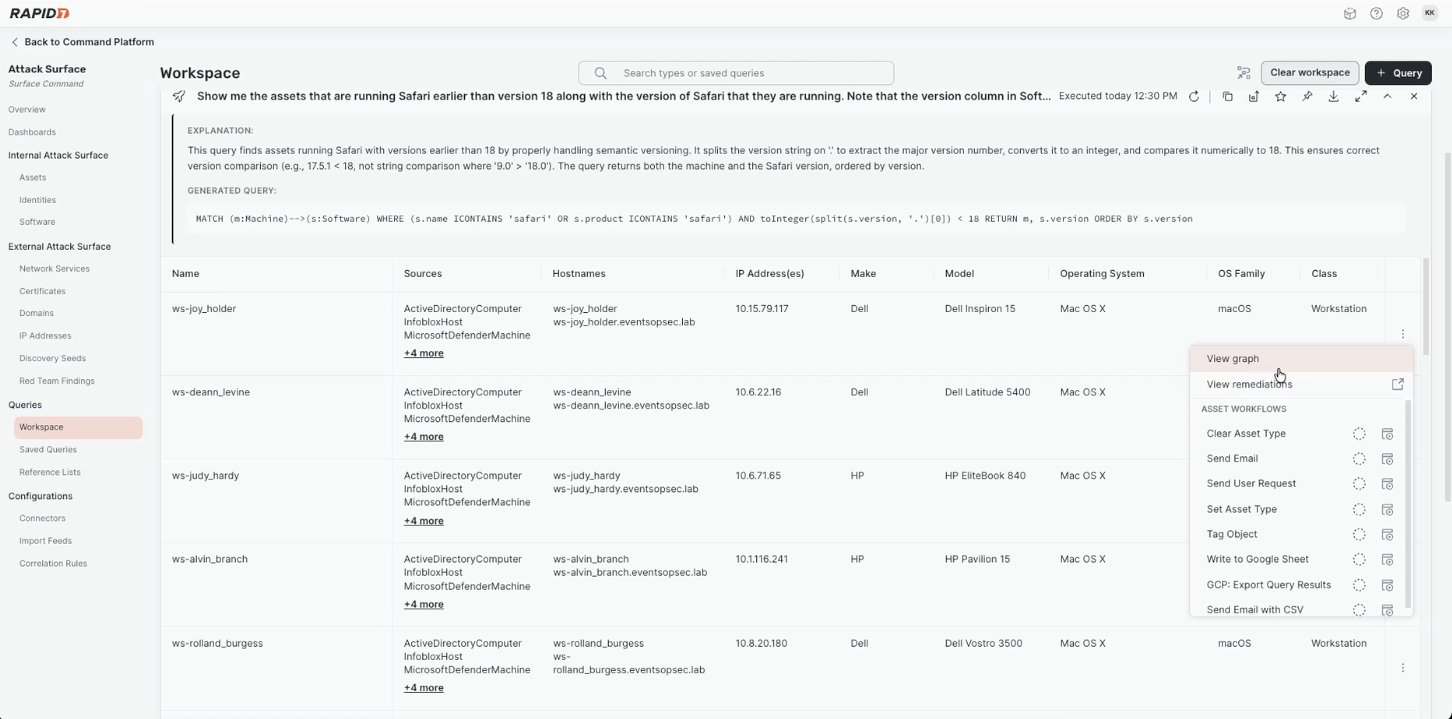
Software Visibility: Depicts details of installed vulnerable software across the technology stack.

Instead of initiating massive, disruptive network scans, security teams can drill directly into the ETR to view key details of the vulnerability, pinpointing relevant assets and software versions in real-time. For example, if a new zero-day dictates that versions of Safari earlier than 18 are vulnerable, Software Visibility allows you to instantly map that criteria against your entire technology stack. That expansive view into your attack surface allows you to uncover whether this newly discovered exposure exists within your environment, shifting your posture from reactive investigation to proactive defense.

Calculating the blast radius: Decoding toxic combinations

Once you know that you have vulnerable instances of Safari running in your environment, the CISO’s initial question evolves. It is no longer just “Are we exposed?” but rather, “How exposed are we?”

Answering this requires breaking down the traditional silos of security data. A vulnerable service running on an isolated sandbox is a minor blip. That same vulnerable service hosted on a production machine where a highly privileged service account recently left a cached credential in memory is a direct path to domain compromise.

To accurately gauge risk, you need a unified view of your attack surface that pulls together both internal and external telemetry, and lets teams find the information easily. Rapid7’s Exposure Command accelerates this level of exposure discovery with natural language queries (in preview), so that instead of writing complex syntax, plain-English questions will uncover shadow AI models, pinpoint insecure assets, or identify overprivileged users. A SOC analyst can simply ask the platform in plain English: “Show me all assets running Safari earlier than version 18.”
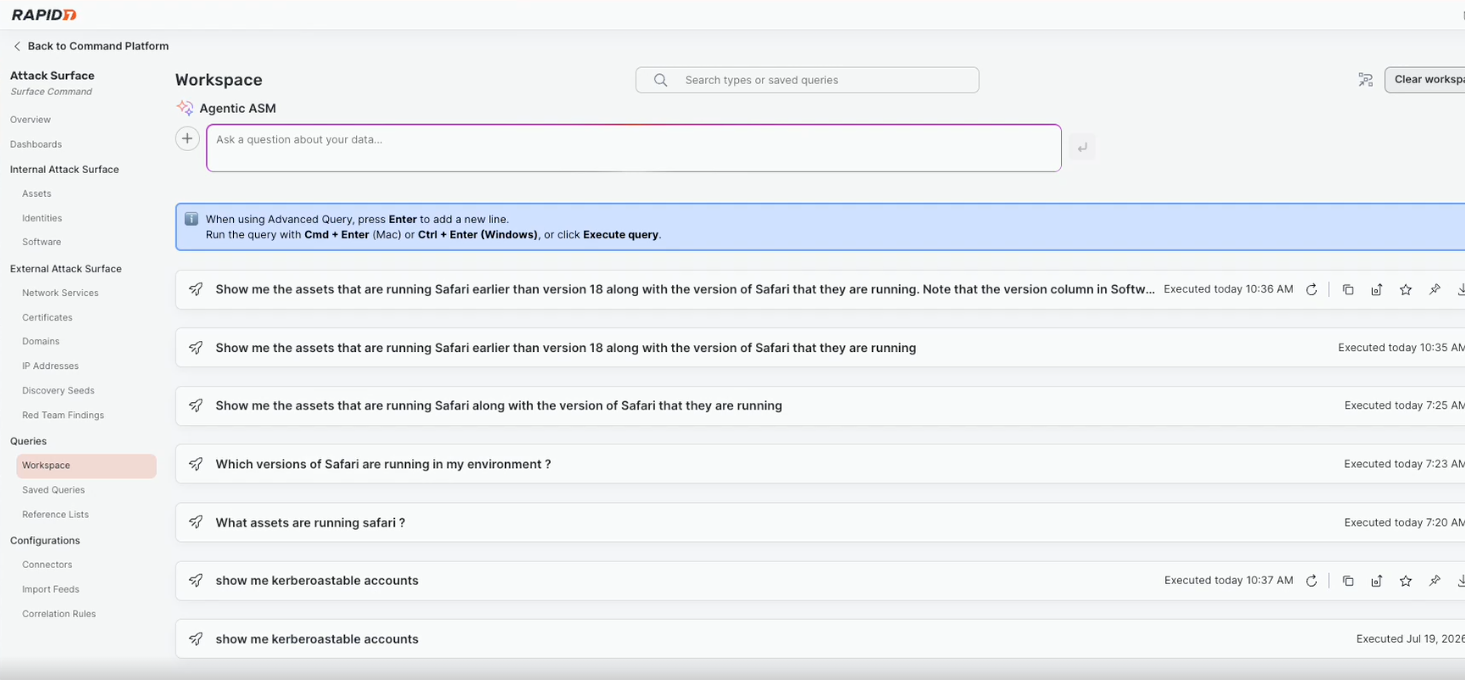
Natural-language-queries.png
Natural language queries: Displays a quick, intuitive way to reveal valuable information about the attack surface.

The platform reveals the total footprint, but more importantly, it also uncovers toxic combinations. It highlights not just the vulnerable assets and software, but can also highlight the specific users associated with those systems. By illuminating these connections, security teams can prioritize their response based on actual business risk rather than generic CVSS scores.

Bridging the SecOps / ITOps divide: Actionable remediation

Identifying the risk is a security function, but fixing it almost always falls to IT Operations. The friction between these two departments usually goes something like this: the SOC demands immediate patching to stop a breach; ITOps demands testing to ensure the patch does not break critical business services.

To achieve preemptive security, we help streamline this important handoff between teams. For instance, when a critical zero-day hits, a patch is often unavailable for days. In the interim, Rapid7 Exposure Command can provide mitigation guidance to help organizations minimize their risk using existing security controls, even when a formal patch does not exist.

Once a patch is released or a formal CVE number is assigned, the challenge shifts to rapid, safe deployment. To accelerate this, Rapid7 leverages AI-Generated Remediation Summaries (available now). Rather than tossing a massive spreadsheet of vulnerable IP addresses over to IT, these AI summaries provide highly tailored, environment-specific guidance.
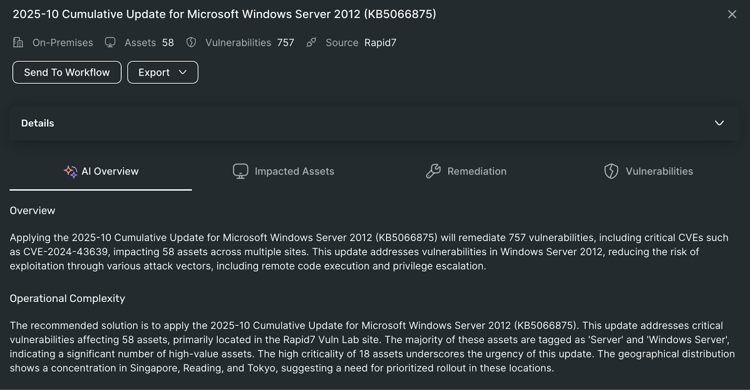
Remediation-summaries.png
Remediation summaries: AI-powered summary of remediation guidance.

The AI contextualizes the vulnerability findings based on your existing security controls, established asset ownership, and the unique makeup of your attack surface. It translates raw vulnerability data into clear, actionable narratives, empowering ITOps to quickly understand not just what needs to be patched, but how to securely and efficiently deploy those patches with minimal disruption to the business.

Communicating up: Translating data into cross-functional narratives

While the SOC and IT are working to remediate the threat, the business demands constant updates. The CISO, the executive team, and the board of directors need to know the organization’s real-time risk posture.

Historically, translating deeply technical security metrics into executive-ready reports meant a security analyst would spend hours manually interpreting data, formatting charts, and building slide decks. These are valuable hours that should have been spent actively hunting threats.

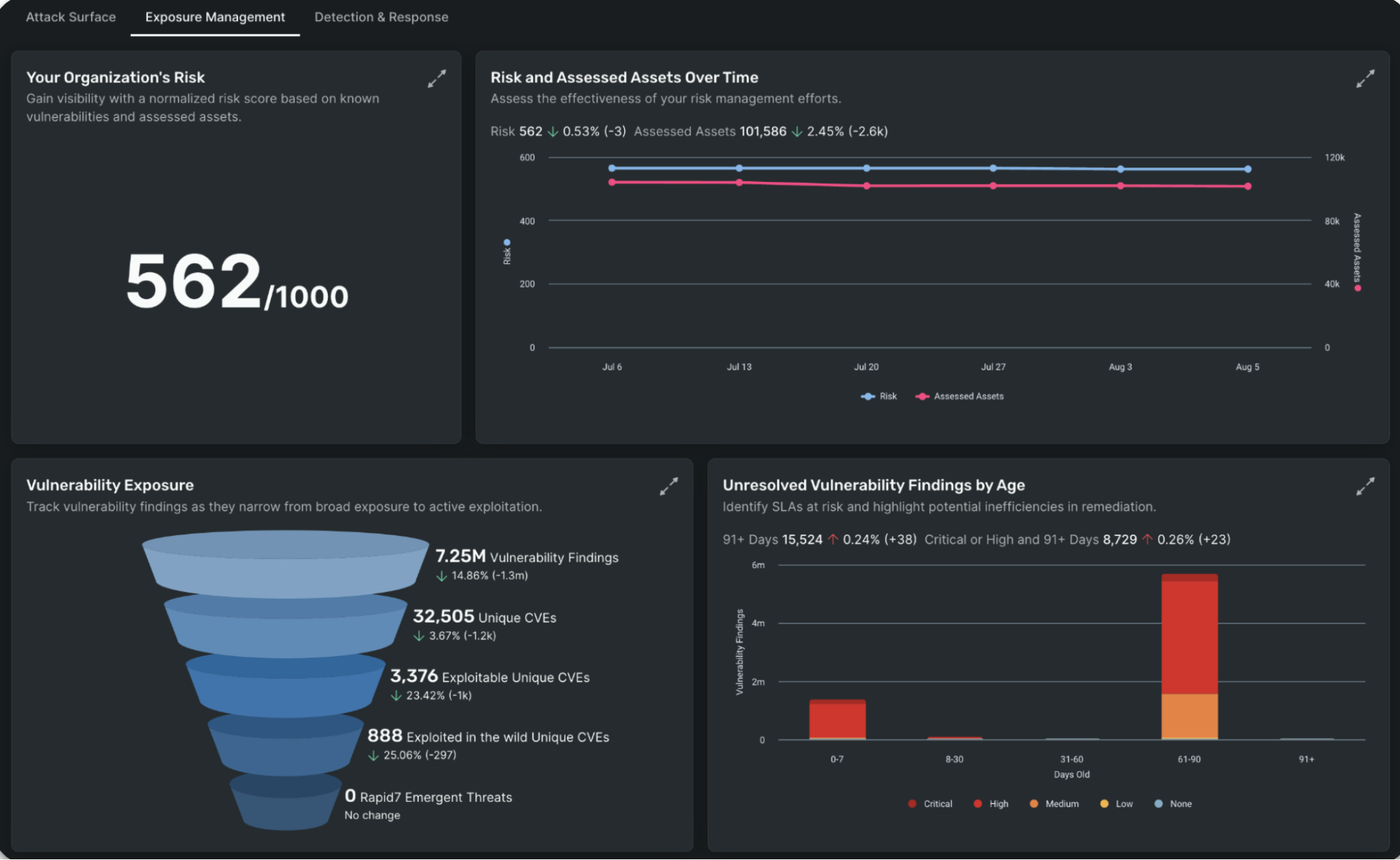
To address this, Rapid7 is introducing AI Dashboard Summaries (in preview). This capability automatically transforms dense, data-heavy dashboards into plain-text, actionable narratives. The platform generates a powerful, easy-to-digest summary of the active risk posture, allowing security leaders to give leadership and cross-functional partners exactly what they need: clear, confident answers, delivered immediately.

We also recognize that security telemetry doesn’t exist in a vacuum. Organizations need complete control over their data. If you want to integrate this vulnerability intelligence with broader enterprise risk models, you can seamlessly export this data to your AI analytics engine of choice via a Model Context Protocol (MCP) server. This flexibility ensures you can add context or perform secondary risk analysis exactly as your business requires.

The preemptive future

The scenario described above is just a snapshot of how AI-enabled capabilities are fundamentally changing the defensive landscape. By leveraging continuous software visibility, AI-accelerated discovery, and automated remediation guidance, we can stay ahead of the ever-narrowing window between vulnerability disclosures and active exploits.

Preemptive security is about building an environment so visible, so well-understood, and so seamlessly integrated that when the inevitable zero-day drops, panic is replaced by precision. Whether it is navigating complex toxic combinations, securing ephemeral cloud workloads, or implementing robust mitigations when no patch is available, these Rapid7 AI-enabled capabilities lay the groundwork for teams to outpace the adversary.

Visit us at BlackHat to see these capabilities in action!
Why CVSS is No Longer Enough for Exposure Management

Post Syndicated from Joel Alcon original https://www.rapid7.com/blog/post/em-cvss-and-exposure-management

For years, cybersecurity professionals have relied on a familiar metric to dictate their day-to-day priorities: the Common Vulnerability Scoring System (CVSS). In today’s hyper-connected, sprawling IT environments, utilizing a static severity score as the ultimate arbiter of risk creates opportunities for threat actors. While defenders chase down theoretical, high-scoring alerts, adversaries are quietly targeting the truly exploitable, business-critical exposures that slip through the cracks.

In a recent report, Gartner® highlighted a projection: 

“By 2028, organizations that prioritize exposures using threat intelligence, asset context, exploitability modeling and security control validation will reduce breach likelihood by at least 70% compared to peers relying primarily on CVSS-based vulnerability prioritization.” [1]

This affirms what many seasoned practitioners have suspected for years: there’s an abundance of vulnerability findings, but a lack of actionable context.

Static scores. Reactive security.

Most vulnerability management programs evolved during a time when the attack surface was relatively static, adversary tooling was rudimentary, and remediation capacity generally exceeded the volume of new disclosures. Today, enterprises are confronted with vulnerabilities scattered across complex cloud architectures, SaaS applications, and intricate supply chains.

In this modern threat landscape, CVSS alone is insufficient because it measures theoretical severity, does not factor in whether an attacker is actually using the vulnerability in the wild, or consider the business value of any affected assets. According to Gartner®, fewer than 10% of vulnerabilities are exploited, yet most are treated as urgent [1]. This all leads to prioritization paralysis, where security teams spend countless hours patching vulnerabilities that pose low material risk to the business. The legacy approach rewards what is auditable rather than what is genuinely impactful.

The path toward smarter prioritization

To break free from endless patching and ineffective risk reduction practices, security professionals are shifting toward a context-driven model. As Gartner notes, strong exposure prioritization requires integrating four critical elements: threat intelligence, asset context, data science, and security control validation. Organizations are approaching these elements in a few practical ways:

Threat intelligence to establish relevance

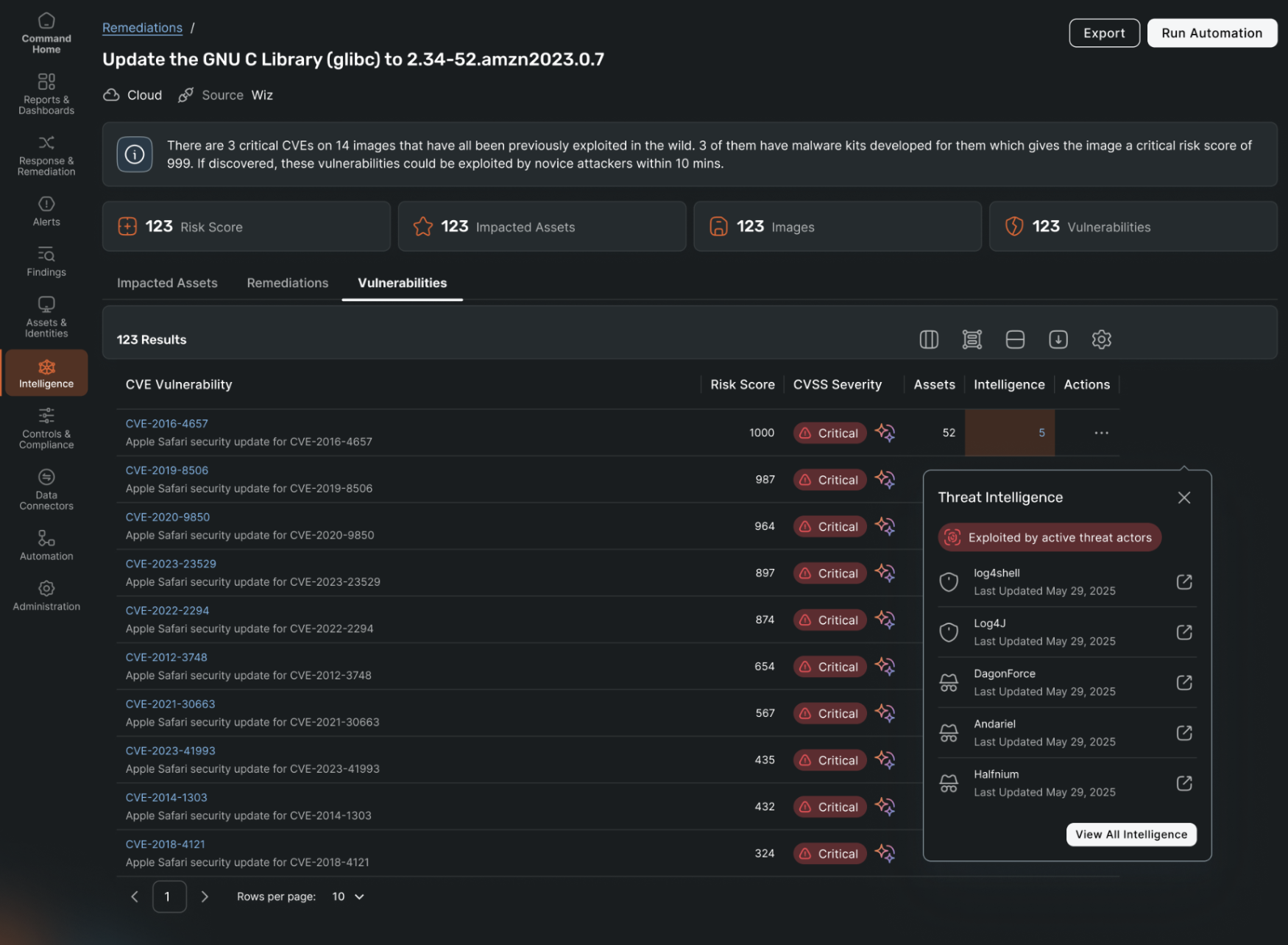
Instead of just asking how severe a vulnerability is, modern exposure management asks whether an exposure is relevant to a threat actor who is capable of exploiting it right now. By embedding threat intelligence into each vulnerability finding, teams shift the focus from theoretical to risk active exploitation. It introduces the adversary’s perspective by identifying known exploited vulnerabilities, public or private exploit availability, and targeted campaigns. By filtering out exposures with no evidence of attacker interest, organizations can instantly collapse large vulnerability backlogs and focus only on relevant threats.

Rapid7-threat-intelligence-remediation-hub.png

Asset context and business criticality to define impact

Not all assets are created equal. A critical vulnerability on an isolated, internal test server is vastly different from the same vulnerability on a public-facing cloud workload processing customer sensitive data. Asset context enriches exposure data with crucial business information: what the asset is, its external accessibility, and its relationship to core business functions. Without this context, security teams waste disproportionate effort on low-impact systems, treating every critical alert as an equal emergency.

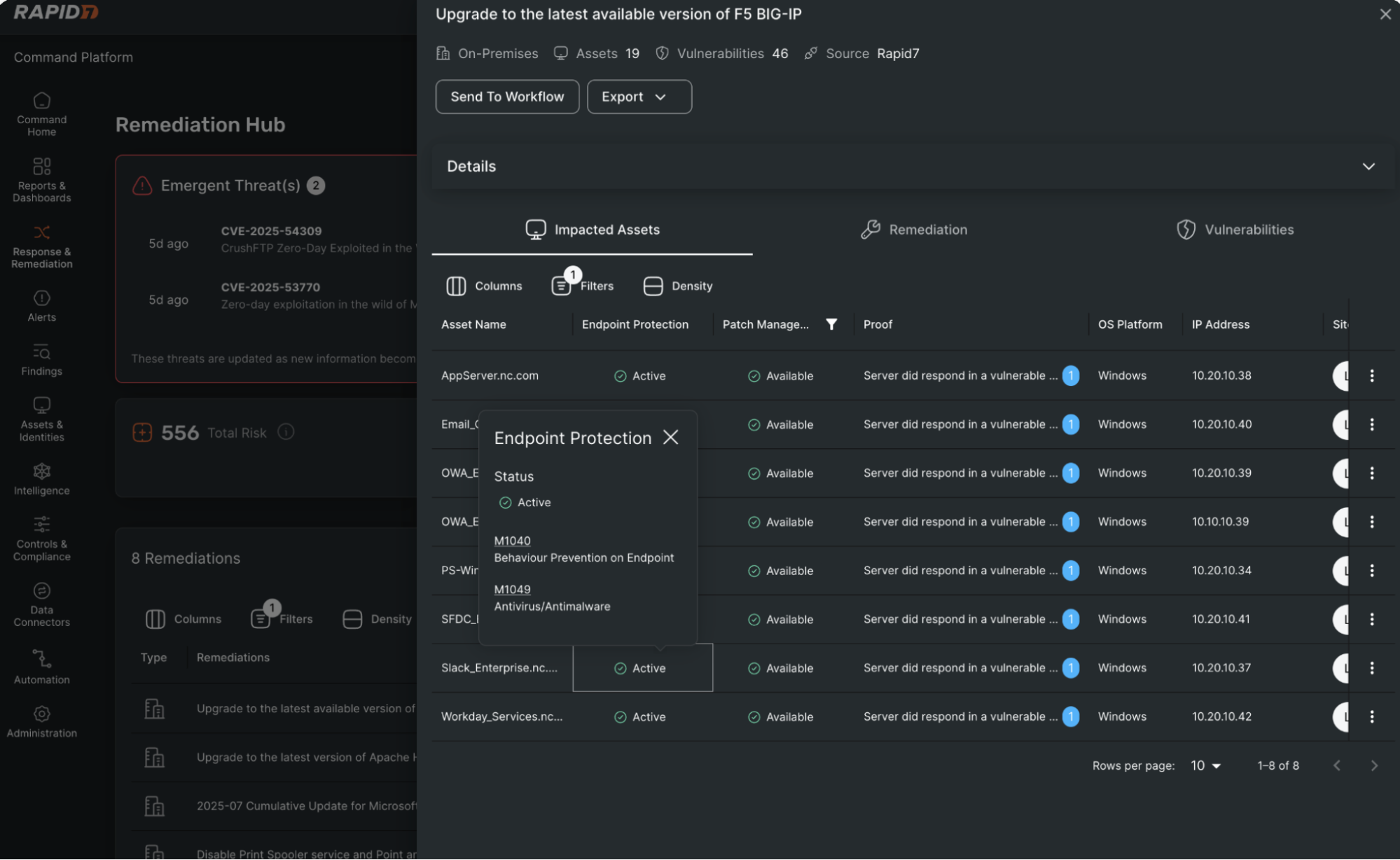
Endpoint-protection-Rapid7-remediation-hub.png

Exploitability modeling for predicting breach likelihood

Security analysts often struggle to assess exploitability given the overwhelming volume of vulnerabilities. By using predictive models like the Exploit Prediction Scoring System (EPSS), organizations can analyze large datasets of historical exploitation to identify latent risks. Exposure assessment platforms should display this data alongside each exposure finding to make it easier to predict the vulnerabilities most likely to become attacks.

Rapid7-vulnerability-risk-score-exposure.png

Security control validation

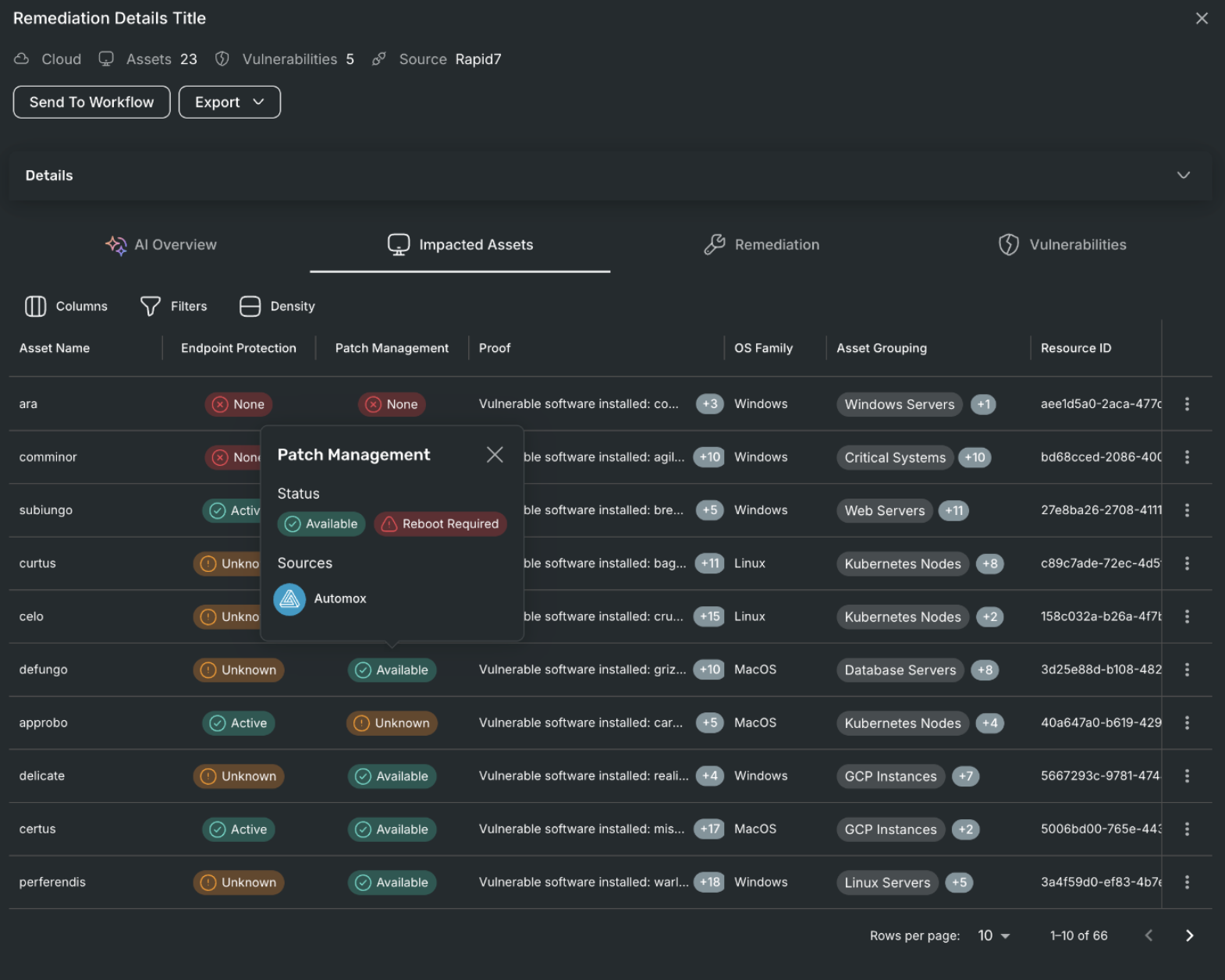
An exposure that appears highly exploitable in theory might be neutralized by existing defenses. By integrating security and policy controls, you can evaluate exposures in the context of endpoint protection and identity management. This passive validation confirms whether an attacker can realistically exploit the exposure in your specific environment.

Rapid7-remediation-details.png

Unified exposure management

Individually, each element highlighted above provides incremental value, but when integrated, they fundamentally transform how prioritization decisions are made. This integrated model ensures that remediation efforts are mobilized only after priorities have been validated in the context of the business and the current threat landscape. It transitions vulnerability management from a purely technical, tool-centric exercise into a strategic, process-driven risk decision.

Security leaders must measure success not by the sheer number of vulnerabilities closed, but by the demonstrable reduction of exploitable exposures and the alignment of remediation efforts with actual attacker behavior. Operationalizing these four elements requires a unified platform that eliminates the silos between vulnerability management, cloud security, and threat intelligence. You cannot manually stitch together disconnected spreadsheets and hope to outpace modern adversaries. This is where forward-thinking organizations are leaning on comprehensive, end-to-end solutions like Rapid7 Exposure Command that seamlessly aggregate visibility across on-premises and dynamic cloud environments. With deep, native integration of Rapid7 Cloud Security capabilities, teams can instantly map asset criticality and external accessibility within complex, ephemeral cloud architectures. Furthermore, by infusing world-class threat intelligence and active exploit data directly into exposure findings, Rapid7 enables security teams to cut through the noise, validate security controls, and pinpoint the exact exposures that matter most—all with minimal friction.

[1] Gartner, Prioritize What Attackers Will Exploit: 4 Elements of Strong Exposure Prioritization, Jonathan Nunez, 5 March 2026.

Preemptive and Proactive: An enhanced CNAPP available with Exposure Command

Post Syndicated from Joel Alcon original https://www.rapid7.com/blog/post/em-preemptive-proactive-enhanced-cnapp-available-exposure-command

Earlier this year, we made a significant announcement: Rapid7 partnered with ARMO to add AI-powered cloud application detection and response (CADR) – or cloud runtime security – to our cloud security portfolio. At the time, I published a blog highlighting this two-part approach for modern cloud security that combines preemptive exposure management (understanding the threats that could exist) with proactive runtime security (detecting the threats that are happening).

Today, we are thrilled to announce that this vision is fully realized and integrated with Rapid7 Exposure Command. For our customers, this milestone represents our ability to deliver on the promise of a complete Cloud-Native Application Protection Platform (CNAPP) that helps security teams preemptively identify and proactively thwart attacks.

Exploring the possibilities of this unified CNAPP

At Rapid7, we believe that a CNAPP is unified if it operates from a single, objective source of truth. By integrating cloud runtime security directly into Exposure Command, we are seamlessly merging the preemptive (posture, configurations, identities, and vulnerabilities) with the proactive (runtime behavior and active threats). The table below summarizes this enhancement:

Today’s Rapid7 Cloud Security solution

What cloud runtime adds

Primary Focus

Prevention, risk reduction, and preemptive response

Real-time exposure detection and proactive response

Core Question

“What is vulnerable and could be attacked?”

“Is an attacker exploiting our environment now?”

Lifecycle Stage 

Pre-deployment, continuous scanning, or periodic intervals

Continuous monitoring of live (in-production) workloads

What It Finds

Misconfigurations, exposed secrets, software CVEs, missing patches

Active exploits, lateral movement, unauthorized process execution, SQL injection

The true power of this unified architecture is best understood through the lens of a security practitioner’s daily battle against cloud threats. The previous blog post discussed this in theory; let’s use this blog to talk about the reality.

The baseline

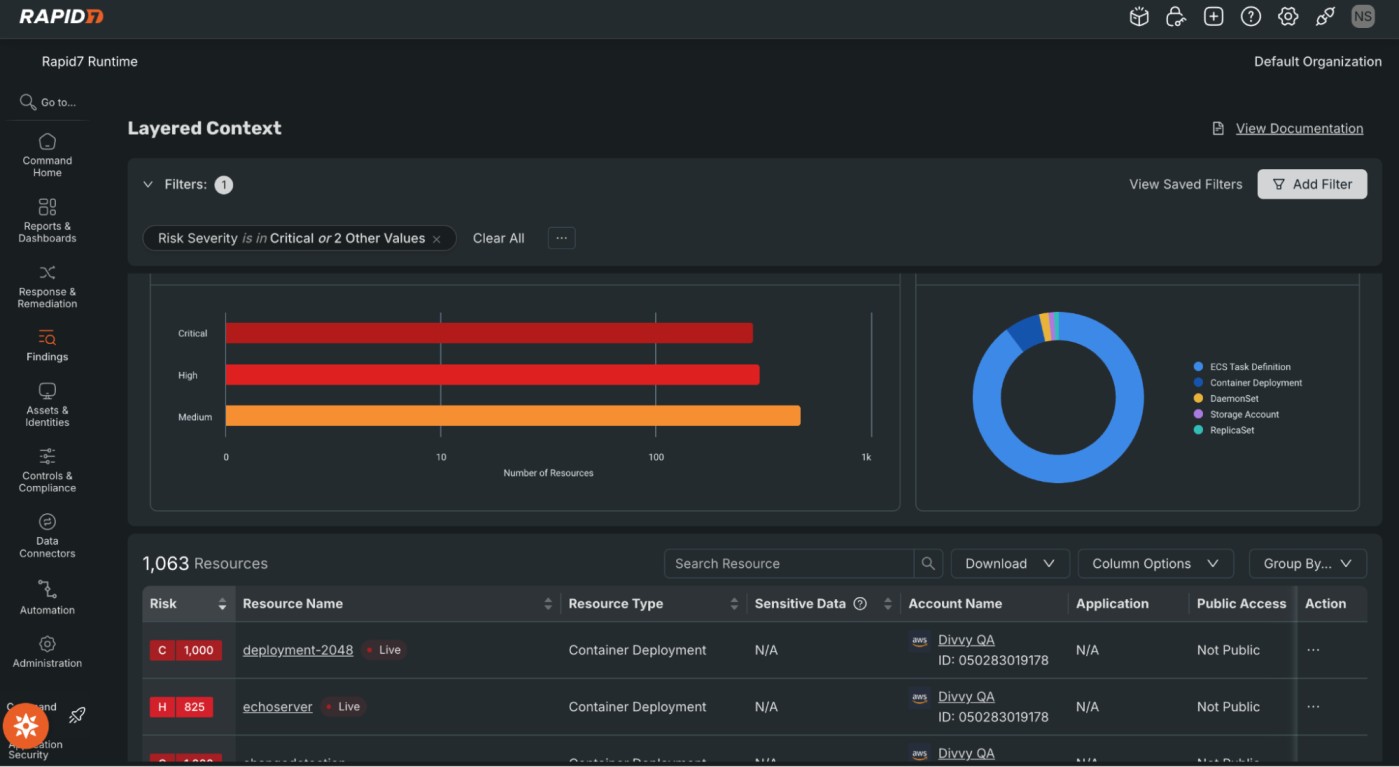
Exposure Command continuously scans and assesses your cloud posture to identify whether a container exposure exists in a production cluster. Traditional scanners would stop here, leaving you to prioritize this vulnerability against others. In Exposure Command, this detection is not just part of a static score, but instead it is part of an attack path. Our preemptive security platform tells you, for instance, whether this specific container has internet access and an over-privileged IAM role, making it highly reachable and exploitable. This means that you are not just looking at a CVE; you are looking at the potential blueprint behind a major breach.

Layered-Context-Dashboard-Rapid7-Exposure-Command-CNAPP.jpg

The proactive validation

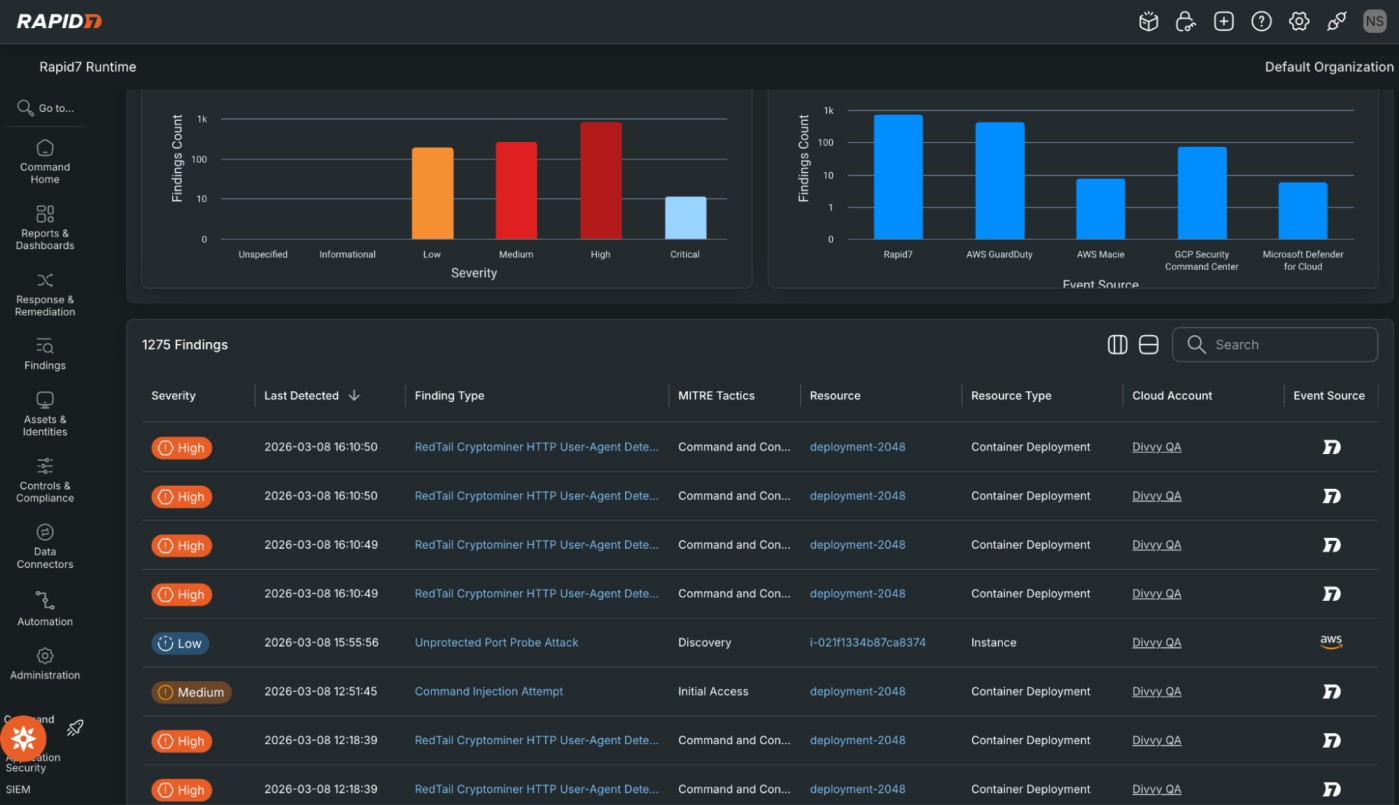
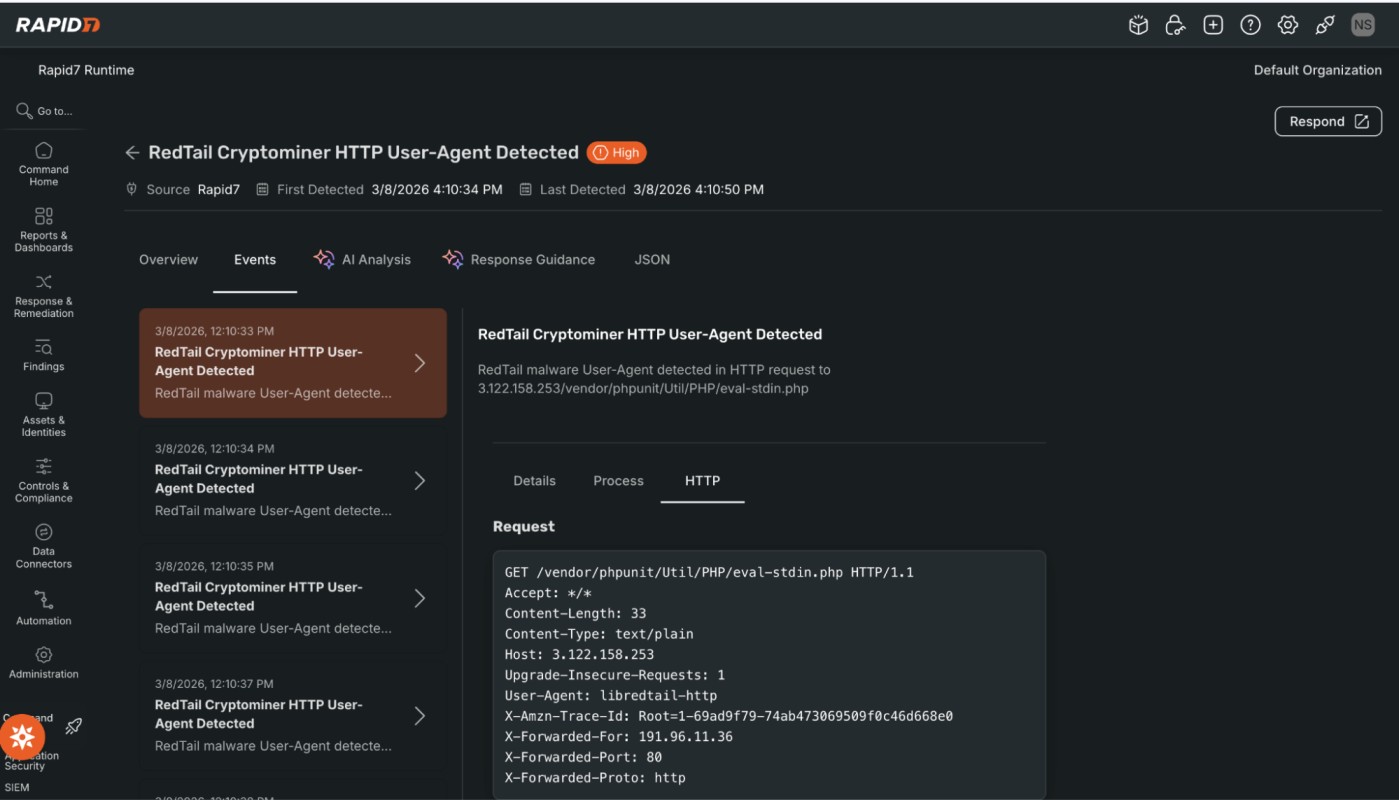
This is where cloud runtime security turns theory into reality. Instead of treating the vulnerability as just a potential risk, the platform utilizes eBPF sensors to provide continuous, direct kernel-level observability and application L7 visibility. Exposure Command analyzes this sensor data, uses AI to establish baseline workload behavior, and uncovers anomalies in real time. For example, security analysts gain instant visibility when that vulnerable container suddenly spawns a reverse shell and initiates an external connection to a known malicious IP, rather than executing its standard database queries.

Runtime-Security-Rapid7-Exposure-Command-CNAPP.jpg

The response

When a runtime anomaly is detected on a high-priority asset, the platform instantly aggregates these events into streamlined alerts. It links the initial application-layer exploit to the infrastructure-level change, such as the attacker attempting a container escape using that over-privileged IAM role. More importantly, the platform can trigger an automated response. By automatically terminating the malicious process, pausing the compromised container, or isolating the namespace, Exposure Command effectively stops an attacker’s lateral movement in seconds.

Malicious-process-alert-Rapid7-Exposure-Command-CNAPP.jpg

The investigation

Stopping the threat, understanding how it happened, and proving you resolved it, is what creates a truly resilient security program. Rapid7 Exposure Command does not just initially block the attack and leave you sifting through raw kernel logs to truly remediate the threat. Instead, it uses AI-generated remediation summaries to translate complex runtime telemetry into a clear, actionable remediation narrative. It explains exactly how the attacker bypassed initial defenses, what lateral movement they attempted, and the precise root-cause misconfigurations that allowed it. This empowers security teams to confidently report to leadership on the active threats they’ve neutralized, while providing developers with the exact context and code-level recommendations they need to patch the underlying exposure.

Amplifying signal vs. noise

When you combine predictive exposure analytics with deep application-layer and kernel-level visibility, you fundamentally change your operational efficiency. You stop chasing every theoretical risk and start focusing on what matters most. Exposure Command is a unified solution that eliminates the noisy alerts that tend to overwhelm security operations teams. Teams are able to prioritize remediation not just by CVSS score, but by real-time validation of what is actively loaded into memory and what is currently being exploited (i.e., risk and exposure). This means your developers spend less time patching vulnerabilities that fail to pose an immediate risk, and SecOps spends less time investigating benign container behavior.

With the general availability of cloud runtime security as part of Exposure Command, Rapid7 delivers a strategic, engineering-driven platform that achieves the mission of true CNAPP. We provide the precise answer to, “Could I be compromised?” through preemptive exposure management, and the definitive answer to, “Am I currently compromised?” through proactive runtime security. By closing the loop between these two questions, we allow enterprises to secure their cloud environments with accuracy, speed, and confidence. This is a great example of the wider approach to preemptive security that Rapid7 is delivering across different use cases through the Command Platform’s comprehensive exposure management and threat detection & response capabilities.

Visit Rapid7’s CNAPP hub page to learn more about how the fully integrated Rapid7 Exposure Command with cloud runtime security can transform your cloud defense.

Reducing Cloud Chaos: Rapid7 Partners with ARMO to Deliver Cloud Runtime Security

Post Syndicated from Joel Alcon original https://www.rapid7.com/blog/post/cds-reducing-cloud-chaos-rapid7-partners-with-armo-delivering-cloud-runtime-security

Rapid7 has partnered with ARMO, a leader in cloud infrastructure and application security based on runtime data, to offer Cloud Runtime Security. The new offering, currently in beta, extends our vulnerability and exposure management solution, Exposure Command, into the moment where cloud risk becomes real: while applications and workloads are running. The solution does this with several differentiators that map directly to what security leaders need most: signal accuracy and response speed.

Introducing Rapid7 Cloud Runtime Security

Rapid7 Cloud Runtime Security combines kernel-level observability with AI-powered behavioral analysis to create a continuous, threat-aware defense layer within all cloud environments. 

The solution provides:

  • AI-driven behavioral baselines for container activity. Because services, teams, and software releases create constant change, static policies can quickly become irrelevant and overly noisy. Cloud runtime security augmented by AI helps establish a behavioral baseline of what “normal” looks like for workload activity. This baseline becomes the standard for identifying deviations that indicate active exploits. This becomes even more critical for AI workloads in which runtime is the only place to understand behavior. 

  • Root-cause in every risk finding. When a threat is detected, the platform does not just create noise by firing an alert. Instead, it reconstructs the entire event with root-cause insights by linking application-layer activity (like a SQL injection) to infrastructure-level changes (like a container escape). It also provides a natural-language narrative of the attack, showing exactly what happened, which credentials were used, and which resources were accessed.

  • Connected dots across the entire cloud ecosystem. From cloud and Kubernetes events, clusters APIs, container and workload processes, to individual lines of code, the solution displays the entire attack story. Instead of sifting through siloed, disparate security tools that each present different alerts, teams gain a single source of objective truth for faster forensic analysis.

  • Deep application-layer visibility. Instantly detect and respond to common attacks, including SQL injections, command injections, local file inclusion (LFIs), and server-side request forgery (SSRF) that regular endpoint detection and response (EDR) tools overlook because their visibility is limited to the host and process level.

  • Orchestrated automated response to detected anomalies. Detection is only part of the full battle. Speed is the difference between a contained event and a disruptive, expensive data breach. The solution automatically terminates malicious processes, pauses compromised containers, isolates namespaces, or blocks egress to prevent an attacker’s lateral movement.

Rapid7 Cloud Runtime Security enables orchestrated automated response when anomalies are detected, enabling teams to quickly mobilize and contain threats. 

Security amidst the chaos

Chaos is the natural state of cloud environments, where instances frequently shut down and containers constantly change. In these environments, chaos isn’t a deficiency, but an inherent characteristic of distributed systems. Containers spin up and down constantly, deployments change multiple times per day, images get rebuilt and redeployed, identities and permissions drift, and workloads inherit misconfigurations at scale

Traditional vulnerability management (VM) was designed to protect static, on-prem technology architectures. Periodic scans, CVSS scores, and reactive patching have been effective here, but point-in-time snapshots and reactive remediation strategies collapse in dynamic, highly-distributed cloud environments for the following reasons:

  • Blind spots. Ephemeral cloud resources can spin up, perform a task, and disappear in minutes. If a vulnerable container exists for only 10 minutes between a scheduled scan, traditional VM tools will miss it and an automated attacker script will find and exploit it in seconds.

  • Missing context. Network scanners find CVEs, but they often lack contextual awareness. For instance, a ‘critical’ vulnerability may represent a low risk in a library that exists on an isolated container with no internet access. Conversely, a ‘medium’ vulnerability on a public-facing server with an over-privileged IAM role can be a catastrophic exploit.

  • Misconfigurations. In the cloud, vulnerabilities can live on unpatched software, but also arise from misconfigured systems. Consider a fully patched server that is compromised because of an open S3 bucket or a broad IAM policy. According to Gartner, “through 2026, nonpatchable attack surfaces will grow from less than 10% to more than half of the enterprise’s total exposure, reducing the impact of automated remediation practices1.”

  • AI-driven complexity. AI is accelerating innovation cycles, and as organizations push out more code, AI has introduced several new dimensions to the attack surface.  These can include vulnerabilities that trick LLM models into revealing sensitive data or bypassing security controls.

The new baseline for modern cloud security

As modern cloud environments are constantly changing, security teams need to know in real time when exposures become active threats. Rather than toiling over a ‘high’ or ‘critical’ vulnerability, they prioritize remediation actions based on the paths that lead to compromise. This is because a vulnerability can become a critical exposure when the conditions around it make it reachable, exploitable, and high impact. Savvy security teams use exposure management solutions to assess whether they are likely to get compromised, then lean on cloud runtime platforms to identify, in real-time, whether they are actively compromised. As a result, the best security programs now run on a “two-engine” model:

  • Predictive and preemptive with exposure management. This risk-forecasting layer discovers, prioritizes, and guides action on the exposures most likely to lead to material impact. Organizations utilize exposure management solutions to identify which exposures should be addressed first, the shortest paths to breach, and the remediation activities that most reduce risk.

  • Real-time and proactive with runtime security. This threat-reality layer detects anomalous behavior as it happens and supports immediate containment actions. Organizations use runtime security solutions to assess whether an exposure is actively being exploited, the configuration changes that may have led to the exposure, and the actions that need to be taken to contain the threat.

On their own, each part of the engine is valuable, but exposure management without runtime can cause teams to overlook active threats; runtime without exposure context can drown teams in noisy alerts. Together, these solutions enable teams to prioritize what matters most and respond instantly when it becomes active.

Visit our cloud security pages to learn more about how Rapid7 empowers teams to proactively manage risk, accelerate DevSecOps, and enforce compliance across multi-cloud environments.

1 Gartner, Predicts 2023: Enterprises Must Expand From Threat to Exposure Management, Jeremy D’Hoinne, Pete Shoard, Mitchell Schneider, John Watts, December 2022

Exploring an Untethered, Unified Approach to CTEM

Post Syndicated from Joel Alcon original https://blog.rapid7.com/2025/05/07/exploring-an-untethered-unified-approach-to-ctem/

Exploring an Untethered, Unified Approach to CTEM

We live in a world where traditional Vulnerability Management (VM) has become infosec’s version of ‘whack-a-mole’— an attempt to tackle risks that constantly shift, multiply, and morph. As organizations push workloads to the cloud, offer customers digital experiences, or as they build AI-enabled applications across  their business, the attack surface expands exponentially. For decades, security teams have relied on traditional network and endpoint-based scanners to discover and patch CVEs, but the reality is attackers don’t think in terms of “CVEs”—they think in attack paths.

The most successful hackers increase the blast radius and impact of their attacks by connecting key dots across your organization:

  • Weak access controls to high-privilege users.
  • Misconfigurations to mission-critical assets.
  • Known exploits to number of impacted systems.

To tame this complicated, quickly-evolving threat landscape, security teams are moving from ticking boxes for vulnerabilities patched, to understanding, contextualizing, and preempting real-world threats before they become breaches. The strategic shift has fueled the rise of Risk-Based Vulnerability Management (RBVM) and Continuous Threat Exposure Management (CTEM).

However, many organizations implement these approaches through an array of point security solutions – vulnerability scanners, endpoint detection software, penetration testing – and feed this data into one or more aggregation tools (usually SIEMs). This fragmented approach has inadvertently paved the way for tool sprawl, operational silos, and security blind spots. In this blog, I’ll explore why RBVM and CTEM have become essential security strategies, common mistakes that organizations make in implementation, and why these shortcomings have fueled the demand for unified exposure management.

RBVM helps teams prioritize remediation based on exploitability, criticality, and threat intelligence, rather than relying solely on CVE severity scores. RBVM solutions typically ingest data from vulnerability scanners, external threat feeds, endpoint detection systems, and other security tools. Security analysts then correlate key findings against SIEM tools to determine which vulnerabilities are actively being exploited in their environment.

The key benefit? This approach reduces alert noise because it filters out low-risk vulnerabilities, enabling security teams to focus remediation efforts on the most critical threats.

However, RBVM approaches come with significant drawbacks:

  • RBVM tools are not designed to perform scans or produce threat intel themselves.
  • Teams must integrate RBVM solutions into their existing security stack (SIEM, SOAR, EDR, cloud security tools) – a process that’s often complex, time-consuming, and costly.
  • Most critically, if there are assets that the RVBM services have no visibility into, they will not produce risk scores for them, creating an incomplete picture of your attack surface and inaccurate representation of true business threats.

The evolution to CTEM

To continuously assess and validate exposures across the entire attack surface, organizations are turning to CTEM as a proactive strategy for mitigating ongoing risk. With real-time, continuous visibility into the attack surface and attack paths, security teams can prioritize remediation efforts based on the risks that impact business-critical systems. Despite the benefits of this more advanced approach, implementing CTEM with fragmented security tools creates significant challenges:

Misleading view of the attack surface.

Your security stack may have top-tier vulnerability scanners, EDR solutions, and CSPM tools, but if these tools aren’t talking to each other, you end up with an incomplete view of the attack paths that hackers would take. Leading CTEM approaches are underpinned by platforms that go beyond CVEs by incorporating misconfigurations, cloud entitlements, shadow IT, lateral movement risks, and application security gaps to provide a comprehensive view of the attack surface.

Lacking business content and impact analysis for prioritization.

Security teams have to sort through alerts, false positives, and vulnerability scan results that often lack business context. Without a unified platform connecting vulnerability findings with risk scores and business impact, teams will struggle to accurately prioritize risk, leaving them spending valuable time remediating issues that do not actually impact business-critical systems. Organizations need to look across the entire attack surface, including internal and external-facing attack vectors, as well as telemetry signals like weak identity and access controls.

Silos hinder incident response.

Vulnerability dashboards and reports do not depict how an adversary would exploit a vulnerability. Organizations need an in-depth view of the attack path to understand, for example, how misconfigurations can result in disruptive domain compromise in the event of a breach. This insight helps security teams identify interconnected systems and organizational peers (e.g., application owners, cloud architects, developers, engineers, etc.) that they will need to coordinate with in case there is a breach.

The driving force for a unified exposure management platform

According to the 2023 Gartner® Technology Adoption Roadmap for Large Enterprises Survey, cybersecurity leaders indicated that on average their organizations had 43 tools in their cybersecurity product portfolios, and 5% of the leaders indicated their organizations had over 100 tools.” We believe that managing that many tools can be overwhelming, especially because security teams often operate their tools in silos. The ensuing sprawl creates blind spots that attackers can easily exploit. Instead of juggling multiple disconnected tools, forward-thinking organizations are embracing a unified approach to exposure management with comprehensive platforms that deliver:

  • Vulnerability management
  • CASM
  • EASM
  • Cloud security
  • Identity security
  • Threat intelligence

Because many high-profile breaches start with compromised credentials or excessive privileges, the ideal exposure management platform maps critical assets against users with weak authentication protocols.

Security teams can no longer rely on a scan-and-patch approach; they need to stay ahead of attackers by continuously identifying, validating, and mitigating risks across the entire attack surface. If your security tools aren’t fully integrated, attackers will exploit what’s left exposed. CISOs, security architects, and SOC leaders are tackling this challenge by moving beyond traditional VM and adopting a unified exposure management strategy with Rapid7’s Exposure Command Platform.

Connecting the dots with Exposure Command

Unlike traditional standalone VM, CASM, EASM, SIEM, or EDR tools that rely on proprietary agents, Exposure Command from Rapid7 brings it all together into one platform. With an inside-out and outside-in view of your risks, combined with trusted threat intelligence and a vendor agnostic approach to vulnerability aggregation, security teams gain a complete, end-to-end view of their attack surface.

Rapid7’s all-in-one Exposure Command platform goes even further by automatically mapping users, authentication protocols, and the criticality of the systems they can access. Armed with deep visibility into vulnerabilities and their impact to the business, organizations can leverage Rapid7’s Remediation Hub to address the risks that have the largest impact on their overall risk posture.

The paradigm has shifted – it’s no longer about chasing vulnerability patches, but about taking command and reducing risk across the business.

Ready to see the difference a unified approach can make? Check out the Rapid7 Exposure Command product trial to learn more about our platform and dive deeper into our unified, modern approach to managing risk and remediating security threats.

Gartner, Infrastructure Security Primer for 2025, John Watts, Franz Hinner, 29 January 2025 (For Gartner subscribers only)

GARTNER is a registered trademark and service mark of Gartner, Inc. and/or its affiliates in the U.S. and internationally and is used herein with permission. All rights reserved.