Post Syndicated from The Atlantic original https://www.youtube.com/watch?v=znvU7ej-_BU
The Case for College
Post Syndicated from The Atlantic original https://www.youtube.com/watch?v=rdu29Zz83IQ
Conversations With Ibtihaj Muhammad and Briana Scurry
Post Syndicated from The Atlantic original https://www.youtube.com/watch?v=m_ypLpFgz90
A Conversation With Governor Mikie Sherrill
Post Syndicated from The Atlantic original https://www.youtube.com/watch?v=WMD6i-YJSKg
Where America is Moving
Post Syndicated from The Atlantic original https://www.youtube.com/watch?v=GZV-2XX1JaU
Trump Has Turned America Into a Credit Risk | The David Frum Show
Post Syndicated from The Atlantic original https://www.youtube.com/watch?v=zaseJWqyG_U
Kara Swisher on What’s Changed in Silicon Valley’s Culture
Post Syndicated from The Atlantic original https://www.youtube.com/shorts/yFFt1py7-r4
The Big Story: War, Peace, and Democracy
Post Syndicated from The Atlantic original https://www.youtube.com/watch?v=6ISrbRG5ZMI
Former White House Adviser Karl Rove Does Impression of Trump Calling Him a ‘Loser’
Post Syndicated from The Atlantic original https://www.youtube.com/shorts/_9ofE88v_II
Mat’s Tat 3
Post Syndicated from Techmoan original https://www.youtube.com/watch?v=w3HwiY3p74w
Седмицата (14–19 септември)
Post Syndicated from Йовко Ламбрев original https://www.toest.bg/sedmitsata-14-19-septemvri/

Възможно ли е седмицата, в която традиционно започва новата учебна година, да е така наситена с политика? И още как. Особено когато наближават избори. Всъщност политика изобщо не е точната дума.
„Как държавата режисира ужаса от Петрохан“ е заглавието на седмичния коментар на Емилия Милчева, който е задължително да прочетете, дори вече да ви се повдига от тази тема. Ето защо:
В престрелката между основните лагери, на които се разполови общественото мнение, се изгубиха децата – жертви на възрастни, отказали да изпълнят задълженията си.
А експрезидентът Румен Радев, който в момента олицетворява изпълнителната власт, подреди други деца в кадър, за да употреби ситуацията за още повече власт.
Как държавата режисира ужаса от Петрохан
По случая „Петрохан“ вече има чудовище, присъда и политически виновници. Няма само приключило разследване, но това с върховенството на закона, както знаем, е за балъци. Между фактите, течовете и удобните версии Емилия Милчева търси какво остана извън публичния разказ.
В анализа си „Кой още има принос, за да се стигне до убийството на Георги Кузев?“ Светла Енчева се връща към върволицата от събития, хора и институционално късогледство, довели до жестокото убийство на 37-годишен мъж от група непълнолетни в Пловдив. Текстът поставя неудобния въпрос за съучастието на обществото, в което системно се отглежда тиха толерантност към агресията и социалната безнаказаност.
Сред съучастниците тук са и медиите, които системно героизираха самозванци в гонитба на рейтинг; политиците, които гласуват популистки закони, нормализирайки дехуманизацията; и не на последно място – и партиите, превърнали темата за педофилията в евтин компромат за предизборни разправии. Невинни няма – обществото и институциите сами си отгледаха тази култура на линч.
А институционалното безхаберие е очевадно и в двата криминални случая.
Кой още има принос, за да се стигне до убийството на Георги Кузев?
Светла Енчева проследява нишката от хора, събития и обстоятелства, довели до убийството на Георги Кузев – от нормализирането на омразата и самоуправството до ролята на медиите, институциите и политиците. „Обичайните заподозрени“ – родителите и социалните мрежи, са само част от картината.
Почти не останаха хора, които да нямат отношение към темата с все по-широкото разпространение на изкуствения интелект. И е нормално някои стъписващи новини напоследък да предизвикват тревожни мисли за посоката, в която се е запътил светът. Няма как да ви успокоявам, че притесненията са изцяло неоснователни. Но мога да погледна на темата под малко по-различен ъгъл и да припомня, че подобни неща вече са се случвали в човешката история. Няколко пъти. Все се оказва, че сме похарчили много повече, отколкото можем да си позволим, и накрая сметката не излиза.
Прочетете повече в новата ми статия в рубриката „Аз, киборгът“, озаглавена „Изкуствен интелект и естествено лицемерие“. А в края на материала ще откриете популярна песен, чийто текст сякаш е писан за химн на индустрията, която създава изкуствен интелект. Заслушайте се само…
Изкуствен интелект и естествено лицемерие
Апокалипсисът се отлага. Поне във формàта, в който ни го пробутват напоследък – като унищожение на света от изкуствен интелект. Само че защо ИИ гигантите изведнъж се сетиха за сигурността и започнаха да превръщат загрижеността си в маркетинг? От Йовко Ламбрев.
Ако още не знаете кой е Никола Цолов, дори и да не сте сред феновете на моторните спортове, значи вероятно живеете в пещера и ви завиждам, че ще научите за него именно от този брой на „Тоест“.
Талантът на Никола е извън всякакво съмнение. Той вече е постигнал безпрецедентни за българския моторен спорт успехи, а е едва на 19 години. Горчивата истина обаче е, че бъдещето му не зависи само от големия му талант. Ще разберете защо в статията „Последната предавка. Докъде ще стигне Никола Цолов?“ на Александър Драганов.
Последната предавка. Докъде ще стигне Никола Цолов?
Какво е нужно, за да се изкачи един състезател до най-високото ниво в моторните спортове? Личните качества достатъчни ли са, или съществуват и други фактори? Александър Драганов анализира темата и хвърля светлина върху мащаба на постиженията на Никола Цолов.
Кой, ако не Атанас Шиников ще открие пустинната фантастика на „Дюн“ в Корана и ще се запита възможен ли е ислямски шариат за извънземни? В първата част на новото си ориенталско приключение „Извънземни и ислям“ Атанас с ловкостта на илюзионист ни размята между фундаментални заглавия от популярната научна фантастика и строгите академични дебати в мюсюлманското право и богословие.
Текстът му е едно интелигентно и духовито изследване за това как класическото богословие може да разбива съвременни догматични клишета, и изпреварва модерната фантастика в мисленето за световете отвъд нашия.
„Господът на световете“. Извънземни и ислям
Ако Аллах е творец на всичко живо, знайно и незнайно, и владетел на всички светове, значи ли това, че ислямът допуска съществуването на извънземни? Атанас Шиников се гмурва в дълбоките и тайни джобове на Корана, за да извади оттам поредните изненади.
Нека завършим седмицата с хубава книга. В рубриката ни „На второ четене“ Антония Апостолова е избрала да припомни романа „Белези“ на исландската писателка Ойдур Ава Олафсдотир. Историята проследява мъж в дълбока екзистенциална криза, който заминава за анонимна, разрушена от война европейска страна с едничката цел да приключи с живота си. Вместо това обаче той хваща бормашината и започва да поправя срутения свят около себе си.
На второ четене: „Белези“
Съвременната исландска литература е слабо позната у нас, но напоследък, благодарение на Светла Стоянова и издателство ICU, се появява ново рафтче в библиотеката на литературния превод. И то не остава незабелязано от Антония Апостолова.
Един разказ за поправимостта на човешкото – напомняне, че изцелението не е грандиозен патетичен жест, а поредица от малки тихи стъпки, с които съграждаме смисъл насред руините.
Така както съществуването на „Тоест“ се крепи на малките, но неизменни месечни дарения на читателите. Включете се и вие в усилията ни за съграждане на смисъл!
И приятно четене на броя!
Kioxia XL1 CXL XL-FLASH NAND Device Shown
Post Syndicated from Eric Smith original https://www.servethehome.com/kioxia-xl1-cxl-xl-flash-nand-device-shown/
The Kioxia XL1 is an XL-FLASH Generation 2 NAND device that is attached to a system as a 512GB memory expansion device via CXL
The post Kioxia XL1 CXL XL-FLASH NAND Device Shown appeared first on ServeTheHome.
Lina Khan Says “AI Exceptionalism” Distorts the Conversation Around the Tech
Post Syndicated from The Atlantic original https://www.youtube.com/shorts/ewZDlx1aYSM
Colin Kaepernick on Trump’s ire over his national-anthem protest
Post Syndicated from The Atlantic original https://www.youtube.com/shorts/QneMAVYAzqI
The Atlantic Festival 2026: Senator Mark Kelly Discusses Whether He’ll Run for President
Post Syndicated from The Atlantic original https://www.youtube.com/shorts/TQXTVvZLfIA
A Conversation With Karl Rove and Andrew Card
Post Syndicated from The Atlantic original https://www.youtube.com/watch?v=M2HB8XA-f7M
A Conversation With Senator Mark Kelly
Post Syndicated from The Atlantic original https://www.youtube.com/watch?v=yI9najEmMzY
Representative Chip Roy Says Checks and Balances Are ‘Not Where I Want It to Be’
Post Syndicated from The Atlantic original https://www.youtube.com/shorts/2Mf4bZTqF4g
Achieving CNIL/EU ePrivacy compliance for email tracking with Amazon SES
Post Syndicated from Toni Pivcevic original https://aws.amazon.com/blogs/messaging-and-targeting/achieving-cnil-eu-eprivacy-compliance-for-email-tracking-with-amazon-ses/
Open and click tracking have long been foundational email metrics. Multiple data protection authorities, including in EU and Canada, have issued guidance requiring explicit opt-in consent before deploying open tracking pixels or click link wrapping in email. As privacy expectations evolve, a growing number of jurisdictions now require senders to obtain explicit consent before tracking whether a recipient opened an email or clicked a link. In this post, you learn how to use Amazon Simple Email Service (Amazon SES) configuration set overrides to control open and click tracking per request.
How Amazon SES tracking works
Amazon SES enables open and click tracking only when explicitly configured by you. Amazon SES does not inject tracking pixels or wrap links by default.
Open tracking — When you add an event destination publishing OPEN events to a configuration set, Amazon SES inserts a 1×1 tracking pixel (served from awstrack.me) into HTML email sent using that configuration set. When a recipient opens the email and their client loads images, Amazon SES records the open event and publishes it to the configured destination.
Click tracking — When you include CLICK events in a configuration set’s event destination, Amazon SES rewrites links in HTML email to redirect through awstrack.me, recording click events before sending the user to the original URL.
Configuration sets — Configuration sets are the control surface for both features. Tracking activates only when an event destination explicitly includes OPEN or CLICK in its matching event types. You can have multiple configuration sets with different tracking configurations and select the appropriate one at send time.
Per-request tracking overrides — Amazon SES now supports open and click tracking override parameters directly in the SendEmail and SendBulkEmail APIs through the ConfigurationOverrides object. You can enable or disable open tracking and click tracking on an individual API call, without maintaining separate configuration sets. The override takes precedence over the tracking behavior defined in the associated configuration set, giving you fine-grained, per-recipient control at send time. This is the most direct way to honor recipient-level consent choices.
Event publishing and metrics — Open and click events are published to the destinations you configure: Amazon CloudWatch, Amazon Data Firehose, or Amazon EventBridge. Plan for reduced fidelity in open-rate dashboards for recipients in jurisdictions where you cannot track without consent.
Note on Amazon SES Contact Lists: Contact Lists manage topic-level subscription preferences (for example, marketing versus transactional) and control whether Amazon SES delivers to a contact. They do not control tracking behavior. There is no native mapping between a contact’s subscription status and tracking pixel injection. Tracking consent must be managed separately in your application.
Prerequisites
To follow the steps in this post, you should be familiar with Amazon SES configuration sets and basic email sending concepts. You also need the following:
- An AWS account with Amazon SES out of sandbox mode.
- AWS Identity and Access Management (IAM) permissions to create and manage Amazon SES configuration sets (ses:CreateConfigurationSet, ses:CreateConfigurationSetEventDestination, ses:DeleteConfigurationSet).
- The AWS Command Line Interface (AWS CLI) version 2 installed and configured, or access to the AWS SDK for Python (Boto3).
Option A: Use per-request tracking overrides (recommended)
The most direct approach to consent-based tracking uses the ConfigurationOverrides parameter in the SendEmail API. This approach requires only a single configuration set with tracking-enabled event destinations. At send time, you override the tracking behavior based on each recipient’s consent status.
AWS SDK:
The ConfigurationOverrides.Tracking object takes precedence over the configuration set’s event destination settings for that individual send. If the recipient has not consented, Amazon SES does not inject the tracking pixel or wrap links, regardless of whether the configuration set has OPEN and CLICK events enabled.
Advantages of per-request overrides:
- No need to maintain separate configuration sets for tracked versus untracked sends.
- A single configuration set can handle all recipients, which simplifies event destination management, suppression, and DomainKeys Identified Mail (DKIM) and domain settings.
- Per-recipient control without branching logic for configuration set selection.
- Works with SendBulkEmail as well, setting tracking overrides per recipient in the bulk request.
SMTP interface — If you send through SMTP, per-request overrides are not available. Use Option B (separate configuration sets) instead.
Option B: Use separate configuration sets
If you send through SMTP or prefer to separate tracking behavior at the configuration set level, create two configuration sets: one with tracking enabled for consented recipients, and one with no tracking for non-consented recipients.
Console: In the Amazon SES console, choose Configuration sets, and then choose Create configuration set. To enable tracking on the first set, add an event destination and include OPEN and CLICK in the matching event types. Create a second set with no OPEN or CLICK event destinations, or omit event destinations entirely.
AWS CLI:
Replace { … } with your CloudWatch destination configuration. For the full parameter structure, see Managing Amazon SES event destinations.
No event destination for OPEN or CLICK means no pixel is injected and no links are wrapped.
Send-time selection:
Your application selects the configuration set for each message based on the recipient’s consent status.
SMTP interface — Set the configuration set through the X-SES-CONFIGURATION-SET header:
Disabling tracking on individual links
To disable click tracking on individual links within a tracked email (for example, your unsubscribe link), use the ses:no-track attribute:
Amazon SES strips the ses:no-track attribute before delivery, so recipients never see it. This works with both Option A and Option B.
Manage consent in your application
Regardless of which option you choose, Amazon SES provides the mechanisms to enable or disable tracking at send time. You are responsible for:
- Maintaining a consent database recording each recipient’s tracking consent status.
- Determining at send time whether a recipient has consented to open and click tracking.
- Passing the correct override parameter (Option A) or selecting the appropriate configuration set (Option B) based on that determination.
Important: Once an email is delivered with a tracking pixel, it cannot be retroactively deactivated.
Capture consent at sign-up. France’s data protection authority (CNIL) recommends collecting tracking consent at the point of email address collection. Include a clearly labeled, unchecked checkbox. For example: “I agree to allow AnyCompany to track whether I open or click email to improve future communications.” This is a separate checkbox from consent to receive marketing email.
Store consent with proof. You must be able to demonstrate valid consent for each individual. Store a consent timestamp and source alongside the subscriber record:
Make refusal as straightforward as acceptance. Do not use pre-checked boxes or dark patterns that make opting out harder than opting in.
Provide withdrawal at any time. Every email sent with tracking enabled must include a link that recipients can use to withdraw tracking consent independently of unsubscribing. A “Manage email preferences” link in the footer, separate from the unsubscribe link, satisfies this requirement:
Replace {SUBSCRIBER_TOKEN} with a signed token that identifies the subscriber’s record in your consent database. Replace {UNSUBSCRIBE_URL} with your Amazon SES one-click unsubscribe URL or list-unsubscribe endpoint.
Monitoring and governance
Audit event volumes. Use Amazon SES event publishing to monitor open and click event counts. If you use Option B, compare volumes between tracking-enabled and no-tracking. If you use Option A, monitor the ratio of sends with tracking enabled versus disabled. A sudden drop in consented opens might indicate an issue with your consent capture flow.
Review data retention. If you rely on the deliverability-only exemption for any segment, verify that your data pipeline retains only the date of last open, not the time, IP address, or user-agent string. Collecting those fields, even temporarily, voids the exemption per CNIL guidance.
Document your consent architecture. Maintain a record of how and when each subscriber provided consent, which form version was in use, and where the consent data is stored.
Clean up
If you created test configuration sets while following this post and do not intend to use them, delete them to avoid unintended configuration being applied to future sends.
Conclusion
Amazon SES gives you the tools to obtain prior consent before tracking opens and clicks. With per-request tracking overrides, you can honor consent decisions inline with each API call, with no additional configuration sets required. For senders using SMTP, separate configuration sets achieve the same outcome. Combined with consent capture at sign-up and a preferences management link in every tracked email, you can maintain meaningful analytics for consented recipients while respecting the privacy of those who have not opted in.
For more information, see the following resources in the Amazon SES Developer Guide:
- Amazon SES Email Metrics FAQs — Open and Click Tracking
- Specifying a configuration set when you send email
- Managing Amazon SES event destinations
- Amazon SES SendEmail API v2 reference
- Amazon SES Contact List Management
- Include once published: https://preview.docs.aws.dev/preview/kiselev/SEA/AmazonSESDocs/mainline/ses/latest/dg/configuration-overrides.html.
Related posts
- Getting started with Amazon SES suppression lists
- Managing email sending with Amazon SES configuration sets
- How to handle bounces and complaints in Amazon SES
About the authors
ReadyOn’s Four Walls of tenant isolation on Amazon EKS
Post Syndicated from Roshan Daneshvaran original https://aws.amazon.com/blogs/architecture/readyons-four-walls-of-tenant-isolation-on-amazon-eks/
ReadyOn, an AWS Partner delivering an intelligent Labor Orchestration Platform for Fortune 100 enterprises, runs a multi-tenant platform on Amazon Elastic Kubernetes Service (Amazon EKS) that handles some of the most sensitive data in enterprise IT. Kubernetes is central to that platform, and it is also one of the most complex surfaces to secure. A default Kubernetes deployment is not secure out of the box: upstream Kubernetes historically lets anonymous requests reach the API server, where they are denied only by RBAC, pods run as root by default, and network policies do not exist until someone writes them.
For single-tenant clusters, hardening is a well-documented challenge. But when you add multi-tenancy, the threat model fundamentally changes. The concern shifts from whether an unauthorized user can reach the cluster to whether Tenant A can access Tenant B’s data. Most multi-tenant Kubernetes platforms rely on a single isolation mechanism: the namespace. Kubernetes designers never intended namespaces to be a security boundary.
ReadyOn’s Harmony platform powers workforce intelligence for Fortune 100 enterprises. It processes payroll data, organizational hierarchies, and operational analytics spanning hundreds of thousands of employees. Cross-tenant access would trigger regulatory obligations across multiple jurisdictions and damage the trust enterprise clients place in their technology partners. The stakes demanded something better than one wall.
This post describes the architecture of ReadyOn’s four independent layers of isolation on Amazon EKS. Their Four Walls model combines Kubernetes namespaces, Karpenter-managed dedicated node pools, Amazon Virtual Private Cloud (Amazon VPC) security groups, and per-tenant Amazon Aurora databases. Together they create a compound defense: to cross a tenant boundary, an unauthorized user would need to simultaneously overcome the Kubernetes API, the node scheduler, the AWS software-defined network, and the data layer.
The Four Walls model
ReadyOn’s architecture places four independent barriers between tenants, each operating at a different layer of the stack and requiring a fundamentally different technique to cross:
- Wall 1 – Namespace isolation: Each tenant operates in a dedicated Kubernetes namespace with strict RBAC policies, resource quotas, and admission control. An Argo CD ApplicationSet generates these resources, so every tenant receives an identical security posture by construction.
- Wall 2 – Compute isolation: Karpenter provisions dedicated, auto scaling node pools for each tenant using a dual-taint strategy. Every node carries both a tenant-identifying taint and a workload-type taint. A pod must tolerate both to be scheduled. This configuration prevents cross-tenant pod placement.
- Wall 3 – Network isolation: Per-tenant Amazon VPC security groups restrict database access to only that tenant’s node pool. Kubernetes network policies enforce default-deny between namespaces. The cluster API server is private, accessible only through VPN with OpenID Connect (OIDC) and MFA.
- Wall 4 – Data isolation: Each tenant has a dedicated Amazon Aurora database cluster and tenant-scoped secrets in AWS Secrets Manager. Workloads use short-lived credentials through IAM Roles for Service Accounts (IRSA), and each tenant has per-tenant observability instances. There is no shared database with row-level filtering.
The power of this model is layering. An unauthorized user would need to cross all four walls simultaneously to reach the tenant boundary. These are layered, overlapping controls: an unauthorized user must defeat them in combination, not one at a time. Because some layers share a control plane (admission control, GitOps, the EKS control plane, and IAM), ReadyOn treats them as defense in depth rather than as fully independent probabilities.
Wall 1: Namespace isolation on Amazon EKS
The namespace is the most visible tenant boundary in Kubernetes. While ReadyOn is realistic about the limitations of namespace isolation as a security mechanism, the namespace still forms the logical foundation upon which the other isolation layers build.
GitOps-enforced consistency
Every tenant namespace is provisioned through an Argo CD ApplicationSet. When ReadyOn onboards a new tenant, they add a single entry to a configuration manifest in Git. The automation generates all required resources: the namespace, network policies, RBAC bindings, resource quotas, and secrets configurations. There are no “legacy” tenants with weaker policies. Every tenant receives an identical security posture by construction.
RBAC and admission control
Each namespace carries role bindings that restrict API access to only that tenant’s resources. No tenant principal can list, get, or modify resources in another namespace. An admission control framework validates all resources against a policy set that enforces security contexts, blocks privileged configurations, and prevents creation of resource types that tenants should not own (DaemonSets, ClusterRoles, admission webhooks).
The generated RoleBinding scopes a tenant group to its own namespace only. Argo CD renders this from the tenant entry in Git, so every namespace gets the identical binding:
Self-healing drift correction
The GitOps controller continuously reconciles live cluster state against the declared state in Git. Any manual modification (whether from a misconfiguration or an unauthorized user who gains limited API access) is automatically reverted within seconds. A human operator never runs kubectl apply against a production cluster.
Wall 2: Compute isolation with Karpenter
Namespace isolation operates at the Kubernetes API layer. Wall 2 drops to the compute layer: the actual machines where tenant code executes. In Harmony, tenants do not share compute nodes.
The dual-taint strategy
ReadyOn’s Karpenter provisioners create nodes with two taints: a tenant-identifier taint (for example, tenant=acme-corp) and a workload-type taint (for example, workload=frontend). A pod must tolerate both taints to be scheduled. Tenant A’s frontend nodes are distinct from Tenant A’s batch nodes, and both are entirely separate from Tenant B’s infrastructure.
Admission controller validation
Even if a pod is created with forged tolerations, an admission controller validates that the toleration claims match the namespace’s tenant identity. The scheduler cannot be directed into cross-tenant placement.
Scoped node credentials
All application nodes enforce IMDSv2 with a reduced hop limit, preventing pods from reaching the instance metadata endpoint. The IAM role attached to each node is scoped to a single tenant’s resources, limiting the scope of a container escape. Platform nodes run on managed node groups with a separate taint that no tenant workload can tolerate.
Wall 3: Network isolation at the VPC layer
Walls 1 and 2 operate within the Kubernetes abstraction. Wall 3 drops below Kubernetes entirely, enforcing isolation at the Amazon VPC and security group level: infrastructure that the Kubernetes control plane does not manage and that a pod with limited access cannot manipulate.
Per-tenant security groups
Each tenant’s Amazon Aurora cluster is protected by a security group that allows inbound connections only from the security group attached to that tenant’s application nodes. Tenant A’s nodes cannot open a TCP connection to Tenant B’s database. This is an Amazon VPC security group rule enforced by the AWS software-defined network. Crossing it would require overcoming that networking layer itself.
Multi-tier VPC architecture
The VPC is divided into four tiers: a public perimeter tier (load balancers only), an application tier (EKS worker nodes in private subnets), a database tier (Aurora clusters with no internet access), and a control plane tier (private EKS API endpoint, VPN-only access with OIDC and MFA).
Default-deny network policies
Kubernetes network policies enforce default-deny for inter-namespace traffic. Tenant pods communicate only with pods in their own namespace and explicitly allowed platform services. All other traffic is denied and logged. Amazon VPC Flow Logs capture all network traffic for anomaly detection.
Wall 4: Data isolation with Amazon Aurora
The final wall addresses the ultimate target: the data itself. Walls 1 through 3 prevent an unauthorized user from reaching another tenant’s data. Wall 4 maintains data isolation even if all other layers fail.
The case against shared databases
A shared database places the entire burden of isolation on application-layer query logic, where a single missing WHERE tenant_id = ? clause can result in inadvertent disclosure. ReadyOn chose dedicated Amazon Aurora clusters per tenant. There is no row-level filter to forget. Tenant A’s code cannot construct a connection to Tenant B’s database: it lacks the endpoint, the credentials, and the network path.
Dedicated Aurora clusters also support unique AWS Key Management Service (AWS KMS) encryption keys per tenant. Each tenant’s data-at-rest is encrypted with a distinct KMS key, meaning that even if raw storage were inadvertently accessed, one tenant’s key cannot decrypt another tenant’s data. Equivalent per-tenant key separation is complex to achieve in a shared database, where every tenant’s rows share the same storage and separation depends on correctly implemented row-level security.
IRSA: No long-lived workload credentials
Every workload authenticates to AWS APIs by using short-lived credentials from AWS Security Token Service (AWS STS), issued through OIDC federation between the EKS cluster and IAM. Each tenant’s workloads assume a unique IAM role scoped to only that tenant’s resources. Credentials expire within minutes. Application workloads hold no long-lived access keys.
Per-tenant observability
Each tenant’s metrics, logs, and traces are routed to dedicated observability backends through OpenTelemetry. Even a spike in error rates (which could reveal sensitive operational intelligence) is invisible to other tenants.
Breaking the threat sequence at every stage
ReadyOn maps their defenses to their own 10-stage multi-tenant threat model, with each stage mapped to the relevant MITRE ATT&CK techniques. The critical inflection point is their lateral movement stage (Stage 8), where an unauthorized user in a Tenant A pod with limited access attempts to cross the boundary to Tenant B’s resources. Figure 1 illustrates this inflection point, showing an unauthorized process inside a Tenant A pod attempting to reach Tenant B and being stopped at each of the four walls.
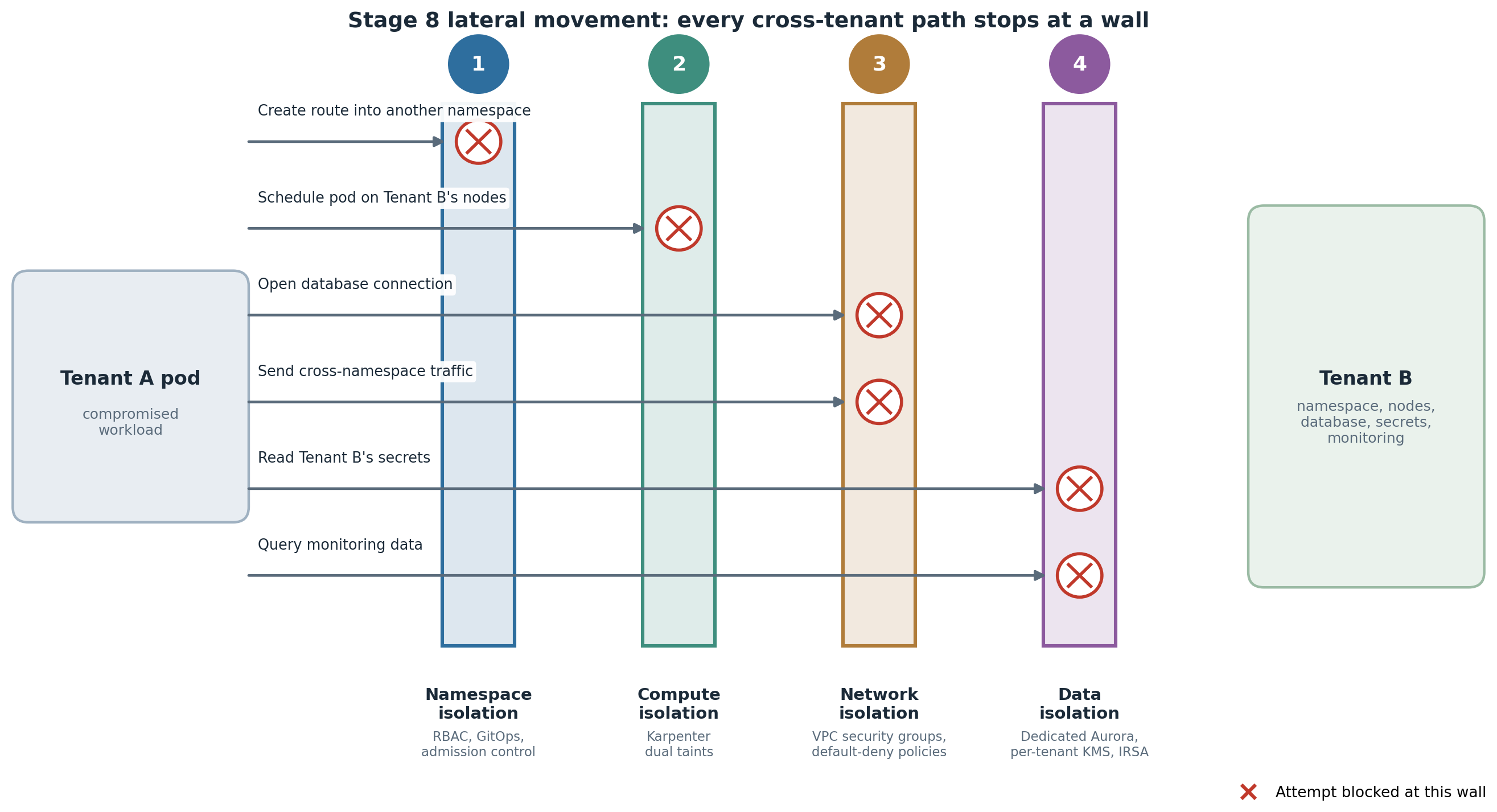
Figure 1: Stage 8 lateral movement, where each of the six cross-tenant paths a compromised Tenant A workload might attempt terminates at the numbered wall that blocks it
Figure 1 depicts a Tenant A pod on the left and Tenant B’s resources on the right. Four labeled vertical barriers sit between them, numbered 1 through 4, representing the four walls in order: (1) namespace isolation, (2) compute isolation, (3) network isolation, and (4) data isolation. Each of the six cross-tenant paths an unauthorized user might attempt is drawn as an arrow from Tenant A that terminates at the numbered wall that blocks it: creating a route into another namespace stops at wall 1. Scheduling a pod on another tenant’s nodes stops at wall 2. Opening a database connection and sending cross-namespace traffic stop at wall 3. And retrieving secrets and querying monitoring data stop at wall 4. No arrow reaches Tenant B.
At Stage 8, all four walls apply simultaneously. ReadyOn systematically validates that every cross-tenant path is blocked:
- Scheduling workloads on another tenant’s nodes is blocked by the dual-taint strategy plus admission controller validation.
- Reaching another tenant’s database is blocked by per-tenant security groups at the Amazon VPC layer.
- Reading another tenant’s secrets is blocked by IRSA scoping plus tenant-scoped secrets paths.
- Querying another tenant’s monitoring data is blocked by dedicated per-tenant observability instances.
- Communicating with pods in another namespace is blocked by default-deny network policies.
- Creating a route that directs traffic into another tenant’s namespace is blocked by policy: tenants cannot create or modify ingress resources, and the platform ingress layer re-validates tenant context on every request.
ReadyOn validates these boundaries through regular adversarial exercises that simulate a tenant pod with full access and attempt every crossing path. In these exercises to date, no test has produced a successful cross-tenant path.
Workload hardening: The innermost defense
Every container in Harmony runs with Pod Security Standards at the “restricted” level:
Containers cannot install tools, modify binaries, or use the kernel interfaces that container escape techniques depend on. Combined with IMDSv2 restrictions and IRSA, even a container escape does not yield useful node-level credentials.
GitOps as the security control plane
Every change to cluster state begins as a pull request requiring review and automated policy checks. The Git repository is the single source of truth. The cluster is a reflection of Git. Zero secrets are stored in Git: the External Secrets Operator resolves references to AWS Secrets Manager at deployment time. Even unauthorized access to the Git repository yields zero usable credentials.
Benefits
ReadyOn’s Four Walls architecture delivers measurable security and operational benefits:
- 10 threat model stages defended, each mapped to MITRE ATT&CK techniques, with all six cross-tenant paths blocked at the lateral movement stage.
- No long-lived credentials in application workloads: all workload authentication uses short-lived OIDC-federated tokens.
- Consistent security posture across all tenants enforced by GitOps templating, with no legacy exceptions.
- Self-healing drift correction reverts unauthorized cluster changes within seconds.
- Multi-region active-passive architecture with automated failover through Amazon Route 53.
Conclusion
Multi-tenant Kubernetes security is not a single problem with a single solution. Namespace isolation is a strong logical boundary, and the Kubernetes documentation recommends pairing it with additional layers rather than relying on it alone as a security boundary. ReadyOn built those additional layers.
ReadyOn’s Four Walls model demonstrates that defense-in-depth is achievable on AWS by layering native services at independent abstraction layers: Kubernetes RBAC at the API layer, Karpenter at the scheduler layer, Amazon VPC security groups at the network layer, and IAM at the data access layer. Each wall independently raises the cost of a cross-tenant attempt, and together they provide defense in depth: an unauthorized user must defeat the walls in combination, not one at a time.
For organizations running sensitive multi-tenant workloads on Amazon EKS, the Four Walls model provides a reference architecture for zero-trust tenant isolation without sacrificing the economics and operational velocity that multi-tenancy delivers.
Learn more
- Amazon EKS Best Practices Guide – Security
- Karpenter documentation
- IAM Roles for Service Accounts (IRSA)
- Amazon Aurora security
- AWS Well-Architected Framework – Security Pillar
- ReadyOn: readyon.com
- Amazon EKS service page
- Amazon Aurora service page