Post Syndicated from Jon Rolfe original https://blog.cloudflare.com/250-cities-is-just-the-start/


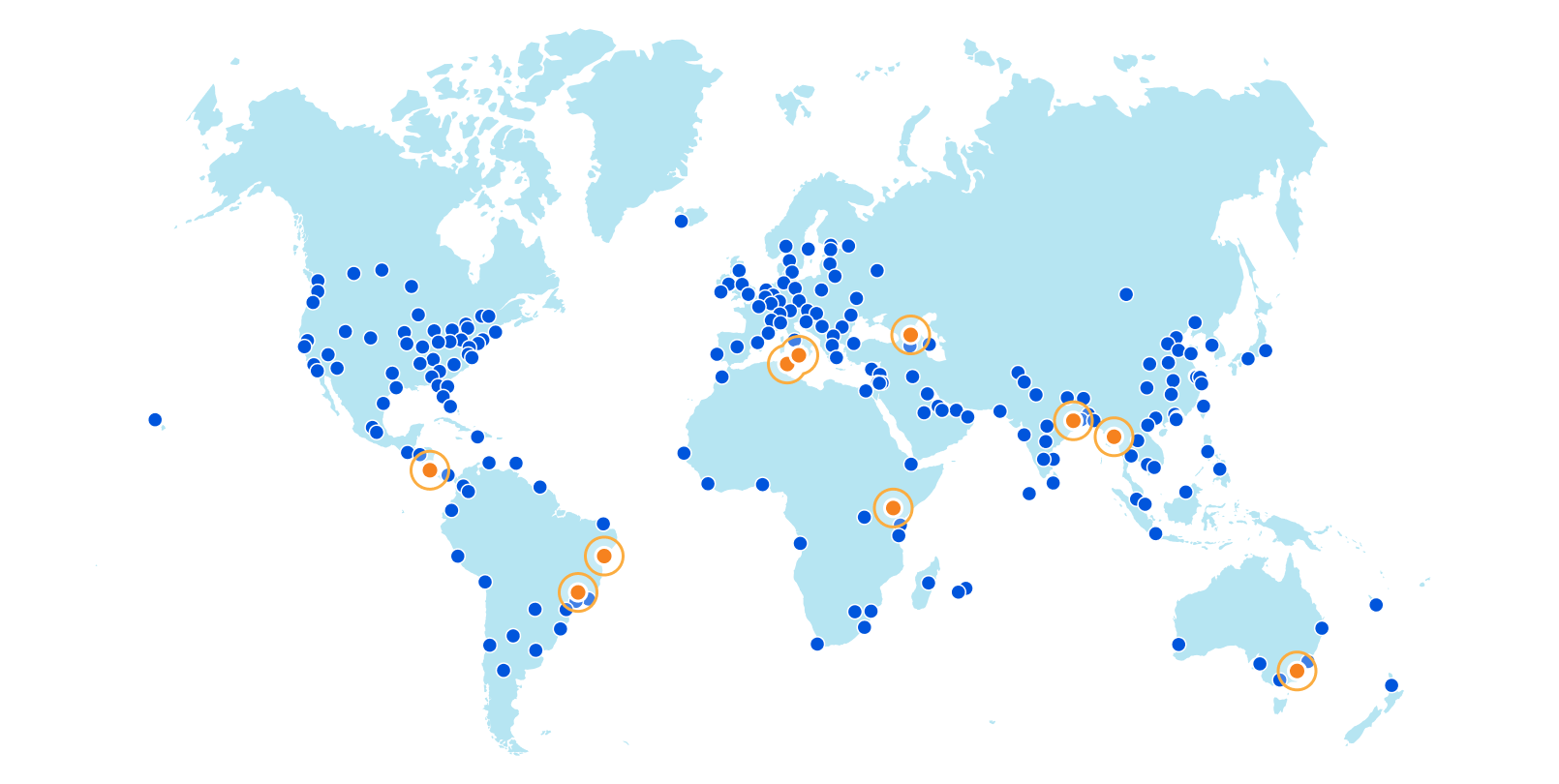
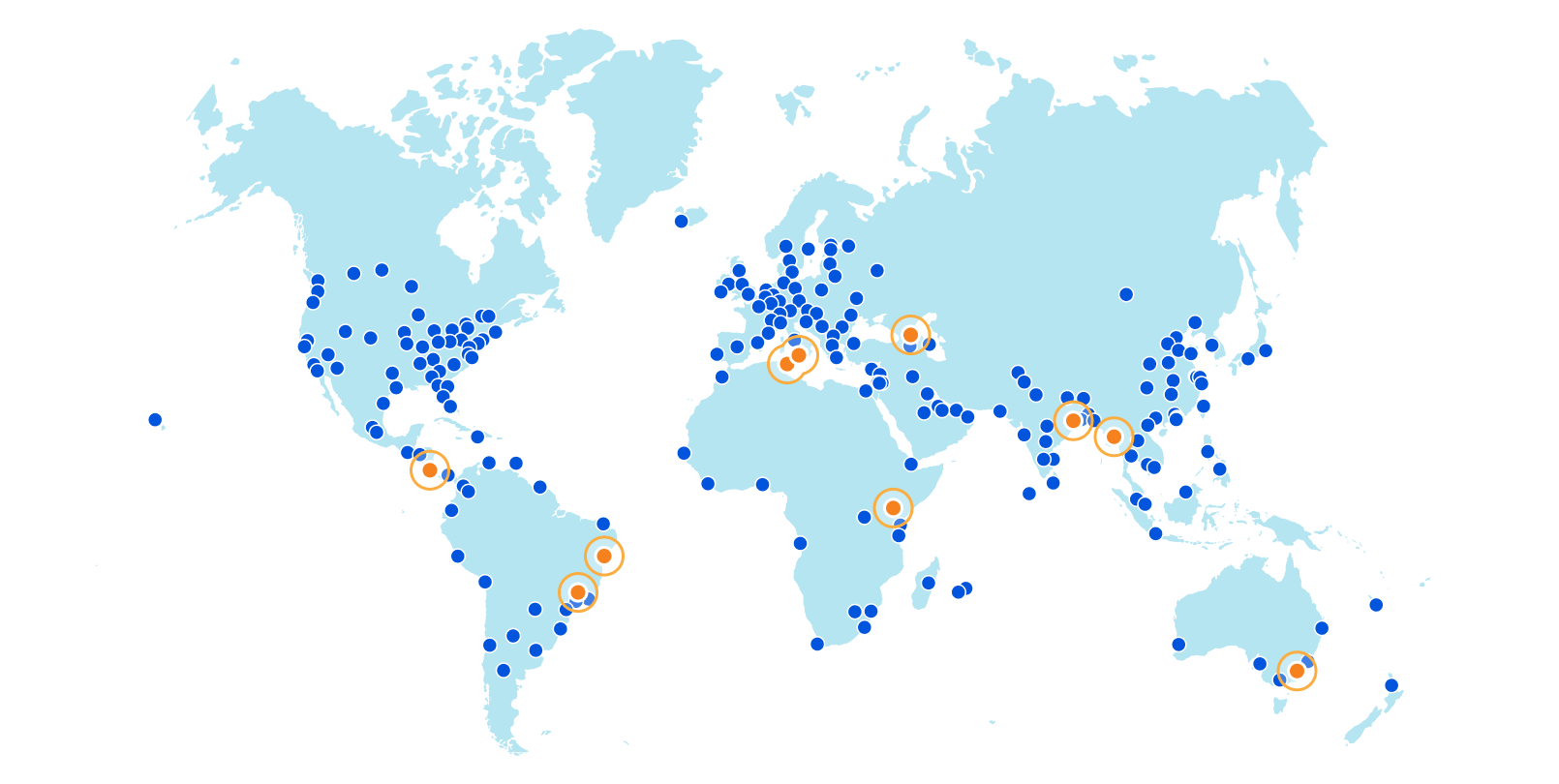
It feels like just the other week that we announced ten new cities and our expansion to 25+ cities in Brazil — probably because it was. Today, I have three speedy infrastructure updates: we’ve passed 250 on-network cities, more than tripled our external network capacity, and increased our long-haul internal backbone network by over 800% since the start of 2020.
Light only travels through fiber so fast and with so much bandwidth — and worse still over the copper or on mobile networks that make up most end-users’ connections to the Internet. At some point, there’s only so much software you can throw at the problem before you run into the fundamental problem that an edge network solves: if you want your users to see incredible performance, you have to have servers incredibly physically close. For example, over the past three months, we’ve added another 10 cities in Brazil. Here’s how that lowered the connection time to Cloudflare. The red line shows the latency prior to the expansion, the blue shows after.
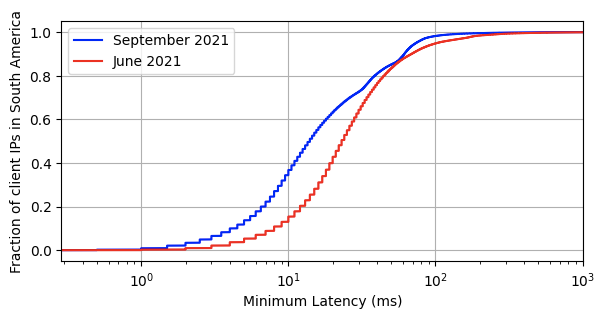
We’re exceptionally proud of all the teams at Cloudflare that came together to raise the bar for the entire industry in terms of global performance despite border closures, semiconductor shortages, and a sudden shift to working from home. 95% of the entire Internet-connected world is now within 50 ms of a Cloudflare presence, and 80% of the entire Internet-connected world is within 20ms (for reference, it takes 300-400 ms for a human to blink):
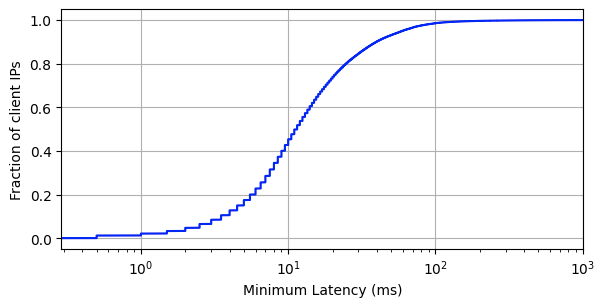
Today, when we ask ourselves what it means to have a fast website, it means having a server less than 0.05 seconds away from your user, no matter where on Earth they are. This is only possible by adding new cities, partners, capacity, and cables — so let’s talk about those.
New Cities
Cutting straight to the point, let’s start with cities and countries: in the last two-ish months, we’ve added another 17 cities (outside of mainland China) split across eight countries: Guayaquil, Ecuador; Dammam, Saudi Arabia; Algiers, Algeria; Surat Thani, Thailand; Hagåtña, Guam, United States; Krasnoyarsk, Russia; Cagayan, Philippines; and ten cities in Brazil: Caçador, Ribeirão Preto, Brasília, Florianópolis, Sorocaba, Itajaí, Belém, Americana, Blumenau, and Belo Horizonte.
Meanwhile, with our partner, JD Cloud and AI, we’re up to 37 cities in mainland China: Anqing and Huainan, Anhui; Beijing, Beijing; Fuzhou and Quanzhou, Fujian; Lanzhou, Gansu; Foshan, Guangzhou, and Maoming, Guangdong; Guiyang, Guizhou; Chengmai and Haikou, Hainan; Langfang and Qinhuangdao, Hebei; Zhengzhou, Henan; Shiyan and Yichang, Hubei; Changde and Yiyang, Hunan; Hohhot, Inner Mongolia; Changzhou, Suqian, and Wuxi, Jiangsu; Nanchang and Xinyu, Jiangxi; Dalian and Shenyang, Liaoning; Xining, Qinghai; Baoji and Xianyang, Shaanxi; Jinan and Qingdao, Shandong; Shanghai, Shanghai; Chengdu, Sichuan; Jinhua, Quzhou, and Taizhou, Zhejiang. These are subject to change: as we ramp up, we have been working with JD Cloud to “trial” cities for a few weeks or months to observe performance and tweak the cities to match.
More Capacity: What and Why?
In addition to all these new cities, we’re also proud to announce that we have seen a 3.5x increase in external network capacity from the start of 2020 to now. This is just as key to our network strategy as new cities: it wouldn’t matter if we were in every city on Earth if we weren’t interconnected with other networks. Last-mile ISPs will sometimes still “trombone” their traffic, but in general, end users will get faster Internet as we interconnect more.
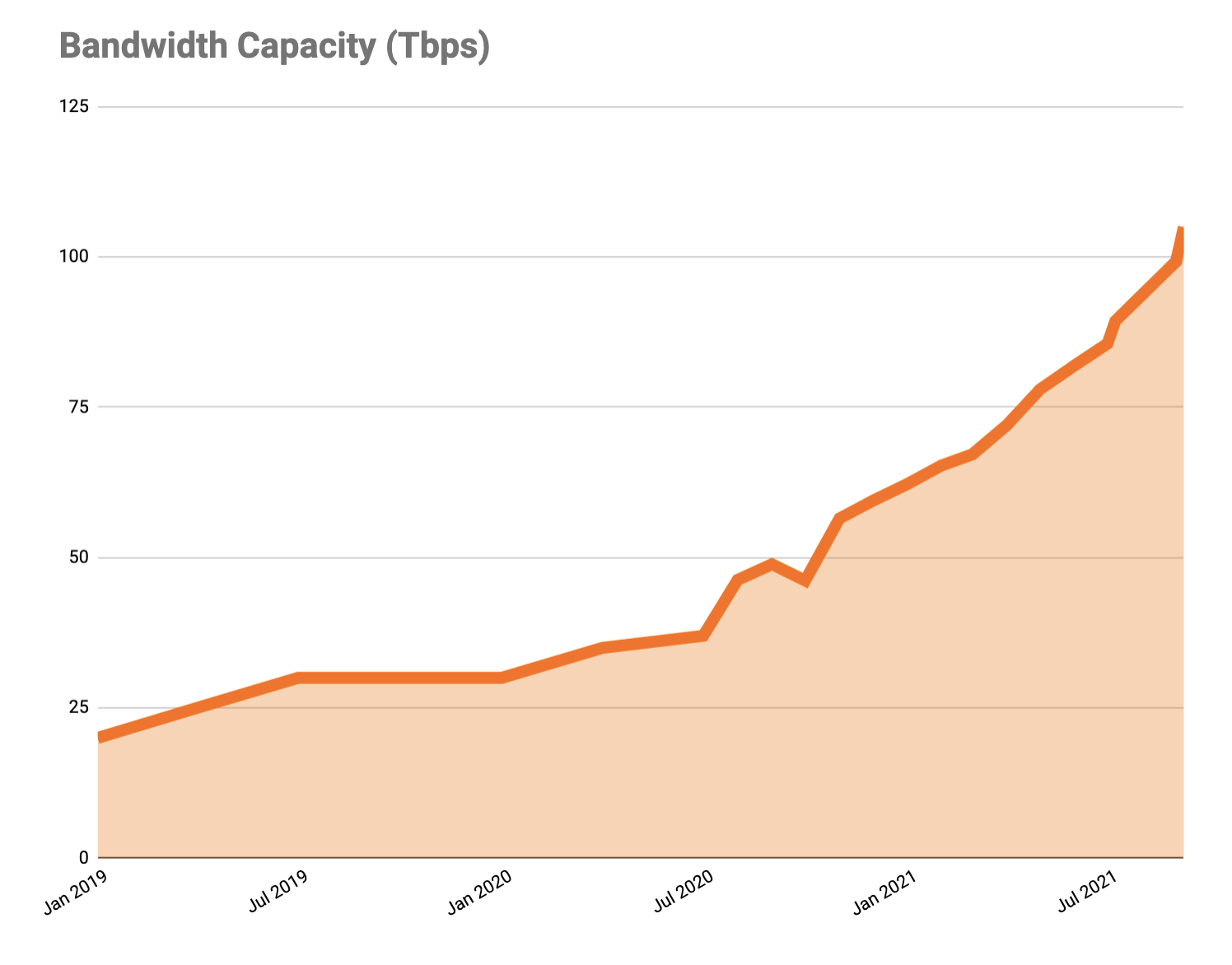
This interconnection is spread far and wide, both to user networks and those of website hosts and other major cloud networks. This has involved a lot of middleman-removal: rather than run fiber optics from our routers through a third-party network to an origin or user’s network, we’re running more and more Private Network Interconnects (PNIs) and, better yet, Cloudflare Network Interconnects (CNIs) to our customers.
These PNIs and CNIs can not only reduce egress costs for our customers (particularly with our Bandwidth Alliance partners) but also increase the speed, reliability, and privacy of connections. The fewer networks and less distance your Internet traffic flows through, the better off everyone is. To put some numbers on that, only 30% of this newly doubled capacity was transit, leaving 70% flowing directly either physically over PNIs/CNIs or logically over peering sessions at Internet exchange points.
The Backbone
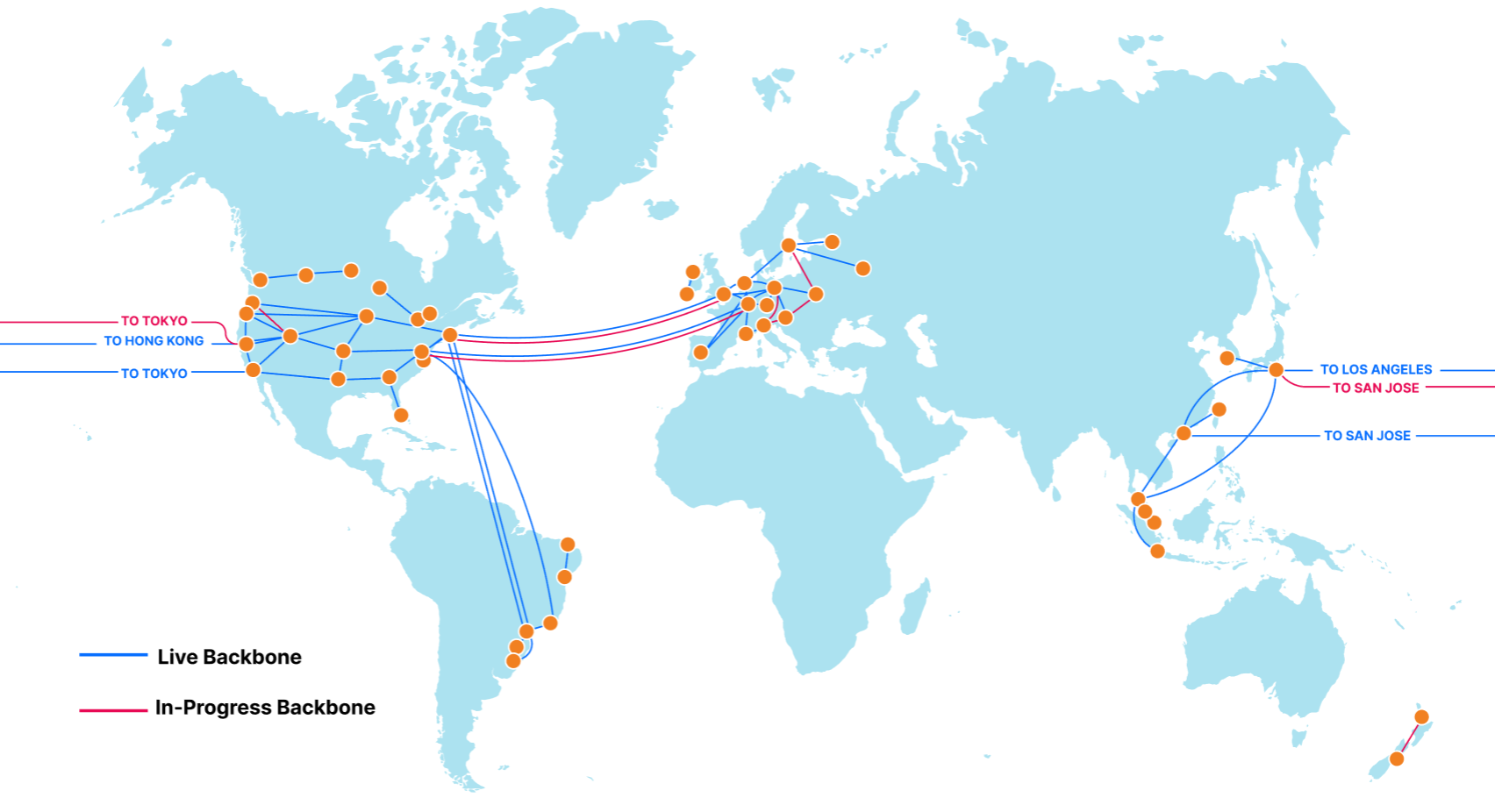
At the same time as this increase in external capacity, we’ve quietly been adding hundreds of new segments to our backbone. Our backbone consists of dedicated fiber optic lines and reserved portions of wavelength that connect Cloudflare data centers together. This is split approximately 55/45 between “metro” capacity, which redundantly connects data centers in which we have a presence, and “long-haul” capacity, which connects Cloudflare data centers in different cities.
The backbone is used to increase the speed of our customer traffic, e.g., for Argo Smart Routing, Argo Tiered Caching, and WARP+. Our backbone is like a private highway connecting cities, while public Internet routing is like local roads: not only does the backbone directly connect two cities, but it’s reliably faster and sees fewer issues. We’ll dive into some benchmarks of the speed improvements of the backbone in a more comprehensive future blog post.
The backbone is also more secure. While Cloudflare signs all of its BGP routes with RPKI, pushes adjacent networks to use RPKI to avoid route hijacks, and encrypts external and internal traffic, the most secure and private way to safeguard our users’ traffic is to keep it on-network as much as possible.
Internal load balancing between cities has also been greatly improved, thanks to the use of the backbone for traffic management with a technology we call Plurimog (a reference to our in-colo Layer 4 load balancer, Unimog). A surge of traffic into Portland can be shifted instantaneously over diverse links to Seattle, Denver, or San Jose with a single hop, without waiting for changes to propagate over anycast or running the risk of an interim increase in errors.
From an expansion perspective, two key areas of focus have been our undersea North America to Europe (transatlantic) and Asia to North America (transpacific) backbone rings. These links use geographically diverse subsea cable systems and connect into diverse routers and data centers on both ends — four transatlantic cables from North America to Europe, three transamerican cables connecting South and North America, and three transpacific cables connecting Asia and North America. User traffic coming from Los Angeles could travel to an origin as west as Singapore or as east as Moscow without leaving our network.
This rate of growth has been enabled by improved traffic forecast modeling, rapid internal feedback loops on link utilization, and more broadly by growing our teams and partnerships. We are creating a global view of capacity, pricing, and desirability of backbone links in the same way that we have for transit and peering. The result is a backbone that doubled in long-haul capacity this year, increased more than 800% from the start of last year, and will continue to expand to intelligently crisscross the globe.
The backbone has taken on a huge amount of traffic that would otherwise go over external transit and peering connections, freeing up capacity for when it is explicitly needed (last-hop routes, failover, etc.) and avoiding any outages on other major global networks (e.g., CenturyLink, Verizon).
In Conclusion
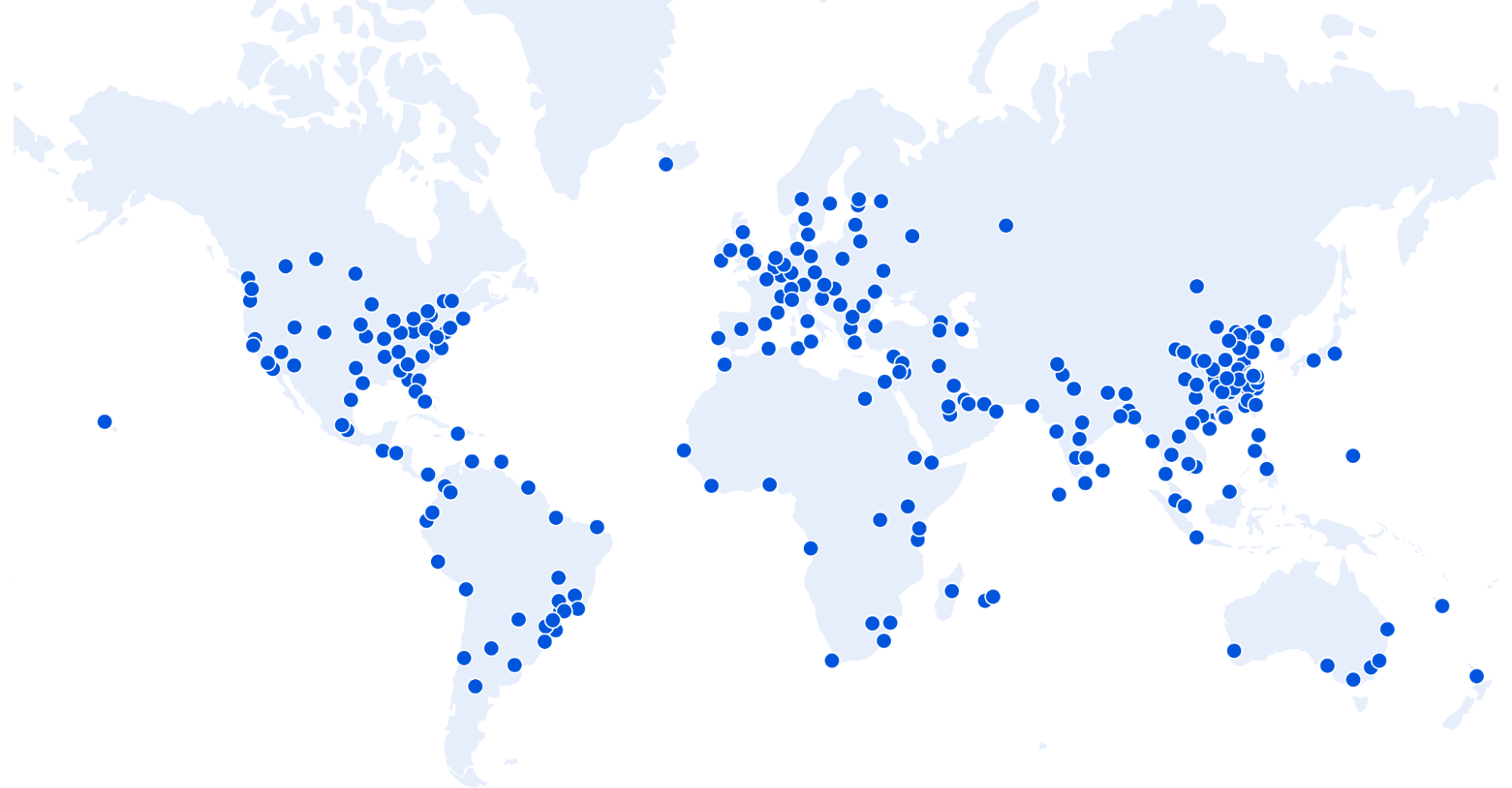
More cities, capacity, and backbone are more steps as part of going from being the most global network on Earth to the most local one as well. We believe in providing security, privacy, and reliability for all — not just those who have the money to pay for something we consider fundamental Internet rights. We have seen the investment into our network pay huge dividends this past year.
Happy Speed Week!
Do you want to work on the future of a globally local network? Are you passionate about edge networks? Do you thrive in an exciting, rapid-growth environment? If so, good news: Cloudflare Infrastructure is hiring; check our open roles here!
Alternatively — if you work at an ISP we aren’t already deployed with and want to bring this level of speed and control to your users, we’re here to make that happen. Please reach out to our Edge Partnerships team at [email protected].