All posts by Narendra Kumar

How Razorpay Built Real-Time Anomaly Detection with Amazon MSK

Post Syndicated from Narendra Kumar original https://aws.amazon.com/blogs/big-data/how-razorpay-built-real-time-anomaly-detection-with-amazon-msk/

When you process over 500 million transactions per month, every second of undetected anomaly means failed payments, lost revenue, and eroded merchant trust. Static monitoring thresholds that worked for thousands of merchants collapse at the scale of millions, and the cost of missed detection compounds exponentially.

In this post, we explore Razorpay’s anomaly detection and alerting platform (ADA) architecture using Amazon Managed Streaming for Apache Kafka (Amazon MSK) and other AWS services. According to Razorpay the system detects transaction anomalies in under 30 seconds, supports thousands of merchant-level alerts, and reduced monitoring costs by approximately 80 percent. The platform maintains 99.99 percent uptime for over 500 million transactions per month.

Founded in 2014, Razorpay has become one of India’s largest full-stack financial solutions companies, powering payments, banking, and business growth for over 10 million businesses. With offerings spanning payment gateway, RazorpayX for business banking, and Razorpay Capital for lending, the company processes over 500 million transactions per month across payments, payroll, banking, and cross-border services.

At this scale, Razorpay’s data platform processes more than 5 billion events daily. Every transaction, settlement, and disbursement generates events that must be monitored in real time for anomalies. These range from systemic degradations and latency regressions to card-testing fraud attacks and velocity abuse at the merchant level.

For a regulated payments platform, undetected anomalies carry consequences far beyond technical metrics. A missed fraud pattern can mean direct financial losses running into millions of rupees. It can also bring regulatory scrutiny from the Reserve Bank of India and irreversible damage to merchant confidence, the foundation of Razorpay’s business. Razorpay needed real-time anomaly detection, but the existing infrastructure couldn’t keep pace with the company’s growth.

The problem: When static thresholds can’t keep up with scale

As Razorpay scaled from thousands to millions of merchants, the existing monitoring infrastructure hit critical limitations across four dimensions.

Anomaly blind spots

Systemic degradations, latency regressions, and success-rate drops went undetected until customers complained. By the time a human operator noticed a 15 percent drop in payment success rates for a specific gateway-merchant combination, thousands of transactions had already failed.

Fraud at velocity

Card-testing activity, velocity abuse, and geo-anomalies at the merchant level required sub-minute detection. Unauthorized users could generate hundreds of micro-transactions in seconds. Traditional batch detection was too slow to prevent damage.

Static thresholds don’t scale

The existing tooling relied on static thresholds with no adaptive baselines. This created a painful dilemma: set thresholds too tight and drown in false alarms (alert fatigue), or set them too loose and miss real incidents.

High cardinality equals high cost

Monitoring thousands of merchants individually on the previous architecture cost approximately $500K per year: $250K in licensing fees plus $250K in infrastructure, with fundamental scalability limits. ThirdEye queried a 21-day lookback at query time, enforcing a 1–2 minute service level agreement (SLA) minimum. The system was not designed for thousands of concurrent merchant-level alerts, a limitation confirmed by the vendor.

Solution overview: ADA: Anomaly detection and alerting

Razorpay built ADA (Anomaly Detection and Alerting), a configurable, multi-tenant engine for real-time anomaly detection and fraud prevention. The platform’s design centers on three core principles that address the limitations of the previous architecture.

First, ADA is declarative: users express what to detect, not how. A single domain-specific language (AdaDSL) drives both batch and streaming execution, eliminating the need for engineers to write custom detection code for each new alert. Second, ADA is adaptive. Dynamic baselines incorporate calendar-aware patterns (day-of-week, time-of-day, holiday adjustments) and machine learning (ML)-compatible thresholds that replace brittle static rules. Third, ADA is inherently multi-tenant: Payments, Payroll, and Banking each operate with isolated detection logic while sharing underlying infrastructure. This design removes the need to maintain separate monitoring stacks per business unit.

Amazon MSK serves as the event backbone of ADA, ingesting transaction events, distributing detection rules, and connecting the components of the real-time pipeline.
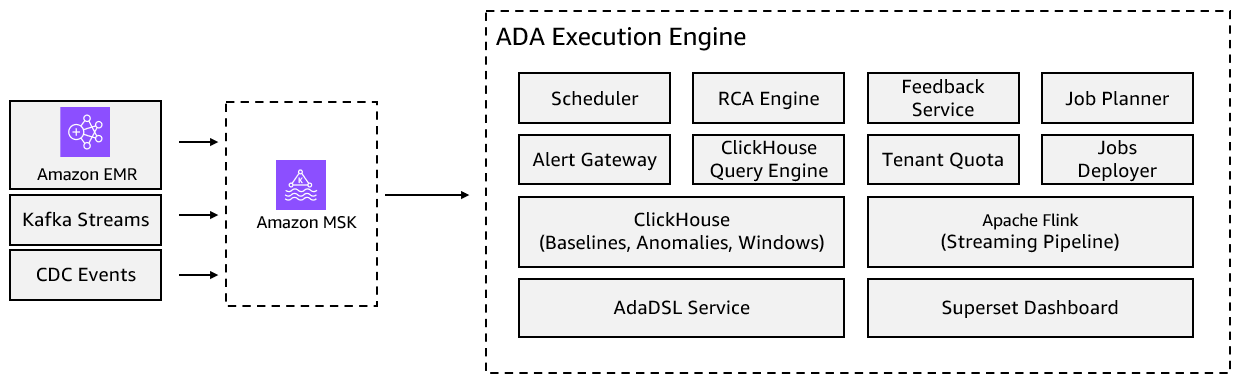
ADA architecture with Amazon MSK as the event backbone connecting event producers, Apache Flink stream processing, ClickHouse baselines, and alert consumers

Architecture: Amazon MSK as the streaming backbone

The ADA architecture positions Amazon MSK as the core integration layer connecting event producers to detection engines and alert consumers. Payment authorization, settlement, and disbursement events flow through Kafka topics managed by Amazon MSK. With Razorpay processing over 500 million transactions per month and 5 billion events daily, the ingestion layer must absorb high throughput with zero data loss.

High-throughput event ingestion

The architecture uses tenant-partitioned topics. Each business unit (Payments, Payroll, Banking) publishes to logically isolated topics while sharing physical infrastructure. This design supports independent consumer groups per tenant with predictable throughput guarantees.

Change Data Capture (CDC) events from Razorpay’s core transactional databases (Amazon Aurora MySQL-Compatible Edition) flow through Debezium and a Kafka Streams-based Harvester service into Amazon MSK. Application events from payment services also publish directly to Amazon MSK topics via native Kafka producers.

Why Amazon MSK as the backbone

Amazon MSK serves as the architectural backbone of ADA, fulfilling four critical functions that together support reliable, real-time anomaly detection at scale. At the ingestion layer, Amazon MSK absorbs the full stream of transaction events with three-replica durability. If downstream consumers experience an outage, they resume from their last committed offset without data loss. Beyond ingestion, Amazon MSK is the event distribution backbone of detection rules. AdaDSL definitions authored by domain experts are serialized and published to a dedicated Kafka snapshot topic, which Flink jobs consume as a broadcast stream.

This delivers hot-reloadable rule updates without pipeline restarts, a critical capability when detection logic must evolve daily. Amazon MSK further supports tenant isolation at the topic level. Payments, Payroll, and Banking events flow through isolated topic partitions that support independent scaling and consumer group management per business unit. Finally, Amazon MSK fully decouples event producers from detection consumers, meaning new detection logic can be deployed, scaled, or rolled back without touching production payment flows.

Apache Flink acts as the stateful stream processing engine between Amazon MSK and the detection/alerting layer. The Flink pipeline implements five key stages:

  1. Kafka Source (tenant-partitioned topics) – Consumes events from Amazon MSK with exactly-once semantics using Flink’s Kafka connector.
  2. Event-Time Assignment + Watermarking – Assigns event timestamps and generates watermarks with a late-arrival tolerance of 2× the window size.
  3. KeyBy (tenant_id, entity_key) + Windowed Aggregation – Partitions the stream by tenant and merchant, then computes windowed aggregates (success rates, latencies, transaction volumes).
  4. Async I/O – Baseline Fetch from ClickHouse. Non-blocking lookups against pre-computed baselines stored in ClickHouse, supporting 1,024 concurrent requests.
  5. Rule Evaluation (threshold / ML / CEP) – Evaluates AdaDSL rules against the enriched stream. This includes Complex Event Processing (CEP) patterns for sequence detection (for example, five consecutive declines followed by a success, a signature of card-testing fraud).

The pipeline outputs to three sinks:

  • anomalies_fct to ClickHouse for anomaly persistence and historical analysis.
  • Alert Gateway to Slack/PagerDuty for immediate notification.
  • windows_fct for reconciliation against batch baselines.

AdaDSL: Declarative detection at scale

AdaDSL abstracts detection logic into human-readable declarations that platform engineers and domain experts can author without understanding the underlying execution mechanics. A single definition compiles to both a ClickHouse Materialized View selector and a Flink CEP pattern, supporting consistent detection semantics across batch and streaming modes.

AdaDSL updates are distributed via the Amazon MSK snapshot topic. When an engineer modifies a rule, it’s serialized to Kafka and consumed by Flink as a broadcast state update. The change propagates to all running pipeline instances without redeployment. This is an important architectural advantage: the detection logic evolves independently of the infrastructure.

Reliability and fault tolerance

The architecture delivers 99.99 percent availability through multiple layers of resilience:

  • Amazon MSK is deployed across three Availability Zones with replication.factor=3 and min.insync.replicas=2, paired with producer-side acks=all. No single broker failure causes data loss or ingestion interruption, because the durability guarantee depends on all three settings working together. Combined with configurable retention policies, Amazon MSK provides a meaningful replay window for consumer recovery.
  • Flink checkpointing to Amazon Simple Storage Service (Amazon S3) provides exactly-once processing semantics. If a Flink task fails, the job manager restores from the latest checkpoint and resumes processing from the corresponding Kafka offsets. No events are lost or duplicated.
  • Idempotent sinks: Dedupe keys (tenant:AdaDSL:version:entity:window_start) prevent reprocessed events from creating duplicate anomaly records or alerts.
  • Event-time watermarks: 2× window tolerance handles late-arriving events gracefully, supporting detection accuracy even under network delays.

Results and business impact

The migration from Pinot + ThirdEye to ADA on Amazon MSK and Apache Flink delivered measurable improvements. The platform achieved approximately 80 percent cost reduction compared to the previous architecture while maintaining a 99.99 percent uptime SLA. Anomaly detection latency in streaming mode is under 30 seconds, and the system processes over 5 billion events daily. It supports thousands of concurrent merchant-level alerts with full multi-tenant isolation across Payments, Payroll, and Banking.

Operational improvements

The ADA platform delivered significant operational improvements across detection accuracy, speed, and team autonomy:

  • Alert fatigue removed – Adaptive baselines with calendar-aware patterns (day-of-week, time-of-day, holiday adjustments) reduced false positives by over 90 percent compared to static thresholds.
  • Mean time to detection reduced from minutes to seconds – Sub-30-second streaming detection replaced batch detection cycles that previously required 1–2 minutes minimum.
  • Self-service detection – Domain experts in Payments, Payroll, and Banking teams author their own AdaDSL rules without requiring platform engineering involvement.
  • Unified platform – One system for anomaly detection, fraud detection, alert routing, and reconciliation across all business units.

Key learnings and best practices

Throughout the design and implementation of ADA, Razorpay identified several architectural principles that proved essential at scale:

1. Separate rule definition from execution

A declarative DSL lets domain experts define detection logic while the platform decides batch or streaming execution. This separation allowed Razorpay to scale the number of active detection rules from dozens to thousands without proportional engineering effort.

2. Use Amazon MSK as the unifying backbone

Kafka’s publish-subscribe model naturally decouples event producers from detection consumers. Beyond basic event transport, Amazon MSK serves as the distribution mechanism for rule updates (broadcast state), tenant isolation (topic partitioning), and fault tolerance (offset-based replay). Investing in the streaming backbone early benefited every subsequent design choice.

Flink excels at sub-minute, stateful detection. ClickHouse excels at deterministic baseline computation and historical context. Rather than forcing one engine to do both, the hybrid architecture plays to each engine’s strengths.

4. Design for multi-tenancy from day one

Shared infrastructure with tenant isolation (row-level security in ClickHouse, scoped topics in Amazon MSK, tenant-partitioned Flink pipelines) keeps operational costs low while serving multiple business units with independent SLAs.

5. Build for extensibility

A plugin-compatible architecture allows ML models (ETS/Prophet for forecasting), CEP patterns (Flink CEP for sequence detection), and custom root cause analysis (RCA) strategies to be added without platform-level changes. Razorpay’s roadmap includes large language model (LLM)-assisted RCA and autonomous AdaDSL generation.

Conclusion

Razorpay transformed its anomaly detection from static-threshold monitoring on Pinot + ThirdEye to an adaptive, real-time system on Amazon MSK and Apache Flink.

This reflects a pattern increasingly common among high-scale FinTech platforms: a reliable, high-throughput streaming layer is not an optimization. It’s a prerequisite for operating payment infrastructure at scale.

Amazon MSK forms the backbone that allows Razorpay to ingest 5 billion events daily and distribute detection rules in real time. It also isolates multiple business units on shared infrastructure and provides exactly-once processing guarantees for financial transaction monitoring. Apache Flink transforms those raw event streams into sub-30-second anomaly detection with CEP-based fraud pattern matching.

For platform engineers building real-time monitoring for financial services, the takeaway is clear. Invest in the streaming backbone early, design for declarative extensibility, and let managed services absorb the operational complexity of distributed stream processing.

If you’re building real-time monitoring for a high-throughput transactional system, start by evaluating your current architecture against the four limitations described in this post. These are anomaly blind spots, detection latency for fraud, static threshold scalability, and cost at high cardinality. From there, consider whether a declarative detection layer (separating rule definition from execution) could accelerate your team’s ability to ship new alerts without infrastructure changes. For a hands-on starting point, explore the Amazon MSK Labs workshop.

To learn more about Amazon MSK, visit the documentation.

About the authors

Narendra Kumar

Narendra Kumar

Narendra is a senior data platform and engineering leader with deep experience in building and operating large-scale data platforms for high-growth FinTech and SaaS organizations. He has worked across the full data lifecycle, including real-time data ingestion, modern lakehouse architectures, analytics platforms, and ML-ready data systems, with a strong focus on reliability, scalability, and cost efficiency.

Masudur Rahaman Sayem

Masudur Rahaman Sayem

Sayem is a Streaming Data Architect at AWS with over 25 years of experience in the IT industry. He collaborates with AWS customers worldwide to architect and implement data streaming solutions that address complex business challenges. As an expert in distributed computing, Sayem specializes in designing large-scale distributed systems architecture for maximum performance and scalability. He has a keen interest and passion for distributed architecture, which he applies to designing production-ready solutions at internet scale.

Sundar Sankaranarayanan

Sundar Sankaranarayanan

Sundar is a Data & Analytics Specialist at AWS with over 20 years of experience in the IT industry. He collaborates with AWS customers across India to architect and implement modern data analytics and Generative AI solutions. As an expert in data lakehouse architectures and cloud-native analytics, Sundar specializes in designing scalable real-time and batch data platforms that unlock business value at enterprise scale. He has a keen interest and passion for the convergence of data and AI, which he applies to helping organizations accelerate their cloud and AI journeys.

How Razorpay achieved 11% performance improvement and 21% cost reduction with Amazon EMR

Post Syndicated from Narendra Kumar original https://aws.amazon.com/blogs/big-data/how-razorpay-achieved-11-performance-improvement-and-21-cost-reduction-with-amazon-emr/

This is a guest post by Narendra Kumar, Head of Platform – Data at Razorpay, in partnership with AWS.

In this post, we explore how Razorpay, India’s leading FinTech company, transformed their data platform by migrating from a third-party solution to Amazon EMR, unlocking improved performance and significant cost savings. We’ll walk through the architectural decisions that guided this migration, the implementation strategy, and the measurable benefits Razorpay achieved.

Founded in 2014, Razorpay has become a powerhouse in comprehensive payment solutions, enabling businesses to accept, process, and disburse payments online. With offerings like RazorpayX for business banking and Razorpay Capital for lending solutions, the company has experienced explosive growth, now serving millions of businesses. This rapid expansion brought significant data challenges. When Razorpay’s data platform began straining under the weight of more than 1PB daily processing demands, the engineering team faced a critical decision: continue scaling their existing third-party solution or modernize with a platform offering greater flexibility and control. They chose Amazon EMR to build a comprehensive data architecture spanning batch warehousing, real-time stream processing, and interactive analytics – all running on Apache Spark with open-source Delta Lake for ACID transactions. This wasn’t simply an ETL migration; it was a complete platform transformation that gave Razorpay’s 800 daily users access to more than 60 concurrent streaming pipelines, more than 3,000 orchestrated workflows, and the ability to query 6PB of data daily. The results validated their architectural choices: 11% better overall performance, 21% cost reduction, and the operational flexibility to optimize Spark resource allocation, leverage EC2 Spot instances, and implement advanced features like liquid clustering – all without vendor lock-in.

Achieving data insights cost-effectively with AWS

The data architecture has a data ingestion layer, data processing layer, and data consumption layer. Razorpay ingests more than 20 TB of new data every day, processes more than 1 PB of daily data using more than 60 data stream processing pipelines. This data is then consumed by querying more than 6 PB of daily data through more than 3,000 scheduled workflows.

Data flows from a variety of sources such as online transaction processing (OLTP) databases – traditional transactional or entity stores, events such as clickstream and application events, and third-party events like reverse extract, transform, and load (ETL). Most of the data consumption use cases power merchant reporting and internal analytics of the organization. The architecture powers a variety of data science use cases and financial infrastructure around a reconciliation service.

Solution overview

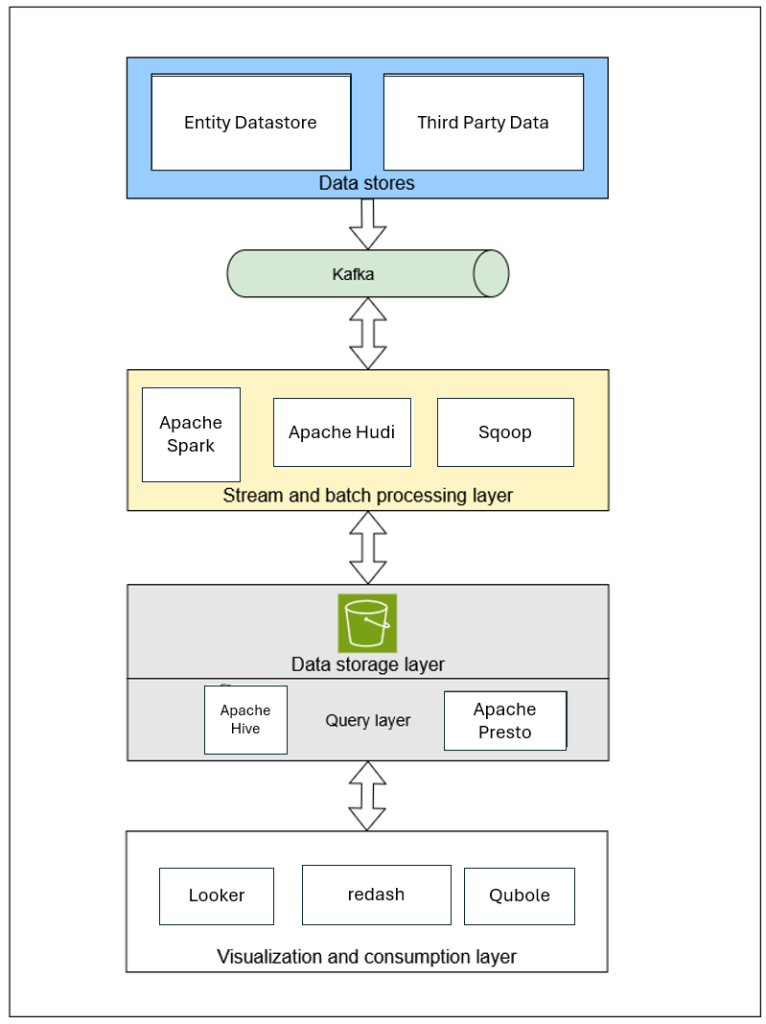
As shown in the following diagram, in its early stages, Razorpay operated on a small scale, using Sqoop to dump transactional data daily into a data lake and managing a Presto layer for querying this data. As they grew, the demand for near real-time data increased, prompting the setup of a change data capture (CDC) collector using Maxwell to stream data manipulation language (DML) events to Kafka. To further enhance data processing, Razorpay built a processing layer that consumed data from Kafka to UPSERT information into the lake using Apache Hudi.

Architecture diagram showing a five-layer big data processing pipeline: data stores feed into Kafka for message streaming, which connects to Apache Spark, Apache Hudi, and Sqoop for stream and batch processing, followed by a data storage and query layer using Apache Hive and Apache Presto, and finally a visualization layer with Looker, redash, and Qubole.

Additionally, the company onboarded data from third-party sources such as Freshdesk and Google Sheets and automated event ingestion from frontend applications using Lumberjack, thereby streamlining their data management processes.

As Razorpay scaled its operations, the demand for multiple real-time use cases became mission-critical, prompting the development of a robust data warehouse ingestion framework to efficiently ingest data into TiDB. To enhance service reliability and support dashboard querying, a low-latency, high-throughput service called Harvester was created, which stored pre-aggregated data for effective monitoring. Over time, reporting use cases emerged, leading to the use of a warehouse service to establish a denormalized report data layer while also exploring a real-time layer for dynamic insights. Additionally, to facilitate a smooth transition to microservices, Razorpay built a unified storage layer capable of supporting data from both its existing monolithic architecture and the new microservices, ensuring seamless integration and improved data accessibility across the organization.

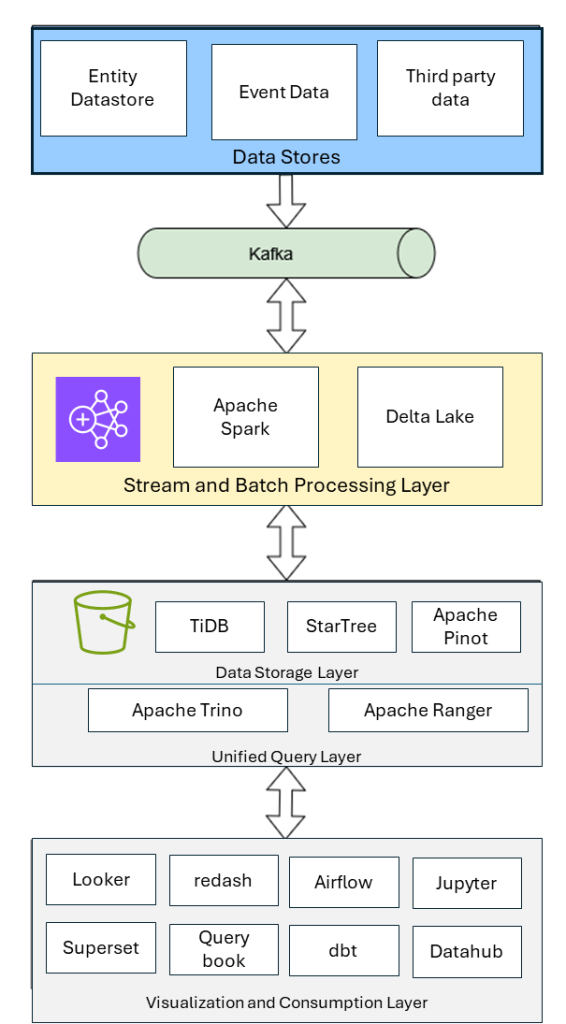
Razorpay implemented a comprehensive data service migration to Amazon EMR using a phased approach. The solution architecture as shown in the following diagram comprises multiple layers handling data ingestion, processing, and consumption.

Technical implementation

A modern and scalable analytics platform focuses on real-time data ingestion, petabyte-scale processing, and cost-optimized storage – all orchestrated with robust workflow management:

Data ingestion layer

To handle large-scale and diverse data sources, they implemented a combination of CDC and file ingestion patterns:

  • CDC using Amazon Aurora MySQL-Compatible Edition – Used Debezium and Maxwell for low-latency replication and streaming of database changes
  • High-volume streaming pipelines – Configured streaming pipelines capable of processing more than 20 TB of daily inbound data
  • Third-party data integration: Implemented secure file push mechanisms to ingest partner and software as a service (SaaS) data into the service

Data processing layer

Razorpay designed the processing stack on Amazon EMR on Amazon Elastic Compute Cloud (Amazon EC2) with Spark as the primary compute engine

  • Batch warehousing – Daily ETL and aggregation jobs processing more than 1 PB of data
  • Stream processing – Real-time analytics pipelines across more than 60 concurrent processing streams
  • Delta merge operations – High-performance incremental updates across more than 25 Delta Lake tables

Data storage and organization

Their data storage follows the medallion architecture pattern layered on an Amazon Simple Storage Service (Amazon S3):

  • Raw zone – Immutable ingestion zone for original source data
  • Processed and aggregated zone – Optimized datasets ready for analytics and reporting
  • Open source software (OSS) Delta Lake format – Implemented open source Delta Lake for ACID transactions, schema enforcement, and faster query performance

Workflow orchestration

Complex data workflows are automated and monitored using a hybrid orchestration approach:

  • Apache Airflow integration – Scheduling and coordinating more than 3,000 workflows per day
  • dbt on Amazon EMR – SQL-based transformations for business logic and metric definitions
  • Specialized compliance jobs – Dedicated workflows meeting the 15-minute SLA for sensitive regulatory reporting

Performance optimizations

To ensure cost efficiency and high throughput, the following optimizations were applied:

  • Spark tuning – Custom configurations for executor memory, shuffle partitions, and serialization to maximize hardware utilization
  • Liquid clustering – Implemented in delta lake tables to improve query performance over large datasets
  • Optimized delta merges – Reduced merge latency for incremental updates.
  • Auto scaling – Dynamic scaling policies based on workload patterns to balance performance and cost

To enable a secure migration, they implemented Amazon EMR security best practices following AWS guidance on encryption, authentication, and authorization as documented in the Amazon EMR security best practices.

This architecture delivers low-latency ingestion, petabyte-scale processing, and robust workflow orchestration so that analytics teams can derive faster insights while maintaining compliance and optimizing for cost.

The combination of Debezium and Maxwell for CDC, Spark on Amazon EMR, OSS Delta Lake on Amazon S3, and Airflow with dbt has proven to be a scalable and resilient approach for modern data analytics workloads

Business Impact: What Amazon EMR Enabled

  • 11% performance improvement enabling faster insights for 800 daily active users
  • 13-15% faster execution for large warehouse jobs, accelerating time-to-insight for critical business decisions
  • 21% cost reduction reinvested into product innovation for merchant customers
  • Seamless scaling from 20 TB to 1 PB+ daily processing without performance degradation
  • Enterprise reliability supporting 350,000 operational reports and compliance requirements

Key learnings and best practices

Throughout their migration to Amazon EMR, Razorpay learned valuable lessons that helped optimize their data platform. We are sharing these insights to help other customers accelerate their own modernization journeys while avoiding common pitfalls.

Infrastructure Stability and Performance

  • Optimizing Spark Resource Allocation – Razorpay initially assumed that Spark’s dynamic allocation would automatically optimize resource utilization. However, they discovered it introduced overhead that degraded performance for certain workload patterns. To address this challenge, they took two approaches depending on workload characteristics – setting explicit maxExecutors values for predictable workloads, and enabling maximizeResourceAllocation to create “fat executors” that fully utilized available cluster resources. These targeted configurations improved job execution times by 13-15% for large-scale data processing workloads.
  • Ensuring Stability with Yet Another Resource Negotiator (YARN) node labels – When using EC2 Spot instances for cost optimization, Razorpay encountered a critical issue in which Spot instance interruptions occasionally terminated nodes running critical driver containers, causing entire job failures. Their solution was elegant and effective. They configured YARN node labels to ensure driver containers always spawn on On-Demand Instances, while task nodes use cost-effective Spot capacity. This architecture delivered both cost efficiency and reliability, making their jobs resilient to Spot interruptions while maintaining 21% cost savings.
  • Managing Spot Instances Effectively – Razorpay’s initial approach of switching entirely to On-Demand Instances during Spot availability constraints eliminated the cost benefits they were seeking. They implemented several best practices to address this such as using instance fleets with allocation strategies (price-capacity optimized and capacity optimized) to maximize Spot availability, spreading primary instances across multiple Availability Zones for fault tolerance, and accepting that heterogeneous executors create varying executor sizes while planning capacity accordingly. They maintained high Spot utilization rates while ensuring workload continuity, achieving optimal price performance.

Cost Optimization

  • Achieving Sustainable Cost Efficiency – As data volumes grew to more than 20 TB daily, Razorpay needed to scale infrastructure while controlling costs. They implemented a comprehensive cost optimization strategy that included multiple components. First, they right-sized primary nodes by avoiding over-provisioning and selecting instance types matching actual workload requirements. They consolidated workloads by combining multiple jobs on fewer large clusters to maximize resource utilization. For SLA-sensitive jobs, they migrated to Amazon EKS and Amazon EMR Serverless for automatic scaling and pay-per-use pricing. They adopted Graviton instances, migrating compatible workloads to AWS Graviton processors for superior price-performance. Finally, they diversified instance fleets by employing multiple instance types to reduce Spot interruption impact.

These optimizations delivered 21% cost savings while supporting 800 daily active users and processing 1 PB of data daily. This enabled Razorpay to invest savings back into product innovation for their merchant customers, demonstrating how technical optimization directly translates to business value.

Conclusion

Razorpay’s migration to Amazon EMR demonstrates how the right data processing platform can transform business outcomes at scale. By achieving 11% better performance, 13-15% faster execution times, and 21% cost savings, EMR enabled Razorpay to build an enterprise-grade data platform that supports 800 daily users, more than 3,000 dashboards, and 10 million monthly queries.

To learn more about building similar data analytics solutions on AWS, check out the following resources.

Documentation:

AWS solutions:

Get started:


About the authors

Narendra Kumar

Narendra Kumar

Narendra is a senior data platform and engineering leader with deep experience in building and operating large-scale data platforms for high-growth FinTech and SaaS organizations. He has worked across the full data lifecycle, including real-time data ingestion, modern lakehouse architectures, analytics platforms, and ML-ready data systems, with a strong focus on reliability, scalability, and cost efficiency.

Ravi Kompella

Ravi Kompella

Ravi is a principal analytics specialist with experience in driving adoption of modern data architectures, enterprise data lakehouses, and real-time data systems across multiple industry verticals in India including startups and SaaS providers.

Shreshtha Dutta

Shreshtha Dutta

Shreshtha is a business and IT transformation leader with deep experience in large-scale cloud migrations, data platforms, and AI-driven innovation. She has led complex Amazon EMR programs, helping enterprises modernize analytics, optimize costs, and realize measurable business value through pragmatic, execution-focused strategies.