Tag Archives: bgp

Hypotheses About What Happened to Facebook

Post Syndicated from Bozho original https://techblog.bozho.net/hypotheses-about-what-happened-to-facebook/

Facebook was down. I’d recommend reading Cloudflare’s summary. Then I recommend reading Facebook’s own account on the incident. But let me expand on that. Facebook published announcements and withdrawals for certain BGP prefixes which lead to removing its DNS servers from “the map of the internet” – they told everyone “the part of our network where our DNS servers are doesn’t exist”. That was the result of a backbone self-inflicted failure due to a bug in the auditing tool that checks whether the commands executed aren’t doing harmful things.

Facebook owns a lot of IPs. According to RIPEstat they are part of 399 prefixes (147 of them are IPv4). The DNS servers are located in two of those 399. Facebook uses a.ns.facebook.com, b.ns.facebook.com, c.ns.facebook.com and d.ns.facebook.com, which get queries whenever someone wants to know the IPs of Facebook-owned domains. These four nameservers are served by the same Autonomous System from just two prefixes – 129.134.30.0/23 and 185.89.218.0/23. Of course “4 nameservers” is a logical construct, there are probably many actual servers behind that (using anycast).

I wrote a simple “script” to fetch all the withdrawals and announcements for all Facebook-owned prefixes (from the great API of RIPEstats). Facebook didn’t remove itself from the map entirely. As CloudFlare points out, it was just some prefixes that are affected. It can be just these two, or a few others as well, but it seems that just a handful were affected. If we sort the resulting CSV from the above script by withdrawals, we’ll notice that 129.134.30.0/23 and 185.89.218.0/23 are the pretty high up (alongside 185.89 and 123.134 with a /24, which are all included in the /23). Now that perfectly matches Facebook’s account that their nameservers automatically withdraw themselves if they fail to connect to other parts of the infrastructure. Everything may have also been down, but the logic for withdrawal is present only in the networks that have nameservers in them.

So first, let me make three general observations that are not as obvious and as universal as they may sound, but they are worth discussing:

  • Use longer DNS TTLs if possible – if Facebook had 6 hour TTL on its domains, we may have not figured out that their name servers are down. This is hard to ask for such a complex service that uses DNS for load-balancing and geographical distribution, but it’s worth considering. Also, if they killed their backbone and their entire infrastructure was down anyway, the DNS TTL would not have solved the issue. But
  • We need improved caching logic for DNS. It can’t be just “present or not”; DNS caches may keep “last known good state” in case of SERVFAIL and fallback to that. All of those DNS resolvers that had to ask the authoritative nameserver “where can I find facebook.com” knew where to find facebook.com just a minute ago. Then they got a failure and suddenly they are wondering “oh, where could Facebook be?”. It’s not that simple, of course, but such cache improvement is worth considering. And again, if their entire infrastructure was down, this would not have helped.
  • Consider having an authoritative nameserver outside your main AS. If something bad happens to your AS routes (regardless of the reason), you may still have DNS working. That may have downsides – generally, it will be hard to manage and sync your DNS infrastructure. But at least having a spare set of nameservers and the option to quickly point glue records there is worth considering. It would not have saved Facebook in this case, as again, they claim the entire infrastructure was inaccessible due to a “broken” backbone.
  • Have a 100% test coverage on critical tools, such as the auditing tool that had a bug. 100% test coverage is rarely achievable in any project, but in such critical tools it’s a must.

The main explanation is the accidental outage. This is what Facebook engineers explain in the blogpost and other accounts, and that’s what seems to have happened. However, there are alternative hypotheses floating around, so let me briefly discuss all of the options.

  • Accidental outage due to misconfiguration – a very likely scenario. These things may happen to everyone and Facebook is known for it “break things” mentality, so it’s not unlikely that they just didn’t have the right safeguards in place and that someone ran a buggy update. The scenarios why and how that may have happened are many, and we can’t know from the outside (even after Facebook’s brief description). This remains the primary explanation, following my favorite Hanlon’s razor. A bug in the audit tool is absolutely realistic (btw, I’d love Facebook to publish their internal tools).
  • Cyber attack – It cannot be known by the data we have, but this would be a sophisticated attack that gained access to their BGP administration interface, which I would assume is properly protected. Not impossible, but a 6-hour outage of a social network is not something a sophisticated actor (e.g. a nation state) would invest resources in. We can’t rule it out, as this might be “just a drill” for something bigger to follow. If I were an attacker that wanted to take Facebook down, I’d try to kill their DNS servers, or indeed, “de-route” them. If we didn’t know that Facebook lets its DNS servers cut themselves from the network in case of failures, the fact that so few prefixes were updated might be in indicator of targeted attack, but this seems less and less likely.
  • Deliberate self-sabotage1.5 billion records are claimed to be leaked yesterday. At the same time, a Facebook whistleblower is testifying in the US congress. Both of these news are potentially damaging to Facebook reputation and shares. If they wanted to drown the news and the respective share price plunge in a technical story that few people understand but everyone is talking about (and then have their share price rebound, because technical issues happen to everyone), then that’s the way to do it – just as a malicious actor would do, but without all the hassle to gain access from outside – de-route the prefixes for the DNS servers and you have a “perfect” outage. These coincidences have lead people to assume such a plot, but from the observed outage and the explanation given by Facebook on why the DNS prefixes have been automatically withdrawn, this sounds unlikely.

Distinguishing between the three options is actually hard. You can mask a deliberate outage as an accident, a malicious actor can make it look like a deliberate self-sabotage. That’s why there are speculations. To me, however, by all of the data we have in RIPEStat and the various accounts by CloudFlare, Facebook and other experts, it seems that a chain of mistakes (operational and possibly design ones) lead to this.

The post Hypotheses About What Happened to Facebook appeared first on Bozho's tech blog.
Understanding How Facebook Disappeared from the Internet

Post Syndicated from Tom Strickx original https://blog.cloudflare.com/october-2021-facebook-outage/

Understanding How Facebook Disappeared from the Internet

Understanding How Facebook Disappeared from the Internet

“Facebook can’t be down, can it?”, we thought, for a second.

Today at 1651 UTC, we opened an internal incident entitled “Facebook DNS lookup returning SERVFAIL” because we were worried that something was wrong with our DNS resolver 1.1.1.1.  But as we were about to post on our public status page we realized something else more serious was going on.

Social media quickly burst into flames, reporting what our engineers rapidly confirmed too. Facebook and its affiliated services WhatsApp and Instagram were, in fact, all down. Their DNS names stopped resolving, and their infrastructure IPs were unreachable. It was as if someone had “pulled the cables” from their data centers all at once and disconnected them from the Internet.

How’s that even possible?

Meet BGP

BGP stands for Border Gateway Protocol. It’s a mechanism to exchange routing information between autonomous systems (AS) on the Internet. The big routers that make the Internet work have huge, constantly updated lists of the possible routes that can be used to deliver every network packet to their final destinations. Without BGP, the Internet routers wouldn’t know what to do, and the Internet wouldn’t work.

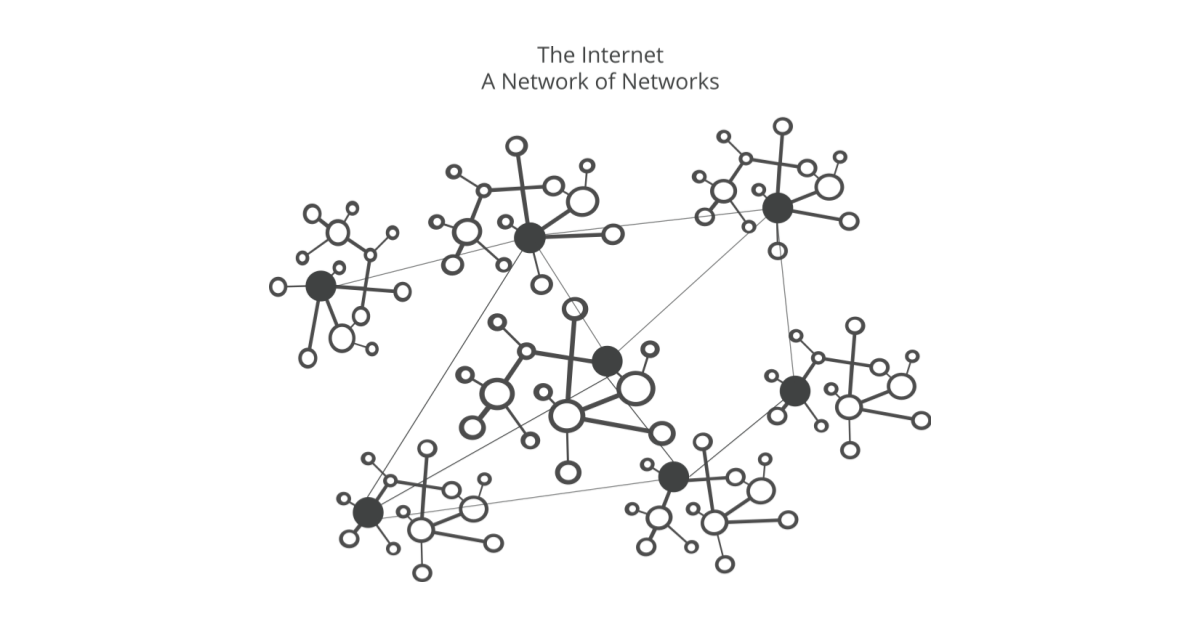
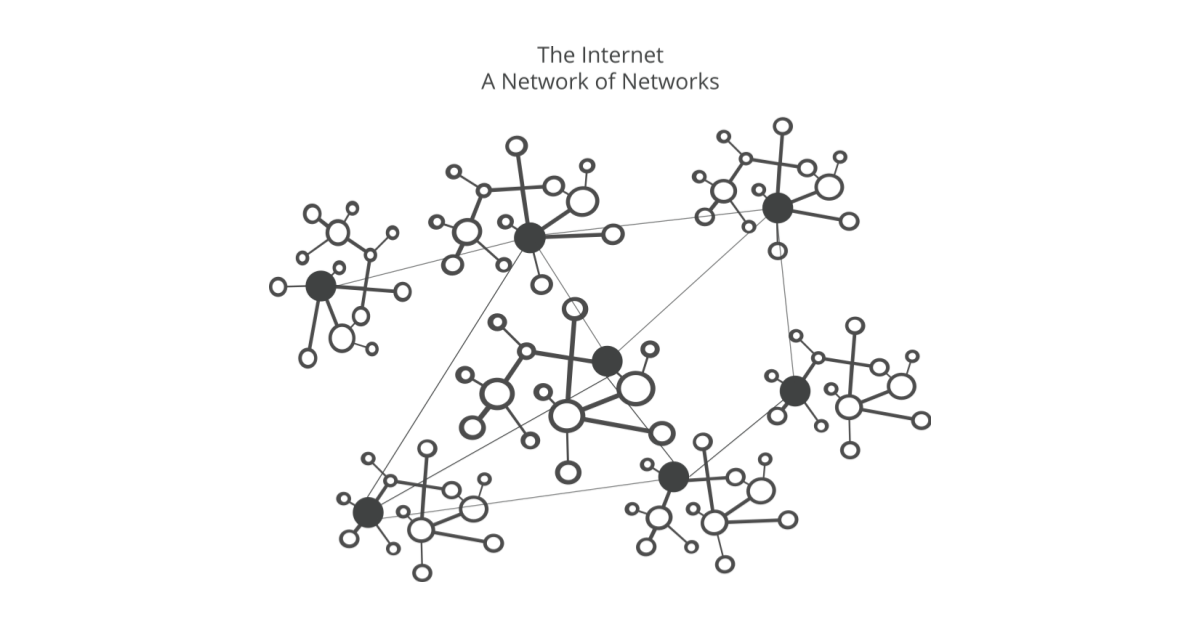
The Internet is literally a network of networks, and it’s bound together by BGP. BGP allows one network (say Facebook) to advertise its presence to other networks that form the Internet. As we write Facebook is not advertising its presence, ISPs and other networks can’t find Facebook’s network and so it is unavailable.

The individual networks each have an ASN: an Autonomous System Number. An Autonomous System (AS) is an individual network with a unified internal routing policy. An AS can originate prefixes (say that they control a group of IP addresses), as well as transit prefixes (say they know how to reach specific groups of IP addresses).

Cloudflare’s ASN is AS13335. Every ASN needs to announce its prefix routes to the Internet using BGP; otherwise, no one will know how to connect and where to find us.

Our learning center has a good overview of what BGP and ASNs are and how they work.

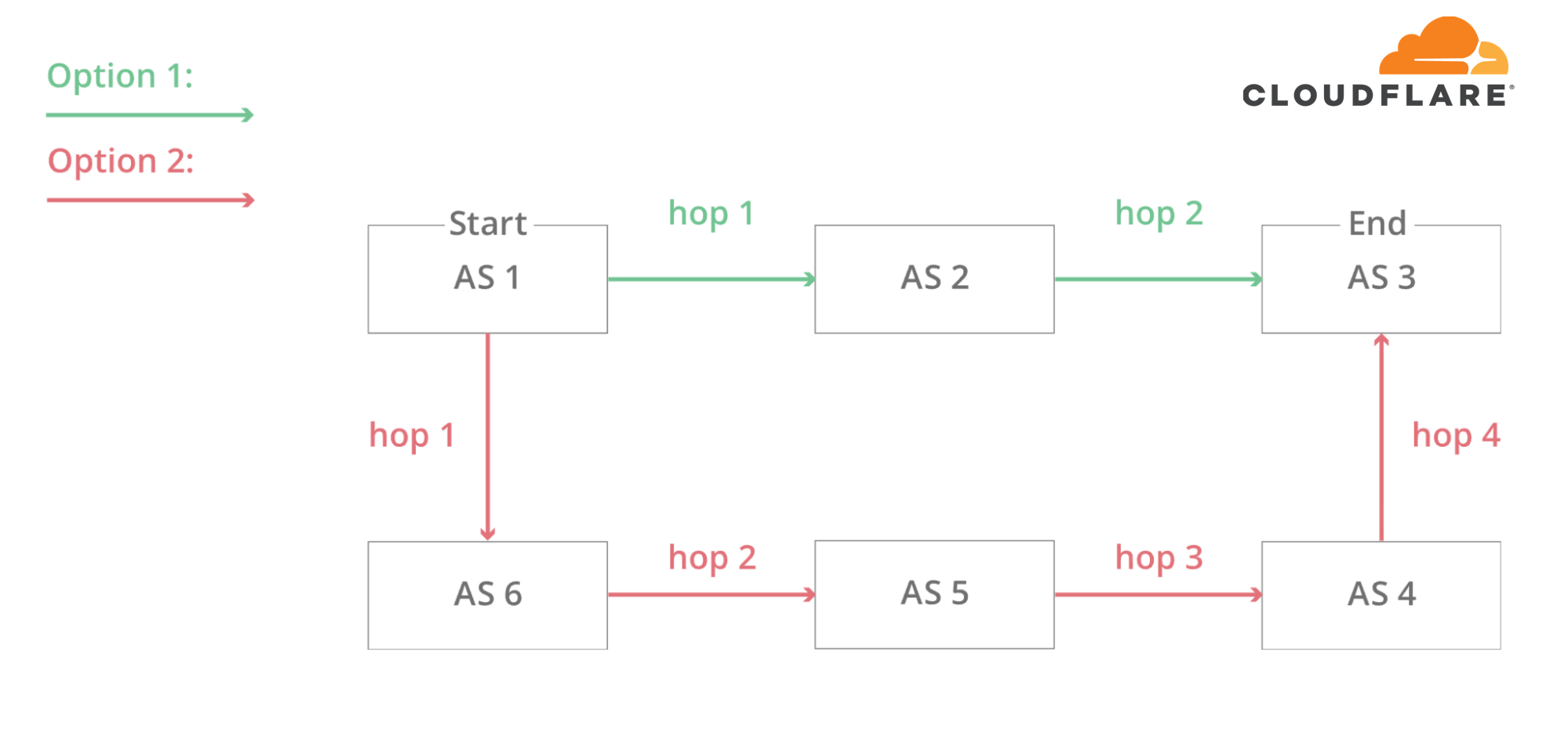
In this simplified diagram, you can see six autonomous systems on the Internet and two possible routes that one packet can use to go from Start to End. AS1 → AS2 → AS3 being the fastest, and AS1 → AS6 → AS5 → AS4 → AS3 being the slowest, but that can be used if the first fails.

Understanding How Facebook Disappeared from the Internet

At 1658 UTC we noticed that Facebook had stopped announcing the routes to their DNS prefixes. That meant that, at least, Facebook’s DNS servers were unavailable. Because of this Cloudflare’s 1.1.1.1 DNS resolver could no longer respond to queries asking for the IP address of facebook.com or instagram.com.

route-views>show ip bgp 185.89.218.0/23
% Network not in table
route-views>

route-views>show ip bgp 129.134.30.0/23
% Network not in table
route-views>

Meanwhile, other Facebook IP addresses remained routed but weren’t particularly useful since without DNS Facebook and related services were effectively unavailable:

route-views>show ip bgp 129.134.30.0   
BGP routing table entry for 129.134.0.0/17, version 1025798334
Paths: (24 available, best #14, table default)
  Not advertised to any peer
  Refresh Epoch 2
  3303 6453 32934
    217.192.89.50 from 217.192.89.50 (138.187.128.158)
      Origin IGP, localpref 100, valid, external
      Community: 3303:1004 3303:1006 3303:3075 6453:3000 6453:3400 6453:3402
      path 7FE1408ED9C8 RPKI State not found
      rx pathid: 0, tx pathid: 0
  Refresh Epoch 1
route-views>

We keep track of all the BGP updates and announcements we see in our global network. At our scale, the data we collect gives us a view of how the Internet is connected and where the traffic is meant to flow from and to everywhere on the planet.

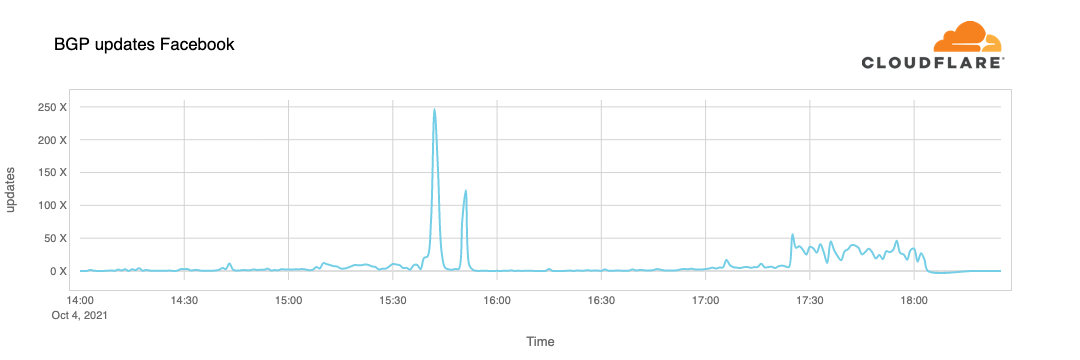
A BGP UPDATE message informs a router of any changes you’ve made to a prefix advertisement or entirely withdraws the prefix. We can clearly see this in the number of updates we received from Facebook when checking our time-series BGP database. Normally this chart is fairly quiet: Facebook doesn’t make a lot of changes to its network minute to minute.

But at around 15:40 UTC we saw a peak of routing changes from Facebook. That’s when the trouble began.

Understanding How Facebook Disappeared from the Internet

If we split this view by routes announcements and withdrawals, we get an even better idea of what happened. Routes were withdrawn, Facebook’s DNS servers went offline, and one minute after the problem occurred, Cloudflare engineers were in a room wondering why 1.1.1.1 couldn’t resolve facebook.com and worrying that it was somehow a fault with our systems.

Understanding How Facebook Disappeared from the Internet

With those withdrawals, Facebook and its sites had effectively disconnected themselves from the Internet.

DNS gets affected

As a direct consequence of this, DNS resolvers all over the world stopped resolving their domain names.

➜  ~ dig @1.1.1.1 facebook.com
;; ->>HEADER<<- opcode: QUERY, status: SERVFAIL, id: 31322
;facebook.com.			IN	A
➜  ~ dig @1.1.1.1 whatsapp.com
;; ->>HEADER<<- opcode: QUERY, status: SERVFAIL, id: 31322
;whatsapp.com.			IN	A
➜  ~ dig @8.8.8.8 facebook.com
;; ->>HEADER<<- opcode: QUERY, status: SERVFAIL, id: 31322
;facebook.com.			IN	A
➜  ~ dig @8.8.8.8 whatsapp.com
;; ->>HEADER<<- opcode: QUERY, status: SERVFAIL, id: 31322
;whatsapp.com.			IN	A

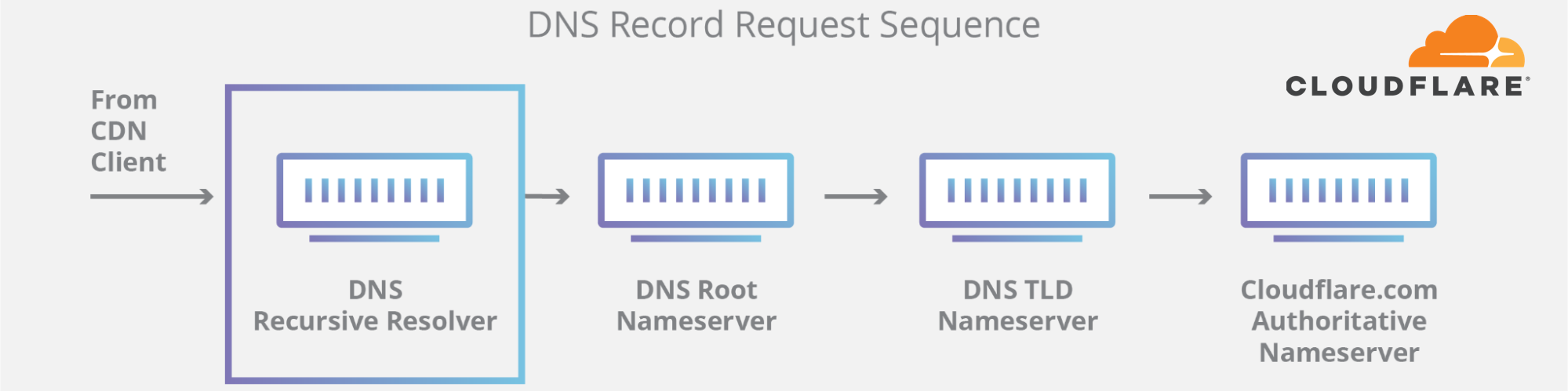
This happens because DNS, like many other systems on the Internet, also has its routing mechanism. When someone types the https://facebook.com URL in the browser, the DNS resolver, responsible for translating domain names into actual IP addresses to connect to, first checks if it has something in its cache and uses it. If not, it tries to grab the answer from the domain nameservers, typically hosted by the entity that owns it.

If the nameservers are unreachable or fail to respond because of some other reason, then a SERVFAIL is returned, and the browser issues an error to the user.

Again, our learning center provides a good explanation on how DNS works.

Understanding How Facebook Disappeared from the Internet

Due to Facebook stopping announcing their DNS prefix routes through BGP, our and everyone else’s DNS resolvers had no way to connect to their nameservers. Consequently, 1.1.1.1, 8.8.8.8, and other major public DNS resolvers started issuing (and caching) SERVFAIL responses.

But that’s not all. Now human behavior and application logic kicks in and causes another exponential effect. A tsunami of additional DNS traffic follows.

This happened in part because apps won’t accept an error for an answer and start retrying, sometimes aggressively, and in part because end-users also won’t take an error for an answer and start reloading the pages, or killing and relaunching their apps, sometimes also aggressively.

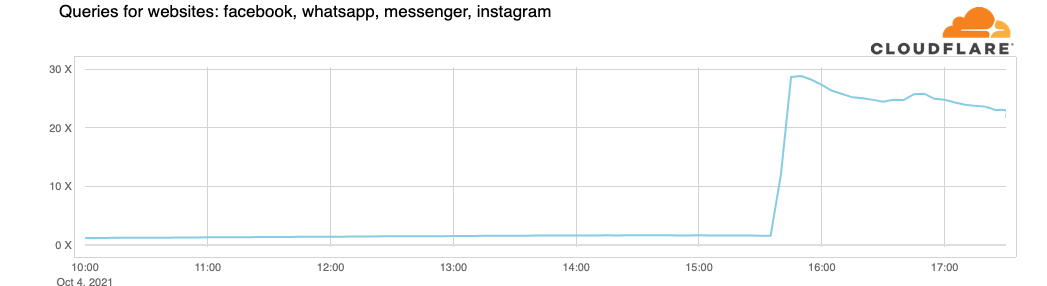
This is the traffic increase (in number of requests) that we saw on 1.1.1.1:

Understanding How Facebook Disappeared from the Internet

So now, because Facebook and their sites are so big, we have DNS resolvers worldwide handling 30x more queries than usual and potentially causing latency and timeout issues to other platforms.

Fortunately, 1.1.1.1 was built to be Free, Private, Fast (as the independent DNS monitor DNSPerf can attest), and scalable, and we were able to keep servicing our users with minimal impact.

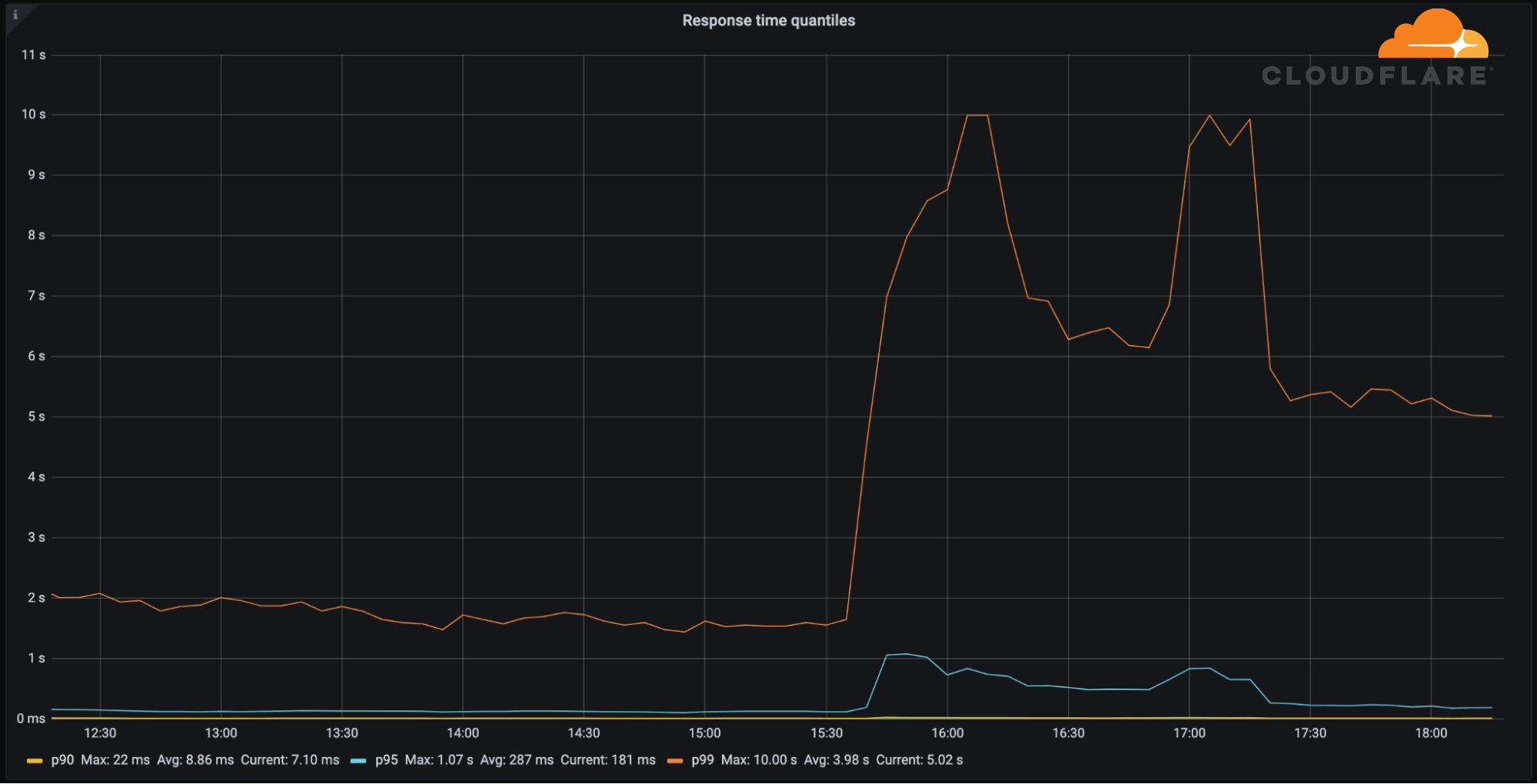
The vast majority of our DNS requests kept resolving in under 10ms. At the same time, a minimal fraction of p95 and p99 percentiles saw increased response times, probably due to expired TTLs having to resort to the Facebook nameservers and timeout. The 10 seconds DNS timeout limit is well known amongst engineers.

Understanding How Facebook Disappeared from the Internet

Impacting other services

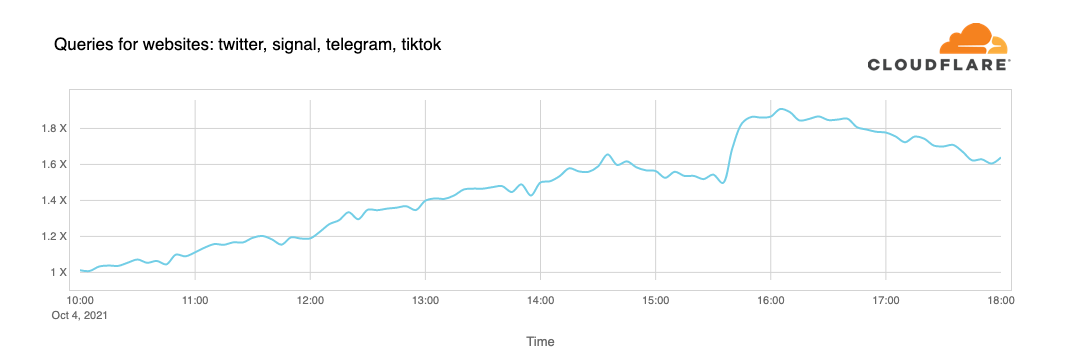
People look for alternatives and want to know more or discuss what’s going on. When Facebook became unreachable, we started seeing increased DNS queries to Twitter, Signal and other messaging and social media platforms.

Understanding How Facebook Disappeared from the Internet

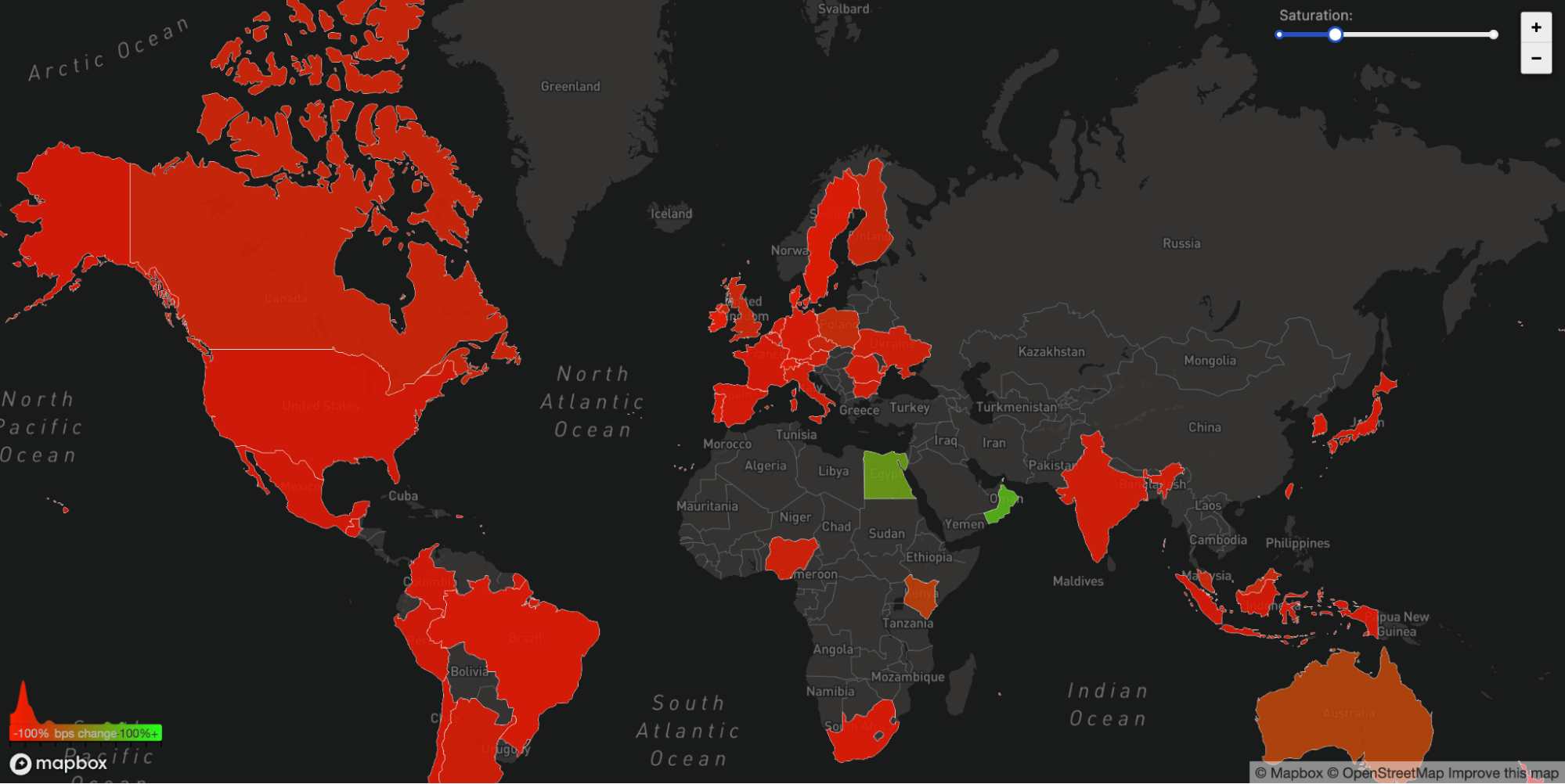
We can also see another side effect of this unreachability in our WARP traffic to and from Facebook’s affected ASN 32934. This chart shows how traffic changed from 15:45 UTC to 16:45 UTC compared with three hours before in each country. All over the world WARP traffic to and from Facebook’s network simply disappeared.

Understanding How Facebook Disappeared from the Internet

The Internet

Today’s events are a gentle reminder that the Internet is a very complex and interdependent system of millions of systems and protocols working together. That trust, standardization, and cooperation between entities are at the center of making it work for almost five billion active users worldwide.

Update

At around 21:00 UTC we saw renewed BGP activity from Facebook’s network which peaked at 21:17 UTC.

Understanding How Facebook Disappeared from the Internet

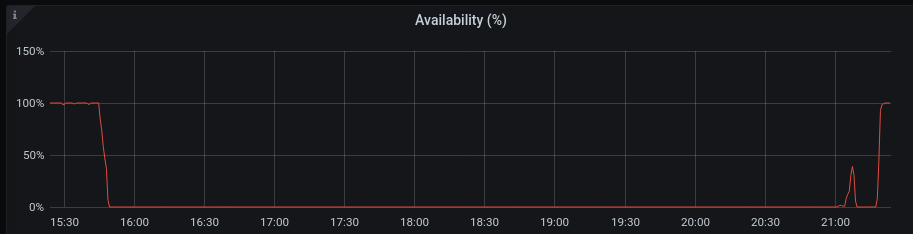
This chart shows the availability of the DNS name ‘facebook.com’ on Cloudflare’s DNS resolver 1.1.1.1. It stopped being available at around 15:50 UTC and returned at 21:20 UTC.

Understanding How Facebook Disappeared from the Internet

Undoubtedly Facebook, WhatsApp and Instagram services will take further time to come online but as of 22:28 UTC Facebook appears to be reconnected to the global Internet and DNS working again.

Fall 2020 RPKI Update

Post Syndicated from Louis Poinsignon original https://blog.cloudflare.com/rpki-2020-fall-update/

Fall 2020 RPKI Update

The Internet is a network of networks. In order to find the path between two points and exchange data, the network devices rely on the information from their peers. This information consists of IP addresses and Autonomous Systems (AS) which announce the addresses using Border Gateway Protocol (BGP).

One problem arises from this design: what protects against a malevolent peer who decides to announce incorrect information? The damage caused by route hijacks can be major.

Routing Public Key Infrastructure (RPKI) is a framework created in 2008. Its goal is to provide a source of truth for Internet Resources (IP addresses) and ASes in signed cryptographically signed records called Route Origin Objects (ROA).

Recently, we’ve seen the significant threshold of two hundred thousands of ROAs being passed. This represents a big step in making the Internet more secure against accidental and deliberate BGP tampering.

We have talked about RPKI in the past but we thought it would be a good time for an update.

In a more technical context, the RPKI framework consists of two parts:

  • IP addresses need to be cryptographically signed by their owners in a database managed by a Trust Anchor: Afrinic, APNIC, ARIN, LACNIC and RIPE. Those five organizations are in charge of allocating Internet resources. The ROA indicates which Network Operator is allowed to announce the addresses using BGP.
  • Network operators download the list of ROAs, perform the cryptographic checks and then apply filters on the prefixes they receive: this is called BGP Origin Validation.

The “Is BGP Safe Yet” website

The launch of the website isbgpsafeyet.com to test if your ISP correctly performs BGP Origin Validation was a success. Since launch, it has been visited more than five million times from over 223 countries and 13,000 unique networks (20% of the entire Internet), generating half a million BGP Origin Validation tests.

Many providers subsequently indicated on social media (for example, here or here) that they had an RPKI deployment in the works. This increase in Origin Validation by networks is increasing the security of the Internet globally.

The site’s test for Origin Validation consists of queries toward two addresses, one of which is behind an RPKI invalid prefix and the other behind an RPKI valid prefix. If the query towards the invalid succeeds, the test fails as the ISP does not implement Origin Validation. We counted the number of queries that failed to reach invalid.cloudflare.com. This also included a few thousand RIPE Atlas tests that were started by Cloudflare and various contributors, providing coverage for smaller networks.

Every month since launch we’ve seen that around 10 to 20 networks are deploying RPKI Origin Validation. Among the major providers we can build the following table:

Month Networks
August Swisscom (Switzerland), Salt (Switzerland)
July Telstra (Australia), Quadranet (USA), Videotron (Canada)
June Colocrossing (USA), Get Norway (Norway), Vocus (Australia), Hurricane Electric (Worldwide), Cogent (Worldwide)
May Sengked Fiber (Indonesia), Online.net (France), WebAfrica Networks (South Africa), CableNet (Cyprus), IDnet (Indonesia), Worldstream (Netherlands), GTT (Worldwide)

With the help of many contributors, we have compiled a list of network operators and public statements at the top of the isbgpsafeyet.com page.

We excluded providers that manually blocked the traffic towards the prefix instead of using RPKI. Among the techniques we see are firewall filtering and manual prefix rejection. The filtering is often propagated to other customer ISPs. In a unique case, an ISP generated a “more-specific” blackhole route that leaked to multiple peers over the Internet.

The deployment of RPKI by major transit providers, also known as Tier 1, such as Cogent, GTT, Hurricane Electric, NTT and Telia made many downstream networks more secure without them having them deploying validation software.

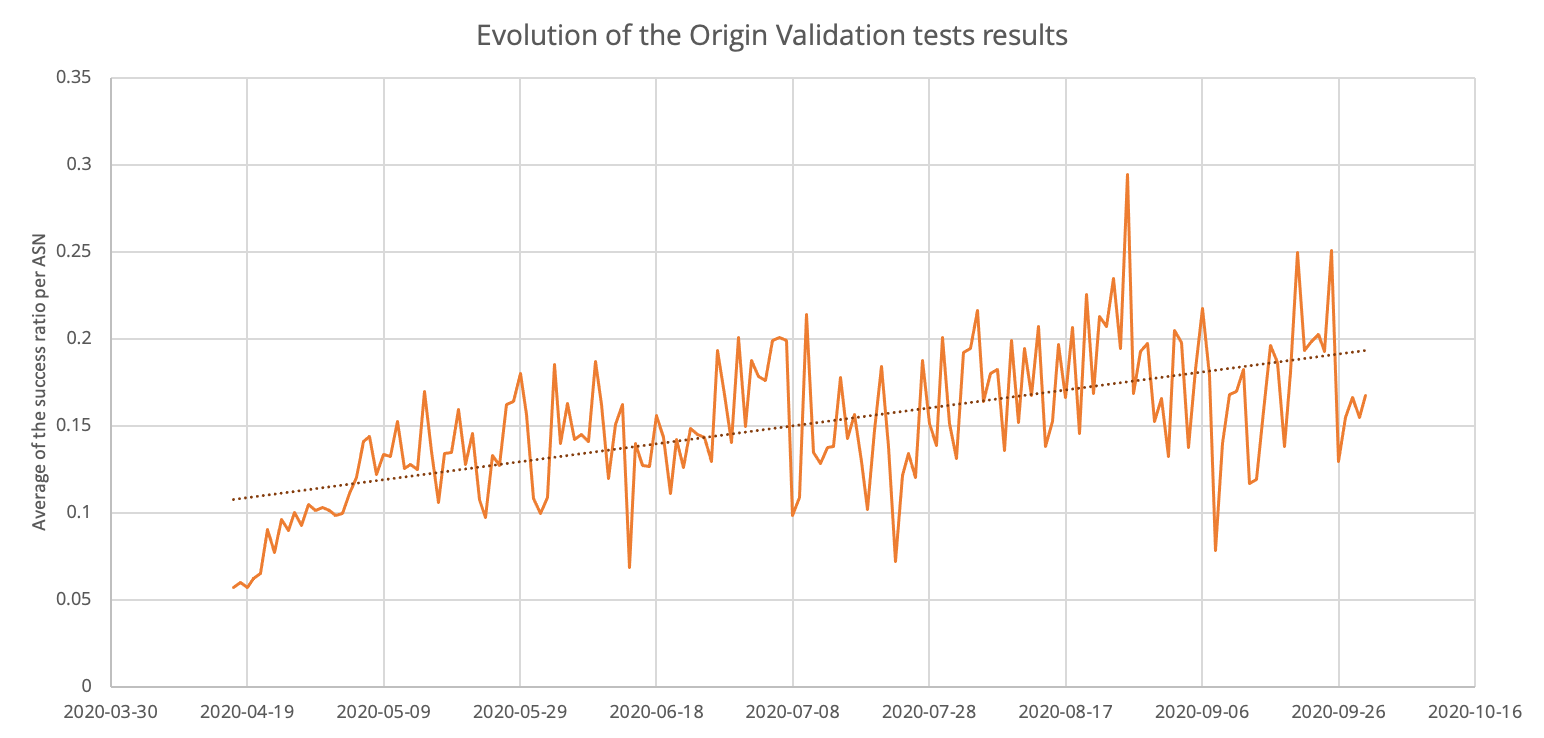
Overall, we looked at the evolution of the successful tests per ASN and we noticed a steady increase over the recent months of 8%.

Fall 2020 RPKI Update

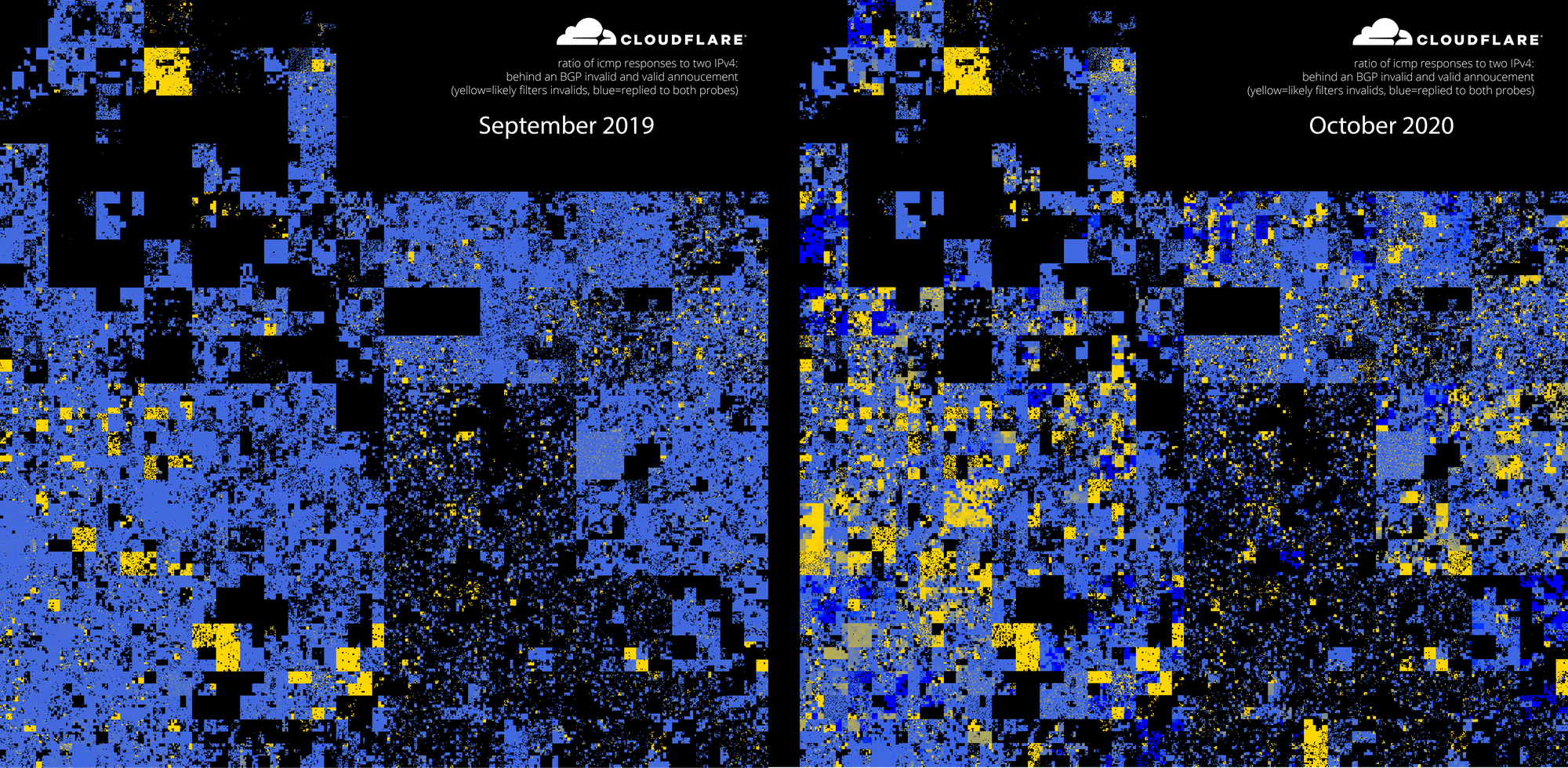
Furthermore, when we probed the entire IPv4 space this month, using a similar technique to the isbgpsafeyet.com test, many more networks were not able to reach an RPKI invalid prefix than compared to the same period last year. This confirms an increase of RPKI Origin Validation deployment across all network operators. The picture below shows the IPv4 space behind a network with RPKI Origin Validation enabled in yellow and the active space in blue. It uses a Hilbert Curve to efficiently plot IP addresses: for example one /20 prefix (4096 IPs) is a pixel, a /16 prefix (65536 IPs) will form a 4×4 pixels square.

The more the yellow spreads, the safer the Internet becomes.

Fall 2020 RPKI Update

What does it mean exactly? If you were hijacking a prefix, the users behind the yellow space would likely not be affected. This also applies if you miss-sign your prefixes: you would not be able to reach the services or users behind the yellow space. Once RPKI is enabled everywhere, there will only be yellow squares.

Progression of signed prefixes

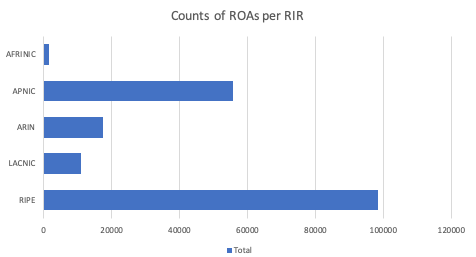
Owners of IP addresses indicate the networks allowed to announce them. They do this by signing prefixes: they create Route Origin Objects (ROA). As of today, there are more than 200,000 ROAs. The distribution shows that the RIPE region is still leading in ROA count, then followed by the APNIC region.

Fall 2020 RPKI Update

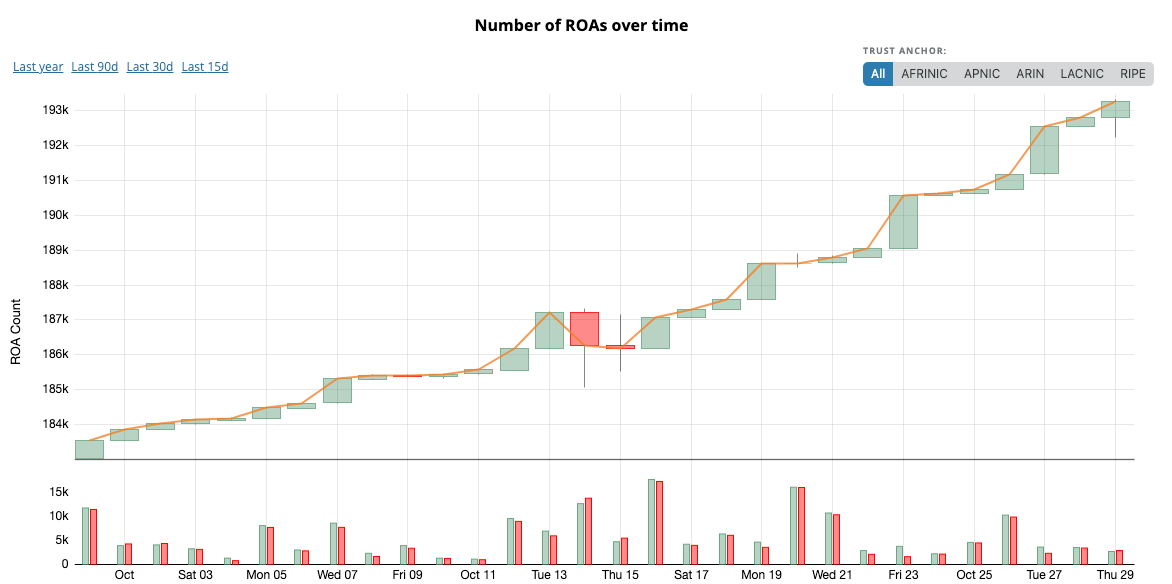
2020 started with 172,000 records and the count is getting close to 200,000 at the beginning of November, approximately a quarter of all the Internet routes. Since last year, the database of ROAs grew by more than 70 percent, from 100,000 records, an average pace of 5% every month.

On the following graph of unique ROAs count per day, we can see two points that were followed by a change in ROA creation rate: 140/day, then 231/day, and since August, 351 new ROAs per day.

It is not yet clear what caused the increase in August.

Fall 2020 RPKI Update

Free services and software

In 2018 and 2019, Cloudflare was impacted by BGP route hijacks. Both could have been avoided with RPKI. Not long after the first incident, we started signing prefixes and developing RPKI software. It was necessary to make BGP safer and we wanted to do more than talk about it. But we also needed enough networks to be deploying RPKI as well. By making deployment easier for everyone, we hoped to increase adoption.

The following is a reminder of what we built over the years around RPKI and how it grew.

OctoRPKI is Cloudflare’s open source RPKI Validation software. It periodically generates a JSON document of validated prefixes that we pass onto our routers using GoRTR. It generates most of the data behind the graphs here.

The latest version, 1.2.0, of OctoRPKI was released at the end of October. It implements important security fixes, better memory management and extended logging. This is the first validator to provide detailed information around cryptographically invalid records into Sentry and performance data in distributed tracing tools.
GoRTR remains heavily used in production, including by transit providers. It can natively connect to other validators like rpki-client.

When we released our public rpki.json endpoint in early 2019, the idea was to enable anyone to see what Cloudflare was filtering.

The file is also used as a bootstrap by GoRTR, so that users can test a deployment. The file is cached on more than 200 data centers, ensuring quick and secure delivery of a list of valid prefixes, making RPKI more accessible for smaller networks and developers.

Between March 2019 and November 2020, the number of queries more than doubled and there are five times more networks querying this file.

The growth of queries follows approximately the rate of ROA creation (~5% per month).

Fall 2020 RPKI Update

A public RTR server is also available on rtr.rpki.cloudflare.com. It includes a plaintext endpoint on port 8282 and an SSH endpoint on port 8283. This allows us to test new versions of GoRTR before release.

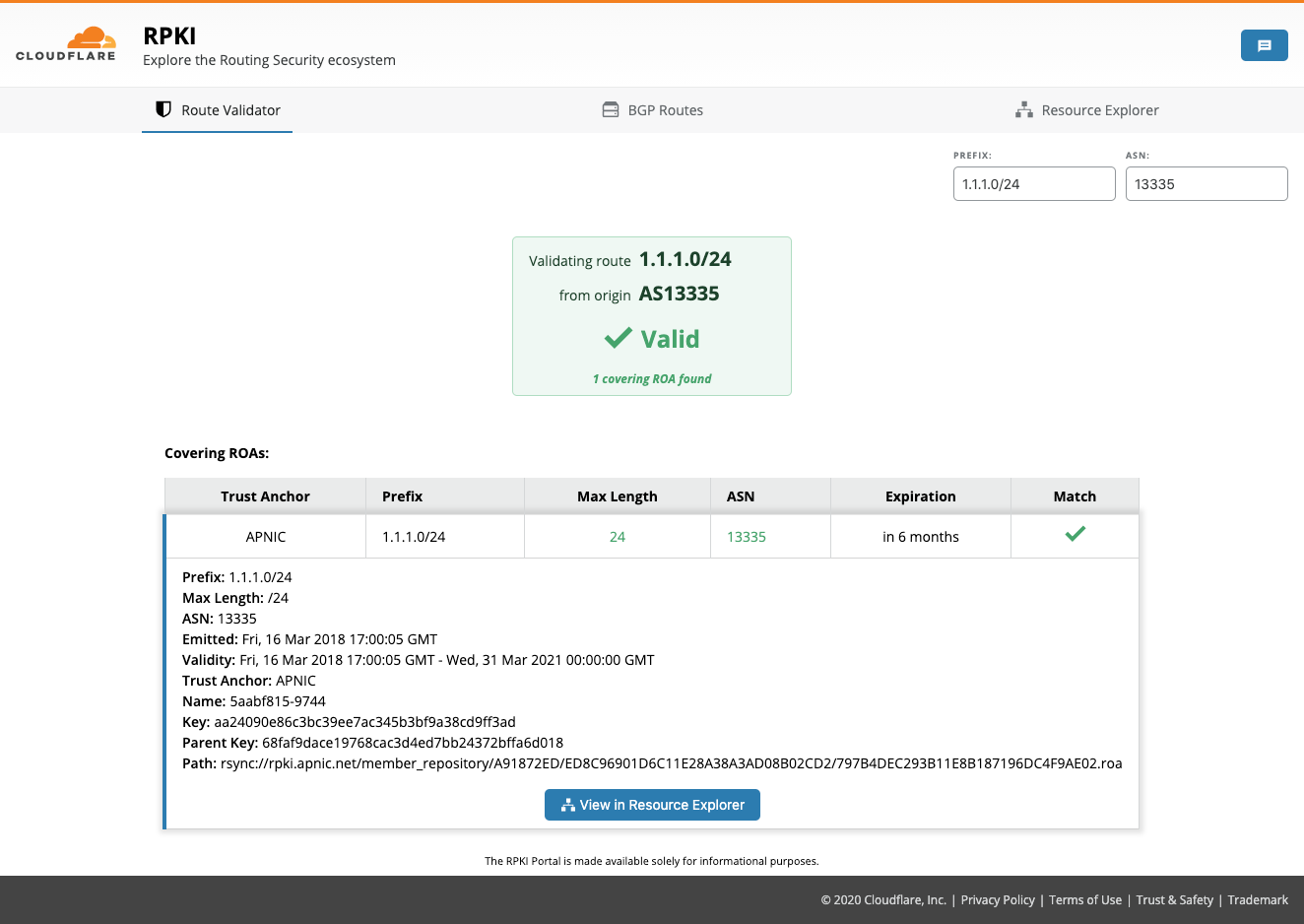
Later in 2019, we also built a public dashboard where you can see in-depth RPKI validation. With a GraphQL API, you can now explore the validation data, test a list of prefixes, or see the status of the current routing table.

Fall 2020 RPKI Update

Currently, the API is used by BGPalerter, an open-source tool that detects routing issues (including hijacks!) from a stream of BGP updates.

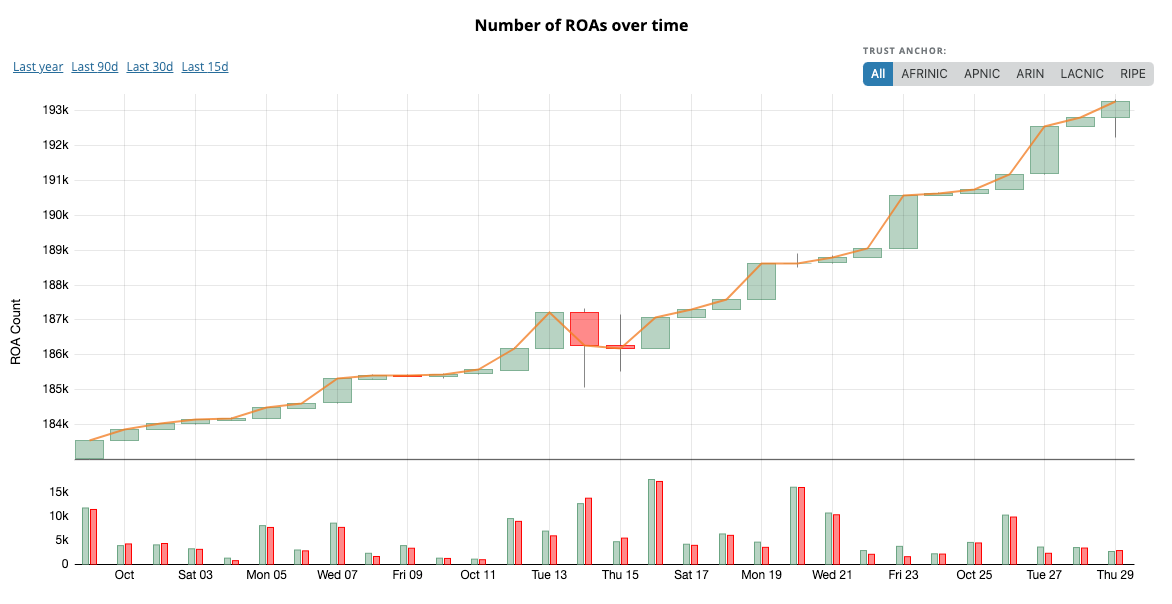
Additionally, starting in November, you can access the historical data from May 2019. Data is computed daily and contains the unique records. The team behind the dashboard worked hard to provide a fast and accurate visualization of the daily ROA changes and the volumes of files changed over the day.

Fall 2020 RPKI Update

The future

We believe RPKI is going to continue growing, and we would like to thank the hundreds of network engineers around the world who are making the Internet routing more secure by deploying RPKI.

25% of routes are signed and 20% of the Internet is doing origin validation and those numbers grow everyday. We believe BGP will be safer before reaching 100% of deployment; for instance, once the remaining transit providers enable Origin Validation, it is unlikely a BGP hijack will make it to the front page of world news outlets.

While difficult to quantify, we believe that critical mass of protected resources will be reached in late 2021.

We will keep improving the tooling; OctoRPKI and GoRTR are open-source and we welcome contributions. In the near future, we plan on releasing a packaged version of GoRTR that can be directly installed on certain routers. Stay tuned!