Tag Archives: MASQUE

What’s new in Cloudflare: MASQUE now powers 1.1.1.1 & WARP apps, DEX now generally available with Remote Captures

Post Syndicated from Mari Galicer original https://blog.cloudflare.com/masque-now-powers-1-1-1-1-and-warp-apps-dex-available-with-remote-captures/

At Cloudflare, we are constantly innovating and launching new features and capabilities across our product portfolio. Today’s roundup blog post shares two exciting updates across our platform: our cross-platform 1.1.1.1 & WARP applications (consumer) and device agents (Zero Trust)  now use MASQUE, a cutting-edge HTTP/3-based protocol, to secure your Internet connection. Additionally, DEX is now available for general availability.

Faster and more stable: our 1.1.1.1 & WARP apps now use MASQUE by default


We’re excited to announce that as of today, our cross-platform 1.1.1.1 & WARP apps now use MASQUE, a cutting-edge HTTP/3-based protocol, to secure your Internet connection.

As a reminder, our 1.1.1.1 & WARP apps have two main functions: send all DNS queries through 1.1.1.1, our privacy-preserving DNS resolver, and protect your device’s network traffic via WARP by creating a private and encrypted tunnel to the resources you’re accessing, preventing unwanted third parties or public Wi-Fi networks from snooping on your traffic.

There are many ways to encrypt and proxy Internet traffic — you may have heard of a few, such as IPSec, WireGuard, or OpenVPN. There are many tradeoffs we considered when choosing a protocol, but we believe MASQUE is the future of fast, secure, and stable Internet proxying, it aligns with our belief in building on top of open Internet standards, and we’ve deployed it successfully at scale for customers like iCloud Private Relay and Microsoft Edge Secure Network.

Why MASQUE?

MASQUE is a modern framework for proxying traffic that allows a variety of application protocols, including HTTP/3, to utilize QUIC as their transport mechanism. That’s a lot of acronyms, so let’s make sure those are clear. 
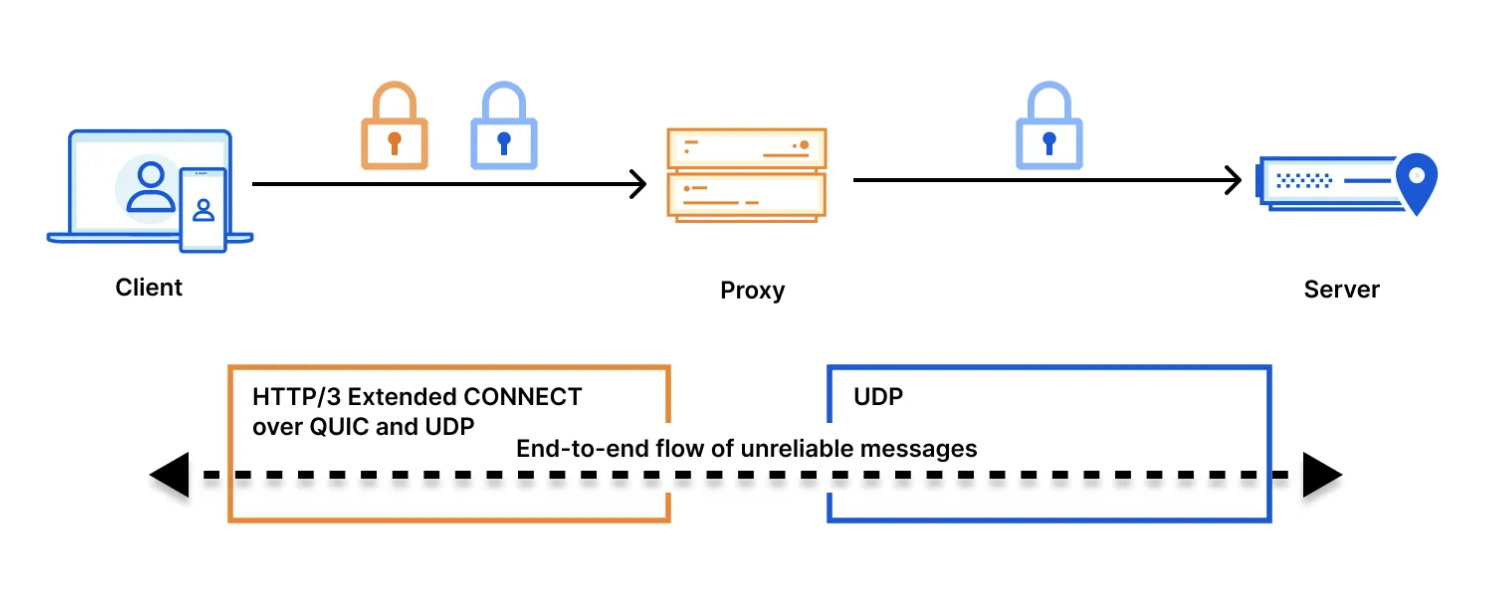

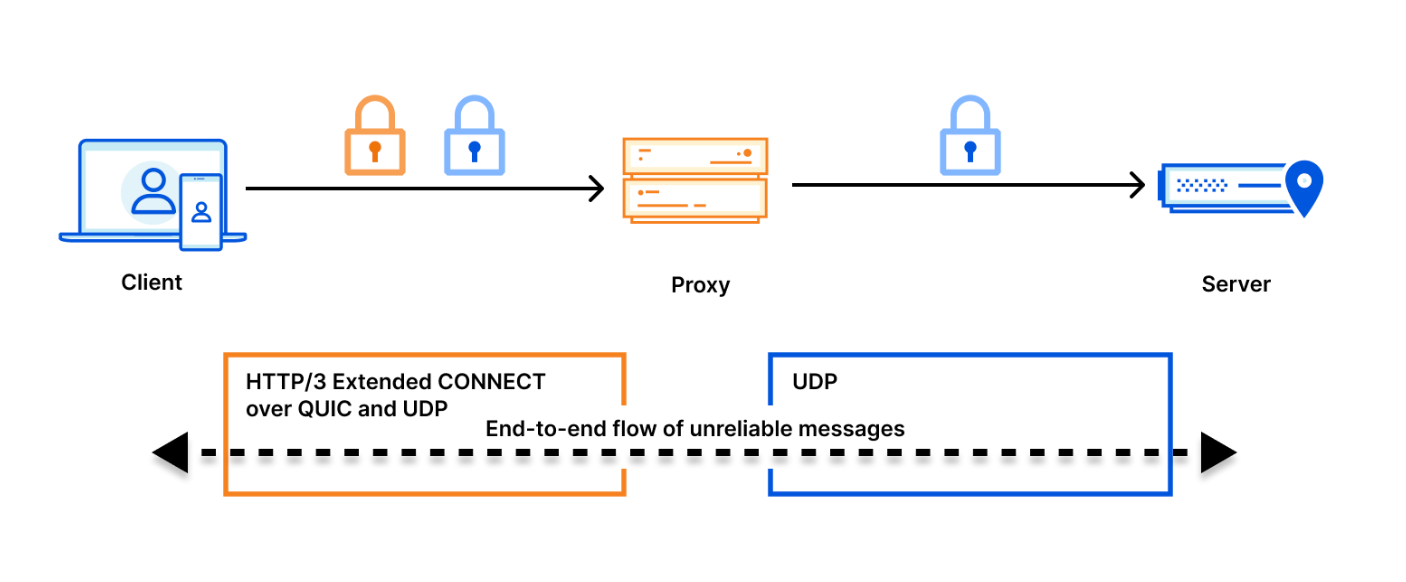
QUIC is a general-purpose transport protocol and Internet standard that operates on top of UDP (instead of TCP), is encrypted by default, and solves several performance issues that plagued its predecessors. HTTP/3 is the latest version of the HTTP protocol, defining the application-layer protocol that runs on top of QUIC as its transport mechanism. MASQUE is a set of mechanisms for tunneling traffic over HTTP. It extends the existing HTTP CONNECT model, to allow tunneling UDP and IP traffic. This is especially efficient when combined with the QUIC’s unreliable datagram extension.

For example, we can use MASQUE’s CONNECT-IP method to establish a tunnel that can send multiple concurrent requests over a single QUIC connection:

HEADERS
:method = CONNECT
:protocol = connect-ip
:scheme = https
:path = /.well-known/masque/ip/*/*/
:authority = example.org
capsule-protocol = ?1

The benefit these protocols have for the quality and security of everyone’s Internet browsing experience is real. Earlier transport protocols were built before the advent of smartphones and mobile networks, so QUIC was designed to support a mobile world, maintaining connections even in poorly connected networks, and minimizing disruptions as people switch rapidly between networks as they move through their day. Leveraging HTTP/3 as the application layer means that MASQUE is more like “normal” HTTP traffic on the Internet, meaning that it is easier to support, is compatible with existing firewall and security rules, and that it supports cryptographic agility (i.e. support for post-quantum crypto), making this traffic more secure and resilient in the long term.

Get started now 

All new installations of our 1.1.1.1 & WARP apps support MASQUE, including iOS, Android, macOS, Windows, and Linux, and we’ve started to roll it out as the preferred protocol over WireGuard. On mobile, to check if your connection is already secured over MASQUE, or change your device’s default option, you can toggle this setting via Advanced > Connection options > Tunnel protocol:
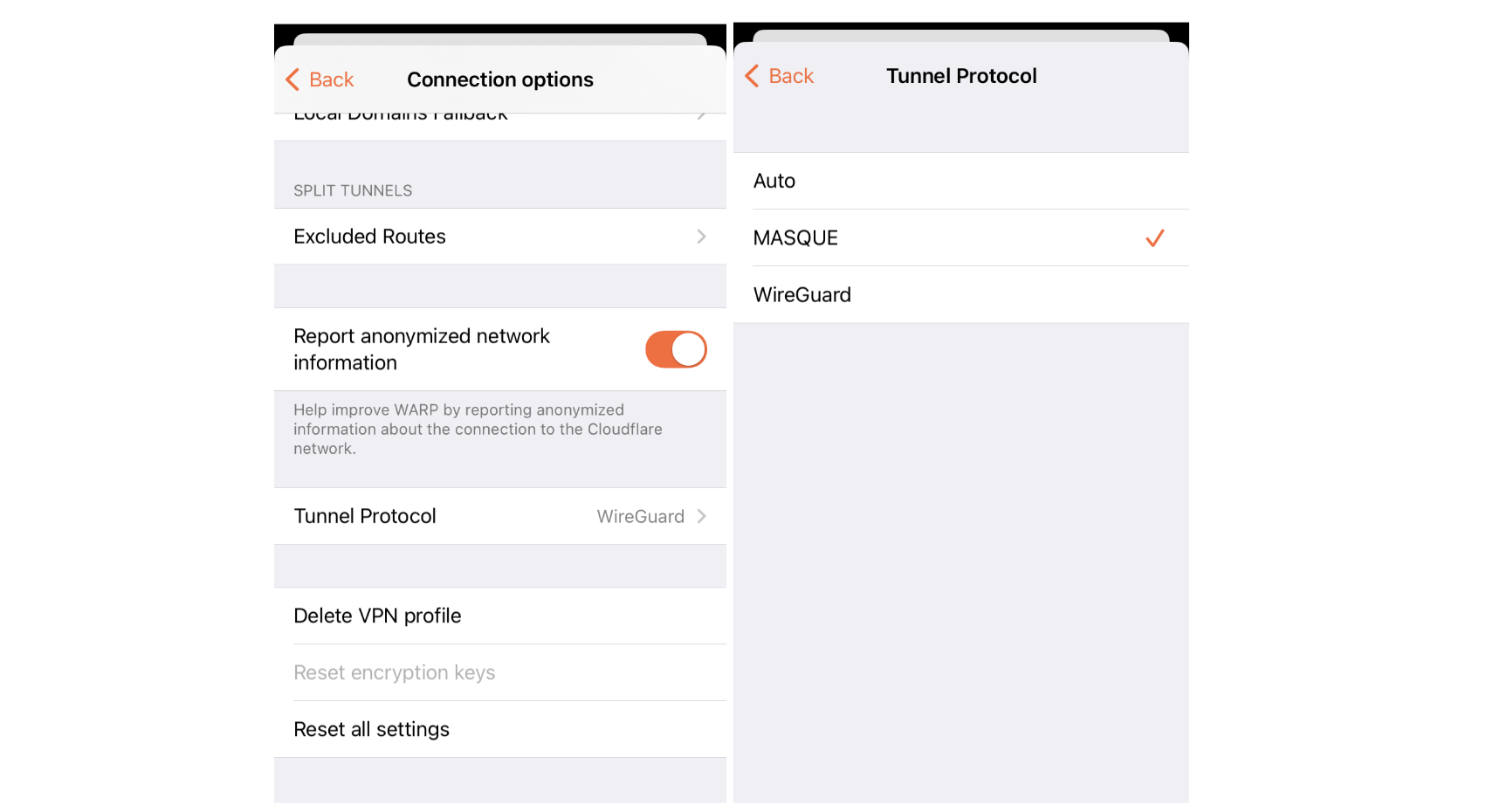

Protocol connection options shown here on the iOS app

We offer the following options: 

  • Auto: this allows the app to choose the protocol.

  • MASQUE: always use MASQUE to secure your connection.

  • WireGuard: always use WireGuard to secure your connection.

On desktop versions, you can switch the protocol by using the WARP command-line interface. For example:

warp-cli tunnel protocol set WireGuard
warp-cli tunnel protocol set MASQUE

With this rollout, we’re excited to see MASQUE deliver increased performance and stability to millions of users. Download one of the WARP apps today!

DEX now Generally Available: Announcing detailed device visibility with DEX Remote Captures


Following the successful beta launch of Digital Experience Monitoring (DEX), we are thrilled to announce the general availability of DEX, along with new Remote Captures functionality.

In today’s hyper distributed environment, user experience is paramount. Recurring performance problems can lead to decreased user satisfaction, lost productivity, and damaged brand reputation.  Digital Experience Monitoring (DEX) offers a comprehensive solution to these challenges. Previous blog posts have discussed the solution and its capabilities. (Introducing Digital Experience Monitoring, Understanding end user-connectivity and performance with Digital Experience Monitoring, now available in beta, What’s new in Cloudflare One: Digital Experience monitoring notifications)

Introducing Remote Captures: PCAP and WARP Diag

Imagine this: an end user is frustrated with a slow application, and your IT team is struggling to pinpoint the root cause. Traditionally, troubleshooting such issues involved contacting the end user and asking them to manually collect and share network traffic data. This process is time-consuming, prone to errors, and often disruptive to the end user’s workflow.

Building upon the capabilities of DEX, we are excited to introduce Remote Captures, a powerful new feature that empowers IT admins to gain unprecedented visibility into end-user devices and network performance. DEX now introduces Remote Captures, a powerful new feature that empowers IT admins to remotely initiate network packet captures (PCAP) and WARP Diag logs directly from your end users’ devices and capture diagnostic information automatically from our device client. This streamlined approach accelerates troubleshooting, reduces the burden on end users, and provides valuable insights into network performance and security.

Why Remote Captures?

Remote Captures offer several key advantages. By analyzing detailed network traffic, IT teams can quickly pinpoint the root cause of network issues. Furthermore, granular network data empowers security teams to proactively detect and investigate potential threats. Finally, by identifying bottlenecks and latency issues, Remote Captures enable organizations to optimize network performance for a smoother user experience.

How Remote Captures work

Initiating a Remote Capture is straightforward. First, select the specific device you wish to troubleshoot. Then, with a few simple clicks, start capturing network traffic and/or WARP Diag data. Once the capture is complete, download the captured data and utilize your preferred tools for in-depth analysis.
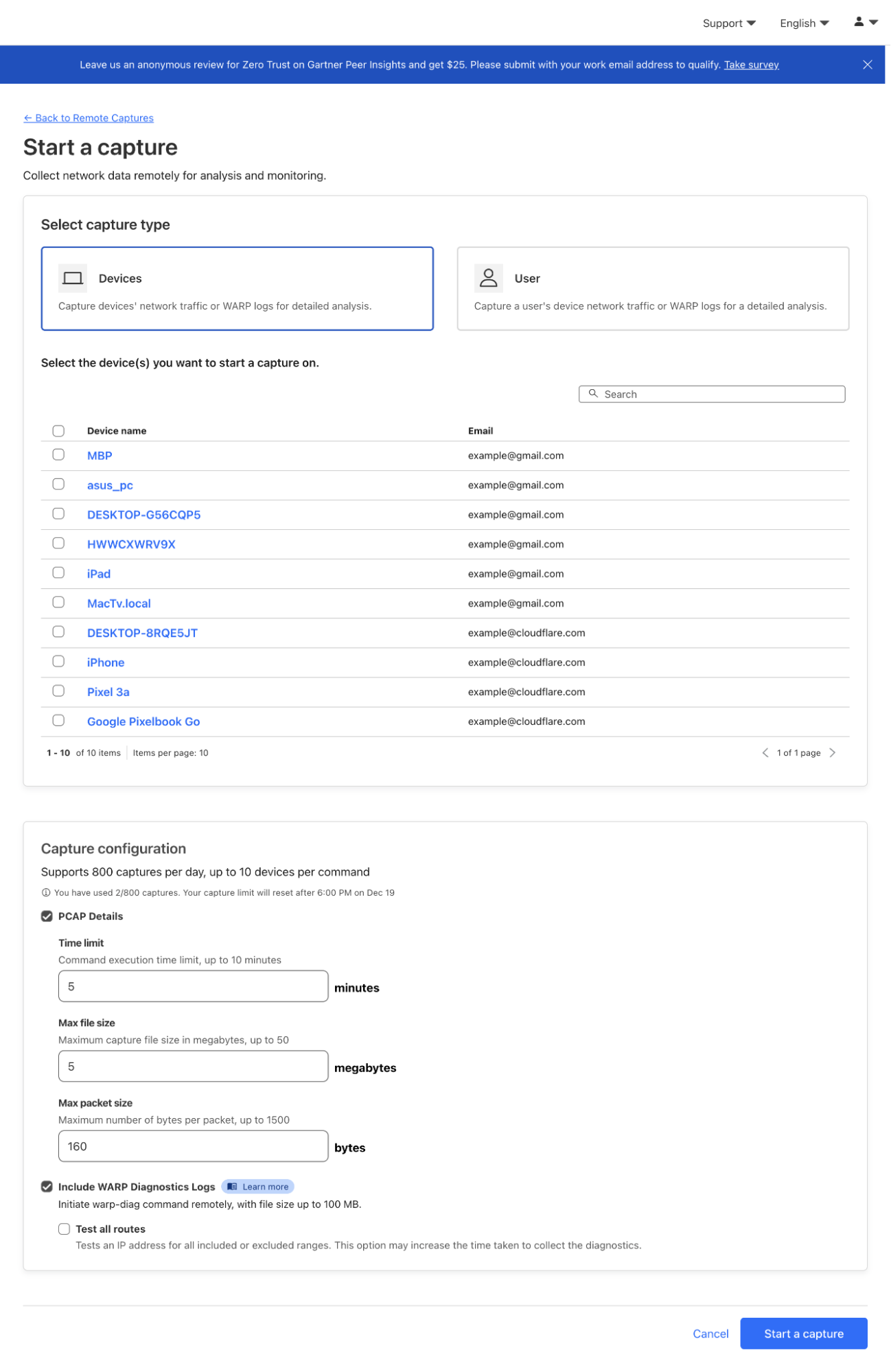

Get started today

DEX Remote Captures are now available for Cloudflare One customers. They can be configured by going to Cloudflare Dashboard >  Zero Trust > DEX > Remote Captures, and then selecting the device you wish to collect from. For more information, refer to Remote captures. This new capability highlights just one of the many ways our unified SASE platform helps organizations find and fix security issues across SaaS applications. Try it out now using our free tier to get started.

Never miss an update 

We hope you enjoy reading our roundup blog posts as we continue to build and innovate. Stay tuned to the Cloudflare Blog for the latest news and updates.
Donning a MASQUE: building a new protocol into Cloudflare WARP

Post Syndicated from Mari Galicer original http://blog.cloudflare.com/masque-building-a-new-protocol-into-cloudflare-warp/

Donning a MASQUE: building a new protocol into Cloudflare WARP

Donning a MASQUE: building a new protocol into Cloudflare WARP

When we originally announced WARP, we knew we were launching a product that was different from other VPNs. Cloudflare has not only hundreds more data centers than your typical VPN provider, but also a unique purview into the adoption of open Internet standards. The confluence of these two factors have led us to today’s announcement: support for MASQUE, a cutting-edge new protocol for the beta version of our consumer WARP iOS app.

MASQUE is a set of mechanisms that extend HTTP/3 and leverage the unique properties of the QUIC transport protocol to efficiently proxy IP and UDP traffic. Most importantly, it will make your Internet browsing experience faster and more stable without sacrificing privacy.

Like many products at Cloudflare, we’re offering this first as a free, consumer offering. Once we’ve had an opportunity to learn from what it’s like to operate MASQUE on mobile devices, at scale, we plan to integrate it into our Zero Trust enterprise product suite.

We’re not saying goodbye to Wireguard

When we first built WARP we chose to go with Wireguard for many reasons – among them, simplicity. This is where Wireguard shines: ~4,000 lines of code that use public-key cryptography to create an encrypted tunnel between one computer and another. The cryptographic parts – encapsulation and decapsulation –  are fast, simple, and secure. This simplicity has allowed us to implement it cross-platform without much effort; today, we support Wireguard clients on iOS, Android, macOS, Windows, and Linux.

That being said, the protocol is not without its issues. Like many tradeoffs in technology, Wireguard’s strengths are also its drawbacks. While simple, it is also rigid: it’s not possible to extend it easily, for example, for session management, congestion control, or to recover more quickly from error-state behaviors we’re familiar with. Finally, neither the protocol nor the cryptography it uses are standards-based, making it difficult to keep up with the strongest known cryptography (post-quantum crypto, for example).

We want to move QUIC-ly

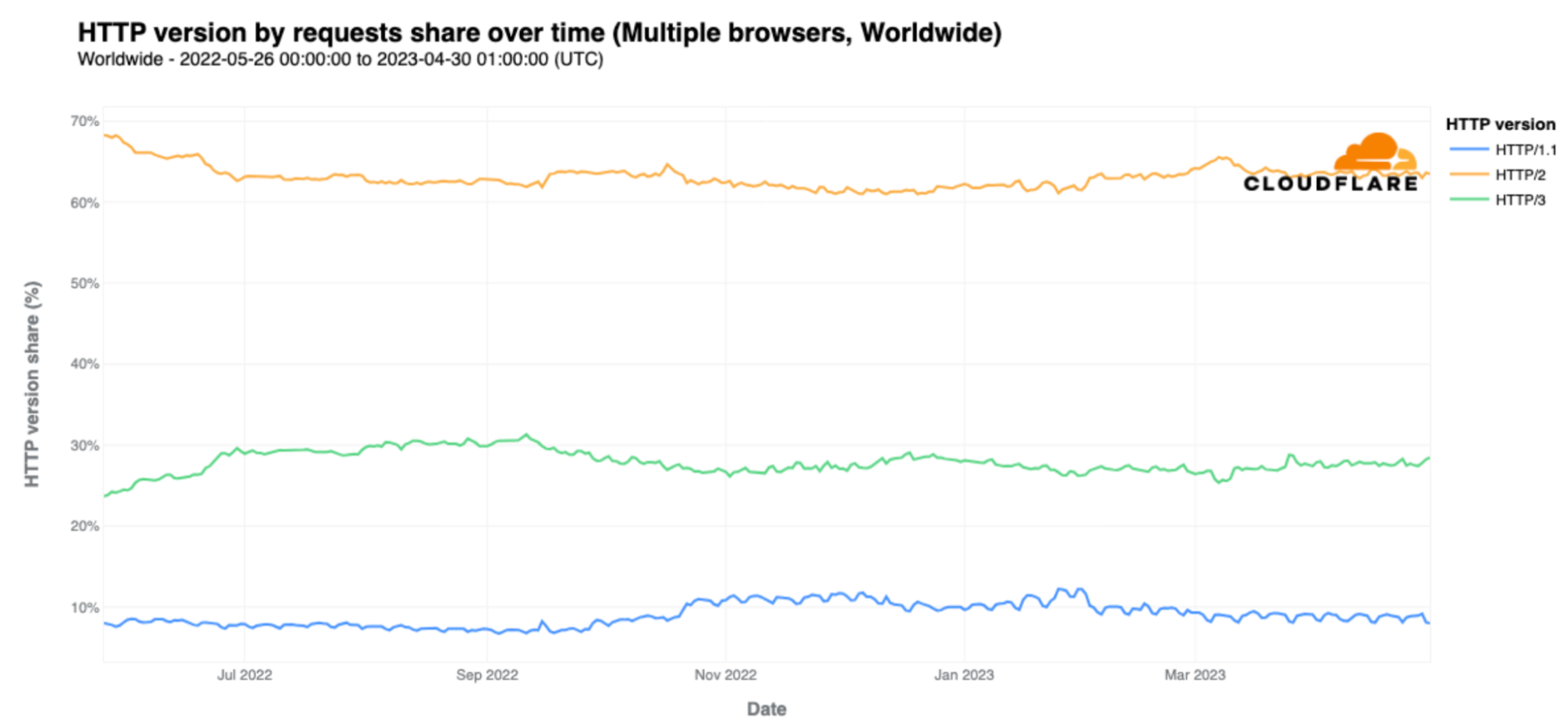
We’re excited about MASQUE because it fits into the way the Internet is evolving. According to this year’s usage report from our Radar team, HTTP/2 is currently the standard in use by the majority of Internet traffic, but HTTP/3 occupies a growing share – 28% as of June 2023. Cloudflare has always been dedicated towards adopting the cutting edge when it comes to standards: when RFC 9000 (the QUIC transport protocol) was published, we enabled it for all Cloudflare customers the very next day.

Donning a MASQUE: building a new protocol into Cloudflare WARP

So why do we think HTTP/3 is so promising? Well, a lot of it has to do with solving performance issues with HTTP/2. HTTP/3 promises a number of things.

Faster connection establishment: the TCP+TLS handshake of earlier HTTP versions typically takes two to three round trips. QUIC performs the transport and security handshake at the same time, cutting down on the total required round trips.

No more head of line blocking: when one packet of information does not make it to its destination, it will no longer block all streams of information.

Agility and evolution: QUIC has strong extension and version negotiation mechanisms. And because it encrypts all but a few bits of its wire image, deploying new transport features is easier and more practical. In contrast, TCP evolution was hampered by middleboxes that failed to keep up with the times.

Naturally, we’d want the proxying protocol we use for so many people’s everyday browsing to take advantage of these benefits. For example, the QUIC unreliable datagram extension doesn't help much for standard web traffic but it's ideal for tunneling UDP or IP packets that expect an unreliable substrate beneath them. Without the unreliable aspect, the protocols on top can get upset and start to perform badly. Datagrams help unlock QUIC's proxying potential.

MASQUE: A new era for VPN performance and flexibility

You may have heard of HTTP GET, POST, and PUT, but what about CONNECT? HTTP-CONNECT is a method that opens up a tunnel between servers and proxies traffic between them. For a deeper dive, check out our Primer on Proxies. Many Cloudflare services use this method like so:

Donning a MASQUE: building a new protocol into Cloudflare WARP

Clients send a CONNECT request, and if the proxy sends back a 2xx (success) status code, tunnel secured! Simple. However, remember that QUIC is UDP-based. Luckily, the MASQUE working group has figured out how to run multiple concurrently stream and datagram-based connections. Establishing one looks like this:

Donning a MASQUE: building a new protocol into Cloudflare WARP

Here’s what this MASQUE proxying looks like:

Donning a MASQUE: building a new protocol into Cloudflare WARP

From a development perspective, MASQUE also allows us to improve our performance in other ways: we’re already running it for iCloud Private Relay and other Privacy Proxy partners. The services that power these partnerships, from our Rust-based proxy framework to our open source QUIC implementation, are already deployed globally in our network and have proven to be fast, resilient, and reliable. We've already learned a lot about how to operate proxies at scale, but there’s plenty of room for improvement. The good news is that every performance improvement we make to speed up MASQUE-based connections for our WARP clients will also improve performance for our customers that use HTTP-CONNECT, and vice-versa.

From a protocol perspective, we also think that MASQUE will prove to be resilient over time. As you can see above, connections are made through port 443, which for both TCP and UDP blends in well with general HTTP/3 traffic and is less susceptible than Wireguard to blocking.

Finally, because MASQUE is an IETF standard, innovations via extensions are already underway. One we’re particularly excited about is Multipath QUIC, an extension whose implementation would allow us to use multiple concurrent network interfaces for a single logical QUIC connection. For example, using both LTE and WiFi on a single mobile device could allow for seamless switching between the two, helping to avoid pesky disruptions when you’re coming to and from work or home.

The magic of supporting MASQUE is that it combines some pretty cool (and very Cloudflare-y!) elements: a standards-based proxying protocol that provides real user-facing performance benefits, built upon Cloudflare’s widely available Anycast network, and encryption of that last-mile between that network and your phone.

So how can I use it?

If you’d like to join the waitlist for our beta tester program for MASQUE, you can sign up here.

You’ll first need to download Testflight on a valid iOS device. We will be sending out invites to download the app via Testflight first come, first served, as early as next week. Once you’ve downloaded the app, MASQUE will be available as the default connection in our beta iOS version, only available in iOS 17 (and up).

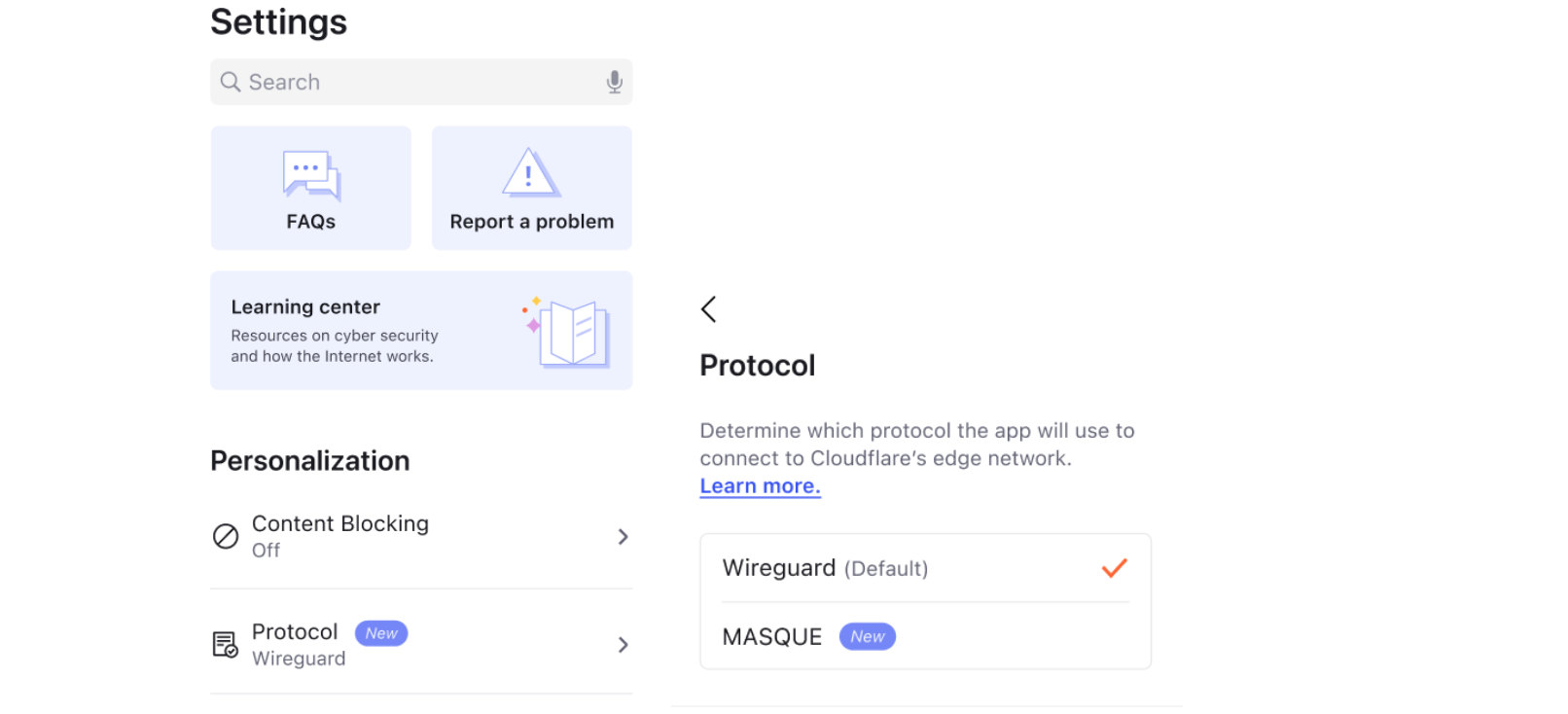
To toggle between Wireguard and MASQUE, go to Settings > Personalization > Protocol:

Donning a MASQUE: building a new protocol into Cloudflare WARP

Protocols come and go, but our privacy promise remains the same

While the protocols that dominate the Internet may change, our promise to consumers remains the same – a more private Internet, free of cost. When using WARP, we still route all DNS queries through 1.1.1.1, our privacy-respecting DNS resolver; we will never write user-identifiable log data to disk; we will never sell your browsing data or use it in any way to target you with advertising data; and you can still use WARP without providing any personal information like your name, phone number, or email address.