Tag Archives: payments

Announcing Cloudflare Wallets: the programmable wallet for the agentic Internet

Post Syndicated from Will Papper original https://blog.cloudflare.com/wallets/

Today, it is difficult for AI agents to try out new APIs. They often have to navigate through a login page designed for humans and not agents, contact a human to add a payment method, generate an API key, and then figure out how to call the API.

This flow is very difficult for agents for two reasons: Agents do not have a stable identifier to sign up for an API, and they do not have a native way to pay for APIs. Because they lack these things, they often struggle to onboard onto software, which limits the growth of agentic commerce. AI agents often give up on these tasks entirely, kicking registration, payment methods, and API key generation back to humans. This makes it very difficult for agents to try out and compare many APIs.

To solve this, we’ve created Cloudflare Wallets. Starting today, you can claim a Cloudflare Wallet handle for your account, which will provide a unique username to help you better connect with merchants. Soon, you will be able to set up and use your Cloudflare Wallet to pay for APIs and content.

Earlier this month, we announced the Monetization Gateway to help Cloudflare customers get paid for their websites and applications. Monetization Gateway will support micropayments using the x402 protocol, which allows for payments to be attached to HTTP requests. These micropayments will be able to pay for uses ranging from AI inference to data to content. If you want to pay or get paid for services behind Monetization Gateway and other x402-compatible endpoints, you’ll need a wallet. 

Cloudflare Wallets will allow you to store stablecoins, purchase services, and receive funds across the web. Each account with a wallet will also be able to create Virtual Wallets for its agents to enable them to buy APIs, MCP Tools, content, and more. You will be able to define guardrails for your Virtual Wallets (such as an allowance, an allow list, and a maximum transaction size) to help your agent spend money safely from your account. This will allow your agent to try out many APIs with low friction and managed risk. Wallet users will have the option to share their Cloudflare Wallet handles, which will give them a stable identity when interacting with merchants.

Building the two-sided agentic market

Cloudflare’s Monetization Gateway will allow eligible Cloudflare customers to sell their resources (such as content or APIs) headlessly to agentic buyers. But for that market to truly develop, agents need more tools to buy from merchants in a machine-native way. Wallets will add another tool to Cloudflare’s Agents SDK, enabling AI agents to easily purchase necessary APIs and content using micropayments.

There will be two types of Cloudflare Wallets: Account Wallets and Virtual Wallets.

Account Wallets are designed for humans who are owners and users of Cloudflare accounts. They will be able to add funds, delegate spend to virtual wallets managed by agents, and remove funds as needed. 

Virtual Wallets, by contrast, are designed for agents and operate via API keys. Within a Virtual Wallet, an agent will be able to spend funds according to its permissions. Its maximum spend will be capped by the limit set by the owner of the Account Wallet. This framework gives agents freedom to act on behalf of users without constant manual approval while limiting an agent’s ability to overspend.

The freedom to explore

Virtual Wallets are exciting because they will allow agents to do what they’re best at: explore dozens or hundreds of services and find the best one for a particular use case. Stablecoin micropayments via x402 will make it simple to try an API without an account, allowing agents to test new options with little friction. The spending caps on Virtual Wallets are designed so that humans can let agents explore autonomously within safe spending limits. These limits may seem like constraints, but counterintuitively they give agents more freedom. If an agent is responsible for $10, you can worry less about its spending than if it is responsible for $1,000. If an API only costs a few cents to try, then $10 is more than sufficient to pursue and evaluate many options.

Once you or your agent has picked an API to use, policies set by you in your Account Wallet will act as cost controls for Virtual Wallets. Want to give every employee a $100 per week budget for AI inference? Simply provision an Account Wallet with the right balance and create Virtual Wallets for each employee with that rule. Anyone who exceeds the limits on their Virtual Wallet will be able to request a manual override from a human who is authorized to make changes to the Account Wallet.

We want to make it easy for Account Wallets to set flexible yet firm spending policies that do not require daily, active monitoring. When something anomalous happens, such as unexpectedly fast spending, a human will be able to review and confirm whether everything is operating as intended. If the spend was intentional, then the administrator of the Account Wallet will be able to raise the limit or approve a one-time injection of funds. If the spend was unintentional, then the spending policies for adding funds to virtual wallets did their job by imposing caps.

We are working to make it as easy as possible to fund and use these wallets. We will start with simple ways to onramp and offramp funds within supported geographies, with self-funding via stablecoins available as an alternative for eligible users. The Internet will not shift completely overnight, but with a majority of traffic on the web now being driven by bots, we are excited to give agents and merchants first-class tools for agentic commerce.

Beyond payments alone

Allowing humans to delegate authority to agents to easily buy and sell services is a helpful starting point. But this delegation is not always obvious to the merchants as they interact with agents. Today, if an agent comes to your website, you may know little about them as a user, despite the fact that the agent is acting on behalf of an individual or an organization. This lack of attribution challenges many traditional web business models. It’s easy to give a one-week free trial or sign-up credits to a human or an organization. It’s hard to give these same perks to an agent that lacks a stable identity and when one human can spin up dozens of agents under their control.

We solve this problem by linking wallets to a Cloudflare account via cloudflare.pay. cloudflare.pay will allow agents to optionally identify themselves, since their identity is a delegate of the account. A research agent could live at research.example.cloudflare.pay, allowing merchants to know that it is an agent from a particular organization. This approach will permit agents to maintain consistent and persistent identities, making the experience better for all parties. It will be completely optional for agents to choose to declare their identity or not, and it will be up to businesses to decide whether they want to prioritize transacting with known agents.

Agent identifiers should be human-readable

We believe that the approach to dealing with agents will look like the approach to dealing with VPNs: If someone is unidentified, they are not inherently untrustworthy, but they need to prove themselves more. This is why we have Turnstile and other initiatives to detect bots within Bot Management. Our identity primitive will build on top of this prior work. For example, Web Bot Auth already allows agents to register their identity via a keypair. IDs attached to Cloudflare Wallets allow this keypair to become human-readable.

We know that agentic identity standards are changing quickly, which is why we wanted to keep our approach simple. We are proposing a human-readable identifier for a not-very-readable keypair, similar to the URL and IP-address pairings used in DNS. We are not trying to define a particular schema or other verification system. We only want to make identity simple to remember and easy to declare. As schemas to enrich agentic identity develop through the x402 Foundation’s initiatives, we will seek to adopt them and intend to encourage others to do the same.

The future of agentic commerce

At Cloudflare, we want to offer all the building blocks for agentic commerce to succeed. Monetization Gateway will offer a way for sellers to get paid without setting up traditional payment infrastructure. Wallets will offer a way for buyers to pay headlessly via agents. Identity will allow merchants to communicate with buyers who identify themselves or enforce identification requirements.

All of these building blocks will create a headless marketplace for the Internet. If you are excited about this and want to participate, you can claim your handle now. We’re excited to see what you build and monetize.

Announcing the Monetization Gateway: charge for any resource behind Cloudflare via x402

Post Syndicated from Rohin Lohe original https://blog.cloudflare.com/monetization-gateway/

Today, we are announcing the Cloudflare Monetization Gateway, an engine that will give Cloudflare customers the ability to charge for any asset protected by Cloudflare: web pages, datasets, APIs, or MCP tools. 

It will provide a single control plane to manage payment policies and access controls across your applications, while also protecting your origin from high payment volumes by handling payment verification and enforcement at the edge. At launch, payments will settle in stablecoins over x402, the open protocol we are building with a coalition of more than 25 industry leaders via the x402 Foundation

The evolving business model of the web

For 30 years, the web has run on a simple economic bargain: trading content for human attention. That attention has been monetized through advertising, subscriptions, and e-commerce. This bargain funded the Internet as we know it. 

But as agents become the dominant Internet users, the model is breaking. An agent does not look at ads or need to maintain a monthly subscription to all the tools it wants to access. It reads a page or consumes a data feed once, takes what it needs, and moves on. Across the web, AI crawlers already request content anywhere from a hundred to tens of thousands of times for every visitor they send back

This reality demands a new model: usage-based pricing for everything. If attention and e-commerce are moving from websites to AI harnesses and AI-written software, then agents should pay for the inputs they need — training data, inference content, developer tooling, and API usage. The natural unit of payment for software is the request, the token, or the outcome, not the seat or the month. A few examples of what that could look like:

  • A few cents per web search, billed per call

  • \$0.001 base fee plus a \$0.01 per MB charge for an upload endpoint

  • \$0.99 per resolved support escalation, paid only when the work succeeds

This is the same shift behind paying creators when an answer engine uses their content — a fair exchange of value whenever content or a resource is used, priced on neutral rails built for the purpose. People often envision an agent buying high-priced assets like web domains, but most of what an agent pays for sits upstream of any checkout, and is priced far lower.

Some of the Internet already works this way. Cloud and APIs have been sold by the call and by the hour for years, but only to a known buyer: a user signs up, they are issued an API key, and they incur usage-based metered billing. Content mostly skipped payment and ran on advertising instead. These business models have never been able to serve unverified buyers for sub-cent transactions because the payment rails cost too much and took too long to settle. Below a certain price, collecting the payment cost more than the payment was worth.

Historically, usage-based billing was difficult to implement. Businesses needed to effectively become payments companies, running their own accounting to track internal usage in a robust and auditable way. Tracking this usage required significant overhauls of backend systems. Many instead chose per-seat pricing because it is simpler and frequently more profitable. 

Agents flip this dynamic. A single agent can do the work of an entire team around the clock, making a flat one-time fee disconnected from actual consumption. At the same time, an agent can make thousands of micropayments without friction, while asking a person to approve each payment would be impossibly burdensome. Usage-based price points are where agents live and where stablecoin-based micropayments shine. That’s because stablecoins (such as Open USD and USDC) allow buyers to transfer tiny sums across the Internet, incurring negligible fees and settling in less than a second. This is not feasible with other payment rails today.

Here’s where we can help. Cloudflare has spent years building usage-based accounting for our own billing systems and for our customers’ analytics. We can dramatically simplify the implementation of usage-based billing for web-based assets thanks to our position as a proxy layer between buyers and sellers. As shown below, with Cloudflare supporting usage-based billing, the evidence of payment can move into the request itself, and the payment validation and the request paths merge.


And here’s the benefit to you: the metering, the payment exchange, and the settlement move off your origin. What stays with you is what matters — your rules, your prices, and your revenue. You will not need to onboard the buyer or stand up a billing system. You will write a rule and agentic buyers will pay for what they use.

A refresher on x402

Last year on Content Independence Day, we gave site owners one-click control over which AI crawlers could reach their content, and with Pay Per Crawl we let them charge crawlers for it. The Monetization Gateway is the next step: instead of only charging crawlers for content, you will be able to charge any caller for any resource, from an API to data to an MCP tool call, and you will not have to build the payment machinery yourself.

x402 is an open protocol that makes it possible to pay over HTTP, named for the 402 status code it finally puts to use. The x402 exchange is simple: a client requests a payment-gated resource. Instead of serving it, the server responds with 402 Payment Required and a small payload that states the price, the accepted asset, and where to pay. The client pays and repeats the request with proof of payment attached. A facilitator verifies, and the server returns the resource. It all happens inside ordinary HTTP requests and responses, with no redirect to a checkout page and no separate payment API to call. Settlement happens peer-to-peer, so any funds that a buyer sends to a seller are directly deposited to the seller’s wallet. We are designing the Monetization Gateway to keep payment overhead low and are aiming for sub-second payment settlement.


x402 Payment Flow: AI Agent ↔ APIServer ↔ Blockchain, Source: x402 Readme on GitHub

Two properties make x402 a good fit for machine payments. The payment amounts can be small, down to fractions of a cent, because the protocol adds almost no overhead. And the buyer needs no account with the seller, because the payment itself is the credential. x402 is rail agnostic, but it is a natural fit for stablecoins, which can settle in under a second for a fraction of a cent with zero chargebacks.

What the Monetization Gateway does

The Monetization Gateway will provide a flexible payment rules API that will allow you to express exactly when you want a caller to pay to access your digital resources.


Here’s how it will work. Tokens, APIs, MCP tool calls, and data already flow through that path. You will decide, as precisely as you want, which of that traffic has to pay. And you will be able to enforce your decisions by writing expressions, similar to expressions that you already write for other Cloudflare rules, in a simple, dedicated product API. The Monetization Gateway will scale with Cloudflare’s global network across 330+ cities, which means that the x402 handshake will occur in close proximity to your buyer. This will reduce request latency and protect your origin. 

A few examples of planned capabilities:

  • Charge for specific REST verbs: Require payment on calls to a specific route, for example $0.01 for every GET or POST request to /api/premium/*.

  • Variable pricing: Charge variable amounts for tasks of varying complexity, for example, image generation might charge any amount up to $2, depending on the compute used.

  • Charge only unauthenticated callers: Intercept HTTP 401 “Unauthorized” responses from your origin and return 402 “Payment Required” instead with pricing and payment instructions.

When a request matches, the Monetization Gateway will verify payment before letting it through. You will be able to set these rules in the dashboard, or manage them as code through the Cloudflare API and Terraform, so a paid endpoint is just another part of your infrastructure config.

The Monetization Gateway will initially allow users to require buyers to pay for services and resources in stablecoins. Sellers will be able to use the stablecoins they accumulate for their own transactions or redeem the stablecoins for equivalent fiat currency in their bank account. Using the Monetization Gateway offers a way to increase the addressable market for your products. With the Gateway, agents can request your resource, be told the price, pay, and get the response. No signup, no API key, no prior relationship required. You will decide how much you need to know about that buyer, and you will have the flexibility to require agents to authenticate with Web Bot Auth and apply usage-based pricing against accounts they already hold.

Where we see this going

The Monetization Gateway will turn the request into a payment and give Cloudflare customers new revenue opportunities, but where this goes is far bigger.

An agent is software that acts autonomously on a user’s behalf, and agents are starting to act on their own. Soon they will carry wallets and buy what they need without a person in the loop: a dataset, an API call, a tool, a block of compute. Some of those resources will be free, and some will require proof of who the agent is and who it acts for, through verified agent identity. Many will require both an identity and a payment, and Cloudflare is one of the few places that will be able to settle all of it inside a single request, by verifying the agent, applying the rule, and checking the payment before the origin ever sees the call. The agent becomes the primary buyer on the Internet, and the request becomes the transaction.

There is an enormous amount of value moving across the Internet today that goes unmonetized or undermonetized, not because no one would pay for it, but because the tools to charge for it have never existed. Every useful API call, every answer, every tool invocation an agent makes has value, and almost none of it is paid for today. That is the opportunity in front of us, and it is what the Monetization Gateway will unlock.

This is what we are building toward: an agent-first Internet with Internet-scale settlement built in. Where the people who make something worth paying for get paid by the software that uses it, automatically. And where the smallest new API can reach the same buyers, on the same terms, as the largest company on the web, and the independent creator is paid by the large language models that use their work. That is the next business model of the Internet, and we are building to power it.

Sign up for our waitlist

The Monetization Gateway waitlist is open now for Cloudflare customers. If you’re interested in monetizing your web page, dataset, API, or MCP tool with usage-based pricing, please join our early access list.


ML Observability: Bringing Transparency to Payments and Beyond

Post Syndicated from Netflix Technology Blog original https://netflixtechblog.com/ml-observability-bring-transparency-to-payments-and-beyond-33073e260a38

By Tanya Tang, Andrew Mehrmann

At Netflix, the importance of ML observability cannot be overstated. ML observability refers to the ability to monitor, understand, and gain insights into the performance and behavior of machine learning models in production. It involves tracking key metrics, detecting anomalies, diagnosing issues, and ensuring models are operating reliably and as intended. ML observability helps teams identify data drift, model degradation, and operational problems, enabling faster troubleshooting and continuous improvement of ML systems.

One specific area where ML observability plays a crucial role is in payment processing. At Netflix, we strive to ensure that technical or process-related payment issues never become a barrier for someone wanting to sign up or continue using our service. By leveraging ML to optimize payment processing, and using ML observability to monitor and explain these decisions, we can reduce payment friction. This ensures that new members can subscribe seamlessly and existing members can renew without hassle, allowing everyone to enjoy Netflix without interruption.

ML Observability: A Primer

ML Observability is a set of practices and tools to help ML practitioners and stakeholders alike gain a deeper, end to end understanding of their ML systems across all stages of its lifecycle, from development to deployment to ongoing operations. An effective ML Observability framework not only facilitates automatic detection and surfacing of issues but also provides detailed root cause analysis, acting as a guardrail to ensure ML systems perform reliably over time. This enables teams to iterate and improve their models rapidly, reduce time to detection for incidents, while also increasing the buy-in and trust of their stakeholders by providing rich context about the system’s’ behaviors and impact.

Some examples of these tools include long-term production performance monitoring and analysis, feature, target, and prediction drift monitoring, automated data quality checks, and model explainability. For example, a good observability system would detect aberrations in input data, the feature pipeline, predictions, and outcomes as well provide insight into the likely causes of model decisions and/or performance.

As an ML portfolio grows, ad-hoc monitoring becomes increasingly challenging. Greater complexity also raises the likelihood of interactions between different model components, making it unrealistic to treat each model as an isolated black box. At this stage, investing strategically in observability is essential — not only to support the current portfolio, but also to prepare for future growth.

Stakeholder-Facing Observability Modules

In order to reliably and responsibly evolve our payments processing system to be increasingly ML-driven, we invested heavily up-front in ML observability solutions. To provide confidence to our business stakeholders through this evolution, we looked beyond technical metrics such as precision and recall and placed greater emphasis on real-world outcomes like “how much traffic did we send down this route” and “where are the regions that ML is underperforming.”

Using this as a guidepost, we designed a collection of interconnected modules for machine learning observability: logging, monitoring, and explaining.

Logging

In order to support the monitoring and explaining we wanted to do, we first needed to log the appropriate data. This seems obvious and trivial, but as usual the devil is in the details: what fields exactly do we need to log and when? How does this work for simple models vs. more complex ones? What about models that are actually made of multiple models?

Consider the following, relatively straightforward model. It takes some input data, creates features, passes these to a model which creates some score between 0 and 1, and then that score is translated into a decision (say, whether to process a card as Debit or Credit).

There are several elements you may wish to log: a unique identifier for each record that is trained and scored, the raw data, the final features that fed the model, a unique identifier for the model, the feature importances for that model, the raw model score, the cutoffs used to map a score to a decision, timestamps for the decision as well as the model, etc.

To address this, we drafted an initial data schema that would enable our various ML observability initiatives. We identified the following logical entities to be necessary for the observability initiatives we were pursuing:

Monitoring

The goal of monitoring is twofold: 1) enable self-serve analytics and 2) provide opinionated views into key model insights. It can be helpful to think of this as “business analytics on your models,” as a lot of the key concepts (online analytical processing cubes, visualizations, metric definitions, etc) carry over. Following this analogy, we can craft key metrics that help us understand our models. There are several considerations when defining metrics, including whether your needs are understanding real-world model behavior versus offline model metrics, and whether your audience are ML practitioners or model stakeholders.

Due to our particular needs, our bias for metrics is toward online, stakeholder-focused metrics. Online metrics tell us what actually happened in the real world, rather than in an idealized counterfactual universe that might have its own biases. Additionally, our stakeholders’ focus is on business outcomes, so our metrics tend to be outcome-focused rather than abstract and technical model metrics.

We focused on simple, easy to explain metrics:

These metrics begin to suggest reasons for changing trends in the model’s behavior over time, as well as more generally how the model is performing. This gives us an overall view of model health and an intuitive approximation of what we think the model should have done. For example, if payment processor A starts receiving more traffic in a certain market compared to payment processor B, you might ask:

  • Has the model seen something to make it prefer processor A?
  • Have more transactions become eligible to go to processor A?

However, to truly explain specific decisions made by the model, especially which features are responsible for current trends, we need to use more advanced explainability tools, which will be discussed in the next section.

Explaining

Explainability means understanding the “why” behind ML decisions. This can mean the “why” in aggregate (e.g. why are so many of our transactions suddenly going down one particular route) or the “why” for a single instance (e.g. what factors led to this particular transaction being routed a particular way). This gives us the ability to approximate the previous status quo where we could inspect our static rules for insights about route volume.

One of the most effective tools we can leverage for ML explainability is SHAP (Shapley Additive exPlanations, Lundberg & Lee 2017). At a high level, SHAP values are derived from cooperative game theory, specifically the Shapley values concept. The core idea is to fairly distribute the “payout” (in our case, the model’s prediction) among the “players” (the input features) by considering their contribution to the prediction.

Key Benefits of SHAP:

  1. Model-Agnostic: SHAP can be applied to any ML model, making it a versatile tool for explainability.
  2. Consistent and Local Explanations: SHAP provides consistent explanations for individual predictions, helping us understand the contribution of each feature to a specific decision.
  3. Global Interpretability: By aggregating SHAP values across many predictions, we can gain insights into the overall behavior of the model and the importance of different features.
  4. Mathematical properties: SHAP satisfies important mathematical axioms such as efficiency, symmetry, dummy, and additivity. These properties allow us to compute explanations at the individual level and aggregate them for any ad-hoc groups that stakeholders are interested in, such as country, issuing bank, processor, or any combinations thereof.

Because of the above advantages, we leverage SHAP as one core algorithm to unpack a variety of models and open the black box for stakeholders. Its well-documented Python interface makes it easy to integrate into our workflows.

Explaining Complex ML Systems

For ML systems that score single events and use the output scores directly for business decisions, explainability is relatively straightforward, as the production decision is directly tied to the model’s output. However, in the case of a bandit algorithm, explainability can be more complex because the bandit policy may involve multiple layers, meaning the model’s output may not be the final decision used in production. For example, we may have a classifier model to predict the likelihood of transaction approval for each route, but we might want to penalize certain routes due to higher processing fees.

Here is an example of a plot we built to visualize these layers. The traffic that the model would have selected on its own is on the left, and different penalty or guardrail layers impact final volume as you move left to right. For example, the model originally allocated 22% traffic to processor W with Configuration A, however for cost and contractual considerations, the traffic was reduced to 19% with 3% being allocated to Processor W with Configuration B, and Processor Nc with Configuration B.

While individual event analysis is crucial, such as in fraud detection where false positives need to be scrutinized, in payment processing, stakeholders are more interested in explaining model decisions at a group level (e.g., decisions for one issuing bank from a country). This is essential for business conversations with external parties. SHAP’s mathematical properties allow for flexible aggregation at the group level while maintaining consistency and accuracy.

Additionally, due to the multi-candidate structure, when stakeholders inquire about why a particular candidate was chosen, they are often interested in the differential perspective — specifically, why another similar candidate was not selected. We leverage SHAP to segment populations into cohorts that share the same candidates and identify the features that make subtle but critical differences. For example, while Feature A might be globally important, if we compare two candidates that both have the same value for Feature A, the local differences become crucial. This facilitates stakeholders discussions and helps understand subtle differences among different routes or payment partners.

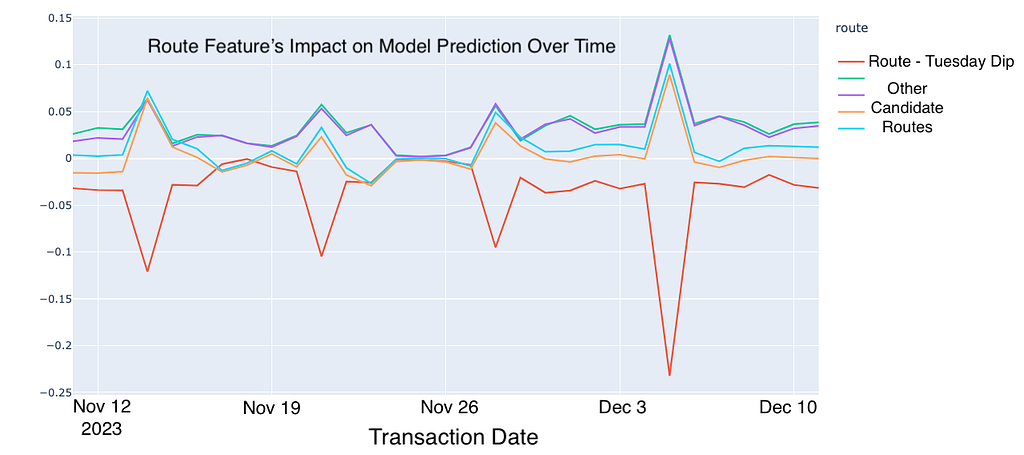
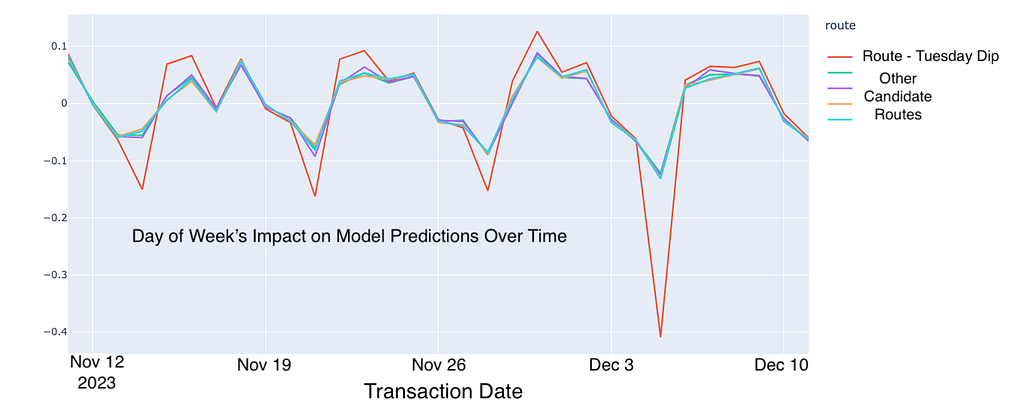
Earlier, we were alerted that our ML model consistently reduced traffic to a particular route every Tuesday. By leveraging our explanation system, we identified that two features — route and day of the week — were contributing negatively to the predictions on Tuesdays. Further analysis revealed that this route had experienced an outage on a previous Tuesday, which the model had learned and encoded into the route and day of the week features. This raises an important question: should outage data be included in model training? This discovery opens up discussions with stakeholders and provides opportunities to further enhance our ML system.

The explanation system not only demystifies our machine learning models but also fosters transparency and trust among our stakeholders, enabling more informed and confident decision-making.

Wrapping Up

At Netflix, we face the challenge of routing thousands of payment transactions per minute in our mission to entertain the world. To help meet this challenge, we introduced an observability framework and set of tools to allow us to open the ML black box and understand the intricacies of how we route billions of dollars of transactions in hundreds of countries every year. This has led to a massive operational complexity reduction in addition to improved transaction approval rate, while also allowing us to focus on innovation rather than operations.

Looking ahead, we are generalizing our solution with a standardized data schema. This will simplify applying our advanced ML observability tools to other models across various domains. By creating a versatile and scalable framework, we aim to empower ML developers to quickly deploy and improve models, bring transparency to stakeholders, and accelerate innovation.

We also thank Karthik Chandrashekar, Zainab Mahar Mir, Josh Karoly and Josh Korn for their helpful suggestions.


ML Observability: Bringing Transparency to Payments and Beyond was originally published in Netflix TechBlog on Medium, where people are continuing the conversation by highlighting and responding to this story.