Tag Archives: Responsible AI

Enabling AI adoption at scale through enterprise risk management framework – Part 2

Post Syndicated from Milind Dabhole original https://aws.amazon.com/blogs/security/enabling-ai-adoption-at-scale-through-enterprise-risk-management-framework-part-2/

In Part 1 of this series, we explored the fundamental risks and governance considerations. In this part, we examine practical strategies for adapting your enterprise risk management framework (ERMF) to harness generative AI’s power while maintaining robust controls.

This part covers:

  • Adapting your ERMF for the cloud
  • Adapting your ERMF for generative AI
  • Sustainable Risk Management

By the end of this post, you’ll have a roadmap for scaling generative AI adoption securely and responsibly.

Adapting your ERMF for the cloud

Before diving into generative AI-specific controls, it’s crucial to understand the fundamental infrastructure that enables these technologies. Cloud computing is the foundational infrastructure that has made generative AI possible and accessible at scale. The development and deployment of large language models and other generative AI systems require massive computational resources, vast amounts of data storage, and sophisticated distributed processing capabilities that cloud systems can efficiently provide.

Cloud technology differs from on-premises IT solutions, and the relationship between financial institutions and cloud service providers is also different from the relationship with a traditional outsourcing provider.

These differences change the nature of many risks that financial institutions face and how they manage them. However, if cloud technology is implemented in the right way, it can reduce risk and provide tools to help Chief Risk Officers (CROs) to manage risk too.

You can read more about how your ERMF needs to change for large scale cloud adoption in Is your Enterprise Risk Management Framework ready for the Cloud?

Adapting your ERMF for generative AI

Organizations adopting generative AI can use their enterprise risk management framework to realize business value while maintaining appropriate controls. This approach allows you to build on existing risk management practices while addressing generative AI’s unique characteristics.

For a structured approach to cloud-enabled AI transformation, the AWS Cloud Adoption Framework for AI, ML, and generative AI (AWS CAF for AI) provides detailed implementation guidance aligned with enterprise risk management principles. For a detailed user guide, see AWS User Guide to Governance, Risk and Compliance for Responsible AI Adoption within Financial Services Industries, available in AWS Artifact using your AWS sign in. AWS Artifact provides AWS security and compliance reports, helping organizations maintain compliance through best practices.

When it comes to model management and the AI system lifecycle, customers can consult ISO42001 AI Management, Section A6. This section encompasses capturing the objective and processes for the responsible design and development of AI systems, including criteria and requirements for each stage of the AI system life cycle. This guidance can help organizations verify that their model management practices align with industry standards for responsible AI development.

From a business leader’s perspective, incorporating generative AI considerations into your ERMF helps establish documented good practices, implement effective controls, and maintain transparency about usage across the enterprise. This enables both responsible innovation and prudent risk management. Here’s how organizations are approaching this:

Generative AI policy and governance foundations in ERMF

In the field of generative AI, organizations establish both guardrails for innovation and clear accountability for risk management. The three lines of defense model provides the structure for implementing these foundational elements:

  • Acceptable use framework for your organization: Clear direction on appropriate generative AI use helps organizations manage risks while enabling innovation. The range of use cases for generative AI is large and likely to expand over the years, making it essential to have clear guidance on what applications are permitted and under what conditions. As organizations explore these opportunities, their framework can evolve with their experience and maturity.
  • Risk accountability: The generative AI lifecycle—from use case selection through implementation and ongoing monitoring—requires clear ownership across business and control functions. While organizations can establish specific generative AI oversight mechanisms, these should integrate with existing governance structures. Risk reporting and accountability for generative AI initiatives should flow through established enterprise risk committees and governance boards, helping to facilitate consistent risk management across the organization rather than creating isolated pockets of oversight.

Implementation approach for generative AI: Putting principles into practice

Building on the three lines of defense model discussed earlier, organizations can adapt their risk management practices to address the unique characteristics of generative AI while using industry best practices and frameworks. This often involves evolving existing controls and introducing new ones specific to generative AI. AWS services have built-in capabilities that support these enhanced governance, risk management, and compliance requirements, helping organizations to implement controlled and responsible generative AI solutions. This includes, for example, Amazon Bedrock Guardrails, among many others.

Building on the risk areas we outlined earlier, we now explore how organizations can implement controls for each of these areas. For each, we describe the principle and the practical implementation considerations. While organizations might prioritize these areas differently based on their use cases and risk appetite, together they provide a framework for responsible generative AI adoption through ERMF.

While we explore high-level control principles that follow, technical teams can review the AWS Well-Architected Framework – Generative AI Lens for detailed architectural guidance that supports these governance objectives.

Fairness

Generative AI systems can deliver equitable outcomes across different stakeholder groups, helping organizations build trust and meet expectations. Organizations can support this by setting up clear fairness metrics for specific use cases, regularly assessing training data for bias, and closely monitoring performance across different groups. For high-stakes applications, additional checks can help facilitate fair treatment across diverse populations.

Amazon Bedrock Guardrails provides configurable safeguards to help maintain fair and unbiased outputs, with customizable thresholds to match different use case requirements. Amazon Bedrock provides comprehensive model evaluation tools including model cards with detailed bias metrics, to assess bias across demographic groups. Amazon Bedrock includes built-in prompt datasets like the Bias in Open-ended Language Generation Dataset (BOLD), which automatically evaluates fairness across key areas such as profession, gender, race, and various ideologies. These capabilities integrate with Amazon SageMaker Clarify for comprehensive bias detection and mitigation, supported by built-in bias metrics and reporting.

Explainability

Generative AI systems can provide understanding of their decision-making processes, supporting accountability and effective oversight. Explainability is essential for all generative AI systems—whether using custom-built or pre-built models, particularly for complex models like transformer networks.

Organizations can implement practical controls by establishing clear explainability thresholds based on use case risk levels. This remains an active industry challenge, with ongoing research and evolving approaches. For critical business applications, tailoring explanations to different stakeholders while maintaining accuracy can improve understanding and trust.

Amazon Bedrock provides tools that help identify which factors influenced the generative AI’s decisions, while maintaining detailed records of system inputs and outputs. For complex workflows, Chain-of-Thought (CoT) reasoning traces are available through Amazon Bedrock Agents, showing the step-by-step logic behind each decision. Organizations can monitor how responses are generated in real time. For Retrieval-Augmented Generation (RAG) applications, which optimize AI outputs by referencing specific knowledge bases, Amazon Bedrock Knowledge Bases automatically includes references and links to source materials used in generating responses.

Privacy and security

Generative AI systems benefit from strong privacy and security measures to protect sensitive information and help prevent unauthorized access or data exposure. These systems can potentially generate content or unintentionally reveal confidential data, which organizations can proactively manage.

Organizations can set up multi-layered protection strategies, including access controls, content filtering, and data privacy safeguards. This can involve creating company-wide standards for prompt engineering to help prevent harmful outputs, using techniques like RAG to control information sources, and using automated systems to detect and protect personal information. Regular testing and validation, especially to comply with regulations like GDPR, can be part of the development and deployment process.

Amazon Bedrock implements multiple security layers including private endpoints with Amazon Virtual Private Cloud (Amazon VPC) support, fine-grained AWS Identity and Access Management (IAM) access control, and end-to-end encryption. Importantly, it maintains no persistent storage of prompt or completion data and helps preserve model provider isolation.

Amazon Bedrock Guardrails provides sensitive information filters that can detect and protect personally identifiable information (PII) through automated input rejection, response redaction, and configurable regex patterns, supporting various use cases while maintaining data privacy. Organizations like Genesys demonstrate these capabilities at scale, maintaining GDPR compliance while processing 1.5 billion monthly customer interactions through Amazon Bedrock.

For detailed security considerations, see Generative AI Security Scoping Matrix, which provides a comprehensive framework for assessing and addressing generative AI security risks.

Safety

Generative AI systems can be designed and operated with safeguards to avoid harm to individuals, and communities. This includes addressing risks of generating dangerous, illegal, or abusive content, and helping to prevent system misuse.

Organizations can implement specific safety measures through predeployment content filtering, real-time safety boundaries with prompt constraints, and output classification systems to detect and block dangerous content. Context-aware content moderation considers the specific application domain, while automated detection can identify potential safety violations before content generation. Ongoing monitoring and updating of these controls help address evolving capabilities and potential risks of generative AI systems.

Amazon Bedrock Guardrails delivers industry-leading safety protections across text and images, blocking up to 85 percent more harmful content on top of native protections provided by foundation models (FMs). Additional safety controls include token limits to avoid excessive responses, rate limiting against misuse, and moderation endpoints for content screening.

For full practical implementation guidance on building safety controls, see Build safe and responsible generative AI applications with guardrails.

Controllability

Organizations can maintain appropriate control over generative AI systems to make sure that they work as intended and can be adjusted or stopped if issues arise. This helps manage risks and maintain system reliability.

A multi-layered approach to control includes implementing technical safeguards and operational processes. Organizations can control model behaviour by adjusting parameters such as temperature (controlling output randomness), and sampling methods like top-k or top-p (managing output diversity). Clear operational boundaries define the system’s scope of action, while human-in-the-loop validation provides oversight for critical applications.

For effective control, organizations can establish parameter thresholds tailored to different use cases, implement rapid adjustment mechanisms, and create clear escalation procedures. Amazon Bedrock enhances control through customizable agent prompts and reasoning techniques, and the ability to break complex tasks into smaller, manageable components. Organizations can choose between structured workflows or flexible agent-based approaches. Regular comparison of outputs against established benchmarks helps maintain system reliability.

This balanced approach supports creative AI outputs while helping to facilitate consistent performance within defined quality limits. This helps prevent service degradation and business disruption while minimizing inefficiencies.

Control capabilities are further enhanced through Amazon CloudWatch monitoring integration and robust knowledge base version control. The capabilities of Amazon Bedrock, including LLM-as-a-judge features, help organizations assess and optimize their generative AI applications efficiently.

Veracity and robustness

Generative AI systems can produce reliable and accurate outputs, even when faced with unexpected or challenging inputs. This helps maintain trust and helps maintain the system’s usefulness across various applications.

Organizations can implement a combination of technical and procedural controls to enhance both system robustness and output reliability. This includes establishing clear parameter thresholds for different use cases, implementing human-in-the-loop validation for critical applications, and regularly comparing outputs against established ground truths. The framework specifies when and how these controls are applied based on the use case criticality and required level of accuracy.

Amazon Bedrock Guardrails improves veracity by helping to prevent factual errors through automated reasoning checks that deliver up to 99 percent accuracy in detecting correct responses from models, using mathematical logic and formal verification techniques. This capability supports processing of large documents up to 80,000 tokens and includes automated scenario generation for comprehensive testing.

Amazon Bedrock also includes sophisticated input sanitization features and supports adversarial testing through AWS testing tools integration.

Governance

Effective governance of generative AI systems helps manage risks, maintain accountability, and align AI use with organizational values and regulations. This covers the entire AI lifecycle, from development to deployment and ongoing operation.

Organizations can create clear governance structures, including defined roles for AI oversight, regular risk assessments, and ways to engage with stakeholders. This involves integrating AI governance into existing risk management practices and making sure of compliance with relevant laws and standards. Because AI technology is evolving rapidly, regular reviews and updates to governance practices are essential to address new capabilities, emerging risks, and changing regulatory requirements. This includes providing appropriate training and skill development for system users.

AWS has achieved of ISO/IEC 42001 certification, demonstrating our commitment to systematic governance approaches in AI implementation. Governance features in Amazon Bedrock include comprehensive model provenance tracking, detailed AWS CloudTrail audit logging, and streamlined model deployment approval workflows integrated with AWS Organizations. AWS Audit Manager provides pre-built frameworks to assess generative AI implementation against best practices.

Transparency

Generative AI systems can operate transparently, helping stakeholders understand system capabilities, limitations, and the context of AI-generated outputs. This builds trust and enables informed decision-making by users and affected parties.

Organizations can implement specific transparency measures including comprehensive model documentation detailing intended use cases, known limitations, and performance boundaries. Clear AI disclosure practices should describe when and how AI is being used and what data is being processed. Regular performance reporting can include accuracy rates, error patterns, and bias assessments.

For customer-facing applications, transparency includes providing clear indicators of AI-generated content, documenting how decisions are made, and establishing processes for users to question or challenge outputs. Maintaining detailed version histories of model updates and changes in system behavior helps track the evolution of AI capabilities and their impacts over time.

From the AWS side of the Shared Responsibility Model, transparency is supported through AWS AI Service Cards and detailed documentation of model characteristics. Amazon Bedrock enhances this with comprehensive logging and monitoring capabilities to track model behavior and performance metrics.

Unified risk management

These eight areas are interconnected and mutually reinforcing within the enterprise risk management framework. While organizations might prioritize them differently based on their use cases and risk appetite, together they provide a comprehensive approach to responsible generative AI adoption. For detailed technical guidance, standards, and compliance requirements, see the AWS guidance documents in Resources for technical implementation, at the end of this blog post, that support implementation across these areas.

AI risk management in practice: Building organizational capability

Successful implementation of generative AI systems involves integrating risk management practices across the organization. This includes establishing processes for measuring outcomes and risks and preparing the organization to adapt as technology evolves. Effective risk management depends on building appropriate knowledge and skills at all levels of the organization.

Organizations can create clear pathways from proof of concept to production by aligning with the three lines of defense model. The ERMF provides broad parameters for reliability, safety, and privacy, which business units can adapt for their specific use cases.

To build and maintain lasting capability for both current and future generative AI adoption, organizations can focus on:

  • Developing incident response plans for AI-specific scenarios
  • Building expertise through training and certification programs
  • Regular review and updates of risk management practices

These elements, when woven into the organization’s operating fabric, create sustainable practices that evolve with advancing technology and emerging risks.

Sustainable risk management: Making your ERMF generative AI-ready

Governance, risk, and compliance (GRC) leaders, Chief Risk Officers (CROs), and Chief Internal Auditors (CIAs) can provide sustained executive sponsorship for generative AI adoption. Long-term capability building extends beyond technology and innovation hubs to encompass business and control functions. Clear direction from leadership helps organizations balance generative AI opportunities with appropriate risk management.

Organizations benefit from viewing generative AI as a transformative capability that touches many functions rather than as isolated initiatives. This approach supports sustainable integration of enterprise-wide governance approaches for generative AI, avoiding the limitations of short-term projects with restricted scope and impact.

Organizations can successfully implement generative AI while maintaining their risk management obligations through controlled, well-defined use cases. TP ICAP’s Parameta division demonstrates this approach in their regulatory compliance implementation. By focusing initially on a highly regulated area, maintaining clear governance controls, and making sure there was human oversight in the compliance review process, they established a framework for responsible AI adoption. This led to creating dedicated oversight roles for AI initiatives, strengthening their governance structure for future AI implementations.

Similarly, Rocket Mortgage’s implementation of AWS services for their AI tool Rocket Logic – Synopsis demonstrates how organizations can use Amazon Bedrock for responsible AI integration at scale. This approach enabled them to maintain stringent data security and compliance measures while saving 40,000 team hours annually through automated processes.

Action checklist for sustainable generative AI implementation:

  • ERMF foundations: Assess and enhance your risk framework’s readiness for generative AI, including acceptable use guidelines and clear accountabilities
  • Technical controls: Begin with core controls such as Amazon Bedrock Guardrails and expand based on specific use cases and risk profiles
  • Organizational capability: Develop broad expertise through training and oversight mechanisms across business and control functions
  • Monitoring and measurement: Create dashboards for key risk indicators and maintain regular reviews
  • Integration strategy: Align generative AI controls with existing processes and organizational strategy

Conclusion

This two-part series has explored the critical importance of integrating generative AI governance into enterprise risk management frameworks. In Part 1, we introduced the unique risks and governance considerations associated with generative AI adoption. Part 2 has provided a comprehensive guide for adapting your ERMF to address these challenges effectively.

We’ve outlined practical strategies for scaling generative AI adoption securely and responsibly, covering key areas such as fairness, explainability, privacy and security, safety, controllability, veracity and robustness, governance, and transparency. By implementing these strategies and following the action checklist provided, organizations can build sustainable practices that evolve with advancing technology and emerging risks.

Organizations that integrate generative AI governance into their ERMF as described in this post are better positioned to accelerate innovation and operational efficiency while protecting against key risks such as data exposure, model hallucinations, and regulatory non-compliance. This balanced approach enables organizations to capture the transformative potential of generative AI while maintaining the robust controls essential for financial services institutions.

For foundational concepts and risk considerations, see Part 1.

Customer success stories

Resources for technical implementation


If you have feedback about this post, submit comments in the Comments section below. If you have questions about this post, contact AWS Support.

Milind Dabhole

Milind Dabhole

Milind is a Principal Customer Solutions Manager focusing on enterprise innovation and risk governance. Before joining AWS, he spent over two decades in financial services, holding senior roles across first, second, and third lines of defense at global financial institutions. At AWS, he advises C-suite executives on cloud and AI transformation strategies that balance innovation with robust controls.

Stephen James Martin

Stephen James Martin

Steve is the Head of Financial Services Compliance and Security for EMEA and APAC. Steve Joined AWS after working for over 20 years in financial service in senior leadership roles with responsibility across Asia, the Middle East, and Europe. At AWS, he supports customers as they use the scale, security, and agility of AWS to transform the industry.

Enabling AI adoption at scale through enterprise risk management framework – Part 1

Post Syndicated from Milind Dabhole original https://aws.amazon.com/blogs/security/enabling-ai-adoption-at-scale-through-enterprise-risk-management-framework-part-1/

According to BCG research, 84% of executives view responsible AI as a top management responsibility, yet only 25% of them have programs that fully address it. Responsible AI can be achieved through effective governance, and with the rapid adoption of generative AI, this governance has become a business imperative, not just an IT concern. By implementing systematic governance approaches at the enterprise level, organizations can balance innovation with control, effectively managing the risks while harnessing the transformative potential of generative AI.

While generative AI technologies offer compelling capabilities, they also introduce new types of risks that need business oversight and management. Financial institutions face real challenges—AI-driven financial analysis tools could make investment recommendations based on biased data, leading to significant losses, while generative AI-powered customer service systems might inadvertently expose confidential customer information. The unprecedented scale and speed at which generative AI operates makes robust business controls essential. However, with the right governance approach and strategic oversight, these risks are manageable.

Part 1 of this two-part blog post guides business leaders, Chief Risk Officers (CROs), and Chief Internal Auditors (CIAs) through three critical questions:

  • What specific or unique risks does generative AI introduce and how can they be managed?
  • How should your enterprise risk management framework (ERMF) evolve to support generative AI adoption?
  • How can you build sustainable generative AI governance in an ever-changing world—what should be on your checklist?

To address these questions, organizations can use established frameworks and standards including:

These frameworks provide valuable guidance for organizations looking to implement responsible and governed AI practices.

Role of GRC leaders, CROs, and CIAs

Governance, risk and control (GRC) functions led by business leaders, CROs and CIAs are well-positioned to advance generative AI innovation in financial services institutions. These functions have successfully managed complex risks in banks for years, and their existing expertise, proven approaches, and established risk frameworks provide a strong foundation for guiding generative AI adoption. They collaborate across the three lines of defense: business leaders making implementation decisions and managing associated risks (first line), risk and compliance functions providing frameworks and oversight (second line), and internal audit providing independent assurance (third line).

If generative AI risks, both perceived and real, are managed through enterprise-wide governance practices rather than isolated project-by-project approaches, organizations can use the advantages offered by generative AI over the long term. This requires integration with the ERMF, with some practices fitting into existing structures while others need deliberate adjustments to ERMF itself to address generative AI’s unique characteristics.

New frontiers in generative AI risk management

The traditional risk landscape at the enterprise level was based on a paradigm in which risks are predicted from past exposures. Preventive controls help stop unwanted things from happening, detective controls discover when bad things slip through the preventive controls, and corrective controls take remediation actions.

Much of this paradigm is still valid in the world of generative AI. For example, access to generative AI applications needs to be managed carefully to avoid unauthorized use. All three types of the preceding controls should help prevent unauthorized use, identify potential breaches, and remedy unauthorized access when detected.

However, additional focus and attention are required in the following areas when implementing generative AI solutions:

  • Non-deterministic outputs – The non-deterministic nature of generative AI outputs poses a specific challenge. While the probabilistic nature of these systems is often useful, the risk of inaccurate output from the black box can have serious business implications, and organizations need to take conscious actions to address these risks. Organizations can address this through Amazon Bedrock Guardrails Automated Reasoning checks, which use mathematically sound verification to help prevent factual errors and hallucinations.
  • Deepfake threat – Generative AI’s ability to create authentic-looking images and documents extends beyond traditional fraudulent activities. It elevates the threat to an entirely new level, creating eerily realistic content with unprecedented ease—hence the term deepfake. This poses significant challenges for organizations in verifying document authenticity, particularly in processes like Know Your Customer (KYC).
  • Layered opacity – While enterprises are learning about generative AI, they must address risks from multi-layered AI systems where each layer generates content and makes decisions based on potentially unexplainable models, hampering traceability. For example, consider generative AI outputs from a third-party system serving as inputs to internal AI systems, creating a chain of interdependent decisions. This lack of transparency in critical decisions affecting organizational performance and customer treatment could have profound implications for enterprise trustworthiness, brand reputation, and regulatory compliance.

The following table outlines key generative AI risk areas and their potential business impacts. In Part 2, we explain how organizations can address these risks through their ERMF. Effectively managing these risks through enterprise-wide governance not only protects the organization but also forms the foundation for responsible AI adoption. Robust risk management and governance are essential prerequisites for achieving responsible AI outcomes.

For a comprehensive foundation in responsible AI implementation, see the AWS Responsible Use of AI Guide, which aligns with the governance principles that we discuss throughout this article.

Risk area Description Potential risk impact
Fairness Are the underlying data and algorithms fair and unbiased? Are the outputs leading to fair outcomes for different groups of stakeholders?
  • Discrimination lawsuits
  • Loss of trust
  • Business loss because of exclusion of segments
Explainability Can stakeholders understand the black box behavior and evaluate system outputs?
  • Legal liabilities and regulatory sanctions due to inability to explain decisions
  • Incorrect business decisions
Privacy and security Are the systems aligned with privacy regulations and security requirements?
  • Fines arising from data breaches
  • Loss of trust
  • Damage because of security incidents
Safety Are there controls to help prevent harmful system output and misuse?
  • Harmful content generation
  • Customer harm
  • Reputational damage
Controllability Are there mechanisms to monitor and steer AI system behaviour, including detection of model and data drifts?
  • Undetected degradation of service
  • Business disruption because of unreliable decisions
  • Customer harm
  • Inefficiencies arising from remediation
Veracity and robustness Can the system maintain correct outputs even with unexpected or adversarial inputs?
  • Incorrect business decisions
  • System failures under stress
  • Loss of operational reliability
Governance Are there documented accountabilities across the AI supply chain including model providers and deployers? Are users adequately trained to use systems?
  • Confusion in crisis management
  • Personal liability for executives
  • Regulatory censure for governance failures
  • System misuse by untrained staff
Transparency Can stakeholders make informed choices about their engagement with the AI system?
  • Loss of customer trust
  • Regulatory non-compliance
  • Stakeholder dissatisfaction

Remitly’s implementation of Amazon Bedrock Guardrails to protect customer personally identifiable information (PII) data and reduce hallucinations demonstrates how financial institutions can effectively manage privacy and veracity risks in generative AI applications, addressing several of the risk areas outlined above.

Conclusion

In this post, we introduced the critical importance of responsible AI governance for enterprises adopting generative AI at scale. We explored the unique risks that generative AI presents, including non-deterministic outputs, deepfake threats, and layered opacity. We outlined key risk areas such as fairness, explainability, privacy and security, safety, controllability, veracity and robustness, governance, and transparency. These risks underscore the need for a robust enterprise risk management framework tailored to the challenges of generative AI.

We emphasized the crucial role of GRC leaders, CROs, and CIAs in advancing generative AI innovation while managing associated risks. By using established frameworks like the AWS Cloud Adoption Framework for AI, ISO/IEC 42001, and the NIST AI Risk Management Framework, organizations can implement responsible and governed AI practices.

In Part 2 of this series, we explore how organizations can adapt their enterprise risk management framework to address these risks effectively, including specific considerations for cloud and generative AI implementation. We’ll provide detailed guidance on making your ERMF generative AI-ready and outline practical steps for sustainable risk management.


Additional reading

If you have feedback about this post, submit comments in the Comments section below. If you have questions about this post, contact AWS Support.
Milind Dabhole

Milind Dabhole

Milind is a Principal Customer Solutions Manager focusing on enterprise innovation and risk governance. Before joining AWS, he spent over two decades in financial services, holding senior roles across first, second, and third lines of defense at global financial institutions. At AWS, he advises C-suite executives on cloud and AI transformation strategies that balance innovation with robust controls.

Stephen James Martin

Stephen James Martin

Steve is the Head of Financial Services Compliance and Security for EMEA and APAC. Steve Joined AWS after working for over 20 years in financial service in senior leadership roles with responsibility across Asia, the Middle East, and Europe. At AWS, he supports customers as they use the scale, security, and agility of AWS to transform the industry.

Minimize AI hallucinations and deliver up to 99% verification accuracy with Automated Reasoning checks: Now available

Post Syndicated from Danilo Poccia original https://aws.amazon.com/blogs/aws/minimize-ai-hallucinations-and-deliver-up-to-99-verification-accuracy-with-automated-reasoning-checks-now-available/

Today, I’m happy to share that Automated Reasoning checks, a new Amazon Bedrock Guardrails policy that we previewed during AWS re:Invent, is now generally available. Automated Reasoning checks helps you validate the accuracy of content generated by foundation models (FMs) against a domain knowledge. This can help prevent factual errors due to AI hallucinations. The policy uses mathematical logic and formal verification techniques to validate accuracy, providing definitive rules and parameters against which AI responses are checked for accuracy.

This approach is fundamentally different from probabilistic reasoning methods which deal with uncertainty by assigning probabilities to outcomes. In fact, Automated Reasoning checks delivers up to 99% verification accuracy, providing provable assurance in detecting AI hallucinations while also assisting with ambiguity detection when the output of a model is open to more than one interpretation.

With general availability, you get the following new features:

  • Support for large documents in a single build, up to 80K tokens – Process extensive documentation; we found this can add up to 100 pages of content
  • Simplified policy validation – Save your validation tests and run them repeatedly, making it easier to maintain and verify your policies over time
  • Automated scenario generation – Create test scenarios automatically from your definitions, saving time and effort while helping make coverage more comprehensive
  • Enhanced policy feedback – Provide natural language suggestions for policy changes, simplifying the way you can improve your policies
  • Customizable validation settings – Adjust confidence score thresholds to match your specific needs, giving you more control over validation strictness

Let’s see how this works in practice.

Creating Automated Reasoning checks in Amazon Bedrock Guardrails
To use Automated Reasoning checks, you first encode rules from your knowledge domain into an Automated Reasoning policy, then use the policy to validate generated content. For this scenario, I’m going to create a mortgage approval policy to safeguard an AI assistant evaluating who can qualify for a mortgage. It is important that the predictions of the AI system do not deviate from the rules and guidelines established for mortgage approval. These rules and guidelines are captured in a policy document written in natural language.

In the Amazon Bedrock console, I choose Automated Reasoning from the navigation pane to create a policy.

I enter name and description of the policy and upload the PDF of the policy document. The name and description are just metadata and do not contribute in building the Automated Reasoning policy. I describe the source content to add context on how it should be translated into formal logic. For example, I explain how I plan to use the policy in my application, including sample Q&A from the AI assistant.

Consoel screenshot.

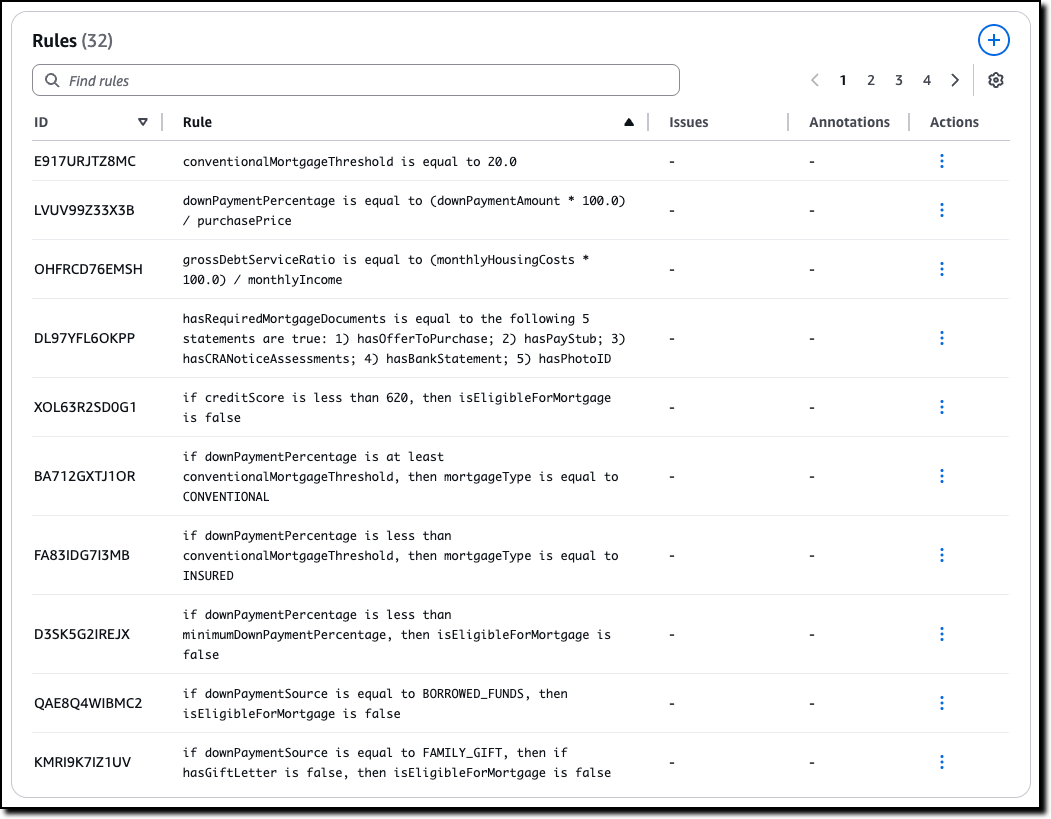
When the policy is ready, I land on the overview page, showing the policy details and a summary of the tests and definitions. I choose Definitions from the dropdown to examine the Automated Reasoning policy, made of rules, variables, and types that have been created to translate the natural language policy into formal logic.

The Rules describe how variables in the policy are related and are used when evaluating the generated content. For example, in this case, which are the thresholds to apply and how some of the decisions are taken. For traceability, each rule has its own unique ID.

Console screenshot.

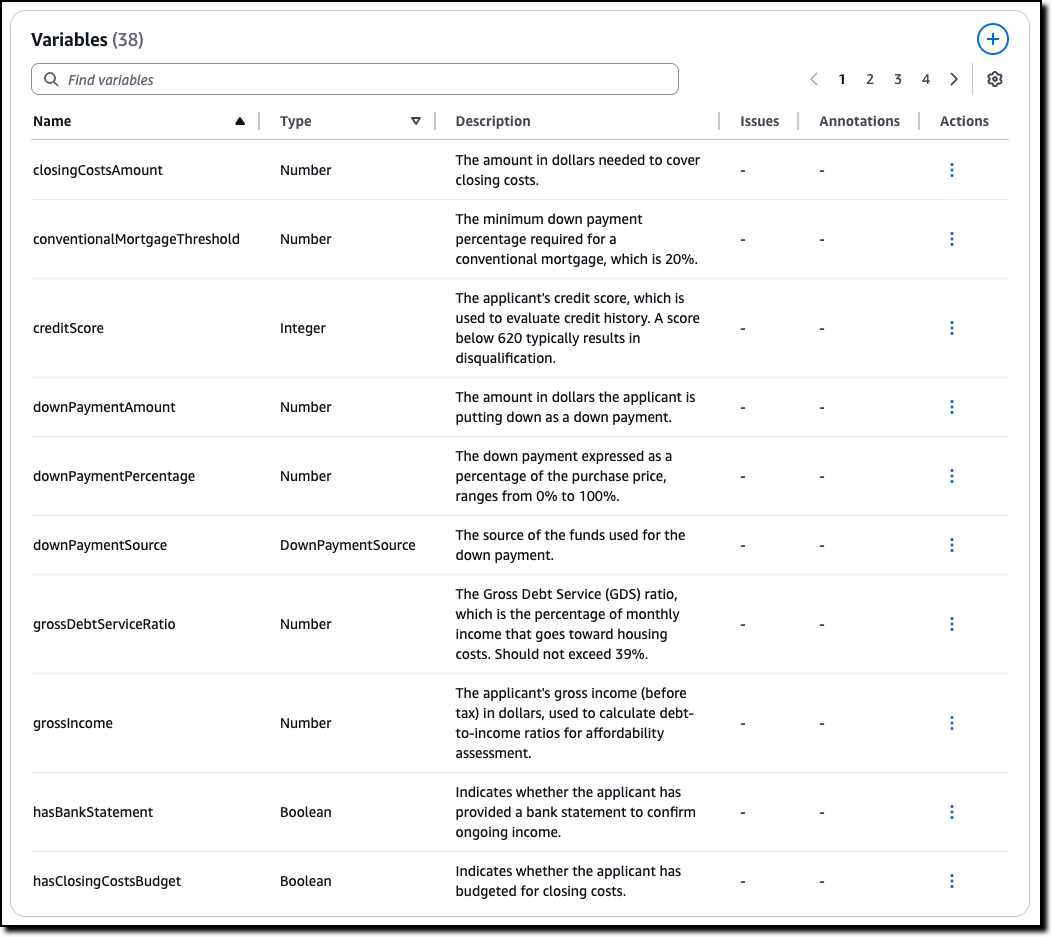
The Variables represent the main concepts at play in the original natural language documents. Each variable is involved in one or more rules. Variables allow complex structures to be easier to understand. For this scenario, some of the rules need to look at the down payment or at the credit score.

Console screenshot.

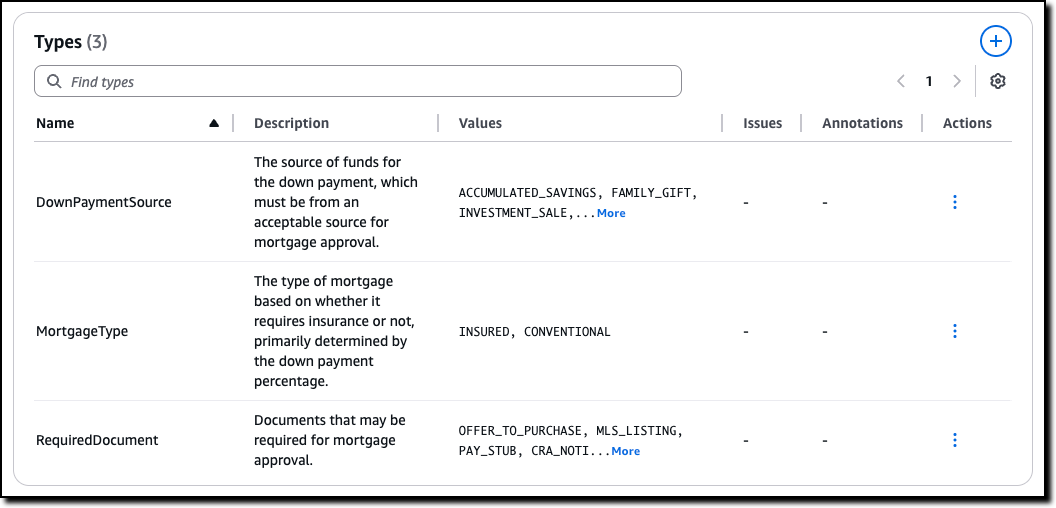
Custom Types are created for variables that are neither boolean nor numeric. For example, for variables that can only assume a limited number of values. In this case, there are two type of mortgage described in the policy, insured and conventional.

Console screenshot.

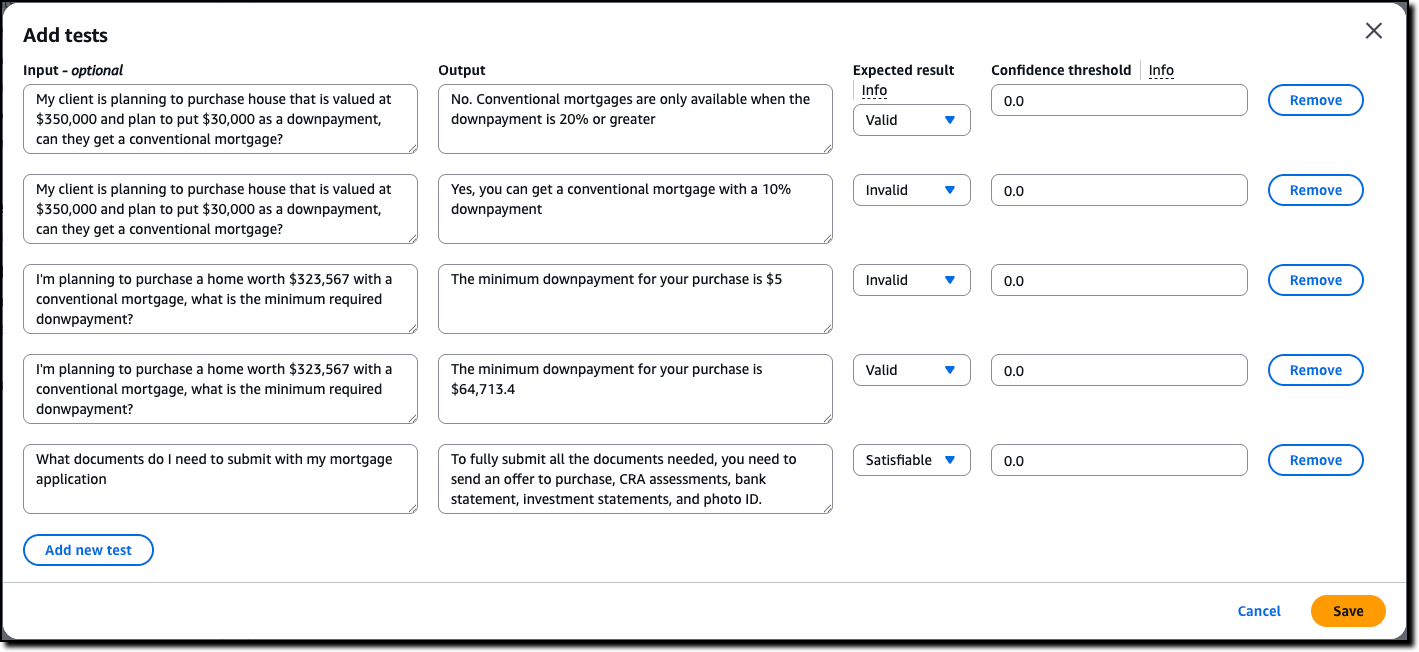
Now we can assess the quality of the initial Automated Reasoning policy through testing. I choose Tests from the dropdown. Here I can manually enter a test, consisting of input (optional) and output, such as a question and its possible answer from the interaction of a customer with the AI assistant. I then set the expected result from the Automated Reasoning check. The expected result can be valid (the answer is correct), invalid (the answer is not correct), or satisfiable (the answer could be true or false depending on specific assumptions). I can also assign a confidence threshold for the translation of the query/content pair from natural language to logic.

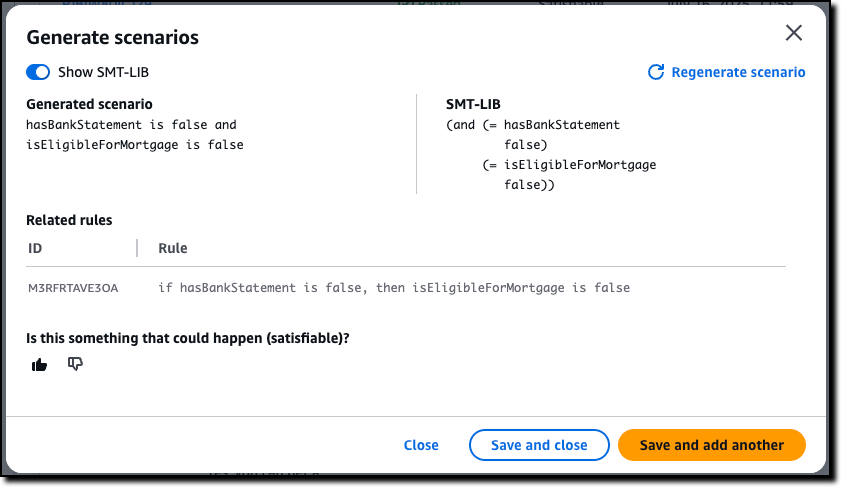
Before I enter tests manually, I use the option to automatically generate a scenario from the definitions. This is the easiest way to validate a policy and (unless you’re an expert in logic) should be the first step after the creation of the policy.

For each generated scenario, I provide an expected validation to say if it is something that can happen (satisfiable) or not (invalid). If not, I can add an annotation that can then be used to update the definitions. For a more advanced understanding of the generated scenario, I can show the formal logic representation of a test using SMT-LIB syntax.

Console screenshot.

After using the generate scenario option, I enter a few tests manually. For these tests, I set different expected results: some are valid, because they follow the policy, some are invalid, because they flout the policy, and some are satisfiable, because their result depends on specific assumptions.

Console screenshot.

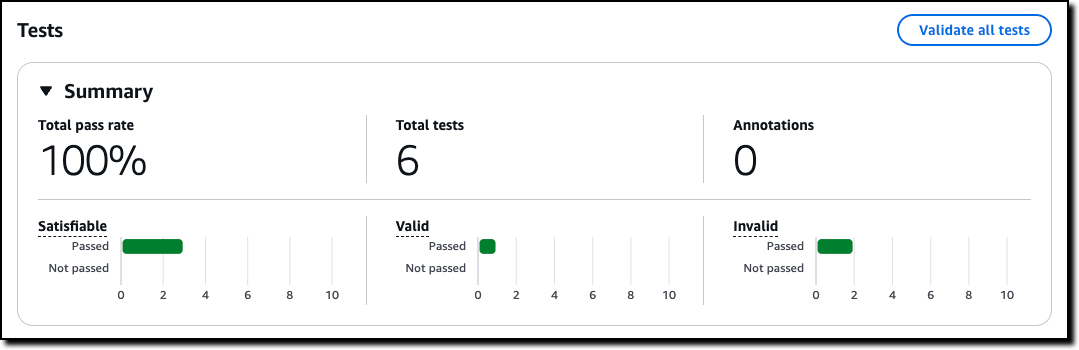
Then, I choose Validate all tests to see the results. All tests passed in this case. Now, when I update the policy, I can use these tests to validate that the changes didn’t introduce errors.

Console screenshot.

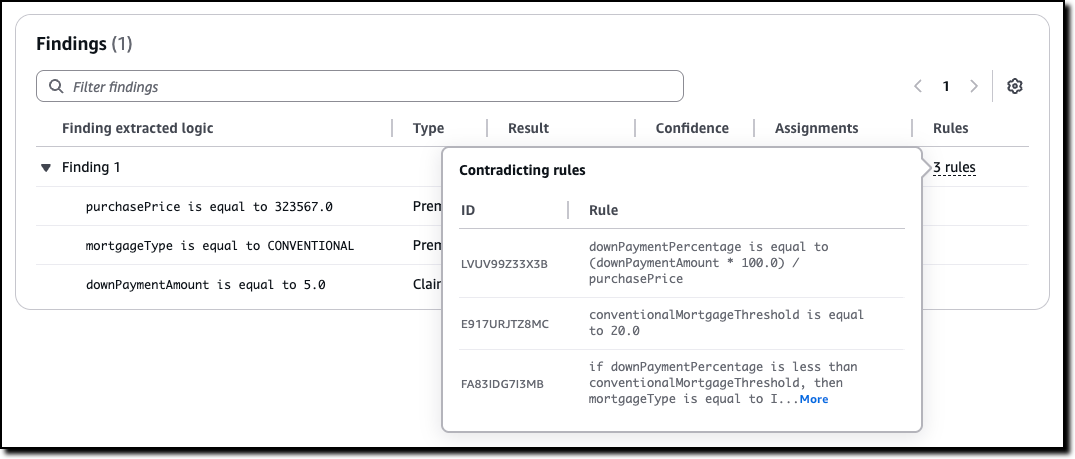
For each test, I can look at the findings. If a test doesn’t pass, I can look at the rules that created the contradiction that made the test fail and go against the expected result. Using this information, I can understand if I should add an annotation, to improve the policy, or correct the test.

Console screenshot.

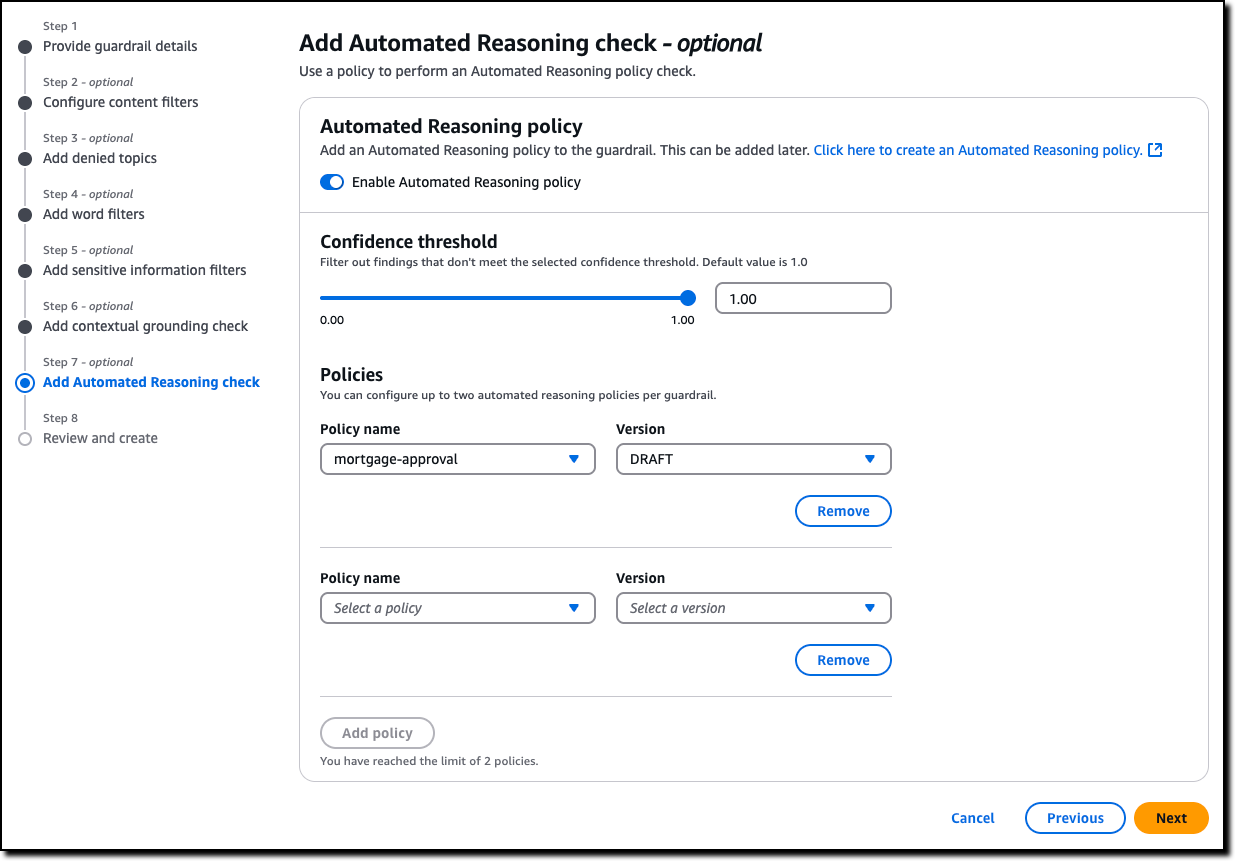
Now that I’m satisfied with the tests, I can create a new Amazon Bedrock guardrail (or update an existing one) to use up to two Automated Reasoning policies to check the validity of the responses of the AI assistant. All six policies offered by Guardrails are modular, and can be used together or separately. For example, Automated Reasoning checks can be used with other safeguards such as content filtering and contextual grounding checks. The guardrail can be applied to models served by Amazon Bedrock or with any third-party model (such as OpenAI and Google Gemini) via the ApplyGuardrail API. I can also use the guardrail with an agent framework such as Strands Agents, including agents deployed using Amazon Bedrock AgentCore.

Console screenshot.

Now that we saw how to set up a policy, let’s look at how Automated Reasoning checks are used in practice.

Customer case study – Utility outage management systems
When the lights go out, every minute counts. That’s why utility companies are turning to AI solutions to improve their outage management systems. We collaborated on a solution in this space together with PwC. Using Automated Reasoning checks, utilities can streamline operations through:

  • Automated protocol generation – Creates standardized procedures that meet regulatory requirements
  • Real-time plan validation – Ensures response plans comply with established policies
  • Structured workflow creation – Develops severity-based workflows with defined response targets

At its core, this solution combines intelligent policy management with optimized response protocols. Automated Reasoning checks are used to assess AI-generated responses. When a response is found to be invalid or satisfiable, the result of the Automated Reasoning check is used to rewrite or enhance the answer.

This approach demonstrates how AI can transform traditional utility operations, making them more efficient, reliable, and responsive to customer needs. By combining mathematical precision with practical requirements, this solution sets a new standard for outage management in the utility sector. The result is faster response times, improved accuracy, and better outcomes for both utilities and their customers.

In the words of Matt Wood, PwC’s Global and US Commercial Technology and Innovation Officer:

“At PwC, we’re helping clients move from AI pilot to production with confidence—especially in highly regulated industries where the cost of a misstep is measured in more than dollars. Our collaboration with AWS on Automated Reasoning checks is a breakthrough in responsible AI: mathematically assessed safeguards, now embedded directly into Amazon Bedrock Guardrails. We’re proud to be AWS’s launch collaborator, bringing this innovation to life across sectors like pharma, utilities, and cloud compliance—where trust isn’t a feature, it’s a requirement.”

Things to know
Automated Reasoning checks in Amazon Bedrock Guardrails is generally available today in the following AWS Regions: US East (Ohio, N. Virginia), US West (Oregon), and Europe (Frankfurt, Ireland, Paris).

With Automated Reasoning checks, you pay based on the amount of text processed. For more information, see Amazon Bedrock pricing.

To learn more, and build secure and safe AI applications, see the technical documentation and the GitHub code samples. Follow this link for direct access to the Amazon Bedrock console.

The videos in this playlist include an introduction to Automated Reasoning checks, a deep dive presentation, and hands-on tutorials to create, test, and refine a policy.

Danilo

Amazon Bedrock Guardrails now supports multimodal toxicity detection with image support (preview)

Post Syndicated from Antje Barth original https://aws.amazon.com/blogs/aws/amazon-bedrock-guardrails-now-supports-multimodal-toxicity-detection-with-image-support/

Today, we’re announcing the preview of multimodal toxicity detection with image support in Amazon Bedrock Guardrails. This new capability detects and filters out undesirable image content in addition to text, helping you improve user experiences and manage model outputs in your generative AI applications.

Amazon Bedrock Guardrails helps you implement safeguards for generative AI applications by filtering undesirable content, redacting personally identifiable information (PII), and enhancing content safety and privacy. You can configure policies for denied topics, content filters, word filters, PII redaction, contextual grounding checks, and Automated Reasoning checks (preview), to tailor safeguards to your specific use cases and responsible AI policies.

With this launch, you can now use the existing content filter policy in Amazon Bedrock Guardrails to detect and block harmful image content across categories such as hate, insults, sexual, and violence. You can configure thresholds from low to high to match your application’s needs.

This new image support works with all foundation models (FMs) in Amazon Bedrock that support image data, as well as any custom fine-tuned models you bring. It provides a consistent layer of protection across text and image modalities, making it easier to build responsible AI applications.

Tero Hottinen, VP, Head of Strategic Partnerships at KONE, envisions the following use case:

In its ongoing evaluation, KONE recognizes the potential of Amazon Bedrock Guardrails as a key component in protecting gen AI applications, particularly for relevance and contextual grounding checks, as well as the multimodal safeguards. The company envisions integrating product design diagrams and manuals into its applications, with Amazon Bedrock Guardrails playing a crucial role in enabling more accurate diagnosis and analysis of multimodal content.

Here’s how it works.

Multimodal toxicity detection in action
To get started, create a guardrail in the AWS Management Console and configure the content filters for either text or image data or both. You can also use AWS SDKs to integrate this capability into your applications.

Create guardrail
On the console, navigate to Amazon Bedrock and select Guardrails. From there, you can create a new guardrail and use the existing content filters to detect and block image data in addition to text data. The categories for Hate, Insults, Sexual, and Violence under Configure content filters can be configured for either text or image content or both. The Misconduct and Prompt attacks categories can be configured for text content only.

Amazon Bedrock Guardrails Multimodal Support

After you’ve selected and configured the content filters you want to use, you can save the guardrail and start using it to build safe and responsible generative AI applications.

To test the new guardrail in the console, select the guardrail and choose Test. You have two options: test the guardrail by choosing and invoking a model or to test the guardrail without invoking a model by using the Amazon Bedrock Guardrails independent ApplyGuardail API.

With the ApplyGuardrail API, you can validate content at any point in your application flow before processing or serving results to the user. You can also use the API to evaluate inputs and outputs for any self-managed (custom), or third-party FMs, regardless of the underlying infrastructure. For example, you could use the API to evaluate a Meta Llama 3.2 model hosted on Amazon SageMaker or a Mistral NeMo model running on your laptop.

Test guardrail by choosing and invoking a model
Select a model that supports image inputs or outputs, for example, Anthropic’s Claude 3.5 Sonnet. Verify that the prompt and response filters are enabled for image content. Next, provide a prompt, upload an image file, and choose Run.

Amazon Bedrock Guardrails Multimodal Support

In my example, Amazon Bedrock Guardrails intervened. Choose View trace for more details.

The guardrail trace provides a record of how safety measures were applied during an interaction. It shows whether Amazon Bedrock Guardrails intervened or not and what assessments were made on both input (prompt) and output (model response). In my example, the content filters blocked the input prompt because they detected insults in the image with a high confidence.

Amazon Bedrock Guardrails Multimodal Support

Test guardrail without invoking a model
In the console, choose Use Guardrails independent API to test the guardrail without invoking a model. Choose whether you want to validate an input prompt or an example of a model generated output. Then, repeat the steps from before. Verify that the prompt and response filters are enabled for image content, provide the content to validate, and choose Run.

Amazon Bedrock Guardrails Multimodal Support

I reused the same image and input prompt for my demo, and Amazon Bedrock Guardrails intervened again. Choose View trace again for more details.

Amazon Bedrock Guardrails Multimodal Support

Join the preview
Multimodal toxicity detection with image support is available today in preview in Amazon Bedrock Guardrails in the US East (N. Virginia, Ohio), US West (Oregon), Asia Pacific (Mumbai, Seoul, Singapore, Tokyo), Europe (Frankfurt, Ireland, London), and AWS GovCloud (US-West) AWS Regions. To learn more, visit Amazon Bedrock Guardrails.

Give the multimodal toxicity detection content filter a try today in the Amazon Bedrock console and let us know what you think! Send feedback to AWS re:Post for Amazon Bedrock or through your usual AWS Support contacts.

— Antje

Prevent factual errors from LLM hallucinations with mathematically sound Automated Reasoning checks (preview)

Post Syndicated from Antje Barth original https://aws.amazon.com/blogs/aws/prevent-factual-errors-from-llm-hallucinations-with-mathematically-sound-automated-reasoning-checks-preview/

Today, we’re adding Automated Reasoning checks (preview) as a new safeguard in Amazon Bedrock Guardrails to help you mathematically validate the accuracy of responses generated by large language models (LLMs) and prevent factual errors from hallucinations.

Amazon Bedrock Guardrails lets you implement safeguards for generative AI applications by filtering undesirable content, redacting personal identifiable information (PII), and enhancing content safety and privacy. You can configure policies for denied topics, content filters, word filters, PII redaction, contextual grounding checks, and now Automated Reasoning checks.

Automated Reasoning checks help prevent factual errors from hallucinations using sound mathematical, logic-based algorithmic verification and reasoning processes to verify the information generated by a model, so outputs align with known facts and aren’t based on fabricated or inconsistent data.

Amazon Bedrock Guardrails is the only responsible AI capability offered by a major cloud provider that helps customers to build and customize safety, privacy, and truthfulness for their generative AI applications within a single solution.

Automated Reasoning checks in Amazon Bedrock Guardrails

Primer on automated reasoning
Automated reasoning is a field of computer science that uses mathematical proofs and logical deduction to verify the behavior of systems and programs. Automated reasoning differs from machine learning (ML), which makes predictions, in that it provides mathematical guarantees about a system’s behavior. Amazon Web Services (AWS) already uses automated reasoning in key service areas such as storage, networking, virtualization, identity, and cryptography. For example, automated reasoning is used to formally verify the correctness of cryptographic implementations, improving both performance and development speed. To learn more, check out Provable Security and the Automated reasoning research area in the Amazon Science Blog.

Now AWS is applying a similar approach to generative AI. The new Automated Reasoning checks (preview) in Amazon Bedrock Guardrails is the first and only generative AI safeguard that helps prevent factual errors due to hallucinations using logically accurate and verifiable reasoning that explains why generative AI responses are correct. Automated Reasoning checks are particularly useful for use cases where factual accuracy and explainability are important. For example, you could use Automated Reasoning checks to validate LLM-generated responses about human resources (HR) policies, company product information, or operational workflows.

Used alongside other techniques such as prompt engineering, Retrieval-Augmented Generation (RAG), and contextual grounding checks, Automated Reasoning checks add a more rigorous and verifiable approach to making sure that LLM-generated output is factually accurate. By encoding your domain knowledge into structured policies, you can have confidence that your conversational AI applications are providing reliable and trustworthy information to your users.

Using Automated Reasoning checks (preview) in Amazon Bedrock Guardrails
With Automated Reasoning checks in Amazon Bedrock Guardrails, you can create Automated Reasoning policies that encode your organization’s rules, procedures, and guidelines into a structured, mathematical format. These policies can then be used to verify that the content generated by your LLM-powered applications is consistent with your guidelines.

Automated Reasoning policies are composed of a set of variables, defined with a name, type, and description, and the logical rules that operate on the variables. Behind the scenes, rules are expressed in formal logic, but they’re translated to natural language to make it easier for a user without formal logic expertise to refine a model. Automated Reasoning checks uses the variable descriptions to extract their values when validating a Q&A.

Here’s how it works.

Create Automated Reasoning policies
Using the Amazon Bedrock console, you can upload documents that describe your organization’s rules and procedures. Amazon Bedrock will analyze these documents and automatically create an initial Automated Reasoning policy, which represents the key concepts and their relationships in a mathematical format.

Navigate to the new Automated Reasoning menu item in Safeguards. Create a new policy and give it a name. Upload an existing document that defines the right solution space, such as an HR guideline or an operational manual. For this demo, I’m using an example airline ticket policy document that includes the airline’s policies for ticket changes.

Then, define the policy’s intent and any processing parameters. For example, specify if it will validate airport staff inquiries and identify any elements to exclude from processing, such as internal reference numbers. Include one or more sample Q&As to help the system understand typical interactions.

Automated Reasoning checks in Amazon Bedrock Guardrails

Here’s my intent description:

Ignore the policy ID number, it's irrelevant. Airline employees will ask questions about whether customers are allowed to modify their tickets providing the customer details. Below is an example question:

QUESTION: I’m flying to Wonder City with Unicorn Airlines and noticed my last name is misspelled on the ticket, can modify it at the airport?
ANSWER: No. Changes to the spelling of the names on the ticket must be submitted via email within 24 hours of ticket purchase.

Then, choose Create.

The system now initiates an automated process to create your Automated Reasoning policy. This process involves analyzing your document, identifying key concepts, breaking down the document into individual units, translating these natural language units into formal logic, validating the translations, and finally combining them into a comprehensive logical model. Once complete, review the generated structure, including the rules and variables. You can edit these for accuracy through the user interface.

Automated Reasoning checks in Amazon Bedrock Guardrails

To test the Automated Reasoning policy, you first have to create a guardrail.

Create a guardrail and configure Automated Reasoning checks
When building your conversational AI application with Amazon Bedrock Guardrails, you can enable Automated Reasoning checks and specify which Automated Reasoning policies to use for validation.

Navigate to the Guardrails menu item in Safeguards. Create a new guardrail and give it a name. Choose Enable Automated Reasoning policy and select the policy and policy version you want to use. Then, complete your guardrail configuration.

Automated Reasoning checks in Amazon Bedrock Guardrails

Test Automated Reasoning checks
You can use the Test playground in the Automated Reasoning console to verify the effectiveness of your Automated Reasoning policy. Enter a test question just like a user of your application would, together with an example answer to validate.

For this demo, I enter an incorrect answer to see what will happen.

Question: I'm flying to Wonder City with Unicorn Airlines and noticed my last name is misspelled on the ticket, I'm currently in person at the airport, can I submit the change in person?

Answer: Yes. You are allowed to change names on tickets at any time, even in person at the airport.

Then, select the guardrail you’ve just created and choose Submit.

Automated Reasoning checks in Amazon Bedrock Guardrails

Automated Reasoning checks will analyze the content and validate it against the Automated Reasoning policies you’ve configured. The checks will identify any factual inaccuracies or inconsistencies and provide an explanation for the validation results.

In my demo, the Automated Reasoning checks correctly identified the response as Invalid. It shows which rule led to the finding, along with the extracted variables and suggestions.

Automated Reasoning checks in Amazon Bedrock Guardrails

When the validation result is invalid, the suggestions show a set of variable assignments that would make the conclusion valid. In my scenario, the suggestions show that the change submission method needs to be email for the validation result to be valid.

If no factual inaccuracies are detected and the validation result is Valid, suggestions show a list of assignments that are necessary for the result to hold; these are unstated assumptions in the answer. In my scenario, this might be assumptions such as that it’s the original ticket on which name corrections must be made or that the type of ticket stock is eligible for changes.

If factual inconsistencies are detected, the console will display Mixed results as the validation result. In the API response, you will see a list of findings, with some marked as valid and others as invalid. If this happens, review the system’s findings and suggestions and edit any unclear policy rules.

You can also use the validation results to enhance LLM-generated responses based on the feedback. For example, the following code snippet demonstrates how you can ask the model to regenerate its answer based on the received feedback:

for f in findings:
    if f.result == "INVALID":
        if f.rules is not None:
            for r in f.rules:
                feedback += f"<feedback>{r.description}</feedback>\n"

new_prompt = (
    "The answer you generated is inaccurate. Consider the feedback below within "
    f"<feedback> tags and rewrite your answer.\n\n{feedback}"
)

Achieving high validation accuracy is an iterative process. As a best practice, regularly review policy performance and adjust it as needed. You can edit rules in natural language and the system will automatically update the logical model.

For example, updating variable descriptions can significantly improve validation accuracy. Consider a scenario where a question states, “I’m a full-time employee…,” and the description of the is_full_time variable only states, “works more than 20 hours per week.” In this case, Automated Reasoning checks might not recognize the phrase “full-time.” To enhance accuracy, you should update the variable description to be more comprehensive, such as: “Works more than 20 hours per week. Users may refer to this as full-time or part-time. The value should be true for full-time and false for part-time.” This detailed description helps the system pick up all relevant factual claims for validation in natural language questions and answers, providing more accurate results.

Available in preview
The new Automated Reasoning checks safeguard is available today in preview in Amazon Bedrock Guardrails in the US West (Oregon) AWS Region. To request to be considered for access to the preview today, contact your AWS account team. In the next few weeks, look for a sign-up form in the Amazon Bedrock console. To learn more, visit Amazon Bedrock Guardrails.

— Antje