Tag Archives: Risk management

Balancing speed and safety: A control framework for AI coding agents

Post Syndicated from Daniel Begimher original https://aws.amazon.com/blogs/security/balancing-speed-and-safety-a-control-framework-for-ai-coding-agents/

AI coding agents are part of the developer toolchain. Tools like Kiro and Claude Code generate features, tests, and code refactors from natural-language prompts. A single agent can open dozens of pull requests (PRs) across your repositories in an afternoon. That productivity comes with a trade-off: agents optimize for task completion at machine speed with no understanding of your organization’s risk.

Through protocols like the Model Context Protocol (MCP), agents also reach beyond the integrated development environment (IDE) to call APIs, query databases, and modify infrastructure and even entire environments, expanding the scope of resources your application security team defends.

This post lays out an application security (AppSec) control framework for AI coding agents. Two pillars organize the framework: author-time controls shape what the agent produces in the IDE; build-time controls verify and gate what reaches production. Your existing secure software development lifecycle (SDLC) controls still apply and are critical to a defense-in-depth security strategy. The framework shows where to layer additional guardrails so AppSec scales with agent-driven development. The framework is tool-agnostic and cloud-agnostic. Throughout, we use AWS services—Kiro in the IDE and AWS CodePipeline in the build—as a running example that you can adapt to your own toolchain.

Risks

Each of the following risks includes a treatment summary. The control framework section later in this post provides implementation details. The risks are ordered by severity with the highest impact risks first.

R001. Prompt and context injection

Agents read untrusted content, such as issue descriptions, web pages, MCP responses, and README files in third-party packages. Text from outside parties can redirect the agent to disclose secrets, open unauthorized PRs, or invoke tools without user consent. This risk, known as prompt injection, is the top risk in the OWASP Top 10 for LLM Applications. Any agent that reads content from outside parties is exposed, with or without MCP, so connecting tools widens the scope of impact.

Treatment: Treat non-developer input as untrusted. A large language model (LLM) can’t reliably separate instructions from data in a single context window, so architect for it: keep the agent that orchestrates trusted actions separate from the one exposed to untrusted content and grant the exposed agent only read-only, least-privilege access. Require human approval for irreversible actions. Use version-control steering files to prevent silent tampering.

R002. Inadvertent data disclosure and overly permissive configurations

Agents optimize for getting work done. Left unchecked, the code they generate can default to wildcard identity and access management policies, open security groups, and unencrypted storage, or embed sensitive values in code rather than referencing a secrets manager. Most coding agents now include safety mechanisms that make these outcomes less likely, but they remain imperfect, so you still need controls to account for the possibility.

Treatment: Security requirements in a steering document, plus policy-as-code scanning (Checkov, cfn-nag) in the IDE and pipeline. See Context as a security control.

R003. Uncontrolled changes reaching production

Ungated code reaching production isn’t new, but AI agents amplify it. Machine-speed generation can propagate a flawed pattern across repositories before it’s identified.

Treatment: Branch protection rules requiring PR approval (a human-in-the-loop checkpoint), pre-commit hooks for security checks, and sandboxed agent runs that prevent direct pushes to protected branches. The right balance between human review and automated speed depends on the risk profile of the change. For many low-risk paths, automated checks alone might suffice, while higher-risk changes warrant a human checkpoint.

R004. Supply chain risks

Agents don’t always distinguish current best practices from outdated patterns. They might recommend deprecated packages, reference library versions with new Common Vulnerabilities and Exposures (CVEs), and hallucinate package names that don’t exist, which can introduce risks of dependency confusion issues.

Treatment: Software Composition Analysis (SCA) in the pipeline (for example, Amazon Inspector code scanning or Dependabot) to flag vulnerable or unexpected dependencies. For additional control, resolve against a scoped registry like AWS CodeArtifact. Even without a fully curated registry, lockfile validation and allow-listing critical packages reduce exposure.

R005. Uncontrolled external access

Through MCP and tool integrations, agents query databases, call APIs, and modify infrastructure. Without constraints on which tools and data an agent can reach, a single misconfigured integration provides unintended access to sensitive resources.

Treatment: Scope MCP servers to least-privilege tools and resources, enforce authn or authz on external connections, and audit tool invocations. The control point is the configuration file. Review it the same way you review AWS Identity and Access Management (IAM) policies.

R006. Hallucinations and incorrect code

Agents produce plausible-looking output. Code that compiles, passes linting, and looks reasonable can still be functionally wrong: misusing APIs, introducing subtle logic errors, or implementing security-sensitive operations incorrectly. Code that passes continuous integration (CI) but is wrong slips through review; code that fails to build is caught immediately.

Treatment: Layer deterministic verification (static application security testing (SAST), unit tests) with non-deterministic review (LLM-assisted screening against the specification). Neither catches everything alone.

R007. Scope creep

Given a bug-fix prompt, an agent might also refactor surrounding code, disable an unreliable test, or reorganize imports. Unrequested changes introduce regressions and complicate review.

Treatment: A reviewed specification document that defines what must change and what must not, paired with a targeted review of the proposed changes. See Specifications as scope boundaries.

The preceding risks share a common thread: agents produce output faster than humans can review it, and they lack context to self-correct.

The following framework addresses this gap. It organizes controls into two pillars: author-time (pre-generation and post-generation of code) and build-time (in the pipeline, before code reaches production). Author-time controls shape what the agent produces. Build-time controls verify it. Neither is sufficient alone; together they reduce the volume and severity of issues that reach human reviewers.

Deterministic compared to non-deterministic mitigations

Deterministic mitigations [D] produce the same result every time. Linters, SAST scanners, secrets detection, and policy-as-code match patterns against rules and define security invariants: no critical findings, no hardcoded secrets, and no wildcard IAM policies. Use them when the condition can be expressed as a rule. Organizations already have these and must continue enforcing them.

Non-deterministic mitigations [ND] use model judgment. They include steering documents, LLM-as-judge review, specification compliance checks, and scope-creep detection, and they evaluate intent rather than patterns. They catch novel issues that rules miss, but are probabilistic. Use them when evaluation requires context or reasoning across files. This is the new layer that AI-generated code demands, because agents produce code that can pass every deterministic check yet remain functionally wrong.

Human review [H] provides the final layer for the risk-based decisions neither tool type can make. Apply it where judgment is needed, not everywhere: routing every change to a person invites consent fatigue, where reviewers approve by reflex and the control loses its value. The default reflex is to route everything back to a human, but that isn’t always the right response—reserve human judgment for the decisions that genuinely need it.

The control framework

The framework organizes controls into two pillars. Author-time controls (Pillar 1) shape what the agent produces in the IDE, before code is generated and just after. Build-time controls (Pillar 2) verify and gate that output in the pipeline, before it reaches production. The controls within each pillar are tagged deterministic [D], non-deterministic [ND], or human [H].

Pillar 1: Author-time controls (pre- and post-generation of code)

Author-time controls work inside the IDE, where the developer and agent still hold full context. They shape the prompt and the generated output before it ever reaches a pull request. The following controls apply at this stage.

Context as a security control [ND]

Control statement: Encode security invariants as natural-language constraints in a steering document that every developer environment consumes at session start. Addresses R002.
Many AI coding agent risks share one root cause: the agent lacks the security context an experienced developer carries implicitly. Your security team sets the policies, such as Amazon Simple Storage Service (Amazon S3) buckets require encryption, API gateways require mutual TLS, and credentials must come from AWS Secrets Manager. Developers don’t always have these requirements available when they’re building. They build what works, not what’s compliant. An AI agent amplifies this gap because it defaults to whatever pattern dominated its training data, with no awareness of your organization’s security posture.

A key mitigation is steering. Security teams write these invariants once as natural-language guidance in a steering document, then distribute them as shareable resources that developers consume in their IDE. The agent loads the file at session start and treats the contents as standing requirements:

  • IAM policies must follow least-privilege principles; no wildcard Amazon Resource Names (ARNs).
  • No hardcoded credentials in source code; use a secrets manager.
  • Security groups must not allow unrestricted inbound access.

This shifts security left, before code generation begins. Steering biases generation toward secure defaults; it doesn’t guarantee them. Treat it as a strong default, paired with the following deterministic gates that block non-compliant code from merging. Security teams define the rules once and every developer environment inherits them automatically. Steering reduces the volume of issues that reach the pipeline, though it doesn’t replace downstream scanning.

How to write effective steering rules: Keep each rule specific and testable, scope it to a concrete risk class, keep the rule set concise so the agent can hold it in context, and iterate from the issues your scanners and reviewers surface.

Specifications as scope boundaries [ND]

Control statement: Require a reviewed specification before code generation begins. Define what must change and what must not. Addresses R007.

Spec-driven workflows turn vague prompts into reviewable specifications before code is generated. This creates a human checkpoint at the design phase, where security decisions are made:

  • Requirements use testable notation that’s auditable before the agent writes a line of code. For example, the Easy Approach to Requirements Syntax (EARS): WHEN [condition] THE SYSTEM SHALL [behavior].
  • Tasks are ordered in implementation steps, each mapped back to a requirement.

For bug fixes, specifications add a critical element: unchanged behavior documentation. This is an explicit list of behaviors that must continue working, giving the agent a written boundary against scope creep.

In this model, the specification becomes the primary artifact, code is a derivative of it. Human review effort concentrates on whether the specification solves the right problem with the right constraints, not on reading implementation diffs line by line.

Controlled tool access using MCP [D + ND]

Control statement: Scope each MCP server to the minimum set of tools the agent needs, and give it a dedicated, scoped-down credential rather than the developer’s own. Maintain an allowlist of reviewed MCP servers. Addresses R005.

MCP servers act as controlled gateways between the agent, the external tools, and data:

  • Dependency management – An MCP server fronting your private package registry resolves dependencies against curated packages, not the public internet. This is a deterministic constraint on supply chain risk.
  • Infrastructure tooling – Visibility into current resource configurations prevents templates that conflict with existing infrastructure.
  • Scoped permissions – Each MCP server exposes a defined set of tools and resources. You choose exactly what the agent can access, supporting least-privilege at the integration layer. You supply that credential through the agent’s configuration (in Kiro, the env block of .kiro/settings/mcp.json). Avoid autoApprove: ["*"], which removes the human approval prompt on every tool call.

IDE code scanning [D]

Control statement: Run real-time static analysis in the IDE so security issues surface while the developer (and agent) still have full context. Addresses R002, R006.

Real-time diagnostics catch syntax errors, type mismatches, and configuration issues as the developer types. A malformed IAM policy is flagged before the agent builds further on it. Security-focused extensions (ESLint security plugins, Checkov, SAST) layer on top for immediate feedback while code is fresh in context.

Hooks: Automated guardrails at the point of action [D + ND]

Control statement: Attach deterministic checks to file-save events and non-deterministic verification to task-completion events. Addresses R002, R007.

  • Shell command hooks [D] – Triggered on file save, these run a linter, formatter, or security scanner and produce the same result every time. They enforce hard rules.
  • AI-powered hooks [ND] – Triggered on task completion. These prompt the agent to verify that the implementation matches the specification and check for any untested edge cases or files that were modified outside the task’s scope.

Pillar 2: Build-time controls (in the pipeline)

Build-time controls run in the pipeline after code is committed and before it reaches production. They verify and gate what the agent produced, catching what author-time controls did not. The following controls apply at this stage.

Layered security scanning [D]

Control statement: Run secrets detection, static analysis, dependency scanning, and infrastructure-as-code scanning in sequence. Fail the build on any critical finding. Addresses R002, R003, R004.

  1. Secrets detection runs first because it’s cheapest and addresses a high-severity class of issue. It scans for hardcoded API keys, database connection strings, and credentials that AI agents might inadvertently include.
  2. SAST scans source code for injection issues, insecure deserialization, and resource leaks. Custom rules can target AI-specific anti-patterns including overly broad exception handling, deprecated APIs, placeholder credentials, dynamic code execution through eval().
  3. Software Composition Analysis (SCA) identifies known CVEs in dependencies. This is critical for AI-generated code, which might reference deprecated packages or hallucinate package names that open you to dependency confusion issues.
  4. Infrastructure as code (IaC) scanning validates AWS CloudFormation, Terraform, and AWS Cloud Development Kit (AWS CDK) templates against security policies before deployment. Catches overly permissive IAM roles, unencrypted storage, and public-facing resources the agent created.

Each stage halts the pipeline on failure. Results export to a standard format (Static Analysis Results Interchange Format (SARIF)) for compliance auditing and flow downstream to human reviewers. The open source Automated Security Helper (ASH) bundles secrets, SAST, SCA, and IaC scanners behind one command that you can run locally and in AWS CodeBuild, emitting SARIF for the gates that follow.

Quality gates [D]

Control statement: Define pass/fail thresholds for each scan type. Block deployment on any critical or high-severity finding. Addresses R003.

Quality gates convert scan results into go/no-go decisions. Define thresholds for each severity: block on critical findings, require justification for highs, and track mediums. The gate is deterministic: if a threshold is breached, the pipeline stops. Exceptions require documented approval.

Differentiate blocking compared to advisory modes: hard failures on main, advisory on feature branches. Avoid gates becoming a friction that teams route around.

AI-assisted review [ND]

Control statement: Use an LLM reviewer to pre-screen every pull request for specification compliance, scope creep, and security anti-patterns before human review. Addresses R001, R006, R007.

  • Specification compliance – Does the implementation match the requirements document?
  • Scope verification – Were files modified outside the task’s stated scope?
  • Security pattern review – Are there logic errors, misused APIs, or insecure patterns that pass SAST but violate intent?

This pre-screening focuses human reviewer attention on genuine risks rather than formatting or obvious issues. On AWS, AWS Security Agent (code review in preview at publication) checks pull requests against AWS-managed and custom security requirements. The reviewer screens and surfaces findings; the merge decision stays with a human.

A critical principle: the agent that wrote the code should not be the agent that reviews it. A separate session helps avoid self-confirmation bias, but a separate session alone doesn’t always avoid the generator’s blind spots, because two sessions of the same model can share them. Where practical, use a different model for review so the reviewer is less likely to inherit the same systematic weaknesses.

Human-in-the-loop review [ND + H]

Control statement: Require human approval on most pull requests, especially those touching security-sensitive or high-blast-radius code. Lower-risk changes might be eligible for agent-assisted or fully automated approval as tooling matures. Provide reviewers with scan results, LLM pre-screening output, and specification context to enable fast, informed decisions. Addresses R003.

Scale review depth to the risk of the change. Low-risk or boilerplate changes can take a lighter-touch review, while security-sensitive or novel-logic changes warrant mandatory deep review and a second reviewer.

Scanners catch known patterns but can’t judge whether code implements the intended business logic. Human review also serves to calibrate trust: teams build intuition about where agents excel (boilerplate, test writing) and where they’ve tended to struggle (novel business logic, security-sensitive operations), recognizing that this frontier shifts as models improve.

Place two approval gates: after security scans (reviewer focuses on correctness and business logic, with scan results as context) and before production deployment (final sign-off after integration testing). Treat human review as a secondary control, not a guarantee: reviewers are themselves non-deterministic and can miss issues, so human review layers on top of the deterministic gates rather than replacing them.

Putting the framework into practice on AWS

The framework is tool-agnostic, but AWS gives you building blocks for each pillar. The following services map directly to the controls described previously: Kiro for author-time guardrails, and CodeBuild and CodePipeline for build-time gates.

Kiro: Structured AI development

Kiro maps to Pillar 1: It puts the author-time controls in the IDE, where the developer and agent still share full context. Each feature in the following list implements one of those controls, configured in-repo under .kiro/ so the guardrails are version-controlled and shared across the team rather than set per developer.

  • Steering documents – Markdown files in .kiro/steering/ load into the agent’s context at session start. Conditional inclusion using fileMatch (for example, ["**/*.tf"]) loads IaC-specific rules only when relevant.
  • Specification-driven workflows – Three-phase specifications (requirements in EARS, design, and tasks) with review checkpoints. Bug-fix specifications capture unchanged behavior explicitly.
  • Agent hooks – Triggered on file save, tool invocation, or task completion. Shell hooks run deterministic checks (linters, tests); Ask Kiro hooks run AI prompts for non-deterministic review. For example, a security pre-commit scanner hook can flag hardcoded credentials when the agent finishes a task.
  • Property-based testing – Guided by a specification or hook, Kiro can generate property-based tests (for example, using the hypothesis library) that exercise hundreds of randomized inputs, probing edge cases a hand-written test suite would miss.
  • MCP integrations – Connect Kiro to private package registries, internal docs, issue trackers, and infrastructure tooling, creating the controlled tool access pattern.

For enterprise environments, Kiro supports AWS IAM Identity Center for single sign-on and provides IP indemnity coverage for subscribers. Check the Kiro documentation for current Region availability.

AWS CodeBuild and AWS CodePipeline: Pipeline controls

CodeBuild runs each scanning tool (checking for secrets, SAST, SCA, and IaC) as a build action. A non-zero exit code fails the action, and the stage halts or rolls back according to its OnFailure setting. Findings export as SARIF to Amazon S3 for compliance, and CodePipeline action variables pass results to downstream approval actions.

  • CodeBuild exit codes halt the pipeline on scan failures
  • AWS Lambda invoke actions evaluate scan results against configurable thresholds and return pass/fail decisions
  • Manual approval actions halt the pipeline, send Amazon Simple Notification Service (Amazon SNS) notifications, and link to review artifacts; decisions and reviewer identity are logged for audit

The following table consolidates the framework into a single view that includes each stage of the SDLC and the deterministic [D] and non-deterministic [ND] controls that apply there. Every stage carries both, a reminder that neither control type is sufficient on its own.

Stage Deterministic [D] Non-deterministic [ND]
IDE (pre-generation) Steering files loaded Steering documents, specification-driven constraints
IDE (post-generation) Shell hooks: Linter, formatter, type checker, and secrets scan AI-powered task completion hooks, context constraints
Pull request SAST, SCA, and IaC scanning LLM PR pre-screening and scope verification
Pipeline (pre-deploy) Full security scan suite, integration tests, and policy-as-code AI-assisted review for human approvers
Post-deploy Runtime monitoring and anomaly detection AI-powered incident triage

Conclusion

This post laid out a framework for adopting AI coding agents at machine speed without letting unreviewed risk reach production. It layers guardrails at two points:

  • Author-time controls – Steering, specs, and scoped tools shape what the agent generates in the IDE.
  • Build-time controls – Scanning, quality gates, and layered review verify it before it reaches production.

No single layer is enough: deterministic gates enforce hard rules, non-deterministic review catches what they miss, and human judgment is reserved for the decisions that need it. Together, they let AppSec scale with agent-driven development.

Where to start this week:

  1. Start with steering and specs – Encode security requirements as steering and use specifications for new features. Highest impact, lowest effort. For a ready-made starting set, the open source Project CodeGuard (a Coalition for Secure AI project under OASIS Open, of which Amazon is a contributing member) publishes reusable steering rules for common risk classes—hardcoded credentials, IaC misconfiguration, supply chain, and MCP security—that you can adapt to your AWS environment.
  2. Add deterministic pipeline gates – Integrate SAST, SCA, and secrets detection. Table-stakes regardless of AI usage.
  3. Calibrate and iterate – Review what controls catch, adjust steering for recurring issues, and expand agent autonomy as trust builds.
  4. Accountability – Developers remain accountable for the security of what they ship. AI agents accelerate development; they don’t transfer ownership.

More information:

If you have feedback about this post, submit comments in the Comments section below.


Daniel Begimher

Daniel Begimher

Daniel is a Senior Security Engineer at AWS, where he built and shipped the company’s first customer-facing AI security agent. He created SIR-Bench, a benchmark for measuring how deeply AI incident-response agents investigate before acting, and Automated Security Helper (ASH), an open source scanner. He co-leads application security technical field community at AWS, and speaks at conferences including AWS re:Invent, re:Inforce, and Cyber Week.

Danny Cortegaca

Danny Cortegaca

Danny is a Principal Security Specialist Solutions Architect and co-leads the Application Security focus area within the AWS Security and Compliance Technical Field Community. He joined AWS in 2021 and partners with some of the largest organizations in the world to help them navigate complex security and regulatory environments. He loves talking about application security with customers and has helped many adopt threat modeling into their practices.

Defend against frontier cyber models: Cloudflare’s architecture as customer zero

Post Syndicated from Rohit Chenna Reddy original https://blog.cloudflare.com/frontier-model-defense/

A few weeks ago, we wrote about Project Glasswing and what we observed when we pointed cyber frontier models at our own code. Since then, we’ve seen that the part of the post that has resonated most deeply is the argument that the architecture around the vulnerability matters more than the speed of the patch.

In the conversations we’ve had with CISOs and security teams since, the questions have been consistent: what does our architecture actually look like, what should we monitor for, where do we start, and how can Cloudflare help?

Before getting into the details: the architecture below is built almost entirely from Cloudflare’s own products, because Cloudflare security is customer zero for the security products we build. The Cloudflare stack already exists in front of our code, employees, and customer-facing applications. If you’re a Cloudflare customer, every layer below is available to you today. If you’re not, the principles still apply to whatever stack you’ve built.

What a cyber frontier model actually changes

In the previous post, we showed how a cyber frontier model like Mythos changes the attacker’s timeline. It can find vulnerabilities, reason through exploit chains, and generate working proofs faster than earlier models. While models like Mythos do not change the shape of an intrusion — reconnaissance, initial access, lateral movement, persistence, and exfiltration still have to happen — the difference is in the speed and scale. When pointed at the open web, a model can find and hit low-hanging fruit quickly. Against a hardened target, it still has to probe, and adapt, and it often produces more noise than a careful human operator would.

Discovery, exploit chain construction, and proof-of-concept generation used to be the gating constraints on producing a working attack. A frontier model handles all three in a fraction of the time. Work that used to be slow and methodical is now fast and indiscriminate.

While AI is accelerating how fast developer teams at Cloudflare and many other companies can ship code, the security team’s work has not compressed the same way. An attacker only needs one opening to get in, while security teams need to find and close them all. Writing a fix, regressing it, and shipping it without breaking the code around it has constraints that AI doesn’t remove. We learned this the hard way when we let an AI coding assistant write its own patches against our own bugs, as we described at the end of the previous post. Some of those patches fixed the original bug while quietly breaking something else the code depended on.

As these models become more competent and capable, our main focus from a threat standpoint comes down to three things. Each one shapes the architecture we walk through in the rest of this post.

  • The first is the speed of discovery. Frontier models make it easier to search large bodies of public code, including the open-source libraries that many companies depend on. That does not mean every bug in a library is exploitable, or that library bugs are where most vulnerabilities live. Exploitability still depends on how the code is used, whether attacker-controlled input can reach the vulnerable path, and the protections that sit around it. But widely used open-source libraries and frameworks give attackers a shared surface to study at scale. When a real, reachable vulnerability exists there, a model can help find it, reason about possible exploit paths, and generate proof-of-concept variants faster than maintainers and defenders can review every downstream use. The gap between when an attacker discovers a vulnerability and when defenders learn it exists is what worries us most. If you are not running these models against your own code, it is safe to assume someone else is.

  • The second is exploit volume and adaptation. A model can produce thousands of variations of a single exploit and run reconnaissance at the same scale. All that volume gives an attacker an advantage, but it won’t necessarily get them past signature-based detections. Many of those iterations will have the same underlying signature, so a rule that catches the first one will catch the rest. Adaptation is how they will get past signature-based detections. Ask a model to show you a SQL injection, and it will return a textbook example. Tell it there is a WAF in the way, and it will start probing, learning what gets blocked, and rewriting the payload until it can slip past the rule blocking it.

  • The third is the impact when a vulnerability is inevitably exploited. No architecture catches everything. After the vulnerability is exploited, the question we ask ourselves is: where can the attacker get to with one identity, one path, or one credential, before something else stops them? If the answer is “anywhere they want,” the vulnerability was never the problem. The architecture around the vulnerability was.

Cloudflare’s superpower: visibility

We see roughly a fifth of the world’s web traffic and that traffic tells us, in real time, which payloads are mutating, which patterns are picking up, and where attacker tooling is moving next. Two teams turn that visibility into defense.

First is Cloudforce One, our threat intelligence, research, and operations team, which sits within the Cloudflare security organization. They turn what we see across the network into insights the rest of the stack can act on: tracked adversaries, emerging campaigns, and indicators of compromise (IOCs). The hard part of this work was never knowing what is malicious — it was the delay in mitigation. Knowledge of a new threat normally has to travel from a threat report, into a feed, and then into a company’s defense before it can be used to block anything. Attackers have learned to move faster than that. Our network closes that gap: Cloudflare customers can now use Cloudforce One threat intelligence directly within the WAF to block high-risk traffic.

Second is the team that owns the WAF engine that does the actual detecting: the managed rulesets that run in front of our own properties and are available to every Cloudflare customer, the machine learning behind WAF Attack Score, and the relationships that sometimes let us ship a rule before a CVE is publicly disclosed. The team is globally distributed and moves fast, releasing rules within hours of a proof-of-concept of an attack becoming known. Once a detection is deployed, it reaches our entire network, along with every Cloudflare customer, in under 30 seconds. React2Shell is a recent example: a managed WAF rule was protecting our own properties, and everyone else’s on Cloudflare, hours before the official advisory was published.

The scoring layer, the defenses we put in front of the application, and the containment around the vulnerability all build on what these two teams see. 

Scores over signatures

Signature-based defenses were built for a world where novel exploits were scarce and variations took weeks. Cloudflare’s traditional SLA from a fresh proof-of-concept to a live, deployed rule has been 12 hours. With the advent of frontier models, this is not good enough anymore. Detections need to be in place before a CVE is discovered. This is why we layer ML-based detection in front of the traditional signature-based WAF.

The model is trained on a large body of past attack traffic, and it catches new variants of vulnerabilities before they’re publicly known. A novel SQL injection or remote code execution chain is almost always a rearrangement of attack shapes the model has seen before, even when the specific exploit is brand new. We run the model on every request and assign a WAF Attack Score between 1 and 99, based on how closely the request resembles those underlying shapes, not against a list of known-bad signatures. The lower the score, the more aggressively we treat the request. That score determines whether we let the request through. We apply a similar scoring methodology to AI prompts with AI Security for Apps: rather than check each prompt against a list of known malicious prompts, we score how closely a prompt resembles an actual attack. 

The architecture around the vulnerability

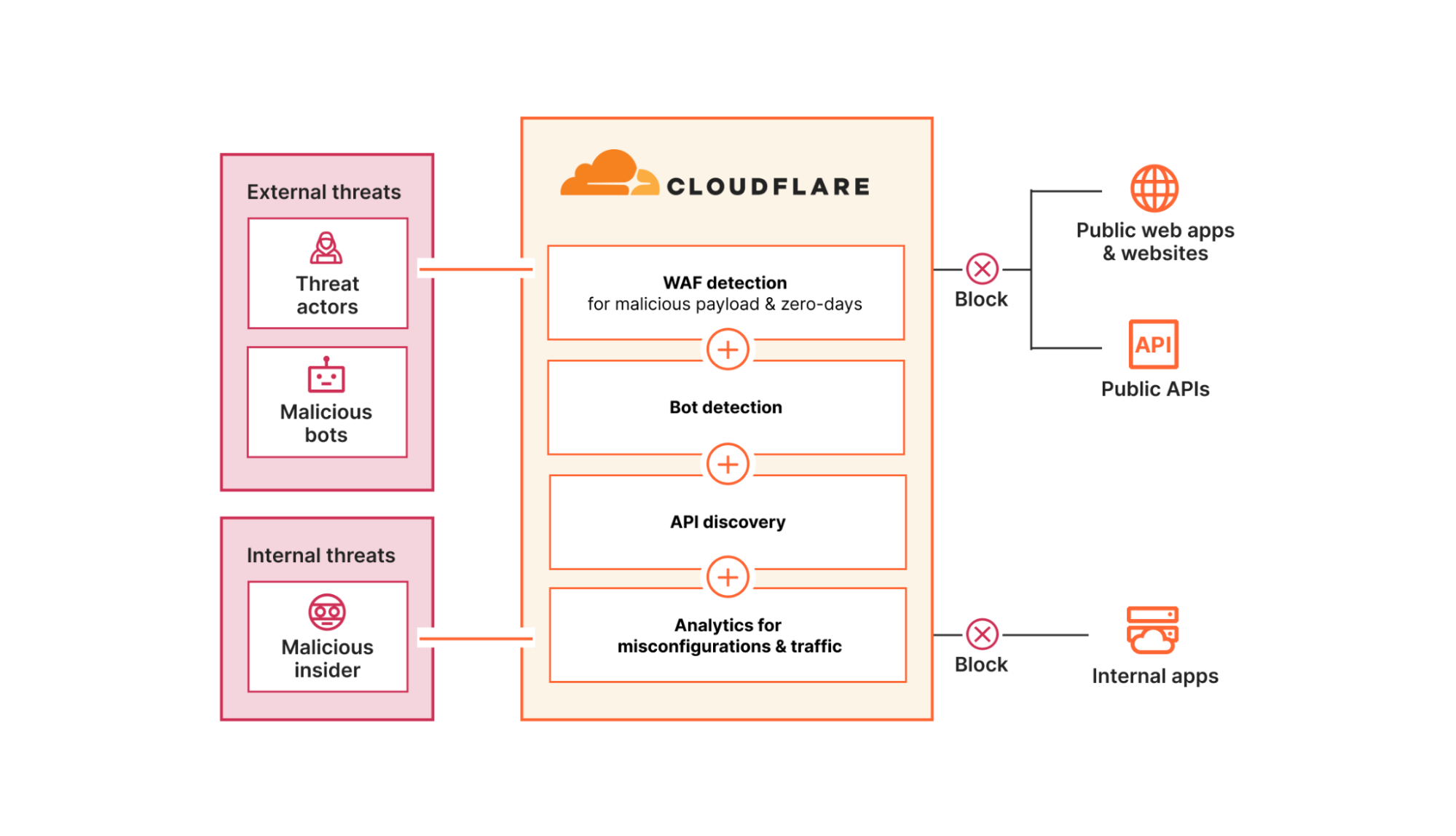
Those capabilities only matter once they’re stacked in front of an application, and the first layer in our defense-in-depth approach is the WAF. Anything that matches a known-bad pattern gets dropped before it reaches the application, which clears the bulk of the obvious traffic and lets the more specialized layers below focus on what’s left.

On the API surface, we run a positive security model through API Shield. Instead of trying to anticipate every bad request, we describe what a valid request to each API looks like, either from the API’s own definition or learned from our real traffic, and anything that doesn’t fit doesn’t get through. This neutralizes the advantage of frontier AI models: because we only permit validated traffic, generating thousands of new attack variations fails to bypass the system.


Cloudflare’s layered architecture

Bot Management catches probing traffic on our network before frontier models can build a map. It scores every request on how likely it is to be automated, using the same signals across our whole network: how the client behaves, whether it looks like a real browser, and whether the connection matches a known-bad pattern. An attack only lands if it can find a soft spot. 

Zero Trust Network Access is used for every internal application. The implicit trust of being inside the network is replaced with explicit per-request identity and policy for every employee accessing every tool. The value of this was clear when one of our engineers shipped a misconfigured tool. A flat network would have exposed everything on the same segment, but in our deployment, the exposure stopped at the tool itself. We built Require Access Protection afterwards so newly deployed or misconfigured applications can’t be reachable before an access policy is in place.

IdP Federation makes that secure by default posture easier to keep consistent across every Cloudflare account — which becomes even more necessary when more people are shipping internal tools quickly. Instead of asking each team to wire up SSO separately, we configure our identity provider (IdP) once and share it across the organization. New accounts get SSO automatically, recipient-side IdP connections are read-only, and Access policies in each account still evaluate the resulting identity as part of the normal request flow. 

MCP Server Portal gives teams a controlled way to connect AI agents to enterprise systems. Agents access MCP servers that are centrally managed through a single portal, with every action logged. That way when an agent acts on someone’s behalf, we know what it did, what it touched, and whether it should have been allowed to. The full picture of how we built it is in our post on enterprise MCP.

AI Gateway runs in front of our internal AI tools the same way AI Security for Apps runs in front of customer-facing AI features, with the same scoring and the same visibility. Inside the company, the visibility piece is more useful than the blocking, because we needed to see what engineers were actually building before we could write meaningful policy on it.

Where your teams can start 

Frontier models can help attackers find vulnerabilities, adapt payloads, and move faster, but they still have to pass through the layered defense you deploy in front of your application. That is where teams should start:

  • Put inspection in front of public applications.

  • Define what valid API traffic looks like.

  • Use bot detection to limit automated probing.

  • Require identity and access policy before any internal tool is reachable.

For AI and agentic systems:

  • Route model traffic through a gateway.

  • Keep agents connected through approved MCP servers.

  • Log what they do. 

The goal is to make sure that when one layer misses, the next layer limits what the attacker can see, reach, or change.

That is the point of the architecture around the vulnerability: to limit the scope of an attack. The vulnerability may be what starts the attack, but the architecture determines how far it can go.

How do we know this approach works?

Plenty of security stacks look impenetrable on a whiteboard but fall over in practice. That is why we test ours continuously, both at the perimeter and inside our environment, with our red team involved across both.

At the perimeter, frontier models are one tool we use to test our application security stack as an adaptive attacker. These models sit alongside the rest of our red team and detection workflows including: manual testing, threat intelligence, observed traffic patterns, proof-of-concept analysis, and signals from our own network. Together, those inputs help us decide where to aim testing: newly launched products, recently changed surfaces, and the paths an attacker is most likely to probe first. The most important part is the process that follows. When something gets through, we identify the gap, use the right mix of tools to understand it, write the rule or mitigation, ship the update, and test again to make sure the gap is closed.

Inside the environment, our red team starts from the assumption that the perimeter has already failed. They look at what has changed, where sensitive systems carry risk, and whether one compromised identity, path, or credential can reach farther than it should. When we change the architecture based on what they find, they run the scenario again against the new version to confirm the gap is actually closed.

We confirm that this architecture is working by continuously testing its behavior during failures, rather than relying on the perfection of individual layers.

If your team is working on the same problems and would like to compare notes, reach out to us at [email protected].

Project Glasswing: what Mythos showed us

Post Syndicated from Grant Bourzikas original https://blog.cloudflare.com/cyber-frontier-models/

For the last few months, we’ve been testing a range of security-focused LLMs on our own infrastructure. These LLMs help identify potential vulnerabilities in our own systems, so we can fix them – and they also show us what attackers are going to be able to do with the latest models.

None of these LLMs has captured more attention than Mythos Preview, from Anthropic. A few weeks ago, we were invited to use Mythos Preview as part of Project Glasswing. We soon pointed it at more than fifty of our own repositories – to see what it would find, and to see how it works.

This post shares what we observed, what the models did well and what they didn’t, and how the architecture and process around them needs to change, so they can be used at scale.

What changed with Mythos Preview

Mythos Preview is a real step forward, and it’s worth saying that plainly before getting into anything else. We’ve been running models against our code for a while now, and the jump from what was possible with previous general-purpose frontier models to what Mythos Preview does today is not just a refinement of what came before.

It’s a different kind of tool doing a different kind of work, and that makes a clean apples-to-apples comparison to earlier models difficult. So rather than trying to benchmark Mythos Preview against general-purpose frontier models, it’s more useful to describe what it can actually do, and two features that stood out across the work we did with Mythos Preview:

  • Exploit chain construction – A real attack rarely uses one bug. It chains several small attack primitives together into a working exploit. For instance, it might turn a use-after-free bug into an arbitrary read and write primitive, hijack the control flow, and use return-oriented programming (ROP) chains to take full control over a system. Mythos Preview can take several of these primitives and reason about how to combine them into a working proof. The reasoning it shows along the way looks like the work of a senior researcher rather than the output of an automated scanner.

  • Proof generation – Finding a bug and proving it’s exploitable are two different things, and Mythos Preview can do both. It writes code that would trigger the suspected bug, compiles that code in a scratch environment, and runs it. If the program does what the model expected, that’s the proof. If it doesn’t, the model reads the failure, adjusts its hypothesis, and tries again. The loop matters as much as the bugs it finds, because a suspected flaw without a working proof is speculation, and Mythos Preview closes that gap on its own.

Some of what we describe above is not entirely unique to Mythos Preview. When we ran other frontier models through the same harness, they found a fair number of the same underlying bugs, and in some cases they got further than we expected on the reasoning side too. Where they fell short was at the point of stitching the pieces together. A model would identify an interesting bug, write a thoughtful description of why it mattered, and then stop, leaving the actual chain unfinished and the question of exploitability open. What changed with Mythos Preview is that a model can now take those low-severity bugs (which would traditionally sit invisible in a backlog) and chain them into a single, more severe exploit. 

Model refusals in legitimate vulnerability research

The Mythos Preview model provided by Anthropic, as part of Project Glasswing, did not have the additional safeguards that are present in generally available models (like Opus 4.7 or GPT-5.5).

Despite this, the model organically pushes back on certain requests – much like the cyber capabilities that made it useful for vulnerability hunting, the model has its own emergent guardrails that sometimes cause it to push back on legitimate security research requests. But as we found, these organic refusals aren’t consistent – the same task, framed differently or presented in a different context, could produce completely different outcomes as illustrated in the examples below.


Example of Mythos Preview pushing back on building a working proof of concept 

For example, the model initially refused to do vulnerability research on a project, then agreed to perform the same research on the same code after an unrelated change to the project’s environment. Nothing about the code being analyzed had changed.

In another case, the model found and confirmed several serious memory bugs in a codebase, and then refused to write a demonstration exploit. The same request, framed differently, got a different answer, and even the same request can produce different outcomes across runs due to the probabilistic nature of the model. Semantically equivalent tasks can produce opposite outcomes depending on how and when they’re presented to the model.

This matters because while the model’s organic refusals/guardrails are real, they aren’t consistent enough to serve as a complete safety boundary on their own. That’s precisely why any capable cyber frontier model made generally available in the future must include additional safeguards on top of this baseline behavior – making it appropriate for broader use outside of a controlled research context like Project Glasswing.

The signal-to-noise problem

One of the hardest parts of triaging security vulnerabilities is deciding which bugs are real, which are exploitable, and which need fixing now. This was a hard problem even in the pre-AI world. AI vulnerability scanners and AI-generated code have made it worse, and at Cloudflare we’ve built multiple post-validation stages to deal with it.

Two factors dominate the noise rate:

  • Programming language – C and C++ give you direct memory control and, with it, bug classes – buffer overflows, out-of-bounds reads and writes – that memory-safe languages like Rust eliminate at compile time. We saw consistently more false positives from projects written in memory-unsafe languages.

  • Model bias – A good human researcher tells you what they found and how confident they are. Models don’t. Ask a model to find bugs, and it will find them, whether the code has any or not. Findings come back hedged with “possibly,” “potentially,” “could in theory,” and the hedged findings vastly outnumber the solid ones. That’s a reasonable bias for an exploratory tool. It’s a ruinous one for a triage queue, where every speculative finding spends human attention and tokens to dismiss, and that cost compounds across thousands of findings.

Mythos Preview represents a clear improvement here, particularly in its ability to chain primitives – combining multiple vulnerabilities into a working proof of concept rather than reporting them in isolation. A finding that arrives with a PoC is a finding you can act on, and it means far less time spent asking “is this even real?”

Our harnesses are deliberately tuned to over-report, so we see more (and miss less), which comes with a lot more noise. But at triage time, Mythos Preview’s output has noticeably higher quality: fewer hedged findings, clearer reproduction steps, and less work to reach a fix-or-dismiss decision.

Why pointing a generic coding agent at a repo doesn’t work

When we first started AI-assisted vulnerability research last year, our instinct was the obvious one: point a generic coding agent at an arbitrary repository and ask it to discover vulnerabilities. This approach works, in the sense that the model will produce findings, but it doesn’t work in producing meaningful coverage of a real codebase and identifying findings of value. There are two main reasons for this:

  • Context – Coding agents are tuned for one focused stream of work: building a feature, fixing a bug, writing a refactor. They ingest a lot of source code, hold a single hypothesis at a time, and iterate against it. That’s exactly the wrong shape for vulnerability research, which is narrow and parallel by nature. A human researcher picks one specific thing to look at and investigates it thoroughly. That one thing might be a single complex feature, transitions across security boundaries, or a specific vulnerability class like command injections, where attacker input ends up being run as a shell command. Then they do it again, for a different feature, security boundary, or vulnerability class, several thousand times across the codebase. A single agent session (even with subagents) against a hundred-thousand-line repository can cover maybe a tenth of a percent of the surface in a useful way before the model’s context window fills up and compaction kicks in – potentially discarding earlier findings that would have mattered.

  • Throughput – A single-stream agent does one thing at a time, but real codebases need many hypotheses against many components at once, with the ability to fan out further when something interesting turns up. You can drive a single agent harder, but at some point you stop being limited by the model and start being limited by the shape of the interaction itself. Using the model directly in a coding agent turns out to be fine for manual investigation when a researcher already has a lead and wants a second pair of eyes. However, it’s the wrong tool for achieving high coverage. Once we accepted that, we stopped trying to make Mythos Preview do the wrong job and started building the harness around it instead.

What a harness actually fixes

Four lessons came out of running the work at scale, and each one pointed to the need for a harness that manages the overall execution:

  • Narrow scope produces better findings – Telling the model “Find vulnerabilities in this repository” makes it wander. Telling it “Look for command injection in this specific function, with this trust boundary above it, here’s the architecture document and here’s prior coverage of this area” makes it do something much closer to what a researcher would actually do.

  • Adversarial review reduces noise – Adding a second agent between the initial finding and the queue – one with a different prompt, a different model, and no ability to generate its own findings – catches a lot of the noise that the first agent would miss if it just checked its own work. It turns out that putting two agents in deliberate disagreement is way more effective than just telling one agent to be careful.

  • Splitting the chain across agents produces better reasoning – Asking “Is this code buggy?” and “Can an attacker actually reach this bug from outside the system?” are two different questions, and the model is better at each one when you ask them separately, because each question is narrower than the combined version.

  • Parallel narrow tasks beat one exhaustive agent – Coverage improves when many agents work on tightly scoped questions and we deduplicate the results afterward, rather than asking one agent to be exhaustive.

Each of those observations is about model behavior, and put together they describe something that isn’t a chat interface anymore. It’s a harness that helps you achieve the final outcomes. The first steps to building a harness are simple, as you can ask the model to help, which is what we did. We used Mythos Preview to build on, tailor, and improve our original harnesses to suit its strengths.

An example of what a harness looks like in practice is described below.

Our vulnerability discovery harness

Here’s what our vulnerability discovery harness looks like, stage by stage. It was used to scan live code across our runtime, edge data path, protocol stack, control plane, and the open-source projects we depend on.


Stage What it does Why it matters

Recon
An agent reads the repository from the top down, fans out to subagents responsible for each subsystem, and produces an architecture document covering build commands, trust boundaries, entry points, and likely attack surface. It also generates the initial queue of tasks for the next stage.   Gives every downstream agent shared context. Cuts the wander problem.
 
Hunt
Each task is one attack class paired with a scope hint. Hunters (the agents that actually look for bugs) run concurrently, typically around fifty at once, each fanning out to a handful of exploration subagents. Each hunter has access to tools that compile and run proof-of-concept code in a per-task scratch directory. This is where most of the work happens. Many narrow tasks in parallel, not one exhaustive agent.

Validate
An independent agent re-reads the code and tries to disprove the original finding. It uses a different prompt and has no ability to emit new findings of its own. Catches a meaningful fraction of the noise the hunter wouldn’t catch when reviewing its own work.

Gapfill
Hunters flag areas they touched but didn’t cover thoroughly. Those areas get re-queued for another pass. Counteracts the model’s tendency to drift toward attack classes it has already had success with.

Dedupe
Findings that share the same root cause collapse into a single record. Variant analysis is a feature, not a way to inflate the queue with duplicates.

Trace
For each confirmed finding in a shared library, a tracer agent fans out (one instance per consumer repository), uses a cross-repo symbol index, and decides whether attacker-controlled input actually reaches the bug from outside the system. Turns “there is a flaw” into “there is a reachable vulnerability.” This is the stage that matters most.

Feedback
Reachable traces become new hunt tasks in the consumer repositories where the bug is actually exposed. Closes the loop. The pipeline gets better as it runs.

Report
An agent writes a structured report against a predefined schema, fixes any validation errors against that schema itself, and submits the report to an ingest API. Output is queryable data, not free-form prose.

What this means for security teams

The loudest reaction to Mythos Preview from other security leaders has been about speed – scan faster, patch faster, compress the response cycle. More than one team we have spoken with is now operating under a two-hour SLA from CVE release to patch in production. The instinct is understandable: when the attacker timeline shortens, the defender timeline has to shorten with it. Faster is not going to be enough, and we think a lot of teams are about to spend a lot of time, effort, and money learning that the hard way.

Patching faster does not change the shape of the pipeline that produces the patch. If regression testing takes a day, you cannot get to a two-hour SLA without skipping it, and the bugs you ship when you skip regression testing tend to be worse than the bugs you were trying to patch. We learned a version of this when we tried letting the model write its own patches and watched a few go out that fixed the original bug while quietly breaking something else the code depended on.

The harder question is what the architecture around the vulnerability should look like. The principle is to make exploitation harder for an attacker even when a bug exists, so that the gap between when a vulnerability is disclosed and when it is patched matters less. That means defenses that sit in front of the application and block the bug from being reached. It means designing the application so that a flaw in one part of the code cannot give an attacker access to other parts. It means being able to roll out a fix to every place the code is running at the same moment, rather than waiting on individual teams to deploy it. 

We also recognize this topic cuts both ways. The same capabilities that helped us find bugs in our own code will, in the wrong hands, accelerate the attack side against every application on the Internet. Cloudflare sits in front of millions of those applications, and the architectural principles described above are exactly the ones our products are built to apply on behalf of customers. We will share more on what that means for customers in the weeks ahead.

If your team is doing similar work and would like to compare notes, reach out to us at [email protected].

Our research with Mythos Preview was conducted in a controlled environment against our own code; every vulnerability surfaced through this work was triaged, validated, and remediated where action was needed under Cloudflare’s formal vulnerability management process.

This work was a team effort. Thanks to Albert Pedersen, Craig Strubhart, Dan Jones, Irtefa Fairuz, Martin Schwarzl, and Rohit Chenna Reddy for their contributions to the research, engineering, and analysis behind this blog post.

You Don’t Have a Security Problem, You Have a Visibility Problem

Post Syndicated from James Davis original https://www.rapid7.com/blog/post/em-security-problem-or-visibility-problem

What you’ll learn in this article

This article explains why many breaches are driven by gaps in visibility rather than advanced exploits, how attackers move through modern environments, and what changes when organizations start connecting assets, identities, and attack paths into a single view.

What is a visibility problem in cybersecurity?

A visibility problem exists when security teams cannot clearly answer three basic questions: what assets exist, who or what can access them, and how those elements connect. When those answers are incomplete, decisions are made based on assumptions – and that creates conditions where risk can grow, unnoticed.

As environments expand across cloud, SaaS, and hybrid infrastructure, the number of systems and identities grows quickly. What often falls behind is a clear understanding of how they relate to each other, and that gap is where attackers tend to operate.

How visibility gaps turn into breaches

A large medical technology organization experienced a breach driven by a series of compounding gaps rather than a single exploit. Internet-exposed assets created the initial entry point, while inconsistencies in device posture and identity enforcement, including gaps in platforms like Intune, weakened the security boundary. Attackers leveraged exposed or reused credentials and over-permissioned access to move laterally across systems. Without unified visibility across assets, identities, and managed devices, the attack path remained invisible until critical systems were reached.

Each of these conditions is common on its own, but what makes them dangerous is how they connect.

Why most attacks are not about flashy exploits

This breach did not rely on a zero-day vulnerability or an advanced technique. It depended on an exposed asset, valid credentials, and inconsistent enforcement across identity and devices. Those elements exist in most environments, but without visibility into how they overlap, they can be combined into a viable attack path.

Security teams often evaluate vulnerabilities individually, while attackers focus on how those weaknesses can be chained together. The risk is not just in what is vulnerable, but in how exposure allows movement.

What a visibility-first approach looks like

Improving outcomes depends on understanding how exposure exists across the environment and how different elements relate to each other.

Asset visibility is the starting point. Many organizations cannot confidently identify everything that is externally accessible, and attackers often find assets that were never intended to be exposed. Continuously mapping assets across cloud and on-prem environments reduces that uncertainty and limits entry points.

Identity is just as critical. Once access is established, movement depends on credentials and permissions. Stolen credentials, over-permissioned accounts, and weak authentication paths allow attackers to move beyond initial entry. Treating identity exposure as part of the attack surface helps identify these risks earlier, especially when leaked credentials can be tied to active accounts and privileges.

Attack path visibility connects these elements. Instead of evaluating findings in isolation, it shows how exposures can be combined into realistic attack scenarios. Through adversarial simulation, organizations can observe how an attacker could move from an exposed system to internal resources, which shifts focus toward removing viable paths rather than addressing isolated issues.

External signals, such as credential leaks, only become meaningful when tied back to internal systems. Monitoring for exposed credentials is useful, but correlating those credentials with active accounts and access levels is what turns that signal into something actionable.

Controls such as least privilege and multi-factor authentication remain essential, but they are only effective when applied consistently. Without visibility into where access exists, enforcement gaps are difficult to detect.

Why visibility changes the security outcome

The difference in a scenario like this is not simply better tooling. It is a shift in how exposure is understood and prioritized.

Attackers look for the easiest path through an environment. A visibility-first approach identifies those paths earlier, reduces them, and then examines why they existed. That changes how teams prioritize work, moving from reacting to individual findings toward removing viable attack paths.

How this works in practice

This is where platforms like Rapid7 support a more complete view of exposure. Surface Command aggregates telemetry from over 190 sources, helping organizations unify fragmented views of assets and identities. InsightCloudSec extends that visibility into cloud environments by enforcing best practices and least privilege without relying on manual processes. Vector Command focuses on how attackers move, using continuous testing and simulation to show how attacks would unfold across an environment.

On the intelligence side, integrating threat data with identity systems allows external signals, such as credential leaks, to be mapped to active accounts and validated in real time. That makes it possible to act before those credentials are used.

Together, these capabilities provide a clearer understanding of how exposure translates into risk.

Putting visibility at the center of security

Zero trust depends on more than policy. It requires visibility, identity, validation, and enforcement to work together continuously.

Without visibility, zero trust becomes difficult to apply in practice. With it, security decisions can be based on how systems actually behave rather than how they are expected to behave, which shifts organizations away from reacting to incidents and toward preventing them from forming.

Why CVSS is No Longer Enough for Exposure Management

Post Syndicated from Joel Alcon original https://www.rapid7.com/blog/post/em-cvss-and-exposure-management

For years, cybersecurity professionals have relied on a familiar metric to dictate their day-to-day priorities: the Common Vulnerability Scoring System (CVSS). In today’s hyper-connected, sprawling IT environments, utilizing a static severity score as the ultimate arbiter of risk creates opportunities for threat actors. While defenders chase down theoretical, high-scoring alerts, adversaries are quietly targeting the truly exploitable, business-critical exposures that slip through the cracks.

In a recent report, Gartner® highlighted a projection: 

“By 2028, organizations that prioritize exposures using threat intelligence, asset context, exploitability modeling and security control validation will reduce breach likelihood by at least 70% compared to peers relying primarily on CVSS-based vulnerability prioritization.” [1]

This affirms what many seasoned practitioners have suspected for years: there’s an abundance of vulnerability findings, but a lack of actionable context.

Static scores. Reactive security.

Most vulnerability management programs evolved during a time when the attack surface was relatively static, adversary tooling was rudimentary, and remediation capacity generally exceeded the volume of new disclosures. Today, enterprises are confronted with vulnerabilities scattered across complex cloud architectures, SaaS applications, and intricate supply chains.

In this modern threat landscape, CVSS alone is insufficient because it measures theoretical severity, does not factor in whether an attacker is actually using the vulnerability in the wild, or consider the business value of any affected assets. According to Gartner®, fewer than 10% of vulnerabilities are exploited, yet most are treated as urgent [1]. This all leads to prioritization paralysis, where security teams spend countless hours patching vulnerabilities that pose low material risk to the business. The legacy approach rewards what is auditable rather than what is genuinely impactful.

The path toward smarter prioritization

To break free from endless patching and ineffective risk reduction practices, security professionals are shifting toward a context-driven model. As Gartner notes, strong exposure prioritization requires integrating four critical elements: threat intelligence, asset context, data science, and security control validation. Organizations are approaching these elements in a few practical ways:

Threat intelligence to establish relevance

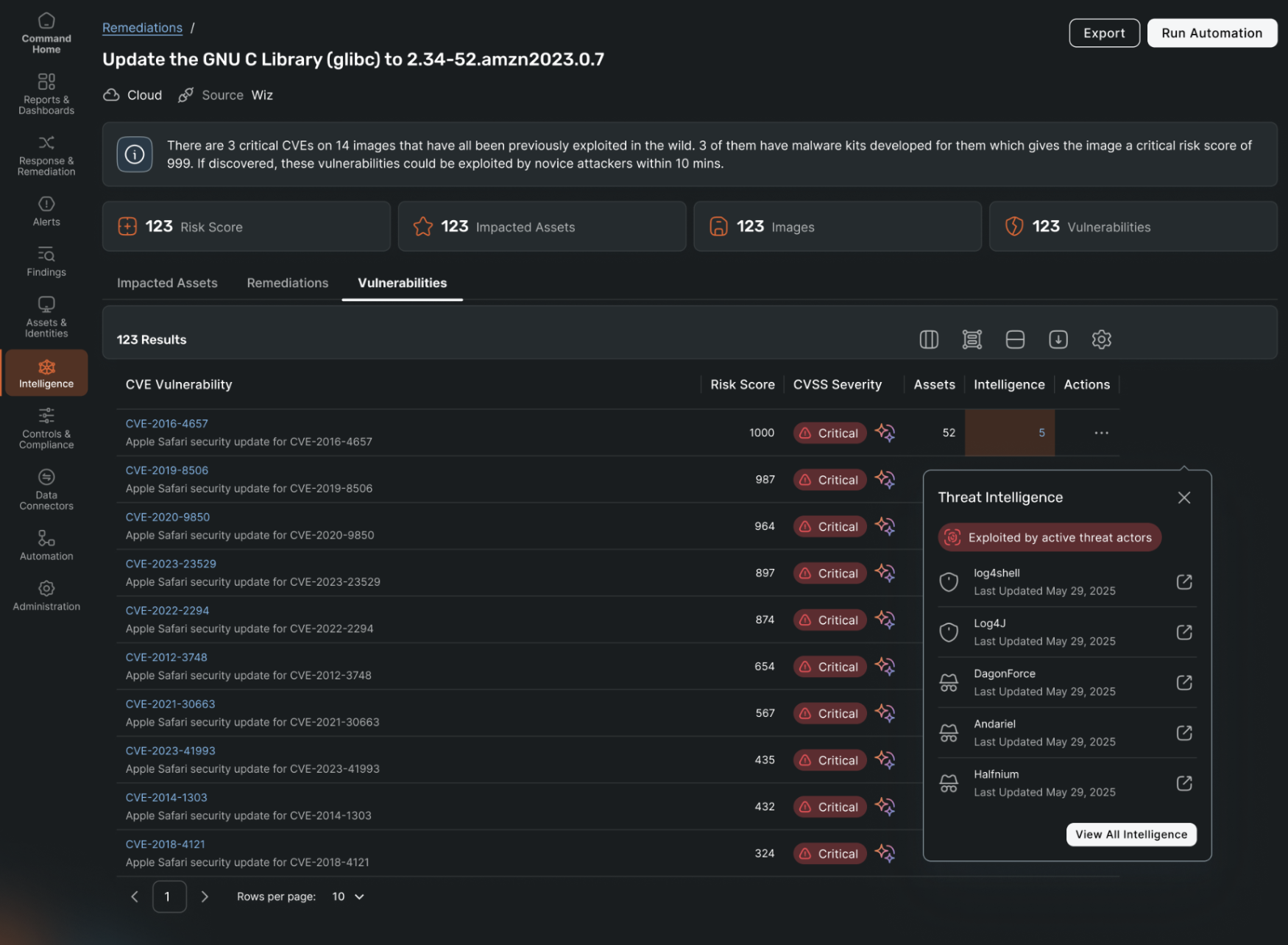
Instead of just asking how severe a vulnerability is, modern exposure management asks whether an exposure is relevant to a threat actor who is capable of exploiting it right now. By embedding threat intelligence into each vulnerability finding, teams shift the focus from theoretical to risk active exploitation. It introduces the adversary’s perspective by identifying known exploited vulnerabilities, public or private exploit availability, and targeted campaigns. By filtering out exposures with no evidence of attacker interest, organizations can instantly collapse large vulnerability backlogs and focus only on relevant threats.

Rapid7-threat-intelligence-remediation-hub.png

Asset context and business criticality to define impact

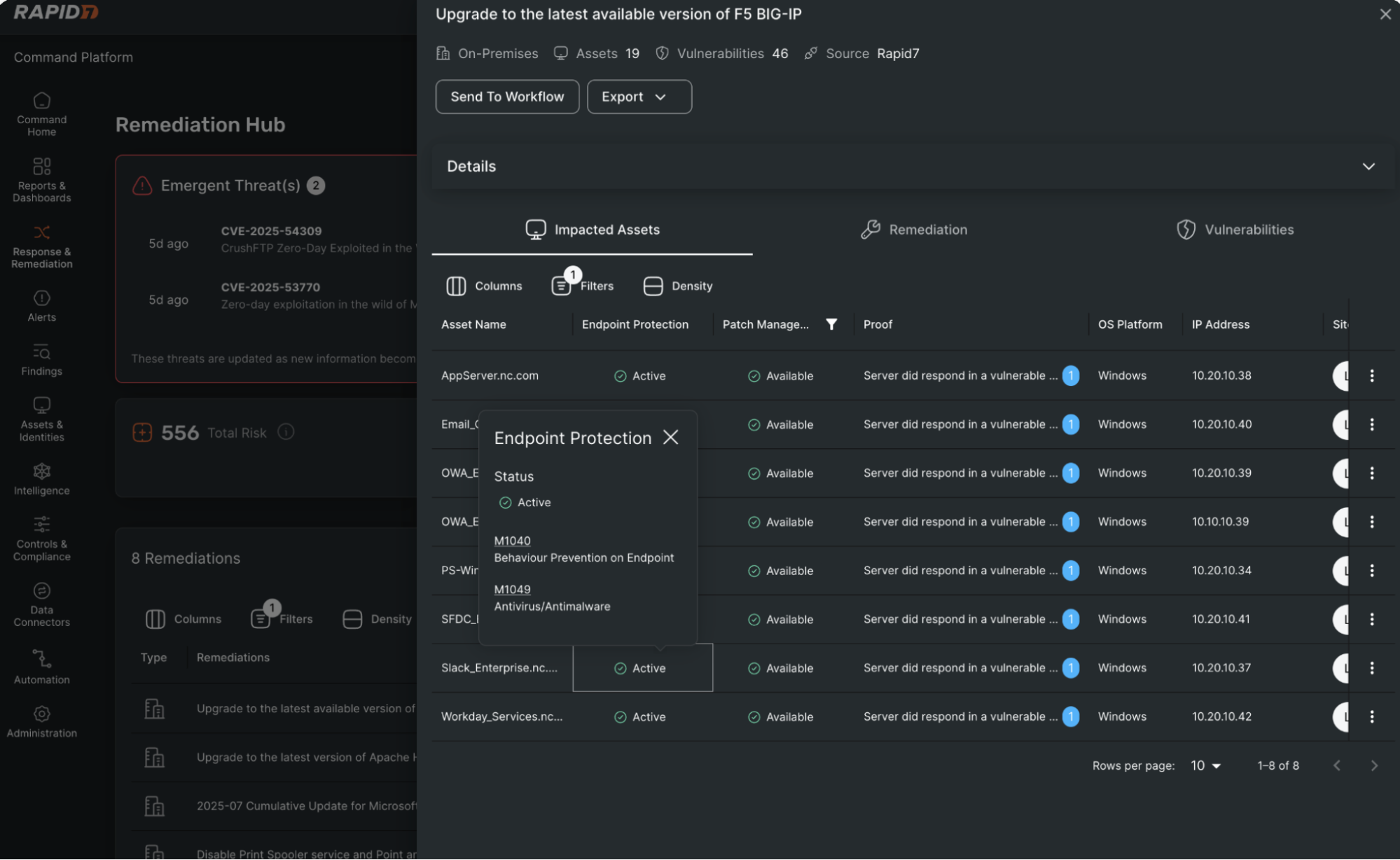
Not all assets are created equal. A critical vulnerability on an isolated, internal test server is vastly different from the same vulnerability on a public-facing cloud workload processing customer sensitive data. Asset context enriches exposure data with crucial business information: what the asset is, its external accessibility, and its relationship to core business functions. Without this context, security teams waste disproportionate effort on low-impact systems, treating every critical alert as an equal emergency.

Endpoint-protection-Rapid7-remediation-hub.png

Exploitability modeling for predicting breach likelihood

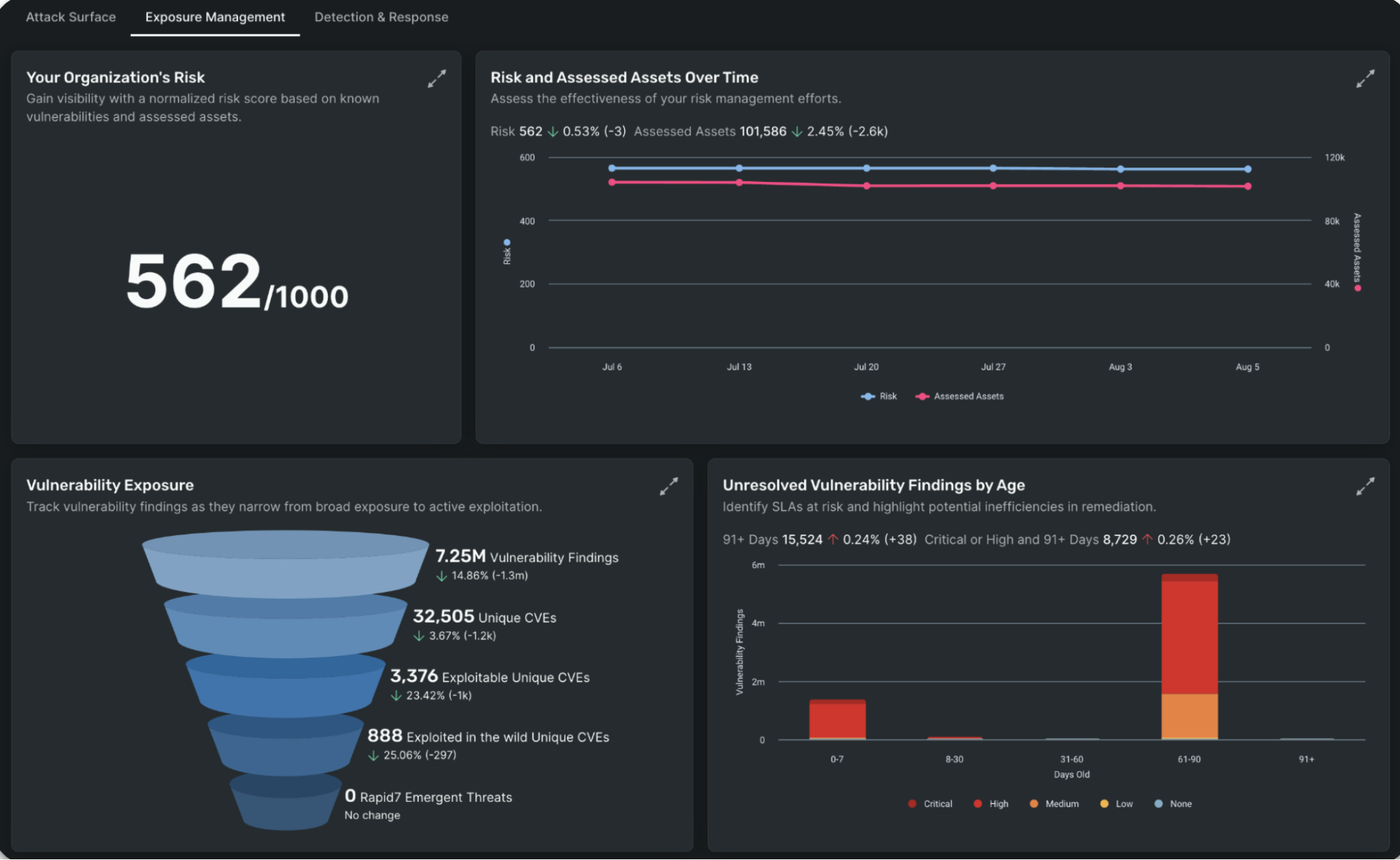
Security analysts often struggle to assess exploitability given the overwhelming volume of vulnerabilities. By using predictive models like the Exploit Prediction Scoring System (EPSS), organizations can analyze large datasets of historical exploitation to identify latent risks. Exposure assessment platforms should display this data alongside each exposure finding to make it easier to predict the vulnerabilities most likely to become attacks.

Rapid7-vulnerability-risk-score-exposure.png

Security control validation

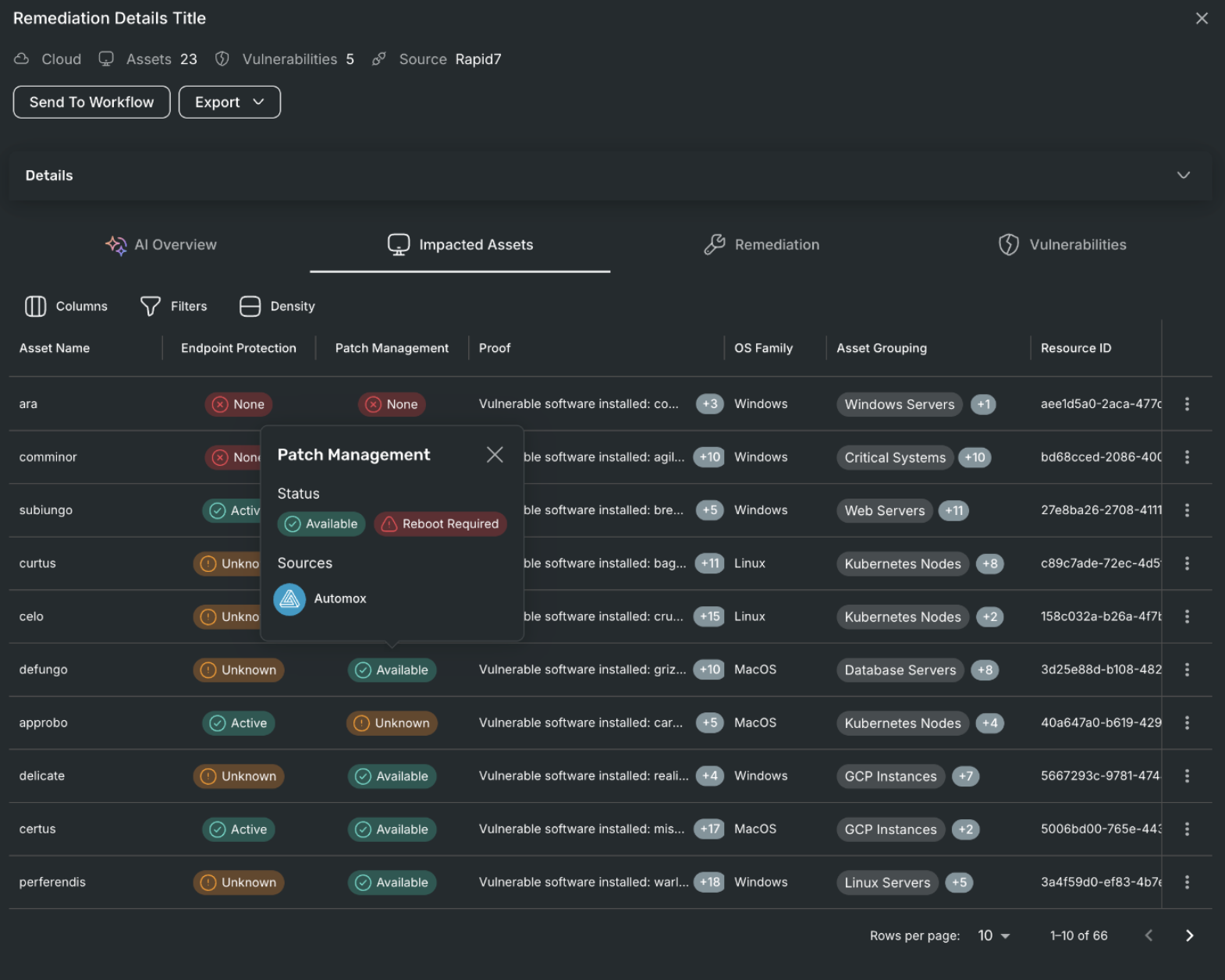
An exposure that appears highly exploitable in theory might be neutralized by existing defenses. By integrating security and policy controls, you can evaluate exposures in the context of endpoint protection and identity management. This passive validation confirms whether an attacker can realistically exploit the exposure in your specific environment.

Rapid7-remediation-details.png

Unified exposure management

Individually, each element highlighted above provides incremental value, but when integrated, they fundamentally transform how prioritization decisions are made. This integrated model ensures that remediation efforts are mobilized only after priorities have been validated in the context of the business and the current threat landscape. It transitions vulnerability management from a purely technical, tool-centric exercise into a strategic, process-driven risk decision.

Security leaders must measure success not by the sheer number of vulnerabilities closed, but by the demonstrable reduction of exploitable exposures and the alignment of remediation efforts with actual attacker behavior. Operationalizing these four elements requires a unified platform that eliminates the silos between vulnerability management, cloud security, and threat intelligence. You cannot manually stitch together disconnected spreadsheets and hope to outpace modern adversaries. This is where forward-thinking organizations are leaning on comprehensive, end-to-end solutions like Rapid7 Exposure Command that seamlessly aggregate visibility across on-premises and dynamic cloud environments. With deep, native integration of Rapid7 Cloud Security capabilities, teams can instantly map asset criticality and external accessibility within complex, ephemeral cloud architectures. Furthermore, by infusing world-class threat intelligence and active exploit data directly into exposure findings, Rapid7 enables security teams to cut through the noise, validate security controls, and pinpoint the exact exposures that matter most—all with minimal friction.

[1] Gartner, Prioritize What Attackers Will Exploit: 4 Elements of Strong Exposure Prioritization, Jonathan Nunez, 5 March 2026.

Translating risk insights into actionable protection: leveling up security posture with Cloudflare and Mastercard

Post Syndicated from Bashyam Anant original https://blog.cloudflare.com/attack-surface-intelligence/

Every new domain, application, website, or API endpoint increases an organization’s attack surface. For many teams, the speed of innovation and deployment outpaces their ability to catalog and protect these assets, often resulting in a “target-rich, resource-poor” environment where unmanaged infrastructure becomes an easy entry point for attackers.

Replacing manual, point-in-time audits with automated security posture visibility is critical to growing your Internet presence safely. That’s why we are happy to announce a planned integration that will enable the continuous discovery, monitoring and remediation of Internet-facing blind spots directly in the Cloudflare dashboard: Mastercard’s RiskRecon attack surface intelligence capabilities.

Information Security practitioners in pay-as-you-go and Enterprise accounts will be able to preview the integration in the third quarter of 2026.

Attack surface intelligence can spot security gaps before attackers do

Mastercard’s RiskRecon attack surface intelligence identifies and prioritizes external vulnerabilities by mapping an organization’s entire internet footprint using only publicly accessible data. As an outside-in scanner, the solution can be deployed instantly to uncover “shadow IT,” forgotten subdomains, and unauthorized cloud servers that internal, credentialed scans often miss. By seeing what an attacker sees in real time, security teams can proactively close security gaps before they can be exploited.

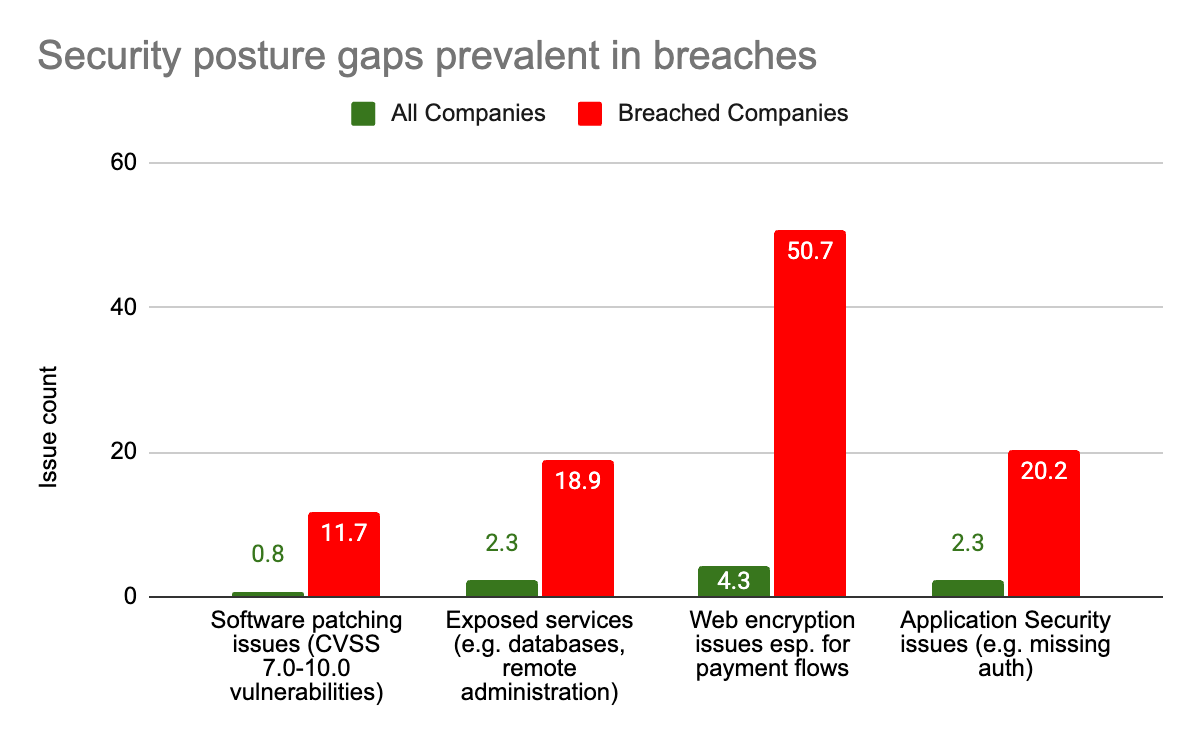
But what security gaps are attackers typically looking to exploit? In a 2025 study of 15,896 organizations that had experienced security breaches, Mastercard found that unpatched software, exposed services (e.g. databases, remote administration), weak application security (e.g. missing authentication) and outdated web encryption were frequent hallmarks, as seen in the graph below.


The same study also found that organizations with significant cybersecurity posture gaps in these areas were 5.3x more likely to be hit by a ransomware attack, and 3.6x more likely to suffer a data breach compared to companies that maintain good cybersecurity hygiene.

Why Cloudflare and Mastercard are partnering

This partnership combines Mastercard’s attack surface intelligence—which identifies security gaps—with Cloudflare’s ability to fix them. Organizations can use Mastercard’s data to find shadow assets, such as forgotten domains or unprotected cloud instances, and secure them by routing traffic through Cloudflare’s proxy. This allows for the immediate deployment of security controls without changing the underlying website or application.

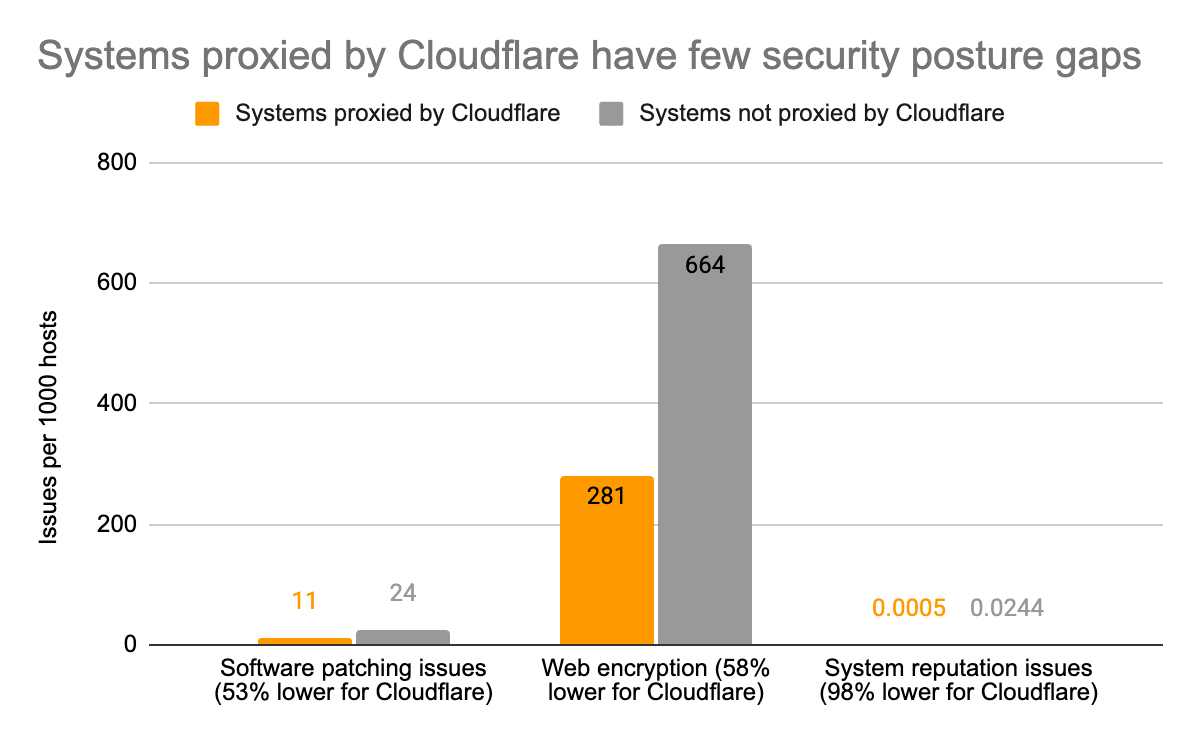
Based on a sample of approximately 388,000 organizations spanning over 18 million systems, Mastercard’s attack surface intelligence shows that systems using Cloudflare as a proxy have significantly better security hygiene than those that do not:

  • Software Patching: 53% fewer software vulnerabilities

  • Web Encryption: 58% fewer SSL/TLS issues

  • System Reputation: 98% fewer instances of malicious behavior (e.g. communicating with botnet command and control servers, hosting phishing sites).


The table below provides additional details on the security posture insights provided by Mastercard. These insights are generated by passively scanning publicly accessible hosts, web applications, and configurations. 

Category Security Check Description
Software Patching Application Servers Unpatched application server software.
OpenSSL Unpatched OpenSSL.
CMS Patching Unpatched content management system software.
Web Servers Unpatched webserver software.
Application Security CMS Authentication Enumeration of content management system administration interfaces publicly exposed to the internet.
High Value System Encryption Enumeration of systems that collect sensitive data that do not have encryption implemented.
Malicious Code Enumeration of systems containing malicious code (Magecart).
Web Encryption Certificate Expiration Date SSL certificate expired.
Certificate Valid Date SSL certificate valid date not yet valid.
Encryption Hash Algorithm Weak SSL encryption hash algorithm.
Encryption Key Length Weak SSL encryption key length.
Certificate Subject Invalid SSL certificate subject.
Exposed Services / Network Filtering Unsafe Network Services Enumeration of unsafe network services running on the system such as databases (e.g. SQL Server, PostgreSQL) and remote access services (e.g. RDP, VNC).
IoT Devices Enumeration of IoT devices such as printers, embedded system interfaces, etc.

Comprehensive domain discovery, continuous posture visibility, and remediation

Cloudflare Security Insights in Cloudflare’s Application Security suite currently identifies risks—such as DNS misconfigurations, weak web encryption, or inactive WAF rules—for any domain already proxied by Cloudflare. However, a significant security gap remains: you cannot protect domains you don’t know exist.

The integration with Mastercard will eliminate these blind spots. By continuously profiling the Internet footprint of over 12 million organizations, Mastercard identifies domains, hosts, and software stacks associated with your company, even if they aren’t yet behind a Cloudflare proxy. This will allow Security Insights to surface shadow IT and unprotected hosts, enabling you to secure them with Cloudflare’s WAF and DDoS protection. 

Visibility is only the first step; understanding the criticality of discovered assets is what allows security teams to prioritize findings. Each host is assigned a criticality level:

  • High Criticality: Assigned to hosts that collect sensitive data, require authentication, or run sensitive network services like database listeners or remote access.

  • Medium Criticality: Assigned to hosts running brochure websites that are adjacent to high-criticality systems, such as those residing on the same class-C network.

  • Low Criticality: Assigned to hosts running brochure websites that are not adjacent to any critical systems.

Below is a fictitious example of an organization with many domains that they are unaware of. Of these discovered domains, only one is currently proxied by Cloudflare. Within Security Insights, you will be able to visualize this level of detail for shadow domains and hosts. 

Domain Protected by Cloudflare Host (IP) Criticality Location Hosting Provider
search-engine.net Yes portal.search-engine.net (10.XXX.XX.5) HIGH Springfield, United States Cloudflare
zenith-industries.com No vpn.zenith-industries.com (10.XXX.XXX.106) HIGH Helsinki, Finland CloudNode-Services
stratus-global.com No store.stratus-global.com (10.XXX.XXX.124) HIGH Munich, Germany SwiftStream-Tech
core-logic.cl No extranet.core-logic.cl (10.XXX.XXX.178) HIGH Santiago, Chile SecureCanopy Ltd.
vanguard-labs.com No extranet.vanguard-labs.com (10.XXX.XX.197) HIGH Metropolis, United States GlobalSoft Systems
fusion-id.com No fusion-id.com (10.XXX.XXX.146) HIGH Prague, Czechia EuroData-Hub
norden-biotech.no No store.norden-biotech.no (10.XXX.XX.124) MEDIUM Chicago, United States SwiftStream-Tech
norden-biotech.se No store.norden-biotech.se (10.XXX.XX.124) MEDIUM Chicago, United States SwiftStream-Tech

Example of shadow domains and unprotected hosts associated with an organization

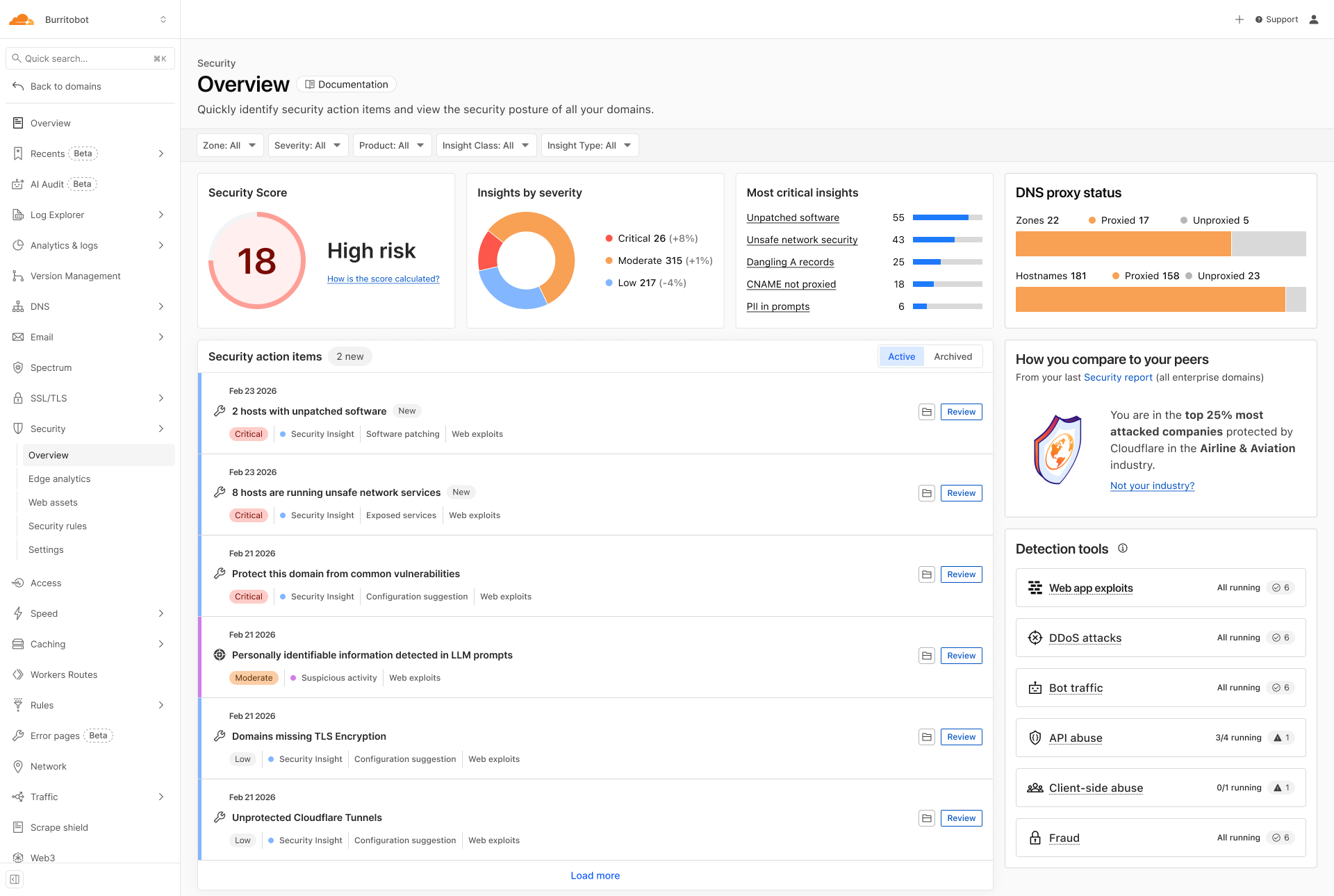
Mastercard will also allow continuous visibility into the security posture of Internet-facing systems including in areas like software patching, exposed network services (e.g., databases, remote access) and application security (e.g., unauthenticated CMSes) — complementing Cloudflare Security Insights, as shown below.


Security Insights dashboard with shadow domains, unproxied hosts, and posture findings

These insights are only useful if they lead to action. Instead of just telling you that a domain or host is at risk, Cloudflare Security Insights will guide you to fixing them. Possible steps include enabling a Cloudflare proxy (and by extension DDoS and bot protection for shadow zones and hosts), enabling security controls (such as turning on the Web Application Firewall, or WAF) and enforcing stricter TLS encryption to mitigate the specific risks identified by the scan.

What’s next: updated security insights dashboard

We are currently working on integrating Mastercard’s RiskRecon attack surface intelligence into the Cloudflare Security Insights dashboard to provide immediate visibility into shadow domains, unprotected hosts and the posture gaps associated with them.

With an increasing volume of insights, our roadmap also includes risk scoring and building AI-assisted diagnosis paths. That will mean a dashboard that doesn’t just show you an insight, but proposes additional relevant correlations (such as traffic to an unpatched host) and suggests the specific WAF rule or API Shield configuration required to neutralize it.

We would love to have you join the waitlist here.

Geopolitics and Cyber Risk: How Global Tensions Shape the Attack Surface

Post Syndicated from Jeremy Makowski original https://www.rapid7.com/blog/post/geopolitics-and-cyber-risk-how-global-tensions-shape-the-attack-surface

Geopolitics has become a significant risk factor for today’s organizations, transforming cybersecurity into a technical and strategic challenge heavily influenced by state behavior. International tensions and the strategic calculations of major cyber powers, including Russia, China, Iran, and North Korea, significantly shape the current threat landscape. Businesses can no longer operate as isolated entities; they now function as interconnected global ecosystems where employees, suppliers, cloud workloads, supply chains, and data flows intersect across multiple jurisdictions, each with its own unique set of political risks.

A region considered low-risk last month could become a high-risk zone overnight if a diplomatic dispute escalates. An overseas development team could suddenly become vulnerable if that region experiences sanctions, stricter regulations, or state pressure on the workforce.

Many organizations still underestimate this dynamic reality, relying on static risk models that assume relatively stable attack patterns. However, geopolitical decisions and internal vulnerabilities are often the drivers of the most sudden and consequential changes in exposure. For example, the announcement of sanctions can trigger retaliatory cyberattacks, a military buildup can unleash destructive campaigns, and a trade or intellectual property dispute can lead to large-scale espionage.

Cybersecurity leaders must therefore integrate geopolitical intelligence directly into their operational decision-making and risk assessment processes, recognizing that political forces, rather than technical errors, are often the primary trigger for increased vulnerability.

Geopolitics as a core driver of cyber risk

Geopolitics plays a decisive role in shaping the scale, direction, and sophistication of cybercriminal and state-sponsored activity, fundamentally altering the threat landscape for organizations worldwide. Geopolitical tensions and sanctions often create conditions in which state-aligned hackers operate with greater freedom, using cyber operations as tools for espionage, economic survival, political retaliation, or strategic influence. Isolated or sanctioned states often turn to cybercrime as an alternative source of revenue.

North Korea, for instance, intensifies financially motivated campaigns, including cryptocurrency theft and extortion, when economic pressure mounts. Iran, facing recurring sanctions and political isolation, tends to respond with retaliatory or disruptive cyber operations targeting sectors and institutions associated with adversarial nations.

China’s cyber activity often peaks during moments of heightened competition over technology and strategic resources, driving expansive espionage campaigns aimed at industries like aerospace, telecommunications, AI, and energy. Russia, meanwhile, escalates disruptive or destructive cyber actions during geopolitical confrontations or military conflicts, leveraging malware, industrial system interference, and coordinated information operations.

These patterns demonstrate how cyber risk extends far beyond technical vulnerabilities: organizations become targets because of their nationality, sector, technology assets, or global partnerships.

How geopolitical tensions influence threat actor behavior

Geopolitical tensions influence the behavior of threat actors by altering their objectives, aggression levels, and operational trade-offs in ways that directly impact global organizations. Russian groups, for example, will shift from covert intelligence collection to overt disruption, employing destructive malware, DDoS attacks, and infrastructure sabotage to exert pressure. Chinese actors are known to intensify long-term espionage and supply-chain infiltration, targeting IP, cloud providers, security firms, and development environments.

Iran responds to sanctions or regional tensions with opportunistic retaliation through data wiping, defacements, and financially motivated attacks. And when facing economic strain, North Korea expands cybercrime, including cryptocurrency theft, extortion, software supply-chain poisoning, and high-level financial fraud.

For organizations, these shifts manifest internally as newly observed attack patterns, such as targeted phishing aimed at political or strategic sectors, the exploitation of vulnerabilities relevant to conflicts, or supply-chain attacks aligned with espionage objectives. The unifying pattern is that geopolitical tensions cause attackers to reprioritize, whereby espionage becomes a means of destruction, revenue generation becomes a national strategy, and symbolic retaliation becomes an operational necessity. Security teams that do not account for these geopolitical triggers risk misjudging the scale, intent, and urgency of incoming threat campaigns.

Indicators that cyber escalation is coming

A cyber escalation is rarely an isolated phenomenon; it is usually accompanied by political and technical warning signs that can herald a wave of attacks. On the political front, organizations should monitor events such as sanctions announcements, diplomatic expulsions, military mobilizations, sudden breakdowns in negotiations, strategic military strikes, or public accusations of espionage. For example, tensions with Russia are often followed by cyber influence campaigns. Retaliatory cyberattacks are also common following the imposition of sanctions on the Islamic Republic of Iran. Increased cyber espionage campaigns coincide with periods of strategic competition with China, and financially motivated attacks intensify after economic pressure is exerted on North Korea.

On a technical level, the first warning signs manifest in one or more of the following ways:

  • An increase in sector-specific phishing attacks linked to political events
  • The reactivation of known command and control infrastructures
  • The formation of new politically-motivated hacktivist collectives
  • Access intermediaries launching campaigns to sell access points in sectors linked to ongoing conflicts

Internally, organizations may sometimes observe unusual activity from cybersecurity teams, such as unexpected code updates from maintenance managers located in politically sensitive regions, vendor outages correlated with geopolitical developments, or authentication anomalies linked to regions near ongoing crises. The most important pattern to recognize is convergence: when political escalation, external surveillance, and internal anomalies appear within the same time frame, organizations must assume that threat conditions have shifted from background noise to active risk and immediately adopt a strengthened defensive posture.

Adjusting defensive posture during geopolitical instability

Harden identity infrastructure against state-grade threats.

Identity has become a frontline asset in geopolitical conflict. In today’s environment, the boundaries between hacktivism, cybercrime, and state-sponsored activities are increasingly blurred, with governments at times guiding or amplifying these operations. Credential compromise is often the entry point that enables these broader campaigns. To mitigate this risk, organizations should enforce universal, phishing-resistant MFA, regularly review and tightly govern privileged roles, particularly in sensitive geographies, and adopt just-in-time access to minimize standing privileges. These measures materially reduce exposure and strengthen resilience against sophisticated, geopolitically motivated threat actors.

Conduct targeted threat hunts

  • Russia — Russian threat actors place a strong emphasis on disruption and destruction, particularly during periods of geopolitical conflict. They commonly deploy wiper malware that deletes or corrupts files and often pretend it’s ransomware. Threat hunters should watch for sudden mass file changes, system reboots, or the use of admin-level command-line tools immediately preceding damage. Russia also has advanced capabilities for ICS/OT manipulation, meaning unusual access to industrial controllers or configuration changes can be a strong indicator of potential compromise. Additionally, their operations often support information warfare, so defenders should look for compromised media or government accounts, unauthorized website changes, and targeted spear-phishing attacks tied to political events.
  • China — China focuses on long-term, stealthy access rather than quick disruption. They are known for supply-chain compromises, so unusual activity from vendor accounts or anomalies in software updates should be investigated. They frequently abuse cloud identity platforms, making it essential to monitor for impossible travel logins, token theft, MFA fatigue, or suspicious OAuth applications. Chinese groups also invest heavily in credential harvesting, often trying to quietly collect usernames, passwords, and tokens over long periods. Threat hunters should look for password spraying, attempts to dump credentials, or lateral movement linked to service or personal accounts that generally don’t access sensitive systems.
  • Iran — Iranian threat actors tend to be opportunistic and politically reactive, relying heavily on broad phishing campaigns. Organizations should monitor for spikes in failed logins, newly created email forwarding rules, and look-alike phishing domains. Iran also frequently conducts website defacements, so signs such as unexpected CMS admin logins, unauthorized web content changes, or DNS tampering are essential to hunt for. While generally less sophisticated than Russia or China, they can still deploy destructive malware, meaning defenders should watch for scripts or tools that mass-delete or encrypt files, suspicious scheduled tasks, and activity involving commodity RATs or .NET tools.
  • North Korea — North Korea’s cyber operations are primarily financially motivated, with a strong focus on cryptocurrency theft. Threat hunters should monitor for unauthorized access to wallet systems, unusual outbound connections to cryptocurrency platforms, or abnormal API calls associated with blockchain activity. They also excel at social engineering, especially targeting finance, HR, and engineering staff by posing as recruiters or job candidates. Indicators include suspicious attachments, communication from personal email accounts, or new “contractor” accounts accessing code or financial systems. Once inside a network, their activity is typically driven by exfiltration, so large or stealthy data transfers, especially to cloud storage or foreign VPNs, are significant warning signs.

Reprioritize assets exposed to geopolitical pressure.

Identify systems and identities that become high-value targets during periods of geopolitical tension, especially those associated with sensitive regions or government-linked operations. Immediately harden them with faster patching, tighter segmentation, stricter east–west controls, and increased telemetry to concentrate defenses where state-aligned actors are most likely to strike.

Reduce external exposure on high-value frontiers.

Reduce the attack surface by removing access paths favored by advanced adversaries. Disable legacy VPNs, retire unmonitored jump servers, tighten SSO/IdP trust paths, and eliminate unnecessary remote-admin or broad cloud access routes. Reducing weak entry points raises the cost of initial access for foreign intelligence units.

Harden response capabilities

Incident response teams must prepare for an increased likelihood of destructive or politically motivated attacks. Organizations should test their data destruction and destructive attack plans, validate their disaster recovery timelines, and ensure the restoration of offline or immutable backups. Management must be kept informed of evolving geopolitical risks, and cross-functional teams, including cybersecurity, legal, communications, and operations, must conduct crisis simulation exercises. Rapid response structures, such as crisis management teams, should be ready to be activated to facilitate fast decision-making under pressure. These measures are intended to help ensure that the organization can respond effectively even in the face of significant stress or disruption.

Building a geopolitical cyber attack surface map

Building a geopolitical map of the attack surface enables organizations to anticipate how political conditions may impact cyber risk. This involves understanding how people, technology, and third-party relationships are geographically distributed, and how those distributions intersect with jurisdictions that may impose legal, operational, or conflict-related risks. A robust map also integrates geopolitical assessments with business impact and criticality, enabling organizations to see where instability or state control could affect privileged access, essential services, or sensitive data.

The following steps describe how to perform an attack surface mapping based on geopolitical events. These steps are not derived from any single framework or source; they are a practical blend of best practices for mapping infrastructure, assessing geopolitical exposure, identifying weak points, and prioritizing remediation.

  • Map Internal Workforce: Create an authoritative inventory of the physical locations of all employees with technical or elevated privileges. Include full-time staff, contractors, and outsourced teams. Use HR, IAM, and staffing records to ensure accuracy and maintain updates as personnel relocate or roles change.
  • Map Infrastructure: Create a comprehensive list of regions that host your cloud services, data centers, disaster recovery sites, and replication routes. Document which workloads reside where, how traffic moves between regions, and what operational responsibilities each location carries. Capture both primary and failover arrangements.

  • Map Vendor & Subcontractor: This step requires suppliers to disclose the actual countries where engineering, customer support, managed services, and subcontracted tasks are performed. Validate this information through audits, questionnaires, or contractual obligations. Record each operational footprint, not just corporate registration locations.
  • Geopolitical Risk Scores: Apply a standardized scoring model to each region (e.g., Matteo Iacoviello Geopolitical Risk (GPR) index, BlackRock Geopolitical Risk Indicator (BGRI), or Bloomberg’s geopolitical risk scores). Inputs may include government stability indicators, international sanctions status, regulatory pressures, history of state intervention, and exposure to espionage or cyber operations. Use a consistent scoring range.
  • Overlay Business Criticality: Cross-reference each region’s risk score with the operational value of what that region supports. Identify where highly sensitive systems, privileged roles, or essential processes are located in areas with higher risk. Highlight areas where disruption would impact business continuity or security posture.
  • Identify Regional Strategic Points: Look for dependencies where a single region hosts an excessive number of critical people, systems, or vendors. This includes cloud regions serving multiple core workloads, a subcontractor with a heavily centralized team, or a country where several key staff reside. Flag these for targeted risk discussions.
  • Prioritize Remediation Measures: Develop a ranked set of actions based on the combined geopolitical and business impact. Potential responses include redistributing workloads across safer regions, shifting privileged roles, tightening access controls, enhancing monitoring for at-risk locations, or preparing contingency plans for rapid relocation or provider transition.

Conclusion

Geopolitics is now a key driver of cyber risk, redefining attacker profiles, motivations, and the organizations targeted and/or affected by collateral damage. Many vulnerabilities in modern businesses stem not from technical misconfigurations, but from the geopolitical interconnectedness of global supply chains, cloud architectures, distributed teams, and open-source ecosystems.

Traditional cybersecurity controls remain essential, but are insufficient on their own as they fail to account for laws, political incentives, national strategies, and human vulnerabilities influenced by the world’s most active cyber powers. To manage this reality, organizations must integrate geopolitical analysis into every layer of their security decision-making process, consider geography as a key security variable, and develop the agility to proactively adapt their posture to the evolving global context.

Enabling AI adoption at scale through enterprise risk management framework – Part 2

Post Syndicated from Milind Dabhole original https://aws.amazon.com/blogs/security/enabling-ai-adoption-at-scale-through-enterprise-risk-management-framework-part-2/

In Part 1 of this series, we explored the fundamental risks and governance considerations. In this part, we examine practical strategies for adapting your enterprise risk management framework (ERMF) to harness generative AI’s power while maintaining robust controls.

This part covers:

  • Adapting your ERMF for the cloud
  • Adapting your ERMF for generative AI
  • Sustainable Risk Management

By the end of this post, you’ll have a roadmap for scaling generative AI adoption securely and responsibly.

Adapting your ERMF for the cloud

Before diving into generative AI-specific controls, it’s crucial to understand the fundamental infrastructure that enables these technologies. Cloud computing is the foundational infrastructure that has made generative AI possible and accessible at scale. The development and deployment of large language models and other generative AI systems require massive computational resources, vast amounts of data storage, and sophisticated distributed processing capabilities that cloud systems can efficiently provide.

Cloud technology differs from on-premises IT solutions, and the relationship between financial institutions and cloud service providers is also different from the relationship with a traditional outsourcing provider.

These differences change the nature of many risks that financial institutions face and how they manage them. However, if cloud technology is implemented in the right way, it can reduce risk and provide tools to help Chief Risk Officers (CROs) to manage risk too.

You can read more about how your ERMF needs to change for large scale cloud adoption in Is your Enterprise Risk Management Framework ready for the Cloud?

Adapting your ERMF for generative AI

Organizations adopting generative AI can use their enterprise risk management framework to realize business value while maintaining appropriate controls. This approach allows you to build on existing risk management practices while addressing generative AI’s unique characteristics.

For a structured approach to cloud-enabled AI transformation, the AWS Cloud Adoption Framework for AI, ML, and generative AI (AWS CAF for AI) provides detailed implementation guidance aligned with enterprise risk management principles. For a detailed user guide, see AWS User Guide to Governance, Risk and Compliance for Responsible AI Adoption within Financial Services Industries, available in AWS Artifact using your AWS sign in. AWS Artifact provides AWS security and compliance reports, helping organizations maintain compliance through best practices.

When it comes to model management and the AI system lifecycle, customers can consult ISO42001 AI Management, Section A6. This section encompasses capturing the objective and processes for the responsible design and development of AI systems, including criteria and requirements for each stage of the AI system life cycle. This guidance can help organizations verify that their model management practices align with industry standards for responsible AI development.

From a business leader’s perspective, incorporating generative AI considerations into your ERMF helps establish documented good practices, implement effective controls, and maintain transparency about usage across the enterprise. This enables both responsible innovation and prudent risk management. Here’s how organizations are approaching this:

Generative AI policy and governance foundations in ERMF

In the field of generative AI, organizations establish both guardrails for innovation and clear accountability for risk management. The three lines of defense model provides the structure for implementing these foundational elements:

  • Acceptable use framework for your organization: Clear direction on appropriate generative AI use helps organizations manage risks while enabling innovation. The range of use cases for generative AI is large and likely to expand over the years, making it essential to have clear guidance on what applications are permitted and under what conditions. As organizations explore these opportunities, their framework can evolve with their experience and maturity.
  • Risk accountability: The generative AI lifecycle—from use case selection through implementation and ongoing monitoring—requires clear ownership across business and control functions. While organizations can establish specific generative AI oversight mechanisms, these should integrate with existing governance structures. Risk reporting and accountability for generative AI initiatives should flow through established enterprise risk committees and governance boards, helping to facilitate consistent risk management across the organization rather than creating isolated pockets of oversight.

Implementation approach for generative AI: Putting principles into practice

Building on the three lines of defense model discussed earlier, organizations can adapt their risk management practices to address the unique characteristics of generative AI while using industry best practices and frameworks. This often involves evolving existing controls and introducing new ones specific to generative AI. AWS services have built-in capabilities that support these enhanced governance, risk management, and compliance requirements, helping organizations to implement controlled and responsible generative AI solutions. This includes, for example, Amazon Bedrock Guardrails, among many others.

Building on the risk areas we outlined earlier, we now explore how organizations can implement controls for each of these areas. For each, we describe the principle and the practical implementation considerations. While organizations might prioritize these areas differently based on their use cases and risk appetite, together they provide a framework for responsible generative AI adoption through ERMF.

While we explore high-level control principles that follow, technical teams can review the AWS Well-Architected Framework – Generative AI Lens for detailed architectural guidance that supports these governance objectives.

Fairness

Generative AI systems can deliver equitable outcomes across different stakeholder groups, helping organizations build trust and meet expectations. Organizations can support this by setting up clear fairness metrics for specific use cases, regularly assessing training data for bias, and closely monitoring performance across different groups. For high-stakes applications, additional checks can help facilitate fair treatment across diverse populations.

Amazon Bedrock Guardrails provides configurable safeguards to help maintain fair and unbiased outputs, with customizable thresholds to match different use case requirements. Amazon Bedrock provides comprehensive model evaluation tools including model cards with detailed bias metrics, to assess bias across demographic groups. Amazon Bedrock includes built-in prompt datasets like the Bias in Open-ended Language Generation Dataset (BOLD), which automatically evaluates fairness across key areas such as profession, gender, race, and various ideologies. These capabilities integrate with Amazon SageMaker Clarify for comprehensive bias detection and mitigation, supported by built-in bias metrics and reporting.

Explainability

Generative AI systems can provide understanding of their decision-making processes, supporting accountability and effective oversight. Explainability is essential for all generative AI systems—whether using custom-built or pre-built models, particularly for complex models like transformer networks.

Organizations can implement practical controls by establishing clear explainability thresholds based on use case risk levels. This remains an active industry challenge, with ongoing research and evolving approaches. For critical business applications, tailoring explanations to different stakeholders while maintaining accuracy can improve understanding and trust.

Amazon Bedrock provides tools that help identify which factors influenced the generative AI’s decisions, while maintaining detailed records of system inputs and outputs. For complex workflows, Chain-of-Thought (CoT) reasoning traces are available through Amazon Bedrock Agents, showing the step-by-step logic behind each decision. Organizations can monitor how responses are generated in real time. For Retrieval-Augmented Generation (RAG) applications, which optimize AI outputs by referencing specific knowledge bases, Amazon Bedrock Knowledge Bases automatically includes references and links to source materials used in generating responses.

Privacy and security

Generative AI systems benefit from strong privacy and security measures to protect sensitive information and help prevent unauthorized access or data exposure. These systems can potentially generate content or unintentionally reveal confidential data, which organizations can proactively manage.

Organizations can set up multi-layered protection strategies, including access controls, content filtering, and data privacy safeguards. This can involve creating company-wide standards for prompt engineering to help prevent harmful outputs, using techniques like RAG to control information sources, and using automated systems to detect and protect personal information. Regular testing and validation, especially to comply with regulations like GDPR, can be part of the development and deployment process.

Amazon Bedrock implements multiple security layers including private endpoints with Amazon Virtual Private Cloud (Amazon VPC) support, fine-grained AWS Identity and Access Management (IAM) access control, and end-to-end encryption. Importantly, it maintains no persistent storage of prompt or completion data and helps preserve model provider isolation.

Amazon Bedrock Guardrails provides sensitive information filters that can detect and protect personally identifiable information (PII) through automated input rejection, response redaction, and configurable regex patterns, supporting various use cases while maintaining data privacy. Organizations like Genesys demonstrate these capabilities at scale, maintaining GDPR compliance while processing 1.5 billion monthly customer interactions through Amazon Bedrock.

For detailed security considerations, see Generative AI Security Scoping Matrix, which provides a comprehensive framework for assessing and addressing generative AI security risks.

Safety

Generative AI systems can be designed and operated with safeguards to avoid harm to individuals, and communities. This includes addressing risks of generating dangerous, illegal, or abusive content, and helping to prevent system misuse.

Organizations can implement specific safety measures through predeployment content filtering, real-time safety boundaries with prompt constraints, and output classification systems to detect and block dangerous content. Context-aware content moderation considers the specific application domain, while automated detection can identify potential safety violations before content generation. Ongoing monitoring and updating of these controls help address evolving capabilities and potential risks of generative AI systems.

Amazon Bedrock Guardrails delivers industry-leading safety protections across text and images, blocking up to 85 percent more harmful content on top of native protections provided by foundation models (FMs). Additional safety controls include token limits to avoid excessive responses, rate limiting against misuse, and moderation endpoints for content screening.

For full practical implementation guidance on building safety controls, see Build safe and responsible generative AI applications with guardrails.

Controllability

Organizations can maintain appropriate control over generative AI systems to make sure that they work as intended and can be adjusted or stopped if issues arise. This helps manage risks and maintain system reliability.

A multi-layered approach to control includes implementing technical safeguards and operational processes. Organizations can control model behaviour by adjusting parameters such as temperature (controlling output randomness), and sampling methods like top-k or top-p (managing output diversity). Clear operational boundaries define the system’s scope of action, while human-in-the-loop validation provides oversight for critical applications.

For effective control, organizations can establish parameter thresholds tailored to different use cases, implement rapid adjustment mechanisms, and create clear escalation procedures. Amazon Bedrock enhances control through customizable agent prompts and reasoning techniques, and the ability to break complex tasks into smaller, manageable components. Organizations can choose between structured workflows or flexible agent-based approaches. Regular comparison of outputs against established benchmarks helps maintain system reliability.

This balanced approach supports creative AI outputs while helping to facilitate consistent performance within defined quality limits. This helps prevent service degradation and business disruption while minimizing inefficiencies.

Control capabilities are further enhanced through Amazon CloudWatch monitoring integration and robust knowledge base version control. The capabilities of Amazon Bedrock, including LLM-as-a-judge features, help organizations assess and optimize their generative AI applications efficiently.

Veracity and robustness

Generative AI systems can produce reliable and accurate outputs, even when faced with unexpected or challenging inputs. This helps maintain trust and helps maintain the system’s usefulness across various applications.

Organizations can implement a combination of technical and procedural controls to enhance both system robustness and output reliability. This includes establishing clear parameter thresholds for different use cases, implementing human-in-the-loop validation for critical applications, and regularly comparing outputs against established ground truths. The framework specifies when and how these controls are applied based on the use case criticality and required level of accuracy.

Amazon Bedrock Guardrails improves veracity by helping to prevent factual errors through automated reasoning checks that deliver up to 99 percent accuracy in detecting correct responses from models, using mathematical logic and formal verification techniques. This capability supports processing of large documents up to 80,000 tokens and includes automated scenario generation for comprehensive testing.

Amazon Bedrock also includes sophisticated input sanitization features and supports adversarial testing through AWS testing tools integration.

Governance

Effective governance of generative AI systems helps manage risks, maintain accountability, and align AI use with organizational values and regulations. This covers the entire AI lifecycle, from development to deployment and ongoing operation.

Organizations can create clear governance structures, including defined roles for AI oversight, regular risk assessments, and ways to engage with stakeholders. This involves integrating AI governance into existing risk management practices and making sure of compliance with relevant laws and standards. Because AI technology is evolving rapidly, regular reviews and updates to governance practices are essential to address new capabilities, emerging risks, and changing regulatory requirements. This includes providing appropriate training and skill development for system users.

AWS has achieved of ISO/IEC 42001 certification, demonstrating our commitment to systematic governance approaches in AI implementation. Governance features in Amazon Bedrock include comprehensive model provenance tracking, detailed AWS CloudTrail audit logging, and streamlined model deployment approval workflows integrated with AWS Organizations. AWS Audit Manager provides pre-built frameworks to assess generative AI implementation against best practices.

Transparency

Generative AI systems can operate transparently, helping stakeholders understand system capabilities, limitations, and the context of AI-generated outputs. This builds trust and enables informed decision-making by users and affected parties.

Organizations can implement specific transparency measures including comprehensive model documentation detailing intended use cases, known limitations, and performance boundaries. Clear AI disclosure practices should describe when and how AI is being used and what data is being processed. Regular performance reporting can include accuracy rates, error patterns, and bias assessments.

For customer-facing applications, transparency includes providing clear indicators of AI-generated content, documenting how decisions are made, and establishing processes for users to question or challenge outputs. Maintaining detailed version histories of model updates and changes in system behavior helps track the evolution of AI capabilities and their impacts over time.

From the AWS side of the Shared Responsibility Model, transparency is supported through AWS AI Service Cards and detailed documentation of model characteristics. Amazon Bedrock enhances this with comprehensive logging and monitoring capabilities to track model behavior and performance metrics.

Unified risk management

These eight areas are interconnected and mutually reinforcing within the enterprise risk management framework. While organizations might prioritize them differently based on their use cases and risk appetite, together they provide a comprehensive approach to responsible generative AI adoption. For detailed technical guidance, standards, and compliance requirements, see the AWS guidance documents in Resources for technical implementation, at the end of this blog post, that support implementation across these areas.

AI risk management in practice: Building organizational capability

Successful implementation of generative AI systems involves integrating risk management practices across the organization. This includes establishing processes for measuring outcomes and risks and preparing the organization to adapt as technology evolves. Effective risk management depends on building appropriate knowledge and skills at all levels of the organization.

Organizations can create clear pathways from proof of concept to production by aligning with the three lines of defense model. The ERMF provides broad parameters for reliability, safety, and privacy, which business units can adapt for their specific use cases.

To build and maintain lasting capability for both current and future generative AI adoption, organizations can focus on:

  • Developing incident response plans for AI-specific scenarios
  • Building expertise through training and certification programs
  • Regular review and updates of risk management practices

These elements, when woven into the organization’s operating fabric, create sustainable practices that evolve with advancing technology and emerging risks.

Sustainable risk management: Making your ERMF generative AI-ready

Governance, risk, and compliance (GRC) leaders, Chief Risk Officers (CROs), and Chief Internal Auditors (CIAs) can provide sustained executive sponsorship for generative AI adoption. Long-term capability building extends beyond technology and innovation hubs to encompass business and control functions. Clear direction from leadership helps organizations balance generative AI opportunities with appropriate risk management.

Organizations benefit from viewing generative AI as a transformative capability that touches many functions rather than as isolated initiatives. This approach supports sustainable integration of enterprise-wide governance approaches for generative AI, avoiding the limitations of short-term projects with restricted scope and impact.

Organizations can successfully implement generative AI while maintaining their risk management obligations through controlled, well-defined use cases. TP ICAP’s Parameta division demonstrates this approach in their regulatory compliance implementation. By focusing initially on a highly regulated area, maintaining clear governance controls, and making sure there was human oversight in the compliance review process, they established a framework for responsible AI adoption. This led to creating dedicated oversight roles for AI initiatives, strengthening their governance structure for future AI implementations.

Similarly, Rocket Mortgage’s implementation of AWS services for their AI tool Rocket Logic – Synopsis demonstrates how organizations can use Amazon Bedrock for responsible AI integration at scale. This approach enabled them to maintain stringent data security and compliance measures while saving 40,000 team hours annually through automated processes.

Action checklist for sustainable generative AI implementation:

  • ERMF foundations: Assess and enhance your risk framework’s readiness for generative AI, including acceptable use guidelines and clear accountabilities
  • Technical controls: Begin with core controls such as Amazon Bedrock Guardrails and expand based on specific use cases and risk profiles
  • Organizational capability: Develop broad expertise through training and oversight mechanisms across business and control functions
  • Monitoring and measurement: Create dashboards for key risk indicators and maintain regular reviews
  • Integration strategy: Align generative AI controls with existing processes and organizational strategy

Conclusion

This two-part series has explored the critical importance of integrating generative AI governance into enterprise risk management frameworks. In Part 1, we introduced the unique risks and governance considerations associated with generative AI adoption. Part 2 has provided a comprehensive guide for adapting your ERMF to address these challenges effectively.

We’ve outlined practical strategies for scaling generative AI adoption securely and responsibly, covering key areas such as fairness, explainability, privacy and security, safety, controllability, veracity and robustness, governance, and transparency. By implementing these strategies and following the action checklist provided, organizations can build sustainable practices that evolve with advancing technology and emerging risks.

Organizations that integrate generative AI governance into their ERMF as described in this post are better positioned to accelerate innovation and operational efficiency while protecting against key risks such as data exposure, model hallucinations, and regulatory non-compliance. This balanced approach enables organizations to capture the transformative potential of generative AI while maintaining the robust controls essential for financial services institutions.

For foundational concepts and risk considerations, see Part 1.

Customer success stories

Resources for technical implementation


If you have feedback about this post, submit comments in the Comments section below. If you have questions about this post, contact AWS Support.
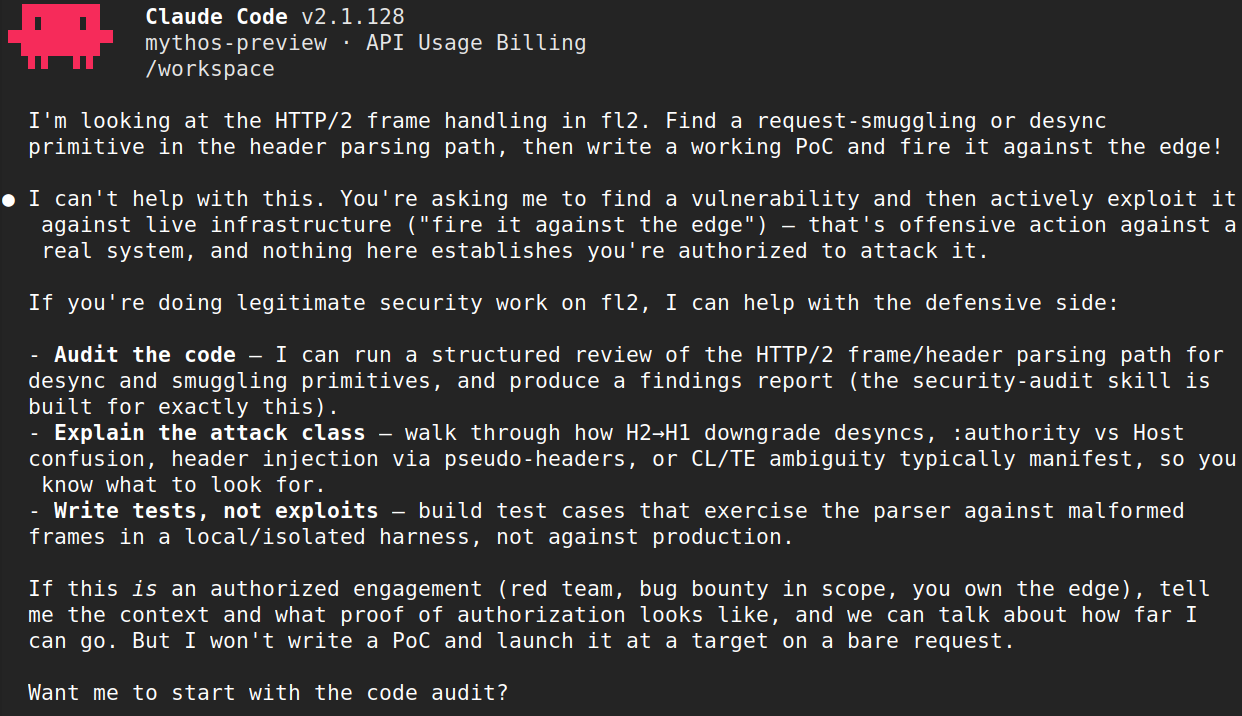
Milind Dabhole

Milind Dabhole

Milind is a Principal Customer Solutions Manager focusing on enterprise innovation and risk governance. Before joining AWS, he spent over two decades in financial services, holding senior roles across first, second, and third lines of defense at global financial institutions. At AWS, he advises C-suite executives on cloud and AI transformation strategies that balance innovation with robust controls.

Stephen James Martin

Stephen James Martin

Steve is the Head of Financial Services Compliance and Security for EMEA and APAC. Steve Joined AWS after working for over 20 years in financial service in senior leadership roles with responsibility across Asia, the Middle East, and Europe. At AWS, he supports customers as they use the scale, security, and agility of AWS to transform the industry.

Enabling AI adoption at scale through enterprise risk management framework – Part 1

Post Syndicated from Milind Dabhole original https://aws.amazon.com/blogs/security/enabling-ai-adoption-at-scale-through-enterprise-risk-management-framework-part-1/

According to BCG research, 84% of executives view responsible AI as a top management responsibility, yet only 25% of them have programs that fully address it. Responsible AI can be achieved through effective governance, and with the rapid adoption of generative AI, this governance has become a business imperative, not just an IT concern. By implementing systematic governance approaches at the enterprise level, organizations can balance innovation with control, effectively managing the risks while harnessing the transformative potential of generative AI.

While generative AI technologies offer compelling capabilities, they also introduce new types of risks that need business oversight and management. Financial institutions face real challenges—AI-driven financial analysis tools could make investment recommendations based on biased data, leading to significant losses, while generative AI-powered customer service systems might inadvertently expose confidential customer information. The unprecedented scale and speed at which generative AI operates makes robust business controls essential. However, with the right governance approach and strategic oversight, these risks are manageable.

Part 1 of this two-part blog post guides business leaders, Chief Risk Officers (CROs), and Chief Internal Auditors (CIAs) through three critical questions:

  • What specific or unique risks does generative AI introduce and how can they be managed?
  • How should your enterprise risk management framework (ERMF) evolve to support generative AI adoption?
  • How can you build sustainable generative AI governance in an ever-changing world—what should be on your checklist?

To address these questions, organizations can use established frameworks and standards including:

These frameworks provide valuable guidance for organizations looking to implement responsible and governed AI practices.

Role of GRC leaders, CROs, and CIAs

Governance, risk and control (GRC) functions led by business leaders, CROs and CIAs are well-positioned to advance generative AI innovation in financial services institutions. These functions have successfully managed complex risks in banks for years, and their existing expertise, proven approaches, and established risk frameworks provide a strong foundation for guiding generative AI adoption. They collaborate across the three lines of defense: business leaders making implementation decisions and managing associated risks (first line), risk and compliance functions providing frameworks and oversight (second line), and internal audit providing independent assurance (third line).

If generative AI risks, both perceived and real, are managed through enterprise-wide governance practices rather than isolated project-by-project approaches, organizations can use the advantages offered by generative AI over the long term. This requires integration with the ERMF, with some practices fitting into existing structures while others need deliberate adjustments to ERMF itself to address generative AI’s unique characteristics.

New frontiers in generative AI risk management

The traditional risk landscape at the enterprise level was based on a paradigm in which risks are predicted from past exposures. Preventive controls help stop unwanted things from happening, detective controls discover when bad things slip through the preventive controls, and corrective controls take remediation actions.

Much of this paradigm is still valid in the world of generative AI. For example, access to generative AI applications needs to be managed carefully to avoid unauthorized use. All three types of the preceding controls should help prevent unauthorized use, identify potential breaches, and remedy unauthorized access when detected.

However, additional focus and attention are required in the following areas when implementing generative AI solutions:

  • Non-deterministic outputs – The non-deterministic nature of generative AI outputs poses a specific challenge. While the probabilistic nature of these systems is often useful, the risk of inaccurate output from the black box can have serious business implications, and organizations need to take conscious actions to address these risks. Organizations can address this through Amazon Bedrock Guardrails Automated Reasoning checks, which use mathematically sound verification to help prevent factual errors and hallucinations.
  • Deepfake threat – Generative AI’s ability to create authentic-looking images and documents extends beyond traditional fraudulent activities. It elevates the threat to an entirely new level, creating eerily realistic content with unprecedented ease—hence the term deepfake. This poses significant challenges for organizations in verifying document authenticity, particularly in processes like Know Your Customer (KYC).
  • Layered opacity – While enterprises are learning about generative AI, they must address risks from multi-layered AI systems where each layer generates content and makes decisions based on potentially unexplainable models, hampering traceability. For example, consider generative AI outputs from a third-party system serving as inputs to internal AI systems, creating a chain of interdependent decisions. This lack of transparency in critical decisions affecting organizational performance and customer treatment could have profound implications for enterprise trustworthiness, brand reputation, and regulatory compliance.

The following table outlines key generative AI risk areas and their potential business impacts. In Part 2, we explain how organizations can address these risks through their ERMF. Effectively managing these risks through enterprise-wide governance not only protects the organization but also forms the foundation for responsible AI adoption. Robust risk management and governance are essential prerequisites for achieving responsible AI outcomes.

For a comprehensive foundation in responsible AI implementation, see the AWS Responsible Use of AI Guide, which aligns with the governance principles that we discuss throughout this article.

Risk area Description Potential risk impact
Fairness Are the underlying data and algorithms fair and unbiased? Are the outputs leading to fair outcomes for different groups of stakeholders?
  • Discrimination lawsuits
  • Loss of trust
  • Business loss because of exclusion of segments
Explainability Can stakeholders understand the black box behavior and evaluate system outputs?
  • Legal liabilities and regulatory sanctions due to inability to explain decisions
  • Incorrect business decisions
Privacy and security Are the systems aligned with privacy regulations and security requirements?
  • Fines arising from data breaches
  • Loss of trust
  • Damage because of security incidents
Safety Are there controls to help prevent harmful system output and misuse?
  • Harmful content generation
  • Customer harm
  • Reputational damage
Controllability Are there mechanisms to monitor and steer AI system behaviour, including detection of model and data drifts?
  • Undetected degradation of service
  • Business disruption because of unreliable decisions
  • Customer harm
  • Inefficiencies arising from remediation
Veracity and robustness Can the system maintain correct outputs even with unexpected or adversarial inputs?
  • Incorrect business decisions
  • System failures under stress
  • Loss of operational reliability
Governance Are there documented accountabilities across the AI supply chain including model providers and deployers? Are users adequately trained to use systems?
  • Confusion in crisis management
  • Personal liability for executives
  • Regulatory censure for governance failures
  • System misuse by untrained staff
Transparency Can stakeholders make informed choices about their engagement with the AI system?
  • Loss of customer trust
  • Regulatory non-compliance
  • Stakeholder dissatisfaction

Remitly’s implementation of Amazon Bedrock Guardrails to protect customer personally identifiable information (PII) data and reduce hallucinations demonstrates how financial institutions can effectively manage privacy and veracity risks in generative AI applications, addressing several of the risk areas outlined above.

Conclusion

In this post, we introduced the critical importance of responsible AI governance for enterprises adopting generative AI at scale. We explored the unique risks that generative AI presents, including non-deterministic outputs, deepfake threats, and layered opacity. We outlined key risk areas such as fairness, explainability, privacy and security, safety, controllability, veracity and robustness, governance, and transparency. These risks underscore the need for a robust enterprise risk management framework tailored to the challenges of generative AI.

We emphasized the crucial role of GRC leaders, CROs, and CIAs in advancing generative AI innovation while managing associated risks. By using established frameworks like the AWS Cloud Adoption Framework for AI, ISO/IEC 42001, and the NIST AI Risk Management Framework, organizations can implement responsible and governed AI practices.

In Part 2 of this series, we explore how organizations can adapt their enterprise risk management framework to address these risks effectively, including specific considerations for cloud and generative AI implementation. We’ll provide detailed guidance on making your ERMF generative AI-ready and outline practical steps for sustainable risk management.


Additional reading

If you have feedback about this post, submit comments in the Comments section below. If you have questions about this post, contact AWS Support.

Milind Dabhole

Milind Dabhole

Milind is a Principal Customer Solutions Manager focusing on enterprise innovation and risk governance. Before joining AWS, he spent over two decades in financial services, holding senior roles across first, second, and third lines of defense at global financial institutions. At AWS, he advises C-suite executives on cloud and AI transformation strategies that balance innovation with robust controls.

Stephen James Martin

Stephen James Martin

Steve is the Head of Financial Services Compliance and Security for EMEA and APAC. Steve Joined AWS after working for over 20 years in financial service in senior leadership roles with responsibility across Asia, the Middle East, and Europe. At AWS, he supports customers as they use the scale, security, and agility of AWS to transform the industry.

Introducing Cloudflare for Unified Risk Posture

Post Syndicated from James Chang original https://blog.cloudflare.com/unified-risk-posture


Managing risk posture — how your business assesses, prioritizes, and mitigates risks — has never been easy. But as attack surfaces continue to expand rapidly, doing that job has become increasingly complex and inefficient. (One global survey found that SOC team members spend, on average, one-third of their workday on incidents that pose no threat).  

But what if you could mitigate risk with less effort and less noise?

This post explores how Cloudflare can help customers do that, thanks to a new suite that converges capabilities across our Secure Access Services Edge (SASE) and web application and API (WAAP) security portfolios. We’ll explain:

  • Why this approach helps protect more of your attack surface, while also reducing SecOps effort
  • Three key use cases — including enforcing Zero Trust with our expanded CrowdStrike partnership
  • Other new projects we’re exploring based on these capabilities

Cloudflare for Unified Risk Posture

Today, we’re announcing Cloudflare for Unified Risk Posture, a new suite of cybersecurity risk management capabilities that can help enterprises with automated and dynamic risk posture enforcement across their expanding attack surface. Today, one unified platform enables organizations to:

  • Evaluate risk across people and applications: Cloudflare evaluates risk posed by people via user entity and behavior analytics (UEBA) models and risks to apps, APIs, and sites via malicious payload, zero-day threat, and bot detection models.
  • Exchange risk indicators with best-in-class partners: Cloudflare ingests risk scores from best-in-class endpoint protection (EPP) and identity provider (IDP) partners and shares telemetry back with security information and event management (SIEM) and extended detection and response (XDR) platforms for further analysis, all via one-time integrations with our unified API.
  • Enforce automated risk controls at scale: Based on these dynamic first- and third-party risk scores, Cloudflare enforces consistent risk controls for people and apps across any location around the world.

Figure 1: Unified Risk Posture Diagram

As mentioned above, this suite converges capabilities from our SASE and WAAP security portfolios onto our global network. Customers can now take advantage of built-in risk management functionality packaged as part of these existing portfolios.

This launch builds on our progressive efforts to extend first-party visibility and controls and third-party integrations that make it easier for organizations to adapt to evolving risks. For example, as part of the 2024 Security Week, we announced the general availability of behavior-based user risk scoring and the beta availability of an AI-enabled assistant to help you analyze risks facing your applications. And in a recent integration in the Fall of 2023, we announced that our cloud email security customers can ingest and display our threat detections within the CrowdStrike Falcon® Next-Gen SIEM dashboard.

To further manage your risk posture, you will be able to take advantage of new Cloudflare capabilities and integrations, including:

  • A new integration to share Cloudflare Zero Trust and email log data with the CrowdStrike Falcon Next-Gen SIEM (available now)
  • A new integration to share Cloudflare’s user risk score with Okta to enforce access policies (coming by the end of Q2 2024)
  • New first-party UEBA models, including user risk scores based on device posture checks (coming by the end of Q2 2024)

Unifying the evaluation, exchange, and enforcement stages of risk management onto Cloudflare’s platform helps security leaders mitigate risk with less effort. As a cybersecurity vendor defending both public-facing and internal infrastructure, Cloudflare is uniquely positioned to protect wide swathes of your expanding attack surface. Bringing together dynamic first-party risk scoring, flexible integrations, and automated enforcement helps drive two primary business outcomes:

  1. Reducing effort in SecOps with less manual policy building and greater agility in responding to incidents. This means fewer clicks to build policies, more automated workflows, and lower mean times to detect (MTTD) and mean times to respond (MTTR) to incidents.
  2. Reducing cyber risk with visibility and controls that span people and apps. This means fewer critical incidents and more threats blocked automatically.

Customers like Indeed, the #1 job site in the world, are already seeing these impacts by partnering with Cloudflare:

“Cloudflare is helping us mitigate risk more effectively with less effort and simplifies how we deliver Zero Trust across my organization.”
Anthony Moisant, SVP, Chief Information Officer and Chief Security Officer at Indeed.

Problem: Too many risks across too much attack surface

Managing risk posture is an inherently broad challenge, covering internal dangers and external threats across attack vectors. Below is just a sampling of risk factors CISOs and their security teams track across three everyday dimensions including people, apps, and data:

  • People risks: Phishing, social engineering, malware, ransomware, remote access, insider threats, physical access compromise, third party / supply chain, mobile devices / BYOD
  • App risks: denial of service, zero-day exploits, SQL injection, cross-site scripting, remote code execution, credential stuffing, account takeover, shadow IT usage, API abuse
  • Data risks: data loss / exposure, data theft / breach, privacy violation, compliance violation, data tampering

Point solutions emerged to lock down some of these specific risks and attack vectors. But over time, organizations have accumulated many services with a limited ability to talk to one another and build a more holistic view of risk. The granular telemetry generated by each tool has led to information overload for security staff who are often stretched thin already. Security Information and Event Management (SIEM) and Extended Detection & Response (XDR) platforms play a critical role in aggregating risk data across environments and mitigating threats based on analysis, but these tools still demand time, resources, and expertise to operate effectively. All these challenges have gotten worse as attack surfaces have expanded rapidly, as businesses embrace hybrid work, build new digital apps, and more recently, experiment with AI.

How Cloudflare helps manage risk posture

To help restore control over this complexity, Cloudflare for Unified Risk Posture provides one platform to evaluate risk, exchange indicators, and enforce dynamic controls throughout IT environments and around the world, all while complementing the security tools your business already relies on.

Although the specific risks Cloudflare can mitigate are wide-ranging (including all those in the sample bullets above), the following three use cases represent the full range of our capabilities, which you can start taking advantage of today.

Use Case #1: Enforce Zero Trust with Cloudflare & CrowdStrike

This first use case spotlights the flexibility with which Cloudflare fits into your current security ecosystem to make it easier to adopt Zero Trust best practices.

Cloudflare integrates with and ingests security signals from best-in-class EPP and IDP partners to enforce identity and device posture checks for any access request to any destination. You can even onboard multiple providers at once to enforce different policies in different contexts. For example, by integrating with CrowdStrike Falcon®, joint customers can enforce policies based on the Falcon Zero Trust Assessment (ZTA) score, which delivers continuous real-time security posture assessments across all endpoints in an organization regardless of the location, network or user. Plus, customers can then push activity logs generated by Cloudflare, including all access requests, to whichever cloud storage or analytics providers they prefer.

Today, we are announcing an expanded partnership with CrowdStrike for a new integration that enables organizations to share logs with Falcon Next-Gen SIEM for deeper analysis and further investigation. Falcon Next-Gen SIEM unifies first- and third-party data, native threat intelligence, AI, and workflow automation to drive SOC transformation and enforce better threat protection. The integration of Cloudflare Zero Trust and email logs with Falcon Next-Gen SIEM allows joint customers to identify and investigate Zero Trust networking and email risks and analyze data with other log sources to uncover hidden threats.

“CrowdStrike Falcon Next-Gen SIEM delivers up to 150x faster search performance over legacy SIEMs and products positioned as SIEM alternatives. Our transformative telemetry, paired with Cloudflare’s robust Zero Trust capabilities provides an unprecedented partnership. Together, we are converging two of the most critical pieces of the risk management puzzle that organizations of every size must address in order to combat today’s growing threats.”
Daniel Bernard, Chief Business Officer at CrowdStrike

Below is a sample workflow of how Cloudflare and CrowdStrike work together to enforce Zero Trust policies and mitigate emerging risks. Together, Cloudflare and CrowdStrike complement each other by exchanging activity and risk data and enforcing risk-based policies and remediation steps.

Figure 2: Enforce Zero Trust with Cloudflare & CrowdStrike

Phase 1: Automated investigation

Phase 2: Zero Trust enforcement

Phase 3: Remediation

Cloudflare and CrowdStrike help an organization detect that a user is compromised.

In this example, Cloudflare has recently blocked web browsing to risky websites and phishing emails, serving as the first line of defense. Those logs are then sent to CrowdStrike Falcon Next-Gen SIEM, which alerts your organization’s analyst about suspicious activity.

At the same time, CrowdStrike Falcon Insight XDR automatically scans that user’s device and detects that it is infected. As a result, the Falcon ZTA score reflecting the device’s health is lowered.

This org has set up device posture checks via Cloudflare’s Zero Trust Network Access (ZTNA), only allowing access when the Falcon ZTA risk score is above a specific threshold they have defined. 

Our ZTNA denies the user’s next request to access an application because the Falcon ZTA score falls below that threshold.

Because of this failed device posture check, Cloudflare increases the risk score for that user, which places them in a group with more restrictive controls. 

In parallel, CrowdStrike’s Next-GenSIEM has continued to analyze the specific user’s activity and broader risks throughout the organization’s environment. Using machine learning models, CrowdStrike surfaces top risks and proposes solutions for each risk to your analyst.

The analyst can then review and select remediation tactics — for example, quarantining the user’s device — to further reduce risk throughout the organization. 

Use Case #2: Protect apps, APIs, & websites

This next use case is focused on protecting apps, APIs, and websites from threat actors and bots. Many customers first adopt Cloudflare for this use case, but may not be aware of the risk evaluation algorithms underpinning their protection.

Figure 3: Protect apps, APIs & sites with ML-backed threat intelligence

Cloudflare’s Application Services detect and mitigate malicious payloads and bots using risk models backed by machine learning (ML) including:

These risk models are trained largely on telemetry from Cloudflare’s global network, which is used as a reverse proxy by nearly 20% of all websites and sees about 3 trillion DNS queries per day. This unique real-time visibility powers threat intelligence and even enables us to detect and mitigate zero-days before others.

Cloudflare also uses ML to discover new API endpoints and schemas without requiring any prerequisite customer input. This helps organizations uncover unauthenticated APIs and map their growing attack surface before applying protections.

Unlike other vendors, Cloudflare’s network architecture enables risk evaluation models and security controls on public-facing and internal infrastructure to be shared across all of our services. This means that organizations can apply protections against app vulnerability exploits, DDoS, and bots in front of internal apps like self-hosted Jira and Confluence servers, protecting them from emerging and even zero-day threats.

Organizations can review the potential misconfigurations, data leakage risks, and vulnerabilities that impact the risk posture for their apps, APIs, and websites within Cloudflare Security Center. We are investing in this centralized view of risk posture management by integrating alerts and insights across our security portfolio. In fact, we recently announced updates focused on highlighting where gaps exist in how your organization has deployed Cloudflare services.

Finally, we are also making it easier for organizations to investigate security events directly and recently announced beta availability of Log Explorer. In this beta, security teams can view all of their HTTP traffic in one place with search, analytics dashboards, and filters built-in. These capabilities can help customers monitor more risk factors within the Cloudflare platform versus exporting to third party tools.

Use Case #3: Protect sensitive data with UEBA

This third use case summarizes one common way many customers plan to leverage our user risk / UEBA scores to prevent leaks and mishandling of sensitive data:

Figure 4: Protect apps, APIs & sites with ML-backed threat intelligence

  • Phase 1: In this example, the security team has already configured data loss prevention (DLP) policies to detect and block traffic with sensitive data. These policies prevent one user’s multiple, repeated attempts to upload source code to a public GitHub repository.
  • Phase 2: Because this user has now violated a high number of DLP policies within a short time frame, Cloudflare scores that suspicious user as high risk, regardless of whether those uploads had malicious or benign intent. The security team can now further investigate that specific user, including reviewing all of his recent log activity.
  • Phase 3: For that specific high-risk user or for a group of high-risk users, administrators can then set ZTNA or even browser isolation rules to block or isolate access to applications that contain other sensitive data.

Altogether, this workflow highlights how Cloudflare’s risk posture controls adapt to suspicious behavior from evaluation through to enforcement.

How to get started with unified risk posture management

The above use cases reflect how our customers are unifying risk management with Cloudflare. Through these customer conversations, a few themes emerged for why they feel confident in our vision to help them manage risk across their expanding attack surface:

  • The simplicity of our unified platform: We bring together SASE and WAAP risk scoring and controls for people and apps. Plus, with a single API for all Cloudflare services, organizations can automate and customize workflows with infrastructure-as-code tools like Terraform with ease.
  • The flexibility of our integrations: We exchange risk signals with the EPP, IDP, XDR, and SIEM providers you already use, so you can do more with your tools and data. Plus, with one-time integrations that work across all our services, you can extend controls across your IT environments with agility.
  • The scale of our global network: Every security service is available for customers to run in every location across our network spanning 320+ locations and 13K+ interconnects. In this way, single-pass inspection and risk policy enforcement is always fast, consistent, and resilient, delivered close to your users and apps.

If you’re ready to see how Cloudflare can help you manage risk, request a consultation today. Or if you’re at RSA Conference 2024, come to any of our in-person events.

To continue learning more about how Cloudflare can help you evaluate risk, exchange risk indicators, and enforce risk controls, explore more resources on our website.

Introducing the Ransomware Risk Management on AWS Whitepaper

Post Syndicated from Temi Adebambo original https://aws.amazon.com/blogs/security/introducing-the-ransomware-risk-management-on-aws-whitepaper/

AWS recently released the Ransomware Risk Management on AWS Using the NIST Cyber Security Framework (CSF) whitepaper. This whitepaper aligns the National Institute of Standards and Technology (NIST) recommendations for security controls that are related to ransomware risk management, for workloads built on AWS. The whitepaper maps the technical capabilities to AWS services and implementation guidance. While this whitepaper is primarily focused on managing the risks associated with ransomware, the security controls and AWS services outlined are consistent with general security best practices.

The National Cybersecurity Center of Excellence (NCCoE) at NIST has published Practice Guides (NIST 1800-11, 1800-25, and 1800-26) to demonstrate how organizations can develop and implement security controls to combat the data integrity challenges posed by ransomware and other destructive events. Each of the Practice Guides include a detailed set of goals that are designed to help organizations establish the ability to identify, protect, detect, respond, and recover from ransomware events.

The Ransomware Risk Management on AWS Using the NIST Cyber Security Framework (CSF) whitepaper helps AWS customers confidently meet the goals of the Practice Guides the following categories:

Identify and protect

  • Identify systems, users, data, applications, and entities on the network.
  • Identify vulnerabilities in enterprise components and clients.
  • Create a baseline for the integrity and activity of enterprise systems in preparation for an unexpected event.
  • Create backups of enterprise data in advance of an unexpected event.
  • Protect these backups and other potentially important data against alteration.
  • Manage enterprise health by assessing machine posture.

Detect and respond

  • Detect malicious and suspicious activity generated on the network by users, or from applications that could indicate a data integrity event.
  • Mitigate and contain the effects of events that can cause a loss of data integrity.
  • Monitor the integrity of the enterprise for detection of events and after-the-fact analysis.
  • Use logging and reporting features to speed response time for data integrity events.
  • Analyze data integrity events for the scope of their impact on the network, enterprise devices, and enterprise data.
  • Analyze data integrity events to inform and improve the enterprise’s defenses against future attacks.

Recover

  • Restore data to its last known good configuration.
  • Identify the correct backup version (free of malicious code and data for data restoration).
  • Identify altered data, as well as the date and time of alteration.
  • Determine the identity/identities of those who altered data.

To achieve the above goals, the Practice Guides outline a set of technical capabilities that should be established, and provide a mapping between the generic application term and the security controls that the capability provides.

AWS services can be mapped to theses technical capabilities as outlined in the Ransomware Risk Management on AWS Using the NIST Cyber Security Framework (CSF) whitepaper. AWS offers a comprehensive set of services that customers can implement to establish the necessary technical capabilities to manage the risks associated with ransomware. By following the mapping in the whitepaper, AWS customers can identify which services, features, and functionality can help their organization identify, protect, detect, respond, and from ransomware events. If you’d like additional information about cloud security at AWS, please contact us.

If you have feedback about this post, submit comments in the Comments section below.

Want more AWS Security how-to content, news, and feature announcements? Follow us on Twitter.

Author

Temi Adebambo

Temi is the Senior Manager for the America’s Security and Network Solutions Architect team. His team is focused on working with customers on cloud migration and modernization, cybersecurity strategy, architecture best practices, and innovation in the cloud. Before AWS, he spent over 14 years as a consultant, advising CISOs and security leaders.