All posts by Ed Montgomery

Dynamic EASM Discovery: Continuous Discovery for a Changing Attack Surface

Post Syndicated from Ed Montgomery original https://www.rapid7.com/blog/post/pt-dynamic-easm-discovery-continuous-discovery-for-a-changing-attack-surface

Staying ahead of what’s exposed, automatically.

The modern enterprise doesn’t stand still. New domains are registered, acquisitions bring inherited infrastructure, cloud workloads spin up and down daily, and somewhere in the middle of it all, your visible footprint on the internet external attack surface keeps expanding.

For CISOs, this constant motion makes one CTEM step particularly difficult: discovery. You can’t validate what you can’t see and manual inventory updates can’t keep up with the pace of digital change.

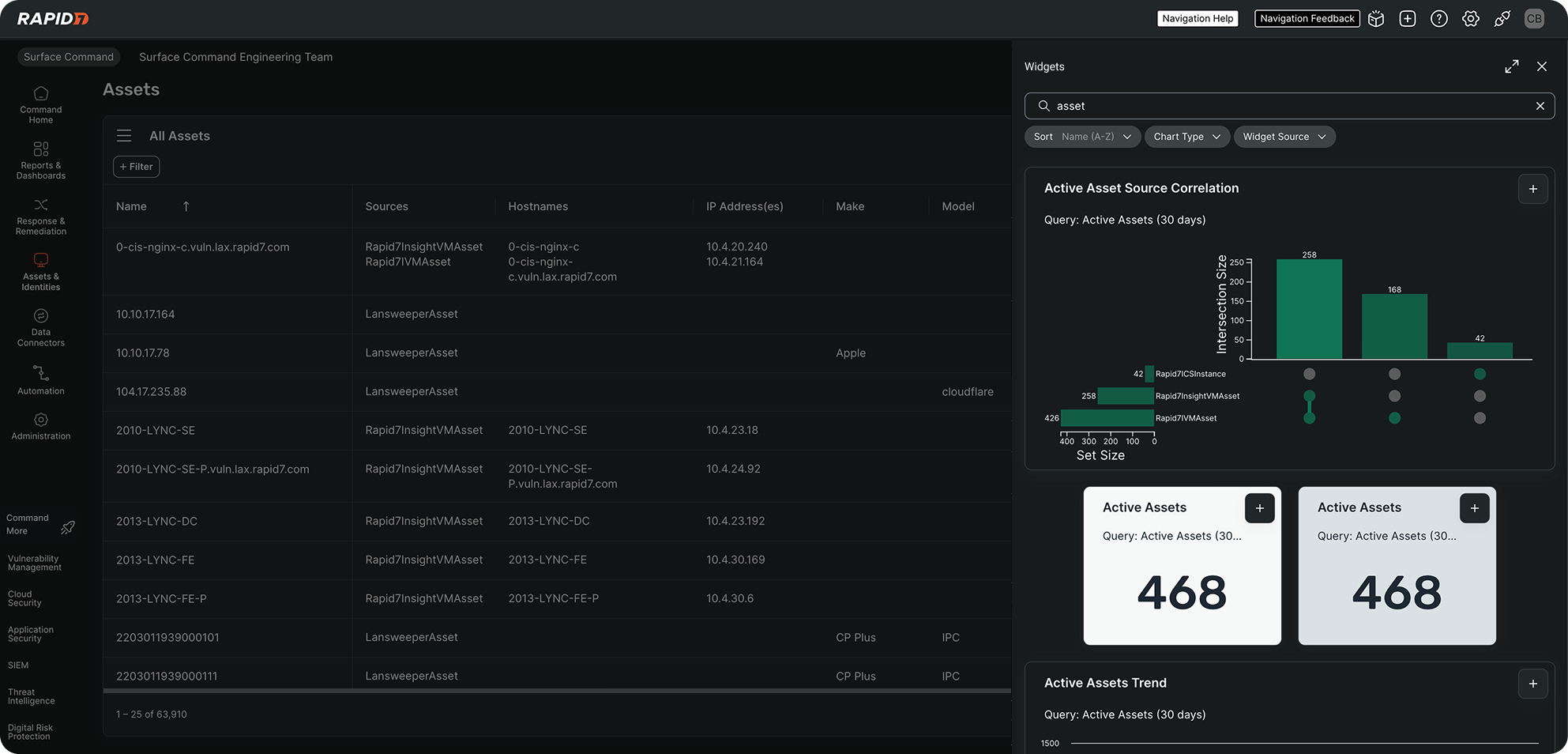
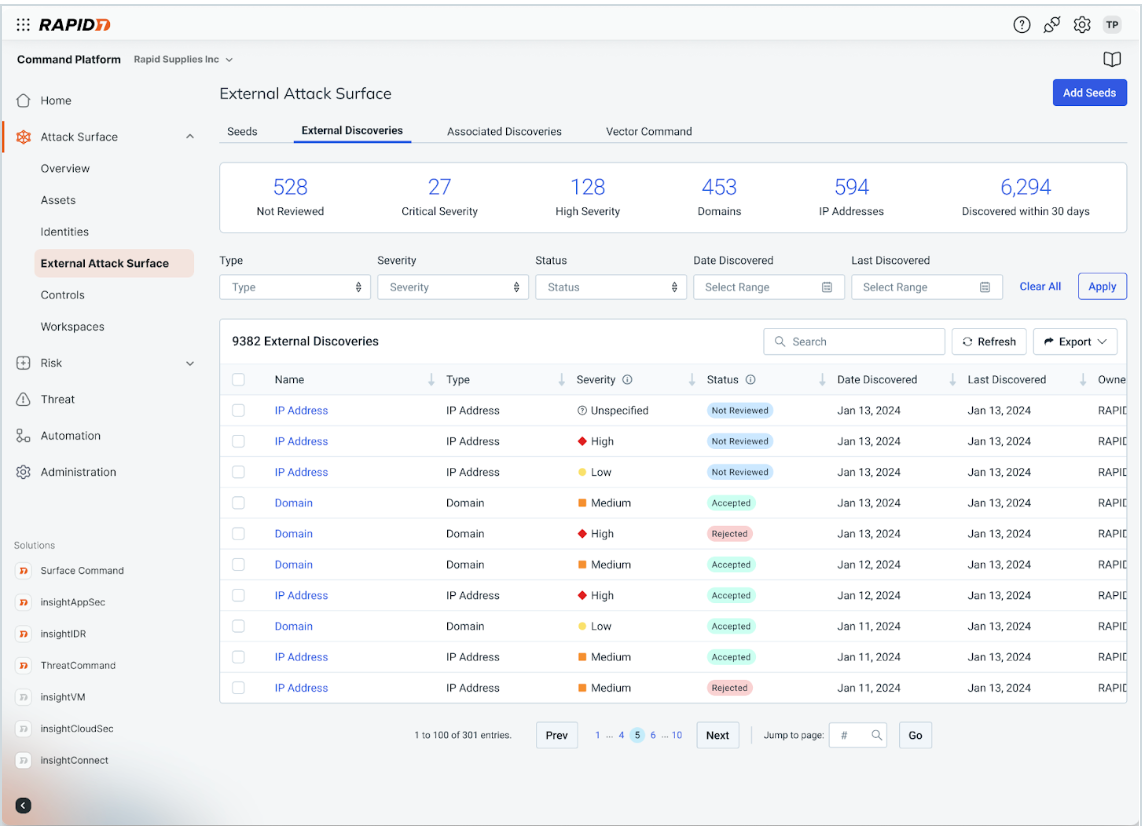
That’s why Rapid7 is introducing dynamic EASM discovery for Surface Command, a new capability that automatically identifies and tracks every part of your external attack surface. By continuously ingesting known domain and IP information from your environment and related management tools, Surface Command ensures your visibility is always accurate, always current, and always ready for validation.

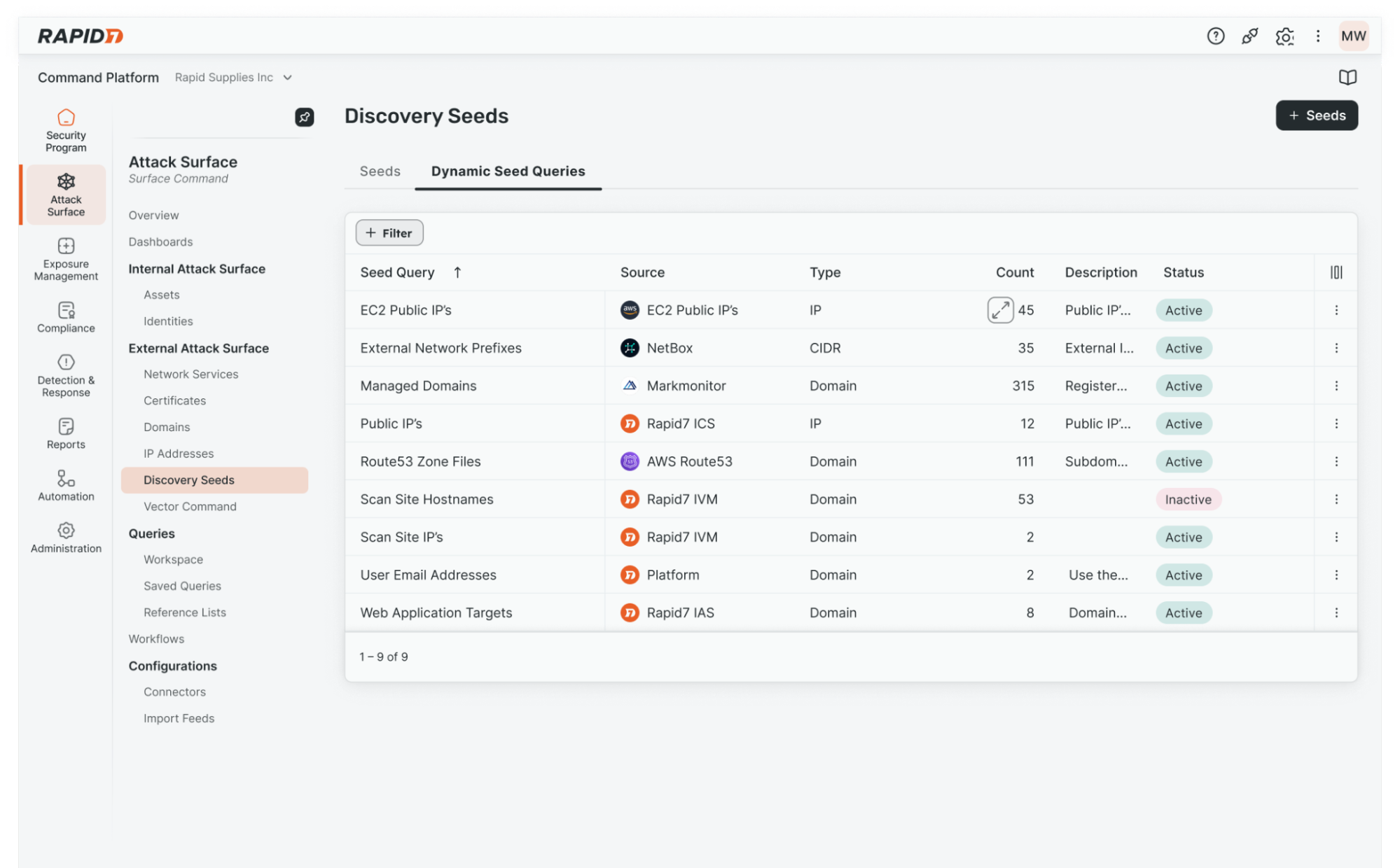
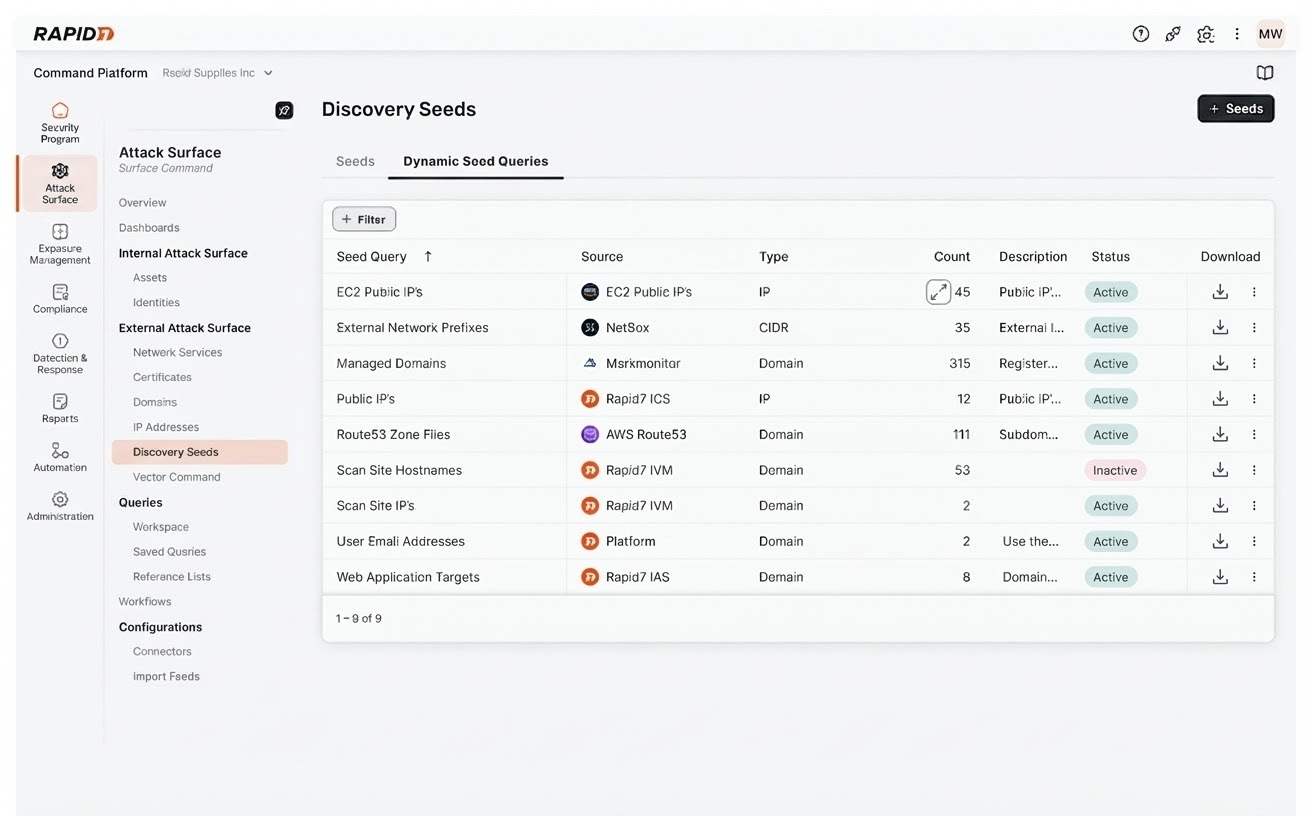
easm.jpg

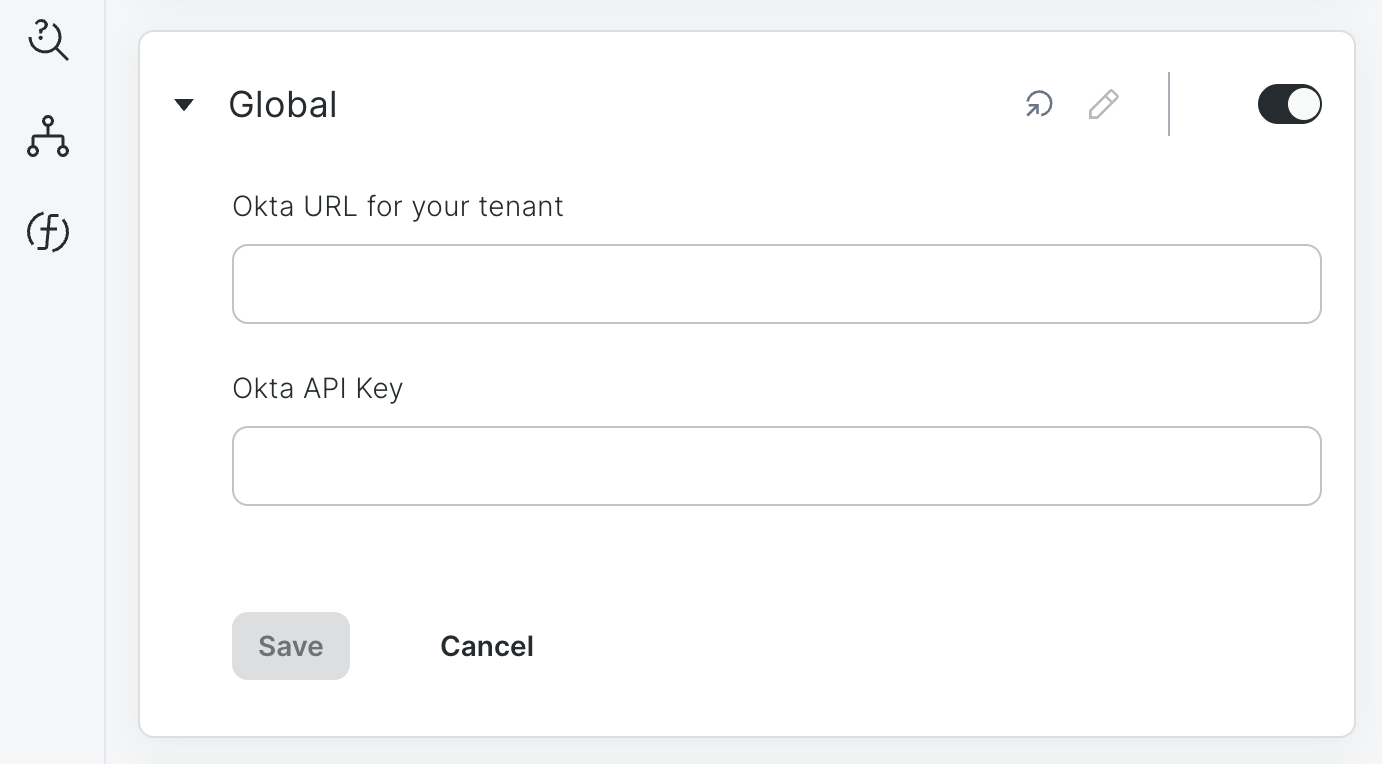
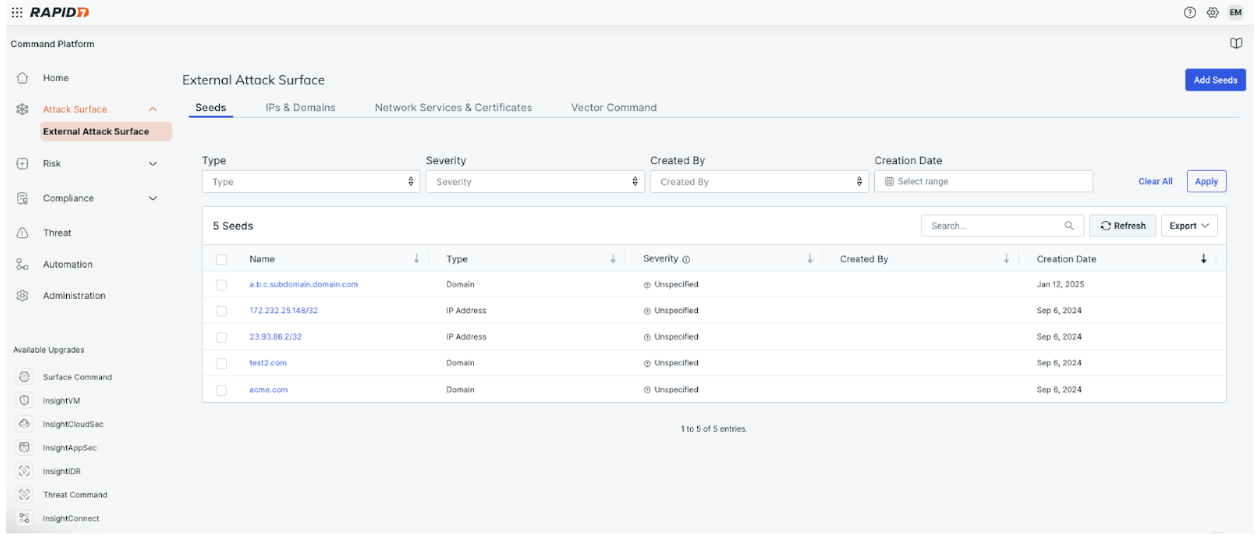
Figure 1: Dynamic Seeds feature in the Rapid7 Command Platform

From static inventories to continuous confidence

Traditional External Attack Surface Management (EASM) tools rely on static “seed lists”, known IPs, domains, or networks used to start discovery scans. But as organizations evolve, those seeds quickly become stale, leaving blind spots that attackers can exploit.

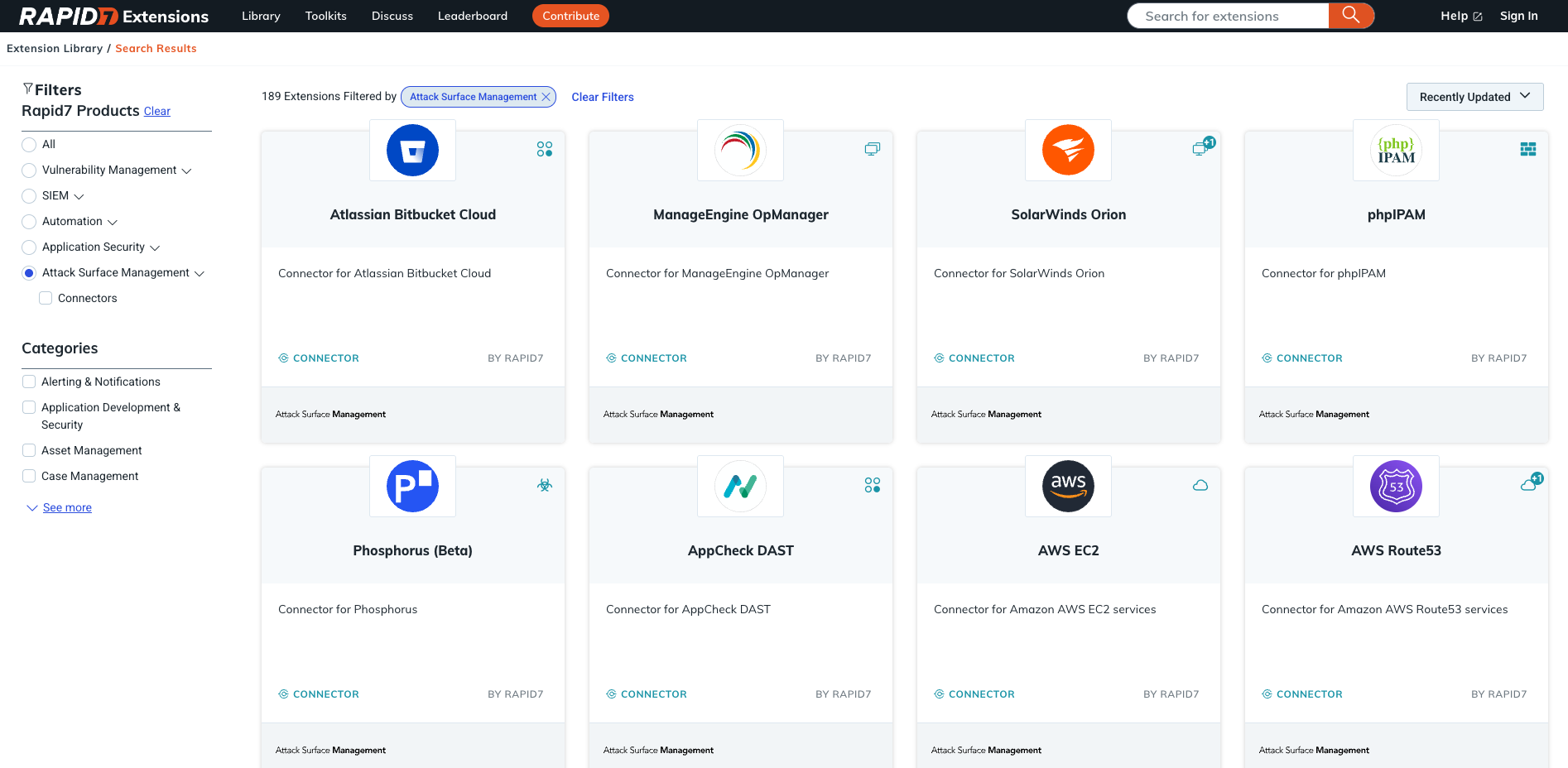
Dynamic EASM discovery replaces static inputs with live intelligence. Surface Command, Rapid7’s attack surface management (ASM) solution, now automatically gathers seed data from across your ecosystem, including DNS records, network services, and asset repositories and feeds it directly into the Rapid7 Command Platform. Asset, vulnerability, automation, control, threat, and enrichment data are ingested into our Command Platform through Connectors.

The result: a continuously updated, validated view of your internet-facing footprint.

No spreadsheets. No manual uploads. No surprises.

Why this matters for CTEM step 2: Discovery

Continuous threat exposure management (CTEM) is the discipline of constantly discovering, prioritizing, validating, and mobilizing against risk. Most organizations excel at discovery and prioritization but validation often lags behind.

Discovery is where confidence becomes measurable:

  • Did the exposure we fixed actually disappear?
  • Is our attack surface shrinking or just shifting?
  • Are we making progress we can prove?

Dynamic EASM discovery strengthens step 2, discovery by ensuring your exposure data reflects the real, live environment. Every time a cloud resource changes or a new asset appears, Surface Command automatically revalidates what’s known versus what’s newly exposed.

That means your CTEM cycle is never out of sync with reality, and your reports to leadership reflect verified reductions in risk, not assumptions.

Connecting visibility to outcomes

Dynamic EASM discovery doesn’t just simplify inventory management, it accelerates progress across the CTEM lifecycle:

  • Discovery: Continuously ingesting data expands your external visibility.
  • Prioritization: Integrated context links assets to business impact and threat intelligence.
  • Validation: Continuous seed refresh confirms exposures are resolved and risk is reducing.
  • Mobilization: Validated insights flow into ITSM and automation workflows for closure.

For security leaders, this translates to clear, measurable progress: a smaller attack surface, shorter exposure windows, and data that executives can trust.

An attacker’s view you can trust

External visibility is only useful if it’s reliable. With dynamic EASM discovery, Surface Command provides a real-time, attacker’s-eye view of your organization’s public-facing assets, domains, subdomains, IPs, and network services; all validated against live data.

This level of automation gives CISOs three distinct advantages:

  • Fewer blind spots – Automatically capture new and transient assets the moment they appear.
  • Proven accuracy – Validate that remediation efforts have actually closed exposures.
  • Faster decisions – Operate on verified intelligence instead of lagging asset data.

Validation becomes continuous, evidence-based, and defensible.

Executive clarity through proof

Boards don’t want more alerts, they want proof that investments in security are paying off. Dynamic EASM Discovery helps CISOs demonstrate that progress with concrete, validated metrics:

  • Total external assets tracked over time
  • Exposure reduction percentages by business unit
  • Remediation velocity measured in real, verified outcomes

When the question comes, “are we actually reducing risk?”

Surface Command gives you evidence, not estimates.

Simplified operations, stronger security

Dynamic EASM discovery is built into Rapid7’s Command Platform, eliminating the manual effort that once slowed exposure management. Security and IT teams can focus on reducing risk instead of reconciling data sources, while automation keeps inventories and dashboards perpetually up to date.

In practice, that means:

  • Reduced administrative overhead
  • Elimination of stale or duplicate records
  • Seamless integration with other Command Platform services for unified CTEM execution

What used to take hours of manual input now happens automatically, at the speed your business evolves.

Continuous validation made simple

Attack surface expansion doesn’t stop, and neither should your visibility. With dynamic EASM discovery, Rapid7 ensures that the foundation of your CTEM program, discovery, is always grounded in current, accurate data.

It’s continuous assurance for a world that doesn’t stand still. This is in early access now, and generally available in January, 2026.

Explore Surface Command

See how Dynamic EASM Discovery keeps your external visibility live, validated, and ready for action.

Contact your Rapid7 account team or click here to initiate a no commitment trial today.

Try the new dynamic EASM discovery self-guided product tour

Rapid7 Extends AWS Hosting Capability with India Region Launch

Post Syndicated from Ed Montgomery original https://www.rapid7.com/blog/post/pt-rapid7-extends-aws-hosting-capability-with-india-region-launch

We are delighted to announce Rapid7 launched a new Amazon Web Service (AWS) cloud region in India with the API name ap-south-2.

This follows an announcement in March 2025, when Rapid7 announced plans for expansion in India, including the opening of a new Global Capability Center (GCC) in Pune to serve as an innovation hub and Security Operations Center (SOC).

The GCC opened in April 2025, quickly followed by dedicated events in the country, to demonstrate our commitment to our partners and customers in the region. Three Security Day events took place in May, in Mumbai, Delhi, and Bangalore. These events brought together key stakeholders from the world of commerce, academia, and government to explore our advancements in Continuous Threat Exposure Management (CTEM) and Managed Extended Detection and Response (MXDR).

“Expanding into India is a critical step in accelerating Rapid7’s investments in security operations leadership and customer-centric innovation,” said Corey Thomas, chairman and CEO of Rapid7. “Innovation thrives when multi-dimensional teams come together to solve complex challenges, and this new hub strengthens our ability to deliver the most adaptive, predictive, and responsive cybersecurity solutions to customers worldwide. Establishing a security operations center in Pune also enhances our ability to scale threat detection and response globally while connecting the exceptional technical talent in the region to impactful career opportunities. We are excited to grow a world-class team in India that will play a pivotal role in shaping the future of cybersecurity.”

Rapid7 expands to 8 AWS platform regions

Today, Rapid7 operates in eight platform regions (us-east-1, us-east-2, us-west-1, ap-northeast-1, ap-southeast-2, ca-central-1, eu-central-1, govcloud).

These regions allow our customers to meet their data sovereignty requirements by choosing where their sensitive security data is hosted. We have extended this capability to ap-south-2 and me-central-1 to process additional data and serve more customers with region requirements we have not previously been able to meet.

What this means for Rapid7 customers in India

This gives our customers in India the ability to access and store data in the India region for our Exposure Management product family.

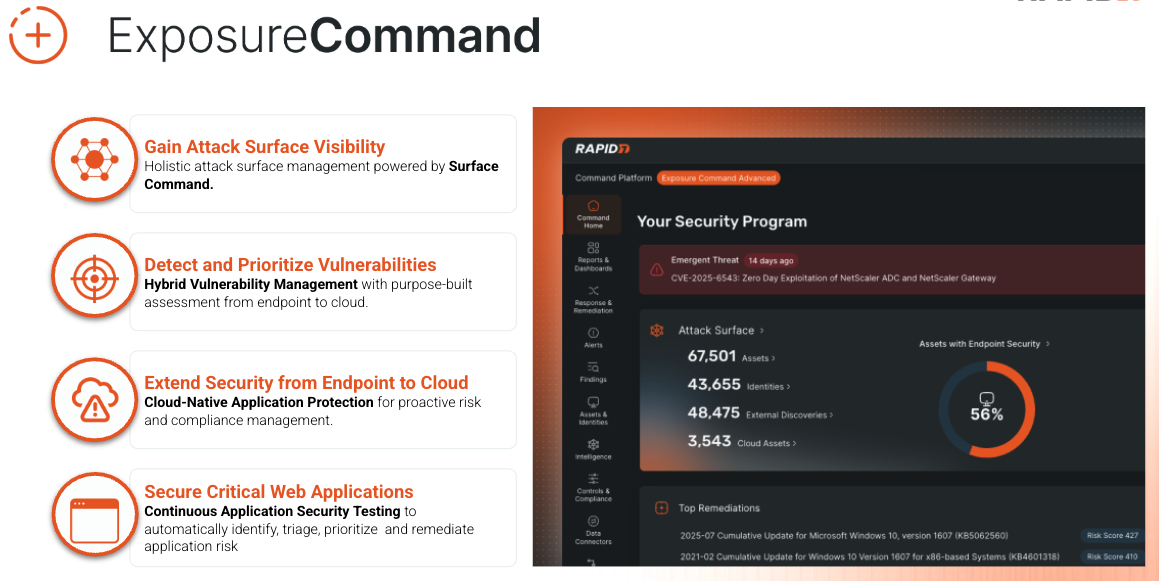
Aws1.png

Exposure Command combines complete attack surface visibility with high-fidelity risk context and insight into your organization’s security posture, aggregating findings from both Rapid7’s native exposure detection capabilities – as well as third-party exposure and enrichment sources you’ve already got in place – allowing you to:

  • Extend risk coverage to cloud environments with real-time agentless assessment

  • Zero-in on exposures and vulnerabilities with threat-aware risk context

  • Continuously assess your attack surface, validate exposures, and receive actionable remediation guidance

  • Efficiently operationalize your exposure management program and automate enforcement of security and compliance policies with native, no-code automation

Learn more about Exposure Command.

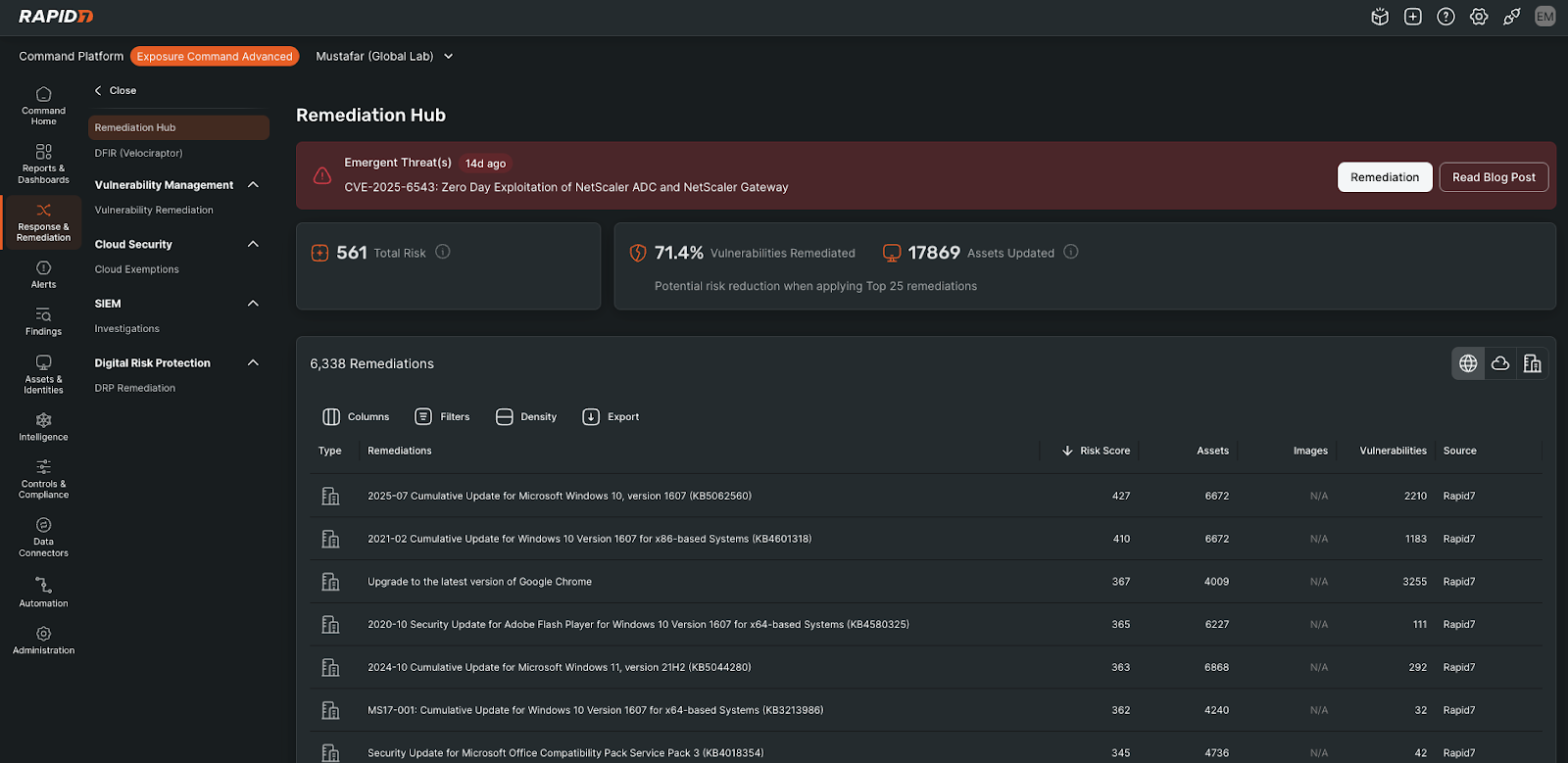
AWS21.png

Figure 1: Exposure Command Remediation Hub

Threats don’t wait, neither should you: Mastering Emergent Threat Response Validation

Post Syndicated from Ed Montgomery original https://blog.rapid7.com/2025/05/23/mastering-emergent-threat-response-validation/

Cybersecurity is a team sport

Threats don’t wait, neither should you: Mastering Emergent Threat Response Validation

In cybersecurity, no one fights alone. Defending against modern threats requires seamless collaboration, real-time intelligence, and precision execution—just like a well-coordinated sports team. That’s why Rapid7 Labs and our Vector Command team work together to stay ahead of adversaries, ensuring security teams have the insights and capabilities needed to respond effectively. While Rapid7 Labs uncovers emerging threats and delivers cutting-edge research, Vector Command puts that intelligence to work—validating response strategies, optimizing defenses, and ensuring organizations are ready when it matters most. Because in cybersecurity, the best defense is a well-prepared team.

What is an Emergent Threat Response?

Rapid7’s Emergent Threat Response (ETR) program from Rapid7 Labs delivers fast, expert analysis and first-rate security content for the highest-priority security threats to help both Rapid7 customers and the greater security community understand their exposure and act quickly to defend their networks against rising threats.

The Rapid7 Command Platform displays any emergent threats on our homepage, at the top of the screen, easily visible once you have logged in. Our expert researchers include a blog post to accompany each emergent threat.

We also notify all Managed Service customers after discovering new Common Vulnerabilities and Exposures (CVEs). This notification includes known information about the CVE, steps to protect your environment and updates on Rapid7’s response.

Threats don’t wait, neither should you: Mastering Emergent Threat Response Validation
Figure 1: An example of how the Emergent Threat message is displayed on our Command Platform home page
Threats don’t wait, neither should you: Mastering Emergent Threat Response Validation
Figure 2: A close-up view of the actual Emergent Threat message with supporting blog post.

Why is ETR critical?

Emergent threat response validation is critical because cyber threats evolve at a relentless pace, often outpacing traditional security measures. Without continuous testing and refinement, even the most advanced security tools can fall short when faced with real-world attacks. By proactively validating threat response strategies, organizations can identify gaps, fine-tune automation, and ensure that security teams are ready to act with speed and precision. This not only minimizes downtime and damage but also strengthens overall resilience, enabling businesses to stay ahead of adversaries rather than scrambling to react after an incident has already occurred. In today’s threat landscape, preparedness isn’t optional—it’s the difference between containment and catastrophe.

Threats don’t wait, neither should you: Mastering Emergent Threat Response Validation
Figure 3: Emergent Threat Alert message.

How can Vector Command help?

This is the value of an always-on, managed red team service. We continuously test your defenses against the latest ETRs, to see if we can breach your network before threat actors do. If we’re successful, we’ll show you how—and provide actionable remediation guidance.

We’d love to highlight the many organizations that have benefited from this capability with Vector Command, however, we respect their privacy.

One example we can share: a global professional services firm adopted Vector Command for this exact use case. As a frequent target of advanced persistent threats, their security team recognized the value of proactive testing of their resilience.

DORA compliance was also a key driver for this client, given their customer footprint in the EU and the requirement to have reporting. DORA compliance reports demonstrate how financial entities meet regulatory expectations around ICT risk management, incident handling, and third-party oversight—ensuring operational resilience.

With Vector Command, we deliver ongoing external network penetration testing. For some customers, this alone is enough to demonstrate to auditors that they are actively validating their defenses in alignment with DORA.

CTEM and Validation

The leading industry analyst, Gartner®, has said, “security operations managers should go beyond vulnerability management and build a continuous threat exposure management program to more effectively scope and remediate exposures”.

Threat exposure management involves identifying, assessing, and mitigating exposures within an organization’s digital environment. CTEM has emerged as a dynamic program designed to help teams manage their expanding attack surface and maintain a consistent, actionable security posture.

The fourth phase of CTEM is the validation phase and this is where always on red teaming, like Vector Command becomes essential.

Rapid7 also supports the second, third and fifth phases of CTEM through our Exposure Command and Exposure Command Advanced, both launched in August 2024.

Threats don’t wait, neither should you: Mastering Emergent Threat Response Validation
Figure 4: Continuous Threat Exposure Management | Source: Gartner 796532_C

Take command of your attack surface

This is the fourth post in our deep dive blog series exploring key capabilities of Vector Command. We hope you’ve found it valuable—and if you have feedback or questions, we’d love to hear from you.

Rapid7 brings together world-class expertise –  from our Labs researchers and red teamers to the superstars who work across our multiple SOC’s.

If you missed our most recent virtual Take Command 2025 summit, the session, “Outpacing the adversary: Red teaming in a complex threat landscape” is still available on demand. You’ll hear firsthand from industry expert, Will Hunt and Rapid7 principal security consultant, Aaron Herndon.

We’ve also created a self-guided product tour for Vector Command—available anytime for a hands-on look at the platform.

Vector Command: Request Demo ▶︎

Ready to see how continuous red team managed services can ensure your potential attack pathways are remediated before they can ever be exploited?


GARTNER is a registered trademark and service mark of Gartner, Inc. and/or its affiliates in the U.S. and internationally and is used herein with permission. All rights reserved.

Gartner, “How to Grow Vulnerability Management Into Exposure Management”, November 2024 (For Gartner subscribers only)

Pentales: Red Team vs. N-Day (and How We Won)

Post Syndicated from Ed Montgomery original https://blog.rapid7.com/2025/04/04/pentales-red-team-vs-n-day-and-how-we-won/

Pentales: Red Team vs. N-Day (and How We Won)

During a recent Vector Command operation, I had the chance to sit down with one of our red teamers to hear firsthand how they identified and exploited an N-Day vulnerability in a customer’s environment. It’s a clear example of how continuous red teaming can uncover and validate real-world risks before attackers do.

While the organization involved remains anonymous, the events described are real. This story reflects how our always-on testing approach closely mirrors the creativity and persistence of actual threat actors.

Initial Recon: Spotting an N-Day in the Wild

Vector Command engagements begin with one core question: If someone wanted to break in, where would they start? That’s the mindset our red team brings to every operation.

A red team is a group of security professionals who simulate real-world adversaries. Their goal isn’t to check boxes or run automated scans, but to think and act like attackers—uncovering weaknesses that traditional assessments often miss. They combine technical skill with creativity, adapting to the environment they’re targeting and exploring how far a real compromise could go.

In this case, as part of Vector Command’s continuous reconnaissance, the red team identified a subdomain hosting a vulnerable web application. The vulnerability, already publicly disclosed, classified the exposure as an N-Day. While the issue was known in the broader security community, it hadn’t yet been patched in this environment.

Using a publicly available proof-of-concept exploit, the team compromised the application and underlying host. From there, they found credentials stored in the file system, granting access to services deeper within the internal network.

From Exploit to Expansion: Breaching the Perimeter and Moving Laterally

As part of our recon, we zeroed in on a subdomain running a web app that was just begging to be poked. It was tied to a recently disclosed N-Day vulnerability—publicly known, actively discussed, and in this case, still unpatched.

We ran a proof-of-concept exploit and landed a shell. From there, we had access to the underlying host, and it didn’t take long to find something useful: credentials stashed away on the file system. Those creds gave us our next step into the internal network.

With the perimeter breached, we started exploring. There was little in the way of segmentation, which made internal discovery a breeze. We quickly found an internal SMTP server and realized we could send emails that appeared completely legit—from the inside, to the inside.

We used that to spin up a phishing campaign. The bait? A cloned version of the company’s actual login portal, hosted on the compromised subdomain. From the user’s perspective, everything looked familiar. The URL checked out. The branding was perfect. And people clicked.

We captured multiple sets of credentials, including an admin account. From there, we confirmed a misconfiguration on a critical internal system. That allowed us to escalate privileges and prepare for full domain takeover.

Classic attack chain: exploit, phish, pivot, escalate. All real. All tested safely under Vector Command.

From Attack Chain to Action Plan

You may be forgiven for thinking an organization would not be happy with this. However, it is exactly the opposite and our Vector Command customer was delighted we found and exploited this vulnerability. We proved the value of our continuous red teaming, mimicking what a real external threat actor would do to breach a network.

The sub-domain we compromised was prioritized for remediation and now has security controls in place. We then re-tested the customer’s environment to ensure their patches actually worked and this particular security gap was closed.

From PoC’s to Happy SOC’s

In our previous blogs, we’ve explored the human side of continuous red teaming—through opportunistic phishing stories, external network assessments, and a deep dive into the TTPs behind post-compromise simulations.

Security Operations Centers (SOCs) are often relieved—not rattled—when we uncover these risks. It gives them proof, insight, and time to act.

As part of Vector Command, this engagement was fully documented—summarized for executive stakeholders and detailed for security practitioners. Reports live in the Vector Command portal, accessible whenever teams need to revisit findings or track remediation progress.

Customers also have the opportunity to debrief directly with the red teamer behind the operation. Whether it’s to dig deeper into the attack chain or walk through lessons learned, we’re here to help strengthen defenses—because at the end of the day, we’re all working toward the same goal.

If you or your security team want to explore how continuous red teaming can support your program, let’s talk.

Ready for Your Own Red Team Reality Check?

If you’re curious what an attacker might find in your environment, Vector Command can help you find out before someone else does.

Learn More about Rapid7’s Vector Command Service ▶︎

Ready to see how continuous red team managed services can ensure your potential attack pathways are remediated before they can ever be exploited?

Unpacking a post-compromise breach simulation with Vector Command

Post Syndicated from Ed Montgomery original https://blog.rapid7.com/2025/03/27/unpacking-a-post-compromise-breach-simulation-with-vector-command/

The reality of modern cyber threats

Unpacking a post-compromise breach simulation with Vector Command

In today’s evolving cyber landscape, breaches are not a matter of if, but when. Attackers continue to refine their techniques, using stealthy post-compromise tactics to maintain persistence, escalate privileges, and move laterally across networks. The key to staying ahead is not just preventing attacks, but building resilience to withstand and respond to them effectively.

This concept of resilience aligns with Continuous Threat Exposure Management (CTEM), a proactive approach to security validation. According to Gartner, CTEM consists of five pillars:

When we look at the five pillars, described by Gartner:

  1. Scope of your organization’s attack surface;
  2. Discover your attack surface;
  3. Prioritize your vulnerabilities;
  4. Validate security controls and finally;
  5. Mobilize people and processes to operationalize the CTEM findings.

Vector Command plays a critical role in the fourth pillar, continuously testing security defenses through post-compromise breach simulations that replicate real-world adversary tactics.

How Vector Command tests resilience

This blog is the third in our Vector Command series, where we explore the tactics, techniques, and procedures (TTPs) leveraged by Rapid7’s expert red team. Today, we’re focusing on post-compromise breach simulations—a critical capability in assessing an organization’s ability to detect and respond to a persistent adversary.

Unpacking a post-compromise breach simulation with Vector Command
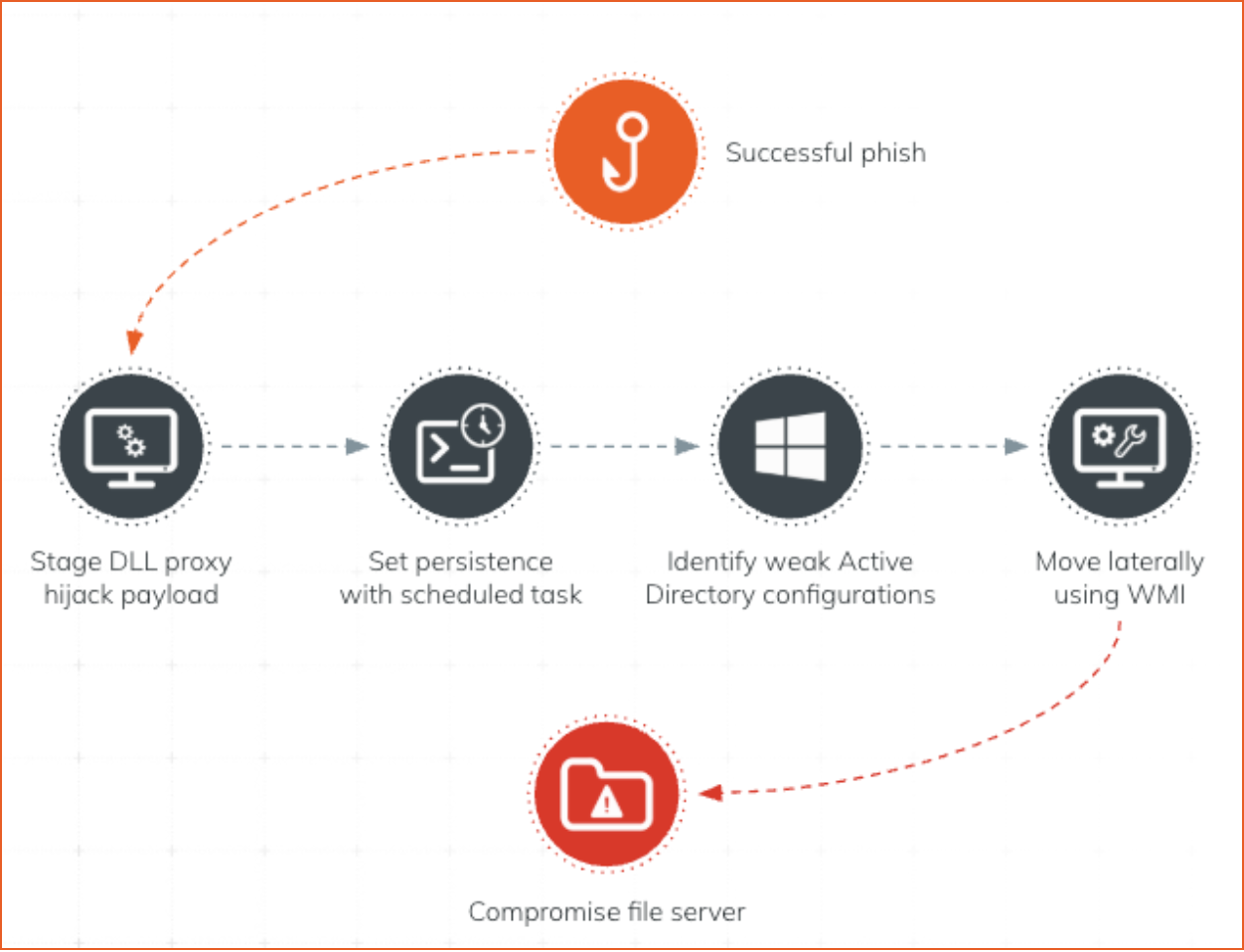
Figure 1: Post Compromise Breach Simulation Attack

TTP mapping to the MITRE ATT&CK framework

Once an attacker gains access—whether through phishing or external exploitation—the real damage begins. As part of our post-compromise breach simulation, Vector Command emulates the tactics and techniques adversaries use once they’re inside, leveraging the MITRE ATT&CK® frameworks as a guide.

Our red team stages command and control payloads and executes a series of proven attacker behaviors to test your resilience across the most common post-compromise scenarios:

  • Configure host persistence – Attackers work to maintain their foothold across reboots and user sessions by modifying startup tasks, hijacking processes, or introducing malicious code. We simulate these tactics to test your defenses against long-term compromise.
  • Attempt host privilege escalation – Gaining initial access is just the beginning. Adversaries often exploit misconfigurations or unpatched vulnerabilities to escalate privileges from standard user accounts to full admin control—enabling deeper access into your environment.
  • Query Active Directory for hosts accessible with compromised credentials – With valid credentials in hand—often obtained through phishing—we test whether an attacker could identify and access other systems or sensitive services using tools that mimic common enumeration techniques.
  • Attempt lateral movement on the network – We simulate how attackers move through your environment by pivoting between systems using native tools and compromised credentials. This reveals how far a real threat actor could go—and how quickly they’d reach your most critical assets.
  • Attempt domain privilege escalation using common misconfigurations – During breach simulations, our red team frequently tests for domain privilege escalation using misconfigurations that are surprisingly common in real-world environments. These include:
  • Local administrator accounts
  • Users with admin-like access
  • Standard users with elevated access to specific systems or sensitive functions

These misconfigurations often intersect with persistence techniques, as attackers take advantage of elevated contexts to maintain long-term access.

Want to see how exposed your organization might be? Surface Command can help identify admin users without multi-factor authentication (MFA), offering a quick view into high-risk accounts and helping fulfill the “Discover” step of Exposure Management.(See our Surface Command Admin users without MFA use case

  • Initial access payloads and internal breach playbooksEvery simulation is guided by detailed internal breach playbooks. These help test your incident response readiness and ensure alignment with known attacker workflows, including phishing payload delivery and post-access exploitation.

Each of these steps represents a real-world risk. By simulating them in a controlled environment, Vector Command helps organizations identify blind spots, validate security controls, and improve detection and response capabilities.

Beyond simulation: Actionable reporting & remediation with Vector Command

Security testing is only as valuable as the insights it delivers. With Vector Command, organizations receive tailored reports designed for both executive leadership and security practitioners:

  • Executive-Level Report: A high-level summary of key findings, business risks, and prioritized remediation steps, written in plain language for strategic decision-making.
  • Technical Report: A detailed breakdown of attack simulations, including timestamps, screenshots, and step-by-step execution logs for the security team to analyze and act on.

These insights are not just reports—they are action plans to help teams fortify their defenses against real adversary behaviors.

Take command of your attack surface

Cyber resilience is about understanding your adversary’s tactics before they use them against you. Vector Command delivers an always-on red teaming service that helps organizations stay ahead of attackers by continuously validating defenses and improving response strategies.

Want to learn more? Join us at our upcoming Take Command virtual summit, where we’ll explore how red teaming is evolving to outpace modern threats.

Register here.

Rapid7 and IDC ASM Spotlight Paper Blog Jan 25

Post Syndicated from Ed Montgomery original https://blog.rapid7.com/2025/03/20/rapid7-and-idc-asm-spotlight-paper-blog-jan-25/

Rapid7 and IDC ASM Spotlight Paper Blog Jan 25

Rapid7 recently collaborated with IDC on their comprehensive Attack Surface Management Spotlight guide. These Spotlight publications deliver expert analyst perspectives on critical business and technology challenges, emerging industry trends, and innovative solutions. We’re pleased to share IDC analyst Michelle Abraham’s insights on cyber risk exposure management and the imperative for organizations to implement proactive security strategies.

IDC’s trend forecast

“Managing exposures with proactive cybersecurity tools and platforms should be a mindset for the entire organisation, from the C-suite to the back office.”

IDC agrees that it is no longer realistic to conduct asset management on spreadsheets due to the increasing complexity of cloud, SaaS and Generative AI technologies used by many organizations. IT teams have an added complexity brought about by hybrid and remote working. This expansion signifies that CAASM and ASM should be part of a wider exposure management system to cover cloud security, application security and vulnerability management.

IDC key takeaways

  • Foundational visibility: Establishing comprehensive awareness of all assets, whether on-premises or in cloud environments. .
  • Contextual intelligence:  Integrating business context and threat intelligence to accurately assess risk levels and prioritize response strategies.
  • Cross-functional utilization: Extending security data beyond the security team to support additional organizational use cases.

Understanding Key Exposure Management Concepts

Check out this blog which will cover off the definitions for ASM, CAASM and EASM.

You can’t protect what you can’t see.” – Aaron Herndon, Principal Security Consultant, Rapid7

The benefits of holistic exposure management

Organizations that adopt a holistic approach to exposure management gain the ability to aggregate, deduplicate, and analyze data from diverse IT and business tools, resulting in a more comprehensive understanding of their security posture.

According to IDC, the most valuable ASM use cases include:

  1. Identifying which assets do not have Vulnerability Management software installed.
  2. Finding assets without endpoint protection solutions.
  3. Determining users, with Admin access, who have not got multi-factor authentication (MFA) activated.
  4. Proactively suggesting users who have a propensity to open and click on Phishing emails utilizing a high phishing susceptibility score.

Organizations that adopt a holistic approach to exposure management gain the ability to aggregate, deduplicate, and analyze data from diverse IT and business tools, resulting in a more comprehensive understanding of their security posture.

Business context is critical. The correct ASM tool will provide insight on the relative importance and criticality of each asset.

Which assets are exposed to the internet and whether there is sensitive data in these assets? Sharing data around asset management is extremely helpful for IT and security teams, ensuring everyone is operating from a “single-source of truth”.

The benefits of CAASM and ASM  extend beyond the security team, in fact other job functions will reap rewards from highly contextualized asset data, including IT, finance and compliance. Security is a team sport.
We have developed several self-guided product tours highlighting key use cases identified by IDC above, for Surface Command and Exposure Command which you can check out at your leisure.

Using CAASM and ASM is all about reducing risk.” – Quote: Michelle Abraham, IDC

IDC’s review of Surface Command and Exposure Command

“Surface Command reconciles data about assets, threats, vulnerabilities, and controls to determine the true attack surface.”

IDC provides context around our Surface Command product that was released in August 2024, following the acquisition of Noetic Cyber.

Rapid7 delivers unparalleled  attack surface visibility through the Command Platform, empowering  security teams to identify, prioritize, and remediate risk across hybrid environments. Surface Command is the only solution available that combines native external and internal scanning into a single unified view of your attack surface, enriched with telemetry from third party security and ITOps tools via more than 130 out-of-the-box connectors.  

The power behind Surface Command is its graph database, showing the relationships between assets, identities and the potential exposure to present the context of the business risk.

Exposure Command builds on this foundational attack surface visibility, layering on adversary-aware risk prioritization and integrated remediation workflows that make it easy for security teams to anticipate where attackers are going to target, pinpoint their most pressing exposures and act swiftly and collaboratively to address issues before they can be exploited.

Elevate your security posture with proactive exposure management

As highlighted by IDC analyst Michelle Abraham in this comprehensive Spotlight report, organizations that implement robust exposure management strategies gain significant advantages:

  • Reduced attack surface: Identify and remediate vulnerabilities before they can be exploited
  • Enhanced visibility: Maintain complete awareness of your entire digital footprint
  • Improved resource allocation: Focus security efforts where they’ll have the greatest impact
  • Cross-functional value: Leverage security data across IT, compliance, and business operations

Rapid7’s Command Platform delivers the comprehensive visibility and actionable intelligence needed to effectively manage your organization’s attack surface. By combining external and internal scanning with powerful contextual analysis, our solutions enable security teams to stay ahead of sophisticated threat actors in today’s complex technological environments.

Ready to transform your approach to exposure management?

Download the complete IDC Spotlight report to discover how proactive security strategies can protect your critical assets and strengthen your overall security posture.

Explaining External Network Assessment with Vector Command

Post Syndicated from Ed Montgomery original https://blog.rapid7.com/2025/03/12/explaining-external-network-assessment-with-vector-command/

Explaining External Network Assessment with Vector Command

Learn how external network assessment works within Vector Command, Rapid7’s continuous red team managed service.

Understanding threat exposure management

Let’s start by providing some context around where Vector Command fits into a security program and more specifically Continuous Threat Exposure Management (CTEM). Threat exposure management involves identifying, assessing, and mitigating exposures within an organization’s digital environment CTEM has emerged as a dynamic program designed to address this expanding footprint and help organizations achieve a consistent and actionable security posture.

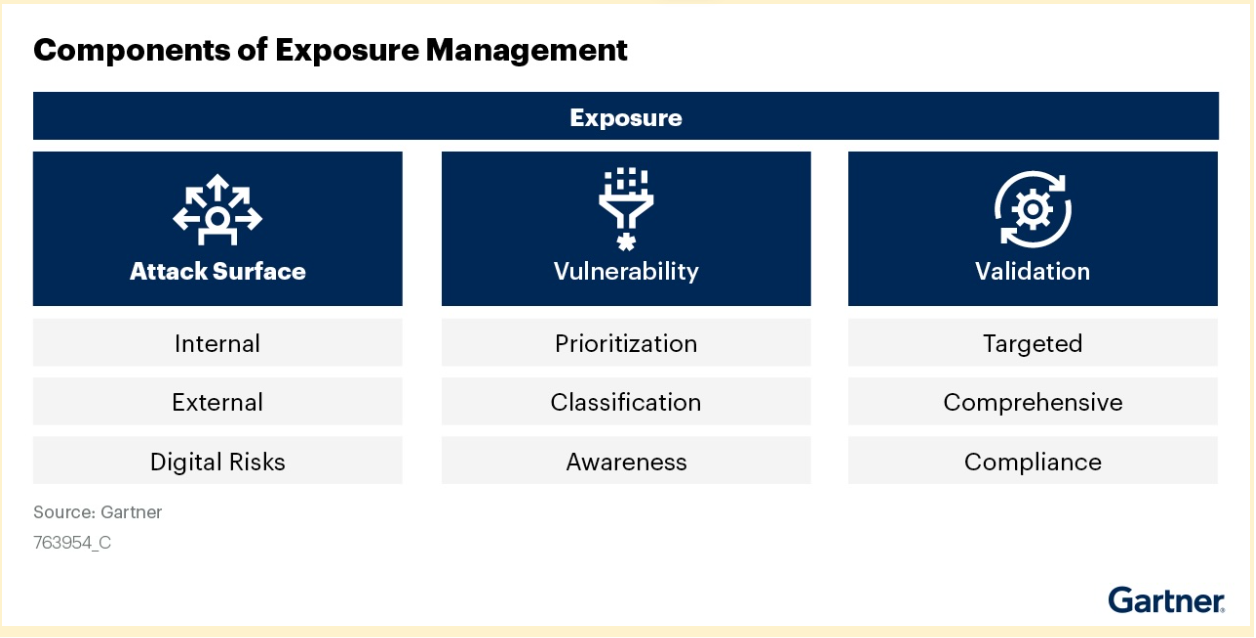
According to Gartner, some of the different technologies that can support a wider CTEM program can be organized into three distinct pillars:

Explaining External Network Assessment with Vector Command

“Your ‘always on’ red team”

Vector Command sits within the validation pillar, your ‘always on’ red team – validating results from technologies or services as well as validating that the controls in place are working as anticipated.

Explaining an external network assessment

An “external network assessment” refers to evaluating the security posture of an organization’s publicly accessible network perimeter. This essentially simulates a hacker’s perspective to identify vulnerabilities on systems and services directly reachable from the internet. This will include web servers, email servers, and exposed ports, to assess potential risks and weaknesses that could be exploited by malicious actors.

Goals of an external network assessment:

  • Our red team is looking to discover potential entry points for attackers.
  • Identify misconfigurations and weak security practices on exposed systems.
  • Evaluate the overall security posture of the external network perimeter.

Rapid7’s Vector Command red team testing approach

Our Vector Command red team experts conduct comprehensive security assessments using a multi-faceted approach:

Initial discovery and assessment

We begin by leveraging EASM-discovered assets and IVM scan results to map your approved attack surface. Our experts validate IVM findings and conduct service discovery to ensure complete coverage.

Vulnerability identification

Our team searches for common web misconfigurations through directory testing, reviews exposed administrative functions, and checks for unauthenticated access to sensitive areas. We also conduct limited, non-intrusive password testing against services like email, IAM, and VPNs using information gathered during EASM scanning.

Continuous monitoring and testing

As an always-on managed service, we:

  • Perform vulnerability scans using InsightVM
  • Validate potentially exploitable findings before publishing them to your portal
  • Monitor Rapid7’s Emergent Threat Response channels for new critical vulnerabilities
  • Evaluate and test public Proof of Concept exploits when applicable
  • Execute payloads to demonstrate successful breaches
  • Assess credentials obtained through phishing campaigns
  • Continuously retest your environment to ensure ongoing security

Throughout this process, we build comprehensive documentation of your attack landscape to inform future security assessments.

Take command of your attack surface

Rapid7 strengthens your organization’s security strategy through Vector Command, delivering comprehensive CTEM alongside our other exposure management solutions.

With Vector Command, customers can now have a team of experts continuously assess their external attack surface. This includes identifying any security gaps, and receiving remediation guidance on an ongoing basis.

Our series of Vector Command blog posts will continue and next up we will cover the TTP Post-Compromise Breach Simulation.

If you would like to hear more about the world of red teaming from one of our experts behind Vector Command, Rapid7 is running a virtual session at our 2025 Take Command Summit, find out more about it here.

Vector Command Opportunistic Phishing Blog

Post Syndicated from Ed Montgomery original https://blog.rapid7.com/2025/02/07/vector-command-opportunistic-phishing-blog/

Gone Phishing with Vector Command

Vector Command Opportunistic Phishing Blog

During one of our customer engagements, our red team will continuously attack your network to see if we can exploit a vulnerability. One of the tactics, techniques and procedures (TTPs) we use is “Opportunistic Phishing”. First, let’s share a quick reminder about what Vector Command is.

Vector Command is Rapid7’s new continuous red teaming managed service, designed to  assess your external attack surface and identify gaps in the security defenses on an ongoing basis. Vector Command continues the expansion of our Exposure Management solutions for our customers. While external attack surface management (EASM) tools offer visibility, they often fall short in validation, generating lengthy lists of potential exposures for security teams to sift through. Traditional penetration testing can help validate vulnerabilities, but its point-in-time nature risks leaving critical exposures undetected for extended periods. With Vector Command, our red team will continuously look for exploitable vulnerabilities.

Vector Command Opportunistic Phishing Blog
Rapid7’s Vector Command Landing page

Hacking the Human

Social engineering attacks are based on the exploitation of someone’s personality and can be referred to as “hacking the human”.

Security professionals often comment how the employee can often be the weakest link in a company’s security posture. From end-of-day tiredness, to our more relaxed nature during a quick lunch break and even our predisposed trusting tendencies towards those causes we care deeply about, can be exploited by threat actors. This is the “social” aspect in “Social Engineering”. Humans can be manipulated into making mistakes through psychological means and giving our login credentials away or other sensitive information.

Opportunistic Phishing – The Human Touch

Opportunistic Phishing, also known as “untargeted attacks” may have no warning signs and is often deployed spontaneously, without a specific target. Rapid7’s red team will use this technique to see what information they can get from a customer engagement.

Let’s take the hypothetical example of a former IT contractor who was employed by a company. The off-boarding policy has not yet been completed. The IT contractor had elevated access to one business application containing personally identifiable information (PII). Our red team, once they identify this former contracted employee, could use their access rights to gain entry to sensitive PII and services on the corporate network.

When an opportunistic attempt is executed by a threat actor, it is most commonly conducted via malware or phishing over email.

In this specific technique, an attacker will send out fraudulent messages, taking care to design the emails to look like the actual organization, often using similar logos, fonts, and signatures. Inside the body of the message will be a URL, typically with a misspelled domain name or extra subdomain. If the recipient is not savvy enough to recognise the fake web address from the real one and clicks on the link, this is when the malware is activated as an executable file and downloaded to the device. The payload often  includes keylogging software, used to collect keystrokes, including your passwords, which now gives the threat actor access to your company network.

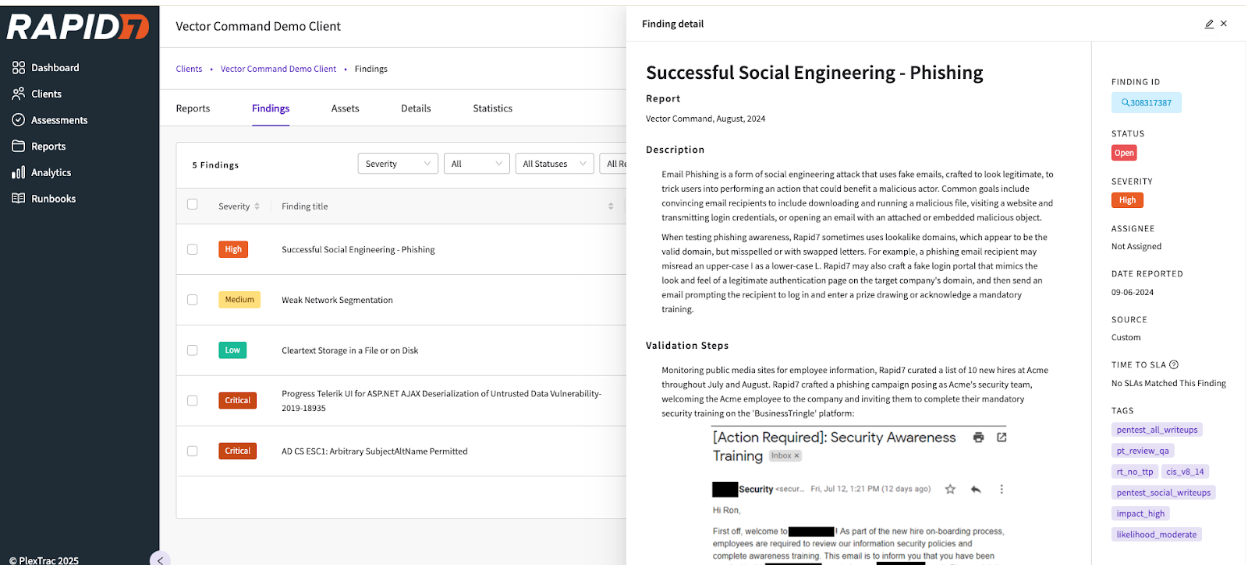
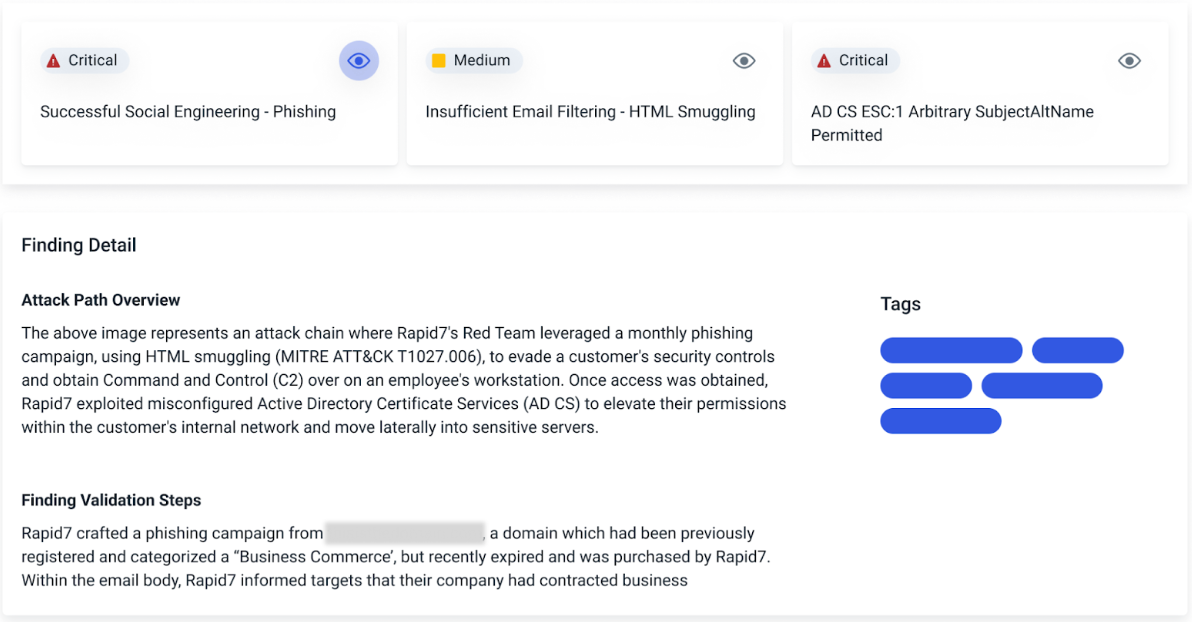
By deploying this tactic, Rapid7’s red team, think, act and behave like a threat actor, but without the malicious consequences for your organization. Using opportunistic phishing, we will find and identify where your security gaps are, with respect to technology (through different configuration types for campaigns) and people, helping you to act and respond. Our advanced Vector Command reporting even gives a detailed outline of the situation, including remediation recommendations for your IT and Security teams.

Vector Command Opportunistic Phishing Blog
A sample report for a Phishing campaign completed by our Vector Command red team

What should you be on the lookout for?

Let’s explore some typical phishing examples that frequently target organizations.

  • Invoices for companies that you do not have a supplier agreement with.
  • Shipping notifications from large retailers, both online and the high street.
  • Password reset requests for your email, or other online account e.g. Amazon, or PayPal.
  • Tax refund emails either at the time of needing to submit your tax return (when it is time sensitive) or months away from when it needs to be completed (anomalous behavior).
  • Can you spot poor grammar, or spelling errors in the subject, or within the body of the email, that would indicate it is not from a reputable source?
  • Does the email have a sense of urgency – “Act now”?
  • Generic greetings like “Dear Customer” as opposed to a more personalized one.
  • Surveys from third-parties or workplace experience coordinators that are out-of-place.
  • Suspicious login alerts from common applications sourcing from an untrusted sender.
  • Password reset requests for your email, or other online account e.g. Amazon, or PayPal.
  • Employee benefit emails either at the time of needing to submit your elections (when it is time sensitive) or months away from when it needs to be completed (anomalous behavior).
  • Shared documents and calendar invitations from third-parties you do not commonly interact with.
  • Browser extensions, software updates, and installation requests via email or phone.
  • Verify unexpected phone calls through internal communication applications such as Teams, or Slack.

Take Command of your Attack Surface

Stay tuned as we continue to share insights of other TTPs employed by Rapid7’s expert  red team to test your cyber resilience.

We have created a self-guided product tour for Vector Command which you can check out at your leisure.

Vector Command: Request Demo ▶︎

Ready to see how continuous red team managed services can ensure your potential attack pathways are remediated before they can ever be exploited?

Mind the Gap: How Surface Command Tackles Asset Visibility in Attack Surface Management

Post Syndicated from Ed Montgomery original https://blog.rapid7.com/2024/11/08/mind-the-gap-how-surface-command-tackles-asset-visibility-in-attack-surface-management/

“Only 17% of organizations can clearly identify and inventory a majority (95% or more) of their assets.” – Gartner

Mind the Gap: How Surface Command Tackles Asset Visibility in Attack Surface Management

Imagine the scenario: your organization has been exposed to a new zero-day vulnerability. You are responsible for Threat & Vulnerability Management (TVM), you have asked your IT department for an assessment of the asset inventory in your organization.

You make the same request to your security team. Both teams give you a different number of assets, with a significant disparity: IT reports 10,000 assets, compared to 8,200 from your colleagues in security.

When you look up your Configuration Management Database (CMDB_ application, you quickly discover that it has not been updated for months and does not accurately represent of your attack surface either.

How do you measure your risk exposure when three sources of information are not in agreement? Your highly-skilled colleagues are now back to using spreadsheets to document your assets—a very manual and time-consuming process that is not a productive use of their time.

Attack Surface Management (ASM)

ASM covers both internal and external assets—the physical and digital assets that an organization needs to have visibility into in order to understand its security posture. By establishing visibility of the attack surface and implementing management processes to prioritize, validate, and mobilize responses, security teams can reduce exposures exploited by malicious threat actors.

“Asset inventory is a common and well-known problem for organizations.”

Manage the Gap in Asset Inventory with Surface Command

We began this blog with a real-life and anonymized example for a customer and the disparity in their asset count between IT and Security teams. Surface Command addresses this operational challenge. Firstly, Surface Command is platform-agnostic; what’s important to Rapid7 is capturing your actual number of assets using a mixture of external scanning and importing data feeds from over 100 commonly used IT and Security tools (EDR, CNAPP, VM, CMDB, etc.). This provides a true, constantly updated view of all assets across the cloud and on-premises. Assets detailed will include cloud containers, servers, workstations, IoT devices, identities, smartphones and more.

To help demonstrate the value of this complete visibility, we have created a short, 2-minute product tour, which you can view at your convenience. In this initial product tour, we show how to identify coverage gaps in your security posture using Surface Command. Take the example of a zero-day vulnerability discovered for a particular operating system; you need to understand your attack surface immediately.

Surface Command will quickly display assets missing  key security controls, such as a deployed endpoint security agent. You can drill down further to focus on assets by operating system or device type. This technology is powered by Rapid7’s Machine Learning (ML) classifiers to ensure coverage and data accuracy.

Watch as we filter down from a large number of total assets, to a smaller, focused number of high-risk assets that can be prioritized for action by your IT and Security Teams, all done with just a few clicks.

This scenario is commonly used by our customers to quickly identify simple security gaps, and with Surface Command, you can easily save this for future use, as well as publish the results to reporting dashboards.

By establishing visibility of the attack surface and implementing management processes to prioritize, validate, and mobilize responses, security teams can reduce their exposure and improve cyber risk management.

After all, you can’t protect what you can’t see.

Mind the Gap: How Surface Command Tackles Asset Visibility in Attack Surface Management

To learn more, click here.

Sources:

Gartner, Innovation Insight: Attack Surface Management – 9 April 2024 – ID G00809126

Gartner, Innovation Insight: Attack Surface Management – 9 April 2024 – ID G00809126

Rapid7 Introduces Vector Command, a New Managed Service for Continuous Red Teaming

Post Syndicated from Ed Montgomery original https://blog.rapid7.com/2024/09/17/rapid7-introduces-vector-command-a-new-managed-service-for-continuous-red-teaming/

Rapid7 Introduces Vector Command, a New Managed Service for Continuous Red Teaming

Rapid7 is delighted to announce the launch of Vector Command, a continuous red teaming managed service designed to assess your external attack surface and identify gaps in the security defenses on an ongoing basis. Following the launch of Surface Command and Exposure Command in August, Vector Command will continue our expansion of Exposure Management protection for our customers.

In today’s digital landscape, organizations are more exposed to cyber threats than ever before. Cloud resources, SaaS solutions, and ever-growing shadow IT create vast external attack surfaces, making businesses increasingly vulnerable. Meanwhile attackers are constantly on the prowl, conducting reconnaissance to exploit weaknesses. Security teams lack visibility into their internet-facing exposures, leaving them vulnerable to potential breaches.

While external attack surface management (EASM) tools offer visibility, they often fall short in validation, resulting in lengthy lists of potential exposures for security teams to sift through. Traditional penetration testing can help validate vulnerabilities, but its point-in-time nature risks leaving critical exposures undetected for extended periods.

Introducing Vector Command

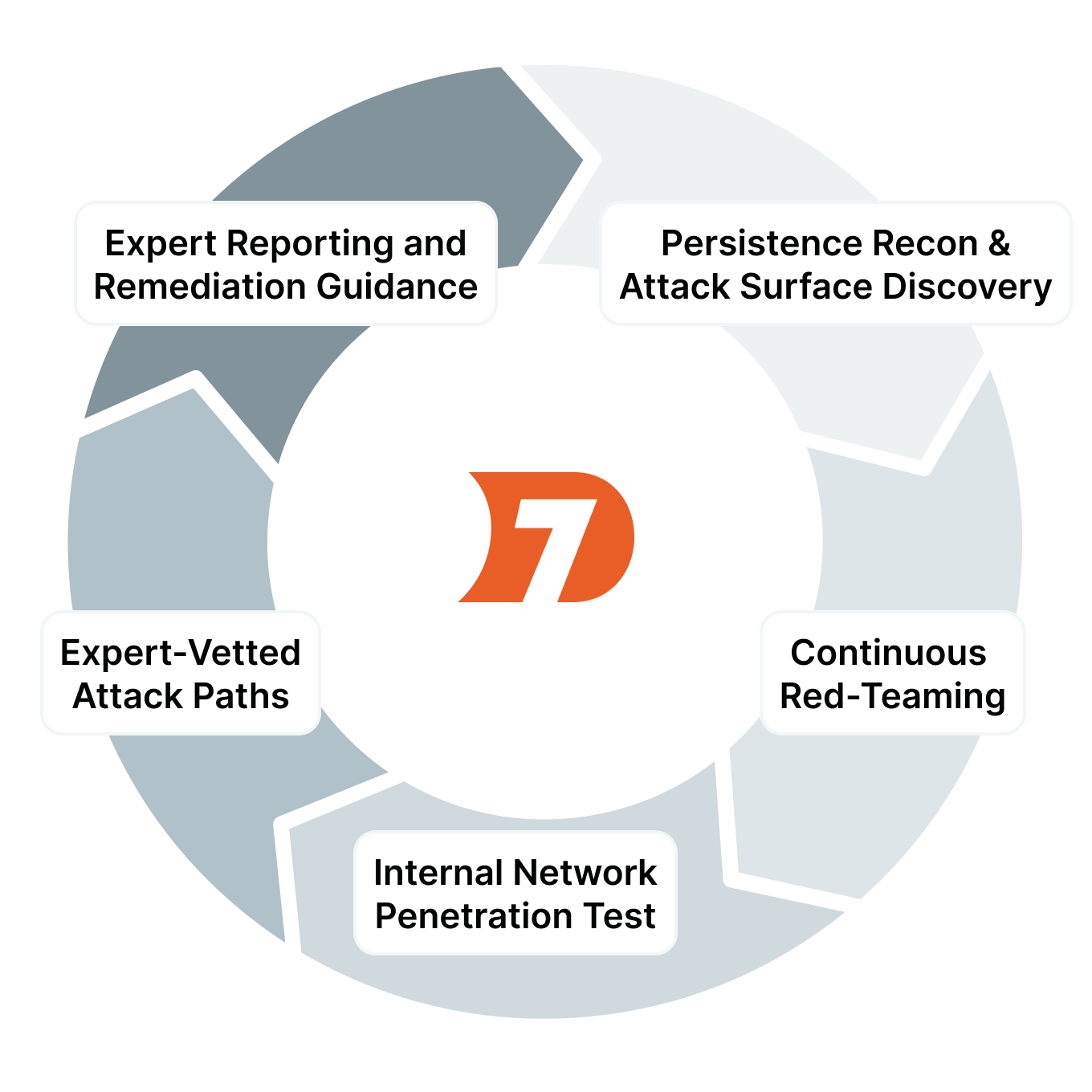
Vector Command is designed to address these challenges head-on, providing a continuous, proactive approach to securing your external attack surface by combining Rapid7’s trusted technology for external attack surface assessments with our world-class red team expertise. By providing an attacker’s perspective, Vector Command empowers security teams to visualize internet-facing assets, validate critical exposures, and take decisive action to mitigate risks.

Vector Command benefits include:

  • Increased visibility of the external attack surface with persistent, proactive reconnaissance of both known and unknown internet-facing assets
  • Improved prioritization with ongoing, expert-led red team operations to continuously validate your most critical external exposures
  • Same-day reporting of successful exploits with expert-vetted attack paths for multi-vector attack chains and a curated list of “attractive assets” that are likely to be exploited
  • Monthly expert consultation to confidently drive remediation efforts and resiliency planning

Rapid7 advantage: trusted technology and red team expertise

At the heart of Vector Command is our red team operators, among the best in the industry, bringing years of experience in simulating real-world attacks and identifying vulnerabilities that automated tools might miss. This combined with our recently launched Command Platform’s external attack surface assessment capability provides a unique and powerful solution to ensure that you are not just receiving a list of potential vulnerabilities, but actionable insights based on real-world attack scenarios.

External attack surface assessment: Powered by Rapid7’s Command Platform, Vector Command will leverage the external attack surface capability to perform ongoing, active reconnaissance and discovery of your external attack surface to help you

  • Find the unknown and ensure continuous understanding of where shadow IT or unknown business assets may exist like exposed web services, remote admin services, and more
  • Zero-in on potential remote access risks, and risky or unencrypted services
Rapid7 Introduces Vector Command, a New Managed Service for Continuous Red Teaming

Red team expertise: Our expert operators leverage the latest tactics, techniques, and procedures (TTPs) to safely exploit the external exposures and test your security controls with red team exercises like:

  • Opportunistic phishing – Our experts will design and conduct phishing campaigns using the latest TTPs with focus on demonstrating the impact of credential capture and payload execution.
  • External network assessment – Ongoing assessment of vulnerabilities exposed in the external network, focused on obtaining access to your organization and its sensitive systems.
  • Post-compromise breach simulation – Upon breach, our experts will safely emulate the latest tactics to obtain command and control over the compromised system. Post-exploitation activities emulate adversary behavior to assess privilege escalation, lateral movement, and persistence.
  • Emergent threat validation – Assess your network perimeter’s susceptibility to the latest Rapid7 emergent threat vulnerabilities to validate patching and security configurations.
Rapid7 Introduces Vector Command, a New Managed Service for Continuous Red Teaming

Take command of your attack surface defenses

In an era where cyber threats are constantly evolving, Vector Command empowers you to stay one step ahead of attackers. By providing continuous visibility, validation, and expert guidance, we help you transform your cybersecurity posture from reactive to proactive.

Don’t wait for a breach to expose weaknesses in your defenses. With Vector Command, you can command your attack surface with confidence, knowing that you have Rapid7’s trusted technology and Red Team expertise on your side.

Learn More