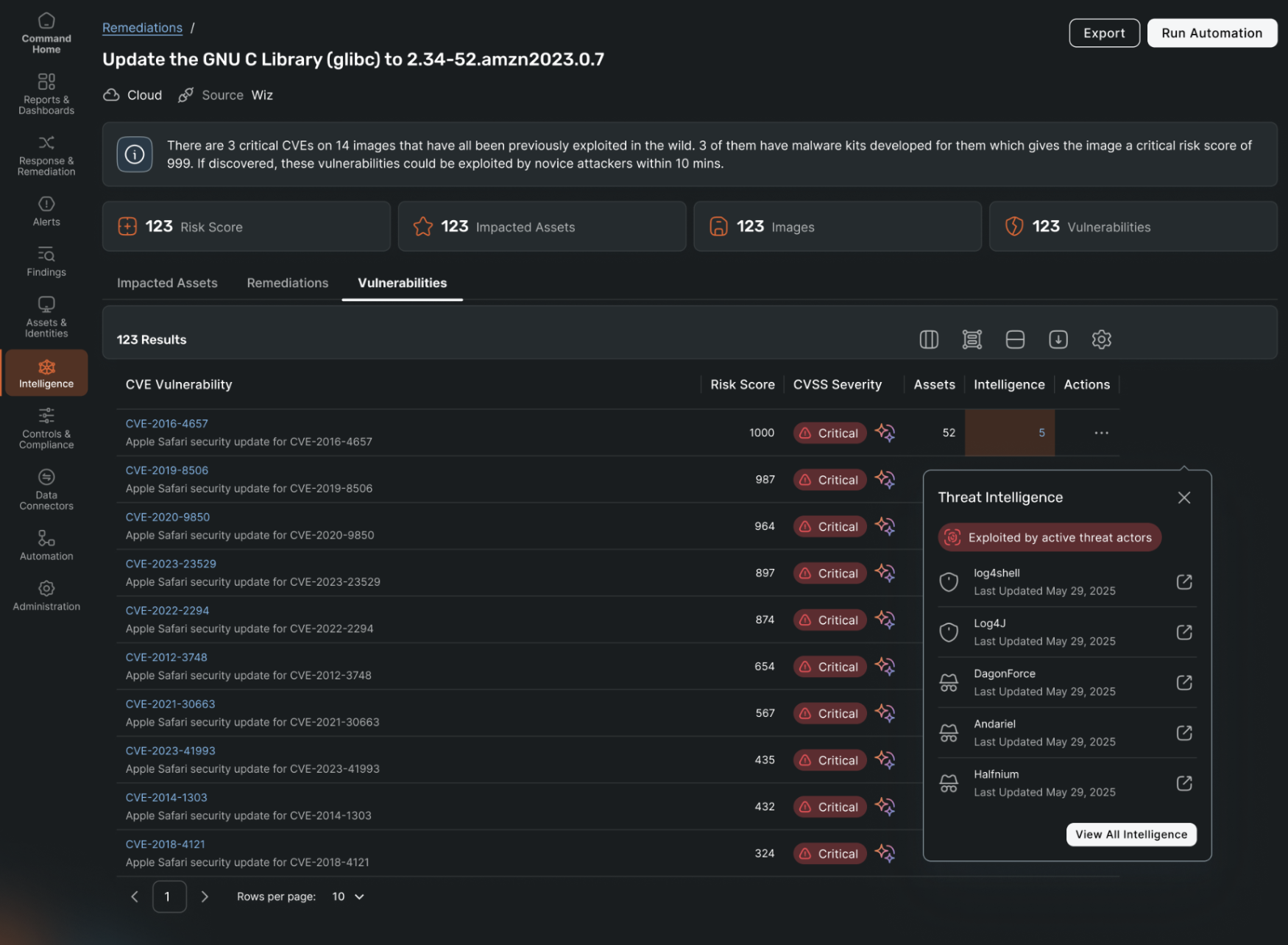
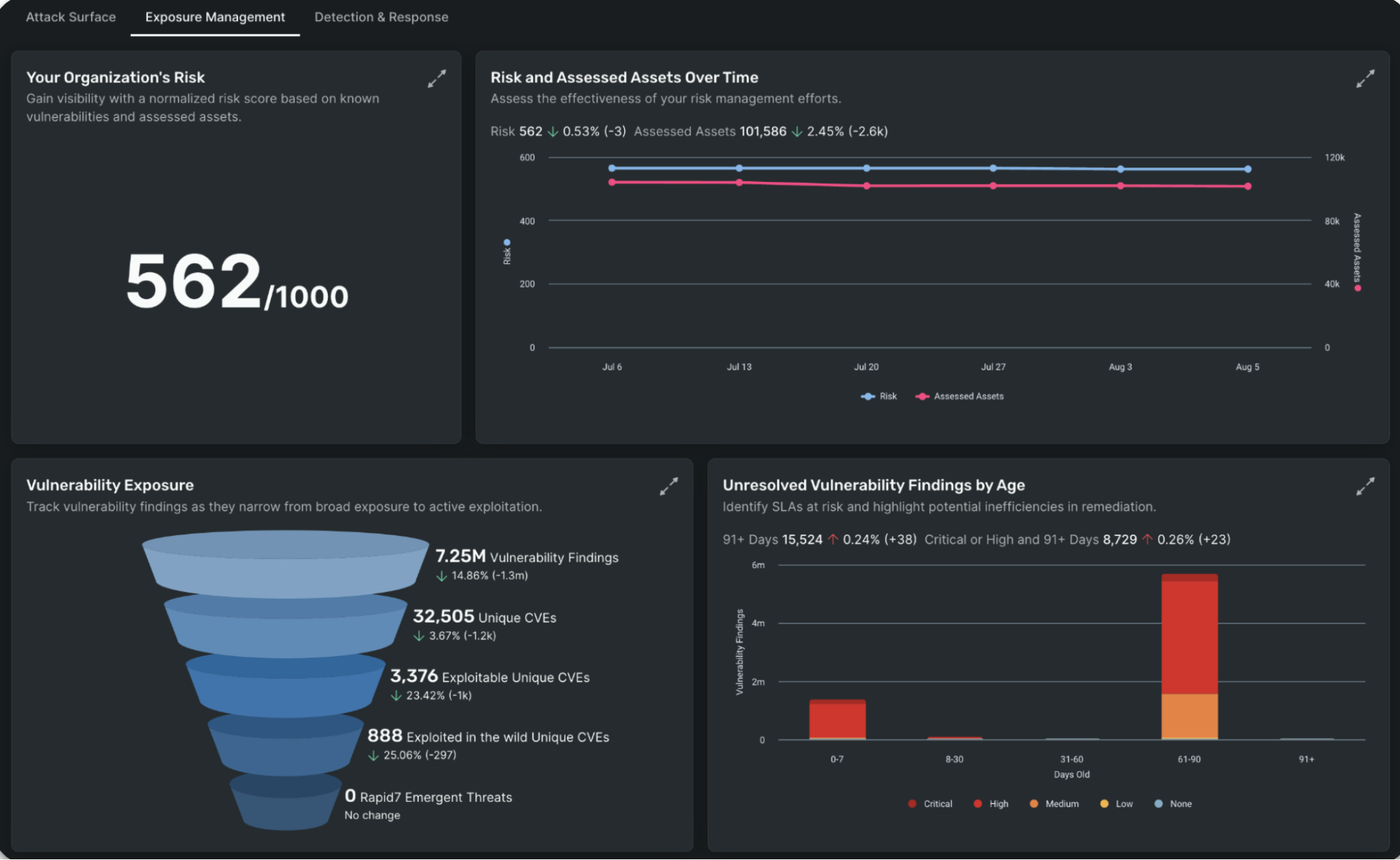
As AI takes on more of the enrichment, correlation, and initial assessment inside the SOC, roles, skills, and KPIs still require deliberate redesign. Security leaders need to decide where automation is dependable, where human judgment should remain decisive, and how teams should be measured when alert handling is no longer the center of the operating model
The Gartner® report, The Roles Required for the AI-Enabled Security Operations Center (SOC), examines the roles and capabilities Gartner expects the SOC to require as AI becomes embedded in security operations. Rapid7 is offering complimentary access to the research, which we believe can help leaders plan their future workforce, operating model, and investment priorities.
How will AI change the role of SOC analysts?
Many analyst roles and performance measures remain closely tied to handling individual alerts. As organizations introduce AI SOC agents to support enrichment, correlation, and initial assessment, leaders may need to reconsider where human expertise creates the greatest operational value.
Gartner states, “Human analysts must transition from alert triage roles to end-to-end case ownership and effective response option communication.” At Rapid7, we believe this shift creates an opportunity for analysts to focus their judgment on validating context, coordinating response, and communicating decisions clearly.
Gartner also recommends, “Stop recording alert metrics and run the SOC on cases and decisions.” Robert Willis, VP of Managed Detection and Response at Rapid7, puts it plainly: “Alert volume is a distraction. The real measure of SOC value is decision quality, did you get the right answer, fast enough to act on it? MDR is built to deliver exactly that: answers, not alerts, so your team can focus on ownership and response rather than triage.” MDR can help manage alert volume while adding investigation and response capacity, giving internal teams more space to focus on the cases that require their context and ownership.
Where does human judgment remain essential?
Rapid7’s experience applying agentic AI within our MDR SOC shows how this division of work can operate in practice. Our agentic workflows have saved more than 200 analyst hours each week and achieved 99.93% benign-disposition accuracy, reducing the repetitive work involved in initial triage and giving analysts more time for complex, ambiguous, and higher-stakes investigations.
We believe human judgment remains essential when a decision carries operational consequences. AI can gather evidence, correlate activity, and present a structured rationale, while analysts validate the conclusion, consider the organization’s priorities, and determine the appropriate response. This human-led, AI-driven model combines machine-speed investigation with accountable decision-making.
Why are SOC engineering roles expected to expand?
As AI-enabled workflows expand, engineering discipline is likely to become increasingly important within security operations. Reliable processes require people who understand threats and security data, can test automated workflows, and can establish appropriate controls around AI-supported decisions.
The report includes the strategic planning assumption, “By 2028 there will be 50% more engineers in security operations teams than analysts.” Gartner also advises organizations, “Redefine detection engineering role descriptions and hiring requirements. Expand them beyond rule writing to include prompt design, workflow testing, and AI output validation.”
From Rapid7’s perspective, detection engineering is developing into a broader operational discipline. Data quality, testing, version control, rollback procedures, documentation, and human approval paths all contribute to dependable AI-enabled workflows. Investing in these capabilities can help teams use automation confidently while keeping people central to consequential security decisions.
Why should Exposure Management be a continuous SOC function?
The report also considers how security operations can identify and validate weaknesses before they contribute to an incident. Gartner states, “Exposure management is the emerging SOC capability to invest in before anything else.”
At Rapid7, we believe exposure management should become a standing operational discipline that connects discovery, validation, prioritization, and remediation with detection and response. Exposure Command can help teams understand which exposures present the greatest risk and direct remediation accordingly, while MDR provides additional expertise and capacity to investigate and respond when threats emerge.
Together, these capabilities support a human-led, AI-driven operating model focused on informed decisions, continuous exposure reduction, and effective response. Access the complimentary Gartner report, The Roles Required for the AI-Enabled Security Operations Center (SOC), to explore how Gartner expects SOC roles and responsibilities to evolve.
Security teams already have long queues of potential application vulnerabilities. The useful question is what happens next: can they see how a weakness behaves in a running application, reproduce the attack, and give developers enough evidence to fix it?
Dynamic application security testing (DAST) helps answer those questions by testing applications as an attacker encounters them. The IDC MarketScape: Worldwide Dynamic Application Security Testing 2026 Vendor Assessment (Doc #US54119126, September 2026). The IDC MarketScape evaluated 16 vendors and named Rapid7 a Leader.
We believe the result reflects the strength of Rapid7’s DAST capabilities, but the IDC MarketScape also offers a useful view of where the category is heading. DAST has developed beyond traditional web scanning into a source of runtime evidence that can help organizations validate risk across the application layer.
From possible weakness to validated application risk
Code analysis and dependency scanning help teams identify weaknesses before an application is deployed. DAST provides a different view by interacting with the assembled application while it is running. It can show what happens when a particular request reaches the application, how the application responds, and whether a suspected weakness can be reproduced.
This is especially valuable for APIs and AI-backed applications, where risk may emerge through interactions among models, prompts, data, tools, and permissions. Some of these behaviors cannot be fully understood from source code or a dependency manifest. They become visible when the application is exercised under runtime conditions.
DAST therefore has a direct role in continuous threat exposure management (CTEM). Discovery gives teams a view of their assets and possible weaknesses, but that view alone does not tell them where to focus. Validation helps narrow the field by showing which exposures can be reached or exploited and providing evidence that teams can use to take action.
For Rapid7, DAST is exposure management applied to the application layer. Web applications, APIs, and AI-backed endpoints are all part of the attack surface, so they need to be discovered, tested, prioritized, and managed alongside infrastructure, cloud, and other exposures.
Why we believe Rapid7 was named a Leader by IDC
Rapid7’s DAST solution is delivered as part of the Exposure Command portfolio. Its scan engine maps an application, executes attacks against the discovered paths, and validates confirmed findings. Security teams can map a broad area of an application while limiting active attacks to an appropriate set of paths, giving them control over how testing is performed.
Findings are checked against Rapid7 telemetry to help determine which issues warrant closer attention. When a finding needs action, browser-based replay reproduces the original request, the attack request, and the triggering response. Developers receive evidence they can work with, rather than a finding they must first spend time proving.
Authenticated scanning can be difficult to maintain across a changing application portfolio, and a broken login sequence can leave important areas untested. Rapid7’s solution can identify the affected step and support a targeted update without requiring the entire sequence to be recorded again.
The connection with Surface Command adds another useful layer. Newly discovered external assets can be surfaced for application testing, helping teams close the gap between finding an application and understanding the risk it presents
DAST plays a core role within Exposure Command: providing the application-layer validation teams need to prioritize risk and move from findings to remediation.
If Q1 set the pace for Rapid7’s tools, Q2 accelerated it. This quarter brought a steady stream of product enhancements, platform investments, and customer-driven innovation across Rapid7’s portfolio. Each release was designed with a clear goal in mind: helping security teams reduce complexity while increasing speed, context, and confidence in their day-to-day operations. Here’s a closer look at what launched in Q2.
Detection and response
Streamline investigations with bidirectional and enriched Microsoft Defender alerts
Bidirectional synchronization and enriched alert context for Microsoft Defender is now generally available for SIEM and MDR customers, enabling security teams to automatically synchronize alert status between Rapid7’s SIEM and the Microsoft Defender console. With added process tree and user identity context, analysts can investigate threats more efficiently while reducing manual effort.
Confidently scale detection engineering with Detection as Code
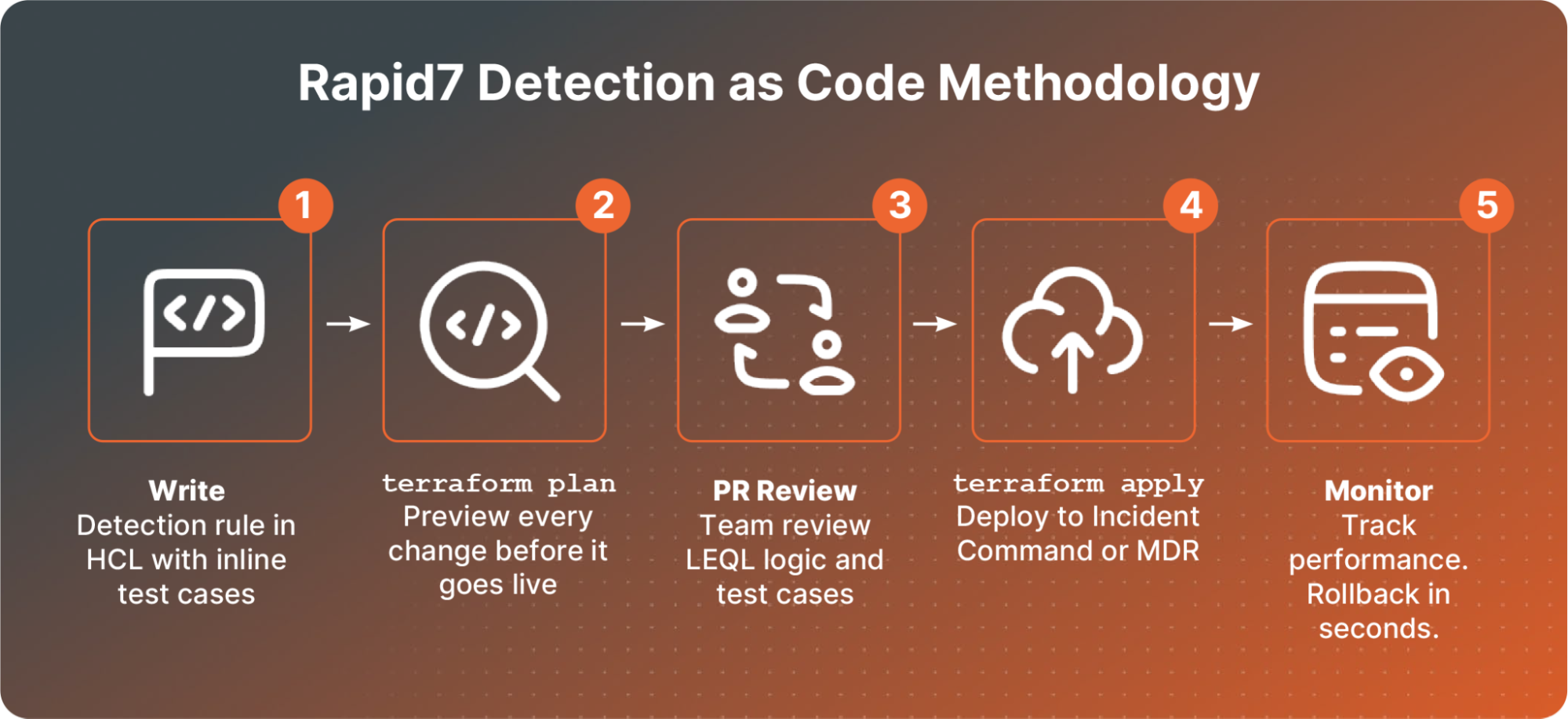
Detection as Code enables security teams to build, test, version, and deploy detections using Terraform and modern engineering workflows. Built-in validation, guardrails, and version control help teams deliver higher-quality alerts, maintain more consistent coverage, and scale detection engineering more effectively.
Figure 1: Rapid7’s Detection as Code methodology.
Strengthen ransomware resilience with Ransomware Prevention for Incident Command
Ransomware Prevention for Incident Command adds an intent-based layer of protection designed to stop ransomware encryption and endpoint damage before they disrupt operations. Built into the Insight Agent, this capability strengthens ransomware resilience while working alongside existing endpoint security investments, without adding operational complexity.
Compliance
New solutions webpages
Across the globe, cybersecurity regulation is shifting away from static compliance checklists and toward ongoing risk management that blends proactive defense with effective detection and response. Rapid7’s platform, which brings exposure management and CTEM together with detection, response, and MDR, is well positioned to help organizations operationalize compliance across mandates such as NIS2, NIST CSF 2.0, DORA, HIPAA, HITRUST, and GovRAMP. To support that effort, Rapid7 has launched an updated library of dedicated compliance solution pages that map platform capabilities to the requirements that matter most across industries and regions. The first set of pages is live now, with more to follow in the coming weeks.
Figure 2: Rapid7’s new GovRAMP compliance solutions page.
Exposure management
Turn prioritized exposures into remediation progress
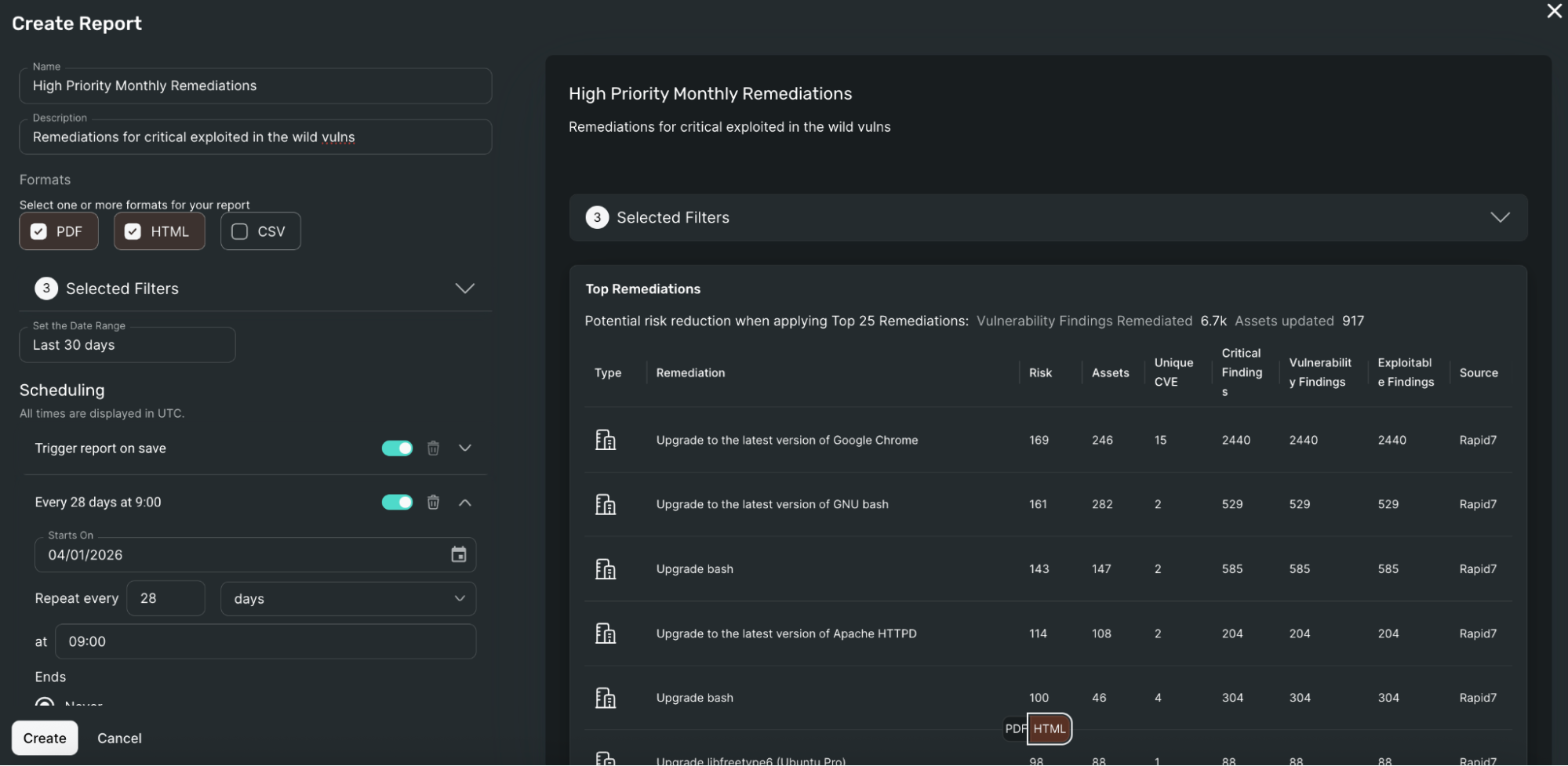
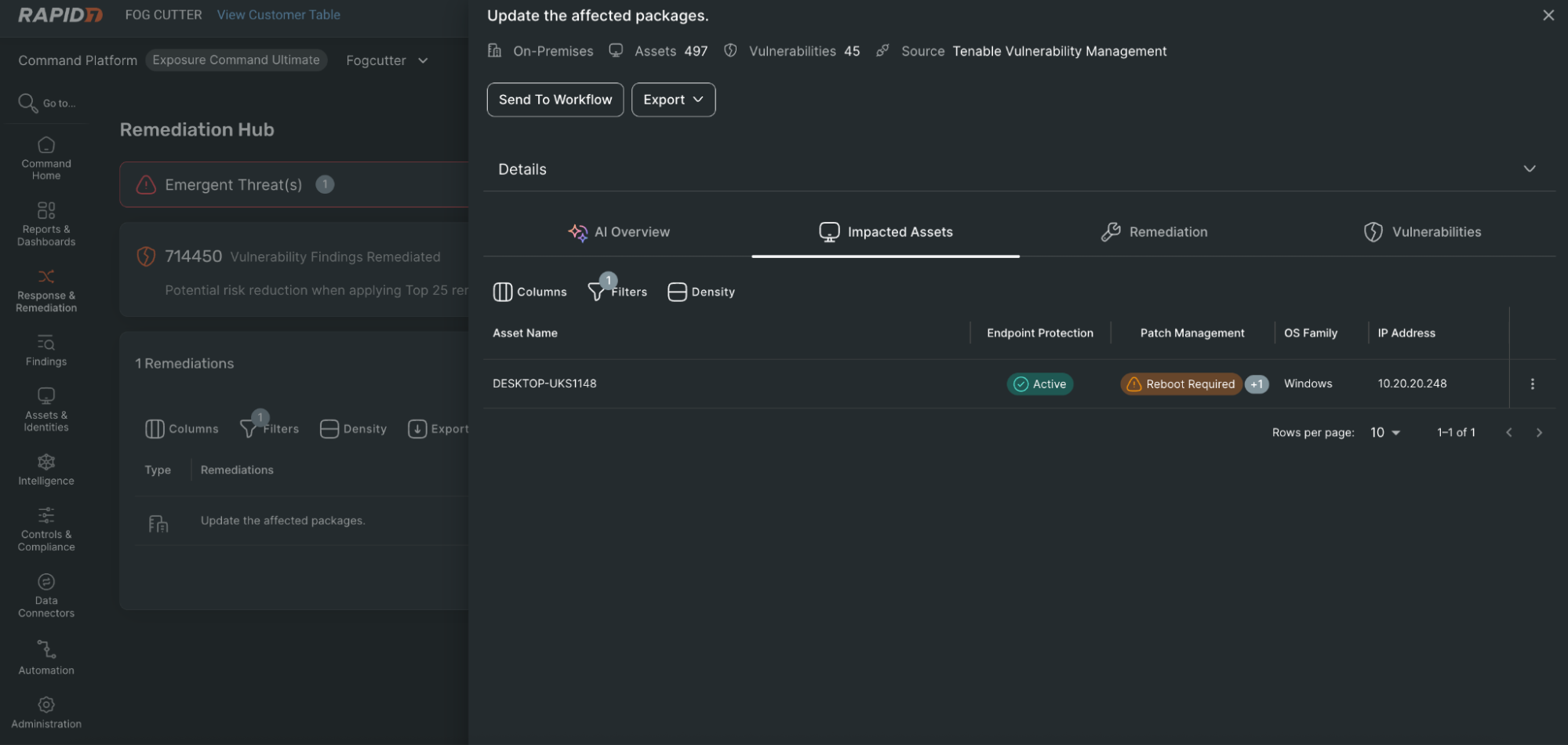
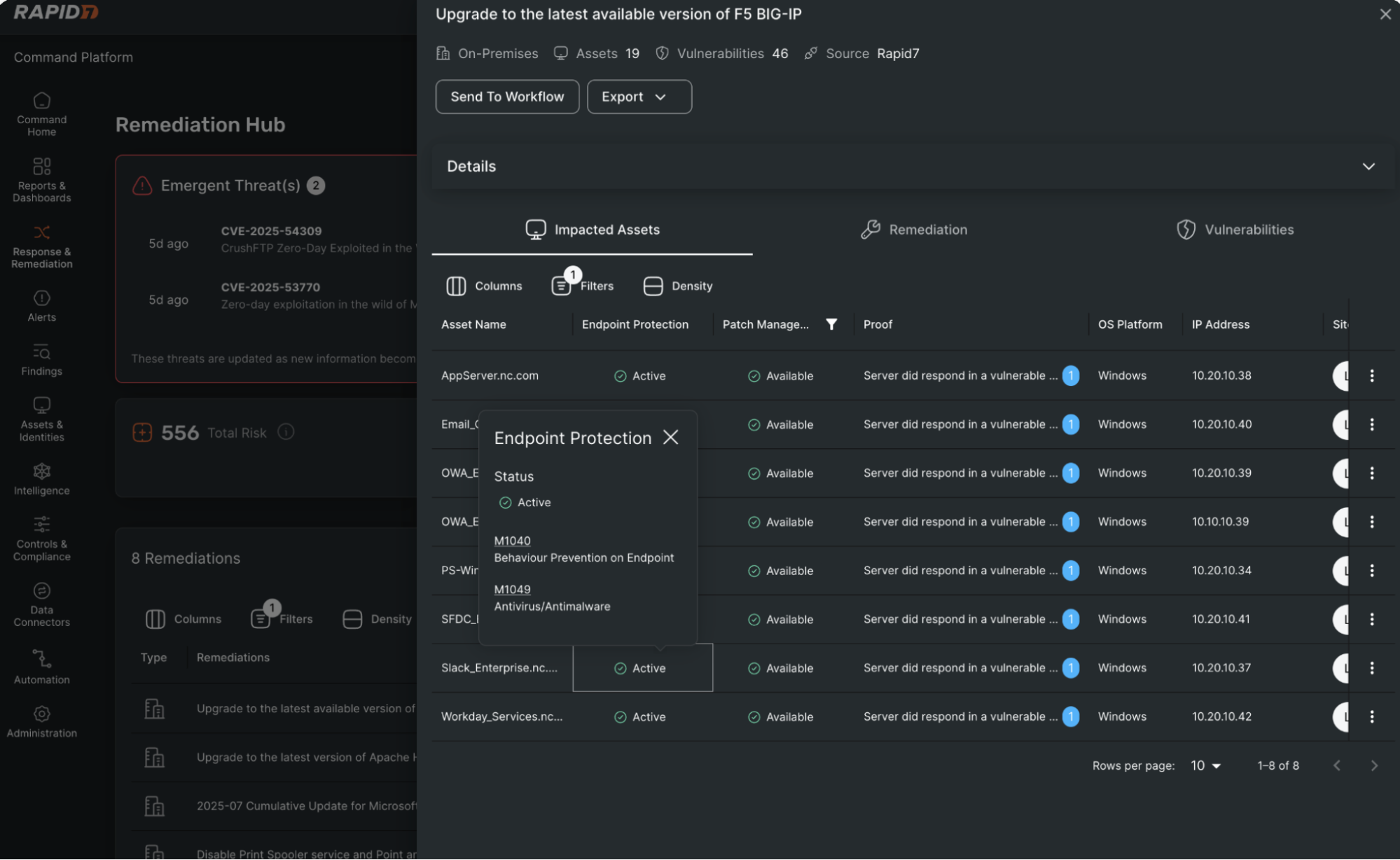
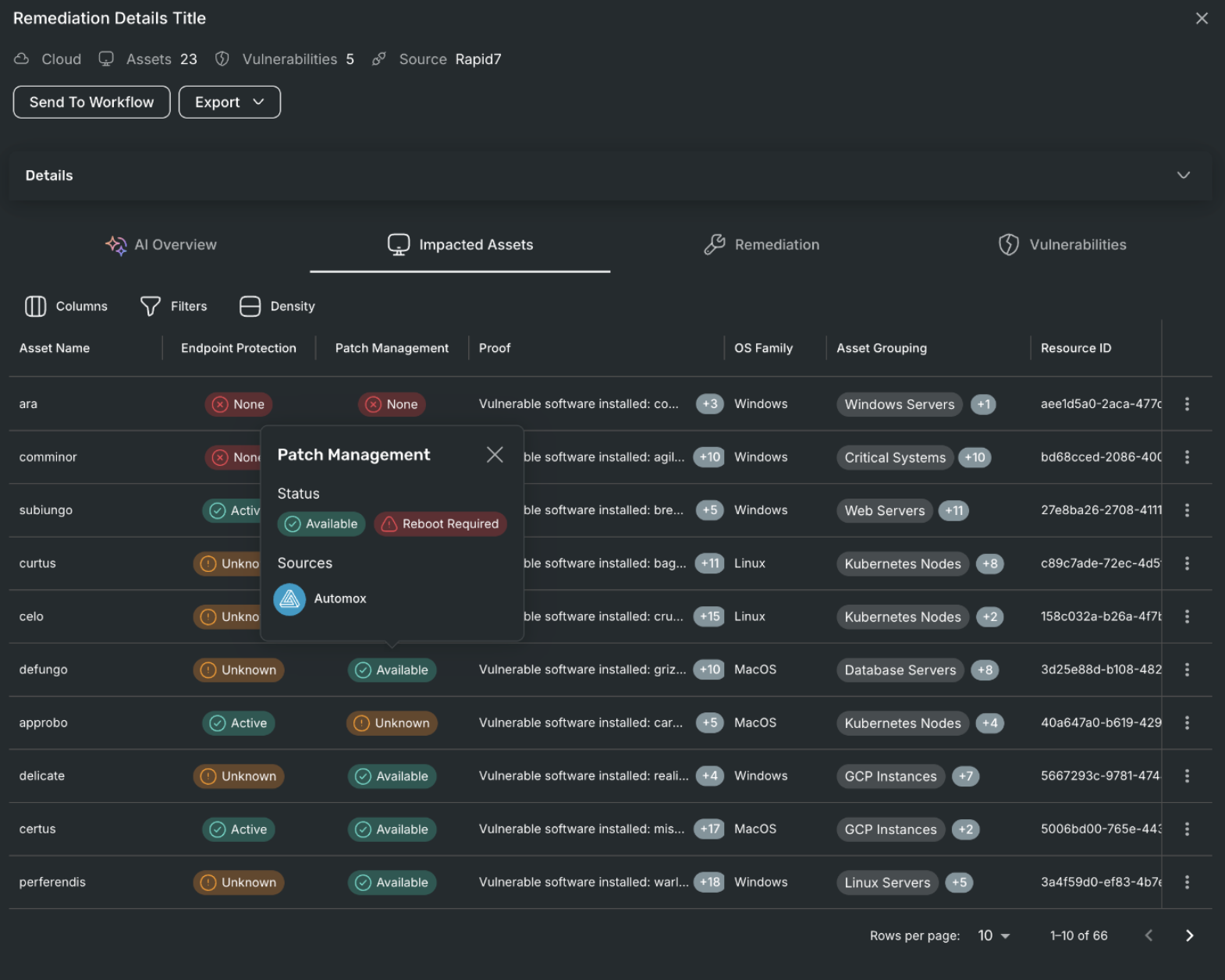
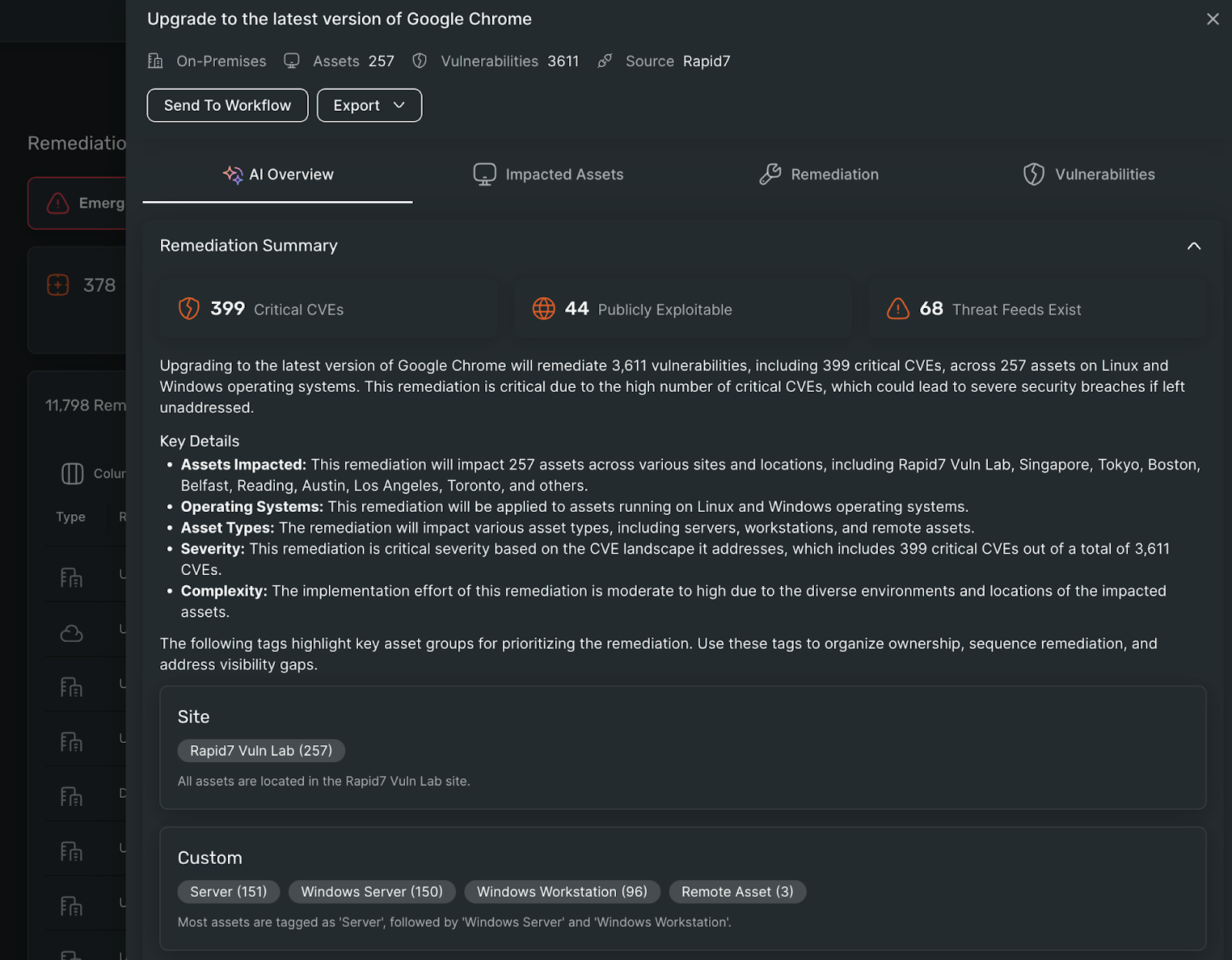
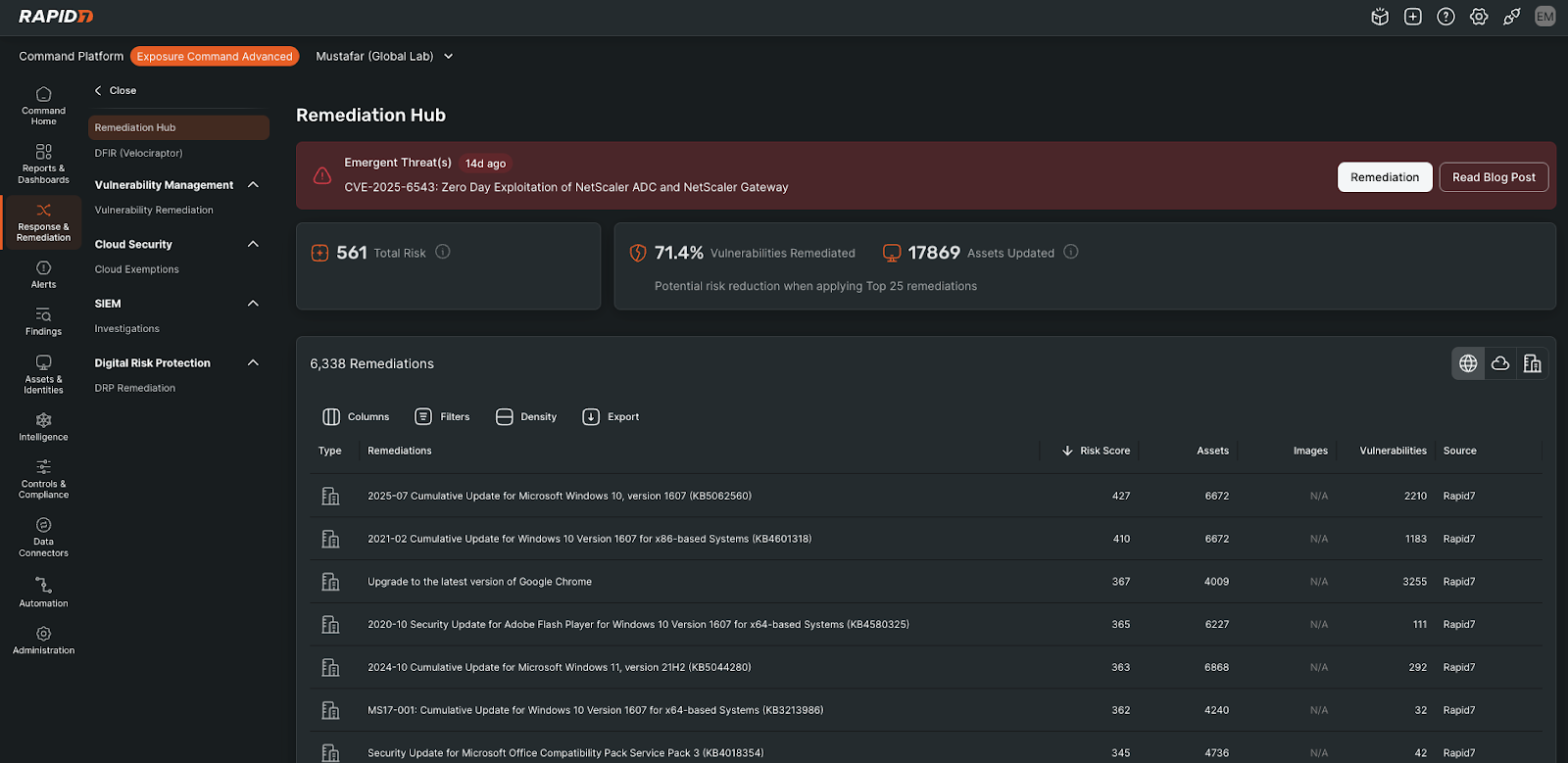
We improved Remediation Hub to help teams turn prioritized exposures into more actionable remediation progress. Updates to the Top Remediations Report add asset-level context, including operating system, IP address, cloud provider, tags, endpoint protection, and patch management details, so teams can better understand what needs to be fixed and who needs to act.
With clearer patch and endpoint coverage signals, reboot status, customizable filters, exportable reports, and scheduled email delivery, teams can spend less time assembling manual updates and more time tracking the remediation work that reduces risk. Read the full blog to learn more about how Exposure Command helps teams move from prioritized exposures to remediation progress.
AI pre-triage for AppSec findings
Rapid7 is also making application security testing faster and more focused with AI vulnerability pre-triaging for InsightAppSec. Available now for AppSec customers in supported regions, the capability uses AI to automatically remove false positives during the scan process, helping teams spend less time manually reviewing findings and more time remediating actual risk.
Initial coverage started with BlindSQL, and the latest engine release adds AI validation for BlindNoSQL findings, including content-based and timing-based detections. The result is a cleaner, more confident view of application risk, so security teams can focus on high-impact vulnerabilities and accelerate remediation with less manual effort.
Attack surface management
Open-source MCP Server and Agent Skill
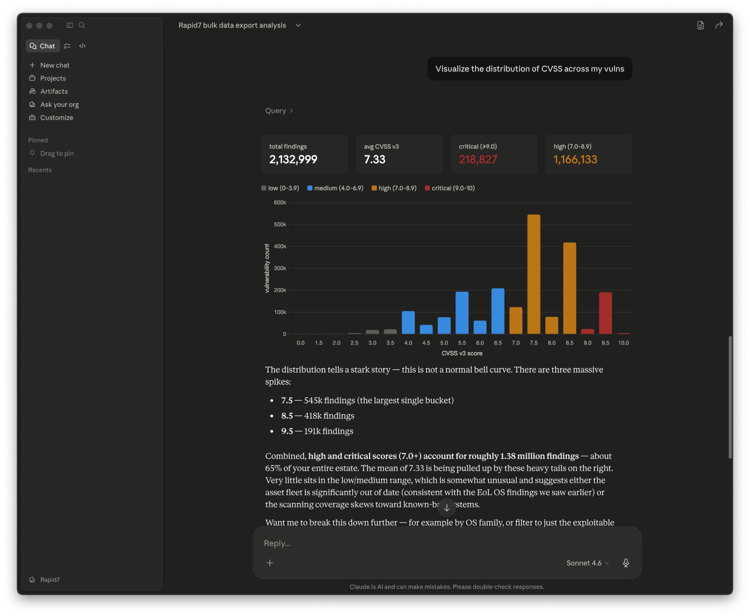
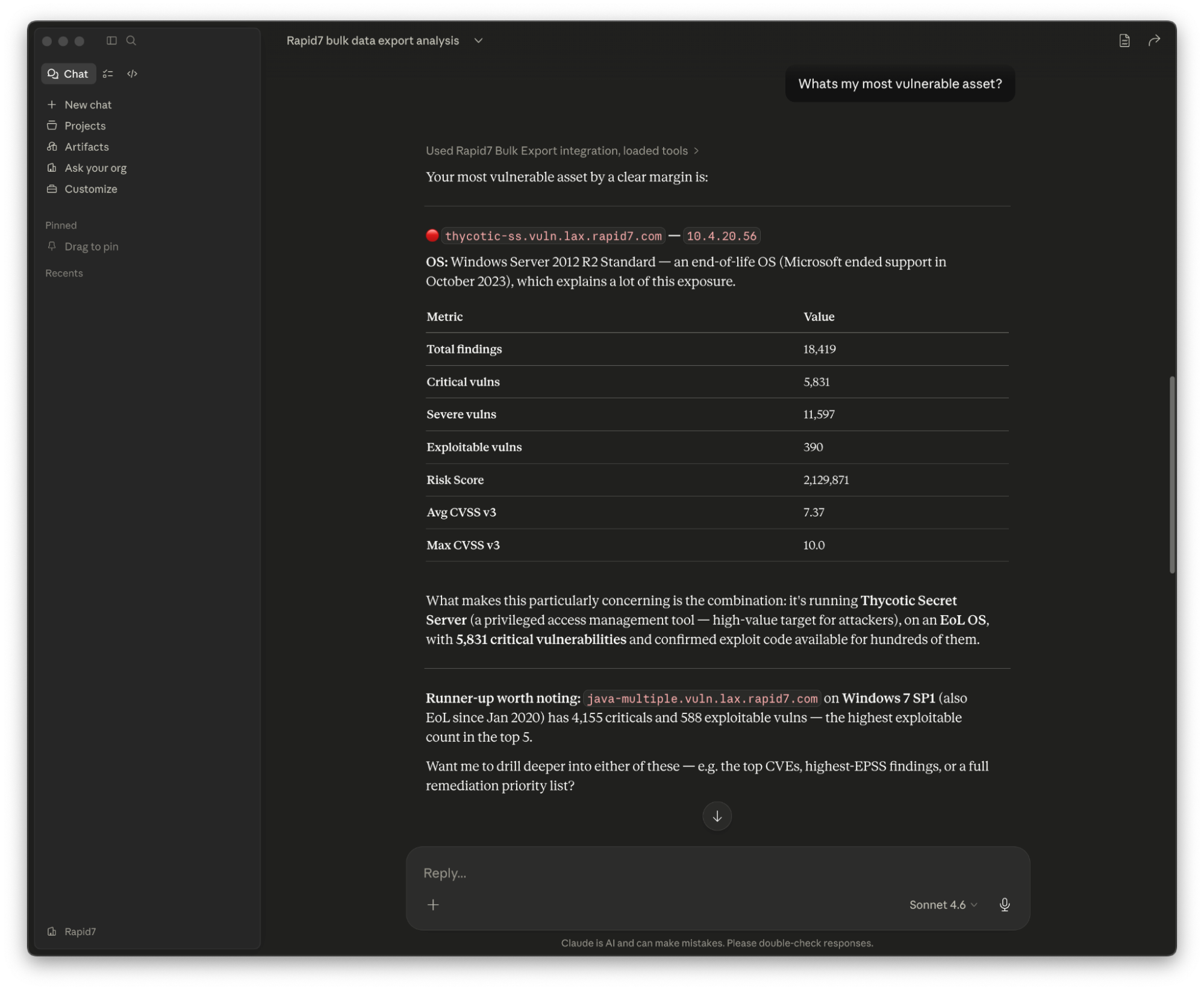
We are delighted to announce the introduction of a free, open-source MCP Server and Agent Skill for Bulk Export. Bulk export is a highly efficient way to access all your Rapid7 vulnerability and exposure data to AI assistants and custom AI workflows. Built as an open-source bridge, it helps customers bring their Rapid7 data into the tools and experiences that work best for their teams. Check out our blog for more detail.
Figure 3: Agent Skill for Bulk Export.
Turn exposure filters into live dashboards
Surface Command also made exposure reporting easier with filter-based dashboard widgets. Teams can now turn saved asset and identity filters into live dashboards without writing Cypher queries, making it faster to track high-risk internet-facing assets, identity-driven exposure hotspots, unmanaged cloud infrastructure, and business-unit risk.
For continuous threat exposure management programs, this helps teams move from one-off reporting to repeatable, always-on views of exposure risk and remediation progress. Read this blog to learn more.
Platform and Labs
Rapid7 Command Platform
Cyber GRC
Rapid7 introduced Cyber GRC to select customers in Q2, giving teams an early look at a new way to connect security, risk, compliance, and third-party risk management in one program. Available to both Exposure Management and Detection and Response customers, Cyber GRC brings governance and compliance workflows closer to the security data teams already use every day.
Cyber GRC will be broadly available in late July. It helps organizations move toward continuous compliance by mapping controls to real environment telemetry, automating evidence collection, and prioritizing risk with live attack surface context. That means teams can spend less time chasing audit artifacts, screenshots, and vendor risk details, and more time understanding which controls, assets, third parties, and risks need attention now.
Rapid7 Labs
Rapid7 Quarterly Threat Landscape Report
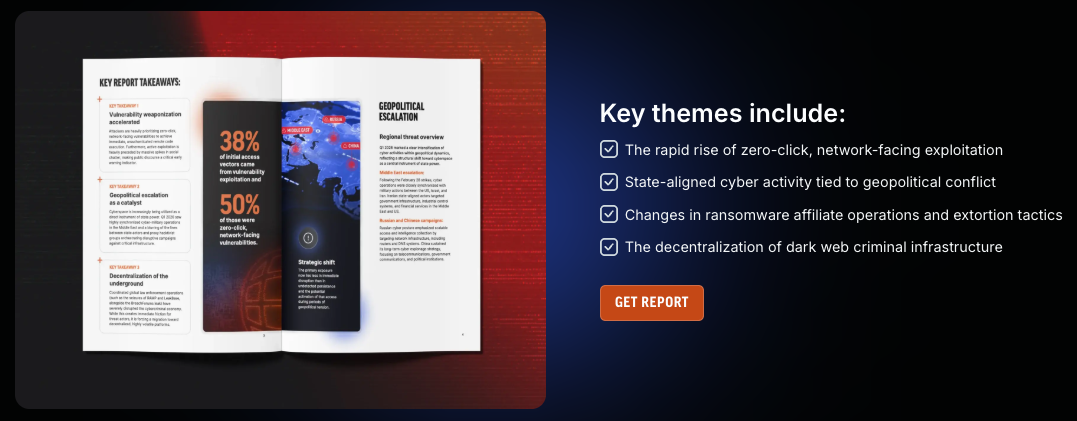
The Rapid7 Quarterly Threat Landscape Report examines the key trends shaping today’s threat landscape, drawing on MDR incident response, vulnerability intelligence, ransomware monitoring, and dark web telemetry. Q1 2026 data highlights the growing dominance of vulnerability exploitation as an initial access vector, the rise of zero-click vulnerabilities, evolving ransomware operations, and the accelerating pace at which attackers operationalize newly disclosed vulnerabilities. Read the report to explore all key findings and takeaways.
Figure 4: Rapid7’s quarterly threat report.
The latest threat research
Rapid7 researchers explored emerging trends shaping the threat landscape, including the growing commercialization of criminal AI-as-a-Service and the evolving tradecraft of advanced threat actors. From the underground adoption of AI tools for fraud and social engineering to an in-depth analysis of the Dropping Elephant malware campaign, these reports provide actionable intelligence on how attackers are adapting their techniques and what defenders can do to stay ahead.
Emergent Threat Response
This quarter’s Emergent Threat Response (ETR) coverage highlights a sustained wave of high-impact vulnerabilities affecting widely deployed enterprise technologies, including Oracle PeopleSoft, Palo Alto Networks PAN-OS, Check Point VPN, Ivanti Sentry, cPanel/WHM, and Nginx UI. For each of these CVEs, Rapid7 tracked active exploitation and rapidly evolving attacker activity to provide timely guidance to help defenders assess risk and respond quickly. See all the details, and our latest ETR coverage, here.
From strengthening detection and response to advancing exposure management, expanding governance capabilities, and delivering actionable threat intelligence, Q2 demonstrated Rapid7’s continued focus on helping security teams do more with less complexity. Every enhancement this quarter was designed to reduce manual effort, surface the context that matters, and help organizations make faster, more confident security decisions. We’re carrying that momentum into the rest of the year, so stay tuned to our blog and releases as we continue building the security operations platform that helps defenders stay ahead of what’s next.
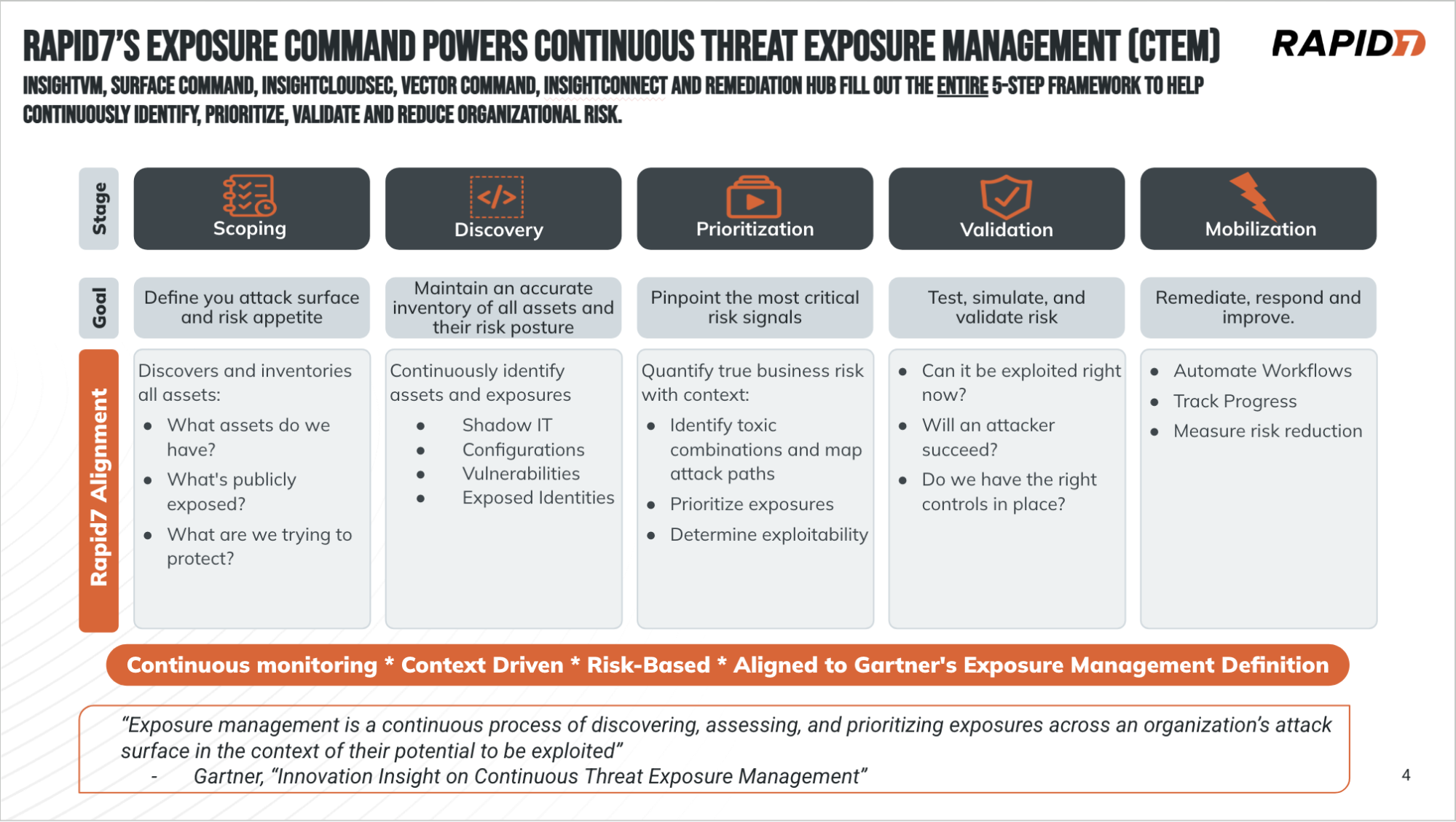
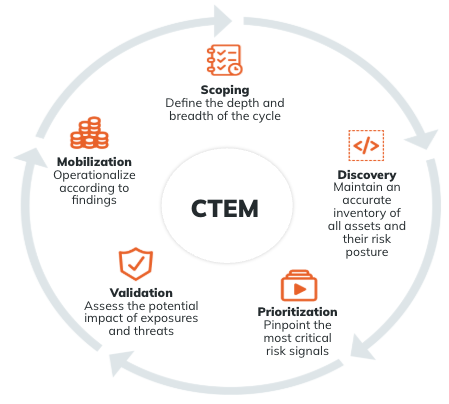
Let’s be honest, the patching window just shrank to something no practitioner or organization can keep up with. Organizations now need to operate in an environment that must assume breach, which means fundamentals like attack surface management, micro-segmentation, identity management, and attack path validation – aka a few core pillars of CTEM – just became the most important initiatives within the cybersecurity department. Rapid7 is the only vendor that provides a truly unified platform to master Continuous Threat Exposure Management (CTEM).
How Rapid7 satisfies all 5 steps of the CTEM Framework
Steps 1 and 2: Scoping and Discovery
Achieving full visibility
Rapid7 eliminates “unknown unknowns” by providing line-of-sight into 100% of your hybrid attack surface.
Surface Command (CAASM): We establish a single source of truth by unifying asset and identity inventory from over 200 third-party vendors and native sources.
Vulnerability Management: Our full-stack active scanning discovers shadow IT hidden within your enterprise network.
External Attack Surface Management (EASM): We scan the entire IPv4 space of the internet to automatically track changes to registered domains and public networks so you can map your external kingdom.
Unified CNAPP (Cloud Security): Our platform provides real-time, agentless visibility into every resource running across your multi-cloud environment (AWS, Azure, GCP, and Kubernetes). Through Event-Driven Harvesting (EDH), we identify infrastructure changes in under 60 seconds. This allows us to map not just the assets, but the complex identities and permissions that define your cloud risk.
Step 3: Prioritization
Moving beyond static scores
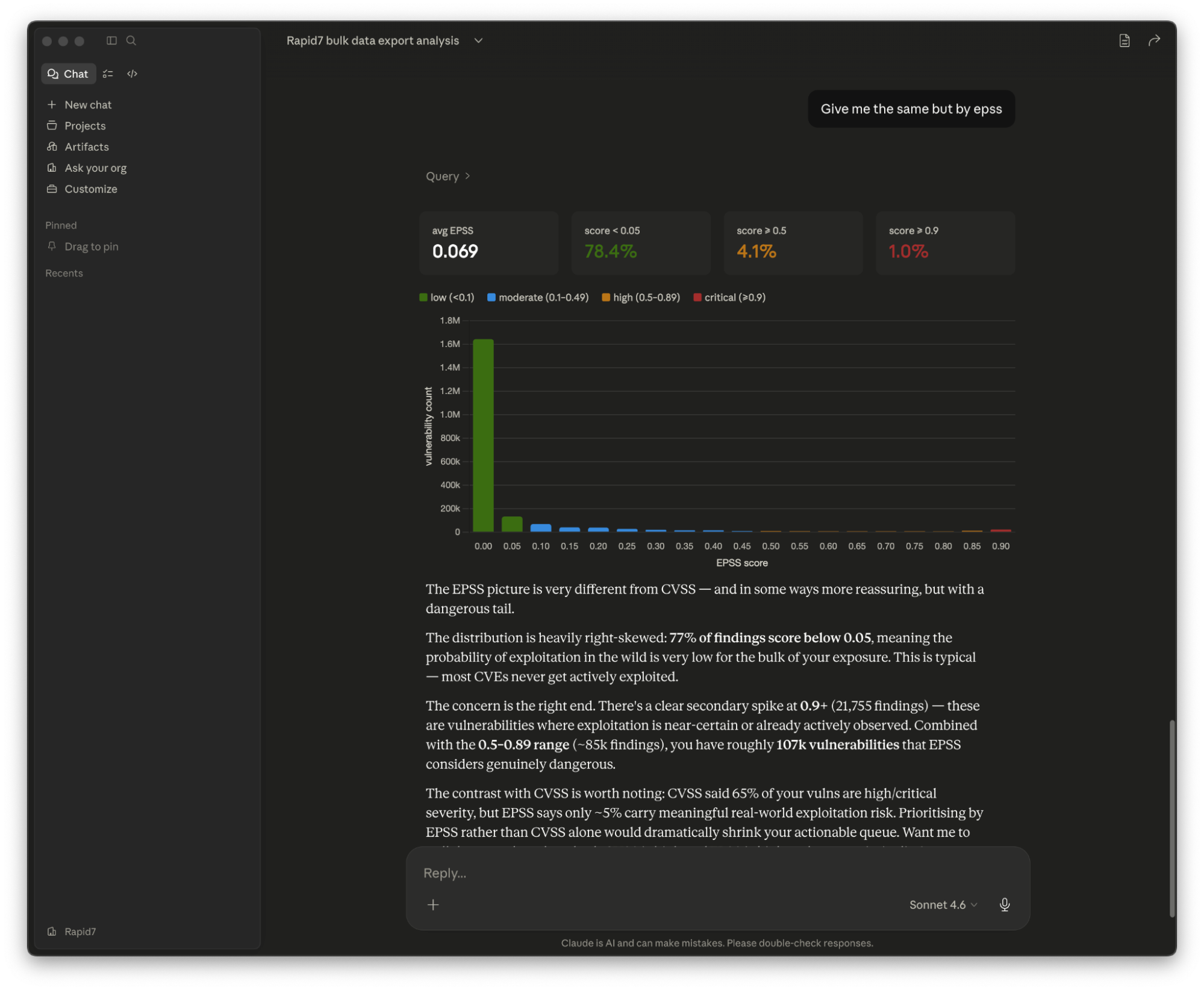
We replace generic risk scores with Active Risk and Threat-Aware Context. Our platform automatically prioritizes vulnerabilities based on real-world exploitability data from Rapid7 Labs and the Exploit Prediction Scoring System (EPSS). We are also able to incorporate your own organization’s tagging infrastructure to properly contextualize your enterprise so you focus on what matters most.
Step 4: Validation
Continuous human-led red teaming
This is where Rapid7 truly stands apart from automated-only vendors or point-in-time pen tests. Vector Command provides the expert human logic needed to bypass compensating controls like WAFs that stop automated tools cold. This gives Rapid7 the ability to answer the question: “How would an attacker get in?” We fully map the attack chain from the external to the internal so you have insight into where your controls are weakest. Ed Montgomery at Rapid7 has written extensively about the power of Vector Command – you can find his blogs here. Here’s a sampling of a couple of those stories:
The Telerik UI Example: While a scanner flags an old version of Telerik, our operators discovered they could bypass a WAF by splitting a malicious payload into 118 individual, “harmless” fragments. We bypassed the WAF and this achieved full remote code execution that a time-boxed, two-week pentest would never have uncovered. An automated scan might have flagged the outdated telerik as something notable but it was really the configuration of the WAF that allowed us to bypass. Something an automated scan would never have found.
SaaS Phishing: Our team used a misconfigured public Jira instance that allowed self-registration to hijack an Office 365 session and move laterally through internal trust. This validated that the true risk was a SaaS misconfiguration, not a patchable CVE.
Step 5: Mobilization
Instant response and remediation
We don’t just find problems; we close the loop with integrated action.
Cloud Runtime Security (CADR): Powered by our partnership with ARMO, our eBPF-based sensor can shut down an attack in seconds by killing malicious processes or pausing containers at the moment of detection.
Automation (SOAR): InsightConnect and our “Bot Factory” in CNAPP trigger automated remediation workflows to lock down S3 buckets or disable compromised users instantly.
Remediation Hub: We provide a centralized, vendor agnostic action-driven list of prioritized fixes to coordinate seamlessly with IT teams.
The new standard: From weeks to minutes
If your CTEM strategy relies on static tools and annual checkboxes, you are not just behind the curve. You are operating in a completely different era. By unifying the full visibility of Surface Command with the critical thinking of Vector Command and the instant response of our Cloud Runtime capabilities, Rapid7 empowers you to take command of your attack surface.
Do not wait for a 118 single bit request bypass to prove your defenses are porous. Move from a posture of passive observation to one of preemptive security.
A new open-source bridge helps customers connect Rapid7 vulnerability data to AI agents, assistants and custom workflows with more flexibility, control, and faster access to insight.
Security teams want more from their data than APIs and one-off reports.
They want to ask better questions, move faster, and bring security context into the workflows they are already building. That’s especially true as more organizations experiment with private AI assistants, internal copilots, and LLM-powered automation. Part of this experimentation is, of course, attempting to lower the pressure on teams that have to figure out how to prioritize the sheer number of actionable vulnerabilities efforts like Project Glasswing are quickly becoming hyper-skilled at spotting.
That’s why Rapid7 is introducing a free, open-source MCP Server and Agent Skill for Bulk Export. Bulk export is a highly efficient way to access all your Rapid7 data; no more paging APIs, no more verbose output. Bulk Export creates a local offline replica of your data the LLM can efficiently and quickly interrogate, reducing token cost and time to answer questions.
This new MCP and Agent Skill gives customers a standardized way to connect Rapid7 vulnerability and exposure data to AI assistants and custom AI workflows. Built as an open-source bridge, it helps customers bring their Rapid7 data into the tools and experiences that work best for their teams.
Why this matters now
Security teams are no longer just buying tools. They’re connecting systems, shaping workflows, and testing how AI can help analysts, IT teams, and leaders get to answers faster. For many teams, the path from raw security data to usable AI context is still manual. It often means exporting data, building wrappers, shaping queries, and managing custom integrations.
Rather than leave every team to solve that challenge from scratch, we wanted to provide a stronger foundation that is flexible, practical, and easy to extend over time. With projects like Metasploit and Velociraptor, Rapid7 is committed to Open Source, and by sharing with the broader community we hope to accelerate velocity and ensure we’re able to incorporate more use cases and fixes. These processes also give customers full visibility of the code running and tools used, ensuring data privacy and allowing the user to do with their data what they please.
What MCP does
Model Context Protocol, or MCP, is an emerging standard for helping AI systems interact with external data and tools in a structured way.
In practical terms, it gives AI assistants a cleaner way to ask questions, retrieve data, and work with systems beyond the model itself. For customers, that means less custom glue code and a more consistent way to use security telemetry in AI-driven workflows.
That matters because many security reporting and analysis workflows still assume a high technical bar. Answering a simple question can require custom queries, SQL knowledge, or dashboard work. But the people who need those answers aren’t always security specialists. They may be IT partners, compliance stakeholders, or executives who want clarity but might not need to understand the underlying query logic.
The MCP server helps lower that barrier: Instead of starting with raw exports and working backward, teams can start with the question they need answered.
CTEM is about helping teams move beyond point-in-time findings toward a more continuous, contextual understanding of risk. That requires security data that can be accessed, connected, and used across the workflows teams rely on.
Bulk Export helps make that possible by giving customers more flexibility in how they use Rapid7 data. The open-source MCP server makes it easier to bring that data into AI-assisted and custom workflows.
⠀
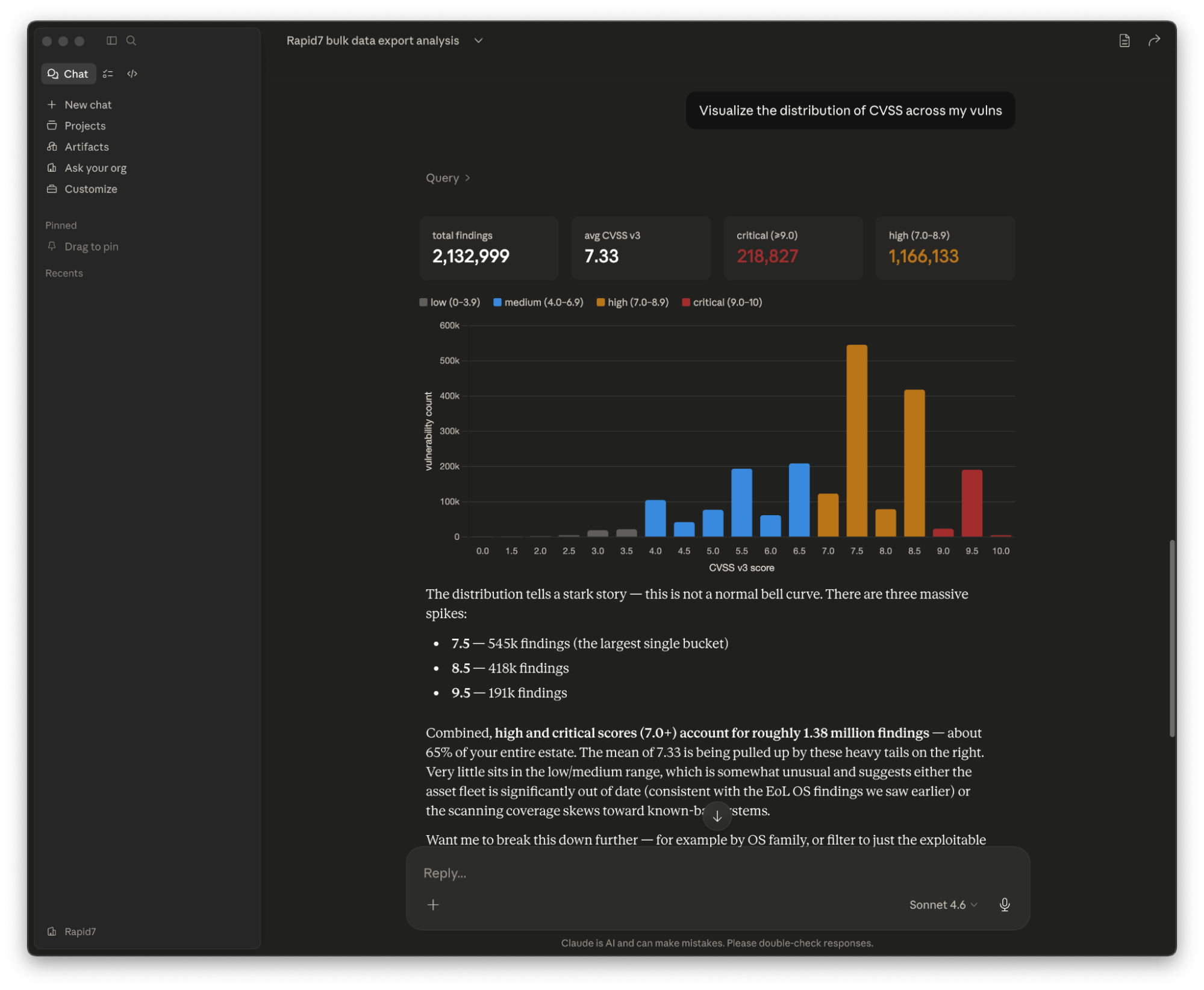
That can support more continuous exposure management workflows by making it easier for teams to triage vulnerability and exposure data. For example, an analyst facing a large queue of new vulnerabilities could use LLM assistance to quickly narrow in on the findings most likely to need attention first. Instead of manually working through exports and queries, they could ask natural-language questions to surface the exposures tied to critical assets, unresolved remediation work, or other signals available in the data.
From data portability to AI-ready interoperability
Bulk Export was already an important step toward giving customers more control over their data. It made it easier to extract and use security telemetry in external tools and analytics environments.
The open-source MCP server builds on that foundation: Instead of using exported data only for dashboards or custom reporting, customers can now use that same data in AI-native experiences. That includes internal assistants, private copilots, workflow automation, and natural-language exploration of vulnerability and exposure data. This makes existing security data easier to use in the environments customers are already investing in.
How it works
At a high level, the architecture is straightforward. Using the Agent Skill, your LLM runs the MCP server locally and automatically prepares the environment by performing the bulk export and loading the data into a local file store. The Agent Skill provides the schemas and knowledge, with the MCP providing the tools to access this data. The LLM then will answer any question by querying, summarizing, and synthesising data locally – an extremely fast and simple process that’s for the LLM.
Depending on the data a customer exports, answers can include vulnerability records, asset data, remediated vulnerabilities, and policy-related results.
The point here isn’t just that a model can access the data, it’s that an open-source layer helps customers inspect, adapt, and extend over time, empowering teams to control how that connection works in their own environment.
What customers can do with it
This opens the door to practical use cases, including:
Using LLM assistance to triage vulnerability data faster
Asking natural-language questions to spot exposure and remediation trends
Investigating which assets are tied to the most urgent vulnerabilities
Understanding what changed over time without manual analysis
Exploring policy failures without building manual queries
Feeding Rapid7 telemetry into private AI assistants and internal workflows
Making reporting more accessible for non-technical stakeholders
⠀
For teams already trying to operationalize AI, this creates a lower-friction path. Instead of building every integration from the ground up, they can start with a reusable bridge and focus on the workflows they want to enable.
A better path from data to action
Security data only creates value when teams can use it. For many organizations, turning raw telemetry into timely answers is still harder than it should be. Analysts need speed. Leaders need clarity. Builders need flexibility. And more customers want security data that works inside the tools and workflows they already rely on.
The open-source MCP server for Bulk Export is designed to help make that possible.
Bulk Export helps customers take control of their data. This is the next step: helping them put that data to work in AI-ready security workflows.
Security leaders know that reducing risk is not just about finding the right exposures, but helping the organization act on them before known issues turn into real incidents.
That is often where remediation gets harder. Security teams may know which actions matter most, but progress can slow when infrastructure, cloud, endpoint, and IT teams do not have the context needed to execute. Teams need clear asset detail to scope the work, trusted status signals to validate remediation, and usable reporting to track progress and stay aligned.
This is exactly the challenge Exposure Command is built to help solve. Exposure Command helps customers understand and prioritize the exposures that matter most, while Remediation Hub (a prioritized remediation view within Exposure Command) helps teams turn that prioritization into action. With new enhancements to Remediation Hub, customers can now do that with more context and confidence, along with better visibility into progress over time through exportable reports.
Why remediation work slows down
Prioritization is an important step, but remediation rarely happens in one place or with one team. Security, infrastructure, cloud, endpoint, and IT operations all need enough context to understand what is being asked of them.
When that context is hard to access, progress slows. Security teams may know what should be fixed, but asset owners still need the information required to assess impact, plan the work, and take action. Teams also need to understand whether assets are actually protected, whether patching has fully taken effect, and how remediation progress should be tracked over time. Without that clarity, remediation becomes harder to coordinate and harder to validate.
Making remediation more actionable
The Top Remediations Report helps close that gap by adding a comprehensive asset-level breakdown for each remediation. In addition to summary remediation information, customers can see source-specific metadata such as operating system, IP address, cloud provider, tags, endpoint protection, and patch management.
It can be used as a high-level summary of remediation priorities; many security teams use it to define remediation goals and share clear, actionable guidance with teams that may not work directly in security tools.
That gives teams a clearer view of the work behind each remediation and makes it easier to move from prioritization to execution.
Customers can also tailor reports to match the way they work, with customizable filters for specific environments, tags, or ownership groups. Reports can be exported in CSV, HTML, and PDF formats, shared with the teams responsible for action, and automatically generated and emailed on a schedule.
Building clearer visibility into patching and endpoint coverage
Action is only part of the equation, since teams also need clear, trustworthy context around asset posture.
Remediation Hub now shows the source of patch management and endpoint protection coverage directly in remediation details, giving customers clearer visibility into where that data comes from and which tools are protecting a given asset. This is especially helpful in environments with multiple solutions in use, and reduces confusion when missing integrations would otherwise make assets appear unprotected.
The update also surfaces whether an asset still requires a reboot after patching, helping explain why vulnerabilities may persist even when remediation work has already started. Together, these additions make it easier for teams to assess true exposure, validate remediation progress, and identify where follow-up is still needed.
Extending remediation data into operational workflows
Remediation does not stop once a team has identified what to fix or validated that a change has been made. Security leaders also need ways to track progress, measure performance, and share remediation outcomes across the organization. That is where exported remediation data becomes important.
By extending access to remediation data outside the platform, customers can more easily support the workflows across reporting, operations, and leadership teams. This makes it easier to analyze remediation activity over time, align to internal reporting needs, and give stakeholders a clearer view of progress.
For security leaders, that means better visibility into whether remediation efforts are moving the organization in the right direction. For operational teams, it means less manual work to assemble and share updates, and more flexibility in how remediation data is used.
What this looks like in practice
For vulnerability management teams, this means faster handoff. Instead of sharing a remediation recommendation and then answering follow-up questions, they can send a report that already includes the asset context needed to begin planning.
For infrastructure and cloud teams, it becomes easier to focus on the parts of the environment they own. Filters help narrow remediation data to the assets, environments, and ownership groups that matter most, reducing noise and making action more straightforward.
For endpoint and patching teams, greater visibility into coverage source and reboot status helps explain why exposure may still remain, even when remediation work is already underway. That makes validation easier and helps teams troubleshoot more effectively.
For security and IT leaders, scheduled reporting and exported remediation data improve shared visibility. Rather than relying on one-off exports or manual updates, teams can more consistently track prioritized remediation work and measure progress over time.
Better context, faster progress
These enhancements help customers do more than identify top remediation priorities. They help teams act on them, validate them, and track them with more confidence.
By bringing together deeper asset context, clearer patch and endpoint visibility, and more usable remediation reporting, Remediation Hub helps reduce the friction that often slows remediation down. The result is smoother collaboration across functional teams, less manual effort, and quicker progress on the remediation work that matters most.
Read more about how Exposure Command helps teams share remediation context, improve coordination, and move faster on risk reduction.
If product releases had a runway moment, Q1 at Rapid7 would’ve walked out in Cloud Dancer; crisp, confident, and quietly powerful, before breaking into a full gallop in the Year of the Horse. At Rapid7, our first-quarter launches combined velocity with refinement: meaningful enhancements designed to move security teams faster without adding complexity. Let’s cover off the key launches, one by one.
Detection and response
MDR for Microsoft
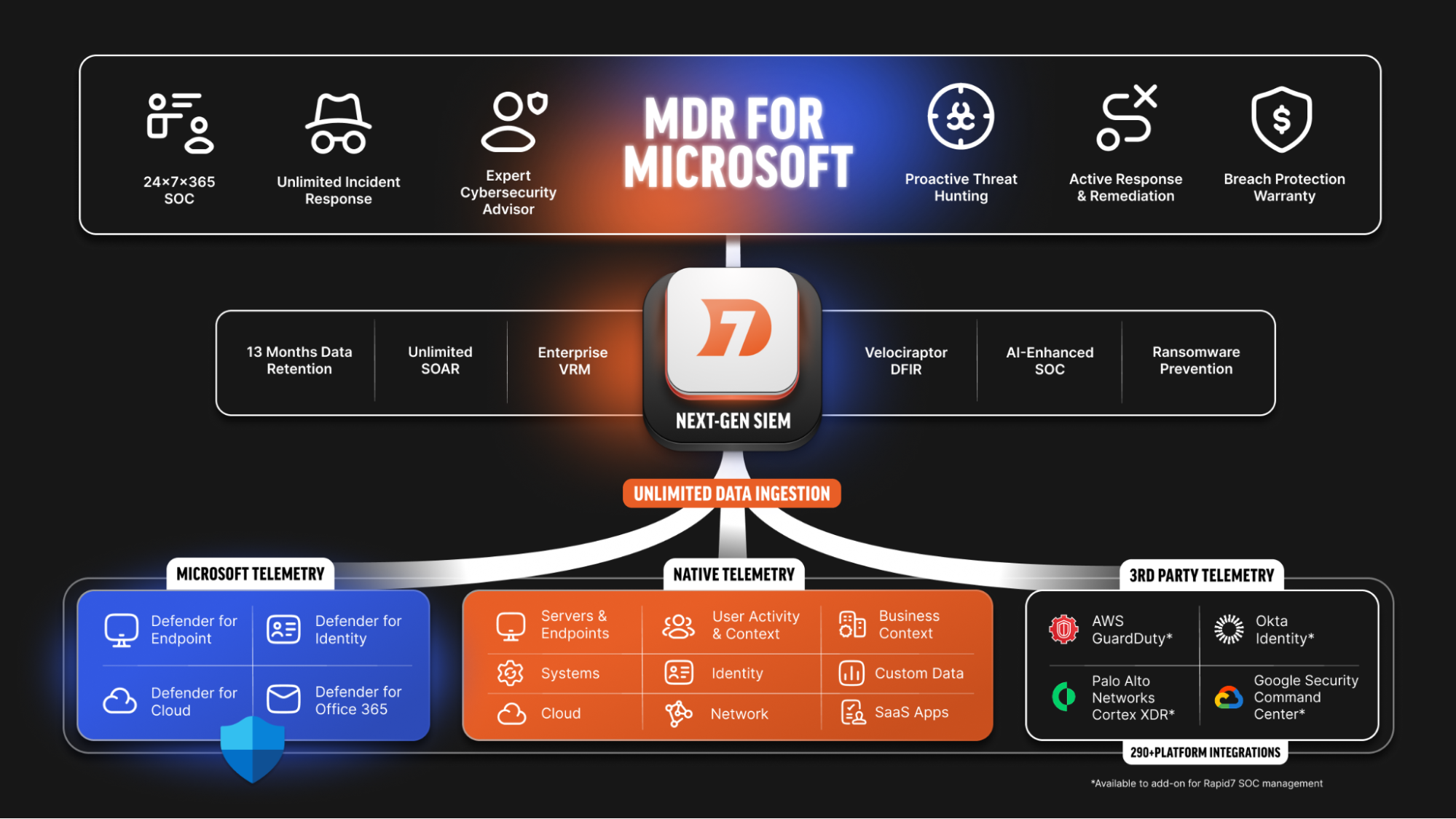
Getting more value from the tools you already have is an objective shared by all of us. For many of you, that translates to achieving greater security operations outcomes and resilience from your Microsoft technology. With MDR for Microsoft, organizations correlate their Microsoft, Rapid7, and third-party telemetry with prioritized risk context so the service can anticipate attacks before they start.
AI-powered triage and investigations – backed by unlimited incident response that ensures threats are fully eradicated – delivers certainty in an uncertain attack environment. Dedicated advisory provides strategic recommendations and program hardening guidance that drives long-term security resilience. Customers ultimately experience security operations excellence and achieve stronger outcomes from their existing Microsoft foundation.
The acquisition of Kenzo Security marks another step forward for the Rapid7 Command Platform and Rapid7’s vision for preemptive, AI-powered security operations. In an environment where most security teams are forced to leave large volumes of alerts uninvestigated, Kenzo’s agentic AI capabilities are expected to help accelerate Rapid7 from AI-assisted workflows toward AI-driven, machine-speed operations. Designed around specialized AI agents that work together across security operations tasks, this technology has the potential to reduce manual strain, broaden investigative coverage, and deliver more consistent, precise outcomes.
An average Kenzo customer reported a 94% reduction in investigation time, and their alert coverage increased from 12% to 100%. As these capabilities are brought into MDR, Managed Threat Complete, InsightIDR, and Incident Command, customers will benefit from a stronger, more scalable approach to cyber defense.
Incident Command
User to Identity mapping
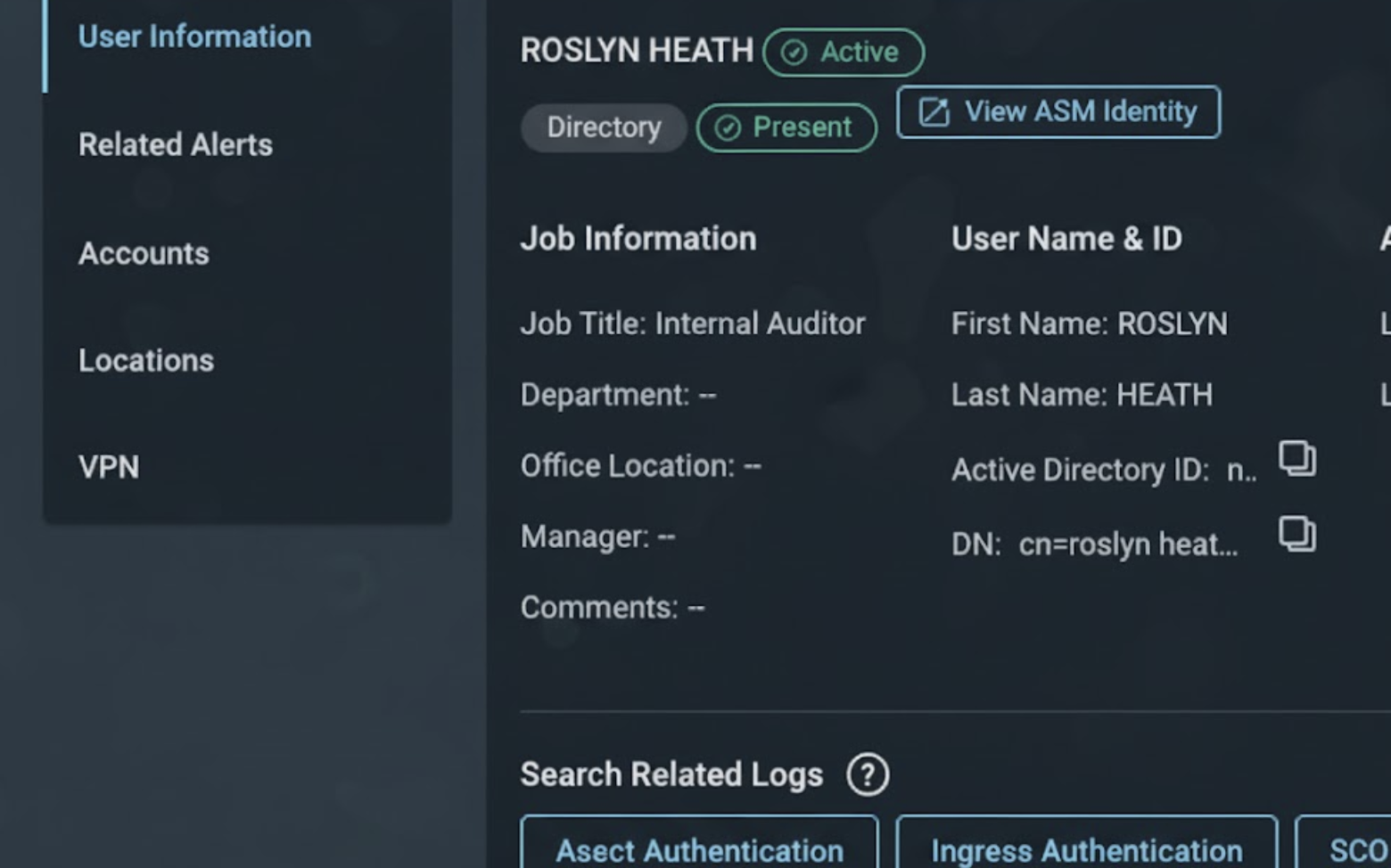
Connecting user activity to full identity context is critical for faster, more confident investigations. With User to Identity mapping in Incident Command, analysts can seamlessly link SIEM users to their corresponding identity profiles, gaining instant visibility into MFA status, account posture, and group memberships. By unifying detection and exposure data, teams eliminate manual reconciliation and close visibility gaps across the identity attack surface. This enables faster triage, deeper insight into user risk, and a complete, connected view of identity-driven threats.
User to Identity mapping within Incident Command
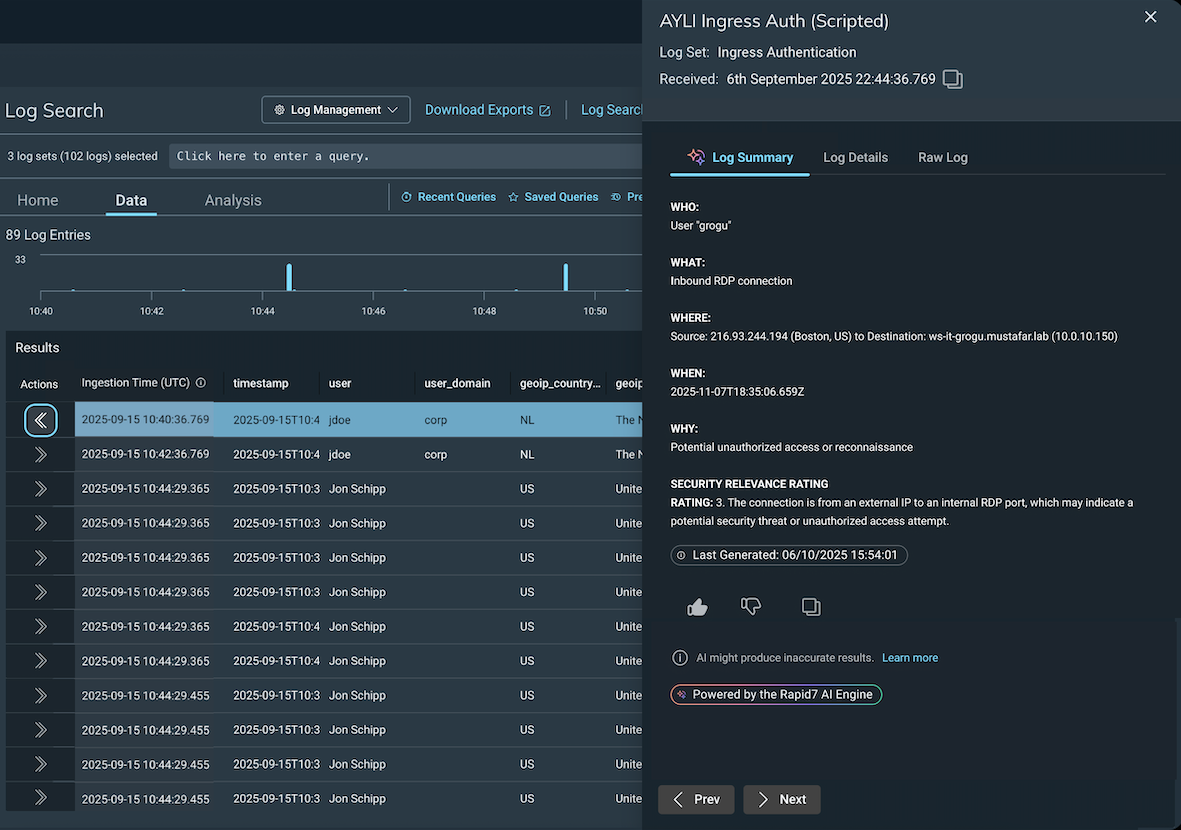
AI-Powered Log Entry Summary
AI-powered Log Entry Summary brings instant clarity to even the most complex log data. By translating raw log lines into a simple “who, what, when, where, and why” framework, analysts can quickly uncover insights without needing to interpret vendor-specific syntax or business logic. This removes the cognitive burden from investigations and hunts, allowing teams to spot threats faster across all data sources. Teams benefit from accelerated triage, more efficient investigations, and smarter decisions driven by clear, actionable context.
Instant context with AI Log Entry summary
Exposure management
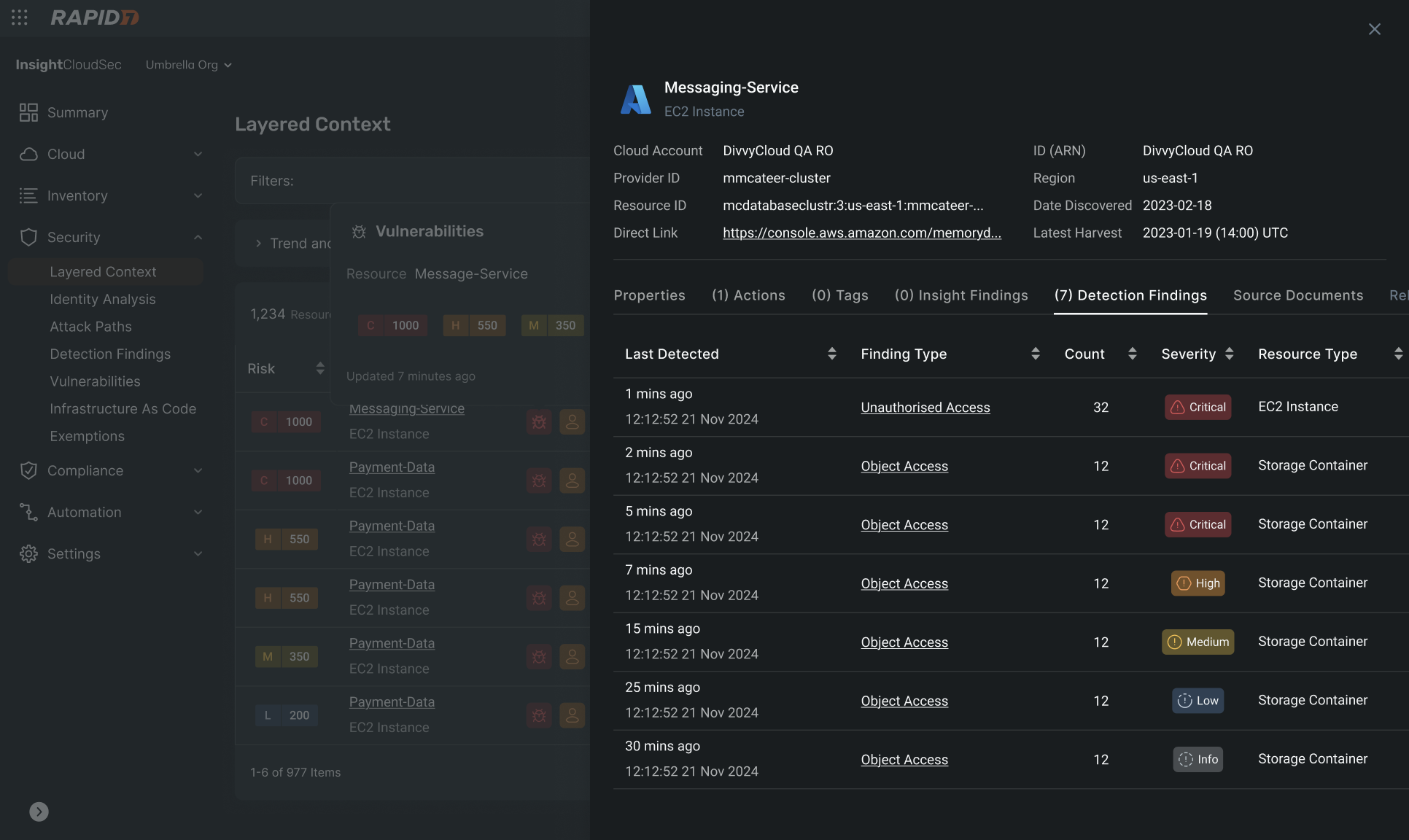
Cloud Runtime Security (application detection and response)
Earlier this year, we made a significant announcement that Rapid7 had partnered with ARMO to add AI-powered cloud application detection and response (CADR) – or cloud runtime security – to our cloud security portfolio. We are thrilled to announce that these capabilities are now integrated with Rapid7 Exposure Command Ultimate. For our customers, this milestone represents our ability to deliver on the promise of a complete cloud-native application protection platform (CNAPP) that helps security teams preemptively identify and proactively thwart attacks. If you’re interested in learning more about this latest innovation to our cloud security portfolio, reach out to one of our account executives.
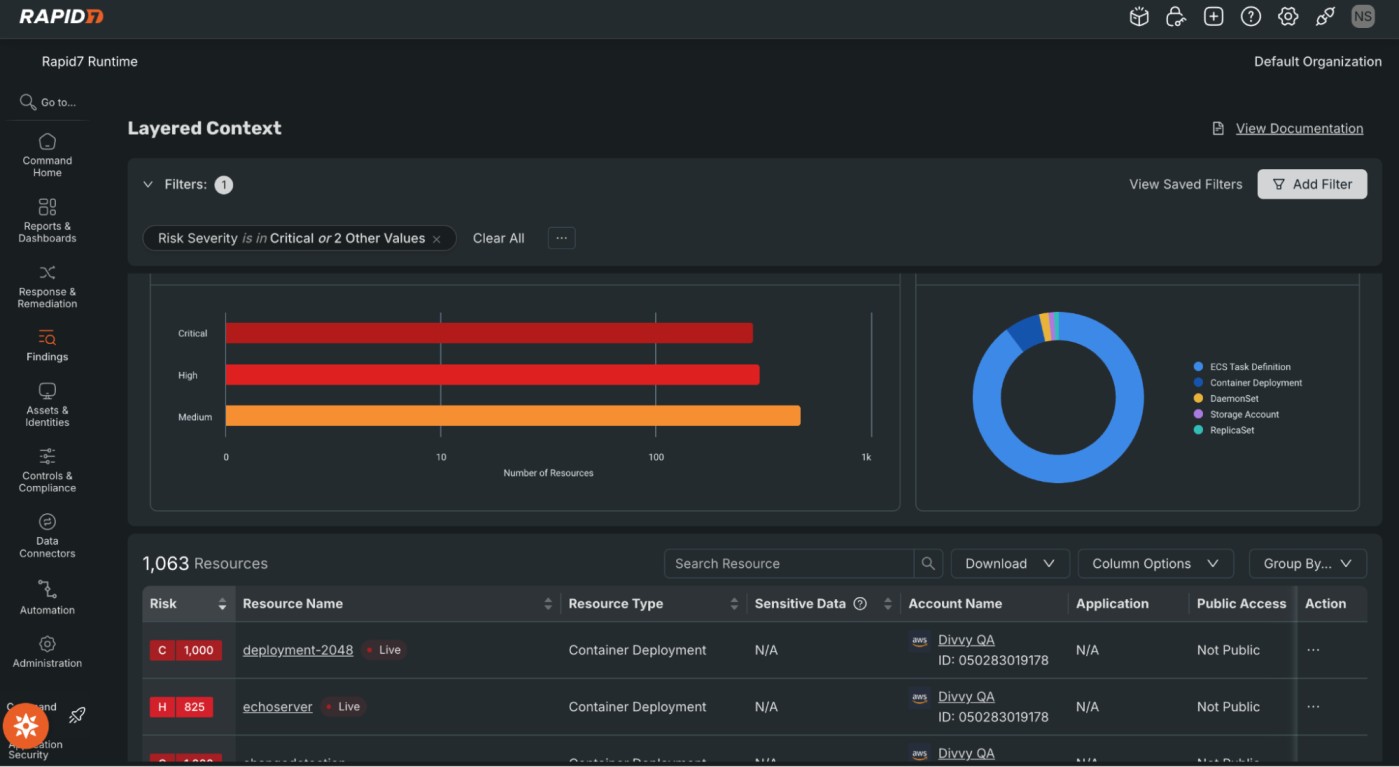
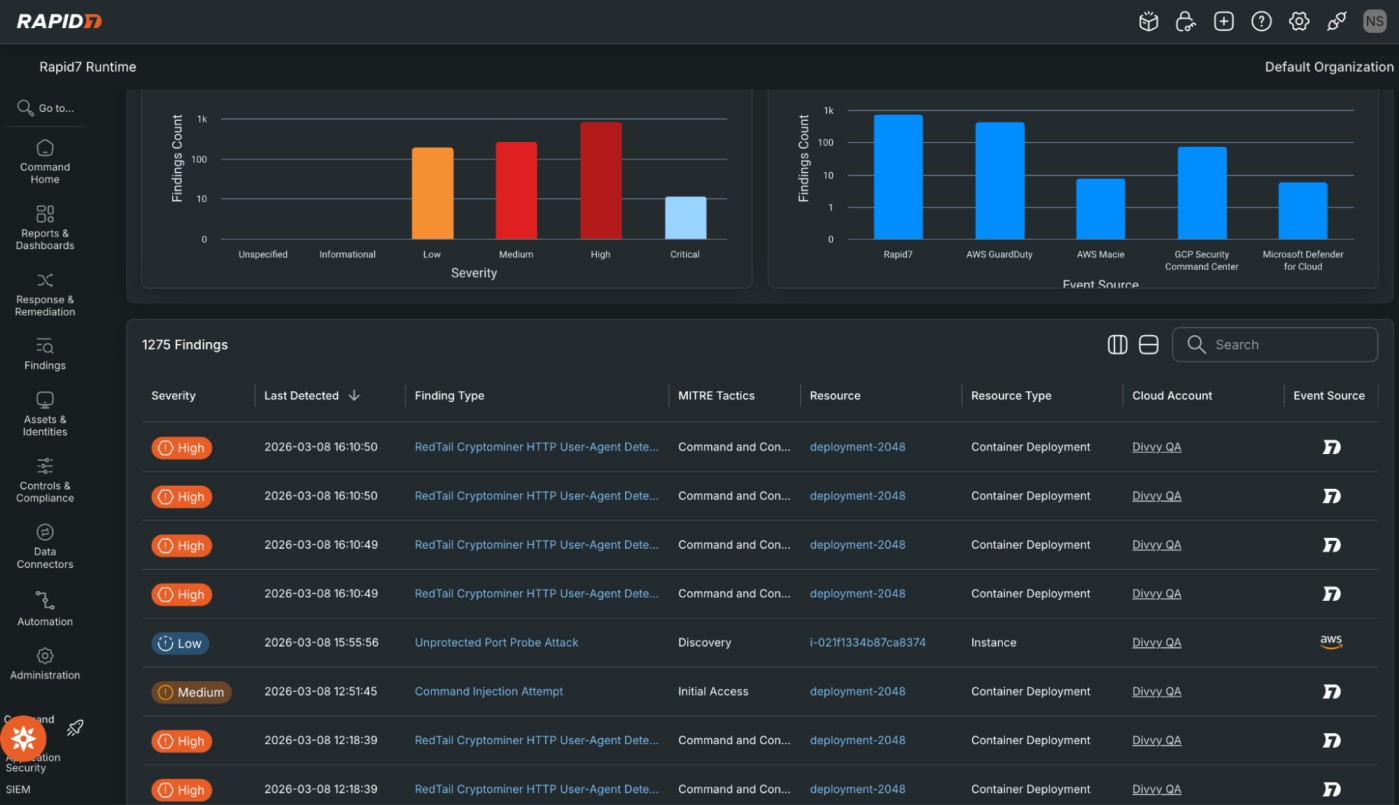
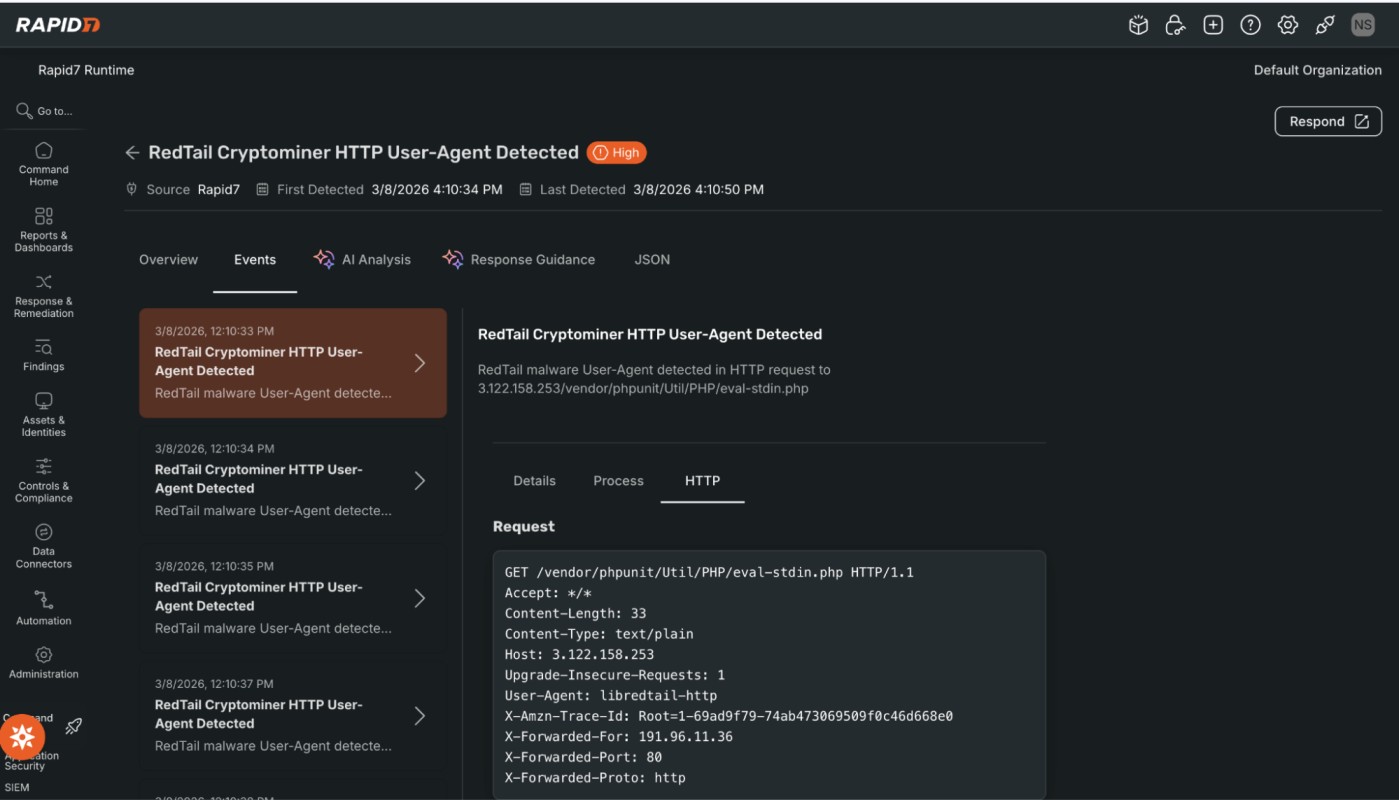
Runtime security delivering real-time visibility across cloud-native and containerized workloads
Top Remediation Report in Remediation Hub
Understanding which remediations to prioritize is only part of the process, teams also need asset-level detail to act. Top Remediations Report adds that context in Remediation Hub, with customizable filters, shared visibility across teams, and automated scheduling for recurring delivery to key stakeholders in CSV, HTML, or PDF. The result is faster coordination, clearer ownership, and quicker remediation progress.
Remediation Bulk Export API
We understand that organizations need to customize reporting for various stakeholders and levels across their business to drive effective vulnerability remediation and communicate security posture. One of the ways that organizations address this need is through our powerful cloud-based API, which enables teams to extract and export large amounts of security data into external tools like Tableau or PowerBI. Customers can export security data at scale, including assets, vulnerabilities, remediations and agent-based policy data, resulting in more flexible reporting and querying.
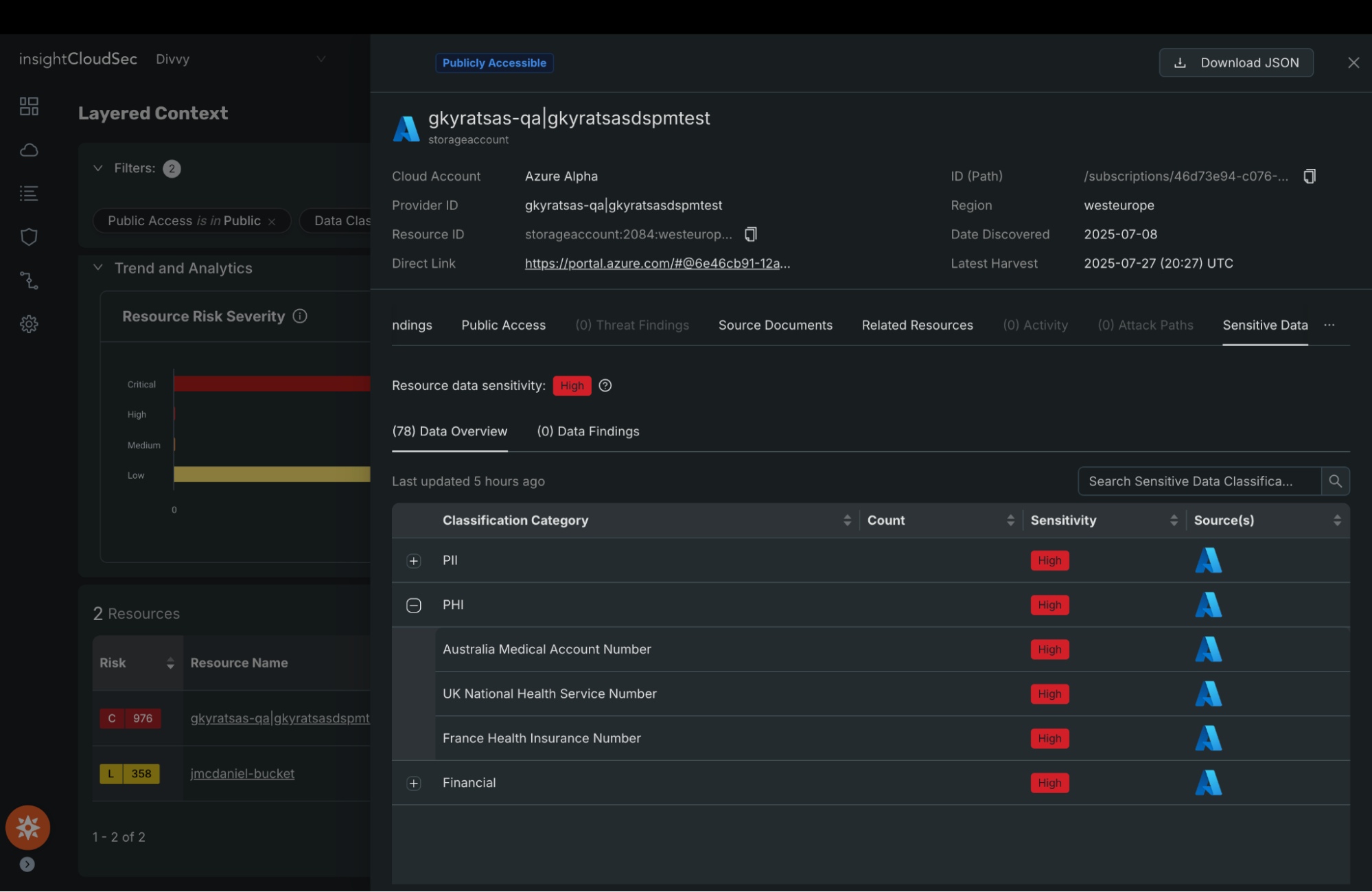
Data Security Posture Management (DSPM)
Understanding which exposures threaten sensitive data is difficult when data security and exposure insights live in separate tools. A partnership between Rapid7 and Symmetry Systems brings those perspectives together on Exposure Command, aligning sensitive data intelligence with real attacker reachability. DSPM capabilities discover sensitive data and map identity access, helping teams prioritize remediation based on breach impact.
Read the blog to learn how aligning data and exposure reduces breach risk.
Automated Sensitive Data Discovery: See how PII, PHI and Financial Data is flagged
Attack surface management
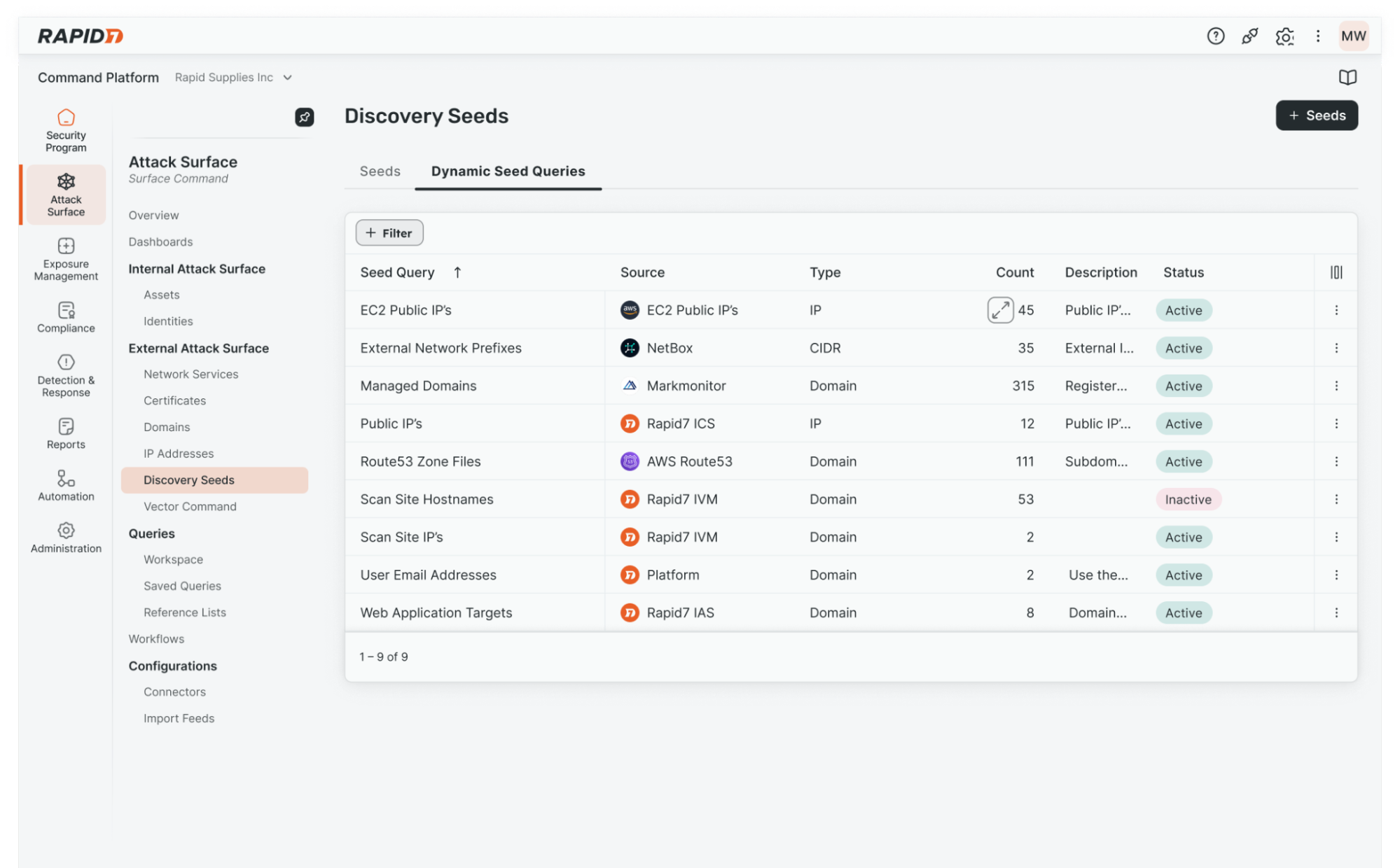
Dynamic External Attack Surface Discovery
Your attack surface doesn’t stand still, and point-in-time visibility can leave teams chasing what’s already changed. Dynamic EASM Discovery helps Surface Command automatically identify and track changes across the external attack surface by ingesting domain and IP data from across the environment. The result is more current visibility, fewer blind spots, and stronger confidence that teams are prioritizing and validating the exposures that matter most.
Read the blog to see how Dynamic EASM Discovery helps teams keep pace with a changing attack surface.
The Rapid7 Command Platform displaying your EASM seed data
Platform and Labs
Rapid7 Command Platform
We’re excited to introduce a centralized way to programmatically access data across all managed tenants with new multi-tenant API keys. For organizations managing multiple environments, tenants, or customers, integrating with each one individually has traditionally required significant manual effort, creating, maintaining, and rotating separate API keys for every tenant. This not only slows down development but also increases operational overhead and the risk of inconsistency.
With this new capability, you can build a single integration that seamlessly “loops” through tenants automatically, enabling consistent data access and streamlined workflows at scale. Whether you’re aggregating data for reporting, powering automation, or integrating with third-party tools, multi-tenant API keys simplify the process and reduce complexity, freeing up your teams to focus on higher-value tasks instead of repetitive configuration. Read all about it in our blog.
Rapid7 Labs
The latest threat research reports from Rapid7 Labs
This quarter Rapid7 Labs continued to deliver critical insights into the evolving threat landscape, uncovering how attackers are adapting their tactics – from stealthy, long-term intrusions to increasingly targeted and data-driven attacks. Our latest research reports highlight the growing complexity of modern threats and the real-world risks facing organizations today. Explore the findings below to better understand what’s changing and what it means for your security strategy.
BPFdoor in Telecom Networks: Sleeper Cells in the Backbone: Rapid7 uncovered a long-running espionage campaign in which a China-nexus threat actor, Red Menshen, embedded stealthy “sleeper cells” inside global telecommunications networks using the BPFdoor backdoor. Operating at the Linux kernel level, this malware enables persistent, hard-to-detect access without typical network signals, allowing attackers to monitor communications, subscriber data, and critical infrastructure over time. The research highlights a shift from opportunistic attacks to deliberate, long-term pre-positioning inside core systems that underpin global connectivity, raising national-level risk.
2026 Global Threat Landscape Report: The latest report from Rapid7 Labs delivers an in-depth analysis of global adversary behavior, drawing on telemetry from Rapid7 MDR investigations, vulnerability intelligence, and frontline incident response. This year’s findings highlight a rapidly evolving threat environment, marked by the collapse of the window between vulnerability disclosure and exploitation, the continued industrialization of ransomware operations, and the acceleration of modern attacks through the use of AI.
Executives’ Digital Footprints Threat Report: Today, 60% of an executive’s digital risk exposure is retrievable through surface web searches, including public records, professional history, and social media activity — all of which can be weaponized for highly targeted attacks. The Executive Digital Footprints Threat Report from Rapid7 Labs details how these executive digital footprints are an often overlooked threat vector that can be exploited, posing risks to the executive, their families, and organizations.
Exposing the Chrysalis Backdoor
Last month, Rapid7 uncovered the Chrysalis backdoor, a sophisticated supply chain attack that leveraged the Notepad++ update mechanism to selectively target organizations with a stealthy, persistent backdoor. This discovery highlights the growing risk of trusted software being weaponized and the real-world impact of advanced, targeted campaigns that can evade traditional defenses, reinforcing the importance of continuous monitoring and validating third-party software behavior in today’s threat landscape. Learn more about the Chrysalis backdoor here, and see more details on its impact and what you can do next here.
Cyber threat activity related to the Iran conflict
Rapid7 is actively monitoring cyber threat activity related to the Iran conflict, providing support for our customers and the cybersecurity community. Review observed activity, official advisories, and recommended defensive actions here.
Announcing Metasploit Pro 5.0.0
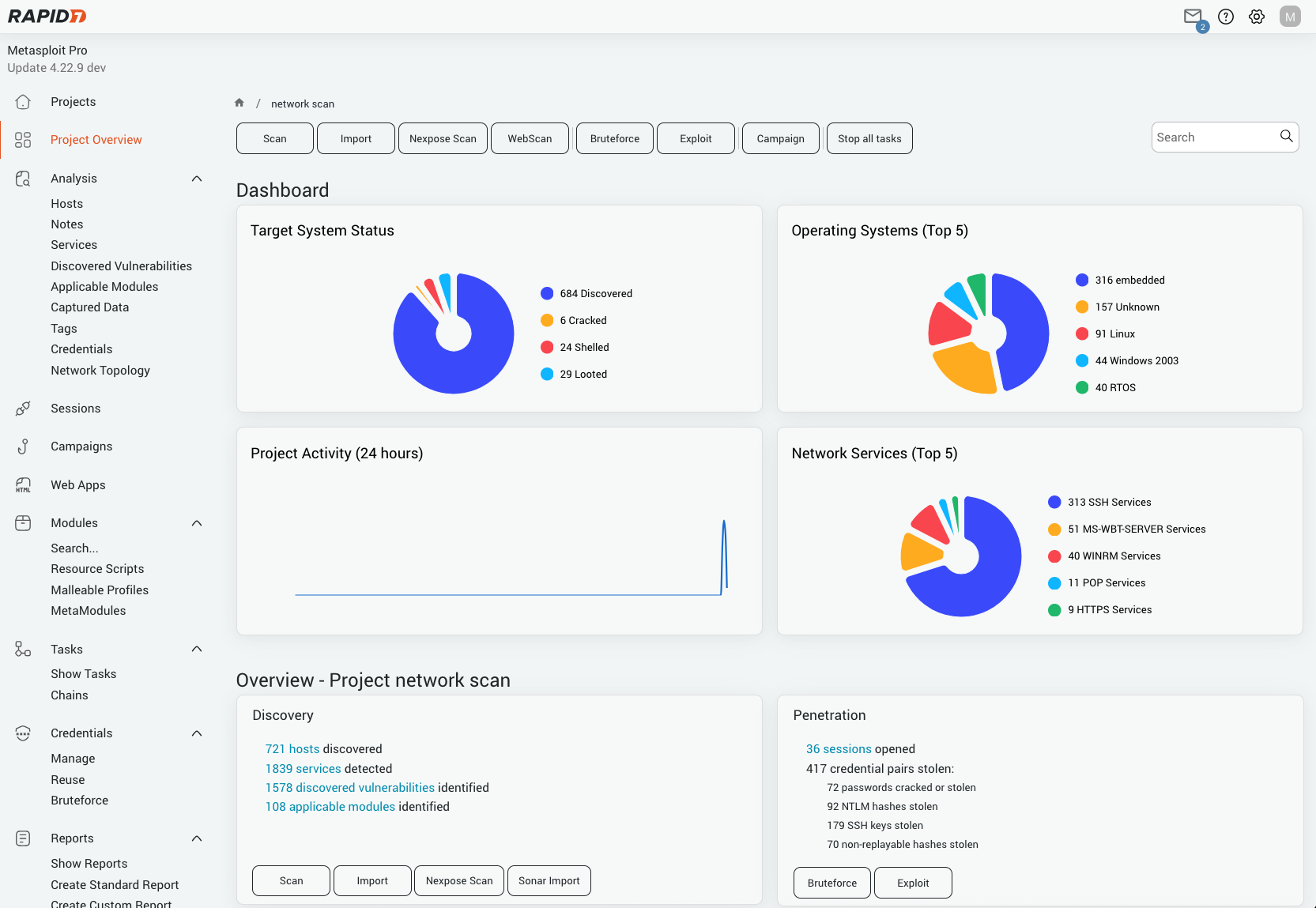
We’re excited to announce the launch of Metasploit Pro 5.0.0, a major evolution in red-team and penetration testing. Built to address today’s dynamic threat landscape, this release delivers a significantly improved UI, usability, validation, and workflow improvements that empower security teams to validate vulnerabilities faster and more effectively. Learn more in our blog post here.
Newly designed interface of Metasploit Pro
We’re just getting started
The innovation doesn’t stop here. We have a strong pipeline of product enhancements and new capabilities rolling out all year long. Be sure to follow our blog and release notes to see how Rapid7 continues to advance our platform and deliver greater value.
For years, cybersecurity professionals have relied on a familiar metric to dictate their day-to-day priorities: the Common Vulnerability Scoring System (CVSS). In today’s hyper-connected, sprawling IT environments, utilizing a static severity score as the ultimate arbiter of risk creates opportunities for threat actors. While defenders chase down theoretical, high-scoring alerts, adversaries are quietly targeting the truly exploitable, business-critical exposures that slip through the cracks.
In a recent report, Gartner® highlighted a projection:
“By 2028, organizations that prioritize exposures using threat intelligence, asset context, exploitability modeling and security control validation will reduce breach likelihood by at least 70% compared to peers relying primarily on CVSS-based vulnerability prioritization.” [1]
This affirms what many seasoned practitioners have suspected for years: there’s an abundance of vulnerability findings, but a lack of actionable context.
Static scores. Reactive security.
Most vulnerability management programs evolved during a time when the attack surface was relatively static, adversary tooling was rudimentary, and remediation capacity generally exceeded the volume of new disclosures. Today, enterprises are confronted with vulnerabilities scattered across complex cloud architectures, SaaS applications, and intricate supply chains.
In this modern threat landscape, CVSS alone is insufficient because it measures theoretical severity, does not factor in whether an attacker is actually using the vulnerability in the wild, or consider the business value of any affected assets. According to Gartner®, fewer than 10% of vulnerabilities are exploited, yet most are treated as urgent [1]. This all leads to prioritization paralysis, where security teams spend countless hours patching vulnerabilities that pose low material risk to the business. The legacy approach rewards what is auditable rather than what is genuinely impactful.
The path toward smarter prioritization
To break free from endless patching and ineffective risk reduction practices, security professionals are shifting toward a context-driven model. As Gartner notes, strong exposure prioritization requires integrating four critical elements: threat intelligence, asset context, data science, and security control validation. Organizations are approaching these elements in a few practical ways:
Threat intelligence to establish relevance
Instead of just asking how severe a vulnerability is, modern exposure management asks whether an exposure is relevant to a threat actor who is capable of exploiting it right now. By embedding threat intelligence into each vulnerability finding, teams shift the focus from theoretical to risk active exploitation. It introduces the adversary’s perspective by identifying known exploited vulnerabilities, public or private exploit availability, and targeted campaigns. By filtering out exposures with no evidence of attacker interest, organizations can instantly collapse large vulnerability backlogs and focus only on relevant threats.
Asset context and business criticality to define impact
Not all assets are created equal. A critical vulnerability on an isolated, internal test server is vastly different from the same vulnerability on a public-facing cloud workload processing customer sensitive data. Asset context enriches exposure data with crucial business information: what the asset is, its external accessibility, and its relationship to core business functions. Without this context, security teams waste disproportionate effort on low-impact systems, treating every critical alert as an equal emergency.
Exploitability modeling for predicting breach likelihood
Security analysts often struggle to assess exploitability given the overwhelming volume of vulnerabilities. By using predictive models like the Exploit Prediction Scoring System (EPSS), organizations can analyze large datasets of historical exploitation to identify latent risks. Exposure assessment platforms should display this data alongside each exposure finding to make it easier to predict the vulnerabilities most likely to become attacks.
Security control validation
An exposure that appears highly exploitable in theory might be neutralized by existing defenses. By integrating security and policy controls, you can evaluate exposures in the context of endpoint protection and identity management. This passive validation confirms whether an attacker can realistically exploit the exposure in your specific environment.
Unified exposure management
Individually, each element highlighted above provides incremental value, but when integrated, they fundamentally transform how prioritization decisions are made. This integrated model ensures that remediation efforts are mobilized only after priorities have been validated in the context of the business and the current threat landscape. It transitions vulnerability management from a purely technical, tool-centric exercise into a strategic, process-driven risk decision.
Security leaders must measure success not by the sheer number of vulnerabilities closed, but by the demonstrable reduction of exploitable exposures and the alignment of remediation efforts with actual attacker behavior. Operationalizing these four elements requires a unified platform that eliminates the silos between vulnerability management, cloud security, and threat intelligence. You cannot manually stitch together disconnected spreadsheets and hope to outpace modern adversaries. This is where forward-thinking organizations are leaning on comprehensive, end-to-end solutions like Rapid7 Exposure Command that seamlessly aggregate visibility across on-premises and dynamic cloud environments. With deep, native integration of Rapid7 Cloud Security capabilities, teams can instantly map asset criticality and external accessibility within complex, ephemeral cloud architectures. Furthermore, by infusing world-class threat intelligence and active exploit data directly into exposure findings, Rapid7 enables security teams to cut through the noise, validate security controls, and pinpoint the exact exposures that matter most—all with minimal friction.
[1] Gartner, Prioritize What Attackers Will Exploit: 4 Elements of Strong Exposure Prioritization, Jonathan Nunez, 5 March 2026.
Earlier this year, we made a significant announcement: Rapid7 partnered with ARMO to add AI-powered cloud application detection and response (CADR) – or cloud runtime security – to our cloud security portfolio. At the time, I published a blog highlighting this two-part approach for modern cloud security that combines preemptive exposure management (understanding the threats that could exist) with proactive runtime security (detecting the threats that are happening).
Today, we are thrilled to announce that this vision is fully realized and integrated with Rapid7 Exposure Command. For our customers, this milestone represents our ability to deliver on the promise of a complete Cloud-Native Application Protection Platform (CNAPP) that helps security teams preemptively identify and proactively thwart attacks.
Exploring the possibilities of this unified CNAPP
At Rapid7, we believe that a CNAPP is unified if it operates from a single, objective source of truth. By integrating cloud runtime security directly into Exposure Command, we are seamlessly merging the preemptive (posture, configurations, identities, and vulnerabilities) with the proactive (runtime behavior and active threats). The table below summarizes this enhancement:
⠀
Today’s Rapid7 Cloud Security solution
What cloud runtime adds
Primary Focus
Prevention, risk reduction, and preemptive response
Real-time exposure detection and proactive response
Core Question
“What is vulnerable and could be attacked?”
“Is an attacker exploiting our environment now?”
Lifecycle Stage
Pre-deployment, continuous scanning, or periodic intervals
Continuous monitoring of live (in-production) workloads
Active exploits, lateral movement, unauthorized process execution, SQL injection
⠀
The true power of this unified architecture is best understood through the lens of a security practitioner’s daily battle against cloud threats. The previous blog post discussed this in theory; let’s use this blog to talk about the reality.
The baseline
Exposure Command continuously scans and assesses your cloud posture to identify whether a container exposure exists in a production cluster. Traditional scanners would stop here, leaving you to prioritize this vulnerability against others. In Exposure Command, this detection is not just part of a static score, but instead it is part of an attack path. Our preemptive security platform tells you, for instance, whether this specific container has internet access and an over-privileged IAM role, making it highly reachable and exploitable. This means that you are not just looking at a CVE; you are looking at the potential blueprint behind a major breach.
The proactive validation
This is where cloud runtime security turns theory into reality. Instead of treating the vulnerability as just a potential risk, the platform utilizes eBPF sensors to provide continuous, direct kernel-level observability and application L7 visibility. Exposure Command analyzes this sensor data, uses AI to establish baseline workload behavior, and uncovers anomalies in real time. For example, security analysts gain instant visibility when that vulnerable container suddenly spawns a reverse shell and initiates an external connection to a known malicious IP, rather than executing its standard database queries.
The response
When a runtime anomaly is detected on a high-priority asset, the platform instantly aggregates these events into streamlined alerts. It links the initial application-layer exploit to the infrastructure-level change, such as the attacker attempting a container escape using that over-privileged IAM role. More importantly, the platform can trigger an automated response. By automatically terminating the malicious process, pausing the compromised container, or isolating the namespace, Exposure Command effectively stops an attacker’s lateral movement in seconds.
The investigation
Stopping the threat, understanding how it happened, and proving you resolved it, is what creates a truly resilient security program. Rapid7 Exposure Command does not just initially block the attack and leave you sifting through raw kernel logs to truly remediate the threat. Instead, it uses AI-generated remediation summaries to translate complex runtime telemetry into a clear, actionable remediation narrative. It explains exactly how the attacker bypassed initial defenses, what lateral movement they attempted, and the precise root-cause misconfigurations that allowed it. This empowers security teams to confidently report to leadership on the active threats they’ve neutralized, while providing developers with the exact context and code-level recommendations they need to patch the underlying exposure.
Amplifying signal vs. noise
When you combine predictive exposure analytics with deep application-layer and kernel-level visibility, you fundamentally change your operational efficiency. You stop chasing every theoretical risk and start focusing on what matters most. Exposure Command is a unified solution that eliminates the noisy alerts that tend to overwhelm security operations teams. Teams are able to prioritize remediation not just by CVSS score, but by real-time validation of what is actively loaded into memory and what is currently being exploited (i.e., risk and exposure). This means your developers spend less time patching vulnerabilities that fail to pose an immediate risk, and SecOps spends less time investigating benign container behavior.
With the general availability of cloud runtime security as part of Exposure Command, Rapid7 delivers a strategic, engineering-driven platform that achieves the mission of true CNAPP. We provide the precise answer to, “Could I be compromised?” through preemptive exposure management, and the definitive answer to, “Am I currently compromised?” through proactive runtime security. By closing the loop between these two questions, we allow enterprises to secure their cloud environments with accuracy, speed, and confidence. This is a great example of the wider approach to preemptive security that Rapid7 is delivering across different use cases through the Command Platform’s comprehensive exposure management and threat detection & response capabilities.
Visit Rapid7’s CNAPP hub page to learn more about how the fully integrated Rapid7 Exposure Command with cloud runtime security can transform your cloud defense.
This blog was written in collaboration with Symmetry Systems’ Claude Mandy.
Rapid7 and Symmetry Systems are partnering to help organizations reduce breach impact by aligning sensitive data intelligence with real-world exposure paths across both human and machine identities.
Breaches are measured in data, not vulnerabilities
Vulnerabilities are one thing, but the breaches that follow are rarely just technical incidents. More often, they become business events with far-reaching consequences, driven by something far more simple than a sophisticated exploit.
According to the 2025 Verizon Data Breach Investigations Report, 98% of system intrusion breaches involved the use of stolen credentials or brute force attacks against easily guessable passwords. Attackers are not just exploiting vulnerabilities; they are leveraging identity access to move through environments and reach sensitive data.
The financial impact of these breaches is staggering. IBM’s 2025 Cost of a Data Breach Report found the global average cost of a data breach is $4.44 million. In highly regulated regions and industries, that cost climbs significantly higher. Those figures reflect detection and response costs, regulatory fines, lost business, and operational disruption. Those figures also rarely capture the longer-term impact on brand trust and customer confidence.
Ultimately sensitive data defines breach impact. Yet, most organizations still evaluate exposure and data risk in isolation. Security teams understand where vulnerabilities exist. Data teams understand where sensitive data lives. But leadership often lacks a unified answer to the most important question:
If an attacker compromises an identity or gains a foothold in our environment, what sensitive data could they realistically reach?
That gap is exactly what Rapid7 and Symmetry Systems are addressing through a new partnership.
Knowing where your data lives is only the beginning
“DSPM is an all-seeing, all-feeling nervous system for data security. It creates awareness of data vulnerabilities and enables mitigation before those are exploited.”
That awareness is foundational. Organizations need continuous visibility into where sensitive data lives, how it is classified, and who can access it. Without that foundation, security and risk decisions are based on assumptions rather than evidence. Awareness alone does not account for how attackers move through an environment.
Exposure management shows how adversaries move across cloud, SaaS, and on-prem environments, while DSPM shows what data is at stake and the potential impact for a compromised identity. Connecting the two is what turns visibility into impact-driven prioritization.
AI agents, copilots, and the new exposure multiplier
As organizations deploy AI agents and copilots across collaboration platforms and cloud systems, identity-driven exposure expands even further. These systems operate with delegated permissions, often aggregating and surfacing data across repositories. If misconfigured or compromised, they can amplify blast radius by inheriting privileged access to sensitive data. AI dramatically increases the scale and speed at which identity-based access can affect data exposure.
This makes the alignment between sensitive data context and attacker reachability even more critical, and that alignment is exactly what this partnership is designed to deliver.
Where sensitive data meets attacker reality
Rapid7 Exposure Command brings attacker context into focus by correlating signals across the attack surface, including:
Internet-facing exposure
Identity-driven access paths
Vulnerabilities and exploitability signals
Reachability across cloud and on-prem environments
Symmetry DataGuard delivers sensitive data and identity context. It provides:
Continuous sensitive data discovery and classification across cloud and SaaS environments
Identity and permission mapping to understand who can access sensitive data
Over-privileged, dormant, and risky access detection to reduce blast radius
Anomalous activity monitoring to surface data misuse and policy violations
Actionable data vulnerability insights to drive targeted remediation
Sensitive data insights from Symmetry are surfaced directly within Rapid7 workflows, showing whether high-value data is actually reachable through real-world attack paths.
Instead of asking “What is vulnerable?”, organizations can confidently answer “What sensitive data could actually get breached?”
Reduce breach impact before it disrupts the business
Every organization faces exposure, and AI only increases the scale and speed at which data can be accessed. This partnership brings together two focused capabilities through a strategic reseller and integrated experience between Rapid7 and Symmetry Systems.
Customers can access full DSPM capability through Rapid7, with sensitive data insights surfaced directly within Exposure Command. From there, teams can seamlessly pivot into Symmetry DataGuard for deeper investigation, governance, and remediation workflows.
Rapid7 provides attacker-aware exposure modeling across hybrid environments. Symmetry delivers deep data security posture management, including sensitive data discovery, identity-to-data mapping, and visibility into AI and machine identities. Together, they create a unified view of exposure and data risk while preserving the depth and specialization of each platform.
By connecting sensitive data intelligence with exposure reachability, organizations gain clarity into what is truly at risk and which actions will have the greatest impact.
The result is measurable: reduced blast radius, a stronger regulatory posture, and remediation aligned to business consequences.
If you are ready to bring sensitive data and identity-driven access (human and machine) into your exposure strategy, Rapid7 and Symmetry are working together to help you prioritize with clarity and confidence.
For teams managing dozens, or even hundreds, of tenants, API access quickly becomes operational overhead. Managed Security Service Providers and large enterprises often find themselves maintaining separate credentials for every environment, adding friction to automation, reporting, and day-to-day operations.
To address this, we are excited to announce multi-tenant API access, a new authentication capability designed to drive operational efficiency and consistent security outcomes across all your customers or environments.
Whether you are a MSSP or an enterprise managing multiple tenants, this new capability transforms how you programmatically access and manage data, allowing you to focus on security outcomes rather than script maintenance.
Managing API keys across multiple tenants to eliminate key sprawl
Without multi-tenant capabilities, a security team managing 50 tenants requires 50 unique credentials that need to be generated, named, and stored. This key sprawl creates overhead for rotation, increased risk of credential leakage, and makes cross-tenant reporting a challenge to automate effectively.
Meaning basic tasks, such as creating a consolidated compliance report, could turn into a multi-day integration project involving brittle scripts and large configuration files.
A centralized approach to multi-tenant API access
Multi-tenant API access introduces a centralized way to programmatically access data across all managed tenants with a single API key. Instead of maintaining individual tenant-specific credentials, you can use one key for many tenants.
At Rapid7, we’re introducing new multi-tenant admin keys that enable access to all current and future tenants, ensuring that new tenants require zero additional API configuration – saving security teams valuable time and effort.
Reducing operational overhead with multi-tenant API access
By removing the authentication bottleneck, our multi-tenant API keys enable security engineers to build a single integration that “loops” through tenants automatically, reducing the time they would otherwise have spent manually configuring API keys per tenant and the maintenance overhead that comes with this.
Using one key to provide seamless access to all tenant data, operations are simplified and the impact on efficiency is measurable: teams reclaim days of effort onboarding new tenants and rotating credentials experiencing 98% time savings overall.
Strengthening API security and compliance across tenants
Beyond efficiency, multi-tenant API access improves security visibility, reducing an organization’s attack surface by utilizing a single multi-tenant key. Fewer keys mean fewer opportunities for developers to accidentally hardcode credentials or leave orphaned keys active after a tenant is decommissioned.
This feature also streamlines compliance. It allows teams to run a single script to pull critical vulnerabilities or alerts across hundreds of tenants into a single dashboard, and enables efficient exports of audit logs across all tenants.
Simplifying cross-tenant automation and reporting
Multi-tenant API access is about freeing security teams to focus on what matters. By centralizing credential control and simplifying automation, we are empowering analysts and engineers to act faster and reduce risk.
Want to see how multi-tenant API access can streamline your operations? Administrators can leverage this new capability by utilizing the new multi-tenant API key type and our new managed organizations API to retrieve details of your managed tenants, enabling you to create or update automation scripts to retrieve or manage data for any (or all) of your managed tenants via existing Rapid7 APIs.
Cisco’s announcement that it will sunset Cisco Vulnerability Management (Kenna) marks a clear inflection point for many security teams. With end-of-sale and end-of-life timelines now defined, and no replacement offering on the roadmap, Kenna customers face an unavoidable decision window.
Beyond the practical need to replace a tool, Kenna’s exit raises a bigger question for security leaders: what should vulnerability management look like moving forward?
Not just a tool change
For many organizations, Kenna wasn’t “just another scanner”. Before their acquisition by Cisco in 2021, Kenna Security helped pioneer a shift away from chasing raw CVSS scores and toward prioritization based on real-world risk, influencing how many teams approach risk-based vulnerability management. Security teams invested years building workflows, reporting, and executive trust around that model.
That’s why this moment feels different. Replacing Kenna isn’t about checking a feature box, it’s about protecting the integrity of the progress teams have already made while using this moment to elevate programs past traditional vulnerability management.
Security leaders are rightly cautious. No one wants to:
Rush into a short-term replacement vs. a platform that suits current and future needs
Trade proven prioritization for untested promises
Disrupt remediation workflows that engineering teams finally trust
At the same time, few teams believe traditional vulnerability management – isolated scanners, static scoring, endless ticket queues – is sufficient on its own anymore.
So where does that leave you?
“Risk-based vulnerability management is dead” doesn’t tell the full story
In response to Kenna’s end-of-life, much of the market has rushed to frame this as the end of risk-based vulnerability management (RBVM) altogether. The message is often loud and binary: RBVM is outdated, jump straight to exposure management.
In practice, that framing doesn’t match how security programs actually evolve.
Most organizations are not abandoning vulnerability management. They are expanding it:
From on-prem to hybrid and cloud
From isolated findings to broader attack surface context
From vulnerability lists to exposure-driven decisions
From static to continuous
The mistake is assuming this evolution requires a hard reset, or that exposure management is completely separate and not part of that evolution.
For CISOs and hands-on leaders alike, the smarter question is: how do we preserve what works today, while building toward what we know we’ll need tomorrow?
What Kenna customers should prioritize next
As you evaluate what comes after Kenna, the right decision comes down to which platform can consistently deliver security outcomes and measurable risk reduction:
Continuity without disruption
Your team already understands risk-based prioritization. The next platform should strengthen that muscle, not force you back to severity-only thinking or one-dimensional scoring models that ignore business context and threat intelligence.
See risk clearly across on-prem, cloud, and external environments
Risk doesn’t live exclusively on-prem or in the cloud. Vulnerability data needs to reflect the reality of modern environments – endpoints, cloud workloads, external-facing assets – without fragmenting visibility. It needs to build on what teams already have by supporting findings from a broad range of existing tools and services, so risk can be understood in one place instead of scattered across platforms.
Customizable remediation workflows
Prioritization only matters if it leads to action. Look for platforms that help security and IT teams collaborate, track ownership, and measure progress without creating more friction.
A credible path forward
Exposure management is valuable only when it’s grounded in accurate data, operational context, and day-to-day usability. Security teams are already drowning in findings across tools, and without context that explains what matters and why, exposure management adds more noise instead of helping teams make decisions and reduce risk. That noise shows up in familiar ways: duplicate findings aren’t reconciled, conflicting risk scores between tools, unclear ownership for remediation, and long lists of issues with no clear path to action.
Why this moment favors steady platforms, not big bets
Kenna’s exit creates pressure, but pressure shouldn’t drive risky or forced decisions. Security leaders are accountable not just for vision, but for outcomes, such as:
Are we reducing real risk this quarter?
Can we explain prioritization decisions to the board?
Will this platform still support us two or three years from now?
This is where vendor stability, roadmap clarity, and operational proof start to matter more than bold claims.
The strongest next steps are coming from platforms that already deliver visibility across hybrid environments, mature, threat-informed vulnerability prioritization, and integrated remediation workflows that teams actually use. From there, exposure management becomes an evolution, not a leap of faith.
A measured path forward
Kenna’s EOL doesn’t signal the end of risk-based vulnerability management. It signals that security programs are ready to expect more from it. For security leaders this is an opportunity to reaffirm what has worked in your program, close real visibility and workflow gaps, and choose a platform that supports both near-term continuity and long-term growth.
The goal isn’t to chase the next trend. It’s to make a confident, practical decision – one that protects today’s outcomes while positioning your team for what’s next.
Looking ahead
If you’re navigating what comes after Cisco Kenna, the most important step is understanding your options early, before timelines force rushed decisions. Explore what a confident transition can look like and how teams are approaching continuity today while preparing for exposure management tomorrow.
Rapid7 has partnered with ARMO, a leader in cloud infrastructure and application security based on runtime data, to offer Cloud Runtime Security. The new offering, currently in beta, extends our vulnerability and exposure management solution, Exposure Command, into the moment where cloud risk becomes real: while applications and workloads are running. The solution does this with several differentiators that map directly to what security leaders need most: signal accuracy and response speed.
Introducing Rapid7 Cloud Runtime Security
Rapid7 Cloud Runtime Security combines kernel-level observability with AI-powered behavioral analysis to create a continuous, threat-aware defense layer within all cloud environments.
The solution provides:
AI-driven behavioral baselines for container activity. Because services, teams, and software releases create constant change, static policies can quickly become irrelevant and overly noisy. Cloud runtime security augmented by AI helps establish a behavioral baseline of what “normal” looks like for workload activity. This baseline becomes the standard for identifying deviations that indicate active exploits. This becomes even more critical for AI workloads in which runtime is the only place to understand behavior.
Root-cause in every risk finding. When a threat is detected, the platform does not just create noise by firing an alert. Instead, it reconstructs the entire event with root-cause insights by linking application-layer activity (like a SQL injection) to infrastructure-level changes (like a container escape). It also provides a natural-language narrative of the attack, showing exactly what happened, which credentials were used, and which resources were accessed.
Connected dots across the entire cloud ecosystem. From cloud and Kubernetes events, clusters APIs, container and workload processes, to individual lines of code, the solution displays the entire attack story. Instead of sifting through siloed, disparate security tools that each present different alerts, teams gain a single source of objective truth for faster forensic analysis.
Deep application-layer visibility. Instantly detect and respond to common attacks, including SQL injections, command injections, local file inclusion (LFIs), and server-side request forgery (SSRF) that regular endpoint detection and response (EDR) tools overlook because their visibility is limited to the host and process level.
Orchestrated automated response to detected anomalies. Detection is only part of the full battle. Speed is the difference between a contained event and a disruptive, expensive data breach. The solution automatically terminates malicious processes, pauses compromised containers, isolates namespaces, or blocks egress to prevent an attacker’s lateral movement.
Rapid7 Cloud Runtime Security enables orchestrated automated response when anomalies are detected, enabling teams to quickly mobilize and contain threats.
Security amidst the chaos
Chaos is the natural state of cloud environments, where instances frequently shut down and containers constantly change. In these environments, chaos isn’t a deficiency, but an inherent characteristic of distributed systems. Containers spin up and down constantly, deployments change multiple times per day, images get rebuilt and redeployed, identities and permissions drift, and workloads inherit misconfigurations at scale
Traditional vulnerability management (VM) was designed to protect static, on-prem technology architectures. Periodic scans, CVSS scores, and reactive patching have been effective here, but point-in-time snapshots and reactive remediation strategies collapse in dynamic, highly-distributed cloud environments for the following reasons:
Blind spots. Ephemeral cloud resources can spin up, perform a task, and disappear in minutes. If a vulnerable container exists for only 10 minutes between a scheduled scan, traditional VM tools will miss it and an automated attacker script will find and exploit it in seconds.
Missing context. Network scanners find CVEs, but they often lack contextual awareness. For instance, a ‘critical’ vulnerability may represent a low risk in a library that exists on an isolated container with no internet access. Conversely, a ‘medium’ vulnerability on a public-facing server with an over-privileged IAM role can be a catastrophic exploit.
Misconfigurations. In the cloud, vulnerabilities can live on unpatched software, but also arise from misconfigured systems. Consider a fully patched server that is compromised because of an open S3 bucket or a broad IAM policy. According to Gartner, “through 2026, nonpatchable attack surfaces will grow from less than 10% to more than half of the enterprise’s total exposure, reducing the impact of automated remediation practices1.”
AI-driven complexity. AI is accelerating innovation cycles, and as organizations push out more code, AI has introduced several new dimensions to the attack surface. These can include vulnerabilities that trick LLM models into revealing sensitive data or bypassing security controls.
The new baseline for modern cloud security
As modern cloud environments are constantly changing, security teams need to know in real time when exposures become active threats. Rather than toiling over a ‘high’ or ‘critical’ vulnerability, they prioritize remediation actions based on the paths that lead to compromise. This is because a vulnerability can become a critical exposure when the conditions around it make it reachable, exploitable, and high impact. Savvy security teams use exposure management solutions to assess whether they are likely to get compromised, then lean on cloud runtime platforms to identify, in real-time, whether they are actively compromised. As a result, the best security programs now run on a “two-engine” model:
Predictive and preemptive with exposure management. This risk-forecasting layer discovers, prioritizes, and guides action on the exposures most likely to lead to material impact. Organizations utilize exposure management solutions to identify which exposures should be addressed first, the shortest paths to breach, and the remediation activities that most reduce risk.
Real-time and proactive with runtime security. This threat-reality layer detects anomalous behavior as it happens and supports immediate containment actions. Organizations use runtime security solutions to assess whether an exposure is actively being exploited, the configuration changes that may have led to the exposure, and the actions that need to be taken to contain the threat.
On their own, each part of the engine is valuable, but exposure management without runtime can cause teams to overlook active threats; runtime without exposure context can drown teams in noisy alerts. Together, these solutions enable teams to prioritize what matters most and respond instantly when it becomes active.
Visit our cloud security pages to learn more about how Rapid7 empowers teams to proactively manage risk, accelerate DevSecOps, and enforce compliance across multi-cloud environments.
Over the last six months we’ve delivered significant advancements across the Command Platform, as well as received recognition as a Leader in Exposure Management and Managed Detection and Response (MDR) analyst reports. From launching new AI-driven capabilities – including our new next-gen SIEM Incident Command – to introducing real-time visibility into organizational risk with enhanced dashboarding, we continued to innovate in ways that support faster, more confident decision making. Explore the highlights of what we’ve been up to below.
Exposure Management: Prioritize risk across your attack surface
Rapid7 named a Leader in the 2025 Gartner® Magic Quadrant™ for Exposure Assessment Platforms
Rapid7 was recognized as a Leader in the inaugural 2025 Gartner® Magic Quadrant™ for Exposure Assessment Platforms (EAP). We believe this reflects our ability to help customers continuously understand, prioritize, and reduce risk across their hybrid environments. Exposure Command brings unified visibility, attacker-aware prioritization, and guided remediation together in one platform, enabling teams to make faster, more confident decisions with validated, business-aligned risk insights. Check out our recent blog post to learn more.
Remediate vulnerabilities faster with AI-generated Risk Intelligence
Prioritizing remediation is difficult when teams are flooded with CVEs and lack actionable context about real-world risk. We introduced AI-generated risk intelligence within Remediation Hub to help teams focus on the vulnerabilities that matter most and drive faster, more consistent risk reduction by distilling exploitability, business impact, toxic combinations, and patchability into clear summaries and guided actions. Check out our recent blog post to learn more.
⠀
AI-generated Remediation Summary in Remediation Hub
Gain real-time visibility and communicate progress with the Exposure Management Dashboard
To effectively plan, track, and communicate exposure reduction, teams need a clear, real-time view of their security posture. The new Exposure Management Dashboard provides this view with an at-a-glance snapshot of asset coverage, exposure trends, and remediation progress — ideal for quarterly planning cycles and board-level reporting. Exportable views make it easy to justify investment decisions, demonstrate measurable improvements, and show how tool consolidation is strengthening your security program. Learn more in our recent blog.
⠀
Exposure Management Dashboard, built to give you a real-time view of organizational risk
Validate real cloud exposures with Public Exposure Validation
When cloud configurations drift or controls degrade, it’s critical to know which assets are actually exposed to the public internet. Public Exposure Validation confirms externally reachable cloud resources using real external scans, reducing noise and eliminating theoretical findings.
Teams gain clearer visibility into true attack paths, shorten investigation cycles, and validate that remediation efforts are closing real gaps. This strengthens their posture with evidence, not assumptions. Learn more in our recent blog.
Keep external visibility accurate with Dynamic EASM Discovery
Accurate external discovery depends on seeds that reflect what’s truly exposed. But static seed lists can quickly become outdated. Dynamic EASM Discovery continuously pulls domains and public IP ranges from authoritative sources such as MarkMonitor, NetBox, and Rapid7 AppSec, ensuring your discovery scope stays current without manual upkeep.
This eliminates blind spots, keeps external inventories aligned with real-world change, and strengthens CTEM outcomes by grounding scope, discovery, and prioritization in real-time data rather than spreadsheets. See our recent blog on Dynamic EASM Discovery to learn more.
Detection and Response: Transform your SOC operations
Rapid7 named a Leader in the 2025 Frost Radar™ for Managed Detection and Response
In addition to being named a Leader in Exposure Assessment, we’re proud to share that we have also received this recognition for Managed Detection and Response with Frost & Sullivan recognizing Rapid7 as aLeader in the 2025 Frost Radar™ for MDR, based on innovation and growth in a field of 120 evaluated vendors. The report highlights:
Rapid7’s AI-driven triage accuracy of 99.93%, which helps security teams close benign alerts and reclaim 200+ SOC hours per week
Our unified platform combining MDR with exposure management, threat hunting, and active remediation
180+ third-party integrations across endpoint, network, cloud, and identity
This recognition reinforces Rapid7’s commitment to proactive, outcome-driven security and delivering continuous innovation, transparent AI, and measurable value to customers. Learn more.
IDC publishes its Business Value of Rapid7 MDR Study
IDC recently published its Business Value of Rapid7 MDR study, highlighting how customers can achieve a 422% three-year ROI, a 5-month payback period, and an impressive range of additional security outcomes delivered through Rapid7 Managed Detection and Response. The study found that Rapid7 MDR significantly reduced the chances of major security incidents and improved the speed to identify threats for customers – translating to both risk reduction and cost savings. Learn more about the study in our blog or download the full report.
New third party event sources available for Rapid7 SOC management
For organizations to stay secure, they need visibility across their entire attack surface. With recent third party event source expansions, our Rapid7 SOC can now manage PAN Cortex XDR, Okta Identity, and Google Security Command Center alerts as a part of our MDR and Managed Threat Complete offerings. This reinforces our defense-in-depth approach, in which Rapid7 collects, correlates, and maps native and third party telemetry to the MITRE ATT&CK framework, providing expanded visibility and greater protection across your entire attack surface. Learn more about SOC-supported third-party event sources here.
Introducing Incident Command
In July we announced our new AI-powered, next-gen SIEM, Incident Command. Designed to transform how security teams manage investigations and response, Incident Command automates manual tasks and guides analysts through complex workflows — accelerating triage, providing real-time recommended actions, and unifying critical context across alerts and incidents.
Backed with generative AI, our next-gen SIEM helps teams reduce mean time to respond (MTTR), improve consistency, and scale security operations without adding headcount. Learn more about what Incident Command can do for your team here.
⠀
The Incident Command Home Page brings critical SOC analyst tools together into a singular, actionable view
Rapid7 recognized for the 7th consecutive year in Gartner® Magic Quadrant™ for SIEM
Rapid7 has been recognized in the 2025 Gartner® Magic Quadrant™ for Security Information and Event Management (SIEM), proof of our continued focus on helping security teams work smarter, respond faster, and stay ahead of evolving threats. This year’s report explores how SIEMs are transforming to meet the demands of modern, hybrid environments with greater automation, stronger analytics, and improved efficiency across security operations. We believe our inclusion underscores our commitment to delivering speed, transparency, and extensibility with our next-gen SIEM. Read the report for more insights.
InsightGovCloud: Trusted security for federal agencies
Rapid7 achieves FedRAMP authorization for InsightGovCloud platform
Our achievement of FedRAMP Authorization to Operate (ATO) underscores our commitment to delivering secure, trusted cloud security solutions for federal agencies. The InsightGovCloud Platform provides government customers with vetted capabilities for vulnerability management, cloud security posture, and threat detection, meeting the rigorous standards required to protect sensitive federal environments, while enabling faster, more efficient security operations. Learn more.
Rapid7 Labs: Uplevel your defenses with our latest cybersecurity intelligence and research findings
New research: Q3 2025 Threat Landscape Report
Our Threat Landscape Report provides an analysis of global adversary behavior drawn from Rapid7’s MDR operations, vulnerability intelligence, and threat research. Our latest Q3 2025 report outlines key trends that are shaping today’s threat environment – including AI-assisted attacks and the rapid operationalization of new vulnerabilities – offering clear guidance to help security teams anticipate emerging risks and strengthen defenses in an increasingly fast-evolving landscape. Read the report here.
Emergent threat response: Real-time guidance for critical threats
Rapid7’s Emergent Threat Response (ETR) program from Rapid7 Labs delivers fast, expert analysis and first-rate security content for the highest-priority security threats. In H2 2025, Rapid7’s ETR team provided expert analysis, content, and mitigation guidance for a variety of notable vulnerabilities, including:
CVE-2025-10035: Critical unauthenticated RCE in GoAnywhere MFT
CVE-2025-53770: Zero-day exploitation in the wild of Microsoft SharePoint servers
Follow along here to see the latest emergent threat guidance from our team.
Technical assessments of CVEs in AttackerKB
Rapid7 researchers also publish additional vulnerability assessments in AttackerKB to help customers and the community understand and prioritize notable CVEs. Notable contributions from the back-half of 2025 include:
CVE-2025-12480 – Gladinet CentreStack RCE via access control bypass
Stay tuned for more!
As always, we’re continuing to work on exciting product enhancements and releases throughout the year. Keep an eye on our blog and release notes as we continue to highlight the latest in product and service investments at Rapid7.
We’re proud to share that Rapid7 has been recognized as a Leader in the 2025 Gartner® Magic Quadrant™ for Exposure Assessment Platforms (EAP). We believe this recognition underscores our commitment to redefining security operations by embedding continuous, business-aligned exposure management into the core of modern defense strategies.
Our approach: Exposure Command at the core
At the root of Rapid7’s leadership is Exposure Command, our unified exposure management solution, underpinned by complete attack surface visibility, threat-informed risk assessment and integrated automated remediation capabilities.
Key capabilities highlighted in the report include:
Unified visibility across environments: Broad attack surface visibility with native support across hybrid infrastructure including on-prem, cloud, containers, and IoT/OT, alongside extensive integrations with third-party security and ITOps tools.
Threat-validated prioritization: Prioritization enhanced with real-world exploit intelligence, plus continuous red teaming and ad-hoc penetration testing through comprehensive managed services.
Comprehensive, AI-driven remediation: Prebuilt workflows and playbooks, intelligent automation, and dynamic persona-centric reporting.
Why exposure assessment matters more than ever
The security landscape has fundamentally changed. Traditional vulnerability management largely centered around point-in-time scans and CVSS scores can no longer keep pace with the dynamic, hybrid environments that define today’s enterprise. Organizations face an ever-expanding attack surface across cloud, on-prem, SaaS, and OT environments while regulations continue to evolve.
This means a dramatic expansion in the scope of IT and security leaders from tech-centric systems management and patching to a core pillar of the business at large. As a result, exposure management is no longer about finding more; it’s about finding what matters and acting on it decisively. This aligns directly with Gartner’s CTEM model, which calls for a continuous, outcome-focused cycle of scoping, prioritization, validation, and mobilization.
Why CTEM + EAP are the future of risk reduction
CTEM isn’t just a buzzword and a new acronym, it’s the next evolution of proactive security, acknowledging a core truth: no organization can patch everything, nor should they try.
The goal is validated exposure reduction through five stages:
Business-aligned scoping (e.g., revenue-generating services, critical data systems)
Threat-informed prioritization with real-world intelligence
Validation via attack-path modeling or adversary emulation (e.g., PTaaS, BAS, AEV)
Mobilization through integrated, repeatable remediation workflows
Gartner suggests CTEM is a way to translate technical vulnerabilities into business-relevant risks and mobilize cross-functional teams in response. EAPs, which Gartner defines as platforms that continuously identify and prioritize exposures across all environments with business and threat context, provide the operational foundation for CTEM.
⠀
⠀
Rapid7’s EAP capabilities allow teams to operationalize CTEM by translating technical findings into business-relevant risk and enabling cross-functional response, bridging the gap between posture and business continuity.
Looking ahead
As exposure management evolves from a siloed security function to an operational imperative, Rapid7 will continue to lead with innovation, transparency, and a relentless focus on customer outcomes. We believe our position as a Leader in the 2025 Gartner® Magic Quadrant™ for Exposure Assessment Platforms is not just a recognition of the work we’ve done but a signal to the market of what’s next. Click here to download the full Report.
We are delighted to announce Rapid7 launched a new Amazon Web Service (AWS) cloud region in India with the API name ap-south-2.
This follows an announcement in March 2025, when Rapid7 announced plans for expansion in India, including the opening of a new Global Capability Center (GCC) in Pune to serve as an innovation hub and Security Operations Center (SOC).
The GCC opened in April 2025, quickly followed by dedicated events in the country, to demonstrate our commitment to our partners and customers in the region. Three Security Day events took place in May, in Mumbai, Delhi, and Bangalore. These events brought together key stakeholders from the world of commerce, academia, and government to explore our advancements in Continuous Threat Exposure Management (CTEM) and Managed Extended Detection and Response (MXDR).
“Expanding into India is a critical step in accelerating Rapid7’s investments in security operations leadership and customer-centric innovation,” said Corey Thomas, chairman and CEO of Rapid7. “Innovation thrives when multi-dimensional teams come together to solve complex challenges, and this new hub strengthens our ability to deliver the most adaptive, predictive, and responsive cybersecurity solutions to customers worldwide. Establishing a security operations center in Pune also enhances our ability to scale threat detection and response globally while connecting the exceptional technical talent in the region to impactful career opportunities. We are excited to grow a world-class team in India that will play a pivotal role in shaping the future of cybersecurity.”
Rapid7 expands to 8 AWS platform regions
Today, Rapid7 operates in eight platform regions (us-east-1, us-east-2, us-west-1, ap-northeast-1, ap-southeast-2, ca-central-1, eu-central-1, govcloud).
These regions allow our customers to meet their data sovereignty requirements by choosing where their sensitive security data is hosted. We have extended this capability to ap-south-2 and me-central-1 to process additional data and serve more customers with region requirements we have not previously been able to meet.
What this means for Rapid7 customers in India
This gives our customers in India the ability to access and store data in the India region for our Exposure Management product family.
⠀
⠀
Exposure Command combines complete attack surface visibility with high-fidelity risk context and insight into your organization’s security posture, aggregating findings from both Rapid7’s native exposure detection capabilities – as well as third-party exposure and enrichment sources you’ve already got in place – allowing you to:
Extend risk coverageto cloud environments with real-time agentless assessment
Zero-in on exposures and vulnerabilities with threat-aware risk context
Continuously assess your attack surface, validate exposures, and receive actionable remediation guidance
Efficiently operationalize your exposure management program and automate enforcement of security and compliance policies with native, no-code automation
The rise of GenAI-powered applications – from internal copilots to customer-facing chatbots – is changing how businesses operate. While these tools drive innovation, they also introduce a fast moving, often invisible layer of risk.
Most traditional AppSec tools were never built to handle the unique threats of conversational AI interfaces. As attackers get savvier, security teams need the right kind of coverage.
That’s why we’re excited to introduce AI Attack Coverage in Exposure Command and InsightAppSec.
This release brings purpose built protection for AI driven applications into your existing AppSec workflows, so you can uncover vulnerabilities that legacy tools miss – and stop AI specific threats before they become business problems.
A new class of risk requires a new kind of coverage
As organizations embrace GenAI, they’re also expanding their attack surface – often without realizing it. LLMs (large language models) and AI integrations create new opportunities for attackers to exploit vulnerabilities like:
Prompt injection: Tricking the model into revealing sensitive data or bypassing security controls.
Plugin abuse: Misusing connected tools through AI interfaces.
Data leakage: Inadvertent exposure of sensitive information in responses.
The problem? These aren’t issues most scanners can detect, and manual reviews don’t scale. AI Attack Coverage addresses this gap head-on with capabilities designed to tackle the evolving threat landscape.
Built to secure what matters most
AI Attack Coverage in Exposure Command introduces a suite of enhancements that work seamlessly within your existing DevSecOps pipelines:
Smarter scanning for smarter apps: Our enhanced R7Crawler interacts with LLMs and chatbots in real-world ways – uncovering vulnerabilities traditional scanners can’t see.
Purpose built LLM testing: With 6 new attack modules, comprising 25+ new attack techniques, that will target six of the OWASP Top 10 for LLMs, we help you find prompt injection, improper output handling, and more.
AI aware validation: Reduce false positives with intelligent validation powered by AWS Nova Pro, so teams can focus on what’s real and actionable.
Developer first remediation: Features like Attack Replay and CI/CD integrations help teams fix faster – without slowing down releases.
Complete visibility, from code to cloud
Exposure Command doesn’t stop at the app layer. With integrated telemetry from InsightCloudSec, you also get:
Full-stack visibility into where GenAI services live across your environment.
Automated enforcement of security best practices for AI/ML environments.
Unified context to prioritize what’s truly risky in your hybrid estate.
Get started with AI Attack Coverage
If you’re building with AI – or thinking about it – now’s the time to make sure your security strategy keeps up. AI Attack Coverage gives your team the visibility, context, and control to manage risk in a world where apps are getting smarter, and attackers are more adept at exploiting them.
Whether you’re an AppSec engineer, a risk leader, or a CISO trying to future-proof your security posture, Exposure Command brings it all together.
We live in a world where traditional Vulnerability Management (VM) has become infosec’s version of ‘whack-a-mole’— an attempt to tackle risks that constantly shift, multiply, and morph. As organizations push workloads to the cloud, offer customers digital experiences, or as they build AI-enabled applications across their business, the attack surface expands exponentially. For decades, security teams have relied on traditional network and endpoint-based scanners to discover and patch CVEs, but the reality is attackers don’t think in terms of “CVEs”—they think in attack paths.
The most successful hackers increase the blast radius and impact of their attacks by connecting key dots across your organization:
Weak access controls to high-privilege users.
Misconfigurations to mission-critical assets.
Known exploits to number of impacted systems.
To tame this complicated, quickly-evolving threat landscape, security teams are moving from ticking boxes for vulnerabilities patched, to understanding, contextualizing, and preempting real-world threats before they become breaches. The strategic shift has fueled the rise of Risk-Based Vulnerability Management (RBVM) and Continuous Threat Exposure Management (CTEM).
However, many organizations implement these approaches through an array of point security solutions – vulnerability scanners, endpoint detection software, penetration testing – and feed this data into one or more aggregation tools (usually SIEMs). This fragmented approach has inadvertently paved the way for tool sprawl, operational silos, and security blind spots. In this blog, I’ll explore why RBVM and CTEM have become essential security strategies, common mistakes that organizations make in implementation, and why these shortcomings have fueled the demand for unified exposure management.
Navigating the peaks and plateaus of RBVM and CTEM
RBVM helps teams prioritize remediation based on exploitability, criticality, and threat intelligence, rather than relying solely on CVE severity scores. RBVM solutions typically ingest data from vulnerability scanners, external threat feeds, endpoint detection systems, and other security tools. Security analysts then correlate key findings against SIEM tools to determine which vulnerabilities are actively being exploited in their environment.
The key benefit? This approach reduces alert noise because it filters out low-risk vulnerabilities, enabling security teams to focus remediation efforts on the most critical threats.
However, RBVM approaches come with significant drawbacks:
RBVM tools are not designed to perform scans or produce threat intel themselves.
Teams must integrate RBVM solutions into their existing security stack (SIEM, SOAR, EDR, cloud security tools) – a process that’s often complex, time-consuming, and costly.
Most critically, if there are assets that the RVBM services have no visibility into, they will not produce risk scores for them, creating an incomplete picture of your attack surface and inaccurate representation of true business threats.
The evolution to CTEM
To continuously assess and validate exposures across the entire attack surface, organizations are turning to CTEM as a proactive strategy for mitigating ongoing risk. With real-time, continuous visibility into the attack surface and attack paths, security teams can prioritize remediation efforts based on the risks that impact business-critical systems. Despite the benefits of this more advanced approach, implementing CTEM with fragmented security tools creates significant challenges:
Misleading view of the attack surface.
Your security stack may have top-tier vulnerability scanners, EDR solutions, and CSPM tools, but if these tools aren’t talking to each other, you end up with an incomplete view of the attack paths that hackers would take. Leading CTEM approaches are underpinned by platforms that go beyond CVEs by incorporating misconfigurations, cloud entitlements, shadow IT, lateral movement risks, and application security gaps to provide a comprehensive view of the attack surface.
Lacking business content and impact analysis for prioritization.
Security teams have to sort through alerts, false positives, and vulnerability scan results that often lack business context. Without a unified platform connecting vulnerability findings with risk scores and business impact, teams will struggle to accurately prioritize risk, leaving them spending valuable time remediating issues that do not actually impact business-critical systems. Organizations need to look across the entire attack surface, including internal and external-facing attack vectors, as well as telemetry signals like weak identity and access controls.
Silos hinder incident response.
Vulnerability dashboards and reports do not depict how an adversary would exploit a vulnerability. Organizations need an in-depth view of the attack path to understand, for example, how misconfigurations can result in disruptive domain compromise in the event of a breach. This insight helps security teams identify interconnected systems and organizational peers (e.g., application owners, cloud architects, developers, engineers, etc.) that they will need to coordinate with in case there is a breach.
The driving force for a unified exposure management platform
According to the 2023 Gartner® Technology Adoption Roadmap for Large Enterprises Survey, cybersecurity leaders indicated that on average their organizations had 43 tools in their cybersecurity product portfolios, and 5% of the leaders indicated their organizations had over 100 tools.” We believe that managing that many tools can be overwhelming, especially because security teams often operate their tools in silos. The ensuing sprawl creates blind spots that attackers can easily exploit. Instead of juggling multiple disconnected tools, forward-thinking organizations are embracing a unified approach to exposure management with comprehensive platforms that deliver:
Vulnerability management
CASM
EASM
Cloud security
Identity security
Threat intelligence
Because many high-profile breaches start with compromised credentials or excessive privileges, the ideal exposure management platform maps critical assets against users with weak authentication protocols.
Security teams can no longer rely on a scan-and-patch approach; they need to stay ahead of attackers by continuously identifying, validating, and mitigating risks across the entire attack surface. If your security tools aren’t fully integrated, attackers will exploit what’s left exposed. CISOs, security architects, and SOC leaders are tackling this challenge by moving beyond traditional VM and adopting a unified exposure management strategy with Rapid7’s Exposure Command Platform.
Connecting the dots with Exposure Command
Unlike traditional standalone VM, CASM, EASM, SIEM, or EDR tools that rely on proprietary agents, Exposure Command from Rapid7 brings it all together into one platform. With an inside-out and outside-in view of your risks, combined with trusted threat intelligence and a vendor agnostic approach to vulnerability aggregation, security teams gain a complete, end-to-end view of their attack surface.
Rapid7’s all-in-one Exposure Command platform goes even further by automatically mapping users, authentication protocols, and the criticality of the systems they can access. Armed with deep visibility into vulnerabilities and their impact to the business, organizations can leverage Rapid7’s Remediation Hub to address the risks that have the largest impact on their overall risk posture.
The paradigm has shifted – it’s no longer about chasing vulnerability patches, but about taking command and reducing risk across the business.
Ready to see the difference a unified approach can make? Check out the Rapid7 Exposure Command product trial to learn more about our platform and dive deeper into our unified, modern approach to managing risk and remediating security threats.
GARTNER is a registered trademark and service mark of Gartner, Inc. and/or its affiliates in the U.S. and internationally and is used herein with permission. All rights reserved.
Co-authored by Peter Whibley, Ed Montgomery, and Joel Alcon
Technology innovation combined with the highly fragmented nature of today’s IT landscape means that vulnerabilities are being exploited faster and at greater scale than ever. Security teams contend with a daily surge of new threat actors and attack vectors. Without a unified view of assets, business context, and compensating controls, they waste weeks identifying which risks are truly critical.
Many organizations try to tackle this challenge by implementing exposure management and risk-based vulnerability management (RBVM) approaches, where vulnerability data from various tools is consolidated into one dashboard. But many of these tools present risk scores without demonstrating a holistic view of the business impact of vulnerabilities, mitigating controls for endpoints, patch management status, and remediation steps.
Without that end-to-end context, security teams are struggling to keep up with the volume of new vulnerabilities. In fact, once the National Vulnerability Database (NVD) announced in February 2024 that it would no longer provide vulnerability scores for all CVEs, the shortcomings of traditional vulnerability management, including RBVM, became more evident.
From chasing vulnerabilities, to proactively mitigating risk
Rapid7’s Remediation Hub enables security teams to go beyond simply identifying vulnerabilities and focus more on remediating risk. By augmenting vulnerability findings with business context, threat intelligence, and compensating controls, organizations gain a continuous, all-in-one view of how to detect and respond to risks across their enterprise. These new capabilities empower security teams to:
Assess the impact of remediation steps. Reimagine your attack surface by viewing the number of vulnerabilities addressed by each remediation action.
Prioritize remediation with confidence. Leverage dynamic, threat-aware risk scores to assess the criticality of issues and quickly go from vulnerability to action.
Optimize risk mitigation. Accelerate risk response through streamlined remediation workflows.
Security teams leverage multiple vulnerability scanning tools for different parts of their infrastructure, including cloud environments, containers, web applications, and endpoints. Each tool reports findings in its own format and utilizes different scoring methods, making it difficult to get a clear, unified picture of an organization’s risk exposure.
By unifying this data into a centralized platform, security teams reduce unnecessary noise caused by redundant vulnerability findings, streamlining triage efforts, reducing silos, and driving faster, more informed remediation efforts.
Rapid7 Remediation Hub delivers this normalized view of third-party vulnerabilities, enabling teams to stop wasting time chasing low-impact issues or overlook high-severity threats. The solution takes this unified lens further via risk scores that combine these vulnerability findings with business context to help security teams quickly identify the most critical vulnerabilities, allocate resources efficiently, and communicate risk more effectively to stakeholders. These capabilities not only boost operational efficiency, but also strengthen an organization’s security posture.
Context-based visibility into endpoint protection and patch management
Context is an essential component of managing risk in today’s increasingly complex technology landscape. By solely relying on vulnerability scores without also understanding business impact or breach likelihood, security teams are left with a hazy, incomplete view of their attack surface.
Rapid7 Exposure Command empowers security teams to prioritize vulnerabilities based on attacker behavior, exploitability, and potential impact – all without the need to export data into separate security tools. Rapid7 delivers deep, multi-layered risk scores calculated from Rapid7 Labs’s threat intelligence, first-party scans, third-party vulnerability findings, and an organization’s unique mitigating controls. Furthermore, Remediation Hub is seamlessly integrated with Rapid7 Surface Command, arming security teams with a continuous view of key mitigating controls of assets across the enterprise, including endpoint protection and patch management in place.
Endpoint protection – Remediation Hub displays which assets have active endpoint protection, as well as the protection type on the asset. Users can use intuitive filters to hone in on critical findings, such as the assets that lack endpoint protection and prioritize remediation efforts via a risk-based approach that gives higher priority to assets that lack endpoint protection.
Patch management – Remediation Hub shows the patch management availability status of each asset, arming security teams with a view of assets that are available for patching by a patch management system. Users can filter on assets with vulnerabilities where no patching is active.
Faster risk response, fewer security silos
Security teams often operate in silos, with a team handling risk identification and another focused on remediation. CISA recommends that critical vulnerabilities be remediated within 15 calendar days of initial detection, but to achieve this, organizations require tight collaboration between these disparate teams.
Unfortunately, because these groups operate with poorly integrated security tools, going from vulnerability finding to risk remediation can take months, with some vulnerabilities going unpatched for years. For instance, the 2024 Verizon Data Breach Investigations Report finds that it takes an estimated 55 days to remediate 50% of critical vulnerabilities once their patches are available.
Remediation Hub tackles this challenge with purpose-built SOAR integrations that help improve collaboration and drive down MTTR (mean time to remediate). The new capabilities automatically trigger remediation workflows, with notifications auto-generated and sent to adjacent teams responsible for implementing the recommended remediations.
For example, users can leverage Remediation Hub to automatically trigger a workflow in Jira or create an incident report in ServiceNow based on the severity or business impact of a vulnerability. Each workflow is fully customizable based on unique security thresholds.
Embracing faster, continuous exposure management
Organizations are rapidly transitioning from traditional vulnerability management to more continuous, exposure management approaches. Rapid7’s Remediation Hub – an integral component of the Exposure Command platform – empowers security teams to embrace the shift.
With a remediation-based approach to vulnerability management and risk reduction, organizations are taking command of their attack surface and discovering a simpler, more effective approach to managing and truly mitigating risk.
If you are interested in learning more about Remediation Hub and our Exposure Command platform, check out our Exposure Command product tour.
When it comes to defending your organization, every second counts. The time to detect, respond, and remediate is critical, but speed alone isn’t enough. Fragmentation across security tools, siloed teams, and manual workflows leaves organizations constantly reactive, overwhelmed by alerts, and at risk of breaches. Rapid7 is here to change that.
Organizations need solutions that unify their approach, streamline processes, and accelerate response times. Rapid7 delivers the industry’s broadest, most unified view of the attack and detection surface. Today, we’re thrilled to announce a series of strategic launches that further this integrated approach and deliver unified remediation across the full breach timeline, integrating proactive exposure management with intelligent detection and automated response. This comprehensive approach provides security teams with the precise tools and deep insights needed to effectively secure their organization and shift from proactively reducing vulnerabilities to swiftly resolving active threats.
Left of Boom: Proactive Exposure Remediation
The most effective security strategy begins before a breach ever happens. Rapid7’s Exposure Command directly addresses this gap, combining advanced risk-based vulnerability management (RBVM) with environmental context, threat intelligence, and native workflow automation.
Launching this week at RSA, we’re excited to announce a trio of updates to Remediation Hub aimed at helping organizations unify and modernize their vulnerability management programs:
Enhanced Automated Remediation Workflows: We’ve significantly expanded our workflow automation capabilities to streamline exposure remediation. Users can now easily launch both pre-built and fully customizable remediation workflows—including notifications, ticketing, and patch deployment—directly from the intuitive Remediation Hub interface. This seamless integration simplifies the remediation process, allowing teams to swiftly address vulnerabilities and maintain robust security hygiene.
Advanced Compensating Controls Assessment: Remediation Hub now provides comprehensive insights into existing compensating controls, empowering teams to strategically deprioritize vulnerabilities that present minimal or no practical risk due to limited accessibility or exploitability—such as a compromised asset running antivirus or behavior prevention. This enhanced visibility is particularly vital for managing unpatchable workloads or addressing vulnerabilities where patches or permanent fixes are currently unavailable.
Expanded Third-Party Vulnerability Integration: Exposure Command has always integrated valuable telemetry from third-party vulnerability scanners such as Tenable, Qualys, and Wiz. Now, we’ve enhanced this capability by incorporating vulnerability findings and detailed risk scoring directly into the Remediation Hub. This allows vulnerabilities identified from any 3rd-party integration to be effectively prioritized using Active Risk assessments and effortlessly embedded into your team’s existing remediation and patch management workflows, streamlining vulnerability management across diverse scanning solutions.
With these new enhancements to Remediation Hub, security teams are empowered with a real-time, validated understanding of exposures enriched with business context, adversary intelligence, and insight into existing compensating controls, not just a list of CVEs. And because the Exposure Command platform brings together native scanning from Rapid7 and vulnerability findings from third-party tools, teams can prioritize vulnerabilities based on attacker behavior, exploitability, and potential impact without spending valuable time porting data into separate tools.
Instead of just alerting your team to a vulnerability, Exposure Command helps you own the risk conversation with the business by aligning on what matters most to the business, the risks already addressed, and outlining a path to closing any remaining gaps. Security teams no longer have to guess which vulnerabilities pose the most risk; instead, they can proactively remediate with certainty, preventing vulnerabilities from escalating into incidents.
Right of Boom: Intelligent Detection, Confident Response, and Financial Assurance
Despite best efforts, security incidents and breaches are ever-present. To reduce their impact and the cost of remediation, security teams need rapid, intelligent responses to evolving incidents, helping them to prioritize and triage, and leverage automation to reduce the volume of potential investigations, and improve their ability to scale to meet remediation tasks. This is why Rapid7 is focusing efforts around building in support post event, marking a significant shift in our capabilities to remediate malicious attacker behavior:
AI Triage and Transparency within InsightIDR: Rapid7 was a pioneer in AI development for security use cases, starting in our earliest days with our VM Expert System in the early 2000s. Since then, Rapid7 has integrated Generative AI into the Command Platform to supercharge SecOps and augment MDR services. This has culminated in Rapid7’s AI-Assisted Triage delivering industry-leading precision, accurately distinguishing critical threats from benign alerts with a 99.89% accuracy rate. Without access to the Rapid7 AI Alert Triage capability, SOC teams waste significant time manually evaluating and correctly classifying malicious alerts, increasing their threat exposure and contributing to SOC inefficiency. With AI Alert Triage, SOC analysts can automatically and accurately focus limited security resources on legitimate threats and improve SOC performance.
Active Remediation with Velociraptor: The response capabilities of the Rapid7 SOC have expanded to include the swift and precise removal of malware and breach artifacts from impacted endpoints. This progression beyond remote containment and guided remediation represents a significant deepening of the MDR partnership between Rapid7 and customers. It relieves security teams not only from the burden of coordinating remediation actions with IT teams, but also helps preserve endpoint integrity, reduce downtime, and avoid unnecessary endpoint rebuilds. With real-time remediation capabilities, the Command Platform links actions directly back to known vulnerabilities, providing valuable context for future prevention and significantly shortening incident response cycles.
Breach Protection Warranty: Investing in security solutions is about more than technology and expert service delivery. It’s about guaranteed results and peace of mind. The Rapid7 SOC analyzes trillions of events each year, and 99.6% of MDR customers remain unaffected by ransomware. Recognizing this, and reinforcing our commitment to ensuring cybersecurity resilience, customers in our premium tier, Managed Threat Complete Ultimate, will now receive up to $1 million in breach-related financial coverage through our Breach Protection Warranty. This represents a tangible demonstration of our confidence in our solutions and our commitment to protecting your organization’s critical assets while also assuring you that, in the unlikely event of a compromise, we are right there by your side.
As our detection and response capabilities continue to expand, we’re pushing to deliver smarter, faster, and more complete security outcomes for our customers. With alert fatigue diminished through precise AI-Assisted Alert Triage, security analysts can spend more time on validated threats and strategic initiatives to enhance organizational posture. The expansion of Rapid7’s response workflow to include remediation redefines effective response while ensuring customer visibility and control. And now, our Breach Protection Warranty offers up to $1 million in breach-related financial coverage: we’re not just preventing and helping you recover from threats, we’re standing behind our ability to do so. Together, these capabilities mark a meaningful shift in how Rapid7 supports customers post-incident: with intelligence, speed, and confidence that extends all the way through recovery.
One Connected Journey, End-to-End
Cybersecurity incidents are complex, evolving threats requiring seamless integration of proactive and reactive security measures. Rapid7’s Command Platform bridges the traditional divides between proactive vulnerability management, intelligent threat detection, and automated incident remediation. With a unified, continuous security lifecycle, your organization can remain agile, informed, and resilient against emerging threats.
Take your cybersecurity posture to the next level. Discover how Rapid7’s unified remediation strategy delivers measurable results and helps secure your organization effectively against breaches. Interested in learning more about how Rapid7’s unified remediation strategy can transform your organization’s security posture? Learn more here.
The collective thoughts of the interwebz
Manage Consent
To provide the best experiences, we use technologies like cookies to store and/or access device information. Consenting to these technologies will allow us to process data such as browsing behavior or unique IDs on this site. Not consenting or withdrawing consent, may adversely affect certain features and functions.
Functional
Always active
The technical storage or access is strictly necessary for the legitimate purpose of enabling the use of a specific service explicitly requested by the subscriber or user, or for the sole purpose of carrying out the transmission of a communication over an electronic communications network.
Preferences
The technical storage or access is necessary for the legitimate purpose of storing preferences that are not requested by the subscriber or user.
Statistics
The technical storage or access that is used exclusively for statistical purposes.The technical storage or access that is used exclusively for anonymous statistical purposes. Without a subpoena, voluntary compliance on the part of your Internet Service Provider, or additional records from a third party, information stored or retrieved for this purpose alone cannot usually be used to identify you.
Marketing
The technical storage or access is required to create user profiles to send advertising, or to track the user on a website or across several websites for similar marketing purposes.