All posts by Emma Burdett

Key Takeaways: Mastering Risk Prioritization with Rapid7 Surface Command

Post Syndicated from Emma Burdett original https://blog.rapid7.com/2025/01/23/key-takeaways-mastering-risk-prioritization-with-rapid7-surface-command/

Key Takeaways: Mastering Risk Prioritization with Rapid7 Surface Command

Managing risk in today’s sprawling IT environments demands precision and adaptability. Security teams face a constant influx of data from various tools, each offering fragmented insights. Rapid7’s Surface Command takes control of this chaos, consolidating data and delivering actionable insights through custom risk management strategies.

In our recent webinar, Chaney Edwards, Senior Security Solutions Engineer at Rapid7, shares actionable techniques to cut through noise, prioritize effectively, and command your attack surface. Here’s what you’ll gain.

Key Takeaways from the Webinar

1. Start with Tailored Risk Scoring
Effective risk prioritization starts with understanding what matters most to your business. During the webinar, Edwards highlights strategies to move away from generic scoring systems, such as identifying which tools provide the most accurate data for specific asset types and aligning risk scores with your operational priorities.

2. Bridge Data Silos for a Clearer View
A key takeaway from the webinar is the importance of integrating data from across your environment. Teams often lose valuable time reconciling conflicting metrics from different tools. Edwards discusses the advantages of using a unified framework to correlate insights from multiple sources, ensuring consistent decision-making.

3. Use Queries to Uncover Insights Quickly
Advanced queries don’t just save time; they also uncover patterns you might otherwise miss. Edwards demonstrates how to build queries that reveal key risks, such as identifying assets with outdated configurations, unpatched vulnerabilities, or public-facing endpoints.

Why Watch the Webinar?

This webinar offers more than a product overview—it’s packed with actionable advice for improving your risk management strategy. Whether it’s learning to build custom risk scores, integrating data sources, or designing better queries, you’ll come away with tools and strategies to elevate your approach to risk prioritization.

Watch the webinar here.

Securing Success: Stories from the SOC Webinar Series

Post Syndicated from Emma Burdett original https://blog.rapid7.com/2025/01/10/securing-success-stories-from-the-soc-webinar-series/

Securing Success: Stories from the SOC Webinar Series

In today’s fast-paced threat landscape, SOC (Security Operations Center) teams are under relentless pressure. Cyberattacks are evolving, threat volumes are skyrocketing, and attackers are exploiting vulnerabilities faster than ever. To navigate these challenges, Rapid7 has launched the “Securing Success: Stories from the SOC” webinar series.

This three-part series provides practical insights, expert advice, and actionable strategies for SOC teams. Featuring Rapid7’s leading experts and real-world case studies, the series covers everything from tackling incidents to building long-term resilience in your SOC.

Why Watch? Key Insights from the Series

Webinar 1: Securing Success: Spotlight on the SOC

Kicking off the series, this webinar offers a behind-the-scenes look at Rapid7’s SOC data and incident trends. Learn how attackers are leveraging cloud misconfigurations, exploiting vulnerabilities, and bypassing MFA. The session highlights actionable steps to detect these threats earlier and optimize your defenses.
Watch the Webinar

Webinar 2: Securing Success: Unlimited Incident Response

Dive into an in-depth case study of a ransomware attack and explore how Rapid7’s unlimited incident response service empowers teams to contain and recover from attacks. Discover the importance of leveraging tools like Velociraptor for forensic investigation, implementing robust containment measures, and prioritizing response actions to mitigate impact.
Watch the Webinar

Webinar 3: Securing Success: Strengthening Your SOC

In the series finale, Rapid7’s top experts, including Jaya Baloo and Raj Samani, address how to enhance SOC operations amidst rising attack volumes and evolving threats. From prioritizing vulnerabilities to leveraging curated threat intelligence, this session equips you with the strategies needed to strengthen your SOC and prepare for the future.
Watch the Webinar

Real Stories, Real Solutions

Each session delivers actionable insights through real-world examples and expert guidance:

  • Improving Detection and Response: Learn how to identify attackers earlier by addressing common access methods like phishing, cloud misconfigurations, and unpatched vulnerabilities.
  • Streamlining Incident Response: Explore Rapid7’s methodologies for tackling complex incidents, ensuring swift containment, and preventing future breaches.
  • Building a Resilient SOC: Discover how threat intelligence, prioritization, and collaboration can help your team focus on what truly matters.

Take the Next Step in Protecting Your Organization

Your attack surface is growing, and defending it requires the right tools and the right team of experts by your side. Learn how Rapid7’s Managed Detection & Response can help your organization unify total risk and threat coverage and keep you secure around the clock.

Amplify your SOC with the insights and tools to outsmart emerging threats, zero-in on the high fidelity signals that threaten your organization, and expertly respond around the clock. Discover how to take command with Managed Threat Complete here.

Unlocking the Power of AI in Cybersecurity: Key Takeaways from Our Latest Webinar

Post Syndicated from Emma Burdett original https://blog.rapid7.com/2025/01/10/unlocking-the-power-of-ai-in-cybersecurity-key-takeaways-from-our-latest-webinar/

Unlocking the Power of AI in Cybersecurity: Key Takeaways from Our Latest Webinar

Today’s SOC teams have to face dramatic challenges that include overwhelming volumes of alerts, blurred perimeter protections, and resource constraints; meanwhile, AI is bursting into SOC workflows as one of the most important elements in addressing these issues more productively and letting teams truly focus on what matters most.

In our recent webinar, Enhancing MDR with AI: Real-World Use Cases & Security Insights,” cybersecurity and AI experts shared their perspectives on how advancements in artificial intelligence are reshaping security operations. The session featured Hannah Coakley (Product Manager, Rapid7), Katie Wilbur (Senior Data Scientist, Rapid7), and Steven Warwick (Solutions Architect, AWS), who discussed the role of AI in addressing today’s most pressing challenges in SOC environments.

Here’s a snapshot of what we covered and why you’ll want to watch the full webinar.

  • AI-Powered Auto Triaging Enhances SOC Efficiency
    AI models can categorize thousands of daily alerts, filtering out noise and prioritizing critical threats. This allows analysts to focus their attention on incidents that matter most, improving response times and reducing manual workloads.
  • Generative AI Speeds Up and Standardizes Reporting
    Incident reporting, a traditionally time-intensive task, is streamlined with generative AI. By producing consistent first drafts, it saves time and ensures clarity in reports, enabling quicker decision-making in high-pressure environments.
  • Responsible AI Practices Build Trust and Transparency
    Effective AI implementation requires keeping humans in the loop to verify outputs and reduce biases. Responsible AI supports analysts rather than replacing them, ensuring its use enhances security efforts while maintaining trust.

You’ll Also Learn

  • The challenges SOCs face with alert volume and how AI helps address this issue.
  • The trade-off between explainability and accuracy when selecting AI models for cybersecurity.
  • How rigorous testing ensures AI models adapt to evolving threats in the cybersecurity landscape.

These are just a few of the insights that came out of an engaging session on the future of AI in cybersecurity. For a deeper dive into how AI is transforming SOC workflows and reshaping the field, watch the full webinar.

Watch the full webinar here to find out how integrating AI into your SOC closes the security gap and enables your team to work at its best.

Command with Confidence: Insights from Andrew Bustamante

Post Syndicated from Emma Burdett original https://blog.rapid7.com/2024/08/28/command-with-confidence-insights-from-andrew-bustamante/

Command with Confidence: Insights from Andrew Bustamante

At the recent Take Command Summit, former CIA intelligence officer and US Air Force combat veteran Andrew Bustamante shared valuable tools, tactics, and techniques from elite intelligence agencies with Rapid7’s Americas Field CTO Jeffrey Gardner in an informal chat. His session, “Command with Confidence,” offered cybersecurity professionals insights to enhance their security strategies with clarity and confidence.

Key Takeaways:

  1. The Four C’s Framework: Bustamante introduced the “Four C’s” framework—consideration, consistency, collaboration, and control. This structured approach is designed to build rapport, ensure consistent performance, and effectively lead teams by taking proactive control.
  2. Goal Setting Techniques: Highlighting a three-step framework for goal setting, Bustamante emphasized starting with SMART goals, then stretching them, and finally aiming for “scary goals” to push boundaries and achieve exceptional outcomes.
  3. The Power of Soft Skills and Persuasion: Bustamante explained how persuasion is rooted in emotional connections rather than logical arguments. By assessing individuals and understanding their emotional triggers, professionals can create compelling narratives that drive action. These soft skills are critical in building effective teams and leading security projects successfully.

“Consideration, consistency, collaboration, and control—these are the pillars of effective leadership and influence. Mastering these can make you unstoppable in any professional environment.” – Andrew Bustamante

Survey Insight: We surveyed our attendees on the importance of soft skills versus technical skills in new security projects. The results showed:

  • 37.5% agree and 34.38% strongly agree that the security community prioritizes technical skills over soft skills.

Ransomware attacks are a significant threat, but with the right strategies and proactive measures, organizations can enhance their defenses and build resilience. To dive deeper into these strategies and hear more from the experts, watch the full video from the Rapid7 Take Command Summit.

Key Takeaways From The Take Command Summit: Navigating New SEC Cybersecurity Disclosure Rules

Post Syndicated from Emma Burdett original https://blog.rapid7.com/2024/08/23/key-takeaways-from-the-take-command-summit-navigating-new-sec-cybersecurity-disclosure-rules/

Key Takeaways From The Take Command Summit: Navigating New SEC Cybersecurity Disclosure Rules

Understanding and complying with the new SEC Cybersecurity Disclosure Rules is a daunting task for many organizations. The Rapid7 Take Command Summit provided an in-depth look at these regulations, offering valuable guidance for cybersecurity professionals.

Here are three key takeaways from the session that are crucial for ensuring compliance and enhancing your organization’s cybersecurity posture.

1. Understand Materiality and Disclosure Requirements

One of the most critical aspects of the new SEC rules is determining the materiality of a cybersecurity incident. Kyra Ayo Caros, Director, Corporate Securities & Compliance at Rapid7  said, “materiality in this context is what would be material for investors to know…what sort of incident would your stakeholders or stockholders need to know about?” This involves assessing the incident’s impact on business operations and financial results. Companies must disclose material incidents within four days of determining their significance, highlighting the need for a robust incident response and evaluation process.

2. Foster Cross-Departmental Collaboration

Effective compliance with SEC rules requires coordination across various departments. Legal Counsel, Cybersecurity Services Group, Venable LLP Harley Geiger emphasized the importance of involving security, legal, and communications teams early in the process to meet disclosure requirements effectively. “Companies should ensure that security, legal, and communications teams are part of the process early on to collaborate on the most effective way of meeting these disclosure requirements.” This collaboration ensures that all relevant information is accurately assessed and reported.

3. Build a Comprehensive Cybersecurity Risk Management Program

The SEC rules also mandate annual disclosure of cybersecurity risk management processes and the role of senior management in overseeing these efforts. Organizations need to describe how they integrate cybersecurity into their overall risk management and governance framework. “It’s crucial to provide an accurate snapshot of your cybersecurity processes and management’s oversight to ensure investor trust,” said Ayo Caros. Ensuring these disclosures are accurate and reflect actual practices is vital for maintaining transparency and compliance.

57% of our post event survey respondents found the complexity and scope of regulations to be the most inhibiting factor in abiding by the SEC Cybersecurity Disclosure Rules. Navigating these intricate requirements poses a significant challenge, often leading to compliance difficulties.

The SEC Cybersecurity Disclosure Rules require a strategic and collaborative approach to ensure compliance and transparency. Understanding materiality, fostering cross-departmental collaboration, and building a comprehensive cybersecurity risk management program are essential steps. For a deeper dive into these strategies and expert insights, click here to watch the full video from the Rapid7 Take Command Event.

Key Takeaways From The Take Command Summit: Enhancing Cybersecurity Culture

Post Syndicated from Emma Burdett original https://blog.rapid7.com/2024/08/16/key-takeaways-from-the-take-command-summit-enhancing-cybersecurity-culture/

Key Takeaways From The Take Command Summit: Enhancing Cybersecurity Culture

Building a resilient cybersecurity culture is crucial in today’s digital landscape. The recent Rapid7 Take Command Summit session titled “Commander in Chief: Enhancing Cybersecurity Culture” offered valuable insights into fostering a strong security mindset within organizations.

Here are three key takeaways from the discussion that every cybersecurity professional should consider.

1. Align Security Objectives with Business Goals: Jaya Baloo, Chief Security Officer at Rapid7, emphasized the importance of aligning security goals with company objectives. “I rarely disjoint what needs to be done for security from the company’s core values and core business.” By integrating security initiatives with overall business goals, organizations can ensure that security measures receive the necessary support and resources.

2. Foster Empathy and Inclusion: Cultivating a cybersecurity culture that values empathy and inclusion is vital. Sofia Dozier, who leads Diversity, Equity, and Inclusion at Rapid7, highlighted the importance of understanding diverse perspectives within the workforce. “Empathy means putting yourself in someone else’s shoes to understand their experience.” By promoting inclusive behaviors, organizations can create a supportive environment where all employees are committed to security.

3. Navigate Complex Regulations with Clarity: A significant challenge for many organizations is navigating the intricate SEC Cybersecurity Disclosure Rules. According to a post summit survey of attendees, 57% of respondents find the complexity and scope of regulations to be the most inhibiting factor in compliance. Baloo stressed the importance of transparency and honesty in security practices, warning against the dangers of “lying by omission” due to fear of repercussions.

Enhancing cybersecurity culture requires aligning security with business goals, fostering empathy and inclusion, and navigating complex regulations transparently. “Culture eats strategy for breakfast,” Baloo said, emphasizing the critical role of a strong security culture in achieving cybersecurity success.

To delve deeper into these strategies and hear more expert insights, click here to watch the full video from Rapid7’s Take Command Summit.

Key Takeaways From The Take Command Summit: Unlocking Security Success

Post Syndicated from Emma Burdett original https://blog.rapid7.com/2024/08/09/key-takeaways-from-the-take-command-summit-unlocking-security-success/

Key Takeaways From The Take Command Summit: Unlocking Security Success

As cybersecurity threats continue to evolve, so must our defenses. The recent Rapid7 Take Command Summit provided invaluable insights into preparing for, responding to, and recovering from ransomware attacks. Here are three essential takeaways from the session, “Before, During, & After Ransomware Attacks,” that every cybersecurity professional should consider.

1. Proactive Defense is Crucial: Fortify your defenses before an attack happens.. According to the panel, comprehensive security measures such as regular patching, network segmentation, and user training are vital. Implementing endpoint detection and response solutions can significantly reduce vulnerabilities. Eddie Bobritsky said, “prevention is always coming before detection and response. Investing in proactive measures is crucial.”

2. Swift Decision-Making During an Attack: During an attack, immediate and decisive action is paramount. Establishing clear protocols and communication channels can mitigate damage effectively. The panel highlighted the importance of isolating infected systems and restricting network access to contain the threat. Robert Knapp said, “swift decision-making is key to minimizing impact and ensuring a successful investigation.”

3. Building Resilience After an Attack: Recovery is a multifaceted effort. Conducting thorough forensic analysis to identify the root causes of the attack and implementing robust data backup and recovery processes are essential steps. Lonnie Best said, “building resilience against the recurrence of ransomware attacks requires proactive security measures and regular security assessments.”

Key Statistics

  • 65% of organizations impacted by ransomware in 2023 faced more than 6 days of downtime.
  • Ransomware payments were said to have topped $1 billion in 2023.
  • Rapid7 tracked 5600 reported ransomware cases between January 2023 and February 2024.

No matter how much you invest in the before stage, it will always be cheaper than dealing with it afterwards.” – Eddy Bobritsky, Senior Director, Product Management, Rapid7

Ransomware attacks are a significant threat, but with the right strategies and proactive measures, organizations can enhance their defenses and build resilience. To dive deeper into these strategies and hear more from the experts, watch the full video from the Rapid7 Take Command Summit.

Key Takeaways From The Take Command Summit: Building Resilient Cyber Defenses Through AI

Post Syndicated from Emma Burdett original https://blog.rapid7.com/2024/07/29/key-takeaways-from-the-take-command-summit-building-resilient-cyber-defenses-through-ai/

Key Takeaways From The Take Command Summit: Building Resilient Cyber Defenses Through AI

One of the most talked-about sessions at the Take Command 2024 Cybersecurity Virtual Summit,”Control the Chaos: Building Resilient Cyber Defenses Through AI,” featured experts from AWS and Rapid7 exploring how artificial intelligence is transforming cybersecurity and sharing practical guidance on leveraging AI to enhance cyber defenses.

Here are the key takeaways:

  1. AI Enhances Alert Triage and Contextual Information: Laura Ellis, Vice President of Data Engineering at Rapid7, highlighted the power of AI in managing the overwhelming volume of alerts. “Using AI to help with alert triage… finding that signal, boosting the signal, reducing the noise, and being that assistant to work through that high volume of alerts.” AI can also provide additional context to security teams, helping them make more informed decisions quickly.
  2. The Role of AI in Reducing Manual Tasks: Generative AI can significantly reduce the manual workload on security analysts. Laura said, “we can leverage AI to generate that first report draft for them,” allowing analysts to focus on more critical tasks. This efficiency is crucial in a field where time and precision are paramount.
  3. Collaboration and Governance in AI Integration: Stephen Warwick from AWS emphasized the importance of cross-industry collaboration and robust governance in AI deployment. “AWS collaborates directly with Nvidia… to ensure secure communication between devices and apply responsible AI policies across the board.” This collaboration is vital for developing secure AI solutions that meet industry standards and regulatory requirements.

Our post summit survey revealed that 37% of respondents see the largest potential for Generative AI in detecting advanced threats faster and with more precision. This highlights AI’s role in automating manual tasks and reducing the workload on cybersecurity teams, leading to quicker threat identification and response.

AI offers significant promise in enhancing cyber defenses by improving alert triage, reducing manual tasks, and ensuring robust governance through collaboration. If you’re interested in learning more about how AI can transform your cybersecurity strategy, click through to watch the full session.

Key Takeaways From The Take Command Summit:Command Your Cloud

Post Syndicated from Emma Burdett original https://blog.rapid7.com/2024/07/26/key-takeaways-from-the-take-command-summit-command-your-cloud/

Key Takeaways From The Take Command Summit:Command Your Cloud

The Cloud security landscape is constantly changing. During the “Command Your Cloud” session at the Rapid7 Take Command Summit, industry experts Ryan Blanchard, Jeffrey Gardner and Devin Krugly shared vital strategies for staying ahead of that constant change.

Effective cloud security requires a blend of proactive measures, prioritization based on real-world threats, and strategic automation. In fact, 35% of our post event survey respondents were unsure about the last time their organization experienced a security incident related to their cloud environment. This highlights a potential lack of visibility and communication regarding cloud security incidents within organizations.

Key Takeaways:

  1. Embrace Democratized Access with Caution: The shift to cloud environments has democratized access and authority within organizations, leading to a broader range of individuals who can provision and manage resources. However, this increased access can result in diverse builds and rapid changes, complicating visibility and control. As Jeff Gardner highlighted, “Excess permissions and misconfigurations are natural outcomes of rapid cloud adoption, but they make you an attractive target for attackers.”
  2. Prioritize People and Processes Before Technology: Effective cloud security starts with people and processes. Gardner emphasized the importance of securing buy-in from higher-ups and modeling good security behavior. “Leadership comes from the top.” he said,”…find a champion on the dev team interested in security and build on that.” Additionally, fostering a no-blame culture can encourage teams to learn from mistakes and continuously improve.
  3. Implement Layered Risk Management: Devin Gregory underscored the necessity of a layered risk management approach. This includes understanding business criticality, public accessibility, attack paths, identity-related risks, misconfigurations, and vulnerabilities. He said, “Understanding the data flows and the business requirements helps prioritize what needs to be secured first.”

“One of the things that has really come into focus for security teams is building a collaborative and empathic environment. It’s about including the security and the IT team and the infrastructure team right in the decisions.” – Devin Krugly, Practice Advisor – VRM, Rapid7

Interested in learning more? Watch the full session to dive deeper into these strategies and enhance your cloud security posture.

Unveiling Key Insights from the 2024 Take Command Summit

Post Syndicated from Emma Burdett original https://blog.rapid7.com/2024/07/18/unveiling-key-insights-from-the-2024-take-command-summit/

Unveiling Key Insights from the 2024 Take Command Summit

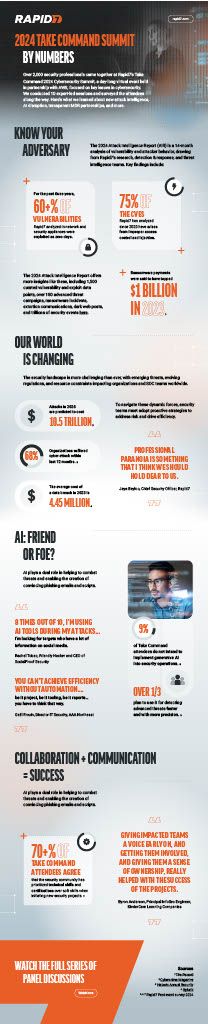
The 2024 Take Command Summit, held virtually in partnership with AWS, united over 2,000 security professionals to delve into critical cybersecurity issues. Our infographic captures the essence of the summit, showcasing expert insights from 10 sessions on topics like new attack intelligence, AI disruptions, and transparent MDR partnerships.

We also highlight attendees’ thoughts on various subject matters, from AI’s role in security to the importance of collaboration and communication. Check out the key highlights, stand out stats, and engaging stories can inform your security strategies and keep your organization ahead of emerging threats.

Unveiling Key Insights from the 2024 Take Command Summit

Takeaways From The Take Command Summit: Unlocking ROI in Security

Post Syndicated from Emma Burdett original https://blog.rapid7.com/2024/07/10/takeaways-from-the-take-command-summit-unlocking-roi-in-security/

Takeaways From The Take Command Summit: Unlocking ROI in Security

Rapid7 CMO Cindy Stanton hosted a discussions with Cindy Stanton, Byron Anderson, Principal InfoSec Engineer, KinderCare Learning Companies and Gaël Frouin Director IT Security, AAA Northeast to talk strategies for measuring team performance and demonstrating ROI in cybersecurity at Rapid7’s recent Take Command summit. The panelists highlighted the importance of clear objectives, noting many security projects fail due to poorly defined goals.

Our post summit survey of attendees showed that 56% of respondents identified limited resources as the biggest inhibitor to measuring security program success. Overcoming these challenges with clear goals, regular metrics, and automation can significantly enhance cybersecurity efforts.

Key Takeaways:

  1. Regular Communication and Metrics: Organizations prioritizing regular communication and metrics-driven approaches are much more likely to achieve positive outcomes.
  2. Risk Metrics as a Common Language: Byron Anderson emphasized using risk metrics to facilitate conversations about decommissioning outdated systems, reducing risk, and ensuring accountability.
  3. Automation and Integration: Gaël Frouin stressed the necessity of automation for efficiency and achieving the best ROI, urging security professionals to consider automation in every process.

“Giving impacted teams a voice early on, and getting them involved, and giving them a sense of ownership, really helped with the success of the projects.” – Byron Anderson, Principal InfoSec Engineer, KinderCare Learning Companies

To dive deeper into these insights and actionable tactics, watch the full video of the session.

Takeaways From The Take Command Summit: Navigating Modern SOC Challenges

Post Syndicated from Emma Burdett original https://blog.rapid7.com/2024/07/02/takeaways-from-the-take-command-summit-navigating-modern-soc-challenges/

Takeaways From The Take Command Summit: Navigating Modern SOC Challenges

At our recent Take Command summit, experts delved into the pressing challenges faced by SOC teams. With 2,365 more data breaches in 2023 than in 2022 (74% of which were a direct result of cyber attacks), the need for robust security operations has never been greater.

Key takeaways from the 25 minute panel:

  1. Emphasizing Proactive Defense: SOC teams must prioritize proactive threat detection and intelligence gathering to stay ahead of evolving cyber threats.
  2. Enhancing Response Times: Reducing incident response times is crucial for mitigating the impact of security breaches and minimizing damage.
  3. Leveraging Advanced Tools: Utilizing advanced threat detection technologies, such as AI and machine learning, can significantly improve the ability to identify and respond to sophisticated attacks.

Key Quote:

“The increasing use of native tools by threat actors means they can stay hidden longer, complicating our detection efforts.”  – Lonnie Best, Detection & Response Services Manager, Rapid7.

The evolving threat landscape requires SOC teams to enhance detection capabilities and streamline operations. To dive deeper into these insights, click through to watch the full discussion.

Takeaways From The Take Command Summit: Unprecedented Threat Landscape

Post Syndicated from Emma Burdett original https://blog.rapid7.com/2024/06/26/takeaways-from-the-take-command-summit-unprecedented-threat-landscape/

Takeaways From The Take Command Summit: Unprecedented Threat Landscape

The Rapid7 Take Command summit unveiled crucial findings from the 2024 Attack Intelligence Report, offering invaluable insights for cybersecurity professionals navigating today’s complex threat landscape.

Key takeaways from the 30 minute panel:

  1. Rise of Zero-Day Exploits: 53% of mass compromise events in 2023 and early 2024 began with zero-day exploits. This highlights the urgent need for improved patch management and proactive defense strategies.
  2. Network Edge Vulnerabilities: Over a third of the vulnerabilities leading to mass compromise events were in network edge technologies, such as firewalls and VPNs, emphasizing the importance of securing these critical points.
  3. Ransomware on the Rise: Rapid7 tracked over 5,600 ransomware incidents in 2023 and early 2024, with ransomware payouts exceeding $1 billion. The sheer volume underscores the importance of robust defenses and incident response plans.

Key Quote:

“Our research shows that more than 40% of incident responses in 2023 stemmed from remote remote access exploits without multifactor authentication. Basic security components are still crucial in making attacks harder.” – Caitlin Condon, Director Vulnerability Intelligence, Rapid7

The 2024 Attack Intelligence Report provides deep insights into the evolving threat landscape, highlighting the rise of zero-day exploits, the critical vulnerabilities in network edge technologies, and the rampant increase in ransomware incidents, you can view it here.

For a deeper dive into these findings, click through to watch the full video and stay ahead of attackers.

Takeaways From The Take Command Summit: Understanding Modern Cyber Attacks

Post Syndicated from Emma Burdett original https://blog.rapid7.com/2024/06/25/takeaways-from-the-take-command-summit-understanding-modern-cyber-attacks/

Takeaways From The Take Command Summit: Understanding Modern Cyber Attacks

In today’s cybersecurity landscape, staying ahead of evolving threats is crucial. The State of Security Panel from our Take Command summit held May 21st delved into how artificial intelligence (AI) is reshaping cyber attacks and defenses.

The discussion highlighted the dual role of AI in cybersecurity, presenting both challenges and solutions. To learn more about these insights and protect your organization from sophisticated threats, watch the full video.

Key takeaways from the 30 minute panel:

  1. AI-Enhanced Attacks: Friendly Hacker and CEO of SocialProof Security Rachel Tobac highlighted the growing use of AI by attackers, stating, “Eight times out of ten, I’m using AI tools during my attacks.” AI helps create convincing phishing emails and scripts, making attacks more efficient and scalable.
  2. Voice Cloning and Deepfakes: Attackers are now using AI for voice cloning and deep fakes, making it vital for organizations to verify identities through multiple communication channels. Rachel continued, “We can even do a deep fake, live during a Teams or Zoom call to trick somebody.”
  3. Cloud Vulnerabilities: Rapid7’s Chief Security Officer Jaya Baloo pointed out that roughly  45% of data breaches are due to cloud issues, caused by misconfigurations and vulnerabilities, making cloud security a critical focus.

“Professional paranoia is something that I think we should hold dear to us,” Jaya Bayloo, Chief Security Officer, Rapid7

Watch the full video here.

Takeaways From The Take Command Summit: Understanding Modern Cyber Attacks

Post Syndicated from Emma Burdett original https://blog.rapid7.com/2024/06/21/takeaways-from-the-take-command-summit-understanding-modern-cyber-attacks/

Takeaways From The Take Command Summit: Understanding Modern Cyber Attacks

In today’s cybersecurity landscape, staying ahead of evolving threats is crucial. The State of Security Panel from our Take Command summit held May 21st delved into how artificial intelligence (AI) is reshaping cyber attacks and defenses.

The discussion highlighted the dual role of AI in cybersecurity, presenting both challenges and solutions. To learn more about these insights and protect your organization from sophisticated threats, watch the full video.

Key takeaways from the 30 minute panel:

  1. AI-Enhanced Attacks: Friendly Hacker and CEO of SocialProof Security Rachel Tobac highlighted the growing use of AI by attackers, stating, “Eight times out of ten, I’m using AI tools during my attacks.” AI helps create convincing phishing emails and scripts, making attacks more efficient and scalable.
  2. Voice Cloning and Deepfakes: Attackers are now using AI for voice cloning and deep fakes, making it vital for organizations to verify identities through multiple communication channels. Rachel continued, “We can even do a deep fake, live during a Teams or Zoom call to trick somebody.”
  3. Cloud Vulnerabilities: Rapid7’s Chief Security Officer Jaya Baloo pointed out that roughly  45% of data breaches are due to cloud issues, caused by misconfigurations and vulnerabilities, making cloud security a critical focus.

“Professional paranoia is something that I think we should hold dear to us,” – Jaya Bayloo, Chief Security Officer, Rapid7

Watch the full video here.