Post Syndicated from Talks at Google original https://www.youtube.com/watch?v=mxPgcNbSacI
Smart Home Chores: Make Chores Fun for Kids & Get Family Rewards! #shorts
Post Syndicated from BeardedTinker original https://www.youtube.com/shorts/76ZDkh8dGz8
Security updates for Monday
Post Syndicated from jzb original https://lwn.net/Articles/1048817/
Security updates have been issued by AlmaLinux (bind9.18, cups, gimp, ipa, kernel, libssh, mingw-expat, openssl, pcs, sssd, tigervnc, and valkey), Debian (gnome-shell-extension-gsconnect, mistral-dashboard, pagure, python-mistralclient, pytorch, qtbase-opensource-src, sogo, tryton-server, and unbound), Fedora (cef, drupal7, glib2, linux-firmware, migrate, pack, pgadmin4, rnp, and unbound), Slackware (libxslt), SUSE (cpp-httplib, curl, glib2, grub2, kernel, libcoap-devel, libcryptopp, libwireshark19, postgresql15, and postgresql17), and Ubuntu (edk2).
Three stable kernels for Monday
Post Syndicated from jzb original https://lwn.net/Articles/1048755/
Greg Kroah-Hartman has announced the release of the 6.17.10, 6.12.60, and 6.6.118 stable kernels. As usual, each
contains a number of important fixes throughout the tree. Users are
advised to upgrade.
Cool: A History of Mint
Post Syndicated from The History Guy: History Deserves to Be Remembered original https://www.youtube.com/watch?v=nR_1E6nFhtE
Banning VPNs
Post Syndicated from Bruce Schneier original https://www.schneier.com/blog/archives/2025/12/banning-vpns.html
This is crazy. Lawmakers in several US states are contemplating banning VPNs, because…think of the children!
As of this writing, Wisconsin lawmakers are escalating their war on privacy by targeting VPNs in the name of “protecting children” in A.B. 105/S.B. 130. It’s an age verification bill that requires all websites distributing material that could conceivably be deemed “sexual content” to both implement an age verification system and also to block the access of users connected via VPN. The bill seeks to broadly expand the definition of materials that are “harmful to minors” beyond the type of speech that states can prohibit minors from accessing potentially encompassing things like depictions and discussions of human anatomy, sexuality, and reproduction.
The EFF link explains why this is a terrible idea.
Comic for 2025.12.01 – Casper 2
Post Syndicated from Explosm.net original https://explosm.net/comics/casper-2
New Cyanide and Happiness Comic
Why Replicate is joining Cloudflare
Post Syndicated from Andreas Jansson original https://blog.cloudflare.com/why-replicate-joining-cloudflare/
We’re happy to announce that as of today Replicate is officially part of Cloudflare.
When we started Replicate in 2019, OpenAI had just open sourced GPT-2, and few people outside of the machine learning community paid much attention to AI. But for those of us in the field, it felt like something big was about to happen. Remarkable models were being created in academic labs, but you needed a metaphorical lab coat to be able to run them.
We made it our mission to get research models out of the lab into the hands of developers. We wanted programmers to creatively bend and twist these models into products that the researchers would never have thought of.
We approached this as a tooling problem. Just like tools like Heroku made it possible to run websites without managing web servers, we wanted to build tools for running models without having to understand backpropagation or deal with CUDA errors.
The first tool we built was Cog: a standard packaging format for machine learning models. Then we built Replicate as the platform to run Cog models as API endpoints in the cloud. We abstracted away both the low-level machine learning, and the complicated GPU cluster management you need to run inference at scale.
It turns out the timing was just right. When Stable Diffusion was released in 2022 we had mature infrastructure that could handle the massive developer interest in running these models. A ton of fantastic apps and products were built on Replicate, apps that often ran a single model packaged in a slick UI to solve a particular use case.
Since then, AI Engineering has matured into a serious craft. AI apps are no longer just about running models. The modern AI stack has model inference, but also microservices, content delivery, object storage, caching, databases, telemetry, etc. We see many of our customers building complex heterogenous stacks where the Replicate models are one part of a higher-order system across several platforms.
This is why we’re joining Cloudflare. Replicate has the tools and primitives for running models. Cloudflare has the best network, Workers, R2, Durable Objects, and all the other primitives you need to build a full AI stack.
The AI stack lives entirely on the network. Models run on data center GPUs and are glued together by small cloud functions that call out to vector databases, fetch objects from blob storage, call MCP servers, etc. “The network is the computer” has never been more true.
At Cloudflare, we’ll now be able to build the AI infrastructure layer we have dreamed of since we started. We’ll be able to do things like run fast models on the edge, run model pipelines on instantly-booting Workers, stream model inputs and outputs with WebRTC, etc.
We’re proud of what we’ve built at Replicate. We were the first generative AI serving platform, and we defined the abstractions and design patterns that most of our peers have adopted. We’ve grown a wonderful community of builders and researchers around our product.
Top announcements of AWS re:Invent 2025
Post Syndicated from AWS News Blog Team original https://aws.amazon.com/blogs/aws/top-announcements-of-aws-reinvent-2025/
 We’re rounding up the most exciting and impactful announcements from AWS re:Invent 2025, which takes place November 30-December 4 in Las Vegas. This guide highlights the innovations that will help you build, scale, and transform your business in the cloud.
We’ll update this roundup throughout re:Invent with our curation of the major announcements from each keynote session and more. To see the complete list of all AWS launches, visit What’s New with AWS.
(This post was updated Nov. 30, 2025.)
Analytics
AWS Clean Rooms launches privacy-enhancing dataset generation for ML model training
Train ML models on sensitive collaborative data by generating synthetic datasets that preserve statistical patterns while protecting individual privacy through configurable noise levels and protection against re-identification.
Compute
Introducing AWS Lambda Managed Instances: Serverless simplicity with EC2 flexibility
Run Lambda functions on EC2 compute while maintaining serverless simplicity—enabling access to specialized hardware and cost optimizations through EC2 pricing models, with AWS handling all infrastructure management.
Containers
Announcing Amazon EKS Capabilities for workload orchestration and cloud resource management
Streamline Kubernetes development with fully managed platform capabilities that handle workload orchestration and cloud resource management, eliminating infrastructure maintenance while providing enterprise-grade reliability and security.
Networking & Content Delivery
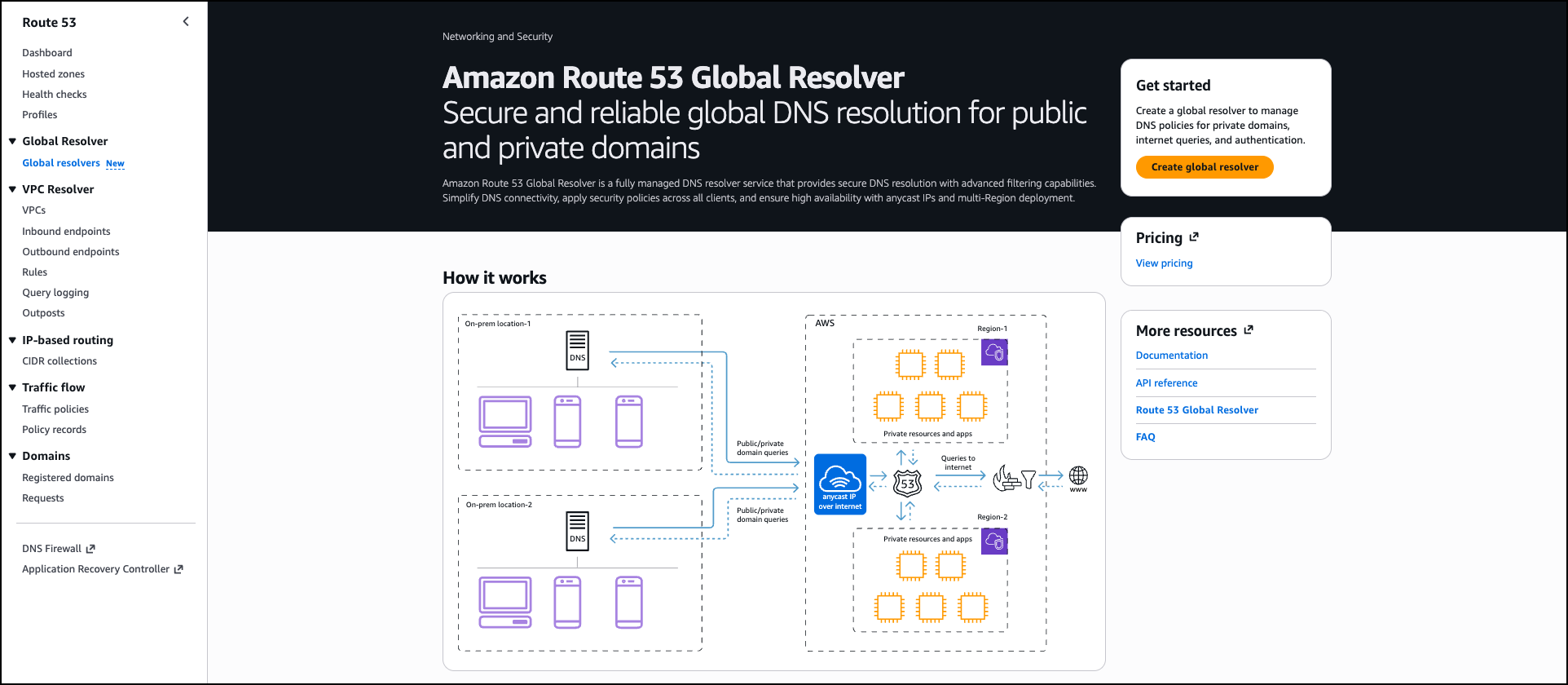
Introducing Amazon Route 53 Global Resolver for secure anycast DNS resolution (preview)
Simplify hybrid DNS management with a unified service that resolves public and private domains globally through secure, anycast-based resolution while reducing operational overhead and maintaining consistent security controls.
Partner Network
AWS Partner Central now available in AWS Management Console
Access Partner Central directly through the AWS Console to streamline your journey from customer to Partner—manage solutions, opportunities, and marketplace listings in one unified interface with enterprise-grade security.
Security, Identity, & Compliance
Simplify IAM policy creation with IAM Policy Autopilot, a new open source MCP server for builders
Speed up AWS development with an open source tool that analyzes your code to generate valid IAM policies, providing AI coding assistants with up-to-date AWS service knowledge and reliable permission recommendations.
Introducing Amazon Route 53 Global Resolver for secure anycast DNS resolution (preview)
Post Syndicated from Esra Kayabali original https://aws.amazon.com/blogs/aws/introducing-amazon-route-53-global-resolver-for-secure-anycast-dns-resolution-preview/
Today, we’re announcing Amazon Route 53 Global Resolver, a new Amazon Route 53 service that provides secure and reliable DNS resolution globally for queries from anywhere (preview). You can use Global Resolver to resolve DNS queries to public domains on the internet and private domains associated with Route 53 private hosted zones. Route 53 Global Resolver offers network administrators a unified solution to resolve queries from authenticated clients and sources in on-premises data centers, branch offices, and remote locations through globally distributed anycast IP addresses. This service includes built-in security controls including DNS traffic filtering, support for encrypted queries, and centralized logging to help organizations reduce operational overhead while maintaining compliance with security requirements.
Organizations with hybrid deployments face operational complexity when managing DNS resolution across distributed environments. Resolving public internet domains and private application domains often requires maintaining split DNS infrastructure, which increases cost and administrative burden especially when replicating to multiple locations. Network administrators must configure custom forwarding solutions, deploy Route 53 Resolver endpoints for private domain resolution, and implement separate security controls across different locations. Additionally, they must configure and maintain multi-Region failover strategies for Route 53 Resolver endpoints and provide consistent security policy enforcement across all Regions while testing failover scenarios.
Route 53 Global Resolver has key capabilities that address these challenges. The service resolves both public internet domains and Route 53 private hosted zones, eliminating the need for separate split-DNS forwarding. It provides DNS resolution through multiple protocols, including DNS over UDP (Do53), DNS-over-HTTPS (DoH), and DNS-over-TLS (DoT). Each deployment provides a single set of common IPv4 and IPv6 anycast IP addresses that route queries to the nearest AWS Region, reducing latency for distributed client populations.
Route 53 Global Resolver provides integrated security features equivalent to Route 53 Resolver DNS Firewall. Administrators can configure filtering rules using AWS Managed Domain Lists that provide flexible controls with lists classified by DNS threats (malware, spam, phishing) or web content (adult sites, gambling, social networking) that might not be safe for work or create custom domain lists by importing domains from a file. Advanced threat protection detects and blocks domain generation algorithm (DGA) patterns and DNS tunneling attempts. For encrypted DNS traffic, Route 53 Global Resolver supports DoH and DoT protocols to protect queries from unauthorized access during transit.
Route 53 Global Resolver only accepts traffic from known clients that need to authenticate with the Resolver. For Do53, DoT, and DoH connections, administrators can configure IP and CIDR allowlists. For DoH and DoT connections, token-based authentication provides granular access control with customizable expiration periods and revocation capabilities. Administrators can assign tokens to specific client groups or individual devices based on organizational requirements.
Route 53 Global Resolver supports DNSSEC validation to verify the authenticity and integrity of DNS responses from public nameservers. It also includes EDNS Client Subnet support, which forwards client subnet information to enable more accurate geographic-based DNS responses from content delivery networks.
Getting started with Route 53 Global Resolver
This walkthrough shows how to configure Route 53 Global Resolver for an organization with offices on the US East and West coasts that needs to resolve both public domains and private applications hosted in Route 53 private hosted zones. To configure Route 53 Global Resolver, go to the AWS Management Console, choose Global resolvers from the navigation pane, and choose Create global resolver.
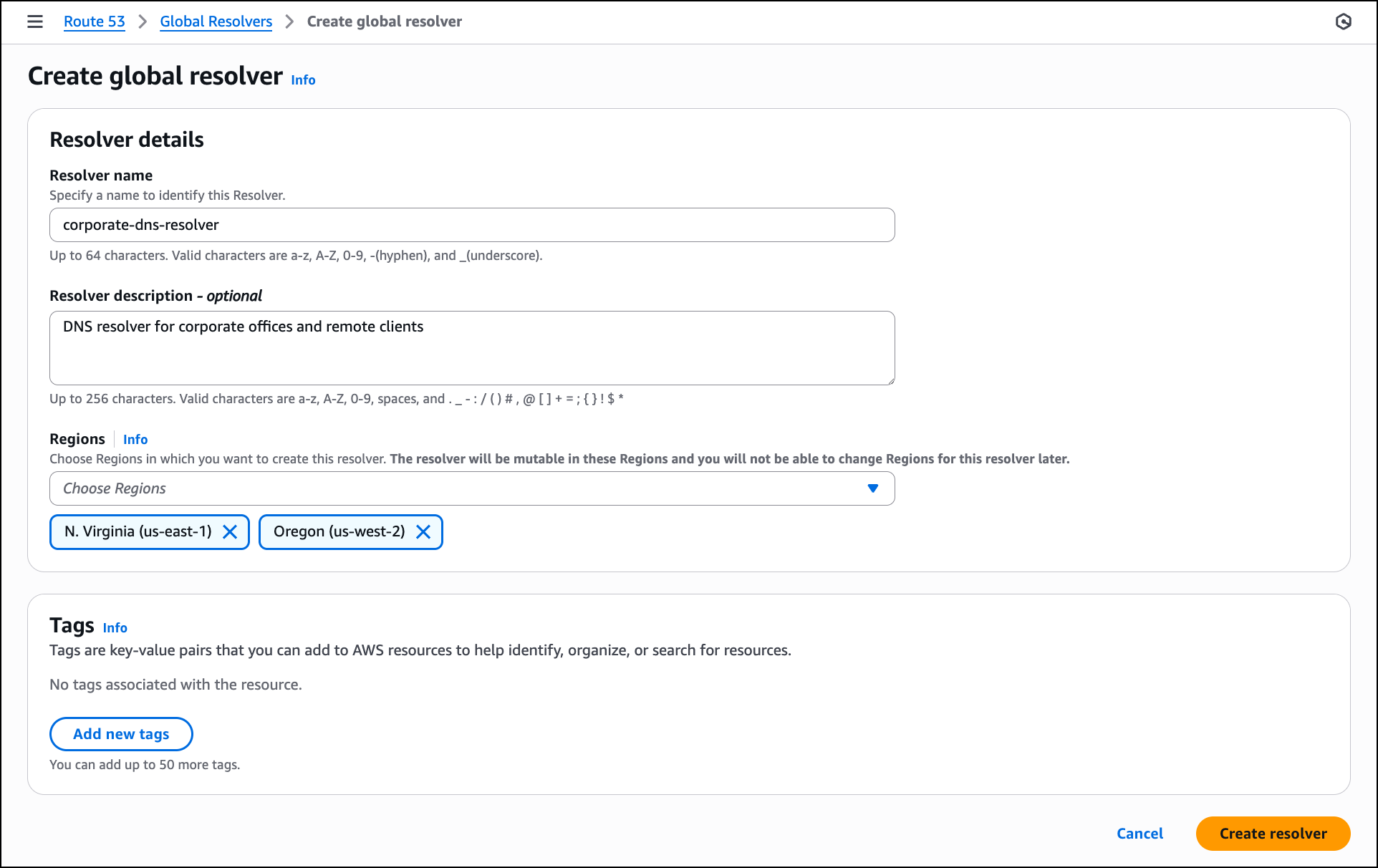
In the Resolver details section, enter a Resolver name such as corporate-dns-resolver. Add an optional description like DNS resolver for corporate offices and remote clients. In the Regions section, choose the AWS Regions where you want the resolver to operate, such as US East (N. Virginia) and US West (Oregon). The anycast architecture routes DNS queries from your clients to the nearest selected Region.
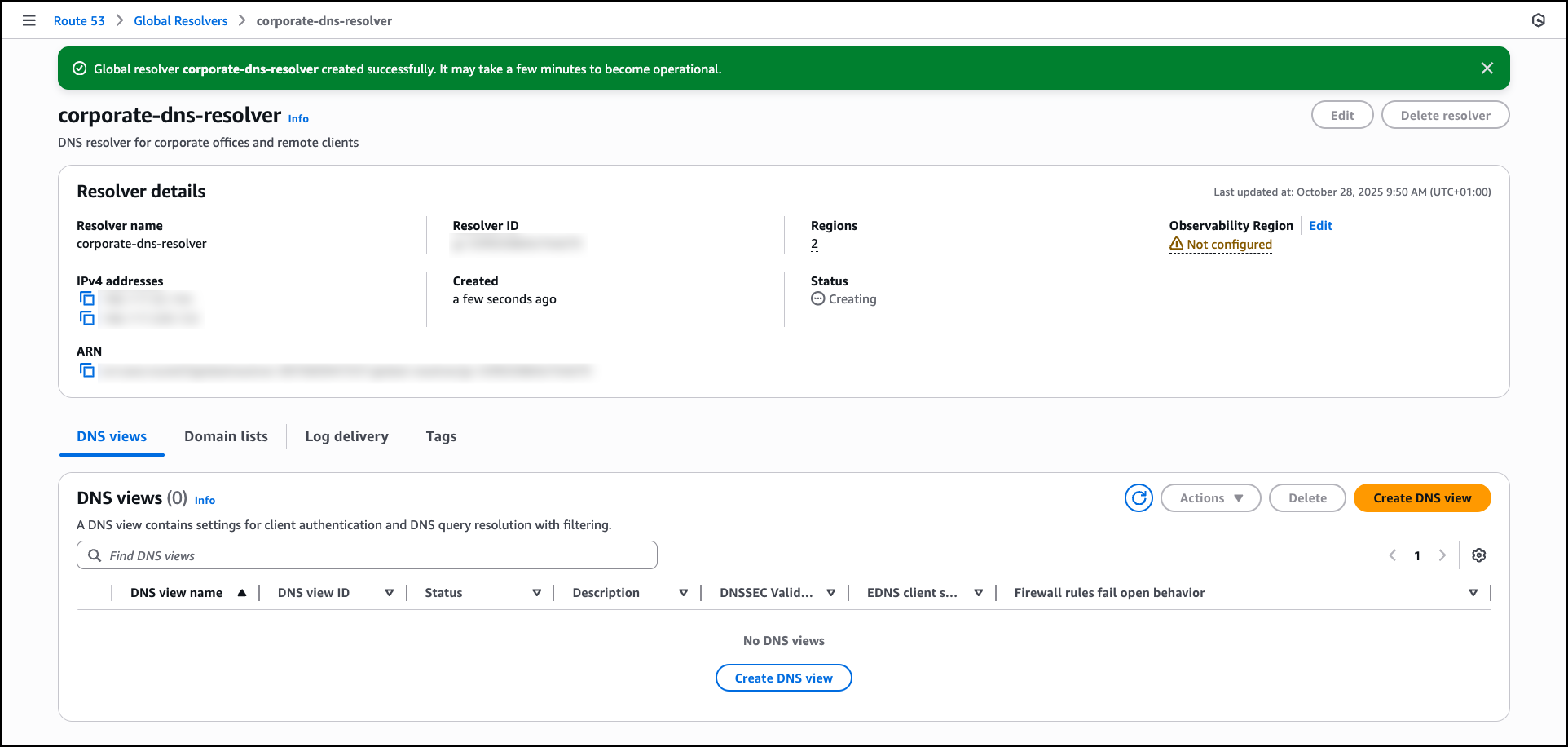
After the resolver is created, the console displays the resolver details, including the anycast IPv4 and IPv6 addresses that you will use for DNS queries. You can proceed to create a DNS view by choosing Create DNS view to configure client authentication and DNS query resolution settings.
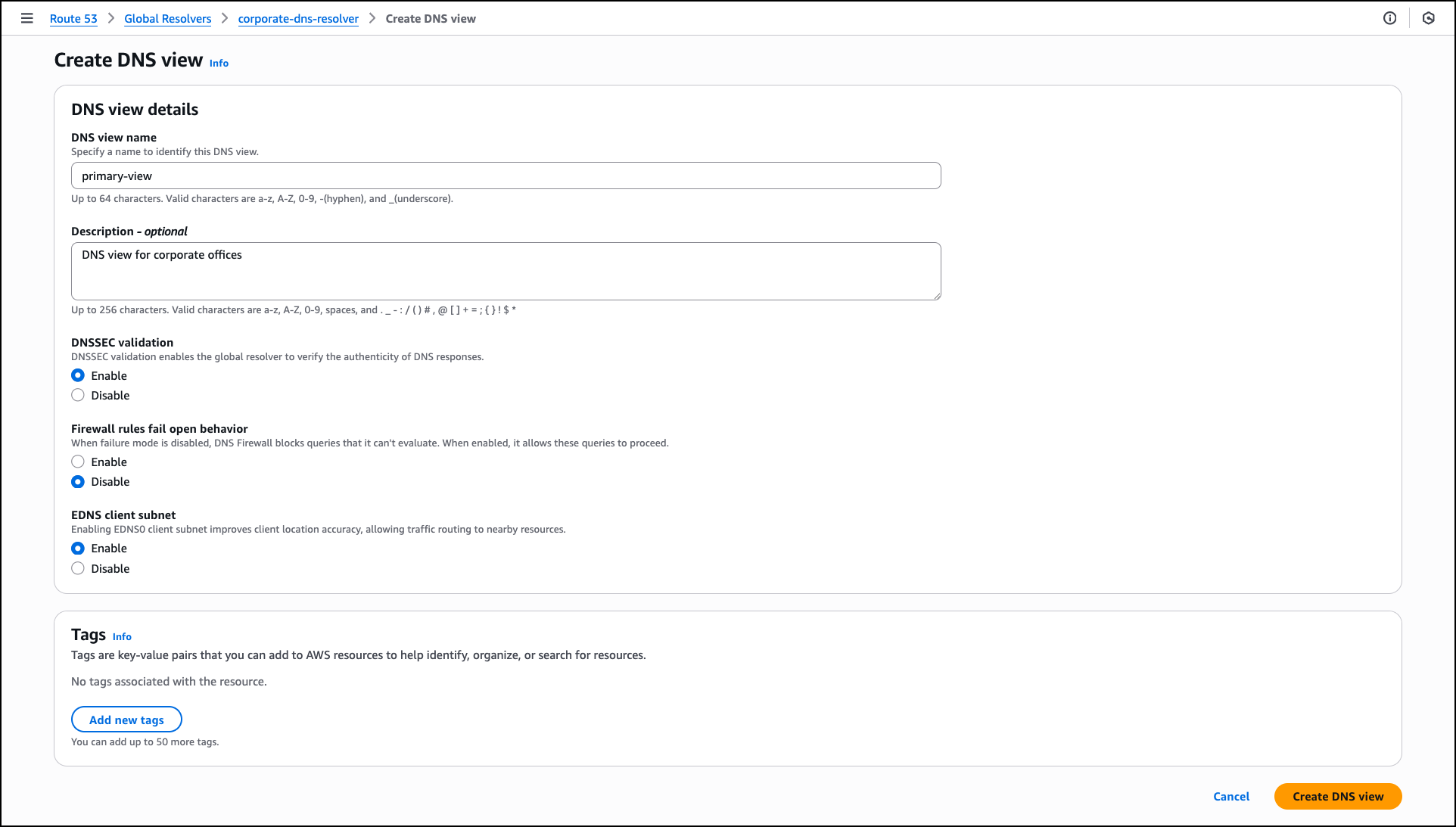
In the Create DNS view section, enter a DNS view name such as primary-view and optionally add a Description like DNS view for corporate offices. A DNS view helps you create different logical groupings for your clients and sources, and determine the DNS resolution for those groups. This helps you maintain different DNS filtering rules and private hosted zone resolution policies for different clients in your organization.
For DNSSEC validation, choose Enable to verify the authenticity of DNS responses from public DNS servers. For Firewall rules fail open behavior, choose Disable to block DNS queries when firewall rules can’t be evaluated, which provides additional security. For EDNS client subnet, keep Enable selected to forward client location information to DNS servers, which allows content delivery networks to provide more accurate geographic responses. DNS view creation might take a few minutes to become operational.
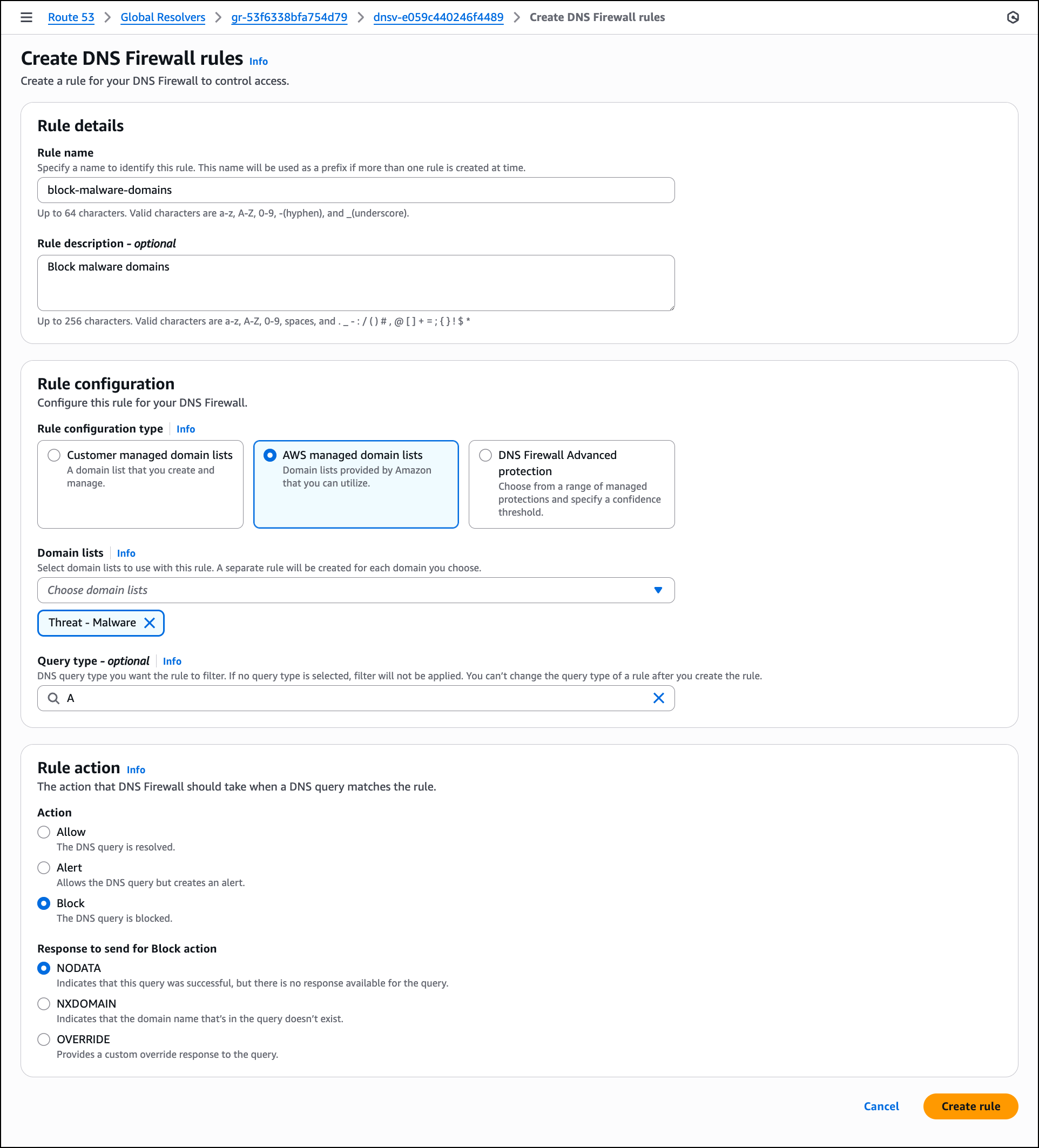
After the DNS view is created and operational, configure DNS Firewall rules to filter network traffic by choosing Create rule. In the Create DNS Firewall rules section, enter a Rule name such as block-malware-domains and optionally add a description. For Rule configuration type, you can choose Customer managed domain lists, AWS managed domain lists provided by AWS or DNS Firewall Advanced protection.
For this walkthrough, choose AWS managed domain lists. In the Domain lists dropdown, choose one or more AWS managed lists such as Threat – Malware to block known malicious domains. You can leave Query type empty to apply the rule to all DNS query types. In this example, choose A to apply this rule only to IPv4 address queries. In the Rule action section, select Block to prevent DNS resolution for domains that match the selected lists. For Response to send for Block action, keep NODATA selected to indicate that the query was successful but no response is available, then choose Create rules.
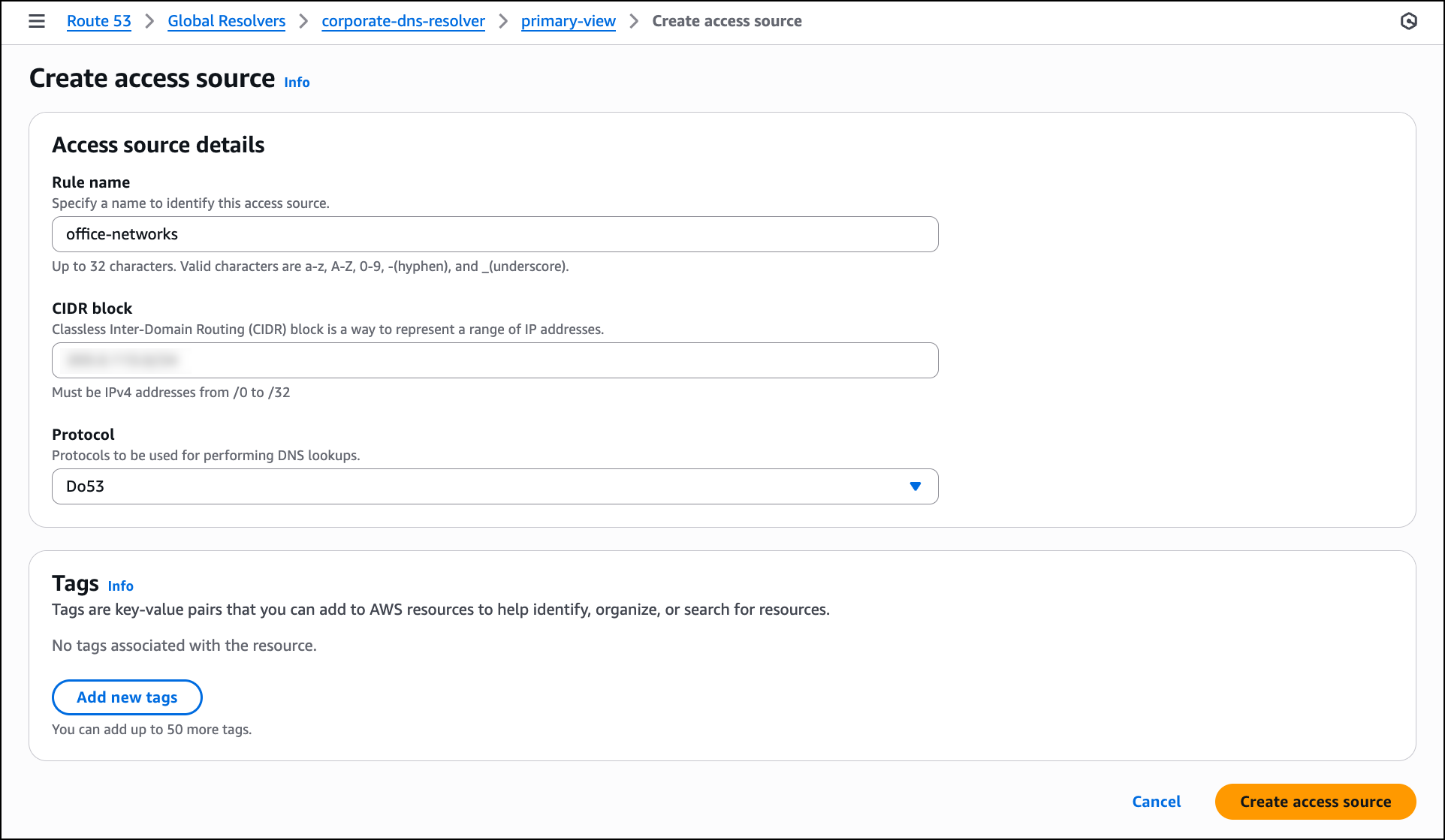
The next step is to configure access sources to specify which IP addresses or CIDR blocks are allowed to send DNS queries to the resolver. Navigate to the Access sources tab in the DNS view and then choose Create access source.
In the Access source details section, enter a Rule name such as office-networks to identify the access source. In the CIDR block field, enter the IP address range for your offices to allow queries from that network. For Protocol, select Do53 for standard DNS queries over UDP or choose DoH or DoT if you want to require encrypted DNS connections from clients. After configuring these settings, choose Create access source to allow the specified network to send DNS queries to the resolver.
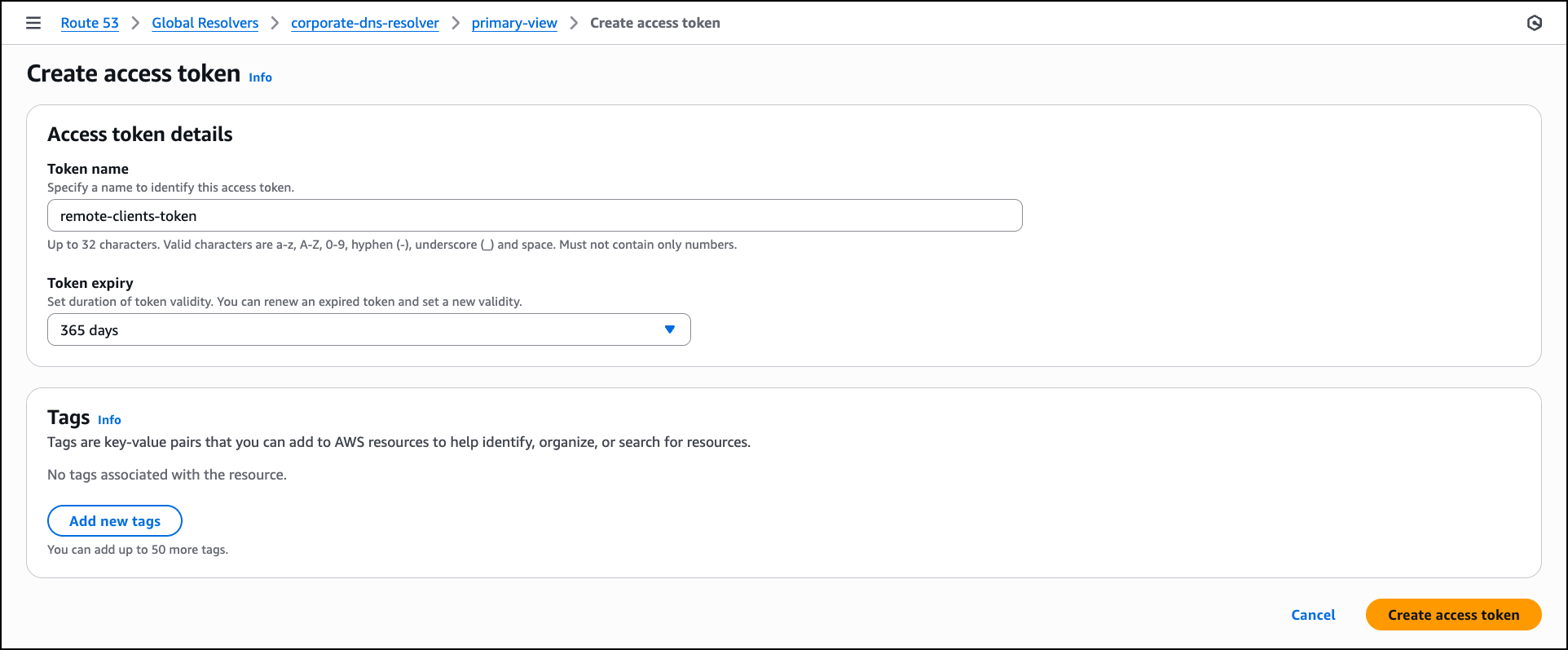
Next, navigate to the Access tokens tab in the DNS view to create token-based authentication for clients and choose Create access token. In the Access token details section, enter a Token name such as remote-clients-token. For Token expiry, select an expiration period from the dropdown based on your security requirements, such as 365 days for long-term client access, or choose a shorter duration like 30 days or 90 days for tighter access control. After configuring these settings, choose Create access token to generate the token, which clients can use to authenticate DoH and DoT connections to the resolver.
After the access token is created, navigate to the Private hosted zones tab in the DNS view to associate Route 53 private hosted zones with the DNS view so that the resolver can resolve queries for your private application domains. Choose Associate private hosted zone and in the Private hosted zones section, select a private hosted zone from the list that you want the resolver to handle. After selecting the zone, choose Associate to enable the resolver to respond to DNS queries for these private domains from your configured access sources.
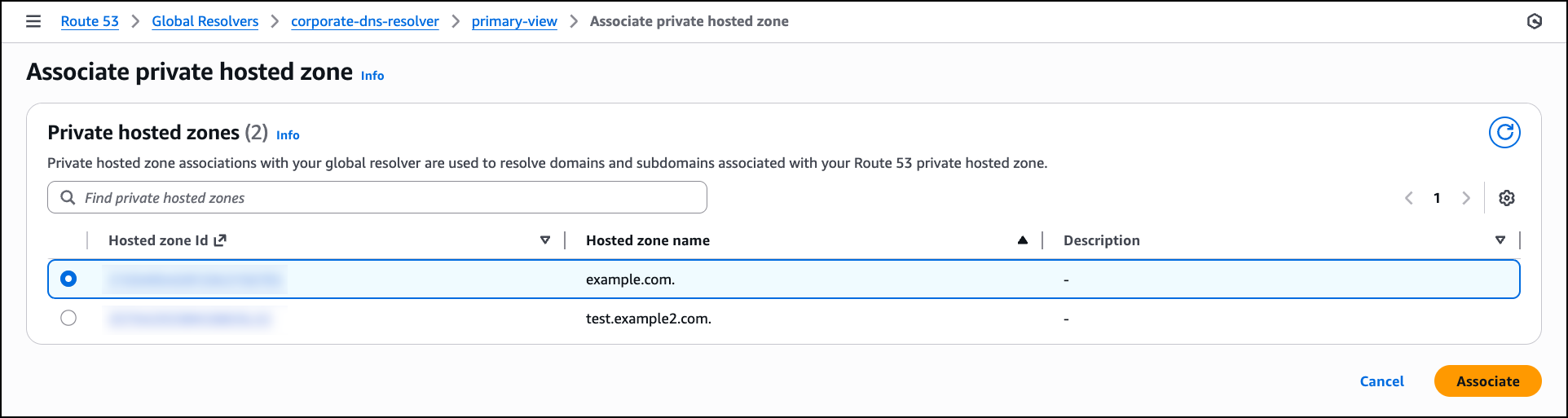
With the DNS view configured, firewall rules created, access sources and tokens defined, and private hosted zones associated, the Route 53 Global Resolver setup is complete and ready to handle DNS queries from your configured clients.
After creating your Route 53 Global Resolver, you need to configure your DNS clients to send queries to the resolver’s anycast IP addresses. The configuration method depends on the access control you configured in your DNS view:
- For IP-based access sources (CIDR blocks) – Configure your source clients to point DNS traffic to the Route 53 Global Resolver anycast IP addresses provided in the resolver details. Global Resolver will only allow access from allowlisted IPs that you have specified in your access sources. You can also associate the access sources to different DNS views to provide more granular DNS resolution views for different sets of IPs.
- For access token–based authentication – Deploy the tokens on your clients to authenticate DoH and DoT connections with Route 53 Global Resolver. You must also configure your clients to point the DNS traffic to the Route 53 Global Resolver anycast IP addresses provided in the resolver details.
For detailed configuration instructions for your specific operating system and protocol, refer to the technical documentation.
Additional things to know
We’re renaming the existing Route 53 Resolver to Route 53 VPC Resolver. This naming change clarifies the architectural distinction between the two services. VPC Resolver operates Regionally within your VPCs to provide DNS resolution for resources in your Amazon VPC environment. VPC Resolver continues to support inbound and outbound resolver endpoints for hybrid DNS architectures within specific AWS Regions.
Route 53 Global Resolver complements Route 53 VPC Resolver by providing internet-reachable, global and private DNS resolution for on-premises and remote clients without requiring VPC deployment or private connections.
Existing VPC Resolver configurations remain unchanged and continue to function as configured. The renaming affects the service name in the AWS Management Console and documentation, but API operation names remain unchanged. If your architecture requires DNS resolution for resources within your VPCs, continue using VPC Resolver.
Join the preview
Route 53 Global Resolver reduces operational overhead by providing unified DNS resolution for public and private domains through a single managed service. The global anycast architecture improves reliability and reduces latency for distributed clients. Integrated security controls and centralized logging help organizations maintain consistent security policies across all locations while meeting compliance requirements.
To learn more about Amazon Route 53 Global Resolver, visit the Amazon Route 53 documentation.
You can start using Route 53 Global Resolver through the AWS Management Console in US East (N. Virginia), US East (Ohio), US West (N. California), US West (Oregon), Europe (Frankfurt), Europe (Ireland), Europe (London), Asia Pacific (Mumbai), Asia Pacific (Singapore), Asia Pacific (Tokyo), and Asia Pacific (Sydney) Regions.
AWS Clean Rooms launches privacy-enhancing synthetic dataset generation for ML model training
Post Syndicated from Micah Walter original https://aws.amazon.com/blogs/aws/aws-clean-rooms-launches-privacy-enhancing-synthetic-dataset-generation-for-ml-model-training/
Today, we’re announcing privacy-enhancing synthetic dataset generation for AWS Clean Rooms, a new capability that organizations and their partners can use to generate privacy-enhancing synthetic datasets from their collective data to train regression and classification machine learning (ML) models. You can use this feature to generate synthetic training datasets that preserve the statistical patterns of the original data, without the model having access to original records, opening new opportunities for model training that were previously not possible due to privacy concerns.
When building ML models, data scientists and analysts typically face a fundamental tension between data utility and privacy protection. Access to high-quality, granular data is essential for training accurate models that can recognize trends, personalize experiences, and drive business outcomes. However, using granular data such as user-level event data from multiple parties raises significant privacy concerns and compliance challenges. Organizations want to answer questions like, “What characteristics indicate a high-probability customer conversion?”, but training on the individual-level signals often conflicts with privacy policies and regulatory requirements.
Privacy-enhancing synthetic dataset generation for custom ML
To address this challenge, we’re introducing privacy-enhancing synthetic dataset generation in AWS Clean Rooms ML, which organizations can use to create synthetic versions of sensitive datasets that can be more securely used for ML model training. This capability uses advanced ML techniques to generate new datasets that maintain the statistical properties of the original data while de-identifying subjects from the original source data.
Traditional anonymization techniques such as masking still carry the risk of re-identifying individuals in a dataset—knowing attributes about a person such as zip code and date of birth can be sufficient to identify them with census data. Privacy-enhancing synthetic dataset generation addresses this risk through a fundamentally different approach. The system trains a model that learns the essential statistical patterns of the original dataset, then generates synthetic records by sampling values from the original dataset and using the model to predict the predicted value column. Rather than merely copying or perturbing the original data, the system uses a model capacity reduction technique to mitigate the risk that the model will memorize information about individuals in the training data. The resulting synthetic dataset has the same schema and statistical characteristics as the original data, making it suitable for training classification and regression models. This approach quantifiably reduces the risk of re-identification.
Organizations using this capability have control over the privacy parameters, including the amount of noise applied and the level of protection against membership inference attacks, where an adversary attempts to determine whether a specific individual’s data was included in the training set. After generating the synthetic dataset, AWS Clean Rooms provides detailed metrics to help customers and their compliance teams understand the quality of the synthetic dataset across two critical dimensions: fidelity to the original data and privacy preservation. The fidelity score uses KL-divergence to measure how similar the synthetic data is to the original dataset, and the privacy score quantifies how likely the dataset is protected from membership inference attacks.
Working with synthetic data in AWS Clean Rooms
Getting started with privacy-enhancing synthetic dataset generation follows the established AWS Clean Rooms ML custom models workflow, with new steps to specify privacy requirements and review quality metrics. Organizations begin by creating configured tables with analysis rules using their preferred data sources, then join or create a collaboration with their partners and associate their tables with that collaboration.
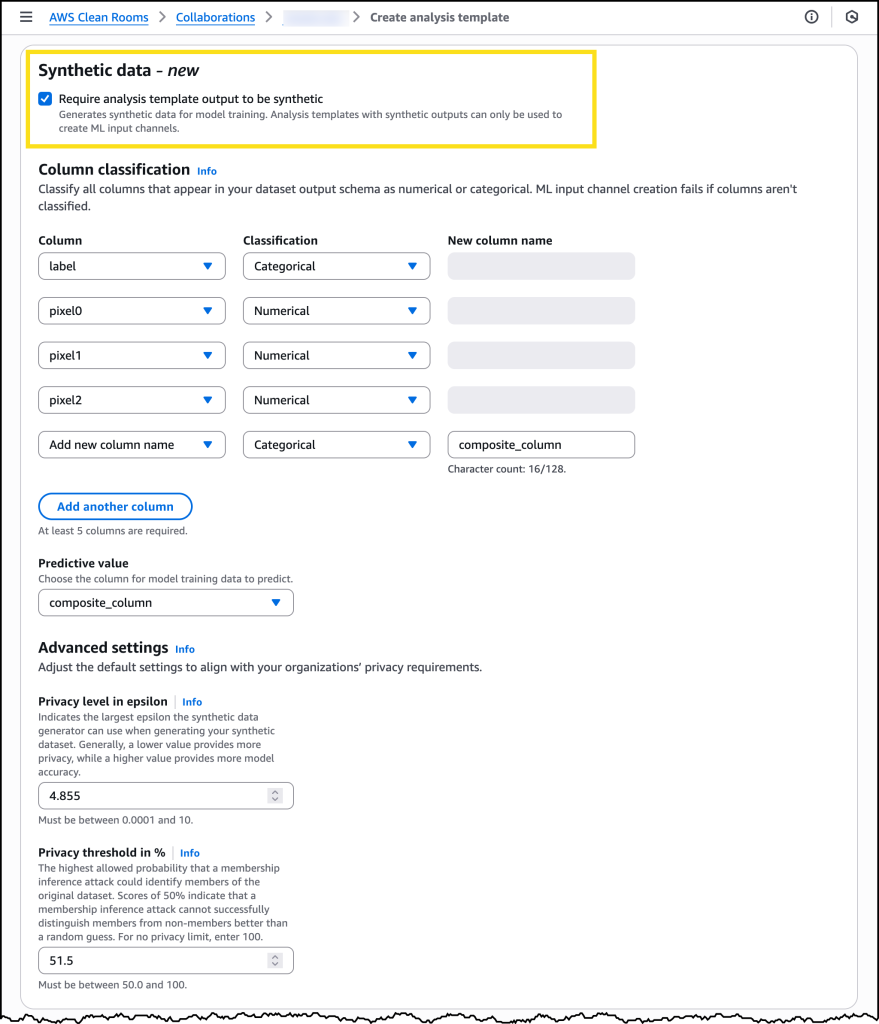
The new capability introduces an enhanced analysis template where data owners define not only the SQL query that creates the dataset but also specify that the resulting dataset must be synthetic. Within this template, organizations classify columns to indicate which column the ML model will predict and which columns contain categorical versus numerical values. Critically, the template also includes privacy thresholds that the generated synthetic data must meet to be made available for training. These include an epsilon value that specifies how much noise must be present in the synthetic data to protect against re-identification, and a minimum protection score against membership inference attacks. Setting these thresholds appropriately requires understanding your organization’s specific privacy and compliance requirements, and we recommend engaging with your legal and compliance teams during this process.
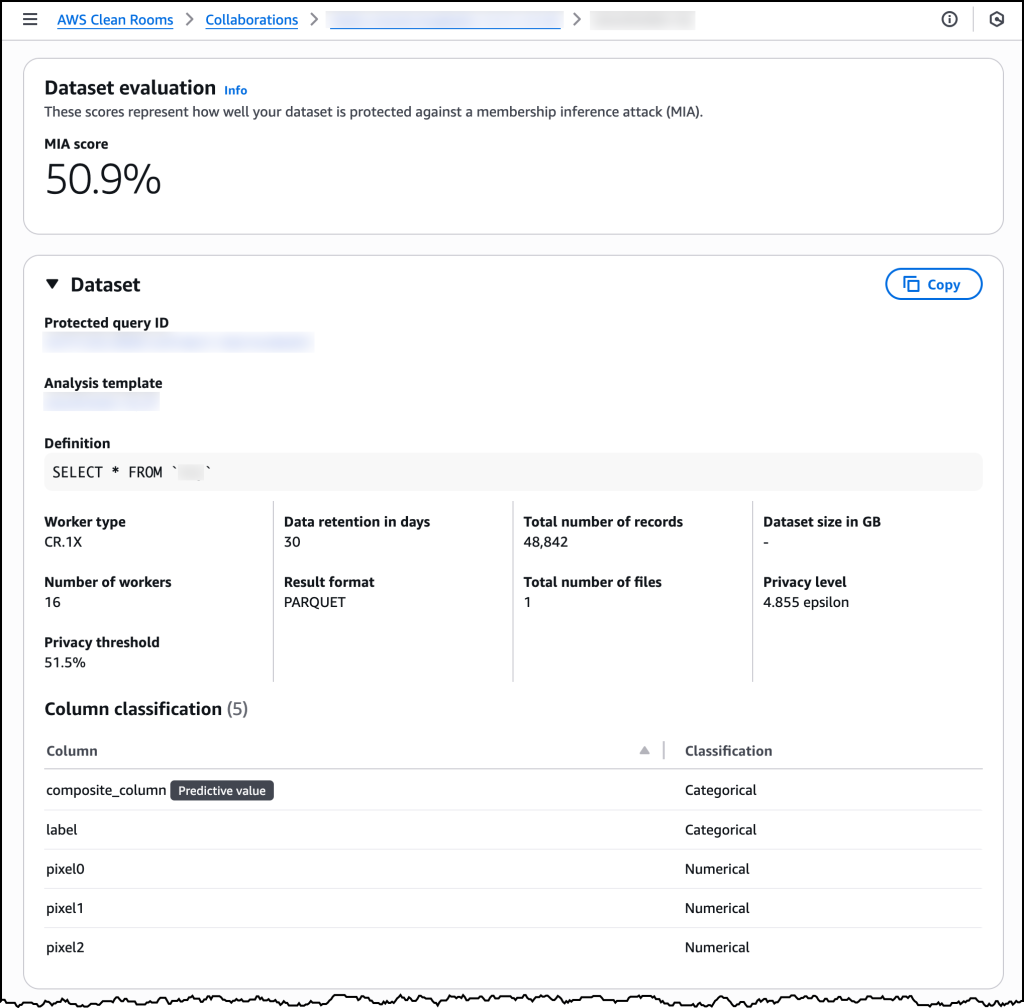
After all data owners review and approve the analysis template, a collaboration member creates a machine learning input channel that references the template. AWS Clean Rooms then begins the synthetic dataset generation process, which typically completes within a few hours depending on the size and complexity of the dataset. If the generated synthetic dataset meets the required privacy thresholds defined in the analysis template, a synthetic machine learning input channel becomes available along with detailed quality metrics. Data scientists can review the actual protection score achieved against a simulated membership inference attack.
Once satisfied with the quality metrics, organizations can proceed to train their ML models using the synthetic dataset within the AWS Clean Rooms collaboration. Depending on the use case, they can export the trained model weights or continue to run inference jobs within the collaboration itself.
Let’s try it out
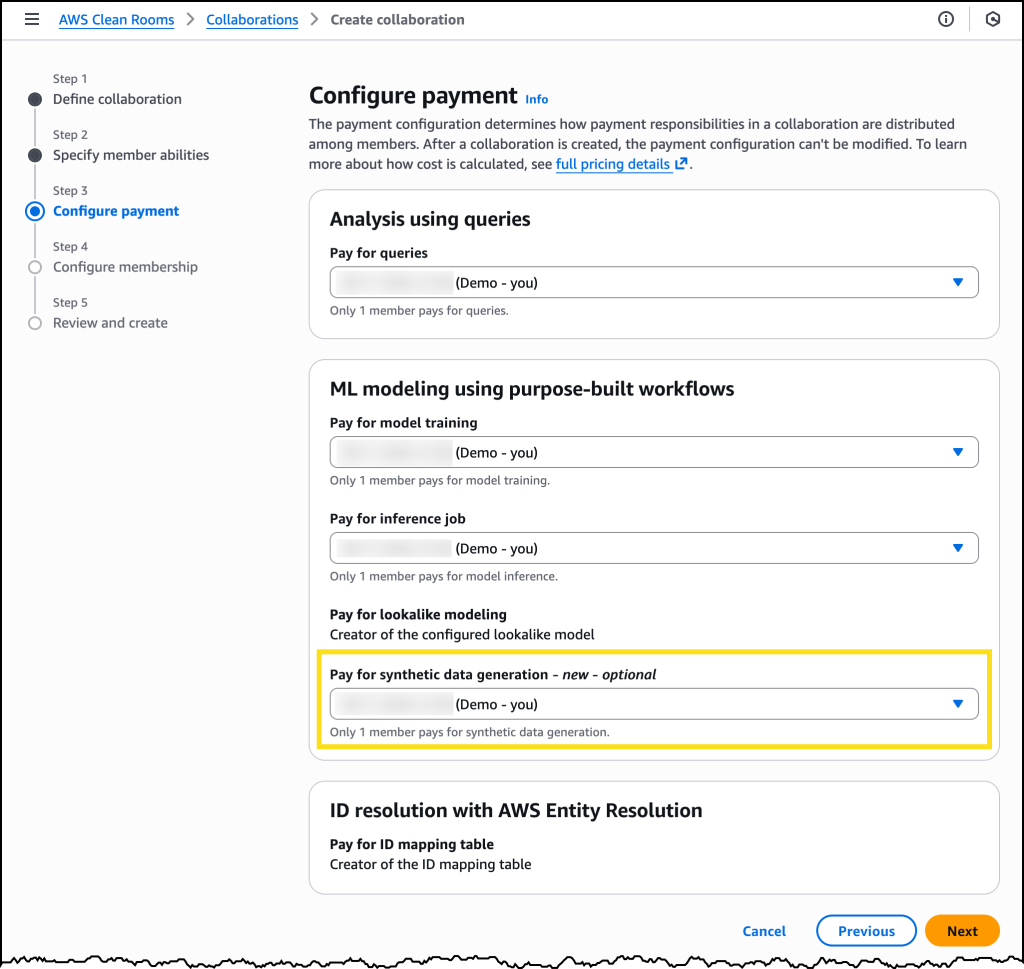
When creating a new AWS Clean Rooms collaboration, I can now set who pays for synthetic dataset generation.
After my Collaboration is configured, I can choose Require analysis template output to be synthetic when creating a new analysis template.
After my synthetic analysis template is ready, I can use it when running protected queries and view all the relevant ML input channel details.
Now available
You can start using privacy-enhancing synthetic dataset generation through AWS Clean Rooms today. The feature is available in all commercial AWS Regions where AWS Clean Rooms is available. Learn more about it in the AWS Clean Rooms documentation.
Privacy-enhancing synthetic dataset generation is billed separately based on usage. You pay only for the compute used to generate your synthetic dataset, charged as Synthetic Data Generation Units (SDGUs). The number of SDGUs varies based on the size and complexity of your original dataset. This fee can be configured as a payer setting, meaning any collaboration member can agree to pay the costs. For more information on pricing, refer to the AWS Clean Rooms pricing page.
The initial release supports training classification and regression models on tabular data. The synthetic datasets work with standard ML frameworks and can be integrated into existing model development pipelines without requiring changes to your workflows.
This capability represents a significant advancement in privacy-enhanced machine learning. Organizations can unlock the value of sensitive user-level data for model training while mitigating the risk that sensitive information about individual users could be leaked. Whether you’re optimizing advertising campaigns, personalizing insurance quotes, or enhancing fraud detection systems, privacy-enhancing synthetic dataset generation makes it possible to train more accurate models through data collaboration while respecting individual privacy.
AWS Partner Central now available in AWS Management Console
Post Syndicated from Sébastien Stormacq original https://aws.amazon.com/blogs/aws/aws-partner-central-now-available-in-aws-management-console/
Today, we’re announcing that AWS Partner Central is now available directly in the AWS Management Console, creating a unified experience that transforms how you engage with AWS as both customers and AWS Partners.
As someone who has worked with countless AWS customers over the years, I’ve observed how organizations evolve in their AWS journey. Many of our most successful Partners began as AWS customers—first using our services to build their own infrastructure and solutions, then expanding to create offerings for others. Seeing this natural progression from customer to Partner, we recognized an opportunity to streamline these traditionally separate experiences into one unified journey.
As AWS evolved, so did the needs of our Partner community. Organizations today operate in multiple capacities: using AWS services for their own infrastructure while simultaneously building and delivering solutions for their customers. Modern businesses need streamlined workflows that support their growth from AWS customer to Partner to AWS Marketplace Seller, with enterprise-grade security features that match how they actually work with AWS today.
A new unified console experience
The integration of AWS Partner Central into the Console represents a fundamental shift in partnership accessibility. For existing AWS customers, such as you, becoming an AWS Partner is now as clear as accessing any other AWS service. The familiar console interface provides direct access to partnership opportunities, program benefits, and AWS Marketplace capabilities without needing separate logins or navigation between different systems.
Getting started as an AWS Partner now takes only a few clicks within your existing console environment. You can discover partnership opportunities, understand program requirements, and begin your Partner journey without leaving the AWS interface you already know and trust.
The console integration creates an intuitive pathway for existing customers to transition into AWS Marketplace Sellers. You can now access AWS Marketplace Seller capabilities alongside your existing AWS services, managing both your infrastructure and AWS Marketplace business from a single interface. Private offer requests and negotiations can be managed directly within AWS Partner Central, and you can manage your AWS Marketplace listings alongside your other AWS activities through streamlined workflows.
Becoming an AWS Partner
The unified console experience provides access to comprehensive partnership benefits designed to accelerate your business growth.
Join the AWS Partner Network (APN) and complete your Partner and AWS Marketplace Seller requirements seamlessly within the same interface. Enroll in Partner Paths that align with your customer solutions to build, market, list, and sell in AWS Marketplace while growing alongside AWS. When you are established, use the Partner programs to differentiate your solution, list in AWS Marketplace to improve your go-to-market discoverability, and build AWS expertise through certifications to drive profitability by capturing new revenue streams. Scale your business by selling or reselling software and professional services in AWS Marketplace, helping you accelerate deals, boost revenue, and expand your customer reach to new geographies, industries, and segments.
Throughout your journey, you can continue using Amazon Q in the console, which provides personalized guidance through AWS Partner Assistant.
Let’s see the new Partner Central console
The new AWS Partner Central is accessible like any other AWS service from the console. Among many new capabilities, it provides four key sections that support Partner operations and business growth within the AWS Partner Network:
1. It helps you sell your solutions
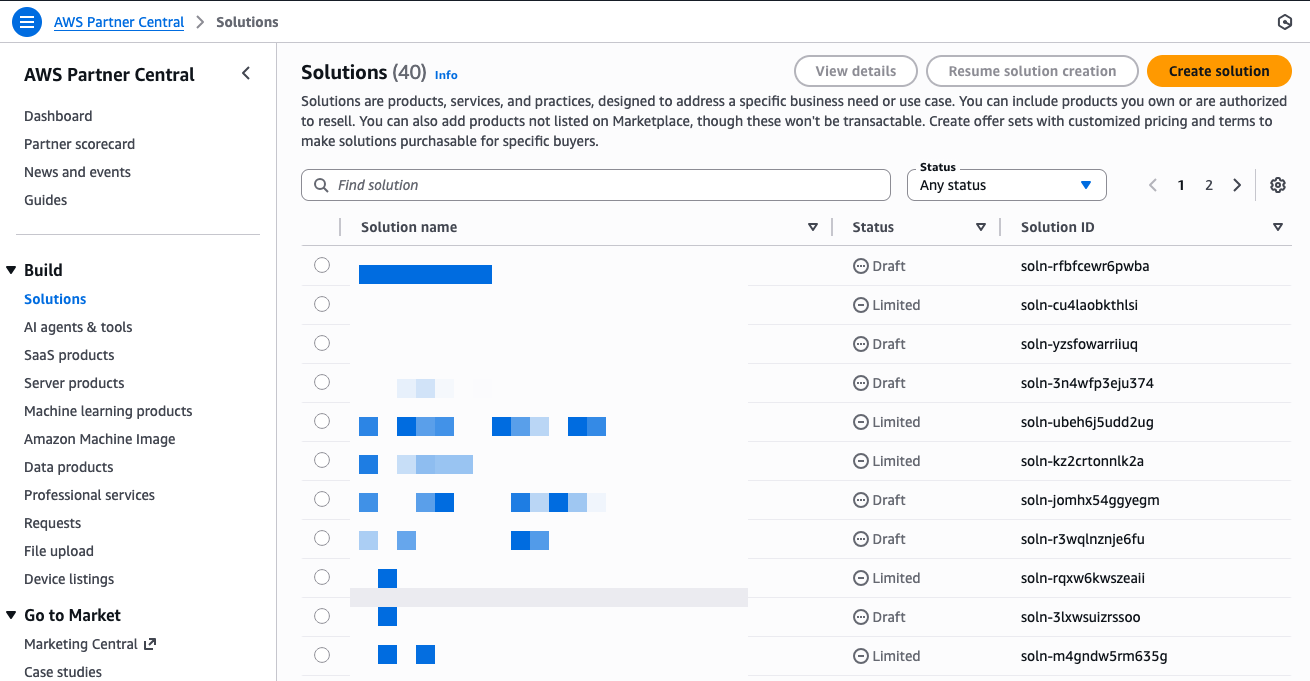
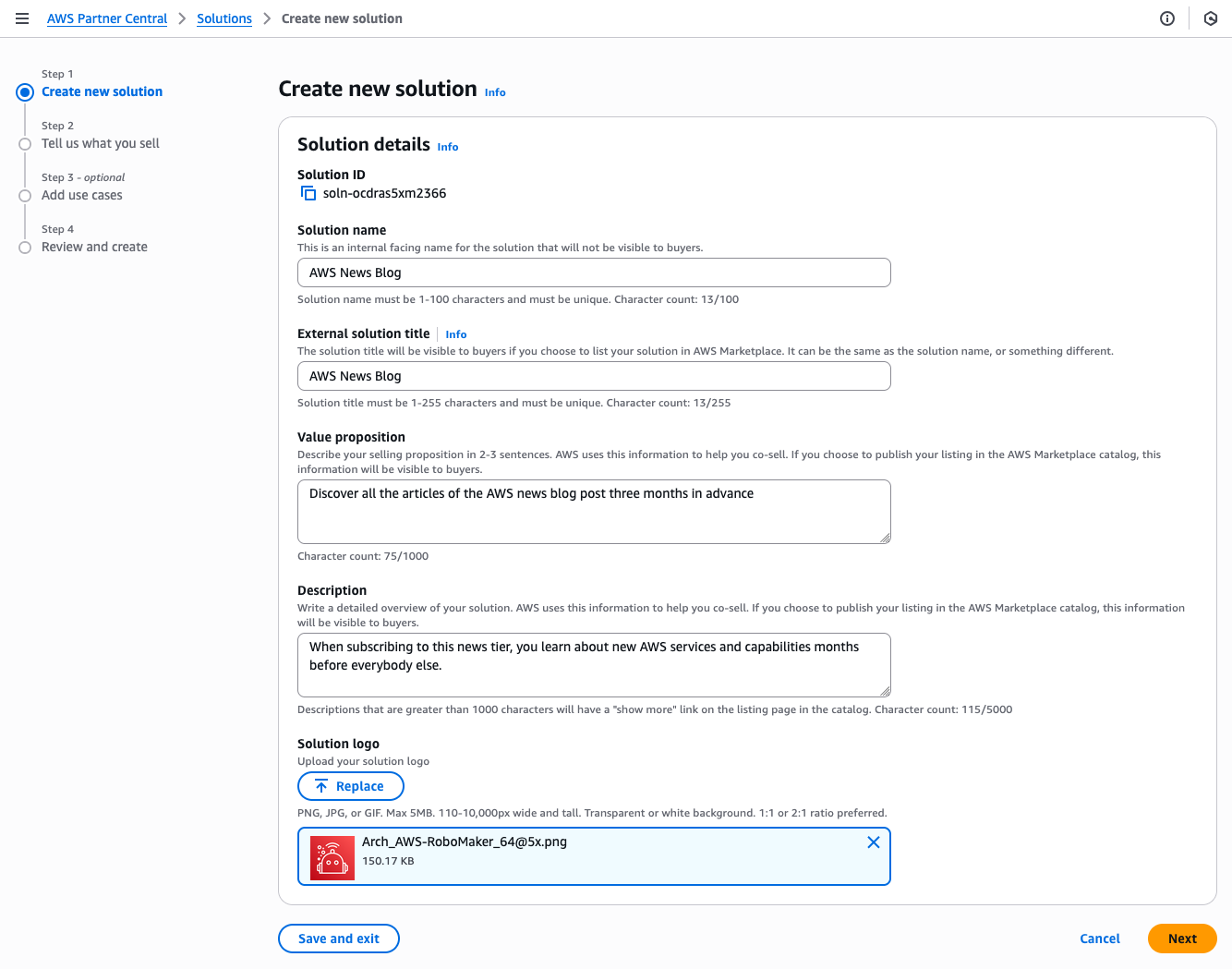
You can create and publish solutions that address specific customer needs through AWS Marketplace. Solutions are made up of products such as software as a service (SaaS), Amazon Machine Images (AMI), containers, professional services, AI agents and tools, and more. The solutions management capability guides you through building offerings that include both products you own and those you are authorized to resell. You can craft compelling value propositions and descriptions that clearly communicate your solution benefits to potential buyers browsing AWS Marketplace.
I choose Create solution to start listing a new solution in the AWS Marketplace, as shown in the following figure.
2. It helps you update and manage your Partner profile
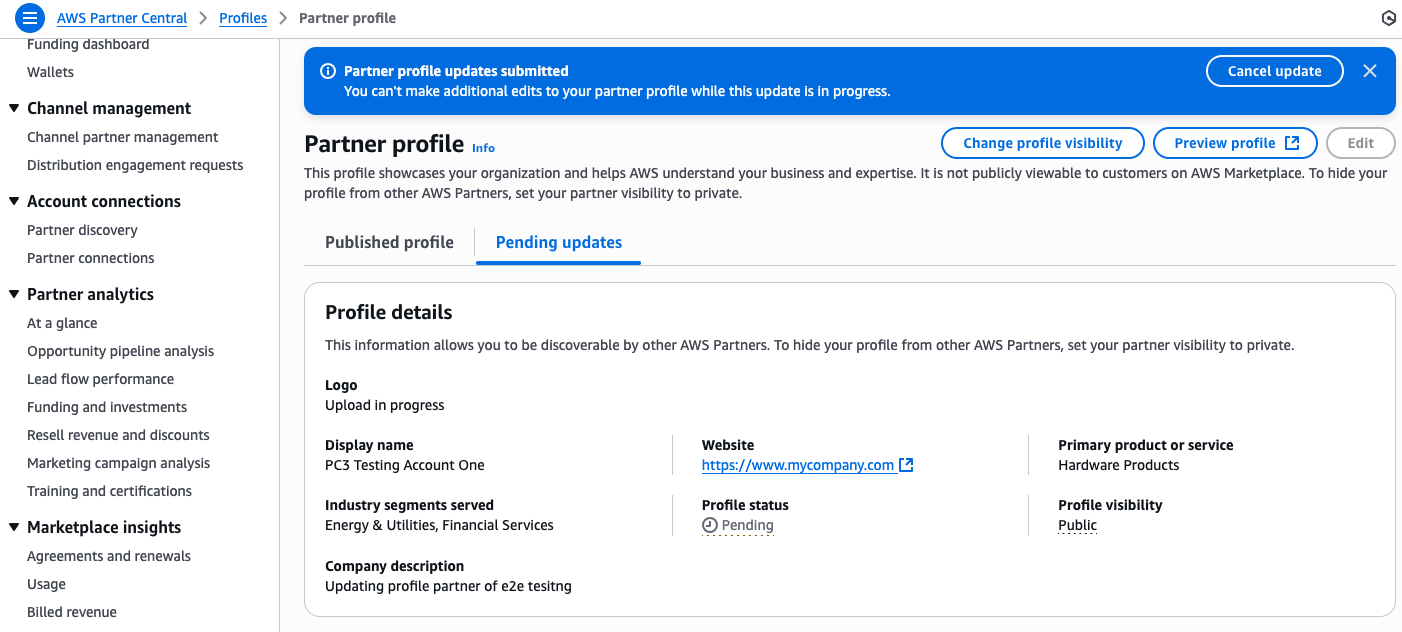
Your Partner profile showcases your organization’s expertise and capabilities to the AWS community. You control how your business appears to potential customers and Partners by highlighting the industry segments you serve and describing your primary products or services. Profile visibility settings provide you with the option to choose whether your information is public or private.
3. It helps you track opportunities
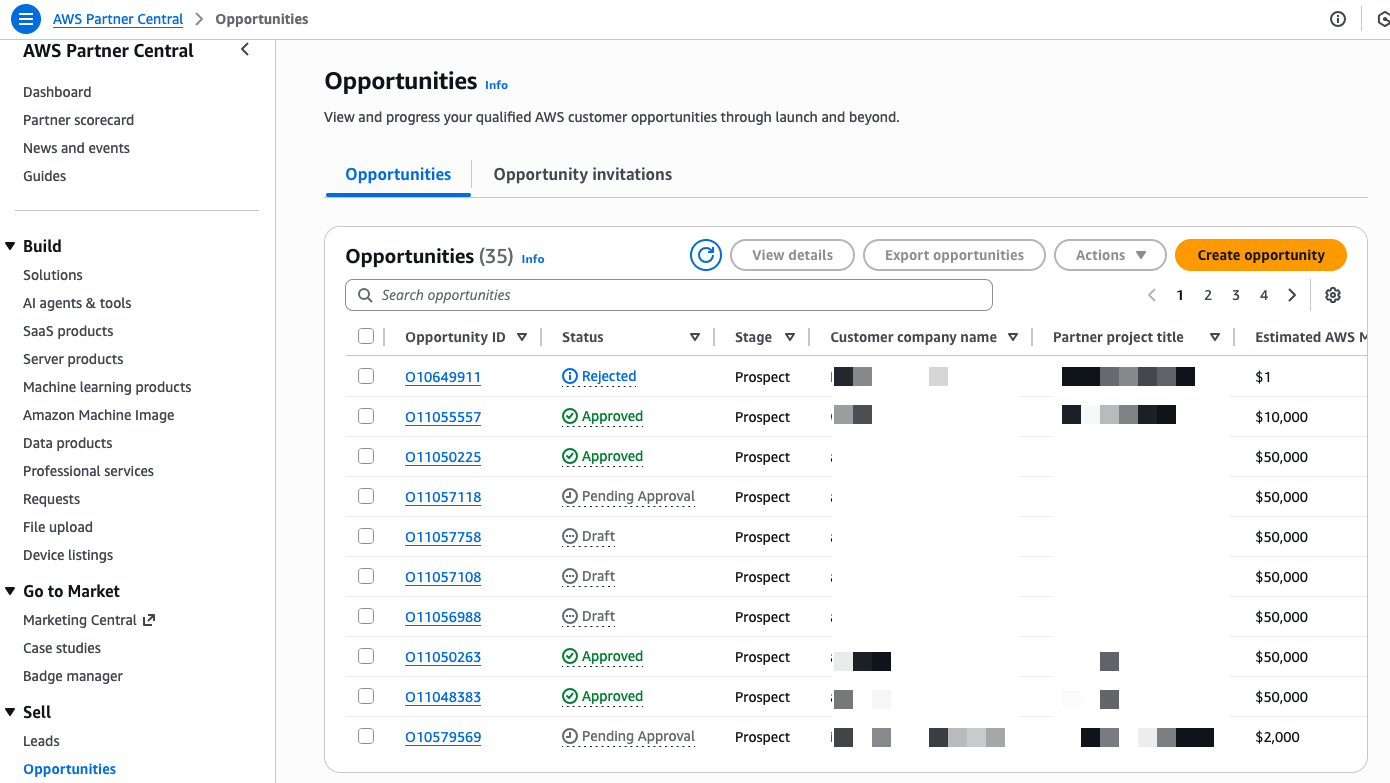
You can manage your pipeline of AWS customers, supporting joint collaborations with AWS on customer engagements. You monitor these prospects using clear status indicators: approved, rejected, draft, and pending approval. The opportunity dashboard shows stages, estimated AWS Monthly Recurring Revenue, and other key metrics that help you understand your pipeline. You can create more opportunities directly within the console and export data for your own reporting and analysis.
4. It provides you with the ability to discover and connect with other Partners
After becoming an AWS Partner, you get access to the AWS Partners network, where you can search for other Partners. You can connect with them to collaborate on sales opportunities and expand your customer outreach.
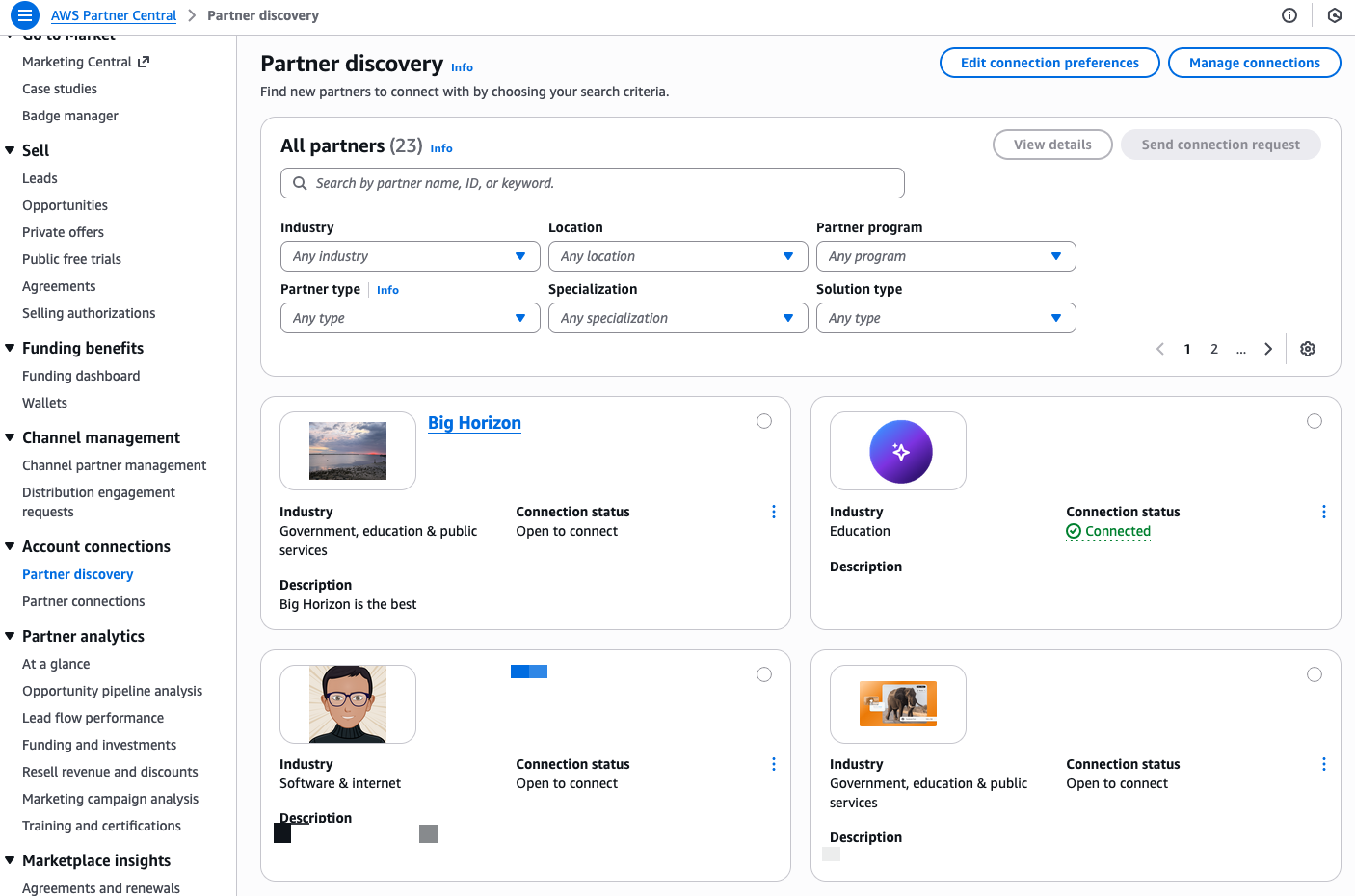
You search through available Partners using filters for industry, location, Partner program type, and specialization. The centralized dashboard shows your active connections, pending requests, and connection history, so that you can manage business relationships and identify collaboration opportunities that can expand your reach. Like all other AWS services, these Partner connection capabilities are now available as APIs, which provide automation and integration into your existing workflows.
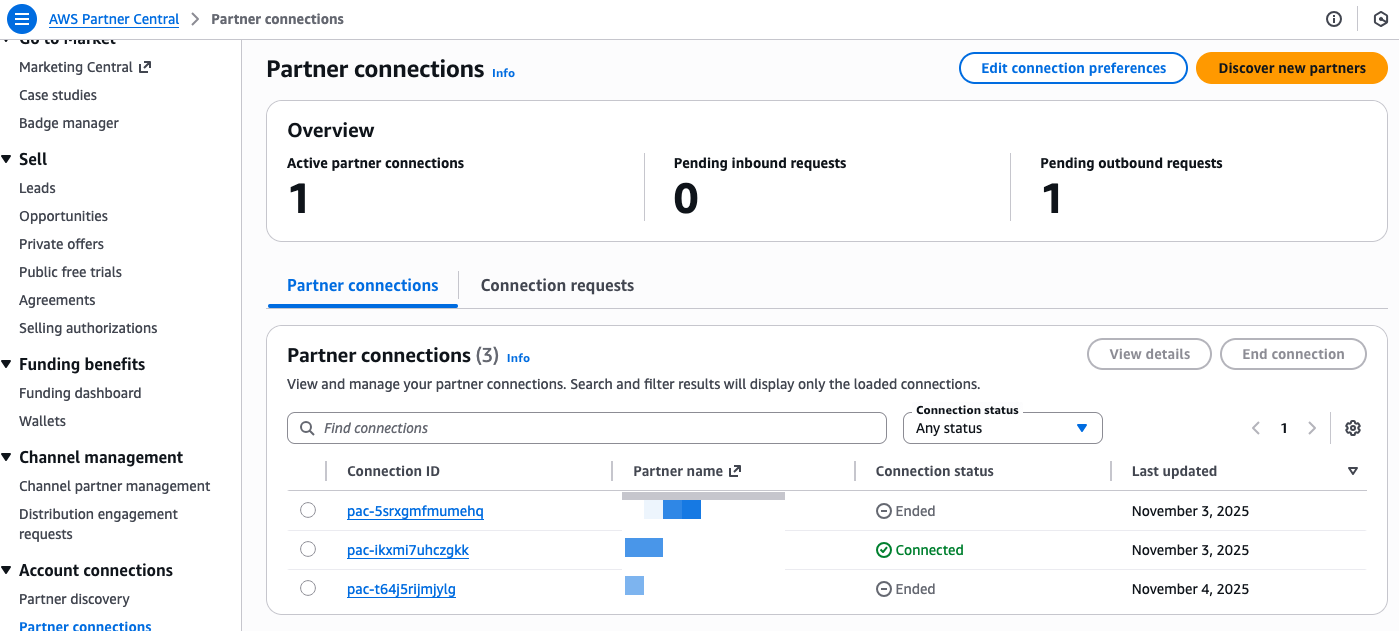
These capabilities work together within the new AWS Partner Central console, accessible directly from the console, helping you transition from AWS customer to successful Partner with enterprise-grade security and streamlined workflows.
The technical foundation: Migrating the identity system
This unified console experience is made possible by our migration to a modern identity system built on AWS Identity and Access Management (IAM). We’ve transitioned from legacy identity infrastructure to IAM Identity Center, providing enterprise-grade security capabilities including single sign-on capabilities and multi-factor authentication. With security as job zero, this migration provides new and existing Partners with the possibility to connect their own identity providers to AWS Partner Central. It provides seamless integration with existing enterprise authentication systems while removing the complexity of managing separate credentials across different services.
One more thing
APIs are the core of what we do at AWS, and AWS Partner Central is no different. You can automate and streamline your co-sell workflows by connecting your business tools to AWS Partner Central. The APIs offered by AWS Partner Central help you accelerate APN benefits—from Account Management (Account API) and Solution Management (Solution API) to co-selling with Opportunity and Leads APIs, and Benefits APIs for faster benefit activation.
You can use these APIs to engage with AWS and grow your Partner business from your own CRM tools.
Get started today
This integration between the console and AWS Partner Central reflects our commitment to reducing complexity and improving the Partner experience. We’re bringing AWS Partner Central into the console to create a more intuitive path for organizations to grow with AWS from initial customer adoption through to full partnership engagement and AWS Marketplace success.
Your journey from AWS customer to successful AWS Partner and AWS Marketplace Seller starts with a few clicks in your console. I encourage you to explore the new unified experience today and discover how AWS Partner Central in the console can accelerate your organization’s growth and success within the AWS community.
Ready to get started? Visit AWS Partner Central in your console to learn more about the AWS Partner Network and discover the partnership path that’s right for your organization.
Introducing AWS Lambda Managed Instances: Serverless simplicity with EC2 flexibility
Post Syndicated from Micah Walter original https://aws.amazon.com/blogs/aws/introducing-aws-lambda-managed-instances-serverless-simplicity-with-ec2-flexibility/
Today, we’re announcing AWS Lambda Managed Instances, a new capability you can use to run AWS Lambda functions on your Amazon Elastic Compute Cloud (Amazon EC2) compute while maintaining serverless operational simplicity. This enhancement addresses a key customer need: accessing specialized compute options and optimizing costs for steady-state workloads without sacrificing the serverless development experience you know and love.
Although Lambda eliminates infrastructure management, some workloads require specialized hardware, such as specific CPU architectures, or cost optimizations from Amazon EC2 purchasing commitments. This tension forces many teams to manage infrastructure themselves, sacrificing the serverless benefits of Lambda only to access the compute options or pricing models they need. This often leads to a significant architectural shift and greater operational responsibility.
Lambda Managed Instances
You can use Lambda Managed Instances to define how your Lambda functions run on EC2 instances. Amazon Web Services (AWS) handles setting up and managing these instances in your account. You get access to the latest generation of Amazon EC2 instances, and AWS handles all the operational complexity—instance lifecycle management, OS patching, load balancing, and auto scaling. This means you can select compute profiles optimized for your specific workload requirements, like high-bandwidth networking for data-intensive applications, without taking on the operational burden of managing Amazon EC2 infrastructure.
Each execution environment can process multiple requests rather than handling just one request at a time. This can significantly reduce compute consumption, because your code can efficiently share resources across concurrent requests instead of spinning up separate execution environments for each invocation. Lambda Managed Instances provides access to Amazon EC2 commitment-based pricing models such as Compute Savings Plans and Reserved Instances, which can provide up to a 72% discount over Amazon EC2 On-Demand pricing. This offers significant cost savings for steady-state workloads while maintaining the familiar Lambda programming model.
Let’s try it out
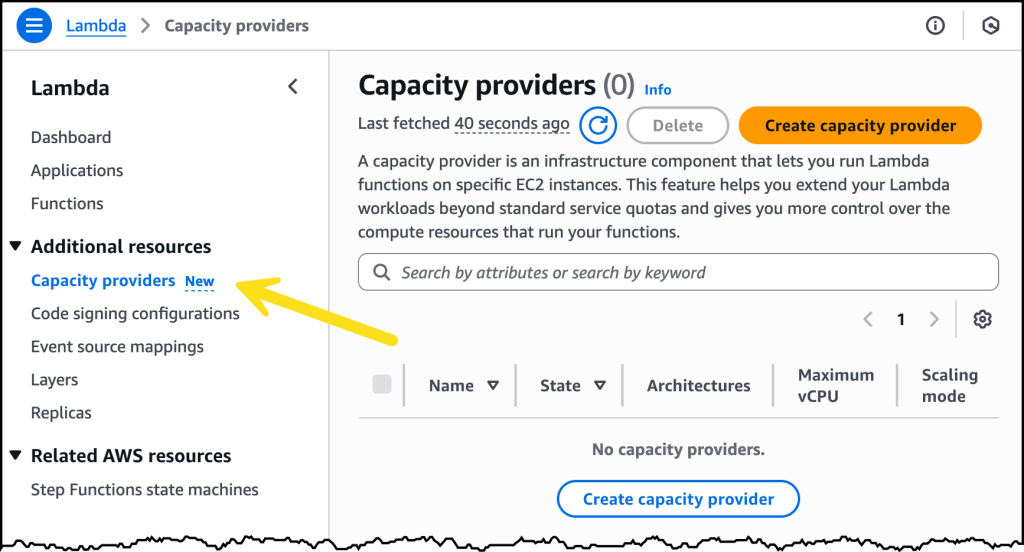
To take Lambda Managed Instances for a spin, I first need to create a Capacity provider. As shown in the following image, there is a new tab for creating these in the navigation pane under Additional resources.
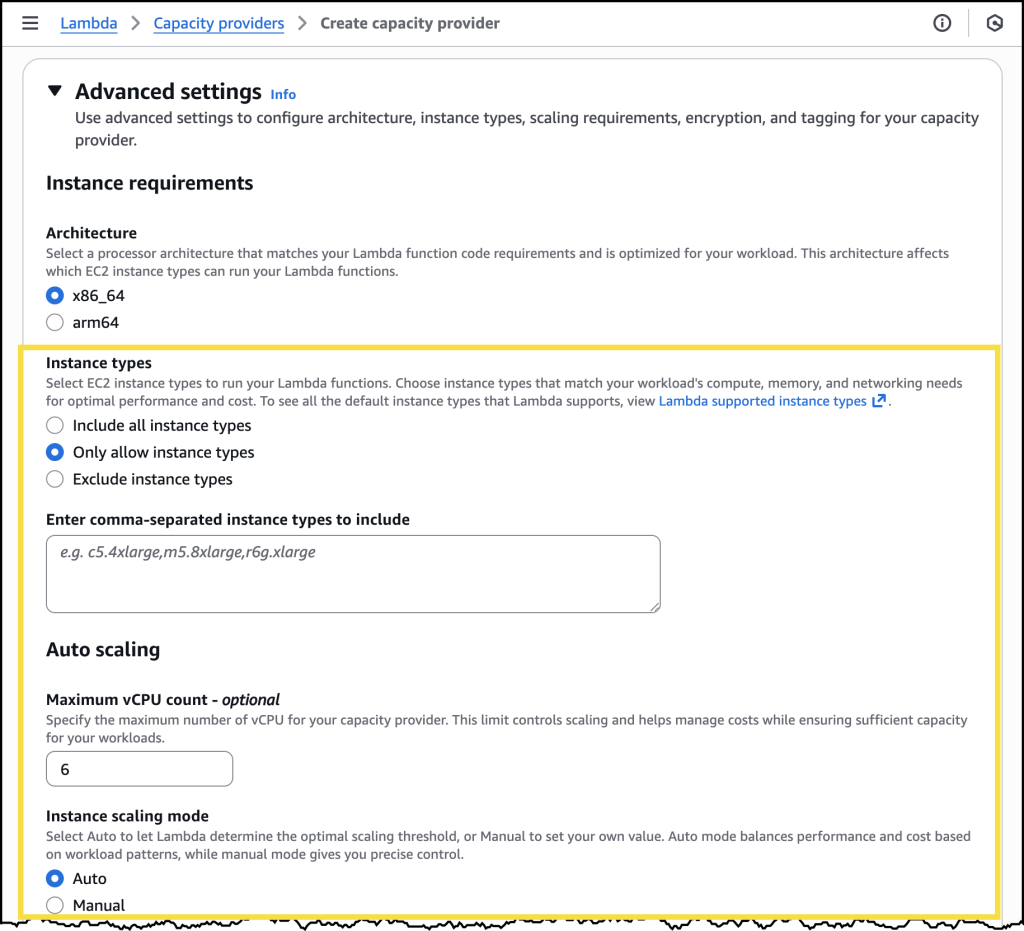
Creating a Capacity provider is where I specify the virtual private cloud (VPC), subnet configuration and security groups. With a capacity provider configuration, I can also tell Lambda where to provision and manage the instances.
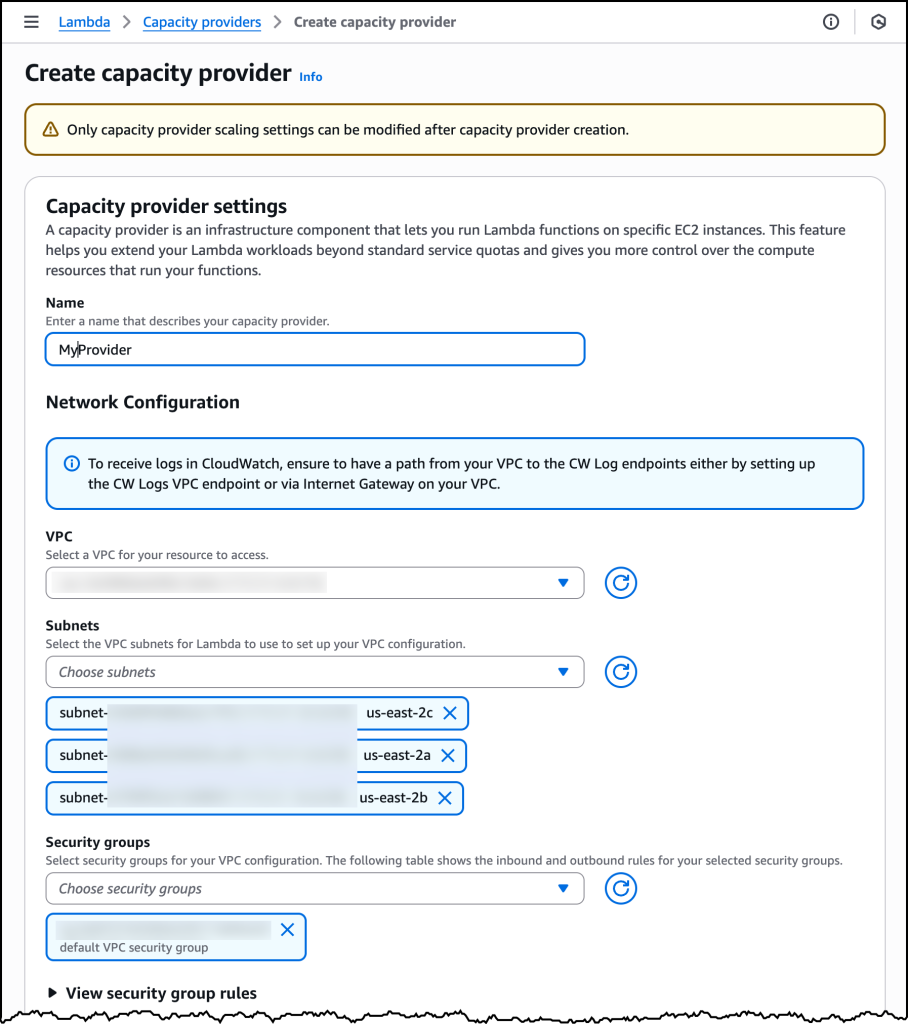
I can also specify the EC2 instance types I’d like to include or exclude, or I can choose to include all instance types for high diversity. Additionally, I can specify a few controls related to auto scaling, including the Maximum vCPU count, and if I want to use Auto scaling or use a CPU policy.
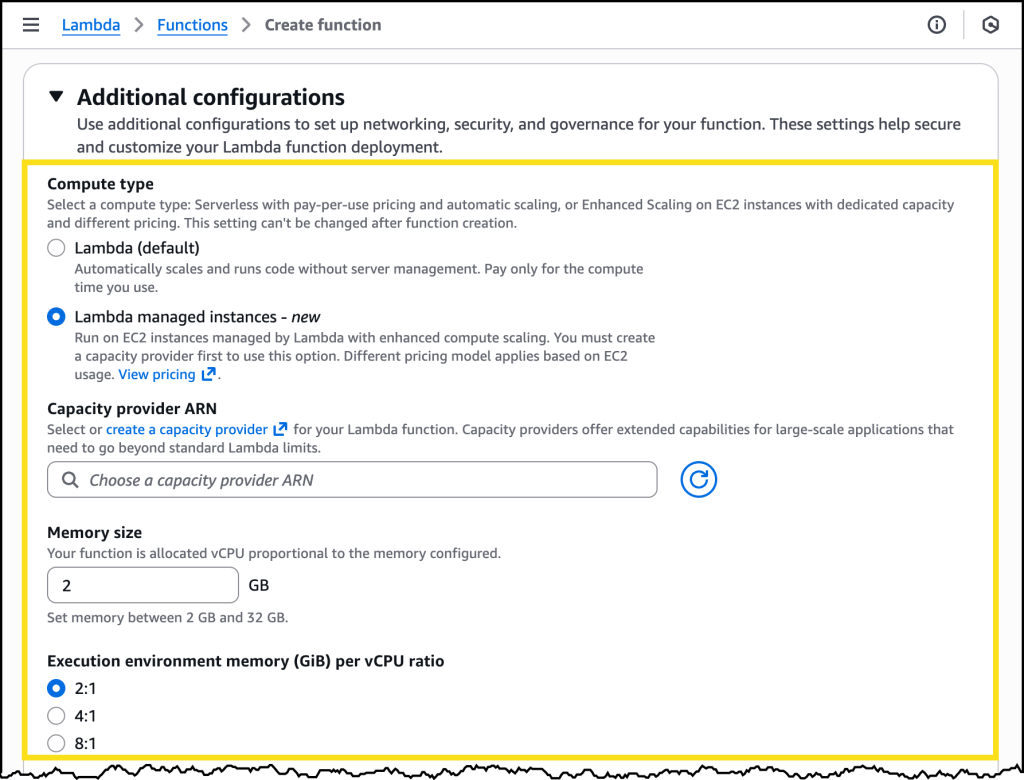
After I have my capacity provider configured, I can choose it through its Amazon Resource Name (ARN) when I go to create a new Lambda function. Here I can also select the memory allocation I want along with a memory-to-vCPU ratio.
Working with Lambda Managed Instances
Now that we’ve seen the basic setup, let’s explore how Lambda Managed Instances works in more detail. The feature organizes EC2 instances into capacity providers that you configure through the Lambda console, AWS Command Line Interface (AWS CLI), or infrastructure as code (IaC) tools such as AWS CloudFormation, AWS Serverless Application Model (AWS SAM), AWS Cloud Development Kit (AWS CDK) and Terraform. Each capacity provider defines the compute characteristics you need, including instance type, networking configuration, and scaling parameters.
When creating a capacity provider, you can choose from the latest generation of EC2 instances to match your workload requirements. For cost-optimized general-purpose compute, you could choose AWS Graviton4 based instances that deliver excellent price performance. If you’re not sure which instance type to select, AWS Lambda provides optimized defaults that balance performance and cost based on your function configuration.
After creating a capacity provider, you attach your Lambda functions to it through a straightforward configuration change. Before attaching a function, you should review your code for programming patterns that can cause issues in multiconcurrency environments, such as writing to or reading from file paths that aren’t unique per request or using shared memory spaces and variables across invocations.
Lambda automatically routes requests to preprovisioned execution environments on the instances, eliminating cold starts that can affect first-request latency. Each execution environment can handle multiple concurrent requests through the multiconcurrency feature, maximizing resource utilization across your functions. When additional capacity is needed during traffic increases, AWS automatically launches new instances within tens of seconds and adds them to your capacity provider. The capacity provider can absorb traffic spikes of up to 50% without needing to scale by default, but built-in circuit breakers protect your compute resources during extreme traffic surges by temporarily throttling requests with 429 status codes if the capacity provider reaches maximum provisioned capacity and additional capacity is still being spun up.
The operational and architectural model remains serverless throughout this process. AWS handles instance provisioning, OS patching, security updates, load balancing across instances, and automatic scaling based on demand. AWS automatically applies security patches and bug fixes to operating system and runtime components, often without disrupting running applications. Additionally, instances have a maximum 14-day lifetime to align with industry security and compliance standards. You don’t need to write automatic scaling policies, configure load balancers, or manage instance lifecycle yourself, and your function code, event source integrations, AWS Identity and Access Management (AWS IAM) permissions, and Amazon CloudWatch monitoring remain unchanged.
Now available
You can start using Lambda Managed Instances today through the Lambda console, AWS CLI, or AWS SDKs. The feature is available in US East (N. Virginia), US East (Ohio), US West (Oregon), Asia Pacific (Tokyo), and Europe (Ireland) Regions. For Regional availability and future roadmap, visit the AWS Capabilities by Region. Learn more about it in the AWS Lambda documentation.
Pricing for Lambda Managed Instances has three components. First, you pay standard Lambda request charges of $0.20 per million invocations. Second, you pay standard Amazon EC2 instance charges for the compute capacity provisioned. Your existing Amazon EC2 pricing agreements, including Compute Savings Plans and Reserved Instances, can be applied to these instance charges to reduce costs for steady-state workloads. Third, you pay a compute management fee of 15% calculated on the EC2 on-demand instance price to cover AWS’s operational management of your instances. Note that unlike traditional Lambda functions, you are not charged separately for execution duration per request. The multiconcurrency feature helps further optimize costs by reducing the total compute time required to process your requests.
The initial release supports the latest versions of Node.js, Java, .NET and Python runtimes, with support for other languages coming soon. The feature integrates with existing Lambda workflows including function versioning, aliases, AWS CloudWatch Lambda Insights, AWS AppConfig extensions, and deployment tools like AWS SAM and AWS CDK. You can migrate existing Lambda functions to Lambda Managed Instances without changing your function code (as long as it has been validated to be thread safe for multiconcurrency) making it easy to adopt this capability for workloads that would benefit from specialized compute or cost optimization.
Lambda Managed Instances represents a significant expansion of Lambda’s capabilities, which means you can run a broader range of workloads while preserving the serverless operational model. Whether you’re optimizing costs for high-traffic applications, or accessing the latest processor architectures like Graviton4, this new capability provides the flexibility you need without operational complexity. We’re excited to see what you build with Lambda Managed Instances.
Simplify IAM policy creation with IAM Policy Autopilot, a new open source MCP server for builders
Post Syndicated from Micah Walter original https://aws.amazon.com/blogs/aws/simplify-iam-policy-creation-with-iam-policy-autopilot-a-new-open-source-mcp-server-for-builders/
Today, we’re announcing IAM Policy Autopilot, a new open source Model Context Protocol (MCP) server that analyzes your application code and helps your AI coding assistants generate AWS Identity and Access Management (IAM) identity-based policies. IAM Policy Autopilot accelerates initial development by providing builders with a starting point that they can review and further refine. It integrates with AI coding assistants such as Kiro, Claude Code, Cursor, and Cline, and it provides them with AWS Identity and Access Management (IAM) knowledge and understanding of the latest AWS services and features. IAM Policy Autopilot is available at no additional cost, runs locally, and you can get started by visiting our GitHub repository.
Amazon Web Services (AWS) applications require IAM policies for their roles. Builders on AWS, from developers to business leaders, engage with IAM as part of their workflow. Developers typically start with broader permissions and refine them over time, balancing rapid development with security. They often use AI coding assistants in hopes of accelerating development and authoring IAM permissions. However, these AI tools don’t fully understand the nuances of IAM and can miss permissions or suggest invalid actions. Builders seek solutions that provide reliable IAM knowledge, integrate with AI assistants and get them started with policy creation, so that they can focus on building applications.
Create valid policies with AWS knowledge
IAM Policy Autopilot addresses these challenges by generating identity-based IAM policies directly from your application code. Using deterministic code analysis, it creates reliable and valid policies, so you spend less time authoring and debugging permissions. IAM Policy Autopilot incorporates AWS knowledge, including published AWS service reference implementation, to stay up to date. It uses this information to understand how code and SDK calls map to IAM actions and stays current with the latest AWS services and operations.
The generated policies provide a starting point for you to review and scope down to implement least privilege permissions. As you modify your application code—whether adding new AWS service integrations or updating existing ones—you only need to run IAM Policy Autopilot again to get updated permissions.
Getting started with IAM Policy Autopilot
Developers can get started with IAM Policy Autopilot in minutes by downloading and integrating it with their workflow.
As an MCP server, IAM Policy Autopilot operates in the background as builders converse with their AI coding assistants. When your application needs IAM policies, your coding assistants can call IAM Policy Autopilot to analyze AWS SDK calls within your application and generate required identity-based IAM policies, providing you with necessary permissions to start with. After permissions are created, if you still encounter Access Denied errors during testing, the AI coding assistant invokes IAM Policy Autopilot to analyze the denial and propose targeted IAM policy fixes. After you review and approve the suggested changes, IAM Policy Autopilot updates the permissions.
You can also use IAM Policy Autopilot as a standalone command line interface (CLI) tool to generate policies directly or fix missing permissions. Both the CLI tool and the MCP server provide the same policy creation and troubleshooting capabilities, so you can choose the integration that best fits your workflow.
When using IAM Policy Autopilot, you should also understand the best practices to maximize its benefits. IAM Policy Autopilot generates identity-based policies and doesn’t create resource-based policies, permission boundaries, service control policies (SCPs) or resource control policies (RCPs). IAM Policy Autopilot generates policies that prioritize functionality over minimal permissions. You should always review the generated policies and refine if necessary so they align with your security requirements before deploying them.
Let’s try it out
To set up IAM Policy Autopilot, I first need to install it on my system. To do so, I just need to run a one-liner script:
curl https://github.com/awslabs/iam-policy-autopilot/raw/refs/heads/main/install.sh | bash
Then I can follow the instructions to install any MCP server for my IDE of choice. Today, I’m using Kiro!
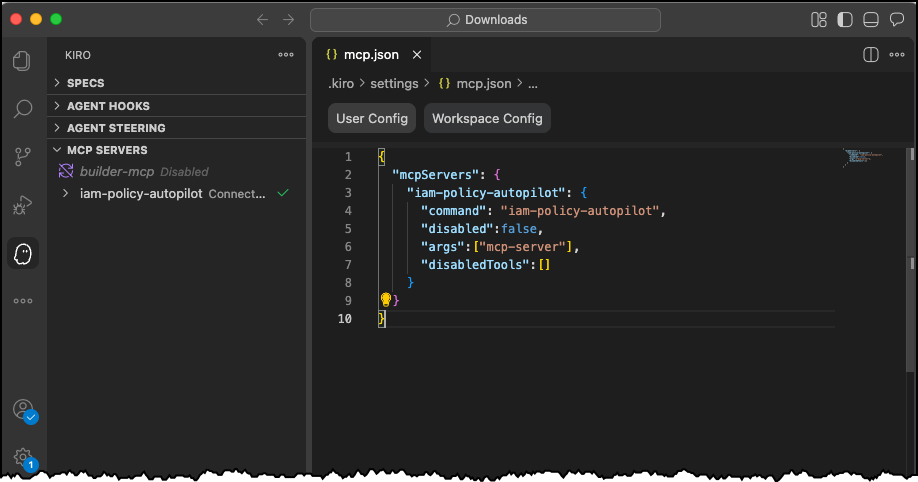
In a new chat session in Kiro, I start with a straightforward prompt, where I ask Kiro to read the files in my file-to-queue folder and create a new AWS CloudFormation file so I can deploy the application. This folder contains an automated Amazon Simple Storage Service (Amazon S3) file router that scans a bucket and sends notifications to Amazon Simple Queue Service (Amazon SQS) queues or Amazon EventBridge based on configurable prefix-matching rules, enabling event-driven workflows triggered by file locations.
The last part asks Kiro to make sure I’m including necessary IAM policies. This should be enough to get Kiro to use the IAM Policy Autopilot MCP server.
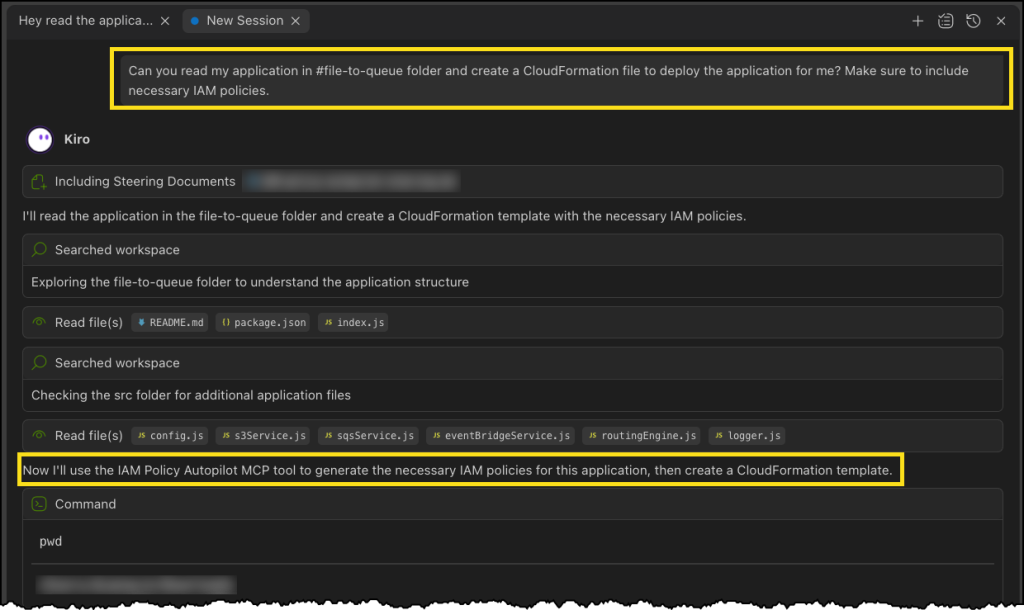
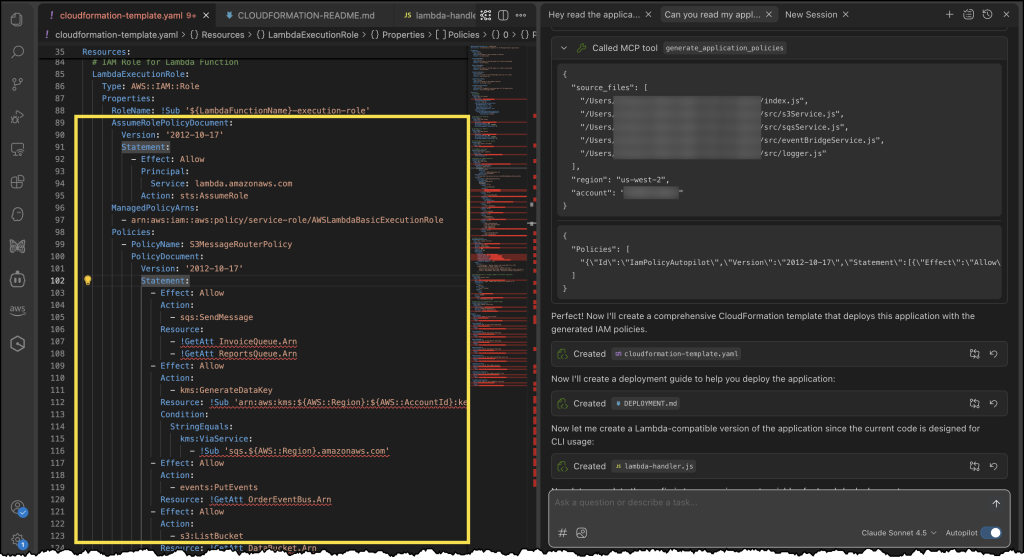
Next, Kiro uses the IAM Policy Autopilot MCP server to generate a new policy document, as depicted in the following image. After it’s done, Kiro will move on to building out our CloudFormation template and some additional documentation and relevant code files.

Finally, we can see our generated CloudFormation template with a new policy document, all generated using the IAM Policy Autopilot MCP server!
Enhanced development workflow
IAM Policy Autopilot integrates with AWS services across multiple areas. For core AWS services, IAM Policy Autopilot analyzes your application’s usage of services such as Amazon S3, AWS Lambda, Amazon DynamoDB, Amazon Elastic Compute Cloud (Amazon EC2), and Amazon CloudWatch Logs, then generates necessary permissions your code needs based on the SDK calls it discovers. After the policies are created, you can copy the policy directly into your CloudFormation template, AWS Cloud Development Kit (AWS CDK) stack, or Terraform configuration. You can also prompt your AI coding assistants to integrate it for you.
IAM Policy Autopilot also complements existing IAM tools such as AWS IAM Access Analyzer by providing functional policies as a starting point, which you can then validate using IAM Access Analyzer policy validation or refine over time with unused access analysis.
Now available
IAM Policy Autopilot is available as an open source tool on GitHub at no additional cost. The tool currently supports Python, TypeScript, and Go applications.
These capabilities represent a significant step forward in simplifying the AWS development experience so builders of different experience levels can develop and deploy applications more efficiently.
Announcing Amazon EKS Capabilities for workload orchestration and cloud resource management
Post Syndicated from Channy Yun (윤석찬) original https://aws.amazon.com/blogs/aws/announcing-amazon-eks-capabilities-for-workload-orchestration-and-cloud-resource-management/
Today, we’re announcing Amazon Elastic Kubernetes Service (Amazon EKS) Capabilities, an extensible set of Kubernetes-native solutions that streamline workload orchestration, Amazon Web Services (AWS) cloud resource management, and Kubernetes resource composition and orchestration. These fully managed, integrated platform capabilities include open source Kubernetes solutions that many customers are using today, such as Argo CD, AWS Controllers for Kubernetes, and Kube Resource Orchestrator.
With EKS Capabilities, you can build and scale Kubernetes applications without managing complex solution infrastructure. Unlike typical in-cluster installations, these capabilities actually run in EKS service-owned accounts that are fully abstracted from customers.
With AWS managing infrastructure scaling, patching, and updates of these cluster capabilities, you can use the enterprise reliability and security without needing to maintain and manage the underlying components.
Here are the capabilities available at launch:
- Argo CD – This is a declarative GitOps tool for Kubernetes that provides continuous continuous deployment (CD) capabilities for Kubernetes. It’s broadly adopted, with more than 45% of Kubernetes end-users reporting production or planned production use in the 2024 Cloud Native Computing Foundation (CNCF) Survey.
- AWS Controllers for Kubernetes (ACK) – ACK is highly popular with enterprise platform teams in production environments. ACK provides custom resources for Kubernetes that enable the management of AWS Cloud resources directly from within your clusters.
- Kube Resource Orchestrator (KRO) – KRO provides a streamlined way to create and manage custom resources in Kubernetes. With KRO, platform teams can create reusable resource bundles that abstract away complexity while remaining natively to the Kubernetes ecosystem.
With these features, you can accelerate and scale your Kubernetes use with fully managed capabilities, using its opinionated but flexible features to build for scale right from the start. It is designed to offer a set of foundational cluster capabilities that layer seamlessly with each other, providing integrated features for continuous deployment, resource orchestration, and composition. You can focus on managing and shipping software without needing to spend time and resources building and managing these foundational platform components.
How it works
Platform engineers and cluster administrators can set up EKS Capabilities to offload building and managing custom solutions to provide common foundational services, meaning they can focus on more differentiated features that matter to your business.
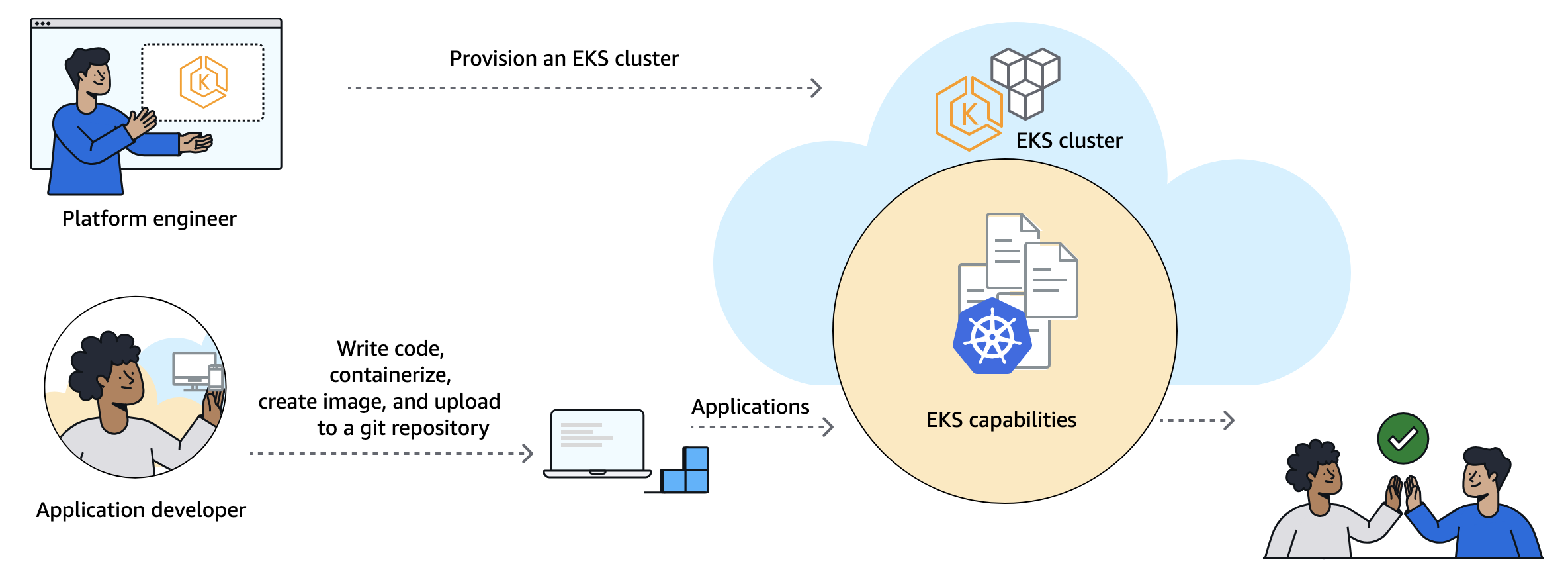
Your application developers primarily work with EKS Capabilities as they do other Kubernetes features. They do this by applying declarative configuration to create Kubernetes resources using familiar tools, such as kubectl or through automation from git commit to running code.
Get started with EKS Capabilities
To enable EKS Capabilities, you can use the EKS console, AWS Command Line Interface (AWS CLI), eksctl, or other preferred tools. In the EKS console, choose Create capabilities in the Capabilities tab on your existing EKS cluster. EKS Capabilities are AWS resources, and they can be tagged, managed, and deleted.
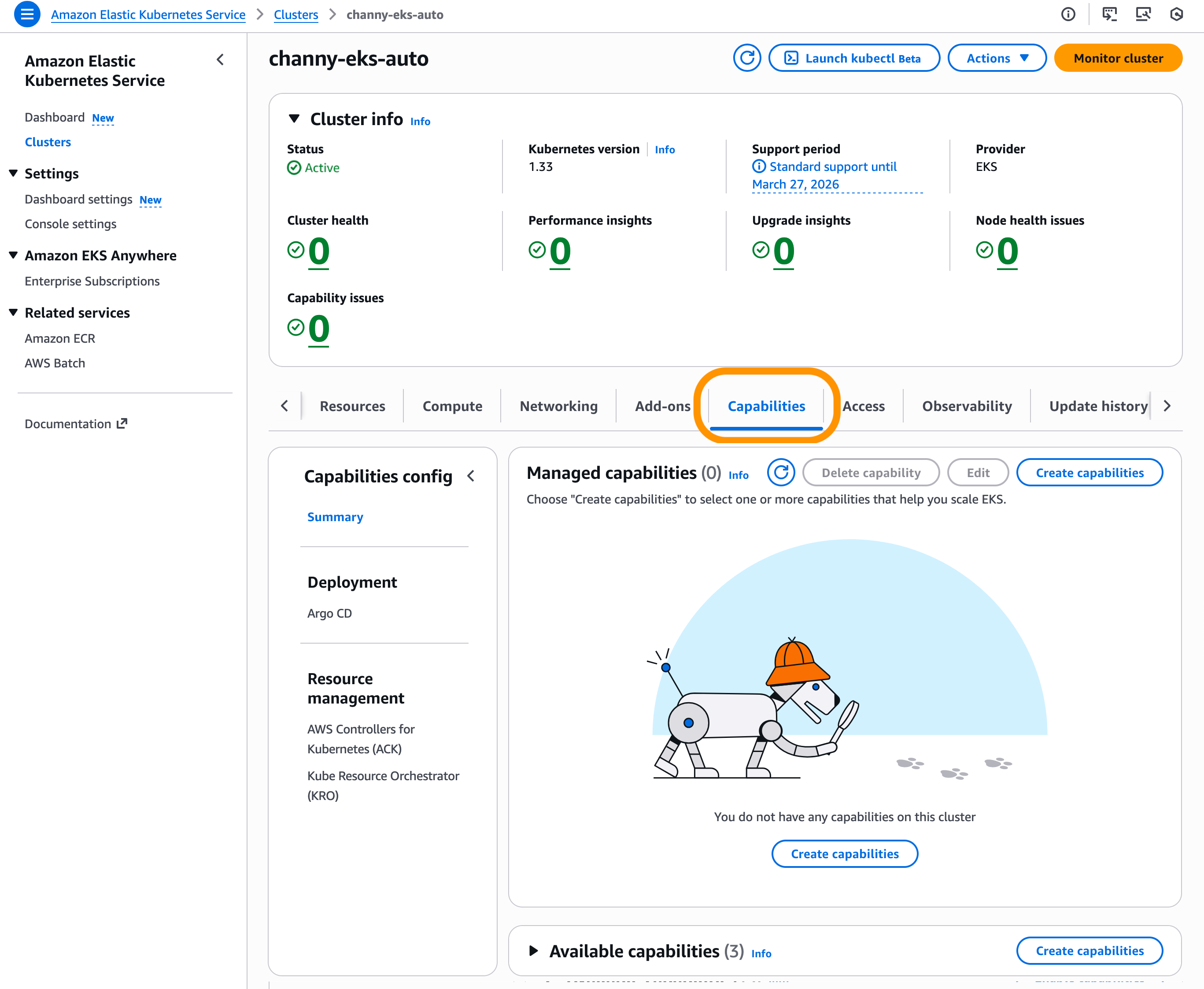
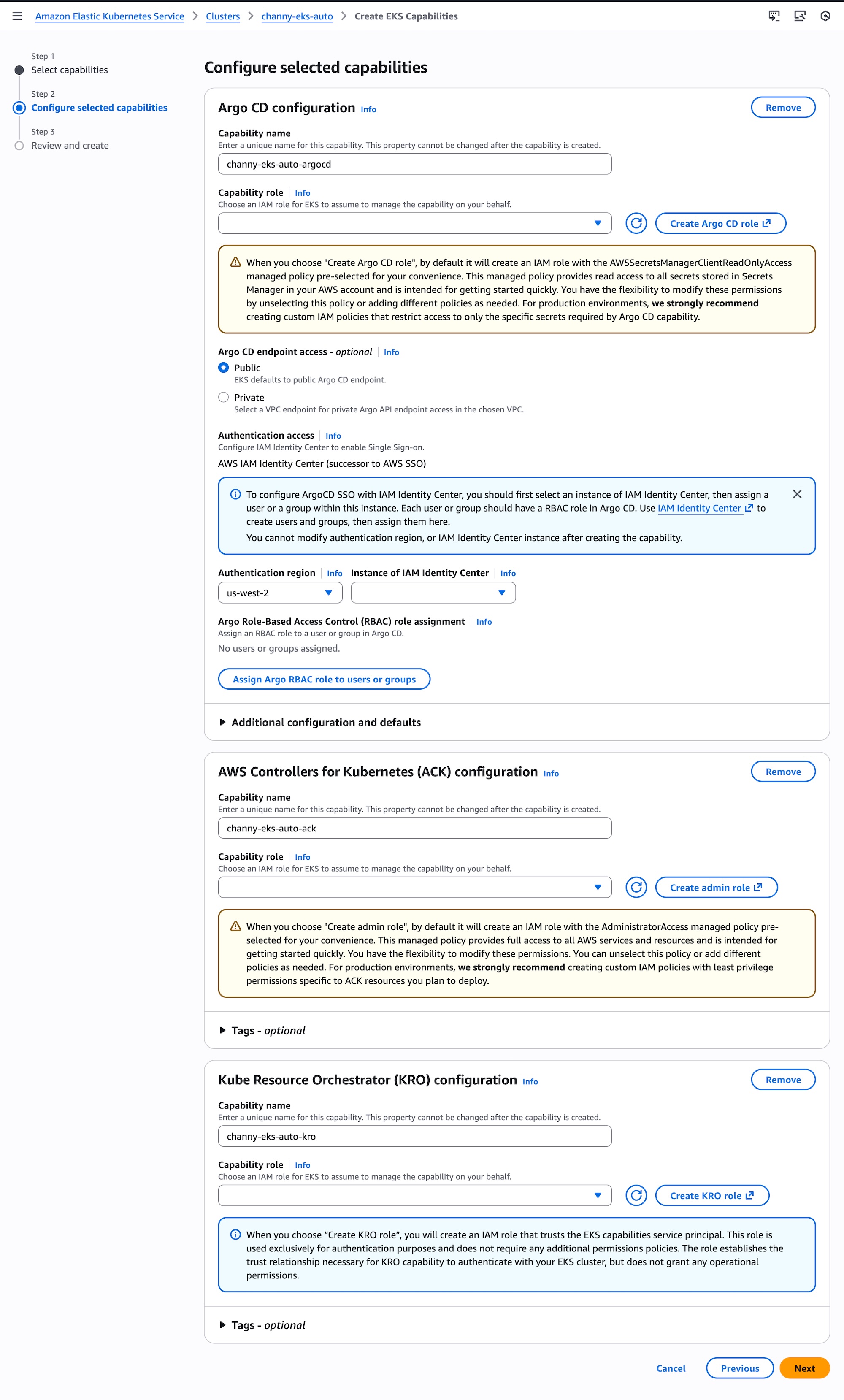
You can select one or more capabilities to work together. I checked all three capabilities: ArgoCD, ACK, and KRO. However, these capabilities are completely independent and you can pick and choose which capabilities you want enabled on your clusters.
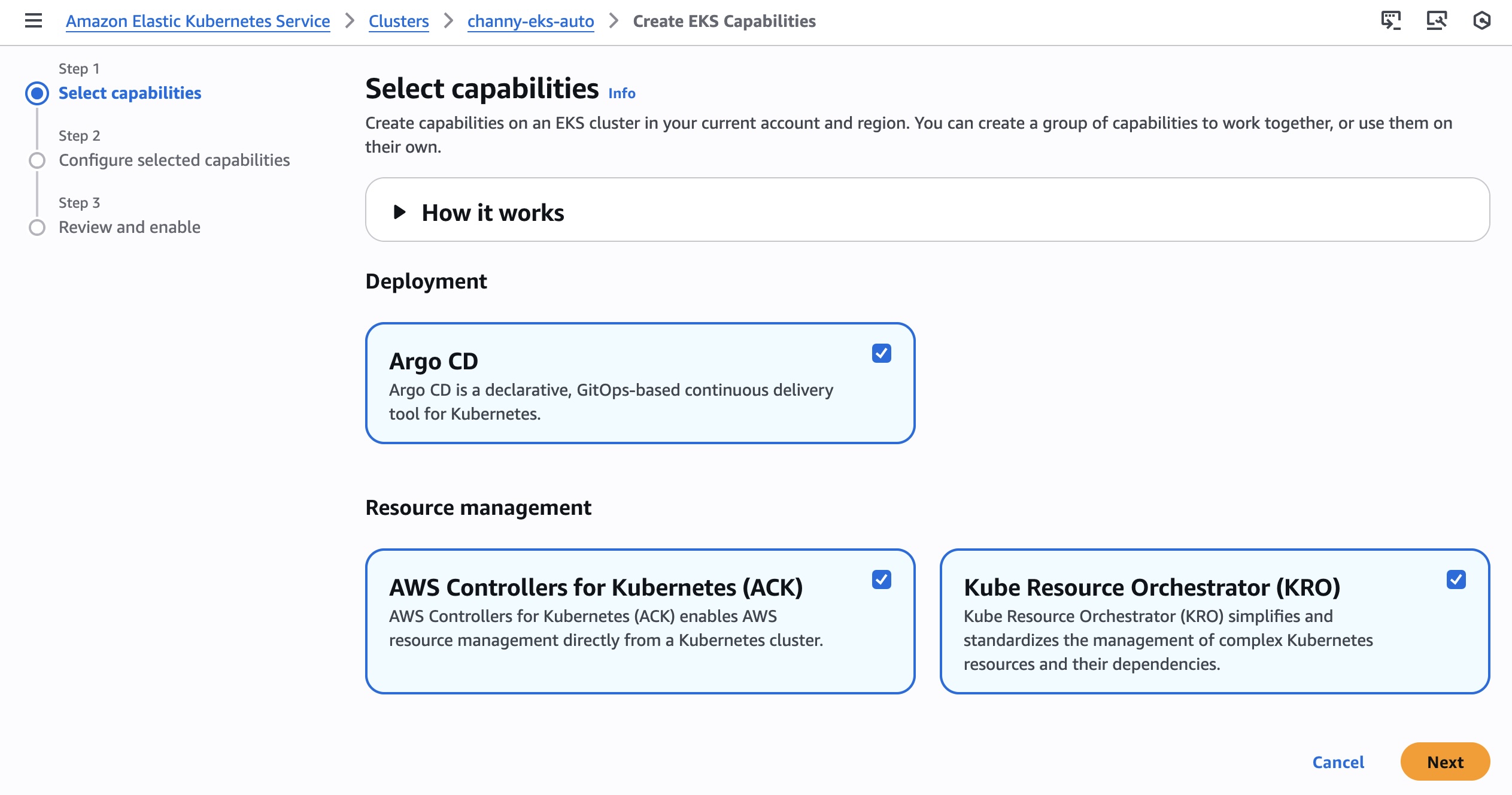
Now you can configure selected capabilities. You should create AWS Identity and Access Management (AWS IAM) roles to enable EKS to operate these capabilities within your cluster. Please note you cannot modify the capability name, namespace, authentication region, or AWS IAM Identity Center instance after creating the capability. Choose Next and review the settings and enable capabilities.
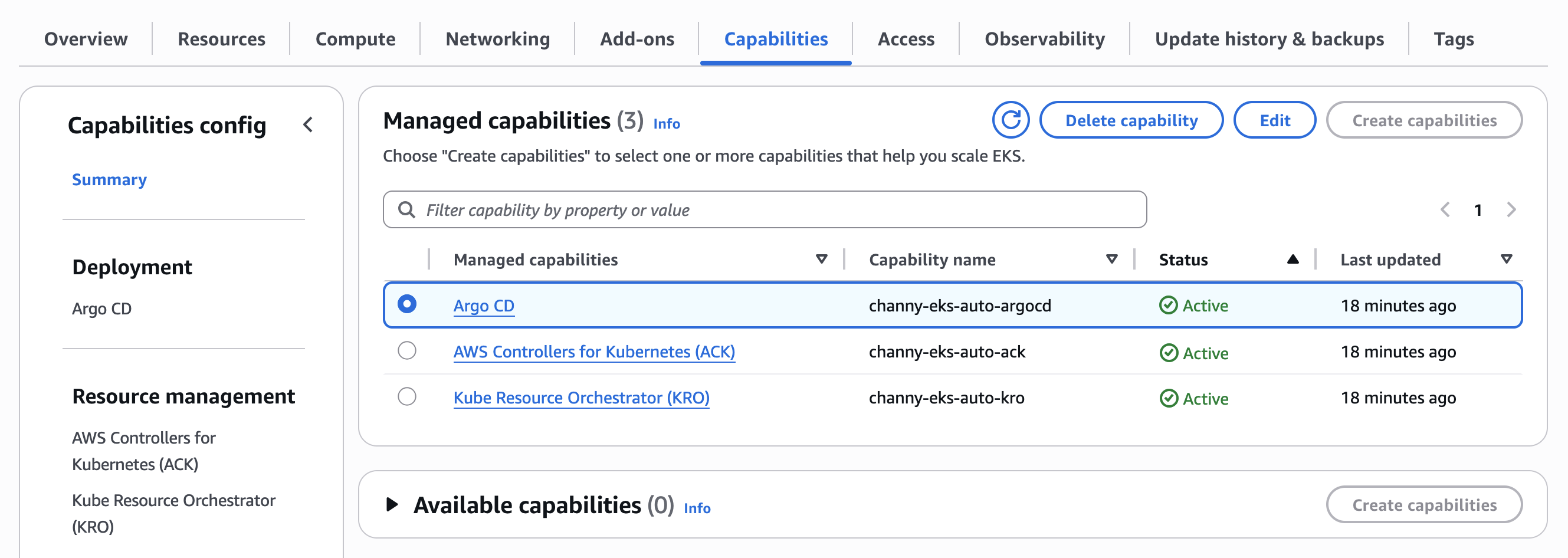
Now you can see and manage created capabilities. Select ArgoCD to update configuration of the capability.
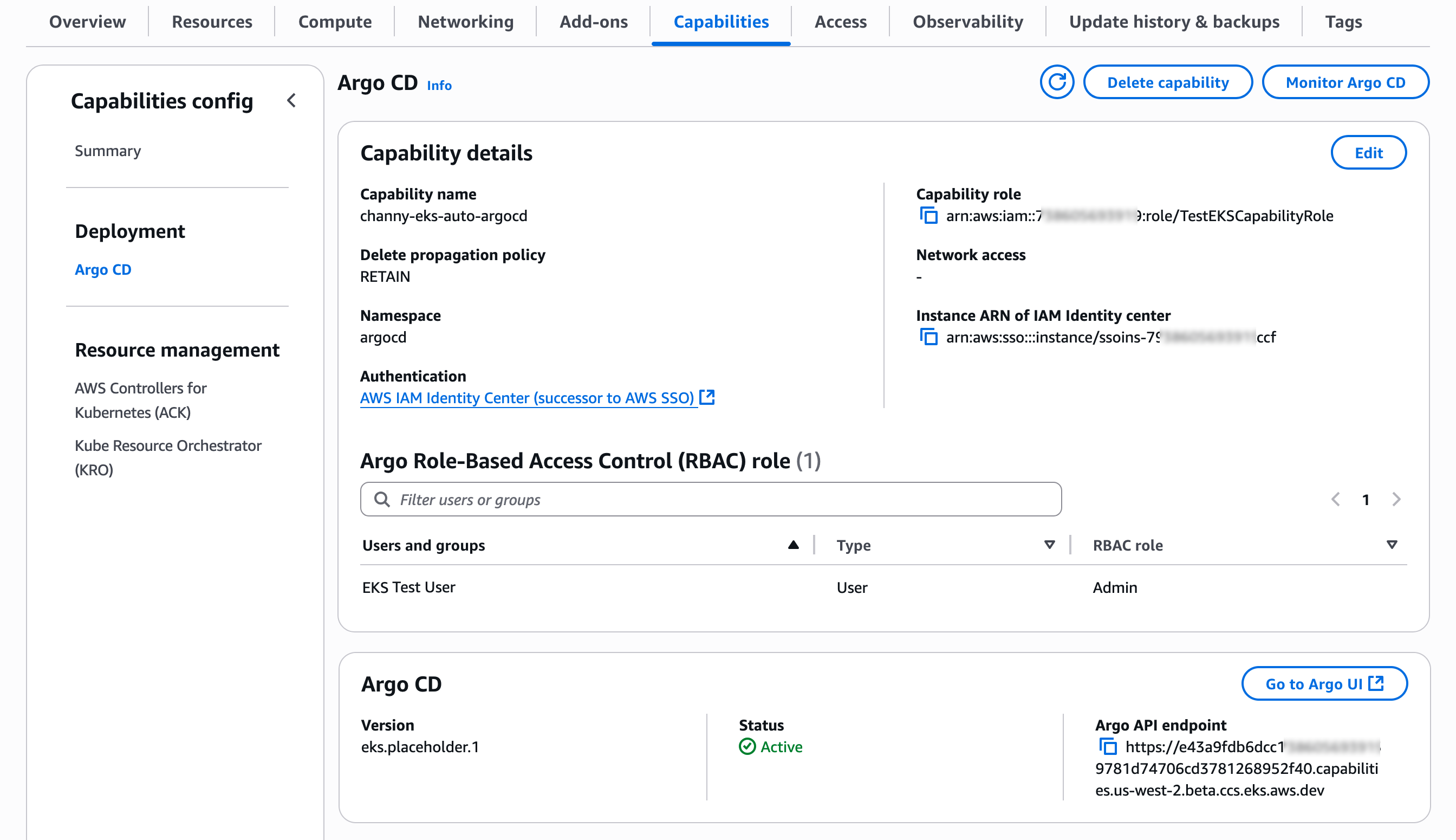
You can see details of ArgoCD capability. Choose Edit to change configuration settings or Monitor ArgoCD to show the health status of the capability for the current EKS cluster.
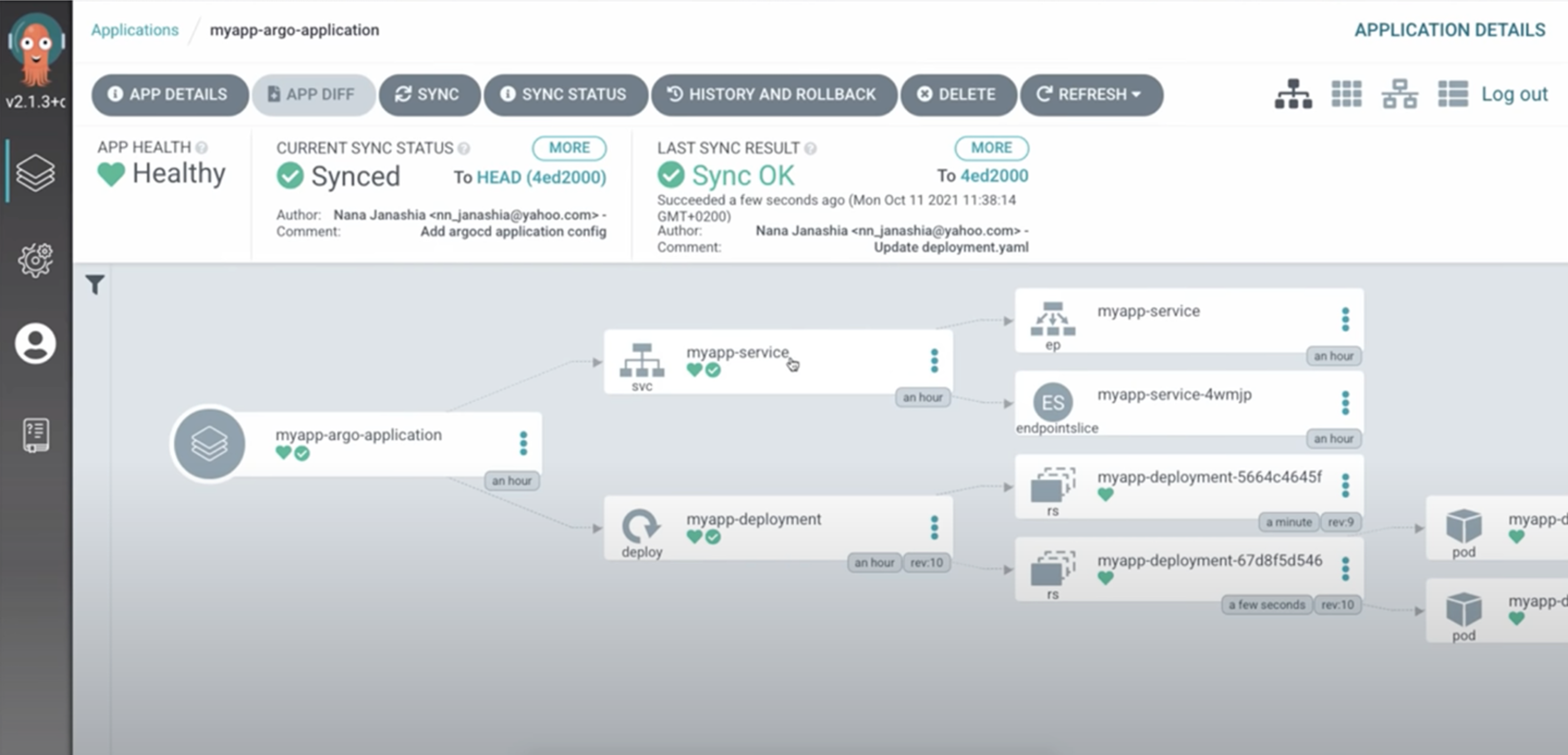
Choose Go to Argo UI to visualize and monitor deployment status and application health.
To learn more about how to set up and use each capability in detail, visit Getting started with EKS Capabilities in the Amazon EKS User Guide.
Things to know
Here are key considerations to know about this feature:
- Permissions – EKS Capabilities are cluster-scoped administrator resources, and resource permissions are configured through AWS IAM. For some capabilities, there is additional configuration for single sign-on. For example, Argo CD single sign-on configuration is enabled directly in EKS with a direct integration with IAM Identity Center.
- Upgrades – EKS automatically updates cluster capabilities you enable and their related dependencies. It automatically analyzes for breaking changes, patches and updates components as needed, and informs you of conflicts or issues through the EKS cluster insights.
- Adoptions – ACK provides resource adoption features that enable migration of existing AWS resources into ACK management. ACK also provides read-only resources which can help facilitate a step-wise migration from provisioned resources with Terraform, AWS CloudFormation into EKS Capabilities.
Now available
Amazon EKS Capabilities are now available in commercial AWS Regions. For Regional availability and future roadmap, visit the AWS Capabilities by Region. There are no upfront commitments or minimum fees, and you only pay for the EKS Capabilities and resources that you use. To learn more, visit the EKS pricing page.
Give it a try in the Amazon EKS console and send feedback to AWS re:Post for EKS or through your usual AWS Support contacts.
— Channy
The End of an Age
Post Syndicated from The History Guy: History Deserves to Be Remembered original https://www.youtube.com/shorts/wrsnumR0ttE
The 6.18 kernel has been released
Post Syndicated from corbet original https://lwn.net/Articles/1048703/
Linus has released the 6.18 kernel, as expected.
So I’ll have to admit that I’d have been happier with slightly less
bugfixing noise in this last week of the release, but while there’s
a few more fixes than I would hope for, there was nothing that made
me feel like this needs more time to cook. So 6.18 is tagged and
pushed out.
Headline changes in this release include
the ability
to manage namespaces with file handles,
support for the AccECN
congestion-control protocol,
initial support for signing of BPF
programs,
improved memory management with sheaves,
the Rust binder driver,
better control over transparent huge
pages,
and a lot more.
This release also saw the removal
of the bcachefs filesystem.
See the LWN merge-window summaries
(part 1, part 2)
and the KernelNewbies 6.18
page for more information.
A Decade of Defense: Celebrating Grab’s 10th Year Bug Bounty Program
Post Syndicated from Grab Tech original https://engineering.grab.com/a-decade-of-defense
Introduction
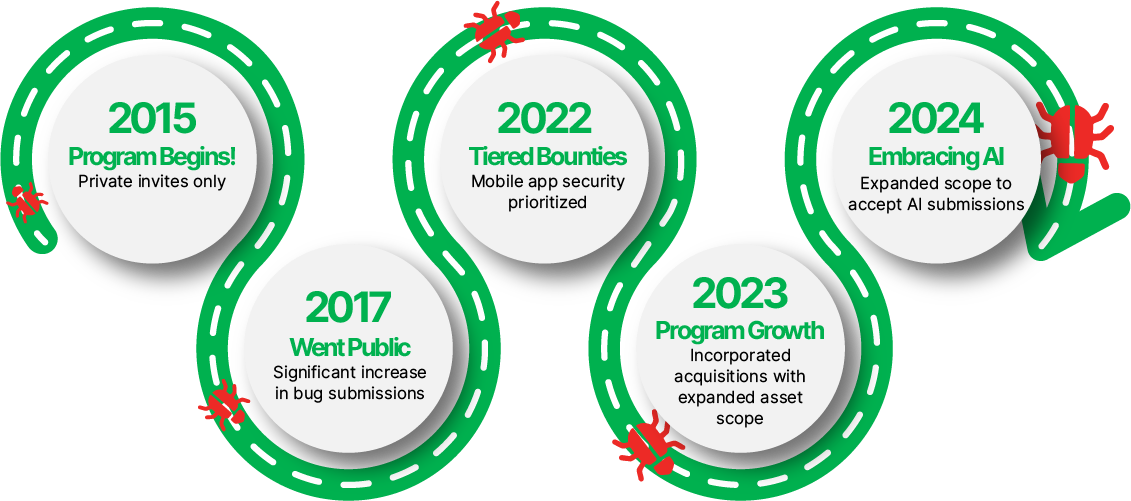
Ten years ago, we launched our bug bounty program in partnership with HackerOne. Beyond a security initiative, it represented an open invitation to collaborative development.
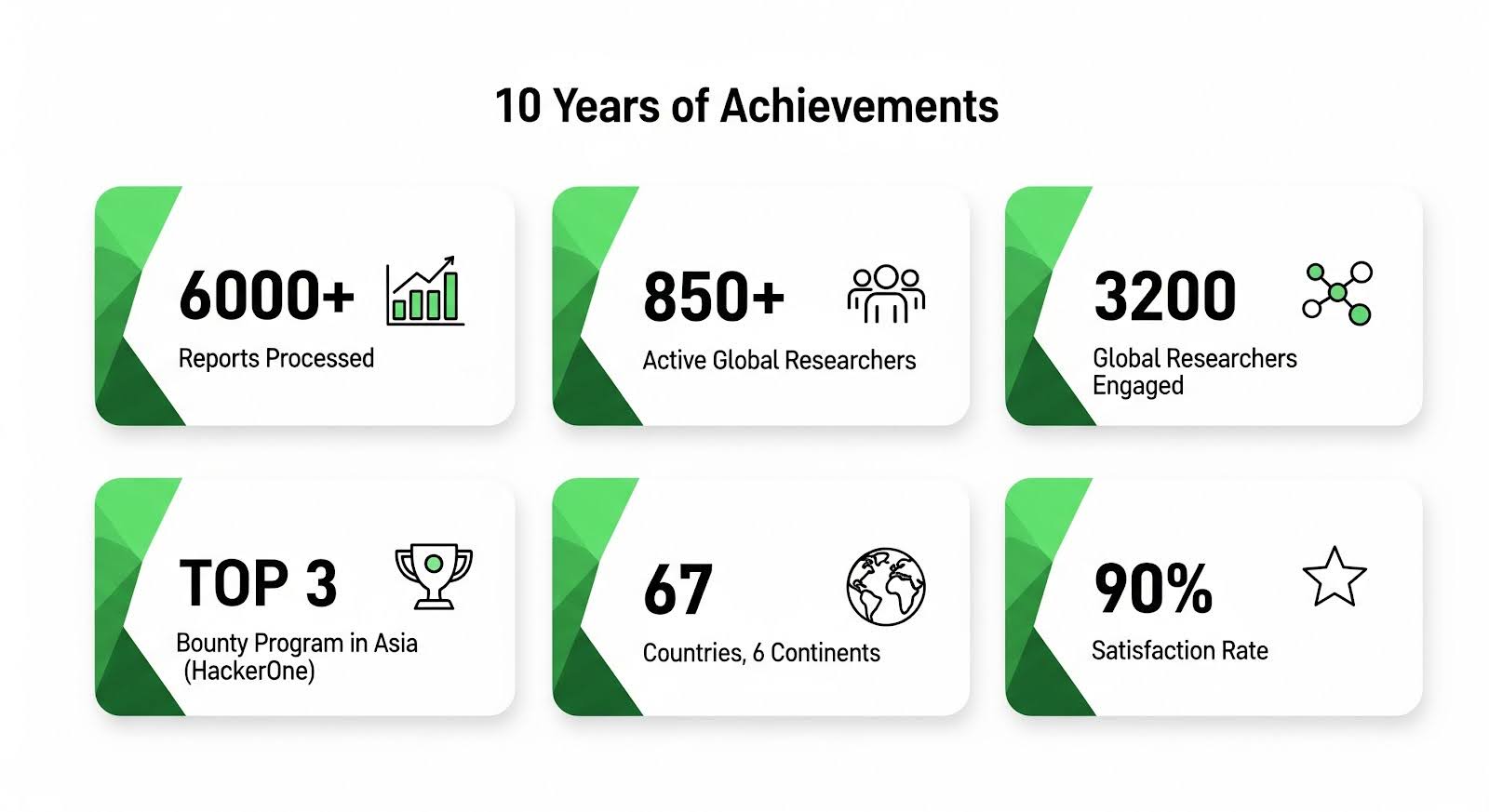
As pioneers in Southeast Asia, we began the program with 23 initial researchers, and it has since evolved into a global community of security researchers.
The strategic structure and scope of our Bug Bounty Program, combined with our continuous innovation and experimentation, have successfully captured the attention of the global security research community. Over the past decade, we have partnered with more than 850 active security researchers from HackerOne’s community of over 2 million cybersecurity professionals worldwide. These dedicated researchers work alongside us across borders and time zones, forming a collaborative defense network that helps protect over 187 million users throughout Southeast Asia. Their ongoing participation demonstrates both the maturity of our program and the trust we’ve built within the security research community.
This milestone reflects the strength of shared purpose and our sustained partnership with the HackerOne platform. It demonstrates the value of human connection and the collective understanding that security is stronger through collaboration. Here’s to a decade of partnership and to many more years of building a safer future, one collaboration at a time!
Evolution and growth: Adapting to a dynamic threat landscape
Over the past ten years, our program has consistently adapted to the dynamic threat landscape and integrated invaluable feedback from our research community. We have grown from a private initiative to a program that consistently ranks among the top 20 worldwide and among the top 3 in Asia on HackerOne. Key milestones from our journey include:
- Expanding our horizons: Our scope significantly broadened in 2023-2024, continuously adding new assets and prominently including financial services in Indonesia and AI systems. This expansion provides researchers with more avenues to contribute to Grab’s security.
- Focused mobile security: We introduced a dedicated bounty table for mobile-specific issues, recognizing the unique challenges of mobile security.
- Incentivizing excellence: We regularly experiment with campaigns of various types and targets, diversifying our reward methods to include both financial rewards and recognition.
- Evolving vulnerability focus: We’ve observed a significant shift in the types of vulnerabilities reported over the decade, moving from foundational issues in early years to more sophisticated and emerging categories recently.
The global stage: Connecting with the best
Our program’s success is deeply rooted in its vibrant global community, which we actively foster through continuous engagement. Our strategy extends beyond the platform to major live hacking events, including the ThreatCon Live Hacking Event 2023 in Nepal and DEFCON 32’s Live Recon Village 2024 in Las Vegas. These initiatives have been instrumental in connecting us with a diverse pool of new talent and strengthening relationships with researchers across different continents. By meeting hackers where they are, we’ve not only brought new expertise into our ecosystem but also demonstrated our commitment to being an accessible and collaborative partner on a global scale.
The high participation and quality submissions from these events demonstrate the effectiveness of this approach. They’ve expanded our global security testing coverage and strengthened our standing within the worldwide cybersecurity community. Through ongoing interactions and submitted reports, we continue to see that security is a collaborative effort with no borders.
Exclusive anniversary celebrations: Global club campaigns
To commemorate our 10th anniversary, we launched three exclusive, invite-only campaigns with HackerOne’s regional clubs in Germany, Morocco, and India. These campaigns served as cultural exchanges, bringing fresh perspectives from outside our core Southeast Asian consumer markets. By engaging with these clubs, we expanded our researcher community and connected with security experts who understand different threat landscapes and methodologies, bringing outside perspectives to our systems.
In August, we also ran a broader anniversary campaign that drew significant participation from the researcher community, resulting in 461 submissions. xchopath was awarded the Best Hacker Bonus for their contributions during this campaign.
These campaigns expanded our global security testing coverage and strengthened relationships with international researcher communities. Beyond vulnerability reports, they functioned as knowledge-sharing initiatives. We connected directly with researchers to learn from their experience and feedback, creating a continuous loop of improvement. This international collaboration also informed our global expansion security strategy by providing insights into how different regions approach digital payments and authentication.
The anniversary campaigns allowed us to validate our security frameworks against diverse regulatory environments and advanced testing methodologies from established security markets, reinforcing our commitment to maintaining robust security standards.
Voices from our community
Behind every vulnerability report is a researcher who chose to help make Grab safer. Their perspectives reveal the human side of our security evolution. These individuals are not just cybersecurity experts; they are partners in our mission to protect millions of users and ensure a safe digital environment. Here are a few testimonies from participants in our past campaigns:
-
“The triage was very fast despite the time difference, which I really appreciated. The triaging experience was better than other programs. The huge scope and business portal with different user roles made it especially interesting to explore.” – ArtSec [H1 Germany club campaign participant]
-
“I liked that different countries have different features—this gives me more attack surface to explore. Response time was great, triage was very fast, and I appreciated Grab’s effort in providing fast responses. The scope was huge with a lot of wildcards for reconnaissance.” – Sicksec [H1 Morocco club campaign participant]
-
“More than 20 bugs were reported, and was particularly happy that bounties were being paid upon triage. The Germany team spent a lot of time on the educational part, especially for newcomers. Communication overall was very good, and the immediate response even outside working hours was really cool. SSO and authentication is my expertise and I liked that aspect of exploring the platform.” – Lauritz [H1 Germany club campaign participant]
The road ahead: Our commitment to a secure future
With a strong community of security researchers across countries and a decade of collaboration, we’ve built meaningful partnerships. Every vulnerability report represents trust, and every discovery reflects dedication to our shared mission. The program demonstrates our choice to build together rather than work in isolation, to protect rather than exploit, and to collaborate rather than compete.
While we celebrate our external community, the success of our program relies equally on our dedicated internal teams. Our cybersecurity teams form the operational foundation of this initiative. Their consistent responsiveness and researcher-focused approach have enabled vulnerability reporting to evolve into a genuine partnership, maintaining researcher trust and keeping Grab secure.
The next ten years will bring challenges we can’t yet imagine, from emerging threats in artificial intelligence to novel cryptographic approaches in a quantum-powered world. We will face them together as a community that spans cultures, time zones, and expertise.
Together, we’ll continue securing Southeast Asia’s digital future, one partnership, one discovery, one shared achievement at a time.
Join us
Grab is a leading superapp in Southeast Asia, operating across the deliveries, mobility, and digital financial services sectors. Serving over 800 cities in eight Southeast Asian countries, Grab enables millions of people every day to order food or groceries, send packages, hail a ride or taxi, pay for online purchases or access services such as lending and insurance, all through a single app. Grab was founded in 2012 with the mission to drive Southeast Asia forward by creating economic empowerment for everyone. Grab strives to serve a triple bottom line – we aim to simultaneously deliver financial performance for our shareholders and have a positive social impact, which includes economic empowerment for millions of people in the region, while mitigating our environmental footprint.
Powered by technology and driven by heart, our mission is to drive Southeast Asia forward by creating economic empowerment for everyone. If this mission speaks to you, join our team today!
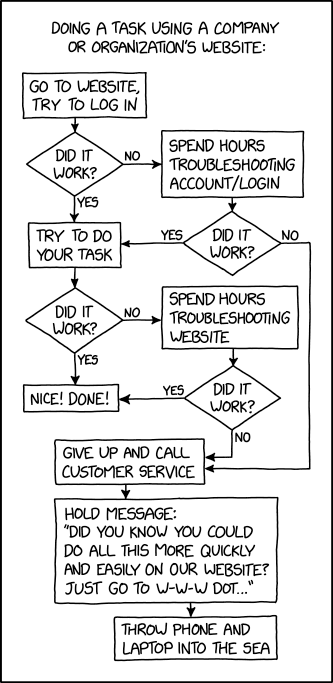
Website Task Flowchart
Post Syndicated from xkcd.com original https://xkcd.com/3175/
NixOS 25.11 released
Post Syndicated from corbet original https://lwn.net/Articles/1048727/
Version
25.11 of the NixOS distribution has been released. “The 25.11
“. Changes include
release was made possible due to the efforts of 2742 contributors, who
authored 59430 commits since the previous release
7,002 new packages, GNOME 49, LLVM 21, a new COSMIC desktop
environment beta, firewalld support, and more; see the
release notes for details.