Tag Archives: Amazon Quick Sight

How BigBasket uses the Iceberg based lakehouse architecture on AWS to power lightning-fast grocery delivery across India

Post Syndicated from Annie Mattoo original https://aws.amazon.com/blogs/big-data/how-bigbasket-uses-the-iceberg-based-lakehouse-architecture-on-aws-to-power-lightning-fast-grocery-delivery-across-india/

Delivering fresh groceries to millions of customers across India in a few minutes demands a radically modern data architecture and resilient processes to help the business make faster decisions. This is what BigBasket was able to achieve by building a lakehouse architecture on AWS.

In this post, we demonstrate how BigBasket implemented the lakehouse architecture on AWS, including their architecture decisions, implementation approach, and the measurable business results you can expect from a similar modernization. Whether you’re facing scalability challenges or planning your own lakehouse implementation, this blueprint provides actionable insights you can adapt for your organization.

About BigBasket

BigBasket (Innovative Retail Concepts Private Limited) is India’s largest online supermarket, serving millions of customers across over 60 cities. Founded in 2011, the company offers groceries, fresh produce, household items, and personal care products through its mobile app and website, operating subscription services (BBDaily) and quick commerce (bbnow). For BigBasket, the ability to deliver groceries on time isn’t only a competitive advantage. It’s the foundation of customer trust, where every minute counts.

However, rapid business growth brought significant operational challenges:

  • Inability to consistently meet on-time delivery adherence because of high order volumes, extended travel times, and more, directly impacting key metrics like on-time rate (OTR)-10 mins and OTR-15 mins.
  • Struggling to meet on-time delivery targets because of picking inefficiency, high order volumes, and extended travel times, directly impacting key metrics like OTR-10 mins and OTR-15 mins.
  • Delays in stock availability impacting vendor fill-rates, inter-distribution center orders, and warehouse operations.
  • Inaccurate stock forecasting for top-selling stock keeping units (SKUs), assortment variety, event SKUs, store capacity, and buying cycles.
  • Lower dark store productivity across picking, stacking, order processing, and goods receipt notes (GRN).

Behind these business challenges lay a fundamental technology problem: the existing data infrastructure couldn’t keep pace. The company experienced rapid store growth, expanding 4x in a short timeframe, which exposed several limitations within their existing data architecture that needed attention.

Understanding the technical bottlenecks

BigBasket’s initial architecture relied heavily on a single data warehouse built on Amazon Redshift to meet all reporting and dashboarding needs. While this traditional approach had served them well initially, several important limitations emerged:

  • Stale data: Extract, transform, load (ETL) pipelines delivered only day-old (D-1) data, making near real-time analysis impossible for dashboard requirements.
  • Extended recovery times: Pipeline failure recovery processes took several hours, causing significant delays in data availability for business users.
  • Schema rigidity: Schema changes in source databases frequently triggered pipeline failures because of a lack of schema evolution support.
  • Scalability constraints: The infrastructure struggled to handle the sudden load increase from 13,000 to over 35,000 transactions for reports and dashboards with more than 1,000 dataset refreshes.
  • Cost implications: Increasing data volumes demanded additional compute resources, driving up costs.
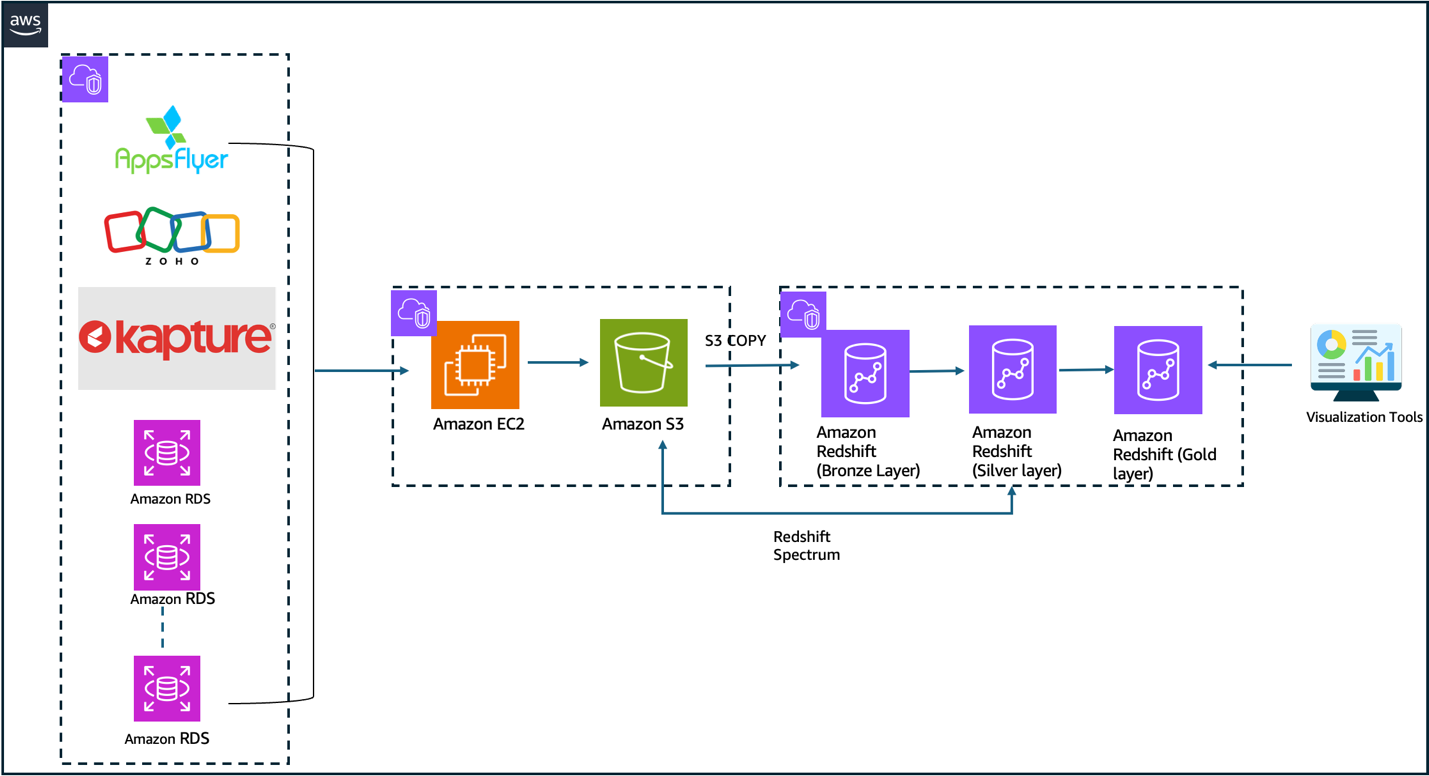
Diagram of the scalability and cost limitations of BigBasket’s legacy Amazon Redshift data warehouse

It became clear that the existing data infrastructure wasn’t able to meet the evolving business requirements and a redesign of their data architecture is needed.

Why lakehouse architecture?

A modern data lakehouse architecture addresses these issues with near real-time data processing, flexible schema evolution, and scalable analytics, capabilities necessary for fast-moving commerce operations. The lakehouse approach combines the flexibility and cost-effectiveness of data lakes with the performance and governance features of data warehouses, combining the strengths of both. The design of a data lakehouse provides interoperability across storage systems for combined analytics activities.

Solution overview

BigBasket partnered with AWS to implement a comprehensive lakehouse architecture using a combination of AWS native services and open-source technologies.

The following diagram shows an elaborated view of Bigbasket’s modernized architecture on AWS.
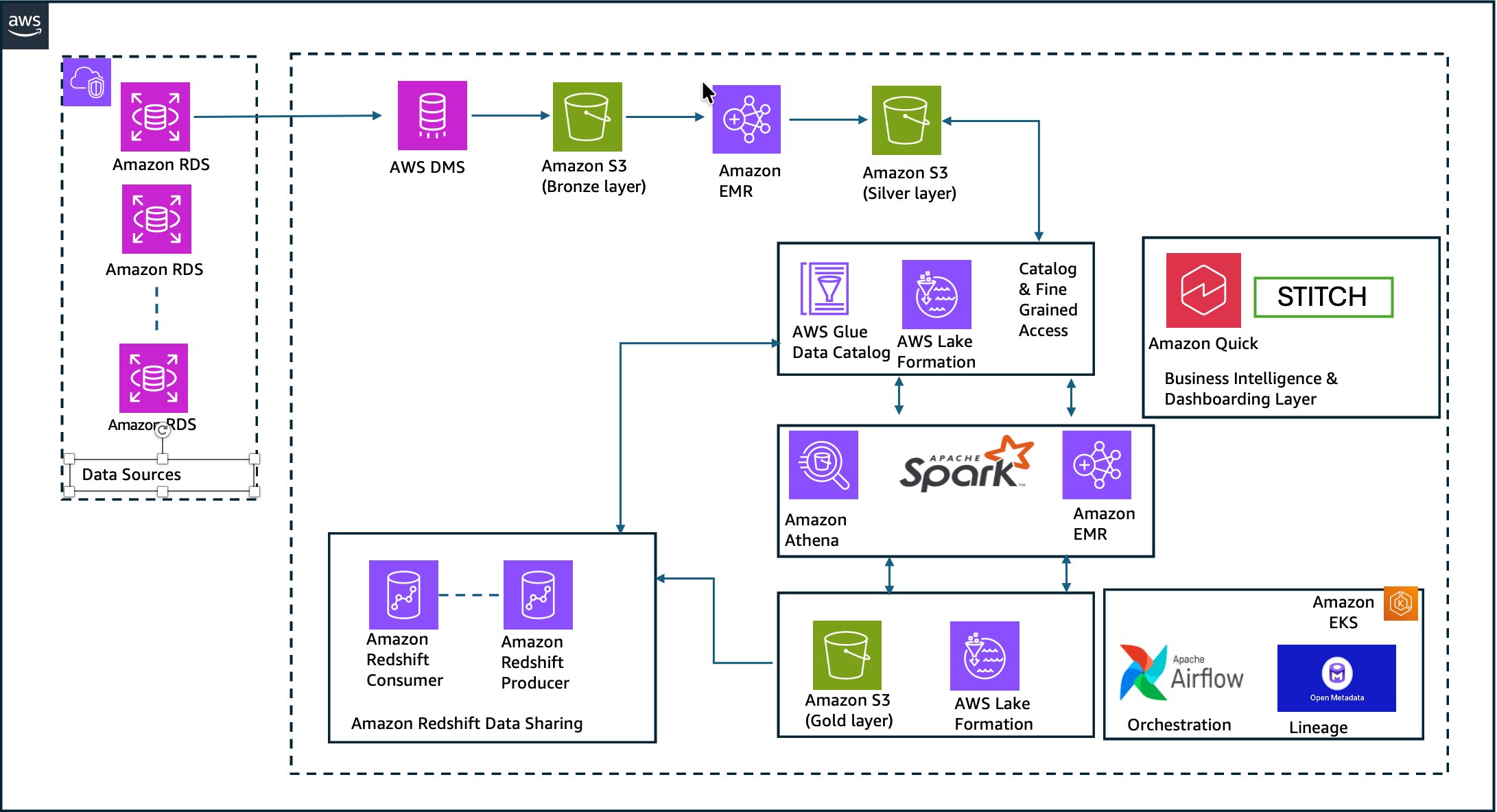
Detailed lakehouse data flow across bronze, silver, and gold medallion layers on AWS

Data ingestion: Enabling continuous replication

AWS Database Migration Service (AWS DMS) ingests data from online transaction processing (OLTP) databases running on Amazon Relational Database Service (Amazon RDS) into the lakehouse on AWS.

This method continuously replicates data with minimal latency, so your analytics reflect near real-time business operations.

Storage and governance: Building a solid foundation

The lakehouse is built on Amazon Simple Storage Service (Amazon S3) and Amazon Redshift, which serve as the centralized data lake and warehouse following a medallion architecture.

The architecture persists all analytical data using Apache Iceberg as the open table format. Iceberg provides a robust foundation for large-scale analytics with the following capabilities:

  • ACID transactions: Guarantees data consistency and correctness across concurrent read and write operations.
  • Time travel: Supports querying historical table versions for auditing, troubleshooting, and recovery.
  • Schema evolution: Allows schema changes without disrupting existing queries or downstream pipelines.

The medallion architecture structures data across three logical layers within the lakehouse:

  • Bronze layer: Implements change data capture (CDC)-based source replication using AWS DMS. Raw change events flow into Amazon S3 as Apache Parquet files in their original format from source systems, preserving the complete change history. The data pipeline processes and deduplicates these events using Apache Spark on Amazon EMR to create and maintain Apache Iceberg tables that act as replicated source tables.
  • Silver layer: Represents the conformed data model, where data is cleansed, standardized, and validated with enforced quality checks. This layer contains core dimension and fact tables, modeled for analytical consistency and reuse across domains. Data is stored as Apache Iceberg tables on Amazon S3, making it reliable and performant for downstream analytics and transformations.
  • Gold layer: Provides business-ready data marts and wide tables optimized for reporting, dashboarding, and domain-specific use cases. These datasets are curated to align with business metrics and key performance indicators (KPIs) and are served from Amazon Redshift, using Iceberg-backed tables to deliver fast, scalable analytics for business intelligence (BI) tools and end users.

This layered approach maintains a clear separation of concerns across raw ingestion, analytical modeling, and business consumption, while supporting scalability and flexibility across the organization. AWS Lake Formation enforces fine-grained data access controls, and the AWS Glue Data Catalog centrally manages metadata across Amazon S3 and Amazon Redshift, ensuring consistent data discovery and governance across the analytics ecosystem.

Data processing: Flexibility and performance

For data processing and transformations, BigBasket uses Amazon EMR with Apache Spark and dbt, orchestrated by Apache Airflow running on Amazon Elastic Kubernetes Service (Amazon EKS) as the core compute layer of the lakehouse. Apache Spark on Amazon EMR handles large-scale distributed processing, including CDC deduplication, incremental transformations, and complex data reshaping. Apache Iceberg serves as the open table format, which provides several critical capabilities.

dbt is used to define and execute transformation logic using SQL, managing the build of data models such as staging, intermediate, and final tables on top of the raw data. dbt uses the dbt-Trino adapter to run these transformations using the Trino engine, materializing the results as Apache Iceberg tables in Amazon S3. This approach provides a simple, modular, and governed way to manage transformations while taking advantage of Iceberg’s transactional guarantees.

These features are necessary for production lakehouse implementations and help you avoid vendor lock-in while maintaining enterprise reliability.

Online analytical processing (OLAP) and analytics: Hybrid approach for cost optimization

The analytics layer uses a hybrid approach that you can adapt based on your query patterns:

  • Amazon Redshift: For querying of active, frequently accessed data from the Gold layer.
  • Amazon Athena: For ad-hoc queries on historical data.
  • Apache Trino: For federated queries across multiple data sources while powering dbt-driven transformations directly on Apache Iceberg tables.

This hybrid strategy optimizes costs by keeping frequently accessed data in Amazon Redshift while querying historical data directly from Iceberg tables in Amazon S3. Amazon Redshift data sharing supports a multi-warehouse architecture for cross-team collaboration, allowing different teams to access shared datasets without data duplication.

Orchestration: Managing complex workflows

Apache Airflow running on Amazon EKS orchestrates and schedules data pipelines across the entire environment, providing visibility and control over complex workflows. This gives you a unified view for monitoring and managing your data operations.

Machine learning integration

Amazon SageMaker AI powers machine learning workloads for predictive analytics and model training directly on lakehouse data, from demand forecasting to delivery optimization. This tight integration means your data scientists can work with the same governed data that powers your analytics.

Visualization: Making insights accessible

Amazon Quick Sight provides data visualization and business intelligence reporting capabilities, making insights accessible to business users across the organization without requiring technical expertise.

Special focus: Clickstream data processing

BigBasket implemented a sophisticated dual-path architecture for processing clickstream data from mobile apps and web interactions:

  • Real-time path: Data flows through Scala stream collectors on Amazon Elastic Compute Cloud (Amazon EC2) (behind Elastic Load Balancing) to Amazon Kinesis Data Streams and Amazon OpenSearch Service for immediate insights into customer behavior. This path is necessary when you need to react to user actions within seconds, for example detecting fraud or personalizing experiences in real time.
  • Batch path: The batch path validates data, stores it in Amazon S3, processes it through Amazon EMR, and loads it into Amazon Redshift for comprehensive historical analysis. This path handles data quality checks, enrichment, and aggregation for long-term analytics.

The trade-off between these approaches is latency versus completeness. Real-time processing gives you speed but may sacrifice some data quality checks, while batch processing provides accuracy but introduces delay. This dual approach achieves both immediate operational insights and deep analytical capabilities, letting you optimize for different use cases.

The following diagram shows how the clickstream data is handled and effectively processed today.
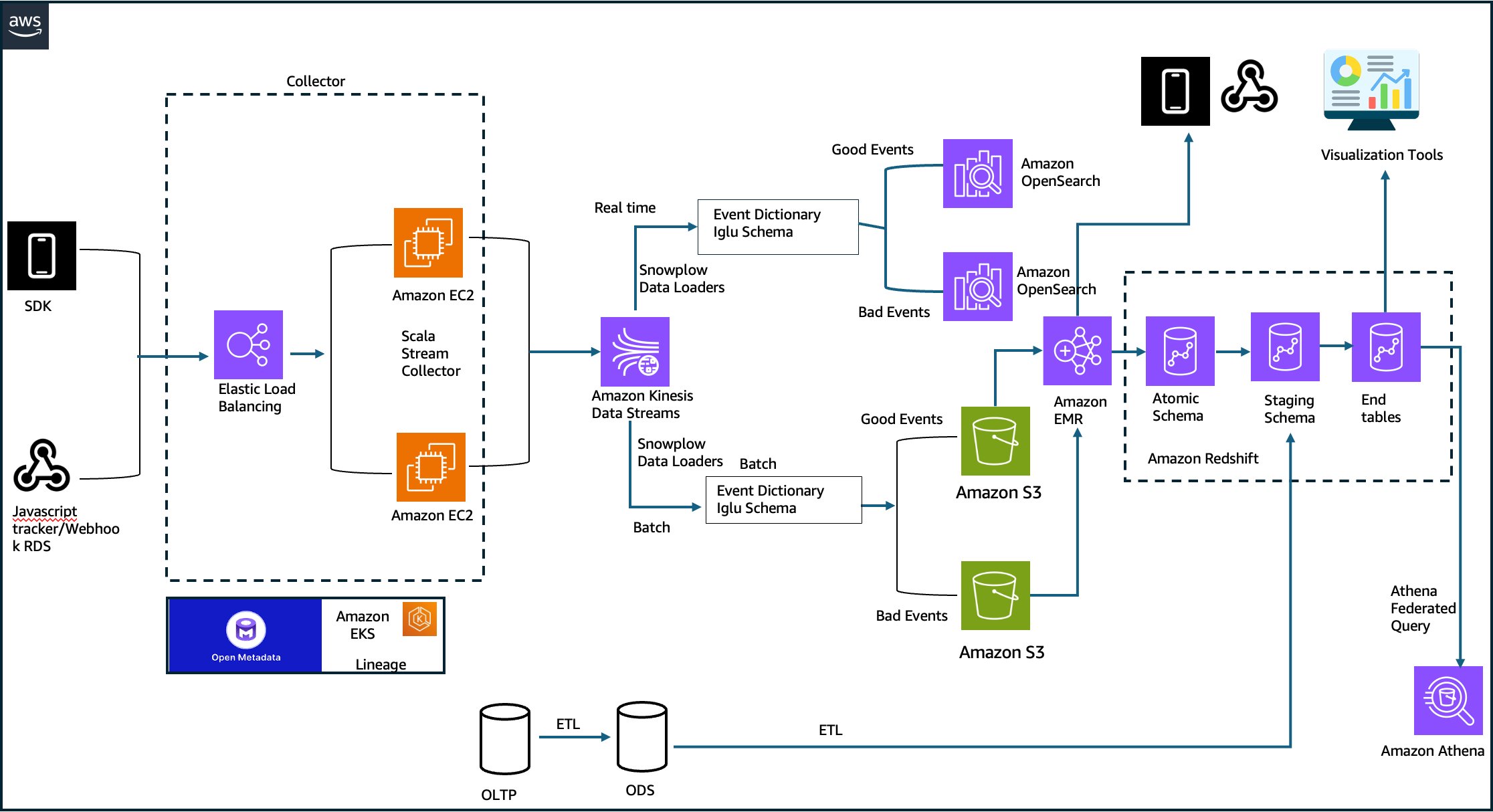
BigBasket’s dual-path clickstream processing architecture with real-time and batch paths on AWS

The results: measurable business impact

The data platform transformation achieved significant results across multiple dimensions:

Technical improvements

  • Near real-time data: Achieved near real-time data availability for dashboards within 3–5 minutes, replacing previously day-old data.
  • Rapid failure recovery: Pipeline failure re-runs now complete in minutes instead of hours.
  • Comprehensive governance: Full control over data governance with robust observability, lineage, data accuracy, and consistency.
  • Enhanced scalability: Successfully handling over 35,000 reports and dashboards with over 1,000 dataset refreshes.

Business outcomes

  • On-time delivery: Improved monitoring with real-time insights on low-performing stores.
  • Stock availability: Reduced operational issues with visibility into key bottlenecks.
  • Stock forecasting: Improved accuracy and availability of top-selling SKUs.
  • Dark store productivity: Enhanced productivity of warehouse executives across all operations.

Key takeaways: lessons for modern data platforms

BigBasket’s journey offers valuable insights for organizations facing similar challenges:

  1. Quick commerce needs quick observability. In the fast-paced world of quick commerce, faster decision-making directly improves business metrics. Real-time data isn’t a luxury. It’s a necessity.
  2. Embrace ELT for real-time needs. Shifting from traditional ETL to an extract, load, transform (ELT) pattern within a lakehouse architecture is important to unlock near real-time analytics capabilities.
  3. A lakehouse delivers speed and governance. Modern lakehouse architectures don’t force trade-offs. You can achieve both fast data availability and comprehensive control, lineage, and accuracy.
  4. Focus on operational resilience. Designing for rapid failure recovery (re-runs in minutes, not hours) is necessary for maintaining data availability and business trust, especially in customer-facing operations.
  5. Incremental migration. You don’t need to rebuild everything. Evolve your current Amazon S3 data lake or reuse your existing investments in Amazon Redshift to build the data lakehouse capabilities.

The road ahead

BigBasket continues to innovate, now moving to adopt Amazon SageMaker Unified Studio to access all lakehouse components in a simplified manner across the enterprise. This next evolution will further streamline data access and accelerate insights across teams.

The company’s transformation demonstrates that with the right architecture and AWS services, organizations can turn data infrastructure challenges into competitive advantages, delivering not only better analytics but better customer experiences.

As you plan your own lakehouse implementation, use these patterns and lessons learned to accelerate your journey and avoid common pitfalls.
About the authors

Naga Sandeep Grandhi

Naga Sandeep Grandhi

Sandeep is an engineering leader at BigBasket, driving data platform and cloud architecture initiatives, including the next-gen data lake built for scale, reliability, and real-time insights.

Vikram Kumar

Vikram Kumar

Vikram is a Principal Engineer at BigBasket, where he leads the data engineering team. He specializes in designing and scaling modern data platforms on AWS, enabling BigBasket to process large-scale data efficiently and power data-driven decision-making across the organization.

Annie Mattoo

Annie Mattoo

Annie is a Sr. Analytics Specialist at AWS, bringing over 15+ years of expertise in helping customers with their DATA & AI journeys. She has successfully led customer teams to seamlessly adopt AWS Data & AI services and has worked with Fortune 500 customers across the globe in her previous roles.

Vineet Thapliyal

Vineet Thapliyal

Vineet is an Enterprise Account Manager at Amazon Web Services (AWS) in Bengaluru, India, where he manages strategic cloud and generative AI engagements across some of India’s largest conglomerates spanning energy, retail, and technology. He is passionate about helping enterprises unlock business value through AI/ML, cloud modernization, and industry-specific innovation — from renewable energy analytics to retail transformation at scale.

Anirudh Chawla

Anirudh Chawla

Anirudh is an Analytics Solution Architect at AWS. He helps organization empowers businesses to harness their data effectively through AWS’s analytics platform. His interest lies in building highly available distributed systems.

Real-time analytics: Oldcastle integrates Infor with Amazon Aurora and Amazon Quick Sight

Post Syndicated from Avdhesh Paliwal original https://aws.amazon.com/blogs/architecture/real-time-analytics-oldcastle-integrates-infor-with-amazon-aurora-and-amazon-quick-sight/

This post is cowritten with Avdhesh Paliwal from Oldcastle.

Oldcastle APG is one of the largest suppliers of construction materials in North America, including asphalt and concrete. The company also provides construction and paving services across more than 150 facilities. As the company migrated from on-premises systems to Infor Cloud ERP hosted on Amazon Web Services (AWS), they faced a critical challenge: maintaining the real-time operational reporting capabilities that hundreds of users across customer service, finance, logistics, and manufacturing depended on daily.

This post explores how Oldcastle used AWS services to transform their analytics and AI capabilities by integrating Infor ERP with Amazon Aurora and Amazon Quick Sight. We discuss how they overcame the limitations of traditional cloud ERP reporting to deploy real-time dashboards and build a scalable analytics system. This practical, enterprise-grade approach offers a blueprint that organizations can adapt when extending ERP capabilities with cloud-native analytics and AI.

Challenges with cloud ERP reporting

The primary challenge that we faced was finding a solution that could accomplish the following:

  • Maintain real-time data access – Our on-premises environment supported hundreds of complex real-time reports, but Infor ERP Cloud’s configuration-based reporting covered minimal reports of our operational needs.
  • Support complex reporting requirements – Users needed multi-dimensional analysis across customer service, finance, logistics, and manufacturing functions.
  • Provide seamless user experience – Business users demanded integrated reporting within the ERP network without switching between multiple systems.
  • Enable advanced analytics –We needed capabilities for demand forecasting, machine learning (ML) capabilities, and intelligent search across real-time data.
  • Scale efficiently – The solution needed to support over 100 concurrent users and process millions of transactions while maintaining performance.
  • Expose Data using API – The solution needed to expose data through APIs, allowing both external and internal applications to access and consume the data securely and efficiently.

Our existing batch reporting process created significant operational challenges across our organization. We had to wait for batch reports, which consumed valuable time and led to delays in critical decision-making across many of our teams. This lag prevented us from capitalizing on real-time business insights and responding quickly to operational issues or economic changes. Without immediate data visibility, our managers couldn’t make timely, data-driven decisions, resulting in missed opportunities for improvement and competitive advantage. Our IT team also struggled with constant report requests but lacked a scalable system to deliver them efficiently, further compounding the productivity loss across our organization.

Solution overview

AWS Solutions Architects worked closely with our application team to build a comprehensive analytics and AI solution to address these challenges. The architecture uses Infor Data Fabric Stream Pipelines to deliver real-time data to AWS. It powers operational dashboards, artificial intelligence and machine learning (AI/ML) models, and intelligent search capabilities. This approach aligns with Infor’s broader strategy of integrating ERP data, data lake information, machine learning (ML) predictions, and documentation to provide comprehensive end-to-end business solutions.

Real-time data streaming architecture

The foundation of our solution is Infor’s Data Fabric Stream Pipelines, an add-on feature that provides real-time streaming data processing. When data events are ingested into Data Fabric, Stream Pipelines processes them immediately and continuously without waiting for storage in the data lake. This approach minimizes the data journey and accelerates operations, helping us extract insights from our data in real time.

The end-to-end workflow consists of the following components:

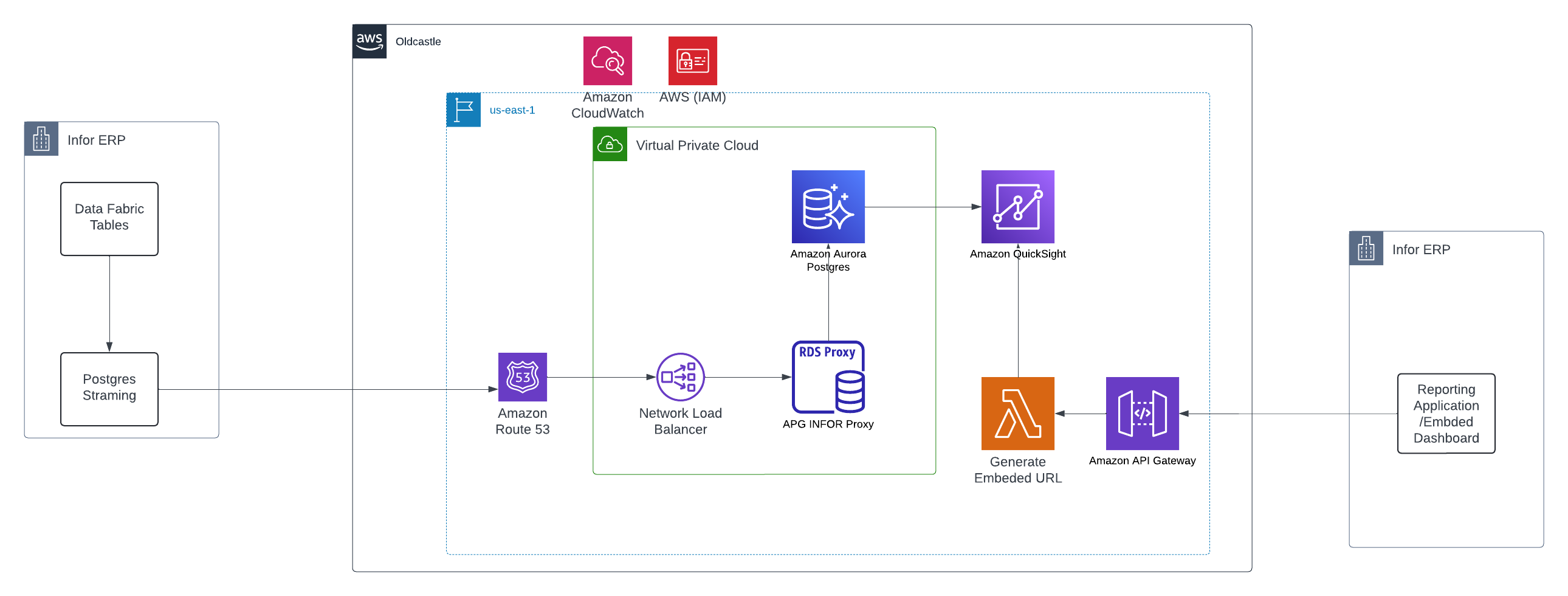
Data ingestion – Infor Data Fabric tables stream changes in real-time. We enabled Stream Pipelines as an add-on feature within our Infor Cloud ERP environment. We Configure the specific ERP table that we want to stream (such as sales orders, inventory, financial transactions) to publish change events immediately upon data modification. Stream Pipelines captures insert, update, and delete operations with metadata about the operation type and timestamp.

Load distribution – Because Infor can’t reach our private VPC directly, we use Elastic Load Balancing (ELB) to distribute traffic and provide secure database access. We implemented a Network Load Balancer (NLB) with static Elastic IP addresses in public subnets, giving us stable, allowlisted IP addresses for Infor’s outbound connections. We configured an Amazon Relational Database Service (Amazon RDS) router with Amazon Elastic Compute Cloud (Amazon EC2) instances as NLB targets. These routers forward traffic from the NLB to our Amazon Aurora database in the private subnet using iptables NAT rules. This makes sure that even if the IP of Aurora changes during failover, our static Elastic IPs remain constant. We configured security groups to accept HTTPS traffic (port 443) only from Infor’s IP ranges on the NLB and allow traffic only from the NLB to the RDS routers.

Connection management – We use Amazon RDS Proxy to manage database connections and provide automatic failover. We deployed RDS Proxy in the private subnet between our RDS router instances and Aurora cluster to pool and reuse connections. This is critical for handling our high-frequency streaming data. We configured the proxy with IAM authentication for secure credentials and set connection pool parameters based on our expected concurrent stream volume to handle burst traffic without overwhelming the database. With automatic failover enabled, if our primary Aurora instance fails, RDS Proxy automatically redirects traffic to the promoted replica, maintaining continuous data flow.

Data storage – We store our operational data in Amazon Aurora PostgreSQL- Compatible Edition with multi-Availability Zone deployment for high availability. We provisioned an Aurora PostgreSQL cluster with one writer instance and multiple reader instances across different Availability Zones. We designed our database schema to handle the incoming streaming data, storing it in JSONB columns for flexible querying while using the native JSON functions of Aurora PostgreSQL when we need to parse and normalize specific fields. We created indexes on frequently queried fields to maintain query performance as our data volume grows. We also configured automated backups with point-in-time recovery and set up the automatic storage of Aurora scaling to accommodate our data growth.

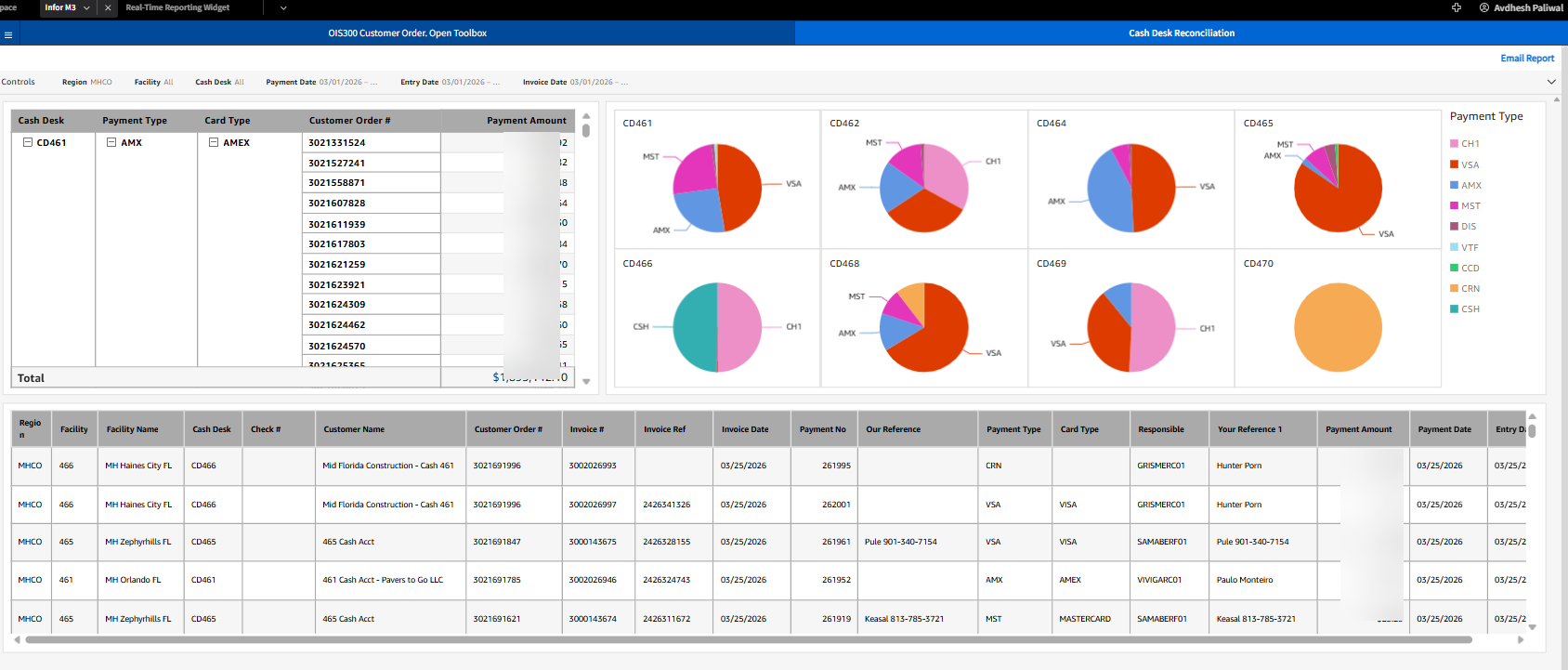
Analytics and visualization – Amazon Quick Sight delivers the interactive dashboards and pixel-perfect reports our teams need. We created a Quick Sight account and established a connection to our Aurora PostgreSQL database using VPC connectivity with credentials stored in AWS Secrets Manager. We identified which datasets benefit from SPICE (Super-fast, Parallel, In-memory Calculation Engine) caching—typically aggregated or frequently accessed data—and configured incremental refresh schedules to keep them current. We built our dashboards using the visual interface of Quick Sight, using calculated fields for business logic, parameters for user interactivity, and row-level security rules to make sure that users only see data that they’re authorized to access. For pixel-perfect reports, we use the pixel-perfect report feature of Quick Sight to create formatted documents suitable for printing or regulatory compliance.

Embedded integration – We securely embedded Amazon Quick Sight dashboards within Infor OS through Amazon API Gateway, which generates dynamic URLs for seamless user access. We enabled Quick Sight embedding in our AWS account and registered our Infor domain. We created an API Gateway REST API with Lambda functions that authenticate users, validate Infor session tokens, and call QuickSight’s GenerateEmbedUrlForRegisteredUser API to produce time-limited, signed URLs with row-level security. Our Lambda function maps Infor user roles to Quick Sight permissions and applies dashboard filters based on the user’s organizational context. We configured CORS settings in API Gateway to allow requests from our Infor domain and implemented rate limiting. On the Infor side, we embedded the Quick Sight dashboards using iframe elements that call our API Gateway endpoint, providing a seamless experience where our users access analytics without leaving the ERP interface.

The following diagram illustrates the real-time analytics architecture:

Architecture diagram showing Infor ERP data flowing via Postgres streaming through Amazon Route 53, a Network Load Balancer, and RDS Proxy to Amazon Aurora PostgreSQL inside a VPC, with Amazon QuickSight for visualization and Amazon API Gateway plus Lambda generating embedded dashboard URLs for a reporting application. Amazon CloudWatch and IAM provide monitoring and access control.

This embedded experience aligns with Infor’s broader system strategy of integrating insights seamlessly into workflows.

Results and business impact

The implementation using this architecture on AWS brought substantial benefits, directly addressing the critical challenges that we faced and demonstrating measurable value in employee productivity and core business process optimization.

Business process improvement

The solution successfully addressed Oldcastle’s key operational challenges:

Challenge: Limited visibility into real-time operations

– Solution delivered: Deployed over 50 complex dashboards and reports in eight months, providing immediate visibility across customer service, finance, logistics, and manufacturing.- Technical achievement: Used Infor Data Fabric Stream Pipelines to process data events immediately upon ingestion, alleviating delays from traditional batch processing.- Impact: Real-time streaming architecture using the NDJSON format makes sure decision-makers have access to current operational data when they need it most.

Challenge: Fragmented user experience requiring multiple systems

– Solution delivered: Dashboards embedded directly into the Infor environment through Amazon API Gateway.- Technical achievement: Generated dynamic URLs for secure embedding with single sign-on capabilities.- Impact: Users access insights without leaving their familiar interface, with personalized views based on roles and permissions that maintain context across the application.

Screenshot of an Amazon QuickSight dashboard embedded in Infor M3, showing a Cash Desk Reconciliation report with a transaction table on the left, pie charts breaking down payment types (Visa, Amex, Mastercard, Cash) by cash desk location, and a detailed transaction grid below with customer order numbers, invoice dates, and payment amounts.

Challenge: Inflexible reporting limiting business agility

– Solution delivered: Both interactive dashboards and pixel-perfect reports are available to meet diverse business needs.- Technical achievement: Quick Sight SPICE caching enables subsecond response times on complex analytics across large datasets.- Impact: On-demand access for immediate insights, scheduled distribution, custom formatting aligned with corporate standards, and multiple export formats (PDF, CSV, Excel).

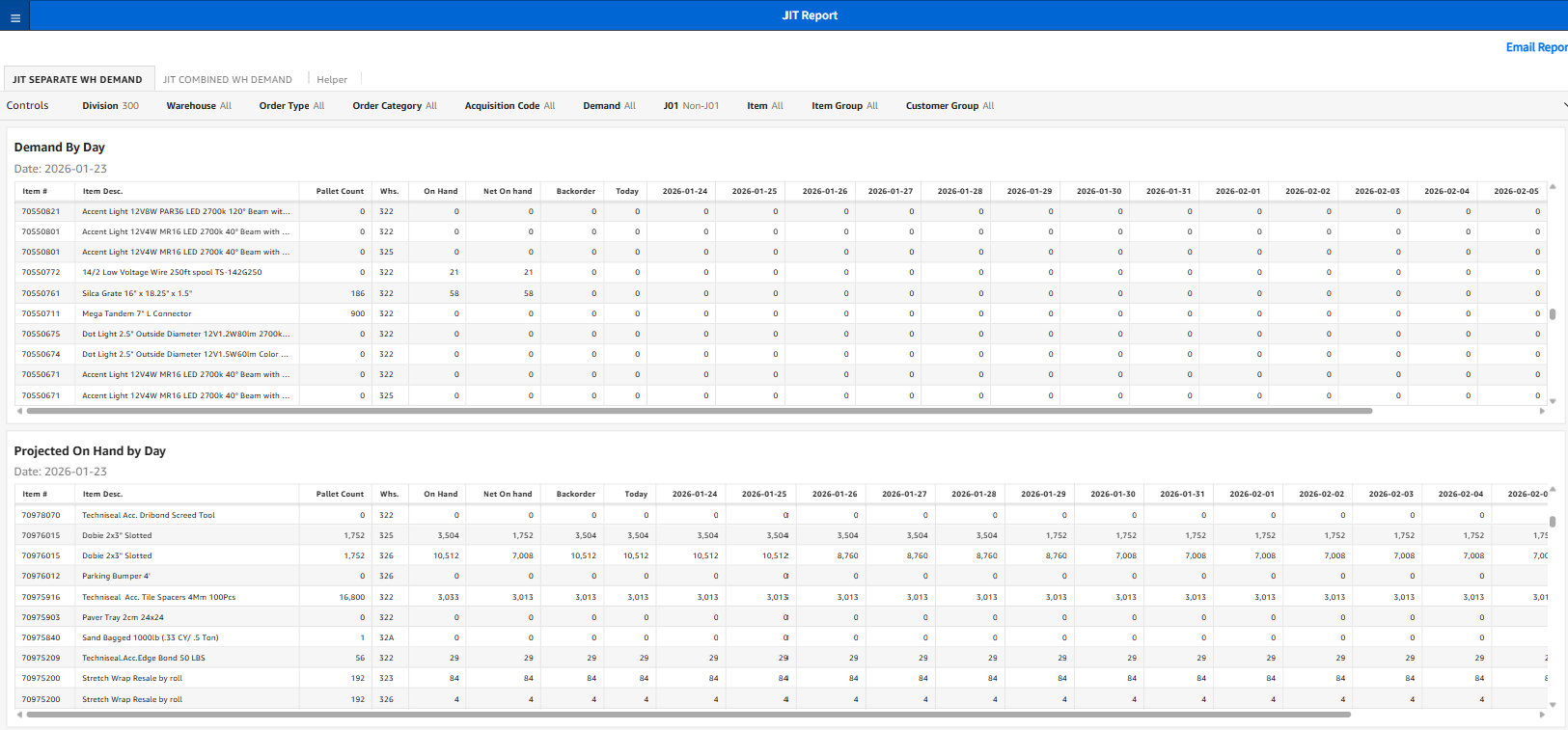
Screenshot of a JIT Report embedded in an ERP application showing two sections: Demand By Day and Projected On Hand by Day. Each section displays a grid of inventory items with daily quantity columns spanning multiple weeks, with backorder and on-hand counts highlighted in blue for items requiring attention.

Challenge: Delayed decision-making due to outdated data

– Solution delivered: Real-time visibility into operations enabled faster, data-driven decisions.- Technical achievement: The Multi-AZ deployment of Amazon Aurora PostgreSQL maintains high availability and continuous data access.- Impact: Decision-makers can respond immediately to operational issues and economic changes with current, reliable data.

Scalability and performance

The architecture delivered exceptional scale and performance, addressing concerns about future growth: – High concurrency: Supports over 100 concurrent users without performance degradation- Data volume handling: Processes millions of transactions daily in real-time- Elastic scaling: Aurora read replicas automatically scale based on demand- Future-ready: Architecture designed to expand to additional regions and use cases- Cost efficiency: AWS services avoided complex third-party integrations, with infrastructure costs scaling efficiently with business growth- API capabilities: Ability to expose data using AWS technologies enables integration with third-party and internal applications

Conclusion

Our journey proves that cloud ERP migrations don’t require sacrificing real-time operational reporting capabilities. By combining Infor Data Fabric Stream Pipelines with AWS analytics and AI services, we’ve maintained real-time data access, accelerated innovation, improved user experience, and built a system that scales efficiently as our business needs evolve. The combination of Infor’s enterprise-grade ERP system with the comprehensive analytics capabilities of AWS has given us the best of both worlds. As we expand our AWS analytics and AI capabilities, we’re not just maintaining parity with on-premises systems, we’re unlocking new sources of business value that weren’t possible before.

Further reading

For more information on the services mentioned in the post, see the following resources:

AWS services:

  • Amazon Aurora PostgreSQL Features – Learn more about the high-availability database that powers Oldcastle’s real-time data storage and Multi-AZ deployment strategy
  • Amazon Quick Sight Embedded Analytics – Explore how to embed interactive dashboards and pixel-perfect reports directly into your enterprise applications, as demonstrated in Oldcastle’s Infor OS integration
  • Amazon Bedrock for Generative AI – Discover opportunities to enhance your analytics system with AI-powered insights and intelligent search capabilities
  • Elastic Load Balancing – Understand how to distribute traffic and secure database connections when integrating cloud ERP systems with AWS services
  • Amazon API Gateway – Learn how to create secure, dynamic URLs for embedding analytics and exposing data through APIs to internal and external applications

Infor Resources:


About the authors