Tag Archives: Christmas

Offline celebrations: how Christmas, NYE, and Lunar New Year festivities shape online behavior

Post Syndicated from João Tomé original https://blog.cloudflare.com/offline-celebrations-how-christmas-nye-and-lunar-new-year-festivities-shape-online-behavior/

Now that 2025 has been here for a few weeks and 2024 has closed with a variety of year-end traditions — from Christmas and Hanukkah celebrations to New Year’s Eve (NYE) countdowns, as well as celebrations of Orthodox Christmas, and Lunar/Chinese New Year — let’s examine how these events have shaped online behavior across continents and cultures. Reflecting on Christmas and NYE 2024 provides insights into how these trends compared with those of the previous year, as detailed in an earlier blog.

One notable finding is the remarkable consistency in human online patterns from one year to the next, a trend that persists despite cultural differences among countries. Data from over 50 countries reveal how people celebrated in 2024–2025, offering a timely reminder of typical holiday trends. While Christmas remains a dominant influence in many regions, other cultural and religious events — such as Hanukkah and local festivities — also shape online habits where Western traditions hold less sway.

In regions where Christmas is deeply rooted, Internet traffic dips significantly during Christmas Eve dinners, midnight masses, morning gift exchanges, and Christmas Day lunches, a pattern evident in both our previous and current analyses.

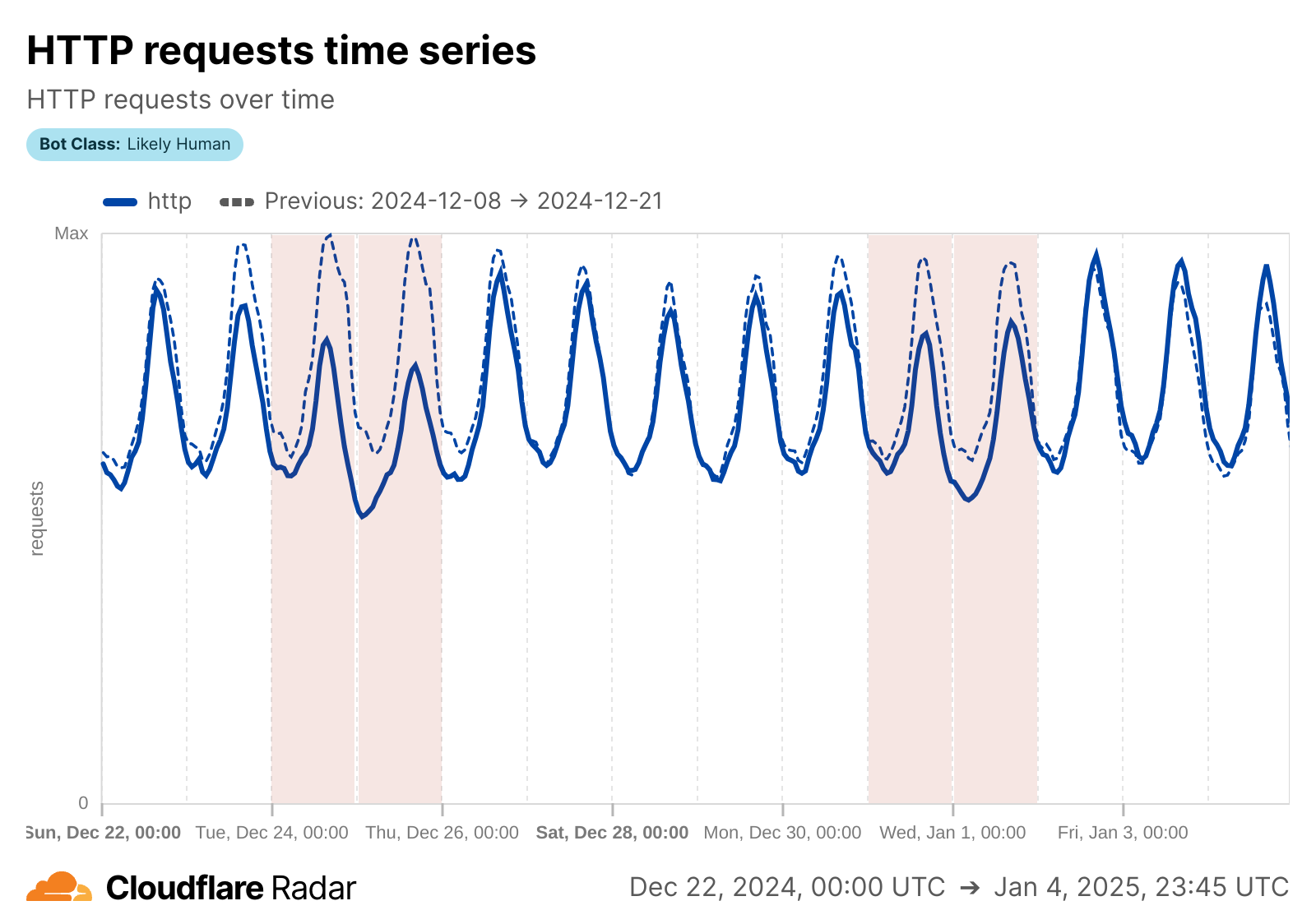
This analysis focuses exclusively on non-bot Internet traffic, filtering out automated activity to highlight genuine human behavior during the most recent holiday season. Before going into specific countries, here’s a global hourly snapshot (UTC-based) of Christmas and New Year’s Eve 2024 traffic from the Cloudflare Radar Data Explorer


This worldwide perspective captures notable drops across a 23-hour window, from New Zealand to Hawaii. Globally, December 25 saw a 19% drop in traffic from the previous week, followed by December 24 with a 14% drop. This holiday period also included the four days with the lowest global traffic during the period between October 1, 2024, and February 6, 2025. In descending order, these days were: December 25, December 24, January 1, 2025, and December 31, 2024.

Some key takeaways:

  • Europe: Christmas Eve drops in Internet traffic reached up to 67% (seen in Denmark; Spain reached 66%).

  • Americas: December 25 was key, with drops ranging from 26% in the US and up to 70% at midnight in Argentina.

  • Regional timing differs: Nordic countries on Christmas Eve disconnect earlier at around 18:00, Southern Europe at 21:00-22:00, and Latin America even later.

  • New Year’s shows worldwide impact, strongest in Latin America: a 73% drop in Chile, followed by 68% drop in Argentina.

  • Lunar New Year: January 29 is a peak offline moment, with drops of 25% in Hong Kong, 23% in Singapore, and 24% in Vietnam.

Note: Unless otherwise noted, all times used in this blog post are local ones; in countries with several timezones, we’re using the timezone where more people live. For the US, Eastern time is used.

Global Christmas and New Year’s Eve daily trends

In this analysis, we apply the same methods as our previous blog post to rank countries and regions by their lowest holiday traffic dates, showing each day’s percentage drop. Many locations, such as the United States, experience clear dips on December 24 and 25 as people disconnect for Christmas Eve and Christmas Day celebrations. In contrast, some regions show smaller declines on December 31 as the New Year approaches. The order and magnitude of these drops vary by country, reflecting cultural nuances — some nations register their largest drop on Christmas Eve, others on Christmas Day, and still others exhibit unique patterns around New Year’s Eve or January 1.

Below is a world map highlighting where traffic dropped the most on December 24 or 25; darker colors indicate larger drops based on our analysis.

In the following table, we provide more details than can be shown in the map. The data focuses only on locations that had their lowest traffic days between December 24-25 and December 31-January 1, along with the respective percentage drop on each of those days compared to the previous week (where applicable).

Top days with the lowest Internet traffic in December 2024 – January 2025

(with respective percentage drops, if any, from the previous week)

Location

December 24

December 25

December 31

January 1

Denmark

-42%

-19%

Portugal

-34%

-29%

Poland

-33%

-24%

Norway

-33%

-15%

Spain

-31%

-26%

Switzerland

-30%

-28%

Finland

-30%

-22%

Austria

-29%

-19%

Ireland

-28%

-31%

Chile

-28%

-25%

-5%

Czech Republic

-28%

-16%

Sweden

-28%

-11%

Colombia

-26%

-35%

-5%

-8%

Italy

-26%

-31%

-1%

Argentina

-25%

-30%

-3%

Belgium

-25%

-23%

-1%

France

-24%

-24%

Mexico

-24%

-21%

-1%

Germany

-24%

-16%

United Kingdom

-22%

-32%

Brazil

-22%

-23%

-2%

-1%

United States

-21%

-26%

Canada

-20%

-22%

Netherlands

-19%

-30%

-8%

Australia

-19%

-29%

New Zealand

-18%

-27%

Greece

-17%

-22%

-5%

Romania

-16%

-12%

-7%

South Africa

-12%

-31%

-4%

Nigeria

-10%

-17%

Japan

-6%

-6%

Philippines

-4%

-6%

-5%

-3%

In cultures with a strong Christmas tradition — mostly in the West — people generally go offline on Christmas Eve (December 24) or Christmas Day (December 25). In regions where Christmas is less culturally significant, key offline moments occur on other dates, such as December 31 or January 1.

In Europe, most countries (including Denmark, Norway, Spain, Portugal, Switzerland, Finland, Czech Republic, Germany, France, Poland, Sweden, Austria, the United Kingdom, Italy, Ireland, Belgium, and Romania) experience their largest traffic drop on December 24, making Christmas Eve the primary offline moment. Some countries also exhibit a less significant drop in traffic on December 25 or December 31.

North America and Latin America display similar patterns, with the United States, Canada, and Mexico showing the largest drop on December 25. In Latin America — specifically in Argentina, Chile, and Colombia — December 25 also sees a significant decline, though in some cases January 1 emerges as a key offline moment, indicating slight variations in local celebration timing.

In Asia, the traffic drops are milder. For example, Japan experienced only modest declines on December 24 and 25, while in the Philippines, January 1 recorded a 3% drop compared with December 25, which had a 6% drop from the previous week. In Hong Kong, Singapore, and Malaysia, the influence of Lunar/Chinese New Year is more pronounced; however, Christmas Day 2024 still registered noticeable declines of 12%, 13%, and 9% in these locations, respectively. Meanwhile, in Indonesia and Turkey, December 31 is their peak low-traffic day, suggesting that Christmas plays a less central role in their offline behavior.

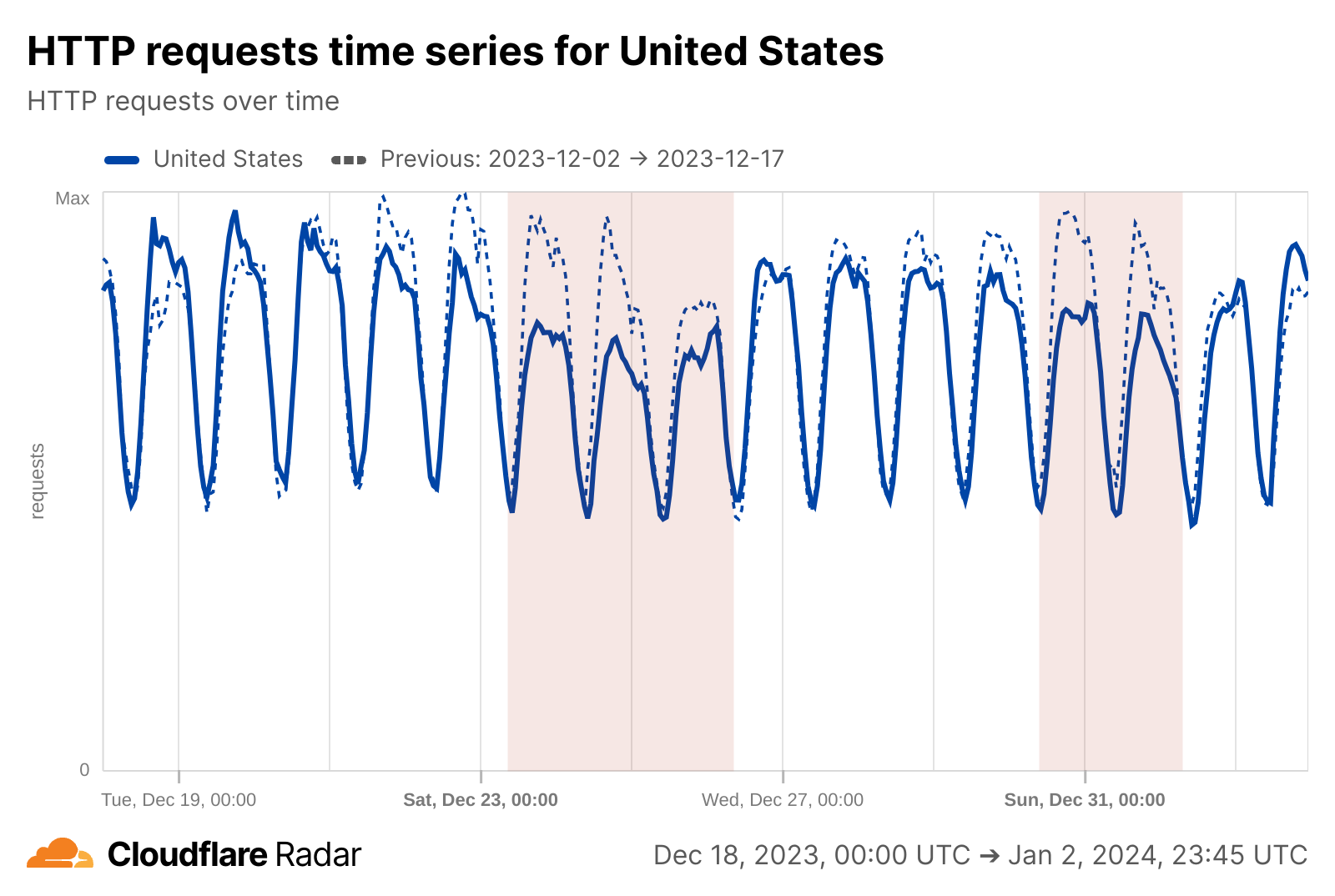
As an example, here’s the US perspective from Cloudflare Radar Data Explorer, where the drop in traffic during Christmas 2024 and New Year’s 2025 is evident:


Comparing Christmas 2023 with 2024, most European regions experienced a stronger traffic drop on their key Christmas day — whether December 24 or December 25 — than in the previous year. The ranking of the days with the lowest traffic sometimes shifts, with new dates such as December 23 or January 1 entering the top three. In North and Latin America, while December 24 and 25 remain important, January 1 has also emerged in several cases. 

Orthodox Christmas impact

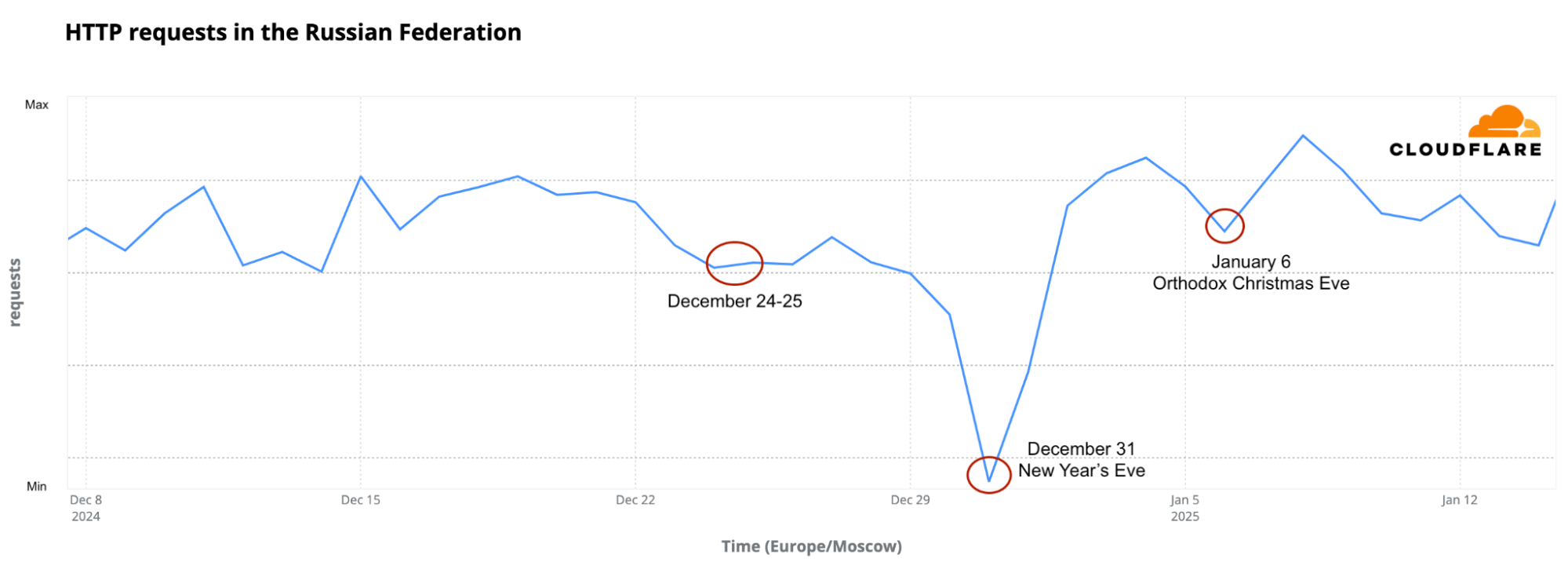
In countries that celebrate Orthodox Christmas (January 7), Internet traffic follows a distinct pattern. During the December 25 Christmas period, the drops are relatively modest — for example, Russia sees a 6% decrease on December 25, while Romania and Ukraine register declines of 16% on December 24 and 12–13% on December 25. However, because traffic falls significantly on December 30–31 — even more so than on December 24–25 — the levels on January 6–7 are considerably higher compared with the previous week. In fact, a notable surge occurs on January 7 compared with December 31, with traffic increasing by 30% in Russia, 32% in Romania, 24% in Ukraine, 31% in Belarus, and 15% in Kazakhstan.

Below is a daily chart of Internet traffic in Russia, which clearly shows the December 30–31 drop and a strong rebound in the following days of the new year. Notably, there is a slight decline on January 6, 2025 — the Orthodox Christmas Eve — registering a 4% drop compared with the previous day.

Where Christmas isn’t central

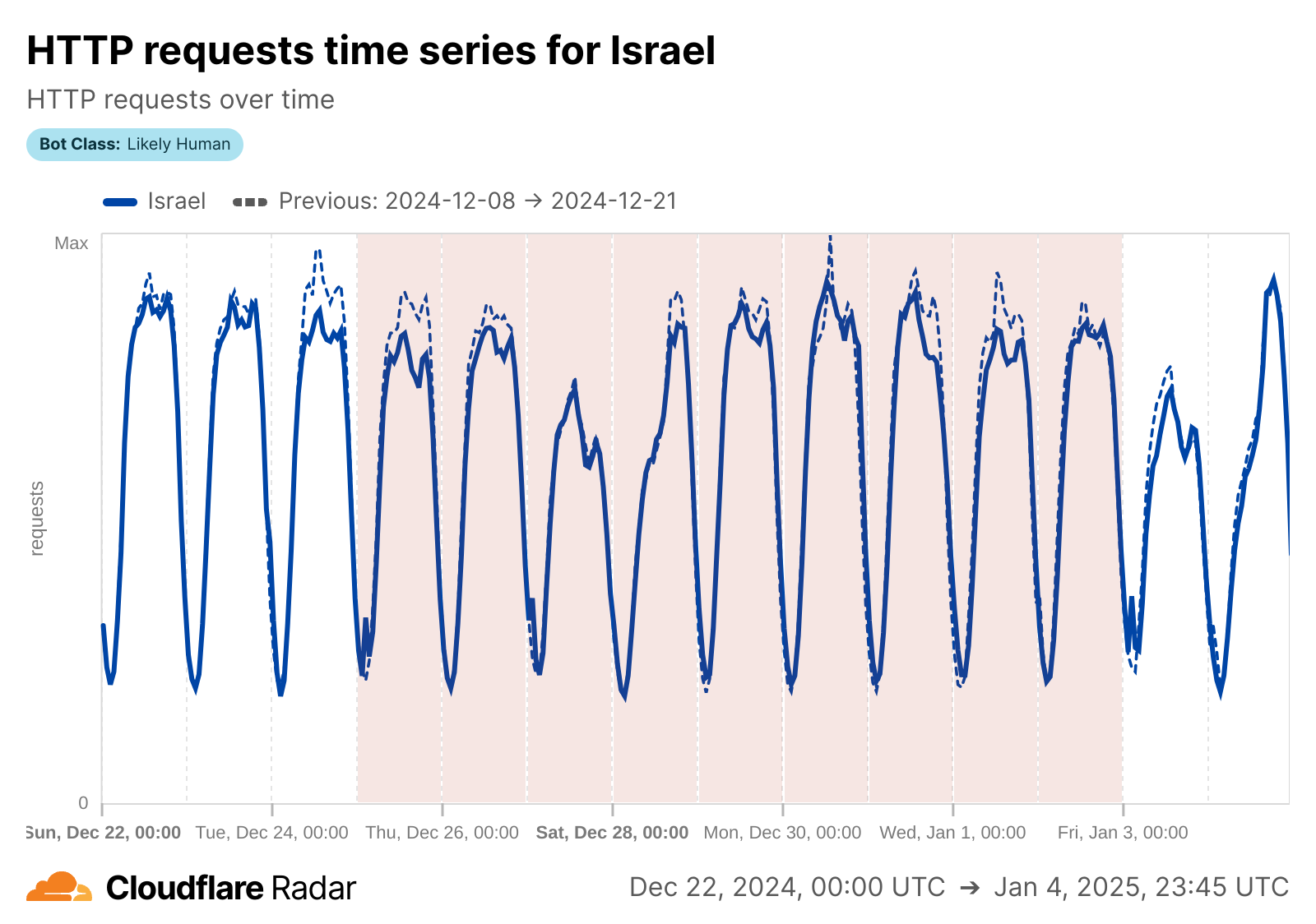
Not every country’s December revolves around Christmas. Hanukkah’s timing changes each year, influencing when people log off. In 2024, Hanukkah started on the evening of December 25, leading to a 5% drop in traffic in Israel, followed by 4% drops on the next two days. (Hanukkah lasted until January 2, 2025.) Looking at a more granular view, traffic dropped ~15% between 14:45 and 20:00 in Israel on December 25. The chart below highlights the days that Hanukkah was celebrated.

In 2023, Hanukkah began on December 7, leading to an 8% traffic drop in Israel that day and a 7% decline on the following days. More granular data shows that on December 7, traffic dropped the most around 17:00, reaching as much as 17%.

In Saudi Arabia, Turkey, Egypt, and Indonesia, the lowest traffic days don’t align with December 24-25. In those regions, Ramadan is a much more impactful event, as we’ve noted in previous blog posts. Meanwhile, in other regions such as China, Hong Kong, Singapore, Vietnam, Taiwan, and South Korea, Lunar New Year plays a much bigger role, as we’ll analyze in more detail below.

Now, let’s focus on a more granular perspective of these trends, showing the impact of Christmas dinners and lunches, and also New Year’s Eve drops in traffic.

A more granular perspective of Christmas


Europe

The Christmas 2024 data show that in Europe, as we saw in the previous year, the stronger traffic drop still occurs during Christmas Eve dinner. In Spain, for example, there is a 66% drop compared with the previous week at 21:45, while the morning and lunch periods on Christmas Day see further declines of 55% at 08:00 and 47% at 15:30. Denmark recorded a 67% drop at 18:45 and a 50% drop the next morning at 07:00. Poland and the Czech Republic experience steep dinner declines, with drops as high as 60% (17:15) and 55% (17:45) respectively, followed by substantial drops in the early morning. France, Portugal, Italy, Switzerland, and Germany follow similar patterns, with dinnertime drops ranging between 46% and 57%, along with additional significant declines during the morning or lunchtime hours.

A closer look at timing reveals interesting regional differences also related to typical times for dinner. In Nordic countries such as Denmark, Norway, Sweden, Finland, and Poland, the Christmas Eve dinnertime drop in traffic happens relatively early — Denmark’s is at 18:45, and Norway’s occurs around 17:45 to 18:15, with Sweden and Finland also showing early declines. A similar pattern appears in the Czech Republic (17:45). Some countries show mixed trends, such as the UK, which sees a 34% drop in traffic both at 16:15 and 20:30, or Switzerland, with 47% at 19:00 and 50% at 21:00, and Germany, with 46% at 19:15.

In contrast, many Latin and Southern European countries experience peak drops later in the evening (this includes Latin America, as we’ll highlight below). Spain, for instance, reaches its maximum drop at 21:45, while Italy and Portugal see the largest declines at 21:15. Greece records its biggest drop between 21:45 and 22:45, at 37%. Romania and France, for example, are slightly earlier, at 20:45. These early or late traffic drops reflect local dinner traditions, which vary by region.

Americas

In the Americas, holiday patterns continue to reflect a mix of cultural traditions. In the United States, Christmas Eve sees a 30% drop between 19:45 and 20:45, aligning with family gatherings, while Christmas Day mornings record a 39% decline at 09:30 and a 33% drop at 13:15, highlighting the quiet start to the day. It’s similar in Canada, both in the drop (35%) and the time (20:30), but Mexico aligns more closely with South American countries.

In Latin America, Christmas Eve (Nochebuena) remains the key period of reduced Internet usage, and the following trends are consistent with Christmas 2023. Significant traffic declines align with late-night traditions like the Midnight Toast (in Argentina, the late-night feast is especially popular) and Misa de Gallo (Midnight Mass). For example:

  • Chile: -62% at 22:45, -63% at midnight (December 25)

  • Argentina: -60% at 22:15, -70% at midnight

  • Colombia: -49% at 22:15, -34% at midnight

  • Peru: -47% at 22:30, -53% at midnight

  • Mexico: -48% at 22:30, -40% at midnight

  • Brazil: -46% at 22:00

Asia Pacific

In the Asia Pacific region and other parts of the world, the reduction in online activity is noticeably milder. Countries such as Indonesia, Japan, South Korea, and Thailand record much smaller drops at Christmas Eve dinner and in the morning. For instance, Japan’s dinner drop is only 11%, while South Korea’s is 18%.

Singapore, Hong Kong, Malaysia, and the Philippines show more variability, with some moderate dinnertime drops but stronger declines later in the day in places like Singapore and Hong Kong. New Zealand and Australia, in the Southern Hemisphere, experienced a 29% and 30% drop respectively at dinner followed by even deeper declines in the morning and early afternoon.

Middle East and Africa

Turning to the Middle East and Africa, the trends reflect regional cultural differences. In these areas the reduction in online activity is generally less dramatic than in predominantly Christian regions. Nigeria, for example, shows a 20% drop at dinner (with additional declines at later times). Our analysis also includes other Middle Eastern locations such as the United Arab Emirates, which registers a relatively modest -12% drop at Christmas Eve dinner with deeper declines later in the day.

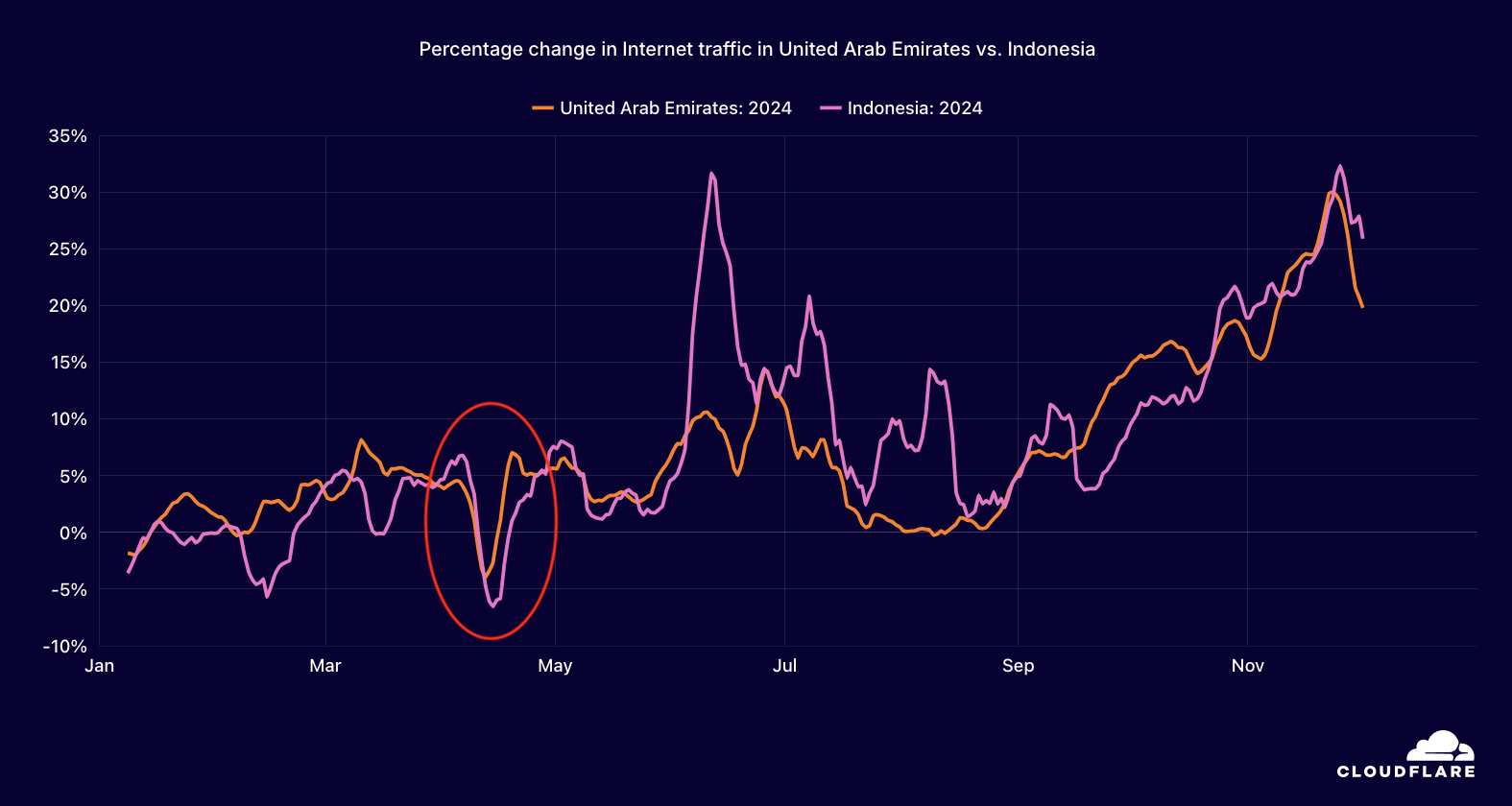
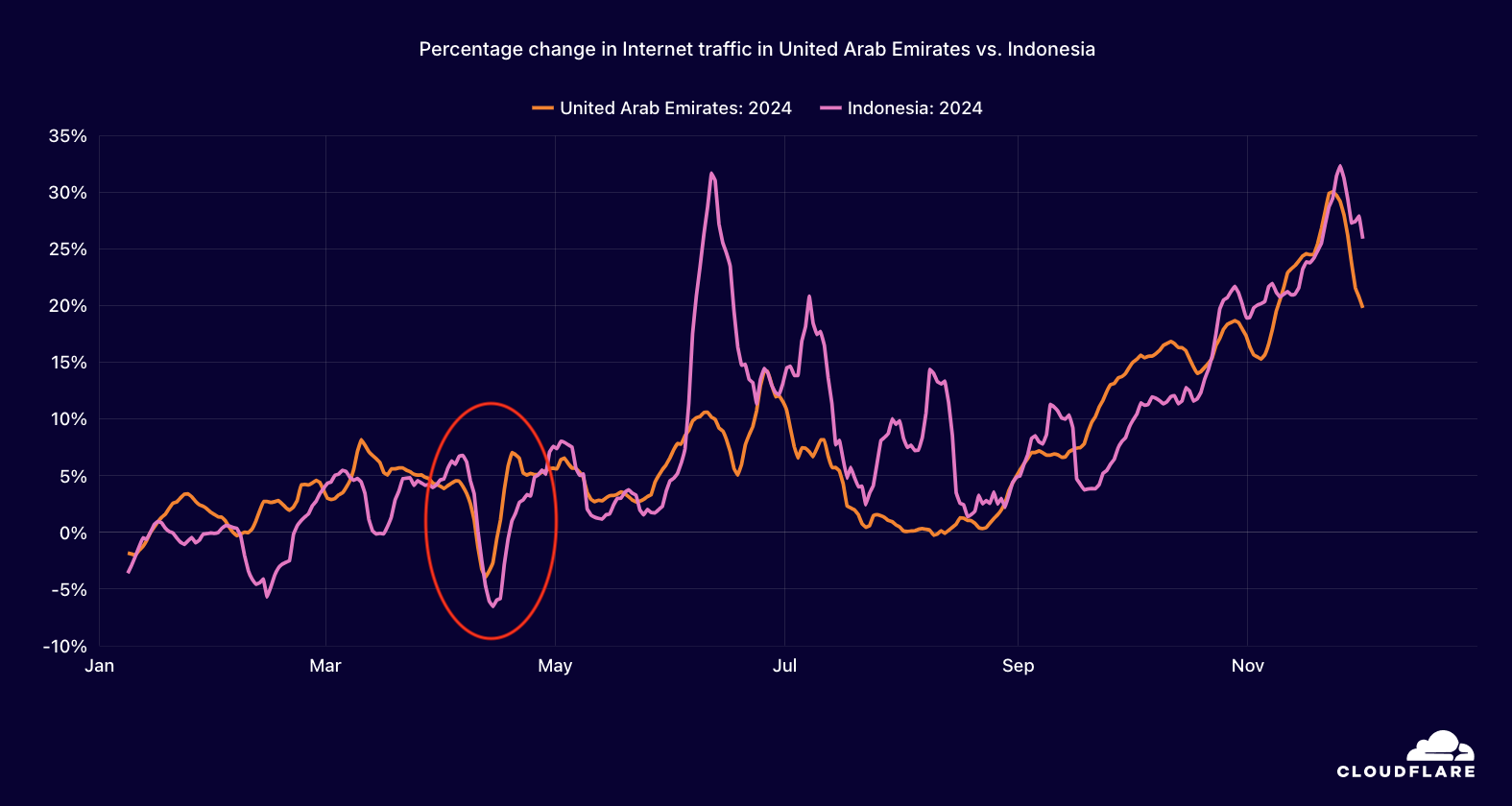
In previous blog posts, we have shown how events like Ramadan clearly impact Internet traffic in countries with large Muslim populations. One example from our Year in Review 2024 highlights Indonesia and the United Arab Emirates, where traffic dropped during Eid al-Fitr, the festival marking the end of Ramadan (April 9-10, 2024).

Boxing Day trends

Boxing Day on December 26 shows a sharp rebound in online activity after the significant drop in traffic during Christmas. In the UK, Canada, Australia, and New Zealand, traffic recovered as people return online after the Christmas break, even if daily traffic in the UK and Canada compared with the previous week was still lower -2% and -3% respectively, it was much higher than Christmas Day (+42% in the UK and +24% in Canada). Traditionally associated with charitable activities, family gatherings, and shopping, the day sees traffic spikes across these regions:

Location

December 26 increase/decrease in daily traffic

Peak traffic increase on December 26

Australia

+6%

December 26, 10:00: +12%

United Kingdom

-2%

December 26, 12:45: +7%

Canada

-3%

December 26, 12:15: +1%

New Zealand

+2%

December 26, 10:30: +7%, 17:15: +11%

Christmas traffic drops in more detail

Here is the list of locations that saw a clear drop in traffic on Christmas Eve or Christmas Day in the morning or around lunch. We selected the time (morning or lunch) with the largest drop compared to the previous week for further analysis. The list is ordered by the Christmas Eve dinner drop. Countries like Russia (where Orthodox Christians celebrate Christmas later, on January 7), Japan, China, Indonesia, Turkey, Israel, Thailand, Egypt, Singapore, Vietnam, and Bangladesh showed no impact during Christmas Eve dinner or Christmas Day morning or lunch.

Location

Christmas Eve Dinner Drop

Christmas Day Morning/Lunch Drop

Spain

-66% at 21:45

-55% at 08:00, -47% at 15:30

Denmark

-67% at 18:45

-50% at 07:00

Argentina

-60% at 22:15, (-70% at 00:00, December 25)

-60% at 08:30

Poland

-60% at 17:15

-52% at 07:15, -33% at 15:45

Chile

-62% at 22:45, (-63% at 00:00, December 25)

-55% at 08:45

Norway

-56% at 17:45, -56% at 18:15

-49% at 07:30, -23% at 13:30

Czech Republic

-55% at 17:45

-51% at 06:45, -26% at 14:00

France

-54% at 20:45

-50% at 07:00, -43% at 13:45

Portugal

-57% at 21:15

-54% at 07:30, -47% at 14:15

Italy

-48% at 21:15

-53% at 06:45, -55% at 13:45

Switzerland

-47% at 19:00, -50% at 21:00

-50% at 06:45, -37% at 13:45

Germany

-46% at 19:15

-40% at 07:15, -21% at 13:45

Brazil

-46% at 22:00

-42% at 08:15, -35% at 13:45

Sweden

-46% at 15:15, -46% at 16:30

-43% at 07:15, -20% at 13:15

Colombia

-49% at 22:15,  (-34% at 00:00, December 25)

-55% at 07:45, -44% at 15:15

Belgium

-51% at 19:45

-49% at 07:15

Mexico

-48% at 22:30, (-40% at 00:00, December 25)

-46% at 08:00

Finland

-45% at 15:30, -43% at 17:00-17:45

-46% at 08:30, -34% at 14:30

Austria

-48% at 19:30

-47% at 06:15, -29% at 14:15

United Kingdom

-34% at 16:15, -34% at 20:30

-36% at 09:00, -43% at 14:45

Romania

-34% at 20:45

-34% at 06:30

Ireland

-38% at 16:15, -40% at 21:00

-42% at 09:30, -42% at 15:15

Canada

-35% at 20:30

-35% at 09:30, -27% at 16:00

South Africa

-26% at 19:30

-35% at 09:30, -46% at 14:30

Netherlands

-35% at 21:00

-38% at 08:30, -40% at 16:00

United States

-30% at 19:45-20:45

-39% at 09:30, -33% at 13:15

Australia

-30% at 21:00

-44% at 13:45

New Zealand

-29% at 19:45

-39% at 09:30, -44% at 13:45

Ukraine

-25% at 18:15

-25% at 09:00, -19% at 14:30

Nigeria

-20% at 16:45, -21% at 22:30

-22% at 13:45, (-36% at 21:45)

South Korea

-18% at 21:00

-19% at 07:45

Malaysia

-19% at 22:15

-22% at 09:15, -13% at 14:15

Philippines

-19% at 21:30

-26% at 06:00

Hong Kong

-13% at 20:30

-20% at 10:00, -17% at 16:15

Japan

-11% at 19:45

-12% at 18:00

Many countries, though not all, experienced a noticeable drop in Internet traffic during Christmas Day lunch, with variations in timing. Spain, Poland, Norway, the Czech Republic, France, Portugal, Italy, Switzerland, Germany, Brazil, Sweden, Colombia, Finland, Austria, the United Kingdom, Ireland, Canada, South Africa, the Netherlands, the United States, New Zealand, and Ukraine all recorded significant declines, mostly in the early afternoon. In contrast, Denmark, Argentina, Chile, Belgium, Mexico, Romania, and Australia did not exhibit the same lunch decline.

New Year’s Eve: A planetary moment


Midnight on January 1 — a moment when people around the world turned away from their screens — revealed regional differences in digital behavior as people disconnected to celebrate. To accurately assess New Year’s impact, we compared traffic at 00:00 on January 1 with 00:00 on December 18 (the same time two weeks prior), avoiding Christmas distortions. This approach highlights the distinct drop in Internet activity due to the celebrations. These latest holiday patterns mirror those of 2023, with slight percentage changes and Latin American countries exhibiting larger drops than Northern Europe or some Asian regions.

Latin America countries led our global analysis with the strongest drops: Chile registered a 73% decline, Argentina 68%, and Colombia a 50% drop, underscoring deep-rooted traditions that drove people to disconnect at midnight.

European nations also experienced substantial declines in Internet traffic, especially those in Latin or Southern Europe, with Romania (-60%), Italy (-58%), Portugal (-57%), and Spain (-56%) demonstrating pronounced drops, while countries like Germany (-48%) and Switzerland (-42%) also emphasized the cultural importance of New Year’s celebrations. Northern Europe, however, showed a more moderate impact, with Norway dropping by 41% and Sweden by 22%.

In contrast, North America experienced a relatively milder decrease in online activity, with the United States with a drop in traffic of 11% and Canada at 15%, likely due to the spread of time zones and staggered celebrations. The trend was similar in 2023, with a 12% drop in the US and 14% in Canada, reinforcing the consistency of local Internet usage patterns from year to year.

Across Asia and the Pacific, the impact varied: the Philippines (-41%), Australia (-21%), South Korea (-18%), and Singapore (-18%) showed significant declines, while Indonesia (-7%) and Malaysia (-11%) experienced a smaller drop.

In the Middle East, the United Arab Emirates saw a 29% decline, and Egypt dropped by 7%, whereas Israel recorded an 11% increase, indicating different cultural or post-celebration dynamics. The 2024 data highlighted New Year’s global influence, with patterns of reduced online activity shaped by diverse local traditions that impacted digital activity.

Locations

January 1, 00:00 drop (compared to December 18)

Locations

January 1, 00:00 drop (compare to December 18)

Chile

-73%

Australia

-21%

Argentina

-68%

Ireland

-21%

Romania

-60%

United Kingdom

-20%

Italy

-58%

France

-20%

Portugal

-57%

Hong Kong

-20%

Spain

-56%

South Africa

-19%

Colombia

-50%

South Korea

-18%

Germany

-48%

Singapore

-18%

Brazil

-48%

Thailand

-17%

Mexico

-48%

Nigeria

-17%

Switzerland

-42%

Finland

-17%

Netherlands

-41%

Taiwan

-17%

Norway

-41%

Canada

-15%

Philippines

-41%

New Zealand

-15%

Poland

-40%

China

-12%

Ukraine

-39%

United States

-11%

Belgium

-38%

Malaysia

-11%

Austria

-38%

Indonesia

-7%

Russia

-35%

Egypt

-7%

Czech Republic

-31%

Vietnam

-3%

United Arab Emirates

-29%

Saudi Arabia

10%

Sweden

-22%

Israel

11%

Chinese & Lunar New Year: family time


The Lunar New Year, also known as Chinese New Year or Spring Festival, is widely celebrated across Asia. It began on Wednesday, January 29, 2025, marking the start of the Year of the Snake, a symbol of wisdom and intuition. A few days prior, China’s extended holiday period began, running from January 29 to February 4, 2025.

This period is marked by Chunyun, the world’s largest annual human migration, as millions return home. Key traditions include the New Year’s Eve Reunion Dinner, fireworks, and cultural performances such as temple fairs and dragon or lion dances. In South Korea, Malaysia, and Singapore, the holiday period was shorter, lasting from January 28 to 30, 2025. Here’s Vietnam as an example, where it is also clearly evident how traffic started to decrease after January 21, 2025:
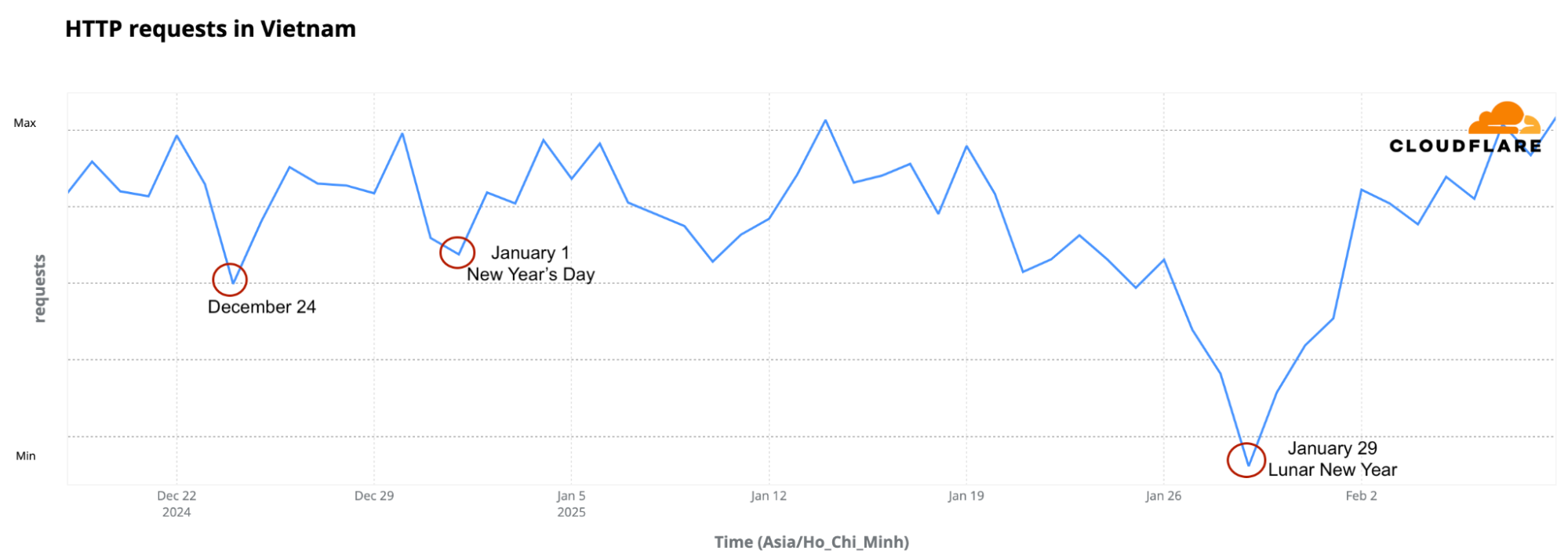

Daily Internet traffic drops when people disconnected to celebrate across Asia. Hong Kong saw its sharpest decline on January 29 (-25%), while Singapore peaked at -23% on the same day. Vietnam (-24%) and Malaysia (-16%) also hit their lowest points on January 29. Taiwan’s biggest drop occurred on January 28 (-15%), while South Korea recorded moderate declines of 8% on both January 28 and 29. China experienced its largest drop on January 28 (-17%), while Indonesia saw its strongest decline on January 29 (-11%). In general, January 29 stood out as a key moment of reduced Internet traffic, though the impact varied by country.

Location

January 28

January 29

January 30

Hong Kong

-22%

-25%

-22%

Vietnam

-12%

-24%

-18%

Singapore

-17%

-23%

-16%

Malaysia

-9%

-16%

-12%

Taiwan

-15%

-14%

-12%

Indonesia

-11%

China

-17%

-9%

South Korea

-8%

-8%

The more granular traffic data revealed specific offline moments that mirrored rich cultural traditions. In China, digital activity dropped sharply on January 28 around midday (-36%) and again in the late afternoon. It also declined by 28% at 00:00 on January 29, likely reflecting deep engagement in family reunions and festivities. Hong Kong, Vietnam, and the Philippines also experienced significant declines around midnight, while Singapore, Malaysia, and Taiwan exhibited notable, though varied, drops.

Location

January 28/29 drops in traffic

China

January 28, 12:30: -36%, 18:15-20:15: -32%
January 29, 00:00: -28%, 08:00: -31%, 13:00: -19%

Singapore

January 29, 00:00: -12%, 15:00: -35%

Vietnam

January 28, 21:30: -33%,
January 29, 00:00: -33%, 06:00: -40%, 18:15: -38%

Philippines

January 28, 20:30: -7%
January 29, 00:00: +3%, 06:00: -8%

Hong Kong

January 28, 19:45: -36%
January 29, 00:00: -29%, 09:30: -40%, 14:45: -35%

Malaysia

January 28, 20:30-21:45: -18%,
January 29, 00:00: -12%, 09:30: -30%, 15:00: -25%, 21:15: -20%

Taiwan

January 28, 18:30: -34%;
January 29, 00:00: -14%, 12:30: -26%

It’s important to note that the midnight drop in traffic during Lunar or Chinese New Year was not as pronounced as during the Gregorian calendar’s New Year, as seen in previous data.

Conclusion: traditions stand the test of time

In 2024, the trends remain strikingly consistent with those of 2023. In Europe, Christmas Eve continues to be the main offline moment, with traffic drops reaching 67% in Denmark and 66% in Spain. In North and Latin America, December 25 remained the key day, as seen with a 26% drop in the US and up to 70% drop at midnight in Argentina. These patterns demonstrate that traditional celebrations still heavily influence online behavior.

Across Asia, unique cultural events drive distinct periods of reduced online activity. The Lunar New Year showed peak disconnection around January 29 in China, Hong Kong, Singapore, and Vietnam. Overall, the 2024 data reinforce the enduring impact of cultural rituals on global Internet usage. Those are also demonstrated by Ramadan in a different part of the year. It also reminds us that while the Internet connects billions, cultural rhythms continue to shape our relationship with technology.

If you’re interested in more trends and insights about the Internet, check out Cloudflare Radar. Follow us on social media at @CloudflareRadar (X), noc.social/@cloudflareradar (Mastodon), and radar.cloudflare.com (Bluesky), or contact us via email.

When the world logs off: Christmas, New Year’s, and the Internet’s holiday rhythm

Post Syndicated from João Tomé original https://blog.cloudflare.com/when-the-world-logs-off-christmas-new-years-and-the-internets-holiday-rhythm/

As January approaches and the year comes to a close, distinct changes in global Internet usage emerge. Year-end traditions — ranging from Christmas feasts to New Year’s Eve (NYE) countdowns — shape online behavior across continents and cultures. Looking back at Christmas and NYE 2023 offers insights into how these trends may repeat this year, and by January 2025, we’ll be able to directly compare patterns. Examining data from 50 countries and regions reveals how people celebrated in 2023-2024, providing a timely reminder of typical holiday trends.

With Cloudflare’s global reach, we observe planet-wide and local Internet habits during the holiday season. In the past, unintended trends during Christmas and New Year’s Eve have surfaced through our Outage Center, which uses automatic traffic anomaly alerts to detect Internet outages or unusual patterns. In the 2023 overview below, traffic dropped enough on those days to trigger dozens of anomaly alerts (orange and pink bubbles):


While Christmas dominates in many regions, other cultural and religious holidays — like Hanukkah or regional festivities — shape online rhythms in places where Western traditions are less central.

In countries and regions where Christmas is deeply rooted, Internet traffic slows during Christmas Eve dinners, midnight masses, morning gift exchanges, and Christmas Day lunches.

This blog post focuses exclusively on non-bot-related Internet traffic requests, filtering out automated activity to provide a clearer view of genuine human behavior during the holiday season. Before going into location-specific perspectives, here’s a global hourly view of Internet traffic during Christmas and New Year’s Eve 2023 from Cloudflare Radar Data Explorer, highlighting notable drops (in UTC, so it captures impacts across more days due to time zones spanning over 23 hours, from New Zealand to Hawaii in the US):


Global Christmas and New Year’s Eve daily trends

Let’s start with a ranking of countries and regions and their top low-traffic holiday dates, showing each day’s percentage drop. Many locations like the US see clear dips on December 24 and 25 as people celebrate Christmas Eve and Christmas Day offline, and some show smaller declines (compared to Christmas) around December 31 as the New Year approaches. Still, the exact order and magnitude differ, reflecting cultural nuances — some nations experience greater drops on Christmas Eve, others on Christmas Day, and others signal unique patterns tied to New Year’s Eve or January 1 celebrations.

In the next table, locations are listed first (in the left column) by those with the lowest traffic on December 24 (and the highest percentage of traffic drop), followed by December 25, and finally December 31 (in the right column).

Top days with the lowest Internet traffic in December 2023 – January 2024

(with respective percentage drops, if any, from the previous week)

Denmark

#1 December 24 (-35%)

#2 December 25 (-11%)

#3 December 31

South Africa

#1 December 25 (-27%)

#2 December 24 (-15%)

#3 December 31 (-5%)

Norway

#1 December 24 (-32%)

#2 December 25 (-12%)

#3 December 31

United Kingdom

#1 December 25 (-26%)

#2 December 24 (-19%)

#3 December 31

Portugal

#1 December 24 (-32%)

#2 December 25 (-24%)

#3 December 31

Italy

#1 December 25 (-25%)

#2 December 24 (-25%)

#3 December 31

Poland

#1 December 24 (-31%)

#2 December 25 (-21%)

#3 December 31

Australia

#1 December 25 (-25%)

#2 December 24 (-15%)

#3 December 31 (-1%)

Spain

#1 December 24 (-28%)

#2 December 25 (-25%)

#3 December 31

Ireland

#1 December 25 (-24%)

#2 December 24 (-22%)

#3 December 23

Sweden

#1 December 24 (-26%)

#2 December 25 (-6%)

#3 December 31

New Zealand

#1 December 25 (-22%)

#2 December 24 (-8%)

#3 December 31 (-4%)

Chile

#1 December 24 (-23%)

#2 December 25 (-24%)

#3 December 31 (-3%)

Canada

#1 December 25 (-19%)

#2 December 24 (-15%)

#3 December 31

Finland

#1 December 24 (-23%)

#2 December 25 (-16%)

#3 December 31

Nigeria

#1 December 25 (-18%)

#2 December 24 (-19%)

#3 January 1

France

#1 December 24 (-22%)

#2 December 25 (-19%)

#3 December 23

Philippines

#1 December 25 (-16%)

#2 December 24 (-7%)

#3 December 31

Germany

#1 December 24 (-21%)

#2 December 25 (-9%)

#3 December 31

Hong Kong

#1 December 25 (-9%)

#2 December 24 (-6%)

#3 December 23

Mexico

#1 December 24 (-21%)

#2 December 25 (-19%)

#3 December 31

Belgium

#1 December 31 (-1%)

#2 December 24 (-20%)

#3 December 25 (-17%)

Belgium

#1 December 24 (-20%)

#2 December 25 (-17%)

#3 December 31 (-1%)

Indonesia

#1 December 31 (-1%)

#2 December 25 (-7%)

#3 December 24

Romania

#1 December 24 (-20%)

#2 December 25 (-14%)

#3 December 31 (-3%)

Netherlands

#1 December 31 (-10%)

#2 December 24 (-10%)

#3 December 25 (-20%)

United States

#1 December 24 (-16%)

#2 December 25 (-21%)

#3 December 31

Ukraine

#1 December 31 (-10%)

#2 December 24 (-5%)

#3 December 30

Brazil

#1 December 24 (-14%)

#2 December 25 (-26%)

#3 December 31

Thailand

#1 December 31 (-6%)

#2 January 1 (-2%)

#3 December 25 (-2%) 

Colombia

#1 December 24 (-14%)

#2 December 25 (-26%)

#3 December 31 (-4%)

The data shows that in many European countries — such as Denmark, Norway, the United Kingdom, Portugal, Italy, Poland, Spain, Ireland, Sweden, Finland, France, Germany, Belgium, the Netherlands, and Romania — Christmas Eve (December24) and Christmas Day (December25) consistently register the biggest drops in Internet traffic. These dips suggest that in much of Europe, Christmas traditions take people firmly offline, whether it’s for family gatherings, festive meals, or religious observances. Outside Europe, similar patterns appear in predominantly Christian-influenced regions, including Australia, New Zealand, Canada, the United States, and several Latin American countries (like Brazil, Chile, and Colombia), confirming that the holiday’s cultural importance is mirrored in their online habits.

In contrast, locations less influenced by Western Christmas traditions, such as those in Asia, show subtler or different patterns. For example, Hong Kong and the Philippines do show declines in traffic, reflecting a hybrid of local and global influences, while places like Thailand and Indonesia present smaller dips on Christmas compared to other days or emphasize different holidays altogether. These variations highlight that while Christmas exerts a strong pull offline in many parts of the world, its impact on Internet usage is shaped by local cultural contexts.

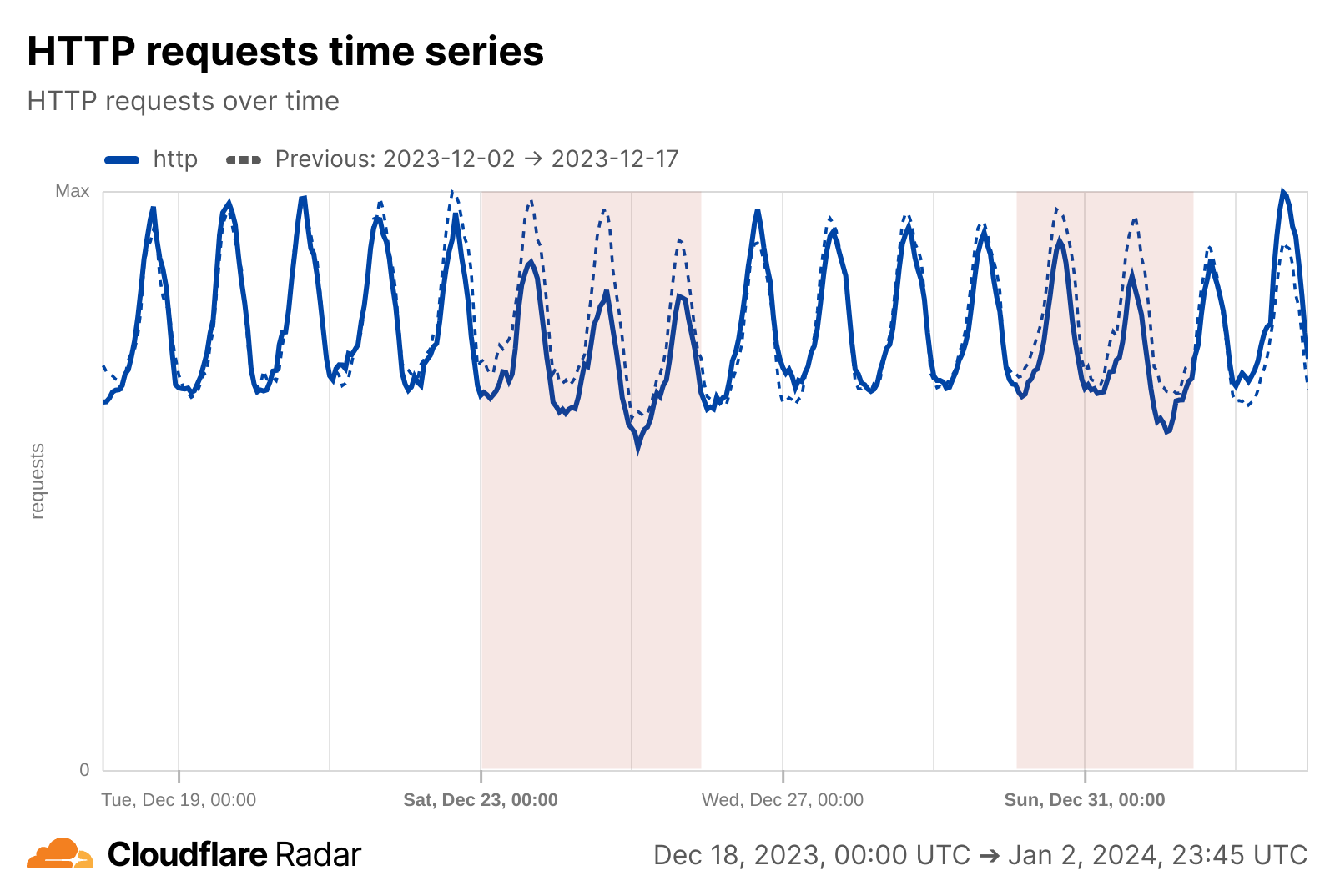
As an example, here’s the US perspective from Cloudflare Radar Data Explorer, where the drop in traffic during Christmas and New Year 2023 is evident:


Where Christmas isn’t central

Not every country’s December revolves around Christmas. In Israel, for example, Hanukkah’s timing changes year to year, influencing when people log off. In 2023, Hanukkah started on December 7, leading to an 8% traffic drop that day and 7% on the following days through December 10. Interestingly, in some years like 2024, Hanukkah begins closer to December 25, potentially overlapping with Western Christmas.

Countries where Christmas didn’t have a clear impact

Turkey

#1 December 31 (-18%)

#2 December 29

#3 December 30

Israel

#1 December 29

#2 January 5

#3 December 30

Japan

#1 December 31 (-8%)

#2 January 1

#3 December 30 — December 24 with -3%

Vietnam

#1 January 1 (-7%)

#2 December 31 (-3%)

#3 January 2

Russia

#1 December31 (-23%)

#2 January 1 (-15%)

#3 December 30

Singapore

#1 December 16

#2 December 17

#3 December 18

India

#1 December 17

#2 December 16

#3 December 24

Bangladesh

#1 December 15

#2 December 16

#3 December 18

Saudi Arabia

#1 January 5

#2 January 6

#3 January 8

China

#1 December 19

#2 December 15

#3 December 18

Now, let’s focus on a more granular perspective of these trends, showing the impact of Christmas dinners and lunches, and also New Year’s Eve drops in traffic.

Note: Unless otherwise noted, all times used in this blog post are local ones; in countries with several timezones, we’re using the timezone where more people live (for the US, Eastern time is used).

A more granular perspective of Christmas: offline feasts and morning quiet


Europe

In Europe, Christmas traditions dominate, leading to the most significant Internet traffic drops. Christmas Eve dinner is a near-universal offline moment, with countries like Spain (-70% at 21:45), Portugal (-70% at 20:30), and Denmark (-68% at 19:45) experiencing the steepest declines. On Christmas Day, mornings are quieter as people relax or attend religious services, while festive lunches drive further drops, with traffic down 43% at 13:45 in Portugal and 44% at 07:15 in France.

By Boxing Day (December 26), digital activity rebounds as people return online for sales or socializing. For instance, the UK shows a 16% increase at 13:00, while Canada records a 19% rise at 08:15. In Australia, traffic climbs by 20% at 09:30, illustrating regional differences in how the day is celebrated.

Americas

In the Americas, holiday patterns reflect a mix of cultural traditions. In the United States, Christmas Eve traffic drops by 29% at 20:15, aligning with evening family gatherings, and Christmas Day sees a 32% decline at 09:15, reflecting quieter mornings.

In Latin America, Christmas Eve (Nochebuena) takes center stage, with significant traffic declines aligning with late-night traditions like the Midnight Toast (in Argentina, the late-night feast is quite popular) and Misa de Gallo (Midnight Mass). For example:

  • Colombia: -48% at 21:45

  • Argentina: -58% at 22:00; -67% at midnight

  • Chile: -64% at 22:45

  • Mexico: -50% at 21:45

  • Brazil: -22% at 21:45

These late-night traffic dips highlight the region’s emphasis on midnight celebrations, family feasts, and religious observances.

Asia Pacific

Asian locations influenced by Western traditions, such as the Philippines and Hong Kong, experience moderate Christmas dips but shift focus to New Year’s celebrations — more on NYE below.

In the Southern Hemisphere, Australia and New Zealand experience their steepest traffic drops during Christmas lunch, with Australia seeing a 43% decrease at 13:45 and New Zealand recording a 42% decline.

Middle East and Africa

In regions less influenced by Christmas, holiday traffic patterns vary significantly. For example, Nigeria sees a 26% drop at lunchtime on Christmas Day, while South Africa records a 37% decline at 14:15, reflecting offline family gatherings.

In predominantly non-Christian countries like Egypt and Saudi Arabia, December 24-25 does not show significant dips; instead, other cultural holidays drive offline moments. For example, as we’ve noted, Israel experienced up to an 8% drop in 2023 during Hanukkah, particularly in the first four days after December 7. In previous blog posts, we have shown how events like Ramadan clearly impact Internet traffic in countries with large Muslim populations. One example from our Year in Review 2024 highlights Indonesia and the United Arab Emirates, where traffic dropped during Eid al-Fitr, the festival marking the end of Ramadan (April 9-10, 2024).


The Boxing Day revival

Boxing Day on December 26 marks a significant digital rebound in countries like the UK, Canada, Australia (where there is a higher increase from the previous week, with daily traffic growing 9%), and New Zealand, as people return online after the Christmas break. Traditionally associated with charitable activities, family gatherings, and shopping, the day sees traffic spikes across these regions:

Location

December 26 increase in daily traffic

Higher traffic increase on December 26

Australia

+9%

December 26; 09:30: +20%

United Kingdom

+2%

December 26; 13:00: +16%

Canada

+1%

December 26, 08:15: +19%

Here is the list of locations that saw a clear drop in traffic on Christmas Eve or Christmas Day morning or lunch. We selected the time (morning or lunch) with the bigger drop compared to the previous week for further analysis. The list is ordered by the Christmas Eve dinner drop. Countries like Russia (where Orthodox Christians celebrate Christmas later, on January 7), Japan, China, Indonesia, Turkey, Israel, Thailand, Egypt, Singapore, Vietnam, and Bangladesh showed no impact during Christmas Eve dinner or Christmas Day morning or lunch.

Location

Christmas Eve Dinner Drop

Christmas Day Morning/Lunch Drop

Spain

-70% at 21:45

-51% at 08:00 (morning)

Portugal

-70% at 20:30

-43% at 13:45 (lunch)

Denmark

-68% at 19:45

-43% at 06:15 (morning)

Chile

-64% at 22:45; (-65% at 00:00, December 25)

-49% at 09:00 (morning) 

Norway

-63% at 18:45

-50% at 06:45 (morning)

Czech Republic

-60% at 18:15

-43% at 06:30 (morning)

Poland

-59% at 17:15

-51% at 07:15 (morning)

Argentina

-58% at 22:00 (-67% at 00:00, December 25)

-52% at 09:00 (morning) 

Italy

-55% at 21:15

-44% at 07:00 (morning)

France

-55% at 20:45

-44% at 07:15 (morning)

Mexico

-50% at 21:45

-38% at 08:15 (morning)

Belgium

-50% at 20:15

-46% at 07:15 (morning)

Switzerland

-50% at 19:45

-46% at 06:30 (morning)

Austria

-50% at 19:15

-42% at 06:15 (morning)

Nigeria

-49% at 18:00

-26% at 12:30 (lunch)

Colombia

-48% at 21:45

-49% at 08:00 (morning)

Germany

-47% at 19:15

-36% at 07:15 (morning)

Sweden

-47% at 16:30

-36% at 07:00 (morning)

Finland

-42% at 17:45

-42% at 08:00 (morning)

Ireland

-40% at 18:15

-36% at 15:15 (lunch)

South Africa

-37% at 19:00

-37% at 14:15 (lunch)

Romania

-34% at 20:45

-34% at 06:30 (morning)

United Kingdom

-34% at 18:00

-38% at 14:45 (lunch)

Canada

-32% at 20:30

-31% at 09:30 (morning)

Netherlands

-30% at 20:45

-35% at 06:45 (morning)

United States

-29% at 20:15

-32% at 09:15 (morning)

Australia

-23% at 20:45

-43% at 13:45 (lunch)

New Zealand

-23% at 18:30

-42% at 13:15 (lunch)

Brazil

-22% at 21:45

-42% at 08:00 (morning)

Philippines

-22% at 21:30

-29% at 06:45 (morning)

New Year’s Eve: A planetary offline moment


Midnight, December 31 is a shared offline moment worldwide, as people step away from their screens to celebrate. To provide a more accurate assessment of New Year’s Eve’s impact, we compare traffic at 00:00 on January 1 with 00:00 on December 18, avoiding distortions caused by Christmas-related patterns. This approach highlights the distinct drop in Internet activity due to New Year’s celebrations.

Across Europe, countries like Portugal (-60%) and Romania (-60%) see dramatic traffic drops, reflecting widespread offline gatherings. Spain (-56%) and Germany (-49%) also experience steep declines, emphasizing the importance of this tradition across the region. Even Northern Europe mirrors this trend, with Denmark (-41%), Norway (-39%), and Sweden (-29%) showing significant dips.

In the Americas, this offline moment is particularly pronounced in Latin America, where family and communal gatherings dominate. Argentina (-66%) and Chile (-74%) lead the region, with Brazil (-46%) and Colombia (-44%) following closely. In North America, the impact is less dramatic due to time zone variations — in this case, with millions of people spread out in distinct time zones. Canada records a 14% drop, and the United States shows a modest 12% decline compared to December 18.

In Asia and the Pacific, New Year’s Eve celebrations heavily influence Internet trends. Thailand saw a 31% drop, Indonesia 23%, and Japan 16%, also reflecting this region’s focus on communal gatherings and celebrations. Australia (-21%) and New Zealand (-11%), among the first countries to welcome the New Year, also show noticeable declines as midnight festivities take center stage.

In the Middle East and Africa, Turkey (-23%), South Africa (-32%), and Nigeria (-15%) exhibit significant offline engagement at midnight. Israel records a smaller but notable 6% dip before midnight, reflecting localized variations in celebration styles.

Of course, this offline intermission doesn’t last long. After a few hours, people return to their devices. France sees a 37% surge at 3:15 on January 1, while Turkey experiences a 36% upswing in the early hours.

Next, we present the list of locations with clear drops in traffic at midnight on New Year’s Eve, compared to December 18, ordered by percentage of drop. 

Locations

January 1, 00:00 drop compared to December 18

Locations

January 1, 00:00 drop compared to December 18

Chile

-74%

Thailand

-31%

Argentina

-66%

Italy

-30%

Romania

-60%

Sweden

-29%

Portugal

-60%

Vietnam

-27%

Spain

-56%

United Kingdom

-25%

Germany

-49%

Ukraine

-25%

Brazil

-46%

Indonesia

-23%

Mexico

-44%

Turkey

-23%

Colombia

-44%

Australia

-21%

Philippines

-43%

Hong Kong

-21%

Netherlands

-42%

Ireland

-19%

Poland

-41%

France

-17%

Denmark

-41%

Japan

-16%

Austria

-40%

South Korea

-16%

Switzerland

-39%

Nigeria

-15%

Norway

-39%

Canada

-14%

Czech Republic

-33%

Finland

-14%

Russia

-32%

Singapore

-13%

Belgium

-32%

United States

-12%

South Africa

-32%

China

-12%

Conclusion: A mosaic of traditions and digital habits

What emerges from these patterns is a rich tapestry of cultural habits. While Christmas Eve and Day are central offline moments in Europe and the Americas, other regions mark their quiet days on different dates, shaped by unique holidays and customs. The insights from 50 countries and regions confirm how cultural traditions guide when people step away from screens.

As the Gregorian calendar year comes to a close, the universal appeal of stepping offline becomes clear. Whether raising glasses at the stroke of midnight, exchanging greetings, or lighting candles for festivals like Hanukkah, these moments remind us that while the Internet connects billions, cultural rhythms still shape our relationship with technology. Whether feasting with loved ones or counting down to a new year, humans everywhere find reasons to unplug — if only for a moment.

If you’re interested in more trends and insights about the Internet, check out Cloudflare Radar. Follow us on social media at @CloudflareRadar (X), https://noc.social/@cloudflareradar (Mastodon), and radar.cloudflare.com (Bluesky), or contact us via email.
Raspberry Pi Christmas Shopping Guide 2020

Post Syndicated from Ashley Whittaker original https://www.raspberrypi.org/blog/raspberry-pi-christmas-shopping-guide-2020/

The most wonderful time of the year is approaching! “Most wonderful” meaning the time when you have to figure out what gift best expresses your level of affection for various individuals in your life. We’re here to take away some of that stress for you — provided your favourite individuals like Raspberry Pi, of course. Otherwise you’re on your own. Sorry.

We’ve got ideas for the gamers in your life, what to get for the Raspberry Pi “superfan” who has everything, and options that allow you to keep giving all year round.

Newest and hottest

If keeping up with the Joneses is your thing, why not treat your nearest Raspberry Pi fan to one of our newest products…

Raspberry Pi 400 | $70

Top view of a woman's hands using the Raspberry Pi 400 keyboard and official Raspberry Pi mouse

This year, we released Raspberry Pi 400: a complete personal computer, built into a compact keyboard, costing just $70. Our community went wild about the possibilities that Raspberry Pi 400 opens up for home learners and for those who don’t have expensive tech options at their fingertips.

You just plug in a mouse, a monitor (any semi-modern TV screen should work), and go. The Raspberry Pi 400 Personal Computer kit costs $100 and comes with a few extras to help get you started. Or you can buy the Raspberry Pi 400 unit on its own.

Depending on where you are in the world, you may need to pre-order or join a waiting list, as Raspberry Pi 400 is in such high demand. But you could give a homemade ‘IOU’ voucher letting the recipient know that they will soon get their hands on one of our newest and most popular bits of kit.

Our latest book of coding coolness | £10

We publish some cool books around these parts. Laura Sach and Martin O’Hanlon, who are both Learning Managers at the Raspberry Pi Foundation, have written the very newest one, which is designed to help you to get more out of your Python projects.

In Create Graphical User Interfaces with Python, you’ll find ten fun Python projects to create, including a painting program, an emoji match game, and a stop-motion animation creator. All for just £10.

So, if you’ve a keen coder in your midst, this book is the best choice to stretch their skills and keep them entertained throughout 2021. Buy it online from the official Raspberry Pi Press store.

Gamers

Raspberry Pi 4 Retro Gaming Kit | £88

Lovely image courtesy of The Pi Hut

The Pi Hut’s Raspberry Pi 4 Retro Gaming Kit costs £88 and includes everything you need to create your very own retro gaming console. All your lucky kit recipient has to find is a screen to plug into, and a keyboard to set up their new Raspberry Pi, which comes as part of the kit along with a case for it. The Pi Hut has also thrown in a 16GB microSD card, plus a reader for it, as well as our official micro HDMI cable. Job done.

Picade 8″ or 10″ display | from £165

Pretty picture courtesy of Pimoroni

How cool does Picade look?! It’s sold by Pimoroni and you can buy an 8″ display set for £165, or a 10″ display version for £225. Show me a self-respecting gamer who doesn’t want a desktop retro arcade machine in their own home.

Picade is a Raspberry Pi–powered mini arcade that you build yourself. All you’ll need to add is your own Raspberry Pi, a power supply, and a micro SD card.

Code the Classics, Volume 1 | £12

And if the gamer on your gift list prefers to create their own retro video games, send them a copy of Code the Classics, Volume 1. It’s a stunning-looking hardback book packed with 224 pages telling the stories of some of the seminal video games of the 1970s and 1980s, and showing you how to create your own. Putting hours of projects in the hands of your favourite gamer will only set you back £12. Buy it online from the official Raspberry Pi Press store.

Raspberry Pi superfans

Raspberry Pi Zero W | $10

For just $10 apiece, you can drop a couple Raspberry Pi Zero W into any tinkerer’s stocking and they’ll be set for their next few projects. They will LOVE you for allowing them try a new, risky build without having to tear down something else they created to retrieve an old Raspberry Pi.

Babbage Bear | $9

What to get the superfan who already has a desk full of Raspberry Pi? An official Babbage Bear to oversee the proceedings! Babbage only costs £9 and will arrive wearing their own Raspberry Pi–branded T-shirt. A special Raspberry Pi Towers inhabitant made our Babbage this Christmassy outfit before we photographed them.

Official t-shirts | $12

If you’ve a superfan on your gift list, then it’s likely they already own a t-shirt with the Raspberry Pi logo on it — so why not get them one of these new designs?

Both costing just £12, the black Raspberry Pi “Pi 4” t-shirt was released to celebrate the launch of Raspberry Pi 4 and features an illustration of the powerful $35 computer. The white Raspberry Pi “Make Cool Stuff” option was created by Raspberry Pi’s own illustrator/animator extraordinaire Sam Alder. Drop that inside fact on the gift tag for extra superfan points.

Wearable tech projects | £7

And if they’re the kind of superfan who would like to make their own Raspberry Pi-–themed clothing, gift them with our Wearable Tech Projects book. This 164-page book gathers up the best bits of wearable technology from HackSpace magazine, with tutorials such as adding lights to your favourite cosplay helmet, and creating a glowing LED skirt. It’s on sale for just £7 and you can buy it online from the official Raspberry Pi Press store.

Keep giving all year

What if you could give the joy of opening a Raspberry Pi–themed gift every single month for a whole year? Our magazine subscriptions let you do just that, AND they come with a few extra gifts when you sign up.

The MagPi magazine

The official Raspberry Pi magazine comes with a free Raspberry Pi Zero kit worth £20 when you sign up for a 12-month subscription. The magazine is packed with computing and electronics tutorials, how-to guides, and the latest news and reviews.

Check out subscription deals on the official Raspberry Pi Press store.

HackSpace magazine

HackSpace magazine is packed with projects for fixers and tinkerers of all abilities. 12-month subscriptions comes with a free Adafruit Circuit Playground Express, which has been specially developed to teach programming novices from scratch and is worth £25.

Check out subscription deals on the official Raspberry Pi Press store

Wireframe magazine

Wireframe magazine lifts the lid on video games. In every issue, you’ll find out how games are made, who makes them, and how you can make your own using detailed guides. The latest deal gets you three issues for just £10, plus your choice of one of our official books as a gift.

Check out more subscriptions deals on the official Raspberry Pi Press store.

Custom PC

Custom PC is the magazine for people who are passionate about PC technology and hardware. You can subscribe to receive three issues for just £10, and you’ll also receive a book as a gift.

Check out subscription offers on the official Raspberry Pi Press store.

That’s all folks. Have a holly jolly one. Drop a question in the comments box below if you’re after something Raspberry Pi–themed which isn’t mentioned here. I’m half elf and should be able to help.

The post Raspberry Pi Christmas Shopping Guide 2020 appeared first on Raspberry Pi.