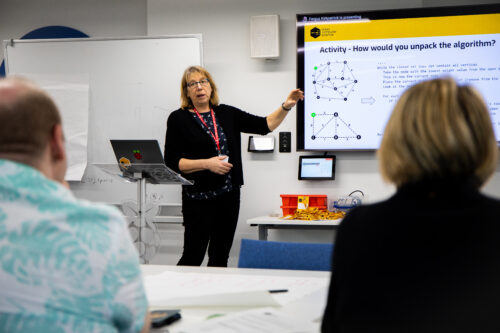
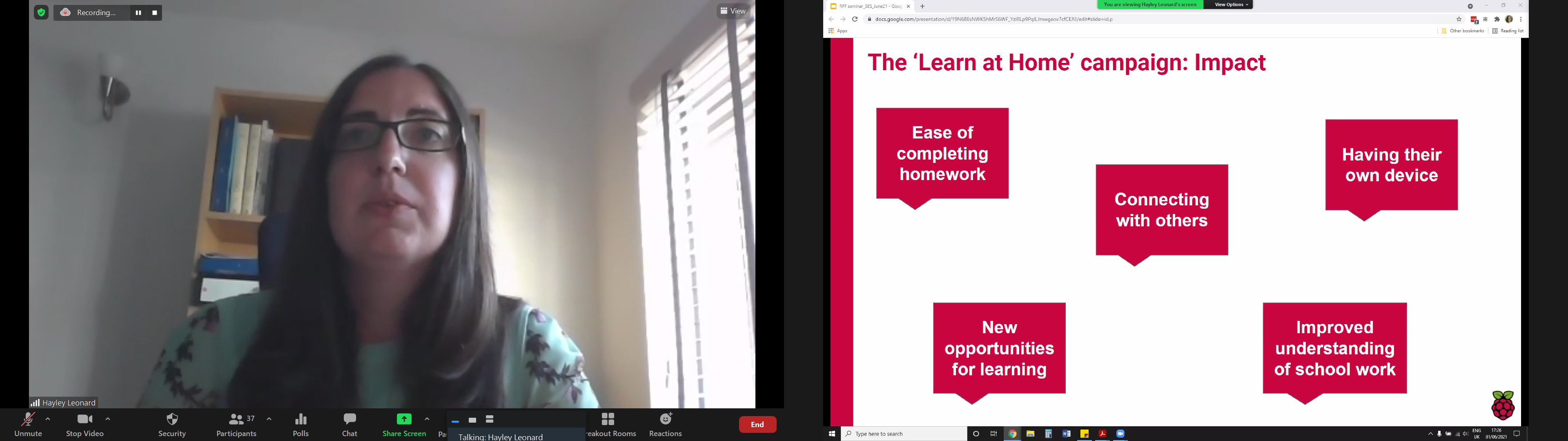
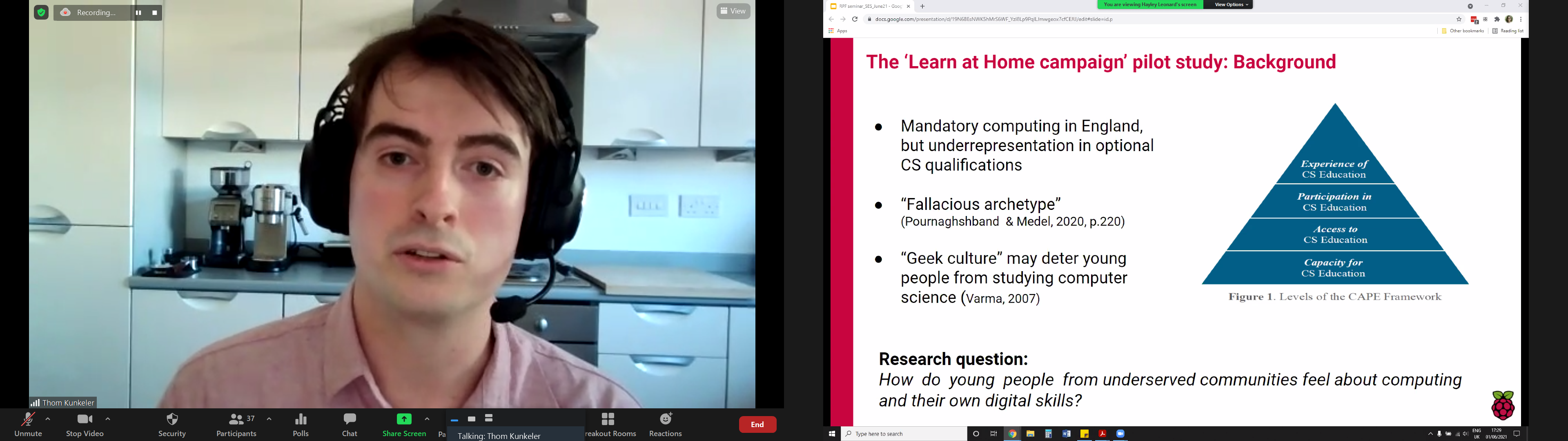
At the Raspberry Pi Foundation, we host a free online research seminar once a month to explore a wide variety of topics in the area of digital and computing education. This year, we’ve hosted eleven seminars — you can (re)discover slides and recordings on our website.
Now we’re getting ready for new seminars in 2021! In the coming months, our seminars are going to focus on diversity and inclusion in computing education. This topic is extremely important, as we want to make sure that computing is accessible to all, that we understand how to actively remove barriers to participation for learners, and that we understand how to teach computing in an inclusive way.
We are delighted to announce that these seminars focusing on diversity and inclusion will be co-hosted by the Royal Academy of Engineering. The Royal Academy of Engineering is harnessing the power of engineering to build a sustainable society and an inclusive economy that works for everyone.
We’re very excited to be partnering with the Academy because of our shared interest in ensuring that computing and engineering are inclusive and accessible to all.
Our upcoming seminars
The seminars take place on the first Tuesday of the month at 17:00–18:30 GMT / 12:00–13:30 EST / 9:00–10:30 PST / 18:00–19:30 CET.
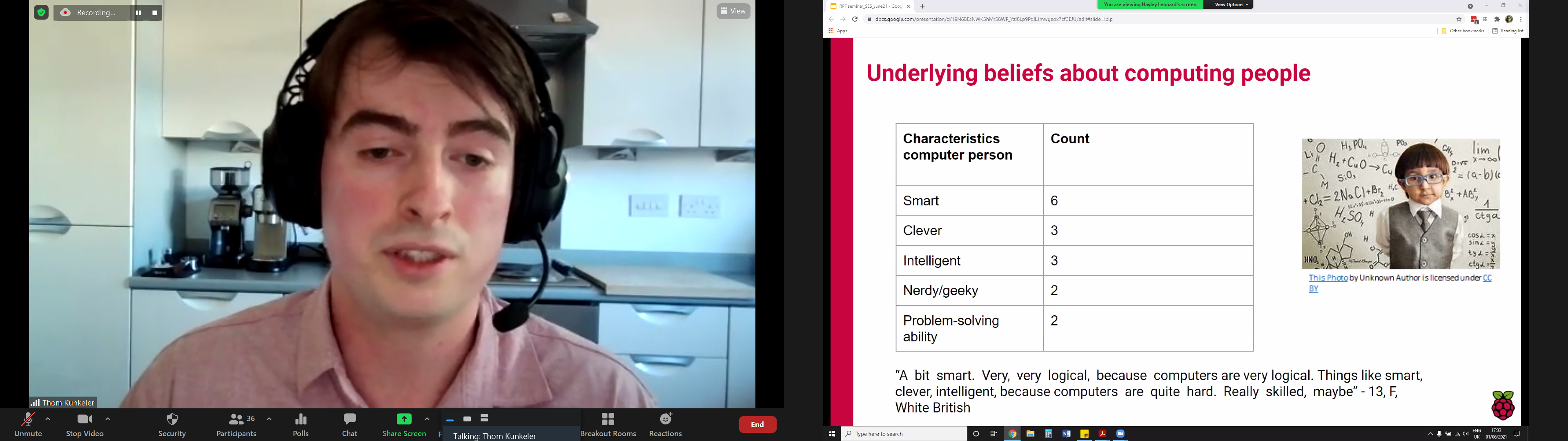
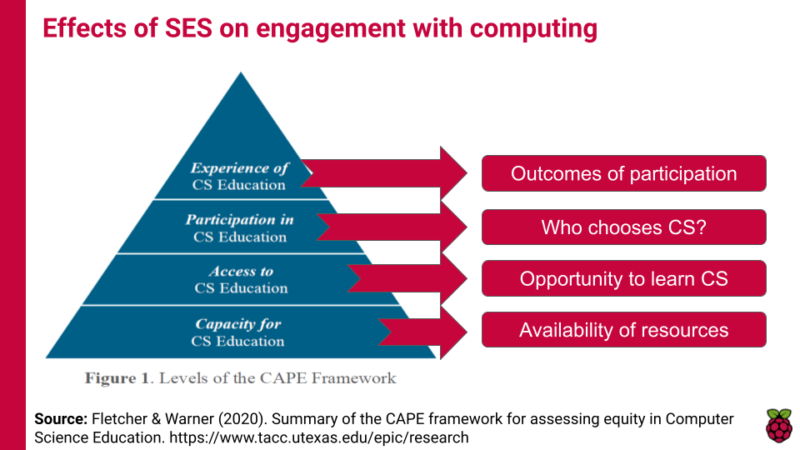
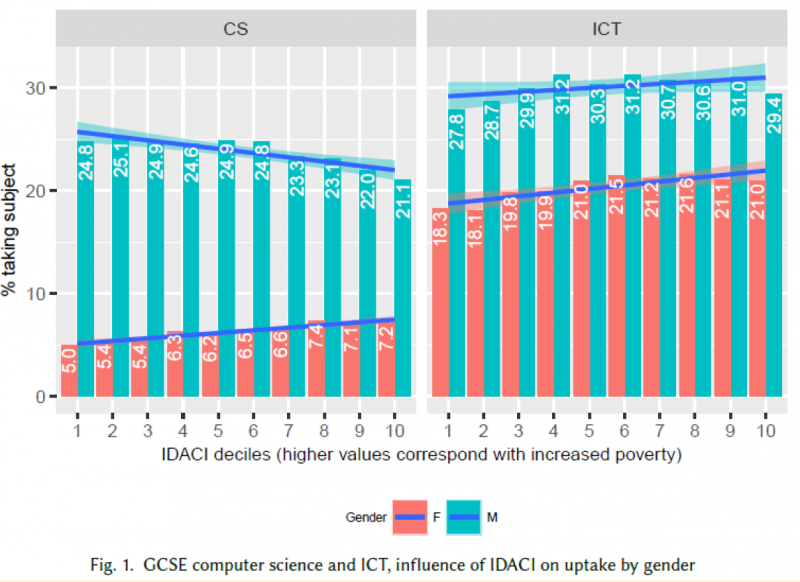
5 January 2021: Peter Kemp (King’s College London) and Billy Wong (University of Reading) will be looking at computing education in England, particularly GCSE computer science, and how it is accessed by groups typically underrepresented in computing.
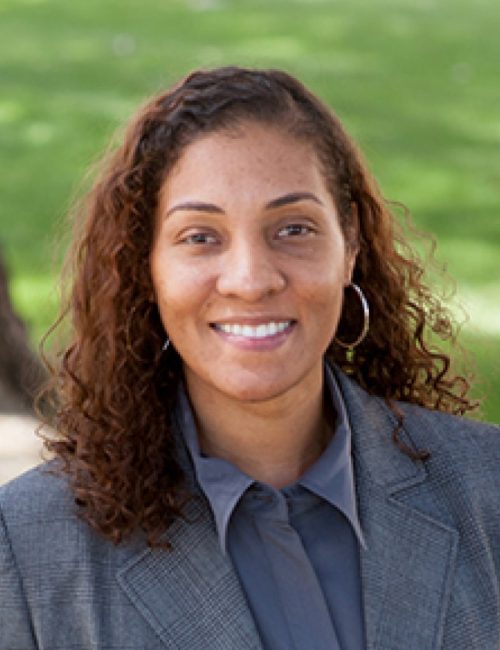
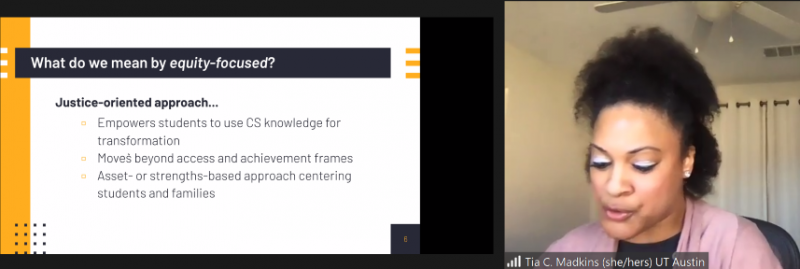
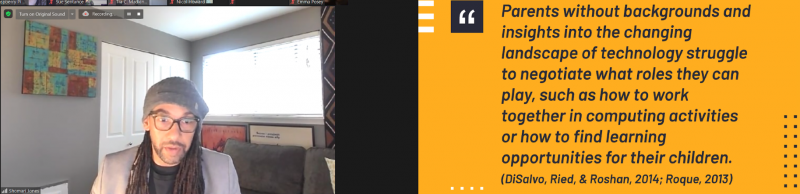
2 February 2021: Professor Tia Madkins (University of Texas at Austin), Nicol R. Howard (University of Redlands), and Shomari Jones (Bellevue School District) will be talking about equity-focused teaching in K–12 computer science. Find out more.
2 March 2021: Dr Jakita O. Thomas (Auburn University, Alabama) will be talking about her research on supporting computational algorithmic thinking in the context of intersectional computing.
April 2021: event to be confirmed
4 May 2021: Dr Cecily Morrison (Microsoft Research) will be speaking about her work on physical programming for people with visual impairments.
Join the seminars
We’d love to welcome you to these seminars so we can learn and discuss together. To get access, simply sign up with your name and email address.
Once you’ve signed up, we’ll email you the seminar meeting link and instructions for joining. If you attended our seminars in the past, the link remains the same.
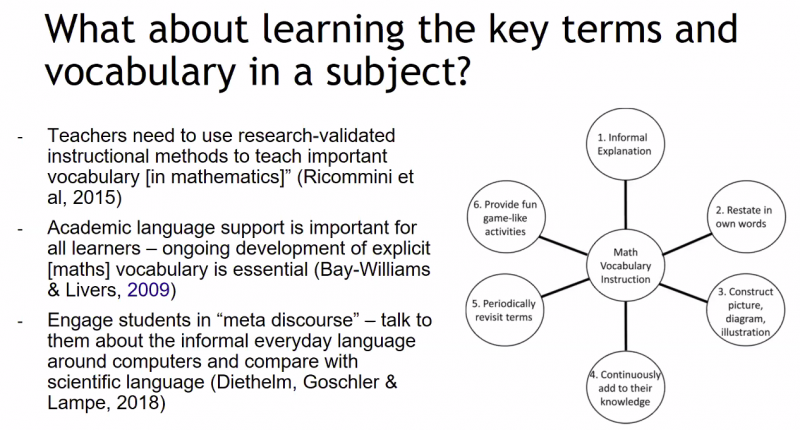
Whenever you learn a new subject or skill, at some point you need to pick up the particular language that goes with that domain. And the only way to really feel comfortable with this language is to practice using it. It’s exactly the same when learning programming.
In our latest research seminar, we focused on how we educators and our students can talk about programming. The seminar presentation was given by our Chief Learning Officer, Dr Sue Sentance. She shared the work she and her collaborators have done to develop a research-based approach to teaching programming called PRIMM, and to work with teachers to investigate the effects of PRIMM on students.
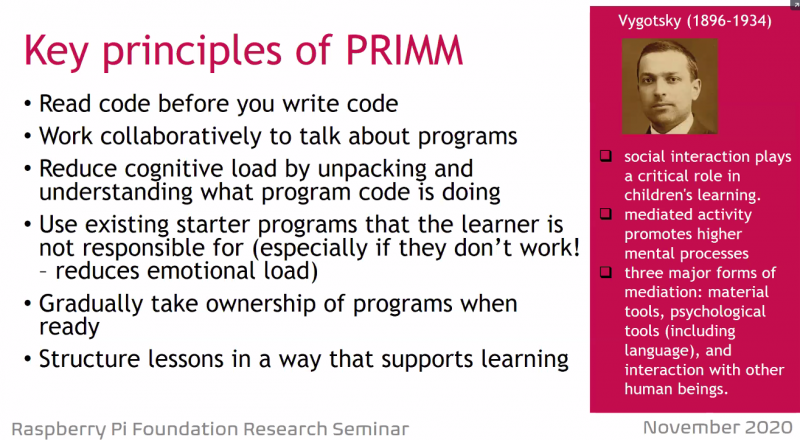
As well as providing a structure for programming lessons, Sue’s research on PRIMM helps us think about ways in which learners can investigate programs, start to understand how they work, and then gradually develop the language to talk about them themselves.
Productive talk for education
Sue began by taking us through the rich history of educational research into language and dialogue. This work has been heavily developed in science and mathematics education, as well as language and literacy.
In particular the work of Neil Mercer and colleagues has shown that students need guidance to develop and practice using language to reason, and that developing high-quality language improves understanding. The role of the teacher in this language development is vital.
Sue’s work draws on these insights to consider how language can be used to develop understanding in programming.
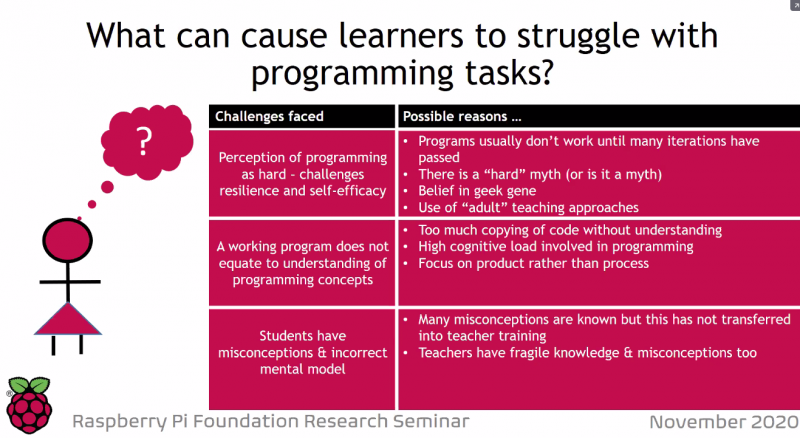
Why is programming challenging for beginners?
Sue identified shortcomings of some teaching approaches that are common in the computing classroom but may not be suitable for all beginners.
‘Copy code’ activities for learners take a long time, lead to dreaded syntax errors, and don’t necessarily build more understanding.
When teachers model the process of writing a program, this can be very helpful, but for beginners there may still be a huge jump from being able to follow the modeling to being able to write a program from scratch themselves.
PRIMM was designed by Sue and her collaborators as a language-first approach where students begin not by writing code, but by reading it.
What is PRIMM?
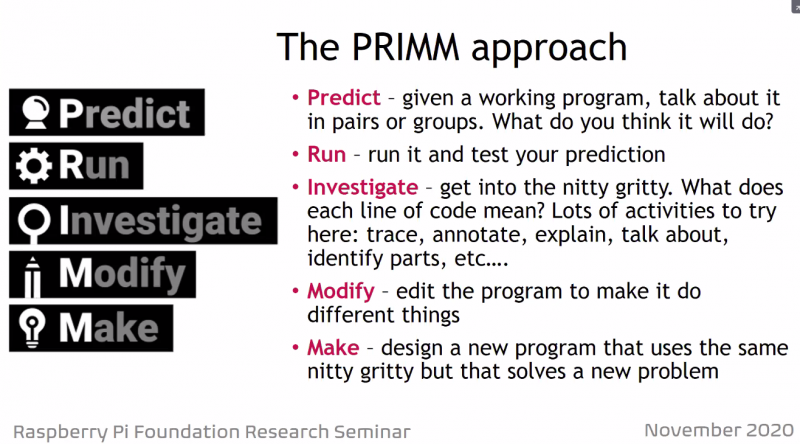
PRIMM stands for ‘Predict, Run, Investigate, Modify, Make’. In this approach, rather than copying code or writing programs from scratch, beginners instead start by focussing on reading working code.
In the Predict stage, the teacher provides learners with example code to read, discuss, and make output predictions about. Next, they run the code to see how the output compares to what they predicted. In the Investigate stage, the teacher sets activities for the learners to trace, annotate, explain, and talk about the code line by line, in order to help them understand what it does in detail.
In the seminar, Sue took us through a mini example of the stages of PRIMM where we predicted the output of Python Turtle code. You can follow along on the recording of the seminar to get the experience of what it feels like to work through this approach.
The impact of PRIMM on learning
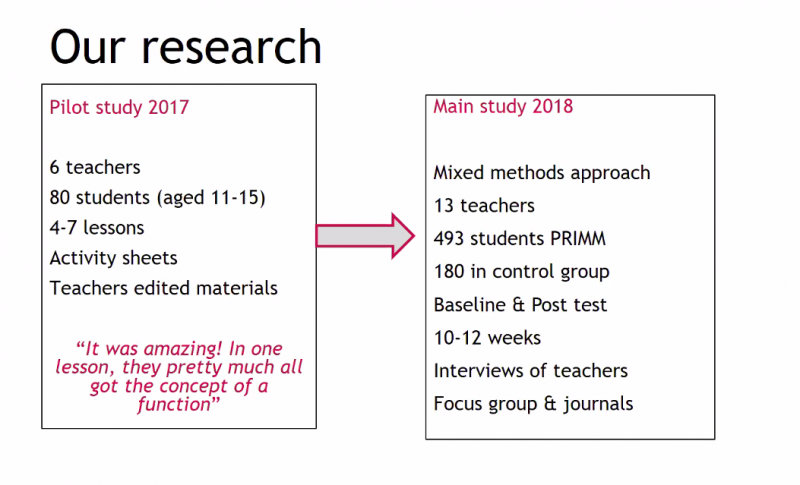
The PRIMM approach is informed by research, and it is also the subject of research by Sue and her collaborators. They’ve conducted two studies to measure the effectiveness of PRIMM: an initial pilot, and a larger mixed-methods study with 13 teachers and 493 students with a control group.
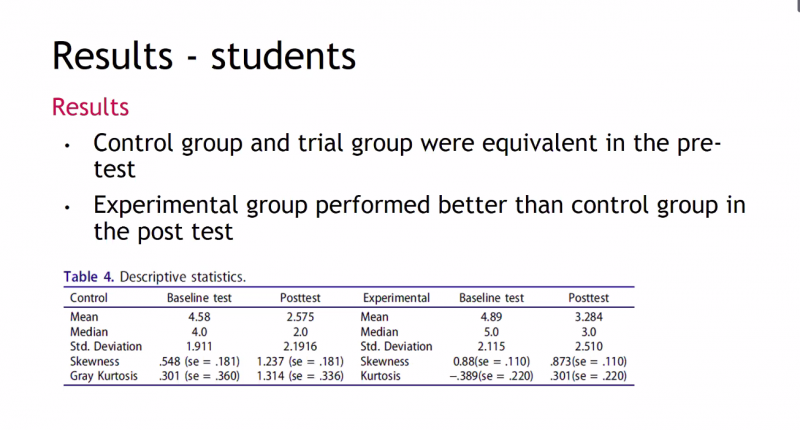
The larger study used a pre and post test, and found that the group who experienced a PRIMM approach performed better on the tests than the control group. The researchers also collected a wealth of qualitative feedback from teachers. The feedback suggested that the approach can help students to develop a language to express their understanding of programming, and that there was much more productive peer conversation in the PRIMM lessons (sometimes this meant less talk, but at a more advanced level).
The PRIMM structure also gave some teachers a greater capacity to talk about the process of teaching programming. It facilitated the discussion of teaching ideas and learning approaches for the teachers, as well as developing language approaches that students used to learn programming concepts.
The research results suggest that learners taught using PRIMM appear to be developing the language skills to talk coherently about their programming. The effectiveness of PRIMM is also evidenced by the number of teachers who have taken up the approach, building in their own activities and in some cases remixing the PRIMM terminology to develop their own take on a language-first approach to teaching programming.
Future research will investigate in detail how PRIMM encourages productive talk in the classroom, and will link the approach to other work on semantic waves. (For more on semantic waves in computing education, see this seminar by Jane Waite and this symposium talk by Paul Curzon.)
Resources for educators who want to try PRIMM
If you would like to try out PRIMM with your learners, use our free support materials:
If you missed the seminar, you can find the presentation slides alongside the recording of Sue’s talk on our seminars page.
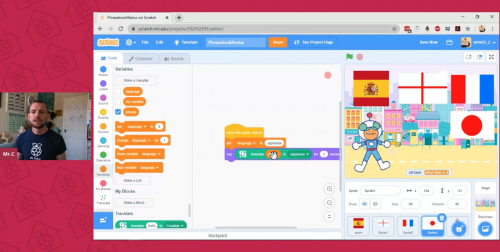
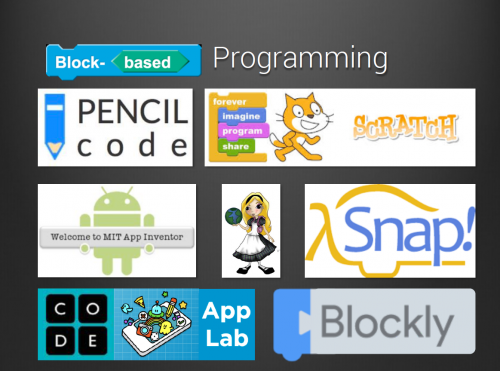
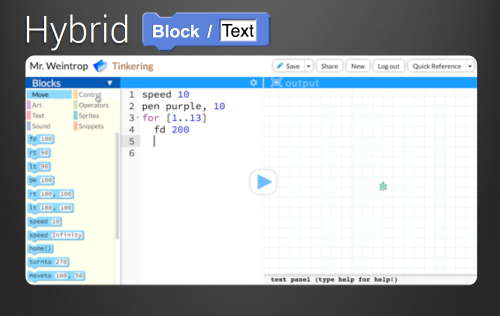
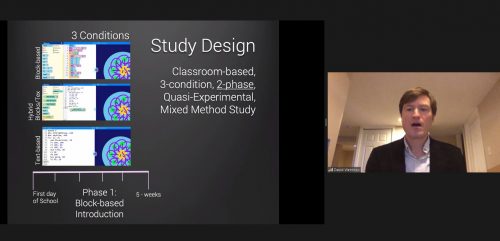
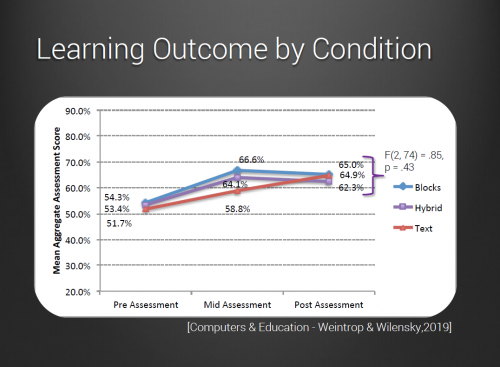
In our next seminar on Tuesday 1 December at 17:00–18:30 GMT / 12:00–13:30 EsT / 9:00–10:30 PT / 18:00–19:30 CEST. Dr David Weintrop from the University of Maryland will be presenting on the role of block-based programming in computer science education. To join, simply sign up with your name and email address.
Once you’ve signed up, we’ll email you the seminar meeting link and instructions for joining. If you attended this past seminar, the link remains the same.
In computing education research, considerable focus has been put on the design of teaching materials and learning resources, and investigating how young people learn computing concepts. But there has been less focus on assessment, particularly assessment for learning, which is called formative assessment. As classroom teachers are engaged in assessment activities all the time, it’s pretty strange that researchers in the area of computing and computer science in school have not put a lot of focus on this.
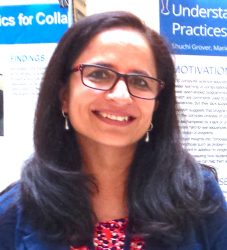
That’s why in our most recent seminar, we were delighted to hear about formative assessment — assessment for learning — from Dr Shuchi Grover, of Looking Glass Ventures and Stanford University in the USA. Shuchi has a long track record of work in the learning sciences (called education research in the UK), and her contribution in the area of computational thinking has been hugely influential and widely drawn on in subsequent research.
Two types of assessment
Assessment is typically divided into two types:
Summative assessment (i.e. assessing what has been learned), which typically takes place through examinations, final coursework, projects, etcetera.
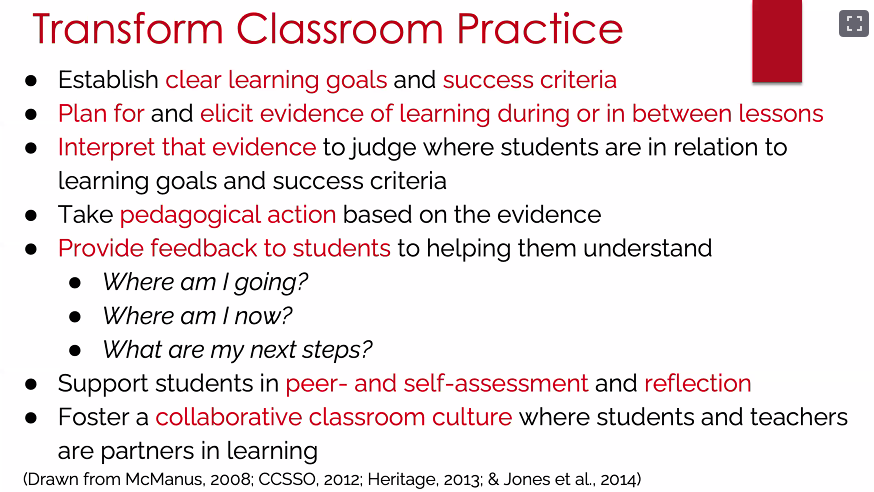
Formative assessment (i.e. assessment for learning), which is not aimed at giving grades and typically takes place through questioning, observation, plenary classroom activities, and dialogue with students.
Through formative assessment, teachers seek to find out where students are at, in order to use that information both to direct their preparation for the next teaching activities and to give students useful feedback to help them progress. Formative assessment can be used to surface misconceptions (or alternate conceptions) and for diagnosis of student difficulties.
Click to enlarge
As Shuchi outlined in her talk, a variety of activities can be used for formative assessment, for example:
Self- and peer-assessment activities (commonly used in schools).
Different forms of questioning and quizzes to support learning (not graded tests).
Rubrics and self-explanations (for assessing projects).
A framework for formative assessment
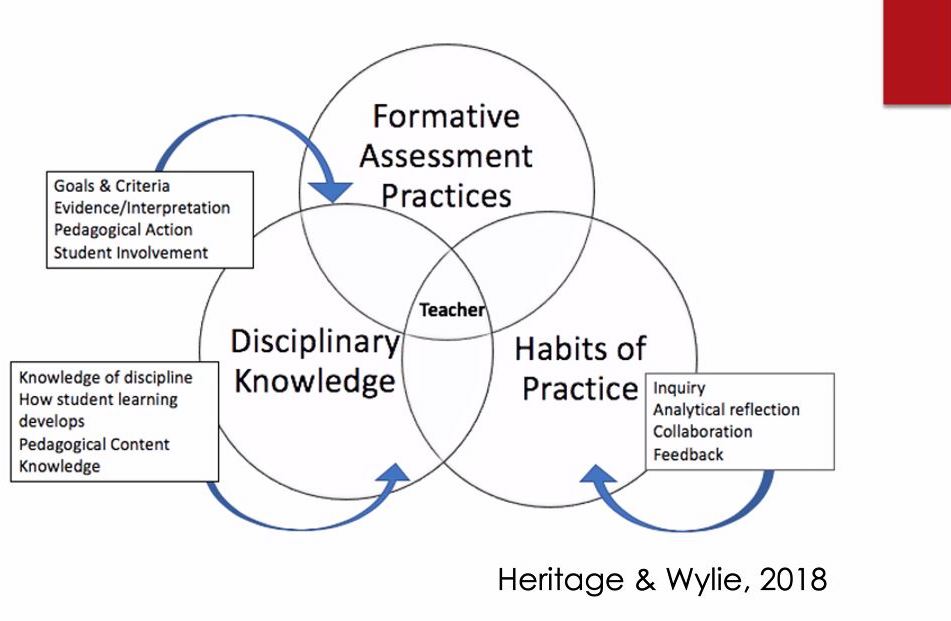
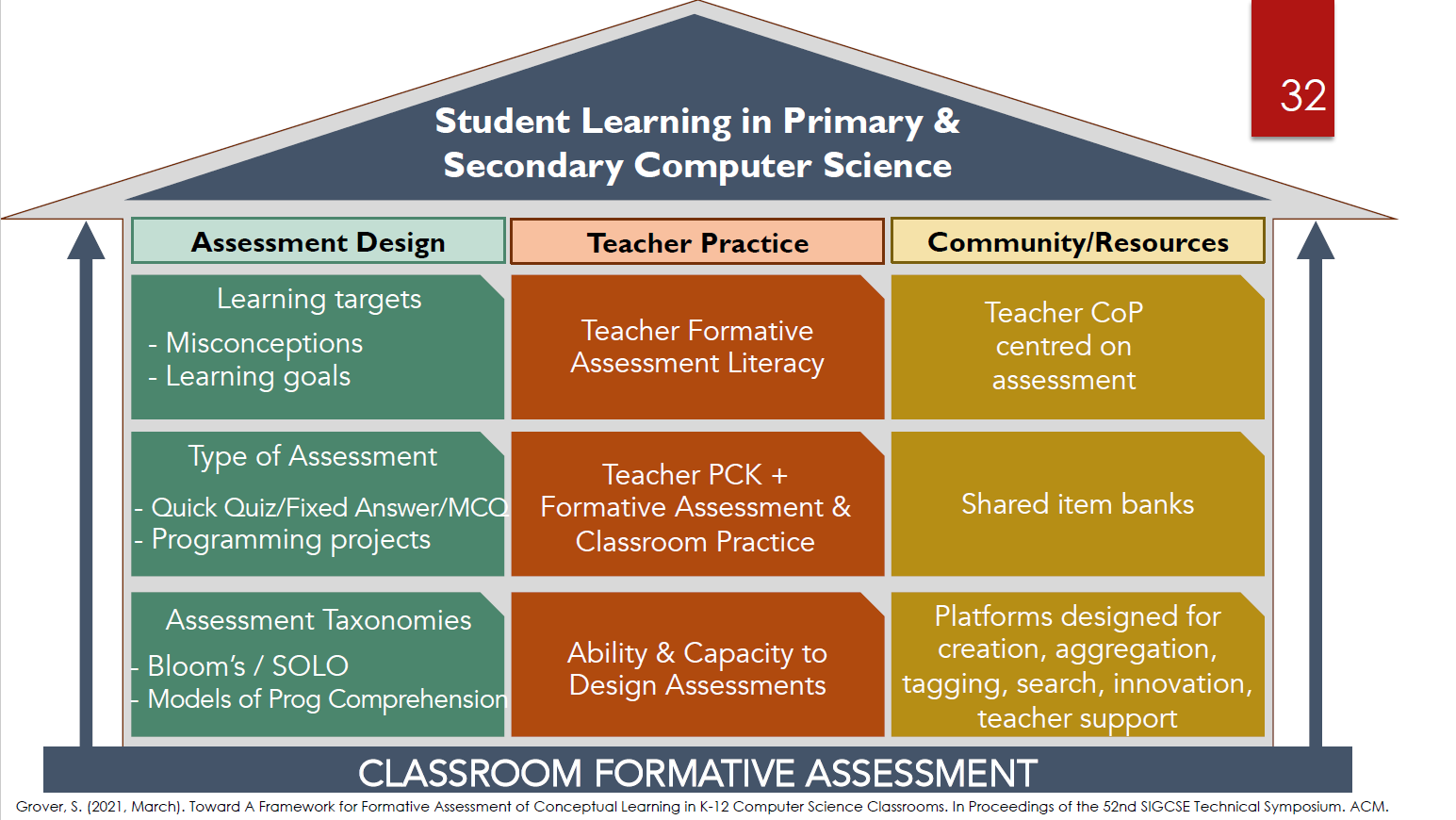
Shuchi described her own research in this topic, including a framework she has developed for formative assessment. This comprises three pillars:
Assessment design.
Teacher or classroom practice.
The role of the community in furthering assessment practice.
Click to enlarge
Shuchi’s presentation then focused on part of the first pillar in the framework: types of assessments, and particularly types of multiple-choice questions that can be automatically marked or graded using software tools. Tools obviously don’t replace teachers, but they can be really useful for providing timely and short-turnaround feedback for students.
As part of formative assessment, carefully chosen questions can also be used to reveal students’ misconceptions about the subject matter — these are called diagnostic questions. Shuchi discussed how in a classroom setting, teachers can employ this kind of question to help them decide what to focus on in future lessons, and to understand their students’ alternate or different conceptions of a topic.
Formative assessment of programming skills
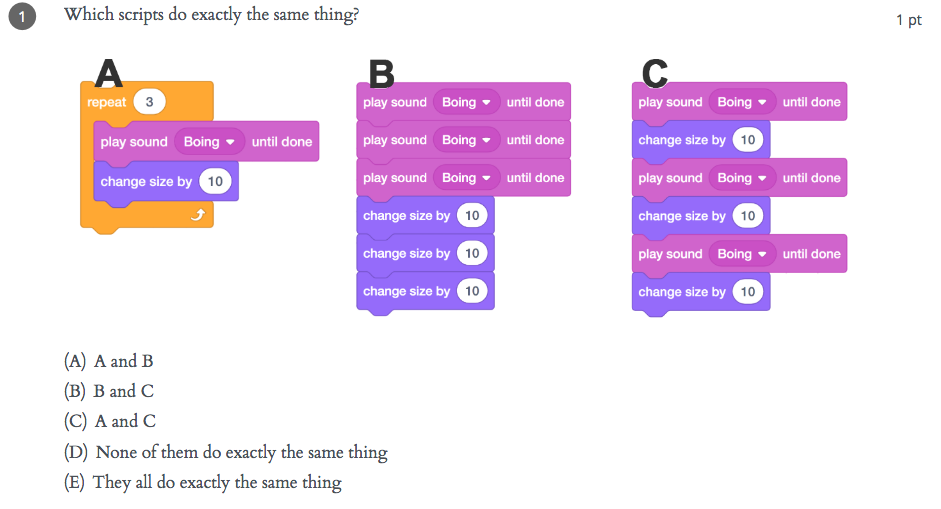
The remainder of the seminar focused on the formative assessment of programming skills. There are many ways of assessing developing programming skills (see Shuchi’s slides), including Parsons problems, microworlds, hotspot items, rubrics (for artifacts), and multiple-choice questions. As an MCQ example, in the figure below you can see some snippets of block-based code, which students need to read and work out what the outcome of running the snippets will be.
Click to enlarge
Questions such as this highlight that it’s important for learners to engage in code comprehension and code reading activities when learning to program. This really underlines the fact that such assessment exercises can be used to support learning just as much as to monitor progress.
Formative assessment: our support for teachers
Interestingly, Shuchi commented that in her experience, teachers in the UK are more used to using code reading activities than US teachers. This may be because code comprehension activities are embedded into the curriculum materials and support for pedagogy, both of which the Raspberry Pi Foundation developed as part of the National Centre for Computing Education in England. We explicitly share approaches to teaching programming that incorporate code reading, for example the PRIMM approach. Moreover, our work in the Raspberry Pi Foundation includes the Isaac Computer Science online learning platform for A level computer science students and teachers, which is centered around different types of questions designed as tools for learning.
All these materials are freely available to teachers wherever they are based.
Further work on formative assessment
Based on her work in US classrooms researching this topic, Shuchi’s call to action for teachers was to pay attention to formative assessment in computer science classrooms and to investigate what useful tools can support them to give feedback to students about their learning.
Click to enlarge
Shuchi is currently involved in an NSF-funded research project called CS Assess to further develop formative assessment in computer science via a community of educators. For further reading, there are two chapters related to formative assessment in computer science classrooms in the recently published book Computer Science in K-12 edited by Shuchi.

There was much to take away from this seminar, and we are really grateful to Shuchi for her input and look forward to hearing more about her developing project.
Join our next seminar
If you missed the seminar, you can find the presentation slides and a recording of the Shuchi’s talk on our seminars page.
In our next seminar on Tuesday 3 November at 17:00–18:30 BST / 12:00–13:30 EDT / 9:00–10:30 PT / 18:00–19:30 CEST, I will be presenting my work on PRIMM, particularly focusing on language and talk in programming lessons. To join, simply sign up with your name and email address.
Once you’ve signed up, we’ll email you the seminar meeting link and instructions for joining. If you attended this past seminar, the link remains the same.
Around the world, formal education systems are bringing computing knowledge to learners. But what exactly is set down in different countries’ computing curricula, and what are classroom educators teaching? This was the topic of the first in the autumn series of our Raspberry Pi research seminars on Tuesday 8 September.
We heard from an international team (Monica McGill , USA; Rebecca Vivian, Australia; Elizabeth Cole, Scotland) who represented a group of researchers also based in England, Malta, Ireland, and Italy. As a researcher working at the Raspberry Pi Foundation, I myself was part of this research group. The group developed METRECC, a comprehensive and validated survey tool that can be used to benchmark and measure developments of the teaching and learning of computing in formal education systems around the world. Monica, Rebecca, and Elizabeth presented how the research group developed and validated the METRECC tool, and shared some findings from their pilot study.
What’s in a curriculum? Developing a survey tool
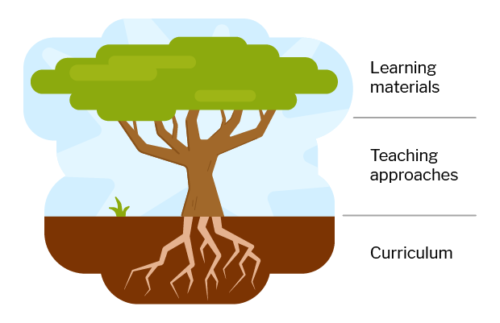
Those of us who work or have worked in school education use the word ‘curriculum’ frequently, although it’s an example of education terminology that means different things in different contexts, and to different people. Following Porter and Smithson (2001)1, we can distinguish between the intended curriculum and the enacted curriculum:
Intended curriculum: Policy tools as curriculum standards, frameworks, or guidelines that outline the curriculum teachers are expected to deliver.
Enacted curriculum: Actual curricular content in which students engage in the classroom, and adopted pedagogical approaches; for computer science (CS) curricula, this also includes students’ use of technology, physical computing devices, and tools in CS lessons.
To compare the intended and enacted computing curriculum in as many countries as possible, at particular points in time, the research group Monica, Rebecca, Elizabeth, and I were part of developed the METRECC survey tool.
METRECC stands for MEasuring TeacheREnacted Computing Curriculum. The METRECC survey has 11 categories of questions and is designed to be completed by computing teachers within 35–40 minutes. Following best practice in research, which calls for standardised research instruments, the research group ensured that the survey produces valid, reliable results (meaning that it works as intended) before using it to gather data.
Using METRECC in a pilot study
In their pilot study, the research group gathered data from 7 countries. The intended curriculum for each country was determined by examining standards and policies in place for each country/state under consideration. Teachers’ answers in the METRECC survey provided the countries’ enacted curricula. (The complete dataset from the pilot study is publicly available at csedresearch.org, a very useful site for CS education researchers where many surveys are shared.)
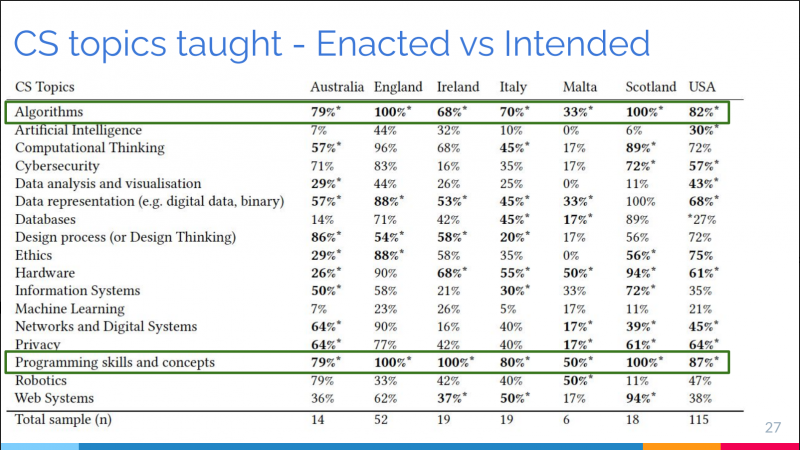
The researchers then mapped the intended to the enacted curricula to find out whether teachers were actually teaching the topics that were prescribed for them. Overall, the results of the mapping showed that there was a good match between intended and enacted curricula. Examples of mismatches include lower numbers of primary school teachers reporting that they taught visual or symbolic programming, even though the topic did appear on their curriculum.
This table shows computer science topic the METRECC tool asks teachers about, and what percentage of respondents in the pilot study stated that they teach these to their students.
Another aspect of the METRECC survey allows to measure teachers’ confidence, self-efficacy, and self-esteem. The results of the pilot study showed a relationship between years of experience and CS self-esteem; in particular, after four years of teaching, teachers started to report high self-esteem in relation to computer science. Moreover, primary teachers reported significantly lower self-esteem than secondary teachers did, and female teachers reported lower self-esteem than male teachers did.
Adapting the survey’s language
The METRECC survey has also been used in South Asia, namely Bangladesh, Nepal, Pakistan, and Sri Lanka (where computing is taught under ICT). Amongst other things, what the researchers learned from that study was that some of the survey questions needed to be adapted to be relevant to these countries. For example, while in the UK we use the word ‘gifted’ to mean ‘high-attaining’, in the South Asian countries involved in the study, to be ‘gifted’ meanshaving special needs.
The study highlighted how important it is to ensure that surveys intended for an international audience use terminology and references that are pertinent to many countries, or that the survey language is adapted in order to make sense in each context it is delivered.
Let’s keep this monitoring of computing education moving forward!
The seminar presentation was well received, and because we now hold our seminars for 90 minutes instead of an hour, we had more time for questions and answers.
My three main take-aways from the seminar were:
1. International collaboration is key
It is very valuable to be able to form international working groups of researchers collaborating on a common project; we have so much to learn from each other. Our Raspberry Pi research seminars attract educators and researchers from many different parts of the world, and we can truly push the field’s understanding forward when we listen to experiences and lessons of people from diverse contexts and cultures.
2. Making research data publicly available
Increasingly, it is expected that research datasets are made available in publicly accessible repositories. While this is becoming the norm in healthcare and scientific, it’s not yet as prevalent in computing education research. It was great to be able to publicly share the dataset from the METRECC pilot study, and we encourage other researchers in this field to do the same.
3. Extending the global scope of this research
Finally, this work is only just beginning. Over the last decade, there has been an increasing move towards teaching aspects of computer science in school in many countries around the world, and being able to measure change and progress is important. Only a handful of countries were involved in the pilot study, and it would be great to see this research extend to more countries, with larger numbers of teachers involved, so that we can really understand the global picture of formal computing education. Budding research students, take heed!
Next up in our seminar series
If you missed the seminar, you can find the presentation slides and a recording of the researchers’ talk on our seminars page.
In our next seminar on Tuesday 6 October at 17:00–18:30 BST / 12:00–13:30 EDT / 9:00–10:30 PT / 18:00–19:30 CEST, we’ll welcome Shuchi Grover, a prominent researcher in the area of computational thinking and formative assessment. The title of Shuchi’s seminar is Assessments to improve student learning in introductory CS classrooms. To join, simply sign up with your name and email address.
Once you’ve signed up, we’ll email you the seminar meeting link and instructions for joining. If you attended this past seminar, the link remains the same.
1. Andrew C. Porter and John L. Smithson. 2001. Defining, Developing and Using Curriculum Indicators. CPRE Research Reports, 12-2001. (2001)
To provide the best experiences, we use technologies like cookies to store and/or access device information. Consenting to these technologies will allow us to process data such as browsing behavior or unique IDs on this site. Not consenting or withdrawing consent, may adversely affect certain features and functions.
Functional
Always active
The technical storage or access is strictly necessary for the legitimate purpose of enabling the use of a specific service explicitly requested by the subscriber or user, or for the sole purpose of carrying out the transmission of a communication over an electronic communications network.
Preferences
The technical storage or access is necessary for the legitimate purpose of storing preferences that are not requested by the subscriber or user.
Statistics
The technical storage or access that is used exclusively for statistical purposes.The technical storage or access that is used exclusively for anonymous statistical purposes. Without a subpoena, voluntary compliance on the part of your Internet Service Provider, or additional records from a third party, information stored or retrieved for this purpose alone cannot usually be used to identify you.
Marketing
The technical storage or access is required to create user profiles to send advertising, or to track the user on a website or across several websites for similar marketing purposes.