All posts by Ash Pallarito

DIY BYOIP: a new way to Bring Your Own IP prefixes to Cloudflare

Post Syndicated from Ash Pallarito original https://blog.cloudflare.com/diy-byoip/

When a customer wants to bring IP address space to Cloudflare, they’ve always had to reach out to their account team to put in a request. This request would then be sent to various Cloudflare engineering teams such as addressing and network engineering — and then the team responsible for the particular service they wanted to use the prefix with (e.g., CDN, Magic Transit, Spectrum, Egress). In addition, they had to work with their own legal teams and potentially another organization if they did not have primary ownership of an IP prefix in order to get a Letter of Agency (LOA) issued through hoops of approvals. This process is complex, manual, and  time-consuming for all parties involved — sometimes taking up to 4–6 weeks depending on various approvals. 

Well, no longer! Today, we are pleased to announce the launch of our self-serve BYOIP API, which enables our customers to onboard and set up their BYOIP prefixes themselves.

With self-serve, we handle the bureaucracy for you. We have automated this process using the gold standard for routing security — the Resource Public Key Infrastructure, RPKI. All the while, we continue to ensure the best quality of service by generating LOAs on our customers’ behalf, based on the security guarantees of our new ownership validation process. This ensures that customer routes continue to be accepted in every corner of the Internet.

Cloudflare takes the security and stability of the whole Internet very seriously. RPKI is a cryptographically-strong authorization mechanism and is, we believe, substantially more reliable than common practice which relies upon human review of scanned documents. However, deployment and availability of some RPKI-signed artifacts like the AS Path Authorisation (ASPA) object remains limited, and for that reason we are limiting the initial scope of self-serve onboarding to BYOIP prefixes originated from Cloudflare’s autonomous system number (ASN) AS 13335. By doing this, we only need to rely on the publication of Route Origin Authorisation (ROA) objects, which are widely available. This approach has the advantage of being safe for the Internet and also meeting the needs of most of our BYOIP customers. 

Today, we take a major step forward in offering customers a more comprehensive IP address management (IPAM) platform. With the recent update to enable multiple services on a single BYOIP prefix and this latest advancement to enable self-serve onboarding via our API, we hope customers feel empowered to take control of their IPs on our network.

An evolution of Cloudflare BYOIP

We want Cloudflare to feel like an extension of your infrastructure, which is why we originally launched Bring-Your-Own-IP (BYOIP) back in 2020

A quick refresher: Bring-your-own-IP is named for exactly what it does – it allows customers to bring their own IP space to Cloudflare. Customers choose BYOIP for a number of reasons, but the main reasons are control and configurability. An IP prefix is a range or block of IP addresses. Routers create a table of reachable prefixes, known as a routing table, to ensure that packets are delivered correctly across the Internet. When a customer’s Cloudflare services are configured to use the customer’s own addresses, onboarded to Cloudflare as BYOIP, a packet with a corresponding destination address will be routed across the Internet to Cloudflare’s global edge network, where it will be received and processed. BYOIP can be used with our Layer 7 services, Spectrum, or Magic Transit. 

A look under the hood: How it works

Today’s world of prefix validation

Let’s take a step back and take a look at the state of the BYOIP world right now. Let’s say a customer has authority over a range of IP addresses, and they’d like to bring them to Cloudflare. We require customers to provide us with a Letter of Authorization (LOA) and have an Internet Routing Registry (IRR) record matching their prefix and ASN. Once we have this, we require manual review by a Cloudflare engineer. There are a few issues with this process:

  • Insecure: The LOA is just a document—a piece of paper. The security of this method rests entirely on the diligence of the engineer reviewing the document. If the review is not able to detect that a document is fraudulent or inaccurate, it is possible for a prefix or ASN to be hijacked.

  • Time-consuming: Generating a single LOA is not always sufficient. If you are leasing IP space, we will ask you to provide documentation confirming that relationship as well, so that we can see a clear chain of authorisation from the original assignment or allocation of addresses to you. Getting all the paper documents to verify this chain of ownership, combined with having to wait for manual review can result in weeks of waiting to deploy a prefix!

Automating trust: How Cloudflare verifies your BYOIP prefix ownership in minutes

Moving to a self-serve model allowed us to rethink the manner in which we conduct prefix ownership checks. We asked ourselves: How can we quickly, securely, and automatically prove you are authorized to use your IP prefix and intend to route it through Cloudflare?

We ended up killing two birds with one stone, thanks to our two-step process involving the creation of an RPKI ROA (verification of intent) and modification of IRR or rDNS records (verification of ownership). Self-serve unlocks the ability to not only onboard prefixes more quickly and without human intervention, but also exercises more rigorous ownership checks than a simple scanned document ever could. While not 100% foolproof, it is a significant improvement in the way we verify ownership.

Tapping into the authorities

Regional Internet Registries (RIRs) are the organizations responsible for distributing and managing Internet number resources like IP addresses. They are composed of 5 different entities operating in different regions of the world (RIRs). Originally allocated address space from the Internet Assigned Numbers Authority (IANA), they in turn assign and allocate that IP space to Local Internet Registries (LIRs) like ISPs.

This process is based on RIR policies which generally look at things like legal documentation, existing database/registry records, technical contacts, and BGP information. End-users can obtain addresses from an LIR, or in some cases through an RIR directly. As IPv4 addresses have become more scarce, brokerage services have been launched to allow addresses to be leased for fixed periods from their original assignees.

The Internet Routing Registry (IRR) is a separate system that focuses on routing rather than address assignment. Many organisations operate IRR instances and allow routing information to be published, including all five RIRs. While most IRR instances impose few barriers to the publication of routing data, those that are operated by RIRs are capable of linking the ability to publish routing information with the organisations to which the corresponding addresses have been assigned. We believe that being able to modify an IRR record protected in this way provides a good signal that a user has the rights to use a prefix.

Example of a route object containing validation token (using the documentation-only address 192.0.2.0/24):

% whois -h rr.arin.net 192.0.2.0/24

route:          192.0.2.0/24
origin:         AS13335
descr:          Example Company, Inc.
                cf-validation: 9477b6c3-4344-4ceb-85c4-6463e7d2453f
admin-c:        ADMIN2521-ARIN
tech-c:         ADMIN2521-ARIN
tech-c:         CLOUD146-ARIN
mnt-by:         MNT-CLOUD14
created:        2025-07-29T10:52:27Z
last-modified:  2025-07-29T10:52:27Z
source:         ARIN

For those that don’t want to go through the process of IRR-based validation, reverse DNS (rDNS) is provided as another secure method of verification. To manage rDNS for a prefix — whether it’s creating a PTR record or a security TXT record — you must be granted permission by the entity that allocated the IP block in the first place (usually your ISP or the RIR).

This permission is demonstrated in one of two ways:

  • Directly through the IP owner’s authenticated customer portal (ISP/RIR).

  • By the IP owner delegating authority to your third-party DNS provider via an NS record for your reverse zone.

Example of a reverse domain lookup using dig command (using the documentation-only address 192.0.2.0/24):

% dig cf-validation.2.0.192.in-addr.arpa TXT

; <<>> DiG 9.10.6 <<>> cf-validation.2.0.192.in-addr.arpa TXT
;; global options: +cmd
;; Got answer:
;; ->>HEADER<<- opcode: QUERY, status: NOERROR, id: 16686
;; flags: qr rd ra; QUERY: 1, ANSWER: 1, AUTHORITY: 0, ADDITIONAL: 1

;; OPT PSEUDOSECTION:
; EDNS: version: 0, flags:; udp: 4096
;; QUESTION SECTION:
;cf-validation.2.0.192.in-addr.arpa. IN TXT

;; ANSWER SECTION:
cf-validation.2.0.192.in-addr.arpa. 300 IN TXT "b2f8af96-d32d-4c46-a886-f97d925d7977"

;; Query time: 35 msec
;; SERVER: 127.0.2.2#53(127.0.2.2)
;; WHEN: Fri Oct 24 10:43:52 EDT 2025
;; MSG SIZE  rcvd: 150

So how exactly is one supposed to modify these records? That’s where the validation token comes into play. Once you choose either the IRR or Reverse DNS method, we provide a unique, single-use validation token. You must add this token to the content of the relevant record, either in the IRR or in the DNS. Our system then looks for the presence of the token as evidence that the request is being made by someone with authorization to make the requested modification. If the token is found, verification is complete and your ownership is confirmed!

The digital passport 🛂

Ownership is only half the battle; we also need to confirm your intention that you authorize Cloudflare to advertise your prefix. For this, we rely on the gold standard for routing security: the Resource Private Key Infrastructure (RPKI), and in particular Route Origin Authorization (ROA) objects.

A ROA is a cryptographically-signed document that specifies which Autonomous System Number (ASN) is authorized to originate your IP prefix. You can think of a ROA as the digital equivalent of a certified, signed, and notarised contract from the owner of the prefix.

Relying parties can validate the signatures in a ROA using the RPKI.You simply create a ROA that specifies Cloudflare’s ASN (AS13335) as an authorized originator and arrange for it to be signed. Many of our customers used hosted RPKI systems available through RIR portals for this. When our systems detect this signed authorization, your routing intention is instantly confirmed. 

Many other companies that support BYOIP require a complex workflow involving creating self-signed certificates and manually modifying RDAP (Registration Data Access Protocol) records—a heavy administrative lift. By embracing a choice of IRR object modification and Reverse DNS TXT records, combined with RPKI, we offer a verification process that is much more familiar and straightforward for existing network operators.

The global reach guarantee

While the new self-serve flow ditches the need for the “dinosaur relic” that is the LOA, many network operators around the world still rely on it as part of the process of accepting prefixes from other networks.

To help ensure your prefix is accepted by adjacent networks globally, Cloudflare automatically generates a document on your behalf to be distributed in place of a LOA. This document provides information about the checks that we have carried out to confirm that we are authorised to originate the customer prefix, and confirms the presence of valid ROAs to authorise our origination of it. In this way we are able to support the workflows of network operators we connect to who rely upon LOAs, without our customers having the burden of generating them.


Staying away from black holes

One concern in designing the Self-Serve API is the trade-off between giving customers flexibility while implementing the necessary safeguards so that an IP prefix is never advertised without a matching service binding. If this were to happen, Cloudflare would be advertising a prefix with no idea on what to do with the traffic when we receive it! We call this “blackholing” traffic. To handle this, we introduced the requirement of a default service binding — i.e. a service binding that spans the entire range of the IP prefix onboarded. 

A customer can later layer different service bindings on top of their default service binding via multiple service bindings, like putting CDN on top of a default Spectrum service binding. This way, a prefix can never be advertised without a service binding and blackhole our customers’ traffic.


Getting started

Check out our developer docs on the most up-to-date documentation on how to onboard, advertise, and add services to your IP prefixes via our API. Remember that onboardings can be complex, and don’t hesitate to ask questions or reach out to our professional services team if you’d like us to do it for you.

The future of network control

The ability to script and integrate BYOIP management into existing workflows is a game-changer for modern network operations, and we’re only just getting started. In the months ahead, look for self-serve BYOIP in the dashboard, as well as self-serve BYOIP offboarding to give customers even more control.

Cloudflare’s self-serve BYOIP API onboarding empowers customers with unprecedented control and flexibility over their IP assets. This move to automate onboarding empowers a stronger security posture, moving away from manually-reviewed PDFs and driving RPKI adoption. By using these API calls, organizations can automate complex network tasks, streamline migrations, and build more resilient and agile network infrastructures.

Cloudflare 1.1.1.1 Incident on July 14, 2025

Post Syndicated from Ash Pallarito original https://blog.cloudflare.com/cloudflare-1-1-1-1-incident-on-july-14-2025/

On 14 July 2025, Cloudflare’s 1.1.1.1 Resolver service became unavailable to the Internet starting at 21:52 UTC and ending at 22:54 UTC. The majority of 1.1.1.1 users globally were affected. For many users, not being able to resolve names using the 1.1.1.1 Resolver meant that basically all Internet services were unavailable. This outage can be observed on Cloudflare Radar.

The outage occurred because of a misconfiguration of legacy systems used to maintain the infrastructure that advertises Cloudflare’s IP addresses to the Internet.

This was a global outage. During the outage, Cloudflare’s 1.1.1.1 Resolver was unavailable worldwide.

We’re very sorry for this outage. The root cause was an internal configuration error and not the result of an attack or a BGP hijack. In this blog, we’re going to talk about what the failure was, why it occurred, and what we’re doing to make sure this doesn’t happen again.

Background

Cloudflare introduced the 1.1.1.1 public DNS Resolver service in 2018. Since the announcement, 1.1.1.1 has become one of the most popular DNS Resolver IP addresses and it is free for anyone to use.

Almost all of Cloudflare’s services are made available to the Internet using a routing method known as anycast, a well-known technique intended to allow traffic for popular services to be served in many different locations across the Internet, increasing capacity and performance. This is the best way to ensure we can globally manage our traffic, but also means that problems with the advertisement of this address space can result in a global outage.   

Cloudflare announces these anycast routes to the Internet in order for traffic to those addresses to be delivered to a Cloudflare data center, providing services from many different places. Most Cloudflare services are provided globally, like the 1.1.1.1 public DNS Resolver, but a subset of services are specifically constrained to particular regions. 

These services are part of our Data Localization Suite (DLS), which allows customers to configure Cloudflare in a variety of ways to meet their compliance needs across different countries and regions. One of the ways in which Cloudflare manages these different requirements is to make sure the right service’s IP addresses are Internet-reachable only where they need to be, so your traffic is handled correctly worldwide. A particular service has a matching “service topology” – that is, traffic for a service should be routed only to a particular set of locations.

On June 6, during a release to prepare a service topology for a future DLS service, a configuration error was introduced: the prefixes associated with the 1.1.1.1 Resolver service were inadvertently included alongside the prefixes that were intended for the new DLS service. This configuration error sat dormant in the production network as the new DLS service was not yet in use,  but it set the stage for the outage on July 14. Since there was no immediate change to the production network there was no end-user impact, and because there was no impact, no alerts were fired.

Incident Timeline

Time (UTC)

Event

2025-06-06 17:38

ISSUE INTRODUCED – NO IMPACT

A configuration change was made for a DLS service that was not yet in production. This configuration change accidentally included a reference to the 1.1.1.1 Resolver service and, by extension, the prefixes associated with the 1.1.1.1 Resolver service.

This change did not result in a change of network configuration, and so routing for the 1.1.1.1 Resolver was not affected.

Since there was no change in traffic, no alerts fired, but the misconfiguration lay dormant for a future release. 

2025-07-14 21:48

IMPACT START

A configuration change was made for the same DLS service. The change attached a test location to the non-production service; this location itself was not live, but the change triggered a refresh of network configuration globally.

Due to the earlier configuration error linking the 1.1.1.1 Resolver’s IP addresses to our non-production service, those 1.1.1.1 IPs were inadvertently included when we changed how the non-production service was set up.

The 1.1.1.1 Resolver prefixes started to be withdrawn from production Cloudflare data centers globally.

2025-07-14 21:52

DNS traffic to 1.1.1.1 Resolver service begins to drop globally

2025-07-14 21:54

Related, non-causal event: BGP origin hijack of 1.1.1.0/24 exposed by withdrawal of routes from Cloudflare. This was not a cause of the service failure, but an unrelated issue that was suddenly visible as that prefix was withdrawn by Cloudflare. 

2025-07-14 22:01

IMPACT DETECTED

Internal service health alerts begin to fire for the 1.1.1.1 Resolver

2025-07-14 22:01

INCIDENT DECLARED

2025-07-14 22:20

FIX DEPLOYED

Revert was initiated to restore the previous configuration. To accelerate full restoration of service, a manually triggered action is validated in testing locations before being executed.

2025-07-14 22:54

IMPACT ENDS

Resolver alerts cleared and DNS traffic on Resolver prefixes return to normal levels

2025-07-14 22:55

INCIDENT RESOLVED

Impact

Any traffic coming to Cloudflare via 1.1.1.1 Resolver services on these IPs was impacted. Traffic to each of these addresses were also impacted on the corresponding routes. 

1.1.1.0/24
1.0.0.0/24 
2606:4700:4700::/48
162.159.36.0/24
162.159.46.0/24
172.64.36.0/24
172.64.37.0/24
172.64.100.0/24
172.64.101.0/24
2606:4700:4700::/48
2606:54c1:13::/48
2a06:98c1:54::/48

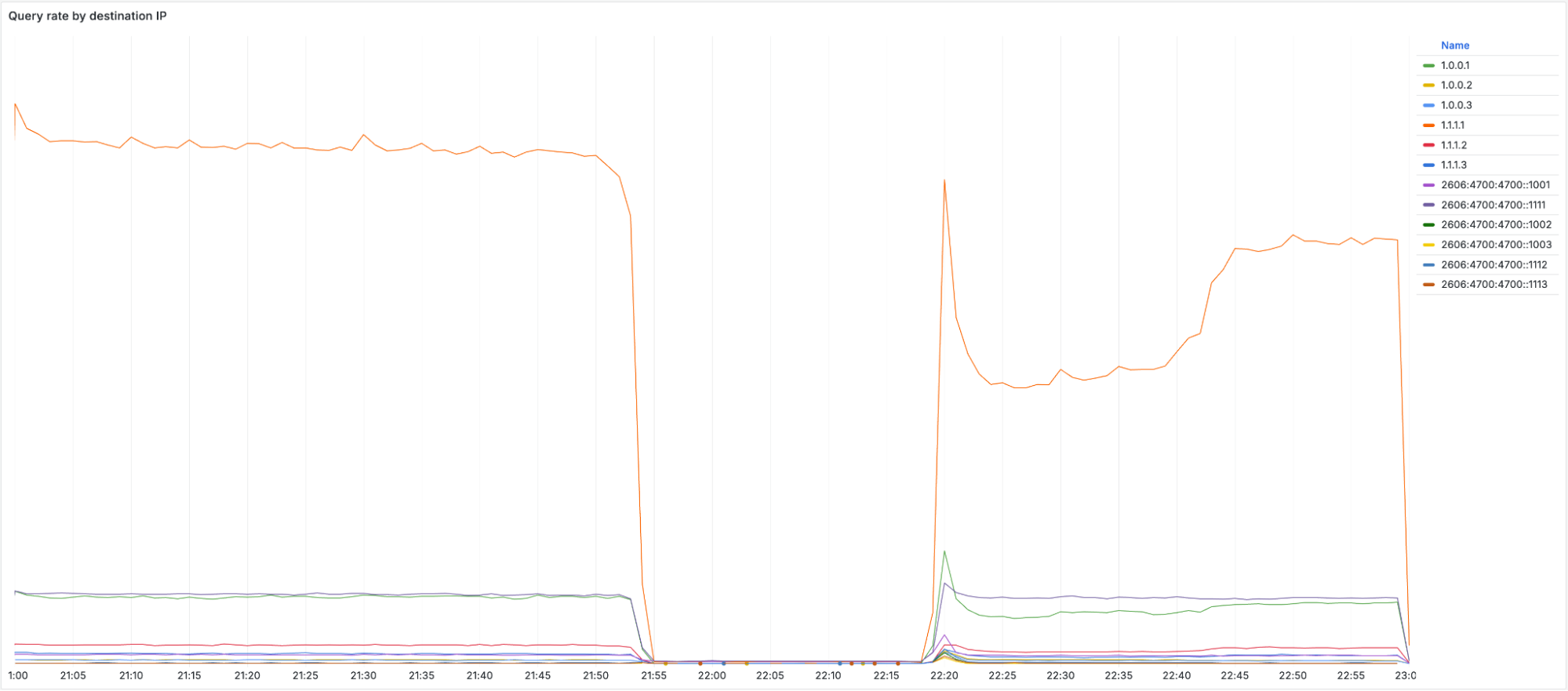
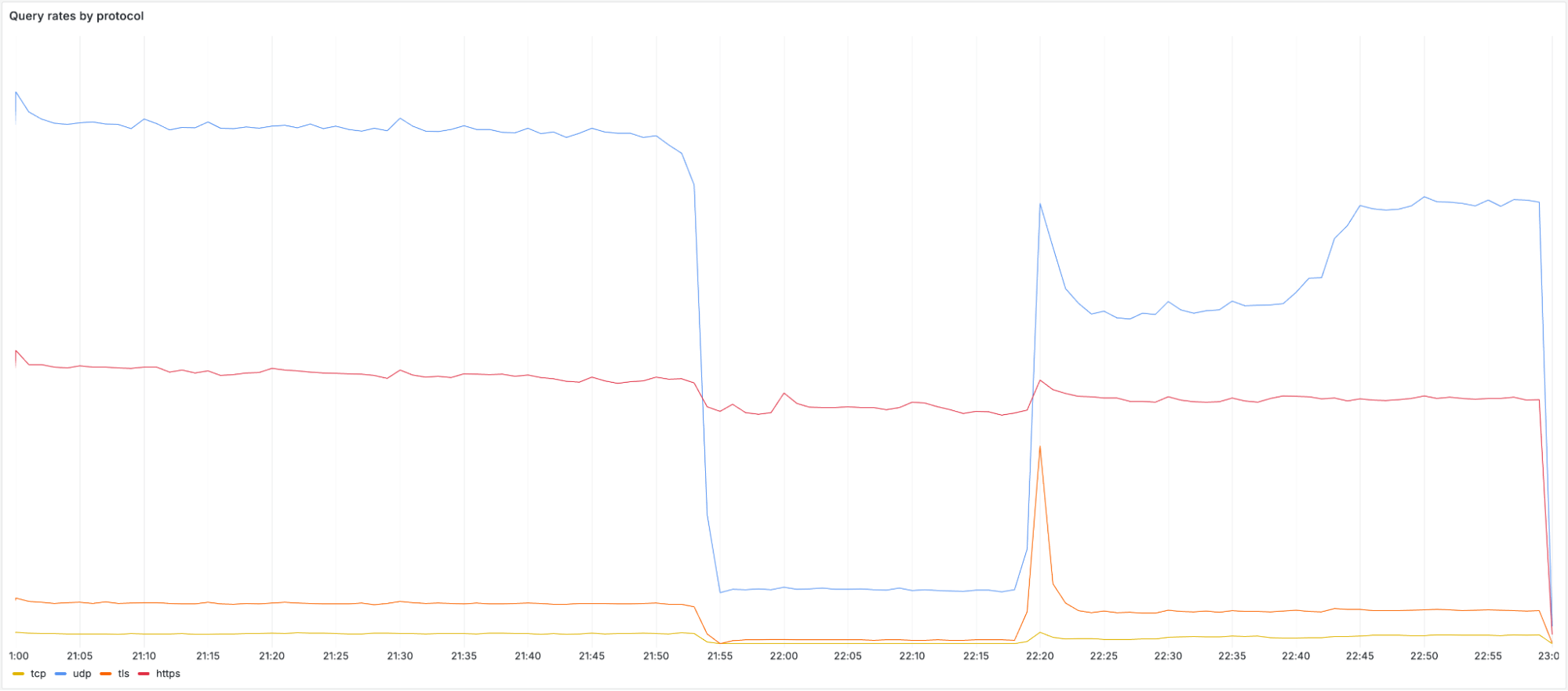
When the impact started we observed an immediate and significant drop in queries over UDP, TCP and DNS over TLS (DoT). Most users have 1.1.1.1, 1.0.0.1, 2606:4700:4700::1111, or 2606:4700:4700::1001 configured as their DNS server. Below you can see the query rate for each of the individual protocols and how they were impacted during the incident:


It’s worth noting that DoH (DNS-over-HTTPS) traffic remained relatively stable as most DoH users use the domain cloudflare-dns.com, configured manually or through their browser, to access the public DNS resolver, rather than by IP address. DoH remained available and traffic was mostly unaffected as cloudflare-dns.com uses a different set of IP addresses. Some DNS traffic over UDP that also used different IP addresses remained mostly unaffected as well.

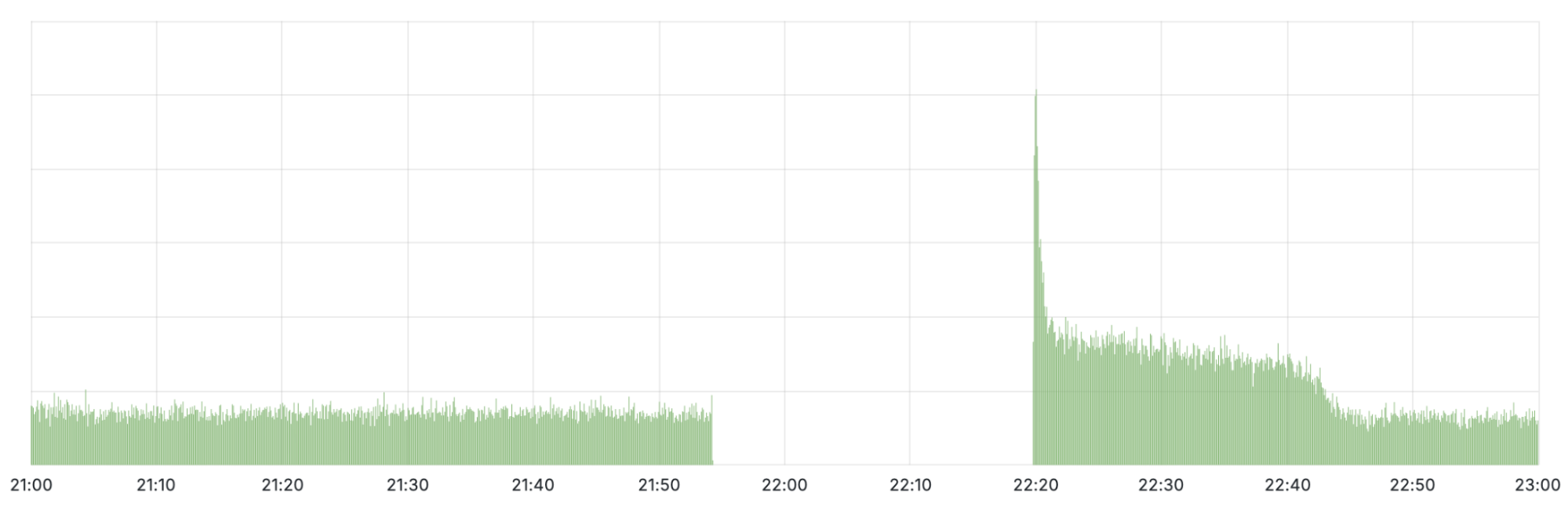
As the corresponding prefixes were withdrawn, no traffic sent to those addresses could reach Cloudflare. We can see this in the timeline for the BGP announcements for 1.1.1.0/24:


Pictured above is the timeline for BGP withdrawal and re-announcement of 1.1.1.0/24 globally

When looking at the query rate of the withdrawn IPs it can be observed that almost no traffic arrives during the impact window. When the initial fix was applied at 22:20 UTC, a large spike in traffic can be seen before it drops off again. This spike is due to clients retrying their queries. When we started announcing the withdrawn prefixes again, queries were able to reach Cloudflare once more. It took until 22:54 UTC before routing was restored in all locations and traffic returned to mostly normal levels.


Technical description of the error and how it happened

Failure of 1.1.1.1 Resolver Service

As described above, a configuration change on June 6 introduced an error in the service topology for a pre-production, DLS service. On July 14, a second change to that service was made: an offline data center location was added to the service topology for the pre-production DNS service in order to allow for some internal testing. This change triggered a refresh of the global configuration of the associated routes, and it was at this point that the impact from the earlier configuration error was felt. The service topology for the 1.1.1.1 Resolver’s prefixes was reduced from all locations down to a single, offline location. The effect was to trigger the global and immediate withdrawal of all 1.1.1.1 prefixes.

As routes to 1.1.1.1 were withdrawn, the 1.1.1.1 service itself became unavailable. Alerts fired and an incident was declared.

Technical Investigation and Analysis

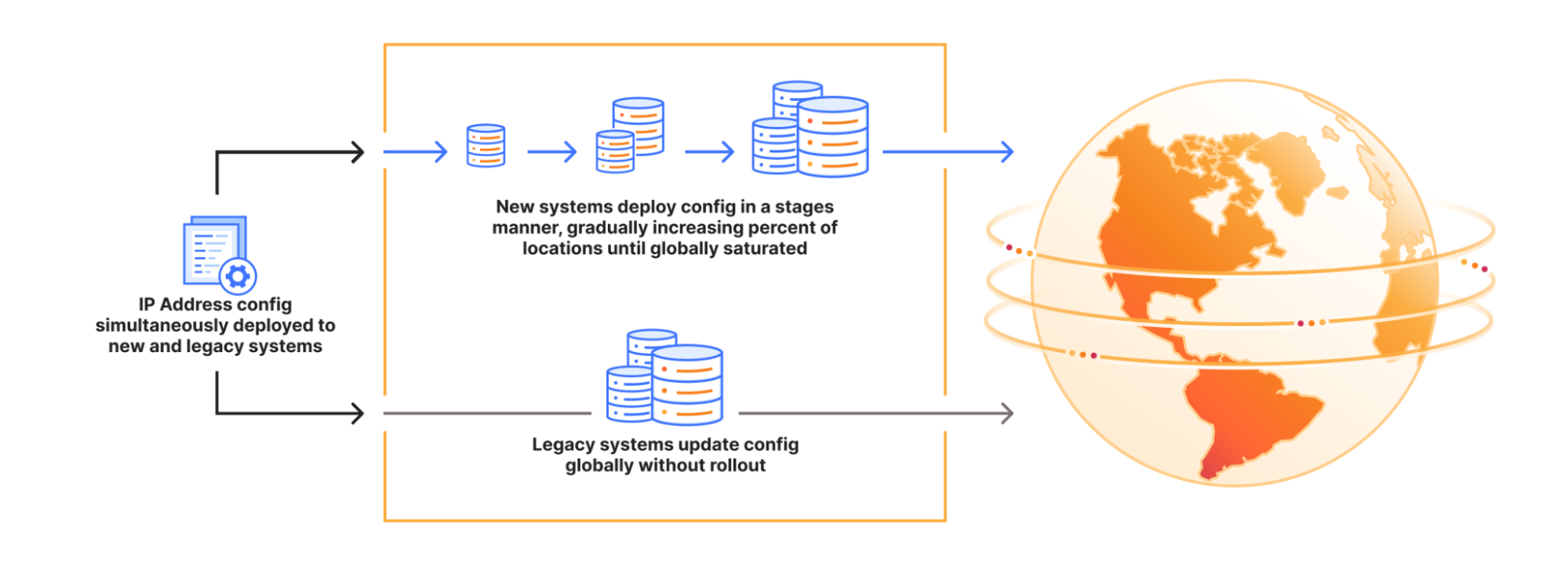
The way that Cloudflare manages service topologies has been refined over time and currently consist of a combination of a legacy and a strategic system that are synced. Cloudflare’s IP ranges are currently bound and configured across these systems that  dictate where an IP range should be announced (in terms of datacenter location) on the edge network. The legacy approach of hard-coding explicit lists of data center locations and attaching them to particular prefixes has proved error-prone, since (for example) bringing a new data center online requires many different lists to be updated and synced consistently. This model also has a significant flaw in that updates to the configuration do not follow a progressive deployment methodology: Even though this release was peer-reviewed by multiple engineers, the change didn’t go through a series of canary deployments before reaching every Cloudflare data center. Our newer approach is to describe service topologies without needing to hard-code IP addresses, which better accommodate expansions to new locations and customer scenarios while also allowing for a staged deployment model, so changes can propagate slowly with health monitoring. During the migration between these approaches, we need to maintain both systems and synchronize data between them, which looks like this:


Initial alerts were triggered for the DNS Resolver at 22:01, indicating query, proxy, and data center failures. While investigating the alerts, we noted traffic toward the Resolver prefixes had drastically dropped and was no longer being received at our edge data centers. Internally, we use BGP to control route advertisements, and we found the Resolver routes from servers were completely missing.

Once our configuration error had been exposed and Cloudflare systems had withdrawn the routes from our routing table, all of the 1.1.1.1 routes should have disappeared entirely from the global Internet routing table. However, this isn’t what happened with the prefix 1.1.1.0/24. Instead, we got reports from Cloudflare Radar that Tata Communications India (AS4755) had started advertising 1.1.1.0/24: from the perspective of the routing system, this looked exactly like a prefix hijack. This was unexpected to see while we were troubleshooting the routing problem, but to be perfectly clear: this BGP hijack was not the cause of the outage. We are following up with Tata Communications.

Restoring the 1.1.1.1 Service

We reverted to the previous configuration at 22:20 UTC. Near instantly, we began readvertising the BGP prefixes which were previously withdrawn from the routers, including 1.1.1.0/24. This restored 1.1.1.1 traffic levels to roughly 77% of what they were prior to the incident. However, during the period since withdrawal, approximately 23% of the fleet of edge servers had been automatically reconfigured to remove required IP bindings as a result of the topology change. To add the configurations back, these servers needed to be reconfigured with our change management system which is not an instantaneous process by default for safety. 

The process by which the IP bindings can be restored normally takes some time, as the network in individual locations is designed to be updated over a course of multiple hours. We implement a progressive rollout, rather than on all nodes at once to ensure we don’t introduce additional impact. However, given the severity of the incident, we accelerated the rollout of the fix after verifying the changes in testing locations to restore service as quickly and safely as possible. Normal traffic levels were observed at 22:54 UTC.

Remediation and follow-up steps

We take incidents like this seriously, and we recognise the impact that this incident had. Though this specific issue has been resolved, we have identified several steps we can take to mitigate the risk of a similar problem occurring in the future. We are implementing the following plan as a result of this incident:

Staging Addressing Deployments: Legacy components do not leverage a gradual, staged deployment methodology. Cloudflare will deprecate these systems which enables modern progressive and health mediated deployment processes to provide earlier indication in a staged manner and rollback accordingly.

Deprecating Legacy Systems: We are currently in an intermediate state in which current and legacy components need to be updated concurrently, so we will be migrating addressing systems away from risky deployment methodologies like this one. We will accelerate our deprecation of the legacy systems in order to provide higher standards for documentation and test coverage.

Conclusion

Cloudflare’s 1.1.1.1 DNS Resolver service fell victim to an internal configuration error.

We are sorry for the disruption this incident caused for our customers. We are actively making these improvements to ensure improved stability moving forward and to prevent this problem from happening again.