All posts by Chris Boyd

Rapid7 Q1 2025 Incident Response Findings

Post Syndicated from Chris Boyd original https://blog.rapid7.com/2025/06/04/rapid7-q1-2025-incident-response-findings/

Rapid7 Q1 2025 Incident Response Findings

Rapid7’s Q1 2025 incident response data highlights several key initial access vector (IAV) trends, shares salient examples of incidents investigated by the Rapid7 Incident Response (IR) team, and digs into threat data by industry as well as some of the more commonly seen pieces of malware appearing in incident logs.

Is having no MFA solution in place still one of the most appealing vulnerabilities for threat actors? Will you see the same assortment of malware regardless of whether you work in business services or media and communications? And how big a problem could one search engine query possibly be, anyway?

The answer to that last question is “very,” as it turns out. As for the rest…

Initial access vectors

Below, we highlight the key movers and shakers for IAVs across cases investigated by Rapid7’s IR team. While you’ll notice a fairly even split among several vectors such as exposed remote desktop protocol (RDP) services and SEO poisoning, one in particular is clearly the leader of the pack where compromising organizations is concerned: stolen credentials to valid/active accounts with no multi-factor authentication (MFA) enabled.

Rapid7 Q1 2025 Incident Response Findings

Valid account credentials — with no MFA in place to protect the organization should they be misused — are still far and away the biggest stumbling block for organizations investigated by the Rapid7 IR team, occurring in 56% of all incidents this first quarter.

Exposed RDP services accounted for 6% of incidents as the IAV, yet they were abused by attackers more generally in 44% of incidents. This tells us that third parties remain an important consideration in an organization’s security hygiene.

Valid accounts / no MFA: Top of the class

Rapid7 regularly bangs the drum for tighter controls where valid accounts and MFA are concerned. As per the key findings, 56% of all incidents in Q1 2025 involved valid accounts / no MFA as the initial access vector. In fact, there’s been very little change since Q3 2024, and as good as no difference between the last two quarters:

Rapid7 Q1 2025 Incident Response Findings

Vulnerability exploitation: Cracks in the armor

Rapid7’s IR services team observed several vulnerabilities used, or likely to have been used, as an IAV in Q1 2025. CVE-2024-55591 for example, the IAV for an incident in manufacturing, is a websocket-based race condition authentication bypass affecting Fortinet’s FortiOS and FortiProxy flagship appliances. Successful exploitation results in the ability to execute arbitrary CLI console commands as the super_admin user. The CVE-2024-55591 advisory was published at the beginning of 2025, and it saw widespread exploitation in the wild.

One investigation revealed attackers using the above flaw to exploit vulnerable firewall devices and create local and administrator accounts with legitimate-looking names (e.g., references to “Admin”, “I.T.”, “Support”). This allowed access to firewall dashboards, which may have contained useful information about the devices’ users, configurations, and network traffic. Policies were created which allowed for leveraging of remote VPN services, and the almost month-long dwell time observed in similar incidents may suggest initial access broker (IAB) activity, or a possible intended progression to data exfiltration and ransomware.

Exposed RMM tooling: A path to ransomware

As noted above, 6% of IAV incidents were a result of exposed remote monitoring and management (RMM) tooling. RMMs, used to remotely manage and access devices, are often used to gain initial access, or form part of the attack chain leading to ransomware.

One investigation revealed a version of SimpleHelp vulnerable to several critical privilege escalation and remote code execution vulnerabilities, which included CVE-2024-57726, CVE-2024-57727, and CVE-2024-57728.

These CVEs target the SimpleHelp remote access solution. Exploiting CVE-2024-57727 permits an unauthenticated attacker to leak SimpleHelp “technician” password hashes. If one is cracked, the attacker can log-in as a remote-access technician. Lastly, the attacker can exploit CVE-2024-57726 and CVE-2024-57728 to elevate to SimpleHelp administrator and trigger remote code execution, respectively. CVE-2024-57727 was added to CISA KEV in February 2025.

The vulnerable RMM solution was used to gain initial access and threat actors used PowerShell to create Windows Defender exclusions, with the ultimate goal of deploying INC Ransomware on target systems.

SEO poisoning: When a quick search leads to disaster

SEO poisoning, once the scourge of search engines everywhere, may not be high on your list of priorities. However, it still has the potential to wreak havoc on a network. Here, the issue isn’t so much rogue entries in regular search results, but instead the paid sponsored ads directly above typical searches. Note how many sponsored results sit above the genuine site related to this incident:

Rapid7 Q1 2025 Incident Response Findings
Multiple sponsored searches above the official (and desired) search result

This investigation revealed a tale of two search results, where one led to a genuine download of a tool designed to monitor virtual environments, and the other led to malware. When faced with both options, a split-second decision went with the latter and what followed was an escalating series of intrusion, data exfiltration and—eventually—ransomware.

Rapid7 Q1 2025 Incident Response Findings
An imitation website offering malware disguised as genuine software

On the same day of initial compromise, the attacker moved laterally using compromised credentials via RDP, installing several RMM tools such as AnyDesk and SplashTop. It is likely that the threat actor searched for insecurely stored password files and targeted password managers. They also attempted to modify and/or disable various security tools in order to evade detection, and create a local account to enable persistence and avoid domain-wide password resets.

An unauthorized version of WinSCP was used to exfiltrate a few hundred GB of sensitive company data from several systems, and with this mission accomplished only a few tasks remained. The first: attempting to inhibit system recovery by tampering with the Volume Shadow Copy Service (VSS), clearing event logs, deleting files, and also attempting to target primary backups for data destruction. The second: deployment of Qilin ransomware and a blackmail note instructing the victim to communicate via a TOR link lest the data be published to their leak site.

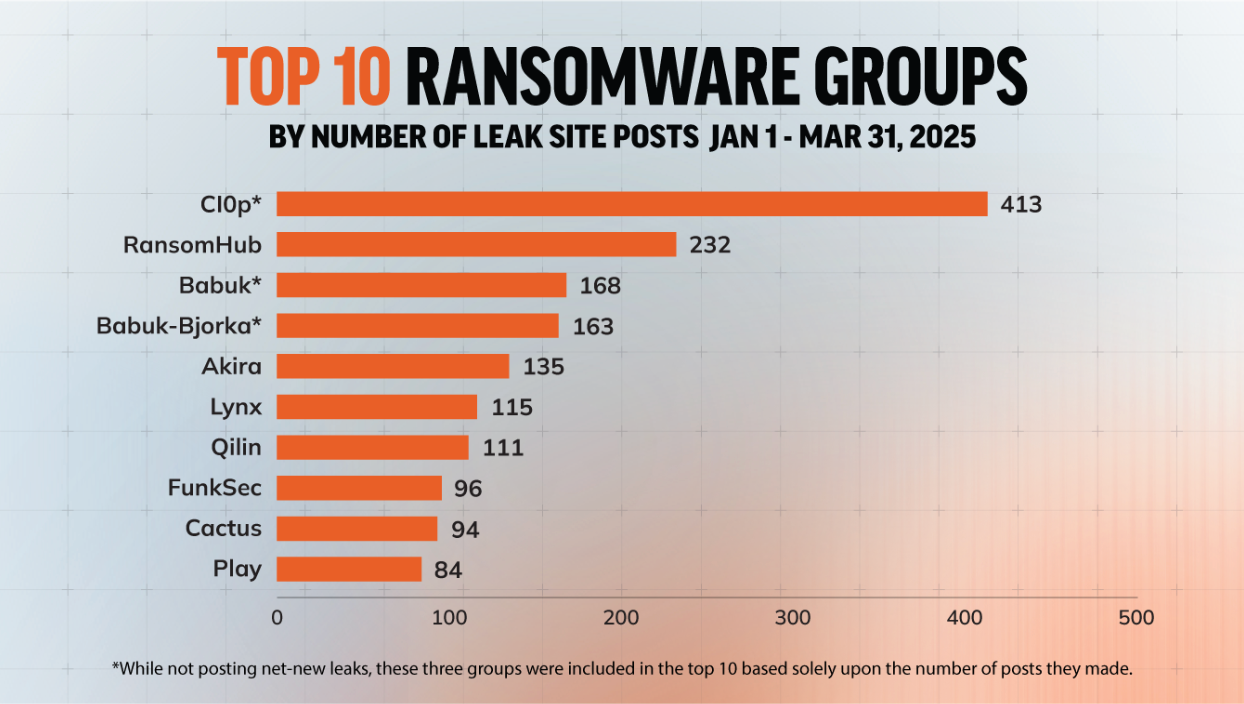
Qilin ranked 7 in our top ransomware groups of Q1 2025 for leak post frequency, racking up 111 posts from January through March. Known for double-extortion attacks across healthcare, manufacturing, and financial sectors, Qilin (who, despite their name, are known not to be Chinese speakers, but rather Russian-speaking) has also recently been seen deployed by North Korean threat actors Moonstone Sleet.

Attacker behavior observations

Bunnies everywhere: Tracking a top malware threat

BunnyLoader, the Malware as a Service (MaaS) loader possessing a wealth of capabilities including clipboard and credential theft, keylogging, and the ability to deploy additional malware, is one of the most prolific presences Rapid7 has seen this first quarter of 2025. In many cases, it’s also daisy-chained to many of the other payloads and tactics which make repeated appearances.

To really drive this message home: BunnyLoader is the most observed payload across almost every industry we focused on. Whether we’re talking manufacturing, healthcare, business services or finance, it’s typically well ahead of the rest of the pack. Here are our findings across the 5 most targeted industries of Q1:

Rapid7 Q1 2025 Incident Response Findings

BunnyLoader is in pole position not only for the 5 industries shown above, but across 12 of 13 industries overall, with 40% of all incidents observed involving this oft-updated malware.

Just over half of that 40% total involved a fake CAPTCHA (commonly used for the purpose of victims executing malicious code), with malicious / compromised sites appearing in a quarter of BunnyLoader cases. Rogue documents, which may be booby-trapped with malware or pave the way for potential phishing attacks, bring up the rear at just 9% of all BunnyLoader appearances recorded. First offered for sale in 2023 for a lifetime-use cost of $250, its continued development and large range of features make it an attractive proposition for rogues operating on a budget.

Targeted organizations: The manufacturing magnet

Manufacturing organizations were targeted in more than 24% of incidents the Rapid7 IR team observed, by far the most targeted industry in Q1 based on both Rapid7’s ransomware analytics and IR team observations. The chart below compares Rapid7’s industry-wide data (comprising a wide range of payloads and tactics) with ransomware leak post specific data. In both cases, manufacturing is a fair way ahead of other industries; this reflects its status as one of the most popular targets for ransomware groups over the last couple of years.

The manufacturing industry is an attack vector for nation states because it is an important component of global trade. It is also an area that has many legacy and older, operational technologies (OT). Combine unpatched legacy systems with complicated supply chains, and you have a risk that nation state actors will find an attractive target. This is especially the case when considering that many manufacturing organizations have critical contracts with governments, and attacks can cause severe disruption if they’re not speedily resolved.

Rapid7 Q1 2025 Incident Response Findings

Conclusion

Q1 2025 resembles a refinement of successful tactics, as opposed to brand new innovations brought to the table. Our Q1 ransomware analytics showed threat actors making streamlined tweaks to a well-oiled machine, and we find many of the same “evolution, not revolution” patterns occurring here.

This progression is particularly applicable in the case of initial access via valid accounts with no MFA protection. We expect to see no drop in popularity while businesses continue to leave easy inroads open and available to skilled (and unskilled) attackers.

In addition, the risk of severe compromise stemming from seemingly harmless online searches underscores the necessity for organizations to reexamine basic security best practices, alongside deploying robust detection and response capabilities. Businesses addressing these key areas for concern will be better equipped to defend against what should not be an inevitable slide into data exfiltration and malware deployment.


Password Spray Attacks Taking Advantage of Lax MFA

Post Syndicated from Chris Boyd original https://blog.rapid7.com/2025/04/10/password-spray-attacks-taking-advantage-of-lax-mfa/

Password Spray Attacks Taking Advantage of Lax MFA

In the first quarter of 2025, Rapid7’s Managed Threat Hunting team observed a significant volume of brute-force password attempts leveraging FastHTTP, a high-performance HTTP server and client library for Go, to automate unauthorized logins via HTTP requests.

This rapid volume of credential spraying was primarily designed to discover and compromise accounts not properly secured by multi-factor authentication (MFA). Out of just over a million unauthorized login attempts we observed, the distribution of originating traffic sources is similar to that previously seen in January 2025. Some of the most prominent nations serving as points of origin for these attempts are as follows:

  • Brazil: 70%
  • Venezuela: 3%
  • Turkey: 3%
  • Russia: 2%
  • Argentina: 2%
  • Mexico: 2%

Analysis of attempted initial access via compromised or absent MFA revealed a significant success rate for defenders’ security controls. Overwhelmingly, 73% of attempts resulted in account lockouts, with an additional 26% failing due to incorrect passwords. Account disabling accounted for 1% of failures. Critically, fewer than 1% of accounts were successfully compromised through brute-force attacks, highlighting the robust effectiveness of implemented credential brute-forcing prevention measures.

There is a heavy emphasis here on rapid-fire, repeated attempts to log in resulting in accounts eventually being locked. The small number of accounts being disabled could be an additional security step after too many attempts to log in, or simply that the person associated with the account has left the organization.

The misuse of FastHTTP to automate unauthorized logins at speed is just one aspect of a much broader problem: namely, the popularity of initial access to networks aided by a persistent lack of MFA for VPN, SaaS, and VDI products. Rapid7 expects to see this type of rapid-fire, brute force attack become more common as cloud authentication becomes more prevalent. It’s entirely possible threat actors will look to try similar account compromising attempts with other tools and libraries, and commonly abused user agent strings.

Incident Response Facts and Figures: Handing Attackers an Easy Victory

Rapid7 has consistently highlighted MFA as a primary concern across several threat research reports. By the midpoint of 2023, data for the first half of the year showed that 39% of incidents our managed services teams responded to had arisen from lax or lacking MFA. Our 2024 Threat Landscape blog highlighted that remote access to systems without MFA was responsible for 56% of incidents as an initial access vector, the largest driver of incidents overall.

The third quarter of 2024 saw 67% of incident responses involving abuse of valid accounts and missing or lax enforcement of MFA. This total sits at 57% for Q4 2024, in part because of a 22% increase in social engineering. Even without pausing to consider user agent-centric password spraying, this is a potentially dangerous combination for organizations not making the most of MFA-centric protection. If the brute forcing doesn’t get you, a social engineering campaign might just do the trick.

Why MFA Matters: The Consequences of “We’ll Set It up Later”

MFA is a key component of an overall Identity Access Management (IAM) strategy. If you’re not making use of it, then your overall defense is weakened against many of the most common threats out there, including:

  • Phishing: The very best password you can muster is made entirely redundant if your employee hands it over to a phisher, whether via a forged website or a social engineering attack. One way to mitigate against this is to use a password manager, which will only automatically enter your details on a valid website. But what happens if your password manager’s master password is compromised, and all the logins contained within are exposed? One of the best ways to address this additional headache is MFA for all your accounts, including your password manager.
  • Malware: Do you know what malware, password stealers, and keyloggers, love more than anything else? Grabbing all of those passwords stored in web browsers, or (in more serious cases) plain text files on the desktop and email drafts. Do you know what they don’t like? Having all of those perilous passwords protected with an additional layer of security. MFA could make the difference between compromise and data exfiltration versus, a last-minute save and a security training refresher.

    Credential stuffing: An unfortunate by-product of years of data breaches (often with phishing as the launchpad), roll-ups of new and ancient login details published online are a constant threat. It’s worth noting that it isn’t just your current employees who could be on these lists—ex-employees with valid credentials are a cause for concern too.

Recommendations from Rapid7’s MDR and IR Experts

Here are some steps you can take now to improve your security posture and mitigate risk from attacks like these, courtesy of Rapid7’s MDR and IR experts:

  • Implement multi-factor authentication (MFA) across all account types, including default, local, domain, and cloud accounts, to prevent unauthorized access, even if credentials are compromised.
  • Use conditional access policies to block logins from non-compliant devices or from outside defined organization IP ranges.
  • Ensure that applications do not store sensitive data or credentials insecurely. (e.g. plaintext credentials in code, published credentials in repositories, or credentials in public cloud storage).
  • Audit domain and local accounts as well as their permission levels routinely to look for situations that could allow an adversary to gain wide access by obtaining credentials of a privileged account. These audits should also include if default accounts have been enabled, or if new local accounts are created that have not been authorized. Follow best practices for design and administration of an enterprise network to limit privileged account use across administrative tiers.
  • Regularly audit user accounts for activity and deactivate or remove any that are no longer needed.
  • Whenever possible and aligned with business requirements, disable legacy authentication for non-service accounts and users relying on it. Legacy authentication, which does not support MFA, should be replaced with modern authentication protocols.
  • Applications may send push notifications to verify a login as a form of multi-factor authentication (MFA). Train users to only accept valid push notifications and to report suspicious push notifications.

You can’t go wrong with MFA

Imagine a scenario where your network is under fire from a worryingly high number of brute force attempts from across the globe, targeting your insecure accounts until just one is compromised. Now imagine that same scenario where everything is blocked by default, regional restrictions are applied, logins from user agents aren’t allowed, and all of your VPNs, your RDP, VDIs, and SaaS tools are secured with MFA.

This may feel like an overreaction to what you may view as an attack that looks like an edge case; however, consider that ransomware groups, alongside more commonly found malware authors and phishers, will also find you a significantly harder target to break as a result of these countermeasures being put in place. Please don’t end up in the inevitable percentage of organizations compromised due to missing MFA in our next threat research report; there’s no better time than now to think about building out a stronger security posture.

2025 Ransomware: Business as Usual, Business is Booming

Post Syndicated from Chris Boyd original https://blog.rapid7.com/2025/04/08/2025-ransomware-business-as-usual-business-is-booming/

2025 Ransomware: Business as Usual, Business is Booming

Getting an edge on your adversaries involves understanding their behaviors and their mindset. Rapid7 Labs took a look at internal and publicly-available ransomware data for Q1 2025 and added our own insights to provide a picture of the year thus far—and what you can do now to reduce your attack surface against ransomware.

The data highlights that businesses can’t afford to take their foot off the gas pedal when it comes to proactively tackling ransomware. Established threat actors and relative newcomers are taking an “if it ain’t broke, don’t fix it” approach, shunning unpredictability for proven revenue generation techniques. And, in almost all cases, the name of the game is data exfiltration and blackmail via leak site posts.

At a glance

The heavy hitters of the current ransomware landscape are a mixture of new and familiar faces, largely leaning into the affiliate model or announcing partnerships with well-known groups for a visibility boost. There were 80 active groups in Q1, 16 of them new since January 1. There are also 13 groups that were active in Q4, 2024, but have thus far been silent in 2025.

2025 Ransomware: Business as Usual, Business is Booming

New ransomware groups active since the start of 2025 include (but are not limited to): Ailock, Belsen Group, CrazyHunter, Cs-137, D0Glun, GD LockerSec, Linkc, NightSpire, Ox Thief, Run Some Wares, SECP0, Sonshi, and VanHelsing.

Popular targets in Q1:

  • Manufacturing, business services, healthcare, and construction were the top industries under siege by a variety of established and newly emerging threat actors. Of the 618 leak site posts we reviewed containing victims’ industry information, 22% were manufacturing organizations. Business services was a distant second at 11%, followed by healthcare services and construction, both at 10%.
  • Top regional targets included traditional favorites such as the U.S., Canada, the UK, Germany, and Australia, as well as a fair share of victims in Taiwan, Singapore, and Japan. We also saw an increase of victims in unusual locations such as Colombia and Thailand.

Reinvested ransoms

The Black Basta chat leaks that occurred in February provided an insightful look into not only the group’s infighting, but also its inner workings. And while the group’s activity stopped dead in its tracks (the last leak site post was on January 11, 2025), we would be remiss if we didn’t give mention to a significant trend we have suspected was happening, but were only able to verify with these chat logs: Ransomware groups are reinvesting the ransoms they’re paid to purchase zero days.

Within the Black Basta chat logs, we observed that on November 23, 2023, the group was offered a zero-day exploit targeting Ivanti Connect Secure for their purchase. The exploit came with an asking price of $200,000, and is described by the seller as an unauthenticated RCE exploit, leveraging an unknown memory corruption vulnerability.

While it’s unclear if a purchase was ever made, we can speculate as to what this vulnerability may or may not have been, based on recently published Ivanti Connect Secure CVEs. There were three notable CVEs exploited in the wild as zero days circa late 2023: CVE-2023-46805, CVE-2024-21887, and CVE-2024-21893. However, the seller describes the zero day as a memory corruption vulnerability, which none of those three were. It was also not CVE-2024-21893, which was an SSRF vulnerability. A more recent CVE affecting Ivanti Connect Secure, which was both a memory corruption vulnerability, and exploited in the wild as a zero day, was CVE-2025-0282; however, the affected version ranges of this CVE don’t line up with the zero day being offered in the Black Basta logs. It is possible the zero day being offered for sale to the Black Basta group remains a zero day, as there is no evidence to suggest that it has been patched.

Separate from the Ivanti discussion, however, we observed that Black Basta did indeed buy a Juniper firewall exploit. This followed a comparison between a public, authenticated remote code execution (RCE) exploit (which only gives user-mode access) and the purchased one that provides full root access.

Repackaged offerings

Several groups are making a name for themselves by simply dragging out the classics. Most recently, a supposedly resurrected Babuk ransomware group was not all it seemed, with old data taken from RansomHub, FunkSec and LockBit repurposed as their own. Rapid7 analysis highlights the challenges of groups reforming or collaborating under new identities, such as “Babuk 2.0” just being LockBit 3.0 / LockBit Black with a different name applied.

Elsewhere, FunkSec is not above repurposing old leak data, and LockBit was found to be posting a mixture of old data and faked attacks after global arrests of suspected LockBit developers and affiliates. Visibly weakened by the trilateral law enforcement action, what was left of LockBit turned to fakery as a way of making it seem as though things were still business as usual.

Restructured groups

When ransomware groups go silent, others are there to take their place. Part of this dynamic is a continuously circulating affiliate network that keeps defenders and cybersecurity analysts on their toes. Rebrands aside, Rapid7 observed what appears to be a “changing of the guard” within the Akira ransomware group.

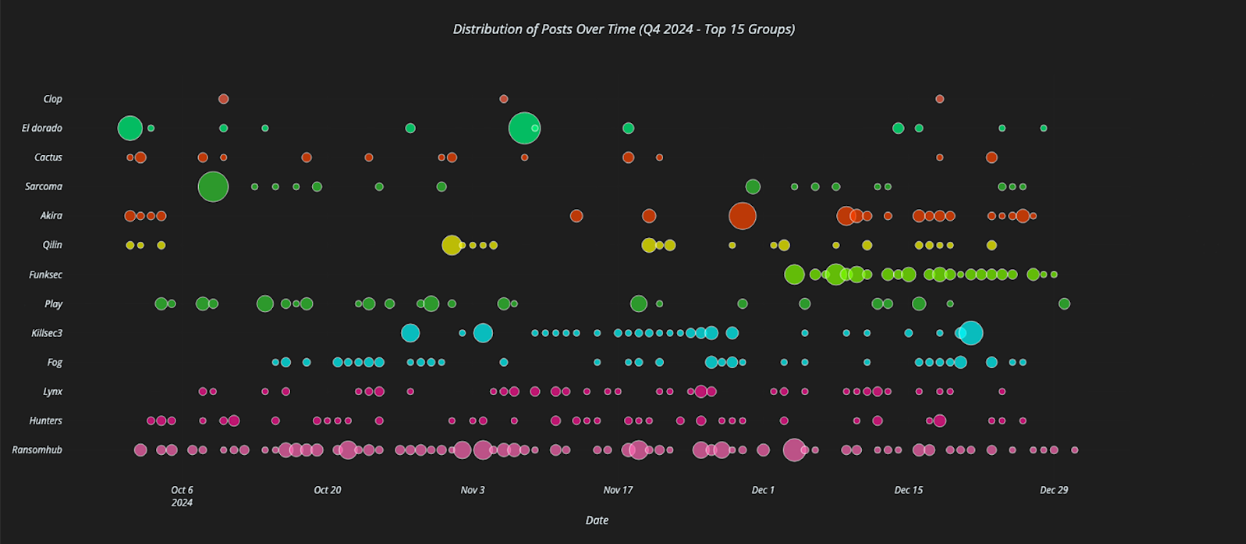
In the scatterplot below, we see Q4 2024 leak site post activity for the top 15 ransomware groups, where the dots indicate individual posts and the dot sizes indicate the amount of data being posted. Looking at Akira’s (5th from top) posting distribution, we can see that it is sporadic but its pace begins to increase around mid December. By way of comparison, RansomHub’s (bottom line) posting distribution is consistent and strong throughout the quarter.

2025 Ransomware: Business as Usual, Business is Booming

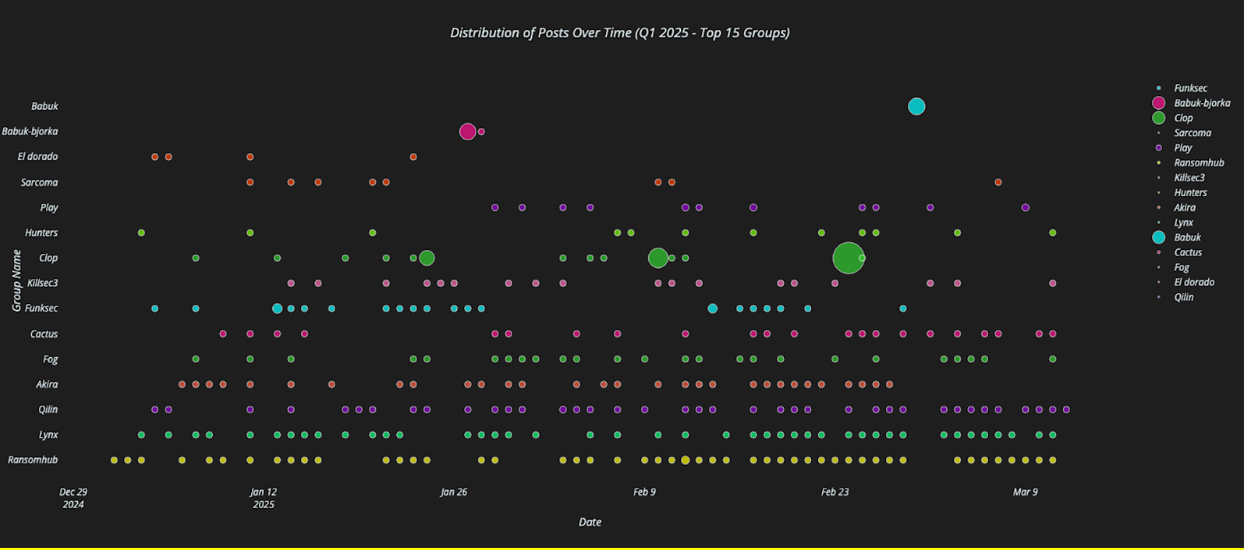
In the following scatterplot, which is Q1 2025, we see Akira (4th from bottom) operating much more in line with other leading players (Qilin, Lynx, etc.). Rather than sporadic, often large data dumps, Akira has begun to make regular postings of similar size. Further trends analysis shows that Akira’s postings shifted from happening primarily on Fridays to being anytime throughout the week.

2025 Ransomware: Business as Usual, Business is Booming

Ones to watch

As noted above, the most prolific ransomware groups for Q1 2025, ranked by the number of posts on their dedicated leak sites, are Cl0p and RansomHub by a considerable margin. Along with these two groups, several others are disrupting businesses of varying sizes and industries. In this section we’ll discuss groups of particular concern due to their reach and/or negative organizational impacts.

RansomHub

RansomHub burst onto the scene in February 2024, combining data encryption and exfiltration from a minimum of 210 organizations across a 6-month period. Affiliates are known to use vulnerability exploitation and phishing for initial access, along with double extortion to force victims into paying a ransom or face leaked data and reputational damage. RansomHub was the most prolific leak group operator we saw in 2024, and based on current trends displays no sign of slowing down.

Cl0p

Cl0p is one of the most well known Ransomware-as-a-Service (RaaS) groups. First seen in 2019, Cl0p has a long history of using exploits to propagate ransomware and leans heavily into double extortion. Cl0p is also known for its involvement in devastating supply-chain incidents, most notably claiming to have stolen data from hundreds of MOVEit Transfer customers. Initial access vectors include phishing emails, social engineering, and malicious attachments.

The group has made a torrent of leak site posts since the start of the year, with an astonishing 345 leak site posts in February alone and 413 for Q1 overall. While some of these posts represent fresh attacks, the majority are drip-fed leaks related to their exploitation of an older vulnerability in Cleo’s file transfer software.

Anubis

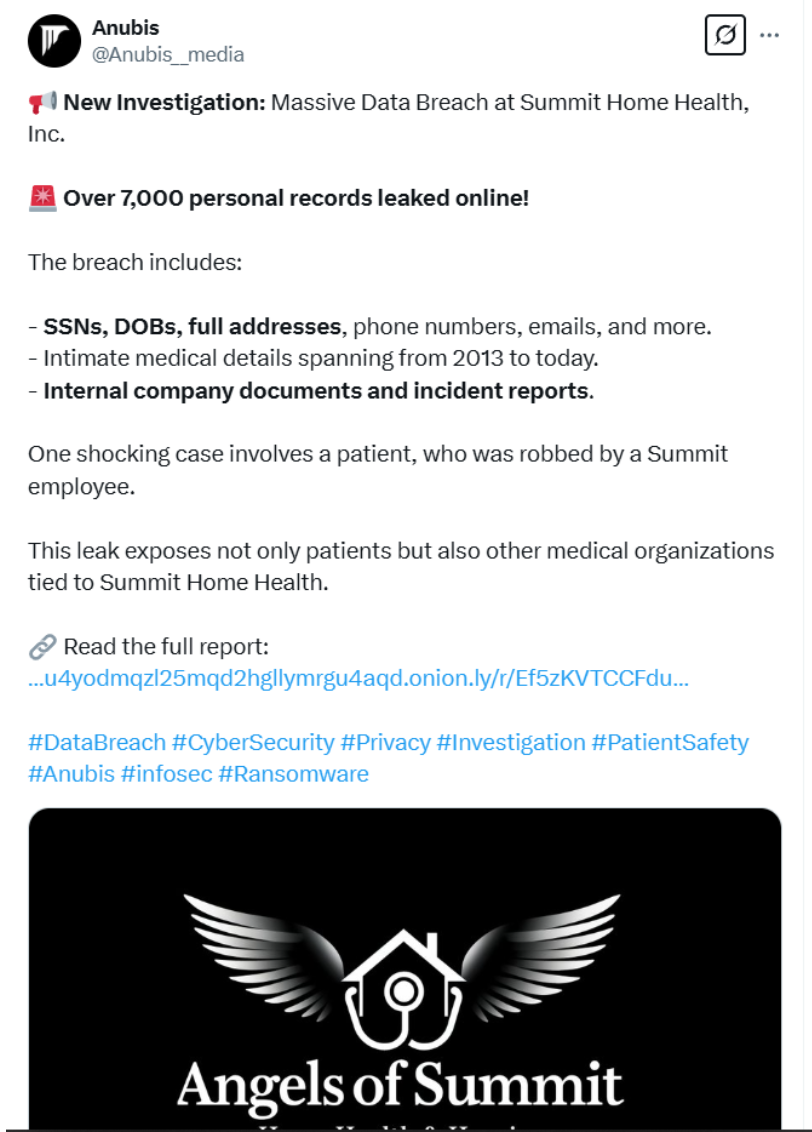
A new RaaS group active since at least November 2024 with a strong focus on data extortion, Anubis has possibly redefined the double extortion approach into something best described as malevolence as a service. It’s not enough to exfiltrate and then leak victim data; Anubis presents findings in a format resembling citizen journalism, exposing the alleged wrongdoings of those they target. The Robin Hood approach, hoping to curry favor with the public, is a well-worn one.

All of this, wrapped up in a slick format of nice graphics and hype-generating announcements on social media.

2025 Ransomware: Business as Usual, Business is Booming

It feels more like buying into membership of an airline loyalty program, as opposed to some kind of ruthless extortion. Already well into the “Watch out for our next exciting leak” promotional activity stage, this is a group making waves and has claimed at least five public victims so far, mainly in the healthcare and engineering sectors. Of note is that Anubis itself has stated it is looking to exclude education, government and non-profit sectors from its list of potential targets. Thus far, targeted regions appear to be the U.S., Canada, Europe, and Australia.

Lynx

First observed in July 2024, this now-established RaaS group combines phishing and malicious downloads alongside double extortion tactics. Lynx targets a variety of sectors including utilities, construction, and manufacturing, with victims located in a wide variety of locations including the U.S., Australia, and Romania.

Lynx offers a slick and professional affiliate panel, allowing affiliates to micromanage almost all aspects of a campaign and its unfortunate targets. The panel includes victim profile pages, news and updates, and an “all-in-one” archive of executables targeting multiple architectures. It’s the kind of setup which lowers the bar to entry for newcomers, and only becomes more popular over time.

Qilin

Although not as visible as some other ransomware groups in Q1 2025, RaaS operator Qilin has achieved some notable success. First observed in 2022, Qilin ransomware has been used to target a wide variety of industries which includes the healthcare, financial, and manufacturing sectors. Known for spear phishing and making use of compromised credentials, Qilin attacks tend to specialize in double extortion and data exfiltration on a large scale—their leaks can range from a few hundred gigabytes to their most recently publicized attack, which is allegedly a haul of 1.1 terabytes of data. Alarmingly, Microsoft has observed North Korean group Moonstone Sleet deploying Qilin ransomware at “a limited number of organizations”, the first time this group has been known to make use of ransomware developed by a RaaS threat actor.

Tactics

Ransomware groups tend to follow a specific pattern: Initial access, reconnaissance, credential theft and lateral movement, exfiltration, and finally encryption. There are divergences, however. Some groups avoid ransomware deployment and file encryption, instead choosing to compromise the network via unsecured VPNs and Remote Desktop Protocol (RDP). From there, they move straight to data exfiltration. This is known as “extortionware.”

Other threat actors, notably LockBit, use Living off the Land (LOTL) tactics to infiltrate networks with legitimate tools and management software already in place. As no malware files are deployed, it becomes increasingly difficult to detect these attacks in motion and threat actors can sit undetected for weeks or even months.

Here are some of the key elements of ransomware tactics across this first quarter of 2025:

  • RaaS is firmly established as a key tactic for prominent ransomware groups. The ease with which affiliates can buy into a ransomware group of choice and immediately begin attacks (see example below) ensures a steady flow of profit for the criminals at the top of the food chain.
2025 Ransomware: Business as Usual, Business is Booming
  • Double extortion is also a firm favorite. FunkSec made inroads into this realm with ransoms as low as $10,000, perhaps designed to be more enticing to victims than the often unreachable demands for totals ranging from $600,000 to a cool million plus.
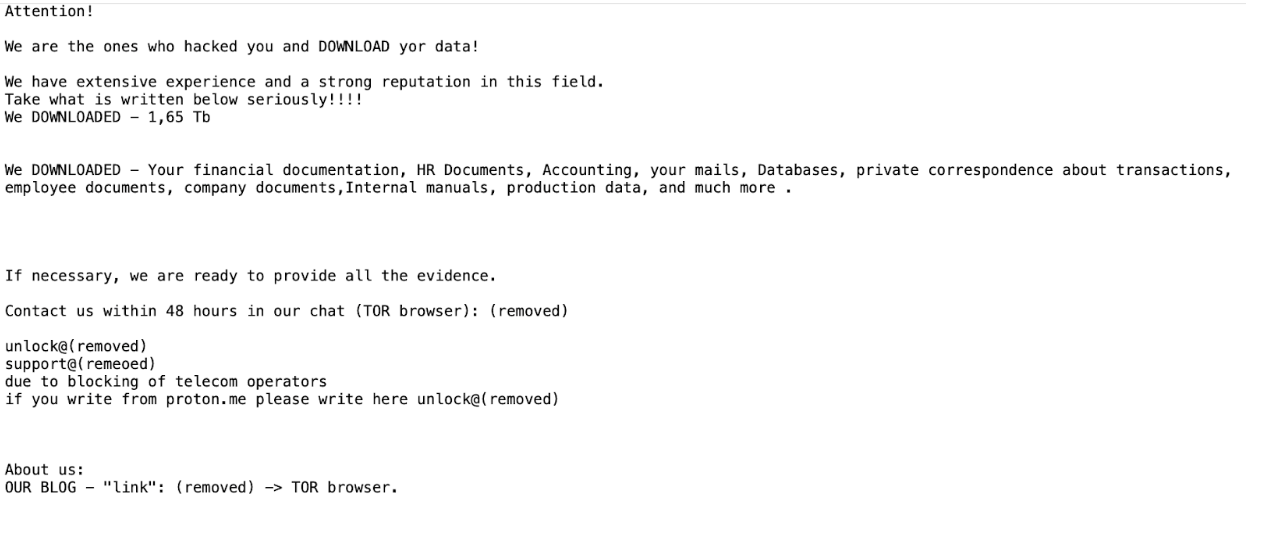
  • The deadline to pay a ransom, or just make initial contact with the threat actor, varies greatly between groups. RansomHub has previously handed out ransoms with deadlines ranging between 72 hours and 90 days. Cl0p has been known to apply varying degrees of pressure to encourage targets to get in touch. In December 2024, the group gave uncommunicative victims 48 hours to make contact or risk having their organization’s names disclosed publicly. Other Cl0p notes, such as the one below, reuse the 48-hour tactic but exclude mention of public exposure. Regardless of the tactics used, there’s no guarantee files will be unencrypted or stolen documents deleted from leak sites should the victims pay up. These supposed deadlines create a sense of urgency while potentially offering victims little beyond false hope.
2025 Ransomware: Business as Usual, Business is Booming

Five things you can do now

Unfortunately, there is no escaping the business reality of ransomware; it is a pervasive problem and it impacts every business at some level sooner or later. A solid defense plan can help to lower risk and prevent a disastrous outcome.

Here are five things you can do now that will make an immediate impact on reducing your attack surface:

  1. Take a fresh look at your MFA — If your organization has deployed multi-factor authentication (MFA), take the time now to review any policy exceptions that have been made over time and remove as many as possible. In addition, ensure that your MFA settings are properly configured (this is critical!). If your organization has not yet deployed MFA, see number 2.
  2. Deploy and configure MFA the right way — Multi-factor authentication is a must to avoid giving attackers an easy win from unsecured VPNs and RDP. Combine with geolocational restrictions, strong, unique passwords, and number matching in MFA applications to help ward off additional threats like MFA fatigue.
  3. Practice continuous patch management, especially for edge devices — Over the last couple of years, network edge devices have become a favorite way for attackers to gain initial access and then pivot elsewhere in the victim’s network. It’s critical that your patch management program accounts for this by prioritizing fixes to these devices as they are released. Prioritization of fixes should also be based on known exploits, their potential impacts to your business, and how these align with your business’s risk tolerance.
  4. Hold a ransomware attack simulation — Activate your incident response plan as if the organization has just been made aware of a breach. Who in the organization is involved and what are their immediate tasks? Are payment policies and outside resources pre-determined so there are no panic-driven mistakes and critical time isn’t lost? Note your learnings and schedule regular simulations every 6 months thereafter.
  5. Investigate your attack surface — Threat actors and their tools are poking and prodding your attack surface in search of vulnerabilities, and you must be proactive in doing the same. Resolve to speak with us regularly about Rapid7’s latest innovations in attack surface management.

Conclusion

Ransomware groups large and small have ushered in 2025 with a clear statement of intent: business as usual, and business is booming. The significant volume of leak posts and the heavy lean toward double extortion would indicate we can expect more of the same as the year progresses. In addition, the first glimmer of reportage-style commentary on their victim’s alleged failings suggests a bumpy road ahead for organizations unlucky enough to end up in the ransomware spotlight.

Newer groups hungry for publicity and affiliate network building will potentially look to emulate the Anubis approach, and do a little reportage style journalism of their own. Gimmicks sell and grab publicity, and reputational damage from data leaks may well go hand in hand with regulatory embarrassment and bad publicity. If that wasn’t bad enough, ransomware groups stand revealed through exposed chat logs as being in the market for purchasing zero days.

Businesses need to do everything they can to minimize the risk of easy network access and data exfiltration. Victims continue to pay the price for poor MFA coverage and inadequate patch management, which is why we heavily stressed these basics in our recommendations section above.

If there is a brave new world of ransomware to speak of, it largely resembles the old one with a few streamlined tweaks to a very well-oiled machine.

Fake BianLian Ransomware Letters in Circulation

Post Syndicated from Chris Boyd original https://blog.rapid7.com/2025/03/19/fake-bianlian-ransomware-letters-in-circulation/

At a glance:

  • The FBI is warning of a mail-based fraud involving letters sent to businesses in the U.S. These letters resemble online ransomware notes demanding payment via Bitcoin.
  • Rapid7 examined a mail-based ransom demand sent to a customer from a local postcode.
  • There is no evidence that any of the recipients have been compromised by BianLian.

From BianLian: “Time Sensitive, Read Immediately”

Fake BianLian Ransomware Letters in Circulation

On March 5, the FBI issued an alert regarding a mail scam targeting U.S. business executives with extortion. The letters claim to be from noted ransomware group BianLian, demanding a payment in Bitcoin ranging from $250,000 to $500,000 within ten days of receipt.

The FBI alert reads as follows:

“Stamped “Time Sensitive Read Immediately”, the letter claims the “BianLian Group” gained access into the organization’s network and stole thousands of sensitive data files. The letter then goes on to threaten that the victim’s data will be published to BianLian’s data leak sites if recipients do not use an included QR code linked to a Bitcoin wallet to pay between $250,000 and $500,000 within ten days from receipt of the letter, claiming the group will not negotiate further with victims.”

The ransom note also warns recipients not to contact law enforcement, stressing that the FBI “does not care” about victims and will not help in the event of a lawsuit — a classic social engineering pressure tactic.

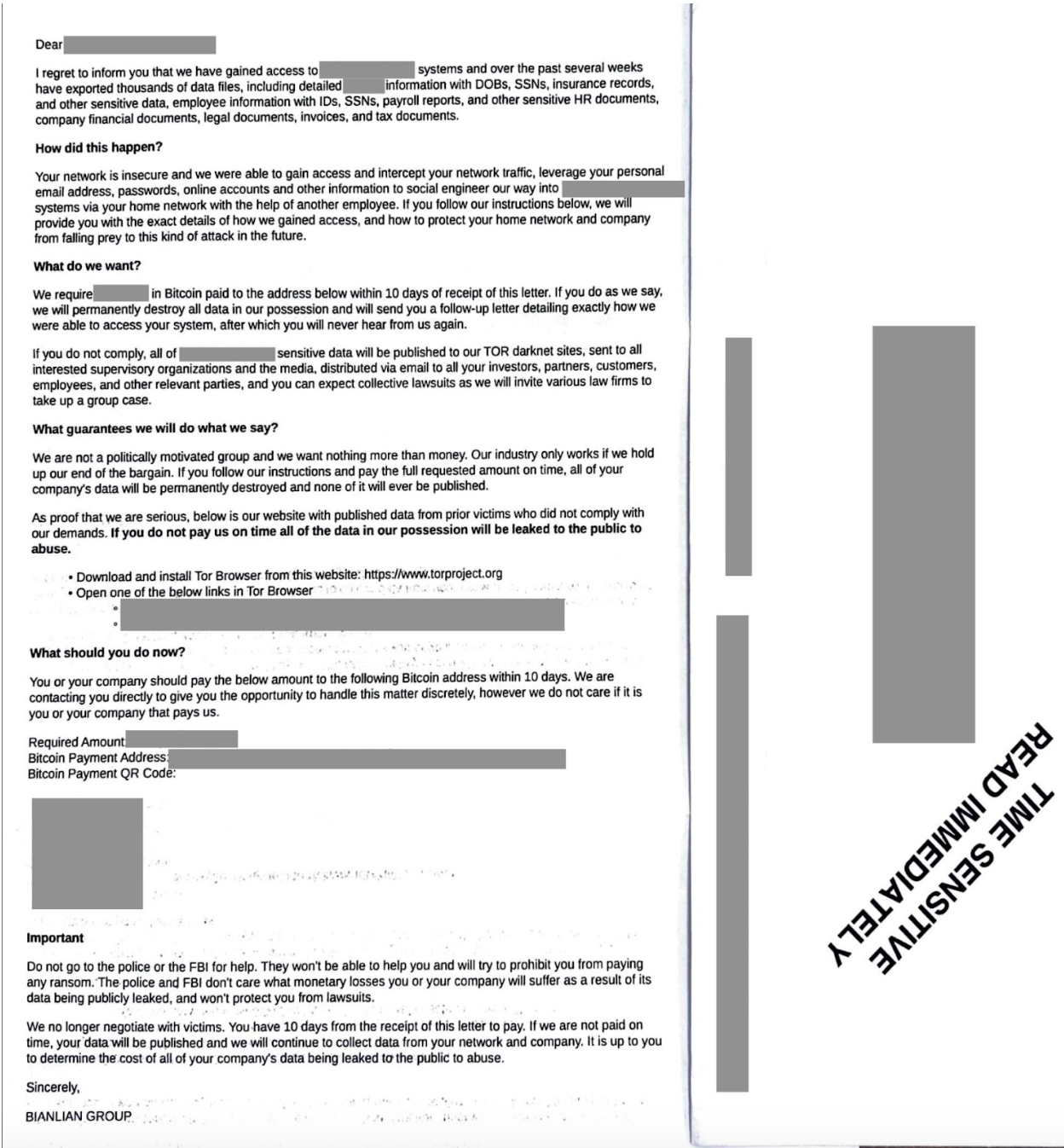
Rapid7 has observed that these letters are still in circulation, with one such letter received by a Rapid7 customer highlighted below. While we have redacted parts of the letter to protect the customer’s identity and other sensitive information, you can see that it follows the pattern of others seen in the wild, falsely claiming to be from BianLian:

Fake BianLian Ransomware Letters in Circulation

It reads:

“I regret to inform you that we have gained access to [redacted] systems and over the past several weeks have exported thousands of data files, including detailed [redacted] information with DOBs, SSNs, insurance records, and other sensitive data, employee information with IDs, SSNs, payroll reports, and other sensitive HR documents, company financial documents, legal documents, invoices, and tax documents.

How did this happen?

Your network is insecure and we were able to gain access and intercept your network traffic, leverage your personal email address, passwords, online accounts and other information to social engineer our way into [redacted] systems via your home network with the help of another employee. If you follow our instructions below, we will provide you with the exact details of how we gained access, and how to protect your home network and company from falling prey to this kind of attack in the future.

What do we want?

We require [redacted] in Bitcoin paid to the address below within 10 days of receipt of this letter. If you do as we say, we will permanently destroy all data in our possession and will send you a follow-up letter detailing exactly how we were able to access your system, after which you will never hear from us again.

If you do not comply, all of [redacted] sensitive data will be published to our TOR darknet sites, sent to all interested supervisory organizations and the media, distributed via email to all your investors, partners, customers, employees, and other relevant parties, and you can expect collective lawsuits as we will invite various law firms to take up a group case.”

The above letter is a match for those received by multiple businesses. Similarly, the Bitcoin payment address does not appear to be connected to the genuine BianLian group—just like several other examples highlighted online.

What you need to do

The FBI has issued the following advice, which is still applicable to this example of mail-based fraud:

  • Notify corporate executives and the organization of the scam for awareness.
  • Ensure employees are educated on what to do if they receive a ransom threat.
  • If you or your organization receive one of these letters, ensure your network defenses are up to date and that there are no active alerts regarding malicious activity.
  • If you discover you are a victim of BianLian ransomware, please visit [the FBI’s] Joint Cybersecurity Awareness Bulletin for recent tactics, techniques, and procedures and indicators of compromise to help organizations protect against ransomware.The FBI also requests that victims report any incident to their local FBI Field Office or the Internet Crime Complaint Center (IC3).

Additionally, Rapid7 recommends the following:

  • Do not scan any QR codes or go to any web links within the letter.
  • Do not pay any ransom.
  • Secure both the letter and envelope in a chain of custody evidence bag, or a ziplock if unavailable.

While ransomware actually was sent through the mail via infected USB sticks in 2022 by threat actor FIN7, that is not the case here. Recipients have not been compromised by BianLian despite what said letters claim. While your business is unlikely to receive one of these letters, other fraudsters may follow suit so a few moments spent warning of the dangers of this tactic may help to prevent an avoidable financial loss.

How To Protect Your Organization’s Bluesky Account From Security Threats

Post Syndicated from Chris Boyd original https://blog.rapid7.com/2025/02/11/how-to-protect-your-organizations-bluesky-account-from-security-threats/

How To Protect Your Organization's Bluesky Account From Security Threats

When a new platform suddenly becomes popular, it’s not uncommon to see it stress tested by malware authors and fraudsters. Many organizations are making the leap to Bluesky without necessarily understanding the potential threats to an account and the business should a compromise take place.

This blog explains how to secure your Bluesky account from security threats such as malware and phishing, as well as establishing your identity to help prevent fraud and impersonation.

We will discuss:

  • What is Bluesky: How it works, what you can do with your data, and why you can keep using it when it’s time to move on.
  • Security and privacy settings: How you can keep your corporate account safe from harm.
  • Using your domain for identity verification: Setting your organization’s domain as the username for both the main account and employees.
  • Content and moderation: Steering your corporate account away from dubious content.

If you’ve recently been tasked with guiding your organization to social media breakout Bluesky, read on to see how you can get your team set up securely.

What is Bluesky?

Bluesky is a social network platform built on the Authenticated Transfer Protocol (ATProto), an “open, decentralized network for building social applications.” One of the desired intentions of using this is that you own your own data. It can be moved to different services thanks to Decentralized Identifiers (DIDs), which keep your services and user identity clearly separated. In theory, should Bluesky go away, you’ll be able to port your data elsewhere and keep your social graph intact.

Security and privacy settings

Bluesky’s security options may appear to be on the modest side, with 3 settings available in the “Privacy and Security” tab:

  • 2-factor authentication (2FA).
  • App passwords.
  • Logged-out visibility.

2FA: At time of writing, email is the only form of 2FA available. Enabling this option will result in email codes sent to your registered email address. These codes are required to be able to log into your account. To disable 2FA, you would need to approve a verification email sent to the same registered address.

This is not as robust an approach as using an authentication app or hardware key verification. If someone compromises your registered email address via phishing or malware, they’ll be able to disable email verification without you knowing and potentially hijack your account.

As a result, Rapid7 recommends you secure your registered email account with multi-factor authentication (MFA) alongside Single Sign-On (SSO).

2FA is still better than having no protection in place at all. In 2024, the US Securities and Exchange Commission (SEC) had its X account compromised because of a SIM swap attack, and the account was confirmed as having no 2FA enabled. Before the account could be recovered, a rogue post caused the price of Bitcoin to jump and then plummet in the space of a few minutes.

App passwords: These are codes generated by Bluesky which you can use for third-party apps, without having to give said apps your Bluesky password. The code can be deleted from your account at any time, and you can also specify whether or not the code grants access to your direct messages. Valid codes are 19 characters long, including 4 dashes, and can only be viewed at time of generation; if you don’t copy it, you’ll have to create a new one.

Logged-out visibility: Bluesky currently has no private account option — everything is public by default. This option requests that users be logged in before being able to access your content. A note of caution: Bluesky warns that “other apps may not honor this request.” It’s trivial to see content while not logged in, so if this is a deal breaker for your business, you may be better off waiting for more granular privacy controls.

Using your domain for identity verification

One of Bluesky’s core features is using DNS management to present the same user identity across the (eventually) federated Bluesky landscape. It makes use of ATProto to offer this functionality, so if you want to verify your on Bluesky account you’ll need to do it via one of your domains. The end result is that your username will be your organization’s web address, like so:

bsky.app/profile/rapid7.com

You can also offer subdomains to all of your employees, who will display as “@theirname.yourbusinessname.com” or similar.

This is useful in relation to verification and identity because closing a social media account often requires an exit plan. You can’t just abandon an account; it could end up being hijacked or forgotten about, with sensitive information lurking in direct messages. You can’t just delete it either, because anyone could grab your old username and use it for nefarious purposes.

Bluesky’s approach enables you to retain the same official username across multiple eligible platforms, and neatly sidesteps any issues arising from platform-specific verification schemes which may be changed, abandoned, or replaced entirely.

There are still some potential issues to consider here. Once the domain-centric username is enabled, your old account will be released back into the wild. This means someone else could register it, and pretend to be your organization. They could then mount phishing campaigns under your brand, or send out malware links under the guise of business-centric activities. You’ll need to be ready to register the old username via another secure email address, and then park it safely to one side while not forgetting to enable 2FA.

This is still largely an improvement on the fate of other more well-known verification programs. When X changed the blue check system to paid premium access, the social media platform endured a wave of “verified” fakes. Elsewhere in 2022, a fake (but verified) pharmaceutical company account claimed that insulin was now “free.” This incident caused the real company’s stock to fall by 4.37%, and even arguably caused multiple advertisers to leave the platform itself.

Content and moderation

Bluesky has a variety of moderation features to steer your account away from scams, phishing, and malware. In addition to being able to mute specific words and tags, Bluesky also makes use of moderation lists, i.e., packs containing multiple users related to specific topics. You’ll find lists for cryptocurrency spammers, pornography bots, content scrapers, and even imitation accounts.

Under the Content Filters setting (found under “Settings > Moderation”), you can select “show”, “warn”, or “hide” for a variety of content including adult content and graphic media. With the recent introduction of video, there’s also the option to not automatically play said content. Additionally, you can enable or disable external media players for services like YouTube, Vimeo, and SoundCloud.

You can take this one step further via “Moderation > Advanced”, where controls allow you to use an “Off, Warn, Hide” setting for a variety of topics such as threats, security concerns, misinformation, scams, and spam, as well as the possibility of many others outside of Bluesky’s pruning defaults. This is done via stackable “labels” through third-party labelling moderation services, designed to work on top of default Bluesky moderation settings. If you select the hide setting for “malware spammers”, then all third-party labelled malware spammer accounts will be hidden from view thus limiting your exposure to multiple security threats.

In 2021, Cardiff University researchers highlighted that a large number of drive-by malware links posted to social media tended to include negative and fear-laden messaging. Said messages were 114% times more likely to be reposted than more benign content. Bluesky’s moderation tools also allow you to filter out posts labelled as containing intolerance, rudeness, and threats. Enabling these moderation options will reduce the possibility of similar rogue posting strategies leading to compromise by malware, social engineering, or system exploits.

Go forth and be social

Security threats propagated through social media date back to the early days of MySpace and Orkut. Even back then, techniques had shifted away from trolling and pranks to data theft via banking trojans and the spread of phishing links via direct messaging. Today’s newer platforms have employed many lessons learned from the mistakes of their forefathers; however, they are not impenetrable.

By making use of the various security and identity settings highlighted above, you’ll be ensuring your business has a more robust approach to tackling data theft, malware infections, and wider network infiltration via the frequently vulnerable underbelly of social network platforms.

Perfect Fit or Business Threat? How to Mitigate the Risk of Rogue Employees

Post Syndicated from Chris Boyd original https://blog.rapid7.com/2025/01/16/perfect-fit-or-business-threat-how-to-mitigate-the-risk-of-rogue-employees/

Perfect Fit or Business Threat? How to Mitigate the Risk of Rogue Employees

Rogue employees present significant financial and cybersecurity risks to organizations. Rapid7 threat researchers and penetration testers are actively observing how malicious actors exploit hiring pipelines to infiltrate businesses. This blog highlights real-world tactics, including:

  • Insider Reconnaissance: Rogue applicants leveraging interviews to map office layouts, identify vulnerable devices, and even plant malware during site visits.
  • Tech Tricks: The use of deepfake technology, AI-generated photos, and VoIP to fake identities, bypass background checks, and mask locations.
  • North Korean Operations: State-sponsored actors posing as remote IT workers with fake resumes and stolen identities to fund illicit activities like missile development.
  • Hiring Weaknesses: Gaps in hiring processes—such as 43% of organizations skipping background checks—leaving businesses vulnerable to exploitation.

Read on to discover how to fortify your hiring and onboarding practices against this business risk.

Understanding the threat

Rogue employees have long been an issue for hiring departments. The Occupational Fraud 2024: A Report to the Nations study reported worldwide losses of more than $3.1 billion from 1,921 fraud cases. Other studies suggest that a typical business may lose as much as 5% of their annual revenue due to this problem. Sadly, the days of “only” having to worry about employees who show up late every day, or tell a few small tales on their work history record, are but a distant memory.

While organizations have been aware of the broad risk from bogus hires for some years, many are playing catch-up with hitherto unknown cybersecurity implications, particularly when state-sponsored actors are at the helm. For example, the FBI issued warnings about remote North Korean workers sending funds to the regime back in 2022, and estimated the number of fake North Korean workers to be in the thousands. These workers generate revenue for ballistic missile development, and according to a 2022 advisory “…may share access to virtual infrastructure, facilitate sales of data stolen by DPRK cyber actors, or assist with the DPRK’s money laundering and virtual currency transfers.”

Multiple examples of other DPRK-centric malicious employment fraud have gone public over the past year. Security education firm KnowBe4 highlighted the detection and removal of a North Korean worker, who’d bypassed various checks at the hiring stage and attempted to deploy malware. In October 2024, an unnamed firm revealed a similar ploy where a remote IT worker faked employment history, downloaded data, and issued a ransom demand. A few months prior to this, a Tennessee resident was arrested for his alleged involvement in a DPRK-centric laptop farm involving stolen identities and software installed without permission.

Even without North Korean involvement, there are many other ways rogue hires can cause security issues across a business. What else lies in wait for the unwary hiring department? More importantly, how can your organization combat these threats?

Rogue hire archetypes

Rogue hires fall into certain categories. Some are potentially more damaging to a business than others, with some overlap in terms of tactics and objectives. If you run into any of the below, then this is what you can expect them to be doing.

  • Malicious applicants: They may be working alone, or as part of a team to steal financial or customer data. The incentive may be financial or tied to data exfiltration, but the attack’s starting point could involve phishing, malware deployment, or BEC (business email compromise). They may intend to continue as a rogue employee if hired, or plan to compromise a business at the physical interview stage and never be seen again.
  • State-sponsored threat actors: These are commonly encountered as freelance workers from North Korea (albeit not exclusively), targeting positions in general IT support, mobile development, virtual currency exchanges, and firmware development across the US, Europe, and East Asia. They often present themselves as being Chinese, South Korean, and Japanese, while making use of forged or stolen identity documents. The FBI believes that most engage in non-malicious IT work, though some make use of privileged systems access to enable malicious cyber intrusions.
  • Proxy employees: They receive one-off or continued payments from a real would-be employee in return for fielding the interviews. The proxy may also take on work-related tasks on behalf of the employee assuming the latter is ultimately hired. The FBI has previously warned that deepfake technology is often used for multiple remote work scams, with available positions granting access to “…customer PII (personal identifying information), financial data, corporate IT databases and/or proprietary information.”

The malicious applicant game plan

Malicious applicants may operate alone, but have the potential to be backed by groups or nations with access to a wide range of resources denied to more common fraudsters. These resources could include fake or stolen identity documents, or unknown malware and vulnerabilities. Their interests are frequently financial, but may veer into data exfiltration should the opportunity arise.

Some rogue hires may not intend to take on employment; instead, the interview is used as a pretext for more direct reconnaissance and malware deployment. To illustrate how a typical malicious applicant could exploit an interview process, a Rapid7 penetration tester shared their experience of a workplace infiltration assignment that they participated in:

“Standard OSINT techniques revealed several open interviews available while I was going to be on location. I typically review job postings for technology stacks the organization uses, in case I want to fall back on phishing campaigns. I also vet for potentially vulnerable endpoint software which may be in use. They did at least have a sign-in sheet and a guard to lead me to the interview.”

It’s worth noting that a penetration tester’s objectives and methods will differ from more targeted, state-sponsored attempts to compromise organizations for specific espionage or other goals. However, there will be some overlap across different groups and individuals.

“I was taken through a variety of rooms and offices, granting me a handy mental map of layout, equipment, possible locations of important devices like servers or network access. During the interview, I asked if I could visit the bathroom and was permitted to walk freely in the office. An unattended logged-in device could be susceptible to malware on a USB stick; I might find physical employee directories, or post-it note passwords. I’m wearing office clothes. If there’s no lanyard requirement enforced, who would suspect anything?”

A networked printer could be a launchpad for malware outbreaks or firmware manipulation. An unguarded stack of expense paper could help to pave the way for BEC once the interviewee has left the premises.

Seemingly innocent interview questions about standard business operations can lead to password reset phishing campaigns, designed to resemble familiar email login pages and MFA (multi-factor authentication) systems. From here, the attacker can use compromised accounts to perform social engineering, or gain deeper access into the network.

Fictitious HR workers can be deployed to send malware-laden hiring or policy documents via email domains imitating the real thing. There is a very real possibility in this scenario of long-term compromise and data exfiltration. Should the attacker decide to escalate further, they may turn to ransomware and double extortion, leading to blackmail and public data exposure.

Now that we’ve highlighted some of the worst-case scenarios from an interview gone wrong, we’ll explore in detail where the hiring pipeline is at its most exposed.

The riskiest stages of hiring

Assuming you’ve posted your job description, the key stages of ingress for bogus hires are now exposed to the wild. The three main areas of interaction are:

  • Screening and shortlisting.
  • The interview(s).
  • Onboarding of successful hires.

Providing barriers to entry at each stage will increase the likelihood of catching rogue personnel.

Businesses most commonly search an applicant’s employment history, perform criminal record checks, and verify their education history [PDF, page 48]. Checks on social media, directorship searches, and specialist vetting are all less likely. However, an astonishing 43% of organizations surveyed said no background checks were run on perpetrators prior to hiring.

This piecemeal approach to hiring gives opportunists a direct line to your organization’s most valuable assets. Those fake HR workers mentioned earlier could just as easily have been bogus IT administrators, responsible for rolling your patches out to users of your software. Now you’re a compromised third-party vendor, enabling the flow of a supply chain attack to multiple customers. They, too, could be at risk from further network ingress, malware, and data exfiltration—all because you failed to perform any background checks on a potential hire.

Beyond this, most businesses do not generally vet staff once employed. This is why precautions are still advisable during initial hire or onboarding. KnowBe4 issuing a limited access laptop to the North Korean IT hire is one reason for the would-be attacker’s lack of success.

Screening and shortlisting

What they want to do:

  • Present a convincing and comprehensive overview of experience and work history.
  • Spread a veneer of credibility on the resume that dissuades further investigation.

What you need to do:

  • Use an applicant tracking system (ATS). An ATS is invaluable for weeding out potential fakes. They’re very good at finding reused names, emails, or even phone numbers across multiple profiles. This is especially useful considering a typical job post can receive hundreds of applications an hour on LinkedIn alone.
  • Third-party background checks. Many services offer to take on the responsibility of background checks from the employer, with some all-in-one solutions offering 100+ types of background check.

    Explore LinkedIn data. If you suspect the candidate’s photograph is a stock image or AI generated, reverse image search and AI checking tools can help. In the KnowBe4 incident, the fake employee used AI to alter a stock photograph. Note that many other tricks exist to bypass checks, such as flipping the photograph horizontally or altering the colors.

You should also consider the authenticity of the profile. Has it been created very recently but boasts many years of work? Does the candidate claim 5 to 10 years of experience despite having few or no reputable contacts in the industry you work in? Are recommendations from co-workers entirely absent?

The interview

In an ideal situation for fraud, fake employees want to:

  • Stay off camera.
  • Answer your questions via a third-party through headset or offscreen.
  • Use VoIP to mask their real location.
  • Avoid discussing anything related to their background.

The interview: what you need to do

  • Create phone and video rules. Insist on a VoIP-free phone call during the hiring process, whether landline or mobile. This, alongside other data gathered, can help you to decide if a candidate really is located in France, Belgium, or Scotland. For web calls, make camera interaction mandatory. Ask for blurred backgrounds (or similar features) to be disabled so you can see where the candidate really is.

    Using cameras has many additional benefits, such as impeding the flow of a proxy hire (someone who is paid to take interviews on the potential employee’s behalf.) It’s much more difficult for fraudsters to take instructions from a headset or even mime(!) if you can see the candidate at all times. Being able to see candidates means there’s also less chance of totally different people showing up to subsequent interviews.

  • Build a consistent picture. Are you permitted to use conferencing tools which allow you to view/log IP addresses or other relevant system information? Fraudsters (particularly proxy hires) use multiple people at different stages of the interview often separated by large distances. These small digital pointers could build up a very different picture of who you think you’re dealing with.
  • Dig into background details. Select 2 or 3 pieces of information from a resume. This could be their hometown, a previous employer, or perhaps their area of expertise. Ask about what it was like growing up in the city they mention, or places of interest they enjoy in their hometown. Faltering answers may be a big clue.

If multiple interviews are planned, record these answers and have subsequent interviewers reuse a few questions. If the candidate is making it up as they go, then the story will quickly fall to pieces.

Onboarding

Even if a rogue has bypassed screening and interviews, you still have a chance to catch them in the act. Here’s what you can do at this stage:

  • Restricting laptop or equipment pickup to a depot where valid identification is required will help prevent it from falling into the wrong hands.
  • Ensure the device is running all required security tools, does not grant admin permissions, and provides access only to work-essential tools such as email, comms, and day-to-day necessities. The device should be “bare-bones” and not come with company data stored locally on the system.
  • Do not allow the new hire any facility to upload files outside of necessities such as old payslips, ID, proof of address/utility bills, and tax details.
  • If you use tools like Slack or Microsoft Teams, ensure the new hire is restricted from accessing channels they don’t need.

Someone who successfully passes the 3 interview steps above has a wealth of options at their disposal. They might immediately try to compromise systems or data before being discovered. Alternatively, they may spend weeks or months exfiltrating data and social engineering other employees. Initial knowledge of common business practices for laptops and remote security, system updates, and authentication can potentially make it easier for them to try and bypass measures in place. It’s a much better idea to not let them get anywhere near this stage in the first place.

Hire with confidence

Rogue workers of all types are a very real threat to your data security and business revenue. From security organizations to blockchain firms, anyone is potentially at risk from a bad hire. Adapting the above hiring practices and combining them with a defense-in-depth approach will help you proactively and confidently deal with these threats to your network, and the people using it.