All posts by Lennart Poettering

Das Leben der Anderen

Post Syndicated from Lennart Poettering original https://0pointer.net/blog/leben-der-anderen.html

German movies are usually not my thing – I don’t like the topics, I don’t
like the scripting, I don’t like the acting, I don’t like the actors, I don’t
like the drama and I don’t like the humor. (Ok, they usually lack humor entirely, so there’s not much not to like of the humor.)

However, there’s now a notable exception: Das Leben der Anderen (The Lives of
Others
) is a very good film, one that I really like. It’s an absorbing drama, the scripting is good and the acting is fine. There’s a good reason that
it has won the European Movie Award (Best Film) and is one of the top
contenders for next years’ Oscar (at least the foreign language one).

If you get the chance to see this movie, do it! It’s worth it.

San Francisco

Post Syndicated from Lennart Poettering original https://0pointer.net/blog/photos/san-fran.html

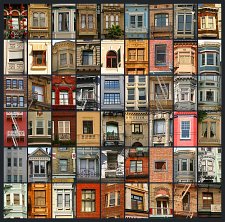
As a followup to my Windows of Barcelona series I prepared Windows of San Francisco:

Windows of San Francisco

A few other series :

Adjazenz!

No, the German names and numbers of the series don’t have any special meaning, their sole purpose is to sound “artsy”, in the spirit of the famous work “Fluktuation 8” by a certain polish action artist.

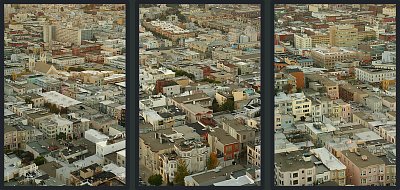
The remaining photos I made during my visit in San Francisco after the
Ubuntu Developers’ Summit in Mountain View in November are now online,
as well.

Unique Eyebrows

Post Syndicated from Lennart Poettering original https://0pointer.net/blog/photos/unique-eyebrows.html

Dear American People,

I guess you’ll find businesses selling unique eyebrow
designs
only in god’s own country:

Unique Eyebrows

And what does “unique” mean? Do their customers get two
different designs for their two eyebrows? – What a bargain!

Groucho Marx’ greasepaint eyebrows are unique, in a way. Maybe that’s what they are selling?

Confused,
     Lennart (a worried European)

Interlocking Quadrilaterals

Post Syndicated from Lennart Poettering original https://0pointer.net/blog/iqlamp-stencil.html

As promised, here’s
a stencil drawing of the Mexican-style IQ Lamp: .ps, .svg, .pdf. (1:1, DIN A4/ISO 216 paper size)

Fake IQ Light from Mexico - Stencil

30 of these are needed to assemble one mexican style lamp, as depicted below.
The material to cut these patterns from needs to be a thin (less than .5 mm
thick) plastic (or maybe cardboard) which needs to be flexible – but not too
flexible, and not glossy. It might be advisable to use energy-saving light
bulbs for this lamp. They are entirely hidden inside the lamp and might be good
to avoid overheating of the plastic. Assembling
instructions
, Video, Instructable. Please note
that assembling the mexican-style IQ light needs a quite a bit manual force
because all pieces are bent a little, in contrast to the original danish
design which appears to be assembled without any force. (at least the video
clip suggests that.) For mounting a cable/lamp socket you might need to cut a
small hole in one of the plastic sheets, to put the cable through.

Once again the photo:

Fake IQ Light from Mexico

Have fun!

Chasing A Light

Post Syndicated from Lennart Poettering original https://0pointer.net/blog/chasing-light.html

Last friday I posted a little Lazyweb experiment,
a hunt for information about a certain kind of lamp sold by a street dealer in
Mexico City. A quick followup on the results:

Surprinsingly many people responded, mostly by email, and partly by blog comment.
As it appears I am not the only one who’s looking for this specific type of
lamp. Furthermore, a non-trivial set of Planet Gnome readers actually already
owns one of these devices. Apparently counterfeit versions of this lamp are
sold all around the world by street dealers and on markets.

The lamp seems to be a modified version of the “IQ Light”, a self
assembly lighting system made up of interlocking quadrilaterals
. It is
a scandinavian design, by Holger Strøm, 1973. It is nowadays
exclusively distributed by Bald & Bang,
Denmark. The lighting system has a very interesting web site of its own, which even includes an
HOWTO for
assembling these lamps. The Bald & Bang web site has a
very stylish video which also shows how to assemble an IQ lamp.

Fake IQ Light from Mexico

While my mexican specimen and the official design are very similar, they
differ: the mexican design looks – in a way – “tighter” and … better (at
least in my humble opinion). For comparison, please have a look on the photo I took from the mexican version which is shown
above, and on the many photos returned by Google
Images
, or the one from the IQ Light homepage. It
appears as if the basic geometrical form used by the mexican design is somehow
more narrow than the official danish one.

So, where can one buy one of those lamps? Fake and real ones are sold on
eBay
, every
now an then
. The Museum
Store of the New York MoMA
sells the original version for super-cheap $160.
If you search with Google you’ll find many more offers like this one, but all
of them are not exactly cheap – for a bunch of thin plastic sheets. All these
shops sell the danish version of the design, noone was able to point me to a shop
where the modified, “mexican” version is sold.

Given the hefty price tag and the fact that the fake, mexican version looks
better then the original one, I will now build my own lamps, based on the
mexican design. For that I will disassamble my specimen (at least partially)
and create a paper stencil of the basic plastic pattern. I hope to put this up
for download as a .ps file some time next week, since many people
asked for instructions for building these lamps. Presumably the original
design is protected by copyright, hence I will not publish a step-by-step guide
how to build your own fake version. But thankfully this is not even necessary, since the vendor already published a HOWTO and a video for this, online.

Thank you very much for your numerous responses!

Ubuntu vs. Free Software

Post Syndicated from Lennart Poettering original https://0pointer.net/blog/projects/ubuntu-vs-free-software.html

Everybody should read Roman Kennke’s
take on Mark Shuttleworth’s OpenSUSE spam mail
. It’s constructive and sensible.

I hope the Ubuntu people find the strength to resist the short-term bliss of
desktop bling for long-term software freedom!

Please learn the lession Java teaches us: resist the temptation of
closed source software and develop alternatives as free software!

Dear Lazyweb!

Post Syndicated from Lennart Poettering original https://0pointer.net/blog/mexico-lamp.html

Let’s see how well Lazyweb works for me!

One of the nicest types of lamps I know is depicted on this photo:

mexico lamp

This lamp is built from a number (16 or so, it’s so difficult to count) of
identical shapes which are put together (a mano) in a very simple, mathematical
fashion. No glue or anything else is need to make it a very robust object. The
lamp looks a little bit like certain Julia fractals, its geometrical structure
is just beautiful. Every mathematical mind will enjoy it.

This particular specimen has been bought from a street dealer in Mexico
City, and has been made of thin plastic sheets. I saw the same model made from
paper on a market near Barcelona this summer (during GUADEC). Unfortunately I
didn’t seize the chance to buy any back then, and now I am regretting it!

I’ve been trying to find this model in German and US shops for the last
months (Christmas is approaching fast!) but couldn’t find a single specimen. I
wonder who designed this ingenious lamp and who produces it. It looks like a
scandinavian design to me, but that’s just an uneducated guess.

If you have any information about this specific lamp model, or could even
provide me with a pointer where to buy or how to order these lamps in/from
Germany, please leave a comment to this blog story, or write me an email to
mzynzcr (at) 0pointer (dot) de! Thank you very much!

Cui Bono?

Post Syndicated from Lennart Poettering original https://0pointer.net/blog/projects/cui-bono.html

So, you thought that only Linux users (and other alternative OS zealots)
would benefit from reverse
engineered Windows drivers
? Ha! Far from the truth, it’s the Windows
users themselves
who are benefitting. (Sorry, that link is in German)

Too bad that this specific Windows port actually infringes my copyrights
since it links my GPL’ed code against the non-free inpout32.dll. And the guy who did
that port doesn’t even think it’s necessary to put his email address anywhere.

MSI Laptop Owners!

Post Syndicated from Lennart Poettering original https://0pointer.net/blog/projects/megawiki.html

MSI Laptop Owners! Join us and extend the MegaWiki, the new Wiki for all kinds of information on Linux on MSI MegaBooks! (and all MSI built laptops sold under other brands)

The MegaWiki is still rather empty but we hope that it will soon grow as
large as our inspiration, the ThinkWiki
which collects information about IBM ThinkPads. For that we need your help!

This site will be the new home of the MSI laptop drivers (backlight control,
rfkill) and provide modified ACPI DSDTs to fix a few BIOS errors. And more!

Conferences: UDS, FOMS and LCA

Post Syndicated from Lennart Poettering original https://0pointer.net/blog/projects/conferences.html

To my surprise I have been invited to the Ubuntu Developers Summit in
Mountain View early next month (as a “ROCKSTAR”, to quote Mark), to promote PulseAudio. And that although I am not an
Ubuntu developer, nor even much of an Ubuntu user. I’ll be available for
discussing everything Multimedia/PulseAudio related. While I’ve not been
invited because of my involvement in Avahi/Zeroconf I will, of course, also be
available for discussion of these topics. As it appears, Canonical is not
resentful
, or maybe it’s just their way to bribe me into registering with
Launchpad? 😉

After UDS I plan to stay a few more days in San Francisco to visit the city.
Can anyone point me to cheap accomodation in SF, or perhaps even lives in SF and
has room where I could sleep?

In addition my PulseAudio presentation has been accepted at linux.conf.au 2007. At GNOME.conf.au I hope to give
another presentation, together with Trent Lloyd about Avahi, everyone’s favourite Zeroconf
implementation. And finally I plan to give yet another presentation, again about
PulseAudio, at FOMS 2007, the Foundations of Open Media Software
conference, which happens shortly before linux.conf.au, also in Sydney. FOMS
is still looking for more people to speak at the conference, so, please go to
their CFP page
and send in your proposal if you have something to talk about!

One fring to rule them all…

Post Syndicated from Lennart Poettering original https://0pointer.net/blog/projects/fring2.html

A while ago I
played around with Cairo and created a Python tool fring, similar to KDE’s Filelight, however not
interactive and very simple. Frédéric Back took my code and gave it a little
GUI love, and this is the result:

fring screenshot

Frédéric added a nice interactive GTK GUI and a fully asynchronous directory
walker based on Gnome-VFS which runs in a background thread and thus doesn’t
block the UI. This makes the user interface snappier than Filelight’s ever was.
It’s a lot of fun to navigate your directories like this!

I would have liked to post a screencast of the new fring in action here, to show how
snappy it is. But unfortunately both Byzanz and Istanbul failed horribly on my 16bpp
display.

The current version of fring is not yet polished for a public
release. In the meantime, you can get the sources from the SVN:

svn checkout svn://svn.0pointer.de/fring/trunk fring

Yes, I am aware that a future version of Baobab will offer a similar view of
the filesystem. However, it just was so much fun to hack on fring, and
due to the power of Python it was so easy and quick to develop this tool, that
we just couldn’t resist to do it.

Updates

Post Syndicated from Lennart Poettering original https://0pointer.net/blog/projects/stuff.html

Various, unrelated news:

Thanks to Marvin Stark my project syrep is now
available in Debian. As you might know all the cool kids have written their
own distributed revision control systems. This is my contribution on this
topic. Although I started to work on it four years ago syrep is still unrivaled
and unbeaten in its specific feature set. (Which is admittedly very different
from the feature set of most other software in this area.)

Thanks to CJ van den Berg and Sjoerd Simons (and a few others from
#pulseaudio) PulseAudio is now available in
Debian
, the auxiliary GUI tools like pavucontrol seem to
be still missing. Nonetheless: it’s now easier then ever to try PulseAudio:

sudo aptitude install pulseaudio \
    pulseaudio-module-hal \
    pulseaudio-esound-compat \
    pulseaudio-utils \
    libgstreamer-plugins-pulse0.10-0 \
    pulseaudio-module-gconf \
    pulseaudio-module-x11 \
    pulseaudio-module-zeroconf

For the next months I will focus on my Diplomarbeit (German equivalent of a master thesis). Due to this I passed maintainership of Avahi to Trent Lloyd and of PulseAudio to Pierre Ossman. I hope to resume maintainership of both projects in January.

My first non-trivial kernel patch has been merged into Linus’ kernel, although the 2.6.19 merge window was already closed. I take this as birthday present from Linus.

If you have a laptop (such as the MSI S270) with Ricoh SD/MMC
interface (not one of the new controllers which are SDHCI compatible, but the
old ones where the SD/MMC is a virtual PCMCIA slot identifying itself as
Bay1Controller), then please support me in writing a Linux driver for
it and request the necessary documentation and datasheets from Ricoh. For more
information on this issue see this
posting on the s270-linux mailing list
, and this followup.

That’s all for now.

avahi-autoipd Released and ‘State of the Lemur’

Post Syndicated from Lennart Poettering original https://0pointer.net/blog/projects/avahi-0.6.14.html

A few minutes ago I released Avahi 0.6.14
which besides other, minor fixes and cleanups includes a new component avahi-autoipd.
This new daemon is an implementation of IPv4LL (aka RFC3927, aka
APIPA), a method for acquiring link-local IP addresses (those from the range
169.254/16) without a central server, such as DHCP.

Yes, there are already plenty Free implementations of this protocol
available. However, this one tries to do it right and integrates well with the
rest of Avahi. For a longer rationale for adding this tool to our distribution
instead of relying on externals tools, please read this
mailing list thread
.

It is my hope that this tool is quickly adopted by the popular
distributions, which will allow Linux to finally catch up with technology that
has been available in Windows systems since Win98 times. If you’re a
distributor please follow these
notes
which describe how to integrate this new tool into your distribution
best.

Because avahi-autoipd acts as dhclient plug-in by default,
and only activates itself as last resort for acquiring an IP address I hope
that it will get much less in the way of the user than previous implementations
of this technology for Linux.

State of the Lemur

Almost 22 months after my first SVN commit to the flexmdns (which was the
name I chose for my mDNS implementation when I first started to work on it)
source code repository, 18 months after Trent and I decided to join our two
projects under the name “Avahi” and 12 months after the release of Avahi 0.1,
it’s time for a little “State of the Lemur” post.

To make it short: Avahi is ubiquitous in the Free Software world. 😉

All major (Debian, Ubuntu, Fedora, Gentoo, Mandriva, OpenSUSE) and many
minor distributions have it. A quick Google-based poll I did a few weeks ago
shows that it is part of at least 19 different
distributions
, including a range of embedded ones. The list of applications
making native use
of the Avahi client API is growing, currently bearing 31
items. That list does not include the legacy HOWL applications and the
applications that use our Bonjour compatibility API which can run on top of
Avahi, hence the real number of applications that can make use of Avahi is
slightly higher. The first commercial hardware appliances which include Avahi are
slowly appearing on the market. I know of at least three such products, one
being Bubba.

If you package Avahi for a distribution, add Avahi support to an
application, or build a hardware appliance with Avahi, please make sure to add
an item to the respective lists linked above, it’s a Wiki. Thank you!
(Anonymous registration without Mail address required, though)
Playing with Cairo

Post Syndicated from Lennart Poettering original https://0pointer.net/blog/projects/fring.html

Play around with Cairo: Check!

One thing that has been sitting on my TODO list for a very long
time was playing around with Cairo. No longer! Yesterday I spent a
little time on hacking a Cairo based equivalent of KDE’s Filelight (Which
BTW is one of the two programs that KDE has but GNOME really lacks,
the other being KCacheGrind). The
result after two hours is this:

Fring Screenshot

This screenshot shows the development tree of my Syrep tool.

This tool has definitely nicer anti-aliased graphics than
Filelight, doesn’t it? The source code is here: fring.py. Anyone
interested in turning this into a proper GNOME application?

A few updates on PulseAudio

Post Syndicated from Lennart Poettering original https://0pointer.net/blog/projects/pulse-news.html

Thanks to Marc-Andre Lureau there’s now a jhbuild file
for PulseAudio
. And there is this (little bit chaotic)
Wiki page
in GNOME Live! about the relation of PulseAudio and
GNOME.

A few weeks ago I wrote a new page for our Wiki where I tried to
describe the steps necessary to get the most out of PulseAudio. It’s
called the Perfect
Setup
.

A few minutes ago I released PulseAudio 0.9.5 and new versions of the auxiliary tools. The changelog:

  • Add module-hal-detect, a module that detects all local sound hardware using HAL and loads the necessary modules. Handles hot-plug and hot-removal of audio devices. (Contributed by Shahms E. King)
  • Add shared memory transfer method for local clients
  • Update module-volume-restore to automatically restore the output device last used by an application in addition to the volume it last used
  • Add a new module module-rescue-streams for automatically moving streams to another sink/source if the sink/source they are connected to dies
  • Add support for moving streams “hot” between sinks/sources
  • Reduce memory consumption and CPU load as result of Valgrind/Massif profiling
  • Add new module module-gconf for reading additional configuration statements from GConf
  • Fix module-tunnel to work with the latest protocol
  • Miscellaneous fixes

One of the nicest new features of PulseAudio 0.9.5 is HAL
integration (which has been contributed by Shahms King). PulseAudio will
now automatically detect all available sound devices and will make
use of them. It supports both hot-plug and hot-remove.

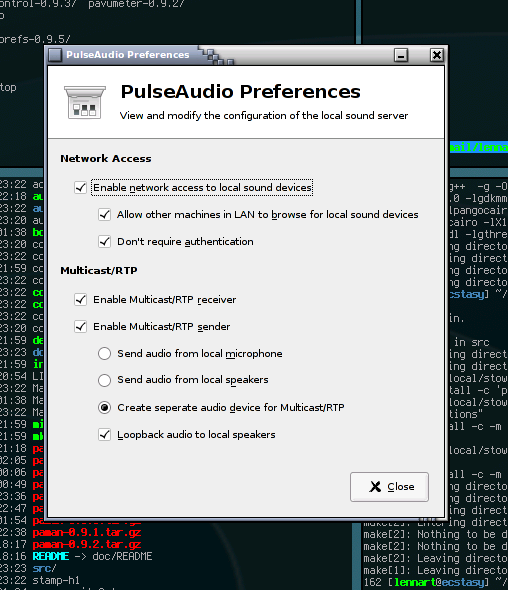
Another nice feature is the GConf integration which allowed us to add another nice application to the PulseAudio toolset: the PulseAudio Preferences utility:

paprefs screenshot

The idea is to have a simple, nice configuration dialog that allows
configuration of the more exotic features of PulseAudio which we do
not enable by default due to security considerations or to not
confuse the user. Right now a lot of features are hidden behind
non-trivial configuration file statements. This preferences tool shall
make them available for the users which are not so keen on editing
configuration files.

Playing around with Valgrind‘s
Massif tool and KCachegrind I did a little bit of memory and perfomance profiling of
the PulseAudio daemon. The 0.9.5 release contains a lot of
optimizations which are result of this work.

Before:

Massif before

After:

Massif after

These plots show the memory consumption against the time, from
starting the server, to playing stream, to stopping the stream and
shutting down the server again. The major improvement was actually an
update to libsamplerate done
by its maintainer to improve the memory handling of that library. (He
didn’t release an updated version of his library containing the
changes shown in the plots yet).

PulseAudio had the nice feature of remembering the playback volume of every
application for quite a while. Starting with 0.9.5 PulseAudio it also remembers
the output device for every application. Together with an updated Volume
Control tool which now allows moving streams between sinks while they are
played this can be used to configure a ruleset like “Ekiga always on the USB
headset, Rhytmbox always on the external speakers” very intuitively and easily:

pavucontrol screenshot

And here’s a final screenshot showing all the tools we currently have for PulseAudio 0.9.5.

PA Screenshot

Launchpad is Evil

Post Syndicated from Lennart Poettering original https://0pointer.net/blog/projects/launchpad-stole-my-name.html

I always think twice before entering my name in any web form or posting to a
mailing list. Is the web site/list respectable? Do the owners of the web site
have any commercial interest in my name (spam, marketing, …)? Would I ever
regret that my name can be found with Google in context with this web
site/mailing list? If I enter my name is it used for collecting data about me?
Is there any reasonable privacy policy?

Often enough I refrain from entering my name after deciding that the answers
to these questions are unsatisfactory. I like to be in control of my name. If I
am not confident that I remain in control I don’t enter my name to any
service.

Recently it came to my attention that Canonical decided to create an account (!) for me in their
commercial, proprietary bug tracker called “Launchpad”. I never asked for one!
I never even considered having one, because their service clearly is nothing
that would pass the tests mentioned above. They are a commercial service, my
account data is apparently “content” for them, they don’t seem to have any
privacy policy. (At least I couldn’t find any, the navigation is pretty
crappy.)

Canonical’s nimbus of being “the good guys” doesn’t hinder them to
incorporate data from free sources (apparently they got my data from the Debian
BTS) and make a commercial service of it, without even asking the original
contributors if that would be OK with them, or if it is OK to incorporate their
name or personal profile in the service. Apparently Canonical is not much
better than a common spam harvester: generating personal profiles for
business, without consent of the “victim”.

If anyone from Canonical reads this: It is not OK for me to use my name as
“content” for your commercial, proprietary service. Please remove any
reference to my name from your “account” database. I don’t want to have a
Launchpad account. I don’t plan to use Launchpad. Let me decide if I ever want to
join! Thank you very much.

Update: I especially dislike the fact that they created an account for me in
a service where Hitler apparently already has six (!) accounts. I am very sure
that I don’t want to be part of that community.

Avahi 0.6.13 released

Post Syndicated from Lennart Poettering original https://0pointer.net/blog/projects/avahi-0.6.13.html

Avahi Logo

I am happy to bring you yet another release of Avahi, everyone’s favourite Zeroconf stack.

  • Add a new D-Bus method for changing the mDNS host name during
    runtime. This functionality is only available to members of the
    UNIX group “netdev”, which is the same access group that is
    enforced by GNOME’s NetworkManager daemon. Since NM will probably
    be the most prominent user of this new method, we decided to limit
    access to the same group. The access group can be set by passing
    –with-avahi-priv-access-group= to “configure”. If you need more
    sophisticated access control you can freely edit
    /etc/dbus/system.d/avahi-dbus.conf.
  • Add a new utility “avahi-set-host-name” which is a command line
    wrapper around the aforementioned SetHostName() method.
  • Bonjour API compatibility library:
    • Implement DNSServiceUpdateRecord()
    • Allow passing NULL as callback function for DNSServiceRegister()
    • Implement subtype registration in DNSServiceRegister() in a
      way that is compatible with Bonjour.
    • Update to newer copy of dns_sd.h
  • If the host name changes update names of static services wich
    contain wildcards.
  • Don’t build documentation about embedding the Avahi mDNS stack into
    other programs by default. This is a feature used only by embedded
    developers. Pass –enable-core-docs to “configure” to enable
    building these docs, like in Avahi <= 0.6.12.
  • Build Qt documentation only when Qt support is enabled in
    the configuration. Same for GLib.
  • Change algorithm used to find a new host name on conflict. In
    Avahi <= 0.6.12 a conflicting host name of “foobar” would be
    changed to the new name “foobar2”. With 0.6.13 “foobar-2” will be
    picked instead. This follows Bonjour’s behaviour and has the
    advantage not confusing people with regular host names ending in
    digits.
  • Don’t disable all static services when SIGHUP is recieved.
  • Fix build when Avahi is configured without Gtk+ but with Python
    support
  • Fix build on MacOS X
  • Support using Solaris DBM instead of gdbm for the service type
    database. The latter is still recommended
  • Minor other fixes and documentation updates

The relevant NetworkManager bug about SetHostName() is #352828.

And our bug tracker is back to only two open bugs for Avahi. That’s a good feeling, I can tell you!