Post Syndicated from xkcd.com original https://xkcd.com/3259/
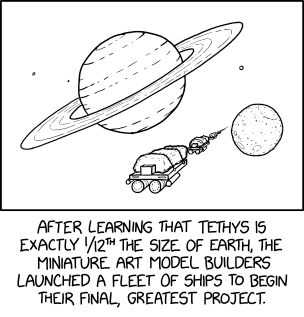
Post Syndicated from xkcd.com original https://xkcd.com/3259/
Post Syndicated from corbet original https://lwn.net/Articles/1077758/
Linus has released the 7.1 kernel.
“So it’s only Sunday morning back home, but it’s Sunday afternoon where
”
I am right now, so I’m doing the 7.1 release at the regular time –
just not in the regular timezone.
Significant changes in 7.1 include
the removal of support for some old 486-based architectures,
some new clone() flags making
process management easier,
BPF support for io_uring,
zero-copy-I/O support for the ublk user-space block
driver,
initial (incomplete) sub-scheduler support
in sched_ext,
more swapping improvements,
a completely rewritten NTFS
implementation,
and much more. See the LWN merge-window summaries (part 1, part 2) for details.
Post Syndicated from B. Schneier original https://www.schneier.com/blog/archives/2026/06/upcoming-speaking-engagements-57.html
This is a current list of where and when I am scheduled to speak:
The list is maintained on this page.
Post Syndicated from Explosm.net original https://explosm.net/comics/diss-track
New Cyanide and Happiness Comic
Post Syndicated from The Atlantic original https://www.youtube.com/shorts/_gEF6-3LPpI
Post Syndicated from Patrick Kennedy original https://www.servethehome.com/antropic-halts-access-to-fable-5-and-mythos-5/
Anthropic shut down access to Fable 5 and Mythos 5 due to an export control concern over the weekend in a wake-up call for the industry
The post Antropic Halts Access to Fable 5 and Mythos 5 appeared first on ServeTheHome.
Post Syndicated from Oglaf! -- Comics. Often dirty. original https://www.oglaf.com/ruin/


Post Syndicated from The Atlantic original https://www.youtube.com/shorts/Ns2M5uGO6wg
Post Syndicated from Patrick Kennedy original https://www.servethehome.com/sth-weekly-newsletters-you-want-to-subscribe-in-q2-2026/
Subscribe to our newsletters to stay up to date on the latest reviews and coverage from STH and more delivered to your inbox
The post STH Weekly Newsletters You Want to Subscribe in Q2 2026 appeared first on ServeTheHome.
Post Syndicated from The Atlantic original https://www.youtube.com/shorts/a0SMeGFMVIw
Post Syndicated from The Atlantic original https://www.youtube.com/shorts/qYJOuWYsz0o
Post Syndicated from Techmoan original https://www.youtube.com/watch?v=UlayEIw4MUI
Post Syndicated from Светла Енчева original https://www.toest.bg/sedmitsata-8-13-yuni/

Елисавета Белобрадова и Мариус Куркински влезли в един бар. По-точно, разминали се на входа, демонстрирайки удивителна симетрия.
Куркински първо се съгласи да участва в антипрайда „Шествие за семейството“ (да не се бърка с „Поход за семейството“, който тази година не се провежда, защото след разкола между евангелистите, които са в основата им, ресурсите отидоха при Шествието). После се отказа. Защо? Защото там, ти-ри-рам, ти-ри-рам.
Белобрадова пък предвождаше група депутатки от „Да, България“, които в навечерието на „София прайд“ внесоха в парламента предложения за промяна в Закона за предучилищното и училищното образование, между които беше и премахването на забраната на т.нар. ЛГБТ пропаганда. Това е нещо, което ПП–ДБ обещаха скоро след като забраната беше приета през август 2024 г. Няколко дни след внасянето на предложенията Белобрадова съобщи, че със съпартийците ѝ оттеглят тъкмо това от тях, свързано с ЛГБТ пропагандата (въпреки че и тази година подписа предизборната декларация на „София прайд“, с която се ангажира да се застъпва за „законови механизми за защита на ЛГБТИ хората от дискриминация във всички нейни форми“). Ама го направи завоалирано, без да споменава Това, за Което не Трябва да се Говори (ЛГБТ). Защо „Да, България“ оттегли точно това предложение? Защото там, ти-ри-рам, ти-ри-рам.
Или както се казва в една друга песен на Мариус от времето, преди той да се отдаде на традиционните ценности и да стане белобрад – „е, не, не мога такива неща да правя“.
Докато слушам тази песен, между другото, се замислих за разликата между частиците, междуметията и вметнатите части. Всъщност едва ли щях да направя тази асоциация, ако не бях прочела новата порция език на Павлина Върбанова. Този път тя е посветена, съвсем не между другото, на вметнатите части и на пунктуационните правила, на които се подчиняват те.
 Павлина Върбанова
След вметката за вметнатите части се връщам към темата за „София прайд“ и „Шествие за семейството“. Тази година за първи път хомофобското шествие, което се провежда паралелно с прайда, е с на практика официален статус. То не само е под егидата на Българската православна църква (което не е било досега), а се радва на одобрението и на управляващите. От името на „Прогресивна България“ Слави Василев прочете в парламента декларация в подкрепа на Шествието. В нея се казва:
Във времена на ценностна дезориентация, социална фрагментация и тежка демографска криза, съхраняването на традиционното семейство не е просто въпрос на личен избор, а стълб на националната ни сигурност, идентичност и бъдеще. […] Избираме да застанем зад ценностите на мълчаливото мнозинство от хора, които се опитват да отстояват традициите, семейството и вярата, а не да ги деконструират, както е модерно напоследък.
Войната е мир, свободата е робство, невежеството е сила, прогресивното е традиционно. Здравей, Оруел. А когато някой ЛГБТ тийнейджър отново се самоубие, защото не може да преживее тормоза (не искам да ви плаша, но такива трагедии ще продължат да се случват), институциите пак няма да разпознаят хомофобията като проблем. Традициите, които възпява новата власт, са опит да се върнат времената, когато ЛГБТ хората са живели в срам, страх, лъжи и неприемане на себе си. За ужасяващите измерения, до които може да доведе неприемането на себе си, препоръчвам новия сериал на Ричард Гад Half Man. Предупреждавам обаче, че не е лек за гледане.
Ала противоречията са, изглежда, основна характеристика за ПБ. И разорителният договор с „Боташ“, по който България трябва да плаща по над половин милион евро на ден, според новата власт се оказва суперизгоден. Ще потекат едни ми ти инфраструктурни проекти… Договорът може и да е такъв, обаче за Турция, която ще го използва като разменна монета за геополитическите си цели, пише Емилия Милчева в тазседмичната си статия „Машаллах, българи!“.
 Емилия Милчева
Освен стопляне на отношенията между България и Турция се наблюдава и завръщане на американско-китайската дружба, обръща ни внимание Искрен Иванов. Сприятеляването на две големи антидемократични сили може да произведе голямо чудовище, но авторът е оптимистичен. Според него възстановяването на добрите отношения между САЩ и Китай е
възможност балансът на силите в международната система да се върне отново към времето, когато политиците преговаряха с политици, а не с терористи.
 Искрен Иванов
Не знам как ще се развият отношенията между САЩ и Китай, но ще ви разкажа, че когато бях в пети клас, татко ми подари пиано и ме посрещна вкъщи с думите, че ми е взел „малко подаръче“. Влязох в детската стая и започнах да търся малкото подаръче – на бюрото, под леглото… А баща ми се заливаше от смях, понеже не виждах пианото, заемащо голяма част от стаята. Сетих се за тази случка, докато разсъждавах за избирателната обществена слепота във връзка със строежите в Баба Алино.
 Светла Енчева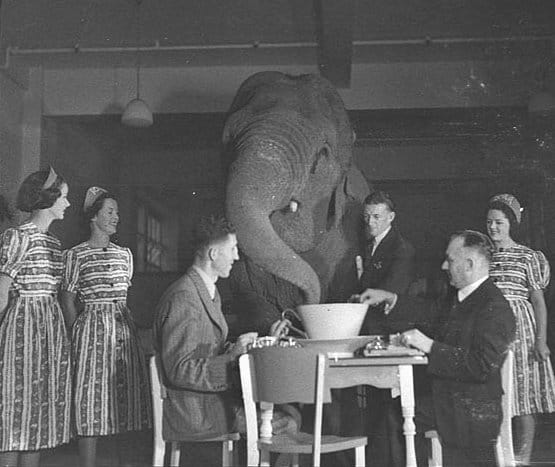
След като ви разказах историята за пианото, вече трябва да сте наясно, че от дете съм темерут. Част от темерутлъка ми е и че никога не развих интерес към компютърните игри. Но пък се възхищавам на хората, които ги правят – като Бисер Дянков, с когото разговаря игромислещата Миглена Николчина. Интервюто с него си струва, независимо дали харесвате компютърни игри, или сте като мен.
 Миглена Николчина
Спортът също е игра. Всяко лято на морето гледам с благородна завист каращите кайтсърфове, понеже никога съм нямала смелост да стана една от тях. Тази седмица „Тоест“ публикува превода на първата част от статията на Георги Тотев за турския остров Гьокчеада, където, освен кайтсърфисти, изплуват и травми от миналото.
 Георги Тотев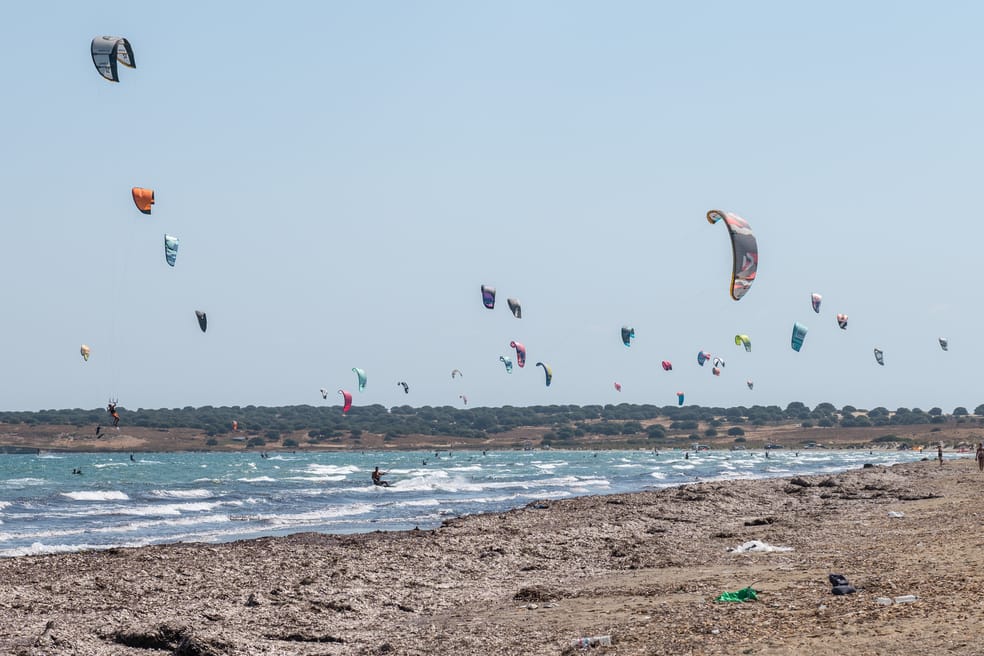
Толкова за тази седмица. Ако смятате, че от „Тоест“ има смисъл, ще сме благодарни да ни подкрепите – жизненоважно е за нас.
А ако ще ходите на „София прайд“, моля, пазете се. По възможност се движете на групи и се приберете бързо след края. Защото хомофобите вече имат благословията на държавата. И ако пострадате, властта едва ли ще прояви особено съчувствие.
Post Syndicated from Patrick Kennedy original https://www.servethehome.com/this-is-an-intel-xeon-6-soc-dpu-on-a-pcie-card-from-senao-at-computex-2026/
We saw an Intel Xeon 6 SoC-based next-generation SmartNIC DPU at Computex 2026. This Senao SX906 is really neat
The post This is an Intel Xeon 6 SoC DPU on a PCIe Card from Senao at Computex 2026 appeared first on ServeTheHome.
Post Syndicated from Spencer McIntyre original https://www.rapid7.com/blog/post/pt-metasploit-wrap-up-13-06-2026
As hard as we try to ensure that Metasploit is bug free, issues inevitably come up. Whether you’re running a module on an op or writing a new one, what we can do is make the debugging experience easier. To that end one of our two Google Summer of Code (GSoC) projects is here to deliver. Building on the previous pattern of HttpTrace comes two new options KerberosTicketTrace and CertificateTrace. These options, when enabled, will enable debugging output of Kerberos tickets and Certificates that are both sent and received by applicable modules. Now when things aren’t going quite right, users have new levers to reach for to inspect what’s happening under the hood.
For example, to inspect exactly what’s happening when using the auxiliary/admin/kerberos/get_ticket module:
msf auxiliary(admin/kerberos/get_ticket) > set KerberosTicketTrace true
KerberosTicketTrace => true
msf auxiliary(admin/kerberos/get_ticket) > run
[*] Running module against 192.168.159.10
[*] 192.168.159.10:88 - Getting TGT for [email protected]
####################
# Kerberos Request: AS-REQ
####################
Protocol Version: 5
Message Type: 10 (AS-REQ)
Pre-Authentication Data:
  Entry[0]:
    Type: 128 (PA_PAC_REQUEST)
    Value: [binary 7 bytes: 3005a0030101ff]
Request Body:
  KDC Options:
    Value: 1082195984
    Flags:
      - FORWARDABLE
      - RENEWABLE
      - CANONICALIZE
      - RENEWABLE_OK
  Client Name:
    Name Type: 1 (NT_PRINCIPAL)
    Name String:
      - smcintyre
  Realm: MSFLAB.LOCAL
  Server Name:
    Name Type: 1 (NT_PRINCIPAL)
    Name String:
      - krbtgt
      - MSFLAB.LOCAL
  Till: 2026-06-12T18:21:36Z
  Rtime: 2026-06-12T18:21:36Z
  Nonce: 6831592
  Encryption Type:
    - 18 (AES256)
    - 17 (AES128)
    - 23 (RC4_HMAC)
    - 3 (DES_CBC_MD5)
    - 16 (DES3_CBC_SHA1)
####################
# Kerberos Response: KRB-ERROR
####################
Protocol Version: 5
Message Type: 30 (KRB-ERROR)
Server Time: 2026-06-11T18:21:36Z
Server Microseconds: 862696
Error Code:
  Name: KDC_ERR_PREAUTH_REQUIRED
  Value: 25
  Description: Additional pre-authentication required
Realm: MSFLAB.LOCAL
Server Name:
  Name Type: 1 (NT_PRINCIPAL)
  Name String:
    - krbtgt
    - MSFLAB.LOCAL
Error Data: [binary 87 bytes: 30553032a103020113a22b04293027301ea003020112a1171b154d53464c41422e4c4f43414c736d63696e747972653005a0030201173009a103020102a20204003009a103020110a20204003009a10302010fa2020400]
####################
# Kerberos Request: AS-REQ
####################
Protocol Version: 5
Message Type: 10 (AS-REQ)
Pre-Authentication Data:
  Entry[0]:
    Type: 2 (PA_ENC_TIMESTAMP)
    Value: [binary 67 bytes: 3041a003020112a23a0438724f4965bd3deb1f061e807b616a09b613f59d9a6749eaee895e2ec3ed3045403cb28874acaa371681e3957a3ec23879141411ba788886f3]
  Entry[1]:
    Type: 128 (PA_PAC_REQUEST)
    Value: [binary 7 bytes: 3005a0030101ff]
Request Body:
  KDC Options: 1350565888
  Client Name:
    Name Type: 1 (NT_PRINCIPAL)
    Name String:
      - smcintyre
  Realm: MSFLAB.LOCAL
  Server Name:
    Name Type: 1 (NT_PRINCIPAL)
    Name String:
      - krbtgt
      - MSFLAB.LOCAL
  Till: 2026-06-12T18:21:36Z
  Rtime: 2026-06-12T18:21:36Z
  Nonce: 7068778
  Encryption Type:
    - 18 (AES256)
    - 23 (RC4_HMAC)
####################
# Kerberos Response: AS-REP
####################
Protocol Version: 5
Message Type: 11 (AS-REP)
Pre-Authentication Data:
  Entry[0]:
    Type: 19 (PA_ETYPE_INFO2)
    Value: [binary 34 bytes: 3020301ea003020112a1171b154d53464c41422e4c4f43414c736d63696e74797265]
Client Realm: MSFLAB.LOCAL
Client Name:
  Name Type: 1 (NT_PRINCIPAL)
  Name String:
    - smcintyre
Ticket:
  Ticket Version Number: 5
  Realm: MSFLAB.LOCAL
  Server Name:
    Name Type: 1 (NT_PRINCIPAL)
    Name String:
      - krbtgt
      - MSFLAB.LOCAL
  Encrypted Part:
    Encryption Type: 18 (AES256)
    Key Version Number: 2
    Cipher: [binary 1098 bytes: a3b825bd279344fd0bc454654f7906e31c8f4918c7c69319515e6a722515b55da36e2ae26f107d9f6278b029ba4c1b937a8a4e9df04f4a54da43794b2216fd5d7762582e94e3aa72fd14bfa0cfb9ff5c9a138acecd57351ff7ca98a9d7d890445316b04359e9210f93ba72c578a1605fb5502ba00fe67d9b55417e356e6400ef3bd07b9e1a8e4aedeb62249bef9f56f0cda3a30969d33fe6999a4855ae8f666b82fdff29047b14d4bcd77b31a6b9ce1ee3a4425cd197250af0cc878995afbeb4de42fb7e55d6095ab27ab3fa7f0afb0010b8e8f5e721a3d0417c7342df77619f6520e726652dc4417d2dbc044529236557441f87a50a7188242fb177e5f1bd45d31902c877d51cd05af7215e520c410e9b7036bc78c1ddad458b0ad99832c4fdd6f8f523ca4241aee8ebce4a0000202ebfb870761833feffc2c248683751a11d556bba4c59b20c7a1627b187d4d4679e19b1928f3ab7edeef3f01b459324178a9e49976519b58d6d7164b29c77e20625c4e710e3bbb0bb32452d4bdb9ed0c3e9873b9511cadf36fb0b372af5f67310319f160c0242d2fff1095bc467c4eb6da0382ab0587d519e5390e56eacb6db4f98c2c25b7ac22edf40db2e0e0eca03dfeba48327916a8caa85c382d04dcea16116c76132dcbfc168b7e3435a37f812f479f1e8309b124a9dcbac1e2ae83063a5e49c1ea584f13f64832c713577f07b3229e83c0fe73c3dc350640a69ea643ef24b66ed17114c262d3e5cdddb8182d8da49173e597b23d94f8ef652433713bf1d5e91c7f984945940d27755584137b00baa9696cdd121c641870830ffc86c8f9989254b6b804912c4989014b3f849cd02e6b06d3cc6401fd3f830cfcd36a0ecf31309d5b6dc82a65b427818694002bcf5fac9c936e1d64205a397126f39f684903803a5405baff041881339c4c8d325a2f446178b66383c209f3dba61bdda626f6e6d63c473638191e447d58aebfcb5a98104c2f96afa3283ac3aca675937afd7c497f1bd41a3dd1b52a6a16db791421a4ab9189d9fa0d610713d9c1eeb2f9c46d6ea197f48e2e643fe773ece0855c63b44b6020044fb7cc1396b26b4747941484b73108b7c1c90e2670cf723033274cc24ceb66a7054b35a9653cd7391a4f81b2c977ee251c9295e47be46b14c66b4031c6758415e543153bde190af0f1abe0f207d84145e3521850f89765997ab72cccaaeb4c5ce8b8be9b33712090d59424c2517e4cd539740750f5792f171fec2b4e4b4bc00cb77bc308abe1b70c75684734aa9ef03c4b419d2e10b4ea6229faf5a4b2af9483156ea32bc4b298f158067ac45afd5c812c407bda57880434cb93a60ac19799004a9adc72d845401ebb8e2a31ed0edf539233d293b1141bb49b36b6475d87c0fd114d97a946e82e39ed58e6c2e0d72826059600d412bd05aaf0af5602ade2f1ff6db363ec33e25756c4bc417b248344ba19ecd8d80d2cd2c2ff32aa355c22ee96166fc7043204dcc48b5595416c4312855c7d6e31d422c93c1d6f3df1a5890b45fc55f1b757b8e]
Encrypted Part:
  Encryption Type: 18 (AES256)
  Key Version Number: 3
  Cipher: [binary 271 bytes: 357637faf370a69ec4780f1fc4308e3d639e59ebbdb5d208cf6df75470bcefdd5210a098aa716055f758d9ec58674abc4b56cec2923329309e2be192db3ee1a63c6f0133a96c440707a0f29f2e075f90c54e2ab7626132f8e898112f81cbde6905d992d9ec6a4c26087043ea8f97c1a876354c47b4a6a76e3321f42edc483530d5248f8daa01db15ab019ac4179dfdb5f6d6c1f2666b9983cd02989612acdad2b2efe352fb9708a080fd304d17a87ff1e152dc8ca981de6cff418f38c5c28612766bfc13fbac51bad1a01fcd7aae544c7d839124e1bce745d20d06c8aca5c7125afe069e8d5299a10cd27b392bd8ae3893181f132f3d49dd746c6c70c6d2b651df998c59be84f2d5b83e5b3c0a71b2]
[+] 192.168.159.10:88 - Received a valid TGT-Response
[*] 192.168.159.10:88 - TGT MIT Credential Cache ticket saved to /home/smcintyre/.msf4/loot/20260611142136_default_192.168.159.10_mit.kerberos.cca_918073.bin
####################
# Kerberos Credential: TGT
####################
Creds: 1
  Credential[0]:
    Server: krbtgt/[email protected]
    Client: [email protected]
    Ticket etype: 18 (AES256)
    Key: 58b969939485b53dee75e4399253524d132cc2ca145f4da4e4951c04a843e544
    Subkey: false
    Ticket Length: 1188
    Ticket Flags: 0x50e10000 (FORWARDABLE, PROXIABLE, RENEWABLE, INITIAL, PRE_AUTHENT, CANONICALIZE)
    Addresses: 0
    Authdatas: 0
    Times:
      Auth time: 2026-06-11 14:21:36 -0400
      Start time: 2026-06-11 14:21:36 -0400
      End time: 2026-06-12 00:21:36 -0400
      Renew Till: 2026-06-12 14:21:36 -0400
    Ticket:
      Ticket Version Number: 5
      Realm: MSFLAB.LOCAL
      Server Name: krbtgt/MSFLAB.LOCAL
      Encrypted Ticket Part:
        Ticket etype: 18 (AES256)
        Key Version Number: 2
        Cipher:
          o7glvSeTRP0LxFRlT3kG4xyPSRjHxpMZUV5qciUVtV2jbiribxB9n2J4sCm6TBuTeopOnfBPSlTaQ3lLIhb9XXdiWC6U46py/RS/oM+5/1yaE4rOzVc1H/fKmKnX2JBEUxawQ1npIQ+TunLFeKFgX7VQK6AP5n2bVUF+NW5kAO870HueGo5K7etiJJvvn1bwzaOjCWnTP+aZmkhVro9ma4L9/ykEexTUvNd7Maa5zh7jpEJc0ZclCvDMh4mVr7603kL7flXWCVqyerP6fwr7ABC46PXnIaPQQXxzQt93YZ9lIOcmZS3EQX0tvARFKSNlV0Qfh6UKcYgkL7F35fG9RdMZAsh31RzQWvchXlIMQQ6bcDa8eMHdrUWLCtmYMsT91vj1I8pCQa7o685KAAAgLr+4cHYYM/7/wsJIaDdRoR1Va7pMWbIMehYnsYfU1GeeGbGSjzq37e7z8BtFkyQXip5Jl2UZtY1tcWSynHfiBiXE5xDju7C7MkUtS9ue0MPphzuVEcrfNvsLNyr19nMQMZ8WDAJC0v/xCVvEZ8TrbaA4KrBYfVGeU5Dlbqy220+YwsJbesIu30DbLg4OygPf66SDJ5FqjKqFw4LQTc6hYRbHYTLcv8Fot+NDWjf4EvR58egwmxJKncusHiroMGOl5JwepYTxP2SDLHE1d/B7MinoPA/nPD3DUGQKaepkPvJLZu0XEUwmLT5c3duBgtjaSRc+WXsj2U+O9lJDNxO/HV6Rx/mElFlA0ndVWEE3sAuqlpbN0SHGQYcIMP/IbI+ZiSVLa4BJEsSYkBSz+EnNAuawbTzGQB/T+DDPzTag7PMTCdW23IKmW0J4GGlAArz1+snJNuHWQgWjlxJvOfaEkDgDpUBbr/BBiBM5xMjTJaL0RheLZjg8IJ89umG92mJvbm1jxHNjgZHkR9WK6/y1qYEEwvlq+jKDrDrKZ1k3r9fEl/G9QaPdG1KmoW23kUIaSrkYnZ+g1hBxPZwe6y+cRtbqGX9I4uZD/nc+zghVxjtEtgIARPt8wTlrJrR0eUFIS3MQi3wckOJnDPcjAzJ0zCTOtmpwVLNallPNc5Gk+Bssl37iUckpXke+RrFMZrQDHGdYQV5UMVO94ZCvDxq+DyB9hBReNSGFD4l2WZercszKrrTFzouL6bM3EgkNWUJMJRfkzVOXQHUPV5Lxcf7CtOS0vADLd7wwir4bcMdWhHNKqe8DxLQZ0uELTqYin69aSyr5SDFW6jK8SymPFYBnrEWv1cgSxAe9pXiAQ0y5OmCsGXmQBKmtxy2EVAHruOKjHtDt9TkjPSk7EUG7SbNrZHXYfA/RFNl6lG6C457VjmwuDXKCYFlgDUEr0FqvCvVgKt4vH/bbNj7DPiV1bEvEF7JINEuhns2NgNLNLC/zKqNVwi7pYWb8cEMgTcxItVlUFsQxKFXH1uMdQiyTwdbz3xpYkLRfxV8bdXuO
[*] Auxiliary module execution completed
msf auxiliary(admin/kerberos/get_ticket) >
Stay tuned for future enhancements like KerberosTicketTraceLevel which should have verbosity toggles such as meta, ticket, and full. We’d like to thank our GSoC contributors eve0805 and Pushpenderrathore for their hard work on this project.
Metasploit is currently reconsidering the UX of evasion modules whereby users are currently required to use the module, set the payload, run it, then return to their exploit and copy the generated output from the evasion module into the exploit. This is a cumbersome process and we think we can do better but before we commit to a direction, we are soliciting feedback from the community on what they think would be the best path forward. To that end, we’ve published a writeup of the options we’re considering and a form through which we’re hoping to receive feedback. The form contains 3 questions and will be open until July 1st, 2026.
Authors: boredchilada and h00die
Type: Exploit
Pull request: #21212 contributed by h00die
Path: multi/misc/clickfix_server
Description: Adds a new Metasploit exploit module exploit/multi/misc/clickfix_server that runs an HTTP server to deliver a “ClickFix”-style social-engineering page which copies a generated command payload to the victim’s clipboard that they are prompted execute.
You can find the latest Metasploit documentation on our docsite at docs.metasploit.com.
As always, you can update to the latest Metasploit Framework with msfupdate and you can get more details on the changes since the last blog post from GitHub:
If you are a git user, you can clone the Metasploit Framework repo (master branch) for the latest. To install fresh without using git, you can use the open-source-only Nightly Installers or the commercial edition Metasploit Pro
Post Syndicated from The Atlantic original https://www.youtube.com/shorts/WM97hgDwOK4
Post Syndicated from Bruce Schneier original https://www.schneier.com/blog/archives/2026/06/friday-squid-blogging-squid-inspired-fluid-pump.html
This fluid pump was inspired by the way squids propel themselves through the water.
As usual, you can also use this squid post to talk about the security stories in the news that I haven’t covered.
Post Syndicated from jake original https://lwn.net/Articles/1077052/
In a shortened session in the filesystem track at the 2026 Linux Storage,
Filesystem, Memory Management, and BPF Summit, Amir Goldstein gave an
update on the overlayfs
union filesystem. There are some new features over the last few years
that he wanted to mention, along with looking at the status of nesting
overlayfs layers. The composefs use case
that was discussed at the summit in 2023
has led to some interesting changes to overlayfs.
Post Syndicated from Aarthi Srinivasan original https://aws.amazon.com/blogs/big-data/access-amazon-s3-data-files-directly-using-aws-lake-formation-permissions/
Data scientists and ML engineers often need to access raw data files in Amazon Simple Storage Service (Amazon S3) for machine learning training, data exploration, and generative AI workflows. However, when table-level access is governed by AWS Lake Formation, accessing the underlying S3 files has required maintaining separate permission mechanisms. S3 bucket policies or AWS Identity and Access Management (IAM) role policies create operational overhead and risk of permission drift.
Lake Formation now supports direct access to S3 data file locations for tables whose permissions it manages. Previously, data scientists with Lake Formation permissions on AWS Glue Data Catalog tables could query them using spark.sql(). Now, they can also read and write the underlying S3 data files using spark.read.parquet() or spark.read.csv() from Amazon EMR Spark jobs, Amazon SageMaker Unified Studio notebooks with EMR compute, and custom applications. All access is governed by the same Lake Formation permissions.
This capability is powered by the new GetTemporaryDataLocationCredentials() API, which vends temporary credentials scoped to registered S3 locations when callers have appropriate Lake Formation permissions on the corresponding Data Catalog tables. This eliminates the need to manage separate S3 bucket policies for file-level access while maintaining fine-grained access control in Lake Formation for table-based access. It enables your data scientists to explore S3 datasets securely, accelerate machine learning pipelines, and build generative AI workflows without compromising governance.
In this post, we demonstrate reading from and writing to Lake Formation-managed S3 locations using Apache Spark jobs from EMR. Lake Formation credential vending for S3 location access is available in EMR release label 7.13 and later, Boto3 1.42.29 and later, AWS Java SDK 2.41.32 and later, and AWS Command Line Interface (AWS CLI) version 2.33.1 and later.
“Through our close collaboration with AWS, Lake Formation’s new S3 location-based permissions have transformed how we manage data governance at Intuit. By unifying two separate access mechanisms for the same data into one unified permission model, we’ve dramatically reduced complexity and streamlined our auditing process. This is exactly the kind of simplification that lets our teams move faster without compromising security, ensuring we maintain the strict compliance and governance standards our regulators expect.”
— Tapan Upadhyay, Group Engineering Manager, Intuit
Lake Formation has made available a specialized library AWS Lake Formation Credential Vending Plugin for AWS SDK V2 for Java. The Java plugin intercepts S3 requests for data, checks Lake Formation permissions for the requested location, and provides temporary scoped credentials to the client if permissions are granted in Lake Formation. If the S3 location access permissions are not managed by Lake Formation, the plugin checks for access in Amazon S3 Access Grants and lastly falls back to IAM permissions. The plugin is supported independently of Spark and comes as an enhancement to EMR Spark Full Table Access (FTA) mode, starting in EMR 7.13 and later. The plugin is integrated at the S3A level. Therefore, any client of S3A can enable it by setting the S3A configurations, in addition to the EMR Lake Formation Full Table Access (FTA) configuration as follows:
With the Java plugin, you can enable governance for data lake resources in your custom applications with Lake Formation permissions – managing both fine grained access for users requiring restricted access on Data Catalog tables while providing direct S3 object level access to use-cases that require them.
Note: (1) The principal that will be accessing direct S3 locations of the tables will require full table access. That is, Lake Formation SELECT permission on all columns and rows of the table is required. (2) The Spark cluster needs FTA configuration. (3) Currently, Apache Iceberg table format is not supported with this plugin.
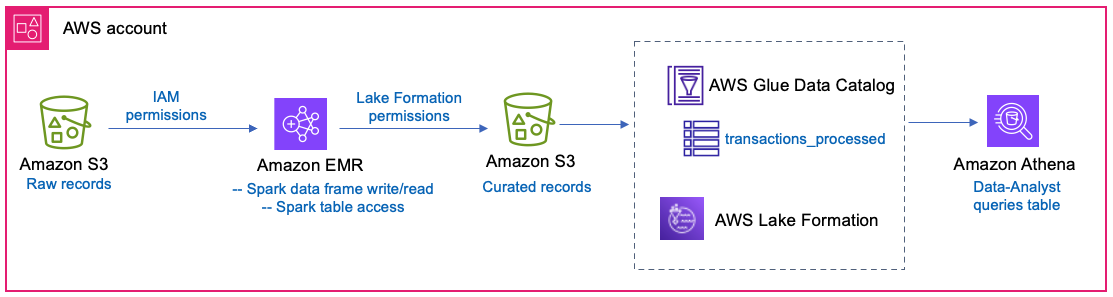
A financial services company runs daily ETL jobs using Spark in EMR. They process raw transaction records in S3 and store the processed records in another S3 location. The transformed Parquet data is registered with Lake Formation and cataloged as a table in Data Catalog. The ETL job will have direct IAM access to the raw data location, while it uses Lake Formation permissions to write to and read from the curated table location. Downstream, a data-analyst role will query the curated table, with restricted column access. The solution is shown in Figure 1.
Figure 1 – Architecture shows EMR Spark writing curated records to the S3 location of a table using Lake Formation permissions while Data-Analyst queries the same table with Lake Formation fine grained access control in Athena.
To get started exploring this feature, we recommend you have the following setup.
First, we will get the setup ready with S3, sample database, table, and data. We will add a raw data set to S3 location, create a table with parquet data in another S3 location that represents the curated dataset for further downstream consumption. We will register the table data location with Lake Formation and grant permissions for the EMR run time role and Data-Analyst role.
Your S3 bucket will have the following structure.
Raw data – s3://<your-bucket-name>/raw/transactions/dt=2024-03-21/
Process data for table – s3://<your-bucket-name>/processed/transactions/
Spark script – s3://<your-bucket-name>/scripts/
Logs for the EMR cluster – s3://<your-bucket-name>/logs/
From the Athena console query editor, create a table in Data Catalog.
2.1 Register the table data location s3://<your-bucket-name>/processed/transactions/ with Lake Formation in Lake Formation mode using the custom S3 registration IAM role. For details on how to register locations with Lake Formation, refer Adding an Amazon S3 location to your data lake.
2.2 Grant DESCRIBE permission on the database finance_db and ALL permission on the table transactions_processed to your EMR runtime role.
2.3 Grant Data location permission to EMR runtime role on the curated table’s location. This is to allow writing to that location.
2.4 Grant DESCRIBE permission on the database finance_db and SELECT permission on the table transactions_processed to your Data-Analyst role. Exclude the columns transaction_id and account_number while granting SELECT permissions on the table to the Data-Analyst role.
For details on how to grant Lake Formation permissions, refer Granting database permissions using the named resource method; Granting table permissions using the named resource method and Granting data location permissions.
3.1 Download the script bdb-5860-script.py.
3.2 Edit the S3 bucket name placeholder in the script (RAW_PATH and TABLE_PATH) to your resource names and upload to your S3 path s3://<your-bucket-name>/scripts/.
3.3 Make sure your EMR runtime role has access to the script location in its IAM policy permissions.
3.4 Submit and run the script as a step to the EMR cluster, following instructions at Add a Spark step.
What does the script do?
It populates raw records of transaction data into a Spark data frame, writes to the raw data bucket location using IAM permissions on the EMR runtime role. We apply some transformations and write directly to the S3 location of the table that is registered with Lake Formation, from the data frame using Spark’s native Parquet writer.
The following figure shows the stdout of the step.
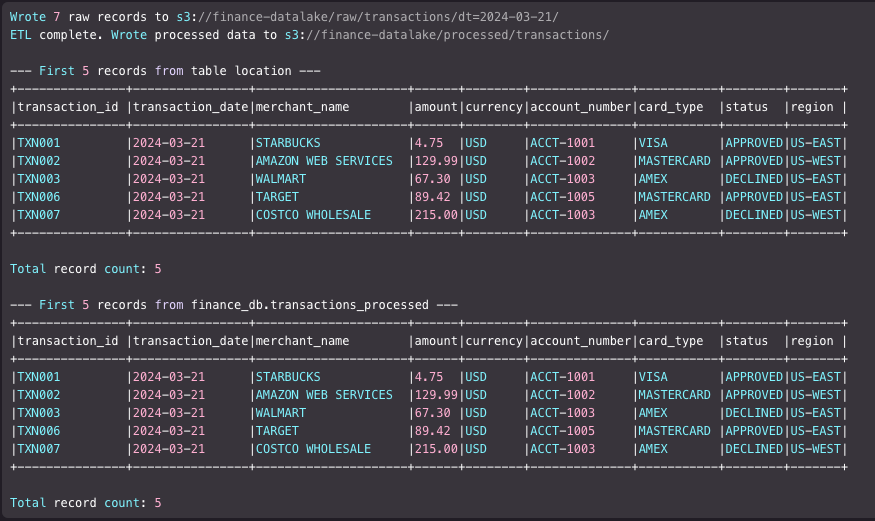
The Java plugin integrated into EMR 7.13 automatically handles the access for the table’s data location registered with Lake Formation, so you don’t need to manually call the GetTemporaryDataLocationCredentials() API. In this example, the table data location s3://<your-bucket-name>/processed/transactions/ is registered with Lake Formation, for which EMR runtime role is granted ALL permissions. The direct S3 location access support by Lake Formation allows reading and writing to the location directly using Spark data frame.
Log in as the Data-Analyst role to the Athena console. Run a select query on the table as follows.
The Data-Analyst role should see all but two columns of the table.

With these steps complete, we’ve read from and written to direct S3 locations using Spark data frames with the syntax s3://bucketname/prefix/, and accessed the same data using database_name.table_name syntax with Lake Formation permissions. This shows fine-grained access at table level and coarse-grained access at the file path level.
To avoid incurring costs, clean up the resources you created for this post.
In this post, we showed how to use Lake Formation’s direct S3 location access to read and write data files using Spark data frames from Amazon EMR, while maintaining unified governance through Lake Formation permissions. We walked through the GetTemporaryDataLocationCredentials() API and the AWS Lake Formation Credential Vending Plugin for AWS SDK v2 for Java, which is integrated into EMR release labels 7.13 and later.
This capability unifies permission management for both fine-grained table-based access and direct S3 file path access in Lake Formation. Your data scientists can now use spark.read.parquet() and spark.write alongside spark.sql(), governed by the same permissions, audited in the same CloudTrail logs, and managed from a single console.
To get started, launch an EMR 7.13 cluster and start exploring the feature. Here are some additional resources:
Acknowledgements: We would like to thank all the team members who worked to launch this feature successfully – Rajas Bhate, Akhil Yendluri, Kunal Parikh, Sharda Khubchandani, Dhananjay Badaya, Santhosh Padmanabhan, Nitin Agrawal and Sandeep Adwankar.
Post Syndicated from The Hook Up original https://www.youtube.com/watch?v=D_78hM_1buM