Tag Archives: multimodal

MAPS: Netflix’s Multimodal Asset Personalization at Scale

Post Syndicated from Netflix Technology Blog original https://netflixtechblog.com/maps-netflixs-multimodal-asset-personalization-at-scale-32f96320785e

By Emma Yanyang Kong, Aditya Deshpande, Asad Abbasi, Bowei Yan, David Fagnan, Ashish Rastogi, Dhaval Patel, Ray Zhang

Introduction

The Netflix experience is a journey of discovery. Every visual cue, from the artwork on a title to the video previews that autoplay while you browse, is there to connect you with a story you will love. We call these visual cues assets, and choosing the right one for each member is a personalization problem of its own. But which image or video preview of Squid Game should we show you? And what do we do right after a title launches, when there’s far too little interaction data to know which asset we should recommend to each member?

For years, our models answered the first question well and the second poorly. They learned which assets members interacted with, but treated every asset as an opaque ID, blind to what was actually in the artwork or video preview. Right after a title launched, its assets had no history, so we dialed up exploration on its assets to gather interaction data, and otherwise fell back to popularity heuristics that ignore your taste. Only once enough interactions had piled up could personalization take over. This is the classic cold-start problem.

This post shares how multimodal embeddings let our models see and hear the assets they recommend, so personalization can kick in far sooner, close to a title’s launch. Because a new asset arrives with its embedding the model already understands, that embedding carries member taste signals from related assets immediately. Consequently, the model needs far less interaction history before it can personalize. We cover three production systems, artwork personalization, query-aware artwork ranking, and video preview personalization, plus a cheap trick for choosing new embeddings before committing to full end-to-end integration and A/B testing.

Artwork Personalization

A single image is often a member’s first touchpoint with a title, so we create a diverse set of artworks for each title to appeal to different member tastes. We already use personalized artwork based on members’ interaction histories, but this approach breaks down for newer titles and their assets, where there is little or no behavioral data to learn from.

Making the Model See the Artwork

Our solution is to let the model “look” at the picture. We encode each artwork with CLIP, a pretrained image-text embedding model, and fold the result into how the model represents that asset, concatenating the per-asset CLIP image embedding, a 768-dimensional vector, with the asset’s learned ID embedding to give an asset representation:

e_id(a) is the asset’s learned ID embedding, and e_a is its CLIP image embedding. The two are concatenated and passed through an MLP layer to give h_a, the representation the model scores against a member.

This single change transforms how the model handles a brand-new artwork. Instead of treating it as an unseen ID, the model now receives a CLIP embedding the moment the asset is created. That allows a member’s preferences over visual themes, talent, and color palettes to be applied immediately, long before the asset accumulates any interactions of its own. Because those preferences are expressed in image-embedding space rather than tied to specific asset IDs, they transfer seamlessly across titles. If you consistently engage with artwork featuring a particular comedian, the model can carry that signal to their new title and prioritize the asset that places them front and center, even if it has never shown you that exact image before, as in the figure below. In this way, cold-start shifts from being a blind spot to something the embedding space already has an informed opinion about.

Knowledge transfer through CLIP embeddings. A member who has interacted with a comedian’s past stand-up artwork (left) leads the model to favor the new-title asset that features that comedian prominently (green check) over one that does not, even though it has never seen that specific image before.

From Five Models to One

That shift, from scoring an asset by the ID it happens to carry to scoring it by what the image actually contains, powers a second big win, model consolidation. Each title’s artwork spans multiple canvases with different croppings (billboard, vertical-box, horizontal-panel, short-panel, landscape-panel), and historically we trained a separate model per canvas, since an ID-based model has no way to know that the cropped and resized renderings of one scene are related, so signal could not flow between canvases and each faced its own cold-start.

CLIP embeddings break that barrier. Because they are largely invariant to crop, resize, and aspect ratio, those near-identical renderings map to nearly the same vector, as the figure further below shows. A single unified model can therefore pool interaction signal across every canvas, so a member’s affinity learned on a high-traffic canvas immediately informs the artwork we pick on a sparse one. The result is one model in place of five, with the largest gains on the canvases that have the least interaction data.

One source image, many canvases. The same Running Point artwork is cropped and resized across billboard, TV, mobile, and out-of-home placements, each with a different asset ID. Because CLIP embeddings barely change under crop and resize, a single unified model can personalize all of them.

Mixing Five Canvases of Training Data

Consolidation introduced a challenge that the per-canvas models never faced: how to effectively mix data across disparate canvases? The canvases differ widely in impression volume, and the interactions they log are not all worth the same to a member’s long-term experience. Training on pooled raw counts would let the highest-volume canvas and the most frequent interaction types dominate, so the low-data canvases we were trying to help would benefit least. Hand-tuning a weight per canvas would just trade that problem for a set of arbitrary hyperparameters and endless online sweeps to tune them.

Instead we use reward-based weighting, building on Netflix’s long-term reward modeling. Each training example is weighted by the long-term reward score attached to its interaction type:

a_ti is a training example, a positive interaction on asset i of title t. Its weight is set by the interaction type e observed on it, scored by ρ, that type’s long-term reward.

where e(·) is the type of the observed positive interaction and ρ is that type’s long-term reward score. Because interaction types are not distributed evenly across canvases, weighting by long-term value rebalances the canvas mixture on its own, with no weight set by hand. A canvas contributes in proportion to the long-term value of the interactions it drives rather than to how many impressions it happens to get. Consolidation becomes feasible, and the unified model optimizes for long-term member satisfaction instead of whichever short-term action is most frequent.

A Note on Offline Evaluation

Every result presented here must clear two bars: an offline metric evaluation followed by a large-scale online A/B test. The offline metric is the subtle one. Judging a new model on logs from the current production policy is biased, because that policy shows some assets far more often than others. The logged rewards describe what the policy preferred, not what members would have chosen from the full candidate set, so a new model that disagrees with the logging policy looks worse than it is, because the impressions it would have picked are barely represented in the data.

We handle this with inverse propensity scoring (IPS) computed on a dedicated slice of exploration traffic. A small fraction of traffic is served by a randomized policy that samples among a title’s candidate assets from a known distribution, so the propensity of showing a given asset in a given context is logged exactly at serving time rather than estimated after the fact. Reweighting every observation by the inverse of its logged propensity gives:

where D is the exploration slice and r(x, a) is the observed reward, such as a play. Impressions that exploration made rare are upweighted accordingly, and the estimator becomes an unbiased estimate of the reward a candidate policy would have earned had we actually deployed it. Having propensities that are known by construction, rather than modeled after the fact, is in our experience the single biggest reason our offline numbers track online outcomes. We report IPS as a ratio against the production baseline, and a candidate has to win there before it gets any A/B traffic.

Combining Both Ideas Works Better

Two ideas are bundled together here, so we ablated them separately against the old five-model production system.

  • V1, image embeddings only. The five per-canvas models kept as they were, each one augmented with image embeddings.
  • V2, unified model only. A single model trained over all five canvases, but with learned ID embeddings alone and no image content.
  • V3, both together. One unified model over all five canvases, with image embeddings in its asset representation.

As the chart below shows, each idea helped exactly where we expected: on the data-starved short-panel canvas and landscape-panel canvas. V3 was the clear winner. A change inside ±1% is not significant for this offline metric, and those bars are hatched in the chart. Most of what V1 and V2 do on their own sits inside that band.

Relative offline IPS lift by canvas for the three variants, each measured against the prior per-canvas model on that same canvas. Both ideas help where interaction data is scarcest, and V3 is strongest. Hatched bars fall inside the ±1% band, where the change in the offline metric is not significant; V3 values are labeled on the plot.

In the online A/B test across all device platforms, which ran for at least four weeks, the results drew a much clearer line: Neither idea moved our online core member metrics on its own. V1 and V2 were both flat and non-significant, and only V3 won a statistically significant lift. It is what runs in production today.

The two ingredients need each other. V1 tells a per-canvas model what an asset looks like, but one sparse canvas has too few examples to teach it how to use that. V2 supplies plenty of data, but only ID-based data, which a new asset lacks. V3 has both, so mature canvases teach the shared model how CLIP embeddings map to member preference and that mapping transfers straight to the sparse ones. The effects compound rather than add, since the V3 short-panel lift (5.691%) exceeds V1 and V2 combined. The lesson is to look for a second blocking factor before concluding that content features do not help.

Cold-Start Challenge from a New UI Launch

The real test came from the product change that motivated the work. Netflix was preparing its largest TV home-screen redesign in a decade, which would make short-panel the dominant artwork canvas effectively overnight. This was a cold-start problem in its sharpest form. The canvas about to receive the most impressions had the least historical data, and waiting for short-panel interactions to accumulate would have degraded the user experience. Consolidation lets short-panel selection draw on signal pooled from every canvas, and CLIP embeddings let the unified model personalize a short-panel asset that has gathered very few interactions of its own.

We shipped V3 ahead of the launch and measured it with a month-long holdback A/B test, keeping a small control group on the prior per-canvas model. V3 absorbed the shift immediately, with statistically significant gains on both our core discovery metric and streaming hours, and larger gains than in the steady-state ablation. That stronger result is what we expected, since a sudden shift in which canvas dominates is exactly where V3 should help most.

Query-Aware Artwork Personalization

Your general taste is the right signal when browsing, but not when searching. For example, when searching for a specific actor, you want artwork that features them, even if your broader taste says otherwise. On the Netflix Search Page, the member’s intent is explicit and stated in the query, and the displayed artwork should reflect it.

The same CLIP embeddings we added for cold-start hand us this almost for free. Because CLIP projects text and images into one shared embedding space, we can measure how well a query matches a candidate artwork directly by the cosine similarity between the CLIP text embedding of the query and the CLIP image embedding of the asset. We blend that alignment term with the usual personalization score:

Here the personalization term is the score the artwork model above already produces for a member and asset, the second term compares the text embedding of the query against the image embedding of the asset, and the mixing weight α between 0 and 1 is tuned through online A/B testing. The first term is “what we think you like”; the second is “what you just asked for,” and α sets how much each matters.

Crucially, this took no extra modeling effort. The CLIP embeddings already sit in the asset representation from the artwork work above, so they carry the text-image alignment for free, and we get a query-aware ranker by adding a single similarity term at scoring time. The effect is visible in the search results themselves.

Query-aware artwork for a search for a specific actor. Each result surfaces an asset that visually features the searched actor, aligning the artwork with the member’s explicit intent.

Personalizing Video Previews via MediaFM

Video previews raise the bar over still artwork. A video preview unfolds over time, and its appeal comes as much from motion, pacing, dialogue, and soundtrack as from any single frame. Our older video preview personalization models saw none of that. Like the early artwork models, they treated each preview as an opaque ID. Our first content-aware attempt, SeqCLIP, described a video preview by its frames, encoding each with a CLIP embedding and then averaging them into one vector. That captured what a video preview looked like, but a mean of still frames still misses what it sounds like, the dialogue and music that carry so much of a preview’s tone.

To capture the rest, we turned to MediaFM, Netflix’s first in-house multimodal foundation model. Trained on 80 million shots, MediaFM fuses the following three signals per shot into a single embedding:

  • Visual: SeqCLIP
  • Audio: A pretrained speech and audio embedding model
  • Text: Captions encoded via a large-scale text model

Adopting MediaFM required no new infrastructure, since we simply integrate its shot embeddings into the asset representation, exactly as we did with CLIP embeddings for artwork.

The added modalities paid off. We evaluated both embeddings against the ID-only baseline offline with IPS and then in a five-week online A/B test across all device platforms, and both signals gave the same ordering, MediaFM > SeqCLIP > ID-only, and each step of added content awareness helped, with the gains largest on TV. Offline, both content-aware embeddings beat the ID-only baseline on IPS and MediaFM beat SeqCLIP, as the chart below shows. Online, MediaFM came out on top too, delivering a statistically significant lift in our core streaming metric over the ID-only baseline and outperforming SeqCLIP. This shows that the audio and timed-text signals, which a visual-only encoder like SeqCLIP cannot capture, add real value. We have since shipped MediaFM as the default video preview embedding across all platforms.

Relative offline IPS lift for the two content-aware video preview embeddings, each measured against the ID-only baseline at the zero rule. Adding visual content awareness helps, and adding audio and timed text on top of it helps further.

Choosing Embeddings Cheaply with a Proxy Task

New embeddings arrive constantly, but end-to-end trials are expensive, which cost data engineering, model retraining, and weeks of A/B test traffic. We couldn’t afford to run the full pipeline for every candidate, so we gated the funnel with a cheap question:

From the content embedding alone, can you predict which asset wins under a plain, unpersonalized policy?

We first select a fixed set of titles. For each title we use exploration data to find its debiased popularity winner, the asset with the highest interaction rate after we adjust for how often it was shown using its propensity score. We mark this winner with a binary label, 1 for the winner and 0 otherwise. We then train a linear probe to recover that label from the asset embedding alone, with no title, cast, or metadata, by minimizing the standard binary cross-entropy loss:

Keeping the probe linear and embedding-only is intentional, since it isolates how much of an asset’s popularity is actually encoded in the embedding. If the embedding captures the semantic drivers of popularity, a simple linear classifier should be able to identify likely winners. If it does not, the probe performs no better than random guessing, which is the baseline we score it against.

We first used the linear probe to screen and prune a broad set of candidate embeddings before modifying any production pipeline, narrowing the field to two finalists, SeqCLIP and the leading MediaFM variant. We then carried both through full offline evaluation and online A/B testing. All three signals, the linear probe accuracies, the offline IPS lifts, and the online A/B results, ranked MediaFM ahead of SeqCLIP, as the chart below shows. That alignment is why the linear probe now gates every new MediaFM version before release.

Linear probe Δaccuracy, offline IPS lift, and online A/B metric lift for the two finalists. All three agree that MediaFM beats SeqCLIP. The online panel is measured against the ID-based baseline, with its values withheld.

The Netflix Embedding Store

None of this would be practical without shared infrastructure. Every embedding in this post, CLIP for artwork, SeqCLIP and MediaFM for video previews, lives in the Netflix Embedding Store, a component of Netflix’s AI Platform that hosts dense embeddings for titles, games, member profiles and multimedia assets. A foundation model encodes raw asset content into a dense vector once, and the Embedding Store serves that vector to every downstream system, the artwork model, the query-aware ranker, the video preview model, and others, through the same interface. Crucially, it serves the exact same embeddings at training time and at online inference time, so there is no skew between what a model learns from and what it sees in production.

Its key property is that it decouples foundation-model updates from personalization-model deployments. A new embedding, or a new version of an existing one, can be registered, backfilled across the catalog, and validated entirely on its own, without touching the training or serving code of any model that consumes it. Once it is in the Embedding Store, it becomes available to every ranking and personalization model through configuration alone, no downstream code changes, no coordinated release. This is what let us swap CLIP into the artwork model, stand up the query-aware ranker on the same vectors, and roll MediaFM through the video preview model, each as an independent change rather than a cross-team migration.

Foundation-model embeddings (CLIP, SeqCLIP, MediaFM) are stored once and consumed by every downstream system: artwork, query-aware artwork, video previews, and other rankers.

What We Learned, and What’s Next

Three lessons stood out.

  1. Pretrained CLIP embeddings let us consolidate five artwork models into one while boosting performance on data-starved canvases. This benefit became especially clear when the redesigned TV home screen rolled out.
  2. For video, multimodality wins decisively. The audio and text signals that a purely visual encoder cannot access pushed MediaFM past SeqCLIP.
  3. A cheap proxy task yields big savings, efficiently pruning the candidate set before running full end-to-end experiments and online A/B tests.

Next, we aim to extend the Embedding Store toward a single shared semantic space for image, text, and video. Such a unified representation would enable cross-modal retrieval, such as matching a video preview to a search query, or a static artwork to the video preview it was derived from, as well as unified asset ranking across surface types and a more cohesive, intuitive discovery experience for members everywhere.

Acknowledgements

We thank Aneesh Vartakavi, Santiago Castro, and Avneesh Saluja for the CLIP embedding and MediaFM work that made the content-aware models described here possible, and Ratna Kavuri for the backend systems that serve multimedia personalization in production.


MAPS: Netflix’s Multimodal Asset Personalization at Scale was originally published in Netflix TechBlog on Medium, where people are continuing the conversation by highlighting and responding to this story.
MediaFM: The Multimodal AI Foundation for Media Understanding at Netflix

Post Syndicated from Netflix Technology Blog original https://netflixtechblog.com/mediafm-the-multimodal-ai-foundation-for-media-understanding-at-netflix-e8c28df82e2d

Avneesh Saluja, Santiago Castro, Bowei Yan, Ashish Rastogi

Introduction

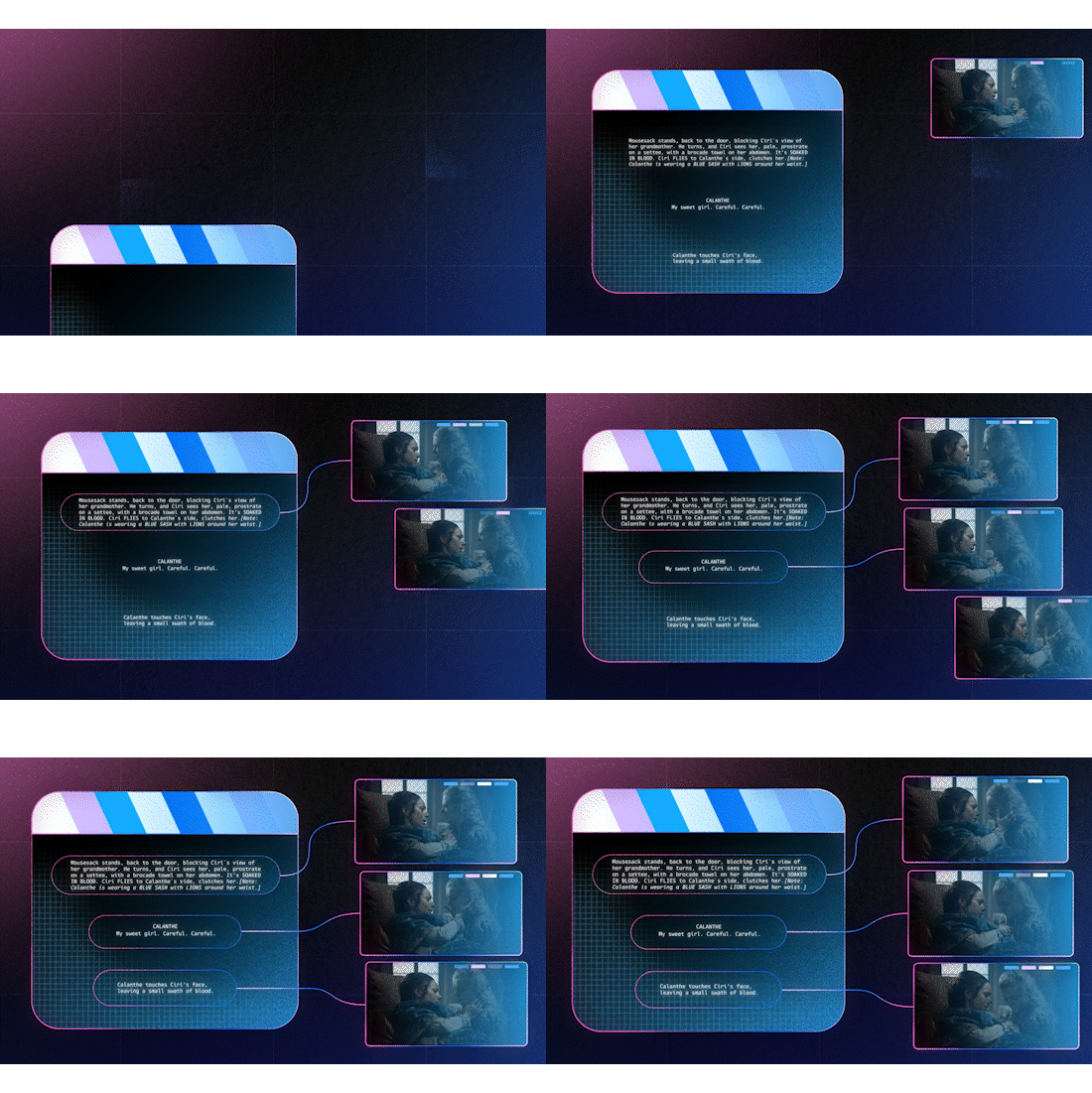
Netflix’s core mission is to connect millions of members around the world with stories they’ll love. This requires not just an incredible catalog, but also a deep, machine-level understanding of every piece of content in that catalog, from the biggest blockbusters to the most niche documentaries. As we onboard new types of content such as live events and podcasts, the need to scalably understand these nuances becomes even more critical to our productions and member-facing experiences.

Many of these media-related tasks require sophisticated long-form video understanding e.g., identifying subtle narrative dependencies and emotional arcs that span entire episodes or films. Previous work has found that to truly grasp the content’s essence, our models must leverage the full multimodal signal. For example, the audio soundtrack is a crucial, non-visual modality that can help more precisely identify clip-level tones or when a new scene starts. Can we use our collection of shows and movies to learn how to a) fuse modalities like audio, video, and subtitle text together and b) develop robust representations that leverage the narrative structure that is present in long form entertainment? Consisting of tens of millions of individual shots across multiple titles, our diverse yet entertainment-specific dataset provides the perfect foundation to train multimodal media understanding models that enable many capabilities across the company such as ads relevancy, clip popularity prediction, and clip tagging.

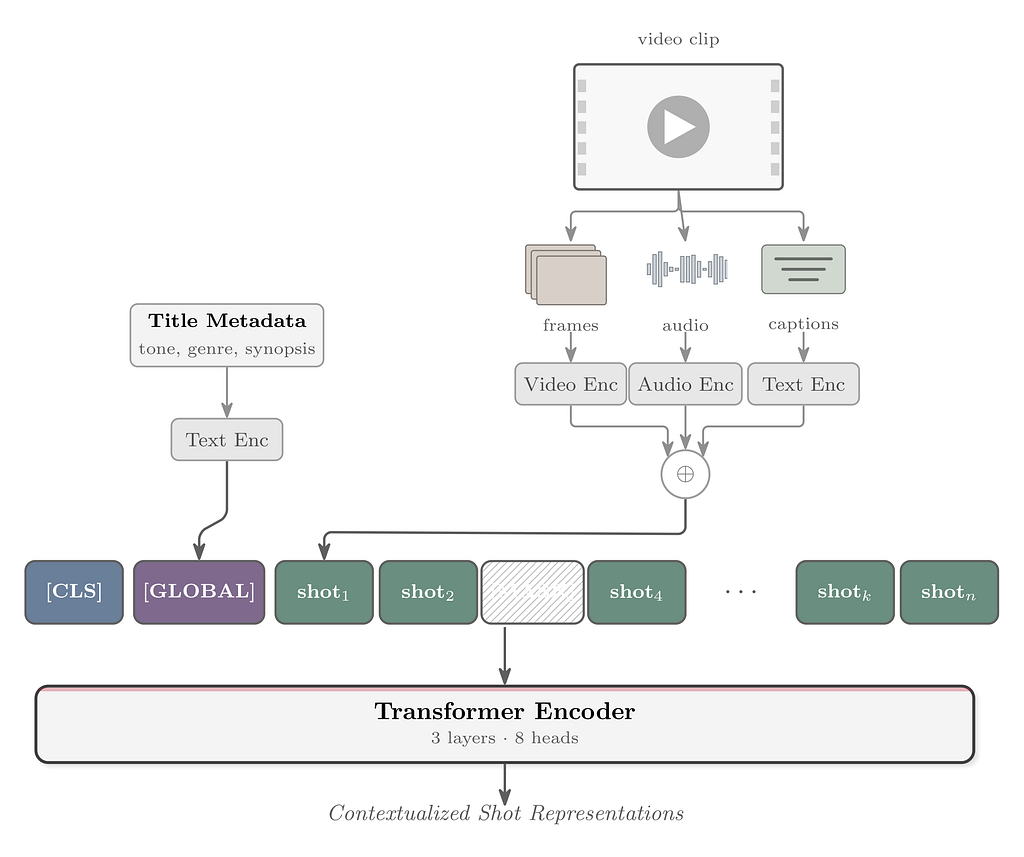
For these reasons, we developed the Netflix Media Foundational Model (MediaFM), our new, in-house, multimodal content embedding model. MediaFM is the first tri-modal (audio, video, text) model pretrained on portions of the Netflix catalog. Its core is a multimodal, Transformer-based encoder designed to generate rich, contextual embeddings¹ for shots from our catalog by learning the temporal relationships between them through integrating visual, audio, and textual information. The resulting shot-level embeddings are powerful representations designed to create a deeper, more nuanced, and machine-readable understanding of our content, providing the critical backbone for effective cold start of newly launching titles in recommendations, optimized promotional assets (like art and trailers), and internal content analysis tools.

Figure 1: MediaFM Architecture

Input Representation & Preprocessing

The model’s fundamental unit of input is a shot, derived by segmenting a movie or episode (collectively referred to as “title”) using a shot boundary detection algorithm. For each shot, we generate three distinct embeddings from its core modalities:

  • Video: an internal model called SeqCLIP (a CLIP-style model fine-tuned on video retrieval datasets) is used to embed frames sampled at uniform intervals from segmented shots
  • Audio: the audio samples from the same shots are embedded using Meta FAIR’s wav2vec2
  • Timed Text: OpenAI’s text-embedding-3-large model is used to encode the corresponding timed text (e.g., closed captions, audio descriptions, or subtitles) for each shot

For each shot, the three embeddings² are concatenated and unit-normed to form a single 2304-dimensional fused embedding vector. The transformer encoder is trained on sequences of shots, so each example in our dataset is a temporally-ordered sequence of these fused embeddings from the same movie or episode (up to 512 shots per sequence). We also have access to title-level metadata which is used to provide global context for each sequence (via the [GLOBAL]token). The title-level embedding is computed by passing title-level metadata (such as synopses and tags) through the text-embedding-3-large model.

Model Architecture and Training Objective

The core of our model is a transformer encoder, architecturally similar to BERT. A sequence of preprocessed shot embeddings is passed through the following stages:

  1. Input Projection: The fused shot embeddings are first projected down to the model’s hidden dimension via a linear layer.
  2. Sequence Construction & Special Tokens: Before entering the Transformer, two special embeddings are prepended to the sequence:
    • a learnable [CLS] embedding is added at the very beginning.
    • the title-level embedding is projected to the model’s hidden dimension and inserted after the [CLS] token as the [GLOBAL] token, providing title-level context to every shot in the sequence and participating in the self-attention process.
  3. Contextualization: The sequence is enhanced with positional embeddings and fed through the Transformer stack to provide shot representations based on their surrounding context.
  4. Output Projection: The contextualized hidden states from the Transformer are passed through a final linear layer, projecting them from the hidden layers back up to the 2304-dimensional fused embedding space for prediction.

We train the model using a Masked Shot Modeling (MSM) objective. In this self-supervised task, we randomly mask 20% of the input shot embeddings in each sequence by replacing them with a learnable [MASK] embedding. The model’s objective is to predict the original, unmasked fused embedding for these masked positions. The model is optimized by minimizing the cosine distance between its predicted embedding and the ground-truth embedding for each masked shot.

We optimized the hidden parameters with Muon and the remaining parameters with AdamW. It’s worth noting that the switch to Muon resulted in noticeable improvements.

Evaluation

To evaluate the learned embeddings, we learn task-specific linear layers on top of frozen representations (i.e., linear probes). Most of the tasks are clip-level, i.e., each example is a short clip ranging from a few seconds to a minute which are often presented to our members while recommending a title to them. When embedding these clips, we find that “embedding in context”, namely extracting the embeddings from within a larger sequence (e.g., the episode containing the clip), naturally does much better than embedding only the shots from a clip.

Tasks

Our embeddings are foundational and we find that they bring value to applications across Netflix. Here are a few:

  • Ad Relevancy: A multilabel classification task to categorize Netflix clips for relevant ad placement, measured by Average Precision. In this task, these representations operate at the retrieval stage, where they help in identifying the candidate set and in turn are fed into the ad serving system for relevance optimization.
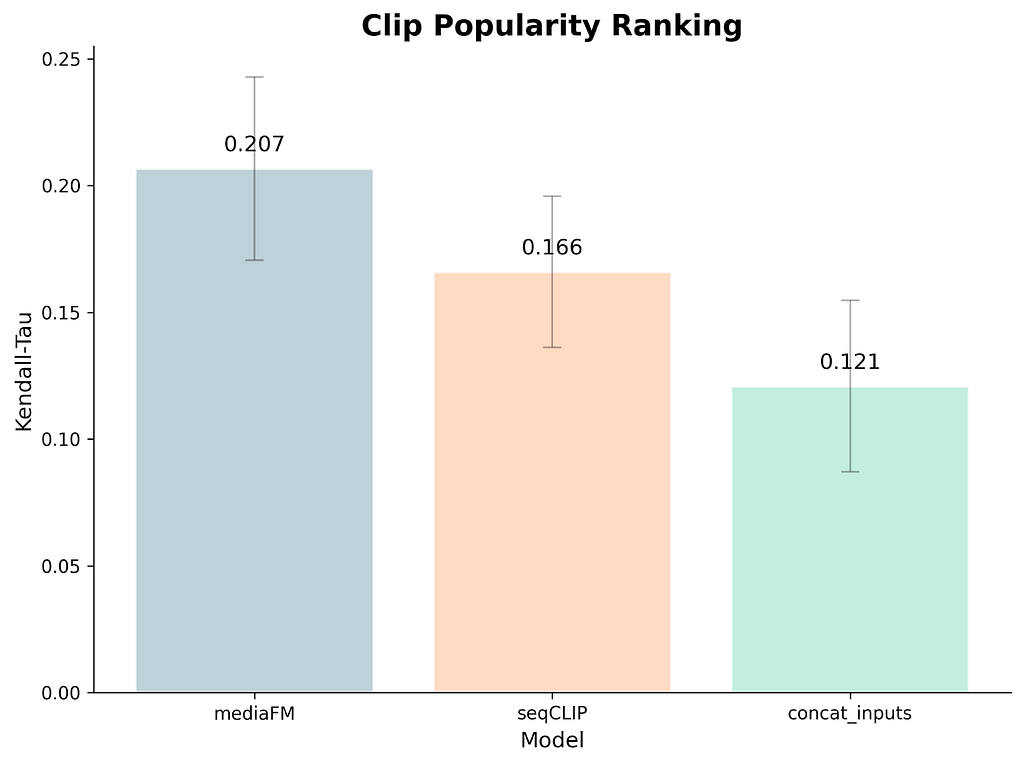
  • Clip Popularity Ranking: A ranking task to predict the relative performance (in click-through rate, CTR) of a media clip relative to other clips from that show or movie, measured by a ten-fold with Kendall’s tau correlation coefficient.
  • Clip Tone: A multi-label classification of hook clips into 100 tone categories (e.g., creepy, scary, humorous) from our internal Metadata & Ratings team, measured by micro Average Precision (averaged across tone categories).
  • Clip Genre: A multi-label classification of clips into eleven core genres (Action, Anime, Comedy, Documentary, Drama, Fantasy, Horror, Kids, Romance, Sci-fi, Thriller) derived from the genre of the parent title, measured by macro Average Precision (averaged across genres).
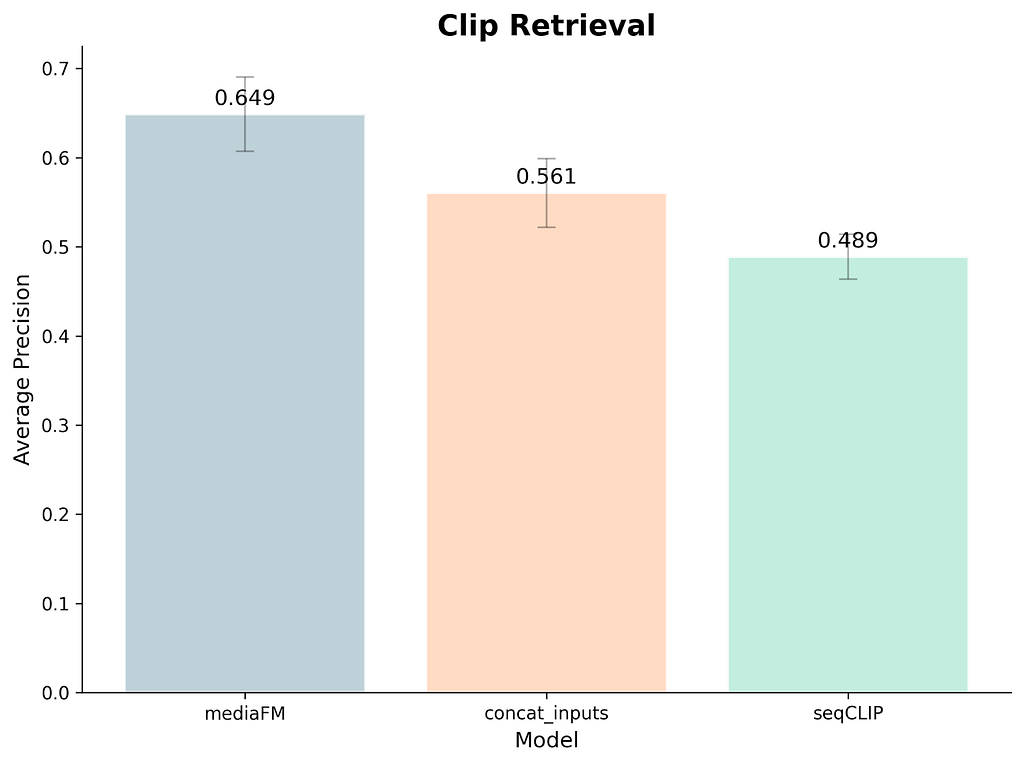
  • Clip Retrieval: a binary classification of clips from movies or episodes into “clip-worthy” (i.e., a good clip to showcase the title) or not, as determined by human annotators, and as measured by Average Precision. The positive to negative clip ratio is 1:3, and for each title we select 6–10 positive clips and the corresponding number of negatives.

It’s worth noting that for the tasks above (as well as other tasks that use our model), the model outputs are utilized as information that the relevant teams use when driving to a decision rather than being used in a completely end-to-end fashion. Many of the improvements are also in various stages of deployment.

Results

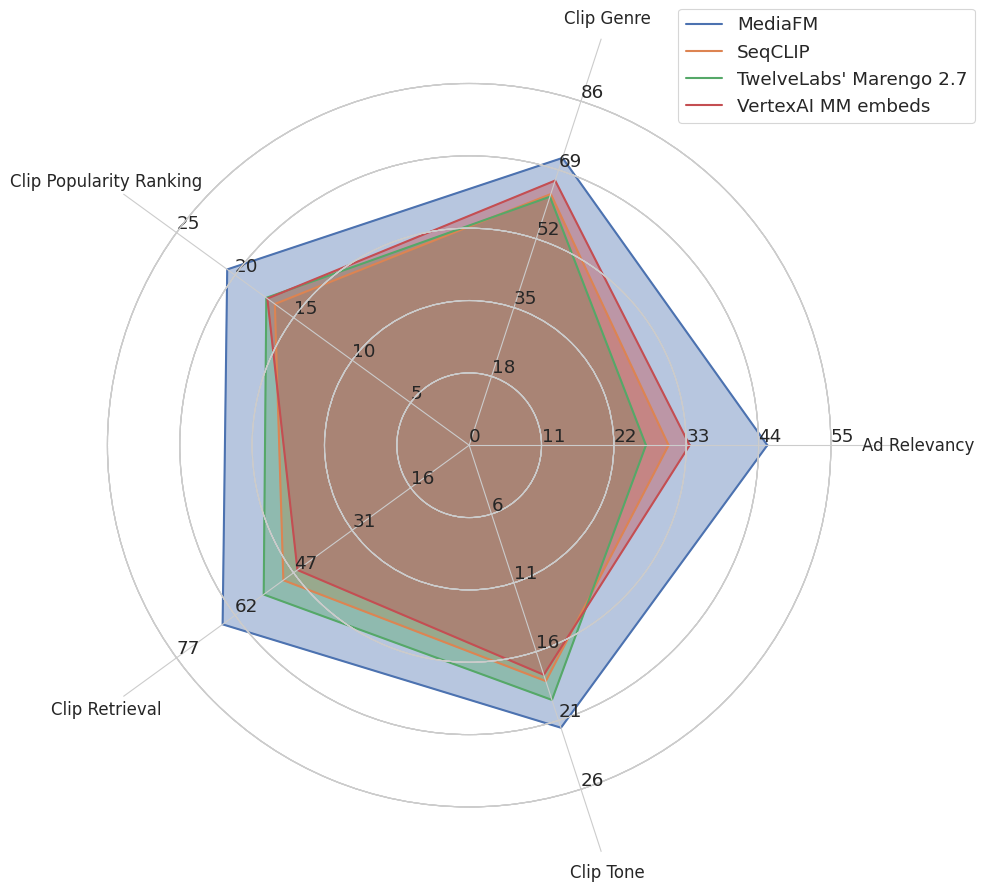
Figure 2³ compares MediaFM to several strong baselines:

Figure 2: Performance of MediaFM vs. external and internal models.

On all tasks, MediaFM is better than the baselines. Improvements seem to be larger for tasks that require more detailed narrative understanding e.g., predicting the most relevant ads for an ad break given the surrounding context. We look further into this next.

Ablations

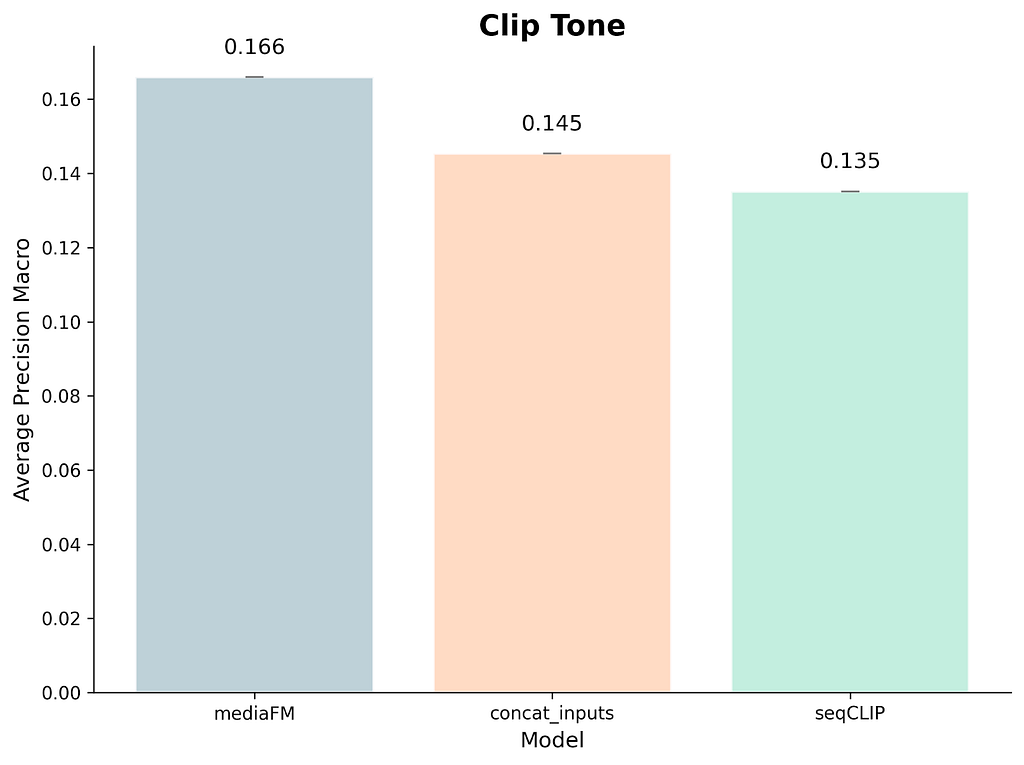
MediaFM’s primary improvements over previous Netflix work stem from two key areas: combining multiple modalities and learning to contextualize shot representations. To determine the contribution of each factor across different tasks, we compared MediaFM to a baseline. This baseline concatenates the three input embeddings, essentially providing the same complete, shot-level input as MediaFM but without the contextualization step. This comparison allows us to isolate which tasks benefit most from the contextualization aspect.

Additional modalities help somewhat for tone but the main improvement comes from contextualization.

Oddly, multiple uncontextualized modalities hurts the clip popularity ranking model, but adding contextualization significantly improves performance.

For clip retrieval we see a natural progression of around 15% for each improvement.

Next Steps

MediaFM presents a way to learn how to fuse and/or contextualize shot-level information by leveraging Netflix’s catalog in a self-supervised manner. With this perspective, we are actively investigating how pretrained multimodal (audio, video/image, text) LLMs like Qwen3-Omni, where the modality fusion has already been learned, can provide an even stronger starting point for subsequent model generations.

Next in this series of blog posts, we will present our method to embed title-level metadata and adapt it to our needs. Stay tuned!

Footnotes

  1. We chose embeddings over generative text outputs to prioritize modular design. This provides a tighter, cleaner abstraction layer: we generate the representation once, and it is consumed across our entire suite of services. This avoids the architectural fragility of fine-tuning, allowing us to enhance our existing embedding-based workflows with new modalities more flexibly.
  2. All of our data has audio and video; we zero-pad for missing timed text data, which is relatively likely to occur (e.g., in shots without dialogue).
  3. The title-level tasks couldn’t be evaluated with the VertexAI MM and Marengo embedding models as the videos exceed the length limit set by the APIs.


MediaFM: The Multimodal AI Foundation for Media Understanding at Netflix was originally published in Netflix TechBlog on Medium, where people are continuing the conversation by highlighting and responding to this story.
Detecting Scene Changes in Audiovisual Content

Post Syndicated from Netflix Technology Blog original https://netflixtechblog.com/detecting-scene-changes-in-audiovisual-content-77a61d3eaad6

Avneesh Saluja, Andy Yao, Hossein Taghavi

Introduction

When watching a movie or an episode of a TV show, we experience a cohesive narrative that unfolds before us, often without giving much thought to the underlying structure that makes it all possible. However, movies and episodes are not atomic units, but rather composed of smaller elements such as frames, shots, scenes, sequences, and acts. Understanding these elements and how they relate to each other is crucial for tasks such as video summarization and highlights detection, content-based video retrieval, dubbing quality assessment, and video editing. At Netflix, such workflows are performed hundreds of times a day by many teams around the world, so investing in algorithmically-assisted tooling around content understanding can reap outsized rewards.

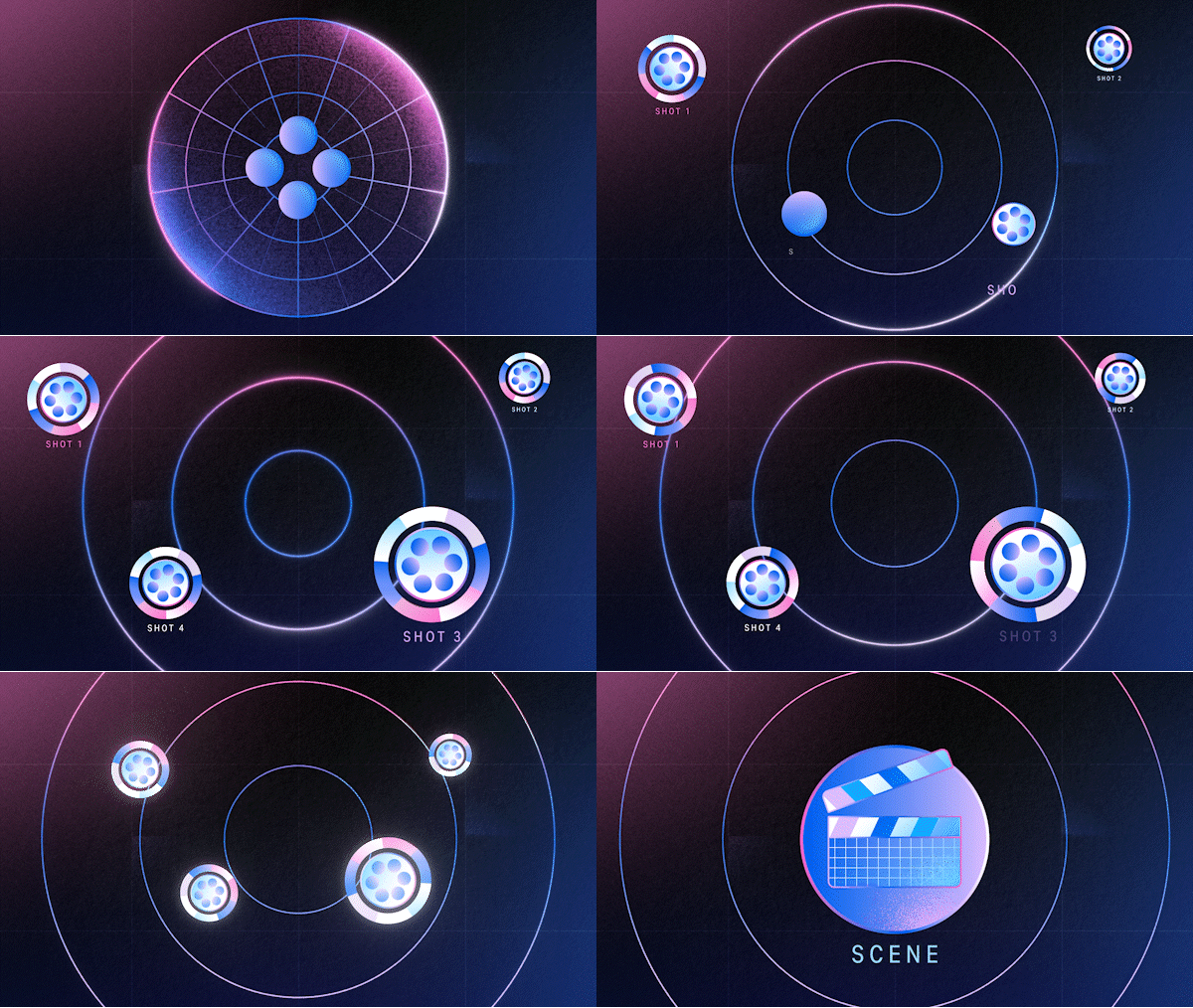
While segmentation of more granular units like frames and shot boundaries is either trivial or can primarily rely on pixel-based information, higher order segmentation¹ requires a more nuanced understanding of the content, such as the narrative or emotional arcs. Furthermore, some cues can be better inferred from modalities other than the video, e.g. the screenplay or the audio and dialogue track. Scene boundary detection, in particular, is the task of identifying the transitions between scenes, where a scene is defined as a continuous sequence of shots that take place in the same time and location (often with a relatively static set of characters) and share a common action or theme.

In this blog post, we present two complementary approaches to scene boundary detection in audiovisual content. The first method, which can be seen as a form of weak supervision, leverages auxiliary data in the form of a screenplay by aligning screenplay text with timed text (closed captions, audio descriptions) and assigning timestamps to the screenplay’s scene headers (a.k.a. sluglines). In the second approach, we show that a relatively simple, supervised sequential model (bidirectional LSTM or GRU) that uses rich, pretrained shot-level embeddings can outperform the current state-of-the-art baselines on our internal benchmarks.

Figure 1: a scene consists of a sequence of shots.

Leveraging Aligned Screenplay Information

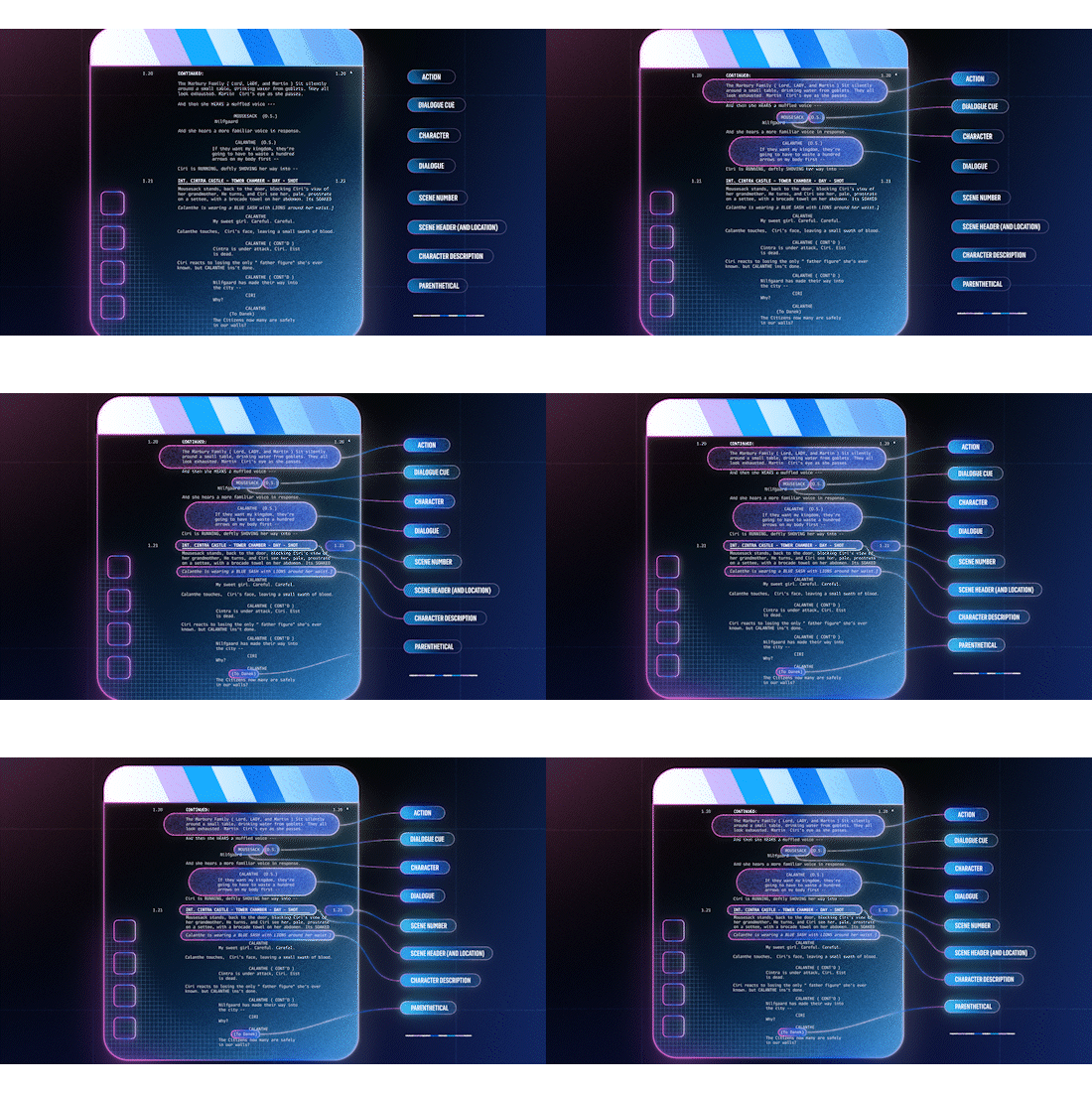
Screenplays are the blueprints of a movie or show. They are formatted in a specific way, with each scene beginning with a scene header, indicating attributes such as the location and time of day. This consistent formatting makes it possible to parse screenplays into a structured format. At the same time, a) changes made on the fly (directorial or actor discretion) or b) in post production and editing are rarely reflected in the screenplay, i.e. it isn’t rewritten to reflect the changes.

Figure 2: screenplay elements, from The Witcher S1E1.

In order to leverage this noisily aligned data source, we need to align time-stamped text (e.g. closed captions and audio descriptions) with screenplay text (dialogue and action² lines), bearing in mind a) the on-the-fly changes that might result in semantically similar but not identical line pairs and b) the possible post-shoot changes that are more significant (reordering, removing, or inserting entire scenes). To address the first challenge, we use pre trained sentence-level embeddings, e.g. from an embedding model optimized for paraphrase identification, to represent text in both sources. For the second challenge, we use dynamic time warping (DTW), a method for measuring the similarity between two sequences that may vary in time or speed. While DTW assumes a monotonicity condition on the alignments³ which is frequently violated in practice, it is robust enough to recover from local misalignments and the vast majority of salient events (like scene boundaries) are well-aligned.

As a result of DTW, the scene headers have timestamps that can indicate possible scene boundaries in the video. The alignments can also be used to e.g., augment audiovisual ML models with screenplay information like scene-level embeddings, or transfer labels assigned to audiovisual content to train screenplay prediction models.

Figure 3: alignments between screenplay and video via time stamped text for The Witcher S1E1.

A Multimodal Sequential Model

The alignment method above is a great way to get up and running with the scene change task since it combines easy-to-use pretrained embeddings with a well-known dynamic programming technique. However, it presupposes the availability of high-quality screenplays. A complementary approach (which in fact, can use the above alignments as a feature) that we present next is to train a sequence model on annotated scene change data. Certain workflows in Netflix capture this information, and that is our primary data source; publicly-released datasets are also available.

From an architectural perspective, the model is relatively simple — a bidirectional GRU (biGRU) that ingests shot representations at each step and predicts if a shot is at the end of a scene.⁴ The richness in the model comes from these pretrained, multimodal shot embeddings, a preferable design choice in our setting given the difficulty in obtaining labeled scene change data and the relatively larger scale at which we can pretrain various embedding models for shots.

For video embeddings, we leverage an in-house model pretrained on aligned video clips paired with text (the aforementioned “timestamped text”). For audio embeddings, we first perform source separation to try and separate foreground (speech) from background (music, sound effects, noise), embed each separated waveform separately using wav2vec2, and then concatenate the results. Both early and late-stage fusion approaches are explored; in the former (Figure 4a), the audio and video embeddings are concatenated and fed into a single biGRU, and in the latter (Figure 4b) each input modality is encoded with its own biGRU, after which the hidden states are concatenated prior to the output layer.

Figure 4a: Early Fusion (concatenate embeddings at the input).
Figure 4b: Late Fusion (concatenate prior to prediction output).

We find:

  • Our results match and sometimes even outperform the state-of-the-art (benchmarked using the video modality only and on our evaluation data). We evaluate the outputs using F-1 score for the positive label, and also relax this evaluation to consider “off-by-n” F-1 i.e., if the model predicts scene changes within n shots of the ground truth. This is a more realistic measure for our use cases due to the human-in-the-loop setting that these models are deployed in.
  • As with previous work, adding audio features improves results by 10–15%. A primary driver of variation in performance is late vs. early fusion.
  • Late fusion is consistently 3–7% better than early fusion. Intuitively, this result makes sense — the temporal dependencies between shots is likely modality-specific and should be encoded separately.

Conclusion

We have presented two complementary approaches to scene boundary detection that leverage a variety of available modalities — screenplay, audio, and video. Logically, the next steps are to a) combine these approaches and use screenplay features in a unified model and b) generalize the outputs across multiple shot-level inference tasks, e.g. shot type classification and memorable moments identification, as we hypothesize that this path would be useful for training general purpose video understanding models of longer-form content. Longer-form content also contains more complex narrative structure, and we envision this work as the first in a series of projects that aim to better integrate narrative understanding in our multimodal machine learning models.

Special thanks to Amir Ziai, Anna Pulido, and Angie Pollema.

Footnotes

  1. Sometimes referred to as boundary detection to avoid confusion with image segmentation techniques.
  2. Descriptive (non-dialogue) lines that describe the salient aspects of a scene.
  3. For two sources X and Y, if a) shot a in source X is aligned to shot b in source Y, b) shot c in source X is aligned to shot d in source Y, and c) shot c comes after shot a in X, then d) shot d has to come after shot b in Y.
  4. We experiment with adding a Conditional Random Field (CRF) layer on top to enforce some notion of global consistency, but found it did not improve the results noticeably.


Detecting Scene Changes in Audiovisual Content was originally published in Netflix TechBlog on Medium, where people are continuing the conversation by highlighting and responding to this story.