Tag Archives: students

How Ada Computer Science empowers students: Survey findings

Post Syndicated from Dan Fisher original https://www.raspberrypi.org/blog/how-ada-computer-science-empowers-students-survey-findings/

Listening to the voices of young people is crucial in creating genuinely effective learning resources. That’s why we recently ran a survey of students who use Ada Computer Science, our platform designed to help students learn and revise key computer science concepts.

“The different topics are nicely categorised and it is easy to find the information I wish to revise.” – Ada Computer Science student

We were delighted to hear from 103 students, most of whom are 16–19 years old and studying in England, and their insights are invaluable in helping us to continue to develop Ada CS.

Students think Ada CS is high quality and useful

The most common ways students use Ada CS are for revision and to check whether they understand concepts. The majority of respondents are building Ada CS into their regular study habits, with over half of respondents using the platform every week.
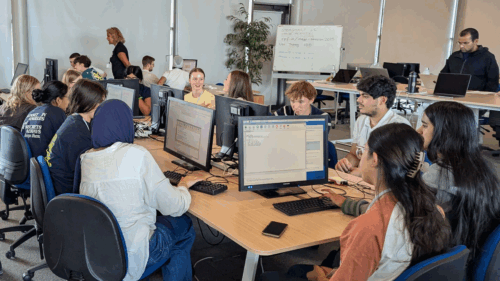
Photo of a class of students at computers, in a computer science classroom.

We were pleased to see the benefits of updates we’ve made, including a redesign of the question finder released in March 2025 — students reported that it is easy to navigate the platform and find what they need: 81% reported being able to find relevant content, and 77% could find the questions they were looking for.

“It’s SO EASY to find exactly what I want.” – Ada Computer Science student

Overall, students perceive Ada CS as both useful for learning about computer science concepts and of high quality. They reported finding the content clear, with a good level of detail.

“The topics are broken down into easily digestible sections, and the provided diagrams really help with understanding the topics.”  – Ada Computer Science student

“The resource is really well designed, short and concise.”  – Ada Computer Science student

We also received helpful suggestions for future improvements. Students shared feedback on how the information on the platform is presented, asking for more concise, revision-friendly content as well as guidance for exploring concepts in more depth. We’ll therefore be looking into alternative ways to structure content as we continue to develop Ada CS. 
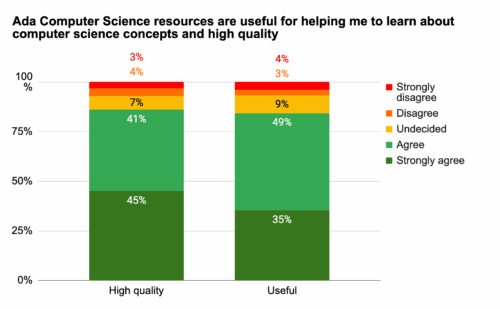
Graph depicting how strongly students felt that Ada Computer Science helps them to learn about computer science concepts.

Students rate the quizzes highly

The most popular feature is the quizzes and practice questions, including the immediate feedback and hints provided. Students value how these resources help them solidify their knowledge, learn from mistakes, and prepare for assessments. 

“The questions are clear and make me think, they’re relevant to my studies and the hints for the questions are very useful.” – Ada Computer Science student

We also appreciated the suggestions we received for how we can further develop this feature, for example, creating more questions, extending the range of question types per topic, and making improvements to the hints.

Impact on learning

Students also feel that using Ada CS has a tangible impact on their learning. 82% agreed they were more confident that they understand CS concepts as a result of using Ada CS and 79% feel more confident learning about computer science concepts without a teacher to explain.

“I do CS A level but I hadn’t done the GCSE and I found that all of the resources gave me enough information to learn the concepts from scratch and now I’m much more confident in my knowledge of the theory.” – Ada Computer Science student
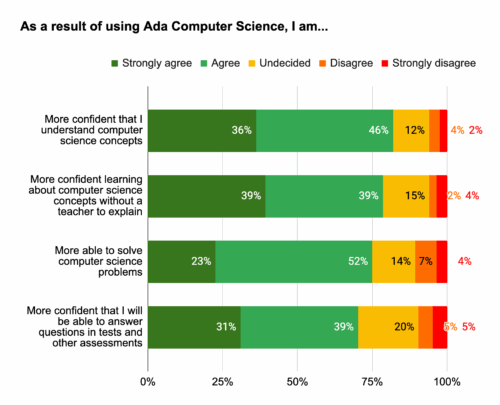
Graph depicting how students feel using Ada CS has on their learning.

What’s coming next?

Students provided us with lots of useful feedback and suggestions for how we can further improve Ada CS, especially relating to practice questions. We’re already working on adding more questions across topics, creating more challenging questions, and adding more question types that will enhance students’ learning experience. We’ve got some other exciting developments in the pipeline too, which we’ll announce soon!

Thank you to everyone who took the time to complete the survey. These findings are invaluable for shaping the future of Ada Computer Science, helping us to continue to provide the best possible learning platform for students.

The post How Ada Computer Science empowers students: Survey findings appeared first on Raspberry Pi Foundation.

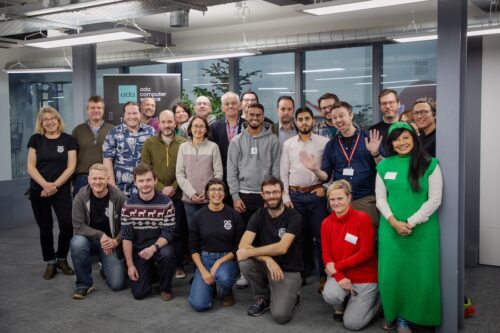
Ada Computer Science: A year in review

Post Syndicated from Dan Fisher original https://www.raspberrypi.org/blog/ada-computer-science-a-year-in-review/

With the new academic year fully under way in many parts of the world, it’s the perfect time to reflect on the growth and innovations we’ve achieved with the Ada Computer Science platform. Your feedback has helped us make improvements to better support teachers and students — here’s a look back at some of the key developments for Ada from the past 12 months.

Teachers in discussion at a table.
Teachers in discussion at a Raspberry Pi Foundation teacher training event.

Supporting students through personalised learning, new resources, and new questions

We made significant improvements throughout the year to support students with exam preparation and personalised learning. We introduced over 145 new self-marking questions and updated 50 existing ones, bringing the total to more than 1000. A new type of question was also launched to help students practise writing longer responses: they label parts of a sample answer and apply a mark scheme, simulating a peer review process. You can read more about this work in the AI section below.

We updated the question finder tool with an intuitive new design. Instead of seeing ten questions at random, students can now see all the questions we have on any given topic, and can use the filters to refine their searches by qualification and difficulty level. This enables students to better personalise their revision and progress tracking

“Ada Computer Science has been very effective for my revision. I like how it provides hints and pointers if you answer a question incorrectly.” 

– Ada Computer Science student

The ‘Representation of sound’ topic received a major update, with clearer explanations, new diagrams, and improved feedback to support students as they tackle common misconceptions in sound physics. We also refreshed the ‘Representation of numbers’ topic, adding new content and interactive quizzes to support teachers in assessing students’ understanding more effectively. 

We introduced a new database scenario titled ‘Repair & Reform’, offering an entity relationship diagram, a data dictionary, and a new SQL editor and question set to help students prepare for project-based assessments. We’ve further expanded this scenario into a full project covering all stages of development, including requirements analysis and evaluation. 

April was dedicated to gearing up for the exam season, with the introduction of revision flashcards and ready-made quizzes on key topics like bitmapped graphics and sorting algorithms. We also launched a student revision challenge, which ran from April to June and attracted over 600 participants.

“Ada Computer Science is an excellent resource to help support teachers and students. The explanations are clear and relevant, and the questions help students test their knowledge and understanding in a structured way, providing links to help them reconcile any discrepancies or misunderstandings.” 

– Patrick Kennedy, Computer Science teacher

Supporting teachers  

We expanded our efforts to support new computer science teachers with the launch of a teacher mentoring programme that offers free online drop-in sessions. We also hosted a teacher training event at the Raspberry Pi Foundation office in Cambridge (as seen in the picture below), where educators saw previews of upcoming content on AI and machine learning and contributed their own questions to the platform.

Group photo featuring computer science teachers and colleagues from the Raspberry PI Foundation.

AI content and AI features

We continued our focus on AI and machine learning, releasing new learning resources that explore the ethical and social implications of AI alongside the practical applications of AI and machine learning models. 

To expand the Ada platform’s features, we also made considerable progress in integrating a large language model (LLM) to mark free-text responses. Our research showed that, as of June, LLM marks matched real teachers’ marks 82% of the time. In July, we received ethics approval from the University of Cambridge to add LLM-marked questions to the Ada platform. 

Computer science education in Scotland

We made significant strides towards supporting Scottish teachers and students with resources tailored to the SQA Computing Science curriculum. From September to November last year, we piloted a new set of materials specifically designed for Scottish teachers, receiving valuable feedback that we’ve used in 2024 to develop new content. More than half of the theory content for the National 5 and Higher specifications is now available on the platform. 

Teacher, in the middle of a computing lesson.

Our ‘Reform & Repair’ database scenario and project align with both SQA Higher and A level standards, providing a comprehensive resource for students preparing for project-based assessments.

Looking ahead: New resources for September and beyond

We have big plans for Ada for the next 12 months. Our focus will remain on continuously improving our resources and supporting the needs of both educators and students. 

After the positive response to our ‘Repair & Reform’ database project, our content experts are planning additional practical projects to support students and teachers. The next one will be a web project that covers HTML, CSS, JavaScript, and PHP, supporting students taking SQA qualifications in Scotland or undertaking the non-examined assessment (NEA) at A level.

We’ll be working on a number of teacher-focused improvements to the platform, which you’ll also see on Ada’s sibling site, Isaac Physics. These will include an overhaul of the markbook to make it more user-friendly, and updates to the ‘Assignments’ tool so assignments better meet the needs of teachers in schools.

We’ll be welcoming the next cohort of computer science students to the STEM SMART programme in January 2025 where, in partnership with the University of Cambridge, we’ll offer free, complementary teaching and support to UK students at state schools. Applications are now open.

Thank you to every teacher and student who has given their time in the last year to share feedback about Ada Computer Science — your insights are invaluable as we work to make high-quality computer science materials easily accessible. Here’s to another fantastic year of learning and growth!

The post Ada Computer Science: A year in review appeared first on Raspberry Pi Foundation.