A TURN server helps maintain connections during video calls when local networking conditions prevent participants from connecting directly to other participants. It acts as an intermediary, passing data between users when their networks block direct communication. TURN servers ensure that peer-to-peer calls go smoothly, even in less-than-ideal network conditions.
When building their own TURN infrastructure, developers often have to answer a few critical questions:
“How do we build and maintain a mesh network that achieves near-zero latency to all our users?”
“Where should we spin up our servers?”
“Can we auto-scale reliably to be cost-efficient without hurting performance?”
In April, we launched Cloudflare Calls TURN in open beta to help answer these questions. Starting today, Cloudflare Calls’ TURN service is now generally available to all Cloudflare accounts. Our TURN server works on our anycast network, which helps deliver global coverage and near-zero latency required by real time applications.
TURN solves connectivity and privacy problems for real time apps
When Internet Protocol version 4 (IPv4, RFC 791) was designed back in 1981, it was assumed that the 32-bit address space was big enough for all computers to be able to connect to each other. When IPv4 was created, billions of people didn’t have smartphones in their pockets and the idea of the Internet of Things didn’t exist yet. It didn’t take long for companies, ISPs, and even entire countries to realize they didn’t have enough IPv4 address space to meet their needs.
NATs are unpredictable
Fortunately, you can have multiple devices share the same IP address because the most common protocols run on top of IP are TCP and UDP, both of which support up to 65,535 port numbers. (Think of port numbers on an IP address as extensions behind a single phone number.) To solve this problem of IP scarcity, network engineers developed a way to share a single IP address across multiple devices by exploiting the port numbers. This is called Network Address Translation (NAT) and it is a process through which your router knows which packets to send to your smartphone versus your laptop or other devices, all of which are connecting to the public Internet through the IP address assigned to the router.
In a typical NAT setup, when a device sends a packet to the Internet, the NAT assigns a random, unused port to track it, keeping a forwarding table to map the device to the port. This allows NAT to direct responses back to the correct device, even if the source IP address and port vary across different destinations. The system works as long as the internal device initiates the connection and waits for the response.
However, real-time apps like video or audio calls are more challenging with NAT. Since NATs don’t reveal how they assign ports, devices can’t pre-communicate where to send responses, making it difficult to establish reliable connections. Earlier solutions like STUN (RFC 3489) couldn’t fully solve this, which gave rise to the TURN protocol.
TURN predictably relays traffic between devices while ensuring minimal delay, which is crucial for real-time communication where even a second of lag can disrupt the experience.
ICE to determine if a relay server is needed
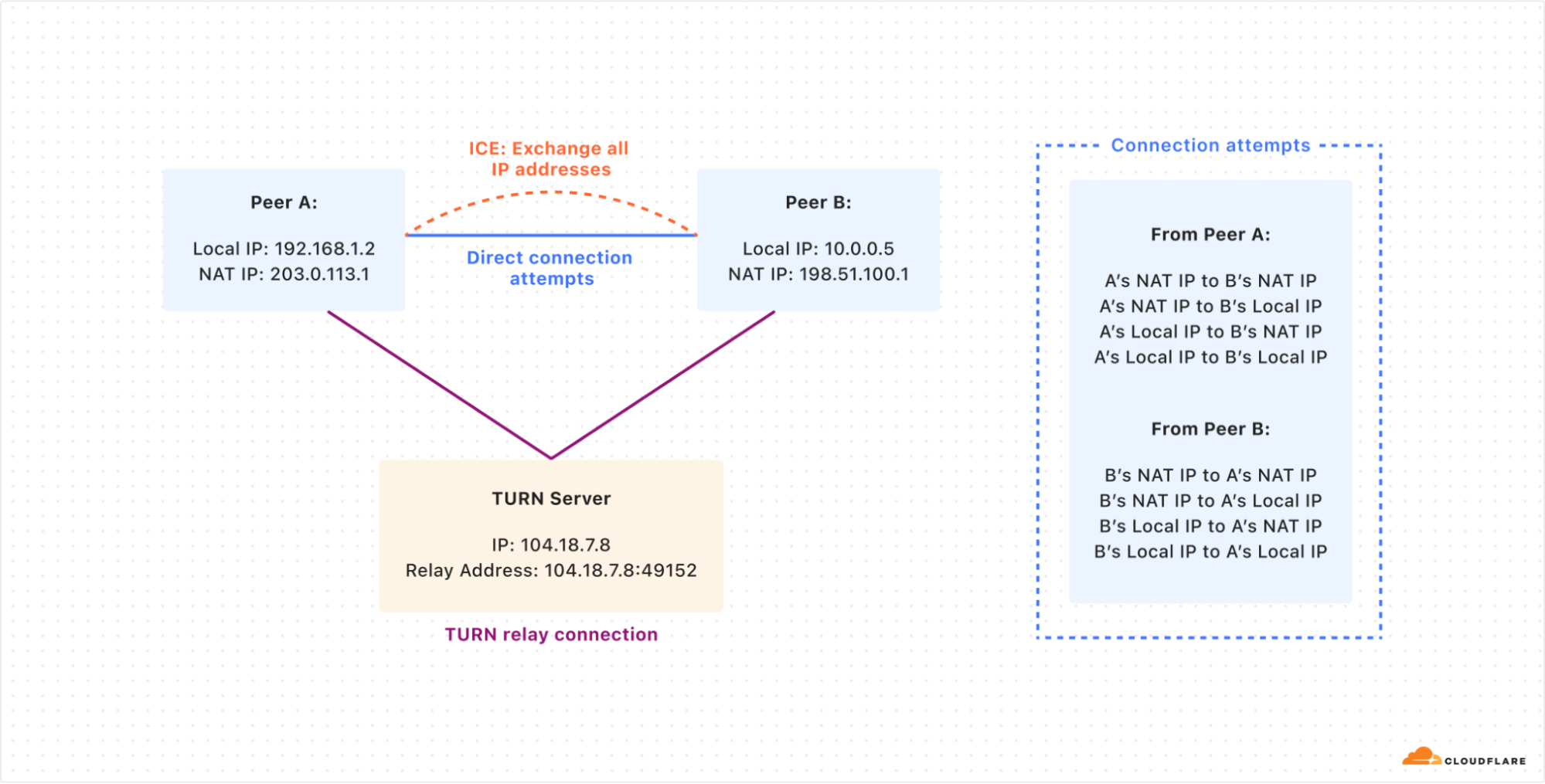
The ICE (Interactive Connectivity Establishment) protocol was designed to find the fastest communication path between devices. It works by testing multiple routes and choosing the one with the least delay. ICE determines whether a TURN server is needed to relay the connection when a direct peer-to-peer path cannot be established or is not performant enough.
How two peers (A and B) try to connect directly by sharing their public and local IP addresses using the ICE protocol. If the direct connection fails, both peers use the TURN server to relay their connection and communicate with each other.
While ICE is designed to find the most efficient connection path between peers, it can inadvertently expose sensitive information, creating privacy concerns. During the ICE process, endpoints exchange a list of all possible network addresses, including local IP addresses, NAT IP addresses, and TURN server addresses. This comprehensive sharing of network details can reveal information about a user’s network topology, potentially exposing their approximate geographic location or details about their local network setup.
The “brute force” nature of ICE, where it attempts connections on all possible paths, can create distinctive network traffic patterns that sophisticated observers might use to infer the use of specific applications or communication protocols.
TURN solves privacy problems
The threat from exposing sensitive information while using real-time applications is especially important for people that use end-to-end encrypted messaging apps for sensitive information — for example, journalists who need to communicate with unknown sources without revealing their location.
With Cloudflare TURN in place, traffic is proxied through Cloudflare, preventing either party in the call from seeing client IP addresses or associated metadata. Cloudflare simply forwards the calls to their intended recipients, but never inspects the contents — the underlying call data is always end-to-end encrypted. This masking of network traffic is an added layer of privacy.
Cloudflare is a trusted third-party when it comes to operating these types of services: we have experience operating privacy-preserving proxies at scale for our Consumer WARP product, Apple’s Private Relay, and Microsoft Edge’s Secure Network, preserving end-user privacy without sacrificing performance.
Cloudflare’s TURN is the fastest because of Anycast
Lots of real time communication services run their own TURN servers on a commercial cloud provider because they don’t want to leave a certain percentage of their customers with non-working communication. This results in additional costs for DevOps, egress bandwidth, etc. And honestly, just deploying and running a TURN server, like CoTURN, in a VPS isn’t an interesting project for most engineers.
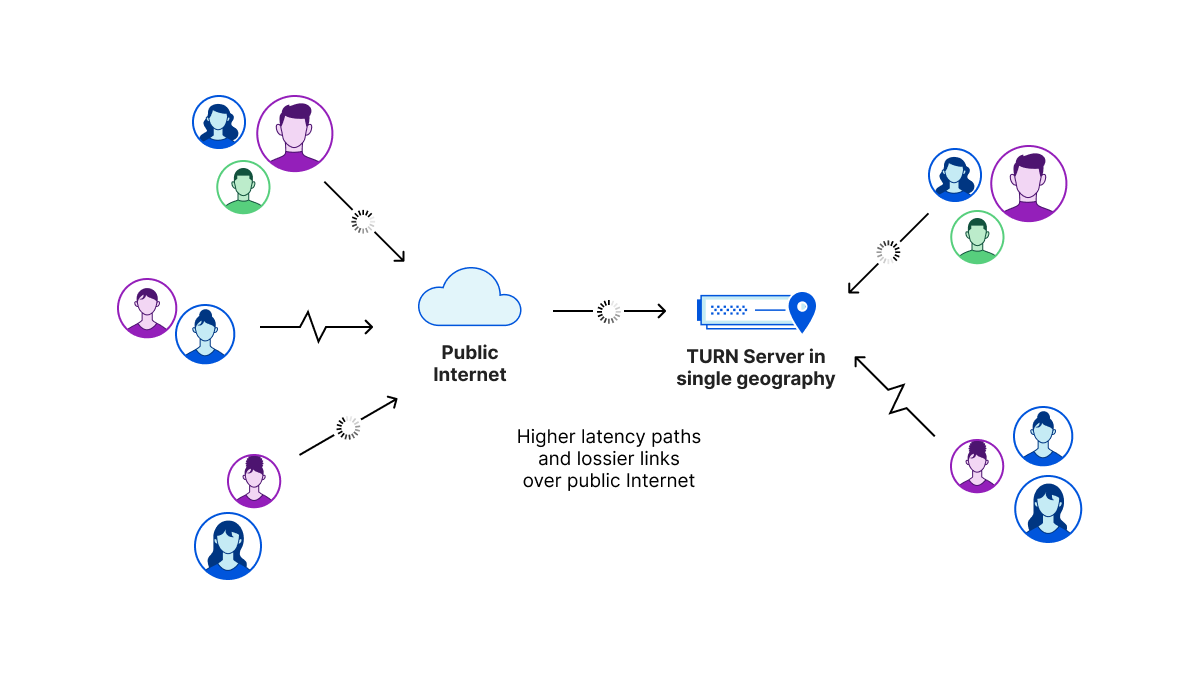
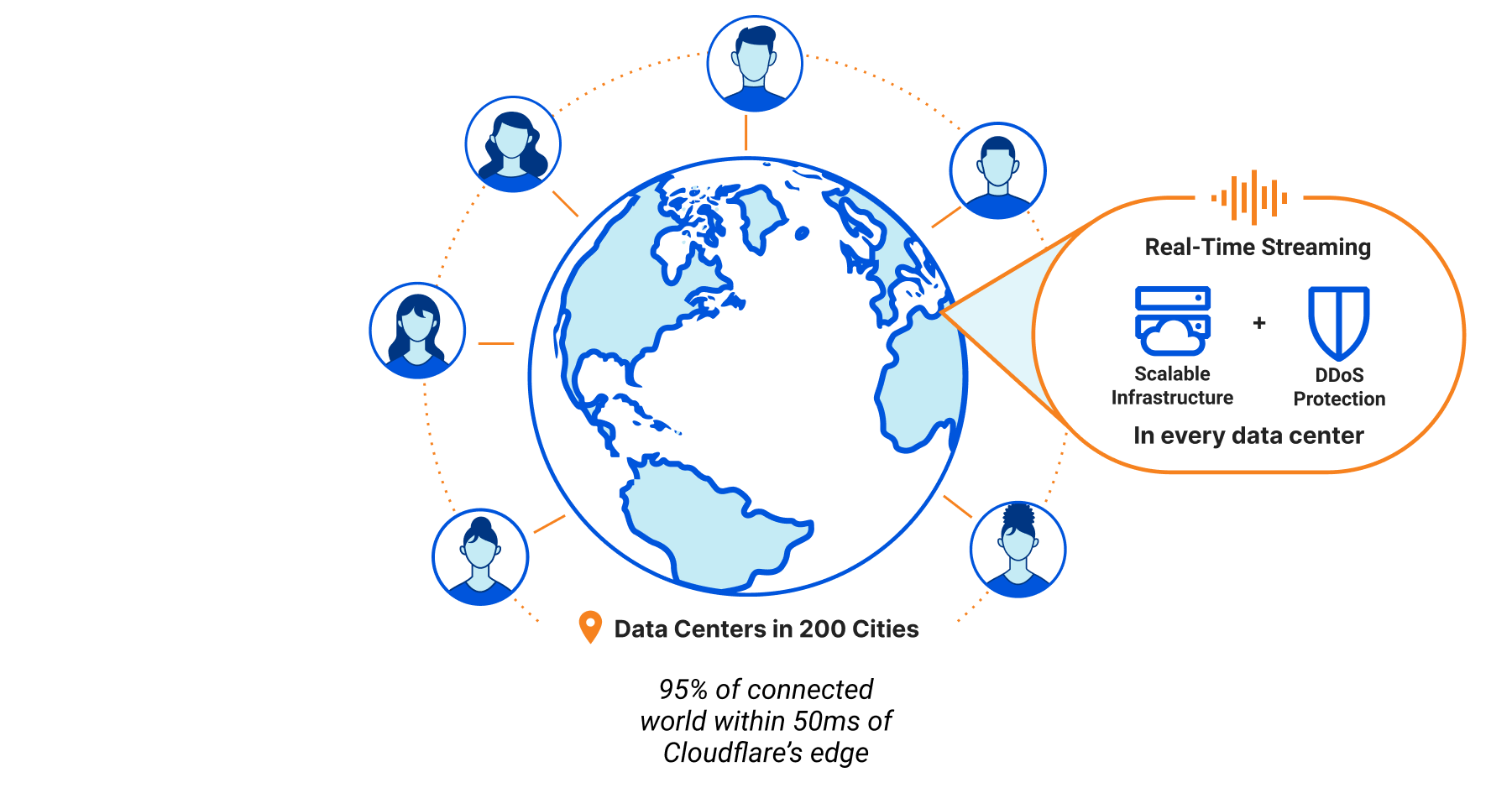
Because using a TURN relay adds extra delay for the packets to travel between the peers, the relays should be located as close as possible to the peers. Cloudflare’s TURN service avoids all these headaches by simply running in all of the 330 cities where Cloudflare has data centers. And any time Cloudflare adds another city, the TURN service automatically becomes available there as well.
Anycast is the perfect network topology for TURN
Anycast is a network addressing and routing methodology in which a single IP address is shared by multiple servers in different locations. When a client sends a request to an anycast address, the network automatically routes the request via BGP to the topologically nearest server. This is in contrast to unicast, where each destination has a unique IP address. Anycast allows multiple servers to have the same IP address, and enables clients to automatically connect to a server close to them. This is similar to emergency phone networks (911, 112, etc.) which connect you to the closest emergency communications center in your area.
Anycast allows for lower latency because of the sheer number of locations available around the world. Approximately 95% of the Internet-connected population globally is within approximately 50ms away from a Cloudflare location. For real-time communication applications that use TURN, leads to improved call quality and user experience.
Auto-scaling and inherently global
Running TURN over anycast allows for better scalability and global distribution. By naturally distributing load across multiple servers based on network topology, this setup helps balance traffic and improve performance. When you use Cloudflare’s TURN service, you don’t need to manage a list of servers for different parts of the world. And you don’t need to write custom scaling logic to scale VMs up or down based on your traffic.
Anycast allows TURN to use fewer IP addresses, making it easier to allowlist in restrictive networks. Stateless protocols like DNS over UDP work well with anycast. This includes stateless STUN binding requests used to determine a system’s external IP address behind a NAT.
However, stateful protocols over UDP, like QUIC or TURN, are more challenging with anycast. QUIC handles this better due to its stable connection ID, which load balancers can use to consistently route traffic. However, TURN/STUN lacks a similar connection ID. So when a TURN client sends requests to the Cloudflare TURN service, the Unimog load balancer ensures that all its requests get routed to the same server within a data center. The challenges for the communication between a client on the Internet and Cloudflare services listening on an anycast IP address have been described multiple times before.
How does Cloudflare’s TURN server receive packets?
TURN servers act as relay points to help connect clients. This process involves two types of connections: the client-server connection and the third-party connection (relayed address).
The client-server connection uses published IP and port information to communicate with TURN clients using anycast.
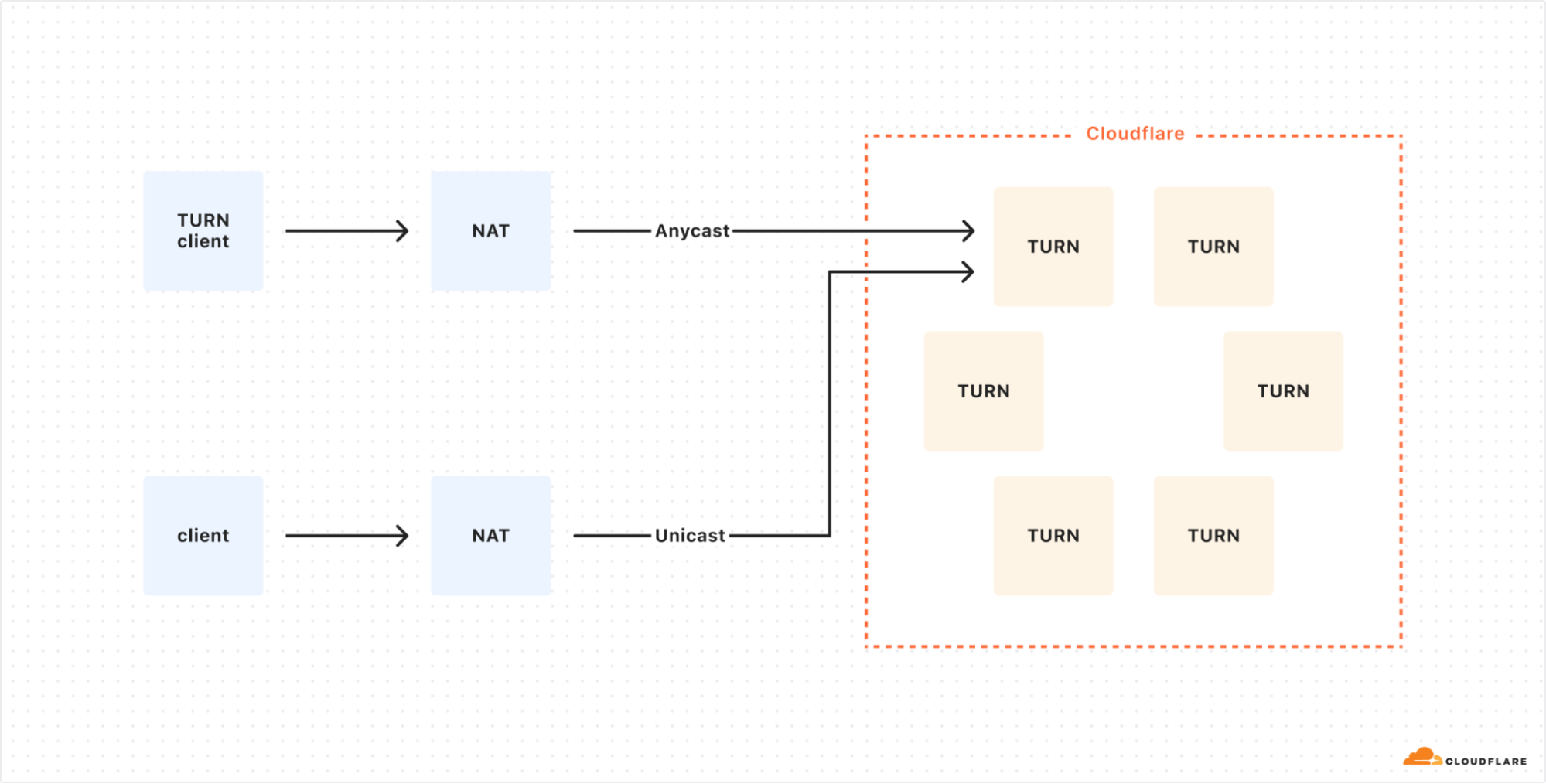
For the relayed address, using anycast poses a challenge. The TURN protocol requires that packets reach the specific Cloudflare server handling the client connection. If we used anycast for relay addresses, packets might not arrive at the correct data center or server.
One alternative is to use unicast addresses for relay candidates. However, this approach has drawbacks, including making servers vulnerable to attacks and requiring many IP addresses.
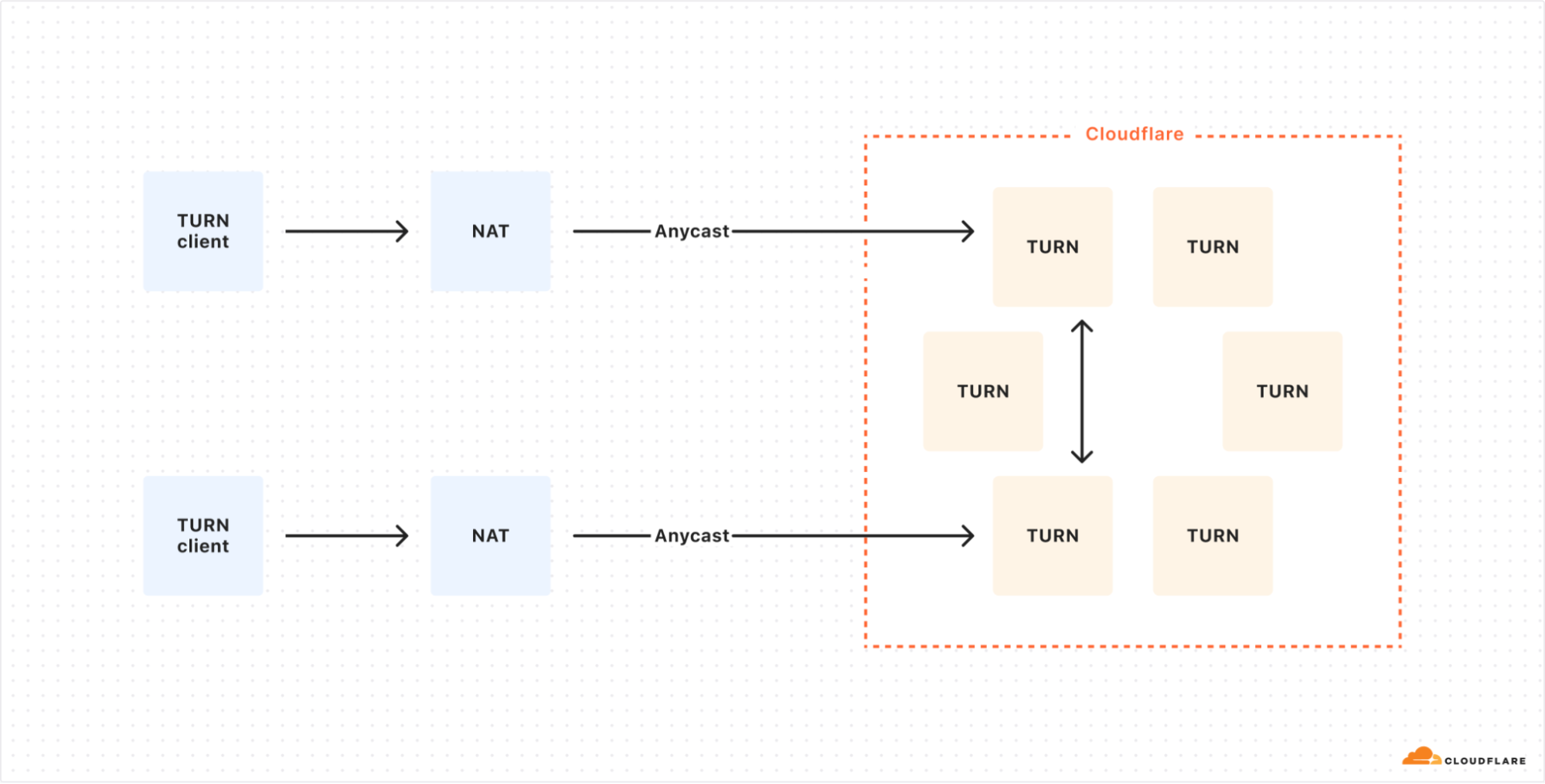
To solve these issues, we’ve developed a middle-ground solution, previously discussed in “Cloudflare servers don’t own IPs anymore – so how do they connect to the Internet?”. We use anycast addresses but add extra handling for packets that reach incorrect servers. If a packet arrives at the wrong Cloudflare location, we forward it over our backbone to the correct datacenter, rather than sending it back over the public Internet.
This approach not only resolves routing issues but also improves TURN connection speed. Packets meant for the relay address enter the Cloudflare network as close to the sender as possible, optimizing the routing process.
In this non-ideal setup, a TURN client connects to Cloudflare using Anycast, while a direct client uses Unicast, which would expose the TURN server to potential DDoS attacks.
The optimized setup uses Anycast for all TURN clients, allowing for dynamic load distribution across Cloudflare’s globally distributed TURN servers.
Try Cloudflare Calls TURN today
The new TURN feature of Cloudflare Calls addresses critical challenges in real-time communication:
Connectivity: By solving NAT traversal issues, TURN ensures reliable connections even in complex network environments.
Privacy: Acting as an intermediary, TURN enhances user privacy by masking IP addresses and network details.
Performance: Leveraging Cloudflare’s global anycast network, our TURN service offers unparalleled speed and near-zero latency.
Scalability: With presence in over 330 cities, Cloudflare Calls TURN grows with your needs.
Cloudflare Calls TURN service is billed on a usage basis. It is available to self-serve and Enterprise customers alike. There is no cost for the first 1,000 GB (one terabyte) of Cloudflare Calls usage each month. It costs five cents per GB after your first terabyte of usage on self-serve. Volume pricing is available for Enterprise customers through your account team.
Switching TURN providers is likely as simple as changing a single configuration in your real-time app. To get started with Cloudflare’s TURN service, create a TURN app from your Cloudflare Calls Dashboard or read the Developer Docs.
For every successful technology, there is a moment where its time comes. Something happens, usually external, to catalyze it — shifting it from being a good idea with promise, to a reality that we can’t imagine living without. Perhaps the best recent example was what happened to the cloud as a result of the introduction of the iPhone in 2007. Smartphones created a huge addressable market for small developers; and even big developers found their customer base could explode in a way that they couldn’t handle without access to public cloud infrastructure. Both wanted to be able to focus on building amazing applications, without having to worry about what lay underneath.
Last year, during the outbreak of COVID-19, a similar moment happened to real time communication. Being able to communicate is the lifeblood of any organization. Before 2020, much of it happened in meeting rooms in offices all around the world. But in March last year — that changed dramatically. Those meeting rooms suddenly were emptied. Fast-forward 18 months, and that massive shift in how we work has persisted.
While, undoubtedly, many organizations would not have been able to get by without the likes of Slack, Zoom and Teams as real time collaboration tools, we think today’s iteration of communication tools is just the tip of the iceberg. Looking around, it’s hard to escape the feeling there is going to be an explosion in innovation that is about to take place to enable organizations to communicate in a remote, or at least hybrid, world.
With this in mind, today we’re excited to be introducing Cloudflare’s Real Time Communications platform. This is a new suite of products designed to help you build the next generation of real-time, interactive applications. Whether it’s one-to-one video calling, group audio or video-conferencing, the demand for real-time communications only continues to grow.
Running a reliable and scalable real-time communications platform requires building out a large-scale network. You need to get your network edge within milliseconds of your users in multiple geographies to make sure everyone can always connect with low latency, low packet loss and low jitter. A backbone to route around Internet traffic jams. Infrastructure that can efficiently scale to serve thousands of participants at once. And then you need to deploy media servers, write business logic, manage multiple client platforms, and keep it all running smoothly. We think we can help with this.
Launching today, you will be able to leverage Cloudflare’s global edge network to improve connectivity for any existing WebRTC-based video and audio application, with what we’re calling “WebRTC Components”. This includes scaling to (tens of) thousands of participants, leveraging our DDoS mitigation to protect your services from attacks, and enforce IP and ASN-based access policies in just a few clicks.
How Real Time is “Real Time”?
Real-time typically refers to communication that happens in under 500ms: that is, as fast as packets can traverse the fibre optic networks that connect the world together. In 2021, most real-time audio and video applications use WebRTC, a set of open standards and browser APIs that define how to connect, secure, and transfer both media and data over UDP. It was designed to bring better, more flexible bi-directional communication when compared to the primary browser-based communication protocol we rely on today, HTTP. And because WebRTC is supported in the browser, it means that users don’t need custom clients, nor do developers need to build them: all they need is a browser.
Importantly, we’ve seen the need for reliable, real-time communication across time-zones and geographies increase dramatically, as organizations change the way they work (yes, including us).
So where is real-time important in practice?
One-to-one calls (think FaceTime). We’re used to almost instantaneous communication over traditional telephone lines, and there’s no reason for us to head backwards.
Group calling and conferencing (Zoom or Google Meet), where even just a few seconds of delay results in everyone talking over each other.
Social video, gaming and sports. You don’t want to be 10 seconds behind the action or miss that key moment in a game because the stream dropped a few frames or decided to buffer.
Interactive applications: from 3D modeling in the browser, Augmented Reality on your phone, and even game streaming need to be in real-time.
We believe that we’ve only collectively scratched the surface when it comes to real-time applications — and part of that is because scaling real-time applications to even thousands of users requires new infrastructure paradigms and demands more from the network than traditional HTTP-based communication.
Enter: WebRTC Components
Today, we’re launching our closed beta WebRTC Components, allowing teams running centralized WebRTC TURN servers to offload it to Cloudflare’s distributed, global network and improve reliability, scale to more users, and spend less time managing infrastructure.
TURN, or Traversal Using Relays Around NAT (Network Address Translation), was designed to navigate the practical shortcomings of WebRTC’s peer-to-peer origins. WebRTC was (and is!) a peer-to-peer technology, but in practice, establishing reliable peer-to-peer connections remains hard due to Carrier-Grade NAT, corporate NATs and firewalls. Further, each peer is limited by its own network connectivity — in a traditional peer-to-peer mesh, participants can quickly find their network connections saturated because they have to receive data from every other peer. In a mixed environment with different devices (mobile, desktops), networks (high-latency 3G through to fast fiber), scaling to more than a handful of peers becomes extremely challenging.
Running a TURN service at the edge instead of your own infrastructure gets you a better connection. Cloudflare operates an anycast network spanning 250+ cities, meaning we’re very close to wherever your users are. This means that when users connect to Cloudflare’s TURN service, they get a really good connection to the Cloudflare network. Once it’s on there, we leverage our network and private backbone to get you superior connectivity, all the way back to the other user on the call.
But even better: stop worrying about scale. WebRTC infrastructure is notoriously difficult to scale: you need to make sure you have the right capacity in the right location. Cloudflare’s TURN service scales automatically and if you want more endpoints they’re just an API call away.
Of course WebRTC Components is built on the Cloudflare network, benefiting from the DDoS protection that it’s 100 Tbps network offers. From now on deploying scalable, secure, production-grade WebRTC relays globally is only a couple of API calls away.
A Developer First Real-Time Platform
But, as we like to say at Cloudflare: we’re just getting started. Managed, scalable TURN infrastructure is a critical building block to building real-time services for one-to-one and small group calling, especially for teams who have been managing their own infrastructure, but things become rapidly more complex when you start adding more participants.
Whether that’s managing the quality of the streams (“tracks”, in WebRTC parlance) each client is sending and receiving to keep call quality up, permissions systems to determine who can speak or broadcast in large-scale events, and/or building signalling infrastructure with support chat and interactivity on top of the media experience, one thing is clear: it there’s a lot to bite off.
With that in mind, here’s a sneak peek at where we’re headed:
Developer-first APIs that abstract the need to manage and configure low-level infrastructure, authentication, authorization and participant permissions. Think in terms of your participants, rooms and channels, without having to learn the intricacies of ICE, peer connections and media tracks.
Integration with Cloudflare for Teams to support organizational access policies: great for when your company town hall meetings are now conducted remotely.
Making it easy to connect any input and output source, including broadcasting to traditional HTTP streaming clients and recording for on-demand playback with Stream Live, and ingesting from RTMP sources with Stream Connect, or future protocols such as WHIP.
Embedded serverless capabilities via Cloudflare Workers, from triggering Workers on participant events (e.g. join, leave) through to building stateful chat and collaboration tools with Durable Objects and WebSockets.
… and this is just the beginning.
We’re also looking for ambitious engineers who want to play a role in building our RTC platform. If you’re an engineer interested in building the next generation of real-time, interactive applications, joinus!
If you’re interested in working with us to help connect more of the world together, and are struggling with scaling your existing 1-to-1 real-time video & audio platform beyond a few hundred or thousand concurrent users, sign up for the closed beta of WebRTC Components. We’re especially interested in partnering with teams at the beginning of their real-time journeys and who are keen to iterate closely with us.
The collective thoughts of the interwebz
Manage Consent
To provide the best experiences, we use technologies like cookies to store and/or access device information. Consenting to these technologies will allow us to process data such as browsing behavior or unique IDs on this site. Not consenting or withdrawing consent, may adversely affect certain features and functions.
Functional
Always active
The technical storage or access is strictly necessary for the legitimate purpose of enabling the use of a specific service explicitly requested by the subscriber or user, or for the sole purpose of carrying out the transmission of a communication over an electronic communications network.
Preferences
The technical storage or access is necessary for the legitimate purpose of storing preferences that are not requested by the subscriber or user.
Statistics
The technical storage or access that is used exclusively for statistical purposes.The technical storage or access that is used exclusively for anonymous statistical purposes. Without a subpoena, voluntary compliance on the part of your Internet Service Provider, or additional records from a third party, information stored or retrieved for this purpose alone cannot usually be used to identify you.
Marketing
The technical storage or access is required to create user profiles to send advertising, or to track the user on a website or across several websites for similar marketing purposes.