All posts by Deanna Lam

How we built AI face cropping for Images

Post Syndicated from Deanna Lam original https://blog.cloudflare.com/ai-face-cropping-for-images/

During Developer Week 2024, we introduced AI face cropping in private beta. This feature automatically crops images around detected faces, and marks the first release in our upcoming suite of AI image manipulation capabilities.

AI face cropping is now available in Images for everyone. To bring this feature to general availability, we moved our CPU-based prototype to a GPU-based implementation in Workers AI, enabling us to address a number of technical challenges, including memory leaks that could hamper large-scale use.


Photograph by Suad Kamardeen (@suadkamardeen) on Unsplash

Turning raw images into production-ready assets

We developed face cropping with two particular use cases in mind:

Social media platforms and AI chatbots. We observed a lot of traffic from customers who use Images to turn unedited images of people into smaller profile pictures in neat, fixed shapes.

E-commerce platforms. The same product photo might appear in a grid of thumbnails on a gallery page, then again on an individual product page with a larger view. The following example illustrates how cropping can change the emphasis from the model’s shirt to their sunglasses.


Photograph by Media Modifier (@mediamodifier) on Unsplash

When handling high volumes of media content, preparing images for production can be tedious. With Images, you don’t need to manually generate and store multiple versions of the same image. Instead, we serve copies of each image, each optimized to your specifications, while you continue to store only the original image.

Crop everything, everywhere, all at once

Cloudflare provides a library of parameters to manipulate how an image is served to the end user. For example, you can crop an image to a square by setting its width and height dimensions to 100×100.

By default, images are cropped toward the center coordinates of the original image. The gravity parameter can affect how an image gets cropped by changing its focal point. You can specify coordinates to use as the focal point of an image or allow Cloudflare to automatically determine a new focal point.


The gravity parameter is useful when cropping images with off-centered subjects. Photograph by Andrew Small (@andsmall) on Unsplash

The gravity=auto option uses a saliency algorithm to pick the most optimal focal point of an image. Saliency detection identifies the parts of an image that are most visually important; the cropping operation is then applied toward this region of interest. Our algorithm analyzes images using visual cues such as color, luminance, and texture, but doesn’t consider context within an image. While this setting works well on images with inanimate objects like plants and skyscrapers, it doesn’t reliably account for subjects as contextually meaningful as people’s faces.

And yet, images of people comprise the majority of bandwidth usage for many applications, such as an AI chatbot platform that uses Images to serve over 45 million unique transformations each month. This presented an opportunity for us to improve how developers can optimize images of people.

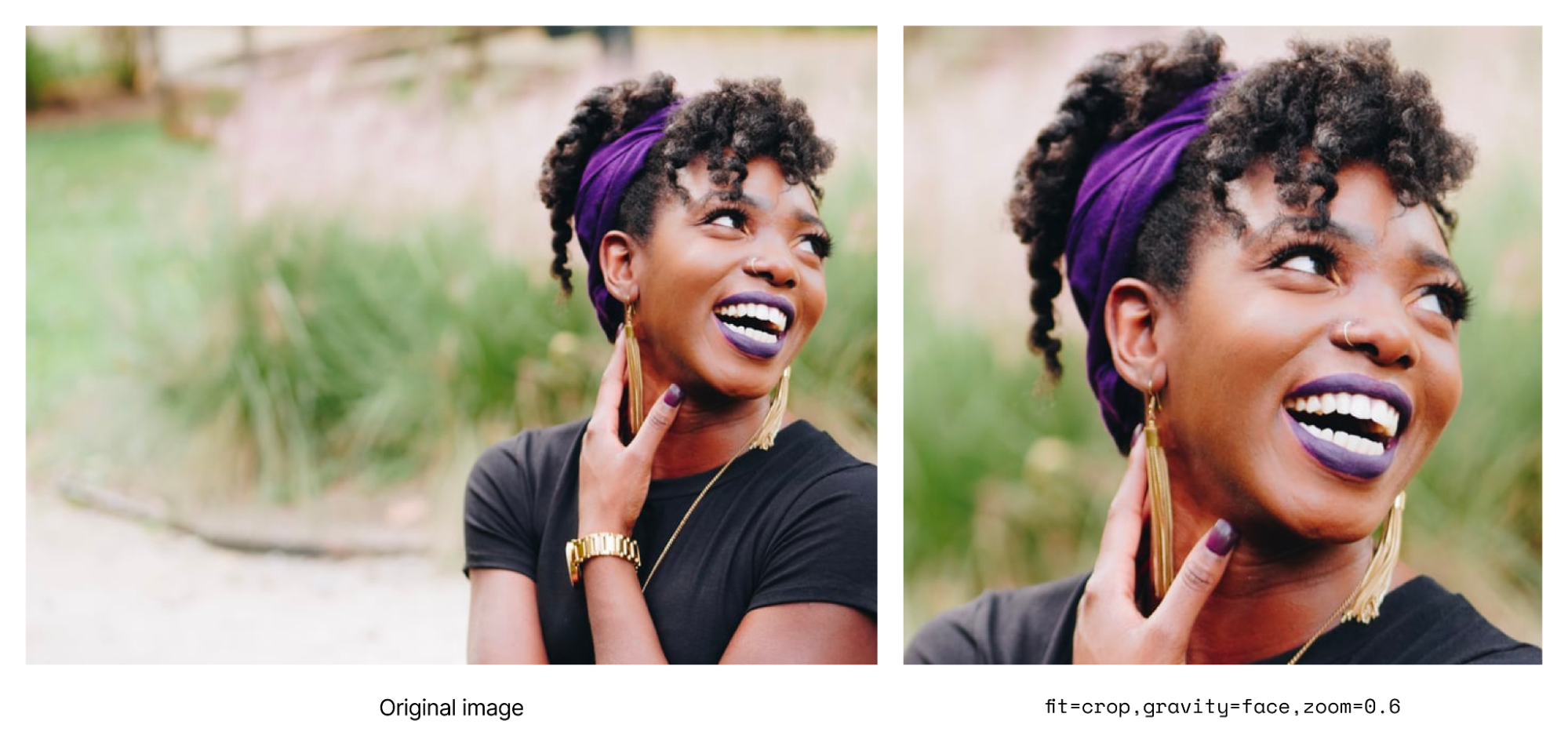
AI face cropping can be performed by using the gravity=face option, which automatically detects which pixels represent the face (or faces) and uses this information to crop the image. You can also affect how closely the image is cropped toward the face; the zoom parameter controls the threshold for how much of the surrounding area around the face will be included in the image.

We carefully designed our model pipeline with privacy and confidentiality top of mind. This feature doesn’t support facial identification or recognition. In other words, when you optimize with Cloudflare, we’ll never know that two different images depict the same person, or identify the specific people in a given image. Instead, AI face cropping with Images is intentionally limited to face detection, or identifying the pixels that represent a human face.

From pixels to people

Our first step was to select an open-source model that met our requirements. Behind the scenes, our AI face cropping uses RetinaFace, a convolutional neural network model that classifies images with human faces.

A neural network is a type of machine learning process that loosely resembles how the human brain works. A basic neural network has three parts: an input layer, one or more hidden layers, and an output layer. Nodes in each layer form an interconnected network to transmit and process data, where each input node is connected to nodes in the next layer.


A fully connected layer passes data from one layer to the next.

Data enters through the input layer, where it is analyzed before being passed to the first hidden layer. All of the computation is done in the hidden layers, where a result is eventually delivered through the output layer.

A convolutional neural network (CNN) mirrors how humans look at things. When we look at other people, we start with abstract features, like the outline of their body, before we process specific features, like the color of their eyes or the shape of their lips.

Similarly, a CNN processes an image piece-by-piece before delivering the final result. Earlier layers look for abstract features like edges and colors and lines; subsequent layers become more complex and are each responsible for identifying the various features that comprise a human face. The last fully connected layer combines all categorized features to produce one final classification of the entire image. In other words, if an image contains all of the individual features that define a human face (e.g. eyes, nose), then the CNN concludes that the image contains a human face.

We needed a model that could determine whether an image depicts a person (image classification), as well as exactly where they are in the image (object detection). When selecting a model, some factors we considered were:

  • Performance on the WIDERFACE dataset. This is the state-of-the-art face detection benchmark dataset, which contains 32,203 images of 393,703 labeled faces with a high degree of variability in scale, pose, and occlusion.

  • Speed (in frames per second). Most of our image optimization requests occur on delivery (rather than before an image gets uploaded to storage), so we prioritized performance for end-user delivery.

  • Model size. Smaller model sizes run more efficiently.

  • Quality. The performance boost from smaller models often gets traded for the quality—the key is balancing speed with results.

Our initial test sample contained 500 images with varying factors like the number of faces in the image, face size, lighting, sharpness, and angle. We tested various models, including BlazeFast, R-CNN (and its successors Fast R-CNN and Faster R-CNN), RetinaFace, and YOLO (You Only Look Once).

Two-stage detectors like BlazeFast and R-CNN propose potential object locations in an image, then identify objects in those regions of interest. One-stage detectors like RetinaFace and YOLO predict object locations and classes in a single pass. In our research, we observed that two-stage detector methods provided higher accuracy, but performed too slowly to be practical for real traffic. On the other hand, one-stage detector methods were efficient and performant while still highly accurate.

Ultimately, we selected RetinaFace, which showed the highest precision of 99.4% and performed faster than other models with comparable values. We found that RetinaFace delivered strong results even with images containing multiple blurry faces:


Photograph by Anne Nygård (@polarmermaid) on Unsplash

Inference—the process of using training models to make decisions—can be computationally demanding, especially with very large images. To maintain efficiency, we set a maximum size limit of 1024×1024 pixels when sending images to the model.

We pass images within these dimensions directly to the model for analysis. But if either width or height dimension exceeds 1024 pixels, then we instead create an inference image to send to the model; this is a smaller copy that retains the same aspect ratio as the original image and does not exceed 1024 pixels in either dimension. For example, a 125×2000 image will be downscaled to 64×1024. Creating this resized, temporary version reduces the amount of data that the model needs to analyze, enabling faster processing.

The model draws all of the bounding boxes, or the regions within an image that define the detected faces. From there, we construct a new, outer bounding box that encompasses all of the individual boxes, calculating its top-left and bottom-right points based on the boxes that are closest to the top, left, bottom, and right edges of the image.

The top-left point uses the x coordinate from the left-most box and the y coordinate from the top-most box. Similarly, the bottom-right point uses the x coordinate from the right-most box and the y coordinate from the bottom-most box. These coordinates can be taken from the same bounding boxes; if a single box is closest to both the top and left edges, then we would use its top-left corner as the top-left point of the outer bounding box.


AI face cropping identifies regions that represent faces, then determines an outer bounding box and focal point based on the top-most, left-most, right-most, and bottom-most bounding boxes.

Once we define the outer bounding box, we use its center coordinates as the focal point when cropping the image. From our experiments, we found that this produced better and more balanced results for images with multiple faces compared to other methods, like establishing the new focal point around the largest detected face.

The cropped image area is calculated based on the dimensions of the outer bounding box (“d”) and a specified zoom level (“z”) in the formula (1 ÷ z) × d. The zoom parameter accepts floating points between 0 and 1, where we crop the image to the bounding box when zoom=1 and include more of the area around the box as zoom trends toward 0.

Consider an original image that is 2048×2048. First, we create an inference image that is 1024×1024 to meet our size limits for face detection. Second, we define the outer bounding box using the model’s predictions—we’ll use 100×500 for this example. At zoom=0.5, our formula generates a crop area that is twice as large as the bounding box, with new width (“w”) and height (“h”) dimensions of 200×1000:


We also apply a min function that chooses the smaller number between the input dimensions and the calculated dimensions, ensuring that the new width and height never exceed the dimensions of the image itself. In other words, if you try to zoom out too much, then we use the full width or height of the image instead of defining a crop area that will extend beyond the edge of the image. For example, at zoom=0.25, our formula yields an initial crop area of 400×2000. Here, since the calculated height (2000) is larger than the input height (1024), we use the input height to set the crop area to 400×1024.

Finally, we need to scale the crop area back to the size of the original image. This applies only when a smaller inference image is created.

We initially downscaled the original 2048×2048 image by a factor of 2 to create the 1024×1024 inference image. This means that we need to multiply the dimensions of the crop area—400×1024 in our latest example—by 2 to produce our final result: a cropped image that is 800×2048.

The architecture behind the earliest build

In the beta version, we rewrote the model using TensorFlow Rust to make it compatible with our existing Rust-based stack. All of the computations for inference—where the model classifies and locates human faces—were executed on CPUs within our network.

Initially, this worked well and we saw near-realtime results.

However, the underlying limitations of our implementation became apparent when we started receiving consistent alerts that our underlying Images service was nearing its limits for memory usage. The increased memory usage didn’t line up with any recent deployments around this time, but a hunch led us to discover that the face cropping compute time graph had an uptick that matched the uptick in memory usage. Further tracing confirmed that AI face cropping was at the root of the problem.

When a service runs out of memory, it terminates its processes to free up memory and prevent the system from crashing. Since CPU-based implementations share RAM with other processes, this can potentially cause errors for other image optimization operations. In response, we switched our memory allocator from glibc malloc to jemalloc. This allowed us to use less memory at runtime, saving about 20 TiB of RAM globally. We also started culling the number of face cropping requests to limit CPU usage.

At this point, AI face cropping was already limited to our own internal uses and a small number of beta customers. These steps only temporarily reduced our memory consumption. They weren’t sufficient for handling global traffic, so we looked toward a more scalable design for long-term use.

Doing more with less (memory)

With memory usage alerts looming in the distance, it became clear that we needed to move to a GPU-based approach.

Unlike with CPUs, a GPU-based implementation avoids contention with other processes because memory access is typically dedicated and managed more tightly. We partnered with the Workers AI team, who created a framework for internal teams to integrate payloads into their model catalog for GPU access.

Some Workers AI models have their own standalone containers; this isn’t practical for every model, as routing traffic to multiple containers can be expensive. When using a GPU through Workers AI, the data needs to travel over the network, which can introduce latency. This is where model size is especially relevant, as network transport overhead becomes more noticeable with larger models.

To address this, Workers AI wraps smaller models in a single container and utilizes a latency-sensitive routing algorithm to identify the best instance to serve each payload. This means that models can be offloaded when there is no traffic.


A scheduler is used to optimize how—and when—models in the same container interact with GPUs.

RetinaFace runs on 1 GB of VRAM on the smallest GPU; it’s small enough that it can be hot swapped at runtime alongside similarly sized models. If there is a call for the RetinaFace model, then the Python code will be loaded into the environment and executed.

As expected, we saw a significant drop in memory usage after we moved the feature to Workers AI. Now, each instance of our Images service consumes about 150 MiB of memory.


With this new approach, memory leaks pose less concern to the overall availability of our service. Workers AI executes models within containers, so they can be terminated and restarted as needed without impacting other processes. Since face cropping runs separately from our Images service, restarting it won’t halt our other image optimization operations.

Applying AI face cropping to our blog

As part of our beta launch, we updated the Cloudflare blog to apply AI face cropping on author images.

Authors can submit their own images, which appear as circular profile pictures in both the main blog feed and individual blog posts. By default, CSS centers images within their containers, making off-centered head positions more obvious. When two profile pictures include different amounts of negative space, this can also lead to a visual imbalance where authors’ faces appear at different scales:


AI face cropping makes posts with multiple authors appear more balanced.

In the example above, Austin’s original image is cropped tightly around his face. On the other hand, Taylor’s original image includes his torso and a larger margin of the background. As a result, Austin’s face appears larger and closer to the center than Taylor’s does. After we applied AI face cropping to profile pictures on the blog, their faces appear more similar in size, creating more balance and cohesion on their co-authored post.

A new era of image editing, now in Images

Many developers already use Images to build scalable media pipelines. Our goal is to accelerate image workflows by automating rote, manual tasks.

For the Images team, this is only the beginning. We plan to release new AI capabilities, including features like background removal and generative upscale. You can try AI face cropping for free by enabling transformations in the Images dashboard.

Improve your media pipelines with the Images binding for Cloudflare Workers

Post Syndicated from Deanna Lam original https://blog.cloudflare.com/improve-your-media-pipelines-with-the-images-binding-for-cloudflare-workers/

When building a full-stack application, many developers spend a surprising amount of time trying to make sure that the various services they use can communicate and interact with each other. Media-rich applications require image and video pipelines that can integrate seamlessly with the rest of your technology stack.

With this in mind, we’re excited to introduce the Images binding, a way to connect the Images API directly to your Worker and enable new, programmatic workflows. The binding removes unnecessary friction from application development by allowing you to transform, overlay, and encode images within the Cloudflare Developer Platform ecosystem.

In this post, we’ll explain how the Images binding works, as well as the decisions behind local development support. We’ll also walk through an example app that watermarks and encodes a user-uploaded image, then uploads the output directly to an R2 bucket.

The challenges of fetch()

Cloudflare Images was designed to help developers build scalable, cost-effective, and reliable image pipelines. You can deliver multiple copies of an image — each resized, manipulated, and encoded based on your needs. Only the original image needs to be stored; different versions are generated dynamically, or as requested by a user’s browser, then subsequently served from cache.

With Images, you have the flexibility to transform images that are stored outside the Images product. Previously, the Images API was based on the fetch() method, which posed three challenges for developers:

First, when transforming a remote image, the original image must be retrieved from a URL. This isn’t applicable for every scenario, like resizing and compressing images as users upload them from their local machine to your app. We wanted to extend the Images API to broader use cases where images might not be accessible from a URL.

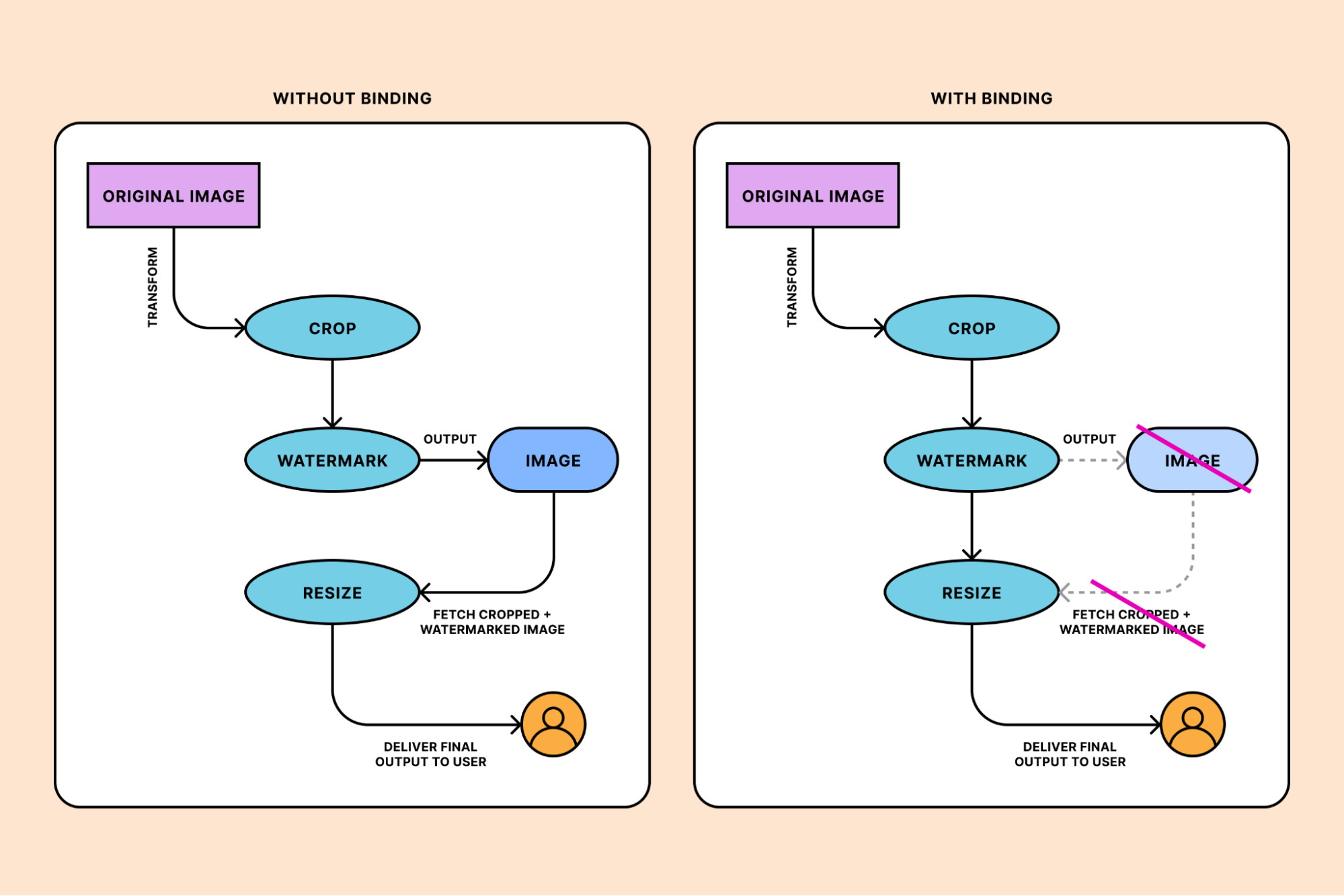
Second, the optimization operation — the changes you want to make to an image, like resizing it — is coupled with the delivery operation. If you wanted to crop an image, watermark it, then resize the watermarked image, then you’d need to serve one transformation to the browser, retrieve the output URL, and transform it again. This adds overhead to your code, and can be tedious and inefficient to maintain. Decoupling these operations means that you no longer need to manage multiple requests for consecutive transformations.

Third, optimization parameters — the way that you specify how an image should be manipulated — follow a fixed order. For example, cropping is performed before resizing. It’s difficult to build a flow that doesn’t align with the established hierarchy — like resizing first, then cropping — without a lot of time, trial, and effort.

But complex workflows shouldn’t require complex logic. In February, we released the Images binding in Workers to make the development experience more accessible, intuitive, and user-friendly. The binding helps you work more productively by simplifying how you connect the Images API to your Worker and providing more fine-grained control over how images are optimized.

Extending the Images workflow


Since optimization parameters follow a fixed order, we’d need to output the image to resize it after watermarking. The binding eliminates this step.

Bindings connect your Workers to external resources on the Developer Platform, allowing you to manage interactions between services in a few lines of code. When you bind the Images API to your Worker, you can create more flexible, programmatic workflows to transform, resize, and encode your images — without requiring them to be accessible from a URL.

Within a Worker, the Images binding supports the following functions:

  • .transform(): Accepts optimization parameters that specify how an image should be manipulated

  • .draw(): Overlays an image over the original image. The overlaid image can be optimized through a child transform() function.

  • .output(): Defines the output format for the transformed image.

  • .info(): Outputs information about the original image, like its format, file size, and dimensions.

The life of a binding request

At a high level, a binding works by establishing a communication channel between a Worker and the binding’s backend services.

To do this, the Workers runtime needs to know exactly which objects to construct when the Worker is instantiated. Our control plane layer translates between a given Worker’s code and each binding’s backend services. When a developer runs wrangler deploy, any invoked bindings are converted into a dependency graph. This describes the objects and their dependencies that will be injected into the env of the Worker when it runs. Then, the runtime loads the graph, builds the objects, and runs the Worker.

In most cases, the binding makes a remote procedure call to the backend services of the binding. The mechanism that makes this call must be constructed and injected into the binding object; for Images, this is implemented as a JavaScript wrapper object that makes HTTP calls to the Images API.

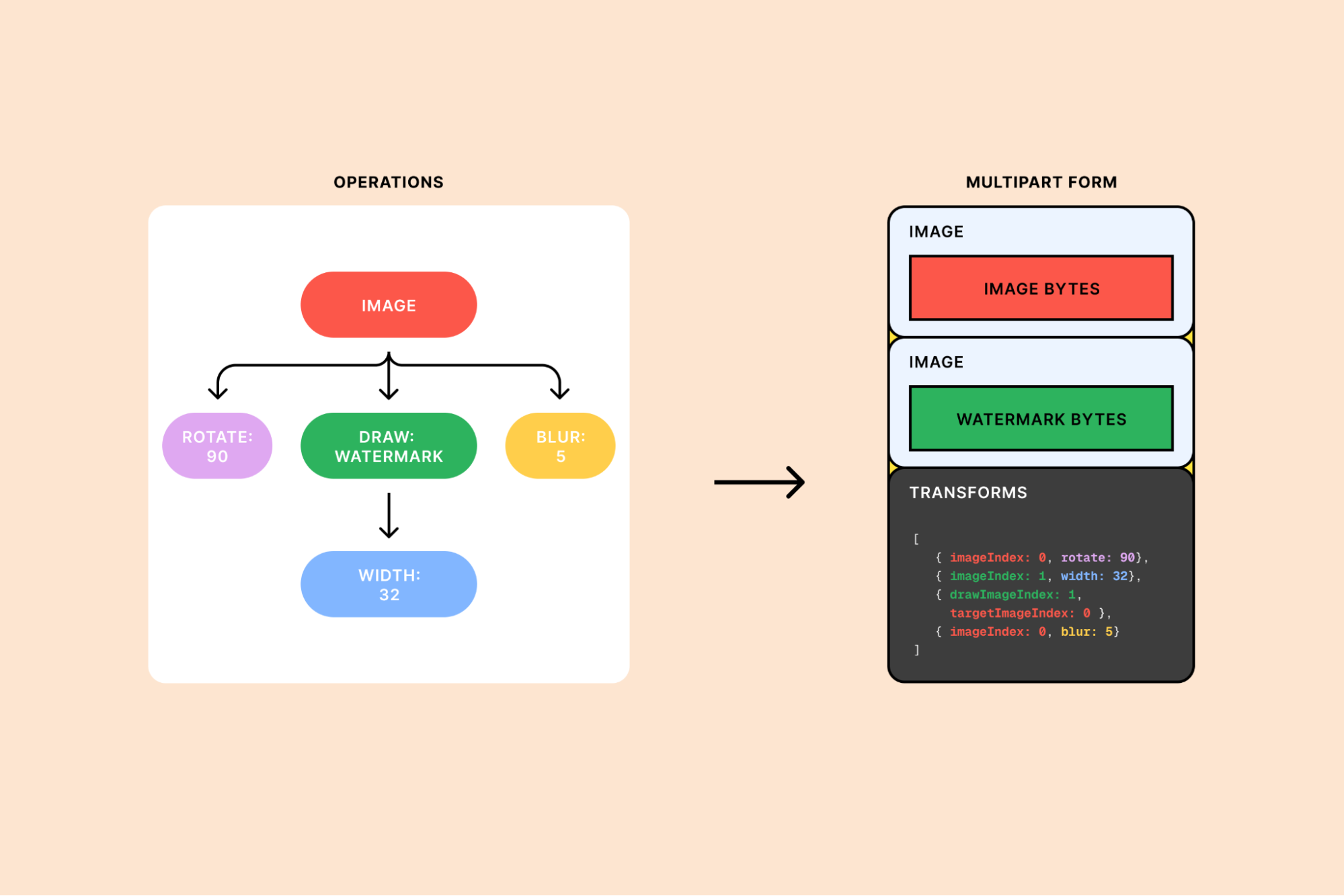
These calls contain the sequence of operations that are required to build the final image, represented as a tree structure. Each .transform() function adds a new node to the tree, describing the operations that should be performed on the image. The .draw() function adds a subtree, where child .transform() functions create additional nodes that represent the operations required to build the overlay image. When .output() is called, the tree is flattened into a list of operations; this list, along with the input image itself, is sent to the backend of the Images binding.

For example, let’s say we had the following commands:

env.IMAGES.input(image)
  .transform(rotate:90})
  .draw(
    env.IMAGES.input(watermark)
      .transform({width:32})
  )
  .transform({blur:5})
  .output({format:"image/png"})

Put together, the request would look something like this:


To communicate with the backend, we chose to send multipart forms. Each binding request is inherently expensive, as it can involve decoding, transforming, and encoding. Binary formats may offer slightly lower overhead per request, but given the bulk of the work in each request is the image processing itself, any gains would be nominal. Instead, we stuck with a well-supported, safe approach that our team had successfully implemented in the past.

Meeting developers where they are

Beyond the core capabilities of the binding, we knew that we needed to consider the entire developer lifecycle. The ability to test, debug, and iterate is a crucial part of the development process.

Developers won’t use what they can’t test; they need to be able to validate exactly how image optimization will affect the user experience and performance of their application. That’s why we made the Images binding available in local development without incurring any usage charges.

As we scoped out this feature, we reached a crossroad with how we wanted the binding to work when developing locally. At first, we considered making requests to our production backend services for both unit and end-to-end testing. This would require open-sourcing the components of the binding and building them for all Wrangler-supported platforms and Node versions.

Instead, we focused our efforts on targeting individual use cases by providing two different methods. In Wrangler, Cloudflare’s command-line tool, developers can choose between an online and offline mode of the Images binding. The online mode makes requests to the real Images API; this requires Internet access and authentication to the Cloudflare API. Meanwhile, the offline mode requests a lower fidelity fake, which is a mock API implementation that supports a limited subset of features. This is primarily used for unit tests, as it doesn’t require Internet access or authentication. By default, wrangler dev uses the online mode, mirroring the same version that Cloudflare runs in production.

See the binding in action

Let’s look at an example app that transforms a user-uploaded image, then uploads it directly to an R2 bucket.

To start, we created a Worker application and configured our wrangler.toml file to add the Images, R2, and assets bindings:

[images]
binding = "IMAGES"

[[r2_buckets]]
binding = "R2"
bucket_name = "<BUCKET>"

[assets]
directory = "./<DIRECTORY>"
binding = "ASSETS"

In our Worker project, the assets directory contains the image that we want to use as our watermark.

Our frontend has a <form> element that accepts image uploads:

const html = `
<!DOCTYPE html>
        <html>
          <head>
            <meta charset="UTF-8">
            <title>Upload Image</title>
          </head>
          <body>
            <h1>Upload an image</h1>
            <form method="POST" enctype="multipart/form-data">
              <input type="file" name="image" accept="image/*" required />
              <button type="submit">Upload</button>
            </form>
          </body>
        </html>
`;

export default {
  async fetch(request, env) {
    if (request.method === "GET") {
      return new Response(html, {headers:{'Content-Type':'text/html'},})
    }
    if (request.method ==="POST") {
      // This is called when the user submits the form
    }
  }
};

Next, we set up our Worker to handle the optimization.

The user will upload images directly through the browser; since there isn’t an existing image URL, we won’t be able to use fetch() to get the uploaded image. Instead, we can transform the uploaded image directly, operating on its body as a stream of bytes.

Once we read the image, we can manipulate the image. Here, we apply our watermark and encode the image to AVIF before uploading the transformed image to our R2 bucket: 

var __defProp = Object.defineProperty;
var __name = (target, value) => __defProp(target, "name", { value, configurable: true });

function assetUrl(request, path) {
	const url = new URL(request.url);
	url.pathname = path;
	return url;
}
__name(assetUrl, "assetUrl");

export default {
  async fetch(request, env) {
    if (request.method === "GET") {
      return new Response(html, {headers:{'Content-Type':'text/html'},})
    }
    if (request.method === "POST") {
      try {
        // Parse form data
        const formData = await request.formData();
        const file = formData.get("image");
        if (!file || typeof file.arrayBuffer !== "function") {
          return new Response("No image file provided", { status: 400 });
        }
        
        // Read uploaded image as array buffer
        const fileBuffer = await file.arrayBuffer();

	     // Fetch image as watermark
        let watermarkStream = (await env.ASSETS.fetch(assetUrl(request, "watermark.png"))).body;

        // Apply watermark and convert to AVIF
        const imageResponse = (
          await env.IMAGES.input(fileBuffer)
              // Draw the watermark on top of the image
              .draw(
                env.IMAGES.input(watermarkStream)
                  .transform({ width: 100, height: 100 }),
                { bottom: 10, right: 10, opacity: 0.75 }
              )
              // Output the final image as AVIF
              .output({ format: "image/avif" })
          ).response();

          // Add timestamp to file name
          const fileName = `image-${Date.now()}.avif`;
          
          // Upload to R2
          await env.R2.put(fileName, imageResponse.body)
         
          return new Response(`Image uploaded successfully as ${fileName}`, { status: 200 });
      } catch (err) {
        console.log(err.message)
      }
    }
  }
};

We’ve also created a gallery in our documentation to demonstrate ways that you can use the Images binding. For example, you can transcode images from Workers AI or draw a watermark from KV on an image that is stored in R2.

Looking ahead, the Images binding unlocks many exciting possibilities to seamlessly transform and manipulate images directly in Workers. We aim to create an even deeper connection between all the primitives that developers use to build AI and full-stack applications.

Have some feedback for this release? Let us know in the Community forum.

What’s new with Cloudflare Media: updates for Calls, Stream, and Images

Post Syndicated from Deanna Lam original https://blog.cloudflare.com/whats-next-for-cloudflare-media


Our customers use Cloudflare Calls, Stream, and Images to build live, interactive, and real-time experiences for their users. We want to reduce friction by making it easier to get data into our products. This also means providing transparent pricing, so customers can be confident that costs make economic sense for their business, especially as they scale.

Today, we’re introducing four new improvements to help you build media applications with Cloudflare:

  • Cloudflare Calls is in open beta with transparent pricing
  • Cloudflare Stream has a Live Clipping API to let your viewers instantly clip from ongoing streams
  • Cloudflare Images has a pre-built upload widget that you can embed in your application to accept uploads from your users
  • Cloudflare Images lets you crop and resize images of people at scale with automatic face cropping

Build real-time video and audio applications with Cloudflare Calls

Cloudflare Calls is now in open beta, and you can activate it from your dashboard. Your usage will be free until May 15, 2024. Starting May 15, 2024, customers with a Calls subscription will receive the first terabyte each month for free, with any usage beyond that charged at $0.05 per real-time gigabyte. Additionally, there are no charges for inbound traffic to Cloudflare.

To get started, read the developer documentation for Cloudflare Calls.

Live Instant Clipping: create clips from live streams and recordings

Live broadcasts often include short bursts of highly engaging content within a longer stream. Creators and viewers alike enjoy being able to make a “clip” of these moments to share across multiple channels. Being able to generate that clip rapidly enables our customers to offer instant replays, showcase key pieces of recordings, and build audiences on social media in real-time.

Today, Cloudflare Stream is launching Live Instant Clipping in open beta for all customers. With the new Live Clipping API, you can let your viewers instantly clip and share moments from an ongoing stream – without re-encoding the video.

When planning this feature, we considered a typical user flow for generating clips from live events. Consider users watching a stream of a video game: something wild happens and users want to save and share a clip of it to social media. What will they do?

First, they’ll need to be able to review the preceding few minutes of the broadcast, so they know what to clip. Next, they need to select a start time and clip duration or end time, possibly as a visualization on a timeline or by scrubbing the video player. Finally, the clip must be available quickly in a way that can be replayed or shared across multiple platforms, even after the original broadcast has ended.

That ideal user flow implies some heavy lifting in the background. We now offer a manifest to preview recent live content in a rolling window, and we provide the timing information in that response to determine the start and end times of the requested clip relative to the whole broadcast. Finally, on request, we will generate on-the-fly that clip as a standalone video file for easy sharing as well as an HLS manifest for embedding into players.

Live Instant Clipping is available in beta to all customers starting today! Live clips are free to make; they do not count toward storage quotas, and playback is billed just like minutes of video delivered. To get started, check out the Live Clipping API in developer documentation.

Integrate Cloudflare Images into your application with only a few lines of code

Building applications with user-uploaded images is even easier with the upload widget, a pre-built, interactive UI that lets users upload images directly into your Cloudflare Images account.

Many developers use Cloudflare Images as an end-to-end image management solution to support applications that center around user-generated content, from AI photo editors to social media platforms. Our APIs connect the frontend experience – where users upload their images – to the storage, optimization, and delivery operations in the backend.

But building an application can take time. Our team saw a huge opportunity to take away as much extra work as possible, and we wanted to provide off-the-shelf integration to speed up the development process.

With the upload widget, you can seamlessly integrate Cloudflare Images into your application within minutes. The widget can be integrated in two ways: by embedding a script into a static HTML page or by installing a package that works with your favorite framework. We provide a ready-made Worker template that you can deploy directly to your account to connect your frontend application with Cloudflare Images and authorize users to upload through the widget.

To try out the upload widget, sign up for our closed beta.

Optimize images of people with automatic face cropping for Cloudflare Images

Cloudflare Images lets you dynamically manipulate images in different aspect ratios and dimensions for various use cases. With face cropping for Cloudflare Images, you can now crop and resize images of people’s faces at scale. For example, if you’re building a social media application, you can apply automatic face cropping to generate profile picture thumbnails from user-uploaded images.

Our existing gravity parameter uses saliency detection to set the focal point of an image based on the most visually interesting pixels, which determines how the image will be cropped. We expanded this feature by using a machine learning model called RetinaFace, which classifies images that have human faces. We’re also introducing a new zoom parameter that you can combine with face cropping to specify how closely an image should be cropped toward the face.

To apply face cropping to your image optimization, sign up for our closed beta.

Photo by Eye for Ebony on Unsplash
https://example.com/cdn-cgi/image/fit=crop,width=500,height=500,gravity=face,zoom=0.6/https://example.com/images/picture.jpg

Meet the Media team over Discord

As we’re working to build the next set of media tools, we’d love to hear what you’re building for your users. Come say hi to us on Discord. You can also learn more by visiting our developer documentation for Calls, Stream, and Images.

Image optimization made simpler and more predictable: we’re merging Cloudflare Images and Image Resizing

Post Syndicated from Deanna Lam original http://blog.cloudflare.com/merging-images-and-image-resizing/

Image optimization made simpler and more predictable: we’re merging Cloudflare Images and Image Resizing

Image optimization made simpler and more predictable: we’re merging Cloudflare Images and Image Resizing

Starting November 15, 2023, we’re merging Cloudflare Images and Image Resizing.

All Image Resizing features will be available as part of the Cloudflare Images product. To let you calculate your monthly costs more accurately and reliably, we’re changing how we bill to resize images that aren’t stored at Cloudflare. Our new pricing model will cost $0.50 per 1,000 unique transformations.

For existing Image Resizing customers, you can continue to use the legacy version of Image Resizing. When the merge is live, then you can opt into the new pricing model for more predictable pricing.

In this post, we'll cover why we came to this decision, what's changing, and how these changes might impact you.

Simplifying our products

When you build an application with images, you need to think about three separate operations: storage, optimization, and delivery.

In 2019, we launched Image Resizing, which can optimize and transform any publicly available image on the Internet based on a set of parameters. This enables our customers to deliver variants of a single image for each use case without creating and storing additional copies.

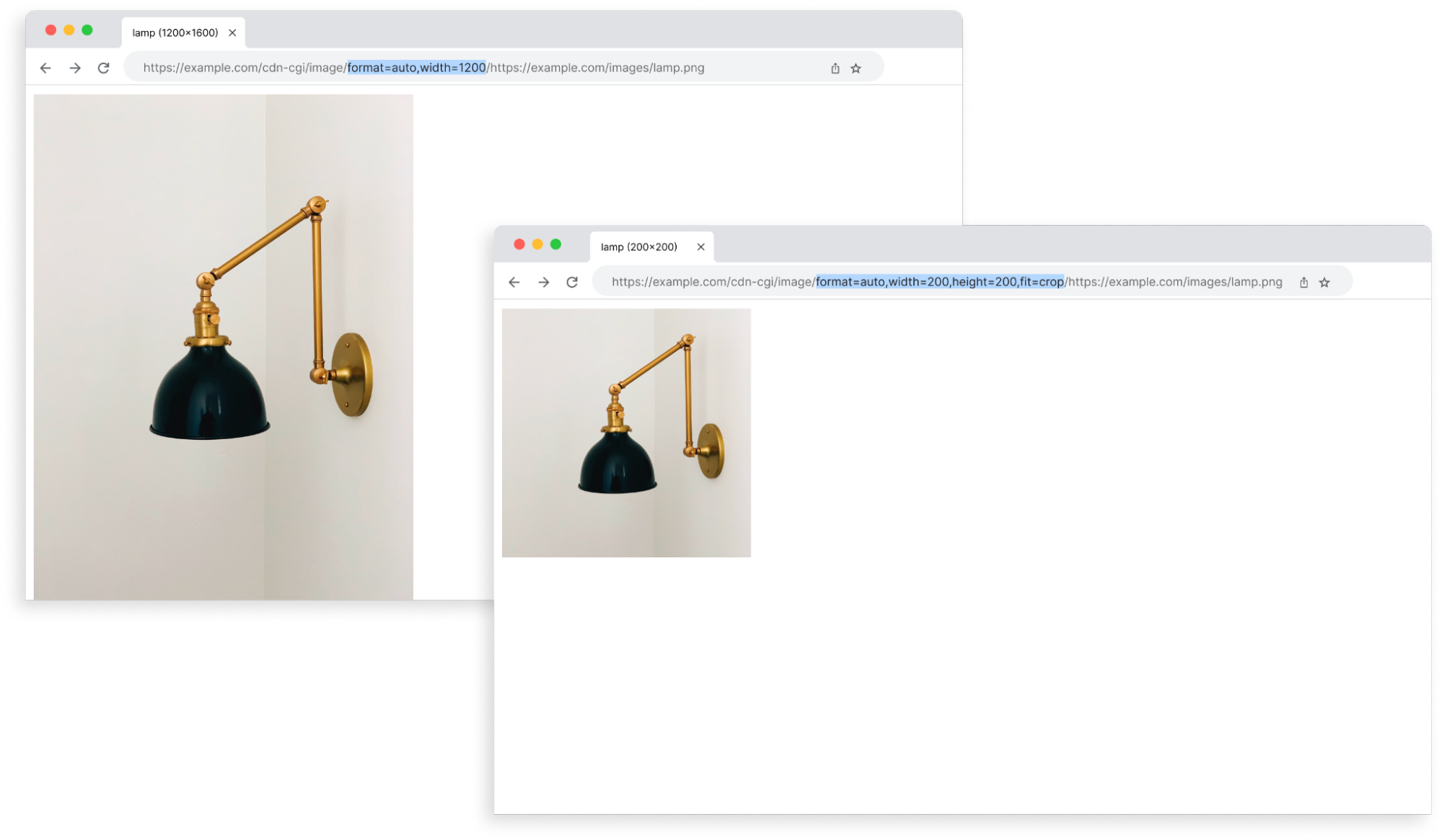
For example, an e-commerce platform for furniture retailers might use the same image of a lamp on both the individual product page and the gallery page for all lamps. They can use Image Resizing to optimize the image in its original aspect for a slider view, or manipulate and crop the image for a thumbnail view.

Image optimization made simpler and more predictable: we’re merging Cloudflare Images and Image Resizing

Two years later, we released Images to let developers build an end-to-end image management pipeline. Developers no longer need to use different vendors to handle storage, optimization, and delivery. With Images, customers can store and deliver their images from a single bucket at Cloudflare to streamline their workflow and eliminate egress fees.

Both products have overlapping features to optimize and manipulate images, which can be confusing for customers. Over the years, we've received numerous questions about which product is optimal for which use cases.

To simplify our products, we're merging Cloudflare Images and Image Resizing to let customers store, optimize, and deliver their images all from one product. Customers can continue to optimize their images without using Cloudflare for storage or purchase storage to manage their entire image pipeline through Cloudflare.

Transparent and predictable pricing

Pricing can cause headaches for Image Resizing customers.

We often hear from customers seeking guidance for calculating how much Image Resizing will cost each month. Today, you are billed for Image Resizing by the number of uncached requests to transform an image. However, caching behavior is often unpredictable, and you can't guarantee how long a given image stays cached. This means that you can't reliably predict their costs.

If you make 1M total requests to Image Resizing each month, then you won't know whether you'll be billed for 10K or 100K of these requests because our pricing model relies on cache. Since assets can be ejected from cache for a variety of reasons, bills for Image Resizing are unpredictable month over month. In some cases, the monthly bills are inconsistent even when traffic remains constant. In other cases, the monthly bill is much higher than our customers expected.

With the new Cloudflare Images, you will be billed only once per 30 days for each unique request to transform an image stored outside of Cloudflare, whether the transformation is cached. Customers will be billed $0.50 per 1,000 unique transformations per month.

In other words, if you resize one image to 100×100, then our new pricing model guarantees that you will be billed only once per month, whether there are 10K or 100K uncached requests to deliver the image at this size. If you resize 200 images to 100×100, then you will be billed for only 200 unique transformations — one for each image at this size — each month.

This change aligns more closely with how our customers think about their usage, as well as ensures that our customers can accurately estimate their costs with confidence. You won't need to consider how your cache hit ratio will affect your bill. To estimate your costs, you'll need to know only the number of unique images and the number of different ways that you need to transform those images each month.

Resize without storage with Cloudflare Images

For developers who only want to resize and optimize images, Cloudflare Images now offers a zero-storage plan. This new plan enables you to transform images while keeping your existing storage and delivery solution unchanged (just like the current Image Resizing product does).

Image optimization made simpler and more predictable: we’re merging Cloudflare Images and Image Resizing

If you want to store your images with Cloudflare Images, then you can always upgrade your plan to purchase storage at any time.

Image Resizing is currently available only for accounts with a Pro or higher plan. The merged Cloudflare Images product will be available for all customers, with pricing plans that are tailored to meet specific use cases.

Existing customers can opt into new pricing

The new version of Cloudflare Images is available on November 15, 2023.

If you currently use Image Resizing, you will have the option to migrate to the new Cloudflare Images at no cost, or continue using Image Resizing.

The functionality and usability of the product will remain the same. You will still manage stored images under the Cloudflare Images tab and can enable transformations from the Speed tab.

As we execute, we'll continue to make improvements in the Dashboard to bring a more centralized and unified experience for Cloudflare Images.

You can learn more about our current image optimization capabilities in the Developer Docs. If you have feedback or thoughts, we'd love to hear from you on the Cloudflare Developers Discord.