All posts by Kevin Donohue

Fast Track ISM-ready cloud environments and IRAP Assessments with Landing Zone Accelerator on AWS

Post Syndicated from Kevin Donohue original https://aws.amazon.com/blogs/security/fast-track-ism-ready-cloud-environments-and-irap-assessments-with-landing-zone-accelerator-on-aws/

This post announces the availability of a new independent assessment report available on AWS Artifact analyzing how Landing Zone Accelerator on AWS (LZA) can automatically deploy multi-account environments in Amazon Web Services (AWS) with Australian Government Information Security Manual (ISM) security controls coverage at scale. The report includes findings from an independent third-party analysis conducted by AWS Partner gwi.digital. In addition to the report, we talk about ISM compliance applicability to LZA and a new testing mechanism for measuring configuration drift, which together can provide Australian customers with a documented and validated foundation to accelerate IRAP assessment readiness.

Background

Australian organizations in public sector, defense, and critical infrastructure agencies must build cloud environments that meet (ISM requirements. The ISM defines 1,081 security control requirements across 22 guideline chapters. Demonstrating compliance is central to achieving an IRAP assessment outcome, but assessments typically require months of preparation, evidence gathering, and testing.

In October 2025, we introduced the LZA Universal Configuration and LZA Compliance Workbook. LZA provisions a multi-account security architecture that automates the deployment of nearly 200 security controls based on AWS Well-Architected pillars and AWS security best practices. The LZA Compliance Workbook, available on AWS Artifact, documents how the Universal Configuration (UC) maps to technical security requirements from 17 global compliance frameworks, with more being added. LZA is an ideal solution for customers with security and compliance obligations—both existing and anticipated—because the guardrails it deploys are applied automatically to new accounts as environments grow.

What’s in the report

To see how LZA can help customers in Australia we teamed up with AWS Partner gwi.digital to run LZA as a customer would. gwi.digital is a consultancy partner specializing in cybersecurity and governance, risk, and compliance (GRC) and has deep experience in IRAP assessments and the ISM framework. The team conducted an independent analysis and evaluation of LZA UC against 1,081 ISM controls. The assessment was conducted in a greenfield AWS environment hosted in the ap-southeast-2 (Sydney) AWS Region, positioned within Phase 2 of the ASD Cloud Security Assessment and Authorization Framework and focused on cloud consumers building on already-authorized AWS services. It builds on existing AWS IRAP foundations: Underlying AWS services were most recently independently assessed at the PROTECTED level by CyberCX last year. While this report does not constitute an official IRAP authorization, certification, or accreditation, it provides a professional evaluation of evidence based on what LZA delivers out of the box (and what it does not), so organizations can make informed decisions.

What the assessment found

Of the 1,081 ISM controls, 256 are within the addressable scope of LZA and include the technical infrastructure controls that a solution like LZA can meaningfully address. Of those 256, LZA achieves Full or Partial coverage for 234 (91%). The remaining 825 controls are outside the scope of LZA: physical security, personnel, organizational governance, and classification-level exclusions. A key contribution for the assessment was analysis of the shared responsibility model that goes beyond the traditional AWS/customer binary. It considers a three-tier view—AWS (provided), LZA (enabled), and Customer (responsibility)—and further categorizes the 825 out-of-scope controls into subcategories so customers can quickly determine which controls require their attention compared to which are already addressed at the infrastructure level. By combining automated deployment, ISM-specific compliance mappings, independent validation, and continuous evidence generation, Australian customers can reduce IRAP assessment timelines while achieving more reliable compliance outcomes.

Note: Results are based on the configuration as-provisioned based on the LZA version and during the time of this assessment. Results may vary depending on customer implementation and configuration choices.

Continuous validation with CATS

Confirming controls are implemented and operating effectively across your environment is complex and often lacks complete coverage. To simplify testing your LZA deployment, we developed the Controls Acceptance Testing Suite (CATS). CATS is an automated compliance validation engine that runs purpose-built tests against the security configuration baseline deployed by LZA UC. For the ISM assessment, CATS executed over 3,600 individual tests across six AWS accounts, evaluating account structure, identity and access, network configuration, logging, encryption, and backup. For Australian customers, CATS enables:

  • Automated evidence generation: Machine-readable results may replace weeks of manual evidence collection
  • ISM-enriched reporting: gwi-digital developed a conversion script that maps CATS output to ISM control references, enabling auditors to interpret results from an ISM perspective
  • OSCAL export: Results in Open Security Controls Assessment Language (OSCAL) format for interoperability with assessment tools
  • Continuous drift detection: Repeatable execution identifies when configurations deviate from the validated baseline between assessment cycles

Note: CATS availability is limited and currently accessible only through AWS Professional Services as a private beta solution and may be subject to change. Availability, features, and pricing are subject to change without notice. Contact your AWS account representative or reach out to a member of the LZA team for questions about CATS, or to provide feedback on the LZA ISM report.

ISM-optimized configuration

Through the assessment, gwi-digital identified configuration adjustments that elevate specific control ratings from Partial to Full, with minimal effort; for example, increasing the default password length from 14 to 15 characters or adjusting log retention to align with Australian Federal Disposal Authority standards. These recommendations have been communicated to the LZA UC team for inclusion in a future ISM-specific guidance section in LZA GitHub documentation.

Getting started

In addition to the LZA ISM report, you can also find the LZA Compliance Workbook available on AWS Artifact. It maps related ISM requirement identifiers to security implementation statements, giving you a starting point from which you can customize and enhance your compliance documentation for your unique use cases after deploying LZA.

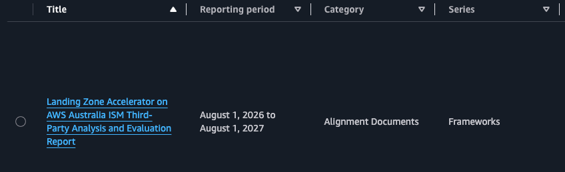
  1. Sign in to your AWS account and then download the LZA Australia ISM Third-Party Analysis and Evaluation Report and LZA Compliance Workbook from AWS Artifact.
    Figure 1: LZA report and workbook in AWS Artifact

    Figure 1: LZA report and workbook in AWS Artifact

  2. Visit the LZA Universal Configuration GitHub repository to review and download the latest configuration baseline.
  3. Use the LZA Implementation Guide to see use cases, review pre-deployment considerations and then follow deployment steps.
  4. Set-up a security compliance chat agent. Consider creating a knowledge base with Amazon Bedrock using the LZA Compliance Workbook, LZA Implementation Guide, web crawlers to the LZA GitHub, and your custom resources to set up your own chat agent.
If you have questions, contact a gwi.digitalexpert, AWS LZA team member, or your AWS account representative.

Conclusion

The combination of ISM mappings in the LZA Compliance Workbook, the gwi-digital analysis report, and CATS evidence gives Australian customers a head start on IRAP assessments.

  • Weeks saved on scoping: Pre-determined control applicability significantly reduces upfront scoping effort
  • Documentation ready: Implementation statements and control requirement alignment reduce the documentation burden
  • Independent assurance: A third-party report that customers and their assessors can reference directly
  • Continuous evidence: CATS generates repeatable security evidence between assessment cycles, replacing periodic manual audits with ongoing assurance

Acknowledgements

The Landing Zone Accelerator team would like to thank Baden Hughes, Henrik Melkonyan, Iain Lindsay-German, and Ian Roderick from gwi.digital for their professionalism and expertise in performing an incredibly thorough assessment, helping us to make LZA better for customers, and for their contributions to this blog post.

If you have feedback about this post, submit comments in the Comments section below.


Kevin Donohue

Kevin Donohue

Kevin is a Senior Security Compliance Engineer at AWS, where he builds solutions and resources to help AWS customers achieve their security and compliance goals. Prior to joining the Landing Zone Accelerator team in AWS Professional Services in 2024, Kevin began his tenure with AWS Security in 2019 specializing in FedRAMP compliance and the shared responsibility model.

Dan Friebe

Dan Friebe

Dan is a Senior Solutions Architect at AWS, helping customers design and build secure cloud solutions. With over a decade of AWS experience and 16+ years supporting public sector missions, he has spent 8 years delivering solutions for customers and enabling partners to deliver at scale. He’s passionate about removing friction between compliance and innovation, helping customers move faster without compromising security.

Dave Connell

Dave Connell

Dave Connell is a Senior Systems Development Engineer within AWS Professional Services. He has spent the last 7 years building software to secure and scale AWS usage, enabling builders to delight customers and deliver business value through excellent software in the cloud. Dave is passionate about enabling delivery of predictable, safe and valuable customer outcomes by empowering the builder.

Landing Zone Accelerator Independent Assessment Report for C5:2020 now available on AWS Artifact

Post Syndicated from Kevin Donohue original https://aws.amazon.com/blogs/security/landing-zone-accelerator-independent-assessment-report-for-c52020-now-available-on-aws-artifact/

Organizations operating in Germany and across Europe increasingly need to demonstrate cloud security compliance under the Cloud Computing Compliance Criteria Catalogue (C5:2020), published by Germany’s Federal Office for Information Security (BSI). Last year, we introduced Landing Zone Accelerator on AWS support for digital sovereignty and today we’re announcing the availability of a new independent assessment report available on AWS Artifact which evaluates how the Landing Zone Accelerator (LZA) on AWS solution provides enhanced coverage for C5:2020 requirements by implementing nearly 200 native security controls. LZA is available using a standard multi-account configuration or as a container-based deployment option in the AWS European Sovereign Cloud, enabling customers with data residency requirements to use the same security configuration baseline.

How this accelerates your compliance journey

Security and compliance are a shared responsibility. LZA takes on part of this responsibility by defining a security architecture baseline and automatically provisioning your AWS environment that scales as your organization grows. Where AWS already provides C5 Type 2 attestation reports for “security of the cloud”, the LZA assessment report offers an independent opinion of how the security baseline LZA provisions aligns with C5:2020 criteria for “security in the cloud”. Instead of starting from scratch, you can deploy with LZA, evaluate the scope of coverage from the report, and use the LZA Compliance Workbook to build on and customize for your organization’s unique use case. These resources can help you reduce time in architecture design, evidence collection, and preparation for C5:2020 assessments. The free LZA Compliance Workbook available on AWS Artifact and open source Universal Configuration GitHub repository are also excellent sources to add to a knowledge base, enabling you to create a security compliance chat agent with Bedrock to assist your governance or assurance teams.

What’s in the report

AWS Partner Schellman, an independent third-party assessor, evaluated the LZA Universal Configuration architecture and security control baseline, which maps to C5:2020 controls in the LZA Compliance Workbook, to determine how the LZA infrastructure aligns to C5:2020 technical requirements. The report concluded that LZA can help implement 325 security controls in aggregate, aligning to technical requirements from eight C5:2020 control areas. It also describes the LZA architecture design, security best practices, and scoping considerations for C5:2020 assessments. This is the first installation of the independent C5 report for LZA, which will be updated in 2027 to evaluate coverage for the pending C5:2026 revision.

In addition to the LZA C5:2020 report, you can also find the LZA Compliance Workbook available on AWS Artifact. It maps C5:2020 requirement identifiers to security implementation statements, giving you a starting point from which you can customize and enhance your compliance documentation for your unique workloads or operational practices after deploying LZA.

Getting started with LZA for C5

  1. Sign in to your AWS account first and then download the LZA C5:2020 Independent Assessment Report and LZA Compliance Workbook from AWS Artifact.
  2. Visit the LZA Universal Configuration GitHub repository to review and download the latest configuration baseline. Also, see guidance for European Sovereign Cloud LZA deployments.
  3. The LZA Implementation Guide walks you through deployment steps, use cases, and pre-deployment considerations.

To learn more, submit a question to a LZA team member or contact your AWS account representative.

If you have feedback about this post, submit comments in the Comments section below.


Kevin Donohue

Kevin Donohue

Kevin is a Senior Security Compliance Engineer at AWS, where he builds solutions and resources to help AWS customers achieve their security and compliance goals. Prior to joining the Landing Zone Accelerator team in AWS Professional Services in 2024, Kevin began his tenure with AWS Security in 2019 specializing in FedRAMP compliance and the shared responsibility model.

Michael Wahlers

Michael Wahlers

Michael is a Principal Solutions Architect and Public Sector Specialist working across Germany, Austria, and Switzerland. With passionate enthusiasm, he supports public institutions with innovative digital solutions. His expertise ensures seamless service delivery, making him a valuable asset in shaping the digital future of the public sector. He also enjoys exploring complex distributed systems and incorporating local contexts into his work.

Introducing the Landing Zone Accelerator on AWS Universal Configuration and LZA Compliance Workbook

Post Syndicated from Kevin Donohue original https://aws.amazon.com/blogs/security/introducing-the-landing-zone-accelerator-on-aws-universal-configuration-and-lza-compliance-workbook/

We’re pleased to announce the availability of the latest sample security baseline from Landing Zone Accelerator on AWS (LZA)—the Universal Configuration. Developed from years of field experience with highly regulated customers including governments across the world, and in consultation with AWS Partners and industry experts, the Universal Configuration was built to help you implement security and compliance at scale for on your regulated workloads. By setting a high bar with the latest AWS security best practices, the Universal Configuration can help address technical control requirements from compliance frameworks across different geographic regions and industry verticals. The Universal Configuration’s multi-account security architecture provides a foundation to host your diverse workload requirements today along with providing the ability to explore the generative AI and agentic AI solutions that will shape your organization in the future. It can also replace months of complex planning and design by deploying a comprehensive security and compliance-driven environment based on AWS Well-Architected principles in a matter of hours.

As organizations grow, they typically pursue or must adhere to new security compliance certifications. LZA and the Universal Configuration help organizations of all sizes and phases in their security and compliance journey. The speed of deployment, step-by-step documentation, and compliance resources can reduce traditional assessment and authorization timelines by months and result in more predictable and successful audit outcomes. This enables more freedom to invest resources to grow the business instead of choosing between security and compliance tradeoffs.

The Universal Configuration helps organizations:

  • Automate the deployment of a secure multi-account AWS environment
    • Foundational security controls based on AWS Well-Architected best practices
    • Apply consistent and predictable security controls post-deployment
    • Enable and integrate with native AWS security, identity, and compliance services
  • Implement controls across system layers
    • Organization-wide security architecture
    • Perimeter and resource-specific preventative, proactive, and detective controls
    • Support for multi-AWS Region resilience, disaster recovery, and active failover
  • Establish a foundation for security and compliance readiness
    • Built-in AWS security best practices and technical implementation statements
    • Map LZA capabilities across global and industry-specific compliance frameworks
    • Deploy hundreds of controls hours instead of months

The LZA Compliance Workbook

The LZA engine has been a trusted tool for quickly deploying secure multi-account AWS environments for over 4 years. It is also cost effective because you pay only for the AWS services used to operate your environment. The Universal Configuration is the first sample configuration accompanied by the LZA Compliance Workbook available on AWS Artifact. It’s a first-of-its-kind resource with detailed control mappings showing how the Universal Configuration can help you address requirements from frameworks including NIST 800-53 Rev5, CMMC/NIST 800-171, ISO-27001, HIPAA, C5:2020, NATO D-32 (Appendix B), and DoD CCI.

The LZA Compliance Workbook is regularly maintained to reflect the latest Universal Configuration baseline and will include additional compliance mappings in future releases. The workbook contains detailed security configuration descriptions based on the Universal Configuration deployment files, along with control requirement mappings and implementation statements that translate its security capabilities into a compliance-friendly format. By combining AWS security best practices with global compliance expertise, the Universal Configuration delivers predicable security outcomes while also helping you meet regional and industry requirements.

Getting started

To get started with the Landing Zone Accelerator on AWS Universal Configuration, the LZA Implementation Guide walks you through the steps, use cases, and considerations when deploying with LZA. You can download the LZA Compliance Workbook from AWS Artifact today and configure notifications to receive emails when future versions are released. You can view the deployment files and additional technical implementation guidance on the GitHub Universal Configuration sample and documentation page. Additionally, visit the AWS Partner Network (APN) for help with audit and advisory initiatives, cloud migrations, deploying the LZA Universal Configuration, and other services. You can visit the AWS Partner Finder tool and search by solution for Landing Zone Accelerator for the latest LZA Partner offerings.

If you have feedback about this post, submit comments in the Comments section below.

Kevin Donohue

Kevin Donohue

Kevin is a Senior Security Compliance Engineer at AWS, where he builds solutions and resources to help AWS customers achieve their security and compliance goals. Prior to joining the Landing Zone Accelerator team in AWS Professional Services in 2024, Kevin began his tenure with AWS Security in 2019 specializing in FedRAMP compliance and the shared responsibility model.

Christine Screnci

Christine Screnci

Christine is a Principal Technical Product Manager at AWS, where she specializes in developing and scaling enterprise-level solutions. Christine began her tenure with AWS in 2016 working with Worldwide Public Sector customers to improve the migration and modernization journey through globally scaled solutions. She is passionate about hypothesis-driven development and experimentation to improve customer experiences with AWS technologies.

Bhavish Khatri

Bhavish is a Senior Delivery Engineer at AWS, where he builds enterprise-scale solutions to help large organizations achieve their compliance goals. Bhavish started at AWS in 2018, specializing in multi-account AWS deployments and focusing on LZA and the Universal Configuration solution. He helps organizations build secure, scalable cloud environments that align with global compliance frameworks and regulatory requirements across diverse sectors.

AWS Customer Compliance Guides now publicly available

Post Syndicated from Kevin Donohue original https://aws.amazon.com/blogs/security/aws-customer-compliance-guides-now-publicly-available/

The AWS Global Security & Compliance Acceleration (GSCA) Program has released AWS Customer Compliance Guides (CCGs) on the AWS Compliance Resources page to help customers, AWS Partners, and assessors quickly understand how industry-leading compliance frameworks map to AWS service documentation and security best practices.

CCGs offer security guidance mapped to 16 different compliance frameworks for more than 130 AWS services and integrations. Customers can select from the frameworks and services available to see how security “in the cloud” applies to AWS services through the lens of compliance.

CCGs focus on security topics and technical controls that relate to AWS service configuration options. The guides don’t cover security topics or controls that are consistent across AWS services or those specific to customer organizations, such as policies or governance. As a result, the guides are shorter and are focused on the unique security and compliance considerations for each AWS service.

We value your feedback on the guides. Take our CCG survey to tell us about your experience, request new services or frameworks, or suggest improvements.

CCGs provide summaries of the user guides for AWS services and map configuration guidance to security control requirements from the following frameworks:

  • National Institute of Standards and Technology (NIST) 800-53
  • NIST Cybersecurity Framework (CSF)
  • NIST 800-171
  • System and Organization Controls (SOC) II
  • Center for Internet Security (CIS) Critical Controls v8.0
  • ISO 27001
  • NERC Critical Infrastructure Protection (CIP)
  • Payment Card Industry Data Security Standard (PCI-DSS) v4.0
  • Department of Defense Cybersecurity Maturity Model Certification (CMMC)
  • HIPAA
  • Canadian Centre for Cyber Security (CCCS)
  • New York’s Department of Financial Services (NYDFS)
  • Federal Financial Institutions Examination Council (FFIEC)
  • Cloud Controls Matrix (CCM) v4
  • Information Security Manual (ISM-IRAP) (Australia)
  • Information System Security Management and Assessment Program (ISMAP) (Japan)

CCGs can help customers in the following ways:

  • Shorten the process of manually searching the AWS user guides to understand security “in the cloud” details and align configuration guidance to compliance requirements
  • Determine the scope of controls applicable in risk assessments or audits based on which AWS services are running in customer workloads
  • Assist customers who perform due diligence assessments on new AWS services under consideration for use in their organization
  • Provide assessors or risk teams with resources to identify which security areas are handled by AWS services and which are the customer’s responsibility to implement, which might influence the scope of evidence required for assessments or internal security checks
  • Provide a basis for developing security documentation such as control responses or procedures that might be required to meet various compliance documentation requirements or fulfill assessment evidence requests

The AWS Global Security & Compliance Acceleration (GSCA) Program connects customers with AWS partners that can help them navigate, automate, and accelerate building compliant workloads on AWS by helping to reduce time and cost. GSCA supports businesses globally that need to meet security, privacy, and compliance requirements for healthcare, privacy, national security, and financial sectors. To connect with a GSCA compliance specialist, complete the GSCA Program questionnaire.

 
If you have feedback about this post, submit comments in the Comments section below. If you have questions about this post, contact AWS Support.

Kevin Donohue

Kevin Donohue

Kevin is a Senior Security Partner Strategist in AWS World Wide Public Sector, specializing in helping customers meet their compliance goals. Kevin began his tenure with AWS in 2019 supporting U.S. government customers in AWS Security Assurance. He is based in Northern Virginia and enjoys spending time outdoors with his wife and daughter outside of work.

AWS FedRAMP Revision 5 baselines transition update

Post Syndicated from Kevin Donohue original https://aws.amazon.com/blogs/security/aws-fedramp-revision-5-transition-update/

On May 20, 2023, the Federal Risk and Authorization Management Program (FedRAMP) released the FedRAMP Rev.5 baselines. The FedRAMP baselines were updated to correspond with the National Institute of Standards and Technology’s (NIST) Special Publication (SP) 800-53 Rev. 5 Catalog of Security and Privacy Controls for Information Systems and Organizations and SP 800-53B Control Baselines for Information Systems and Organizations. AWS is transitioning to the updated security requirements and assisting customers by making new resources available (additional information on these resources below). AWS security and compliance teams are analyzing both the FedRAMP baselines and templates, along with the NIST 800-53 Rev. 5 requirements, to help ensure a seamless transition. This post details the high-level milestones for the transition of AWS GovCloud (US) and AWS US East/West FedRAMP-authorized Regions and lists new resources available to customers.

Background

The NIST 800-53 framework is an information security standard that sets forth minimum requirements for federal information systems. In 2020, NIST released Rev. 5 of the framework with new control requirements related to privacy and supply chain risk management, among other enhancements, to improve security standards for industry partners and government agencies. The Federal Information Security Modernization Act (FISMA) of 2014 is a law requiring the implementation of information security policies for federal Executive Branch civilian agencies and contractors. FedRAMP is a government-wide program that promotes the adoption of secure cloud service offerings across the federal government by providing a standardized approach to security and risk assessment for cloud technologies and federal agencies. Both FISMA and FedRAMP adhere to the NIST SP 800-53 framework to define security control baselines that are applicable to AWS and its agency customers.

Key milestones and deliverables

The timeline for AWS to transition to FedRAMP Rev. 5 baselines will be predicated on transition guidance and requirements issued by the FedRAMP Program Management Office (PMO), our third-party assessment (3PAO) schedule, and the FedRAMP Provisional Authorization to Operate (P-ATO) authorization date. Below you will find a list of key documents to help customers get started with Rev. 5 on AWS, as well as timelines for the AWS preliminary authorization schedule.

Key Rev. 5 AWS documents for customers:

  • AWS FedRAMP Rev5 Customer Responsibility Matrix (CRM) – Made available on AWS Artifact September 1, 2023 (attachment within the AWS FedRAMP Customer Package).
  • AWS Customer Compliance Guides (CCG) V2 AWS Customer Compliance Guides are now available on AWS Artifact. CCGs are mapped to NIST 800-53 Rev. 5 and nine additional compliance frameworks.

AWS GovCloud (US) authorization timeline:

  • 3PAO Rev. 5 annual assessment: January 2024–April 2024
  • Estimated 2024 Rev. 5 P-ATO letter delivery: Q4 2024

AWS US East/West commercial authorization timeline:

  • 3PAO Rev 5. annual assessment: March 2024–June 2024
  • Estimated 2024 Rev. 5 P-ATO letter delivery: Q4 2024

The AWS transition to FedRAMP Rev. 5 baselines will be completed in accordance with regulatory requirements as defined in our existing FedRAMP P-ATO letter, according to the FedRAMP Transition Guidance. Note that FedRAMP P-ATO letters and Defense Information Systems Agency (DISA) Provisional Authorization (PA) letters for AWS are considered active through the transition to NIST SP 800-53 Rev. 5. This includes through the 2024 annual assessments of AWS GovCloud (US) and AWS US East/West Regions. The P-ATO letters for each Region are expected to be delivered between Q3 and Q4 of 2024. Supporting documentation required for FedRAMP authorization will be made available to U.S. Government agencies and stakeholders in 2024 on a rolling basis and based on the timeline and conclusion of 3PAO assessments.

How to contact us

For questions about the AWS transition to the FedRAMP Rev. 5 baselines, AWS and its services, or for compliance questions, contact [email protected].

To learn more about AWS compliance programs, see the AWS Compliance Programs page. For more information about the FedRAMP project, see the FedRAMP website.

If you have feedback about this post, submit comments in the Comments section below. If you have questions about this post, contact AWS Support.

Want more AWS Security how-to content, news, and feature announcements? Follow us on Twitter.

Kevin Donohue

Kevin Donohue

Kevin is a Senior Security Partner Strategist on the AWS Global Security and Compliance Acceleration team, specializing in shared responsibility and regulatory compliance support for AWS customers and partners. Kevin began his tenure with AWS in 2019 with the AWS FedRAMP program, where he created Customer Compliance Guides to assist U.S. government customers with their assessment and authorization responsibilities.

Customer Compliance Guides now available on AWS Artifact

Post Syndicated from Kevin Donohue original https://aws.amazon.com/blogs/security/customer-compliance-guides-now-available-on-aws-artifact/

Amazon Web Services (AWS) has released Customer Compliance Guides (CCGs) to support customers, partners, and auditors in their understanding of how compliance requirements from leading frameworks map to AWS service security recommendations. CCGs cover 100+ services and features offering security guidance mapped to 10 different compliance frameworks. Customers can select any of the available frameworks and services to see a consolidated summary of recommendations that are mapped to security control requirements. 

CCGs summarize key details from public AWS user guides and map them to related security topics and control requirements. CCGs don’t cover compliance topics such as physical and maintenance controls, or organization-specific requirements such as policies and human resources controls. This makes the guides lightweight and focused only on the unique security considerations for AWS services.

Customer Compliance Guides work backwards from security configuration recommendations for each service and map the guidance and compliance considerations to the following frameworks:

  • National Institute of Standards and Technology (NIST) 800-53
  • NIST Cybersecurity Framework (CSF)
  • NIST 800-171
  • System and Organization Controls (SOC) II
  • Center for Internet Security (CIS) Critical Controls v8.0
  • ISO 27001
  • NERC Critical Infrastructure Protection (CIP)
  • Payment Card Industry Data Security Standard (PCI-DSS) v4.0
  • Department of Defense Cybersecurity Maturity Model Certification (CMMC)
  • HIPAA

Customer Compliance Guides help customers address three primary challenges:

  1. Explaining how configuration responsibility might vary depending on the service and summarizing security best practice guidance through the lens of compliance
  2. Assisting customers in determining the scope of their security or compliance assessments based on the services they use to run their workloads
  3. Providing customers with guidance to craft security compliance documentation that might be required to meet various compliance frameworks

CCGs are available for download in AWS Artifact. Artifact is your go-to, central resource for AWS compliance-related information. It provides on-demand access to security and compliance reports from AWS and independent software vendors (ISVs) who sell their products on AWS Marketplace. To access the new CCG resources, navigate to AWS Artifact from the console and search for Customer Compliance Guides. To learn more about the background of Customer Compliance Guides, see the YouTube video Simplify the Shared Responsibility Model.

 
If you have feedback about this post, submit comments in the Comments section below. If you have questions about this post, contact AWS Support.

Want more AWS Security news? Follow us on Twitter.

Kevin Donohue

Kevin Donohue

Kevin is a Senior Manager in AWS Security Assurance, specializing in shared responsibility compliance and regulatory operations across various industries. Kevin began his tenure with AWS in 2019 in support of U.S. Government customers in the AWS FedRAMP program.

Travis Goldbach

Travis Goldbach

Travis has over 12 years’ experience as a cybersecurity and compliance professional with demonstrated ability to map key business drivers to ensure client success. He started at AWS in 2021 as a Sr. Business Development Manager to help AWS customers accelerate their DFARS, NIST, and CMMC compliance requirements while reducing their level of effort and risk.