Post Syndicated from Crosstalk Solutions original https://www.youtube.com/watch?v=WeWEhwBo5KI
[$] Development statistics for the 6.5 kernel
Post Syndicated from corbet original https://lwn.net/Articles/941675/
The 6.5 kernel was released
on August 27 after a nine-week development cycle. By that time, some
13,561 non-merge changesets had found their way into the mainline
repository, the lowest number seen since the 5.15 release (12,377
changesets) in late 2021. Nonetheless, quite a bit of significant work was
done in this cycle; read on for a look at where that work came from.
Bugzilla Celebrates 25 Years With Special Announcements (Bugzilla blog)
Post Syndicated from jake original https://lwn.net/Articles/942937/
August 26 was the 25th anniversary of the release of the Bugzilla bug tracker as open-source software under the Mozilla Public License (MPL). A blog post for the occasion has some announcements, including several upcoming releases, help wanted, and a new legal entity to house the project:
Which now brings us to today, when I’m happy to announce the formation of Zarro Boogs Corporation, which will now be overseeing the Bugzilla Project. This is a taxable non-profit non-charitable corporation – we have filed with the IRS our intent to operate under US Tax Code §501(c)(4) (still pending approval from the IRS) meaning the IRS would require us to spend money raised on project expenses and not make a profit, but money donated to us will not earn you a tax deduction because we aren’t a charity (software development is not considered a charitable cause in the US). Unlike Thunderbird, which is a subsidiary of the Mozilla Foundation, we are an independent entity not owned by or associated with the Mozilla Foundation, although they have licensed the use of the Bugzilla trademark to us.
Security updates for Monday
Post Syndicated from jake original https://lwn.net/Articles/942922/
Security updates have been issued by Debian (chromium, clamav, librsvg, rar, and unrar-nonfree), Fedora (caddy, chromium, and xen), and SUSE (ca-certificates-mozilla, gawk, ghostscript, java-1_8_0-ibm, java-1_8_0-openjdk, php7, qemu, and xen).
Spacecraft on Wheels: NASA’s LRV
Post Syndicated from The History Guy: History Deserves to Be Remembered original https://www.youtube.com/watch?v=NSiEF7YzQzw
Remotely Stopping Polish Trains
Post Syndicated from Bruce Schneier original https://www.schneier.com/blog/archives/2023/08/remotely-stopping-polish-trains.html
Turns out that it’s easy to broadcast radio commands that force Polish trains to stop:
…the saboteurs appear to have sent simple so-called “radio-stop” commands via radio frequency to the trains they targeted. Because the trains use a radio system that lacks encryption or authentication for those commands, Olejnik says, anyone with as little as $30 of off-the-shelf radio equipment can broadcast the command to a Polish train—sending a series of three acoustic tones at a 150.100 megahertz frequency—and trigger their emergency stop function.
“It is three tonal messages sent consecutively. Once the radio equipment receives it, the locomotive goes to a halt,” Olejnik says, pointing to a document outlining trains’ different technical standards in the European Union that describes the “radio-stop” command used in the Polish system. In fact, Olejnik says that the ability to send the command has been described in Polish radio and train forums and on YouTube for years. “Everybody could do this. Even teenagers trolling. The frequencies are known. The tones are known. The equipment is cheap.”
Even so, this is being described as a cyberattack.
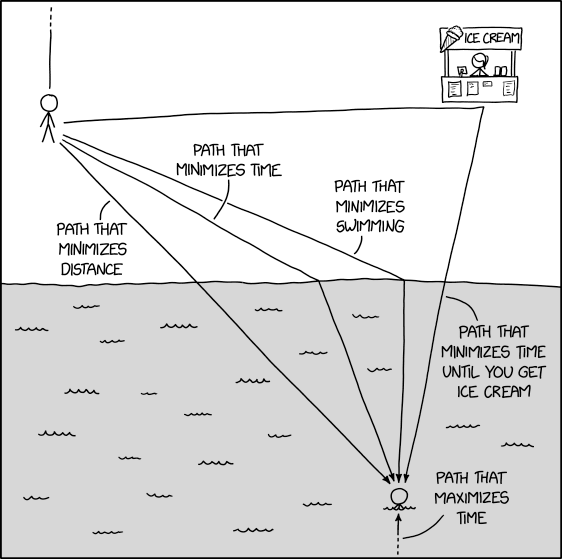
Path Minimization
Post Syndicated from xkcd.com original https://xkcd.com/2821/
The Device that Won WW2 – The Cavity Magnetron
Post Syndicated from Curious Droid original https://www.youtube.com/watch?v=CbTWzC86R4Y
The 6.5 kernel has been released
Post Syndicated from corbet original https://lwn.net/Articles/942876/
Linus has, as expected, released the 6.5
kernel.
I still have this nagging feeling that a lot of people are on
vacation and that things have been quiet partly due to that. But
this release has been going smoothly, so that’s probably just me
being paranoid. The biggest patches this last week were literally
just to our selftests.
Headline features in 6.5 include
faster booting on large x86 systems,
Arm Permission Indirection Extension
support,
Rust 1.68.2 support,
unaccepted memory handling,
“mount beneath” support for filesystems,
the cachestat() system call,
the ability to pass a pidfd via a SCM_CREDENTIALS control message,
scope-based resource management for
internal kernel code,
the deprecation of the SLAB allocator,
and more. See the LWN merge-window summaries
(part 1,
part 2) and the (in-progress)
KernelNewbies 6.5 page
for details.
Three stable kernels
Post Syndicated from corbet original https://lwn.net/Articles/942864/
The
6.1.48,
5.15.128, and
5.10.192
stable kernels have been released; each contains another set of important
fixes.
LIVE – It is TIME (w/special guests) – ShaveTheHead.com
Post Syndicated from digiblurDIY original https://www.youtube.com/watch?v=17Vm4FDpNfc
Take a Trip with The History Guy: Washington DC
Post Syndicated from The History Guy: History Deserves to Be Remembered original https://www.youtube.com/watch?v=CyfNjXpqbCk
NVIDIA L4 24GB Review The Versatile AI Inference Card
Post Syndicated from Patrick Kennedy original https://www.servethehome.com/nvidia-l4-review-the-versatile-ai-inference-card-pny/
In our NVIDIA L4 review, we see how this ultra-popular low-profile inference card performs and compares to the NVIDIA T4
The post NVIDIA L4 24GB Review The Versatile AI Inference Card appeared first on ServeTheHome.
Empiretech 180° Wide Camera Review | Better than Reolink Duo 2?
Post Syndicated from digiblurDIY original https://www.youtube.com/watch?v=_aq1MKbns4I
comely
Post Syndicated from Oglaf! -- Comics. Often dirty. original https://www.oglaf.com/comely/


Comic for 2023.08.26 – Literal
Post Syndicated from Explosm.net original https://explosm.net/comics/literal
New Cyanide and Happiness Comic
The GOP Debate: Trumpiness Without Trump
Post Syndicated from The Atlantic original https://www.youtube.com/watch?v=pCejEoPdreM
New QCT VMware Cloud Foundation Microsoft Azure HCI and Enterprise AI Solutions
Post Syndicated from John Lee original https://www.servethehome.com/new-qct-vmware-cloud-foundation-microsoft-azure-hci-and-enterprise-ai-solutions/
QCT has new VMware and Microsoft solutions for HCI and is leveraging its experience in hyper-scale AI to build enterprise AI solutions
The post New QCT VMware Cloud Foundation Microsoft Azure HCI and Enterprise AI Solutions appeared first on ServeTheHome.
This 1999 Digital Camera Uses Tiny Clik Disks! Agfa CL30
Post Syndicated from LGR original https://www.youtube.com/watch?v=RpNXb-6tahQ
Are two B&O A1 speakers more than twice as good as one?
Post Syndicated from Techmoan original https://www.youtube.com/watch?v=fYBEnowdvuw